Signposts to Annwn: Lore

Book.of.Taliesin.facsimile

This posts shares some of the lore associated with Annwn. Awen, the divine breath of inspiration, is seen to originate from Annwn. Also included are passages about initiation, death and rebirth, and the soul.

Awen

‘Let’s approach God who is
– according to the utterance of Talhaearn –
the true judge of the worth of the world,
the One who adjudged the qualities
of passionate song.
He with his miracle bestowed
immeasurable inspiration:
there are 140 ‘ogrfen’
in inspiration;
eight score
in each one.
In Annwfn he ranged the (divisions of inspiration),
in Annwfn he made them,
in Annwfn below the earth,
in the air above the earth.
There is one who knows
what sadness
is better than joy.
I know the set gradations
of inspiration when it flows;
(I know) about payments to a poet,
about propitious days,
about a joyful life,
about the aeons of the fortress,
about the ones like kings,
how long their dwelling places (shall last)…

I sing inspiration,
I bring it forth from the depth.
The connected river which flows (around the world):
I know its might,
I know how it ebbs,
I know how it flows,
I know how it courses,
I know how it retreats.
I know how many creatures
are under the sea;
I know the nature
of each one in its shoal;
how many divisions in a day,
how many days in a year…’
– The Hostile Confederacy, The Book of Taliesin, (Haycock transl.)

‘I entreat my Lord
that (I may) consider inspiration:
what brought forth (that) necessity
before Ceridfen
at the beginning, in the world
which was in need?’
– The Childhood Achievements of Taliesin, The Book of Taliesin, (Haycock transl.)

‘Where does inspiration flow to,
at midnight (and) mid-day?’
– I am the vitality, The Book of Taliesin, (Haycock transl.)

‘He (Urien) defended my song (emanating) from Ceridfen’s cauldron;
unrestrained is my tongue, a repository of inspiration.
That inspiration of poetry – my God created it
at the same time as fresh as fresh milk and dew and acorns…

I have three songs of consistent harmony
and they will be perpetuated by poets until Judgement.’
– The Chair of Taliesin, The Book of Taliesin, (Haycock transl.)

‘Here is the declamation of a brilliant poem
of immeasurable inspiration…

splendid (was it) when there emanated from the Sovereign/cauldron
the ‘ogyrwen’ of triune inspiration.’
– The Chair of Teyrnon, The Book of Taliesin, (Haycock transl.)

‘When the ‘Cadeiriau’ come to be judged
my own will be the best of them:
my song, and my cauldron, and my rules,
and my careful declamation, worthy of a chair in harmonious song.
I’m called a knowledgeable one in Don’s court,
I, and Euronwy, and Euron.’
– The Chair of Ceridwen, The Book of Taliesin, (Haycock transl.)

Initiation

Sixty Years of Solitude

‘For sixty years
I endured solitude
in the water gathered in a band (around the earth),
(and) in the lands of the world.
I had a hundred servants,
(and) a hundred dominions after that.’
– The Hostile Confederacy, The Book of Taliesin, (Haycock transl.)

Death and Rebirth

‘A hen got hold of me –
a red-clawed one, a crested enemy;
I spent nine nights
residing in her womb.
I was matured,
I was drink set before a ruler,
I was dead, I was alive,
a stick went into me;
I was on the lees,
separated from it, I was whole;
and the drinking vessel stiffened resolve,
(for) the red-clawed one imbued me with passion.’
– The Hostile Confederacy, The Book of Taliesin, (Haycock transl.)

The Soul

‘Do you know what you are
when you are asleep:
a body or a soul
or a pale mysterious thing?…

The lamented soul –
who saw it, who recognises it?
I am amazed in books
that they do not know for certain
what the soul’s dwelling is,
(and) what its limbs look like;
from which region flow
the great wind and the great stream
in dire combat
endangering the sinner.’
– The Childhood Achievements of Taliesin, The Book of Taliesin, (Haycock transl.)

‘I praise my Father,
My God, my sustainer,
who added, through my head,
a soul into my design.’
– Song of the Great World, The Book of Taliesin, (Haycock transl.)

Kingfisher in Flight

For Brian Taylor

An unexpected kingfisher.

I might not have been there
in the hide if it wasn’t for you,
your teachings on the agency of birds,
the transformations of souls,
auspices of sapphire-blue.

The sad news was unexpected too.

It took me back to our brief meetings:
how you always wore binoculars,
showed me my first goosander.

I thought I’d never see a kingfisher
let alone a halcyon wonder so close
whistling from branch to branch.

You’d have called it ‘a showing’.

I e-mailed you to share the news.

Another e-mail flash from the blue
jolts me back to your careful records
on alcedo atthis and ‘the best views’.

You wrote of death with such beauty
citing Ovid’s resurrection of Alcyone:

a kingfisher in flight – ‘a departing light’.

Kingfisher in Flight


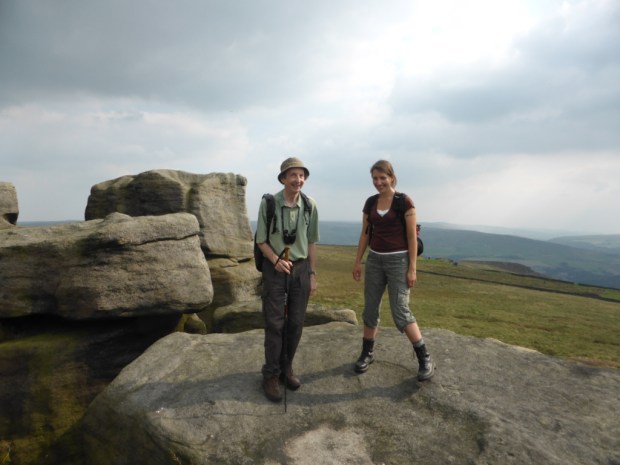
Brian Taylor, a dedicated animist and the author of Animist Jottings, passed away on the 13th of February. I was particularly moved by Brian’s writings on kingfishers and admired his advocation of an animism deeply rooted in the natural world that had room for magical encounters and the otherworldly too. Although we only met in person a few times (most memorably when he came to Penwortham and pointed out a goosander on the Ribble and when we visited Bridestones and marvelled at the expressions of the rocks and the flying ants) we shared many fruitful conversations in the blogosphere and through e-mail. Brian was one of the wisest, most caring, thoughtful, and articulate people I have ever met. He will be missed.

Picture with Brian Taylor Bridestones 5th September 2014

Brian Taylor and myself at Bridestones, September 5th, 2014

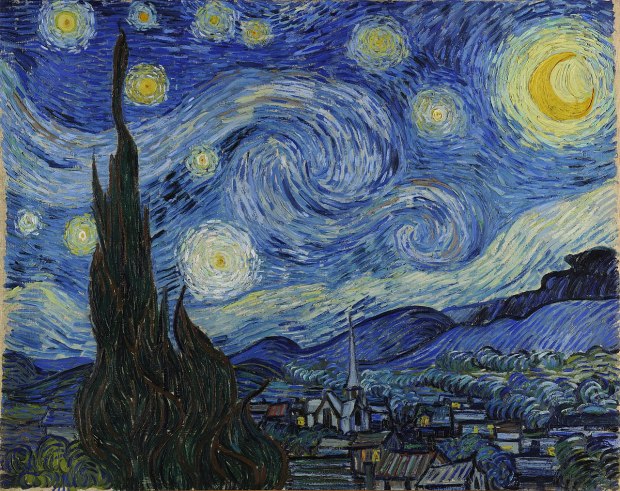
In Van Gogh’s Starry Night

I can picture you
with many-headed horses
many-headed hounds

amongst stars unswung
swinging cypress

hear your laughter
in the Mistral ‘the idiot wind’.

But you are not in
Saint-Rémy-de-Provence.

You are here on Castle Hill
swaying beech trees
where St Walburge’s
cannot outspire the Pennines.

Why the stars so bright and loud?
The processions of mist walking on the summits?
The long lapping tongue of a death-hound?

You are silent
but from a small room
in a distant asylum Van Gogh speaks:

“we take death to reach a star”.

1280px-Van_Gogh_-_Starry_Night_-_Google_Art_Project


Hoddom and Brydekirk: The Fire of the Gods Endures

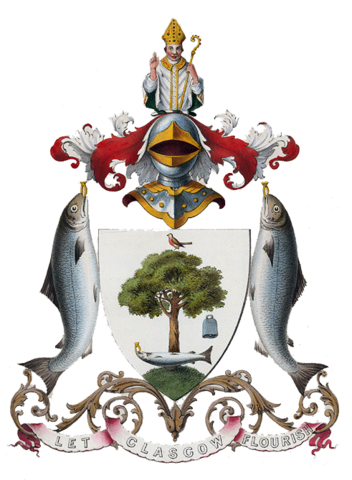
St Kentigern on Glasgow Coat of Arms, Wikipedia Commons

In Jocelyn’s The Life of St Kentigern there is a story about the saint’s recall from Wales to the Old North by Glasgow’s ruler, Rhydderch Hael. Following an angelic vision, Kentigern sets out with 665 disciples and arrives in Hoddom where he is greeted by a multitude of people.

Drawing a cross and invoking the Holy Trinity, Kentigern orders anyone against the word of God to depart. This results in ‘a vast multitude of skeleton-like creatures, horrible in form and aspect’ departing from the assemblage and fleeing from sight.

Reassuring the terrified crowd Kentigern ‘lays bare’ what they believe in. He condemns their idols to the fire and tells them their principal deity ‘Woden’ from whom they claim descent is nothing more than a mortal man of a pagan sect whose body is ‘loose in the dust’ whilst his soul ‘endures the eternal fire’ in the underworld.

As Kentigern preaches faith in Jesus Christ the flat plain of ‘Hodelm’ rises into a hill which remains to this day. The people ‘renounce Satan’ and are washed in the waters of baptism.

This foundation legend explains the association of the site of the church and the graveyard beside the river Annan across from Woodcock Air (the hill) at Hoddom with St Kentigern.

Woodcock Air Hill

The Life of St Kentigern was commissioned by Jocelyn, Bishop of Glasgow, and written by Jocelyn, a monk of Furness, in the 12th century. As a literary hagiography it was clearly designed to promote the life of Kentigern (who lived in the 6th century) and vilify paganism. As a historical document it should be approached with caution, particularly in light of the anachronism concerning Woden.

Whilst there is archaeological evidence of a Northumbrian monastery based around St Kentigern’s church at Hoddom it was not founded until the 8th century. (This is evidenced by an 8th century letter sent by Alcuin to Wolfhard, Abbott of Hodda Helm). The Anglo-Saxons did not arrive until long after Kentigern died. It seems Jocelyn wove later tales concerning the conversion of Woden’s worshippers into the text.

This leaves us with the question of who the people of Hoddom venerated prior to Kentigern’s arrival. The existence of a local cult is evidenced by a Roman altar stone found in the wall of the church at Hoddom Cross and built into the porch in 1817. Unfortunately when it was found the sides could not be seen and the ‘mouldings of the capital and base’ had been ‘dressed off’. There are no clues who it was dedicated to.

However the surrounding area echoes with pagan memories: the place-names Brydekirk and Lochmaben; an altar to Vitris and a ram’s head at Netherby; the story of Gwenddolau, the last pagan Brythonic king, whose soul was gathered by Gwyn ap Nudd after he was killed at the Battle of Arfderydd. Myrddin Wyllt’s flight from Arfderydd in battle-madness to Celyddon.

Intrigued and troubled by the story of Kentigern’s conversion of the people of Hoddom, wondering whether between the lines and beneath the Hollywood-style Biblical pyrotechnics any ‘truths’ (or at least personal gnoses) about their pagan religion may be intuited from the land, I returned to the area North of the Wall.

Walking from Ecclefechan to Hoddom, the first thing that struck me was the teeming of nature in the Scottish villages and fields. Flocks of spotted starlings on the roofs and telephone wires. Droves of sparrows flitting in and out of the hedgerows. The un-mowed roadsides were alive with flowers and every flower was covered with bees. Slick black slugs wandered through long grasses. I felt an unusual liberty in ‘the right to roam’.

Hoddom CrossMy first stop was at the church at Hoddom Cross. Roofless and derelict due to a fire, ivy climbed its walls and mausoleums. Ferns and wildflowers pushed through the railings to adorn older graves marked by sandstone gravestones. Newer graves with shiny porcelain headstones adorned with freshly wrapped bouquets glimmered in the background.

Something birch-white caught my eye. Going to investigate I found myself blinking in disbelief. In a Christian graveyard a couple of miles from any village I was staring at what to all appearances was a carving of a white dog with a purposively painted red nose. Dormach red-nose! I thought immediately of Gwyn ap Nudd’s famous hound who accompanies him as he guides the dead to the otherworld.

Admittedly it had antler-like twigs for ears and might have been a representation of Rudolph the red-nosed reindeer. But why carve it white from birch? It looked far more like a dog and a hound of Annwn at that. Too strange a find in a graveyard to be pure coincidence when I was tracing the deity(s) associated with the Roman altar (which I did not see).

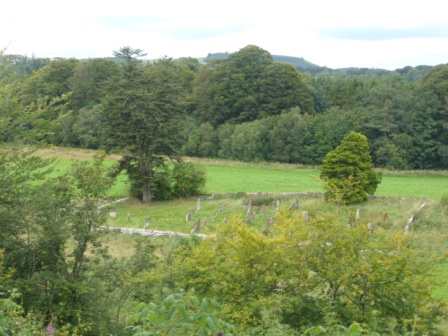
River AnnanAfter visiting the ‘new’ church I walked to St Kentigern’s graveyard at Hoddom across the Annan from Woodcock Air. Watched over by a tall fir (or pine?) tree it was blissfully overgrown with ferns, yarrow, willowherb, bee-humming knapweed, decorated by harebells.

St Kentigern's Graveyard

Wandering amongst the gravestones I noticed carved images of skulls and crossbones and remarkable winged souls which a notice recorded as ’18th century folk art’. So here are Kentigern’s skeletons, I thought, unbanished. Symbols of death and our transition to the otherworld living on through years of Christian rule.

From the vantage point on Woodcock Air as I looked down on St Kentigern’s graveyard the sandstone gravestones shifted into brown-clad people. I gained a sense of the slowness of lives decanted by prayer, steady seasonal work in the fields, the slow turning of cart wheels, the satisfaction of self-subsistency and knowing you would die and be buried in your land close to your community.

St Kentigern's Graveyard from Woodcock AirAnd beneath the Northumbrian monastery did I gain a sense of St Kentigern’s church? The scene of conversion? The deity(s) to whom the ‘idols’ were dedicated? The ‘truth’ felt buried deep. Momentarily seeing the raised area where the church stood as a burial mound I thought back to Jocelyn’s words about ‘Woden’ being a mortal man of a pagan sect whose body is in the dust whilst his soul ‘endures the eternal fire’ in the underworld.

Could these words be read obliquitously to refer to a deified ancestor or ancestral deity believed to live on in the brightness of the world beyond this world? Perhaps even to Gwyn who as a psychopomp and leader of ‘the Wild Hunt’ is Woden’s closest Brythonic equivalent?

BrydekirkI also had the opportunity to visit Brydekirk. Intriguingly Ronald Cunliffe Shawe claims Gwenddolau worshipped ‘Woden’ and ‘a fire goddess’. His reference leads to the passage about Woden in The Life of St Kentigern. I can’t find anything mentioning a fire goddess. However Gwenddolau’s worship of such a deity would make perfect sense if Brydekirk is named after Bride or Brigid. Brigid was later venerated as St Brigid and her priestesses tended an eternal flame.

At the church I was told by one of the parishioners it was indeed named after St Brigid of Ireland. I also learnt St Bryde’s Well was a natural spring and was gifted with an indispensable description of its location.

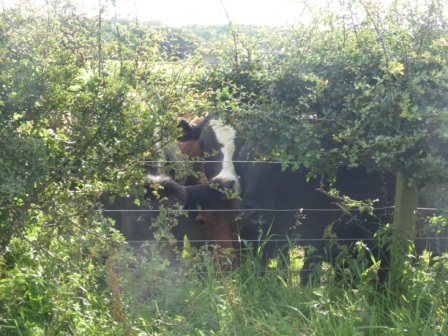
My walk to the well down the Annan then alongside fields was accompanied by a curious herd of cows who followed peeping out through gaps in the hedge. Their strange behaviour led me to recall the story of how St Brigid was raised by a white cow with red ears: another otherworldly animal.

CowsThe area surrounding St Bryde’s Well was hopelessly overgrown with brambles, nettles and Himalayan Balsam. With the guidance of the parishioners I still couldn’t find it. Ready to give up I saw what looked like a pink veil. I first assumed it was a votive offering marking the spring. When I got closer I realised it was a balloon strung with pale gauze. Another extraordinary marker that proved to be no mere coincidence.

Turning round, I noticed a water dispenser and beyond heard running water. Seeing a rivulet at the bottom of a steep bank running into the Annan, I followed its course to find a small stream leading to the natural spring pouring from amongst mosses and ferns into an orangey circular basin: St Bryde’s Well.

Across the river I also visited the remains of St Bryde’s tower. All I found was a single flight of steps climbing upward into the fire of the sun. Could this has have been a stairway walked by Brigid’s priestesses who maintained her eternal flame?

St Bryde's TowerI returned to Penwortham with no clear answers about how or whether St Kentigern converted the people of Hoddom or what they experienced and believed. Such ‘truths’ can only be conjectural and are always determined by our questions, assumptions and  beliefs.

What I gained was a deeper understanding of how our physical and literary landscapes interweave. How sign and signified lead the dance of a journey which is led by the gods who lead us to places where all distinctions break down in the numinosity of their presence.

At Hoddom and Brydekirk I met a myriad inhabitants of a northern land and I met Gwyn and Bride (who I know here in Lancashire as Brigantia) in new ways. I learnt that within the land and its stories and even in the most depredatory of Christian texts the fire of the gods endures.

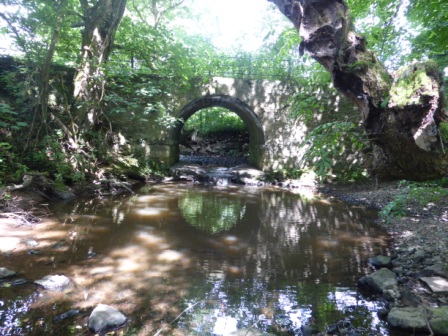
Bezza Bridge

Pink of willowherb
and white of meadowsweet

line the road to Bezza Brook.
Where you cross at Bezza Bridge

step down, step down, step down
in the incantation of the strange-light

hear the brook’s flow see the spirits stream
on the walls of the tunnel of life.

Dwell not on the tunnel of death
lest you hear the Skriker skrike.

Do not look for a rag on the wind
or an eye in the midst of the strange-light.

Bezza Bridge

Gwyn ap Nudd and Gwallog ap Lleenog: One Brother Dies and the Other Lives On

In The Conversation of Gwyn ap Nudd and Gwyddno Garanhir, Gwyn states his presence at the death of Gwallog ap Lleenog ‘From a long line of princes / Grief of the Saxons’. Gwallog is a descendant of Gwyr y Gogledd ‘The Men of the North’. His descent on his father’s side is recorded in the Harleian Genealogies. ‘[G]uallauc map Laenauc map Masguic clop map Ceneu map Coyl hen.’ This places him amongst the lineage of Coel Hen (Old King Cole).

More importantly within the context of my research on Gwyn ap Nudd and the Old North, Gwyn, Gwallog and Caradog are mentioned as half-brothers through their shared descent on the maternal side from Tywanwedd in Descent of the Saints. Tywanwedd is the daughter of Amlawdd Wledig, a Welsh prince who may have ruled on the border of Herefordshire.

These three brothers appear again in an entry in Peniarth MS 132: ‘Gwyn ap Nudd greiddyei (?) ap Lludd. He went to Llew ap Llyminod Angel. He went between sky and air. He was brother to Caradog Freichfras and Gwallog ap Lleenog. He and they had the same mother.’

Between Sky and Air

Between Sky and Air

In Geraint son of Erbin Caradog, Gwallog, Gwalchmai and Owain son of Nudd appear alongside Arthur as ‘guarantors’ of Edern son of Nudd after he is mortally wounded by Geraint. Caradog and Edern appear together as Arthur’s ‘counsellors’ in The Dream of Rhonabwy. This brings to light further familial links.

It is of great interest to note that if Tywanwedd is Gwyn’s mother, this places him in the same lineage as Arthur (Arthur’s mother was Eigr daughter of Amlawdd) and Culhwch (Culhwch’s mother was Goleuddydd, daughter of Amlawdd): the three are first cousins (!).

However, Peter Bartrum argues due to Gwyn, Gwallog and Caradog’s ‘disparate nature’ in ‘character, place and time’ it was more likely their mother was a fairy like Gwyn. Considering Gwyn is a god whose worship as Vindos / Vindoroicos / Vindonnus can be traced back to the Romano-British period it seems clear she must also have been divine: a goddess who, like Gwyn, may later have been perceived as a fairy.

As within Brythonic mythology there is a long tradition of relations between deities and mortals, often bearing offspring (for example Owain Rheged’s parents were Urien Rheged and the goddess Modron, mother of Mabon) it seems possible the story behind Gwallog’s birth was that his father, Lleenog, slept with a fairy woman. Perhaps one of her guises was Tywanwedd, and as Tywanwedd she seduced Lleenog?

The story of Gwallog’s birth from a fairy woman provides some fascinating insights into the continuity of pagan beliefs within a northern British society that was nominally Christian. It also supports my growing intuition that Gwyn, his father (and now his mother) were viewed as ancestral deities by the Britons of the Old North, Wales and beyond.

***

Gwallog’s kingdom is traditionally Elmet. This is derived from Ifor Williams’ translation of lines in The Song of Gwallawg ap Lleenawg where Gwallog is named ‘a judge over Elmet’. Bede speaks of ‘silva elmete’ (‘the forest of Elmet’) saying ‘subsequent kings made a house for themselves in the district, which is called Loidis.’ Loidis is Leeds and place-name evidence suggests Elmet covered West Yorkshire.

Further evidence Gwallog ruled Elmet comes from Nennius’ History of the Britons. He tells of how Edwin of Northumbria ‘occupied Elmet and expelled Certic, king of that country’. Certic is usually identified as Ceredig, Gwallog’s son.

Gwallog’s renown as a war-leader is evidenced by the Triads, where he is named as one of three ‘Pillars of Battle’, ‘Bull Protectors’ and ‘Battle-Leaders’ of Britain. According to Nennius he was amongst four kings; Urien, Rhydderch the Old, Gwallog and Morcant, who played a leading role in defending the north against the Bernician Angles. Whilst some scholars assume Nennius refers to an alliance between the four kings, Tim Clarkson believes he refers to separate campaigns and these northern rulers were as likely to have been enemies as allies.

Whilst the existence of an alliance is impossible to prove or disprove we know Morcant ordered Urien’s assassination at Aber Lleu (opposite Lindisfarne) and Gwallog fought either with or against the sons of Urien Rheged ‘Gwallach, horseman of battle, planned / to make battle in Erechwydd (Rheged) / against the attack of Elphin’ following Urien’s death.

In two poems attributed to Taliesin we find further evidence Gwallog fought just as ferociously against other Brythonic war-lords as against the Angles and Saxons. In The Song of Llenawg, Taliesin lists battles in Agathes, Bretrwyn, Aeron (a river in Ceredigion), Arddunion, the wood of Beit, Gwensteri and the marsh of Terra. He also mentions a cattle raid and conflict ‘At the end of the wood of Oleddyfein, / From which there will be pierced corpses, / And ravens wandering about.’

In The Song of Gwallog ap Lleenawg, Taliesin says Gwallog ‘rejected uniform ranks of the rulers, / Of the hosts of Rhun and Nudd and Nwython’. This shows he battled against other well-known northern rulers. He is finally described as ‘king of the kings of tranquil aspect’ over Caer Clud (Dumbarton, capital of the kingdom of Strathcylde), Caer Caradawg (the location of one of three ‘perpetual harmonies’ of the Isle of Britain) and the land of Penprys (Powys?). It seems he subjugated a number of other kings.

In The Black Book of Carmarthen we find an enigmatic poem called A Song on Gwallawg ab Lleenawg which refers to how Gwallog lost an eye in his youth. He is said to have lost it to an ‘accursed tree’ which appears thrice: as ‘black’, ‘white’ then ‘green’. In another variant he loses it to a ‘white goose’.

That Gwallog and his battles are so well remembered suggests this fearsome one-eyed warrior was known across Britain during his time and centuries later. Whilst his exploits are celebrated by the Bards I can only imagine his opponents and the ordinary people must have lived in dread of being caught up in the conflicts or ordered to fight.

Sadly we have no records of how anybody outside the ruling classes viewed Gwallog. However in the poem about how he lost his eye we may find reminiscences of a folk tradition. One can imagine gatherings around the fire whereby beery speculations led to a plethora of ‘how Gwallog lost his eye’ songs.

***

The only record I have been able to find which may relate how Gwallog met his end is in Geoffrey of Monmouth’s The History of the Kings of Britain. He refers to Guallauc of Salisbury who dies fighting against the Romans in the Battle of Saussy (France). Whether this is ‘true’ and whether Gwallog and Guallauc are the same person remains uncertain.

In The Conversation of Gwyn ap Nudd and Gwyddno Garanhir, Gwyn tells Gwyddno he was present at Gwallog’s death. Within the context of Gwyn’s rulership of Annwn and role as a psychopomp, I assume he appeared to guide him to the land of the dead. The knowledge that Gwyn and Gwallog were half-brothers adds a whole new dimension to this scene and to their relationship. Gwyn was not only acting as a guide of the dead to a celebrated warrior but to his kinsman.

Gwyn also mentions his presence at Llachau’s death. Llachau is Arthur’s son. If Tywanwedd was Gwyn’s mother, this makes them cousins once removed. Again he gathers the soul of a relative.

At the end of The Conversation, Gwyn laments that he is alive whilst the warriors of Prydain (Britain) are slain and in their graves. Knowledge of Gwyn’s ancestral connections with these men provides a deeper understanding of why he chooses to recite their names to Gwyddno and particularly grieves their fall.

Because Gwyn is a god of Annwn whose role is to guide and contain its spirits until the world’s end, he is fated to witness the deaths of his mortal and semi-mortal kindred as he lives on.

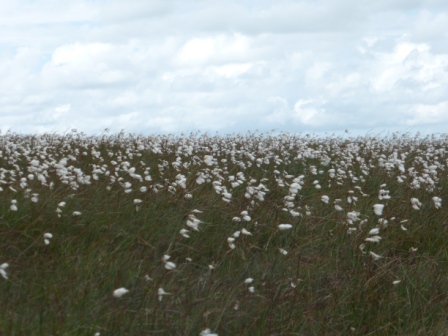
Cotton Grass, Winter HillSOURCES

Bartrum, Peter A Welsh Classical Dictionary: People in History and Legend up to about A.D. 1000 (National Library of Wales, 1993)
Bromwich, Rachel (ed) The Triads of the Island of Britain (University of Wales Press, 2014)
Clarkson, Tim The Men of the North: The Britons of Southern Scotland (John Donald, 2010)
Evans, J. Gwengobryn The Black Book of Carmarthen (Lightning Source UK Lmtd, 1907)
Heron (transl) Gwyn ap Nudd and Gwyddno Garanhir https://barddos.wordpress.com/2015/02/08/gwyn-ap-nudd-and-gwyddno-garanhir/
Monmouth, Geoffrey of The History of the Kings of Britain (Penguin Classic, 1973)
Pennar, Meirion (transl.) The Black Book of Carmarthen (Llanerch Enterprises, 1989)
Skene, William F. The Four Ancient Books of Wales (Forgotten Books 2007)

She who was jealous of flowers

How jealous I am fragile flowers
of how you only arrive
once a year
how you are always beautiful
vibrant coloured
how you do not have to labour
on and on pink-fleshed at the modern wheel.

How ignorant you are of everything beneath you
of the effortfulness of soil
worms with their moon rakes
bent double like miners in midnight toil
the dung beetle rolling his ball
to the edge of the world.
Look down and see beauty costs the earth.
It is made of broken snail shells.

But you pretty flowers are not labourers.

Have you ever tried to sprout from a cold hard bulb?
Endured the underworld’s permafrost?
Seen miniscules of worms die?
Do you know the origin of minerals or miracles?

We are told they come from God.

They come from years and the bones of dinosaurs.
Do you know how many continents
it takes to make a flower?
How many extinctions?
How the rumbling of plague carts
served us before you were here?
How like you we come from many deaths?

I did not know you could talk or how
we have grown together.
I am amazed.
My widening eyes
are brimming with forbidden knowledge.

Then be beautiful in your petals for us
tread lightly on the dead
for these are short hours
of spring sun
before we cast our bodies
on the ground and are together again.

Gwyn ap Nudd and the Spirits of Annwn: Remembering the Underworld Gods

I recently came across an article through the Caer Feddwyd Forum (1) called ‘The Underworld Gods’ by medieval scholar, Will Parker. It brought to my awareness the existence of an inscription in Chamalieres in central France, which took the form of a prayer or invocation addressed to an entity or group of entities known in Ancient Gaul as the andedion, ‘the Under-world God(s)’ or ‘Infernal One(s)’ (2).

Parker links the andedion to the Irish andee ‘non-gods’ and suggests a similar group of deities would have been worshipped in Iron Age Britain. Through etymological links between the ‘elements Clt. dio(n) (Ir. dé) ‘god(s)’ and ‘the suffix ande-/an-‘ he connects them to Annwn ‘not world’, Britain’s indigenous otherworld or underworld. Parker goes on to identify the andedion and andee with the spirits of Annwn and their ruler, Gwyn ap Nudd.

This is of interest to me because Gwyn is my patron god. Parker’s insights make it possible to trace a trajectory from Iron Age beliefs concerning underworld gods, through Gwyn’s appearances in medieval literature and later folklore to those who worship him today.

Gwyn ap Nudd ‘White Son of Mist’ is a Brythonic deity. His veneration dates back, at least, to the Iron Age, where he appears as Vindonnus ‘White or Clear Light,’ in a trio of Gallo-Brythonic inscriptions in Essarois. Here he is equated with Apollo, another hunter deity (3). It is likely he was worshipped across Britain as Vindos ‘White’ (4). It has also been conjectured that Gwyn and his hunting dog, Dormarth ‘Death’s Door’ occupied the astrological positions of Orion and Sirius to the ancient Britons.

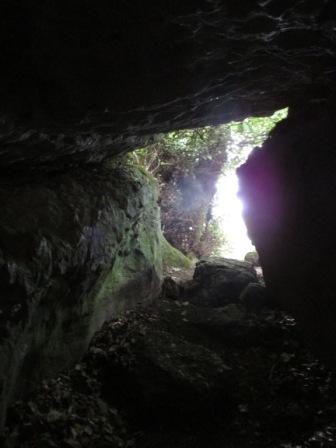
Cave, SilverdaleParker suggests Late Bronze Age ‘ritual shafts’ and ‘offering pits’ containing depositions including human and animal bones, grain, pottery and metalwork express a ‘quid-pro-quo’ relationship between the ancient Britons and the underworld gods. If he is correct, it is possible that Vindos / Gwyn, Dormarth and other kindred spirits were involved in these rites.

Gwyn’s first literary appearances are in medieval Welsh texts; ‘How Culhwch Won Olwen’ (11th C) in The Mabinogion and ‘The Dialogue of Gwyddno Garanhir and Gwyn ap Nudd’ (13th C) in The Four Ancient Books of Wales. These texts have roots in an older, oral tradition and contain fragments of tales from across Britain that predate Christianity. A significant number of these, including two featuring Gwyn, are from ‘The Old North’ (5). This is important to me because I connect with Gwyn in Lancashire.

Parker argues that superstitions about the underworld gods carry over into The Mabinogion. This is evidenced in the disappearance of livestock, children and crops. Pwyll’s encounter with Arawn, a King of Annwn, is the catalyst for the unfolding drama of the first four Mabinogi. Parker says these stories show the spirits of Annwn could not ‘be simply dismissed or ignored. Instead, a complex narrative had to be constructed in which, through a series of symbolic ritual manoeuvres, their power was drawn out, confronted and finally neutralised.’ The attempts of medieval scholars to disempower these deities can be seen at work in the development of Gwyn’s mythology.

In ‘The Dialogue of Gwyddno Garanhir and Gwyn ap Nudd,’ (6) Gwyn is presented as a divine warrior returning from battle to the Tawe near the vale of Neath. Gwyddno, ruler of Cantre’r Gwaelod, speaks of and addresses him with reverence and respect. ‘Bull of conflict was he, active in dispersing an arrayed army, / The ruler of hosts, indisposed to anger, / Blameless and pure was his conduct in protecting life.’ Other epithets Gwyddno uses include ‘hope of armies’ and ‘hero of hosts.’ ‘Host’ may refer to the spirits of Annwn.

Gwyn introduces himself as ‘Gwyn, the son of Nud, / The lover of Creurdilad, the daughter of Lud.’ He names his horse as ‘the torment of battle’ and refers to Dormarth as ‘truly the best of dogs,’ ‘handsome,’ ‘round bodied’ and ‘ruddy nosed.’ References to his possession of a ‘polished ring’ and ‘golden saddle’ are also suggestive of his status.

The title ‘Bull of Conflict’ refers to Gwyn’s role as a psychopomp. At the end of the poem he describes his travels across Britain gathering the souls of fallen soldiers. He appears to be berating this task. ‘I have been where the soldiers of Prydain were slain, / From the East to the North; / I am alive, they in their graves! / I have been where the soldiers of Prydain were slain / From the East to the South / I am alive, they in death!’

This poem contains important clues about Gwyn’s identity as a divine warrior and huntsman, whose role was to gather the souls of the dead and take them to Annwn.

In ‘How Culhwch Won Olwen’ in The Mabinogion, Gwyn is depicted as a huntsman and advisor to King Arthur. His place in Arthur’s court list and apparent subjection to both Arthur and God may be read as attempts by medieval scholars’ to explain and downgrade his position.

That ‘Twrch Trwyth will not be hunted until Gwyn son of Nudd is found’ (7) hints at his role as leader of the hunt, and knowledge of otherworldly beings. The Twrch was a king reputedly turned into a swine by God. When Gwyn does not reveal his location it is possible he is defending his own.

The advice of Gwyn and Gwythyr ap Greidol ‘Victor Son of Scorcher’ is also needed by Arthur to find Pennant Gofid in the ‘uplands of hell,’ which Evans and Bromwich say is ‘clearly situated in North Britain’ (8). When they reach this location, Gwyn and Gwythyr advise Arthur in his defeat of the ‘The Hag of Pennant Gofid,’ another otherworldly entity. The parcity of their advice, which leads to several failed attempts by Arthur’s men before the Christian King is forced to step in to slay her, may also suggest that Gwyn and Gwythyr are acting as tricksters.

A pair of lines fundamental to understanding Gwyn’s mythos, and which continue to intrigue and perplex me, are the following; ‘God has put the spirit of the demons of Annwfn in him, lest the world be destroyed. He will not be spared from there’ (9).

Taken literally, this seems to mean that at some point during the period of Christianisation God put the spirit of the demons of Annwn ‘in’ Gwyn’s person to prevent the world’s destruction. Or it may mean that he granted Gwyn rulership of them for this purpose. However, it is probable that the agency of God was brought in as a cover to excuse the prevalent belief in the existence of these spirits and their ruler.

Even if we assume God’s agency is a cover for existing beliefs, the notion that Gwyn somehow contains ‘the spirit of the demons of Annwn’ is a fascinating one. In a conversation via e-mail, Heron (10) told me the word ‘spirit,’ in Welsh, is ‘aryal,’ which can mean ‘ferocity,’ ‘essence’ or ‘nature’. He referred me to Evans and Bromwich, who say ‘Gwyn’s partaking of the ‘nature of the devils of Annwfn’ indicates a recognition on the part of the redactor of the tale that Gwyn ap Nudd belonged to a sinister and forbidden mythology’ (11). Within this mythology he may already be seen to embody the nature of these entities, or to hold power over them.

That the destruction of the world is at stake suggests Gwyn’s role was extremely significant. If it is assumed this notion has older roots, some of the offerings of the ancient Britons may be explained as attempts to placate these spirits and their ruler due to their destructive capacity. It is also possible Gwyn was invoked as the only being who could hold them in check.

Fears and superstitions surrounding Gwyn and the spirits of Annwn may lie behind the story of his abduction of Creiddylad. After Creiddylad, who is both Gwyn’s lover and sister, elopes with Gwythyr, Gwyn seizes her back. It might be assumed he takes her to Annwn, and that this suggests an underlying fear of being abducted by Gwyn and his forces.

Gwythyr amasses his armies and attacks Gwyn. Gwyn triumphs and captures a number of Gwythyr’s allies, who are mainly rulers of the Old North. During their captivity Gwyn slaughters Nwython, cuts out his heart and feeds it to his son, Cyledr, who goes mad. This could be read as a clear example of Gwyn’s ferocity and hints at existing superstitions about what goes on in Annwn.

Evans and Bromwich say the concentration of the names of people Gwyn kidnaps suggest ‘that north Britain was the ultimate place of origin for the Creiddylad episode, and that this incident was one of the surviving fragments of tradition emanating from there’ (12). It is therefore likely it originates in earlier beliefs held about Gwyn and his host by the Northern Britons.

Arthur eventually comes North to Gwythyr’s aid and frees his noblemen. Afterward he makes peace between Gwyn and Gwythyr by placing a dihenydd ‘fate’ on them. This dictates that they must fight for Creiddylad’s hand every Calan Mai ‘May Day’. An added condition, which seems particularly unfair, is that Creiddylad must remain in her father’s house, and no matter who wins neither can take her until Judgement Day. It is likely Arthur’s agency was brought in to explain an earlier myth, which was already prevalent in the Old North.

Whilst, on one level, this myth may be about fears of abduction to the underworld, it is more frequently interpreted as a seasonal drama comparable with Hades’ capture of Persephone. In this reading, Creiddylad is a maiden goddess who embodies the powers of spring and fertility. Creiddylad’s abduction by Gwyn may explain the failure of these powers at Calan Gaeaf, the first day of winter. Gwythyr and Arthur’s rescue of her at Calan Mai, the first day of summer, may explain their resurgence.
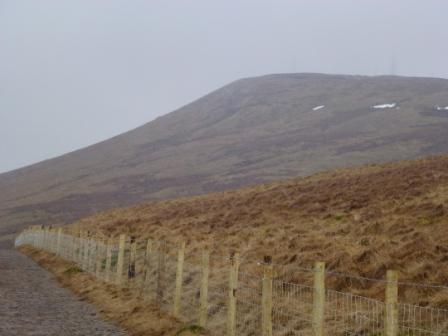
Winter Hill

Winter Hill

Gwyn is also seen as the Winter King. It is possible his white, shining qualities relate to snow and cold, associations which could date back to the Ice Age. Elen Sentier links Gwyn with the reindeer goddess Elen of the Ways (13) and the Boreal forest. He may also be connected with the North wind. The 14th C Welsh poet Dafydd ap Gwilim refers to ‘Tylwyth Gwyn, talaith y gwynt’ ‘the family of Gwyn, the province of the wind’ (14). The pervasiveness of a myth featuring Gwyn in Northern Britain could have a basis in its harsh winters.

In a later text, The Life of St Collen (14th C), Gwyn is referred to as ‘the King of Annwn and the Fairies’ and is supposedly banished by the saint from Glastonbury Tor (15). The transition from belief in Gwyn as a King of Annwn to King of the ‘Tylwyth Teg’ or ‘Fair Folk’ is a significant one. The original natures of Gwyn and the spirits of Annwn are covered over by their reduction to diminutive form. However, hints at their mythos can still be found in the majority of folktales.

Gwyn retains his status as leader of the Wild Hunt in the folklore of Wales and Somerset. There he is seen to appear on horse back with a pack of white, red-eared hounds, riding out on Nos Calan Gaeaf and through the winter months, chasing down the souls of the dead. To hear his hounds is an omen of death. The other riders are seen often seen as captive souls and may represent the spirits of Annwn.

In the North West of England, however, the hunt is assigned either to the Norse god Odin, or to Christian angels. In Cumbria it is Michael, and in Lancashire and Yorkshire Gabriel is said to lead a pack of black, red-eyed dogs, the Gabriel Ratchetts.

Coincidentally, Preston born writer Francis Thompson is famous for a poem called ‘The Hound of Heaven.’ Anybody who has felt like Gwyn’s hounds are on their tail might find these lines hauntingly familiar; ‘I fled Him, down the nights and down the days; / I fled Him, down the arches of the years; / I fled Him, down the labyrinthine ways / Of my own mind; and in the mist of tears / I hid from him, and under running laughter.’ (16)

More recently, Gwyn’s significance as an ancient god has been attested by contemporary scholars such as Geoffrey Ashe, in King Arthur’s Avalon (2007) and Nicholas R. Mann in The Isle of Avalon (1996) and Glastonbury Tor (2012). He is also the subject of a full length book called Gwyn: Ancient God of Glastonbury and Key to the Glastonbury Zodiac (2007) by Yuri Leitch.

This increase in interest suggests we are approaching a time when Gwyn and the spirits of Annwn are taken seriously as Brythonic deities again. However, the main focus of these books is Gwyn’s role at Glastonbury, with only a small mention of his place in Wales and other areas of Britain. Disappointingly there is no mention of Gwyn’s activities in the North. In this respect I have only my own experiences and conjectures to go on.

Fairy Lane

Fairy Lane

I first met Gwyn on Fairy Lane in my hometown of Penwortham, where he challenged me to journey with him to Annwn. Since then I have worked with him as a guide to the otherside of my local landscape and its hidden myths. His interest in my locality surprised me at first. However, it seems less surprising when looked at in the context of his role as an ancient underworld god of Britain, particularly in relation to the history and folklore surrounding this site.

Penwortham has been inhabited since 4000BC. The Riversway Dockfinds, a collection of animal bones, 30 human skulls, two dug out canoes and the remains of a timber structure suggest the existence of a lake village on Penwortham Marsh. Nearby is Castle Hill, a point of military and religious importance. There is a church dedicated to St Mary on the summit of Castle Hill, which means it was likely to have been a pre-Christian sacred site.

That the church is dedicated to St Mary and she was also the patron saint of a healing well at the foot of Castle Hill suggest the presence of an earlier female deity with healing powers, who has been Christianised as Mary. Three human skulls found in the wall of the church (17), which may have served an apotraic function suggest superstitious beliefs in chthonic spirits were also once popular but not openly acknowledged.

The survival of the legend of Penwortham Fairy Funeral attests to these superstitions. In the earliest version in Bowker’s Goblin Tales of Lancashire (1878), it is set on Church Avenue on Castle Hill. Two men walking home to Longton encounter a procession of fairies carrying a coffin. Robin, one of the men, looks into the coffin and sees his own miniature corpse. Frightened by the sight, they follow the fairies into St Mary’s graveyard. Robin attempts to prevent the burial by reaching out to grab the leader of the fairies. The procession vanishes and Robin, driven mad, topples to his death from a haystack a couple of months later (18). In later versions, this story takes place on Fairy Lane, which runs through Penwortham Wood at the foot of Castle Hill.

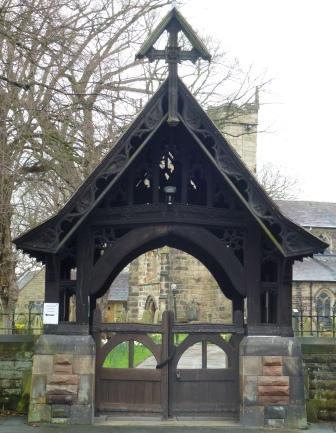
This legend may be interpreted to hint at older beliefs in underworld gods. Church ways are often identified with spirit paths. It is possible that prior to Christianity people believed chthonic spirits to have been actively involved in bearing the deceased to the underworld. The ringing of bells to drive them away and superstitions surrounding lych gates are testaments to fear of such entities. The movement of the legend to Fairy Lane may be seen as an attempt to sever their connection with the church. It is also possible it represents a shift in the energy of the area.

Gwyn ap Nudd and the spirits of Annwn (more frequently referred to as fairies today) are frightening beings. However, they play an essential role in maintaining the relationships between the worlds, the seasons, and the living and the dead. Like death itself and the cold dark of winter they will never go away. Their roles and identities, covered over or ignored for many centuries, can be recovered and understood.

Like Pwyll’s meeting with Arawn, my relationship with Gwyn has changed my life. He guides me to visions in Annwn and the physical world I would not be able to access without him. He teaches me to walk the spirit paths and inspires me to learn the song lines of this land’s ancestral heritage.

As late summer arrives, harvesters take to the fields and leaves begin to fall I sense the spirits of Annwn stirring, the first hint of the breath of winter on the wind. Monday is the date of the commemoration of the beginning of the First World War. When I help lay candles in front of Preston cenotaph for each of the 1956 soldiers who lost their lives I will remember that care of the souls of the battle dead was once believed to be Gwyn’s role.

(1) http://www.caerfeddwyd.co.uk/
(2) http://www.mabinogi.net/sections/Appendix/The_Underworld_Gods.pdf
(3) James MacKilliop, Dictionary of Celtic Mythology, (1998), p375
(4) Robin Herne, Old Gods, New Druids, (2009), p48
(5) A collection of Kingdoms in the North of England and Southern Scotland from 500AD and 800AD.
(6) Transl. William F. Skene, ‘The Dialogue of Gwyddno Garanhir and Gwyn ap Nudd,’ The Four Ancient Books of Wales, (2007), p210-211
(7) Transl. Sioned Davies, ‘How Culhwch Won Olwen,’ The Mabinogion, (2007), p199
(8) Ed. Rachel Bromwich and Simon Evans, Culhwch and Olwen, (1992), p169
(9) Transl. Sioned Davies, ‘How Culhwch Won Olwen,’ The Mabinogion, (2007), p199
(10) https://www.blogger.com/profile/02055792516386371373
(11) Ed. Rachel Bromwich and Simon Evans, Culhwch and Olwen, (1992), p133
(12) Ibid. p150
(13) Elen Sentier, Elen of the Ways, (2013), p26-28
(14) Dafydd ap Gwilim, Poems, (1982), p132 – 133
(15) http://www.maryjones.us/ctexts/collen.html
(16) Francis Thompson, The Hound of Heaven and Other Poems, (2000), p11
(17) Rev C. Nelson, St Mary’s Church, Penwortham, Lancashire, Archaeological Watching Brief and Explanation, (2011), p48
(18) http://www.gutenberg.org/files/39712/39712-h/39712-h.htm#THE_FAIRY_FUNERAL

Many thanks to Heron and Lee at Caer Feddwyd for bringing Will Parker’s article to my attention.

Corpse Road

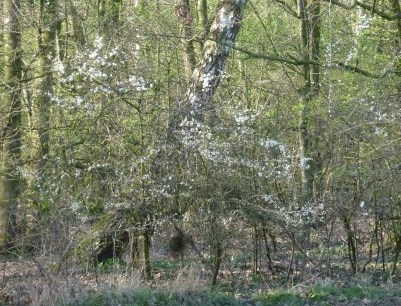
Birch and Blackthorn, Hurst Grange Park, PenworthamWho’ll walk the corpse road back to me?
– ‘Revenants’ Andrew O’Riordan

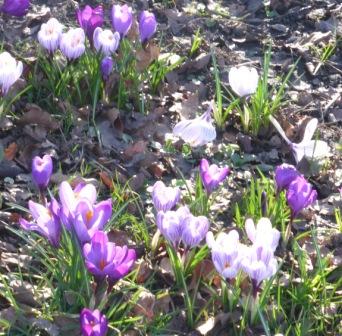
Where spring brings hope to downy birch
And blossoms of stars to blackthorn trees
When the hunt is still as the final frosts
Who will walk the corpse road back to me?

Where spring brings hope to drunks of the woods
With the pale potential of anemone
When my court dance in dew where a man lay cold
Who will walk the corpse road back to me?

Where spring brings hope to primrose hills
But none to vagrants on city streets
When wills clash like I do with impudent rivals
Who will walk the corpse road back to me?

Where spring brings hope to prison gardens
For a watchful moment the condemned walk free
When to solitary confinement comes Annwn’s darkness
Who will walk the corpse road back to me?

Where spring brings hope to those who can see it
Yet Victorian cells of asylums scream
When dreams of my kind are derided as madness
Who will walk the corpse road back to me?

Where spring brings no hope and death is release
And no fusion of flowers can quench the pain
When souls are lost as my absent queen
Will you walk the corpse road back to me?

Lych Gate, St Mary's Church, Penwortham* Poem written in the voice of Gwyn ap Nudd, a British King of the dead and the fairies

Gatherer of Souls

I have been where the soldiers of Prydain were slain…
I am alive, they in their graves!
– Words spoken by Gwyn ap Nudd in The Black Book of Carmarthen XXXIII

Spring is here, daffodils
amongst the headstones,
flowers on the cenotaph
grieving summers of war-

shells shattering spirit paths,
ditches filled with corpses,
a perverse test of love
for brave young fools

and you being liminal,
battle rage and compassion
on the blood soaked fields
where banshees wail

gathering the fallen
from amongst explosions,
returning to Prydain
wracked and torn.

Spring is here, yet in
Annwn’s long autumn you know
the weight of the battle dead,
the sorrow behind the veil.
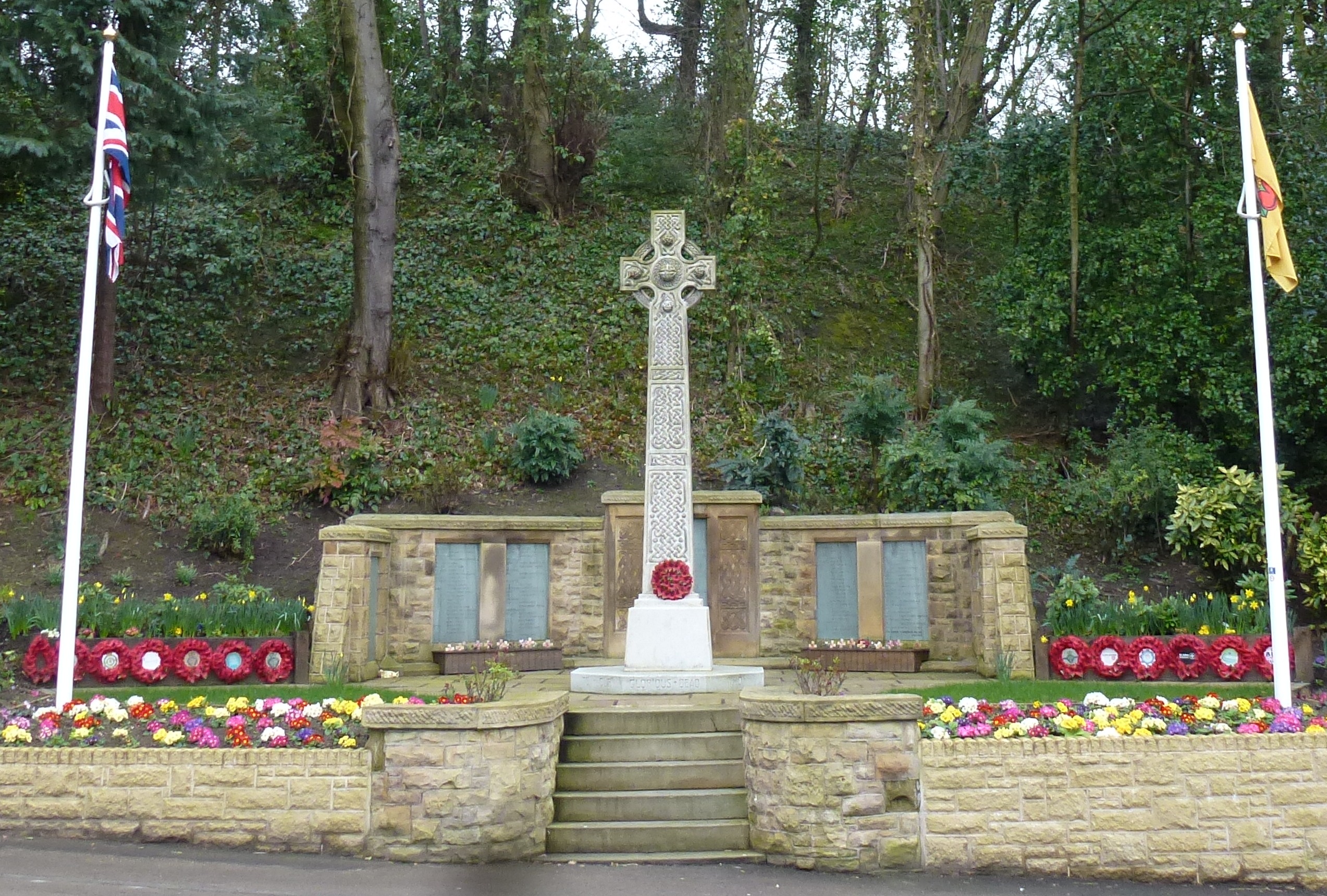
War memorial in Penwortham