Gwythyr ap Greidol: An Ancient British God of Fire, Sun, Summer, and Seed

Gwythyr ap Greidol ‘Victor son of Scorcher’ appears in the medieval Welsh story Culhwch and Olwen as the rival of Gwyn ap Nudd ‘White son of Mist’ for the love of Creiddylad ‘Heart’s Desire’. That he is a fitting opponent for Gwyn and consort for Creiddylad, who are the son and daughter of the ancient British god Lludd/Nudd/Nodens, suggests he is also an important British deity.

Strip away the Christian veneer from Culhwch and Olwen and we have a story in which Gwyn (Winter’s King) and Gwythyr (Summer’s King) battle for Creiddylad (a fertility goddess). On Nos Galan Gaeaf, Winter’s Eve, Gwyn abducts Creiddylad to Annwn* and Gwythyr rides to Annwn and attempts to rescue her and is imprisoned. The abduction of Creiddylad and imprisonment of Gwythyr explain the coming of winter. On Calan Mai, the First Day of Summer, Gwythyr battles Gwyn for Creiddylad, wins, and she returns with him to Thisworld and together they bring fertility to the land. This explains the coming of summer. Gwyn and Gwythyr may earlier have been seen to slay one another on Nos Galan Gaeaf and Calan Mai and take it in turns to enter a sacred marriage with Creiddylad, who acted as a powerful sovereignty figure rather than just a maiden to be fought over.

It is clear from this tale that Gwythyr is our ancient British god of summer. In another episode in Culhwch and Olwen we catch a glimpse of Gwythyr’s associations with fire and sunshine. As he is walking over a mountain he hears ‘weeping and wailing’ and sees its source is a burning anthill. He cuts the anthill off at ground level and rescues the ants from the blaze. We do not know what caused the fire. Did their nest, which ants orientate toward the sun, a little like solar panels, in a summer day, absorb too much heat? Or was the fire caused by Gwythyr’s scorching feet? We have seen that one translation of his father’s name, Greidol, is Scorcher, and we know wildfires break out in the summer. Here we see the dangers of fire and the sun and Gwythyr’s attempt at remediation.

The ants go on to help Gwythyr to gather nine hestors of flax seed which was sown in ‘tilled red soil’, in a field that has remained barren, so it can be ploughed into a new field, to provide the linen for Olwen’s veil in preparation for her marriage to Culhwch. It is possible to read Gwythyr’s association with seed being linked to the ‘male’ side of fertility and with doing the groundwork for the arrival of summer for his bride, Creiddylad, might also require a linen veil for her wedding dress.

The ancient Britons used fire to clear the forest to plant hazel trees and wildfires bring about new growth – in Gwythyr’s associations with fire and seed we find these processes.

These stories show that Gwythyr is a god of summer, fire, and generation in Thisworld who is opposed to Gwyn, a god of winter, ice, and the destructive forces of Annwn, the Otherworld. On the surface one is a bringer of life and the other a bringer of death yet their relationship is one of interdependence. It is necessary they take it in turns to enter a sacred marriage with Creiddylad as an eternal summer or an endless winter would have equally deadly consequences for both worlds.

As Gwythyr’s story was passed on through the oral tradition he and his father were depicted as allying with Arthur against Gwyn and the ‘demons’ of Annwn and playing a role in their demise. Thus Gwythyr is associated with other culture gods like Amaethon, the Divine Ploughman, and Gofannon, the Divine Smith, who help the Christian king to civilise the wild and shut out the Annuvian.

This process may be traced back to the Neolithic revolution when farming began to replace the hunter-gatherer lifestyle, the cultivation of seed hunting and foraging, the grain god (Gwythyr) the hunter (Gwyn). Christians did their best to eliminate the veneration of Gwyn by depicting him and his spirits as demons yet they continued to be loved in folk culture as the fairies and their king.

The stories of Gwythyr, by name, did not survive in the folk tradition, but it possible to find a likeness between him and other grain gods** who die a ritual death at the end of the harvest – when Gwyn, the harvester of souls, reaps down his rival and Gwythyr and the seed return to Annwn.

From the Neolithic period our society as a whole has favoured Gwythyr over Gwyn. We have created an eternal summer with the fire of Gwythyr in the engines of industry creating a society in which the cold and darkness of winter has been eliminated by electric lighting and central heating. Crops grow all year round under artificial lights. This has unsurprisingly led to global heating, to the climate crisis, to the scorching fires on Winter Hill where I perceive Gwythyr battling his rival. Ironically, and tellingly, these two great gods and the great goddess they battle for have been forgotten.

Yet, slowly, the worship of Gwyn and Creiddylad is reviving amongst modern polytheists. I know few who venerate Gwythyr and believe this is because his stories have been subsumed by those of other grain gods. This is a shame, for Gwythyr’s stories contain deep wisdom relating how fire, sun, summer and seed have played a role in the climate crisis from a polytheist perspective.

As a devotee of Gwyn, committed to the otherside, to the Annuvian, to redressing the balance, Gwythyr is a god whose powers I acknowledge through the summer and during the harvest period although I do not worship him. I would be interested to hear how and whether other polytheists relate to Gwythyr at this time.

*Annwn has been translated as ‘the Deep’ and the ‘Not-World’ and is the medieval Welsh Otherworld or Underworld.
**Such as Lleu Llaw Gyffes/Lugus and John Barleycorn.

Will You Leave?

Will the seasons continue to turn?

Will your battle still commence?

In these days of plague when
we need you so much

will you depart
to the land of the dead
to sleep in your cold castle
in Annwn?

~

The seasons must turn.

My battle must commence
and my death-blow must be struck.

Yet when I die you will see my ghost
and when I sleep I will sleepwalk.

Many will see the wolf of my soul.

Through these days of plague
I will guide the dead.

This poem is addressed to my patron god, Gwyn ap Nudd, on Calan Mai. Today Gwyn (Winter’s King) battles against Gwythyr (Summer’s King) for Creiddylad, a goddess of spring and flowers, and is destined to lose and return to sleep in the Castle of Cold Stone, in Annwn.

Creiddylad’s Garden

Creiddylad
most majestic maiden
in the Islands of Britain,
let me know your
majesty

in this garden

on my knees
two hands clasped
together on this trowel
making offerings
of water

amongst flowers
where you walk unveiled,
stunning, bees dancing
around you.

Let me be your bee!

Feed me
when I’m hungry.
When I fall exhausted
pick me up gently

and I will make
the sweetest honey.

“Stay here in this garden,” my patron god, Gwyn ap Nudd, advised me a week before the lockdown. A couple of days before my conservation internship was cancelled and, like many, I was rendered jobless.

We’ve been on lockdown in the UK for over a fortnight now and how I’ve to-and-froed, some days accepting this advice and, on others, after reading the news, wishing I was doing something more important, more heroic, than shopping and cleaning for my parents, tending the garden, doing my best to find the focus to pray, meditate, spend time in devotion to my gods, and to write for my supporters.

My main battle has been against feelings of guilt and uselessness caused by my awareness of the utter contrast between my easy life, touched by the bliss of the spring sun, and the hell that the nurses and doctors are going through on the front line, risking their lives fighting for the lives of others. The risks taken by the funeral services. The chaos and stress faced by supermarket staff. Our dependence on the long hours and monotonous work of fruit and veg pickers usually imported from abroad.

I’ve thought of applying for, have actually applied for, some of these jobs (which may have necessitated moving out of my parent’s house so I do not put them at risk), but nothing has come of it.

“Stay here in this garden.” I accept the gods have their reasons when the Blasted Oak, spelling disaster, appears in a tarot reading on what will happen if I take a veg picking job.

And deep within I know if I took any of the above jobs I’d likely get physically or mentally ill. That there is something fundamentally wrong with this industrialised and militarised system that keeps comparing the ‘fight’ against this virus with the Second World War and tries to inspire a wartime ethos.

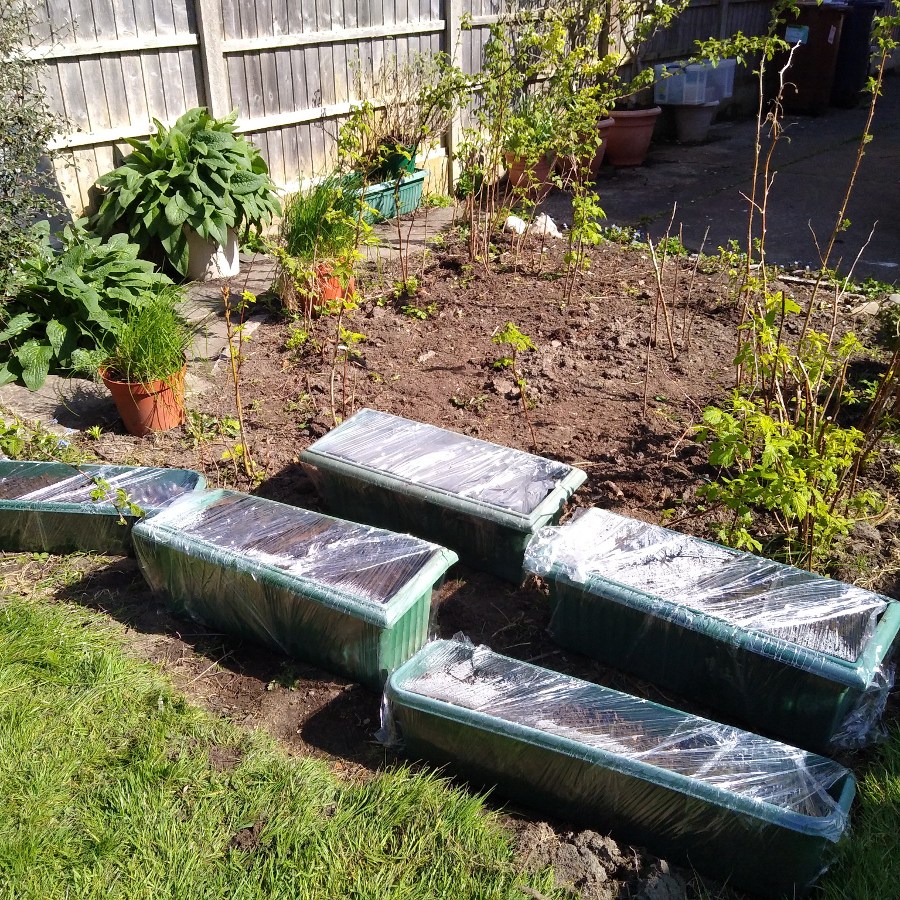
And so I tend my parents’ garden, cutting back years of overgrowth, clearing the paths, weeding amongst the many beautiful flowers that already grow here – hyacinths, daffodils, bluebells, honesty. And the shrubs and trees – apple, pear, rose, quince, camelia. Watering the raspberry canes. Sowing herb and lettuce seeds in troughs and veg seeds – carrot, turnip, onion, cauliflower, broccoli – in the soil.

And somewhere along the way it enters my mind this is ‘Creiddylad’s Garden’. And once the thought has entered it will not leave. I come to see the face of Creiddylad, ‘the most majestic maiden in the islands of Britain’, one of our Brythonic goddesses of flowers and spring, in each flower.

Creiddylad is a sovereignty deity who walks between worlds and lovers. This ‘majestic maiden’ is truly a majesty, a Queen, the lifeforce of nature who inspires great awe in her worshippers and the male deities, Gwyn and Gwythyr, Kings of Winter and Summer, who fight for her every Calan Mai.

Through the Winter she dwells with Gwyn, in the Otherworld, as Annwn’s Queen. In the Summer, with Gwythyr, she is May Queen, a great sovereign in Thisworld, revealing herself slowly flower by flower.

In Creiddylad’s contrary nature I find a better understanding of my own pulls between darkness and light, Thisworld and Otherworld. There is a part of me that wants to walk with Gwyn, a warrior and psychopomp, facing death, disease and sorrow. And at the same time an awareness he and other humans do this so the rest of us can appreciate the flowers and the sunlight and the lives that are our gifts.

It sometimes seems easier, more worthy, to embrace pain than pleasure. Why? I do not know. Only that in Annwn the sadness of the dead is transformed into great beauty and joy, and it this is that Creiddylad brings with her when walks from the Otherworld, into the light, and embraces Gwythyr.

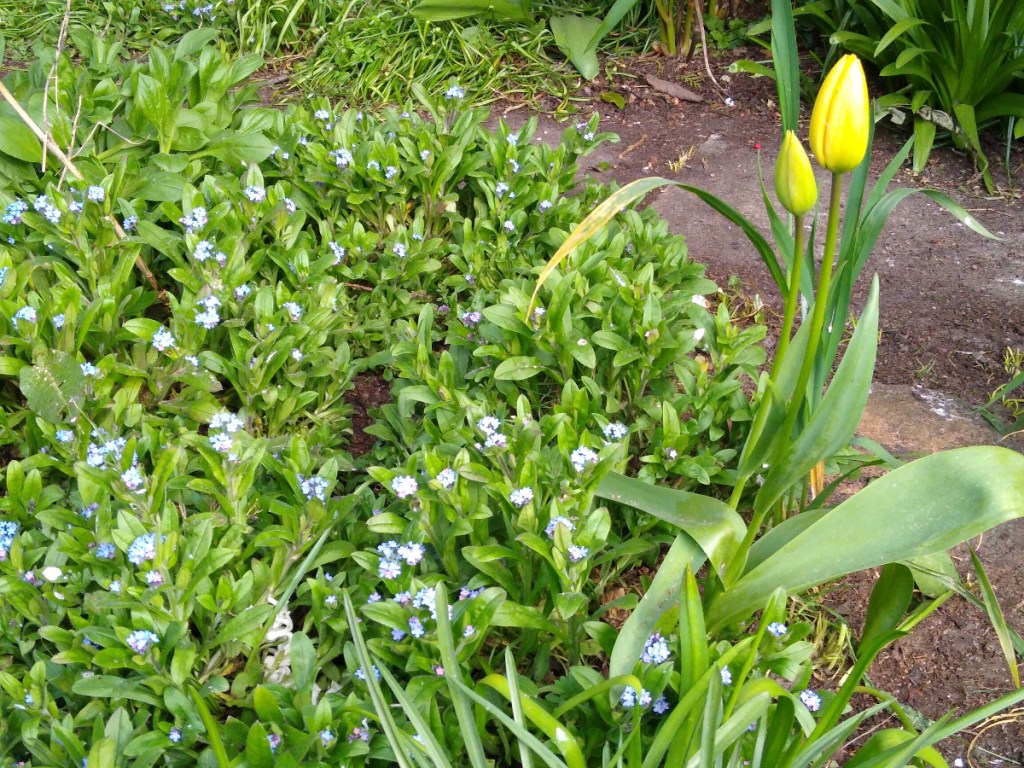
Many of the flowers in my garden speak of similar myths through the correlates of other cultures. The narcissus, or the daffodil, was the plant Persephone was picking before Hades took her to… Hades. The hyacinth was born from the blood of Hyacinth, the lover of Apollo, killed by his rival Zephyrus, and its beautiful petals are inscribed with ‘AI AI’ ‘Alas’. Lungwort’s petals turn from pink to blue as the flowers are pollinated, edging toward death, like flesh, or deoxygenated blood.

Nature and myth, death and life, Thisworld and Otherworld, are deeply intertwined in Creiddylad’s garden. A place where I work slowly, contemplating the mysteries, where I meet flowers, goddess, gods. It seems they don’t want me to be a hero but instead a small suburban bee offering a taste of Creiddylad’s honey.

I Will Go On

I am
green growth
rising from rhizome,
bud and bulb.

I am
sepal, petal,
stigma, stamen,
stolon,

male and female,

sexual
and asexual.

I am
pretty where
you want me: I am tulip,
poppy, geranium
and rose.

I am
hogweed,
balsam, knotweed
where you
don’t.

No-one
can stop me.

No Arthur
can lock me up.

Even my beloved
in his cold stone fortress
loses his hold.

I am
Creiddylad.

I am freedom

reaching from
darkness towards
the sun.

I will go on.

The Calling of Creiddylad

Creiddylad,
strings of birdsong
pull your hair.

Creiddylad,
they turn your head
towards the sun.

Creiddylad,
your face is a gently
opening petal.

Creiddylad,
your footsteps call
the flowers from sleep
in hill and mound
and dun.

Creiddylad,
you are unstoppable
in your majesty

although a part of you is weeping inside
for the love of winter
who will soon
be gone.

Creiddylad,
do not turn back,
do not turn
back

to the darkness
of Annwn.

Creiddylad,
step into the light
of the spring sun.

First Rose

You
flowered
in my garden
all winter

no waiting
patiently
for spring

first rose.

You
dared to
be in colour
outside my window
whilst I wore
dark clothes
carried

the dark
from my room
past you

brought
it back daily
unable to

imagine

how you
stay so yellow
or red or purple
or blue when
my moods

flicker
flimsier than
your hardy
petals.

When
I wonder
if your beauty
might adorn
my corpse
you try

to smile

remind me
of hardiness.
Of my god who
loves winter
flowers.

“Creiddylad.”

I speak her name.

“Prima rosa.
Rhosyn gyntaf.
First rose.”

“We endure
Annwn’s darkness,”
she smiles back.
“We endure.”

Her Crying Eye

For Creiddylad

Weep tears
surround me
like a stranger
to all hope like
a Goth song

always winter

in black by
the strobe lights
underground.

In the catacombs
the priestess weeps:
the altar is gone.

Reminders flash.

Was this worship?

Raising my hands
to the other stars of
disco balls drums

pounding sadness
all night in the dark
half of the year?

Pay the price.

Yes I’m paying.

Must I pay by tears?

I stole her ecstasy
in a white-cream pill.

Was this happiness?

Flashbacks repeat.

I am always empty
but her crystal tears
suggest something.

I wish I could cry.


Crying Eye Clip Art Library II

*This poem was inspired by the visions of two participants in a workshop I ran on ‘Honouring Creiddylad’ at the Space to Emerge camp – they both saw a crying eye.

Burial

A Poem for Calan Mai

Two gods fight. Two dragons circle the sky.
A scream is in my mouth – soon my god will be gone.

He dies so the bluebells, mayflowers, hawthorn blossoms thrive,
baby birds pecking from eggs stumbling pink into the dawn.

There will be a victory tonight and there will be a wedding.
There will be a death tonight and there will be a burial.

Whilst lovers dance the maypole and tryst in the woods
I will walk alone without a bouquet and in silence

down forgotten paths to the castle of cold stone
where winter is entombed while summer rules

to pay my regards in tears of dew and mourning songs
amongst the kindly fay, the winged horses, the howling hounds.

While others laugh at the wedding I will weep at the funeral.
I will bury two dragons in the stone chest of my heart.

I will bury two dragons

She Walks Between Worlds and Lovers (Calan Gaeaf)

It is summer in the otherworld when she is there
winter in the otherworld without her.
In Gwyn’s arms she is Lady Death:
petals fading wilting perishing discoloured
returning to the earth with work of insects,
seeds descending into soft and loamy soil,
sinking down with the work of worms.
Into his fateful embrace he takes her
down beneath bones of the dead,
fallen trunks and golden pollen.
In ancientmost forests Creiddylad
is Annwn’s Queen in sacred marriage.
Their passion in the unseen summer
stirs the dreams of sleeping corm,
bulb, knotty seed: movement
of potential, hidden, dormant
until the explosion to life. Each
underground power puts out shoot, stem, leaf,
reaching upward through snow for another sun.
She is their secret growth until the moment of flowering
when she sees her time in the otherworld is over
and walks between worlds and lovers.

Leaves in Greencroft Valley

She Walks Between Worlds and Lovers (Calan Mai)

It is summer in this-world when she is here
winter in this-world without her.
In Gwythyr’s arms she is Lady Life:
coming to be as the first snowdrop
purple yellow crocuses are her slippers
pink red primroses her cloak. Her smile
her lips are daffodils’ long trumpets.
May flowers weave her grassy hair
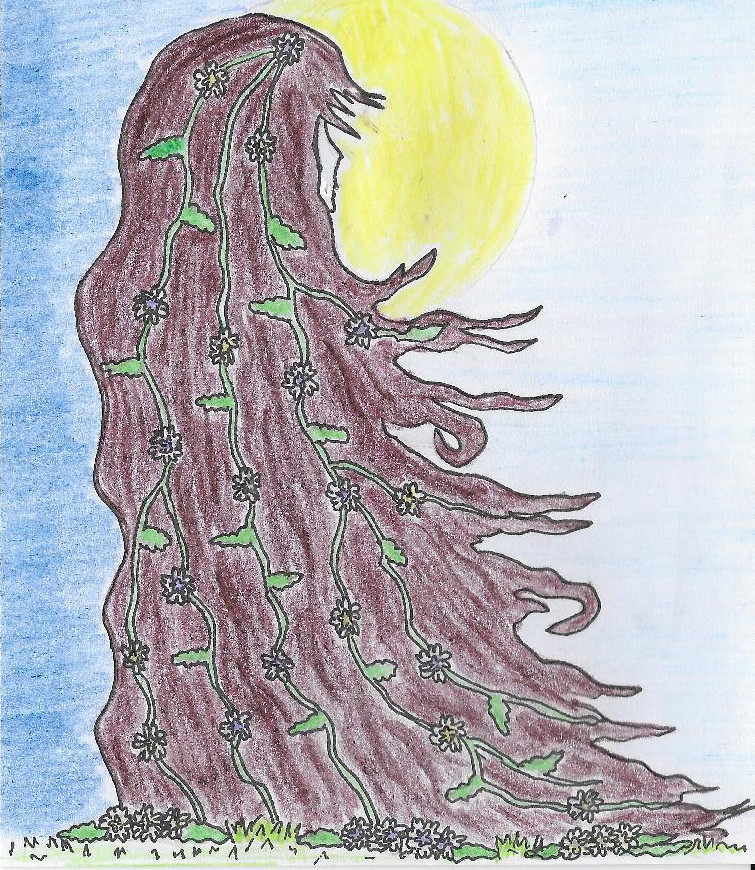
as she embraces this-world’s ruler.
In dewy glades Creiddylad is May Queen
in sacred marriage headdress a veil of hawthorn
wedding dress woven from wood anemone
wood sorrel she lies with him in woodlands
of bluebells starwort becoming buzzing fields
heliotropic gaze of ox-eye daisies poppies
face alive with vibrant butterflies and bees
exulting in the dance of pollen’s gold dust
until the seasons turn and cold winds come
she sees her time in this-world is over
and walks between worlds and lovers.

Blubells and Starwort