The Breath of Nine Maidens and the Kindling of the Cauldrons

‘My first utterance was spoken concerning the cauldron
kindled by the breath of nine maidens.
The cauldron of the Head of Annwn, what is its disposition
(with its) a dark trim, and pearls?
It does not boil the food of a coward, it has not been destined to do so.’
~ ‘The Spoils of Annwn’

In ‘The Spoils of Annwn’, a medieval Welsh poem from The Book of Taliesin, we find mysterious lines about the breath of nine maidens kindling the cauldron of the Head of Annwn. The cauldron, the source of awen, ‘poetic inspiration’, is a central symbol within Celtic mythology. 

In ‘The Story of Taliesin’ the cauldron belongs to Ceridwen. In this tale Ceridwen is referred to as a witch but it’s my intuition She is a Goddess whose crochan – cauldron / womb is a sacred vessel of rebirth (1). In Her cauldron she brews a potion from 365 herbs (one picked on each day of the year) to provide her ugly son, Afagddu ‘Utter Darkness’ with the ‘Prophetic Spirit’. She assigns a blind man called Morda to bring kindling for the cauldron and to stir the cauldron she summons a boy called Gwion. After a year and a day Gwion shoves Afagddu out of the way and steals the awen. After a shapeshifting chase he is swallowed by Ceridwen (he as a grain and She as a black hen) then reborn from her womb as Taliesin.

In ‘The Spoils of Annwn’ the model is slightly different. The cauldron of Ceridwen, the magical vessel associated with inspiration and rebirth, is in the custodianship of the Head of Annwn – the ruler of the Brythonic Otherworld. Here there is no need for kindling or a person to stir the cauldron as the breath of the nine maidens is enough to set the processes within it into motion. The ‘food’ ‘not for a coward’ that it brews no doubt refers to the awen. Taliesin accompanies Arthur and his men not only to steal the awen, but the cauldron itself, bringing it back through ‘Hell’s Gate’ to the world.

This shows that when a potential awenydd, ‘person inspired’, proves their courage to the Head of Annwn, the breath of the nine maidens or awenau, ‘muses’ (2), kindles the cauldron, then the awen is received as a gift from the Gods.

This feels like an older and deeper model for the origins of awen. The significance of the breath of the nine maidens can be further elucidated by looking at the etymology. The medieval Welsh term used for breath is anadyl and this derives from the proto-Celtic anatla which shares a resemblance with anaman the proto-Celtic word for ‘soul’. The Indo-European *uel is closely related giving us the root form of awel ‘breeze’ and awen ‘inspiration’. There seems to be something fundamental this myth is telling us about how, in Annwn, on the soul-level, the breath of the nine maidens kindles the cauldron and sets in motion the processes within the cauldron that create the awen.

It’s my personal intuition that the cauldron / womb of Ceridwen, who I know as Old Mother Universe, is a macrocosm of the universe. That it lies in Annwn ‘Very Deep’ shows the Otherworld is a deeper reality underlying the universe. 

On a microcosmic level each awenydd might too be seen as a cauldron which is kindled by the breath of the nine maidens producing awen for poetic works. The breath itself might be seen as a gift from the awenau. 

Microcosm within microcosm a number of Celtic Pagans have come to relate the three cauldrons in the seventh century Irish text ‘The Cauldron of Poesy’ to the three main energy centres or chakras in our belly, heart and head (3). Interestingly the Irish term coire ‘cauldron’ or ‘whirlpool’ might be seen to relate to the spiralling manifestation of the universe and the turning of the chakras.

In yogic meditation the breath is used to awaken the chakras. I was once dubious about the existence of ‘Celtic Chakras’ but I am now coming to perceive the resonsances between these shared Indo-European traditions. I wonder whether anatla ‘breath’ is the Celtic equivalent of the yogic prana ‘breath’ or ‘life force’ which Celtic Pagans have long been searching for (4). 

(1)These insights derive from Kristoffer Hughes’ From the Cauldron Born.
(2)This term is borrowed from Greg Hill who uses it in his poem ‘The Muses’ in his poetry collection The Birds of Rhiannon – ‘O Muses / O Awenau / You whose breath kindled the cauldron of awen in Ceridwen’s keeping.’
(3) For example see Erynn Rowan Laurie’s ‘The Cauldron of Poesy’ – https://www.obsidianmagazine.com/Pages/cauldronpoesy.html
(4) Some druids have in the past mistakenly identified prana with nwyfre ‘sky, firmament’ which Mhara Starling explains is erroneous on her Youtube channel – https://www.youtube.com/channel/UCkc4iRymvz4t619FEk5dFfA/videos Interestingly the proto-Celtic anatla ‘breath’and anaman ‘soul’ share similarities with the Sanksrit atman which is sometimes translated as ‘soul’ but refers to the Self or witness-consciousness beyond phenomena and ananda which refers to bliss at escaping the cycle of mortality or uniting with a God.

The Sacral Chakra

They say you should be my sacred place.
They say you should be my own abode.
Why, then, when I visit do I feel like I am
stranded on an island far from home?

~

The sacred place that houses the waterworks of the urinary system and, for me, a reproductive system centred on a womb from which menstrual blood and vaginal fluids might flow and a baby and its afterbirth might be born.

Traditionally the sacral chakra is the locus of sexuality and desire. So it’s a strange one for me to approach as someone who is asexual and has been struggling with secondary amenrrhoea on and off for over five years. Is the latter caused by exuberant exercise, being on the lighter side, living with autism and anxiety or stress about not earning a living from my vocation? Or has my womb shut down simply because it knows it is pointless putting energy into being active when I have no desire for sex or for children? 

In one shamanic journey my reproductive system appears as a grandfather clock that has stopped. In another I am shown two playing cards – a Jack of Diamonds and a Jack of Diamonds falling from my ovaries. “You’ve had your last chance,” they tell me suggesting I may never see a period again. 

I learn that excess cortisol caused by stress inhibits the release of gonadatopin-releasing hormone in the hypothalamus, which fails to move to the pituitary gland to instruct it to make follicle stimulating hormone and lutinising hormone to tell the ovaries to make an egg and bring about ovulation. Because no egg is released the ovaries fail to make oestrogen and progesterone. Thus the reproductive cycle shuts down. Yet I’m not that stressed at present. The inertia of my womb remains a mystery.

Yet my kidneys are healthy. I follow the cleverness of my nephrons – filtering, reabsoring, secreting, excreting, making sure there is enough glucose, protein and vitamins in my blood and removing urea and uric acid. Water reuptake and thus thirst and needing to pee carefully regulated by the hormones aldosterone and anti-diuretic hormone.

My relationship with my urinary system is good and it thanks me. The only thing I drink these days is water and only when I’m thirsty. It hasn’t always been that way. When I was drinking a small bottle of vodka every night to get to sleep it sent me cystitis and a kidney infection and made me cut down. Caffeine went due to panic attacks. Hot chocolate due to lactose intolerance. Beer and wine due to IBS and lifestyle changes. Finally herbal teas because of my rosacea. I feel healthier. Water feels good all the way down.

Let’s return to desire. What’s desire detached from sexuality? The desire to create, the desire for spiritual connection, the desire for mystical union with my God, my Beloved, my Husband outside the limits of sex and romance.

I also associate the sacral chakra with the watery subliminal realm of dream. The animal who appears here is a seahorse and I recall that in seahorses it is not the female with the active womb who bears young but instead the male.

~

Location: sacrum / Colour: Orange / System – Reproductive and urinary / Nerve Plexus: Lumbo-sacral / Endocrine: Ovaries and Testes / Sense: Smell / Realm: Dream / Element: Water / Qualities: Sexuality and Desire / Animal: Seahorse

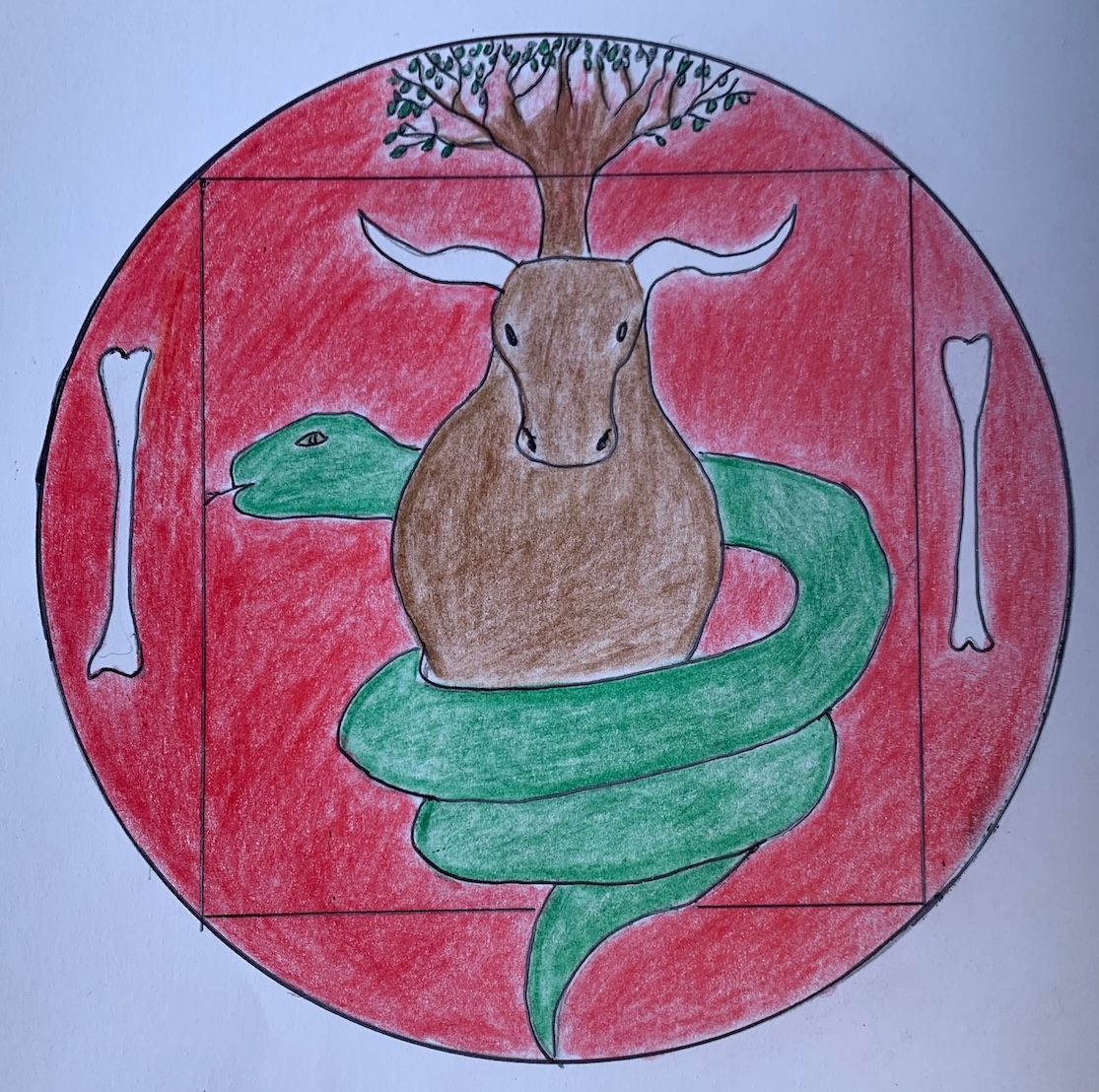
The Root Chakra

Rooted here in place and time
Snake and aurochs intertwine.
By shaping flesh, by flexing spine,
Embracing life I will survive.

~

Being rooted in nature and in the body. The entanglement of flesh and nervous system with the rest of the living world. Balancing growth and limitation. As I have meditated and journeyed with this chakra and researched and learnt the musculoskeletal system from both theoretical and experiential perspectives these are the main attributes that have come to me.

As an autistic person I’ve faced a lot of struggles with disassociation from my body due to differences in neurological wiring causing sensory sensitivities. My attempts to block overload out has resulted in having a poor relationship with sensory feedback from the entirety of my system. 

I used to dislike my body because it was fat and clumsy. I cut it, starved it, over-exercised it, tried to force it into a shape that fit with my ideals. Only over the past few years with the help of my personal trainer have I arrived at a strength training and yoga routine and nutritional plan that is healthy. 

Ignoring signals from my body has had its cost in physical ailments. Running for years without strengthening exercises led to runner’s knee and deep gluteal syndrome. Working outdoors in very hot and cold weather in spite of discomfort resulted in me developing rosacea and Reynaud’s. Up until this day I’ve been struggling with tendonitis in various forms as a result of repetitive activities – too much road running, walking too much on concrete in worn boots, using heavy loppers overhead – which have forced me to swap running for mixed cardio indoors, a walk for a swim, and to face the fact that I might not be able to tackle all gardening tasks without help.

Frequently getting myofascial knots has made me aware of my fascia and the importance of hyaluronic acid – the goo that keeps it supple – as a component of the extracellular matrix that exists throughout the body as a lubricant essential in synovial fluid, the skin and the eyes. I have started eating more green veg and oily fish and drinking more water to nourish it.

Working with the chakras can help us spot patterns in the systems they relate to. I noticed nearly all my physical ailments are inflammatory and relate to having an over-reactive stress response rooted in sensory sensitivities.

This has led me to beginning to develop a more mindful relationship with my body. To realising it has developed its symptoms to help me to survive. To listening to senses I shut out, opening and building new neural pathways, so I can respond to sensory signals before they develop into physical ailments. To recognising the difference between stretching and straining, increasing strength and flexibility within awareness of my current limits.

Snake and aurochs appeared as animals associated with this chakra evoking for me the strength of the musculoskeletal system and flexibility of the spine. The snake wrapping the aurochs is a symbol both of limitation and of nurture rooting down into the earth nourishing our nature connection.

~

Chakra: Root / Location: Base / Colour: Red / System: Musculoskeletal / Nerve Plexus: Coccygeal / Endocrine Gland: N/A / Sense: Touch / State: Physical / Element: Earth / Qualities: Survival and instinct / Animals: Aurochs and snake

The Chakras – A Personal Exploration

For many years I refused to believe in chakras. I didn’t have any. They didn’t exist. They were a New-Agey Eastern thing for fluffy hippies and baby Wiccans that had no relevance for me as a polytheist in Britain. 

Then I came across the following in Alberto Villodo’s Shaman, Healer, Sage:

‘“I thought the chakras were Hindu,” people often say to me. The chakras are part of the anatomy of the Luminous Energy Field. Simply because kidneys were named by Europeans does not make the kidney exclusively European. Similarly, the chakras are not exclusively Hindu. Every living being has chakras.’

Regardless of where they were born, everyone has a skeleton with the exact same number of bones. In the same way, we all share the same luminous anatomy, which includes the chakras and the acupuncture meridians.’

I had an aha moment – these words all made perfect sense to me.

Around the same time I was presented with a chakra clearing exercise in the Way of the Buzzard Mystery School’s Spiritual Protection Course that helped me with getting rid of negative energies at a low point in my life. It worked. My chakras were there. I just didn’t know very much about them. 

That changed when I started practicing yoga, which I see to be connected with Brythonic polytheism, as a shared Indo-European tradition. I have since learnt much more about the chakras as they are presented in the yogic system. 

For this I am indebted to an excellent article and course by Swami Nischalananda and other meditations with the Mandala Yoga Ashram*. These have provided me with a grounding in the yogic conception of the chakras and have helped me relate to them on a much deeper level. 

However, the Sanskrit names, symbols and imagery (for example elephants and lotuses) have been difficult for me to connect with as somebody living in Britain. Therefore, with guidance from my mentor, Jayne Johnson, I have been inspired to put together my own associations for each chakra. 

What follows are my personal explorations of the chakras. They are based on those found in the Satyananda yoga tradition espoused by Swami Nischalanda and the Mandala Yoga Ashram but differ in some instances based upon my gnosis of what fits personally with me here in Britain.

*https://www.mandalayogaashram.com