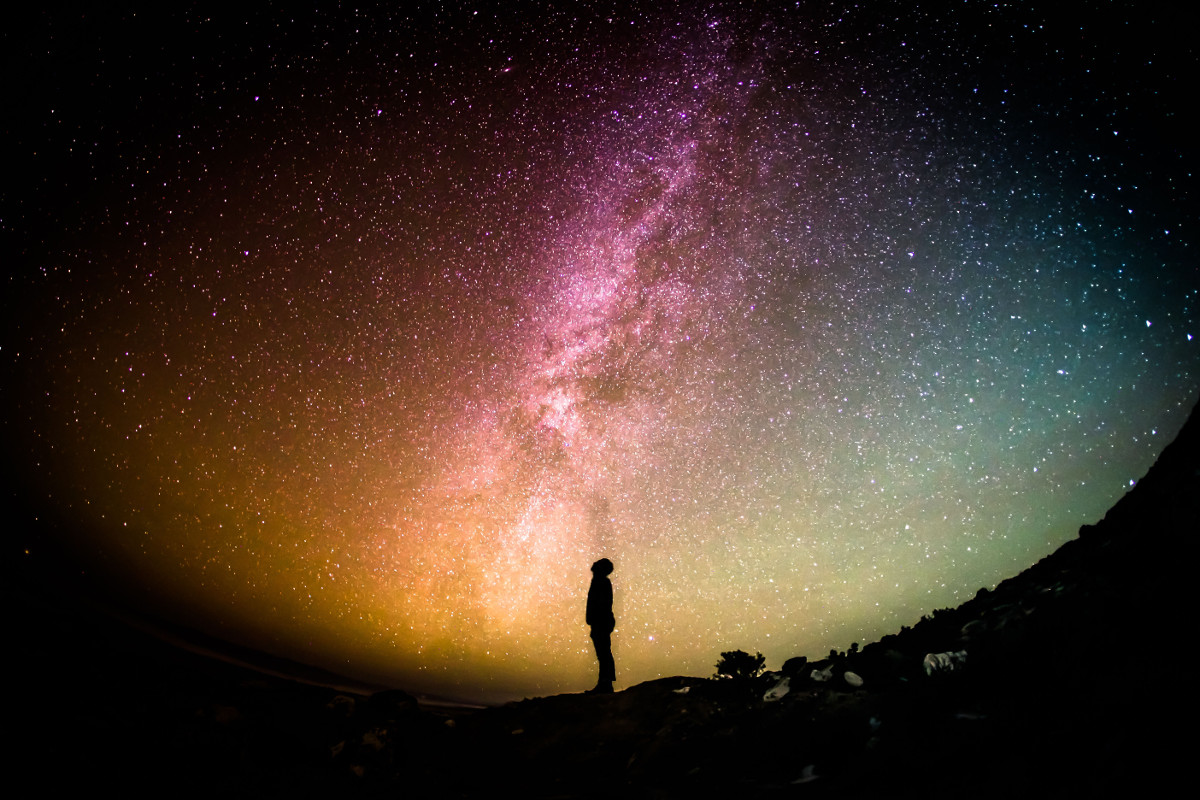
The Stellar Origins of Taliesin

I.

Taliesin 4am

A premature foetus
with eyelids stretched closed
inner eyes pondering
the universe within

born from the cauldron
of Ceridwen
after the disaster
dancing its stillbirth
like a puppet on the wind

something fay
something alien
something that fell from the stars

II.

The story of the (re)birth of Taliesin is well known. A young man called Gwion Bach stole the Awen from the cauldron of Ceridwen, leaving it shattered and the land poisoned. He fled and was pursued by Ceridwen, each shifting through a series of forms. He was finally swallowed as a piece of grain by Ceridwen as a great black hen. Ceridwen gave birth to him as Taliesin.

Throughout the poetry attributed to Taliesin he repeatedly states this identity is only one of his many forms. For example at the beginning of ‘The Battle of the Trees’ he says ‘I was in a multitude of forms / before I was unfettered’ and lists a number of his transformations:

I was a slender mottled sword
made from the hand.
I was a droplet in the air,
I was the stellar radiance of the stars.
I was a word in writing,
I was a book in my prime.
I was the light of a lantern
for a year and a half.

This way Taliesin consistently denies his origins from Ceridwen’s crochan ‘womb’ or ‘cauldron’. It is notable he never refers to her as ‘mother’. In ‘The Battle of the Trees’ he states explicitly: ‘It was not from a mother and father / that I was made’ then he tells an alternative story of his creation:

and my creation was created for me
from nine forms of consistency:
from fruit, from fruits,
from God’s fruit in the beginning;
from primroses and flowers,
from the blossom of trees and shrubs,
from earth, from the sod
was I made,
from nettle blossom,
from the ninth wave’s water.
Math created me
before I was completed.
Gwydion fashioned me –
great enchantment wrought by a magic staff;
by Eurwys, by Euron,
by Euron, by Modron;
by five enchanters –
of a kind like godparents
was I reared.

In ‘The Greater Song of the World’ he says he was made by God from ‘seven consistencies’:

of fire and earth,
and water and air,
and mist and flowers,
and the fruitful wind.

In ‘The Story of Taliesin’ he makes a stranger claim: ‘my original country is the region of the summer stars’. We have already seen Taliesin state he has been ‘the stellar radiance of the stars’. How does this sit with his account of his creation and his (re)birth from Ceridwen’s womb?

III.

Marged Haycock notes Taliesin’s words share similarities with apocryphal Middle Age sources describing the creation of ‘the microcosmic Adam’ not only from dust, but ‘from land and sea, earth, the clouds of the firmament, wind, stones, the light of the world’ and ‘the Holy Spirit’.

There are parallels between the creation of Taliesin as microcosm and the world as macrocosm. Intriguingly we now know our world was born from the stars through the process of stellar nucleosynthesis. The Taliesin poems uncannily predict the theses of modern science. All the elements that make up our planet and the life upon it originate from the stars.

After the Big Bang the stars formed as hydrogen and helium were drawn together by gravity and nuclear fusion began. Hydrogen was burnt first, then helium, which produced carbon, oxygen, neon, magnesium, silicon, sulfur, argon, calcium, titanium, chromium, and iron. The collapse and explosion of stars in supernovae ejected the elements across the universe.

Our solar system was born from a cloud of interstellar gas and dust composed of hydrogen, helium, and elements from supernovae. As gravity caused it to contract nuclear fusion began in the sun and the planets, including the earth, formed. From the elements came life – microorganisms, plants, trees, fish, birds, animals, then humans and all our creations.

Taliesin is indeed correct that he originates from the stars. The story of the creation of Taliesin by ‘five godparents’: Gwydion, Math, Eurys, Euron, and Modron, is also the story of the creation of the world. It may even be suggested these five deities were once seen to have a role as creator gods, perhaps sharing a similarity with the archons of the Gnostic tradition.

IV.
Taliesin seems to have succeeded in denying his motherhood by Ceridwen. In fact denial of Ceridwen’s status as the Great Goddess of the cauldron, the womb of all life, is a consistent theme throughout the poems attributed to Taliesin and medieval Welsh poetry as a whole.

In ‘The Childhood Achievements of Taliesin’ he says:

I entreat my Lord
that (I may) consider inspiration:
what brought forth (that) necessity
before Ceridfen
at the beginning, in the world
which was in need?

Here he is claiming that awen, inspiration, born from Ceridwen’s cauldron is of earlier origin.

In ‘The Chair of Teyrnon’ we find tension between conflicting translations of peir as ‘cauldron’ or ‘Sovereign’ (God). ‘Ban pan doeth o peir / ogyrwen awen teir’; ‘Splendid (was it) when there emanated from the Sovereign/cauldron / the ‘ogyrwen’ of triune inspiration’.

Amongst later bards petitioning Ceridwen for awen is only acceptable when disguised as a metaphor and under the ordinance of God. Cuhelyn Fardd asks God for poetic power akin to ‘the dignity of Ceridfen’s song, of varied inspiration’. Prydydd y Moch requests inspiration from God ‘as from Ceridfen’s cauldron’ and asks God for ‘the words of Ceridfen, the director of poetry’.

However, it cannot be denied that when Gwydion and company create Taliesin they are tapping into the creative processes of the womb of the universe and its old mother herself – Ceridwen.

If the stars were born from that first shattering of Ceridwen’s cauldron, the Big Bang, and Taliesin was born from the stars, then Ceridwen is still his mother and this cannot be denied. She will always be his beginning and his ending and he will never escape her no matter how hard he denies her as the origin of his creation and no matter how fast he shifts form and runs.

SOURCESAndrew Zimmerman Jones, ‘Stellar Nucleosynthesis’, Thought.com, (2017)
August Hunt, ‘Dinas Emrys and the Goddess Euron’, Shadows in the Mist (2017)
Greg Hill, ‘Who was Taliesin?’ Awen ac Awenydd
Marged Haycock, Prophecies from the Book of Taliesin, (CMCS, 2013)


Twrand o’r Gyre

A hen got hold of me –
a red-clawed one, a crested enemy;
I spent nine nights
residing in her womb
The Hostile Confederacy

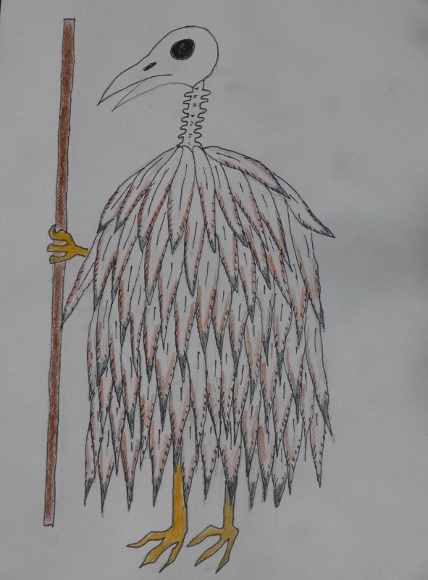
Bird-Head

“The witch Ceridwen made me like this.”

He reminds me of one of Baskin’s cave birds:
the bare white skull with its long maxilla,
the sclerotic ring,

the way he stares just ‘so’ like a raptor,
cervical vertebrae twisting down

to feathered shoulders.

Immediately I have questions
I know I shouldn’t ask –

like where he got his cloak,
whether it’s part of him,
what’s beneath.

I keep my beak well shut,

follow with respect up the mountain
to the tap-tap-tap of his stick

as he points out bones picked clean by birds,

the skeleton still sitting waiting for death.

When I grow weary I think of how the dying
made it higher with their last breath
and stumble on to the summit.

Will I fall apart in a heap of bones
or crumble into a pile of dust?

Only his sunken eyes know.

Gyre

I totter like an old woman.

Before I’ve had the chance to look down
at what I’ve left behind I’m swept

into a gyre,
circling and circling
with the last things of Thisworld –
a wardrobe emptying of clothes,
a cupboard spilling chutnies,
jams, ketchups, vinegar.

Things I’ll dimly miss.

A new set of wings
is beating in my chest
carrying me higher higher.
The sun is my new head
illuminating the plains
of a new horizon.

Its brightness is beyond pain,
understanding, words such as ‘firmament’,
‘cloud’,‘cirrocumulus’, ‘Heaven.’

Here

the winged souls are busy,

half human, half bird,

hollowing out their bones
with the chink, chink, chink
of tiny chisels, breaking

and re-fixing humerus,
ulna, radius, fusing carples
and phalanges into wings.

Separating toes into claws.

Stretching lungs into air sacs
and filling lightened bodies full
of soulful air and otherlight.

Far Above

they are greeted by elders
who teach them to build nests

with sticks and clothes pegs,
moss, spit, newspaper cuttings
of past lives they wished they had,
toys, shoes, watch hands, fluff
from the bellies of teddy bears.

Like little old women or foetuses
they climb back into the eggs,

back into a chick-like slumber,

back into the womb of an old hen,
back into the cauldron of Ceridwen,
back into before they were born.

Nine Nights

Finally Twrand tells his story:

“For nine nights and nine days
I resided in her womb asleep like
a feather in the skies drifting from
planet to planet learning stories
of other worlds beyond her dreams
and all her deepest imaginings.

I saw the trajectory of Thisworld.

I plucked the feather of my Awen
from the side of a red-clawed hen.

When I was born she killed me:

wrung my neck, bent me out of shape.
I raised my skeleton from the sand,
fixed my wings and learnt to ride
the winds of the gyre unreturning.”

Twrand o'r Gyre MML

Afagddu, Prophet of Darkness

I. The Dark Son

Afagddu, ‘Utter Darkness’, is a minor figure in Welsh mythology whose significance has not been recognised because he was pushed out of the way by Gwion Bach, who became the celebrated bard, Taliesin.

Afagddu’s mother is Ceridwen. She and God are called on interchangeably as the ultimate source of awen, divine inspiration, by the medieval bards. This suggests she is the greatest of the Brythonic deities, the Great Goddess closest to a creator God, Old Mother Universe, the creatrix and destructrix from which all life is born and to whom it returns at the moment of death.

If this is the case, then surely her son, Afagddu, should hold a greater position within Brythonic tradition? Why is his story shoved aside like a dirty secret? Why is his name not better known?

I believe this is partly due to his hideous apparel. In Elis Gruffudd’s recording of ‘The Story of Taliesin’ we are told his ‘looks, shape and carriage were extraordinarily odious’. Firstly they named him Morfran, ‘Great Crow’ or ‘Sea Raven’ but ended up calling him Afagddu ‘Utter Darkness’ ‘on account of his gloomy appearance’. John Jones’ redaction describes him as ‘the most ill-favoured man in the world’ and compares him to his sister, Creirwy, ‘Living Treasure’, ‘the fairest maiden in the world’.

Afagddu’s ancestry goes some way to explaining his looks. Ceridwen’s name can be translated as ‘crooked wife’ (from cwrr, ‘crooked’, and fen, ‘wife’) and ‘fair and loved’ (from cerid, ‘love’ and wen, ‘fair’). Perhaps because she is both crooked and fair she gave birth to crooked and fair children. Afagddu’s father is Tegid Foel, ‘the Bald’, whose patrimony is Llyn Tegid. Tegid’s baldness, along with his rulership of a lake rather than a human kingdom, suggest he is a monstrous water deity.

Unfortunately for Afagddu he was born ‘in the days when Arthur started to rule’ – a period when Christianity was the religion of warrior elites who built their status through the repression of the gods, monsters, ancestral animals, and witches of the ancient British pagan traditions. Ceridwen was allegedly keen for Afagddu to ‘win acceptance amongst the nobility.’ It’s my suspicion this was the addition of a Christian interculator who was either ignorant of Ceridwen’s identity as a goddess or purposefully erased it. At some point she was reduced to a ‘magician’ and Tegid to a ‘nobleman’.

II. The Spirit of Prophecy

In Gruffudd’s recording, after realising that Afagddu will not be recognised for his looks, Ceridwen decided instead to ‘make him full of the spirit of prophecy and a great prognosticator of the world to come.’ The link between his ‘ugliness’ and being chosen for a prophetic vocation may date back to traditions of pagan Britain wherein differences were celebrated and revered rather than despised.

After ‘labouring long in her arts’ Ceridwen discovered a way of achieving prophetic knowledge by choosing certain herbs on certain hours and days and brewing them in a cauldron for a year and a day. Resultingly ‘three drops containing all the virtues of the multitude of herbs would spring forth; on whatever man they fell… he would be extraordinarily learned and full of the spirit of prophecy.’

Interestingly, in John Jones’ version, Ceridwen learnt to ‘boil a cauldron of awen’ from the book of the Fferyllt, ‘Alchemists’, and books of astrology. We find a steady shift from a pagan standpoint where Ceridwen was the omniscient mother of the stars and planets and herbs and well aware of their motions and qualities, to her working hard at her art, to her learning it from the books of human mages.

In both variants Ceridwen made the fatal mistake of recruiting a young man called Gwion Bach to stir the cauldron. In Gruffudd’s, after a year and a day had passed, she stationed Afagddu beside the vessel to receive the drops on the allotted hour then… fell asleep!!! When the trio sprang forth, Gwion shoved Afagddu out of the way and received their blessings. In Jones’s, ‘three drops of liquid accidentally leapt from the cauldron onto the thumb of Gwion Bach; lest he be burnt, he thrust the digit into his mouth.’ In the former Gwion was an active thief and in the latter an innocent bystander.

From 'The Story of Taliesin' on Sacred Texts

In both retellings the cauldron shattered and the remains of the brew spilled out and poisoned the land. Ceridwen was, understandably, furious. After finding out what happened from Afagddu she chased Gwion through a variety of shapes (he fled as hare, she pursued as a greyhound, he leapt into a river as a salmon and she dived as an otter, he took flight as a bird and she followed as a hawk) before he became a grain of wheat and she became a black hen and swallowed him whole.

For Afagddu her reaction was too late. Pushed aside by Gwion, who was reborn all-knowing and shiny-browed to take centre stage as Taliesin, erased from the story, he fell into utter darkness. We never find out how he felt or reacted to the theft of the awen. Imagining our own emotions we can assume he was disappointed, angry, jealous, bitter, consumed by wrath. Bereft of the spirit of prophecy, abandoned by his mother in a poisoned land, disparaged by the nobility, Afagddu chose another path.

III. The Man With Stag’s Hairs

From other texts we learn ‘Morfran son of Tegid’ became a fearsome warrior. In The Triads of the Island of Britain, Triad 24, he is listed with Gilbert son of Cadgyffro and Gwgawn Red-Sword as one of ‘Three Slaughter-Blocks of the Island of Britain’. Someone who is an ysgymyd aeruaeu, ‘slaughter block’ or ‘chopping block of battles’ ‘holds his ground firmly… in spite of the enemy’s blows’.

Morfran son of Tegid appears in the court list in Culhwch and Olwen:‘no-one wounded him at the battle of Camlan because of his ugliness. Everyone thought he was an attendant demon; he had hair on him like a stag.’ He is compared, this time, with ‘Sanddef Pryd Angel angel-face – no-one wounded him at the battle of Camlan because of his beauty. Everyone supposed he was an attendant angel.’

Morfran is still clearly despised. The reference to him having ‘stag’s hair’ connects him with other warriors who became wyllt ‘mad’ or ‘wild’ in battle and took the forms of wild animals. In The Gododdin combatants are described as ‘bull of an army’, ‘wolf in fury’, ‘terrible bear’ and ‘celebrated stag’.

He shares a kinship with the shapeshifters who Arthur captured and forced to join his hunt for Twrch Trwyth ‘King of Boars’. These include Rhymi who took ‘the form of a she-wolf’ and gwyllon such as Cynedyr Wyllt who was ‘nine times wilder than the wildest beast’. Whether Afagddu fought on Arthur’s side freely or was coerced remains uncertain. Whatever the case his description suggests he became wyllt and battled in a stag-like guise.

The comparison of Morfran to an ‘attendant demon’ is evocative of the ‘devils of Annwn’ led by Gwyn ap Nudd, a pagan god, who gathers the souls of the dead from the battlefield. Gwyn’s epithet is ‘Bull of Battle’ and he has ‘horns on his head’. His host, members of his ‘Wild Hunt’, are part animal.

The evocation of attendant demons and angels gathering souls from the battlefield presents us with a vivid depiction of the conflict between paganism and Christianity. Morfran is placed on the side of Gwyn.

IV. The Bird of Wrath

We find further evidence of Morfran/Afagddu’s connections with battlefield demons in ‘The Death Song of Uther Pendragon’ in The Book of Taliesin. Uncannily the celebrated bard channels Uther’s voice:

I broke a hundred forts.
I slew a hundred stewards.
I bestowed a hundred mantles.
I cut off a hundred heads.

Later lines refer to Afagddu:

The unskillful
May he be possessed by the ravens and eagle and bird of wrath.
Avagddu came to him with his equal,
When the bands of four men feed between two plains.

These lines are obtuse and require unpacking. Firstly we find a reference to an unskillful warrior who Taliesin-as-Uther calls for to be ‘possessed by the ravens and eagle and bird of wrath’. This seems, again, to be evoking the tradition of shapeshifting wherein warriors were possessed by a bird or animal.

The ‘bird of wrath’ is Morfran/Afagddu; he appears in the next line and Morfran means ‘Great Crow’ or ‘Sea Raven’, a name for a cormorant. His approach with his ‘equal’ refers to his bird-form.

The final line is the most difficult to comprehend. Its reference to bands of four men feeding is suggestive of bird-like or animal-like behaviour. In the context of the poem I believe it refers to men-in-bird-form feeding on the corpses of the dead on a battlefield ‘between two plains’.

References to corpse-eating birds are prevalent throughout medieval Welsh literature. Gwenddolau owns two birds: ‘two corpses of the Cymry they ate for dinner, and two for their supper’. The Eagle of Pengwern is ‘greedy for the flesh of Cynddylan’. Gwyn’s ravens ‘croak over gore’. In Rhonabwy’s Dream, Owain’s warband, who are described as ravens, not only kill Arthur’s army but carry off their heads, eyes, ears, and arms. The Papil Stone depicts two bird-headed men bearing a human head between their long beaks, which make them look more like cormorants than carrion birds.

The image of men-as-birds feeding on the dead is a horrific one and perhaps portrays fearful superstitions about warriors who become wyllt. These may not be entirely ungrounded. Bones bearing human teeth marks from Gough’s cave show some of the early Britons practiced cannibalism. In Culhwch and Olwen, Gwyn forced Cyledyr to eat his father’s heart, making him wyllt.

The evidence suggests Afagddu not only partook in the slaughter at numerous battles but may also have joined the birds who feasted on the corpses of the dead. His name became a self-fulfilling prophecy. Driven over the edge by losing the awen he lost himself in war and surrendered to utter darkness.

V. A Night of Unordinary Darkness

Afagddu’s name is derived from y faggdu, ‘a night of unordinary darkness’. What happened to him after he was seen at Camlan amongst the battlefield demons remains unknown. If, as I have surmised, he killed other men and ate their flesh, we can guess he descended traumatised into a long dark night.

That most famous of the gwyllon, Myrddin Wyllt, slew his sister’s son and daughter whilst battle-mad. After the Battle of Arfderydd he witnessed Gwyn and his host arriving to gather the souls of the dead. One of Gwyn’s spirits tore him out of himself and assigned him to the forest of Celyddon where he recovered from trauma, guilt, and grief and learnt the arts of poetry and prophecy.

Is it possible Afagddu also made a recovery and became a poet and prophet? Lines from ‘The Hostile Confederacy’, from The Book of Taliesin, suggest he did:

Until death it shall be obscure –
Afagddu’s declamation:
skilfully he brought forth
speech in metre.

Here we find references to the obscurity of his prophetic speech and to his mastery of poetic metre. Afagddu has become a poet-prophet. How he won his awen and became filled with the spirit of prophecy remains obscure as his declamation. I have only my own experiences and intuitions to go on.

Three years ago, during a conversation with Gwyn, I was transported into ‘The Story of Taliesin’. I found myself in Afagddu’s shoes, watching as the cauldron shattered and the contents spilled out, poisoning the streams and rivers, killing Gwyddno Garanhir’s horses and other animals and birds. I walked with Afagddu as he attempted to comfort the dying. Since then I have been inspired to write about him visiting other areas polluted by man-made disasters, helping those affected, cleaning up the land.

Whereas Myrddin found healing in the forest of Celyddon, Afagddu found it in the darkest of places. Perhaps undoing the damage caused by his mother’s cauldron is his way of making reparations, not only for the toxic effects of her attempt to brew the awen for him, but for his own atrocities.

Afagddu’s awen arises from nights of darkness and poisoning and death in which he sees his own nature reflected. They have their own poetry, which seems ugly to an Arthurian eye, but less so from an Annuvian perspective that embraces what our society derides as hideous as poetic and prophetic.

Afagddu’s story is not without happiness. He owns a horse, ‘Silver-White, Proud and Fair’, one of ‘Three Beloved Horses of the Island of Britain’. Her fairness speaks of faerie/Annuvian qualities. I believe she was a gift from Annwn, from Gwyn, in return for his help with the dead and dying lands. She represents his awen, galloping silver-white, proud and fair, from the longest and darkest of nights.

SOURCES

A.O.H. Jarman (transl.), Aneirin – Gododdin, (Gomer Press, 1998)
Charlotte Guest, The Mabinogion, (1877)
Kristoffer Hughes, From the Cauldron Born, (Llewellyn, 2013)
Marged Haycock, Legendary Poems from the Book of Taliesin, (CMCS, 2007)
Patrick Ford, Mabinogi and Other Welsh Tales, (University of California Press, 2008)
Rachel Bromwich (ed), The Triads of the Island of Britain, (University of Wales Press, 2014)
William F. Skene (transl), The Four Ancient Books of Wales, (Forgotten Books 2007)
Annuvian Awen

Annuvian Awen

Allan o dywyllwch caf fy ngeni
Allan o waed caf fy ngeni
Allan o ysbryd caf fy ngeni

Yn canu o Annwn

Tri phelydryn golau
Tri phelydryn llais
Tri phelydryn wirionedd

I oleuo â rhyfeddod
Ac yn torri’r galon wytnaf

Yn canu o Annwn

~

Out of darkness I am born
Out of blood I am born
Out of spirit I am born

Singing from Annwn

Three rays of light
Three rays of voice
Three rays of truth

To illuminate with wonder
And break the hardest heart

Singing from Annwn

~

About a month ago I awoke with the symbol above in my mind with the name ‘Annuvian Awen’. Awen derives from the Indo-European *-uel ‘to blow’ and has the same root as the Welsh awel ‘breeze’. It is the primordial breath that binds all things, as Kristoffer Hughes says, ‘the voice of the universe speaking to itself’.

The Awen symbol was popularised by Iolo Morganwg in the 1860s. He claimed it was derived from a Welsh alphabet recorded by Nennius in the ninth century and that its meaning was ‘I am that I am’. It has been used by Neo-Druids since.

In medieval Welsh poetry ‘the ogyrven of threefold inspiration’ originate from the cauldron of Ceridwen. Crochan means both ‘cauldron’ and ‘womb’. It is the place from which all beings of the universe are born and to where they return at death.

The cauldron of Ceridwen lies in Annwn, ‘Very Deep’, the ancient British Otherworld. It is guarded by the Head of Annwn: a god with many names who I know as Gwyn ap Nudd. Gwyn guides the souls of the dead and of living initiates to the cauldron.

The black background of the Annuvian Awen represents the origin of Awen from the darkness of Ceridwen’s cauldron in the depths of Annwn. The red stands for the blood of the dead (human and non-human) whose sacrifices have made it possible the living can have Awen. The white is spirit: the breath, the voice of truth, the misty otherlight of the ogyrven ‘spirits’ contained in the person of Gwyn ‘White’ who is also known as the giant Ogyrven.

When I had created the design I received the gnosis I must write a poem to accompany it in English and Welsh. My Welsh is very basic. Having written the English version with an eye to how it looked and sounded in Welsh, translating as I went, I contacted fellow awenydd and Welsh-speaker Greg Hill for help with the translation.

Greg corrected my grammatical errors and helped me with choices of individual words. Interestingly this led to changing the tense of the English poem from past to present which was a big improvement. This fortuitous exchange of Awen between awenyddion gave birth to the poem in its present form. We decided to use it with the symbol on the front page of ‘Awen ac Awenydd’: a website providing a repository of information on the awenydd path.

For me the Annuvian Awen forms an expression of the path of the awenydd that acknowledges the importance of depth in our increasingly superficial world; the need to recover the inspiration that lies in the deeps of Annwn and in the deep places of our souls to combat the soullessness that allows the destructive systems that are wrecking Thisworld to thrive.

The ways to Annwn are dark, misty, uncertain, steeped in blood, for the most part forgotten. Yet there are gods and guides who offer to walk with us and share our quest. So we go with them through the darkness, across the river of blood, to return with the otherlight to illuminate the beauty of Thisworld because not only our lives but the lives of our souls depend on it.

SOURCES

Angela Grant, ‘A Short History of the Awen’, The Druid Network
Greg Hill, ‘Awen’, Awen ac Awenydd
Greg Hill, ‘Taliesin, the Bardic Tradition and the Awen’, The Way of the Awenydd
Greg Hill, ‘The Girl in Ogyrven’s Hall’
Kristoffer Hughes, Natural Druidry, (Thoth Publications, 2007)
Kristoffer Hughes, From the Cauldron Born, (Llewellyn, 2013)
Marged Haycock, Legendary Poems from the Book of Taliesin, (CMCS, 2007)
Awen’, Wikipedia

Caer Golud: The Guts of Annwn

In verse four of ‘The Spoils of Annwn’ the lines about Caer Wydyr (‘Glass Fort’) are followed by a single reference to Caer Golud (‘Fortress of Impediment’).

‘Three loads of Prydwen went with Arthur:
save seven, none came back from the Fort of Impediment.’

Nothing more is said about Caer Golud. To the best of my knowledge it does not appear in any other literature. Marged Haycock translates golud as ‘impediment’ from goludd. This suggests Caer Golud is another name for the impenetrable Caer Wydyr, which is guarded by six thousand men and an incommunicative watchman.

An alternative translation is from coludd (which mutates from ‘g’): ‘guts’, ‘bowels’ or ‘entrails’ This is a fascinating possibility and fits with links between the Glass Fort and Glastonbury (‘the Glass Island’) as a place the 6thC prophet, Melkin, claims is ‘greedy for the death of pagans, above others in the world.’

Melkin’s words suggest pagan beliefs and practices survived in Glastonbury into the 6thC. The word ‘greedy’ evokes devouring and the digestive processes of the guts. This would certainly tie in with other descriptions of the Brythonic otherworld.

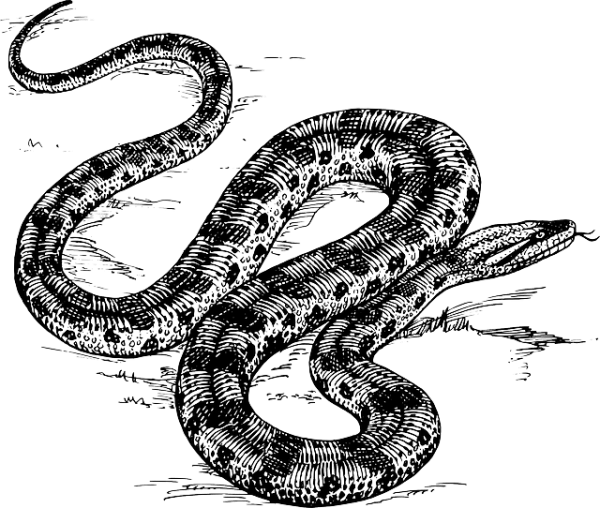
In ‘The First Address of Taliesin’ the bard inquires into the width of ‘the mouth’ of Uffern (‘inferno’). ‘Kat Godeu’ refers to ‘a great-scaled beast’ with ‘a fierce battalion / beneath the roof of his tongue’ and ‘A speckled crested snake’ with ‘a hundred souls, on account of (their) sin… tortured in its flesh.’

snake-water-river-sketch-cartoon-big-wild-animal

Public Domain

Both poems are heavily Christianised yet if we remove the punitive connotations resulting from Annwn’s identification with Uffern/Hell and thus sin, it is possible to find traces of a shamanistic standpoint far more visceral than courtly medieval portrayals of the otherworld.

We recall Gwion Bach (as a grain of wheat) was swallowed by Ceridwen (as a black hen). A sow feeds on Lleu Llaw Gyfes’ rotten flesh when, mortally wounded, he takes the form of an eagle. The Hounds of Annwn hunt down and devour souls.

Gwion’s swallowing by Ceridwen leads to his rebirth as Taliesin. In a similar Irish story, Dechtire swallows a small animal whilst drinking a glass of water and is then told she is pregnant by Lugh with the son who will grow up to become Cu Chullain.

It is possible these stories date back to a time people didn’t causally connect sex and pregnancy due to the time lapse. The belly is not only the place of digestion but gestation: eating the ‘dead’ and birthing life were connected with this mysterious place.

***

In From The Cauldron Born, Kristoffer Hughes notes that in Welsh the word for cauldron is pair or crochan, which resembles croth ‘womb’. Ceridwen’s cauldron, her belly, is where Gwion is devoured and reborn as Taliesin.

Taliesin describes his fate in language evocative of malting and brewing in ‘The Hostile Confederacy’:

‘I was a grain…
A hen got hold of me –
a red-clawed one, a crested enemy;
I spent nine nights
residing in her womb.
I was matured,
I was a drink set before a ruler,
I was dead, I was alive,
a stick went into me;
I was on the lees,
separated from it, I was whole;
and the drinking-vessel stiffened resolve,
(for) the red-clawed one imbued me with passion.’

In ‘Lake of the Cauldron’ Charlotte Hussey glosses lines from The Second Branch where the giant, Llasar, emerges from a lake in Ireland with the Cauldron of Rebirth on his back to depict a similar process.

The cauldron is described as decorated with animals and divinities including a woman with ‘long-breasts’ and a ‘sweaty belly’ stirring it ‘as if it were a pan’. The woman pushes the narrator ‘into the boil’. Llasar watches as

‘…She hacks
shoulder blades, buttocks apart,
scrapes off chunks of flesh,
bones sinking then surging to the rim,
tossed by the churning waters.’

This bears similarities with scenes of initiation from shamanic cultures. Mircea Eliade records that a Samoyed shaman was decapitated and chopped into bits by a blacksmith who boiled him in a cauldron ‘big as half the earth’ then reforged him with magical capacities. In some traditions the initiate is eaten.

In relation to the devouring snake in ‘The Spoils of Annwn’ it’s of interest amongst the Negritos there is great snake named Mat Chinoi. Thirty female Chinoi ‘of the utmost beauty’ live in its belly with their ornaments and combs. By passing two ordeals it is possible to enter the snake to find a wife.

It’s noticeable none of the Brythonic texts mention bowels or excrement. This may be because they were penned by Christian scribes in the medieval period. This contrasts with the bawdy toilet humour of the Norse myths and the mythologies of other cultures.

In Dream and the Underworld, James Hillman notes that in a late Orphic hymn the name of ‘the Goddess of the realm of death’ is ‘borborophoba, which was can render in the double-sense of shit-fearing: she who keeps it at bay, and she who makes it flow in panic.’ In the Egyptian Otherworld, where everything is reversed, people defecate through their mouths.

Hillman refers to dreams of diarrhea as ‘radical compelling movements into the underworld or as an underworld that has come to sudden irrepressible life within us, independent of who we are and what we are. Like death, diarrhea strikes when it will and all alike. Shit is the great leveller… Toilet dreams… can be read as underworld initiations.’

***

Our lack of knowledge of Caer Golud parallels the lack of attention our cerebrally obsessed culture has paid to the gut over the last few centuries. Thankfully over the past few decades scientists have begun to pay attention to this long neglected area.

In the 1960’s Michael Gershon published a ground-breaking book called The Second Brain. He draws attention to the fact that if the major nerve between the brain and gut is cut, the gut continues to work, and can function independently of the central nervous system.

The Enteric Nervous System ‘the brain below’ regulates peristalsis. One of the most important neurostransmitters in this process is serotonin. Serotonin plays an important role in the regulation of mood and 95% lies in the gut.

More recently scientists have been studying the microbiota of the gut as a ‘collective unconscious’, their symbiotic relationship with their host, and their influence on behaviour. Gut microbiota affect memory, sociability, and levels of stress and anxiety.

I’ve suffered from anxiety most of my life and a few months ago got diagnosed with IBS (Irritable Bowel Syndrome). Finding out these links was a eureka moment. When I get stressed I have bowel problems which upset my gut making me more stressed: it’s a vicious cycle.

Frighteningly 10% of people in the UK suffer from IBS and it’s the second biggest cause of absence from work yet nobody talks about it. As I’ve also done in the past, they just make excuses or take Immodium and pretend it isn’t an issue. I can’t help thinking such a high percentage of people suffering from IBS results from living in such a stressful world.

I can’t see an easy or immediate way out of this cycle. However, I do believe the root cause can be addressed. We need to stop participating in the stressful worlds our guts cannot tolerate and which are indigestible to the deities of Annwn and work toward creating alternatives.

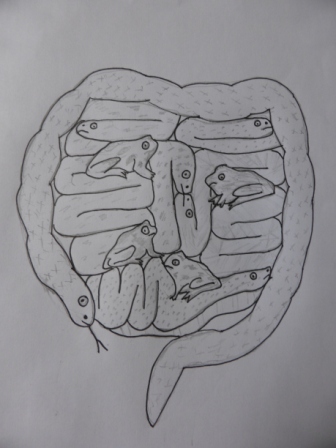
The time has returned to learn to listen again to the forgotten worlds of our guts which are paralleled by Caer Golud and its great-scaled beasts and speckled crested snakes in the realm of our Annuvian borborophoba, Ceridwen.

P1160376 - Copy

SOURCES

Charlotte Hussey, Glossing the Spoils, (Awen Publications, 2012)
Cryan, Dinan, Stilling, Stanton, ‘Collective Unconscious: How Gut Microbes Shape Human Behaviour’, Journal of Psychiatric Research 63, (2015)
James Hillman, The Dream and the Underworld, (CN, 1979)
Kristoffer Hughes, From the Cauldron Born, (Llewellyn, 2013)
Marged Haycock, Legendary Poems from the Book of Taliesin, (CMCS, 2007)
Michael D. Gershon, The Second Brain, (Harper Collins, 1999)
Mircea Eliade, Shamanism, (Princeton, 2004)
Nicolas R. Mann, The Isle of Avalon, (Green Magic, 2001)
Thomas Kinsella (transl), The Tain, (OUP, 1979)