The Breath of Nine Maidens and the Kindling of the Cauldrons

‘My first utterance was spoken concerning the cauldron
kindled by the breath of nine maidens.
The cauldron of the Head of Annwn, what is its disposition
(with its) a dark trim, and pearls?
It does not boil the food of a coward, it has not been destined to do so.’
~ ‘The Spoils of Annwn’

In ‘The Spoils of Annwn’, a medieval Welsh poem from The Book of Taliesin, we find mysterious lines about the breath of nine maidens kindling the cauldron of the Head of Annwn. The cauldron, the source of awen, ‘poetic inspiration’, is a central symbol within Celtic mythology. 

In ‘The Story of Taliesin’ the cauldron belongs to Ceridwen. In this tale Ceridwen is referred to as a witch but it’s my intuition She is a Goddess whose crochan – cauldron / womb is a sacred vessel of rebirth (1). In Her cauldron she brews a potion from 365 herbs (one picked on each day of the year) to provide her ugly son, Afagddu ‘Utter Darkness’ with the ‘Prophetic Spirit’. She assigns a blind man called Morda to bring kindling for the cauldron and to stir the cauldron she summons a boy called Gwion. After a year and a day Gwion shoves Afagddu out of the way and steals the awen. After a shapeshifting chase he is swallowed by Ceridwen (he as a grain and She as a black hen) then reborn from her womb as Taliesin.

In ‘The Spoils of Annwn’ the model is slightly different. The cauldron of Ceridwen, the magical vessel associated with inspiration and rebirth, is in the custodianship of the Head of Annwn – the ruler of the Brythonic Otherworld. Here there is no need for kindling or a person to stir the cauldron as the breath of the nine maidens is enough to set the processes within it into motion. The ‘food’ ‘not for a coward’ that it brews no doubt refers to the awen. Taliesin accompanies Arthur and his men not only to steal the awen, but the cauldron itself, bringing it back through ‘Hell’s Gate’ to the world.

This shows that when a potential awenydd, ‘person inspired’, proves their courage to the Head of Annwn, the breath of the nine maidens or awenau, ‘muses’ (2), kindles the cauldron, then the awen is received as a gift from the Gods.

This feels like an older and deeper model for the origins of awen. The significance of the breath of the nine maidens can be further elucidated by looking at the etymology. The medieval Welsh term used for breath is anadyl and this derives from the proto-Celtic anatla which shares a resemblance with anaman the proto-Celtic word for ‘soul’. The Indo-European *uel is closely related giving us the root form of awel ‘breeze’ and awen ‘inspiration’. There seems to be something fundamental this myth is telling us about how, in Annwn, on the soul-level, the breath of the nine maidens kindles the cauldron and sets in motion the processes within the cauldron that create the awen.

It’s my personal intuition that the cauldron / womb of Ceridwen, who I know as Old Mother Universe, is a macrocosm of the universe. That it lies in Annwn ‘Very Deep’ shows the Otherworld is a deeper reality underlying the universe. 

On a microcosmic level each awenydd might too be seen as a cauldron which is kindled by the breath of the nine maidens producing awen for poetic works. The breath itself might be seen as a gift from the awenau. 

Microcosm within microcosm a number of Celtic Pagans have come to relate the three cauldrons in the seventh century Irish text ‘The Cauldron of Poesy’ to the three main energy centres or chakras in our belly, heart and head (3). Interestingly the Irish term coire ‘cauldron’ or ‘whirlpool’ might be seen to relate to the spiralling manifestation of the universe and the turning of the chakras.

In yogic meditation the breath is used to awaken the chakras. I was once dubious about the existence of ‘Celtic Chakras’ but I am now coming to perceive the resonsances between these shared Indo-European traditions. I wonder whether anatla ‘breath’ is the Celtic equivalent of the yogic prana ‘breath’ or ‘life force’ which Celtic Pagans have long been searching for (4). 

(1)These insights derive from Kristoffer Hughes’ From the Cauldron Born.
(2)This term is borrowed from Greg Hill who uses it in his poem ‘The Muses’ in his poetry collection The Birds of Rhiannon – ‘O Muses / O Awenau / You whose breath kindled the cauldron of awen in Ceridwen’s keeping.’
(3) For example see Erynn Rowan Laurie’s ‘The Cauldron of Poesy’ – https://www.obsidianmagazine.com/Pages/cauldronpoesy.html
(4) Some druids have in the past mistakenly identified prana with nwyfre ‘sky, firmament’ which Mhara Starling explains is erroneous on her Youtube channel – https://www.youtube.com/channel/UCkc4iRymvz4t619FEk5dFfA/videos Interestingly the proto-Celtic anatla ‘breath’and anaman ‘soul’ share similarities with the Sanksrit atman which is sometimes translated as ‘soul’ but refers to the Self or witness-consciousness beyond phenomena and ananda which refers to bliss at escaping the cycle of mortality or uniting with a God.

Dreaming the Monastery of Annwn

When I founded the Monastery of Annwn just over two years ago I feared it would always be a rule of one. To my utter surprise for such a niche interest (Brythonic Polytheistic Monasticism centring on the Annuvian Gods) the monastery is thriving with a dozen members, most of whom participate regularly in group rituals, meditations and check-ins, or on our online forum. Several of us are living by vows and the Rule of the Heart.

Only a few months ago I thought it would be impossible to support myself as a nun of Annwn but I have received glimmers of hope with my soul guidance sessions off to a good start and my Patreon membership growing a little. 

This month my spiritual mentor suggested instead of trying to logically plan my next steps ahead for the future we should open a space for dreaming. She challenged me to dream my biggest dream and set it down without thinking about the ‘real world’ limitations that might prevent it happening. 

Immediately I knew this was to make the Monastery of Annwn a physical reality. I’d already had lots of flashes of inspiration so I set them down then journeyed to the Spirit of the Monastery to ask for guidance for the future. 

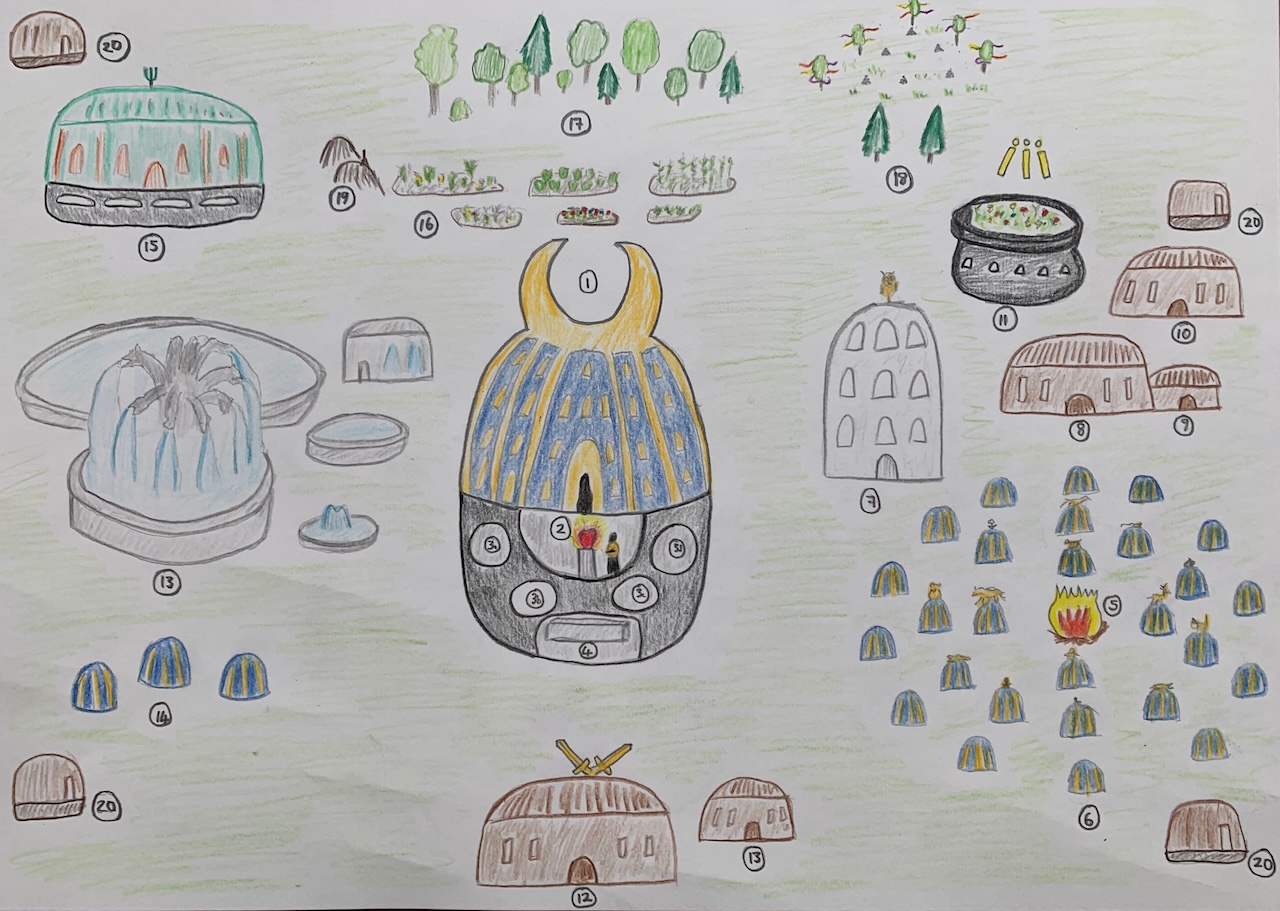
Below is my dream Monastery of Annwn at this point in time. I see it as a centre for worship of the Gods and Goddesses of Annwn, a sanctuary for healing and retreat, and a place for learning about the Brythonic tradition from a polytheistic perspective. It combines above ground, underground, indoor and outdoor spaces.

My hope is that it would sustain itself by growing its own food and making money from healings, retreats, running workshops and courses on Brythonic myths and Deities and polytheistic monasticism and sales of inspired works from monastic devotees.

(1) The Monastery of Annwn – The central temple space containing shrines to the Gods and Goddesses of Annwn and space for worship and ecstatic dance.
(2) The Chamber of the Heart – At its centre is the Altar of the Heart where  monastic devotees can venerate the Heart of Annwn. There will always be a monastic devotee keeping the beat of the heart day and night.
(3) Underground Caves – For communion a) Orddu’s Cave b) Cave of the Spirits of Annwn c) Cave of Bardic Incubation d) Cave of the Unknown.
(4) Gwyn’s Tomb – This will be where Gwyn symbolically lies in His tomb during the summer and monastic devotees will be able to visit and spend time in silence with Him. In winter the coffin will be removed and this will be a space of initiation involving death and rebirth prior to taking vows.
(5) The Hearth of Annwn –  A space where monastic devotees gather.
(6) Huts of the Monastic Devotees – There are three circles. The first two circles are hut for monastics who have made lifelong vows. On top of each hut is a representation of one of their tutelary spirits. The third circle is for novices and for those who are in the process of discernment.*
(7) Crazy Owl’s Library – A library containing books on Brythonic lore and monastic and mystery traditons along with mythology from around the world.
(8) Gwyn’s Feasting Hall – Here meals are served.
(9) Ceridwen’s Kitchen – Here nutritious food made with local ingredients is cooked. 
(10) Gwyn’s Guest House – A bunkhouse for guests.
(11) Awen Arts – An arts centre with an art gallery and performance space for poetry, singing and music and spaces for crafts and crafting. It will also contain a shop selling inspired works by monastic devotees.
(12) The Training Hall of Gwyn and Gwythyr – A hall for training in martial arts and other kinds of movement including dance and yoga. 
(13) Giant’s Gym – For strength training and rehabilitation. 
(14) The Healing Fountains of Anrhuna – A complex of healing waters including fountains, spas and pools and a shower house and baths for daily use.
(15) Healing Huts – Huts for shamanic healing and various therapies.
(16) The Dream Temple of Nodens – A temple for Nodens with underground dream incubation chambers and healing hounds.
(17) Creiddylad’s Garden – Here vegetables, salad, herbs and fruit are grown.
(18) Gwyn’s Wildwood – A woodland space for meditation, communion and celebration.
(19) The Blessed One’s Burial Ground – A natural burial ground for monastic devotees whose graves will be marked with small cairns. Potentially this might be expanded to provide space for others who support our aims.
(20) Ceridwen’s Compost Toilets – Four sets spaced around the monastery.
(21) Ceridwen’s Compost Heap – For recycling all waste from the garden and feasting hall.

Potentially, off scene, there will be ‘herds of Annwn’ – pigs and cattle for meat and milk and horses for horse riding and equine therapy.

*

Daily Routine

Communal worship will take place in the monastery mornings and evenings. Rather than breaking up the day with regular communal prayers like the Benedictines** prayer will be integrated into daily activities. Each will open with prayers of praise and petition and end with prayers of thanksgiving. For example, prayers to Creiddylad for gardening, prayers to Gwyn and Gwythyr for martial arts, prayers to Anrhuna for healing work. Meals will be preceded by prayers of thanksgiving to the spirits of the land.

Additional rituals will take place for Holy Days and on the dark, new and full moons.

Week Days

5am Communal worship in the monastery – morning prayers and songs for Gwyn ap Nudd and His family, the Spirit of the Monastery, the spirits of place and ancestors. 

5.30am Communal silence in the monastery (the only thing that will be heard is the beat of the Heart of Annwn).

6am Breakfast.

6.30am Communal practice in the monastery – Readings from Brythonic texts followed by meditation and contemplation or a shamanic journey.

7.30am Study in small groups in the library – Brythonic texts and Lectio Divina.

8.30am Exercise – Run, walk, strength training, martial arts, gentle movement (ie. yoga or chair yoga).

9.30am Shower and snack.

10am Study and practice in small groups – Brythonic lore, meditation, journeywork, spiritwork, divination, plant and tree spirit medicine, shamanic healing.

12 noon – Lunch.

12.30pm Devotional creativity or healing work.

2.30pm Manual labour – cleaning, laundry, groundskeeping, gardening.

5pm Baths.

5.30pm Tea.

6pm Free time for private prayer and study and group discussions.

8pm Communal worship in the monastery – evening prayers and songs for Gwyn ap Nudd and His family, the Spirit of the Monastery, the spirits of place and ancestors.

8.30pm Retire for evening prayers to Nodens as God of Dreams.

9pm Bed.

Saturday

5am Communal worship in the monastery – morning prayers and songs for Gwyn ap Nudd and His family, the Spirit of the Monastery, the spirits of place and ancestors. 

5.30am Communal silence in the monastery (the only thing that will be heard is the beat of the Heart of Annwn).

6am Breakfast.

6.30am Communal practice in the monastery – Readings from Brythonic texts followed by longer meditation and contemplation or shamanic journey.

9am – Snack.

9.30am – Ecstatic dance.

11.30am – Shower.

12 noon – Lunch.

12.30 – Free time in which some individuals and groups may choose to spend time in the woods or gardens or go for a longer walk in the local area.

5pm Baths.

5.30pm Tea.

6pm Free time for private prayer and study and group discussions.

8pm Communal worship in the monastery – evening prayers and songs for Gwyn ap Nudd and His family, the Spirit of the Monastery, the spirits of place and ancestors.

8.30pm Retire for evening prayers to Nodens as God of Dreams.

9pm Bed.

Sunday

5am Communal worship in the monastery – morning prayers and songs for Gwyn ap Nudd and His family, the Spirit of the Monastery, the spirits of place and ancestors. 

5.30am Communal silence in the monastery (the only thing that will be heard is the beat of the Heart of Annwn).

6am Breakfast.

6.30am Communal practice in the monastery – Readings from Brythonic texts followed by longer meditation and contemplation or shamanic journey.

9am – Snack.

9.30am – Personal spiritual development.

12 noon – Lunch.

12.30 – Pilgrimage walk involving prayers and offerings to local spirits.

4pm – Community gathering for sharing news and developments.

5pm Baths.

5.30pm Tea.

6pm Free time for private prayer and study and group discussions.

8pm Communal worship in the monastery – evening prayers and songs for Gwyn ap Nudd and His family, the Spirit of the Monastery, the spirits of place and ancestors.

8.30pm Retire for evening prayers to Nodens as God of Dreams.

9pm Bed.

*The Huts of the Monastic Devotees were inspired by Danica Swanson’s ideas around a ‘cottage cluster monastery’ and the bee hive huts of monastics associated with the south-western Irish seaboard.
**Matins / vigils (nighttime), lauds (early morning), prime (first hour of daylight),  terce (third hour), sext (noon), nones (ninth hour), vespers (sunset), compline (end of the day).

If you would like to see the Monastery of Annwn become a physical reality please like or comment.

Composting with Ceridwen

A couple of years ago our local council stopped taking our food waste for recycling so we decided to get a compost bin. Over this period I have come to associate it with Ceridwen. She has revealed Herself to be not only a Goddess of the Cauldron, a vessel used for cooking, but of a number of other vessels of transformation including our compost bin which takes the bits of food that don’t go in the cauldron (apple cores, onion skins, potato peelings, carrot tops etc.) and turns it into compost for our garden.

I’ve felt Her presence as I’ve learnt how it works, what it likes and dislikes, how to get a healthy balance of the food waste with greens (vegetative material) and browns (paper and cardboard) to make good compost.

One of the startling things that happened was that the comfrey plant I have kept in a pot nearby for many years seeded a number of new plants in the cracks around the compost bin. I thought about pulling them up before I realised comfrey leaves make really good compost and the plants had come to help. They felt like a gift and I believe they are likely to be included in the 365 herbs from which Ceridwen brewed awen.

As the weather grows colder composting time has to an end. The last thing I put into the bin were the pages from my novel-in-progress, In the Deep, which isn’t to be, at least in that format. It feels right to be returning them to Ceridwen, Goddess of the Awen. I pray they will make good compost.

The Distant Island and Coming Home

A week ago a journey undertaken for me by my spiritual mentor, Jayne Johnson, led me to meditating on a distant island within a ruined clochán. To a vision of a ‘last nun’ bricked up within a corbel stone hut with the birds of the sea and an eagle, a raven, and an owl bringing her food and stories. Alone, but for the crashing of the tides, of the calling of the gulls. Her own breath.

The next time I set out to meditate on this island I found a part of myself resisting and instead wanting to root into my home, my garden, specifically to go to our raspberry patch, to taste a raspberry, to watch the insects. 

Then, the next time I tried to depart, I was posed the question of whether I could physically give up my home, my possessions, my comforts – regular meals, my running, my gym, to exist on gifts of food and stories in that far off place.

My answer was ‘no’ and as I spoke it I felt that place being shut off for me. A crash of thunder. A dark veil coming down. Access forbidden. My connection gone.

It left me feeling inferior to those who were able to make those sacrifices. To those proper monks and nuns. Then I heard another voice telling me it’s ok to ‘come home’ and recognised it as belonging to Old Mother Universe, Ceridwen.

There is a longstanding traditon of going far away, doing extreme things, to have spiritual experiences. The Desert Fathers. The peregrini. The anchoresses who bricked themselves up. Those who go to Peru to take ayahuasca or take to the Welsh mountains or Devonian moors for wilderness fasts.

It’s not something I’ve felt the need to do or feel that it would be psychologically safe for me to do as an autistic person prone to anxiety attacks and melt downs who already exists too close to the edge of madness. 

A little like Alice I’m able to imagine a thousand impossible things before breakfast. My challenge has not been accessing non-ordinary experiences but discerning what comes from my own mind and what comes from the Gods. 

For that I need to be rooted in the land where I live, in my routine of devotional practices to my Gods, my creativity, regular meals, exercise. 

I find when I break with this I don’t get divine madness – just insanity. 

Prior to covid I did travel a little mainly to visit sites in the Welsh myths or places associated with my patron God, Gwyn, such as Glastonbury Tor and Cadair Idris. This resulted in some insights and inspiration but 99% of my awen comes from having a regular prayer, meditation and journeywork practice and from simply slogging away at my keyboard in an old fashioned writerly way.

A good many of my answers to prayers and the visionary nuggets at the core of my best poems and stories and the novels I am working on have come when I’m out running or walking locally or in the early hours in bed at home. 

For me becoming a nun of Annwn has been a homecoming not a going away.

Home from conservation and ecology work that took place on a combination of local nature reserves, wastewater treatment works and residential properties but also took me as far away as Manchester, Cheshire, and the Wirral.

Home to my room, my monastic cell, in the house I live in with my parents, which I have only moved away from twice since we moved there when I was four.

Home to our garden where I tend and grow wild and cultivated plants and herbs.

Home to my body and to learning about what with proper nourishment it can do. How far it can run, what weights it can lift, what shapes it can bend into.

Home to a life of devotional creativity centred on my relationship with Gwyn.

There’s a place for going away but also a greater need for coming home. For accepting ourselves as ourselves, for knowing not only our extremes but our limits.

The Vision of Ceridwen

I’m the broken bird-thing
at her table again

her wizened hand
in my claws

telling her
I’m going to mend
our broken vision

and all will be beautiful.

***

Sometimes you end up in a myth. It’s not the myth you thought you’d end up in or the myth you chose. You’re not who you thought you would be. Nobody else sees the myth the same way you do.

It began when I first started learning about the Bardic Tradition and heard that Ceridwen was the goddess of the cauldron that brews awen, the poetic inspiration that is like mead to the Brythonic bards.

As a poet I thought Ceridwen was a goddess well worth meeting so I drew myself a cauldron, lit a candle, constructed a visualisation. One of those 2D interfaces that sometimes helps you interact with what is. I imagined Ceridwen as a blue-robed, dark-haired, faceless woman stirring a cauldron.

Nothing happened. Then, from nowhere, out leapt a hideous grey-haired hag who put her bony arms around my neck, nearly strangling me. She demanded I go with her to her cottage in her woods. She sat me down at her table in a room with a sun dial and smaller cauldron over the hearth on a wobbly three-legged stool and insisted that I call her ‘grandmother’. Initially I thought she was an ancestor.

I presumed this showed Ceridwen wasn’t interested in me. She already had worthier devotees. Soon afterwards I got found by my patron god, Gwyn ap Nudd, a ruler of Annwn and guardian of the cauldron.

I met ‘grandmother’ again when I was travelling Annwn in search of inspiration on my flighty white-winged mare. She ditched me and I found myself falling downwards through the air, flapping my arms like wings, steadily acquiring black feathers, but not quickly enough to stop me hitting the ground. When I returned to my senses the hag-like woman was standing over me. With a wrinkly smile she told me I was ‘beginning to get my raven’s wings’ before taking me to her cottage again.

There she told me to look into her cauldron, where I saw in vivid blues and reds a Dark Age battle of clashing spears, crashing swords, broken shields, fallen flags, blood crimsoning the nearby waters, then the shades rising in a sorrowful march to depart. Researching it afterwards I realised it was the Battle of the Region Linuis fought by Arthur against the Saxons and wrote a poem about it*.

After this gift of awen from her cauldron I began to suspect the hag was the real (as opposed to my imagined) Ceridwen. The name ‘grandmother’ came to make sense a couple of years later. Gwyn had shown me a cauldron filled with stars and not long afterwards I went to see my friend, Nick Williams, performing an experimental poetry set in a blacked-out room with strobe lights. I had the sensation of being in a cauldron of poesy and also in the womb of the universe. I recalled that Nick refers to a goddess called Old Mother Universe and realised she is Ceridwen – the oldest mother of all.

I went on to write a book called The Broken Cauldron, focusing on how Ceridwen’s crochan ‘cauldron’ or ‘womb’ is shattered in the Welsh myths and of my task of gathering the stars back into it.

Whereas, in the Bardic Tradition and Druidry, Taliesin and Arthur, those responsible for stealing the awen and the cauldron and the shatterings that have brought devastation to the land are hailed as heroes, I found myself standing in the shoes of Morfran ‘Sea Raven’, Ceridwen’s dark and ugly son, who was later known as Afagddu ‘Utter Darkness’.

He for whom she boils her cauldron in the hope the brew will inspire him and cure his imperfections. He who does not get the awen, who cannot win poetic inspiration the quick way, but must work to find the words to heal the lands poisoned by the contents of the broken cauldron, to repair it piece by piece, story by story, so the stars shine in bright new constellations on a new world.

Gwyn is my guide in this task, and in serving him, I am also serving Ceridwen. She does not appear to me often, but when she does, I am often her awkward black-winged child, the dark imperfect one.

As Afagddu I’m learning imperfection is necessary; an understanding of what others find repulsive, whether it’s darkness, death, decay, plastic, the monstrous creatures of Thisworld or the Otherworld. That these hold their own beauty when the concept is not corrupted by our society’s false ideals.

It’s not the Old Mother’s Universe that needs fixing, but the way we perceive it, the collective vision, which guides our acts. When we learn to see clearly both Creirwy* and Afagddu will be beautiful.

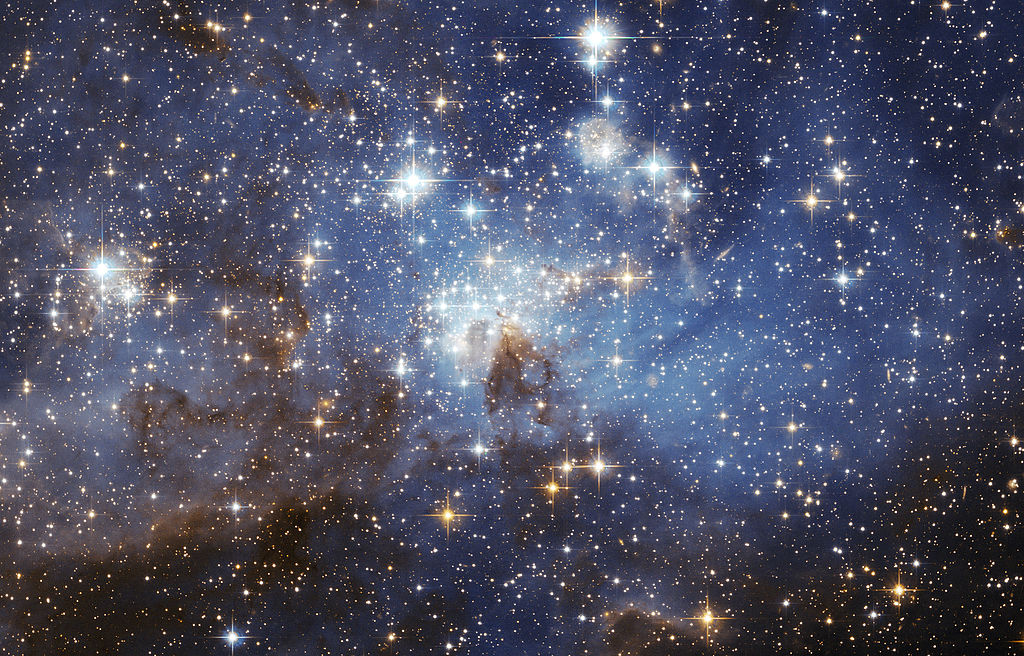
A star-forming region in the Large Magellanic Cloud Wikipedia Commons

*’The Region Linuis’ was first published in Heroic Fantasy HERE.
**Creirwy means ‘Lively Darling’. She is Afagddu’s beautiful (twin?) sister.

With thanks to Wikipedia Commons for the image ‘A star-forming region in the Large Magellanic Cloud’ by ESA/Hubble.

Shattered Vessels and Scattered Sparks

Notes on Welsh Mythology and Lurianic Kabbalah

In 2015 my patron god, Gwyn ap Nudd, showed me a cauldron filled with stars. Shortly afterwards I was transported into the scene in The Story of Taliesin, where Gwion Bach steals three drops of awen (1) and the cauldron breaks, spilling the deadly remnants of the brew across Gwyddno Garanhir’s lands. With it I saw the stars pouring out and was told by Gwyn my task was to gather them.

This story continues to play a guiding role in my path as an awenydd. I was recently astonished when I found similarities between my personal gnoses and Lurianic Kabbalah. This system was created by the Jewish Rabbi, Issac Luria (1534 – 1572) the Ari or the Holy Lion, who lived in Safed in Israel.

According to Luria Or Ein Sof ‘God’s Infinite Light’ was withdrawn in the Tzimtzum ‘contraction’ that made possible the creation of this finite world. The light continued to emanate through the ten eyes of Adam Kadmon ‘Primordial Man’. Each point of light formed the keter ‘crown’ of a sefirot ‘emanation’ in the world of Tohu ‘Chaos’. These lights were contained by ten vessels. Because the seven bottommost vessels could not contain the intensity of the lights they died, shattering, descending into Tohu. This was known as shevirat ha-kelim ‘the shattering of the vessels’. The three vessels at the top were more powerful and those lights continued to shine, emanating the Infinite Light.

Notozin ‘sparks’ of light clung to the fragments of the vessels. By the act of tikkun, the repair of the world above and below by gathering the sparks (seen both as divine light and holy souls)and returning them to the Creator the unity of the shattered God-Head could be re-established.

Parallels can be found between the broken cauldron and the shattered vessels and between tikkun and the task I was assigned by Gwyn, Gatherer of Souls, gathering the stars back into the cauldron. The three remaining vessels, emanating the Infinite Light, resemble the modern symbol for awen /I\.

In the Welsh myths the cauldron is the womb of Ceridwen. She is replaced as the source of awen and as a creator goddess by God in medieval poetry (2). Her cauldron lies in Annwn ‘the Deep’ and its guardian is Gwyn/Pen Annwn ‘Head of the Otherworld’. In ‘The Spoils of Annwn’ it is stolen by Arthur and his men. We find the lines: ‘cledyf lluch Lleawc idaw ry dyrchit, / ac yn llaw Leminawc yd edewit’, ‘Lleog’s flashing sword was thrust into it, / and it was left in Lleminog’s hand’ (3). This potent image of violation is suggestive of the shattering of the cauldron in a lighting-flash and the theft of its pieces.

This scene might originate from an older creation myth akin to the Mesopotamian story of the slaying of the dragon-goddess, Tiamat ‘Deep’, by the lightning-god Marduk, and Indra’s release of the waters from the dragon, Vritra, by a thunderbolt in the Hindu tradition. In Genesis, before God creates the world, we are told ‘the earth was formless and empty, darkness was over the surface of the deep, and the Spirit of God was hovering over the waters,’ suggesting the existence of an older water-deity.

The shattering of Ceridwen’s cauldron is the Big Bang, the moment of creation, when the waters spill out with the stars (4). Ceridwen may have created of her own will before Lleog broke her sacred vessel.

The cauldron is shattered repeatedly in Welsh mythology and these instances are bound up with the near-destruction of the world. In the Second Branch the cauldron breaks after pouring out the speechless dead in a battle that leaves only seven Britons alive and five pregnant women in Ireland. In The Story of Taliesin its breaking poisons Gwyddno’s lands. The survivors are left to pick up the pieces.

My task as an awenydd living in the Anthropocene, this Sixth Mass Extinction, precipitated by Lleog’s sword and Gwion’s theft of the awen shattering the cauldron, is to regather the stars. By gathering constellations of stories in service to Gwyn and Ceridwen I strive to repair the cauldron, the womb of Old Mother Universe, and mend the ways between Thisworld and Annwn. This is my Tikkun.

Photo by Marika Vinkmann on Unsplash

(1) The Welsh word for poetic inspiration stemming from the Indo-European *uel ‘to blow’ and sharing its root with awel ‘breeze’.
(2) This is evidenced in ‘The Chair of Teyrnon’ and ‘The Childhood Achievements of Taliesin’ from The Book of Taliesin and the poems of Cuhelyn Fardd and Prydydd y Moch.
(3) Lleog ‘death-dealer’ (from Lleawc) and Lleminog ‘the leaper’ (from Leminawc) may be names of the same person, who may also be identified with Lleu Llaw Gyffes ‘the Fair-Haired One with the Skilful Hand’. It would certainly take his skill to steal the cauldron. All may be reflexes of the Pan-Celtic god, Lugus.
(4) This was suggested to me by an initiatory experience. After my first dedication to Gwyn, before the star cauldron (the candlelit White Spring at Glastonbury), I experienced swimming through a sea of stars.

SOURCES

Howard Schwartz, ‘How the Ari Created a Myth and Transformed Judaism’, Tikkun
Kristoffer Hughes, From the Cauldron Born, (Llewellyn, 2013)
Laurence Fine, ‘Tikkun in Lurianic Kabbalah’, My Jewish Learning
Marged Haycock (transl), Legendary Poems from the Book of Taliesin, (CMCS, 2007)
Moshe Miller, ‘Shattered Vessels, Kabbalah Online
Patrick Ford (transl), Mabinogi and Other Welsh Tales, (University of California Press, 2008)
Genesis 1., New International Version, The International Bible Society

Henwen – The Birthing and Devouring Sow

gloucester-old-spot-sow-public-domain

I. Henwen – ‘Old White’

In Triad 26. we find the story of a sow called Henwen ‘Old White’. She belongs to Dallwyr Dalben and is kept in Glyn Dallwyr in Cornwall in the care of Coll, son of Collfrewy, one of three ‘Three Powerful Swineherds.’ She becomes pregnant and it is ‘prophesied that the Island of Britain would be the worse for the womb-burden.’ Therefore Arthur and his warriors set out to destroy her.

When Henwen is ready to farrow she goes into the sea at Penrhyn Awstin and is followed by Coll (and, presumably, Arthur and his men). Landing in Wales she begins to give birth to offspring. Surprisingly, they are not piglets! In Gwent she brings forth a grain of wheat and a bee, giving the name to Wheat Field, and in Pembroke barley, ‘therefore, the barley of Llonion is proverbial.’ In these two instances, in South Wales, Henwen’s births are benign and generative, creating crops and pollinators.

When Henwen reaches North Wales, however, she gives birth to wild creatures. At the Hill of Cyferthwch in Arfon she brings forth a wolf-cub and a young eagle. The wolf is given to Bergaed and the eagle to Breat, princes of the North, and they are both ‘the worse for them.’ We find a contrast between the fertile plains of South Wales and the wilder, more rugged regions of North Wales.

‘At Llanfair in Arfon under the Black Rock’ she gives birth to a kitten who is thrown by Coll into the sea. The sons of Palug foster it in Môn (Anglesey) ‘to their own harm’ and it becomes known as Palug’s Cat. In ‘Arthur and the Porter’ we are told that it was eventually ‘pierced’ by Arthur and his men. However, before they managed to kill it, nine score chieftains fell at dawn and it devoured them. Palug’s Cat was one of Three Great Oppressions of Môn along with Daronwy, and Edwin, King of Lloegr.

II. A Sow’s Feast

It believe that Henwen also makes an appearance in ‘The Fourth Branch’ of The Mabinogion. In this story Gwydion is searching for his nephew, Lleu. Gwydion stays at the house of a peasant in Manor Bennard. He learns his learns his host owns a sow who returns every night to feed her piglets. However, nobody knows where she goes during the day ‘any more than if she sank into the earth’. These lines recall Triad 26. where Henwen sinks into the sea, suggesting her otherworldly nature.

Gwydion follows the trail of the sow to a mighty oak which stands between two lakes and is neither wetted by water nor melted by fire. At its roots the sow is feasting hungrily on rotten flesh and maggots. When Gwydion looks up he sees they are falling from Lleu, who is perching in eagle-form in the top-most boughs, pierced by the spear of his rival, Gronw, the gore dripping from his rancid wound.

In the context of this story it seems significant that Gwydion is led to Lleu by this mysterious sow. Earlier Gwydion stole the seven piglets who were given to Pryderi, son of Pwyll Pen Annwn, by Arawn, King of Annwn (along with Coll and Drystan, Pryderi was one of the ‘Three Powerful Swineherds’).

These piglets were special, ‘some kind of creature that has never been in this island before has arrived in the South’. Gwydion’s theft led to a chase from South to North Wales and several devastating battles between his men and Pryderi’s. Pryderi was finally killed by Gwydion in single combat.

It is my intuition Henwen was the Annuvian mother of the seven piglets. Her devouring of Gwydion’s nephew may represent her taking back from him in exchange for what was stolen from her. The chase South to North and trail of devastation are thematically linked with Henwen’s story.

Another point of note is that Daronwy, ‘The Oak of Goronwy’, is referred to as ‘the radiance of the men of Goronwy’ and therefore associated with Lleu’s rival, Gronw Pebr (pebyr mean ‘radiant’). It could be the oak where Lleu perched after being wounded by Gronw’s spear – a scene based on an older initiatory myth. With Henwen’s clawing child, Palug’s Cat, it is included in the Oppressions of Mon. Thus it makes sense to find Henwen devouring the dying Lleu back into Annwn at its roots.

III. Hwcha Ddu Gwta – ‘Black Short-Tailed Sow’

In Welsh folklore we find a mysterious verse about Hwch Ddu Gwta ‘Black Short-Tailed Sow’:

Black short-tailed sow
On every stile
Spinning and weaving
On Calan Gaeaf night

Get home quick, be the first
The Hwch Ddu Gwta gets the last.

She is said to emerge from the ashes of bonfires on Nos Galan Gaeaf and wait at stiles to prey on people walking home late. It is bad luck to be the last to get home as Hwch Ddu Gwta will eat you.

It seems possible the white Henwen, the birthing mother who provided the harvest, is also the black devourer.

There is a similar legend in southern Sweden. Gloso is a ‘glowing sow’ who appears ‘over the twelve days of Christmas’ with ‘eyes of fire, sparks spring from her bristle, and she travels like a burning flame.’ This recalls Hwch Ddu Gwta’s birth from the embers on Nos Galan Gaeaf.

She is also connected with the harvest. Three blades of wheat are left for her in the field. ‘These are for Gloso: one for Christmas night, one for the night of the new year, one for king’s night.’ This makes me wonder whether similar rituals existed to appease the harvest sow in her darker winter apparel.

IV. Ceridwen – The Old Mother

Greg Hill suggests Hwch Ddu Gwta might be connected with the Ladi Wen ‘White Lady’ who also walks abroad on Nos Galan Gaeaf, and with Ceridwen, the goddess of the cauldron. Robert Graves, in The White Goddess, also identified the sow with Ceridwen, ‘the White Lady of Death and Inspiration.’

It is my personal belief that Ceridwen is the Old Mother of the Universe, the Great Goddess from whose crochan, ‘womb’ or ‘cauldron’, all life is born and to whom it returns at death. This would certainly fit with the Henwen ‘Old White’ as the mother who births harvests and monsters and swallows the dead.

SOURCES

Charles Lecouteux, Phantom Armies of the Night: The Wild Hunt and the Ghostly Processions of the Dead, (Inner Traditions, 2011)
Greg Hill, ‘Traditional Customs for the Calend of Winter’, Dun Brython
Rachel Bromwich (ed), The Triads of the Island of Britain, (University of Wales Press, 2014)
Robert Graves, The White Goddess: A Historical Grammar of Poetic Myth (Faber & Faber, 1999)
Sioned Davies (transl.), The Mabinogion, (Oxford University Press, 2007)
William Skene (transl.), ‘Arthur and the Porter’, Mary Jones Celtic Literature Collective

The Giant’s Letters

In Barddas Iolo Morganwg provides a mythical account of the origin of letters, which he claims was passed down from the ancient Bards of the Isle of Britain.

‘Einigain, Einigair, or Einiger, the Giant, was the first that made a letter to be a sign of the first vocalisation that ever was heard, namely, the Name of God. That is to say, God pronounced His Name, and with the word all the world and its appurtenances, and all the universe leaped together into existence and life, with the triumph of a song of joy. The same song was the first poem that was ever heard, and the sound of the song travelled as far as God and his existence are, and the way in which every other existence, springing into unity with Him, has travelled forever and ever… It was from the hearing, and from him who heard it, that sciences and knowledge and understanding and awen from God, were obtained. The symbol of God’s name from the beginning was /|\…

Einigan the Giant beheld the three pillars of light, having in them all demonstrable sciences that ever were, or ever will be. And he took three rods of the quicken tree, and placed on them the forms and signs of all sciences, so as to be remembered; and exhibited them. But those who saw them misunderstood, and falsely apprehended them, and taught illusive sciences, regarding the rods as a God, whereas they only bore His Name. When Einigan saw this, he was greatly annoyed, and in the intensity of his grief he broke the three rods, nor were others found that contained accurate sciences. He was so distressed on that account that from the intensity he burst asunder, and with his (parting) breath he prayed God that there should be accurate sciences among men in the flesh, and there should be a correct understanding of of the proper discernment thereof. And at the end of a year and a day, after the decease of Einigan, Menw, son of the Three Shouts, beheld three rods growing out of the mouth of Einigan, which exhibited the sciences of the Ten Letters, and the mode in which all the sciences of language and speech were arranged by them, and in language and speech all distinguishable sciences. He then took the rods and taught from them the sciences – all except the name of God, which he kept a secret, lest the Name should be falsely discerned; and hence arose the Secret of the Bards of the Isle of Britain.’

The letters were known as gogyrven, a term which has been translated as ‘spirit’ and ‘muse’, and provides the sense that the letters were inspirited and possessed their own lives and potent agency.

When etched onto wood with a knife each letter was known as a coelbren ‘omen stick’ and ‘The Coelbren’ was the name given to the alphabet, which later developed to contain twenty-four letters.

***

It has long been proven that Morganwg’s writings are forgeries and were not passed on from the ancient bards. They are also heavily influenced by Christianity. However, they may still be read as inspired works that contain deep truths open to reinterpretation from a modern Brythonic pagan perspective.

From numerous instances in medieval Welsh poetry where poets deny adamantly that awen is from God and not from the Great Goddess Ceridwen* we can derive that God replaced Ceridwen as the creator of the world and source of the awen. Their denials conceal an older truth. That the universe was born when she spoke her secret name which brought about the primal shattering of her crochan ‘cauldron’ or ‘womb’ – the Big Bang, and the echoing of her name throughout creation as awen-song.

If Ceridwen is our great creatrix, Old Mother Universe, who heard her song? Who is Einigan the Giant? A clue may be found in the name gogyrven or ogryven for letter. Ogryven is also the name of a giant. Hywel ab Owain Gwynedd speaks of ‘a girl in Ogyrven’s Hall’:

Unwilling to leave her (it would be my death)
My life-force is with her, my vitality ebbs
Like a legendary lover my desire undoes me
For a girl I can’t reach in Ogyrven’s Hall.

John Rhys says: ‘three muses had emerged from Giant Ogyrven’s cauldron. But Ogyrven seems to be one of the names of the terrene god, so that Ogyrven’s cauldron should be no other probably than that which we have found ascribed to the Head of Hades.’ It seems that Ogyrven is Pen Annwn, the Head of the Otherworld and guardian of Ceridwen’s cauldron. He is elsewhere known as Arawn or Gwyn ap Nudd.

The identity of Einigan with the Head of the Otherworld is consolidated by Iolo himself. In a later passage in Barddas, referring to the creation of the world we find the following dialogue:

Disciple: ‘By what instrumentality or agency did God make these things?’
Master: ‘By the voice of his mighty energy…’
Disciple: ‘Did any living being hear that melodious voice?’
Master: ‘Yes; and co-instantaneously with the voice were seen all sciences and all things cognitive, in the imperishable and endless stability of their existence and life. For the first that existed, and the first that lived, the first that obtained knowledge, and the first that knew it, was the first that practiced it. And the first sage was Huon, the son of Nudd, who is called Gwynn, the son of Nudd, and Enniged the Giant.’

Menw is a character from Welsh mythology who fittingly knows the language of the animals. The reference to him being the ‘son of Three Shouts’ may refer to the ritual cry of Diaspad Uwch Annwfn ‘the scream over Annwn’ and the power of the voice to summon Annuvian spirits to blight land and people.

Thus we have the seeds of an alternative story of the origin of letters inspired by Morganwg’s writings.

***

The Giant’s Letters

In the beginning there was Annwn, the Deep, a place of silent darkness within the crochan of the Great Goddess. In that silence, in that depth, a very small something formed – a name. And when the Goddess spoke her name, her womb, her cauldron shattered with an almighty bang, her waters broke and poured out in torrents of stars, planets, worlds, our beautiful world amongst them. The universe and its song were born from the secret name of Old Mother Universe and that song was known as awen.

But what is a song with noone to hear it? It was lucky that another of the gods of the Deep heard the song. He is known as Einigan the Giant, Ogryven the Giant, Gwyn ap Nudd, and countless other names. When he heard it, it was so powerful, so full of the joy of the becoming of the universe, so full of the sorrow of the shattering of the cauldron that would be never be whole again, that it seared three burning rays of light into his mind /|\. No matter whether he was sleeping or waking, no matter whether he sat still or ran or hunted through the universe for their source on his dark starry-eyed steed, they would not disappear and the song would not stop repeating itself over and over again.

“What is it you want? What is your demand?” he growled whilst resting at noon beneath a quicken tree.

“We want to be born, we want to be known, we want to be understood.”

The giant finally realised what must be done. Taking his knife he harvested a branch from the tree and cut it into three rods. Onto them he engraved markings for the ten deepest and most primal notes of the song, chanting each gogyrven over and over again, channeling into it its share of the light. When the three coelbren, ‘omen sticks’ as he called them, were formed, the rays faded from his mind. As he looked upon his creation he was filled with a feeling of deep satisfaction and peace and a strange but rightful emptiness, not unlike a mother who has just given birth to three beautiful children.

Yet he still could not rest until he found people who would come to know and understand his creation. He passed on the letters, but, to his horror, they soon lost their meaning. Rather than recognising them as the awen-song of Old Mother Universe, the echoing of her secret name, they began to worship the letters and the knowledge that they allowed them to accumulate instead. Every time a letter was written without purpose he was aware of the light of the universe fading out. He grew so angry that he broke the rods. The intensity of his grief burst his heart, burst him asunder like the broken cauldron. With his last breath he prayed their connection to the song of the awen and their rightful expression in poetry would be reclaimed.

A year and a day afterwards, Menw, son of Three Shouts, beheld the three rods growing from the giant’s mouth. Everywhere his parts had fallen the shoots of new forests of wild words sprang up. Menw learnt the letters and found to his delight they allowed him to commune with the animals who ran ran through those woodlands, with the stones, the rivers, the mountains, the bright shining stars. With all the things that echoed with the Song of Old Mother Universe. When he sang them out loud in perfect poetry he saw three rays of light burning in his mind and his heart was filled with joy.

Menw passed on the secrets of the awen to others who, like him, became awenyddion. When the last died, the light faded. Until those three rays were seen once again by an awenydd called Iolo Morganwg, who penned the story of Einigan the Giant. His works were passed on to others who would answer the giant’s prayer and reclaim the connection of his letters to the name of Old Mother Universe.

And what became of him? Death is rarely the end of a giant. Einigan died and returned to the cauldron. From it he was reborn as its guardian, the Head of Annwn, the ruler of the land of the dead from which the universe was born and to which it will return, as his reward for creating the letters.

abcedilros - the giant's letters

*Taliesin says:

I entreat my Lord
that (I may) consider inspiration:
what brought forth (that) necessity
before Ceridfen
at the beginning, in the world
which was in need?

In ‘The Chair of Teyrnon’ we find tension between conflicting translations of peir as ‘cauldron’ or ‘Sovereign’ (God). ‘Ban pan doeth o peir / ogyrwen awen teir’; ‘Splendid (was it) when there emanated from the Sovereign/cauldron / the ogyrwen of triune inspiration’.

Amongst later bards petitioning Ceridwen for awen is only acceptable when disguised as a metaphor and under the ordinance of God. Cuhelyn Fardd asks God for poetic power akin to ‘the dignity of Ceridfen’s song, of varied inspiration’. Prydydd y Moch requests inspiration from God ‘as from Ceridfen’s cauldron’ and asks God for ‘the words of Ceridfen, the director of poetry’.

SOURCES

Greg Hill, ‘The Girl in Ogyrven’s Hall’, The Way of the Awenydd, (2015)
Greg Hill, ‘Who was Taliesin?’, Awen ac Awenydd
Iolo Morganwg, The Barddas, (Weiser, 2004)
John Michael Greer, The Coelbren Alphabet, (Llewellyn, 2017)
Kristoffer Hughes, From the Cauldron Born, (Llewellyn, 2013)
Marged Haycock (transl), Legendary Poems from the Book of Taliesin, (CMCS, 2007)
Sioned Davies (transl.), The Mabinogion, (Oxford University Press, 2007)

Afagddu’s Sorrows

I.

Oh bone bird mother
do you not see my skeleton on the beach?

Do you not know which cormorant I was?

Do you not know how many stones I ate?
Do you not know of the sorrow of plastic I choked on?
Do you not know how I swallowed enough poison
to save the world but it was still not enough?

Whatever I did I could never gain perfection
with my oily wings, my puddling feet,
my shuffling look of misery.

II.

When I fought I flew into
a blind unchannelled rage like a primeval bird
and no-one could bring me back, could call me back again…

thus I was better as an attendant demon believed malevolent.

I could have been a bard if I had not sung the wrong songs –
the antithesis of the music of the tongue, disharmony, un-cynghanedd.

If my words had not creaked like a broken wing beating and beating
up above as I went about picking up loose pieces of words
that had been discarded like the limbs of dolls
and sad squashed teddies.

III.

In my childhood I had no hug, no cot, no mobile, no talking abacus,
and my mum did not leave the television on.

I didn’t really get to know the village where I was born
down beneath Lake Bala from which only
a harper and robin escaped.

I was more interested in the secret tunnel
between the worlds into which I could drag my ‘belongings’
and keep them safe – the rubbery Wellingtons,
the scribbly marker pens and notes.

Bala has always led to Tryweryn –

to the sunken villages and the empty beds
into which I climbed longing for mum and dad,

to the empty post office, school, chapel, chapel house,
to the cemetery and the new memorial chapel.

IV.

Black, ragged, bloated on November nights
I cannot remember my birthday but only the birthday
of my sister and how this was celebrated with whistles and balloons.

I instead was tarred and feathered and pecked to death

until I was rags and banners of intestine
and of course the cold dry bones,

until the door was opened
and I was bidden go.

Oh bird bone mother
if only you could see me now –

I am flying high beyond perfection.