Penwortham Fairy Funeral

Penwortham Fairy Funeral is a legend based around Castle Hill, a site of religious and formerly military importance in my home town. The first part of this article presents the original version and its later developments in the context of their placement in the landscape. The second will discuss its origin and meaning within the context of British foklore.

The Fairy Funeral receives its first known mention in James Bowker’s Goblin Tales of Lancashire (1878). A cow-doctor and younger man called Robin are walking home by moonlight from a farmhouse at the foot of Castle Hill to Longton. They climb the hill and pass through St Mary’s graveyard. As they make their exit the clock tolls midnight. They walk down a track to the Lodge, where they hear a passing bell. The gate of the Lodge swings open and a little figure wearing dark clothing and a red cap steps into the avenue chanting. He is followed by a cavalcade of similar figures carrying a coffin and singing a requiem.

The coffin is open. Robin looks inside and sees his miniature corpse, dewy and pale. The procession continues into the graveyard followed by the men. Driven by dread, Robin reaches out and touches the leading fairy. The cavalcade vanishes and a storm sweeps in. Driven mad by the scene, a month later Robin falls to his death from a haystack and is buried in the graveyard where he had seen the funeral of his double take place (1).

Fairy Funeral 1

1850’s map, from Mario Maps, route marked in red

A later version appears to have been passed down by word of mouth. Eli Robinson and Giley Leatherbarrow are walking home from the Black Horse pub in Preston. Having consumed too many Thwaites bitters they decide to take a short cut through Penwortham Wood, which lies on the east slope of Castle Hill. Following the mud track, which is known in the locality as Fairy Lane, they catch sight of the procession. Eli sees the face in the coffin is his own. When he gets home, Eli’s missus refuses to believe he saw a fairy funeral, thinking instead that Thwaites’s ale will be death of him. A month later he is dead. In this version it is uncertain whether he falls from a haystack or takes his own life (2).
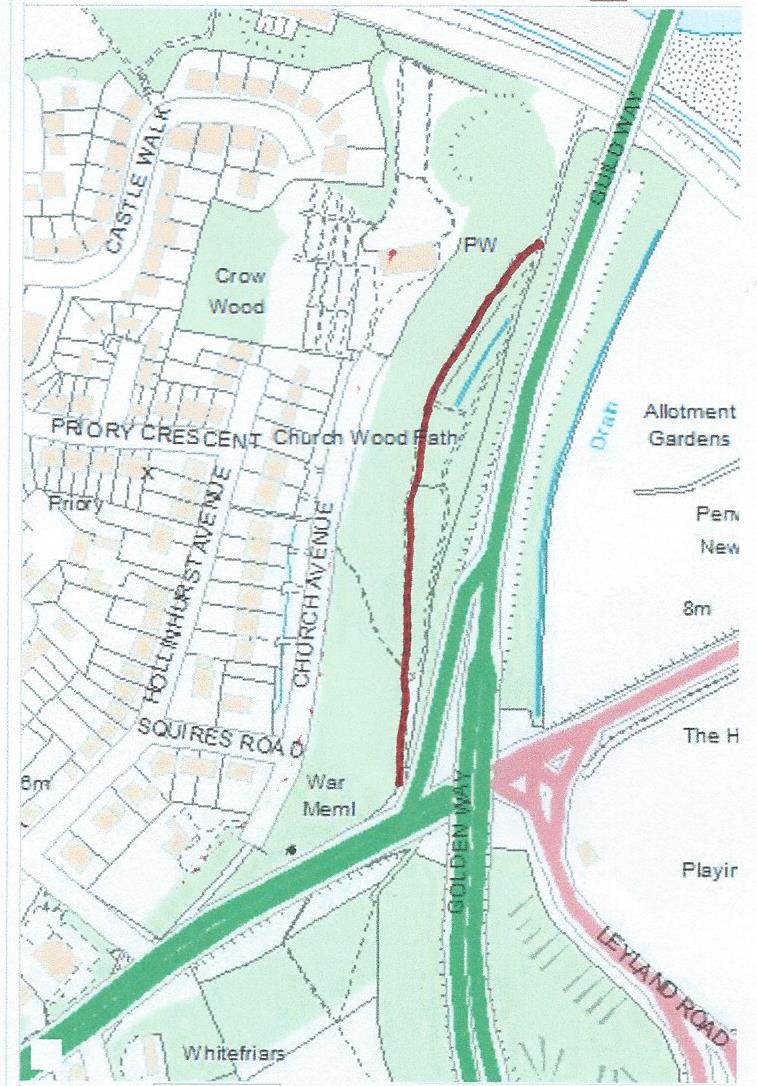
Fairy Funeral 2

Current map, from Mario Maps, route marked in red

Whilst the characters, background and location change, the core myth- a young man sees the double of his corpse borne by a fairy funeral procession and dies within a month- remains the same.
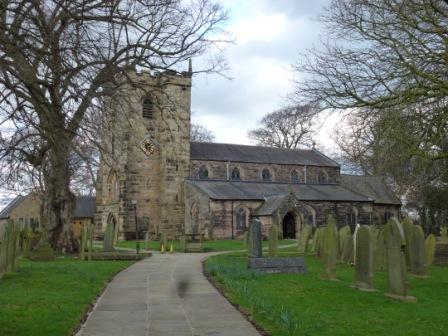
St Mary's Church, PenworthamThe legend can be seen as rooted in the funeral traditions of the township. The earliest known burial at St Mary’s Church is a 12th century crusader. Although there are no more gravestones until 1682, recent excavations uncovered a Rawstorne family crypt and large number of unnamed bodies whose graves had been built over during an extension of the church. Local historian David Hunt believes everybody who lived in Penwortham would have been buried at St Mary’s and suspects many of the uncovered bodies were victims of the 1631 plague (3). The graveyard was expanded greatly during the 18th century and as plaques for cremations exist well into the 21st century, I assume it is still in use.
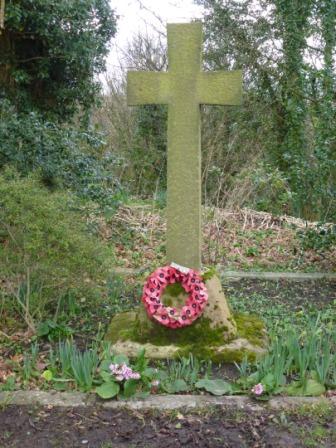
Stone Cross, Church AvenueThe name Church Avenue is suggestive of a processional route. Half way along is a stone cross, replacing a more ancient pedestal (on the map below), which may have been a marker. South of Church Avenue is the site of St Mary’s Well, which was attributed healing powers but dried up at the end of the 19th century before being built over by the A59. Leading to the well from Middleforth was a pilgrim’s path which may also have been part of the route.

Processional Route

1850’s map, from Mario Maps, route marked in red

The position of the current War Memorial suggests the route has continuing connections with ancestral remembrance.

Penwortham War Memorial

I suspect the reason the location of the legend changed was due to houses being built along Church Avenue in the early part of the 20th century. A secular perspective might assume people stopped associating the well lit avenue and its modern housing with the spectral procession, which in the original version travelled along a dark, tree lined mud road. Contrastingly, those who believe in fairies might argue that when the road and houses were built the fairies were either forced to move or made a decision to hold their funerals elsewhere.
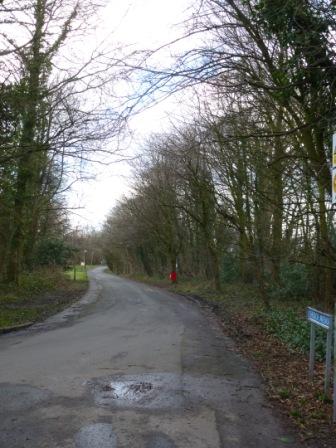
Church Avenue

Anybody who has visited Fairy Lane will know it is an enchanted place. Ash and sycamore are decked with ivy and the ground is thick with moss and rich with fern and hart’s tongue. Every spring the woodland is carpeted with wild garlic and bluebells. The trees lining the lane are gnarled and fay and it’s easy to see why it might be associated with fairies, or why the fairies might have chosen it is an alternative location for their processions.
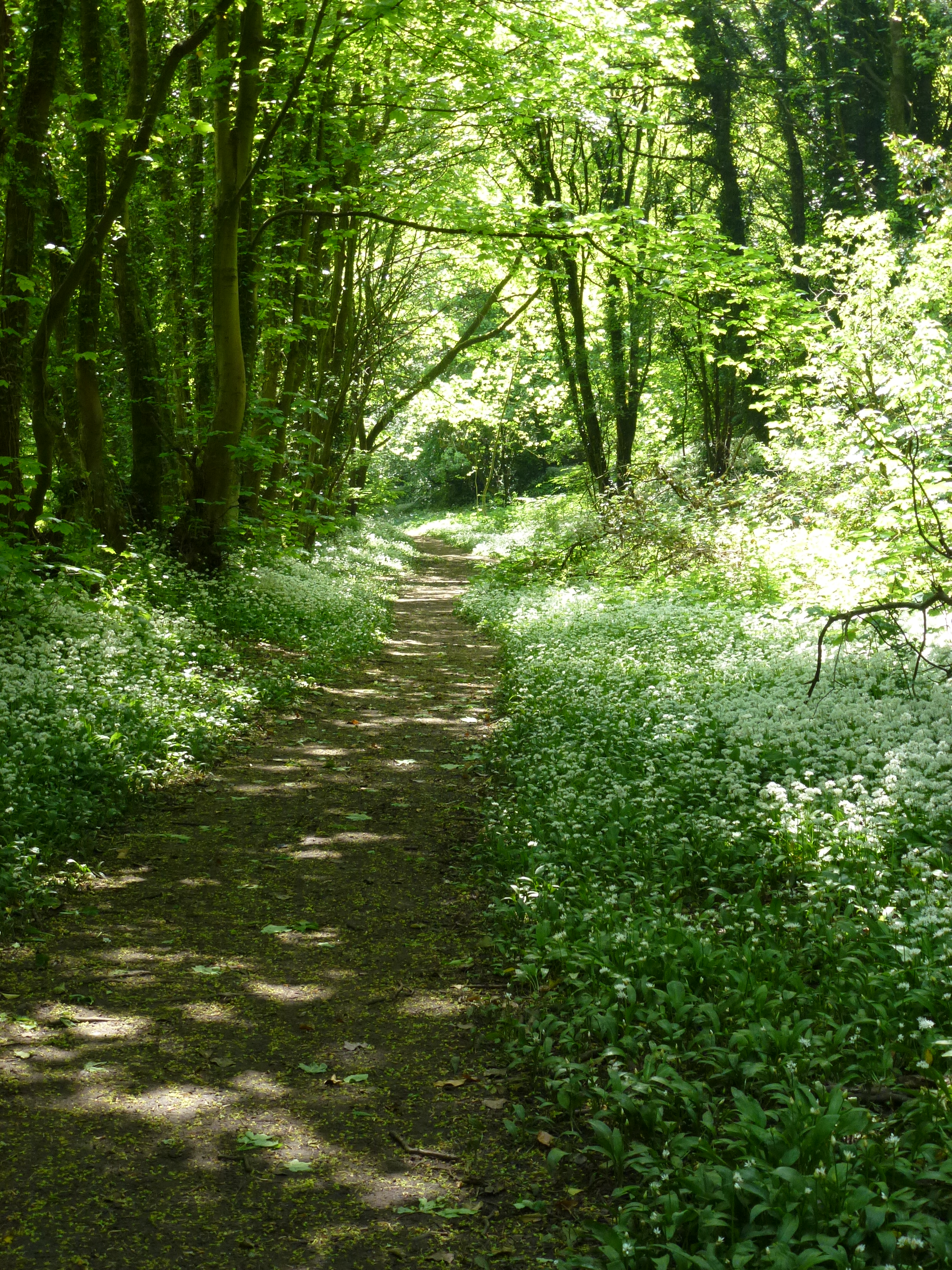
Faery Lane, Spring

~

The origin of Penwortham Fairy Funeral can be partially derived from the landscape and local funeral traditions. However this does not explain why the men saw fairies, as opposed to ghosts or other spectres, or the portentous aspect of the legend. Locating it within the context of British folklore has helped me gain a better understanding.

Prior to Saxon settlement, the inhabitants were part of a culture who spoke Cumbric, a British language close to the Welsh Cymric (4). This is shown in the etymology of ‘Penwortham’. According to Alan Crosby the ‘Pen’ element is a British word meaning ‘prominent headland.’ ‘Worth’ is Old English and means ‘enclosed settlement’. ‘Ham’ is Old English for ‘land within the bend of a river’ (5). An older spelling of Penwortham found in the Domesday Book is ‘Peneverdant.’ Rev. Thornber says ‘the old name of Penwortham is of British origin, thus – Peneverdant is formed of three words – pen, werd or werid and want, as Caer werid, the green city (Lancaster) and Derwent, the water, that is the green hill on the water.’ (6) East of Penwortham is Walton-le-dale. Walton is Old English for ‘the settlement of the Welsh’ (ie. native Britons).

Paul Devereux says that associations between fairies and funeral processions are common in Welsh mythology. He cites Edmund Jones ‘It was said of Welsh fairies “very often they appeared in the form of Funeral before the death of many persons, with a Bier, and a Black Cloth, in the midst of a company, about it, on every side, before and after it”… it was “past all dispute that they infallibly foreknew the time of Men’s death.”’ (7)

The term ‘fairy’ derives from the Latin ‘fatum,’ which means fate. Their Welsh name is ‘the Tylwyth Teg,’ the fair tribe or family (8). Implicit are physical qualities and a capacity to deal in ‘fairness.’ Bowker’s Goblin Tales of Lancashire and other collections of British folklore which depict people’s interactions with fairies, be they helpful sprites or malevolent boggarts, show the survival of a belief they play an active role in the determination of human fate.

In Burnley in Lancashire there is a similar legend. Captain Robert Parker of Extwistle Hall is walking home from a Jacobite meeting. He hides and by moonlight sees his name etched in brass on the coffin. He takes this as a warning not to support the Jacobites and backs out of the 1715 uprising (9) thus escaping imprisonment. However in 1717 he and two of his daughters are seriously injured in an accident in the hall involving gun powder. Parker dies from his injuries a month later (10).

Other fairy funeral legends include the following: In Gwent a man witnesses a fairy funeral procession approaching down a mountain toward ‘Abergeeg, or Lanithel church.’ He hides behind a wall and as the funeral passes steals a black veil from the bier, which he finds to be made of an ‘exceeding fine Stuff… very light’ (11). In Cornwall a man witnesses the funeral of a fairy queen. As the fairies bury her their shriek of lament is so alarming he joins in. Hearing his voice the fairies depart in panic, piercing him with sharp instruments as they fly away (12). The London based poet William Blake also claims to have witnessed a fairy funeral (13).

Although the consequences of witnessing these funerals are not as dire or fortuitous as the Lancashire cases it is clear the fairies are seen as real and that interacting with them has a real effect on human lives. The man from Gwent steals an actual cloth. The Cornish man is physically injured. Whilst Blake is not harmed he claims to have died several times during his lifetime and his poetry certainly displays the visionary quality of Faery.

Whilst our secular worldview attempts to eliminate beliefs unproved by reason or science they continue to be evidenced by arts and folklore and in personal experiences with the fairy races themselves. Penwortham Fairy Funeral is only one example of relations between humanity and Faery. I wonder whether there as many stories as there are incidences of contact with fairies?

Fairy Lane, Spring 2014

(1) http://www.gutenberg.org/files/39712/39712-h/39712-h.htm#THE_FAIRY_FUNERAL
(2) http://everything2.com/title/The+Fairy+Funeral
(3) http://www.srtt.co.uk/2012/12/the-archaeology-of-penwortham-a-talk-by-david-hunt-2/
(4) Aidan Turner-Bishop, ‘Fairy and Boggart Sites in Lancashire,’ ed. Linda Sever, Lancashire’s Sacred Landscape (2010), p96
(5) Alan Crosby, Penwortham in the Past (1988), p14
(6) Rev. W. Thornber, ‘The Castle Hill of Penwortham,’ Transactions of the Historic Society of Lancashire and Cheshire 1856/7, p66
(7) Paul Devereux, Spirit Roads (2003), p135
(8) T. Gwynn Jones, Welsh Folklore (1930), p51
(9)http://www.lancashiretelegraph.co.uk/lookingback/8452575.Bag_a_boggart__but_don___t_give_it_gifts_/?ref=rss
(10) Aidan Turner-Bishop, ‘Fairy and Boggart Sites in Lancashire,’ ed. Linda Sever, Lancashire’s Sacred Landscape (2010), p97
(11) http://www.blaenau-gwent.gov.uk/8037.asp
(12) http://www.sacred-texts.com/neu/eng/efft/efft22.htm
(13) Katherine Briggs, The Fairies in Tradition and Literature (2002), p197
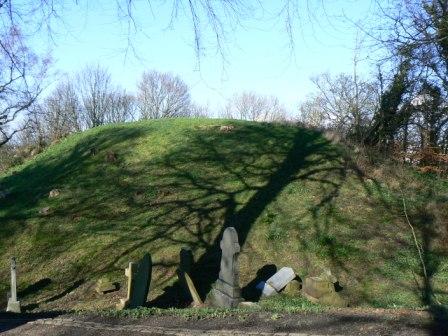
Castle Hill

Castle Hill, motteSegregated by the howling by-pass and enclosed within a shroud of trees Castle Hill is a well kept secret unknown to most of Penwortham’s residents. Yet this hidden headland puts the ‘pen’ in Penwortham, or Peneverdant- ‘the green hill on the water’. It is the place where the history of the township began.

Occupation of the area dates to the Neolithic Period. The construction of Preston Docks in the late nineteenth century unearthed a collection of human skulls dating from 4000BC to 800BC, the bones of auroch and red deer, a bronze age spearhead, remnants of a brushwood platform and pair of dug out canoes indicating the existence of a dwelling akin to Glastonbury Lake Village inhabited by the Setantii tribe. Following from the notion that churches are built on pagan sacred sites it is possible St Mary’s church (which is on the summit) replaced a burial mound and / or stone circle.

The sacred nature of the hill is shown by three recorded holy wells. The best known is St Mary’s Well, which was located at the hill’s foot. It was attributed healing properties and was an important sight of pilgrimage. Since drying up its has sadly been covered over by the by-pass. This well was of such importance local people walked a mile to fetch water from it, following the pilgrim’s path. St Anne’s well was located to the west of the church. A well within the church was recently discovered to contain a body inhumed with three skulls which might serve an apotraic function.

A ballista ball and nearby industrial site supplemented by the tale of a ghostly troupe of centurions suggest Roman occupation. The castle mound and its twin at Tulketh were built by Saxons to hold off the Vikings who buried the infamous Cuerdale Horde. When the Normans invaded they rebuilt the castle and Peneverdant served as administrative centre to the Barony of Bussel. The hill was also the site of Penwortham Priory and residence of some scurrilous monks.

Since then St Mary’s church has governed the parish. Whilst the earliest known grave is of a 12th C crusader, the graveyard has served as a burial place for Penwortham’s people since the sixteenth century. The war memorial on the south bank resonates deeply with its association with ancestral remembrance.

One of its darkest legends concerns a fairy funeral. Two men returning home come upon a procession of little men clad in black, wearing red caps and bearing a coffin. One of them dares to look within and sees his miniature doppelganger dead and cold. When the fairies begin the burial he tries to stop it by grasping their leader and the party vanishes. Driven mad by the experience he topples from a haystack to his untimely end.

The path running through Church Wood beside the hill is known as Fairy Lane. In spring it is covered by bluebells and ransoms. In summer the blackbird song never ends. In autumn winds crash, leaves fall and the by-pass roars. Through winter’s depth ivy keeps the wood alive, the leaning yew holds vigil and for a blessed moment there is silence.

Every visit to this magical place, standing between humanity and nature, the dead and the living reminds me of those unseen bonds which might otherwise remain unacknowledged as the old green hill.

* First published in The Druid Network Newsletter (Samhain 2013)

Gwyn’s Apprenticeship and the Role of the Awenydd

Moon over Castle HillAfter two years studying Druidry (and many years prior to this of searching) on the morning of the winter solstice I received a name for my spiritual path- Awenydd. It was a gift, bestowed by Gwyn ap Nudd (1) and the spirits of my local landscape.

Over the past year my path has grown to centre on my apprenticeship to Gwyn, which began when I made a vow to him as my patron at Glastonbury’s White Spring last January. This role has involved learning more deeply the life cycles of the trees, plants and wildlife of my local area, journeying to meet their spirits and travelling into the land’s past to learn its history. With Gwyn’s guidance I have journeyed the Otherworld, gaining direct experience of realms such as Annwn and Faery, met their inhabitants and borne witness to mythic events.

In exchange I have strived to share this magic through poetry with the aim of revealing my local landscape as inspirited and communicating my vision of the Otherworld. I believe this serves Gwyn for it his task as a king of the Otherworld and leader of the Wild Hunt to maintain the dynamic between the worlds lest this one be destroyed (2). Being gifted with the role of the Awenydd seems to be a natural development of this relationship.

An early description of the Awenyddion can be found in Giraldus Cambrensis’ 12th century manuscript, Description of Wales.

‘There are certain persons in Cambria, whom you will find nowhere else, called Awenyddion, or people inspired; when consulted upon any doubtful event, they roar out violently, are rendered beside themselves, and become, as it were, possessed by a spirit. They do not deliver the answer to what is required in a connected manner; but the person who skilfully observes them, will find, after many preambles, and many nugatory and incoherent, though ornamented speeches, the desired explanation conveyed in some turn of a word: they are then roused from their ecstasy, as from a deep sleep, and, as it were, by violence compelled to return to their proper senses. After having answered the questions, they do not recover till violently shaken by other people; nor can they remember the replies they have given. If consulted a second or third time upon the same point, they will make use of expressions totally different; perhaps they speak by the means of fanatic and ignorant spirits. These gifts are usually conferred upon them in dreams: some seem to have sweet milk or honey poured on their lips; others fancy that a written schedule is applied to their mouths and on awaking they publicly declare that they have received this gift.’ (3)

When I first read this passage a couple of years back I found little I could relate to. Returning to consider it now I find the ideas more resonant.

A phrase which immediately stands out is that the Awenyddion are people inspired. Within the Bardic Tradition I have found the predominance of structured courses of training and people’s preconceptions about the role of the Bard problematic. Experience has taught me I cannot learn stories or poems by rote. Myths and the deities within them have a life of their own, calling through Bardic, folkloric and contemporary texts, or revealing themselves in the landscapes of either world to impart the gifts of inspiration and transformation when the time is right.

Following a conversation with a visiting speaker at my local pagan society, who when I named my path as “Druid Bard” assumed I was of the ‘Bardic Grade’ and completing a ‘gwers’ within OBOD I began to question (and not for the first time) whether this name was a true fit with my spirituality.

During this period I asked Gwyn how my apprenticeship related to Druidry. He told me my role is bound up with the primal Awen, which flows before thought through all things. This supported my suspicion that true inspiration can only speak when systems, concepts and fear of other people’s opinions are set aside. Only by listening directly to the Awen and my own intuition could I become a person inspired and create works worthy of sharing with others.

Another point of resonance is that inspiration is a gift from the spirits, through possession, dreams, milk or honey or a ‘written schedule.’

I’ve never been possessed in the sense of losing my senses and being unable to recall what happened afterward. However I have channelled the voices of spirits and deities whilst writing poetry. During a writing trance visions have appeared where they have revealed themselves in new ways and I’ve recognised their guiding hand even when making finishing touches, in the gift of a completing image or right feeling of a word.

I’ve also been gifted with inspiration in dreams. One of my most significant dreams was when I learnt the identity of my white totem mare. She appeared to me winged and I joined consciousness with her to fly to the top of Castle Hill, a local sacred site. Another important dream occurred the night before my birthday. After seeing a moon bridge in the river Ribble I dreamt of questioning a series of gnarled fay in a cave in Castle Hill. When I realised the process was futile Gwyn appeared and inquired why I hadn’t asked him. By this time I had forgotten the question. The dream conveyed a powerful message about the ethos of questioning in the realms of Faery and dream.

The mention of milk or honey puts me in mind of mead, which in my experience certainly inspires connection with the spirits, writing processes, performances and rituals. The image of the ‘written schedule’ touching an Awenydd’s lips seems to symbolize direct inspiration through the written word.

In the modern world the role of the Awenydd is not limited to ecstatic prophets. Kristoffer Hughes places ‘becoming Awenydd’ – ‘becoming the inspirer’ at the core of Druidry. He says ‘they were the enlightened ones, those who serve, those who inspire to bring others into the mystery of spirit and the great song… by inspiration.’ (4)

Elen Sentier is an ‘awenydd, a spirit keeper and taleweaver from a long family lineage.’ She describes this path as ‘British native shamanism.’ (5) Alongside her reindeer goddess, Elen of the Ways she works with Gwyn as ‘the goddess’ guardian.’ Part of her work involves tracing Elen’s Deer Trods which are also the ‘energy roads’ down which Gwyn leads the Wild Hunt. Many of these are ‘spirit paths’ taking souls to the Otherworld (6) and correspond with corpse roads such as Church Avenue on Castle Hill.

For me the name Awenydd has a magic born of its direct connection with the spiritual source which flows through the land defying all systems and can only be spoken in poetry. My role as an Awenydd is one that I only have intimations of at present- small clues to the potential of learning with the leader of the wild chase and king of the Otherworld to travel the spirit paths and experience the mysteries of the primal Awen in order to return as the inspirer.

(1) Gwyn ap Nudd is a Brythonic deity. His name means White Son of Mist. He is a king of the Otherworld, leader of the wild hunt and guide of souls.
(2) Evidence of this role is found in The Mabinogion, ‘Twrch Trwyth will not be hunted until Gwyn son of Nudd is found- God has put the spirit of the demons of Annwfn in him, lest the world be destroyed. He will not be spared from there.’ Sioned Davies, ‘How Culhwch won Olwen,’ The Mabinogion, (2007), p199
(3) http://www.gutenberg.org/cache/epub/1092/pg1092.html
(4) Kristoffer Hughes, Natural Druidry, (2007), p67
(5) Elen Sentier, Elen of the Ways, (2013), pvii
(6) Ibid. p26-28

Awenydd

I.
As the longest night looses
darkest claws I walk amongst shadows
at dawn where moonlight floods
through the arms of trees
and a solitary lamppost lights the vale.

Lamppost, Greencroft ValleyII.
River-trees stand stark and tall,
consistent in her mind’s
unravelling of currents and tides,
cormorants and gulls,
a ragged heron.

RibbleIII.
The host’s roar to a lullaby
quells as moon leads dawn
over chiming hills to be swallowed
by cloud as the hunt returns
to graveyard and mound.

Moon over Castle HillIV.
My lord of the fay
makes his presence known.
He speaks to the mist within my bones
like the lych gate unfastening,
awenydd– my magic word.

Lych gate, St Mary's ChurchV.
The spirit paths are mine
to walk for an evanescent pulse
of dawn. Time stands still
from vale to hill and the stream
sings: awenydd, awenydd.

Fish House Brook

Spirit of the Aquifer

In eighteen eighty four
a monolithic feat of engineering
shifts the Ribble’s course:
no water to the springs.

From the hill’s abyssal deep
a rumbling of the bowels,
a vexed aquatic shriek:
no water to the wells.

Breached within the chasm
a dragon lies gasping
with a pain she cannot fathom:
no water to the springs.

Water table reft
her giving womb unswells,
surging through the clefts:
no water to the wells.

Unravelling inside
her serpent magic streams
to join the angry tides:
no water to the springs.

Culverted and banked
her serpent powers fail,
leaking dry and cracked:
no water to the wells.

The spinning dragon-girl
tumbles from her swing
and slips to the underworld:
no water to the springs.

Her spirit will not rise
through the dead and empty tunnels,
disconsolate we cry:
no water to the wells.

The hill, no longer healing
stands broken of its spell,
no water to the springs,
no water to the wells.

Peneverdant, A Lunar Cycle

I. Dark Moon

On a dark moon
the lady in the ivy
winds down the dark hill
and the falling graves.

All memory
is sliding into darkness,
the river’s tides
her open mouth.

She is waiting
for the return
of her tribe
on their oaken boats.

The moon is dark
over the river-
an eye, a maelstrom
between the worlds.

The fleet are ready,
the church is empty,
graves as hollow
as the old green hill.

She will be waiting
in the ivy
for the return
of her tribe
on their oaken boats.

II. New Moon

All is darkness
but the splash of the tide,
the wing of an owl.

Lady Ivy
recounts her losses
on the hill
and the bank
where the hangman
wore his cowl.

They are waiting
in the maelstrom eye
of the new moon-
the river’s entryway
to living day
and deep Annwn.

They are waiting,
her hidden tribe
on their oaken boats
in a slit of light,
an opening moonbeam
to row through
the night
to the old green hill.

III. Moon First Quarter

There is wisdom
in the eyes of an owl-
a demand,
a categorical imperative.

Behind cumulonimbus clouds
secretly moon’s orb
is swelling.

They row.
History is written
in their woad-
gods and goddesses,
an oak king,
the lakes and water courses
of their oaken fleet,
the moon’s eye
in the shining river
and all the laws of the deep.

IV. Full Moon

The moon is full
behind the clouds.
She casts no light
on the empty boats,
the processional route
around the old green hill,
the moving river of woad.

Lantern bearers
pass the old iron rails,
the gloomy gathering of graves
to assemble on the mound,
igniting the beacon fire.

By the wing of an owl
the clouds are moved.
The moon looks down,
victorious.

They salute her orb
in the shining river,
the gods of the hill
and the deep.

On this night
of opened graves
anything is possible
in the light of the beacon fire
before the lambent eye of the moon.

V. Moon Last Quarter

Night has fallen
from the moon’s closing eye.

The owl has flown
to the hunt.

The fire gone cold
with the lanterns’ glow
is eclipsed by street lamps
and brake lights.

The by-pass roars
by the old green hill.
The river is concreted
back in her new course.

Lady Ivy
winds down
the hill and the graves.
She waits
for the tribe to row
to the river-moon
on their oaken boats,
to her maelstrom-eye
between the worlds.

Lady of the Oak

I leave the shelter of the grove ducking beneath twisted hawthorn branches. The trees weave the entrance closed behind me. Rain hits my face, falling from a heaven of relentless grey. Reading the sky’s grimace I wonder what has been seen.

A crow caws his warning. Sprinting toward me up the hollow way I see a young man, legs a blur of blue white checkers and feet a splash of mud and leather. Hair slicked to his head, his dark eyes flicker with awe and wariness. The first dapples of a beard play across his chin like leafy shadows.

“M-my Lady of the Oak,” he stammers pulling up.

His breathless chest heaves beneath a sodden tunic. It is rare for youths to approach me without an elder. Looking more closely at my gnarled face his eyes widen in dawning horror. “Bad news travels from up river. A Man of the Oak wishes to speak with you.” He runs away in a flurry of muddy feet.

I follow down the hollow way heedless of the downpour weighing my cloak for the damp of the air already resides deep within my bones. Looking east, rain drenches the green hill, our sacred headland, and the greener barrow housing our ancestors. The torrent’s drumming beat strikes bubbles across the marsh land. As I walk onto the wooden pad way the reeds hiss like snakes. Decay bites my throat. The steely cast of the river of shining water reflects the glumness of the sky.

In a canoe roped to the jetty my cousin Drust sits hunched in his robes. I question what he is doing here, alone.

The river’s song answers. Her visions flood my mind. I see the battle at the ford of roaring water. Broken chariots, tribesmen slaughtered, the hero light vanishing from their eyes like fleeing stars. The eagle standard flies high, reflected in the crimson river. Seeing the pale flicker of their separating ghosts I speak a prayer for the souls doomed to return to a land where they no longer belong.

Sorrow chokes me like bile. I vomit it in anger at Drust, “what are you doing here, when your clan are dead?”

Drust looks up, yet his face remains hidden by his cowl. “I am taking the remnants of our traditions and our gods to the island across the sea.”

I laugh, a throaty brittle sound like twigs twisting and snapping. “Gods are not like saplings, to be taken away and re-rooted and traditions are not nurtured by foreign soils. It seems the ideas of the invaders have penetrated more deeply than I imagined.”

Drust tenses. Drawing my knife from its leather sheath I lean down and slice the rope tying his canoe to the jetty. The river sluices him west and out to sea.

The wind carries enemy voices. Reflected in the falling droplets I see swords and plumed helms. Slipping on the wood and slithering up the hollow way I reach the grove and beg the hawthorns for passage. A peace of ancient green breaks over me, like I’m sinking into a bed of moss. Beneath the canopy’s protective shadow I believe myself safe until tumult disturbs the roots. Crows caw, anticipating carrion.

I cross a sea of acorns and approach the grove’s mighty king. Putting my arms around his trunk, I press my face to the rough bark. “Brother Oak, let me see into the future.”

My heartbeat merges with the pulse of rising sap. My feet become roots reaching downward through damp soil to the outer edges of the grove. My arms stretch into branches and split, bearing bunches of lobed leaves nourished by the hidden sun, washed by the rain, flourishing green.

The ground shudders at the march of soldiers, galloping hooves and chariot wheels. Battle cries are hollered. Bows hum to the crash of metal. Screams and groans rock me. I taste blood and its bitterness fills me.

Earth and water shift as ditches are cut, fields plundered to feed the enemy. Ancestral ghosts clutch my twigs shrieking of their barrow torn down and a temple built to a foreign god. I moan at the ache of rot softening my flesh, bowing and creaking as my branches snap and innards hollow. I beg for lightning’s merciful release but there is no answer from the clouds of sorrow.

“Brother, let me return,” I speak. “The tribe need my support in their defeat.”

I ease back from the oak as the hawthorns scream and turn to see branches broken, shredded leaves and burst haws at the sandaled feet of a man dressed in a plumed helmet, iron breast plate and red woollen tunic. His eyes are blue, skin tanned by the sun of a hotter land. Brandishing a sword stained with blood and sap he accuses me of witchcraft, of sacrificing innocents to divine the future from their death throes.

I smile. The man freezes in horror. I draw my knife and mustering all my oaken might I drive it between the iron plates and slice open his stomach, spilling his guts upon the grass. Attempting to gather them in like rope he drops twitching and groaning to his knees.

I read the future of his people and their empire from his pulsing entrails.

Kneeling, I pick up a handful of blood soaked acorns and address my brother, “do not fear. Whilst tribes and empires rise and fall, the steady strength of oak will conquer all.”

Oak, St Mary's graveyard, Castle Hill

The Black One of the Seas

Castle Hill, on the RibbleThe green hill on the water drifts
Anchorless on high tide.
Wraiths of fog fight the primal mist.
Hoof beats fall from behind.

The splash of marsh brings rounded feet;
Miracle he doesn’t sink,
Approaches like an isle-bound fleet,
The Black One of the Seas.

His mane is waves, his arching crest
Vaunts higher than a mountain.
His tail, a tiller switches, twists,
His nostrils foam black fountains.

His heaving chest rumbles and roars,
Rolls like the tides of the seas.
His long legs, a volley of oars
Beat like a heart possessed.

A troupe of seven rides his back,
The Northern King Elidyr,
Advisors, servants, child behind,
A cook upon his crupper.

Weary party, a doomed portent,
Endlessly blown ferry
Voyages black and breaking straits
From Clyde to Anglesey.

Rhythms of life they drive and smash
Like waves wrecking a jetty.
Then sink back to the ocean’s death
With the Black One of the Seas.

* This poem is based on ‘The Three Horse Burdens’ from The Triads of the Island of Britain, which can be found here: http://www.celtnet.org.uk/texts/llyfr_coch/typ_eng.html

The Colloquium of the Brooks

Ribble close to Mill Brook


On the silted shore of the Ribble
Where the gulls dip and call
The river banks her vista
And the tides ebb and flow
In unending expeditions
From the land to the sea
The brooks broach their quantas
And descry their misery.

Fish House Brook:
How long now?

Penwortham Brook:
Patience little sister, can’t you see the times are changing?

Fish House Brook:
I’m barely in a position to perceive change
Caught in the constrictions of the concrete culverts
Cut by the man-made channels, blinkered in blind
Alley-ways, forced through dire traps and grilles,
Stumbling in terror via that jail house prison
Cruelly manufactured for me below Hill Road South.

Mill Brook:
If you would look beyond those despotic fixities you would see
The dark pall of the industrial era has lifted, your brother
And I are freed from servitude, our water running clearer by the day.

Fish House Brook:
And you see this as consolation?
Do you not remember when the magnitude of our flow
Turned water wheels, had the force to overturn wagons
And shifted the lay of the land to sculpt our valleys?

Mighty Belisama, you must recall our glory days
Before they shifted your course from Watery Lane to Castle Hill,
Deformed our travails, forever destabilised our tables?

Belisama:
Quarrelsome brooks, stare firmly at the quintessence
Of your course and see all that remains constant is change.
Since the ice lords rode our backs, pitched us deeper
Into the frozen earth, and through the aeons before
Our wills and paths have never been wholly our own.

Fish House Brook:
That the principalities of nature shape us I do not disclaim.
But these men… with their yellow jackets
And heaving ploughs, excavators and cranes,
Winding cords, caterpillar rolls, drop down drains,
Their discernment as dense as a builder’s helmet,
Vision blank as a steel lid, they are numb as their machines.

Penwortham Brook:
Not like the orphans who worked my looms.
I remember their knocked legs stumbling to my bank,
How they stared into the rainbow of my polluted depths.
With wide white eyes they contemplated their horror in me,
Knowing not what they were or what I could be.

Fish House Brook:
At least then we were seen. Now the people stagger
By blind as drunks, ditching debris on our banks.

Mill Brook:
Humans… still given wholly to gods
They cannot see. Servile seeking invisible wealth
Not even gleaming gold. Their only idols strip plastic
Features on the screens, flip in pixels to wide dumb grins.

Fish House Brook:
The vapid screens suck out their lives.
They are not aware of, nor do they understand their sacrifice.
Whilst trapped within their drains we wither up and die.

Penwortham Brook:
Belisama, tell her that isn’t true.

Belisama:
How many years have men visited our banks?

Fish House Brook:
Well, I remember when we were treated with reverence.
Do you recall the long days spent by smiths at the forge,
The bold shatter of sparks, the bright ring of the hammer,
The beauty of gifts delivered in resonant ceremonies,
Swords, axes, heads crafted from stone and those of enemies
Whilst now all they drop in is litter and fag ends.

Penwortham Brook:
It was when the factories rose that the human race
Became effulgence and we it’s dumping ground.

Fish House Brook:
Now red fades to grey and the system is dying.
Their wonders drop, one by one, like falling dolls.
They roam the streets, jobless and desolate.
There is no hope in their eyes.
They have no strength left.

Belisama:
Bearers of the brooks, steerers of the streams,
Deliverers of my bright waters. Do not dismay!
Like the course of a river, times will change
We are bound into a whole with sea and rain.
With he who brings the tides come the waves.
I still commune with the lords of the glaciers
And they say we have not got long to wait.

Fish House Brook

The King of Faery

In woodland damp, a shady dark divine
On aged slope the creeping ivy climbs.
Caressing thorn and dressing ash with vine
A poison maid spreading her locks sublime
Drapes kingdom fair with wanton waxen shine.
The deep earth’s lawless vagabond of joy
Cords heart shaped leaf where eldritch magic lives,
Ascends, protects the glamorous abode
Of fair folk ancient as the darkness of the wood.

Rooted fast at the foot of hallowed hill
In somber silence stands a leaning yew
Ghosts and needles shadowing its boughs
Whispers hanging sorrowful and true,
Of pageant stately passing at full moon.
Yew tree hides the underworld’s feared gateway
Beneath the haunted watching of its roots.
The wise and dead or reckless seek entry
Imploring the illustrious King of Faery.

~

His spectral shine shimmers white as moonlight
His hair floats fair about his phantom limbs
His warrior attire is black as night.
The eyes of the hunter of souls are grim
As the howl of his hounds on Annwn’s winds.
His dread black steed is a beast of the marsh
Dripping like the sea, his whinnying swims
Like a wetland dobbie bridging the worlds
And hurtling his way across the oak covered swamp.

The King’s pale face is black with wrath
For an eldritch dream killed by disbelief.
Souls who crossed to Annwn to be reborn
Stagnate in the gloom of apathy’s reign.
Through a mist of twilight doomed rides the King.
He travels the path of the Ribble’s old course
From the heart of the hill the death knell rings.
Decked in somber garments the fair folk march
Calling souls to the underworld with funeral spells.