The King of Annwn’s Cheekbones

If I had a thousand words 
to describe the King of Annwn’s cheekbones 

I would say they were like icebergs, 
like the hulls of the ships that crash into them and sink, 
like the angles of the limbs of the dead men who float to the surface, 
like the way He lays out the dead in the icy caverns where the ice dragon
roams with a single icy jewel hidden deep within his forehead.

I would say they are like the way He says
the letter ‘A’, the capital, with the triangular tip, 
as if it is not the beginning but the end of the alphabet.

I would say they are like the broken glass
of shattered coffins in my good dreams and not the bad.

I would say they are the antithesis of polar bears and the peak of antinomy.
I would say that I have seen many a skier slide down them to death.

I would say they are like runways and the paths of aircraft
and the flightpaths of starships,
the souls trampling
across them to the otherworld.

I would say they are like the travels of swans and geese.

I would say they are like the strobe lights that shine down 
from the helicopters that fly over my house at night,
sometimes hunting for the criminals 
as He is always hunting 
for the dead.

I would say
they are like the spotlight
in which I stood, dancing, seeking to win His favour.

I would say they are like His anger, like His fury, like His lament,
that they were bent with a hammer in a forge that was
neither hot nor cold nor even burning.

I would say they are his secret.

I would say everybody knows but keeps quiet.

I would say they are like the divine madness that unfolds
itself within His followers in their shapeshifting,
folding, unfolding, spreading wings.

I would say they are bone-light
but heavy in my hands.

I would say
they are like the precipice
I walked on so narrowly between life and death,
so very thin and dangerous on both sides a fall into the abyss.

I would say they were the answer to my prayer after a long dark night
of soul searching, the first slants of the appearance 
of a face in the darkness,
the first strokes
of a name written on my soul.

I would say they were the remedy 
to the poison within me, the pharmakon, the paradox.

I would say they were the pride that summoned me from shame.

I would say they were the answer to my cry for help.

I would say they will help old men 
and feeble infants regain
their dignity again.

I would say
they will once more
be serpents and dragons
with wings bent at cheek-bone-like angles.

I would say I have spoken only half the words 
and will speak the other half 
to him alone 
in death.

The Wise Lad

Over the Twelve Days of Devotion to Gwyn ap Nudd (25th Dec – 5th Jan) I focused on Gwyn’s boyhood. In all honesty at first I wasn’t looking forward to spending twelve days with Gwyn as a boy on the basis of my experiences with the boys at my primary school who were loud, boisterous, rude and bullying.

Thankfully, following my writing of ‘Vindos and the Salmon of Wisdom’, Gwyn reassured me that I wouldn’t be spending my time with Him ‘as a stupid boy’ but ‘as the Wise Lad’.

What will follow over the next few days is the best of the inspiration He gifted to me during this period. Beneath is an image of the Wise Lad with the Salmon of Wisdom and nine hazel nuts looking pixie-like and slightly sinister. I have been led to believe that, like the term ‘the Fair Folk’, ‘the Wise Lad’ is a euphemism for something darker.

My Husband Returns

from one thousand battlefields
where in the dreamtime
He still gathers
the dead.

He is alive.
They are dead.
They will not return.

I think of all the widows
and what a gift it is to be
married to an undying God

who comes in the old armour
and military garments

of all the ages who have fought

and the funereal attire,
black coats, blacker hats…

of all the ages who have wept.

My only tears are tears of happiness
and my laughter is the laughter
of the fair folk who
for once didn’t laugh at our wedding.

His only tear carries the memories
of the astonishing and today
it is for the many and for me alone.

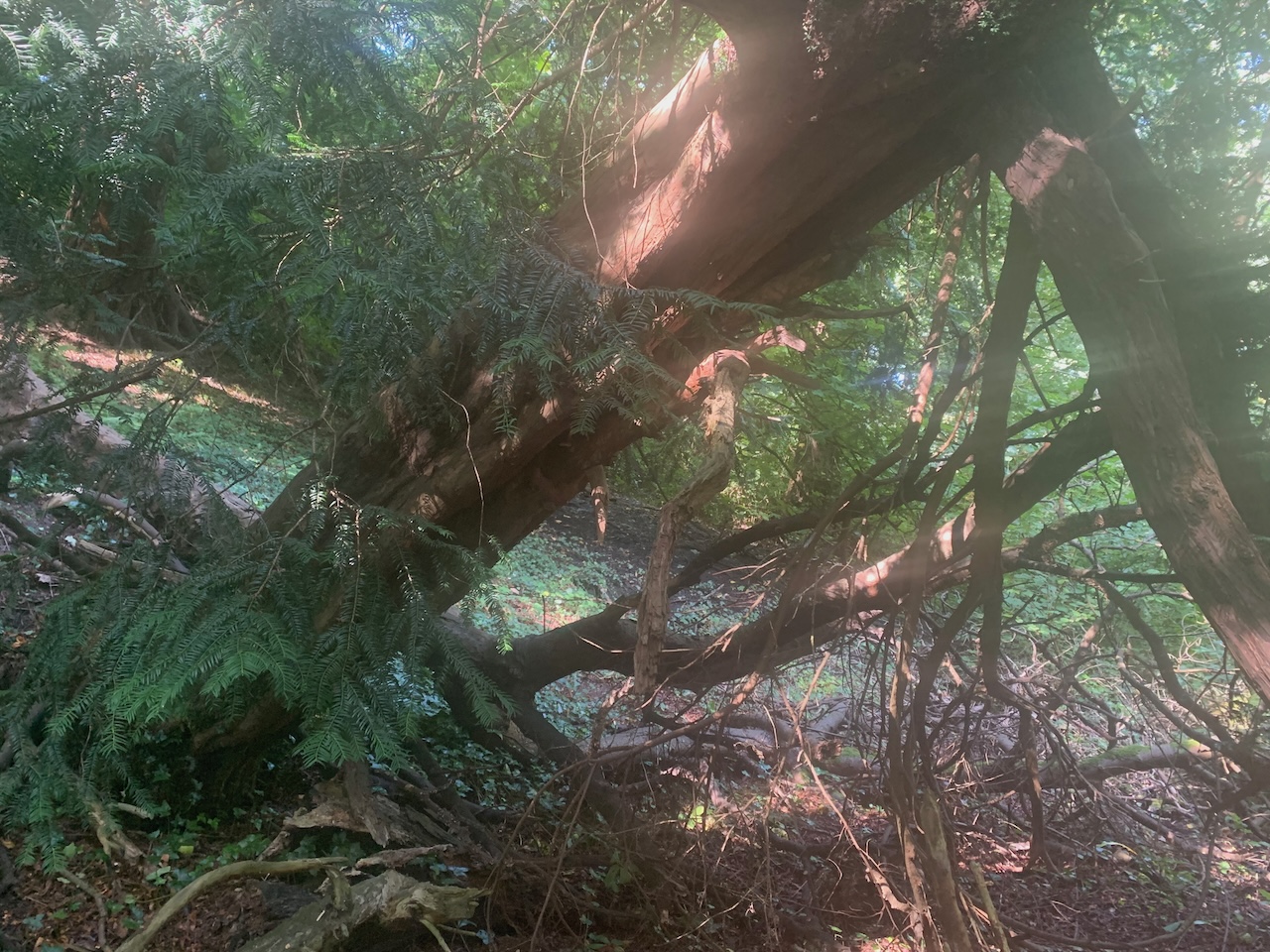
A poem celebrating the twelfth anniversary of my meeting with Gwyn ap Nudd at the Leaning Yew. At this time of year He returns from His sleep in the Castle of Cold Stone for Mis Medi ‘The Reaping Month’ (September). It is the first time I have celebrated our meeting and His return since our spiritual marriage.

Building Brythonic Polytheistic Monastic Practices Part Two – Meditation

Meditation is most developed in the Hindu and Buddhist religions. The earliest references to meditation are in the Vedas from around 1500 BC. In Hinduism the aim of yoga – a combination of meditation (dhayana), breathwork (pranayama) and body postures (asana) – is to still the mind, liberating it from sensory distractions and ultimately from the cycle of death and rebirth, unifying the self (atman) with the Gods (the Brahman or Shiva). In Buddhism the aim of meditation is to reach enlightenment, which resulted in liberation from the cycle of reincarnation as a buddha ‘awakened one’.

These forms of meditation begin with training the mind to focus on one thing – usually the breath. Other subjects of meditation include nature and virtues. Both employ the chanting of sacred syllables to still the mind. Tantric practices involve meditating on and attaining union with a multitude of Deities.

In Christianity meditation is a form of contemplative prayer. Discursive meditation is rooted in the scriptures and involves imagining oneself in the stories, in the shoes of the protagonists, to develop a deeper understanding. Lectio Divina focuses on passages of scripture and has four phases – Lectio (read), meditatio (reflect), oratio (respond) and contemplatio (rest).

Unfortunately I haven’t been able to find any references to meditation in ancient polytheist cultures. The only evidence I have found is the image of the antlered Deity on the Gundestrup Cauldron (150 BC) who is sitting in a meditative position and bears a striking resemblance to Shiva the ‘Lord of Yoga’.

The cauldron is of Celtic La Tène period design and the antlered figure has tentatively been identified as Cernunnos, ‘Horned’, which might be a Gaulish title for Vindos / Gwyn ap Nudd, who I believe is pictured on another plate plunging dead warriors into a vessel headfirst to emerge as riders on His hunt. 

*

When I came to Paganism and Polytheism the first type of meditation I came across was guided meditation, which involves being guided by written words or voice into imaginal landscapes to meditate in safe places or meet with Deities. 

Examples include meditations leading to an inner grove, a spring, or a tree, or another form of sanctuary, meeting Brigit at a well or Cernunnos in a woodland. To the best of my knowledge this type of meditation originated in the Western esoteric tradition with groups like the Hermetic Order of the Golden Dawn and Thelema and was later taken up by Wiccans, Druids and polytheists.

The way I see guided meditation to work is that one must first consciously imagine the scenery (our imagination is one of the tools by which we connect with the Divine) and this act of imagining creates an interface through which the spirit realm speaks. In my experience it is an act of co-creation. Some comes from one’s own imagination and some from the spirit realm in varying degrees and intensity. On some occasions I’ve remained within my imagination and felt like the scenery and Gods are nothing more than cardboard cut-outs and on others I have found myself in lands that are not of my imagining, entirely other, having genuine conversations with the Gods.

Through Druidry I learnt ways of working meditatively with the Brythonic myths by entering into them and standing in the shoes of some of the Deities. Most notably Afagddu, when Taliesin stole His awen and the Cauldron of Ceridwen shattered leaving Him with its poisoning of Gwyddno’s lands.

I also developed a practice akin to Lectio Divina drawn from creative writing workshops in which I meditated on a line or a scene from a medieval Welsh story or poem, then did free writing around it, then crafted it into a finished piece.

*

It’s only over the last couple of years I’ve looked into more traditonal forms of mediation. As a Brythonic polytheist I steered clear of the ‘Eastern’ traditions until I learnt that India and Europe shared an Indo-European culture and there are lots of resonances between Hindu and Brythonic beliefs.

Last year I started practicing yoga and integrating meditation, breathwork and body postures into my practice on the basis of a revelation of the Gundestrup Deity as ‘Meditating Gwyn’ as a way of unifying myself with Him.

At the core of my practice is uniting my breath with Gwyn’s breath, my heart with His heart, being as present in my body as possible so He and my other spirits can experience presence in Thisworld through their union with me.

When I first tried focused meditation I found it incredibly difficult (and still do). I avoided it for a while sharing the beliefs of many others that Eastern meditation isn’t for Westerners and isn’t suitable for our busy Western minds.  This changed when I discovered the Breathe and Flow yoga channel and Bre mentioned that if something is difficult it’s often the thing we need most. 

I started practicing focused meditation with their Expand programme and particularly benefited from their meditation, ‘Refocus’, which describes the benefits of stilling our busy ‘monkey minds’, shifting from sympathetic to parasympathetic states of the nervous system and rewiring our neural pathways. This meditation is very useful as every couple of minutes there are reminders, if thoughts have begun to trickle in, to return the attention to the breath. When I meditate alone it often takes longer to catch myself thinking.

Learning from Breathe and Flow that by focusing on and changing my breath I can control my mind and my emotions has been life changing in helping me manage my anxiety and panic which were beforehand often out of control.

I’ve been inspired to adapt some of the pranayama practices to fit with my spiritual path. Sama vritti, ‘box breathing’ (inhale, hold, exhale, hold), I do to a count of seven heartbeats to unite myself with ‘the Breath of the Gods’. Nadi shodhana, ‘alternating nostril breathing’ I use as a way of balancing the red and white dragons, fire and mist, strength and calm. Dirga ‘deep breathing’ and ‘sleep breath’ (4-7-8) I associate with the healing states of Nodens.

As I have learnt the body postures I have come to link some with my Deities and with various animals in the Brythonic myths. Suptka Baddha Konasana ‘reclining bound angle pose’ is Anrhuna as Mother of Annwn and Parsva Savasana ‘side corpse pose or foetal position’ is foetal Gwyn. Tadasana ‘Mountain Pose’ and Utkata Konasana ‘Goddess pose’ invoke the strength of Anrhuna. Adho Mukha Svanasa ‘downward dog’ and ‘Uttana shishosana ‘puppy pose’ are Gwyn’s hounds or the healing dogs in the temple of Nodens.

The medley of animals, Marjaryasana ‘Cat Pose’, Bitilasana ‘Cow Pose’, Mrigasana ‘Deer Pose’, Catur Svanasana ‘Dolphin’ puts me in mind of the animals surrounding the antlered God on the Gundestrup Cauldron and I wonder if the flows between the poses might have been based around stories featuring sacred animals such as the search for Mabon.

The power of these practices and the changes they have brought about in my life have led me to believe that what we know about the Bardic Schools and their twenty-year programmes for memorising poetic forms and traditional tales is but the remnant of a deeper spiritual tradition in which the stories were meditated on and embodied and lived as mythic realities.

Building Brythonic Polytheistic Monastic Practices Part One – Prayer

In building Brythonic polytheistic monastic practices I feel at once like a pioneer because few people are doing this specific work today but at the same time like I’m standing on the shoulders of thousands of ancestors because since homanids arose the majority have been animists and polytheists.

Since I came to Brythonic polytheism through Paganism and Druidry over ten years ago I have been developing my practices and deepening them further as a monastic since I took vows as a nun of Annwn in 2022.

My main practices are prayer, meditation and trance. These lead into and complement one another and their boundaries can be permeable. Here I will provide my personal understandings and how I have come to them through studying their development in ancient and contemporary polytheisms and current mainstream religions then share how I put them into practice.

Prayer

The first and foremost of my practices is prayer. Prayer, in its most basic form, is conversation with the other-than-human worlds and persons. Indigenous people have always lived in dialogue with the land and its spirits, the Gods and the ancestors, with prayer permeating their lives from rising to sleeping. 

People have likely been praying for as long as they can speak. Some of the earliest recorded examples of polytheist prayers are the Litany of Re from the Egyptian New Kingdom (16th – 11th BC) and the Homeric Hymns (7th BC).

The hegemony of Christianity brought about a shift in focus in prayer from the land and its Deities to one transcendent God and the saints. The rise of rationalism, materialism, industrialisation and capitalism have all played a role in putting into doubt and in erasing beliefs in Gods and spirits. One of the main problems with Western society is that we’ve forgotten how to pray.

Within the current mainstream religions Christianity has the most developed system of prayer and meditation is seen to be a form of contemplative prayer. 

Prayers can be formal (written prayers that are often memorised) or informal (personal prayers in one’s own words often taking the form of a dialogue). Some of the most common forms of prayer are praise / adoration, thanksgiving, petition / supplication, confession, and intercession. Other prayers are written for the marking and celebration of Holy Days.

*

Unfortunately we don’t have any evidence of prayers to the Brythonic Gods because the ancient Britons did not write anything down. However, archaeological evidence shows they made offerings of bones, pottery, jewellery, weapons and other objects in sacred places such as hill-tops, springs, rivers, lakes, bogs, in pits and shafts, and in or near burial mounds. Such offerings were undoubtably accompanied by prayers and ceremonies. 

Much of our knowledge of the Brythonic Gods comes from Romano-British altars and temples wherein they were often equated with the Roman Gods (for example Apollo-Maponos, Mars-Nodens, Sulis-Minerva). The vast numbers of Romano-British curse tablets recovered from sacred sites show people were petitioning the Gods for aid against those who had wronged them.

We also find references in Roman texts to ancient Gaulish and British rituals. Most of them describe sacrifices of animals and humans. These ceremonies  (and others less bloody) likely opened and closed and were punctuated with prayers to the Gods who were the recipients. Tacitus describes black-clad women with fiery brands and Druids raising their hands to the skies in prayer to call upon the Gods for aid against the Roman invastion of Anglesey.

These more extreme examples presuppose an underlying relationship with the Gods founded on prayer and reciprocity common amongst the general populace.

By the time the stories of the Brythonic Gods were written down in the medieval period Britain had been Christianised and all but Wales Anglicised. The Gods appear in the texts in euhemerised form (eg. Maponos as Mabon, Matrona as Modron) but the only prayers to be found are to the Christian God.

*

This has meant Brythonic polytheists have had to begin writing prayers from scratch, building on the forms found in ancient polytheisms and other religions.

Thankfully we’re not alone. The rise of the polytheist movement has given birth to numerous devotionals featuring prayers from publishers such as 

Bibliotheca Alexandrina and Moon Books and from independent authors and editors.

I worked with Dun Brython building devotional material for several years. On the website and in the devotional anthology The Grey Mare on the Hill can be found a variety of prayers to Brythonic Deities with a focus on Rigantona / Rhiannon.

Pauline Kennedy’s ‘Prayer for Epona Rigantona’ is an excellent example of praise.

‘Epona of Horses, I praise you!
Rigantona of the Land, I praise you!
Epona of Sovereignty, I praise you!
Rigantona of Journeys, I praise you!
Epona of Stables, I praise you!…’

‘Rigantona: Calan Gaeaf’ by Greg Hill is a seasonal prayer marking the first day of winter.

‘By Orion’s light
At the dark of the moon
Now the hawthorn tree is bare

A shadow passes through the veil
Of the Otherworld on a Grey Mare

Rigantona; roses wither on your altar
But we keep your vigil here.’ 

Albion and Beyond is an active Brythonic polytheist group committed to sharing information and resources and to building community. Here there is a section on the Bardic Arts with poetry for Andraste, Cocidius, Maponos and Nodens.

‘Cloud-Maker’ by Nico Solheim-Davidson praises Nodens and petitions Him for rain.

‘Nodens, Iron-handed ruler
Cloud-maker, dream-catcher
Hound-master, net-thrower, rain lord. 
Waters of deep Dumons you ride,
Turning to rain, the provider…
Guide us Iron-Hand to good times,
As we turn our praise to you, lord.
Come fast cloud-chasers, mist-racers,
Bounding and bustling in the sky,
Bring unto us your rapid rains, 
Fill the heavens with your dark cloaks.’

*

My personal practice began mainly with informal prayers to Gwyn, my patron God, and His family and my local spirits along with formal prayers for Holy Days. Since I became a nun I have been using more formal prayer – some prayers I have written myself and shared prayers of the Monastery of Annwn.

I get up at 4am and begin my morning prayers with a statement of intent to honour Gwyn. Speaking His name as the first word after I have got up and the last word before I go to bed has become increasingly important to me.

This is followed by prayers of praise to the Spirit of the Monastery, the spirits of place, the ancestors, and Gwyn and His family then formal prayers for Gwyn. These include both written prayers and songs. In the summer, when Gwyn is absent, every morning I sing a seasonal song called ‘You Are Gone.’ 

‘Dawn arrives but You are gone,
the birds are singing yet You are gone,
the flowers are turning their petalled heads
Towards the sun but you are gone…

You are gone but Your haunting 
is everywhere with Your promise of return…’

I also read a shared prayer of the monastery, ‘In Summer We Miss You.’

‘In summer we miss You 
We miss You like we miss the rain
but we know You will return again
like the raindrops on our window panes…’

This is followed by informal prayer which usually includes adoration and petition. ‘Gwyn ap Nudd, my lord, my teacher, my inspiration, my beloved, I appreciate the sacrifice You made through your death and sleep so summer can come. I am grateful for Your tireless work through the winter gathering souls. You are the Heart of my Heart, the heartbeat of my heartbeat, keeping me alive and strong. I pray to You today I might be more present, compassionate, loving, as You love me and all the souls You gather…’ Time is also spent simply being with Gwyn and listening to what He has to say.

My evening prayers take a similar form but with thanksgiving in the place of praise and ‘confession’ in the place of petition. Here I don’t mean confessing sins as such but sharing what I’ve done during the day and getting any mistakes and failures off my chest. ‘I’ve worked hard today on Your book but I got side-tracked by wondering if anyone has checked in on my blog…’ I spend time in communion with Gwyn and playing a heartbeat on my drum to bring my heart into alignment with His.

Finally, I pray to Nodens for as my God of dreams, then I say farewell to Gwyn.

An example of my daily prayers from last October can be viewed HERE. 

I am also striving to become more prayerful in my daily activies. To see writing, exercising, cleaning, cooking, gardening as forms of prayer. This doesn’t come easily to me as someone who has been very task / goal rather than relationship orientated for most of my life and is one of my biggest challenges.

Mystics of the Sacred Heart Part Seven – Peggy Allen’s Bible

As a remarkable coincidence at the time of writing this series, whilst I was cleaning, I stumbled across the Bible of my grandmother on my mother’s side, Peggy Allen. My grandmother was sent away to boarding school at a Catholic convent in France when she was 12 years old. Tucked within the pages of her Bible I found two prayer cards relating to the Sacred Heart of Jesus.

The first features a prayer from Thérèse de l’Enfant Jésus called Au Sacré-Cœur with an image of the saint and Jesus showing His Sacred Heart. In England she is known as Therese of Liseux (1841 – 1884) ‘the Little Flower of Jesus’.

The other depicts Blessed Marie Deluil-Martiny (1841 – 1884) a French religious sister who was the Founder of Association of the Daughters of the Heart of Jesus. She was murdered in the convent by a gardener.

Although my grandmother was not religious when I knew her she was obviously familiar with the tradition of the Sacred Heart when growing up.

Might my draw to Gwyn’s Sacred Heart be partially based on ancestral memories?

Mystics of the Sacred Heart Part Five – Saint Margaret Mary Alacoque and the Flaming Heart

The devotion to the Sacred Heart only reached popularity amongst Catholics in the 17th century and this was due to the influence of Margaret Mary Alacoque (1647 – 1690).

Margaret lived in France and entered a Visitation convent at Paray-le-Monial aged 24. There Jesus appeared to her four times revealing His love of humanity through visions of His Sacred Heart. These are recorded in her diary.

I. The Flaming Heart

In her first vision she reports that she reposed ‘upon His Sacred Breast’ and ‘for the first time, He opened to me His Divine Heart.’

Jesus said: ‘My Divine Heart is so inflamed with love for men, and for you in particular that, being unable any longer to contain within Itself the flames of Its burning Charity, It must spread them abroad by your means…’ 

This was followed by an exchange of hearts. ‘After this, He asked me for my heart, which I begged Him to take. He did so and placed it in His own Adorable Heart, where He showed it to me as a little atom which was being consumed in this great furnace, and withdrawing it thence as a burning flame in the form of a heart, He restored it to the place whence He had taken it.’

Jesus then said: ‘My well-beloved, I give you a precious token of My love, having enclosed within your side a little spark of its glowing flames, that may serve you for a heart and consume you to the last moment of your life… I now give you that (name) of the beloved disciple of My Sacred Heart.’ (20)

I relate to the imagery of the flaming heart because a few years ago I offered my heart to Gwyn on ‘the Altar of the Heart’ and it burst into flames and He told me that its fire would light the way to the worship of His family.

II. Wearing the Heart

Margaret’s second striking vision is the source of the representation of the Sacred Heart in Catholicism today: ‘The Divine Heart was presented to me in a throne of flames, more resplendent than a sun, transparent as crystal, with this adorable wound. And it was surrounded with a crown of thorns, signifying the punctures made in it by our sins, and a cross above.’

Margaret was told: “This Heart of God must be honored under the form of His heart of flesh, whose image He wanted exposed, and also worn on me and on my heart.’ (21)

This led to Margaret wearing and creating and distributing images of the Sacred Heart which after her death were used to ward off the plague in Marseilles.

This isn’t something Gwyn has called me do… yet…

III. First Friday Devotion

Jesus appeaerd again to Margaret with His breast like a furnace. ‘Opening it, He showed me His loving and lovable Heart as the living source of those flames. Then he revealed to me all the unspeakable marvels of His pure love, and the excess of love He had conceived for men from whom He had received nothing but ingratitude and contempt.’

To make up for their ‘ingratitude’ He asked her to ‘receive Holy Communion on the First Friday of each month’ and tells her that ‘every night between Thursday and Friday I will make you partaker of that sorrow unto death which it was My will to suffer in the Garden of Olives.’ (22) This is the source of the Catholic Holy Hour between 11 and 12 midnight every Thursday.

IV. The Feast of the Heart

In her fourth vision Jesus opens His heart to Margaret again and asks her to inaugurate ‘the first Friday after the octave of Corpus Christi’ as ‘a feast in honor of My Heart.’ This usually takes place in the month of June.

I was called to start celebrating a feast for Gwyn on the 29th of September over ten years ago and began with just one friend. Many Gwyn devotees celebrate His feast on this day and we hold a group rite at the Monastery of Annwn. I feel it is the power of Gwyn’s heartbeat that has drawn us together.

V. Disciple of the Sacred Heart

More controversially, when Margaret dedicated her life to Jesus, ‘she went to her cell, bared her breast, and, imitating her illustrious and saintly foundress, cut with a knife the name of Jesus above her heart. From the blood that flowed from the wound she signed the act in these words: ‘Sister Margaret Mary, Disciple of the Divine Heart of the Adorable Jesus’. (24)

Margaret’s visionary fervor and discipleship quickly spread following her death but the devotion to the Sacred Heart was not approved until seventy years later.

REFERENCES

(21) https://www.churchpop.com/visions-of-the-sacred-heart-of-jesus-4-mystical-messages-to-st-margaret-mary-alacoque/
(22) Ibid.
(23) Ibid.
(24) Monseigneur Bougaud, Revelations of the Sacred Heart of Jesus to Blessed Margaret Mary and the History of Her Life, (New York: Benziger Brothers, 1890), p. 209 – 210

Mystics of the Sacred Heart Part Four – The Graces of Saint Gertrude

Gertrude (1256 – 1302) was a Bendictine nun at the monastery of Helfta and received many of her teachings about the Sacred Heart from Mechtilde.

Like Mechtilde, Gertrude was a ‘Bride of Christ’. He bestowed upon her four graces. The first was the impression of His wounds on her heart. ‘O most merciful Lord, engrave Thy Wounds upon my heart with Thy most Precious Blood, that I may read in them both Thy grief and Thy love; and that the memory of Thy Wounds may ever remain in my inmost heart, to excite my compassion for Thy sufferings and to increase in me Thy love.’ (15) I often feel like with this with Gwyn – His stories being engraved upon my heart.

Her second grace was an arrow of light that shot from the side of Jesus and pierced her heart. ‘After I had received the Sacrament of Life, I saw a ray of light, like an arrow, dart forth from the Sacred Wound in Thy right Side, on the Crucifix . . . It advanced toward me and pierced my heart.’ (16) This resulted in a tide of affection and desire to be united with Jesus rising within her. 

I haven’t had an experience like this but it puts me in mind of the ecstasy of St Teresa of Avila wherein an angel thrusts a ‘long spear of gold’ into her heart and entrails leaving her ‘all on fire with a great love of God.’ (17) 

Like Lutgarde, Gertrude exchanged hearts with Jesus and this was her third grace. ‘Thou hast granted me Thy secret friendship, by opening to me the sacred ark of Thy Deified Heart in so many different ways as to be the source of all my happiness. Sometimes as a special mark of our mutual friendship, Thou didst exchange It for mine!’ (17)

Her fourth grace was the placing of the infant Jesus within her. ‘It was the anniversary of the blessed night of Our Lord’s Nativity. In spirit, I tried to fulfill the office of servant of the glorious Mother of God when I felt that a tender, new-born Infant was placed in my heart. At the same instant, I beheld my soul entirely transformed. Then I understood the meaning of these sweet words: ‘God will be all in all’ (1 Cor. 15:28).’ (18) I found this vision particuarly beautiful. Over the Twelve Days of Devotion last year I explored Gwyn’s birth and infancy and felt He was very close to my heart although not quite in it.

Jesus further disclosed His heart as a treasury, a harp, a fountain, a golden thurible and an altar. Like Mechtilde she delighted in its ‘harmonious beatings’. He offered His ‘Divine Heart’ to her as an instrument to ‘charm the eye and ear of Divinity’ and said of all those who had asked Gertrude to pray for them, ‘they may draw forth all they need from my Divine Heart.’ (19). 

This imagery is similar to Mechtilde’s and relates to my own delight in the beat of Gwyn’s heart and to the joy and inspiration that I draw from it.

REFERENCES

(15) Anonymous, St. Gertrude the Great: Herald of Divine Love, TAN Books, Kindle Edition
(16) Ibid.
(17) https://en.wikipedia.org/wiki/Ecstasy_of_Saint_Teresa
(18) Anonymous, St. Gertrude the Great: Herald of Divine Love, TAN Books, Kindle Edition
(19) Ibid.
(20) Ibid. 

Mystics of the Sacred Heart Part Three – Saint Mechtilde and the Eternal Praise of the Heart

Mechthilde (1240 – 1298) was born into the wealthy Hackeborn family and entered the Benedictine convent of Helfa in Saxony at the age of seventeen.

She had numerous visions of the Sacred Heart of Jesus, spoken of in The Book of Special Grace, which she compiled after a spiritual crisis aged 50. 

I. The Mighty Beating of His Heart

Mechtilde shares a vision in which she rests against Christ’s bosom, listening ‘with attentive ear to the ceaseless and mighty beatings of His own sweet Heart’. Through these ‘beatings’ He sounds ‘invitations’: ‘Come… my love, and receive all that the Beloved can give to His beloved; come. My sister, and possess the inheritance of heaven, which I have bought for thee with My precious Blood; come, My spouse, and enjoy My Godhead.” (5)

This resonated with me deeply for listening to the sound of Gwyn’s Heart, the Heart of Annwn, mighty, awe-inspiring, deafening sometimes, is one of my core practices. I’ve experienced the Heart calling me, inviting me and other monastic devotees to come to Him and worship Him in the Monastery of Annwn. ‘Hear the heart, the heart of Annwn, / hear the heart oh monk and nun / Hear the heart, the heart of Annwn, / “To the monastery we come.”

II. Eternal Praise

On other occasions Mechtilde lays her mouth on the Divine Heart of Jesus and gains sustenance. ‘Drop by drop’ she is gifted verses to offer to His Mother. (6) She also draws from His heart a ‘sweet fruit’ which she places in her mouth signifying ‘eternal praise’ which ‘floweth forth from Him’. (7)

The praise of God is shown to her in another vision as ‘a tube, as it were, coming out of the Heart of God, to her own heart, and then winding back again from her own heart to that of God, by which was signified the praise of God.’ (8) This is later expanded upon. ‘Then straightway she saw tubes, as it were, going forth from the hearts of the angels to the Heart of God, and they made such sweet melody that no man can utter it’. (9)

In another vision Jesus shows reveals His heart as a lamp ‘overflowing’ with large drops of light yet not ‘anywise lessened’. It overflows ‘by little strings of lamps; some of which seemed to stand upright, and to be full of oil, while others were empty, and hung upside down.’ Mechtilde understands ‘by lamps that burnt upright were signified the hearts of those who were present at Mass with devotion and longing desires, while by the lamps that hung down were signified the hearts of those who refused to be raised up by devotion.’ (10) 

These remarkable visions show how the praise of God / Jesus, flows from His Sacred Heart to the angels and is gifted to His most ardent devotees. This puts me in mind of the gift of awen ‘inspiration’ to awenyddion in the Brythonic tradition, which flows from the cauldron into the cauldrons of those who praise the Gods. Gwyn owns ‘the Cauldron of Pen Annwn’ and is ‘my patron, inspiration and truth’ and my awen from Him also feels like a gift from His heart.

In The Triads of the Island of Britain  we find 90. ‘The Three Perpetual Harmonies of the Island of Britain: One was at the Island of Afallach, and the second at Caer Garadawg, and the third at Bangor. In each of these three places were 2,400 religious men; and of these 100 in turn continued each hour of the twenty-four hours of the day and night in prayer and service to God, ceaselessly and without rest forever.’ (11)

It is notable that one of these ‘Perpetual Harmonies’ was ‘at the Island of Afallach.’ Afallach, from afal, ‘apple’ is another name of Gwyn’s. This makes me wonder if an earlier tradition of eternal praise for Gwyn once existed. Whether that was the case or not I long found a monastery wherein the beat of Gwyn’s heart is played and His praises sung day and night.

III. The Fortress of the Heart

In an astonishing vision Jesus takes Mechtilde into His heart and shuts her in. He shows her the upper part is ‘the sweetness of the spirit of God’ and the lower part ‘the treasury of all good’. In the south is the ‘eternal paradise of all riches’. In the west is ‘eternal peace and joy without end’. In the north is ‘eternal security’. (Jesus does not mention what lies in the east). (12) His heart is elsewhere described as ‘a fair house’ and ‘a house of miraculous beauty’. (13)

This reminds me a little of the depictions of Gwyn’s fortress as filled with fair people and revelry. For me Gwyn’s hall is the heart of the kingdom of Annwn His heart, the Heart of Annwn, beats in its midst. I wonder if there was a mystical tradition wherein His fortress was seen to be the interior of His heart.

When Mechtilde asks how to cleanse her heart Jesus replies: ‘In the love of My divine Heart I will wash thee’ and shows her a ‘river of love’ filled with golden fish. (14)

Here I’m reminded of the sparkling rivers of mead and wine in Annwn and of a personal vision I had of rivers of blood, like veins, pouring from Gwyn’s heart and connecting with the hearts of all beings in Annwn and in Thisworld.

IV. Greet My Heart

Jesus appeared to Mechthilde and said the following: ‘In the morning let your first act be to greet My Heart and to offer Me your own. Whoever breathes a sigh toward Me, draws Me to himself.’ (15)

I found this profoundly beautiful. Every morning Gwyn’s name is the thing I say in my morning prayers and I could imagine incorporating a greeting of His heart and an offering of my heart to Him into my devotions.

There is much modern polytheists could learn from this remarkable saint about the nature of visionary experience and devotion.

REFERENCES

(5) Anon, Revelations of S. Mechtilde, (1875), https://dn790004.ca.archive.org/0/items/selectrevelation00mech/selectrevelation00mech.pdf p117
(6) Ibid. p112 – 113
(7) Ibid. p126
(8) Ibid. p118 – 119
(9) Ibid. p133
(10) Ibid. p136 – 138
(11) Rachel Bromwich (ed), The Triads of the Island of Britain, (University of Wales Press, 2014), p232
(12) Anon, Revelations of S. Mechtilde, (1875), https://dn790004.ca.archive.org/0/items/selectrevelation00mech/selectrevelation00mech.pdf p133 – 135
(13) Ibid. p138, p142
(14) Ibid. 119 – 120
(15) Mechthild, St Joseph’s Abbey, http://spencerabbey1098.blogspot.com/2014/11/mechtilde.html

Mystics of the Sacred Heart Part One – The Sacred Heart and the Sacred Wounds

Through my recent visit to London and to the Tyburn Convent I found out about the Roman Catholic devotion to the Most Sacred Heart of Jesus. I have since been reading further on the subject and have been astonised by the parallels between my gnosis of Gwyn’s heart as the Heart of Annwn and the experiences of the Christian mystics of the sacred heart.

In this series I will be sharing the story of the origins of the devotion to the Sacred Heart and discussing how the visions of these mystics relate to my experiences.

*

The devotion to the Sacred Heart originated from the devotion to the Sacred Wounds of Jesus. There were five in total. The first four were the wounds to His hands and feet from the nails when He was crucified. The fifth was the wound in His side from the Spear of Longinus by which He was pierced to ensure He was dead. From this wound poured blood and sweat. 

Associations between the Sacred Wounds and the Sacred Heart began in the Benedictine and Cistercian monasteries in the 11th – 12th centuries. In Sermon 61 St Bernard of Clairvaux (1090 – 1153) speaks of ‘the soul of the martyr’ being ‘safe’ ‘in the heart of Jesus whose wounds were opened to let it in’. (1) 

In the 13th century, in ‘With You is the Source of Life’, St Bonaventure (1221 – 1274) wrote: ‘“They shall look on him whom they pierced”. The blood and water, which poured out at that moment, were the price of our salvation. Flowing from the secret abyss of our Lord’s heart as from a fountain, this stream gave the sacraments of the Church the power to confer the life of grace, while for those already living in Christ it became a spring of living water welling up to life everlasting.’ (2)

The last of Christ’s lifeblood was seen as pouring as an offfering from His heart. This resonates with my vision Gwyn showed me of His death, pierced by a spear, in raven form, hanging upside down on a yew over the Abyss in a sacrifice in which He gave every last drop of His blood to ‘set the world to rights’ following the devastation wrecked by his battling with His rival, Lleu / Gwythyr.

In a follow-up story I wrote Mabon won a cup containing Gwyn’s blood from the Abyss and used it to heal Nudd, Gwyn’s father, ‘the Fisher King’. It is interesting to note that abyss imagery occurs in the writings of Bonaventure.

It seems no coincidence that in a later legend the blood and sweat of Jesus was taken in the Holy Grail by Joseph of Arimathea to Britain and buried near Glastonbury Tor – a site sacred to Gwyn. When Joseph rested wearily on his staff the Glastonbury Thorn sprung up giving name to Wearyall Hill.

In my visions when Gwyn is killed by His rival on Calan Mai the hawthorns blossom from His blood. Could the Christian legend be based on an earlier myth wherein a cup containing the blood from Gwyn’s Sacred Heart was buried?

REFERENCES

(1) ‘Sacred Heart of Jesus – Part One’, Knights of the Precious Blood, https://www.kofpb.org/2020/05/06/sacred-heart-of-jesus-part-1-history-of-the-devotion/
(2) Sister Julie Anne Sheahan, ‘Call includes Consecration to the Sacred Heart of Jesus, Franciscan Sisters, https://fscc-calledtobe.org/2022/06/23/call-includes-consecration-to-the-sacred-heart-of-jesus