All My Devotion

This is a devotional song for my patron God Gwyn ap Nudd. It began as an experiment in singing in trance whatever came into my mind in a monastic chant style linked with the repetition of the line ‘I bring all my devotion to you’. Slowly the verses Gwyn wanted me to sing coalesced. Hopefully this explains its misty dreamlike nature which I think fits with the meaning of His name ‘White son of Mist’.

White Son of Mist, mist-filled wanderer, Your hound haunts the cloud mountains where Your horse grazes on nothing…

…and I bring all my devotion to You…

Bull of Battle, undying warrior, Your sword parts the veil where carrion birds circle and the past unfurls…

… and I bring all my devotion to You…

Guide of Souls, gentle hunter, the graves lie open and the dead ride the storm of my soul…

… and I bring all my devotion to You…

King of Annwn, Your star shines brightly, I kneel before it at the end when silence rules…

… and I bring all my devotion to You

Nodens God of Dreams and Building a Dreamwork Practice

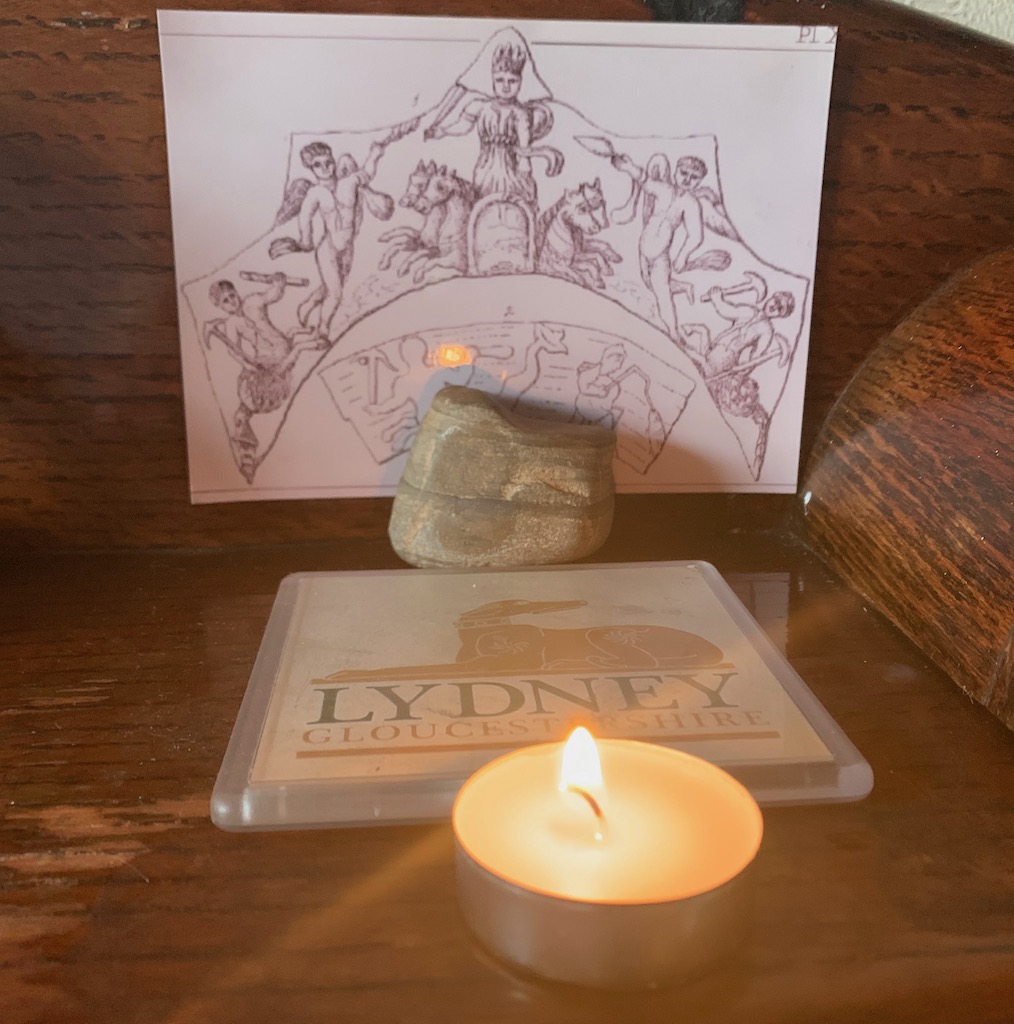
Nodens is an ancient British God of water and healing dreams. This is evidenced from His temple at Lydney where He is pictured on a mural crown driving a chariot pulled by water-horses and flanked by spirits of the wind and sea. The layout suggests that pilgrims took a ritual bath in the bath house, made offerings in His temple, then retired to a dormitory to enter a sacred sleep. On waking their dreams were interpreted by an ‘interpretus’. 

I have been relating to Nodens as a God of dreams since 2012. I started connecting with Him around the same time I met His son, Vindos/Gwyn ap Nudd*. At this time I found out that Nodens was also worshipped here in Lancashire as evidenced by two Romano-British silver statuettes, dedicated to Him as Mars-Nodontis, found on Cockersand Moss. 

I used to suffer from insomnia and started praying to Nodens as a dream God when I was desperate to sleep the night before travelling to the midlands for a Druid Network Conference in the midlands at which I was speaking for the first time on the bardic tradition. I was nervous not only about the talk but staying away from home in the company of so many people. 

I prayed to Nodens… and I slept… and when I returned home I made Him an offering of mint tea and thus began my practice of praying to Him every night before I go to sleep and making regular offerings. Since then I have never struggled to getting to sleep although I still sometimes struggle with early waking. Skeptics amongst you might argue this is simply the consequence of having a winddown routine and spending time in darkness in front of a candle but I personally believe that my prayers to Nodens are the driving cause. 

Nodens has also helped me to build a dreamwork practice. Several years ago He instructed me to collect a ‘dream stone’ from the Ribble and to place it on His altar then to put my dreams into it as an offering to Him when I wake up. I also journal my dreams for the purposes of remembering them. In the evenings I reflect on my dreams before I pray to Nodens and go to sleep.

Interestingly Nodens has never played an active role in interpreting my dreams, although I have sensed His guidance when making interpretations. I have never used books, but have been encouraged to explore the personal symbology of my dreams and what certain images and themes mean when they arise.

I often dream that I am ‘back at the stables’ – mainly at Oakfield Riding School where I spent a large part of my childhood working on the yard for free rides and where I worked as a riding instructor after giving up my PhD. In my dreams it represents my desire to return to a safe and a familiar place.

Another common theme is visiting shops that are selling a combination of rock/goth clothing and accessories and Pagan paraphenalia. These consistently have multiple levels, like Preston market, or Affleck’s Palace in Manchester, where I used to shop and hang out. I often see people from the past. I find I can’t relate to them and I cannot find what I am looking for. These dreams remind me that although I had friends with a similar taste in music we had nothing in common outside that and I didn’t truly fit in. Also that what I was searching for, some kind of deeper meaning, cannot be bought.

It’s not that often the Gods show up in my dreams but when they do it is deeply meaningful such as when Gwyn showed me how to send my soul into a hazel tree, then a beetle, then something else, in order to escape execution.**

In many of my dreams, frustratingly, I know I am on a mission for Gwyn, but have failed or forgotten what it is, showing my anxieties about failing Him. 

I’ve never had an experience with Nodens in my dreams but sense the touch of His (silver) hand when there is humour. For example a couple of months back I mistakenly allowed a troublesome member who made an inciteful post into the Monastery of Annwn and was not sure what to do about it. I then dreamt I was working at the stables and found someone had put a turd in one of the horse’s water buckets and was furious. The dream told me that, in the same way I could not allow a person who puts turds in horse’s water buckets to come to the stables, I could not have someone who posts inciteful posts in the monastery. With the words of other members this convinced me to ban them.

Dreamworking with Nodens has not given me all the answers to my dreams but it has helped me to remember, record, listen to, honour and act upon them. Over the time I have been recording my dreams I have logged an increasing number each year showing my dream recall has been improving. 

I believe this practice is important as dreams are the way our Gods and our souls can speak to us with the least interference from our conscious minds. For this reason I don’t try to control my dreams through techniques like lucid dreaming.***

I would be interested to hear about whether anyone else has been inspired to take up a dream work practice with Nodens or works other ways with dreams.

*Nodens is known as Nudd or Lludd in medieval Welsh literature.
**I have recorded an account of this dream HERE.
***Another reason I haven’t experimented with this technique is that asking the question ‘am I dreaming?’ in everyday life would be a trigger for returning to doubts about the nature of reality and blurring of boundaries that led to me not knowing what was real and was not and made me fear I was going mad during a mental health crisis in my early twenties.

A good place to start getting into dreamwork is Nimue Brown’s book Pagan Dreaming HERE

Myrddin’s Museum

Afterthoughts on the Thirteen Treasures of the North

When I set out researching, meditating on, journeying to, and writing about the Thirteen Treasures of the North it was with the aim of assessing their value for the modern world. I aimed to answer the question of whether they are ‘hallows’: holy artefacts associated with the gods and the Otherworld or the rich boy’s toys of a forgotten age.

I certain felt a sense of the aura of the numinous about some of the treasures and, unsurprisingly, connected with some better than others. During the process I became aware my reactions to being in their presence were based on my values. I took an instant disliking to the Sword of Rhydderch and the Cloak of Padarn due to their associations with war and the Tyrian purple of the Roman Empire. Yet I was carried away by the Chariot of Morgan, struck by a premonitory shiver by the Chessboard of Gwenddolau, and could happily have joined Rhygenydd drinking from his Vat.

Whilst the only treasure that can authoritatively be connected with a deity is the Cauldron of Dyrnwch, through its parallels with the Cauldron of Pen Annwn, I received hints about the possibilities of their divine origin from my research and experiences and suggestions from readers in the comments. Most of the treasures can tentatively be associated with Brythonic deities:

1. The Sword of Rhydderch – Forged by Gofannon and symbolic of a bond between the kings of Strathclyde and a goddess of the land, most likely Clutha, goddess of the Clyde.
2. The Hamper of Gwyddno – Woven by a goddess-in-crane-form on the Island of the Dancing Cranes. I suspect this might be Ceridwen, who wove the wicker basket in which Taliesin was found in Gwyddno’s fish weir. The basket and hamper could be the same treasure.
3. The Horn of Brân – This may have been taken from an otherworldly bull or ox like the Brindled Ox and may be connected with the bull-god who is known in Gaul as Tarvus Trigaranus, ‘The Bull With Three Cranes’. His image also appears in Romano-British sculptures.
4. The Chariot of Morgan – Forged by Gofannon (Potia’s suggestion) possibly with Amaethon’s help.
5. The Halter of Clydno – My vision of the halter summoning horses from the Plains of Annwn suggests it might be connected with Rhiannon. Alternatively the appearance of halters in Kelpie legends might be suggestive of associations with water-horses such as Du Y Moroedd.
6. The Knife of Llawfrodedd – ???
7. The Cauldron of Dyrnwch – Pen Annwn (Gwyn/Arawn/Ogyrven). Brân the Blessed is another keeper and ultimately it is the womb of Ceridwen.
8. The Whetstone of Tudwal – This was possibly created at the same time as the Sword of Rhydderch (both belong together in Strathclyde) but I’m not sure who by.
9. The Cloak of Padarn – ???
10, 11. The Vat and Dish of Rhygenydd – These may have belonged to Rosmerta who is depicted with a vat and straining spoon and holding a dish (suggested by Greg).
12. The Chessboard of Gwenddolau – A gift from Lugus.
13. The Mantle of Arthur – ???

Unfortunately we do not know how the Thirteen Treasures came to belong to the Men of the North. The development of the tradition, which might once have been fluid, with the stories changing as the treasures passed through the hands of various owners, ended in the seventh century with the fall of the North.

Thus it seems fitting that a story exists wherein Myrddin managed to procure the Thirteen Treasures and took them to a glass house on Bardsea Island which is often described as a museum. This shows they were removed from use in the post-Roman period when the North fell and became historical objects frozen in time. It also symbolises their removal from the living storytelling tradition to one that was repeated by rote then written down in the 15th century.

Will the Thirteen Treasures of the North remain behind the glass windows of Myrddin’s museum or can they be reclaimed as hallows with the stories of their divine origin shining with relevance for the 21st century? Only time will tell…

The Thirteen Treasures of the North

The Crazy Owl of Gwyn ap Nudd

330px-Waldkauz-Strix_aluco

In ‘Y Dylluan’ (‘The Owl’) (1350), the medieval Welsh poet Dafydd ap Gwilym refers to the ‘Crazy Owl’ ‘of Gwyn ap Nudd’:

Piercingly she shrieked: I recognise her form,
she is the bird of Gwyn ap Nudd.
Crazy Owl that sings to robbers,
misfortune on her tongue and on her tune.

She will not be silent whilst he chants his prayer by starlight. He cannot sleep because of ‘the voice and screeching of the Owl, / her frequent outcry and her laugh, / and poetry’s travesty from her tongue.’ His description of her is far from flattering and becomes increasingly sinister:

Dirty she is, with two raucous cries,
big-headed, with a hateful shout,
broad-browed, and berry-bellied,
old wide-eyed catcher of mice,
busy, vile, and colourless,
shrivelled her voice, her colour that of tin…
and her face, like that of a gentle human being,
and her form, she-fiend of birds.

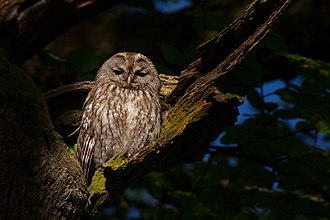
Speaking of her ‘wretched song’ he says ‘“Hw-ddy-hw” – a lively gasp – / with energy, by Anna’s grandson, / she incites the hounds of night.’ By the “hw-ddy-hw” we know Dafydd is referring to the tawny owl who is also known as the screech owl.

‘Anna’s grandson’ refers to Gwyn. In The Mabinogion, Gwyn’s father, Nudd/Lludd is the son of Beli Mawr who, in the Harleian Genealogies, is partnered with Anna. This may be mapped onto an older cosmography where Bel and Don are the ‘parents’ of Gwyn’s father, Nudd.

The ‘hounds of night’ are the Cwn Annwn, ‘Hounds of the Otherworld’, with whom Gwyn hunts the souls of the dead. This poem suggests the screech of Crazy Owl precedes Gwyn’s Hunt and that she flies at its head, terrifying, fiend-like with her human-like face.

In the final verse, Dafydd determines not only to scare the owl away with his song, but to ‘put… a bonfire in each ivied tree’, presumably with the intention of eliminating owls!

***

Gwyn is not the only god of hunting and the dead who appears with an owl. Charles Hardwick notes that the Hunter Hackelberg, who he identifies with Woden, the Germanic leader of ‘the Wild Hunt’, is accompanied by an owl named Tutursel:

‘Mounted on his white or dappled grey steed, the wild huntsman may always be recognised by his broad-brimmed hat, and his wide mantle, from which he is named Hakelbarend or Hakelberg, an old name signifying mantle-wearer. The hooting owl, Tutursel, flies before him.’

In the story of ‘The Hunter Hackelberg and the Tut-Osel’, the owl was a nun called Ursula who tormented her sisterhood and interrupted services with her ‘discordant voice’. Therefore they called her Tutursel. After her death, ‘from eleven o’clock at night she thrust her head through a hole in the tower and tooted miserably; and every morning at about four o’clock she joined unasked in the matin song.’

When the nuns realised the voice was Tutursel’s they refused to enter the nunnery until she was banished. Tutursel eventually met Hackelberg and found she delighted in his wood-cry “Hu Hu!” as much he delighted in her “U! Hu!” and she has flown with him since.

We do not know the story behind how Crazy Owl came to fly with Gwyn. Yet the reference to her ‘face, like that of a gentle human being’ may suggest she is of human origin or is a shapeshifter capable of taking human form.

***

In ‘The Fourth Branch’ of The Mabinogion, Blodeuwedd, a flower maiden, is transformed into an owl by Gwydion as a punishment for helping her lover, Gronw, to kill her husband, Lleu. This story may be based on an older seasonal myth where Blodeuwedd chose freely to be flowers whilst with Lleu in summer and an owl whilst with Gronw (a hunter god) in winter.

This story is paralleled by Creiddylad spending the summer with Gwythyr and winter with Gwyn. This led me to wonder whether Creiddylad takes owl-form on Gwyn’s Hunt. My meditations spoke otherwise – Crazy Owl is a separate person to Creiddylad with her own story*.

I’d like to end with this poem by Thomas Vantor, written in 1619, which describes the owl as a bright lady singing the dirge of the dying and puts me in mind of the Crazy Owl of Gwyn ap Nudd:

Sweet Suffolk owl, so trimly dight,
With feathers like a lady bright,
Thou sittest alone, singing at night
Te whit, te whoo, te whit, te whoo,
Thy note that forth so freely rolls
With shrill command the mouse controls,
And sings a dirge for dying souls,
Te whit, te whoo, te whit, te whoo.

*Crazy Owl’s story will appear in my next book Gatherer of Souls.

SOURCES

Dafydd ap Gwilym, Poems, (Gomer Press, 1982)
Charles Hardwick, Traditions, Superstitions, Folklore, (Forgotten Books, 2012)
Kristine Weinstein, The Owl in Art, Myth, and Legend, (Book Sales, 1991)
Marianne Taylor, Owls, (Bloomsbury, 2012)
Sioned Davies (transl.), The Mabinogion, (Oxford University Press, 2007)
The Hunter Hackelnberg and the Tut-Osel

The Wizard of the Waves

P1140193 - Copy

I.
Several years ago, I made the mistake of offending Manawydan. I was new to journeying. My guide took me to the otherside of Blackpool and we alighted outside a swimming pool. On the wall was a stereotypical plasticy image of a wizard in starry indigo-blue robes with a wand and bent wizard’s hat. Cartoon letters beside him read: ‘THE WIZARD OF THE WAVES’.

I couldn’t believe my eyes. I was incredulous. This wasn’t how the otherside appeared in books about shamanism. Turning to my guide I asked affrontedly “why have you brought me to see this tacky wizard?”

The wizard stepped from the wall and raised his wand. The scene dissipated with the dismal crashing of all the waves of the sea. I found myself back in my room immensely disorientated. Later it dawned on me that I’d offended Manawydan. I felt like kicking myself.

II.
Manawydan’s stories contain deep magic. However I struggle to connect with him because he’s humble, practical, wise: all the things I’m not.

After the catastrophic battle against Matholwch, King of Ireland, where Brân was slain, Manawydan and seven survivors returned with his head. They feasted with it for seven years at Harlech then for a potentially interminable period on the island of Gwales.

In the feasting hall in Gwales there were three doors: two open, one closed. Previously Brân told them “so long as you do not open the door… you can remain there and the head will not decay. But as soon as you open that door you can stay no longer.”

Manawydan echoed his brother’s wisdom. ‘”See over there… the door we must not open.”‘

Darned doors. Particularly the closed ones. They’re such a temptation. As soon as someone says “don’t open that door”…

This time the culprit was Heilyn. When he opened the door and looked out all their past sufferings and losses returned. Brân’s head began to decay.

III.
Manawydan should have inherited Brân’s Kingdom but it was usurped during their sojourn in Ireland by Caswallon. To make up for his loss, Pryderi offered him Dyfed and marriage to Rhiannon.

Manawydan and Rhiannon were happily married and became firm friends with Pryderi and his wife, Cigfa. Their life of hunting, feasting and enjoyment was brought to an end when a blanket of mist descended leaving Dyfed devoid of men, domestic beasts and dwellings.

They survived in the wilderness for a year by hunting and fishing and eating honey from wild bees. Tiring of their frugal lifestyle, Manawydan suggested leaving for England to earn a living through craftsmanship.

In Hereford Manawydan took up saddlemaking. There were was more than a hint of magic about his work: he enamelled the pommels with the skill of Llasar Llaesgyngwyd; the gigantic blue smith who forged the Cauldron of Rebirth and delivered it to Brân.

Manawydan was a victim of his own success. The jealous townspeople decided to kill him and his company. Pryderi’s response was to “kill these churls.”

More sensibly Manawydan said “if we were to fight them, we would get a bad reputation and would be imprisoned. It would be better for us to go on to another town and earn our living there.”

Pryderi listened and they moved on. However when Manawydan took up shieldmaking he coloured the shields the same way they coloured the saddles. Again the townspeople were jealous and they were forced to move on.

In the next town Manawydan took up shoemaking. Instead of using enamel he made friends with the goldsmiths who taught him to make golden buckles. He became known as one of Three Golden Shoemakers and again was far too successful for his own good.

IV.
Manawydan and his company decided to return to Dyfed. Out hunting they were led by a white boar to a fortress. Manawydan recognised the work of whoever put the spell on the land and advised them not to enter.

“Don’t enter that enchanted fortress!” A bit like “don’t open that door…”

Pryderi rushed straight in. Enraptured by a golden bowl, upon touching it, he became speechless and well and truly stuck. Rhiannon followed and suffered the same fate. The blanket of mist descended and in a blink of an eye the fortress was gone.

Manawydan saved the day by capturing the pregnant wife of Llywd Cil Coed, the enchanter, in the form of a mouse. Ransoming her at a miniature gallows he persuaded Llywd to remove the magic from Dyfed and release Pryderi and Rhiannon.

V.
Manawydan’s stories are filled with magic. He’s got deep knowledge of the magical arts, those who wield magic, the unfathomable nature of magic itself. He’s a true wizard.

However if I was in his stories I’d indubitably be the one who failed to listen to his advice. Who could not resist the temptation to open the door or storm the fortress. Who’d still be wandering through mist subsisting on wild fruits and honey or staring entranced into a golden bowl.

But I’m not in his stories. He’s started coming into mine. In a memory that’s not my own in which I’m drunk aboard The Manxman: a boat moored at Preston Dock and used as a floating nightclub pulled away in 1991 long before I was old enough to drink.

In dreams of tides and shoes and rollercoasters dropping into the sea. In the call of gulls. In the tidal pull of the sea drawing me further and further up the Ribble estuary to the coast.

VI.
The medieval stories of the Brythonic deities are immensely valuable. However because they were penned by Christian monks nearly a thousand years ago they can impose a filter on direct experience of ‘pagan’ deities in the twenty-first century.

I’ve learnt a lot from Manawydan’s devotee, Angharad Lois, who keeps a blog called From the Edges which features stories from the shorelines and also Muddy Boots and Mistletoe where she’s part way through the Thirty Days of Devotion project for Manawydan. Angharad carefully weaves Manawydan’s lore together with her own experiences and contemporary art and literature presenting a fuller picture of who he is in the modern world.

I found a quotation Angharad picked out by Alison Leigh Lilly, about Manawydan’s Irish cognate, Manannan Mac Lir, resonated with me ”One day I am sweet, another day I am sour,’ says the Irish trickster god Manannan mac Lir in his guise as the traveling buffoon whose hat is full of holes and whose shoes squish with puddle water when he walks.’

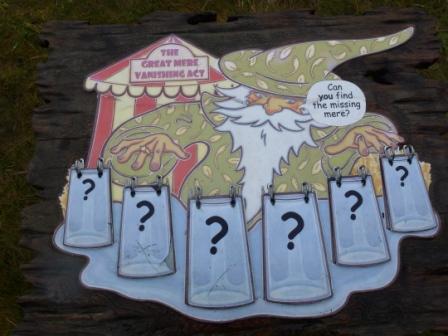
I recognised this deity in The Wizard of the Waves and this wooden carving of a wizard at Martin Mere titled ‘The Great Mere Vanishing Act’ where he says ‘Can you find the missing mere?’

Quiz on walkway, Martin Mere

Well I worked out what happened to Martin Mere: fifteen miles of lake drawn out to sea by the pumps at Banks. But I still haven’t fathomed Manawydan. Maybe that’s it. Maybe the Wizard of the Waves is unfathomable as magic and his deep blue starry robes of the sea.

P1140208 - Copy