Fascia – the Missing Link

“You haven’t pulled anything,” said my physio, “it’s just a myofascial knot that needs trigger-pointing out.” 

“Oh, well that’s a relief,” I said. 

That was the first time. I’d thought I’d pulled a muscle in my quad when I was straining with my foot on a spade trying to remove a huge juncus effusus rushfrom Little Woolden Moss on the Manchester Mosslands. 

He said the same thing when I went to him thinking I’d strained my neck overdoing a shoulder press at the gym. It turned out it was transferred pain from a knot in my shoulder and once he had done his work I could move my neck pain-free.

Since then I’ve got a lot better at recognising myofascial knots and at least partially releasing them myself by applying pressure and by foam rolling. 

But what are they? How and why do they form? My research into fascia provided the missing link between my intutions about how stress and trauma are stored in the physical body and how this relates to the energy body.

‘Myo’ refers to muscle. We all know what muscles are. But less people know about fascia. We certainly weren’t taught about it in biology lessons at school. Skeleton – yes. Muscles – yes. Organs – yes. But the importance of the connective tissue that holds them together received barely a mention. In fact, surgeons used to cut it out and throw it away thinking it was useless! Fascia was also ignored by anatomists as it swiftly dries up after death and can only be studied in a living person during operations or a very fresh corpse.

Research on fascia began in the 1970s and it’s only over the past decade or so the findings have come into the mainstream and it has become a buzz-word.

Fascia is made of collagen, elastin and a gel-like ground substance composed of hylauronic acid. It includes the superficial fascia beneath our skin, the deep fascia around and interpenetrating our muscles, and the visceral fascia around our organs. As such it forms a single living web, interweaving the inner parts of our body together.
Fascia provides a support structure for our body and allows for the smooth gliding of muscles, tendons and ligaments. It is also, in the words of Dr Robert Schleip, ‘our richest sensory organ’. It is filled with nerve endings – encapsulated nerve endings for proprioception (telling us where our body is) and free nerve endings for introception (transmitting information about how we feel). According to Schleip 40% of the nerves of our sympathetic nervous system are in the fascia, which explains why it can become so tight and tense. Our fascia is alive and has its own innate intelligence.
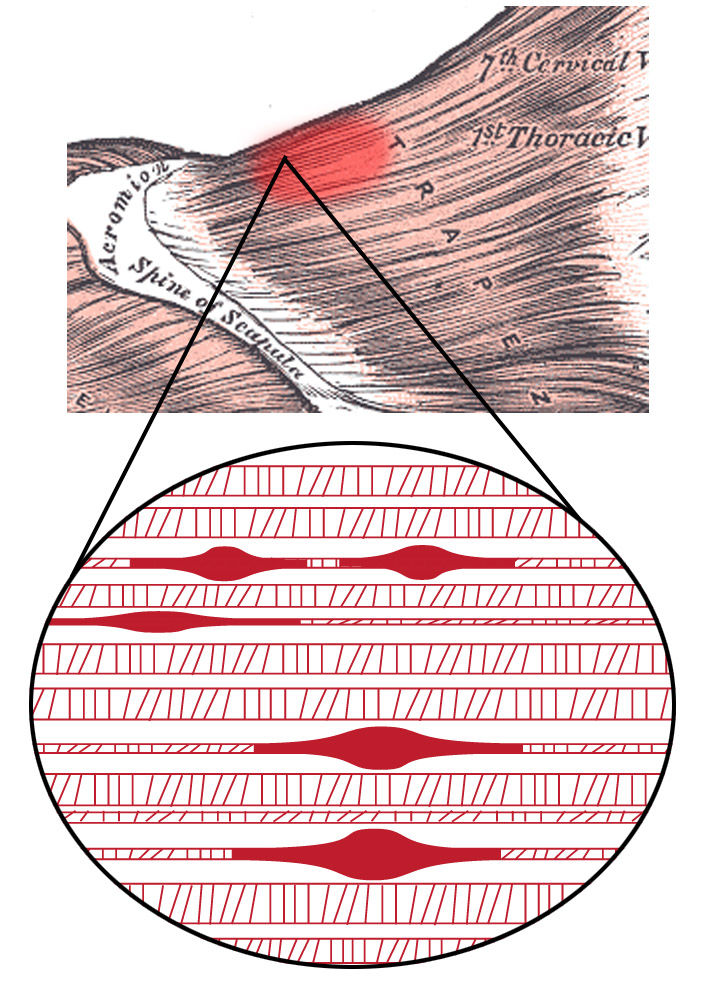
Myofascial knots are contracted areas in bands of muscle / fascia (remember they are interwoven) caused by overuse, injury and stress. They form irritable nodes where toxins build up and pain from them is often referred elsewhere. I didn’t get how pain could refer until I found out fascia is one continuous organ.

Trauma can be stored in the fascia if, after a traumatic event, there is no release. This can be for large traumas like accidents and severe injuries or smaller traumas like mine where I’ve felt a sudden pull and thought, “Oh shit.” The holding of trauma is often accompanied by holding the breath. Stress from work and relationships can also accumulate and be held in the fascia.

Finding this out helped to explain a number of my problems. I have runner’s knee in my left knee and deep gluteal syndrome in my left buttock. These two related problems come from having spent twenty years running on and off (with the off being due to these issues) without doing any strengthening. Since starting strength training at the gym they are greatly improved but have not gone away and I’ve realised that is because I’m still holding and moving my body in a certain way and this is due to trauma still held in my fascia.

Also, I’m prone to stiffness and knots in my neck and shoulders along with tightness in my jaw and squinty and achy eyes. These result from, like most Westerners, having spent most of my childhood and adult life hunched over a desk, squinting at words, under pressure to pass exams and meet deadlines. 

Even though I’m now only a victim of my own deadlines I find it difficult to destress and to spend time away from my computer as the programming of society that I should be here, working, is so strong within me. And I’ve managed to eliminate social use, using my computer only for research and writing. I’m aware others spend many more hours on their laptops or phones.

All these pressures have accumulated in my fascia over the years and congealed into a structure I am concerned might take just as long to release!

As well as working with myofascial knots on the level of the physical body it is possible to work with them on the level of the energy body as well. Dr. Daniel Fenster provides evidence that over 90% of myofascial knots can be mapped onto accupuncture points and this is why accupuncture works so well. Accupuncture needles go deeper than the skin but not into muscle – into the fascia. This is where the meridians or nadis, river-like channels carrying chi or prana ‘vital life energy’ run. In yoga the energy body is called the prana-maya kosha ‘breath-filled sheath’ – it is associated with breath.

Whereas physiotherapists simply remove the knots some practitioners, such as Schleip, work with clients in a more holistic way that involves the use of breath and sound to release trauma that is held in the body. This makes complete sense because, if holding the breath played a role in the contraction causing the knots, then breathing out helps to undo them. 

For much of my life I’ve existed in a constant sympathetic state in which I’ve been breathing in shallow into my chest exacerbarting panic and anxiety. For the past couple of years, since discovering yoga and polyvagal theory, I have been working to shift from a sympathetic to a parasympathetic state by slowing and deepening my breathing and extending my exhales. Trying to relax and breathe deeply in the gym, where I get overexcited if I’m doing well or tense up if I’m anxious about injury, is proving to be one of my biggest challenges.

As a shamanic practioner-in-training I am learning to feel and see blocked and congealed energies and to move them through vision, feel and breath. This new knowledge about how fascia relates to the energy body is something I intend to incorporate into my practice when healing myself and others.

One of the things I am learning from experience is that it’s no use doing energy work if I’m not also making changes in physical reality too. There’s no point removing congealed energy from the knot in my shoulder if I’m going to sit bent over my computer clicking on my mouse for several hours a day. Lifestyle changes to restructure my fascia for longevity.

SOURCES

Fenster, Daniel. Free Your Fascia: Relieve Pain, Boost Your Energy, Ease Anxiety and Depression, Lower Blood Pressure, and Melt Years Off Your Body with Fascia Therapy (Hay House, 2020)
Kusheva, Tatyana, ’Fascia – The Mysterious World Under Your Skin’ on Youtube, (Tatyana Kusheva, 2021)
Schelip, Robert, ‘The Bodywide Fascial Network’ on Youtube, (Inner Sense, 2021)

The Breath of Nine Maidens and the Kindling of the Cauldrons

‘My first utterance was spoken concerning the cauldron
kindled by the breath of nine maidens.
The cauldron of the Head of Annwn, what is its disposition
(with its) a dark trim, and pearls?
It does not boil the food of a coward, it has not been destined to do so.’
~ ‘The Spoils of Annwn’

In ‘The Spoils of Annwn’, a medieval Welsh poem from The Book of Taliesin, we find mysterious lines about the breath of nine maidens kindling the cauldron of the Head of Annwn. The cauldron, the source of awen, ‘poetic inspiration’, is a central symbol within Celtic mythology. 

In ‘The Story of Taliesin’ the cauldron belongs to Ceridwen. In this tale Ceridwen is referred to as a witch but it’s my intuition She is a Goddess whose crochan – cauldron / womb is a sacred vessel of rebirth (1). In Her cauldron she brews a potion from 365 herbs (one picked on each day of the year) to provide her ugly son, Afagddu ‘Utter Darkness’ with the ‘Prophetic Spirit’. She assigns a blind man called Morda to bring kindling for the cauldron and to stir the cauldron she summons a boy called Gwion. After a year and a day Gwion shoves Afagddu out of the way and steals the awen. After a shapeshifting chase he is swallowed by Ceridwen (he as a grain and She as a black hen) then reborn from her womb as Taliesin.

In ‘The Spoils of Annwn’ the model is slightly different. The cauldron of Ceridwen, the magical vessel associated with inspiration and rebirth, is in the custodianship of the Head of Annwn – the ruler of the Brythonic Otherworld. Here there is no need for kindling or a person to stir the cauldron as the breath of the nine maidens is enough to set the processes within it into motion. The ‘food’ ‘not for a coward’ that it brews no doubt refers to the awen. Taliesin accompanies Arthur and his men not only to steal the awen, but the cauldron itself, bringing it back through ‘Hell’s Gate’ to the world.

This shows that when a potential awenydd, ‘person inspired’, proves their courage to the Head of Annwn, the breath of the nine maidens or awenau, ‘muses’ (2), kindles the cauldron, then the awen is received as a gift from the Gods.

This feels like an older and deeper model for the origins of awen. The significance of the breath of the nine maidens can be further elucidated by looking at the etymology. The medieval Welsh term used for breath is anadyl and this derives from the proto-Celtic anatla which shares a resemblance with anaman the proto-Celtic word for ‘soul’. The Indo-European *uel is closely related giving us the root form of awel ‘breeze’ and awen ‘inspiration’. There seems to be something fundamental this myth is telling us about how, in Annwn, on the soul-level, the breath of the nine maidens kindles the cauldron and sets in motion the processes within the cauldron that create the awen.

It’s my personal intuition that the cauldron / womb of Ceridwen, who I know as Old Mother Universe, is a macrocosm of the universe. That it lies in Annwn ‘Very Deep’ shows the Otherworld is a deeper reality underlying the universe. 

On a microcosmic level each awenydd might too be seen as a cauldron which is kindled by the breath of the nine maidens producing awen for poetic works. The breath itself might be seen as a gift from the awenau. 

Microcosm within microcosm a number of Celtic Pagans have come to relate the three cauldrons in the seventh century Irish text ‘The Cauldron of Poesy’ to the three main energy centres or chakras in our belly, heart and head (3). Interestingly the Irish term coire ‘cauldron’ or ‘whirlpool’ might be seen to relate to the spiralling manifestation of the universe and the turning of the chakras.

In yogic meditation the breath is used to awaken the chakras. I was once dubious about the existence of ‘Celtic Chakras’ but I am now coming to perceive the resonsances between these shared Indo-European traditions. I wonder whether anatla ‘breath’ is the Celtic equivalent of the yogic prana ‘breath’ or ‘life force’ which Celtic Pagans have long been searching for (4). 

(1)These insights derive from Kristoffer Hughes’ From the Cauldron Born.
(2)This term is borrowed from Greg Hill who uses it in his poem ‘The Muses’ in his poetry collection The Birds of Rhiannon – ‘O Muses / O Awenau / You whose breath kindled the cauldron of awen in Ceridwen’s keeping.’
(3) For example see Erynn Rowan Laurie’s ‘The Cauldron of Poesy’ – https://www.obsidianmagazine.com/Pages/cauldronpoesy.html
(4) Some druids have in the past mistakenly identified prana with nwyfre ‘sky, firmament’ which Mhara Starling explains is erroneous on her Youtube channel – https://www.youtube.com/channel/UCkc4iRymvz4t619FEk5dFfA/videos Interestingly the proto-Celtic anatla ‘breath’and anaman ‘soul’ share similarities with the Sanksrit atman which is sometimes translated as ‘soul’ but refers to the Self or witness-consciousness beyond phenomena and ananda which refers to bliss at escaping the cycle of mortality or uniting with a God.

The Throat Chakra

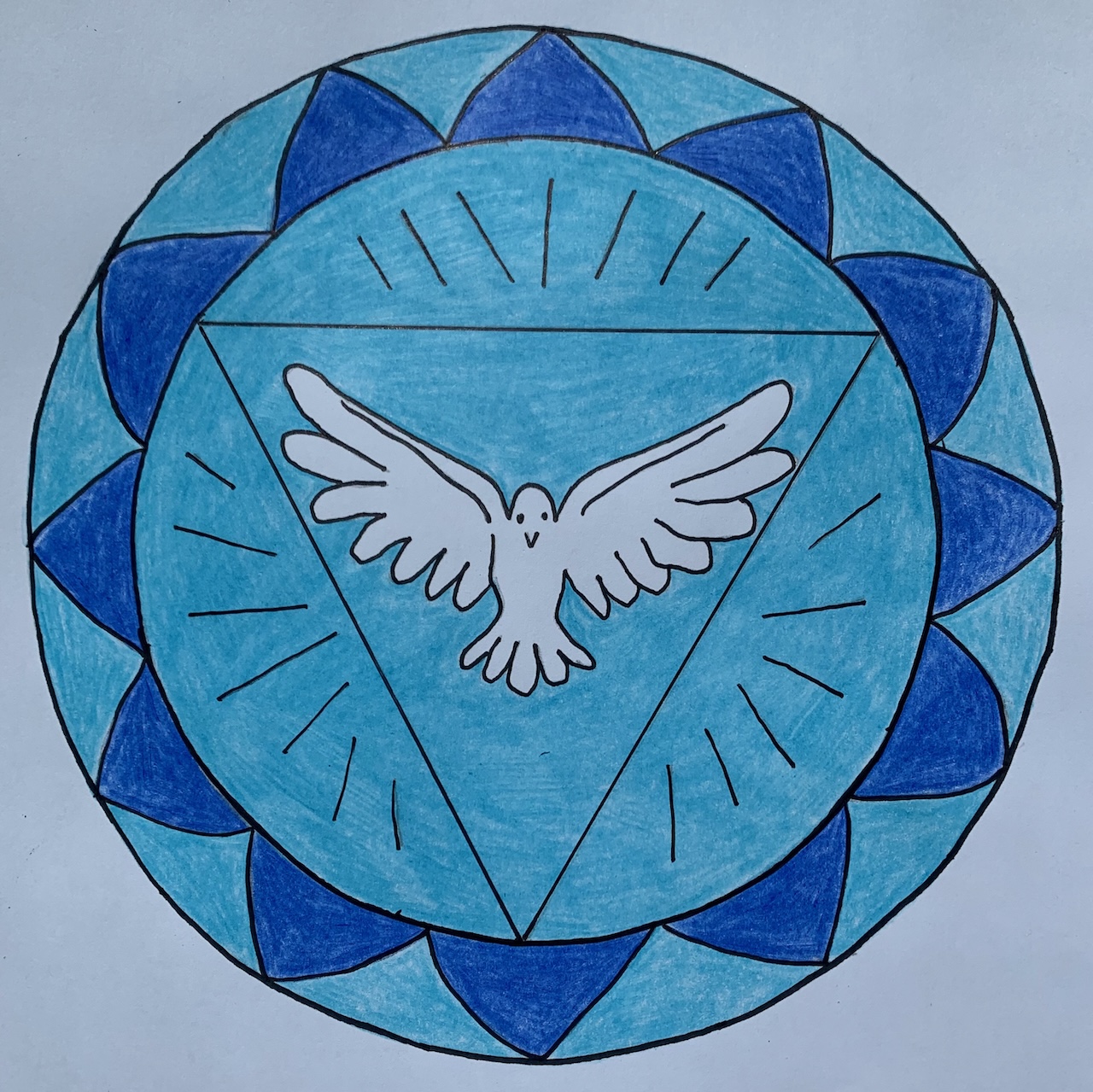
A dove flies free
across a clear blue sky.
I have the right to stay silent
and from Annwn sound my cry.

~

The throat chakra is associated with the voice and communication. It’s been an interesting one for me to work with as somebody who was once a performing poet with a really big gob but who has recently begun to appreciate far more spending time in solitude and silence. 

I had my first Reiki session a few months ago and the practitioner aptly spotted my overactive solar plexus chakra and told me that I had a blockage between it and my throat chakra. Intriguingly during the treatment I found a lot of saliva in my mouth which related to her work to clear the blockage. When we chatted about it afterwards she intuited that the block might be to do with me being unable to say positive things about myself. I realised this was true – I’m able to speak about my fears and limitations but not my assets. 

She suggested trying positive affirmations. I had a go at these. I could just about manage, “I am strong,” as I’ve worked so much on my physical and mental strength. However, “I am kind,” “I am patient,” did not ring true as I was still being snappy with my dad. “I am becoming kinder,” “I am becoming more patient,” felt more realistic. Unfortunately this work has recently gone out of the window due to recent stresses but I intend to return to it. 

It also connected with purification and with the breath. I’ve found that breathwork is one of the best things for helping me to regulate nervous system.

In The Miracle of Mindfulness Thich Nhat Hanh says: ‘Our breath is the bridge from our body to our mind, the element which reconciles our body and mind and which makes possible one-ness of body and mind. Breath is aligned to both body and mind and it alone is the tool which can bring them both together, illuminating both and bringing both peace and calm.’

It’s interesting that, as I’ve been working with this chakra, a number of negative thought and behaviour patterns have arisen to be purified. These have been based around financial insecurity causing me to go against my commitment to my spiritual vocation and inner nature as a monastic who needs solitude and routine by signing up for a secular counselling course and by forcing myself into running and attending groups on evenings and weekends. Neither of these things worked out and I needed to withdraw.

In relation to purification I found out the origin of the word ascesis. It comes from theGreek askēsis ‘training’, from askein ‘to exercise’ and was associated with athletics. I had associated it only with self-denial in its extreme and punitive forms and had not thought of myself as an ascetic. Yet for me as someone for whom exercising regularly (strength training and yoga), eating healthy foods and not engaging with social media is important the term has begun to resonate with me and I now associate it with this chakra.

Metabolism, digestion, heart rate, hormones and sleep are regulated by the thyroid gland so I see why the throat chakra is related to ascetic processes.

At first when the white dove appeared as the symbol I was surprised. I thought, ‘I’ve never even seen a white dove.’ Then I Googled white doves and found out they are specially bred birds of the species Columba livia domestica – rock doves or rock pigeons. The very same as the feral pigeons who visit my back garden to feed on the seed and live under the railway bridge. 

Intriguingly, a few months back, in a dream a bird appeared that looked like a pigeon but which I intuited was a dove (both are in the Columbidae family). I was told it had come from my supervisor, Jayne, ‘to end the conflict between A and B.’ A number of conflicts within and without have come to an end (and Jayne has helped with this) in the period I have been working with this chakra.

~

Location: throat / Colour: Blue / System: Pulmonary / Nerve Plexus: Cervical / Faculty: Speech / Realm: Social / Element: Ether / Qualities: Communication and purification / Animal: Dove

Breathe

We need to remember that our very breathing is to drink our mother’s milk – the air – made for us by countless microbial brothers and sisters in the sea and soil, and by the plant beings with whom we share the great land surfaces of our mother’s lustrous sphere.’
Stephan Harding

Inspire. Expire.
Anadlu i mewn. Anadlu i allan.
Breathe in. Breathe out.

Respiration (from spirare ‘breath’ and re ‘again’) is participation.

Inspire. Expire.
Anadlu i mewn. Anadlu i allan.
Breathe in. Breathe out.

Lungs. Two. Right and left. Each enclosed in a pleural sack in the thoracic cavity of the chest. Primary bronchus, secondary bronchi, tertiary bronchi, terminal bronchiole. In the alveoli, ‘little cavities’, across the blood-air barrier, gas exchange takes place.

Breathe in: oxygen 21%, carbon dioxide 0.04%. Breathe out: oxygen 16%, carbon dioxide 4.4%. 6 carbon glucose, oxidised, forms carbon dioxide. Product: ATP (adenosine triphosphate) ‘the molecular unit of currency of intracellular energy transfer’. The spark of all life.

Inspire. Expire.
Anadlu i mewn. Anadlu i allan.
Breathe in. Breathe out.

Respiration (from spirare ‘breath’ and re ‘again’) is participation.

Inspire. Expire.
Anadlu i mewn. Anadlu i allan.
Breathe in. Breathe out.

Birds have lungs plus cervical, clavicular, abdominal, and thoracic air sacs. Hollow-boned they are light as balloons, breathing in, breathing out. Then there are the lungless. Through tiny holes in the abdomen called spiracles leading to the trachea, insects fill their air sacs. Earthworms and amphibians breathe in and out through moist skins. Fish breathe water in through gulpy mouth breathe it out through gapey gills.

Plants breathe through their leaves. By daylight they photosynthesise. Stomata breathe carbon dioxide. It mixes with water. The green lions of chlorophyll work their magic by sunlight. Oxygen is released. From glucose the magical hum and buzz of ATP. At night they respire glucose and oxygen back to carbon dioxide and water. 10 times more oxygen produced than used.

Underground fungi breathe the air of the soil through thread-like hyphae that mass as mycelia. They respire aerobically (with oxygen) or anaerobically (without oxygen), changing glucose to ATP (it’s all about ATP!), ethanol, carbon dioxide, and water. This old, old, metabolic pathway dates back to the days before oxygen ruled our breath and is utilised by microbes. The hidden ones of the deep, single-celled, or living colonies, breathe through their single cell walls in ancient ways – acetogenesis, methanogenesis – to gain the blessed ATP.

Inspire. Expire.
Anadlu i mewn. Anadlu i allan.
Breathe in. Breathe out.

Respiration (from spirare ‘breath’ and re ‘again’) is participation.

Inspire. Expire.
Anadlu i mewn. Anadlu i allan.
Breathe in. Breathe out.

And what is this creature that does not breathe (in or out) with no metabolism or need for ATP? This simple strand of genes in a designer jacket called a capsid? Does this thing, neither dead nor living, have a spirit? Like all living things was it breathed into life by the gods?

Or is this death-bringer undead? This assaulter of lungs? Lung-cell-killer and causer of coughs – dead lung cells coughed up as sputum, mucus, the yellow remains of what was ours?

By what dark programme does it turn the body against itself – alveoli ‘little cavities’ where the exchange of carbon dioxide and oxygen takes place filling with water – no space to make ATP? No lungs – no breath. The pump of ventilators, breathing in, breathing out, our new iron lungs…

Did it crawl from the cauldron of inspiration like the speechless dead or is it something entirely other?

Inspire. Expire.
Anadlu i mewn. Anadlu i allan.
Breathe in. Breathe out.

Respiration (from spirare ‘breath’ and re ‘again’) is participation.

Inspire. Expire.
Anadlu i mewn. Anadlu i allan.
Breathe in. Breathe out.

To whom do we pray? To the gods and goddesses of breath and to the spirits of inspiration? To Ceridwen, Gwyn ap Nudd, Morgana and her sisters, who gave us breath, and take it away?

“Breath always leads to me,” says Gwyn. I find this reassuring and disconcerting from a death-god. From the one who releases the spirits of Annwn from the cauldron and holds them back.

So we breathe together with the lunged and lungless creatures with skin, fur, feathers, shells, scales, leaves, hyphae, the single-celled, the uncelled who ride our breath, until we return to the gods. To the winds that carry the voices of all ancestors over our 4.543 billion year old earth.

Inspire. Expire.
Anadlu i mewn. Anadlu i allan.
Breathe in. Breathe out.

Respiration (from spirare ‘breath’ and re ‘again’) is participation.

Inspire. Expire.
Anadlu i mewn. Anadlu i allan.
Breathe in. Breathe out.

*I adapted this meditation from an earlier version ‘The Ways We Breathe‘ previously published on Gods & Radicals following guidance from my deities to focus on my breath and being struck by the realisation that a distinguishing feature of coronavirus and other viruses is that they do not breathe.

Winter Kingdom

As I make my circuit stars hold vigil in an icy breath.
Roses of Annwn bring beauty from death.
Wintering starlings spotted with snow
sleep in a tree that nobody knows.
There is a courtship of stability in this kingdom of cold
where we reknit the bonds as dream unfolds
in shadows of farmhouses down the pilgrim’s path
through old stony gates in footsteps of the past
to the healing well where a serpent’s eye
sees through the layers of time’s disguise.
A procession sways down the old corpse road
where the lych gate swings open and closes alone.
From the empty church bells resound.
Reasserting its place on the abandoned mound
a castle extends to the brink of the sky.
Within its dark memory a fire comes to life.
As warriors gather to warm their cold hands
I know I am a stranger in a strange land.

Fungi, Greencroft Valley


*Roses of Annwn is a kenning for mushrooms I came across in The Faery Teachings by Orion Foxwood