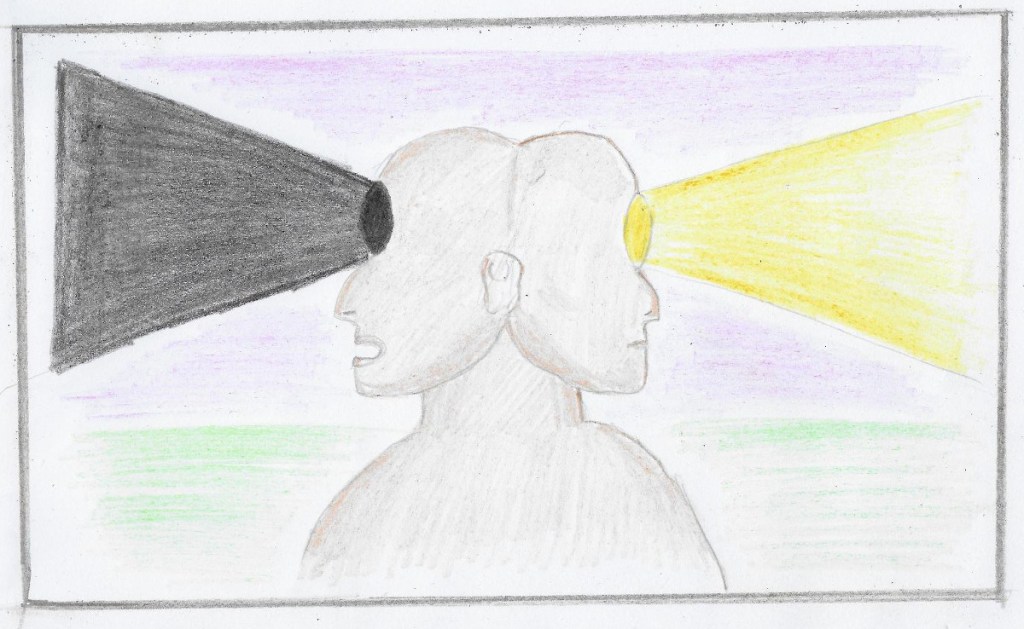
In the Irish myths we find a giant named Balor whose name derives from the common Celtic *Boleros ‘the Flashing One’. He is best known for the destructive power of his eye, which burns or poisons.
In ‘The Second Battle of Mag Tuired’ Balor fights on the side of the Formorians ‘underworld giants’, who come from beneath the earth or sea, to fight against the culture gods, the Tuatha Dé Danann.
Balor has ‘a destructive eye’ which is ‘never opened except on the battlefield’ by four men pulling a ring on the lid. We are told that any host which looked into his eye, even if there were thousands, ‘would offer no resistance to warriors’. Its ‘poisonous power’ originates from an accident. When Balor’s father’s druids ‘were brewing magic’ the fumes ‘affected the eye’ and ‘the venomous power of the brew settled in it.’
Balor kills the king and battle leader of the Tuatha Dé Danann, Nuadu Silverhand. Yet the moment the lid on his eye is raised Lug Lormanslech (who is elsewhere known as Lug Lámfada ‘of the Long Hand’) kills him by firing a slingstone from his slingshot into his eye and causing him to fall backwards and kill twenty-seven men. Lug later takes the place of Nuada as king of the Tuatha Dé Danann
In ‘Balor on Tory Island’ he has a burning eye which is covered by nine leather shields or seven coverings which he removed one by one: ‘With the first covering the bracken began to wither, with the second the grass became copper-coloured, with the third the woods and timber began to heat, with the fourth smoke came from the trees, with the fifth everything grew red, with the sixth it sparked. With the seventh, they were all set on fire, and the whole countryside was ablaze!’ Balor is killed by Lug, with a a red spear crafted by Gavidin Gow, which pierces through all the coverings.
In this Formorian giant it is possible to find some parallels with the British giants and forces of Annwn ‘the Deep’, the Otherworld or Underworld. Llasar, described as ‘a huge, monstrous man’ with ‘yellow-red hair’ and ‘an evil, ugly look about him’ emerges from ‘the Lake of the Cauldron’. The scream of a dragon causes men to lose their strength and makes the land and its inhabitants barren.
There are also similarities between Battles of Mag Tuired and ‘The Battle of the Trees’. Like the Tuatha Dé Danann, the Children of Don, Lleu (cognate with Lug) ‘radiant his name, strong his hand’, the magician-god, Gwydion, and the plough-god, Amaethon, battle against the forces of the King of Annwn and these include giants such as Bran the Blessed and Annuvian monsters.
However, neither Nodens/Nudd (cognate with Nuada) or Boleros (who would be cognate with Balor) are mentioned. This leaves me wondering whether we had a similar story in which Nodens was killed or injured by Boleros and Lugus/Lleu triumphed over the giant and his destroying eye.
A similar story about how Boleros gained the destructive powers of his eye would certainly fit with narratives in which the cauldron which brews the awen and revives the dead also produces poison.
The tale of Boleros of the Burning Eye is one of the stories I am striving to re-imagine in my new book.
 The Sanctuary of Vindos