The Brightness beyond Endurance: Gwyn ap Nudd and the Battle of Arfderydd

In my waking dream spears pierce the night sky opening onto another night filled with rainbows and blinding stars. Battle cries ascend from black fog. In a stained glass window I glimpse a man with a hunched back in a green and mossy gown departing from a picture into darkness. From these images I derive my research on Gwyn ap Nudd and the Old North should begin with the Battle of Arfderydd. This is an account of my initial findings and thoughts to date.

The Battle of Arfderydd haunts Britain’s consciousness as one of three of the most futile Dark Age battles. It took place in 573 and was fought between Brythonic rulers of the Old North; Gwenddolau ap Ceidio and his cousins Gwrgi and Peredur ap Eliffer. All were descendants of Coel Hen. Thus it epitomises the internecine strife that prevented northern rulers from putting up a successful resistance to the Angles of Northumbria.

The Triads of Ancient Britain tell us it was fought over a lark’s nest. This probably refers to Caerlaverock (‘Lark’s Fort’) on the site of which still stands a stunning medieval castle. It is generally believed the Battle of Arfderydd took place on the plain between Liddel Water and Carwinley Burn. It is possible the motte and bailey named Liddel Strength was the location of Gwenddolau’s fort. After Gwenddolau was killed, his war-band retreated to the fort and held out for ‘a fortnight and a month’ before their defences fell and they too were slain and (according to a local tradition) buried near Upper Moat.

In ‘The Dialogue of Gwyn ap Nudd and Gwyddno Garanhir’ Gwyn states his presence at Gwenddolau’s death:

‘I was there when Gwenddolau was slain,
Ceidio’s son, a pillar of poetry,
When ravens croaked on gore.’

That Gwenddolau adhered to a pre-Christian mythos featuring Gwyn as a god who gathered the souls of the dead to Annwn is hinted at by certain lines in the Triads. Gwenddolau is referred to as one of three ‘Bull Protectors’ of Britain. Gwyn himself is referred to as a ‘Bull of battle’. Contrary to popular belief, Celts and not Vikings wore helmets affixed with bull horns. The bull was viewed as a sacred animal and its qualities were attributed to war leaders and psychopomps. It is also of interest ‘Gwyn’ and ‘Gwen’ both mean ‘white’ or ‘blessed’.

Gwenddolau is also said to own a pair of birds who wear a ‘yoke of gold’ and devour two corpses of the Britons for dinner and two for supper. If the latter is an oblique reference to funerary practices whereby bodies are left on stone slabs for their flesh to be consumed by carrion birds this shows Gwenddolau and his people were not performing Christian burials. The northern Britons may have believed Gwyn’s presence as a gatherer of souls was signalled by the approach of corpse-eating birds (or dogs or wolves). Gwenddolau’s birds may have had a permanent position in this role.

Another striking passage which may read as a portrayal of Gwyn’s presence at the Battle of Arfderydd with the spirits of Annwn can be found in The Life of St Kentigern. Here, Lailoken (Myrddin Wyllt) tells the saint of a vision which drove him to madness in Coed Celyddon (the Caledonian Forest):

‘In that fight the sky began to split above me and I heard a tremendous din, a voice from the sky saying to me ‘Lailocen, Lailocen, because you alone are responsible for the blood of all these dead men, you alone will bear the punishment for the misdeeds of all. For you will be given over to the angels of Satan, and until the day of your death you will have communion with the creatures of the wood. But when I directed my gaze towards the voice I heard, I saw a brightness too great for human senses to endure (my italics).

The Brightness beyond EnduranceI saw, too, numberless martial battalions in the heaven, like flashing lightning, holding in their hands fiery lances and glittering spears which they shook most fiercely at me. So I was torn out of myself and an evil spirit seized me and assigned me to the wild things of the woods, as you see.’

It seems possible the introduction of the voice of God and angels of Satan are a Christian cover for the appearance of Gwyn and the spirits of Annwn. Gwyn’s earlier name Vindonnus ‘clear light, white’ links him to the unendurable brightness. As a god of thresholds; between the worlds and life and death, experiences of his presence take place on the edge of human sense. Hence Lailoken / Myrddin’s transition from ‘sanity’ to ‘madness.’

The battalions in the sky look more like warriors than angels. The notion that the spirits of Annwn include deified ancestors arriving to take their fallen kindred fits with their numinous apparel. These spirits are frequently demonised by Christian writers. That an ‘evil spirit’ (ie. a spirit of Annwn) tears Lailoken / Myrddin ‘out of himself’ and assigns him to the wildwood is a significant factor in his flight and later recovery.

In the saga poetry of The Black Book of Carmarthen and The Red Book of Hergest we witness Myrddin’s transformation from a golden-torqued warrior of Gwenddolau’s court into a poet who prophecies against war. Myrddin shares harrowing depictions of ‘the blood-shed of battle’ and his guilt about the deaths of Gwendydd’s children. Whether he is literally responsible for killing them or feels responsible is uncertain.

‘Now Gwendydd loves me not and does not greet me…
I have killed her son and daughter.
Death has taken everyone, why does it not call me?
For after Gwenddolau no lord honours me.’

He mourns Gwenddolau’s death:

‘I have seen Gwenddolau, a glorious prince,
Gathering booty from every border;
Beneath the brown earth now he is still,
Chief of the kings of the North, greatest in generosity.’

Myrddin also speaks of his flight from ‘Rhydderch Hael, defender of the Faith’. Rhydderch was ruler of Alt Clut and renowned for championing Christianity and his patronage of St Kentigern. Myrddin’s words have led some scholars to believe Arfderydd was fought between Pagan (Gwenddolau) and Christian (Rhydderch) forces. After Gwenddolau’s death Rhydderch rises to greater power, forming an alliance with Urien Rheged, Gwallog ap Llenog and Mercant Bwlc against the Angles at Lindisfarne.

During this period Myrddin retreats to Celyddon, keeping the company of wild creatures such as wolves, a piglet and a favoured apple tree. He states he has wandered ‘ten and twenty years’ with ‘madness and madmen’ ‘gan willeith a gwyllon.’ Myrddin’s epithet ‘gwyllt’ means ‘mad’ or ‘wild.’ ‘Gwyllon’ can refer to ‘madmen’, ‘wildmen’ or to ‘spirits’ or ‘shades.’ They may be equated with the ‘seven score men’ who fought at Arfderydd then lapsed into madness in Celyddon and perished. These gwyllon are ancestral presences; spirits of Annwn.

Myrddin’s capacity to see the spirits of Annwn may result from his vision of the brightness beyond endurance. Whilst initially it tips him over the edge, it confirms the existence of Gwyn and his spirits and an afterlife. This provides him with the strength to live through suffering; ‘Snow up to my hips among the wolves of the forest, / Icicles in my hair’ until his ‘threefold’ death. Myrddin says ‘After enduring sickness and grief in the Forest of Celyddon / May I be a blissful man with the Lord of Hosts.’ (In ‘The Dialogue of Gwyn ap Nudd and Gwyddno Garanhir’ Gwyn is referred to as ‘Lord of Hosts’.)

Associations between Gwyn and healing processes that take place in the wild also appear in a fourteenth century Latin manuscript called Speculum Christiani: ‘Some stupid people also stupidly go to the door holding fire and iron in the hands when someone has inflicted illness, and call to the king of the Benevolent Ones and his queen, who are evil spirits, saying ‘Gwyn ap Nudd who are far in the forests for the love of your mate allow us to come home.’

Myrddin’s vision also grants him the power of prophetic poetry. It is noteworthy that this former warrior uses poetry to give voice to the horror of warfare and to warn against future bloodshed. A critical attitude toward war differentiates the saga poems from earlier heroic poetry. We might recall similarities between Myrddin’s ‘Death has taken everyone, why does it not call me?’ and Gwyn’s ‘I have been where the warriors of Britain were slain / I live on; they are dead’. Both are laments.

Unfortunately, the northern British stories of Gwyn ap Nudd and Myrddin Wyllt and the deep, wild wisdom they contain are little known in contrast to the courtly Christian tales of King Arthur, Merlin and his knights. For a medieval aristocracy later bent on Crusades; ‘One King, One God, One Law’ there was no room for a northern wild man and his words against war or the ruler of an otherworld and ancestral presences immanent in the wild places of this-world. Perhaps this can be changed…

***

SOURCES

Blake, William The Complete Poetry and Prose of William Blake (Anchor Books, 1988)
Breeze, Andrew “The Name and Battle of Arfderydd, near Carlisle,” Journal of Literary Onomastics: Volume 2: Issue 1, Article 1. (2012)
Evans, J. Gwengobryn The Black Book of Carmarthen (Lightning Source UK Lmtd, 1907)
Heron (transl.) ‘Gwyn ap Nudd and Gwyddno Garanhir’ https://barddos.wordpress.com/2015/02/08/gwyn-ap-nudd-and-gwyddno-garanhir/
Hunt, August The Arthur of History: A Reinterpretation of the Evidence (August Hunt, 2012)
Pennar, Meirion (transl.) The Black Book of Carmarthen (Llanerch Enterprises, 1989)
Rudiger, Angelika H. ‘Gwyn ap Nudd: Transfigurations of a character on the way from medieval literature to neo-pagan beliefs’ in Gramarye, Issue 2 (University of Chichester, Winter 2012)
Skene, William F. The Four Ancient Books of Wales (Forgotten Books 2007)
Thomas, Neil ‘The Celtic Wild Man Tradition and Geoffrey of Monmouth’s Vita Merlini: Madness or Contemptus Mundi?’ in Arthuriana Vol. 10, No. 1 (Spring 2000)
Tolstoy, Nikolai The Quest for Merlin (Sceptre, 1985)
The Old North from Peneverdant

SnowdropsIn the land where I live, spring awakes. Snowdrops in their prime unfold the voluminous skirts of their lanterns. Lords and ladies push their courtship through the soil alongside first signs and scents of ransoms. Swollen mosses take on a bright green living vibrancy.

As I walk the path centuries of ancestors walked to St Mary’s Well, I hear the loudness of a thrush. Could it be the one who calls me from sleep each morning, speckled chest blanched and white as birch amongst ash and sycamore? The trees hold back for now, but I know the sap will start rising soon.

I pass the site of the healing well and cross the road to the War Memorial. Splashes of pink, purple and yellow primroses are planted in beds before the Celtic cross. Etched on blue-grey slabs are the names of seventy-three men who lost their lives in the First World War and forty-six who died in the second. They are honoured and remembered here. I also think of the dead who have no memorial or whose memories have been erased or forgotten.

I follow the footpath uphill onto Church Avenue. Leading to St Mary’s Church, it once went to a Benedictine Priory, dissolved and more recently demolished. A strange road this; trodden by pilgrims in search of miraculous cures and by funeral processions. By soldiers too, maybe armies, defending this crucial position from what we now see as the castle motte.

Passing the church on the hill’s summit I stand in the graveyard amongst tilted and fallen headstones, beneath sentinel beech trees whose shells and bronzed and curling leaves still litter the greening earth.

There’s no access to the motte’s vantage point, but through leafless trees I can make out the city of Preston with its clock tower, steeples, tower blocks and huge manufacturies along Strand Road. I recall images of its panoply of smoking chimneys, flaming windows, imagine the pounding Dickensian melancholy-mad elephants.

Preston’s sleeker now. Cleaner. Less red and black. Concrete grey. Not so smoky. But sometimes the industrial pall still holds. Somewhere behind its walls lies a medieval town and behind that…

The Pennines form a sweeping backdrop, rising higher than Priest Town’s spires ever could; Parlick, Wolf Fell, Longridge Fell, Billinge Hill, Great Hill, Winter Hill. An easterly green and purple barricade. To the west, the river Ribble, Belisama, strapped into her new course, stretches long arms to her shining estuary. A sea gull cries over the horizon and disappears.

I’ve spent several years researching the history of Penwortham. The Riversway Dockfinds mark the existence of a Bronze Age Lake Village. Ballista balls on Castle Hill and a huge industrial site at Walton-le-dale ascertain a Roman presence. Following the breakdown of Roman rule, history grinds to a halt.

There is a black hole in Penwortham’s past the size of the Dark Ages; during the time of the Old North.

Historians have conjectured about this. David Hunt and Alan Crosby agree that place names (where we find a mixture of Brythonic and Old English, like Penwortham* often conjoined) suggest a gradual settlement of the local area by Anglo-Saxons during the seventh century. They say Penwortham’s remoteness on the edges of Northumbria and Mercia meant it was not a major concern. However, this conflicts with the significance of its location as a defensive position for the early Britons and Romans and later probably for the Saxons of Mercia and the key role it played for the Normans during the harrying of the North.

History starts up again with the Saxon hundreds, invasions from Scandinavia and the Norman Conquest. But what happened in between?

Unfortunately, likewise, there is a black hole in the history of the Old North the size of Penwortham. And it isn’t the only one.

The very concept of ‘Yr Hen Ogledd’ ‘the Old North’ is problematic. It is a term used post datum by scholars to identify an area of land covering the majority of northern England and southern Scotland from the time of the breakdown of Roman rule in the fifth century until the Anglian kingdom of Northumbria came to dominate in the eighth century.

During this period, it was simply known as ‘Y Gogledd’ ‘the North’. Its people spoke a Brythonic language known as Cumbric, which was similar to the Cymric language of the Welsh. Its rulers ‘Gwŷr y Gogledd’ ‘the Men of the North’ claimed common descent from either Coel Hen (Old King Coel) or Dyfnawl Hen. Again, the genealogies are problematic because they were created by kings to certify their reign by tracing their lineage back to legendary ancestral figures.

The main kingdoms of the Old North are usually identified as Alt Clud, in the south-west of Scotland, which centred on Dumbarton and later became Strathclyde; Gododdin, in the south-east of Scotland, which had a base at Edinburgh; Elmet, in western Yorkshire and Rheged in north-west England.

The location of Rheged is a matter of ongoing debate. For Ifor Williams it centres on Carlisle and the Eden Valley and covers Cumbria, the Solway Firth and Dumfries and Galloway. John Morris posits the existence of a northern Rheged in Cumbria and a southern Rheged that extended into Lancashire and Cheshire. On the basis of landscape and resources, Mike McCarthy suggests a smaller kingdom or set of sub-kingdoms existed either north or south of the Solway. If McCarthy is correct, we do not have a name for present day Lancashire at all but a black hole the size of a county or larger!

Another problem is that textual sources about the Old North are extremely limited. We have some historical records such as the Annales Cambriae, the Historia Brittonum and Anglo-Saxon Chronicle. Much of the history of this period is derived from the heroic poetry of the Dark Age bards Taliesin and Aneirin. Later saga poetry construes dramatic dialogues between characters associated with earlier events.

Research leads to where history and myth converge but can take us no further. It becomes necessary to step beyond study across the threshold to otherworlds where the past, our ancestors and deities still live.

So I speak my intentions to the spirits of place; the Lady in the Ivy with her glance of green, wood pigeons gathered in the trees, the people buried here in marked and unmarked graves.

I speak with my god, Gwyn ap Nudd, who abides beyond this land but sometimes seems closer than the land itself. The god who initiated and guides this quest.

His suggestion: what is a black hole but a portal?

Our agreement stirs a ghost wind from behind the graves, rustling bronze beech leaves and tree whispers from above.

The hill seems greener. A single white sea gull barks. Then long-tailed tits come chittering and twirling to the brambles.

Beech trees and castle motte*Penwortham first appears in the Domesday Book in 1086 as ‘Peneverdant.’ Writing in 1857 Rev. W. Thornber claims this name is of British origin and ‘formed of three words- pen, werd or werid and want, as Caer werid, the green city (Lancaster) and Derwent, the water, that is the green hill on the water’. This describes exactly how I imagine Castle Hill would have looked during the eleventh century near the Ribble on the marsh. However, ‘verdant’ has always sounded more like French for ‘green’ to me.

Alan Crosby says ‘Peneverdant’ results from a Norman scribe trying to write an unfamiliar word (which was likely to have been in use for up to 500 years) phonetically. He tells us the ‘Pen’ element in Penwortham is British and means ‘prominent headland’ whilst ‘wortham’ is Old English and means ‘settlement on the bend in the river’.

If Penwortham had an older British name prior to Saxon settlement, it is unknown. I can’t help wondering if it would have been something like ‘y pen gwyrdd ar y dŵr,’ which is modern Welsh for ‘the green hill on the water’. It’s not that far from Peneverdant.

Imagine the Old North

Imagine the Old North. What can it be? Can you see it in this land, from your green hill across the marsh how the ordinary people saw it?

Can you see ravens in trees amongst the crows? Was it common enough for magpies?

Can you imagine the rumours of embittered warlords and honey-tongued bards who sung their praises? Can you taste weak beer or braggot? Do you feast on dog or wild boar?

Can you imagine living in a world where the animals speak? How will you learn their tongues? Will they lead you into their expanses?

Your books are filled with stories. Can you imagine the ones who got away? How their hearts beat on river-banks and they were pierced by spears as carrion birds circled? How the sleek otter swept into the depths and carried their death-cries to his young? Can you imagine what the ravens whispered in their thatched nest?

Can you imagine the task of bringing peace to the battle-dead?

Where all the darkness of history wanders and I hold the spirits of Annwn back… can you imagine?

What can our poetry be? A sound, a scream, a panorama of the Old North in a beam of light?

River Ribble from the Ribble Way, east of Ribchester Bridge
*Questions posed by Gwyn ap Nudd.
**Photograph of the river Ribble from the Ribble Way east of Ribchester Bridge.

Review: Creatures by Greg Hill

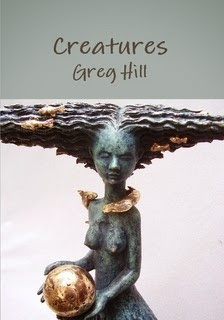
Creatures by Greg HillGreg Hill lives in Wales. He was editor of The Anglo-Welsh Review and contributes regularly to Welsh literary magazines. I’ve followed his blog for a while and was delighted when I heard about the release of his first full length collection of poetry in print; Creatures.

The title alone creates intrigue. What kind of creatures? The epigraph replies; ‘All creaturely things… Plants growing, / Roads running, / Rivers flowing, / Places that sing.’ It is clear from the outset this collection is about an animate landscape where every being is a creature, alive and sentient.

The first ekphrastic poem is based on the picture on the cover; Fidelma Massey’s sculpture, ‘Water Mother,’ who dreams thoughts of water into being. Here, the ‘cosmic ebb and flow’ of thought and water is contained in the poem. Analogies between living water and perception recur throughout the book. In ‘Cwm Eleri’ the poem’s tight structure fails to contain the river, which slips from grasp like time. In ‘Myddleton’s River’ water-ways link London, Wales and the underworld, forming a conduit for complicated alchemical processes of mental and physical transformation.

The contrast between our immediate perception of creatures and those aspects of their being impossible to grasp is central. A jackdaw sitting happily in the hearth becomes ‘an image… a token of wildness… like a jigsaw piece from another puzzle;’ a homely and familiar event made strange. Greg writes that as a heron dips out of sight ‘a part of me fell out of the sky with it,’ lost ‘except that something / settles in the flow of these words.’ We can never completely grasp our perceptions. Only through words can they find permanent representation.

Several poems present roads, paths and boundaries as living entities and how our understanding of them shifts once they are crossed and they slip into memory. If we try to return, the roads are ‘dull,’ ‘dusty,’ ‘empty.’ Our former selves are shadows, unfamiliar reflections. ‘Strange border guards’ usher us ‘from what / we neither know nor recognise.’ These haunting and complex poems demonstrate how choices shape our relationship with the landscape and hence our memories.

The mysteries of the Bardic Tradition and its creatures are explored in novel ways. ‘Awen’ depicts a shepherd lad inspired to speak poetry by a spirit ‘like a forest god’ who is elusive as the words he inspires. Four episodes from the Mabinogion are covered. I was fascinated by ‘A Scaffold for a Mouse,’ which depicts ‘Manawydan living in a dream / landscape with the life / conjured out of it like a flat plane.’ Through his ‘firm grip’ on the mouse, ‘a small thing / for a great purpose,’ he breaks the ‘powerful magic’ of Llwyd, awakening ‘form to its true nature’ thus freeing Rhiannon, Pryderi and Cigfa.

This collection depicts a relationship with the creaturely world that is on the surface simple and direct yet beneath mysterious and disconcerting. Each time I return to these poems I discover new meanings and thematic relationships within the whole. I’d recommend this book to anybody who likes poetry with lots of depth and has a love for nature, myth and creatures.

Creatures can be purchased through Lulu here: http://www.lulu.com/spotlight/greghillpoetry

Greg Hill’s poetry site is here: http://greghill.weebly.com/
Greg’s blog, Hill’s Chroicle can be found here: http://hills-chronicle.blogspot.co.uk/

Spirits of Annwn fly over reaped fields

Spurned birds circle
fields weeping
for all that is good
in the world
gone

dry harvest
all the legions of the dead
strewn fallen scattered
let them seed
this world in the arms of their loved ones

the circles begin again
hearts cut in twain

by the reapers’ blades
hear them come
softly sweeping bare-footed
with the silence of a love song

pile straw onto carts

the hallowed dead
ascending in a cloud of wings

spirits of Annwn fly over reaped fields

then down and under
circling circling

Ribble Illusions

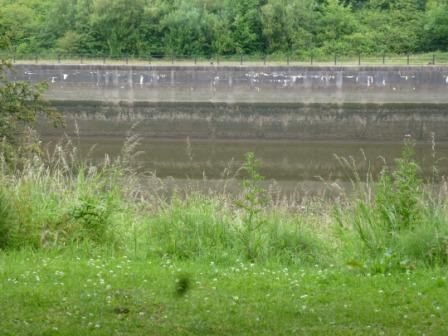
Yesterday I had a most uncanny experience. Approaching the river Ribble from Castle Hill, I found myself facing a long stretch of tide marked wall that gave the appearance it had dropped away into nowhere. I was struck by a sudden sense of vertigo. The Ribble couldn’t have disappeared, as if had fallen into a void, surely?

River RibbleOn closer inspection, seeing the reflections of the grilles and staircases, and catching subtle fluctuations in the surface of the water, I realised this was an illusion created by a combination of its stillness with the markings on the stone.

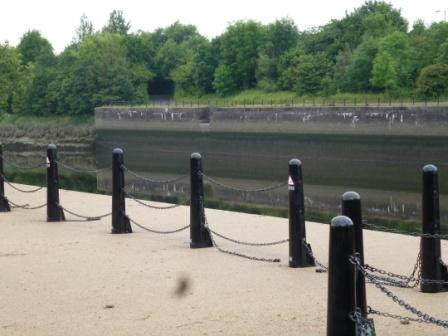
River Ribble, reflection of a grilleRiver Ribble, stairsTo my relief at either end of the concrete barriers, the ‘true’ water level was clear.

River Ribble, water level

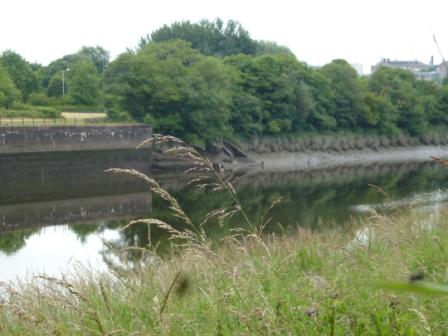
River Ribble, water levelDrawn  to stay a while in meditation on the strange appearance and disappearance of the river, which occurred as I shifted my eye-line, I was gifted with the sight of several birds. Common and black headed gulls and terns circled, their darker shadows mirrored in the water. Another bird, which I think may have been a grebe or even a black throated diver flew in. Diving with quick flips of its tail it emerged, for the most part, triumphant with white-silver fish, which after a brief kerfuffle vanished down its throat. Finally, a heron arrived to land majestically on a piece of flotsam.

Heron, river RibbleFor me this goes to show that even where it is channelled, the Ribble is a magical and mind altering place. I give thanks to the river, all its visitors and inhabitants, and its goddess Belisama.

Fish House Brook

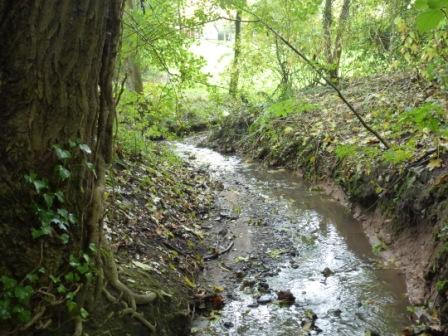
Fish House BrookFish House Brook is a stream in Penwortham, which runs from behind my street, Bank Parade, through Greencroft Valley to the river Ribble. Since I started litter picking in the valley three years ago I have been clearing the brook, walking it regularly and researching its history. This article traces its course from source to mouth and provides snap shots of the ways people have related to it over the last few centuries.

~

The source of Fish House Brook and its earliest stretch have been culverted underground. Its course is indicated by the street names Bank Parade and an adjacent cul-de-sac called Burnside Way. It runs underneath the gardens on the eastern side of Bank Parade.

Bank Parade and Burnside Way, courtesy of Mario Maps

Bank Parade and Burnside Way, courtesy of Mario Maps

A few months ago Gordon at number 14 kindly invited me into his garden to see the site of its steep banking, which is now occupied by a pond.

FHB tributary's old valley BP no. 14 - CopyHe also lifted the grille to let me take a peek at the swiftly flowing underground stream.

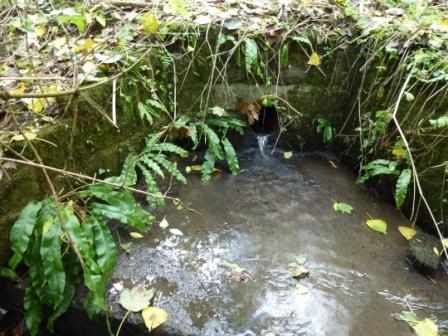
FHB culverted tributary - CopyThe brook now emerges from a concrete pipeline behind Malt Kiln Cottage.

Fish House Brook, sourceThe following maps show Fish House Brook running from behind Malt Kiln Cottage into Greencroft Valley in the 1840’s and today.

Malt Kiln Farm and Greencroft Valley

Malt Kilm Cottage and Greencroft Valley 1840’s, courtesy of Mario Maps

Malt Kiln Farm and Greencroft Valley

Malt Kiln Cottage and Greencroft Valley now, courtesy of Mario Maps

Malt Kiln Cottage

Malt Kiln Cottage

Malt Kiln Cottage originally housed a water mill used to mill grain for beer. A picture of the pool behind the mill leat can be found on the Tithe Map (1838). Elizabeth Basquill provides a detailed account of how the malsters in residence used water from the stream and adjacent well to soak barley in a malster’s trough before it was dried and delivered by horse and cart round the corner to the Black Bull pub (2).

Malt Kiln Cottage, Tithe Map, 1838

Malt Kiln Cottage, Tithe Map, 1838

During this period Fish House Brook must have been much larger and more powerful to turn a water wheel. Its diminishment shows the effect of building 300 houses and their accompanying pipelines for clean water, drainage and sewage during the Central New Towns Project in the 1980’s.

Greencroft Valley

Greencroft Valley

Greencroft Valley is the largest surviving green space between the new estates. The old field lines remain intact, indicated by rows of trees. The wooded areas provide living space and nesting places for hedgehogs, squirrels and birds including magpies, wrens, a variety of tits, nut hatches and a woodpecker.

Greencroft Valley

Greencroft Valley playing field

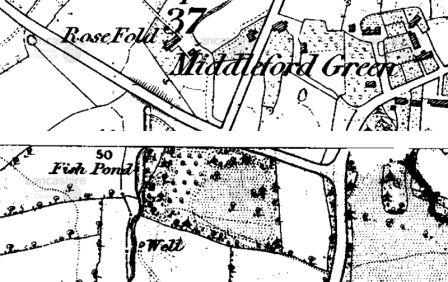
The brook has had its share of pollution problems, mainly from grey water out of faulty washing machines. Since reporting this, it has been less frequent. Frog spawn and frogs have been seen, and a few smaller insects. However, there is no sign of any fish. This is disappointing as the 1840’s map shows a fish pond, which according to the Tithe Map was in Fish Pan Field, suggesting local people used to pan in the brook for fish.

Fish Pan Field

Fish Pond and Greencroft Valley 1840, courtesy of Mario Maps

Fish Pan Field

Greencroft Valley now, courtesy of Mario Maps

The brook is culverted from Greencroft Valley beneath Hill Road South.

Fish House Brook, Culvert under Hill Rd SouthIt emerges close to Rosefold house and cottages.

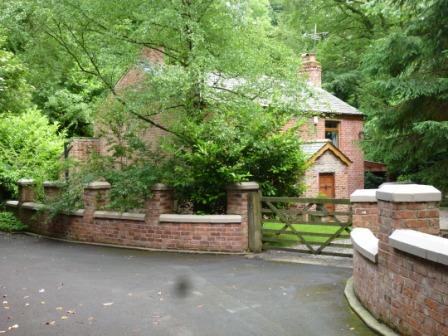
Rose Fold Cottages

Rose Fold Cottages

According to Elizabeth Basquill the cottages and yard were part of a tannery. During the late 19th century Fish House Brook was used to wash hides. ‘The hides were soaked in slaked lime first, then washed, and the hair and flesh scraped off.’ This process would have caused considerable pollution to the stream. Two adjacent fish ponds, which Elizabeth believes may have existed from the medieval period were ‘later used as tan pits for washing the skins’ (3).

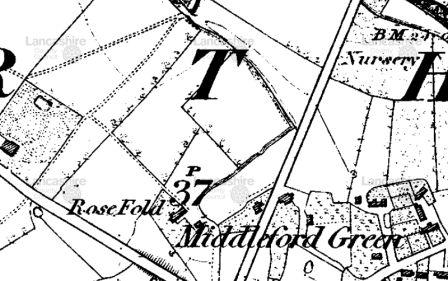
Rosefold

Rose Fold 1840, Courtesy of Mario Maps

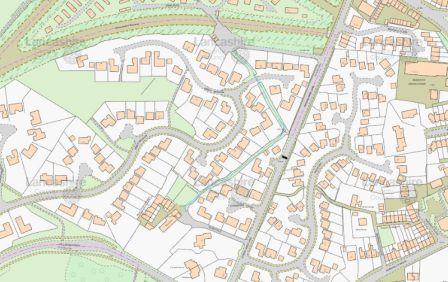
Rosefold

Rose Fold now, courtesy of Mario Maps

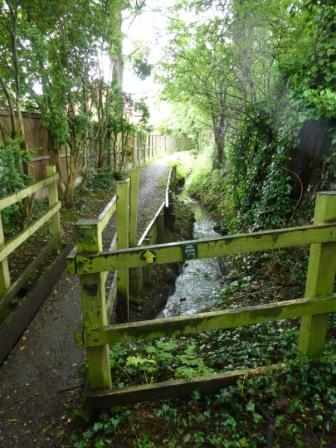
The first stretch of the brook, heading northeast, cannot be followed behind the houses. Where it makes a rightangle and heads northwest, a footpath runs alongside it. This follows the line of a much older route that led from Middleforth Green to St Mary’s Well (4).

Fish House BrookIt then bends right and passes through Campbell’s Park Homes following its old course round the back of the mobile houses.

Fish House Brook, Campbell's Park Homes

Fish House Brook, Campbell’s Park Homes

Campbells Park Homes, Meadows

Fish House Brook 1840, courtesy of Mario Maps

Campbell's Park Homes, Meadows

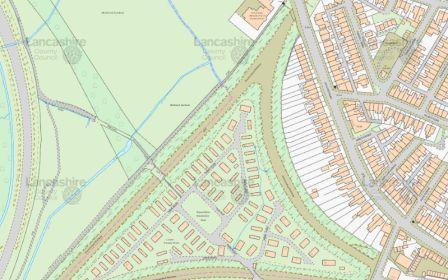
Fish House Brook, the Meadows and Campbells Park Homes now, courtesy of Mario Maps

The residential park nestles within the triangle of Penwortham Junction. The train lines pictured closed in 1965 and are now covered by beech, birch, sycamore, bramble and an array of wildflowers, forming important wildlife corridors.

Campbell's Park Homes

Campbell’s Park Homes

Another tributary enters Fish House Brook, running from the back of Far Field across the meadows. The pathway to St Mary’s Well crosses it, and there is a newer footbridge further south. At this time of year the meadows are thriving with mayflowers, buttercups, plantain, wild carrot, orange tipped and cabbage white butterflies and an abundance of bees.

The Meadows

The Meadows

The brook runs through Penwortham Allotments (unfortunately out of bounds) then is finally culverted beneath Leyland Road under Fish House Bridge.

Fish House Bridge

Fish House Bridge

Fish House Bridge

Fish House Brook culverted under Fish House Bridge

The 1840’s map shows a lodge beside Fish House Bridge. Alan Crosby says the bridge took its name from a timber building which ‘served as the quarters of the manorial river bailiff.’ This dwelling was adjacent to the fish garths, which were mainly used for catching salmon between December and August. It was the bailiff’s task to make sure the fishermen from different townships abided by the rules of the fisheries (5).

Fish House Bridge

Fish House Bridge 1840’s, courtesy of Mario Maps

Fish House Bridge

Fish House Bridge now, courtesy of Mario Maps

It is clear Fish House Brook derives its name from the Fish House, and as far as I know, no trace of an earlier name remains.

~

Each of these locations holds a story and discloses a relationship between the brook and the people who have depended on it. Since water started being piped in the 19th century, we’ve had no need to fetch it from wells or streams for drinking or bathing. Due to modern farming and production methods few of us rely on local waterways for fish, mill our own grain or tan our own skins.

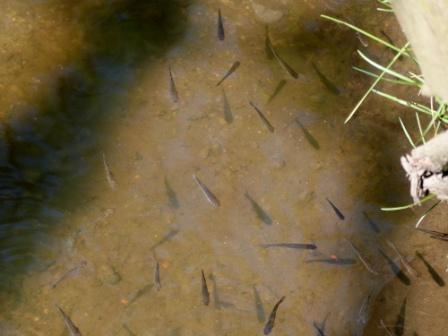
This has a distancing effect. Due to continuing building work, I cannot imagine a time when the water from Fish House Brook will be safe to drink. It is uncertain whether fish will return, although some small fish were sighted by mum in nearby Penwortham Brook.

Small fish photographed by my mum in Penwortham Brook. Can you identify them?

Small fish photographed by my mum in Penwortham Brook. Can you identify them?

Whilst it’s impossible to turn back the clocks, I think there is time to get to know and understand our watercourses, and the lives and motivations of the people who have worked with and changed them. This article is an early marker stone on the journey through this process for me.

(1) Courtesy of Mario Maps
(2) Elizabeth Basquill, More Hidden Histories of Penwortham Houses (2011), p6-11, 42-44
(3) Ibid, p34-36
(4) St Mary’s Well was famous for being the cleanest source of water in the area and was attributed healing properties. Local people used to walk a mile to access their favoured water source, and it was also a site of pilgrimage.
(5) Alan Crosby, Penwortham in the Past, (1988), p48
Gwyn Portrait, April’s End

The huntsman has ridden all night, following the brilliance of the spirit roads- the shining tracks that criss-cross the island of Britain. Instead of returning home he remains here for dawn, listening to the idiosyncrasies of each bird’s song, watching dew form on blades of grass, on petals of hawthorn blossoms and may flowers.

He is and is not the mist, riding through damp meadows over hills, mountains and moors on a pale horse accompanied by a hound of the same complexion. He is and is not each sun-lit cloud he travels with, the touch and whisper of the wind.

He cannot stay here long, for this world we see as the land of the living is not his. He must return home to Annwn, the Otherworld, to prepare for a battle that cannot be won. To fight for a maiden he shouldn’t have loved, shouldn’t still love… in bluebells and forget-me-nots, emerging greens and white and yellow flowers he sees her colours.

For a moment he is possessed by memories of their passion, and the crimes it drove him to. A glimpse of his blacked face in a reed strewn pool shows no amount of war paint can mask his guilt, which he must live with for as long as there are people to sing his songs.

He searches for a sign. What is Judgement Day? When is it? Although he knows the language of the trees and plants, the tracks of every wild creature and the flight of birds, these questions are beyond his power to divine. When the worlds end, will Creiddylad and I be together again?

May Flower, Penwortham

Winter Kingdom

As I make my circuit stars hold vigil in an icy breath.
Roses of Annwn bring beauty from death.
Wintering starlings spotted with snow
sleep in a tree that nobody knows.
There is a courtship of stability in this kingdom of cold
where we reknit the bonds as dream unfolds
in shadows of farmhouses down the pilgrim’s path
through old stony gates in footsteps of the past
to the healing well where a serpent’s eye
sees through the layers of time’s disguise.
A procession sways down the old corpse road
where the lych gate swings open and closes alone.
From the empty church bells resound.
Reasserting its place on the abandoned mound
a castle extends to the brink of the sky.
Within its dark memory a fire comes to life.
As warriors gather to warm their cold hands
I know I am a stranger in a strange land.

Fungi, Greencroft Valley


*Roses of Annwn is a kenning for mushrooms I came across in The Faery Teachings by Orion Foxwood

Hey Ivy

Hey ivy,
Hey-ey-ey-ey ivy
Life force of this valley
Immortal green

Hey ivy,
Hey-ey-ey-ey ivy
Arriving from mystery
In a chorus of leaves

Hey ivy,
Hey-ey-ey-ey ivy
She gives us shelter
Beneath her palisades

Hey ivy,
Hey-ey-ey-ey ivy
She feeds us berries
When trees are bleak

Hey ivy,
Hey-ey-ey-ey ivy
We sing her praise songs
With ardent beaks

Hey Ivy