The Breath of Nine Maidens and the Kindling of the Cauldrons

‘My first utterance was spoken concerning the cauldron
kindled by the breath of nine maidens.
The cauldron of the Head of Annwn, what is its disposition
(with its) a dark trim, and pearls?
It does not boil the food of a coward, it has not been destined to do so.’
~ ‘The Spoils of Annwn’

In ‘The Spoils of Annwn’, a medieval Welsh poem from The Book of Taliesin, we find mysterious lines about the breath of nine maidens kindling the cauldron of the Head of Annwn. The cauldron, the source of awen, ‘poetic inspiration’, is a central symbol within Celtic mythology. 

In ‘The Story of Taliesin’ the cauldron belongs to Ceridwen. In this tale Ceridwen is referred to as a witch but it’s my intuition She is a Goddess whose crochan – cauldron / womb is a sacred vessel of rebirth (1). In Her cauldron she brews a potion from 365 herbs (one picked on each day of the year) to provide her ugly son, Afagddu ‘Utter Darkness’ with the ‘Prophetic Spirit’. She assigns a blind man called Morda to bring kindling for the cauldron and to stir the cauldron she summons a boy called Gwion. After a year and a day Gwion shoves Afagddu out of the way and steals the awen. After a shapeshifting chase he is swallowed by Ceridwen (he as a grain and She as a black hen) then reborn from her womb as Taliesin.

In ‘The Spoils of Annwn’ the model is slightly different. The cauldron of Ceridwen, the magical vessel associated with inspiration and rebirth, is in the custodianship of the Head of Annwn – the ruler of the Brythonic Otherworld. Here there is no need for kindling or a person to stir the cauldron as the breath of the nine maidens is enough to set the processes within it into motion. The ‘food’ ‘not for a coward’ that it brews no doubt refers to the awen. Taliesin accompanies Arthur and his men not only to steal the awen, but the cauldron itself, bringing it back through ‘Hell’s Gate’ to the world.

This shows that when a potential awenydd, ‘person inspired’, proves their courage to the Head of Annwn, the breath of the nine maidens or awenau, ‘muses’ (2), kindles the cauldron, then the awen is received as a gift from the Gods.

This feels like an older and deeper model for the origins of awen. The significance of the breath of the nine maidens can be further elucidated by looking at the etymology. The medieval Welsh term used for breath is anadyl and this derives from the proto-Celtic anatla which shares a resemblance with anaman the proto-Celtic word for ‘soul’. The Indo-European *uel is closely related giving us the root form of awel ‘breeze’ and awen ‘inspiration’. There seems to be something fundamental this myth is telling us about how, in Annwn, on the soul-level, the breath of the nine maidens kindles the cauldron and sets in motion the processes within the cauldron that create the awen.

It’s my personal intuition that the cauldron / womb of Ceridwen, who I know as Old Mother Universe, is a macrocosm of the universe. That it lies in Annwn ‘Very Deep’ shows the Otherworld is a deeper reality underlying the universe. 

On a microcosmic level each awenydd might too be seen as a cauldron which is kindled by the breath of the nine maidens producing awen for poetic works. The breath itself might be seen as a gift from the awenau. 

Microcosm within microcosm a number of Celtic Pagans have come to relate the three cauldrons in the seventh century Irish text ‘The Cauldron of Poesy’ to the three main energy centres or chakras in our belly, heart and head (3). Interestingly the Irish term coire ‘cauldron’ or ‘whirlpool’ might be seen to relate to the spiralling manifestation of the universe and the turning of the chakras.

In yogic meditation the breath is used to awaken the chakras. I was once dubious about the existence of ‘Celtic Chakras’ but I am now coming to perceive the resonsances between these shared Indo-European traditions. I wonder whether anatla ‘breath’ is the Celtic equivalent of the yogic prana ‘breath’ or ‘life force’ which Celtic Pagans have long been searching for (4). 

(1)These insights derive from Kristoffer Hughes’ From the Cauldron Born.
(2)This term is borrowed from Greg Hill who uses it in his poem ‘The Muses’ in his poetry collection The Birds of Rhiannon – ‘O Muses / O Awenau / You whose breath kindled the cauldron of awen in Ceridwen’s keeping.’
(3) For example see Erynn Rowan Laurie’s ‘The Cauldron of Poesy’ – https://www.obsidianmagazine.com/Pages/cauldronpoesy.html
(4) Some druids have in the past mistakenly identified prana with nwyfre ‘sky, firmament’ which Mhara Starling explains is erroneous on her Youtube channel – https://www.youtube.com/channel/UCkc4iRymvz4t619FEk5dFfA/videos Interestingly the proto-Celtic anatla ‘breath’and anaman ‘soul’ share similarities with the Sanksrit atman which is sometimes translated as ‘soul’ but refers to the Self or witness-consciousness beyond phenomena and ananda which refers to bliss at escaping the cycle of mortality or uniting with a God.
The Return of the Hooded Man

Oh Hooded Man, my old friend,
what have you come to say?
In solitude and silence cloaked
dark and familiar on a spring day?

~

After two years of solitude focusing on my writing my shamanic work has led me out into the community again. I’ve really enjoyed guiding individuals and groups into the Otherworlds in one-to-one sessions and shamanic circles. Offering shamanic healings is magical work that fits perfectly with my calling as a nun of Annwn dedicated to Gwyn and makes my soul sing.

However, I’ve discovered that, as an autistic person and introvert who needs a set routine (my natural circadian rhythyms work best on 4.30am get-ups and 8.30am bed times) I can only cope with such intense interpersonal interaction in the daytime. I tried shifting my timings half an hour to 5am and 9pm to make it easier to attend and run groups in the evenings. Yet when I did, I found I was getting overstimulated, unable to sleep, then when I slept, waking up early with my mind whirring desperately trying to process the events. As a knock-on effect I was coming to dread late groups and that was causing additional sleep loss. Running a shamanic circle each month locked me into a monthly cycle of anxiety and sleep deprivation. Thus, although it was sad, it was also a relief when due to not having enough numbers to pay for the room, I was forced to close Penwortham Shamanic Circle. 

As an alternative to evenings I thought about running weekend groups as I wanted to provide opportunities to practice shamanism to working people. As an experiment I tried attending a seasonal creative workshop on a Sunday but in spite of it being really thoughtfully put together and well run struggled with the shift in routine. It made me realise how much I need weekends after working with clients during the week. Once-upon-a-time my Saturday wind-down was drinking a bottle of wine and writing drunken poetry but more recently I’ve replaced that with playing the heartbeat of Annwn for Gwyn for an hour then entering deep relaxation through an hour of body scan meditation or Yoga Nidra. This provides me with a much-needed nervous system resest before I spend Sunday continuing to recharge by praying, meditating, cleaning and going for a local walk or a swim. Attending an event on a Sunday made me stressed all Saturday and unable to benefit from my wind-down then resentful on Sunday as I couldn’t have my alone time. This made me realise that weekends aren’t going to work for me either.

I’ve been trying to force myself to do things against need for solitude and routine for several reasons. One is that I have been trying to follow as role models shamanic practitioners who have succeeded in making a living from their work by running evening shamanic circles and weekend workshops. Another is, although I’m not naturally a community builder, I have mistakenly stepped into the role of attempting to build community in the hope this will establish a foundation for my one-to-one work. The last is financial insecurity – feeling that if I can provide more opportunities for more people I will be more likely to make a living from my shamanic services.

By trying to copy others I’ve not only gone against my own nature but forgotten there are other models available. In the Brythonic tradition the awenyddion ‘people inspired’ (our native soothsayers / spiritworkers / shamans) appear to be hermits, edge dwellers, who were occasionally consulted by the community for prophecies spoken through possession by spirits. One of my spirit guides, who I consider to be an ancestor of spirit, Orddu, lived alone in a cave in Pennant Gofid ‘the Valley of Grief’ in ‘the uplands of Hell’ and was referred to as a gwrach ‘witch’ likely on account of her practicing spiritwork / shamanism inspired by Gwyn and the spirits of Annwn. Myrddin Wyllt is another prophetic figure who lived a hermitic life as a wildman in the forest of Celyddion and only occasionally appeared to prophecy.

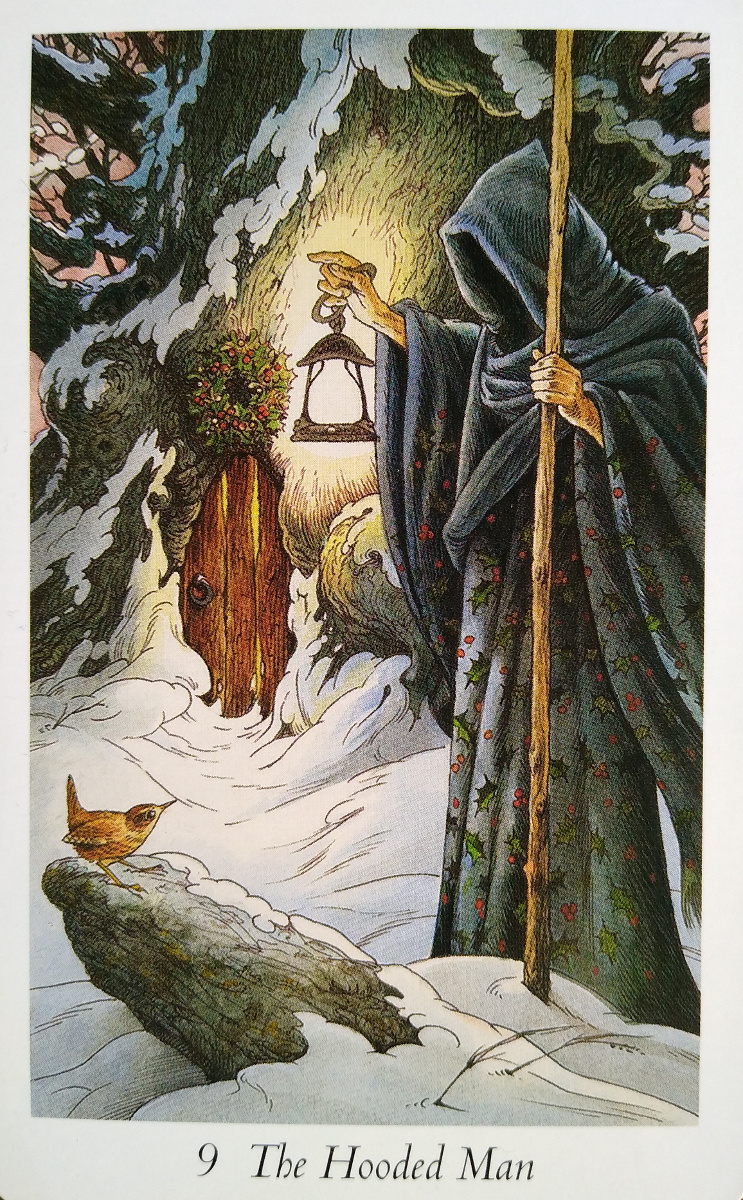
I have a print-out of the Hooded Man from the Wildwood Tarot on my wall to remind me to honour my need for solitude. He’s been absent from my tarot readings of late and it’s unsurprising he has reappeared at this point in time. I have taken this as a sign that I need to better balance my monastic need for solitude and routine with my outward-facing vocation of doing shamanic work.

The Speaking Ones

Several years ago I had a vision of the world becoming as a whirlpool from the source. ‘Green moving swards of vegetation, trees, people, marching through a labyrinthine kingdom back into the void carrying houses and entire civilisations.’ Sometimes people got stuck. With bird-headed ones they came knocking on the back of my head trying to shout through me. I was on Psylocybe mushrooms and alone at the time and didn’t dare let them.

The practice of a person allowing spirits to speak through them is found in many world religions from Voodoo to Evangelical Christianity. It was likely to have been an important component of pre-Christian Brythonic polytheistic religion and survived into the 12th century as recorded by Gerald of Wales.

Gerald writes of awenyddion ‘people inspired’. ‘When consulted upon any doubtful event, they roar out violently, are rendered beside themselves, and become, as it were, possessed by a spirit.’ Their speeches are ‘nugatory, ‘incoherent’, ‘ornamented’. When ‘roused from their ecstasy, as from a deep sleep’ they cannot ‘remember the replies they have given’. He conjectures: ‘perhaps they speak by the means of fanatic and ignorant spirits.’ (1)

Gerald’s words provide evidence for a Brythonic tradition of spiritwork in which there exist ‘soothsayers’, referred to as awenyddion, who are possessed by spirits by whom they speak in the metaphorical language of poetry.

I first came across the term ‘awen’ for ‘poetic inspiration’ in the Druid communities and saw myself as a bard before my patron God, Gwyn ap Nudd, initiated me as an awenydd. I have served Gwyn in this role for over ten years by journeying to Annwn to bring back inspiration for my communities. 

I have prayed for awen and for the Gods and spirits to inspire and come into me when writing in a similar way to the ancient Greek poets calling on the Muses and to William Blake asking the Daughters of Beulah to come into his hand. (2) I’ve also experimented with trance singing, letting go, just letting any words and tune flow. But, until recently, I hadn’t dared speak the voices of spirits.

This changed after a conversation with a fellow member of the Monastery of Annwn, who told me of his calling to channel Gwyn. It reminded me of the bird-headed spirits, who’d come knocking, whose desire to speak I had denied. I felt the time to offer my voice had come and journeyed to them.

I saw them as crows flocking in the sky in the shape of infinity then crossed bones. Their home appeared as the floating skeleton of a great raven. I offered to gift them my voice and they gave me some instructions. They would stand behind me. Then I must open the door and loosen my tongue. I tried it whilst in the Otherworld and received a prophecy about a distant son of Don.

Several days later on their prompting I composed a song to enter the trance state:

Crows, crows, the Speaking Ones
Y rhai sy’n siarad

Come, come from Annwfn
Come, come your will be done

Crows, crows, the Speaking Ones
Y rhai sy’n siarad

Come, come bring your words
Come, come you will be heard

Crows, crows, the Speaking Ones
Y rhai sy’n siarad

When I tried it the first time and asked who wanted to speak they told me they would take it in turns and each wanted me to make their words into an oracle. I did this by letting them speak out loud through me first then writing down what I could remember and putting it into more poetic form. (3)

On completion of the oracles I read them to the Speaking Ones and gained their approval. At first I wasn’t planning to make any of this work public but I was told they wanted their voices to be heard so I will be posting the oracles of these seven crow-guides over the course of the next week. 

(1) https://awenydd.weebly.com/giraldus-cambrensis-and-the-awenyddion.html
(2) ‘Daughters of Beulah! Muses who inspire the Poets Song… 
Of varied beauty, to delight the wanderer and repose 
His burning thirst & freezing hunger! Come into my hand 
By your mild power; descending down the Nerves of my right arm 
From out the Portals of my Brain, where by your ministry 
The Eternal Great Humanity Divine, planted his Paradise’
~ William Blake, ‘Milton’
(3) As a note I don’t consider this to be full trance possession because, whilst working alone, I don’t dare let go of my conscious faculties fully. Also, for this particular work, I have been asked to record the words so need to be aware enough to remember them. During this process I’ve felt something other has come through, but that I’m not fully out of the way, and suspect my consciousness might have coloured some of the content.

Meditating Gwyn

My breath with Your breath,
my heart with Your heart,
my feet on Your path,
You and I as one.

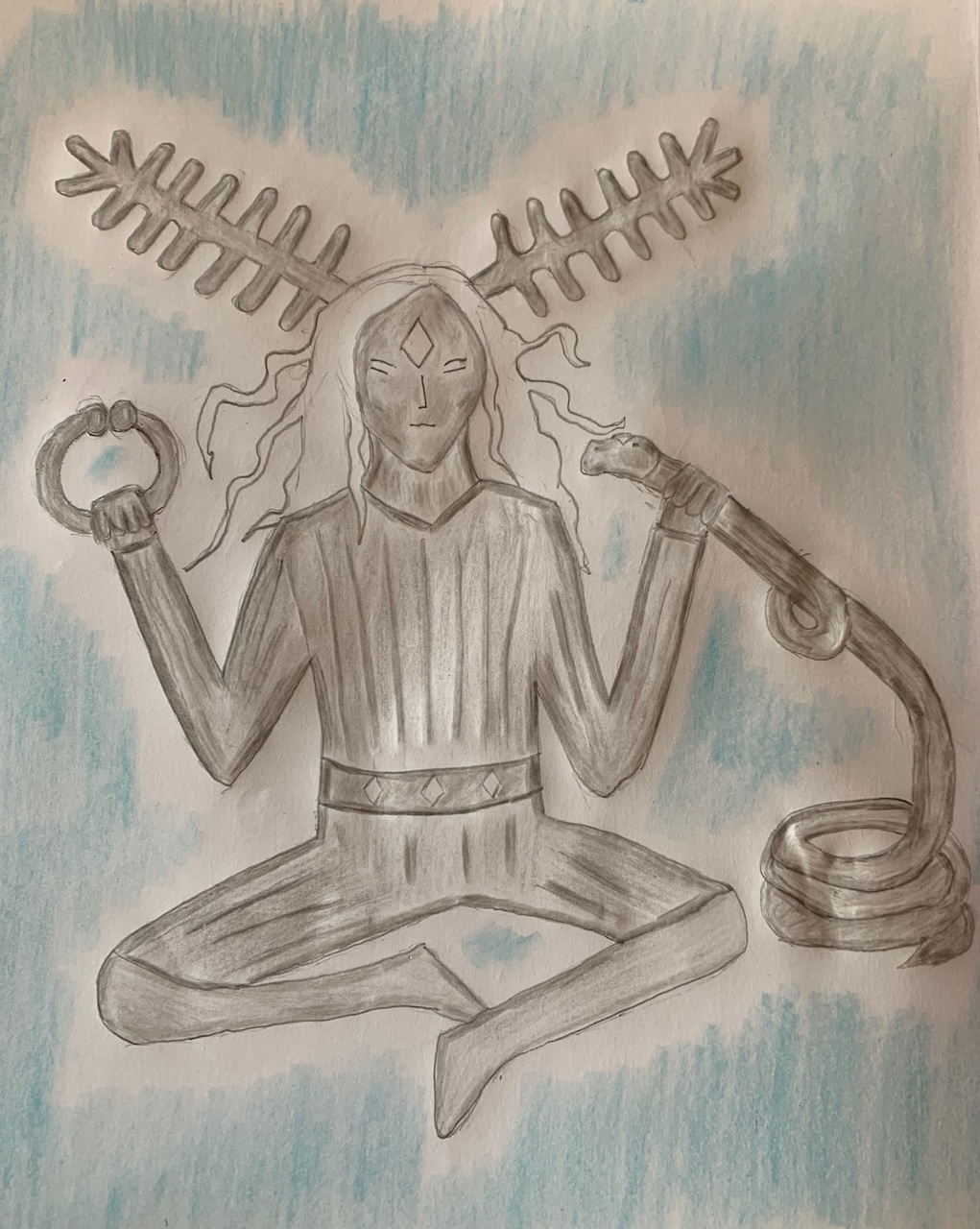
This piece of devotional art represents a face of my patron God, Gwyn ap Nudd, who I know as Meditating Gwyn and the Inspirer. Gwyn first appeared to me in this form when I started to take seated breathing meditation seriously after finding techniques that worked for me from yoga.

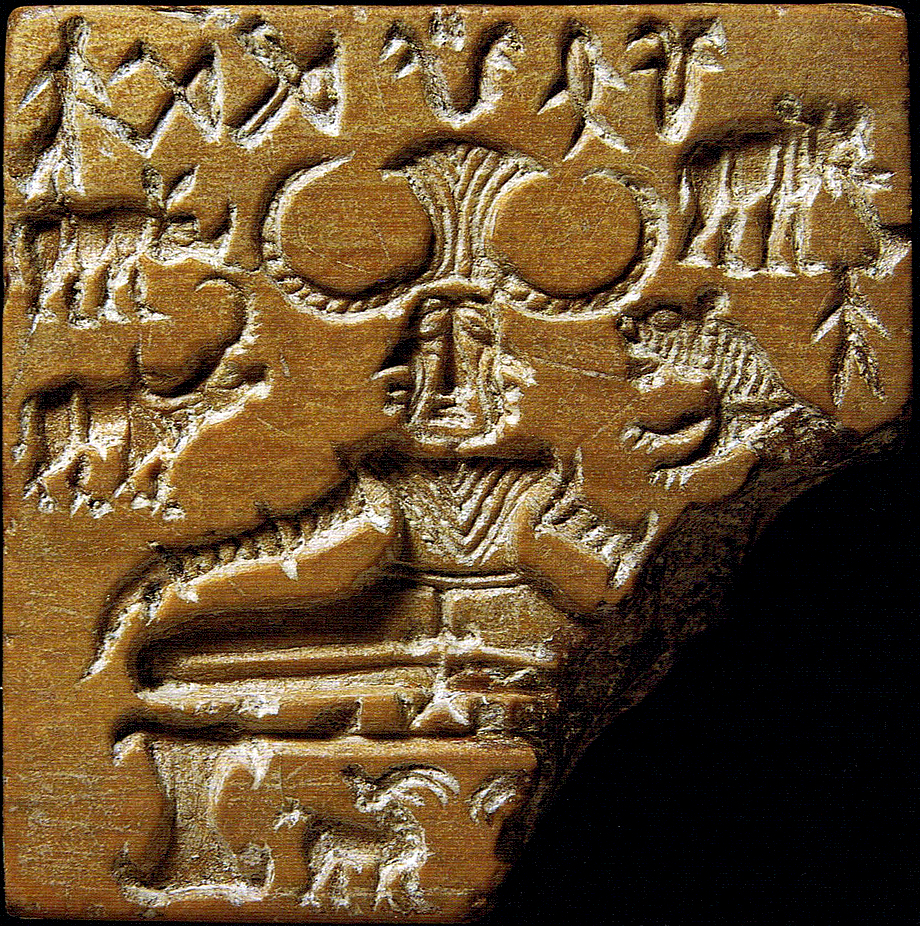
Several years ago I received the gnosis that the meditating deity on the Gundestrup Cauldron is likely to be Gwyn (who may also be Cernunnos ‘Horned’ by another title) and Gwyn’s appearance in this guise confirmed it.

I had not thought of Gwyn, as a warrior-hunter God who gathers the souls of the dead, as being associated with meditation until He took this apparel. Yet it made sense in terms of my experience of Him paradoxically being not only the storm of the Wild Hunt but the calm at the heart of the storm. It also ties in with His likeness with Shiva, the Hindu Lord of Yoga, with them both being creator-destroyers with connections with bulls and snakes/serpents depicted in similar poses.

Since then Gwyn has continued appearing to me in this guise when I meditate, helping me to align my breath with His breath, my heart with His heart, keep my feet on His path and enter union with Him.

Whilst this image resembles the image on the Gundestrup Cauldron in many ways, it differs in others. You will probably notice Gwyn’s antlers don’t look like real antlers. They look more like radio antennas. I asked Him about that and He said it represents His ability, when meditating, to tune into what is happening in Thisworld and the Otherworld and sense the deaths of those whose souls He needs to gather.

Gwyn and the serpents have jewels in their foreheads. This addition has come to me in personal gnosis as I’ve journeyed with Him into the deep past, before the world was created, before humans, when He lived in Annwn amongst serpents. He and the serpents all had these magical jewels. I found no evidence of this for a long while until I saw a bronze head with a forehead jewel from Furness, Lancashire in Pagan Celtic Britain. I then learnt the serpent associated with Shiva, Nandi, has a magical forehead jewel. There are also three jewels in Gwyn’s belt which, to me, are the three stars in the belt of His constellation, the Hunter (Orion).

He wanted hair. Although Gwyn is not pictured on a cauldron I kept His silver-grey apparel as I see Him as having grey skin in His more primordial form (Creiddylad has green skin, Nodens/Nudd blue, Anrhuna grey) which I later realised fits with representations of the Gods in the Hindu and Buddhist yogic traditions.

This image on the Gundestrup Cauldron has also been associated with awenyddion ‘people inspired’ who likely used meditation and journeywork to travel to Annwn to bring back inspiration for their poetry. I see it as an image of Gwyn as the Inspirer which can be imitated by His Inspired Ones.

Who am I?

I am not Taliesin enthroned in Caer Siddi where bardic words are a fountain of wine and mead and are served like sweet pastries and Turkish Delight on golden platters by a whirl of wisp-like spirits.

I am not Myrddin alone and starving in the Forest of Celyddon amongst the gwyllon with icicles for hair and a lean wolf beside him. By pine and root and name of plant and bone of bird laying to rest the skeletons of Arfderydd, healing rib by rib by the wisdom of awen.

I am not Orddu in her cave listening to the slow drip of water counting down to her preordained death.

I am not Afagddu on the shoreline. I have not swallowed stones. I have never tricked a fisherman.

I am not the Dark Magician in his high tower in the woodland at the back of the world where people come and go like the mists whilst his intentions, like the tower, forever remain concealed.

I am not the Nun in her cloister, the Bride of Christ with wedding bells in her head suffocating in his tomb.

I am not the Priestess of Avalon who serves my god lighting candles at the White Spring.

I am a suburban poet. I am Gwyn’s awenydd. I am not quite a hermit. I am possibly almost a mystic.

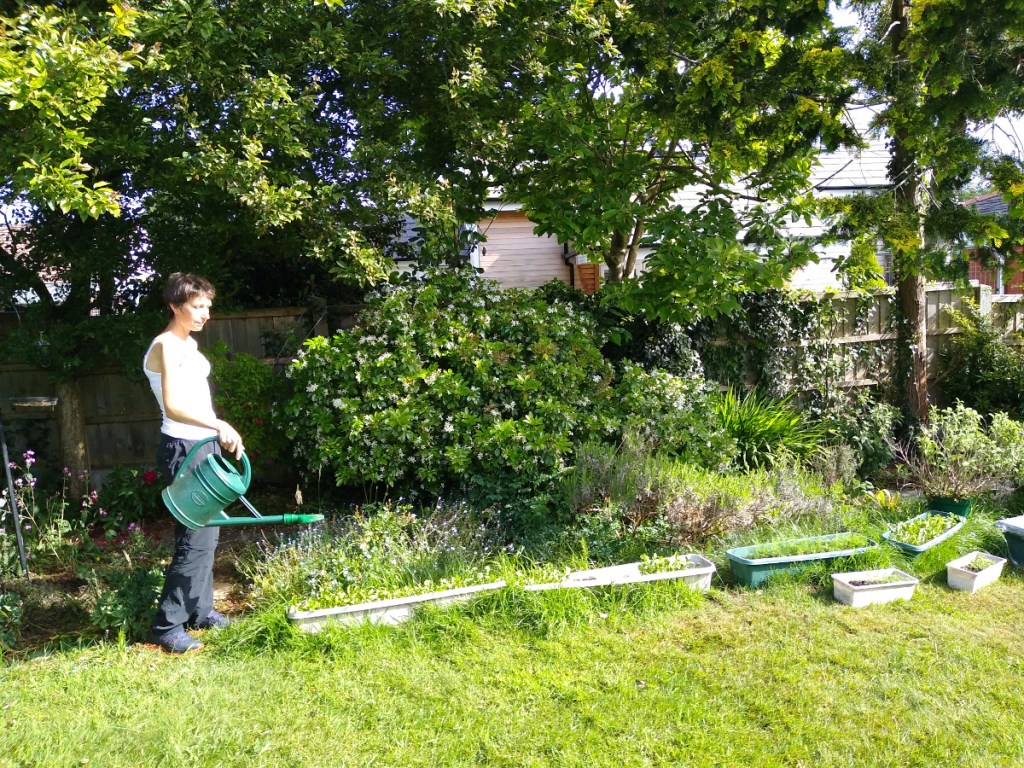
I am a between person. I am at home and not at home here in Peneverdant. I am in Creiddylad’s Garden. I like the slowness of the watering can. I like chloroplasts and slipping into them to learn of light and dark reactions, to become part of the Calvin-Benson Cycle. I like garden gnomes.

Perhaps one day I will wear a robe and shave my head or perhaps I will go naked in spite of the neighbours and the gaps in the garden fence or perhaps I will disappear like a mason bee into a bug hotel.

I know that, one day, like everything in this garden, I will be compost. Food for stinging nettles and beetles.

I am the key to the mysteries for which I have not found the lock yet.

I am the book in my hand that is not yet written.

Underground Shrines of the Inspired Ones

Thomas Stephan Unsplash

‘Was the rite conducted by a gutuater?
(‘master of voice’, ‘inspirer of song’)
chanting to inspire a modern awenydd
stepping down into the smoke of the chamber,
hearing the uttered syllables, riding the waves
of sound in the torchlight, finding a way back
to that world, re-creating, even as they did,
a rite that is alive in vision, in the presence
of those spirits called upon to officiate
as before…’
Greg Hill

Greg Hill’s poem ‘Gutuater’ led me to the section on the underground shrine of the Chartres ‘magician’, dated ‘to the second century AD’, in Miranda Aldhouse-Green’s Sacred Britannia (2018). In 2005, during excavations for a car park in the centre of Chartres the construction workers found a ‘basement shrine’ accessed by ‘a wooden ladder and ‘a cache of sacred material, including pottery vessels, oil-lamps and a broad-bladed knife, of the kind used in killing sacrificial animals.’

The pottery vessels were incense burners (thuribula) likely used for burning mind-altering drugs. Inscribed on one of the vessels, on each of the four panels, is a script beginning with names of the cardinal points: ‘oriens (East), meridie (South), occidens (West), and septentrio (North).’ Beneath each directional heading is a prayer to ‘all powerful spirits’ written by their ‘guardian’, ‘Caius Verius Sedatus’ and ‘a long list naming these spirits’ (which, disappointingly, Green does not share). However, she does mention the term ‘dru’ occurs in the list, suggesting Sedatus was invoking the spirits of druids.

What stands out to me firstly is that here we have evidence of a Roman citizen with a Gaulish cognomen – Sedatus – performing a ritual underground to invoke underworld spirits. In Gaul they were known as the Andedion and were invoked on the Tablet of Chamalières (50AD) for aid in battle. Secondly, we find a fascinating combination of Greco-Egyptian magic with invoking native spirits.

Finally, Green provides an interesting interpretation of the role of Sedatus. She mentions that Chartres was ‘the capital of the Iron Age Carnutes tribe’ and this land provides ‘evidence for the survival of specifically native, non-Roman spiritual leaders’. Aulus Hirtius ‘an officer in Caesar’s army and later governor of transalpine Gaul’ speaks of the resistance of ‘a freedom fighter called Gutuatrus’. This means ‘master of voice’ or ‘father of inspiration’. It may have been a title rather than a name as references to gutuatri have been found in the nearby Aeduan territory. An altar from Macon ‘recorded the presence of a gutuater of Mars’ (possibly Nodens under interpretatio Romana?). The word ‘GVTVATER’ is inscribed on the base of an altar to the local god, Anvallus, from Autun. Thus Sedatus may have acted in a religious role as a gutuater for his people.

Intriguing parallels can be found between the Gaulish and British traditions. In The Gods of the Celts (2011), Green records a remarkable example of an underground shrine to an underworld god from a similar period:

‘At the bottom of this shaft, found at Deal in Kent, all some 2.5 metres deep, was an oval chamber containing a complete figurine, composed of a featureless block of dressed chalk from which rises a long slender neck and a head with a well-carved, very Celtic face. This figure may have stood in a niche high up in one wall of the chamber. The presence of footholds in the shaft indicates that access to the shrine was intended but only four or five adults could have sat in the chamber at once and the shrine was perhaps meant for the deity or god and priest alone. Pottery would indicate a first or second century AD date for the structure.’

It seems likely this deity is one of the spirits of Annwn, our British equivalent to the Andedion. It may even be Pen Annwn, the Head of the Otherworld, who is known as Arawn or as Gwyn ‘White’.

The term gutuater may be linked to Talhearn Tad Awen ‘Father of Inspiration’ who is mentioned in Nennius’ History of the Britons (828) and to the awenyddion ‘people inspired’ mentioned by Gerald of Wales in his Description of Wales (1194). They served a prophetic function and were said to ‘speak by the means of fanatic and ignorant spirits’. Gerald notes their speeches are ‘nugatory’, ‘incoherent’, and ‘ornamented’ although an explanation can be ‘conveyed in some term of a word’. Their use of a non-logical and poetic language fits with Green drawing attention to the ‘plosive’ sounds in ‘the list of obscure names’ spoken by Sedatus, which lend them power when recited out loud.

These links have led me to wonder whether the ‘priest’ from Deal was an awenydd who invoked Gwyn and the spirits of Annwn in his underground shrine and whether such practices were wider spread. Could there be continuity between these 2nd century inspired ones and the 12th century awenyddion?

dark_cave___free_background_by_digitalequinedesigns

With thanks to Thomas Stephan on Unsplash for the smoke image and to Digital Equine Designs on Deviant Art for ‘Dark Cave’.