Twelve Days of Prayer

‘The Twelve Days of Christmas’ is a ‘sacred and festive season’ marked by Christians between Christmas Day (25th December) and the Epiphany (6th January). It was instituted by the Council of Tours in 567 to mark the period between the birth of Jesus and the revelation he is God incarnate on the visit of the magi.

For me, as a Brythonic polytheist who venerates Gwyn ap Nudd as Winter’s King, the mid-winter holy days have always felt particularly special and sacred. They begin with Eponalia, on 18th December, the feast of the horse-goddess and midwife of the sun. This is followed by the Winter Solstice, 21st / 22nd December, the height of Gwyn’s reign and presence within the land. 24th December is Mother’s Night and, although this is traditionally an Anglo-Saxon festival, one I associate with the Mother Goddesses such as Matrona/Modron and Anrhuna. 25th December is the day of the rebirth of the sun-child Maponos/Mabon. Then the next twelve days are a time of rest and celebration based around casting out the old year and welcoming in and preparing for the new.

Over the past few years I have noticed an increasing number of other pagans and polytheists exploring ways of marking these holy days. There are existing traditions of using them for divination. From my mum I learnt of the tradition of recording one’s dreams and linking them numerically to the calendar months. Cailtin Matthews has suggested using the Twelve Days for reading nature omens in a similar way.

In his essay ‘On the First Day of Christmas, the Dead brought back to me…’ Lee Davies connects the Twelve Days with Gwyn, the Wild Hunt, and the dead, who ride out to clear the ground for the New Year and also bring blessings of prosperity. He speaks of the koryos tradition in which people not only embody but ‘become the dead’ – a possible root of the misrule associated with the Twelfth Night.

With this in mind I decided to use the Twelve Days as a period of more intensive prayer and prayer writing for Gwyn and the spirits of Annwn and the dead with whom he rides out on his hunt through the winter months. This resulted in a series of visions and visionary dialogues. Here I share a selection from the twelve prayers.
Twelve Days of Prayer

For Gwyn

I.
Prayer
is to open
the little box of the heart
to let in the god who cannot fit within

two sides of a membrane
flap, dissolve like
the so-called
‘veil’

between the worlds
when you ride from the mist
on a creature somewhat like a horse
two hounds with teeth within teeth
all the countless uncontainable
monsters of Annwn

filling
this little box
I sometimes call a heart.
When it bursts and otherworlds
spill forth I know it is
so much more.


III.
You are ghost.
You and your legions.

You clothe yourselves
in cloud, in mist, you move
through our world like the wind.
Sometimes we hear you passing through.
Sometimes we sense only your silence
as you fill our vales with neither
your presence or absence.

Sometimes I feel ashamed
of my flesh and my fear to follow
you into battle in the wars that
rage on between the worlds.

Could it be that I’m afraid of death?

Of seeing my ghost looking back at me
as I write this poem from amongst your kind?

“You wear your flesh and your fear well.”

You speak in the voice that turns gold to leaves
and flesh to dust and skin to paper bearing
an elegy on the heels of your host.


IV.
“Fierce bull of battle,
awesome leader of many,”
I find myself whispering
Gwyddno’s words as though
they were the beginning
of an ancient prayer.

“Who will protect me?

“I will protect you.”

Your armour is a night
of stars and each of them
wields a spear against

my deep demonic fears.

I am awed by your strength
as I am mystified by its origin
for to whom does a god turn?
To whom does a god pray?

I see a bull striding majestic
down a passageway of light
into the infinite brightness
of a star, a heart, a fortress,
the Otherworld within his chest.

VI.
I come to pray
when I want to scream.

If I could comprehend you
could I contain the spirits within?

I fear to scream is the obliteration

of all prayer until you show me

how you tend to all the silent
and the unsilent screams

for a scream is prayer
as crescendo.


VIII.
I pray to you
as your awenydd
as your inspired poet

speak of my restlessness
the jangling of spirits within
my intimation I could be

so much more and you say:

“Poetry is more than rhyming words.
Awen is more than human speech.

The soul of the earth is living poetry
and each soul itself a poem breathed –

part of the divine breath which keeps

the rivers afloat, the mountains high,
the deer running through the woodlands,
the birds in the skies, the flowers growing
upwards turning their heads towards the sun.
And has the power to transform it all –
hurricanes, volcanic flames, tidal waves,
the death-wind from a nuclear blast creating
the wolves with glowing eyes and the monsters
with limbs where there should not be limbs
spoken of by awenyddion of long ago.

It can destroy (or fix) everything.

Why do you think I keep the awen
in a cauldron in a fortress that disappears
that spins that is shrouded by mystery and mist
and is sometimes known as the towers of the winds
and sometimes as the whale’s belly?

There is nothing more – I should know
for I have sought, I have hunted, with every
hound of Annwn beyond where the winds
of Thisworld and Otherworld blow beyond
the Universe and its moment of conception and
come back with nothing on my bloodless spear,
my hounds with nothing in their empty jaws,
bearing nothing in my empty hands but
knowing a little more about nothing.

One cannot be any more and about nothing
there is nothing to be said so be happy
as you are, awenydd, whilst still
a bearer of the divine breath.”


XII.
Your gift

is a shining bow
washed in the light
of the New Year’s sun.

I pray for the strength to draw it.
I pray for the patience to carve the arrows
each engraved with the words of a spell.
I pray for the focus to shoot true,

mind, body, and bow as one,
straight to the heart.

Fragments of Annwn – Depths

No-One Knows

the extent of the marshland of Annwn. Some cross it in a day. For others it goes on forever like the mist that obscures the musical birds, the shriekers of the mournful shrieks, the droners of the ancient drone, the players of the carnyxes that gurgle beneath the waters. You never know what is splashing behind on countless feet until it is too late. Sometimes you get lost following the will-o-wisps like lost hopes to where all hope fails. Sometimes you make sacrifices or become the sacrifice see your bog body your ghost flying free like a lonely bird. You become an inspirer or a guide only to bring doom to the unwary. When you think you know the way you slip. When you think you have found the awen you find it escapes words, that the sigh of its name is already escaping your lungs, that breath is not yours to keep forever and must return to the gods.

Awenydd of the Marsh

“You have not yet crossed the marsh.”

No, I’ve got lost again, led round on splashing circle feet to the village where there is a wooden pole and on it a woman seated cross-legged on the head of a bull a crane with wings spread above her.

When she’s not on the pole she’s in the central hut a cord of light down the centre of her spine surrounded by worlds that flicker in and out of existence whether at her will or not I am uncertain.

I’ve never heard her speak, seen her eyes blink, perhaps she dare not for fear of unseeing the realities she holds within her gaze. She doesn’t even breathe. Without her things would fall apart.

My eyes are tired, I’m out of breath, my worlds are out of reach, and I’m missing something.

An Abandoned Sea-Dragon

A blue watery dragon is snared by a weak rusty-looking metal chain around one leg, like a ship at anchor, like an abandoned boat, where the tides come up and wash over her body then back down again. She is ridden with fleas. She is one of the dragons that have been forgotten. I know I could easily break the chain but am told that it is not the chain that binds the dragon there. She has forgotten how to leave. The knight who chained her has fled from his fear of her death. The people do not feed her. She just lingers. It’s an awful story. A terrible mess. There’s no resolution. It’s embarrassing.

elizabeth-explores-unsplash

With thanks to Elizabeth Explores on Unsplash for the image.

The Awenydd Identity and Cultural Appropriation

Introduction

I’m writing this essay because, over the past few months, I have noticed a number of people speaking either of their reluctance to identify as awenyddion due to fears of cultural appropriation or more generally voicing their concerns about English and American Pagans appropriating the term.

I first came across the term awenydd ‘person inspired’ in Natural Druidry by Kristoffer Hughes. In its lightning-like connection to the awen ‘poetic inspiration’ and used as a descriptor of one who quests and gives voice to this divine breath in poetry I intuited it was the word I’d been searching for to describe my spiritual path (I had formerly identified as a bard). This was confirmed by my patron god, Gwyn ap Nudd, on the Winter Solstice in 2013. Since then I have served Gwyn as an awenydd by giving voice to his myths and those of other Brythonic deities, the lore of the land, and the ancestors. With Greg Hill I co-founded the Awen ac Awenydd website and, with Lia Hunter, we have been working on compiling an anthology featuring the voices of other modern awenyddion.

So it came as a bit of a shock that my adoption of the awenydd identity might be seen as cultural appropriation. And that, much worse, I might have unwittingly influenced the choice of others to appropriate the term. Over the past few weeks I have led discussions on the topic on the Awen ac Awenydd Facebook page and discussed it with Greg by email and would like to share some conclusions.

The Awenydd Identity

Firstly I will provide an introduction to the awenydd identity. The earliest use of the term awen is found in Nennius’ History of the Britons (828) where he refers to Talhearn ‘Tad Awen’ ‘Father of Inspiration’, chief of the famous bards Aneirin, Taliesin, and Cian. This may be our first reference to an awenydd.

Here it is important to note that bardism has its roots in an older Brythonic tradition. From the Iron Age, throughout the Roman-British period, until the Anglo-Saxon invasions all of present-day England, Wales, and southern Scotland were part of a shared Brythonic culture. Taliesin and Aneirin composed poems about the battles between the Brythonic rulers and the Anglo-Saxons which gave rise to the fall of Yr Hen Ogledd ‘The Old North’. As the invaders pushed the Brythonic peoples west they took their stories and traditions with them, leading to them being maintained in Wales.

In his Description of Wales (1194) Gerald of Wales speaks of awenyddion ‘people inspired’ who ‘when consulted upon any doubtful event, they roar out violently, are rendered beside themselves, and become, as it were, possessed by a spirit.’ Their answers are described as ‘nugatory’, ‘incoherent’, and ‘ornamented’ yet can be explained the ‘turn of a word’. These are hallmarks of both poetic and prophetic language. Their inspiration comes from states of ecstasy and dreams. The awenydd is depicted as a solitary spirit-worker and soothsayer.

In medieval Welsh poetry awen originates from the cauldron of Ceridwen and/or from God. It is seen to flow from Annwn, ‘the Deep’ or ‘the Otherworld’, where the cauldron is guarded by Pen Annwn. In The Story of Taliesin receiving (or in some versions stealing!) awen from the cauldron, thereby becoming an awenydd, is the source of Taliesin’s omniscience and mastery of the bardic arts.

The term awenydd is consistently used as a synonym for an inspired poet. For example the fourteenth century poet Dafydd ap Gwilym describes himself as an ‘awenydd gwyrdd’ ‘green poet’. Lewis Glyn Cothi, in the fifteenth century, refers to Grufydd ab Rhys and his kinsmen as ‘awenyddion’.

In a letter to his cousin (1694) the Welsh poet Henry Vaughan speaks of an orphaned shepherd receiving awen when the ‘hawk upon the fist’ of ‘a beautiful young man with a garland of green leaves upon his head… a quiver of arrows att his back’ flies into his mouth and awakes in him ‘fear’, ‘consternation’ and ‘the gift of poetrie’. This of interest because it is suggestive of awen being gifted by a numinous figure – perhaps Maponos/Mabon, a god of youth, hunting, and music/poetry.

During the Druidic revival, awenyddion are conceived radically differently. In hisBarddas (written in the late 18th century but published in 1862), Iolo Morganwg speaks of Awenyddion as ‘Aspirants’ who have ‘no privileges’ within the Gorsedd of the Bards of the Island of Britain until they have completed three years of discipleship. Only then may they graduate from the lowly status of Awenydd to ‘Primitive Bard Positive’. Iolo states that Awen comes ‘from God’.

Following Iolo, in his introduction to the heroic elegies of Llywarch Hen (1792) William Pughe refers to Awenyddion as ‘disciples’ who are examined for their ‘understanding, affections, morals, and principles’, undergo ‘severe trials’, and must ‘learn such verbs and adages as contained the maxims of the institution, and to compose others himself, on any relative subject, doctrinal or moral’ to gain the the degree of ‘Bardd Braint’ a ‘Bard of Privilege’.

Here we find the awenydd as the lowest position within a highly moralistic order based on Christian concepts. We are miles away from the shepherd lad being gifted with inspiration by an unnamed god.

The term awenydd is defined today in The Dictionary of the Welsh Language as an ‘(inspired) poet; bardic pupil; inspired person, genius’. In modern Wales it is used to refer to poets who write in strict metre.

Like many terms some parts of the meaning of awenydd have changed through the centuries, but its essence remains the same. It consistently refers to somebody who receives awen from the divine (be it the Brythonic gods and spirits or the Christian God) and expresses it in well crafted poetry.

Last year, on the basis of these two underlying currents, at Awen ac Awenydd we created our own definition of the awenydd identity – ‘an awenydd is a spirit-worker and inspired poet in the Brythonic tradition’.

Cultural Appropriation

Awen ac Awenydd is a community of self-identified awenyddion. Some of us, such as Greg, live in Wales and are Welsh speakers. Others, such as myself, live in other parts of the UK, or in America, and are learning Welsh. For us the question has risen of whether we are appropriating the awenydd identity.

To answer this question we need to understand the concept of cultural appropriation. This came into use in the 1980s as part of the discourse critiquing Western expansionism and colonialism. It entered the Oxford Dictionaries in 2017 where it is defined as ‘the unacknowledged or inappropriate adoption of the customs, practices, ideas, etc. of one people or society by members of another and typically more dominant people or society.’

Cultural appropriation involves a dominant culture taking elements from a minority culture and using them to make a profit, for fun, or for fashion, without giving anything back. This is often done without knowledge of or sensitivity to their meaning within the culture they are taken from and is a form of colonialism. This differs from cultural exchange in which the interchange is mutually beneficial.

Examples of cultural appropriation include the adoption of ‘exotic’ aspects of Indian culture following the economic exploitation of the Indian subcontinent by the British Empire, the claiming of the religious term ‘Shaman’ outside the indigenous religion of Siberia and its neighbouring peoples, and the use of ‘Sweat Lodges’ from the Amerindian tradition against the wishes of the Lakota elders (who suggest casually employing their techniques may be harmful to the participants).

Unfortunately, since the term has become fashionable, there have been a proliferation of more superficial examples such as an eighteen-year-old girl wearing a cheongsam to her high school prom and the row over Jamie Oliver’s ‘punchy jerk rice’.

Am I Appropriating?

So the question arises of whether English and American Pagans (members of dominant cultures) are appropriating the term awenydd from the Welsh (a minority culture) thus engaging in an act of colonialism.

First off I’d like to say that this question is based on the presuppositions that there is an absolute distinction between England and Wales and that Wales has been colonised by the English. There is a strong argument for the English colonisation of Wales over the last thousand years. There are numerous examples of military (Anglo-Norman castles), economic (mines, reservoirs), religious (the English Prayer Book), and linguistic (the Welsh Not) oppression. However, Wales along with England and Scotland, has benefited from oppressing other countries as part of the British Empire. More positively there are numerous examples of mutually beneficial cultural exchange between Wales and England (such as the Anglo-Welsh poetry of Henry Vaughan, David Jones, and Dylan Thomas).

These issues are complex, thorny, put our presuppositions into question, and do not take into consideration that for many centuries beforehand present-day England, Wales, and southern Scotland were part of a Brythonic culture which remains alive within the land and our shared heritage.

During our conversations Greg suggested, as a general condition, that an English or American Pagan would be appropriating the awenydd identity if they were doing so without knowledge of the Welsh culture and its Brythonic roots and were profiting in some way without giving anything back. For example an English Pagan selling courses on becoming an awenydd without knowing the background of the Welsh myths and mispronouncing the names would be appropriating.

Since I discovered that the stories of the Brythonic deities have been preserved in the Welsh myths I have been studying them and sharing them online and through performances in my local community. I’ve written three books based on the lore of the land and Brythonic mythology. I occasionally give talks and workshops sharing my knowledge and facilitating connection with the Brythonic gods. I am slowly learning Welsh, am a member of Preston’s Welsh Club, and for the past few years have made sure that Welsh poetry is included in the World Poetry Day event I help organise.

I believe I’m making the necessary effort to learn about the Welsh/Brythonic culture and language. Yet could it be said I’m profiting financially and in terms of status from selling it to other English people? Possibly, but my financial gains from books, talks/workshops,and poetry performances are miniscule in contrast to the amount of time and effort I’ve put into research and creative writing, plus the majority of my work is available for free online to people of all nationalities. And there is really nothing to be gained in terms of status by identifying with a little known path – it’s not like I’m declaring myself Arch High Druid of the Old North or Chief Bard of Gwyn ap Nudd or something.

Conclusion – In the Eyes of the Gods

More fundamentally it’s my personal belief that what we call the awen and the deities associated with it are much older and deeper than human concepts and distinctions. When Gwyn appeared in my life seven years ago I was completely befuddled by the question of why a wild Welsh god would want anything to do with a suburban English poet. It’s taken me that long to unravel his connections with the Old North and role as a psychopomp guiding the dead and the living back to Annwn and presiding over the mysteries of the awen as the guardian of the cauldron of Ceridwen.

For me being an awenydd is a religious calling based on my relationship with my patron god. It’s not something I can give up because I’m afraid someone will accuse me of cultural appropriation.

This was proven when I tried taking down the term ‘awenydd’ from my blog and the Annuvian Awen symbol I’d been gifted. It hurt. Both are essential to my relationship with my god and to my soul.

My personal decision to continue identifying as an awenydd is based on this feeling rather than logical and political arguments, which always break down into meaninglessness in the eyes of the gods.

cropped-annuvian-awen1-250

*With thanks to discussion and feedback from Greg Hill, who is a paradigmatic example of an awenydd who honours and serves the Brythonic gods and is engaged in modern Welsh culture, having learnt Early Welsh and provided translations of many Welsh texts into English as part of his vocation.

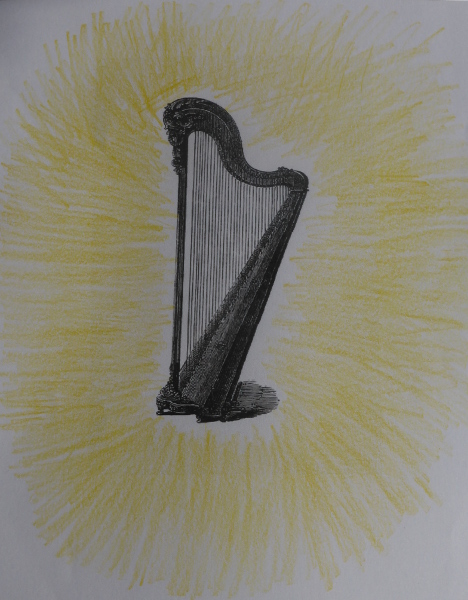
Mabon Learns to Play the Harp

It was Mabon who played then in the youth of the world
Greg Hill

Take the hand of the invisible
and make it visible.

Pluck a chord of light
like a string from the ball of the sun.

Imagine spiders spinning their webs

between the constellations;
the songs of the stars,

make them audible.

Fashion the nine chords
of my harp – the harp of Teirtu –

do not think of how it will play alone
as you in this House of Stone

in the hall of Pen Annwn.
Think not of the turning of his fortress

‘in Annwn below the earth’
or ‘in the air above’.

Do not ponder the reason
for your imprisonment – why

you must become an awenydd or bard.

Reach into the darkness with the audacity
of youth and imagine the discovery

of the wealthy realms of Pluto.

Ask not why the sun does not shine there,
why a dog’s jaws are the doors

and questions remain unanswered.
Reach deep within for the chord that moves

the hearts of planets – underworld gods.

In the river of tears consume the hazel nut
unknowing if it contains the awen

or countless meteoric souls.

Escape down the trail of a meteor
on the salmon of Llyn Llyw.

Take the hand of the visible
and make it invisible.

Forget this story –
you have always been the harper
and my harp has always played on…

Mabon's Harp

The Vision of Ceridwen

I’m the broken bird-thing
at her table again

her wizened hand
in my claws

telling her
I’m going to mend
our broken vision

and all will be beautiful.

***

Sometimes you end up in a myth. It’s not the myth you thought you’d end up in or the myth you chose. You’re not who you thought you would be. Nobody else sees the myth the same way you do.

It began when I first started learning about the Bardic Tradition and heard that Ceridwen was the goddess of the cauldron that brews awen, the poetic inspiration that is like mead to the Brythonic bards.

As a poet I thought Ceridwen was a goddess well worth meeting so I drew myself a cauldron, lit a candle, constructed a visualisation. One of those 2D interfaces that sometimes helps you interact with what is. I imagined Ceridwen as a blue-robed, dark-haired, faceless woman stirring a cauldron.

Nothing happened. Then, from nowhere, out leapt a hideous grey-haired hag who put her bony arms around my neck, nearly strangling me. She demanded I go with her to her cottage in her woods. She sat me down at her table in a room with a sun dial and smaller cauldron over the hearth on a wobbly three-legged stool and insisted that I call her ‘grandmother’. Initially I thought she was an ancestor.

I presumed this showed Ceridwen wasn’t interested in me. She already had worthier devotees. Soon afterwards I got found by my patron god, Gwyn ap Nudd, a ruler of Annwn and guardian of the cauldron.

I met ‘grandmother’ again when I was travelling Annwn in search of inspiration on my flighty white-winged mare. She ditched me and I found myself falling downwards through the air, flapping my arms like wings, steadily acquiring black feathers, but not quickly enough to stop me hitting the ground. When I returned to my senses the hag-like woman was standing over me. With a wrinkly smile she told me I was ‘beginning to get my raven’s wings’ before taking me to her cottage again.

There she told me to look into her cauldron, where I saw in vivid blues and reds a Dark Age battle of clashing spears, crashing swords, broken shields, fallen flags, blood crimsoning the nearby waters, then the shades rising in a sorrowful march to depart. Researching it afterwards I realised it was the Battle of the Region Linuis fought by Arthur against the Saxons and wrote a poem about it*.

After this gift of awen from her cauldron I began to suspect the hag was the real (as opposed to my imagined) Ceridwen. The name ‘grandmother’ came to make sense a couple of years later. Gwyn had shown me a cauldron filled with stars and not long afterwards I went to see my friend, Nick Williams, performing an experimental poetry set in a blacked-out room with strobe lights. I had the sensation of being in a cauldron of poesy and also in the womb of the universe. I recalled that Nick refers to a goddess called Old Mother Universe and realised she is Ceridwen – the oldest mother of all.

I went on to write a book called The Broken Cauldron, focusing on how Ceridwen’s crochan ‘cauldron’ or ‘womb’ is shattered in the Welsh myths and of my task of gathering the stars back into it.

Whereas, in the Bardic Tradition and Druidry, Taliesin and Arthur, those responsible for stealing the awen and the cauldron and the shatterings that have brought devastation to the land are hailed as heroes, I found myself standing in the shoes of Morfran ‘Sea Raven’, Ceridwen’s dark and ugly son, who was later known as Afagddu ‘Utter Darkness’.

He for whom she boils her cauldron in the hope the brew will inspire him and cure his imperfections. He who does not get the awen, who cannot win poetic inspiration the quick way, but must work to find the words to heal the lands poisoned by the contents of the broken cauldron, to repair it piece by piece, story by story, so the stars shine in bright new constellations on a new world.

Gwyn is my guide in this task, and in serving him, I am also serving Ceridwen. She does not appear to me often, but when she does, I am often her awkward black-winged child, the dark imperfect one.

As Afagddu I’m learning imperfection is necessary; an understanding of what others find repulsive, whether it’s darkness, death, decay, plastic, the monstrous creatures of Thisworld or the Otherworld. That these hold their own beauty when the concept is not corrupted by our society’s false ideals.

It’s not the Old Mother’s Universe that needs fixing, but the way we perceive it, the collective vision, which guides our acts. When we learn to see clearly both Creirwy* and Afagddu will be beautiful.

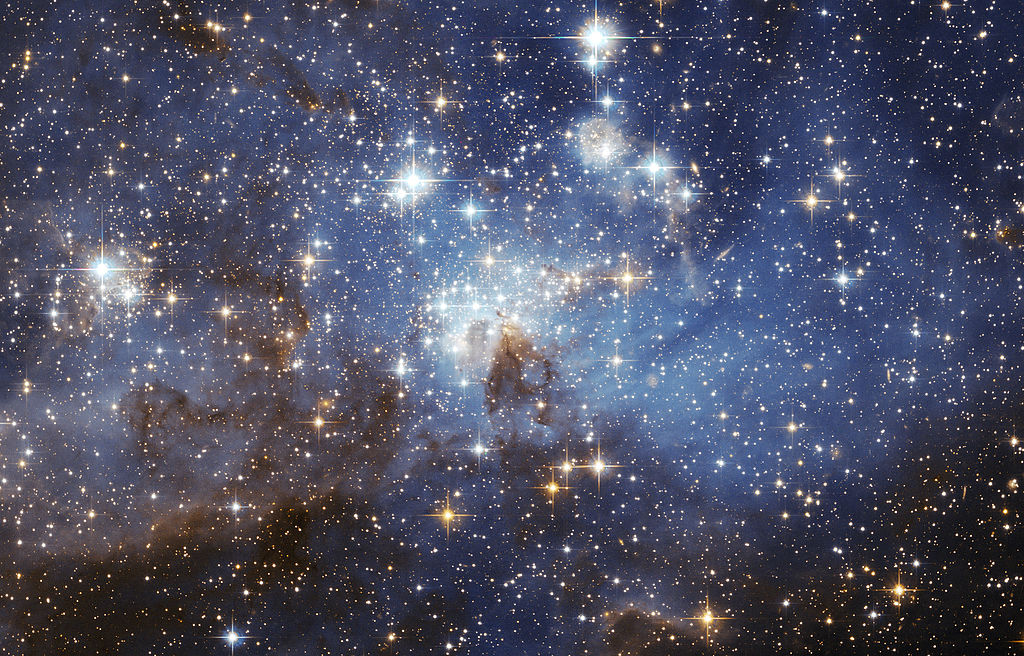
A star-forming region in the Large Magellanic Cloud Wikipedia Commons

*’The Region Linuis’ was first published in Heroic Fantasy HERE.
**Creirwy means ‘Lively Darling’. She is Afagddu’s beautiful (twin?) sister.

With thanks to Wikipedia Commons for the image ‘A star-forming region in the Large Magellanic Cloud’ by ESA/Hubble.

The Giant’s Letters

In Barddas Iolo Morganwg provides a mythical account of the origin of letters, which he claims was passed down from the ancient Bards of the Isle of Britain.

‘Einigain, Einigair, or Einiger, the Giant, was the first that made a letter to be a sign of the first vocalisation that ever was heard, namely, the Name of God. That is to say, God pronounced His Name, and with the word all the world and its appurtenances, and all the universe leaped together into existence and life, with the triumph of a song of joy. The same song was the first poem that was ever heard, and the sound of the song travelled as far as God and his existence are, and the way in which every other existence, springing into unity with Him, has travelled forever and ever… It was from the hearing, and from him who heard it, that sciences and knowledge and understanding and awen from God, were obtained. The symbol of God’s name from the beginning was /|\…

Einigan the Giant beheld the three pillars of light, having in them all demonstrable sciences that ever were, or ever will be. And he took three rods of the quicken tree, and placed on them the forms and signs of all sciences, so as to be remembered; and exhibited them. But those who saw them misunderstood, and falsely apprehended them, and taught illusive sciences, regarding the rods as a God, whereas they only bore His Name. When Einigan saw this, he was greatly annoyed, and in the intensity of his grief he broke the three rods, nor were others found that contained accurate sciences. He was so distressed on that account that from the intensity he burst asunder, and with his (parting) breath he prayed God that there should be accurate sciences among men in the flesh, and there should be a correct understanding of of the proper discernment thereof. And at the end of a year and a day, after the decease of Einigan, Menw, son of the Three Shouts, beheld three rods growing out of the mouth of Einigan, which exhibited the sciences of the Ten Letters, and the mode in which all the sciences of language and speech were arranged by them, and in language and speech all distinguishable sciences. He then took the rods and taught from them the sciences – all except the name of God, which he kept a secret, lest the Name should be falsely discerned; and hence arose the Secret of the Bards of the Isle of Britain.’

The letters were known as gogyrven, a term which has been translated as ‘spirit’ and ‘muse’, and provides the sense that the letters were inspirited and possessed their own lives and potent agency.

When etched onto wood with a knife each letter was known as a coelbren ‘omen stick’ and ‘The Coelbren’ was the name given to the alphabet, which later developed to contain twenty-four letters.

***

It has long been proven that Morganwg’s writings are forgeries and were not passed on from the ancient bards. They are also heavily influenced by Christianity. However, they may still be read as inspired works that contain deep truths open to reinterpretation from a modern Brythonic pagan perspective.

From numerous instances in medieval Welsh poetry where poets deny adamantly that awen is from God and not from the Great Goddess Ceridwen* we can derive that God replaced Ceridwen as the creator of the world and source of the awen. Their denials conceal an older truth. That the universe was born when she spoke her secret name which brought about the primal shattering of her crochan ‘cauldron’ or ‘womb’ – the Big Bang, and the echoing of her name throughout creation as awen-song.

If Ceridwen is our great creatrix, Old Mother Universe, who heard her song? Who is Einigan the Giant? A clue may be found in the name gogyrven or ogryven for letter. Ogryven is also the name of a giant. Hywel ab Owain Gwynedd speaks of ‘a girl in Ogyrven’s Hall’:

Unwilling to leave her (it would be my death)
My life-force is with her, my vitality ebbs
Like a legendary lover my desire undoes me
For a girl I can’t reach in Ogyrven’s Hall.

John Rhys says: ‘three muses had emerged from Giant Ogyrven’s cauldron. But Ogyrven seems to be one of the names of the terrene god, so that Ogyrven’s cauldron should be no other probably than that which we have found ascribed to the Head of Hades.’ It seems that Ogyrven is Pen Annwn, the Head of the Otherworld and guardian of Ceridwen’s cauldron. He is elsewhere known as Arawn or Gwyn ap Nudd.

The identity of Einigan with the Head of the Otherworld is consolidated by Iolo himself. In a later passage in Barddas, referring to the creation of the world we find the following dialogue:

Disciple: ‘By what instrumentality or agency did God make these things?’
Master: ‘By the voice of his mighty energy…’
Disciple: ‘Did any living being hear that melodious voice?’
Master: ‘Yes; and co-instantaneously with the voice were seen all sciences and all things cognitive, in the imperishable and endless stability of their existence and life. For the first that existed, and the first that lived, the first that obtained knowledge, and the first that knew it, was the first that practiced it. And the first sage was Huon, the son of Nudd, who is called Gwynn, the son of Nudd, and Enniged the Giant.’

Menw is a character from Welsh mythology who fittingly knows the language of the animals. The reference to him being the ‘son of Three Shouts’ may refer to the ritual cry of Diaspad Uwch Annwfn ‘the scream over Annwn’ and the power of the voice to summon Annuvian spirits to blight land and people.

Thus we have the seeds of an alternative story of the origin of letters inspired by Morganwg’s writings.

***

The Giant’s Letters

In the beginning there was Annwn, the Deep, a place of silent darkness within the crochan of the Great Goddess. In that silence, in that depth, a very small something formed – a name. And when the Goddess spoke her name, her womb, her cauldron shattered with an almighty bang, her waters broke and poured out in torrents of stars, planets, worlds, our beautiful world amongst them. The universe and its song were born from the secret name of Old Mother Universe and that song was known as awen.

But what is a song with noone to hear it? It was lucky that another of the gods of the Deep heard the song. He is known as Einigan the Giant, Ogryven the Giant, Gwyn ap Nudd, and countless other names. When he heard it, it was so powerful, so full of the joy of the becoming of the universe, so full of the sorrow of the shattering of the cauldron that would be never be whole again, that it seared three burning rays of light into his mind /|\. No matter whether he was sleeping or waking, no matter whether he sat still or ran or hunted through the universe for their source on his dark starry-eyed steed, they would not disappear and the song would not stop repeating itself over and over again.

“What is it you want? What is your demand?” he growled whilst resting at noon beneath a quicken tree.

“We want to be born, we want to be known, we want to be understood.”

The giant finally realised what must be done. Taking his knife he harvested a branch from the tree and cut it into three rods. Onto them he engraved markings for the ten deepest and most primal notes of the song, chanting each gogyrven over and over again, channeling into it its share of the light. When the three coelbren, ‘omen sticks’ as he called them, were formed, the rays faded from his mind. As he looked upon his creation he was filled with a feeling of deep satisfaction and peace and a strange but rightful emptiness, not unlike a mother who has just given birth to three beautiful children.

Yet he still could not rest until he found people who would come to know and understand his creation. He passed on the letters, but, to his horror, they soon lost their meaning. Rather than recognising them as the awen-song of Old Mother Universe, the echoing of her secret name, they began to worship the letters and the knowledge that they allowed them to accumulate instead. Every time a letter was written without purpose he was aware of the light of the universe fading out. He grew so angry that he broke the rods. The intensity of his grief burst his heart, burst him asunder like the broken cauldron. With his last breath he prayed their connection to the song of the awen and their rightful expression in poetry would be reclaimed.

A year and a day afterwards, Menw, son of Three Shouts, beheld the three rods growing from the giant’s mouth. Everywhere his parts had fallen the shoots of new forests of wild words sprang up. Menw learnt the letters and found to his delight they allowed him to commune with the animals who ran ran through those woodlands, with the stones, the rivers, the mountains, the bright shining stars. With all the things that echoed with the Song of Old Mother Universe. When he sang them out loud in perfect poetry he saw three rays of light burning in his mind and his heart was filled with joy.

Menw passed on the secrets of the awen to others who, like him, became awenyddion. When the last died, the light faded. Until those three rays were seen once again by an awenydd called Iolo Morganwg, who penned the story of Einigan the Giant. His works were passed on to others who would answer the giant’s prayer and reclaim the connection of his letters to the name of Old Mother Universe.

And what became of him? Death is rarely the end of a giant. Einigan died and returned to the cauldron. From it he was reborn as its guardian, the Head of Annwn, the ruler of the land of the dead from which the universe was born and to which it will return, as his reward for creating the letters.

abcedilros - the giant's letters

*Taliesin says:

I entreat my Lord
that (I may) consider inspiration:
what brought forth (that) necessity
before Ceridfen
at the beginning, in the world
which was in need?

In ‘The Chair of Teyrnon’ we find tension between conflicting translations of peir as ‘cauldron’ or ‘Sovereign’ (God). ‘Ban pan doeth o peir / ogyrwen awen teir’; ‘Splendid (was it) when there emanated from the Sovereign/cauldron / the ogyrwen of triune inspiration’.

Amongst later bards petitioning Ceridwen for awen is only acceptable when disguised as a metaphor and under the ordinance of God. Cuhelyn Fardd asks God for poetic power akin to ‘the dignity of Ceridfen’s song, of varied inspiration’. Prydydd y Moch requests inspiration from God ‘as from Ceridfen’s cauldron’ and asks God for ‘the words of Ceridfen, the director of poetry’.

SOURCES

Greg Hill, ‘The Girl in Ogyrven’s Hall’, The Way of the Awenydd, (2015)
Greg Hill, ‘Who was Taliesin?’, Awen ac Awenydd
Iolo Morganwg, The Barddas, (Weiser, 2004)
John Michael Greer, The Coelbren Alphabet, (Llewellyn, 2017)
Kristoffer Hughes, From the Cauldron Born, (Llewellyn, 2013)
Marged Haycock (transl), Legendary Poems from the Book of Taliesin, (CMCS, 2007)
Sioned Davies (transl.), The Mabinogion, (Oxford University Press, 2007)

Afagddu’s Sorrows

I.

Oh bone bird mother
do you not see my skeleton on the beach?

Do you not know which cormorant I was?

Do you not know how many stones I ate?
Do you not know of the sorrow of plastic I choked on?
Do you not know how I swallowed enough poison
to save the world but it was still not enough?

Whatever I did I could never gain perfection
with my oily wings, my puddling feet,
my shuffling look of misery.

II.

When I fought I flew into
a blind unchannelled rage like a primeval bird
and no-one could bring me back, could call me back again…

thus I was better as an attendant demon believed malevolent.

I could have been a bard if I had not sung the wrong songs –
the antithesis of the music of the tongue, disharmony, un-cynghanedd.

If my words had not creaked like a broken wing beating and beating
up above as I went about picking up loose pieces of words
that had been discarded like the limbs of dolls
and sad squashed teddies.

III.

In my childhood I had no hug, no cot, no mobile, no talking abacus,
and my mum did not leave the television on.

I didn’t really get to know the village where I was born
down beneath Lake Bala from which only
a harper and robin escaped.

I was more interested in the secret tunnel
between the worlds into which I could drag my ‘belongings’
and keep them safe – the rubbery Wellingtons,
the scribbly marker pens and notes.

Bala has always led to Tryweryn –

to the sunken villages and the empty beds
into which I climbed longing for mum and dad,

to the empty post office, school, chapel, chapel house,
to the cemetery and the new memorial chapel.

IV.

Black, ragged, bloated on November nights
I cannot remember my birthday but only the birthday
of my sister and how this was celebrated with whistles and balloons.

I instead was tarred and feathered and pecked to death

until I was rags and banners of intestine
and of course the cold dry bones,

until the door was opened
and I was bidden go.

Oh bird bone mother
if only you could see me now –

I am flying high beyond perfection.


Signposts to Annwn: Lore

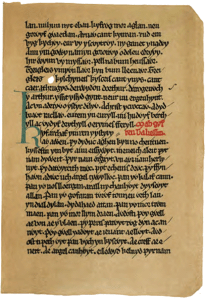
Book.of.Taliesin.facsimile

This posts shares some of the lore associated with Annwn. Awen, the divine breath of inspiration, is seen to originate from Annwn. Also included are passages about initiation, death and rebirth, and the soul.

Awen

‘Let’s approach God who is
– according to the utterance of Talhaearn –
the true judge of the worth of the world,
the One who adjudged the qualities
of passionate song.
He with his miracle bestowed
immeasurable inspiration:
there are 140 ‘ogrfen’
in inspiration;
eight score
in each one.
In Annwfn he ranged the (divisions of inspiration),
in Annwfn he made them,
in Annwfn below the earth,
in the air above the earth.
There is one who knows
what sadness
is better than joy.
I know the set gradations
of inspiration when it flows;
(I know) about payments to a poet,
about propitious days,
about a joyful life,
about the aeons of the fortress,
about the ones like kings,
how long their dwelling places (shall last)…

I sing inspiration,
I bring it forth from the depth.
The connected river which flows (around the world):
I know its might,
I know how it ebbs,
I know how it flows,
I know how it courses,
I know how it retreats.
I know how many creatures
are under the sea;
I know the nature
of each one in its shoal;
how many divisions in a day,
how many days in a year…’
– The Hostile Confederacy, The Book of Taliesin, (Haycock transl.)

‘I entreat my Lord
that (I may) consider inspiration:
what brought forth (that) necessity
before Ceridfen
at the beginning, in the world
which was in need?’
– The Childhood Achievements of Taliesin, The Book of Taliesin, (Haycock transl.)

‘Where does inspiration flow to,
at midnight (and) mid-day?’
– I am the vitality, The Book of Taliesin, (Haycock transl.)

‘He (Urien) defended my song (emanating) from Ceridfen’s cauldron;
unrestrained is my tongue, a repository of inspiration.
That inspiration of poetry – my God created it
at the same time as fresh as fresh milk and dew and acorns…

I have three songs of consistent harmony
and they will be perpetuated by poets until Judgement.’
– The Chair of Taliesin, The Book of Taliesin, (Haycock transl.)

‘Here is the declamation of a brilliant poem
of immeasurable inspiration…

splendid (was it) when there emanated from the Sovereign/cauldron
the ‘ogyrwen’ of triune inspiration.’
– The Chair of Teyrnon, The Book of Taliesin, (Haycock transl.)

‘When the ‘Cadeiriau’ come to be judged
my own will be the best of them:
my song, and my cauldron, and my rules,
and my careful declamation, worthy of a chair in harmonious song.
I’m called a knowledgeable one in Don’s court,
I, and Euronwy, and Euron.’
– The Chair of Ceridwen, The Book of Taliesin, (Haycock transl.)

Initiation

Sixty Years of Solitude

‘For sixty years
I endured solitude
in the water gathered in a band (around the earth),
(and) in the lands of the world.
I had a hundred servants,
(and) a hundred dominions after that.’
– The Hostile Confederacy, The Book of Taliesin, (Haycock transl.)

Death and Rebirth

‘A hen got hold of me –
a red-clawed one, a crested enemy;
I spent nine nights
residing in her womb.
I was matured,
I was drink set before a ruler,
I was dead, I was alive,
a stick went into me;
I was on the lees,
separated from it, I was whole;
and the drinking vessel stiffened resolve,
(for) the red-clawed one imbued me with passion.’
– The Hostile Confederacy, The Book of Taliesin, (Haycock transl.)

The Soul

‘Do you know what you are
when you are asleep:
a body or a soul
or a pale mysterious thing?…

The lamented soul –
who saw it, who recognises it?
I am amazed in books
that they do not know for certain
what the soul’s dwelling is,
(and) what its limbs look like;
from which region flow
the great wind and the great stream
in dire combat
endangering the sinner.’
– The Childhood Achievements of Taliesin, The Book of Taliesin, (Haycock transl.)

‘I praise my Father,
My God, my sustainer,
who added, through my head,
a soul into my design.’
– Song of the Great World, The Book of Taliesin, (Haycock transl.)

Afagddu’s Declamation

Until death it shall be obscure –
Afagddu’s declamation
The Hostile Confederacy

I am bedraggled tonight, unwelcome,
the one taught to hang his head
in his mother’s court:

Utter Darkness, the Dark Son,
the Ugly One she wishes
utterly forgotten.

I carry no shield, spear, or sword.
The brushing of damp fur
on my thighs

unnerves the courtly women.
My hair hangs like ivies over
the face of a bridge,

disappears like rain into a dark adit.
They compare me to Sanddef
the angelic.

Wings tarred to my back, I am
the sea-bird abandoned
in the oil-slick.

I drag myself in with my shadow,
carping words in metres
they can’t name.

The slow swooshing of my feet
reminds them of wetsuits.
From my feathers

sadness drips like tears of oily rain.
When I shake myself off
like a wet dog

they flinch away from the globules.
Looking into my green eye
they are beholden.

With my reptilian beak I speak
of swallowing sorrow
like stones,

plummeting down to the deep
in search of lands
unpoisoned

by my mother’s toxic cauldron.
From the darkest places
I won my awen.

I cleared the blowholes of whales,
untangled sea turtles
from gillnets.

On islands of bottles, pill packets,
polystyrene, prosthetic limbs,
I laid out the dead.

I learnt to divine from the plastics
in the entrails of copepods,
euphausiids,

mussels, mackerel, jellyfish,
sea gulls who rattled
in flight.

From bottle caps and cotton bud sticks,
pieces of red, green, blue, yellow
Lego bricks,

an alphabet of magnetic letters
stuck to a sunken fridge
I read the future.

Of course they were upside down,
back to front, in another
language.

I was forced to turn myself inside out
like a rabbit unskinning
to decipher it.

I’m still not sure whose future
I brought back in
my pockets.

I empty them out and letters writhe
like sea worms spelling
an inky fate

to the chant of plastic-eating bacteria:
Ideonella sakaiensi I gathered
from the deep.

The courtiers draw back their chairs,
weapons aglinting,
curse me.

I am but the messenger – the angelus.
Nevertheless they take aim.
A terrible poetry

of microbeads spills from my belly
as I fly up like a fury
to declaim…

Cormorant_(Phalacrocorax_carbo)_(17)

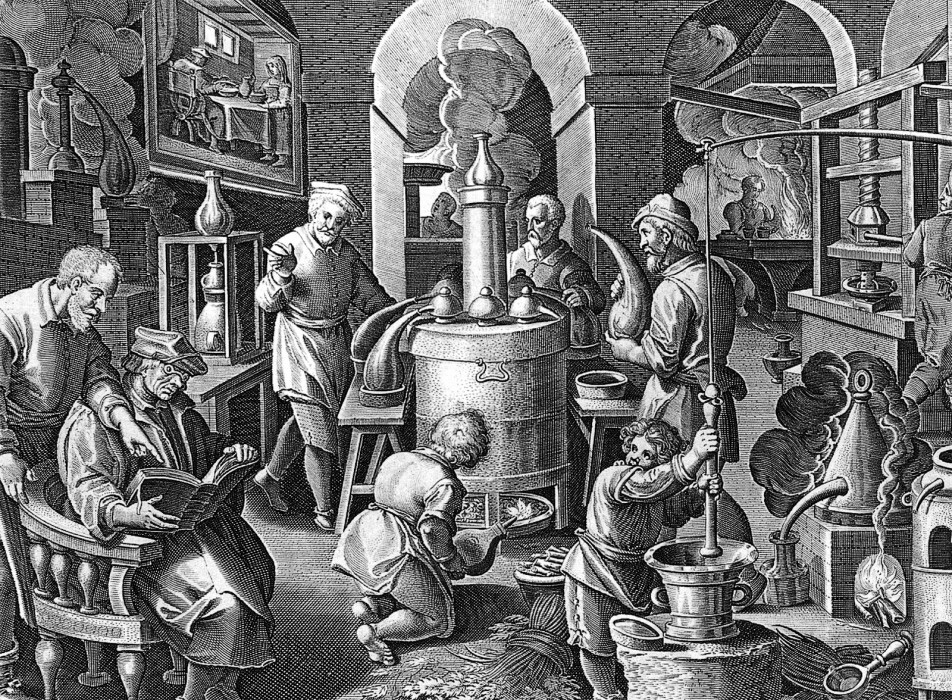
Y Fferllyt / The Alchemists

Gwnëynt eu peiron
a verwynt heb tan
gwnëynt eu delideu
yn oes oesseu.

They’d make their cauldrons
that were boiling without fire;
they’d work their materials
for ever and ever.
The Hostile Confederacy

alchemy

In the blackness of a starless night
I could not stop brow-beating
myself with the hammer
of what is missing
inside me whilst outside
they forged a sky of black iron
with a ringing ringing beat dividing
cosmos from chaos within the metal dome
fixing the crystal constellations.
They’d make their cauldrons

sturdy and strong as they’d make
their crucibles and flasks and funnels
and their chimerical language,
working with the elements,
conjunctions of planets,
365 herbs to inspire,
voices rising like phoenixes
from the ashes of the nigredo
on magical wings higher and higher
that were burning without fire

whilst we burnt everything
and our cauldrons would not boil.
I walked the plains of cold dark vessels;
leaking, cracked, the prima materia
spilling out like poison.
As we emptied the oil wells
and the gas wells and I followed
the dragon ships the emptiness
inside me grew emptier.
Whilst we built our hell
they’d work their materials

in the cauldrons deep inside them.
Thus they’d brew their awen
whilst we pillaged elixirs
from other worlds
and the elements ran wild;
burning, drowning, shaking monsters.
The black sky cracked and with the crystal stars
we fell like charred birds from the heavens
plummeting without feathers
for ever and ever.