The Breath of Nine Maidens and the Kindling of the Cauldrons

‘My first utterance was spoken concerning the cauldron
kindled by the breath of nine maidens.
The cauldron of the Head of Annwn, what is its disposition
(with its) a dark trim, and pearls?
It does not boil the food of a coward, it has not been destined to do so.’
~ ‘The Spoils of Annwn’

In ‘The Spoils of Annwn’, a medieval Welsh poem from The Book of Taliesin, we find mysterious lines about the breath of nine maidens kindling the cauldron of the Head of Annwn. The cauldron, the source of awen, ‘poetic inspiration’, is a central symbol within Celtic mythology. 

In ‘The Story of Taliesin’ the cauldron belongs to Ceridwen. In this tale Ceridwen is referred to as a witch but it’s my intuition She is a Goddess whose crochan – cauldron / womb is a sacred vessel of rebirth (1). In Her cauldron she brews a potion from 365 herbs (one picked on each day of the year) to provide her ugly son, Afagddu ‘Utter Darkness’ with the ‘Prophetic Spirit’. She assigns a blind man called Morda to bring kindling for the cauldron and to stir the cauldron she summons a boy called Gwion. After a year and a day Gwion shoves Afagddu out of the way and steals the awen. After a shapeshifting chase he is swallowed by Ceridwen (he as a grain and She as a black hen) then reborn from her womb as Taliesin.

In ‘The Spoils of Annwn’ the model is slightly different. The cauldron of Ceridwen, the magical vessel associated with inspiration and rebirth, is in the custodianship of the Head of Annwn – the ruler of the Brythonic Otherworld. Here there is no need for kindling or a person to stir the cauldron as the breath of the nine maidens is enough to set the processes within it into motion. The ‘food’ ‘not for a coward’ that it brews no doubt refers to the awen. Taliesin accompanies Arthur and his men not only to steal the awen, but the cauldron itself, bringing it back through ‘Hell’s Gate’ to the world.

This shows that when a potential awenydd, ‘person inspired’, proves their courage to the Head of Annwn, the breath of the nine maidens or awenau, ‘muses’ (2), kindles the cauldron, then the awen is received as a gift from the Gods.

This feels like an older and deeper model for the origins of awen. The significance of the breath of the nine maidens can be further elucidated by looking at the etymology. The medieval Welsh term used for breath is anadyl and this derives from the proto-Celtic anatla which shares a resemblance with anaman the proto-Celtic word for ‘soul’. The Indo-European *uel is closely related giving us the root form of awel ‘breeze’ and awen ‘inspiration’. There seems to be something fundamental this myth is telling us about how, in Annwn, on the soul-level, the breath of the nine maidens kindles the cauldron and sets in motion the processes within the cauldron that create the awen.

It’s my personal intuition that the cauldron / womb of Ceridwen, who I know as Old Mother Universe, is a macrocosm of the universe. That it lies in Annwn ‘Very Deep’ shows the Otherworld is a deeper reality underlying the universe. 

On a microcosmic level each awenydd might too be seen as a cauldron which is kindled by the breath of the nine maidens producing awen for poetic works. The breath itself might be seen as a gift from the awenau. 

Microcosm within microcosm a number of Celtic Pagans have come to relate the three cauldrons in the seventh century Irish text ‘The Cauldron of Poesy’ to the three main energy centres or chakras in our belly, heart and head (3). Interestingly the Irish term coire ‘cauldron’ or ‘whirlpool’ might be seen to relate to the spiralling manifestation of the universe and the turning of the chakras.

In yogic meditation the breath is used to awaken the chakras. I was once dubious about the existence of ‘Celtic Chakras’ but I am now coming to perceive the resonsances between these shared Indo-European traditions. I wonder whether anatla ‘breath’ is the Celtic equivalent of the yogic prana ‘breath’ or ‘life force’ which Celtic Pagans have long been searching for (4). 

(1)These insights derive from Kristoffer Hughes’ From the Cauldron Born.
(2)This term is borrowed from Greg Hill who uses it in his poem ‘The Muses’ in his poetry collection The Birds of Rhiannon – ‘O Muses / O Awenau / You whose breath kindled the cauldron of awen in Ceridwen’s keeping.’
(3) For example see Erynn Rowan Laurie’s ‘The Cauldron of Poesy’ – https://www.obsidianmagazine.com/Pages/cauldronpoesy.html
(4) Some druids have in the past mistakenly identified prana with nwyfre ‘sky, firmament’ which Mhara Starling explains is erroneous on her Youtube channel – https://www.youtube.com/channel/UCkc4iRymvz4t619FEk5dFfA/videos Interestingly the proto-Celtic anatla ‘breath’and anaman ‘soul’ share similarities with the Sanksrit atman which is sometimes translated as ‘soul’ but refers to the Self or witness-consciousness beyond phenomena and ananda which refers to bliss at escaping the cycle of mortality or uniting with a God.

The Speaking Ones

Several years ago I had a vision of the world becoming as a whirlpool from the source. ‘Green moving swards of vegetation, trees, people, marching through a labyrinthine kingdom back into the void carrying houses and entire civilisations.’ Sometimes people got stuck. With bird-headed ones they came knocking on the back of my head trying to shout through me. I was on Psylocybe mushrooms and alone at the time and didn’t dare let them.

The practice of a person allowing spirits to speak through them is found in many world religions from Voodoo to Evangelical Christianity. It was likely to have been an important component of pre-Christian Brythonic polytheistic religion and survived into the 12th century as recorded by Gerald of Wales.

Gerald writes of awenyddion ‘people inspired’. ‘When consulted upon any doubtful event, they roar out violently, are rendered beside themselves, and become, as it were, possessed by a spirit.’ Their speeches are ‘nugatory, ‘incoherent’, ‘ornamented’. When ‘roused from their ecstasy, as from a deep sleep’ they cannot ‘remember the replies they have given’. He conjectures: ‘perhaps they speak by the means of fanatic and ignorant spirits.’ (1)

Gerald’s words provide evidence for a Brythonic tradition of spiritwork in which there exist ‘soothsayers’, referred to as awenyddion, who are possessed by spirits by whom they speak in the metaphorical language of poetry.

I first came across the term ‘awen’ for ‘poetic inspiration’ in the Druid communities and saw myself as a bard before my patron God, Gwyn ap Nudd, initiated me as an awenydd. I have served Gwyn in this role for over ten years by journeying to Annwn to bring back inspiration for my communities. 

I have prayed for awen and for the Gods and spirits to inspire and come into me when writing in a similar way to the ancient Greek poets calling on the Muses and to William Blake asking the Daughters of Beulah to come into his hand. (2) I’ve also experimented with trance singing, letting go, just letting any words and tune flow. But, until recently, I hadn’t dared speak the voices of spirits.

This changed after a conversation with a fellow member of the Monastery of Annwn, who told me of his calling to channel Gwyn. It reminded me of the bird-headed spirits, who’d come knocking, whose desire to speak I had denied. I felt the time to offer my voice had come and journeyed to them.

I saw them as crows flocking in the sky in the shape of infinity then crossed bones. Their home appeared as the floating skeleton of a great raven. I offered to gift them my voice and they gave me some instructions. They would stand behind me. Then I must open the door and loosen my tongue. I tried it whilst in the Otherworld and received a prophecy about a distant son of Don.

Several days later on their prompting I composed a song to enter the trance state:

Crows, crows, the Speaking Ones
Y rhai sy’n siarad

Come, come from Annwfn
Come, come your will be done

Crows, crows, the Speaking Ones
Y rhai sy’n siarad

Come, come bring your words
Come, come you will be heard

Crows, crows, the Speaking Ones
Y rhai sy’n siarad

When I tried it the first time and asked who wanted to speak they told me they would take it in turns and each wanted me to make their words into an oracle. I did this by letting them speak out loud through me first then writing down what I could remember and putting it into more poetic form. (3)

On completion of the oracles I read them to the Speaking Ones and gained their approval. At first I wasn’t planning to make any of this work public but I was told they wanted their voices to be heard so I will be posting the oracles of these seven crow-guides over the course of the next week. 

(1) https://awenydd.weebly.com/giraldus-cambrensis-and-the-awenyddion.html
(2) ‘Daughters of Beulah! Muses who inspire the Poets Song… 
Of varied beauty, to delight the wanderer and repose 
His burning thirst & freezing hunger! Come into my hand 
By your mild power; descending down the Nerves of my right arm 
From out the Portals of my Brain, where by your ministry 
The Eternal Great Humanity Divine, planted his Paradise’
~ William Blake, ‘Milton’
(3) As a note I don’t consider this to be full trance possession because, whilst working alone, I don’t dare let go of my conscious faculties fully. Also, for this particular work, I have been asked to record the words so need to be aware enough to remember them. During this process I’ve felt something other has come through, but that I’m not fully out of the way, and suspect my consciousness might have coloured some of the content.

Sacred Breeze

Sacred breeze a whisper on my eyelashes
Sacred breeze a stranger’s hand awakening me
Sacred breeze the hairs on my neck all rising
Sacred breeze the fair folk tugging on my sleeve
Sacred breeze the scent of flying horses
Sacred breeze the breath of my blessed deity
Sacred breeze the sound of living and dying
Sacred breeze without you not a wave in the sea
Sacred breeze filling my lungs with awen
Sacred breeze without you am empty
Sacred breeze I am grateful for your blessings
Sacred breeze without you I am nothing

Review – Taliesin Origins by Dr. Gwilym Morris-Baird

Dr. Gwilym Morus-Baird is a native Welsh speaker and scholar. He runs the excellent Celtic Source website where he shares scholarly research and personal insights into the Celtic myths through videos and free and paid online courses. Taliesin Origins originated from an online course. 

As would be expected this book provides a superb introduction to the myth of Taliesin well grounded in the social and political history of Wales. It not only introduces material that might already be known to students of the bardic tradition such as Ystoria Taliesin (‘The Tale of Taliesin’) and the poetry from Llyfr Taliesin (The Book of Taliesin) but sets it in a context with and expounds on its themes through other bardic works that are less familiar. The author’s translations of these, as well as the Taliesin content, are valuable resources in themselves. 

Morus-Baird, who is not only a scholar, but a musician, presents the material in a way that is not only academically accurate but lively and vivid and enthused with experiential insights based on his practices as a living bard.

One of my favourite parts was where he traces the travels of the historical Taliesin north from Cynan’s court at Pengwern (Shrewsbury) to Urien’s court in Rheged*. Here we find an evocation of the revelry in the hall and the lord with ‘long, flowing white hair and beard’ ‘his body’ ‘covered with many battle scars’.

There is a good deal of speculation founded on research and personal insights. Morus-Baird presents a strong argument for the story of Gwion stealing awen from Ceridwen’s cauldron then being eaten by her and reborn as Taliesin originating from interactions between the visionary tradition of the witches and the Welsh bards. This tale is shown to play out in the prehistoric ritual landscapes around the Dyfi and Conwy estuaries where it is set. It is argued that the alternative telling of the creation of Taliesin by Gwydion from vegetation as ‘a weapon of bardic destruction’ along with the trees in Kat Godeu (‘The Battle of the Trees’) originates from a different bardic lineage.

This book also contains much philosophical depth. The concept of awen is explored from its Proto-Celtic origin in *awek ‘inspiration or insight’ through its complex of meanings in Irish and in Welsh which include awel ‘breath.

The imagination is beautifully likened to the Mare Goddess Rhiannon as ‘an insubstantial beast, a grey mare of little but breath. We may ride her to ends of the Earth, but she vanishes the minute we look at her too closely.’ Awen as is seen to ‘live’ in Annwfn and is drawn upon by the bards.

Morus-Baird states that the popular understanding of Annwfn as the otherworld isn’t the ‘most accurate’ and translates it as ‘inner world’ or ‘inner depth’, describing it as ‘a world-within-the-world, a depth that is everywhere’. Drawing on the First Branch of The Mabinogion along with the poetry of Cynddelw and Taliesin (who speaks of his seat in Caer Siddi ‘the fairy-mound Fortress’) he categorieses Annwfn as a timeless, pristine place of high ideals and dismisses the Christianised hellish view in Culhwch ac Olwen.

At the end of the section on Annfwn he summarises his argument: 

‘The main difference between Annwfn and our realm appears to be a temporal one. Whereas our plane of existence is characterised by ageing and death, ‘sickness and old age’ do not affect those in Caer Siddi. It appears to be the place of eternal renewal, where pristine life continues without the effects of time and its changes. By contrast, to partake of the mortal realm is to be swept up in the turbulent currents of transformation, to be spun in the cycles of birth and death and to know the suffering of experience.’**

Annwfn is described not as a land of dead, in the sense of a final destination for souls, but it is one where spirits such as those of Taliesin and Myrddin can reside. These ‘bardic masters’ can be channelled in live performances.

Taliesin Origins is an engaging read on an intellectual and spiritual level. I have been studying the bardic tradition for over ten years and it gave me additional food for thought and led me to question a number of assumptions. I would recommend it as the go-to source for anyone interested in the Taliesin myth whether from an academic or religious perspective or both. 

*There’s a mention of Taliesin crossing the Ribble at Preston near to my home. It hadn’t crossed my mind he would have passed so close on his travels.
**This isn’t an argument I wholly agree with. Although there are lots of examples of Annwfn being a timeless, pristine place we also have descriptions of terrible battles there which include violence and death. The prime example being in Preiddeu Annwfn from which only seven men return. Gwyn ap Nudd speaks of this conflict – ‘At Caer Fanddwy I saw a host / Shields shattered, spears broken, / Violence inflicted by the honoured and fair’. If this is to be conflated with the raid set in Ireland the Head of Annwfn himself is killed. One might claim these are so terrible because they are interruptions to the pristine state and I believe this is partly the case. Yet the presence of Annwfian monsters in Kad Godeu along with the gormes ‘oppression’caused by a dragon in Lludd a Llefelys that blights Britain and its people are suggestive of a darker side to Annwfn. It’s my personal belief that like the ‘otherworlds’ of most Indo-European cultures it has both pristine and beautiful and monstrous and terrifiying aspects (for example the Hindu and Buddhist ‘heavens’ and ‘hells’, the Norse Valhalla and Hel, the Greek Elysian Fields and Tartarus). In my personal experience of travelling Annwfn in spirit the transformative processes, including life and death, mirror our own.

Composting with Ceridwen

A couple of years ago our local council stopped taking our food waste for recycling so we decided to get a compost bin. Over this period I have come to associate it with Ceridwen. She has revealed Herself to be not only a Goddess of the Cauldron, a vessel used for cooking, but of a number of other vessels of transformation including our compost bin which takes the bits of food that don’t go in the cauldron (apple cores, onion skins, potato peelings, carrot tops etc.) and turns it into compost for our garden.

I’ve felt Her presence as I’ve learnt how it works, what it likes and dislikes, how to get a healthy balance of the food waste with greens (vegetative material) and browns (paper and cardboard) to make good compost.

One of the startling things that happened was that the comfrey plant I have kept in a pot nearby for many years seeded a number of new plants in the cracks around the compost bin. I thought about pulling them up before I realised comfrey leaves make really good compost and the plants had come to help. They felt like a gift and I believe they are likely to be included in the 365 herbs from which Ceridwen brewed awen.

As the weather grows colder composting time has to an end. The last thing I put into the bin were the pages from my novel-in-progress, In the Deep, which isn’t to be, at least in that format. It feels right to be returning them to Ceridwen, Goddess of the Awen. I pray they will make good compost.

Paths to Gwyn

There are many paths to Gwyn. 

~

There is the bard in the mead hall. The one who sings at the feast in Caer Vedwit, the Mead Feast Fort, in Gwyn’s hall, in a heavy blue-grey chain. 

I sung there once, where the harp of Teirtu plays on its own. Where the ghost of Maponos walked. Where the fair folk and the dead dance and mix and eat the meat of leaves whilst the king watches from his throne of bones.

I drank enough mead to feast the dead for centuries and took the songs of our king to the halls of towns and cities, to libraries, pubs, shopping centres.

I sang in chains, tried to strangle myself with them, then cast them off. 

I walked this path for a while but this path was not for me. 

~

There is the path of the madman, the wild woman, the path of the followers of Myrddin Wyllt. Those who are afflicted by trauma and by the claws of Annwn torn out of themselves, split open, as if by a spear, their bird spirits flying out. 

Hawk spirits, golden eagle spirits, goldcrest spirits, passerines in strange migrations. All heading to their forests of Celyddon. To pines and raided gold mines. To the damps of the Celtic rainforests where it rains five days a week. To the remnants of woodlands in the suburbs along the trickle of suburban streams.

I was the wren in the bush singing of how I tore myself open for our God and how my heart was my sacrifice on mid-winter’s day still beating beneath the yew.

A part of me is still there, singing for Him, loud yet hidden. No-one hears. 

I walked this path for a while but this path was not for me. 

~

There is the path of the cave woman, the inspired one, the witch. Orddu ‘Very Black’, Orwen ‘Very White’, all their ancestors around the cauldron. 

Black skin, white hair, white skin, black hair, wolf furs, corvid feathers, black beaks.

Those who sing with crows and wash the skulls of their ancestors in holy springs. Cast the wolf bones. Lie beneath wolf furs waiting for visions of the Deep.

Those who drink the awen, scry in the cauldron like our God, sing of past and future things. Swallow stars. Universes. Things too big to speak. Die in His arms.

I swallowed the star of the King of Annwn and it is within me still and I am still in my cave after all these centuries with a murder of crow women inside me. 

The nun in her cell who still flies, still runs, divines with black feathers.

I walked this path for a while and have decided it is for me. 

I wrote this poem as a step along my journey in discerning what it means to be an inspired one and nun of Annwn devoted to Gwyn ap Nudd in relation to the Brythonic tradition and my solitary life in suburban Penwortham.

For the Dead, for the Mad, for the Poets

for the torn apart all the parts of our bodies will ride tonight,
crawl up from the bogs onto our swampy horses,

not the bog bodies who were found,
but those who were not found.

*

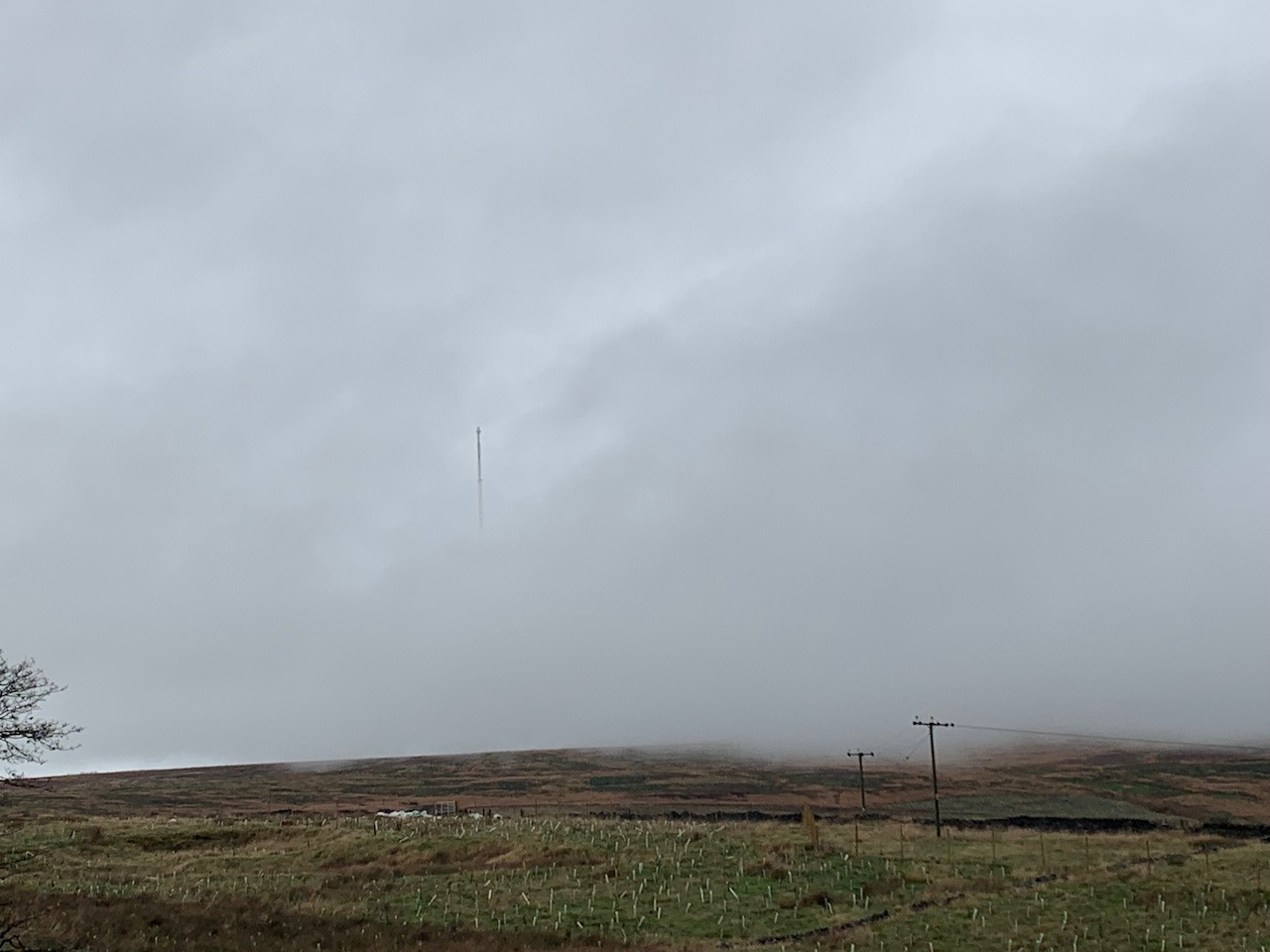
You summon back our voices like the mast on Winter Hill.

You make us appear again like television. Your hunt
would make a good film but most times myth
is better told in softly spoken words
and half-seen visions.

Radio broken. 
Someone smashed the television.

*

You are always off screen.
You are the one who is not named.
You are the one whose face is the face of a god.

The howls of the wind are the chorus of your hounds,

your words are furies and each has a hand, 
clutching, pulling, ripping, tearing.

*

You are the god of illusion
and the rending apart of all illusions.

The one who tears our false truths to shreds.

The jostling elbows, stuck-out toes, the heels dug in.

*

This is the time of fire, flood, rain, and catastrophe,
yet the beech leaves are yellow, gold, and green

in the kingdom beyond the kingdom beyond the kings 

and we call you a king without knowing the true meaning

of sovereignty, that your throne means more than gold.

*

Are you silence or the breaker of silence? 

So long ago I wrote: 

“The universe began 
with a howl and from the howl came death.”

The death-hounds within me giving tongue to a mythos
that came to me before my world had begun.

*

AWEN is not always a smooth chant
in the mouths of druids, but the broken vowels
of an awenydd when language cannot help and poetry fails.

Still, the body, its dislocated limbs, remember how to ride tonight.

*

And where is she in all of this? Riding ahead treading air un-abducted? 
Did you take her from the underworld or did she take you there?

Time, the clock does not obey, pivots like she on her wild white mare

like a dislocated limb. I have found that myth dislocates too,
frees itself from time and space, free and true.

This poem marks the first time I have felt inspired to share something here for a long time, something I felt compelled to share for my god after a walk near Winter Hill on Nos Galan Gaeaf. Maybe there will be more, maybe not, no promises, no deadlines…

The Mothers of Destiny

I.

Bendithion yr Awen

I undertake a fool’s quest to understand the origins of the breath of life and in my foolishness am granted an answer. I find myself amongst a crowd singing with them as three Mothers of Destiny breathe the awen (which is at once inspiration and one’s fate) into a baby.

It is suspended over a baptismal font that reminds me of the Roman altar to the Mothers at Lund Church near Springfields around five miles away from me.

Our voices are pre-Roman, Roman, post-Roman, of all the women who have sung their blessings to a child in this ancient gathering place and in churches where Matrona ‘the Mother’ appears as Mary and the Matronae as Faith, Hope and Charity.

They rise and fall as we sing: “Awen bendithion yr awen bendithion yr awen bendithion…”

II.

Sea Maidens

My fool’s quest continues as I cannot, now, resist returning to the mothers to pose the question of my own destiny. They appear as three sea maidens, stormy, stony-faced, amidst a sea of raging waters.

III.

The Web of my Destiny

The goddess in the middle shows me ‘the Web of my Destiny’. She holds it between her hands like a cat’s cradle. It shimmers golden and pulsates with coloured jewels of energy. She tells me that a small tweak can change everything. I realise that making a cat’s cradle is a two-way process, between a person and the gods, and it’s my turn.

‘From the Well of Life Three Drops Instilled’

‘… to nobler sights
Michael from Adam’s eyes the film removed
Which that false fruit that promised clearer sight
Had bred, then purged with euphrasy and rue
The visual nerve (for he had much to see)
And from the Well of Life three drops instilled.
So deep the power of these ingredients pierced
Even to the inmost seat of mental sight
That Adam now enforced to close his eyes
Sunk down and all his spirits became entranced.
But him the gentle angel by the hand
Soon raised and his attention thus recalled:
Adam, now ope thine eyes and first behold
The effects which thy original crime hath wrought…’
Paradise Lost

I’ve recently been re-reading John Milton’s Paradise Lost (1667). The third or fourth time round this epic vision seems no less powerful in its depictions of Heaven and Hell and Earth both pre and post fall or radical in Milton’s writing the perspective of Satan and his inner motivations and turmoil.

As an Annuvian kind of person I will admit to feeling more sympathy with Milton’s rather magnificent Satan, refusing to serve in Heaven preferring to reign in Hell, the only one amongst the fallen angels (who include many pre-Christian gods) who dares travel to Paradise to thwart God’s plans by bringing about the fall, than the brainless Adam and Eve, Milton’s spoilsport God, or his Son.

The ending, with its deus ex machina, again was disappointing. It turns out the fall was not only predicted but designed by God to make possible and all the more powerful Jesus’ redemption of humanity. Paradise Lost is, in essence, a work of theodicy, written ‘to justify the ways of God to men’.

I’m sharing this because, whilst re-reading the book, I found the lines cited above that seem to contain Christian and pre-Christian Brythonic lore. When the archangel, Michael, purges Adam’s fallen sight he not only uses traditional plants – euphrasy, or eyebright, and rue were used for treating eye ailments – but ‘three drops’ from ‘the Well of Life’. This grants Adam visions of the future, mainly the ill-doings of his offspring until the Flood. As far as I know there is a Tree of Life but not a Well of Life in Paradise in Christian literature, which makes me wonder if it comes from another source.

The most obvious is the Welsh ‘Story of Taliesin’. In this tale Gwion Bach steals three drops of awen ‘inspiration’ from the cauldron of Ceridwen, which grant him omniscience as the all-seeing Taliesin. Milton’s evocative description of these ‘ingredients’ piercing ‘to the inmost seat of mental sight’ and putting Adam into a trance before he opens his eyes to see the future fit shares similarities with the prophetic visions of Taliesin and other awenyddion, ‘persons inspired’ referred to by Gerald of Wales.

However, although this story had been published in Welsh in the mid-16th century, it was not available in English at Milton’s time. Whether he had travelled to Wales (Milton was born in London, studied at Cambridge, lived in Berkshire, and travelled extensively throughout Europe before returning to London) or had heard the story in England in some form remains unknown.

The resemblances are so uncanny that, if he had not, it seems possible he was tapping into some deeper source. It is of interest that Milton refers not to a cauldron, but to a well, a far older image. Throughout the British and Irish myths cauldrons and wells are associated with inspiration and rebirth.

After Gwion tastes the awen Ceridwen pursues him in a shapeshifting chase and swallows him into her crochan ‘cauldron’ or ‘womb’ from which he is reborn, shining-browed, and omniscient as Taliesin. In ‘The Second Branch’ the cauldron brings dead warriors to life. In ‘The Spoils of Annwn’, refusing to ‘boil the food of a coward’ it is associated with the bardic initiation rites of Pen Annwn.

In the Irish myths the Well of Segais is associated with imbas ‘inspiration’. No-one was allowed to approach it except its keeper, Nechtan, and his three cup-bearers on pain of their eyes exploding. However, Boann, Nechtan’s wife, disobeyed. It overflowed and she was dismembered and died. The river created took her name – the Boyne. When Finn burnt his thumb whilst cooking a salmon from this river he received the imbas. In The Battle of Moytura the Tuatha Dé Dannan dig Wells of Healing and throw in their mortally wounded, who not only come out whole but more ‘fiery’ than before (!).

It seems that Milton is, indeed, tapping into a deep source. Here, in Peneverdant we once had a Well of Healing, dedicated to St Mary at the foot of Castle Hill, which I believe was associated with an earlier Brythonic mother goddess of healing waters who has revealed her name to me as Anrhuna. I believe she is the consort of Nodens (cognate with Nechtan) and the mother of Gwyn ap Nudd (cognate with Finn), Pen Annwn. Perhaps we once had a myth based around these deities that has now been lost.

In Paradise Lost, for Adam, as for many who taste the three drops of inspiration (aside perhaps for Taliesin) possessing foreknowledge is both a blessing and curse. At first he laments Michael’s gift:

‘O visions ill foreseen! Better had I
Lived ignorant of future, so had borne
My part of evil only, each day’s lot
Enough to bear! Those now that were dispensed,
The burden of many ages, on me light
At once, by my foreknowledge gaining birth
Abortive to torment me, ere their being,
With thought that they must be! Let no man seek
Henceforth to be foretold what shall befall
Him or his children…’

He is then reconciled by his perception of God’s purpose:

‘… Now I find
Mine eyes true op’ning and my heart much eased,
Erewhile perplexed with thoughts what would become
Of me and all mankind, but now I see
His Day in whom all nations shall be blest.’

‘O goodness infinite, goodness immense!
That all this good of evil shall produce
And evil turn to good more wonderful
Than that which by Creation first brought forth
Light out of darkness!’

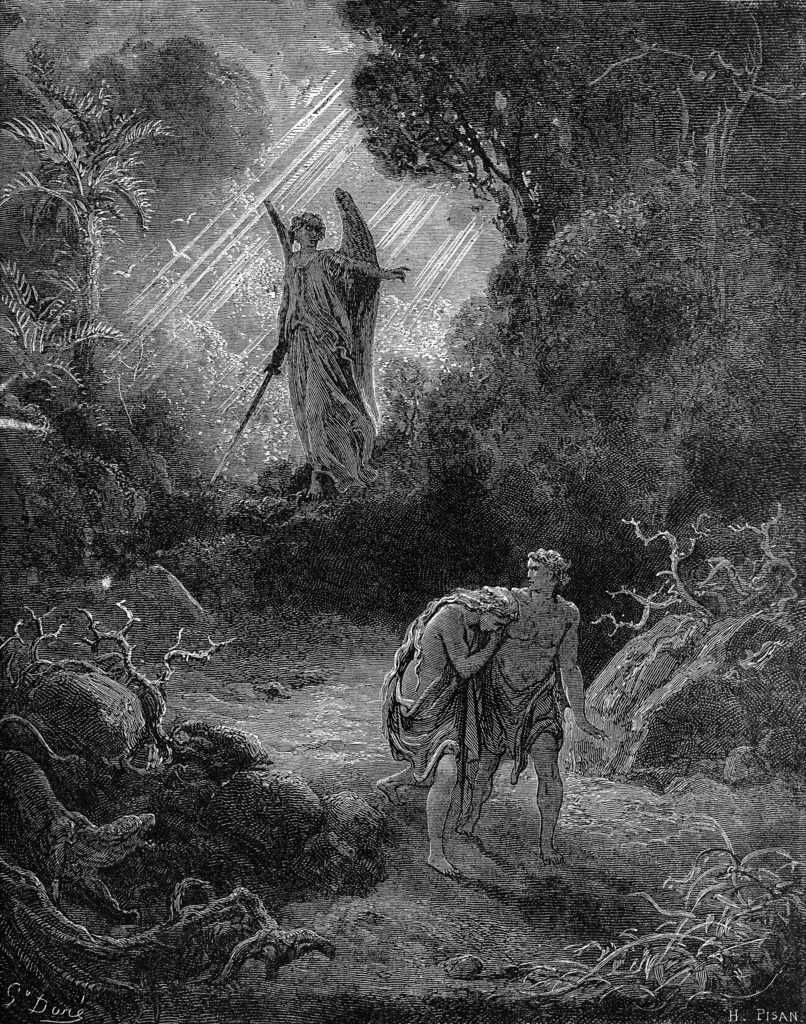
Adam’s visions give him the strength to depart with Eve from Paradise to Earth to beget humankind. The gate to Paradise, to the Tree of Life and the Tree of Knowledge, and no doubt to the Well of Life is barred and guarded by a ‘flaming brand’ ‘the brandished Sword of God’ ‘fierce as a comet’.

In Christian literature, in contrast to the simplistic notion preached to school children that the souls of good people go to Heaven and those of bad people go to Hell, Paradise is not truly regained until after the Apocalypse and Jesus’ harrowing of Hell and the resurrection of the dead.

It may be suggested that, in our Brythonic myths, all souls return to the Well of Life. That, with a little awen to awaken ‘mental sight’, the living can travel in spirit to Annwn and be reborn as awenyddion.

Here, in Peneverdant, where the well has run dry due to the foolishness of humans shattering the aquifer when moving the river Ribble to create Riversway Dockland, it remains possible to traverse the waters of the past, of the Otherworld, to return to the unfathomable source from which Milton drew.