Caer Rigor and the Closed Door

In the second verse of ‘The Spoils of Annwn’ Taliesin, Arthur and his men stole the cauldron of the Head of Annwn, escaped from Caer Vedwit, slammed ‘Hell’s gate’ shut and lit lamps outside. By their flickering light they saw only seven survivors remained.

At the opening of the third verse Taliesin says:

‘I’m splendid of fame: songs are heard
in the four quarters of the fort, stout defence of the island.’

Taliesin’s reference to songs heard ‘in the four quarters of the fort’ echoes the opening of the second verse. Here the fortress is not revolving. Instead, its defensive function is emphasised.

Marged Haycock translates ynys pybyrdor as ‘stout defence of the island’. However, it is more commonly translated as ‘island of the strong door’ (from ynys ‘island’, pybyr ‘strong’ and dor ‘door’).

This suggests it bears relation to the feasting hall on the island of Gwales in ‘The Second Branch’. Taliesin was one of seven survivors from the battle between the armies of Brân (King of Prydain) and Matholwch (King of Ireland). He and his companions feasted with Brân’s head. Beforehand Brân told them:

‘And you will stay for eighty years in Gwales in Penfro. And so long as you do not open the door towards Aber Henfelen, facing Cornwall, you can remain there and the head will not decay. But as soon as you enter that door you can stay no longer.’

After eighty years, Heilyn’s curiosity got the better of him and he opened ‘that door’. When he looked out at Cornwall and Aber Henfelen ‘every loss they had ever suffered, and every kinsman and companion they had lost, and every ill that had befallen them was as clear as if they had encountered it in that very place; and most of all concerning their lord.’

Robin Melrose says ‘The ‘strong door’… seems to be the door between the otherworld and the world of the living – strong because in this case it prevents the dead from regretting all that they have left behind in the world of the living.’

When Taliesin and his companions feasted with Brân’s head, they entered the timeless state of the otherworld host; of the dead. Contrastingly in ‘The Spoils of Annwn’ they raid the otherworld, assault its people, steal their treasure then slam ‘the strong door’ shut behind them.

The shift in narrative from participation to raiding, assault and theft is symbolic of how views of Annwn differed between the British Foretime and Arthurian period. In the former, Pwyll and Arawn, a King of Annwn, struck up an honourable alliance. The gargantuan Brân was considered a hero. In the latter, giants and the rulers of Annwn appear as adversaries.

Haycock notes there is scribal confusion between pybyr and pefr. Pefrdor has been translated as ‘radiant door’, ‘shining door’ and ‘flaming door’. Perhaps because of its fiery connotations the door was labelled as ‘porth Vffern’ (Vffern is from Latin inferno) ‘Hell’s gate’.

flaming_door_by_dull_stock

Flaming Door by Dull Stock on Deviant Art

The closing of the door seems symbolic of the way relationships with Annwn and its deities were shut off during the Arthurian period. Annwn was equated with hell and its people with demons. They later became known as fairies.

In the next lines, Taliesin refers to what is going on in the fortress whilst they stand outside the door listening to the songs:

‘Fresh water and jet are mixed together;
sparkling wine is their drink, set in front of their battalion.’

The lines about the otherworldly battalion drinking wine are self-explanatory but what about the mixing of jet and water? Jet is a lignite, like coal formed from trees decaying under extreme pressure, which was used in jewellery during the Bronze Age and late Roman period.

Jet’s chthonic nature links it with the otherworld. It is frequently found in ancient burials. As the dead were buried with jet to wear in the next life, it seems possible some of the otherworld host are wearing jet.

However, this doesn’t explain its mixing with water. A possible source is the Archbishop of Seville’s Etymologiae (600-625): ‘(Jet) is black, flat, smooth, and burns when brought near fire. Dishes cut out of it are not destructible. If burned it puts serpents to flight, betrays those who are possessed by demons, and reveals virginity. It is wonderful that it is set on fire by water and extinguished with oil.’

The main focus is on jet’s combustible nature. Caitlin and John Matthews describe the effect of jet being set on fire by water as ‘like a flambeau’. The term ‘flambeau’ may refer to a burning torch or to a cocktail to which a splash of Grand Mariner is added before it is ignited. This certainly fits with the imagery of the lamps outside ‘Hell’s Gate’ and the drinking party within illuminated by the hallucinatory effect of water and jet mixing.

Haycocks translates muchyd as ‘jet’ and echwyd as ‘fresh water’. She says echwyd could also mean ‘mid-day’, thus contrasting the darkness of jet with the light of the mid-day sun. This fits with the later question of ‘when, at noon, the Ruler (of Annwn?) was born’.

At the end of the verse we find out this fortress is called Caer Rigor. This is from the Latin rigor ‘stiffness, rigidity’ hence Haycock translates Caer Rigor as ‘The Petrifaction Fort’. For me this represents the hardening of the fluidity of the otherworld, the closing of doors and the end of relationship.

Additionally, frigor means ‘cold’ which contrasts with porth Vffern. Annwn is both fiery and icy. This is paralleled in The Life of St Collen where Collen says the garments of the host of the Annuvian King, Gwyn ap Nudd, are ‘red’ to signify ‘burning’ and ‘blue’ to signify ‘coldness’.

In Norse mythology, Muspel: ‘bright and hot’ and Niflheim: source of all things cold and grim, were the first two worlds to come into existence from Ginnungagap ‘the great void before creation’. The fierceness and intensity of fire and ice originated from other worlds. Only under Christianity did these qualities become punitive.

Later in ‘The Spoils of Annwn’ Taliesin poses questions about the nature of the elements:

‘… whether the sea is all one water,
whether fire – an unstoppable force is all one spark.’

The mixing of jet and water may well be connected with the mysteries of creation. In an earlier post, I noted that Caer Vedwit ‘is bound up with the passage of day and night and the seasons and the cycles of birth, life, death and rebirth, time itself.’

The door to Annwn is now closed yet Taliesin, Arthur and their party possess the cauldron: the vessel of its mysteries. To what use will they put it now they have shut themselves off from the advice of the deities of the otherworld?

~

Caer Rigor

This is Caer Rigor
(from the Latin rigor:
rigid, stiff, petrified,
frigid, cold).

Rigor mortis has
set in to this dead fort.
This is the body
post mortem.

The revolving fort
does not move.
When it turns
it turns backwards.

The song in its quarters
is sung backward
like a record
on loop.

Caer Rigor is dying
into itself:
a sword blow
to the sacred place,

the desecrated cauldron
borne away.
In the vortex
jet and water mix.

The song of the dead
is deafening.
Taliesin,
how will you explain?

How will you craft
your verses
so you are the hero
and no-one hears

Caer Rigor?

The Theft of the Cauldron

In the second verse of ‘The Spoils of Annwn’ the cauldron of the Head of Annwn is stolen in one swift move:

‘Lleog’s flashing sword was thrust into it,
and it was left behind in Lleminog’s hand.

These lines have been interpreted in many different ways. Cledyf means ‘sword’ and lluch ‘flashing’. Lleawc (‘Lleog’) has been taken to mean ‘destroyer’ or ‘death-dealer’.

Lluch Lleawc has been identified with Llen(n)l(l)eawc Wyddel ‘Llenlleog the Irishman’ from Culhwch and Olwen. There is a strong case for this because parallels exist between Lleog’s role in the theft of the Head of Annwn’s cauldron and Llenlleog’s in stealing the cauldron of Diwrnarch Wyddel.

In Culhwch and Olwen, Arthur and his men must attain Diwrnarch’s cauldron to boil food for the guests at Culhwch’s wedding feast. (In an earlier post I mentioned that the cauldrons of Diwrnarch and the Head of Annwn share the quality of only boiling meat for the brave).

Arthur sends a message to Odgar, King of Ireland, to tell Diwrnarch, his steward, to hand the cauldron over. Diwrnarch refuses. Arthur and his men set sail for Ireland and make for Diwrnarch’s house where they eat and drink. After feasting, Arthur asks for the cauldron.

Diwrnach says no again. Bedwyr seizes the cauldron and puts it on the back of Hygwydd, Arthur’s servant. Llenlleog Wyddel grabs Caledfwlch (‘hard breach / cleft’ Arthur’s sword) and by swinging it round kills Diwrnarch Wyddel and all his retinue. They escape with the cauldron filled with Irish treasure.

It seems possible the flash of Lleog’s sword as he thrusts it into the cauldron parallels its death-dealing swing, killing or blinding and incapacitating the Head of Annwn and his company as they feast and drink in Caer Vedwit.

Some scholars equate Lleog with the Irish god Lugh whose name may derive from the Proto-Indo-European *leuk ‘flashing light’. Lugh’s epithets include Lámhfhada ‘long arm’ or ‘long hand’, Lonnbeimnech ‘fierce striker’ and Ildánach ‘skilled in many arts’.

To complicate matters further, Lleog has been identified with Lleminog, in whose hand the cauldron of the Head of Annwn is left. Lleminawc may be translated as ‘leaping (one)’ or ‘leaper’.

In ‘Teithi etmygant’* (‘They admire qualities’) Llyminawc bears the meaning ‘keen, eager, ready.’ It refers to ‘an eager leader of an army’ who is a prophetic figure. Some scholars identify Lleminog with Arthur.

So… the Head of Annwn and his people are defeated by Lleog’s flashing sword and the cauldron is left in the hand of Lleminog (who may be Lleog or Arthur). We don’t find out whether there is further conflict or how Arthur and his men escape with the cauldron.

The next line of ‘The Spoils of Annwn’ reads: ‘And in front of the door of Hell’s gate lamps were burned’.

One assumes the escape has been made, ‘hell’s’ door slammed shut and lamps lit outside it. The word translated as Hell here is Vffern. ‘Uffern’ is borrowed from the Latin inferno and appears frequently in medieval Welsh poetry as a negative appellation for the otherworld.

‘What is the measure of Hell? (translated from Uffern)
how thick its veil,
how wide its mouth,
how big are its baths?’**

‘Madawg…
Was taken by fierce Erof…
Among the hideous fiends
Even to the bottom of Uffern.’***

Doors between the worlds are also a regular feature in Welsh mythology. In ‘The Spoils of Annwn’, Ynys pybyrdor has been translated as ‘isle of the strong door’ (ynys ‘island’, pybyr ‘strong’ + dor ‘door’). In ‘The Second Branch’ the Assembly of the Noble Head takes place in an otherworldly stasis on the island of Gwales until a forbidden door is opened.

The name of Dormach, the dog of Gwyn ap Nudd, has been translated as ‘death’s door’ by John Rhys (dor ‘door’ and marth ‘death’). Dogs are frequently guardians of the otherworld. There are no dogs in ‘The Spoils of Annwn’ but Taliesin speaks of monks congregating and howling like wolves and dogs in the final two verses.

Emphasis is placed on closing the door between the worlds and keeping it shut. The people of Annwn and its spatio-temporal laws must be kept separate. We recall that if Gwyn did not contain the fury of the spirits of Annwn, they would destroy thisworld.

The second verse of ‘The Spoils of Annwn’ ends with the refrain ‘save seven, none returned from the Mead-Feast Fort’. This is repeated after the visit to each fort and conveys the terrible cost of raiding the otherworld. Its repetition suggests the names of seemingly individual fortresses are perhaps names for one fort and the verses refer to different parts of the same journey.

The forces of Annwn are shut out yet the presence of the cauldron represents the destabilising power of Annuvian magic in thisworld. The cauldron of the Head of Annwn has been stolen from the mead feast in Caer Vedwit: the revolving fortress, centre of the mysteries of day and night, the seasons, birth, life, death and rebirth, time itself.

Diwrnarch’s cauldron is taken from Ireland to the house of Llwydeu son of Cilcoed in Dyfed where it is remembered by Mesur y Pair (‘the measure of the cauldron’). It is then presumably used to brew food for Culhwch and Olwen’s guests at their wedding feast. Later it is taken by Myrddin to ‘the glass house’ with the other Treasures of the Island of Britain.

What happens to the cauldron of the Head of Annwn after it is stolen next nobody knows. It is never seen again. It may be worth contemplating the question “where is it now?”

P1140789 - Copy

*In Skene’s translation this is the second part of ‘Canu y Cwrwf’ (A Song to Ale’)
**‘The First Address of Taliesin’ (transl. Marged Haycock)
***‘The Death-song of Madawg’ (transl. William Skene)

SOURCES

Caitlin and John Matthews, King Arthur’s Raid on the Underworld, (Gothic Image, 2008)
Marged Haycock (transl.), Legendary Poems from the Book of Taliesin, (CMCS, 2007)
Rachel Bromwich (ed), The Triads of the Island of Britain, (University of Wales Press, 2014)
Sarah Higley (transl.), ‘Preiddu Annwn’, (Camelot, 2007)
Sioned Davies (transl.), The Mabinogion, (Oxford University Press, 2007)
William F. Skene (transl), The Four Ancient Books of Wales, (Forgotten Books 2007)

Caer Vedwit: The Fortress of the Mead-Feast and its Revolutions

The second sea fortress raided by Arthur, Taliesin and ‘three full loads’ of Prydwen in ‘The Spoils of Annwn’ is Caer Vedwit ‘The Mead-Feast Fort’.

Opening the second verse Taliesin says:

‘I’m splendid of fame – song was heard
in the four quarters of the fort, revolving (to face) the four directions.’

Kaer pedryuan, ‘four quarters of the fort’ has also been translated as ‘Four-Cornered Fort’, ‘Four-Pinnacled Fort’, ‘Four-Peaked Fort and ‘Four-Turreted Fort’. The latter suggests it bears relationship with Caer Siddi: ‘around its turrets are the wellsprings of the sea’.

The image of a four-quartered, revolving fortress filled with song is fascinating and compelling. So far I have not come across the name Caer Vedwit or revolving fortresses in any other medieval Welsh literature. However fortresses that disappear, recede, or can only be entered under special conditions feature in numerous stories.

A close parallel with Caer Vedwit is found in the Ulster Cycle. In ‘The Feast of Bricriu’, Cú Roí has a fortress which revolves to his chant throughout the night so that nobody can enter:

‘In what airt soever of the globe Curoi should happen to be, every night o’er the fort he chaunted a spell, til the fort revolved as swiftly as a mill-stone. The entrance was never to be found after sunset.’

Caer Vedwit is associated with the Head of Annwn. It seems possible its revolutions are brought about by his spell-song.

The mead-feast is a central feature of medieval stories set in thisworld and Annwn. The status of a lord was judged by his capacity to maintain large groups of warriors feasting and drinking in his hall. The consumption of copious amounts of mead could provide a more prosaic explanation for the songs in Caer Vedwit and its revolutions.

The Cauldron of the Head of Annwn

The purpose of raiding Caer Vedwit is the theft of the cauldron of the Head of Annwn, which no doubt formed the centre of the mead-feast. Taliesin says:

‘My first utterance was spoken concerning the cauldron
kindled by the breath of nine maidens.
The cauldron of the Head of Annwn, what is its disposition
(with its) a dark trim, and pearls?
It does not boil a coward’s food, it has not been destined to do so;’

A cauldron with similar qualities appears in ‘The Thirteen Treasures of the Island of Britain’. It is owned by Dyrnwch the Giant ‘if meat for a coward were put in it to boil, it would never boil; but if meat for a brave man were put in it, it would boil quickly (and thus the brave could be distinguished from the cowardly.’

The cauldron’s special ‘disposition’ of only brewing food for the brave shares similarities with the Irish tradition of the champion’s portion. In ‘The Feast of Bricriu’, Bricriu invites a group of champions to his house to fight for ‘a cauldron full of generous wine with room enough for the three valiant braves of Ulster’ along with a seven-year-old boar and other delicacies.

Cú Chulainn wins but his right to the champion’s portion is not settled until he has defended Cú Roí’s fortress and proved his courage to Cú Roí in the beheading game*.

The Blue Smith and the Cauldron of Rebirth

Haycock says gwrym am y oror a mererit (‘a dark trim and pearls’) refers to a dark substance decorating the rim of the cauldron such as ‘an iron band, or enamel, jet or niello (black sulphide of silver)’. Mererit is borrowed from Latin margarita and means ‘pearl’.

John and Caitlin Matthews translate gwrym am y oror a mererit as ‘Ridged with enamel, rimmed with pearl’ and suggest the cauldron was crafted by Llasar Llaes Gyfnewid (‘Blue Smith who Reforges the Weak’).

In ‘The Second Branch’ of The Mabinogion, Llasar emerged from the Lake of the Cauldron in Ireland with the cauldron of rebirth on his back. After he and his wife were driven out of Ireland, he took it to Britain and gifted it to Brân then taught Manawydan the art of enamelling.

Brân gave the cauldron to Matholwch, King of Ireland, as recompense for an insult. Matholwch later used it to bring life to dead Irish warriors who were killed by Brân’s army. The cauldron was shattered when a living man was thrown into it.

We hear nothing else about Llasar except that his son, Llashar, was one of seven men left by Brân to guard Britain. Bryn Saith Marchog ‘The Hill of the Seven Horsemen’ is named after them.

Whether the cauldron of rebirth and the cauldron of the Head of Annwn are the same remains a matter of speculation. Their magical properties and elaborate craftmanship suggest they were forged by an otherworldly being, perhaps a gargantuan blue smith, in Annwn’s depths.

The Head of Annwn

Who is the Head of Annwn? In ‘The First Branch’, Pwyll wins the title Pen Annwn by taking the form and role of Arawn, a King of Annwn, winning his yearly battle and resisting the temptation of sleeping with his wife. It’s my intuition Pwyll’s acquisition of the title is based on his assumption of Arawn’s identity and Arawn was formerly Pen Annwn.

Another candidate for the title is Gwyn ap Nudd. In Culhwch and Olwen, Gwyn is introduced as the deity who contains the fury of the spirits of Annwn to prevent the destruction of the world and adversary of Arthur.

Arthur sides with Gwyn’s rival, Gwythyr, during their struggle for Creiddylad and binds them in battle for her every May Day. Gwyn and Gwythyr also act as tricksters when Arthur goes to kill Orddu ‘The Very Black Witch’.

In ‘The Conversation of Gwyn ap Nudd and Gwyddno Garanhir’ Gwyn refers to witnessing a battle at Caer Vandwy:

‘… I saw a host
shield shattered, spears broken,
violence inflicted by the honoured and fair.’

Caer Vandwy is the sixth fortress in ‘The Spoils of Annwn’. It seems likely Gwyn refers to the battle between Arthur and the people of Annwn for the Brindled Ox.

Seasonal Revolutions

In the sixth verse we find a second reference to the Head of Annwn:

‘(those) who don’t know on what day the Head** is created,
(nor) when, at noon, the Ruler was born,
(nor) what animal is it they guard, with his silver head.’

It’s likely the silver-headed animal is the Brindled Ox guarded by the people of Annwn and the ‘Ruler’ is the Head of Annwn. This riddle pertains to his conception and birth. In his Gallic Wars (58-49BC) Julius Caesar said:

‘All the Gauls assert that they are descended from the god Dis, and say that this tradition has been handed down by the Druids. For that reason they compute the divisions of every season, not by the number of days, but of nights; they keep birthdays and the beginnings of months and years in such an order that the day follows the night.’

Dis was a Roman god of the underworld who presided over its wealth. Whilst it seems unlikely the Gaulish deity was called Dis this identification suggests he performed a similar role and had deep connections with how people perceived the passage of time and the seasons.

Caesar says the ‘institution’ of the Druids ‘is supposed to have been devised in Britain, and to have been brought over from it into Gaul; and now those who desire to gain a more accurate knowledge of that system generally proceed thither for the purpose of studying it.’

It seems possible Gaulish beliefs about ‘Dis’ derive from the mythos of the Head of Annwn. Arawn and Gwyn both fight yearly battles against opponents associated with summer: Hafgan (haf means ‘summer’) and Gwythyr ap Greidol (‘Victor son of Scorcher’) placing them in the role of the Winter King who must be defeated for summer to come.

In The Death of Cú Roí, Cú Roí carries off a maiden called Blathnat (‘Blossom’) along with a cauldron that is the child of three cows who carry three men/birds on their ears. Cú Chulainn’s army behead Cú Roí and win Blathnat, cattle and treasure.

Parallels with Gwyn’s abduction of Creiddylad, Arthur rescuing her and taking the cauldron and Brindled Ox are obvious. Of course these wintry deities don’t stay ‘dead’ long.

It may be suggested the revolutions of Caer Vedwit, home of the Head of Annwn, are bound up with the passage of day and night and the seasons and the cycles of birth, life, death and rebirth, time itself.

The Nine Maidens

Taliesin says the cauldron of the Head of Annwn is kindled by the breath of nine maidens. There are numerous references to groups of nine women connected with underworld gods in Gallo-Brythonic tradition.

In 1AD, Pomponius Mela wrote of nine priestesses serving a Gaulish god on the island of Sein. Known as Senes, they could create storms, shift shape, cure illnesses and foretell the future.

A Gaulish tablet from Larzac dated 90AD provides evidence of a coven of nine sorceresses working underworld magic:

‘Herein-:
– a magical incantation of women,
– their special infernal names,
– the magical incantation of a seeress who fashions this prophecy…

…Below, there they shall be impressed, the prophetic curse of these names of theirs is a magical incantation of a group of practitioners of underworld magic: Banona daughter of Flatucia, Paulla wife of Potitos, Aiia daughter of Adiega, Potitos father of Paulla, Severa daughter of Valens (and) wife of Paullos(?), Adiega mother of Aiia, Pottita wife of Primos daughter of Abesa.’

Here anderna is used to refer to the underworld and andernados to a group of practitioners working underworld magic. A similar tablet from Chamalières invokes andedion ‘underworld gods’ and anderon ‘infernal beings’. These Gaulish terms bear similarities with the Irish Andeé ‘non-gods’ and Brythonic Annwn ‘the deep’ ‘the not-world’.

Superstitions surrounding witchcraft and the underworld no doubt lie behind Arthur’s slaughter of Orddu and the nine witches of Caer Loyw and Cai’s killing of nine witches in Arthur and the Porter.

In Geoffrey of Monmouth’s The Life of Merlin, Morgan and her sisters: Moronoe, Mazoe, Gliten, Glitonea, Gliton, Tyronoe, Thitis and Thitis with her lyre, are presented in a more positive light. They inhabit the paradisal island of Avalon. Morgan is a shapeshifter adept in herbalism and the healing arts who tends Arthur’s fatal wound after Camlan.

Bringing Life to the Dead

A man named Morgan Tud appears as Arthur’s physician in Geraint son of Erbin. It’s my suspicion this is Morgan in male guise. Morgan acts as healer to Gwyn’s brother, Edern ap Nudd. Edern is defeated by Geraint in another seasonal battle at Whitsuntide.

Geraint strikes Edern what sounds like a killing blow: ‘he summoned up his strength and struck the knight on the top of his head so that all the armour on his head shatters and all the flesh splits, and the skin, and it pierces the bone and the knight falls on his knees.’

However Edern gets up and ride to Arthur’s court. Upon his arrival the gatekeeper says: ‘no one has ever seen such a terrible sight to gaze upon as he. He is wearing broken armour, in poor condition, with the colour of his blood more conspicuous on it than its own colour.’

Edern’s invincibility indubitably stems from his identity as an Annuvian deity like Gwyn. Morgan is assigned the task of healing Edern, which is analogous to bringing him back to life.

The capacity of women not only to heal but bring life to the dead is shown in Peredur. At the court of the King of Suffering, Peredur sees ‘only women’ then:

‘a horse approaching with a saddle on it, and a corpse in the saddle. One of the women got up and took the corpse from the saddle, and bathed it in a tub of warm water that was by the door, and applied precious ointment to it. The man got up, alive, and went up to Peredur, and greeted him, and made him welcome. Two other corpses entered on their saddles, and the maiden gave those two the same treatment as the previous one.’
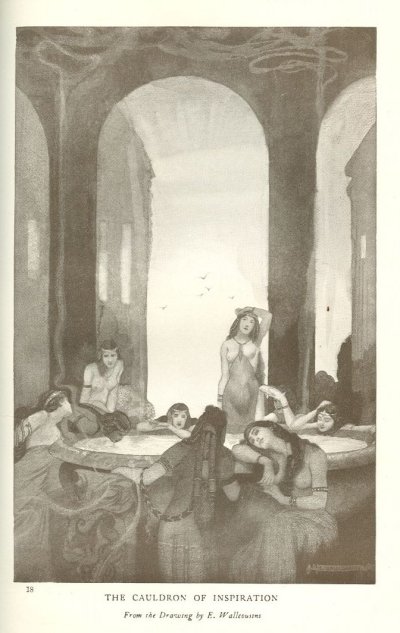
E. Wallcousins 'In Caer Pedryvan' (1912) Wikipedia Commons

Wikipedia Commons

Morgan is also associated with the mysteries of death and rebirth represented by the cauldron. It may be suggested the scene where she heals Arthur is based on an older myth wherein she and her sisters tended the Head of Annwn after his seasonal death.

Glastonbury Tor and the Mead-Feast

The sacred complex associated with Caer Vedwit: the cauldron, the Head of Annwn, and the nine maidens came together for me several years ago at Glastonbury Tor.

The isle of Avalon (‘apples’) is frequently identified with Glastonbury in the apple-growing summerlands of the Somerset Levels. Prior to the fall in sea levels, Glastonbury was an island; the area is still prone to flooding. It is easy to see how the story of Arthur being taken to Morgan and her sisters on Avalon by boat emerged from the landscape.

In The Life of St Collen whilst Collen was abbot of Glastonbury he supposedly banished Gwyn and his fairy host whilst they were feasting in the hall of his magical castle on the Tor. It seems likely the cauldron formed the centre of their mead-feast.

My first vision of the otherworld took place at Glastonbury Festival. After thirteen years of searching for an explanation, Gwyn finally appeared in my life and I realised he was my patron. Identifying the nine maidens as Morgan and her sisters and the Head of Annwn as Gwyn led me back to Glastonbury to devote myself him.

When I entered the Well House of the White Spring I could barely believe my eyes. The scene depicted in Caer Vedwit was there before me. In the centre of a subterranean cavern was the cauldron overflowing with thundering water. A dark haired woman in long skirts kindled candles around its rim. In the centre was a shrine to the Lady of Avalon and to the right and left altars for Gwyn and Brigid***.

For one day of my life everything went beautifully to plan. I made my vow to Gwyn beside the candle-lit cauldron as shadows of otherworlds and othertimes circled around me. The world spun around my resolution and my life has never been the same.

However Caer Vedwit has revolved since. Last time I went to Glastonbury the White Spring was barred. Shortly afterward I witnessed a vision where the cauldron lay shattered, its poison streaming throughout the land. I’d tasted the Awen. The time had arrived to look at the consequences of bringing forth Annuvian magic into thisworld.

The theft of the cauldron will be covered in upcoming posts.

* Cú Roí arrives at the Royal Court in Emain and challenges the Ultonians to behead him if he can return the blow. Presuming Cú Roí will die, Fat Neck agrees. Afterward Cú Roí picks up his head and returns the next night for his recompense. Fat Neck refuses. Loigaire and Conall Cernach also play the game but refuse to accept the blow. The only person brave enough to proffer his neck to Cú Roí is Cú Chullain who through his bravery wins the champion’s portion. The beheading game also forms the central plot of Gawain and the Green Knight.
**ny wdant py dyd peridyd Pen is translated by Marged Haycock as ‘(those) who don’t known on what day the Lord is created’ but I’ve chosen the more literal translation of ‘Pen’ as ‘Head’. An alternative used by Sarah Higley and John and Caitlin Matthews is ‘Chief’.
***Some scholars have connected the role of the nine maidens kindling the flames beneath the cauldron with their breath with the work of St Brigid’s flamekeepers at Kildare. In his 12th C The History and Topography of Ireland, Giraldus Cambrensis ‘it is only lawful for women to blow the fire, fanning it or using bellows only, and not with their breath.’ It seems possible this was a ban on older pagan practices.

SOURCES

Caitlin and John Matthews, King Arthur’s Raid on the Underworld, (Gothic Image, 2008)
Geoffrey of Monmouth, The Life of Merlin, (Forgotten Books, 2008)
Geraldus Cambrensis, The History and Topography of Ireland, (Penguin Classics, 1982)
George Henderson (transl.), Fled Bricend (The Feast of Bricriu), (Parentheses Publications, 1999)
John Koch (transl.), ‘The Tablet of Larzac,’ The Celtic Heroic Age (CSP, 2003)
Lady Charlotte Guest, ‘St Collen and Gwyn ap Nudd
Heron (transl), ‘Gwyn ap Nudd and Gwyddno Garanhir
Marged Haycock (transl.), Legendary Poems from the Book of Taliesin, (CMCS, 2007)
Maria Tymoczko, Two Death Tales from the Ulster Cycle: The Death of Cu Roi and the Death of Cu Chulainn, (Dolmen Press, 1981)
Rachel Bromwich (ed), The Triads of the Island of Britain, (University of Wales Press, 2014)
Sarah Higley (transl.), Preiddu Annwn, (Camelot, 2007)
Sioned Davies (transl.), The Mabinogion, (Oxford University Press, 2007)
William F. Skene (transl), The Four Ancient Books of Wales, (Forgotten Books 2007)
Will Parker, The Four Branches of the Mabinogi, (Bardic Press, 2005)
W. A. W.A. McDevitte and W.S. Bohn (transl.), The Works of Julius Caesar, (Sacred  Texts, 1869)

The Last Witch of Pennant Gofid

I journeyed for weeks
through mist and hunger
to find the split rack of her bones,
bones stripped, flesh burnt
and boiled in the cauldron,
blood drained and bottled in two jars.

I plundered the ashes where the cauldron stood,
sniffed for blood where the jars were filled.
Played maracas with her bones,
made intricate arrangements,
chanted and sung
but could not raise her ghost.

“She is amongst the spirits of Annwn now,”
spoke the god I called instead.

“Lay her bones to rest. In the fire of poetry
console her burning spirit.”

***

I’m laying her bones to rest. The Last Witch of Pennant Gofid. Her name was Orddu. It meant ‘the Very Black Witch’. Whether she had black skin, black hair or used black magic seem irrelevant now. All that is left is her scapula split in twain, her shattered pelvis, two arms, two legs, her broken skull. Jagged shadows in two orbits retrieved from either side of the cavern.

Her bones are still. I am angry and restless. I cannot abide the story of her death. How Arthur came as he always did into every story every world every myth with his hatred of witches: sword slung over his shoulder like a sundered lightning bolt, a living knife in his hilt, a shield on his thigh adorned with an image of the Virgin Mary, aboard a huge mare.

Caw of Prydyn behind him a giant with a curling beard and the damned jars like heinous milk bottles on each side of his saddle; half a man in size, well-stoppered, thick-glassed, unbreakable. Then the retinue with spear and shield, tawdry banners and flags.

Following to stragglers’ jeers Hygwydd the servant staggering bow-legged bent-backed beneath the gigantic cauldron that brewed food for the brave. Hygwydd’s brother Cacamwri with Hir Amren and Hir Eiddil dragging ponies piled with saddle-bags of food and weapons.

At Arthur’s right Gwythyr ap Greidol, a gristled war-lord with fire and a hundred bloody campaigns in his eyes. A blazing passion. And to Arthur’s left Gwyn ap Nudd, the guide who tricked and dizzied their quest cloaked in mist summoning his hounds to eat the fallen from the mountainside.

Of the host who went to Pennant Gofid only a fragment reached the cave where Orddu plaited her black hair, blackened her skin with war-paint, fastened down her helmet. Sharpened her sword then set it aside like an afterthought. Cracked her knuckles and flexed her talons.

When Arthur blanched a voice mocked from the mist “if you’re scared, witch-killer, why not send your servants in instead?”

Arthur pointed Hygwydd and Cacamwri toward Orddu beckoning. She grabbed Hygwydd by the hair, dragged him to the floor, threw off Cacamwri’s assault, arrested their weapons, beat them out bloody and bruised. Arthur sent Hir Amren and Hir Eiddil in to be crushed in her wrestling hold, torn by her talons, beaten out with broken bones. Arthur fumbled for his knife.

“Why are you afraid, Christian warlord?” Orddu asked. “Far from home. Far from heaven. Do you remember I trained your northern warriors? Without my wisdom, gifts from our gods, they will be nothing but bickering chieftains with a lust for gold and immortality that will bring Prydain’s downfall?”

Overcome by fury Arthur threw his knife in a wrathful arc that sliced down through Orddu’s helmet through her ribs. Dropped to the floor as she fell aside in two halves screaming “Prydain will fall!” “Prydain will fall!” “Prydain will fall!” as the mist writhed and the hounds of Annwn howled.

When her twitching halves lay still Caw filled the bottles with her blood still warm and jammed down the corks. They stripped her of armour and flesh. Boiled a merry meal. Stole her sword. Left with a cauldron filled with northern treasure whilst her spirit watched aghast in the misted arms of Gwyn ap Nudd.

***

I cannot abide the story of Orddu’s death. How Arthur came as he always came into every story every world every myth with his hatred of witches with his living knife to put an end to wild recalcitrant women. Now I’ve laid it to rest I’ll share another story instead.

I shall tell what this fatal blow and the blows on the Witches of Caerloyw cost Prydain (“Prydain will fall!” “Prydain will fall!” “Prydain will fall!”). Not only the fall of the Old North and the Men of the North. The rise and fall of the British Empire (it had to needed to fall). But the splitting and bottling of magical women for over a thousand years.

Draining of our blood. Boiling of our flesh. Testing if we float. Gave us The King James Bible and The Malleus Maleficarum. Took away our prophecies and visions, gods and goddesses, our fighting strength. Gave us virginity and chastity belts. Cut us off from plants and spirits, rocks and rain, rivers and mist, otherworlds.

Over a thousand years on we are but shadows of ourselves. Mirrored pouts tottering on high heels. Watching ourselves on selfie-sticks. Worshipping televisions. Still split in half, bottled, boiling, floating, banging to get out.

Not long ago I split the jars. Escaped to another place. Wandered my estate kissing Himalayan Balsam. Watching Ragwort sway with wasps. Mugwort flowering like coral. But this was not enough. Gods and fairies walked to the world of the dead and called me after them. Since then I have seen the dead walk in the bright eye of the sun.

I could not go back to the jars. To glass windows and tower blocks. To numbers on computer screens. The pencil skirts of offices. To fracking rigs threatening to break both worlds.

So I came to Pennant Gofid searching for answers and companionship on my lonely path. Found only Orddu’s bones and the god who took her spirit. Yet found a link in spirit with a companion and a god in the magical tradition of the Old North.

***

So I constructed a fire of poetry and spoke my words of consolation:

“Orddu Last Witch of Pennant Gofid
know you are not the last
to walk these paths
to caves and mountain ranges,
through otherworlds and distant ages,
seeking visions of the present
the future and past.

The rule of Arthur has fallen.
Though Prydain still falls
we have broken the jars.
Our blood is no longer contained
by the tyrants of Arthur’s court.
We are winning back our flesh.
Our magic. Our strength.

Remembering our gods.
Know your life will be remembered
where there are prophecies and hailstorms,
rain and rivers, caves and heresy,
in the mists of Gwyn ap Nudd
where your spirit burns
forevermore.”

Then I took her bones in my rucksack and crawled through to a dark chamber. On a little shelf beside Orwen ‘the Very White Witch’ I laid Orddu’s bones to rest.

Gwyn ap Nudd and Du y Moroedd: Travelling the Old North, Wales and Beyond

In Culhwch and Olwen, Du y Moroedd (‘The Black of the Seas’) is introduced as the only horse who can carry Gwyn ap Nudd on the hunt for Twrch Twryth (‘King of Boars’). Du is a water-horse of celebrated fame in the Brythonic tradition. A study of his stories reveals that, like Gwyn, he is intimately connected with the landscapes and peoples of the Old North and Wales. He is also a traveller between worlds and thus a most fitting mount for Annwn’s ruler on his hunt for the greatest of boars.

The most detailed piece of information we possess about Du appears in The Triads of the Islands of Britain. As one of three ‘horse burdens’ he ‘carried on his back seven and a half people from Benllech in the north to Benllech (Elidir) in Mon. These were the seven people: Elidyr Mwynfawr and Eurgain his wife, daughter of Maelgwn Gwynedd, and Gwyn Good Companion and Gwyn Good Distributor, and Mynach Naoman his counsellor, and Prydelaw the Cupbearer, his butler, and Silver Staff his servant, and Gelbeinifen, his cook who swam with two hands and on the horse’s crupper – and he was the half person.’

The historical basis of this triad is Elidyr’s seaward journey from his home in northern Britain to Wales to seize the throne of Gwynedd from Rhun, Maelgwn’s illegitimate son (Elidyr’s claim was based on his marriage to Eurgain). Elidyr was killed at Aber Mewydd near Arfon. Afterward his fellow Men of the North; Clydno Eidyn, Nudd Hael, Mordaf Hael and Rhydderch Hael took vengeance by burning Arfon. Rhun and all the men of Gwynedd pursued them north to the river Gweryd.

This demonstrates the complex ancestral and political relationships between the people of the north and Wales and exemplifies the internecine strife that eventually led to the fall of the northern Brythonic kingdoms. It also shows that armies travelled between the Old North and Wales by land and sea.

It is of interest the Men of the North who came to avenge Elidyr are all of the ‘Macsen Guledig’ lineage. This places them in the same family as Gwyn’s ally and rival, Gwythyr ap Greidol and his kinsmen who Gwyn battles against and takes captive. Gwyn’s relationship with these northern men as a ruler of Annwn is just as fraught and unstable as relations between human rulers.

That Gwyn rides the same horse as Elidyr strengthens the sense of his familial ties with these Men of the North. That he acts as a psychopomp to several northern warriors suggests he may have been seen as an ancestral god. This is backed up by common usage of the name Nudd: Nudd Hael, Dreon ap Nudd and Nudus (the Latinised form from a memorial stone in Yarrow).

***

I assume Du is named as the only horse who can carry Gwyn due to his capacity to move between worlds. This is supported by analogy with The Pursuit of Giolla Dheachair where a ‘monstrous horse’ carries fifteen and a half of Finn’s (Gwyn’s Irish counterpart) companions to the Otherworld.

In this context it seems possible the triad depicts the surprise arrival of Elidyr and his party from the blackness of the sea on the darkest of nights as if from (or perhaps literally from!) the Otherworld. After Elidyr’s death one can imagine Gwyn appearing aboard this great water-horse on the bank of the Arfon to escort him to Annwn.

Du’s possession of uncanny and even monstrous qualities is echoed in later water-horse legends. In Brigantia: A Mysteriography Guy Ragland Phillips identifies the Black Horse of Bush Howe (a horse-shaped landscape feature of stone on the Howgill Fells in Cumbria) with Du. He suggests Elidyr’s northern Benllech was Bush Howe and cites an alignment down Long Rigg Beck valley to Morecambe to Anglesey saying the horse would be within its line of sight.

Ragland Phillips also claims a ‘dobbie cult’ centres on the Black Horse. ‘Dobbie’ is the ‘Brigantian’ name for a water-horse and he defines it as ‘a big, black misshapen thing that ‘slips about’. Like dobbin (a term still commonly used in the north for horses who are ploddy or woodenheaded) it ‘may have for its first element the Celtic Dhu, ‘black’.’

David Raven records a recent visit to the site, during which he photographed the Black Horse and stood on its back. Afterward he found out from a local historian that in the 1930’s and 40’s school children used to be allowed a day off to maintain the horse. A village elder said this was a practice undertaken by farmers in the pre-war period on an ‘annual Boon Day’.

This is strongly suggestive of cult activity and a longstanding service to the Black Horse. Jack (the village elder) also told David of a legend about Roman legions using the horse as a landmark on their travels ‘up the Lune valley, from Lancaster to Penrith and Carlisle.’ The Black Horse of Bush Howe is associated with travelling the northern landscape too.

The continuity of Du’s fame in Wales is attested by Welsh poetry. He appears in The Song of the Horses, a poem attributed to Taliesin: ‘The Black, from the seas famous, / The steed of Brwyn’. He is frequently used as a standard of comparison. Guto’r Glyn compares a foal with the ‘Son of the Black One of Prydyn’ (Du’s grandson) and Tudur Aled compares another horse with Du saying he is of ‘greater vigour… such was his strength and daring.

Like northern Britain, Wales has a water-horse tradition: the ‘ceffyl dwr’. I haven’t found any water-horse stories connected with Anglesey or Arfon on the internet but this doesn’t eliminate the possibility they exist in Welsh literature or folk memory.

***

Finally I’d like to return to Gwyn’s partnership with Du on the hunt for Twrch Trwyth in Culhwch and Olwen. Ysbaddaden’s statement to Culhwch that the hunt cannot begin until Gwyn is found hints at his role as a divine huntsmen and former leader of the boar hunt. Culhwch’s central task of assembling an array of renowned huntsmen, hounds and horses to hunt the Twrch is founded on an older and deeper myth.

About its details we can only conjecture. It is my guess it featured Gwyn, huntsmen, horses and hounds pursuing the King of Boars. It may have contained clues to the ‘mysteries’ of hunting: the hunt, the kill and ensuing feast as sacred activities based on an earlier shamanistic perspective.

Further insights may be gained by analogy with Odin’s hunting of the boar Saehrimnir (‘Sooty Sea-Beast’). Odin rides a great black eight-legged horse who can travel between worlds called Sleipnir (‘Slippy’ or ‘Slipper’). After the hunt Saehrimnir is cooked every evening but the next day is whole. Odin’s feast in Valhalla is mirrored by Gwyn’s feast in his otherworldy hall (in The Life of St Collen on Glastonbury Tor). Perhaps Gwyn’s hunt also rides each day to slay the Twrch then magically he is reborn and this reflects the sacred acts of hunting and eating and the procreation of the boar.

In Culhwch and Olwen it is not mentioned whether Gwyn or Du are found. They do not appear on Arthur’s hunt. Gwyn only comes when summoned by Arthur, who asks him if he knows the whereabouts of Twrch Twryth after he disappears at Glyn Ystun. It is implicit Arthur is seeking Gwyn’s knowledge because he suspects the Twrch has fled to Annwn. Gwyn claims he does not know anything about Twrch Trwyth. It is my intuition he is lying to protect the King of Boars and perhaps to cause mischief.

Following a chase across Wales and finally to Cornwall, whereby many of Arthur’s men are injured or killed by the Twrch and his piglets, they finally catch him and remove the comb and shears from between his ears. Afterward he is driven into the sea, which is suggestive of his return to Annwn. It is of interest that, unlike other otherworldly animals he confronts, Arthur does not slay Twrch Trwyth.

In later Welsh folklore Gwyn is depicted as a demon huntsman aboard a monstrous black horse who preys on the souls of sinners. This image derives from and parodies his partnership with Du as a divine huntsmen and his role as a guide of the dead. Whereas he was revered as much as feared by the pagan Britons, in this Christianised guise he solely brings terror (a misguided and one-sided view).

Gwyn and Du’s names disappear from the stories of northern Britain completely after the medieval period. It seems possible their myths lie behind some of our stories of spectral huntsmen and dobbies but due to the complex intermingling of local legends with Brythonic and Germanic lore the origins of these tales cannot be ascertained.

Yet our landscape remembers the travels of Gwyn and Du across the Old North, Wales and beyond by land and sea. On the paths of the hunt and at river-estuaries where tides beat the shore to gull-cries and winds of distant longing they are still here.

Ribble EstuarySOURCES
Bartrum, Peter A Welsh Classical Dictionary (National Library of Wales, 1993)
Bromwich, Rachel (ed.) The Triads of the Islands of Britain (University of Wales Press, 2014)
Davies, Sioned (transl.) The Mabinogion (Oxford University Press, 2007)
Ragland Phillips, Guy Brigantia: A Mysteriography (Routledge and Keegan Paul Ltd, 1976)
Raven, David http://davidraven-uk.blogspot.co.uk/2010/01/black-horse-of-bush-howe.html
Rhys, John Studies in the Arthurian Legend (Adamant Media Corporation, 2001)
Skene, William F. The Four Ancient Books of Wales (Forgotten Books 2007)
Sturluson, Snorri The Prose Edda (Penguin Books, 2005)

Gwyn, Gwythyr and Creiddylad: A Story from the Old North

Cherry BlossomCulhwch and Olwen is one of the oldest and most fascinating repositories of ancient British mythology. It originates from two texts; a fragmented version in The White Book of Rhydderch (1325) and full version in The Red Book of Hergest (1400). The main narrative centres on Culhwch’s quest to win Olwen for which he enlists the help of Arthur and his retinue; a medley of historical and mythological characters.

Embedded within it we find fragments of other tales which may be of older origin and have stood alone. These include the hunt for the legendary boar Twrch Twryth and release of Mabon from imprisonment in Gloucester. Most significantly for me as someone who venerates Gwyn ap Nudd, we find the story of his rivalry with Gwythyr ap Greidol for the love of Creiddylad and their battle for her every May Day.

This story is central to understanding Gwyn’s mythology. Because I am based in Lancashire it also of great interest that it originates from the Old North. In this article I summarise the story and introduce its themes and background with the aim of bringing Gwyn’s neglected connections with the north to the fore. In conclusion I discuss its contemporary relevance.

The story begins by stating that Creiddylad ‘went off’ with Gwythyr. Creiddylad is the daughter of Lludd Llaw Eraint ‘Lludd of the Silver Hand’ a mythic king of Britain. Earlier in the main narrative we are told she is ‘the most majestic maiden there ever was in the Three Islands of Britain and her Adjacent Three Islands.’ This shows she is deeply connected with the sovereignty of the land. Whilst attempts to trace the etymology of her name have been made such as ‘Craidd’ ‘heart’ and ‘dylan’ ‘water’ no agreement has been reached.

Gwythyr and his father, Greidol, are named in the genealogies of the Men of the North. Greidol is ‘the son of Enfael the son of Deigyr the son of Dyfnwal (Dyfnarth) the son of Ednyfed the son of Maxen (Macsen Guledig)’. Greidol’s name means ‘hot, passionate, fierce’. He was a knight in Arthur’s court and appears in the triads as one of the great architects and enemy-subduers of Britain.

Robert Graves interprets Gwythyr ap Greidol as ‘Victor son of Scorcher’. Gwythyr is the father of Arthur’s wife, Gwenhyfawr. His horse appears alongside Arthur’s in The Songs of the Horses ‘boldly bestowing pain’. In Culhwch and Olwen he wins the friendship of a colony of ants who bring nine hestors of flax seed, one of the items Culhwch must attain. Gwythyr’s resting place is included in The Stanzas of the Graves. These references show the longevity of his connection with Arthur and that he was a significant hero in his own right.

Unfortunately I have not found any references to where Greidol or Gwythyr lived. As other Men of the North in his family such as Nwython ruled in the Strathclyde area, south-west Scotland may be a possibility.

Creiddylad’s status as a maiden and the statement about her going off with Gwythyr suggest he may be her first love. Next we are told ‘before he could sleep with her Gwyn ap Nudd came and took her by force.’ It is likely Gwythyr is waiting to marry Creiddylad before they sleep together. Before they can wed Gwyn takes her away.

In Culhwch and Olwen Gwyn ap Nudd ‘White son of Mist’ is introduced as a ruler of Annwn (the Brythonic underworld) who contains the fury of its spirits and prevents their destruction of this-world. This may relate to earlier beliefs about Gwyn’s status as a god of the dead connected with chthonic spirits. Will Parker cites examples of offerings in ritual shafts and pits to propitiate such deities in the Bronze to Romano-British periods.

In The Dialogue of Gwyn ap Nudd and Gwyddno Garanhir Gwyn appears as a gatherer of the battle dead. After offering Gwyddno protection he states his presence at the deaths of a number of warriors; Gwenddolau, a northern British king who perished at the Battle of Arfderydd (north of Carlisle) and Bran who died alongside him, Gwallog ap Llenog ruler of Elmet (Yorkshire), Llachau Arthur’s son and Meurig ap Careian. This provides further confirmation of Gwyn’s role as a god who facilitates the transition from life to death.

In later literature Annwn becomes Fairyland and Gwyn its King. Although Gwyn’s status is reduced from god to fairy (and likewise his people) he remains feared and respected. Our rich heritage of Brythonic fairy lore demonstrates a continuity of relations between the worlds and interactions with spirits. In most of these tales uncanny themes such as glamoury, enchantment, changeling children and abduction take the fore. Fairies are often connected with wild and liminal places. Divisions between the fay and the dead remain blurred.

Gwyn’s abduction of Creiddylad may have its basis in prevalent superstitions. Professor Ronald Hutton notes that Early Welsh literature testifies ‘to the attribution of an especially arcane quality to May Day (‘Calan Mai’) and its eve.’ This was a liminal time when winter gave way to summer and was connected with love, fertility and woodland trysts. It was also a time dangerous spirits were abroad. Marriage was not advised in case one should mistakenly take a fairy lover.

When Gwyn takes Creiddylad by force I assume he abducts her to Annwn and claims her maidenhood. Frustratingly we gain no insight from the text into what Creiddylad thinks or feels. As a ‘maiden’ I imagine she must be terrified when he takes her and they descend. What he says to her and whether their sex is consensual remains uncertain.

Later Gwyn and Creiddylad become lovers. This is shown in The Dialogue of Gwyn ap Nudd and Gwyddno Garanhir where Gwyn introduces himself as ‘Gwyn ap Nudd / The lover of Creiddylad, daughter of Lludd’. If scholars are correct in identifying Nudd (the Romano-British god Nodens) and Lludd, Gwyn and Creiddylad are brother and sister. Whilst this would make their relationship incestuous in human terms, in many myths gods and goddesses consider it superior to sleep with members of their blood-line.

The 14th century manuscript Speculum Christiani reads ‘Gwyn ap Nudd who are far in the forests for the love of your mate allow us to come home’. Gwyn’s love of Creiddylad is central. Whilst he may not always be moved directly by human pleas he can be compelled to answer for love of his partner. This shows Gwyn holds Creiddylad in reverence and esteem. In later stories where Gwyn appears as the King of Fairy he is often accompanied by his Queen who is a respected equal.

Creiddylad’s transition from maiden to Queen of Annwn may be read as a story of coming to maturity. It might also reflect an ‘initiatory’ process whereby her relationship with Gwyn introduces her not only to sexuality but wild nature and the hidden wisdom of the underworld.

In relation to Gwyn and Creiddylad being ‘far in the forest’ it is interesting to note a tradition amongst the Strathclyde Britons of locating Annwn in the forests of the north. The 6th century Byzantine writer Procopius claims the lands north of Hadrian’s Wall were populated with snakes, serpents and other wild creatures. Those who cross the wall die straight away and this area is the destination of the souls of the dead. This fits with Gwyn’s rulership of Annwn and dwelling with Creiddylad in a forest abode. A feasible location is Celyddon (the Caledonian forest).

Gwythyr gathers a host and goes to fight against Gwyn. I imagine they ride into the wild depths of Celyddon and thereby enter Annwn to seek out the lovers. Their attack on Gwyn relates to a long tradition of stories depicting raids on the underworld by the armies of this-world.

In this case Gwyn triumphs and captures Gwythyr and a number of his noblemen. The majority are Men of the North and close relations of Gwythyr’s. Gwrgwst Ledlwm is the son of Dynfnarth. Cyledyr and his father, Nwython are also descended, through Guipno, from Dyfnarth. Pen son of Nethog is a corruption of Nwython. Hence Pen is Nwython’s son. If the genealogies are correct, Gwyn captures four generations of northern men (!). The only persons not of northern descent are Graid son of Eri and Glinneu son of Taran.

Gwyn’s slaughter of Nwython, cutting out his heart and feeding it to Cyledyr casts him as a cruel and sinister deity. This is hinted at in the lines about him containing the fury of Annwn’s spirits. However, there is no historical record of Nwython meeting his end this way. Tim Clarkson says that Neithon ap Guipno ‘died peacefully in his bed’. How much of this episode is a result of Gwyn’s demonization by adherents of Christianity and how much reflects his true nature is open to debate.

That Cyledyr becomes ‘Wyllt’ may relate to superstitions connecting Gwyn and his spirits with wildness and madness. Following the Battle of Arfderydd (where Gwyn states his presence at the death of Gwenddolau) Lailoken (Myrddin) sees an unendurable brightness and host of warriors in the sky. Afterward he becomes ‘Wyllt’ living amongst ‘gwyllon’ in Celyddon. The gwyllon hold a similar status to the spirits of Annwn as ancestral presences immanent in wild places. It seems significant they are connected with the forests of the north.

Afterward Arthur ‘comes north’ summons Gwyn to him and releases Gwythyr and his other noblemen from captivity. The source of Arthur’s power over Gwyn is not mentioned nor is it obvious he brings an army. Sense suggests he cannot take on Gwyn and the spirits of Annwn alone, particularly considering that in The Spoils of Annwn only seven return of each three hundred who set sail for the underworld.

Arthur makes peace between Gwyn and Gwythyr by consigning them to battle every May Day for Creiddylad’s hand. An additional condition, which seems rather unfair, is that neither can take her until Judgement Day. Until then she must remain in her father’s house. Creiddylad is presented not only as a puppet tossed between two lovers but at the beck and call of Arthur. It is not explained how Arthur puts this command on Gwyn, Gwythyr or Creiddylad.

It is my intuition Arthur’s intercession is a later addition to an earlier myth inserted for the purpose of integrating it into the narrative of Culhwch and Olwen. Like ‘God’ (who is said to have put the fury of the spirits of Annwn in Gwyn!) Arthur is introduced as a deus ex machina. His agency explains and makes palatable to a Christian audience the rivalry between an underworld god and human (or perhaps semi-divine) hero for the favour of a fertility goddess. Arthur shutting Creiddylad in her father’s house could represent a Christian ban on woodland liaisons.

MayflowerThis story may originate from an earlier seasonal myth where Gwyn and Gwythyr are the forces of winter and summer battling over Creiddylad who embodies new life and spring. In this case their struggle is eternal. On May Day, Gwythyr the Summer King and a hero of this-world triumphs over Gwyn the Winter King and ruler of the underworld.

That such a tradition existed is suggested by ritual combats enacted in Wales in the nineteenth century by representatives of summer and winter. After summer won celebratory dancing was held around a May-pole. Pairs or groups would often fight over the May-pole. Whilst May-pole dancing is still a strong tradition across northern Britain, I haven’t found any battles between summer and winter yet.

If Gwythyr wins Creiddylad’s hand on Calan Mai (May Day) it would make sense that Gwyn takes her back to Annwn on Nos Galan Gaeaf or Calan Gaeaf (the eve or first of November) another time associated with dangerous spirits. If this is the case I know of no stories or traditions based around it.

I find it important to remember this story of Gwyn, Gwythyr and Creiddylad is only one medieval variant set in the Old North. Doubtless it underwent countless re-tellings in other times and places before it was written down and stuck. For me it is imperative to gain a personal understanding of it through lived relationships with its deities on the land where I live in the here and now.

So far I have reached the insights that the forgetting of this story in northern Britain is also the story of our forgetting of our relationship with the passing seasons, the deities associated with them and the sovereignty of the land. Another lesson it discloses is that human ownership of the land is transitory. There is a balance the forces of the wild and the underworld maintain.

In modern times the majority of people walk only within the Arthurian courts of this-world, paying respect to celebrities, pop culture and football heroes. In this era Gwythyr rules. He and the people of the north have forgotten about Creiddylad’s marriage to Gwyn in the wild forests of Annwn.

However, after centuries of forgetting Gwyn is appearing again within our folklore and as a god to his devotees. We’re remembering the seasons. We’re remembering Annwn, wild places, spirits and the dead. And first-most in Gwyn’s eyes we’re remembering Creiddylad and to treat her with reverence and respect.

***

SOURCES

 Bromwich, Rachel and Evans, Simon D. Culhwch and Olwen (University of Cardiff Press, 1992)
Clarkson, Tim The Men of the North: The Britons of Southern Scotland (John Donald, 2010)
Davies, Sioned (transl.) The Mabinogion (Oxford University Press, 2007)
Evans, J. Gwengobryn The Black Book of Carmarthen (Lightning Source UK Lmtd, 1907)
Green, Thomas Concepts of Arthur (Tempus Publishing, 2007)
Gwynn Jones, T. Welsh Folklore and Custom (D. S. Brewer, 1979)
Heron (transl) ‘Gwyn ap Nudd and Gwyddno Garanhir’ https://barddos.wordpress.com/2015/02/08/gwyn-ap-nudd-and-gwyddno-garanhir/
Hutton, Ronald The Stations of the Sun (Oxford University Press, 1996)
Parker, Will The Four Branches of the Mabinogi http://www.mabinogi.net/
Pennar, Meirion (transl.) The Black Book of Carmarthen (Llanerch Enterprises, 1989)
Rudiger, Angelika H. ‘Gwyn ap Nudd: Transfigurations of a character on the way from medieval literature to neo-pagan beliefs’ in Gramarye, Issue 2 (University of Chichester, Winter 2012)
Sikes, Wirt British Goblins (Lightning Source UK, 2011)
Skene, William F. The Four Ancient Books of Wales (Forgotten Books 2007)
Squire, Charles Celtic Myths and Legends (Parragon, 2000)

Gwyn ap Nudd and the Spirits of Annwn: Remembering the Underworld Gods

I recently came across an article through the Caer Feddwyd Forum (1) called ‘The Underworld Gods’ by medieval scholar, Will Parker. It brought to my awareness the existence of an inscription in Chamalieres in central France, which took the form of a prayer or invocation addressed to an entity or group of entities known in Ancient Gaul as the andedion, ‘the Under-world God(s)’ or ‘Infernal One(s)’ (2).

Parker links the andedion to the Irish andee ‘non-gods’ and suggests a similar group of deities would have been worshipped in Iron Age Britain. Through etymological links between the ‘elements Clt. dio(n) (Ir. dé) ‘god(s)’ and ‘the suffix ande-/an-‘ he connects them to Annwn ‘not world’, Britain’s indigenous otherworld or underworld. Parker goes on to identify the andedion and andee with the spirits of Annwn and their ruler, Gwyn ap Nudd.

This is of interest to me because Gwyn is my patron god. Parker’s insights make it possible to trace a trajectory from Iron Age beliefs concerning underworld gods, through Gwyn’s appearances in medieval literature and later folklore to those who worship him today.

Gwyn ap Nudd ‘White Son of Mist’ is a Brythonic deity. His veneration dates back, at least, to the Iron Age, where he appears as Vindonnus ‘White or Clear Light,’ in a trio of Gallo-Brythonic inscriptions in Essarois. Here he is equated with Apollo, another hunter deity (3). It is likely he was worshipped across Britain as Vindos ‘White’ (4). It has also been conjectured that Gwyn and his hunting dog, Dormarth ‘Death’s Door’ occupied the astrological positions of Orion and Sirius to the ancient Britons.

Cave, SilverdaleParker suggests Late Bronze Age ‘ritual shafts’ and ‘offering pits’ containing depositions including human and animal bones, grain, pottery and metalwork express a ‘quid-pro-quo’ relationship between the ancient Britons and the underworld gods. If he is correct, it is possible that Vindos / Gwyn, Dormarth and other kindred spirits were involved in these rites.

Gwyn’s first literary appearances are in medieval Welsh texts; ‘How Culhwch Won Olwen’ (11th C) in The Mabinogion and ‘The Dialogue of Gwyddno Garanhir and Gwyn ap Nudd’ (13th C) in The Four Ancient Books of Wales. These texts have roots in an older, oral tradition and contain fragments of tales from across Britain that predate Christianity. A significant number of these, including two featuring Gwyn, are from ‘The Old North’ (5). This is important to me because I connect with Gwyn in Lancashire.

Parker argues that superstitions about the underworld gods carry over into The Mabinogion. This is evidenced in the disappearance of livestock, children and crops. Pwyll’s encounter with Arawn, a King of Annwn, is the catalyst for the unfolding drama of the first four Mabinogi. Parker says these stories show the spirits of Annwn could not ‘be simply dismissed or ignored. Instead, a complex narrative had to be constructed in which, through a series of symbolic ritual manoeuvres, their power was drawn out, confronted and finally neutralised.’ The attempts of medieval scholars to disempower these deities can be seen at work in the development of Gwyn’s mythology.

In ‘The Dialogue of Gwyddno Garanhir and Gwyn ap Nudd,’ (6) Gwyn is presented as a divine warrior returning from battle to the Tawe near the vale of Neath. Gwyddno, ruler of Cantre’r Gwaelod, speaks of and addresses him with reverence and respect. ‘Bull of conflict was he, active in dispersing an arrayed army, / The ruler of hosts, indisposed to anger, / Blameless and pure was his conduct in protecting life.’ Other epithets Gwyddno uses include ‘hope of armies’ and ‘hero of hosts.’ ‘Host’ may refer to the spirits of Annwn.

Gwyn introduces himself as ‘Gwyn, the son of Nud, / The lover of Creurdilad, the daughter of Lud.’ He names his horse as ‘the torment of battle’ and refers to Dormarth as ‘truly the best of dogs,’ ‘handsome,’ ‘round bodied’ and ‘ruddy nosed.’ References to his possession of a ‘polished ring’ and ‘golden saddle’ are also suggestive of his status.

The title ‘Bull of Conflict’ refers to Gwyn’s role as a psychopomp. At the end of the poem he describes his travels across Britain gathering the souls of fallen soldiers. He appears to be berating this task. ‘I have been where the soldiers of Prydain were slain, / From the East to the North; / I am alive, they in their graves! / I have been where the soldiers of Prydain were slain / From the East to the South / I am alive, they in death!’

This poem contains important clues about Gwyn’s identity as a divine warrior and huntsman, whose role was to gather the souls of the dead and take them to Annwn.

In ‘How Culhwch Won Olwen’ in The Mabinogion, Gwyn is depicted as a huntsman and advisor to King Arthur. His place in Arthur’s court list and apparent subjection to both Arthur and God may be read as attempts by medieval scholars’ to explain and downgrade his position.

That ‘Twrch Trwyth will not be hunted until Gwyn son of Nudd is found’ (7) hints at his role as leader of the hunt, and knowledge of otherworldly beings. The Twrch was a king reputedly turned into a swine by God. When Gwyn does not reveal his location it is possible he is defending his own.

The advice of Gwyn and Gwythyr ap Greidol ‘Victor Son of Scorcher’ is also needed by Arthur to find Pennant Gofid in the ‘uplands of hell,’ which Evans and Bromwich say is ‘clearly situated in North Britain’ (8). When they reach this location, Gwyn and Gwythyr advise Arthur in his defeat of the ‘The Hag of Pennant Gofid,’ another otherworldly entity. The parcity of their advice, which leads to several failed attempts by Arthur’s men before the Christian King is forced to step in to slay her, may also suggest that Gwyn and Gwythyr are acting as tricksters.

A pair of lines fundamental to understanding Gwyn’s mythos, and which continue to intrigue and perplex me, are the following; ‘God has put the spirit of the demons of Annwfn in him, lest the world be destroyed. He will not be spared from there’ (9).

Taken literally, this seems to mean that at some point during the period of Christianisation God put the spirit of the demons of Annwn ‘in’ Gwyn’s person to prevent the world’s destruction. Or it may mean that he granted Gwyn rulership of them for this purpose. However, it is probable that the agency of God was brought in as a cover to excuse the prevalent belief in the existence of these spirits and their ruler.

Even if we assume God’s agency is a cover for existing beliefs, the notion that Gwyn somehow contains ‘the spirit of the demons of Annwn’ is a fascinating one. In a conversation via e-mail, Heron (10) told me the word ‘spirit,’ in Welsh, is ‘aryal,’ which can mean ‘ferocity,’ ‘essence’ or ‘nature’. He referred me to Evans and Bromwich, who say ‘Gwyn’s partaking of the ‘nature of the devils of Annwfn’ indicates a recognition on the part of the redactor of the tale that Gwyn ap Nudd belonged to a sinister and forbidden mythology’ (11). Within this mythology he may already be seen to embody the nature of these entities, or to hold power over them.

That the destruction of the world is at stake suggests Gwyn’s role was extremely significant. If it is assumed this notion has older roots, some of the offerings of the ancient Britons may be explained as attempts to placate these spirits and their ruler due to their destructive capacity. It is also possible Gwyn was invoked as the only being who could hold them in check.

Fears and superstitions surrounding Gwyn and the spirits of Annwn may lie behind the story of his abduction of Creiddylad. After Creiddylad, who is both Gwyn’s lover and sister, elopes with Gwythyr, Gwyn seizes her back. It might be assumed he takes her to Annwn, and that this suggests an underlying fear of being abducted by Gwyn and his forces.

Gwythyr amasses his armies and attacks Gwyn. Gwyn triumphs and captures a number of Gwythyr’s allies, who are mainly rulers of the Old North. During their captivity Gwyn slaughters Nwython, cuts out his heart and feeds it to his son, Cyledr, who goes mad. This could be read as a clear example of Gwyn’s ferocity and hints at existing superstitions about what goes on in Annwn.

Evans and Bromwich say the concentration of the names of people Gwyn kidnaps suggest ‘that north Britain was the ultimate place of origin for the Creiddylad episode, and that this incident was one of the surviving fragments of tradition emanating from there’ (12). It is therefore likely it originates in earlier beliefs held about Gwyn and his host by the Northern Britons.

Arthur eventually comes North to Gwythyr’s aid and frees his noblemen. Afterward he makes peace between Gwyn and Gwythyr by placing a dihenydd ‘fate’ on them. This dictates that they must fight for Creiddylad’s hand every Calan Mai ‘May Day’. An added condition, which seems particularly unfair, is that Creiddylad must remain in her father’s house, and no matter who wins neither can take her until Judgement Day. It is likely Arthur’s agency was brought in to explain an earlier myth, which was already prevalent in the Old North.

Whilst, on one level, this myth may be about fears of abduction to the underworld, it is more frequently interpreted as a seasonal drama comparable with Hades’ capture of Persephone. In this reading, Creiddylad is a maiden goddess who embodies the powers of spring and fertility. Creiddylad’s abduction by Gwyn may explain the failure of these powers at Calan Gaeaf, the first day of winter. Gwythyr and Arthur’s rescue of her at Calan Mai, the first day of summer, may explain their resurgence.

Winter Hill

Winter Hill

Gwyn is also seen as the Winter King. It is possible his white, shining qualities relate to snow and cold, associations which could date back to the Ice Age. Elen Sentier links Gwyn with the reindeer goddess Elen of the Ways (13) and the Boreal forest. He may also be connected with the North wind. The 14th C Welsh poet Dafydd ap Gwilim refers to ‘Tylwyth Gwyn, talaith y gwynt’ ‘the family of Gwyn, the province of the wind’ (14). The pervasiveness of a myth featuring Gwyn in Northern Britain could have a basis in its harsh winters.

In a later text, The Life of St Collen (14th C), Gwyn is referred to as ‘the King of Annwn and the Fairies’ and is supposedly banished by the saint from Glastonbury Tor (15). The transition from belief in Gwyn as a King of Annwn to King of the ‘Tylwyth Teg’ or ‘Fair Folk’ is a significant one. The original natures of Gwyn and the spirits of Annwn are covered over by their reduction to diminutive form. However, hints at their mythos can still be found in the majority of folktales.

Gwyn retains his status as leader of the Wild Hunt in the folklore of Wales and Somerset. There he is seen to appear on horse back with a pack of white, red-eared hounds, riding out on Nos Calan Gaeaf and through the winter months, chasing down the souls of the dead. To hear his hounds is an omen of death. The other riders are seen often seen as captive souls and may represent the spirits of Annwn.

In the North West of England, however, the hunt is assigned either to the Norse god Odin, or to Christian angels. In Cumbria it is Michael, and in Lancashire and Yorkshire Gabriel is said to lead a pack of black, red-eyed dogs, the Gabriel Ratchetts.

Coincidentally, Preston born writer Francis Thompson is famous for a poem called ‘The Hound of Heaven.’ Anybody who has felt like Gwyn’s hounds are on their tail might find these lines hauntingly familiar; ‘I fled Him, down the nights and down the days; / I fled Him, down the arches of the years; / I fled Him, down the labyrinthine ways / Of my own mind; and in the mist of tears / I hid from him, and under running laughter.’ (16)

More recently, Gwyn’s significance as an ancient god has been attested by contemporary scholars such as Geoffrey Ashe, in King Arthur’s Avalon (2007) and Nicholas R. Mann in The Isle of Avalon (1996) and Glastonbury Tor (2012). He is also the subject of a full length book called Gwyn: Ancient God of Glastonbury and Key to the Glastonbury Zodiac (2007) by Yuri Leitch.

This increase in interest suggests we are approaching a time when Gwyn and the spirits of Annwn are taken seriously as Brythonic deities again. However, the main focus of these books is Gwyn’s role at Glastonbury, with only a small mention of his place in Wales and other areas of Britain. Disappointingly there is no mention of Gwyn’s activities in the North. In this respect I have only my own experiences and conjectures to go on.

Fairy Lane

Fairy Lane

I first met Gwyn on Fairy Lane in my hometown of Penwortham, where he challenged me to journey with him to Annwn. Since then I have worked with him as a guide to the otherside of my local landscape and its hidden myths. His interest in my locality surprised me at first. However, it seems less surprising when looked at in the context of his role as an ancient underworld god of Britain, particularly in relation to the history and folklore surrounding this site.

Penwortham has been inhabited since 4000BC. The Riversway Dockfinds, a collection of animal bones, 30 human skulls, two dug out canoes and the remains of a timber structure suggest the existence of a lake village on Penwortham Marsh. Nearby is Castle Hill, a point of military and religious importance. There is a church dedicated to St Mary on the summit of Castle Hill, which means it was likely to have been a pre-Christian sacred site.

That the church is dedicated to St Mary and she was also the patron saint of a healing well at the foot of Castle Hill suggest the presence of an earlier female deity with healing powers, who has been Christianised as Mary. Three human skulls found in the wall of the church (17), which may have served an apotraic function suggest superstitious beliefs in chthonic spirits were also once popular but not openly acknowledged.

The survival of the legend of Penwortham Fairy Funeral attests to these superstitions. In the earliest version in Bowker’s Goblin Tales of Lancashire (1878), it is set on Church Avenue on Castle Hill. Two men walking home to Longton encounter a procession of fairies carrying a coffin. Robin, one of the men, looks into the coffin and sees his own miniature corpse. Frightened by the sight, they follow the fairies into St Mary’s graveyard. Robin attempts to prevent the burial by reaching out to grab the leader of the fairies. The procession vanishes and Robin, driven mad, topples to his death from a haystack a couple of months later (18). In later versions, this story takes place on Fairy Lane, which runs through Penwortham Wood at the foot of Castle Hill.

This legend may be interpreted to hint at older beliefs in underworld gods. Church ways are often identified with spirit paths. It is possible that prior to Christianity people believed chthonic spirits to have been actively involved in bearing the deceased to the underworld. The ringing of bells to drive them away and superstitions surrounding lych gates are testaments to fear of such entities. The movement of the legend to Fairy Lane may be seen as an attempt to sever their connection with the church. It is also possible it represents a shift in the energy of the area.

Gwyn ap Nudd and the spirits of Annwn (more frequently referred to as fairies today) are frightening beings. However, they play an essential role in maintaining the relationships between the worlds, the seasons, and the living and the dead. Like death itself and the cold dark of winter they will never go away. Their roles and identities, covered over or ignored for many centuries, can be recovered and understood.

Like Pwyll’s meeting with Arawn, my relationship with Gwyn has changed my life. He guides me to visions in Annwn and the physical world I would not be able to access without him. He teaches me to walk the spirit paths and inspires me to learn the song lines of this land’s ancestral heritage.

As late summer arrives, harvesters take to the fields and leaves begin to fall I sense the spirits of Annwn stirring, the first hint of the breath of winter on the wind. Monday is the date of the commemoration of the beginning of the First World War. When I help lay candles in front of Preston cenotaph for each of the 1956 soldiers who lost their lives I will remember that care of the souls of the battle dead was once believed to be Gwyn’s role.

(1) http://www.caerfeddwyd.co.uk/
(2) http://www.mabinogi.net/sections/Appendix/The_Underworld_Gods.pdf
(3) James MacKilliop, Dictionary of Celtic Mythology, (1998), p375
(4) Robin Herne, Old Gods, New Druids, (2009), p48
(5) A collection of Kingdoms in the North of England and Southern Scotland from 500AD and 800AD.
(6) Transl. William F. Skene, ‘The Dialogue of Gwyddno Garanhir and Gwyn ap Nudd,’ The Four Ancient Books of Wales, (2007), p210-211
(7) Transl. Sioned Davies, ‘How Culhwch Won Olwen,’ The Mabinogion, (2007), p199
(8) Ed. Rachel Bromwich and Simon Evans, Culhwch and Olwen, (1992), p169
(9) Transl. Sioned Davies, ‘How Culhwch Won Olwen,’ The Mabinogion, (2007), p199
(10) https://www.blogger.com/profile/02055792516386371373
(11) Ed. Rachel Bromwich and Simon Evans, Culhwch and Olwen, (1992), p133
(12) Ibid. p150
(13) Elen Sentier, Elen of the Ways, (2013), p26-28
(14) Dafydd ap Gwilim, Poems, (1982), p132 – 133
(15) http://www.maryjones.us/ctexts/collen.html
(16) Francis Thompson, The Hound of Heaven and Other Poems, (2000), p11
(17) Rev C. Nelson, St Mary’s Church, Penwortham, Lancashire, Archaeological Watching Brief and Explanation, (2011), p48
(18) http://www.gutenberg.org/files/39712/39712-h/39712-h.htm#THE_FAIRY_FUNERAL

Many thanks to Heron and Lee at Caer Feddwyd for bringing Will Parker’s article to my attention.