Scorched

The UK is in the throes of a heat wave. Here in Lancashire temperatures have reached a scorching 30 degrees for four consecutive days. It’s been uncharacteristically warm and dry for two months. Preston, dubbed the ‘wettest city in England’, has barely seen an inch of rain since the beginning of May. Our lawn is scorched, our raspberries are shrivelled, the rivers and streams are running low.

In northern British mythology the first of May is the day that Gwythyr ap Greidol ‘Victor son of Scorcher’ beats Gwyn ap Nudd ‘White son of Mist’ in a ritual battle to win the hand of Creiddylad, a fertility goddess whose name may stem from creir/crair ‘treasure… object of admiration or love.’

Scorched Fire Sign

Gwythyr ap Greidol’s name suggests he is a god of victory in combat, the scorching fire of war and the heat of passion. His is the spark that gives life to the land but also initiates the wildfire. Over the last week wildfires have raged across Saddleworth Moor, Rivington Moor, and Winter Hill. The latter seems symbolic of Gwythyr, Summer’s King, beating Gwyn, Winter’s King, on his home ground. Of course I haven’t been up to Winter Hill whilst it is ablaze (last night it reignited in multiple locations), but I noticed the portent of the full moon over the mast, lit up red like a warning sign.

Scorched Winter Hill Warning

People have been evacuated from their houses and schools closed. Less has been said about the numerous birds, small mammals and insects who have lost their lives or been driven from their homes.

Just as concerning is the Ribble running the lowest I have ever seen, banks of silt and sandstone bedrock exposed, tributaries becoming drier and drier, pond water getting lower and lower. Water shortages have already hit in the South East and Staffordshire. In the North West United Utilities are recommending that we cut down on water use. On next week’s forecast there is not a drop of rain in sight.

Scorched Ribble

May 2018 was the hottest on record in the UK and June looks set to be a record breaker too. What is causing this uncharacteristic heat, empowering Gwythyr, the Victor, to increasingly destructive victories?

***

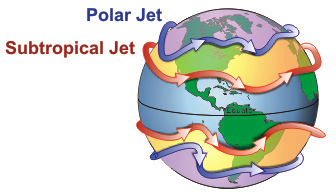
Research suggests this long period of hot weather results from the effects of man-driven global warming on the North Atlantic Polar Front Jet Stream. The Jet Stream is a ‘ribbon’ of winds blowing east to west at up to 200 miles an hour 9 to 16 kilometres above the earth’s surface over the mid-latitudes. It arises due to the contrast between warm tropical air and cold polar air. The differences in the pressure of warm and cold air produce a ‘pressure gradient force’. These winds would blow from high to low pressure, from south to north, if it wasn’t for the Coriolis effect.

jet_streams_wpclipart

The higher the contrast in temperature the stronger the Jet Stream. It is strongest in winter due to the cooling of the poles and weakest in summer due to their warming. Low pressure systems causing wet windy weather occur to the north of the Jet Stream and high pressure systems causing warm settled weather to the south. During the winter, when it’s strong, the Jet Stream lies south of the UK and gives us rain and wind. If it remains to the south we tend to have wet summers too. If the Jet Stream weakens in the summer and shifts north of the UK we are more likely to have hot still weather.

According to Dr. Jennifer Francis and Stephen Vavrus the warming of the Arctic is lessening the temperature gradient between the equator and the North Pole and causing the jet to slow and become ‘wavier’. James Mason explains that when ‘the eastwards progression of these upper waves becomes sluggish or stalls’ this ‘leads to prolonged weather-conditions of one type or another’ like this heat wave, which is dangerous not so much due to its temperature but the length of time without rain leading to wildfires and water shortages and potentially to drought and crop failure.

***

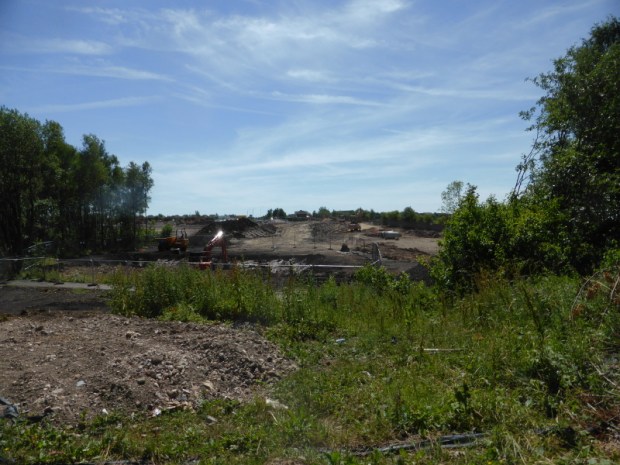
The root of global warming is humanity’s reckless drive for economic growth at the cost of the environment. Our government are aware of the increasing dangers of drought in the summer and flooding in the winter and are taking steps to deal with the effects but not the cause. Instead they are pushing ahead with plans to create more houses, more roads, more jobs; pumping out more greenhouses gases, removing more green space, causing more warming. Here in South Ribble alone 9000 houses are being built along with new and expanded roads and business parks. Preston, South Ribble, and Chorley are being merged into one urban conglomerate with parks as our only green spots.

Lostock Hall Gasworks Development

Dissenting voices are not listened to by the victors. From their positions of wealth and comfort they refuse to see, acknowledge, care about the effects their victory is having on the land and its creatures.

In British mythology Gwythyr and his father sided with Arthur against Gwyn and his spirits, the ancient animals, the monsters, the giants, the witches, and were victorious. In modern Britain the Arthurian court of war-mongering treasure-hoarding politicians and business leaders reign supreme.

800px-Holy-grail-round-table-bnf-ms-120-f524v-14th-detail

What to do in a world where history is determined and written by the victors, when, as Gwyn knows before going into battle every May Day, as Walter Benjamin says, ‘this enemy has not ceased to be victorious’?

Perhaps we must look beyond battle, beyond victory, which can only makes us the next victors, for other ways to our bit for the scorched land, the drying rivers, the dying creatures, the cast-out gods.

SOURCES

Ed Walker, ‘Winter Hill fire reignites and is in multiple locations’, Blog Preston,
John Mason, ‘A Rough Guide to the Jet Stream’, Skeptical Science,
Francis Perraudin, Helen Pidd and Kevin Rawlinson, ‘A hundred soldiers sent in to tackle fire on Saddleworth Moor’, The Guardian
Walter Benjamin, ‘On the Concept of History’, Marxists.Org
BBC Weather, Penwortham, BBC website
Climate change the jet stream’, Climate Central
Preston’s named wettest place in England’, Lancashire Evening Post,
UK weather: Water shortage warnings and hosepipe bans as heatwave intensifies’, The Indepedent
What is the jet stream?’, Met Office

Between Texto and Gloss

I. The Glosa

As an awenydd and polytheist writing and sharing poetry is an essential part of my path. Of all the poetic forms I have experimented with, including English, Welsh, Irish, French, and Italian metres, I have found the Spanish glosa the most conducive to religious practice.

The glosa was invented by the Spanish court poets during the Golden Age. It takes the form of four lines of text (texto) from an existing poet and four ten line stanzas of commentary (gloss) written by the glosser with the final line taken consecutively from the quatrain. The conventional rhyme scheme is ABBAACCDDC.

This versatile form was popular in Parisian literary salons during the reign of Louis XVI, in Germany in the Romantic period, and in Latin America throughout the struggles for independence. It was introduced into the English language comparatively recently by the Canadian poet P. K. Page in 1994.
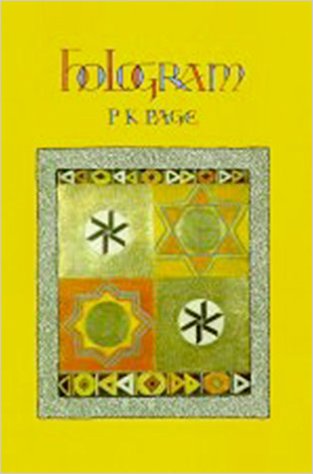
Hologram by P.K.Page

In Hologram, Page used a series of glossae to pay homage to other poets. Her use of a rhyme scheme where the sixth and ninth lines rhyme with the borrowed tenth, and italicisation of the text and its repetitions, has set the form for poetry in English.

Page’s work prepared the ground for Charlotte Hussey, another Canadian poet, who teaches Old Irish and Arthurian literature and studied Celtic Shamanism with Tom Cowan. Her collection of glossae, Glossing the Spoils (2012), glosses the ‘earliest Western European texts’ to ‘mend a break in tradition and time’, thereby reweaving the ancient myths into modernity.

Glossing the Spoils by Charlotte Hussey

In these glossae Hussey opens a visionary space between texto and gloss where it is possible for conversations with mythic personages and experiences of the transformative qualities of ‘the spoils’ to take place. In ‘Lake of the Cauldron’ she glosses lines from ‘Branwen Daughter of Llyr’. After watching a ‘huge man with yellow-red hair’ emerging ‘from the lake with the cauldron on his back’ the narrator is pushed ‘into the boil’ by a woman with ‘dreadlocks’, ‘long breasts’, and ‘a sweaty belly’ who ‘hacks / shoulder blades, buttocks apart, / scrapes off chunks of flesh / bones sinking then surging to the rim’. The ‘great monstrous man’ from the text watches her dismemberment ‘with an evil thieving look about him’.

Many of the poems reveal the subliminal influence of these near-forgotten myths on our time. ‘Trolls’ is based on lines spoken by the Loathly Lady in Parzival. It ends with ‘The knight, lifting his fluted, iron / visor with its narrow sights’ to ‘stare out’ for ‘a crusading convoy / to join, another holocaust to start, / or a melancholic witch to burn’. Glossing Perlesvaus, Hussey draws parallels between the animistic qualities of the ghastly black shield of the knight’s aggressor with its ‘dragon’s head throwing out / fire and flame with a terrible force’ and the atom bomb – a weapon of destruction she notes cannot be contained or exorcised (1).

I read Glossing the Spoils for the first time in 2012. Discovering the glosa and Hussey’s use of it as a gateway to visionary experience has had a profound effect on my spiritual path and my approach to the medieval Welsh texts that are central to my tradition as an awenydd.

II. The Bull of Conflict

I wrote my first glosa in September that year after an initiatory encounter with Gwyn ap Nudd, a god of the dead and ruler of Annwn, the Brythonic Otherworld. Desiring to honour and thank him for pulling me back from the brink of an abyss and to learn more about him, I decided to gloss four lines from ‘The Dialogue of Gwyn ap Nudd and Gwyddno Garanhir’ (2).

This poem, from The Black Book of Carmarthen (1350) documents a conversation that takes place in the misty hinterland between the worlds following Gwyddno’s death. Gwyn appears as a ‘bull of conflict’ – a divine warrior and psychopomp – to guide Gwyddno back to Annwn. Set during the fall of northern Britain to the Anglo-Saxons it contains some of the most powerful and poignant lines in Western European literature, ending with Gwyn’s lament:

I was there when the warriors of Britain were slain
From the east to the north;
I live on; they are in the grave.

I was there when the warriors of Britain were slain
From the east to the south;
I live on; they are dead.

Choosing four lines I started by meditating on the first and was taken back to walking the streets of Preston that afternoon in the aftermath of the Preston Guild Festival (4) and the pervading melancholy. Drifting amongst shadow-people I found myself in the Harris Museum surrounded by the spoils of war and face-to-face with Gwyn stepping from the poem.
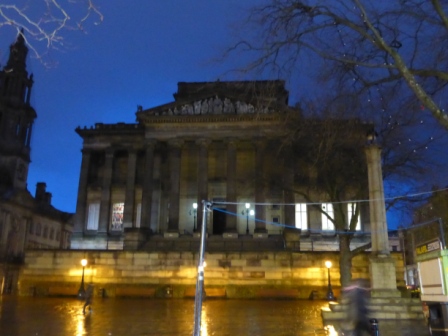
The Harris

The Harris Museum

In this familiar yet unfamiliar space, between texto and gloss, between poet and god a conversation took place that would change my life. Gwyn’s imperative of ‘enchanting the shadowlands’ gave me a purpose, became the title of my first book, and has guided my path ever since.

The Bull of Conflict

I come from battle and conflict
With a shield in my hand;
Broken is the helmet
By the pushing of spears.
‘The Dialogue of Gwyddno Garanhir and Gwyn ap Nudd’

On an empty day automata drift,
Wending suit shapes through the mist.
Touchless I fade like a symbol unhitched.
The spoils of war quake in the museum.
Piercing the grey wearing horns of a bull
A white warrior blackened and bloodied
Disguises his limp in an infinite gloom,
On his spear leans, softly says:
“My comrades are slain and yet I live,
I come from battle and conflict.”

His dire avowal brings howling winds,
Chill clutch at my shoulders their lament dins
Of hero light fading from mortal skin.
In glass cabinets swords clash savage,
Raging figures thrash on ragged pages
Chanting the desolate past of ravaged war bands.
With war-torn wisdom, sombrely he whispers:
“These gathered memories to you I give.
Gone are the days I crossed this land
With a shield in my hand.”

His barrage of sadness barks in my mind
Like hapless hounds on a winter’s night.
Fierce their madness, dark their plight,
For the perishing souls they collect,
The past’s great spirit protect.
Like thundering wind obligation overwhelms me.
The blade of futility threatens to unfasten me.
“How do I cherish and defend these memories
When like the kingdoms of Rheged and Elmet
Broken is the helmet?”

I ask the Bull of Conflict.
His tears run bright with the passing of time,
Chariots wheeling in multihued light,
Victims reflected in star lit skies.
He says: “this shadow land needs enchantment
To banish the blight of despair.
Nurture the memories with magic
And they’ll sing a blessed new year.
Do not be pressed into fear
By the pushing of spears.”

This was a once-in-a-lifetime experience which led me to devote myself to Gwyn as my patron god. Nothing quite like it has happened since and I have written many glosa, good and bad.

III. The Spoils

Hussey’s title, Glossing the Spoils, works on many levels. By ‘the spoils’ it refers to the spoils of war, the spoils of the distant past gathered in museums, and the spoils of our literary heritage. It also subtly alludes to ‘The Spoils of Annwn’, from The Book of Taliesin (14th C). Taliesin, the narrator, accompanies Arthur and his men on a raid on Annwn to plunder its treasures, including the cauldron of Pen Annwn, ‘Head of the Otherworld’ (Gwyn). There a catastrophic battle takes place, which Gwyn later describes to Gwyddno:

And to my sorrow
I saw battle at Caer Fanddwy.

At Caer Fanddwy I saw a host
Shields shattered, spears broken,
Violence inflicted by the honoured and fair.

Arthur assaults ‘the honoured and fair’: the fair folk ruled by Gwyn, who are forced to retaliate. In a moment suggestive of both pillage and rape Lleog thrusts his ‘flashing sword’ into the cauldron and it is ‘left behind in Lleminog’s hand’. Arthur escapes from Annwn with the spoils, slamming ‘Hell’s Gate’ shut. Only seven of three ship-loads of his men survive the conflict.

Analogously most of the spoils in our museums have been plundered violently from other lands. The literary heritage of Western Europe is largely based on a history of the victors, mythic and real, crusading, conquering, colonising. As Walter Benjamin says: ‘There is no document of civilization which is not at the same time a document of barbarism.’

These thoughts were on my mind when I embarked on a quest to explore the contemporary relevance of the Thirteen Treasures of the Island of Britain (3). They include the cauldron (which is kept by Dyrnwch the Giant), the Hamper of Gwyddno Garanhir, vessels for eating and drinking, weapons, items of clothing, and vehicles for transport. It is likely most of them were won or stolen from Annwn by the northern British warlords who own them.

Like the spoils evoked by Hussey the treasures are animate, inspirited, alive, expressing their agency through magical qualities. The cauldron will only brew meat for the brave. Brân’s horn provides any drink one wishes. Morgan’s chariot takes a traveller wherever they wish quickly. Rhydderch’s sword bursts into flames in the hand of any man who is well-born.

The Gwyddbwyll Gwenddolau, ‘Chessboard of Gwenddolau’ (4), is made of gold and has silver gwerin, ‘men’, who play by themselves. The men represent Gwenddolau’s army and his enemy and serve a divinatory function – the outcome of the game predicts the result of real battles.

Writing a glosa based on four lines about the chessboard took me on a visionary journey to Gwenddolau’s seat of rule in Arfderydd (modern day Arthuret in Scotland) and gave me a glimpse of its magic outliving Gwenddolau to predict the outcomes of upcoming wars.

View from Liddel Strength

Caer Gwenddolau

The Chessboard of Gwenddolau

The Chessboard of Gwenddolau…
if the pieces are set,
they play by themselves.
The board is gold and the men silver
(5).
The Thirteen Treasures of the Island of Britain

I leave my world behind at Carwinley Burn
to follow the feral steps of a girl,
red-haired, torqued, coloured-trousered,
a wild thing with fox’s teeth at her neck
down a fox-hole to the grave
of Gwenddolau.
Beside his bull-horned corpse
stands a table and upon it a golden board.
Round its edges silver dead men lie.
The Chessboard of Gwenddolau

has lain here as long as my father,”
she says. “It predicts the outcome of battles.
It played before Arfderydd, Catraeth,
when Britain’s air force clashed
with the Luftwaffe,
on the eve of the invasion of Iraq. As yet
it has never mispredicted an event.
At times of peace it sleeps.
At times of threat
if the pieces are set

they play out every move in the coming conflict.”
As she speaks the eyes of a warrior
jerk open and his spasmodic
hand grips his spear.
A warhorse rises from a tangle of stirrups and mane.
A bishop shakes off his robes and delves
for fireballs and mist in his pockets.
Caers rebuild their ramparts.
Returning to health
they play by themselves

speechless as automata resuming their positions.
Warriors move forward two squares
spearing on the diagonal.
Warhorses leap
over the mounting carnage,
on a fiery blast fall into splinters.
A king drags his queen into a caer.
As the bishops prepare the final spell
I am shaken by a premonitory shiver.
The board is gold and the men silver.

For me this glosa reveals the sad fact that since the war-torn period when Gwenddolau lived and now there has barely been a time when the warriors of Britain have not been at war. The uncanny battles fought between the gwerin, beneath the earth, in Annwn, represent our militant history.

As modern glossers we are faced with a past of ravaging, wounding, spoiling: a world spoilt by Arthurian warlords. How, between texto and gloss, can we enchant its shadows, heal its wounds?

Footnotes

(1) In ‘Glossing Faery
(2) At this point I was working with William Skene’s 1868 translation. I recommend the 2015 translation by Greg Hill. The title and glossed lines are from Skene, but the other two are from Hill.
(3) The Thirteen Treasures of the Island of Britain appear in several medieval Welsh manuscripts. The earliest is the autograph of Gwilym Tew in Peniarth Manuscript 51 (1460).
(4) Gwyddbwyll means ‘wood-sense’. Its translation as ‘Chessboard’ isn’t entirely correct because chess originated in the Arab world and was imported to Britain by the Normans in the 11th century.
(5) Here I took the poetic liberty of changing the form and tense of the original quote.

Sources

Charlotte Hussey, Glossing the Spoils, (Awen Publications, 2012)
Charlotte Hussey, ‘Glossing Faery’, Awen ac Awenydd
Greg Hill, ‘The Conversation Between Gwyn ap Nudd and Gwyddno Garanhir’, Awen ac Awenydd,
Keith Ellis, ‘The Glosa: A Genre to be Noticed for its Constructive Values’, Comparative Literature and World Literature, Vol 1. No. 2 (2016)
Marged Haycock, Legendary Poems from the Book of Taliesin, (CMCS, 2007)
P. K. Page, Hologram, (Brick Books, 1995)
Walter Benjamin, ‘On the Concept of History‘, Marxists.org
William Skene, ‘The Dialogue of Gwyn ap Nudd and Gwyddno Garanhir’, The Four Books of Ancient Wales, (Forgotten Books, 2007)

The One Who Didn’t Go To The Meadows of Defwy

In the fifth verse of ‘The Spoils of Annwn’ Taliesin berates ‘pathetic men’ (monks) who do not know ‘who made the one who didn’t go to the Meadows of Defwy’. I have been perplexed for several months by these lines, which pose the questions: Where and what are these mysterious meadows? Who didn’t go? What is the significance of not going? Who is his/her maker?

The Meadows of Defwy

Both my research and spirit-journeys suggest the Meadows of Defwy are in Annwn, ‘the Deep’, the Brythonic Otherworld. ‘The Spoils of Annwn’ depicts Arthur’s raid on seven otherworldly fortresses and his plundering of its treasures. Arthur’s adversaries are Pen Annwn, ‘the Head of the Otherworld’, and his people.

In the fifth verse, the Meadows of Defwy are connected with the Brindled Ox and Caer Vandwy, ‘the Fortress of God’s Peak’. In ‘The Conversation of Gwyn ap Nudd and Gwyddno Garanhir’, Gwyn (Pen Annwn) speaks of his ‘sorrow’ at witnessing ‘a battle at Caer Vandwy’ where ‘the honoured and fair’ fought Arthur’s raiding party and lost. This resulted in the theft of the Brindled Ox.

The first time I journeyed to the Meadows of Defwy I walked straight into the aftermath of the Arthur’s battle and recorded what I saw in the following verse:

A plain of blood where men once stood.
The lights have gone out in Caer Vandwy.
The clashing sea rolls over shield and spear.
The living dead. The dead dead again.

The Brindled Ox had been stolen, leaving only the deep trails of his struggling hooves as he was hauled aboard Prydwen, Arthur’s ship. His herd were frightened witnesses who had watched from a distance.

The association of the Brindled Ox with the Meadows of Defwy suggests it is a place where the animals of Annwn graze. This is backed up by the folktale Childe Roland, in which Roland found herds of horses, cows, sheep, goats, swine, and a flock of hens in Fairyland/Annwn. Roland beheaded each of their herders before assaulting the Fairy King’s castle.

wild-flowers-1363733002BId

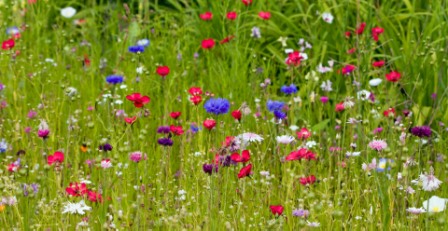
In more recent journeys I have found myself galloping through the Meadows of Defwy as a horse with the horse-herds. The meadows have appeared as a paradisal place of endless grassy plains alive with meadowflowers, bees, butterflies, grasshoppers, crickets.

It shares a kinship with ‘the Plains of Annwn’, which are written about by modern polytheist Nick Ford:

Broad and wide the plains of Annwn,
Sweet and thick, the grass thereon;
Fragrant with a million flowers,
Where graze the herds of Riganton.

Mild the breeze breathes on the pastures,
Blows the grasses that way, this;
As the horse-herds, like the wind, race
Further than the mind can guess.

The Meadows of Defwy are connected with the mare goddess Rigantona/Rhiannon and seem to bear some resemblance to the Elysian Fields of Greek mythology where the souls of the dead go to lead a blessed and happy afterlife.

Marged Haycock suggests Defwy is a river-name deriving from def-/dyf ‘black’ and may have been viewed as a river of the dead. A river Dyfwy is referred to in ‘The Spoils of Taliesin’: ‘Fine it is on the banks of Dyfwy / when the waters flow’. The Elysian Fields are located by the river of Oceanus, which separates this world from the underworld.

This ties together to suggest the Meadows of Defwy are a liminal place where the dead reside happily alongside the animals of Annwn (unless assaulted by thisworldly raiders!).

The One Who Didn’t Go

 It is my belief the phrase ‘the one who didn’t go the Meadows of Defwy’ does not literally mean someone who has not visited the meadows, but refers figuratively to someone who has escaped death.

Who could that be?

After pondering this question for a long while I received an answer from Greg Hill’s new translation of ‘The Conversation Between Taliesin and Ugnach’. When I first read this poem, which opens: ‘Horseman who rides to the fortress, / With white hounds and great horns’ I had a strong feeling the horseman was Gwyn, but was confused by his revelation of his name as Ugnach.

My confusion was laid to rest by Greg’s explanation that the suffix -ach signifies a supernatural character. It’s therefore likely to be another title of Gwyn/Pen Annwn. Greg added in a discussion that when Ugnach identifies himself he uses the word ‘heno’, a variant on ‘name’, but that ‘heno’ also means ‘tonight’. He might be saying ‘he is Ugnach just for tonight’.

The identification of Ugnach with Gwyn/Pen Annwn makes perfect sense in the context of the poem. Ugnach repeatedly extends his invitation to Taliesin to visit his fortress, promising ‘shining mead’, ‘wine flowing freely’, ‘fine gold for your spear-rest’ and a ‘bed’. Taliesin refuses to be lured by his ‘speech honeyed and fair’ and repeatedly states he does not know Ugnach. Whilst acknowledging Ugnach’s feast he insists he cannot stay.

Taliesin is refusing to stay with Ugnach in the lands of the dead; to accept death; to go to the Meadows of Defwy.

Taliesin is the One Who Didn’t Go To The Meadows of Defwy. Characteristically he is riddling about himself!

Who then is his maker?

Taliesin describes his making in ‘the Battle of the Trees’:

It was not from a mother and a father
that I was made,
and my creation was created for me
from nine forms of consistency:
from fruit, from fruits,
from God’s fruit in the beginning;
from primroses and flowers,
from the blossom of trees and shrubs,
from earth, from the sod
was I made,
from nettle blossom,
from the ninth wave’s water.
Math created me
before I was completed.
Gwydion fashioned me –
great enchantment wrought by a magic staff.

It seems this story refers to his making prior to his incarnation as Gwion Bach and rebirth from the womb of Ceridwen as Taliesin. He believes himself to have been created by the magician gods ‘before the world (was made)’ ‘when the extent of the world was (still) small’.

Thus he places himself above the processes of death and rebirth symbolised by the cauldron of Ceridwen which stands at the centre of the feast of Pen Annwn. Refusing to go to the fortress of Ugnach, Taliesin goes instead to ‘the fortress of Lleu and Gwydion’. Caer Gwydion is located in the Milky Way. There he hopes to reside in eternal life with his makers.

Taliesin escapes the fortress from which he helped steal the cauldron, the meadows where he fought ‘the honoured and fair’, the god of many names he refuses to know, but for how long?…

SOURCES

 Greg Hill, ‘The Conversation Between Gwyn ap Nudd and Gwyddno Garanhir’, The Way of the Awenydd
Greg Hill, ‘The Conversation Between Taliesin and Ugnach’, The Way of the Awenydd
Marged Haycock, Legendary Poems from the Book of Taliesin, (CMCS, 2007)
Nick Ford, ‘The Plains of Annwn’, Association of Polytheist Traditions

13. The Mantle of Arthur

The mantle of Arthur in Cornwall: whoever was under it could not be seen, and he could see everyone.’
Thirteen Treasures of the Island of Britain

We know of the atrocities
he committed when he was visible:
the headless giants, witches with cloven heads,
slaughtered dog-heads and wolves stripped of their furs.

We have seen the desolate battlefields in thisworld and Annwn.

What then of the invisible deeds behind his rise to power?

Some say Arthur walks invisibly amongst us still,
seeing everyone without being seen,
his hand guiding Empire.

Sweeping from his mantle the blade of Caledfwlch falls.

~

The Mantle of Arthur

~

Arthur was the son of Uther Pendragon and Eigr and was a legendary warlord who fought against the giants and witches of ancient Britain and carried out an infamous raid on Annwn. He also led twelve battles against the Anglo-Saxons and died at Camlan in 537. It’s odd to find Arthur’s mantle, here associated with Arthur’s court in Cornwall, in this list of northern treasures.

We find a detailed description of Arthur’s mantle, Gwen ‘White’ or ‘Blessed’, in Rhonabwy’s Dream. It is made of ‘damasced, brocaded silk’ and has ‘a reddish gold apple at each of its corners’. We are told of its attributes: ‘the person wrapped in it could see everyone yet no one could see him. And no colour would ever last on it except its own colour.’

In Culhwch and Olwen, Arthur’s mantle, along with his ship, sword, spear, shield, and dagger are listed as the only gifts that he refuses to give to Culhwch.

In ‘The Second Branch’ Caswallon, son of Beli Mawr, puts on a magic mantle in order to murder Caradog, son of Brân the Blessed, and six of his men, thus usurping the rulership of Britain. We are told ‘no one could see him killing the men – they could only see his sword.’ It may be suggested this is the same mantle and was associated with sovereignty.

As far as I am aware there are no stories about Arthur using his mantle to make himself invisible and carrying out any kind of deeds or misdeeds whilst under its protection.

Rich mantles, cloaks, and coats make frequent appearances in medieval Welsh mythology.  There is story about Arthur attempting to take Padarn’s Coat and I can’t help wondering whether these treasures are connected or the same. Culhwch wears a ‘purple, four-cornered cloak about him, with a ruby-gold ball at each corner. Each ball was worth a hundred cows.’

It seems possible that, like Padarn’s Coat, Arthur’s mantle and Culhwch’s cloak were dyed with Tyrian Purple and thus symbolic of the wealth and prestige of the Romano-British elites. Although the name of Arthur’s cloak, Gwen, suggests it may be white, I think this alludes to its blessed/magical nature. Without laundrettes and whiteners it would have been impractical to keep a garment white particularly for a warlord regularly up to his elbows in blood. One of the qualities of Tyrian Purple was its ‘resistance to weather and light’. For Arthur it would have been a blessing that his mantle kept its own colour and the countless blood stains didn’t show.

~

SOURCES

Rachel Bromwich (ed), The Triads of the Island of Britain, (University of Wales Press, 2014)
Sioned Davies (transl.), The Mabinogion, (Oxford University Press, 2007)
Tyrian Purple, Wikipedia

Rhymi

‘The bitch Rhymi… in the form of a she-wolf… she goes around with her two whelps. She has killed my livestock many times, and she is down below Aber Daugleddyf in a cave.’
– Culhwch and Olwen

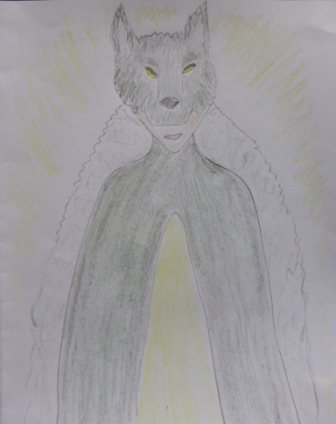
I was in a multitude of shapes before I assumed wolf-form. My keen sense of smell, my canine teeth, the sense of awe surrounding the silence of my feet and my savagery were all conducive to my role as a death-eater.

I was feared and revered by the people of Prydain for thousands of years until they decided their dead: human and animal should not be eaten by wolves.

I’m not sure what brought about this decision – whether it was their abandonment of hunting for farming, their penning in and marking ownership of the herds, the arrival of the sheep or the religion of the sheep with its shepherd-like patriarchs who despised both wolves and women.

Whatever the case, I became reviled. Whenever farmers caught me raising my jaws from a half-eaten carcass, gnawing bones dragged from a freshly dug grave, they sent huntsmen after me with hounds, bows and arrows, knives and spears, to bring back the trophy of my head.

Of course, I knew how to deal with huntsmen. My most ardent pursuer was Deigyr of Caerdydd. When numbers and brute strength did not succeed, he decided to track me by stealth instead. Disguising his scent in fox urine he followed me from kill to kill. Leading him into Caerdydd, I slipped off my wolf-fur and, taking a softer form, allowed him to buy me a flagon of bragget.

We got talking about the art of hunting and the nature of the wolf. The bragget slid down like hot blood. Soon I was back at his house, lounging on a wolf-skin rug, admiring the furs on his walls, the heads of beavers, badgers, foxes, boars, and wolves.

After we slept together I killed Deigyr with his hunter’s knife and devoured his corpse. Many moons later I gave birth to two whelps: Gwyddrud and Gwydden, in a sea-cave beneath Aber Daugleddyf.

Their suckling on the polyps of my teats was interrupted by a ship with a rude white prow carrying hundreds of warriors. As they fired their bows into the water I snapped every arrow with my jaws and rose up, barging and harassing the vessel I recognised as Prydwen to the shore.

An army awaited me with endless rows of spears and shields.

When I showed no fear, Arthur called on God to change me into my own form, grasped my wolf-fur and pulled it off.

The spears dropped to the floor.

The King of Prydain recoiled in dismay, eyes bulging like sea anemones, face pale as coral, “Please God, change her back!”

When his plea went unanswered, Arthur desperately attempted to throw the fur back over me, but it landed limp and useless on the sand.

“Please God, change her back. Please cover her up!”

Rhymi sketch

Orddu, the Very Black Witch

There is no document of civilization which is not at the same time a document of barbarism.’
  Walter Benjamin

Orddu has been a powerful presence in my life since I started investigating the story of her death. In the medieval Welsh tale, Culhwch and Olwen (1070AD), she meets a gruesome end. She is cut in twain by Arthur’s knife, then her blood is drained and bottled to dress the beard of the giant, Ysbaddaden Bencawr.

The murder of Orddu is the penultimate act in a trail of bloody atrocities committed by Arthur and his men so Culhwch can win Olwen. Ancient animals are hunted down, giants butchered, otherworldly treasures stolen, numerous historical and mythical figures subordinated and incorporated into Arthur’s court. Finally, Ysbaddaden is barbered and beheaded.

The civilising rule of Arthur as a champion of Christianity unifying Britain is asserted by his barbaric assault on this land’s divinities and those who interact with them. His reign as a national hero is based on his wiping out not only of the lives, but the stories, of a myriad Others cast into an abyss of ignominy from which few of us hear their screams.

Orddu’s death cry has resounded in my ears for several years now. Sadly she does not appear in any other sources. Nothing is known about her outside Culhwch and Olwen, where she takes to the stage for a brief and brutal battle before her life is snuffed from the page and from history. However, clues to her significance can be gleaned by reading the surface text otherwise, from the perspective of Annwn, ‘the deep’, the ancient British Otherworld.

Orddu is introduced as ‘the Very Black Witch, daughter of the Very White Witch’ (Orddu means ‘Very Black’ and Orwen ‘Very White’). This is suggestive of a matrilineal tradition of witchcraft passed on from mother to daughter through the generations. Whether Orddu and Orwen are titles, or refer to the witches’ skin colour, hair colour, or the type of magic they practiced remains unclear. Still, these women can be pictured singing spells, passing on plant knowledge, caring less for labels than the flow of magic that runs in their blood and sings in their souls.

When Arthur embarks on his quest to bottle Orddu’s blood he sets out for the North. Northern Britain, with its rough terrain and cold weather, where the influence of Rome struggled harder to maintain its hold, is traditionally viewed as hostile and dangerous in medieval Welsh literature.

Orddu is located in ‘Pennant Gofid in the uplands of hell’. Pennant Gofid means ‘Valley of Grief’. This may be viewed simultaneously as a place where people come to grief and a place where they come to grieve. ‘Hell’ is translated from ‘Uffern’, ‘Inferno’, a word used synonymously with ‘Annwn’. The associations with mourning and the Otherworld suggest Pennant Gofid was a valley of the dead and that Orddu was its custodian. As such it would have been viewed as profoundly sacred by local ‘pagans’, but as hellish by Christian intruders with no understanding of their beliefs. I have not managed to locate Pennant Gofid within the physical landscape, but when I journey there in spirit it is steep and stony. A white river with foaming rapids roars through it. Through its ever-present mists hardy stumpy trees can be glimpsed, cairns, dolmens and, occasionally, mountain ghosts.

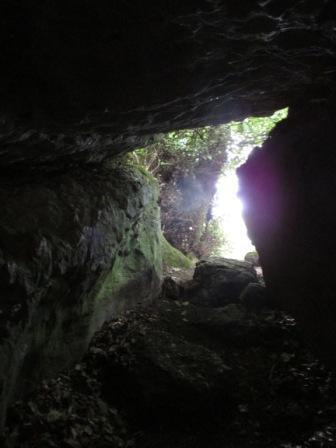
Orddu is found in a ‘hag’s cave’. This signifies her connection with ancient ancestral traditions which have no place in the civilised world of Arthur. Caves are places of access to Annwn and its mysteries. The bones of Orddu’s ancestors may have been buried in the cave’s recesses. In my journeywork it is half way up the valley; a precarious scramble. Nearby a spring emerges from the rock. There I received the gnosis it is the place Orddu and her kindred grieved for their predecessors and the dead who are buried in the valley. Their salt tears are the source of the white waters of the River of Grief. There I mourned Orddu’s death.

To find Orddu’s cave, Arthur is dependent on the guidance of the pre-Christian deities Gwyn ap Nudd (‘White son of Mist’) and Gwythyr ap Greidol (‘Victor son of Scorcher’). Gwyn is a god of Annwn and ruler of its spirits who are referred to as ‘demons’ in Culhwch and Olwen. In The Black Book of Carmarthen (1350AD) he appears as a gatherer of the souls of the dead.

Gwyn and Gwythyr are deadly rivals for the love of a maiden called Creiddylad. In an earlier episode, Arthur put an end to their conflict by placing a command on them to fight for Creiddylad every May Day until Judgement Day. Their appearance together and as advisors to Arthur seems contrived as a way of demonstrating Arthur’s power.

Read beneath the surface and we see that Gwyn’s presence in Orddu’s story has deeper roots. If Orddu is located on the edge of Annwn, then Gwyn is the deity who must be called upon to part the mists to find her. Orddu’s witchcraft may be rooted in her relationship with Gwyn as a god of Annwn and with the spirits and the dead who he presides over.

Evidence of groups working magic with the deities of the Otherworld has been found in Gaul. The Tablet of Larzac (90AD), from a seeress’s grave, refers to a coven of witches practicing andernados brictom ‘underworld-group magic’. The Tablet of Chamalieres (50AD) evidences a group of men calling on ‘Andedion’ ‘Underworld God(s)’ for aid in battle. ‘Annwn’ and ‘Andedion’ share the same stem. The poet Dafydd ap Gwilym refers to ‘witches of Annwn’ suggesting similar groups existed in Britain.

We also have records of a native tradition of prophesy and spirit-work. In his Description of Wales (1194AD), Giraldus Cambrensis refers to ‘Awenyddion’, ‘people inspired’ who are possessed by spirits and perform oracular trance when consulted on ‘doubtful events’. Orddu can be pictured prophesying with the spirits of Annwn and invoking their aid. Arthur’s subordination of Gwyn represents the negation of her source of magic.

When Arthur and his men approach Orddu’s cave she shows no sign of fear. Arthur hesitates until Gwyn and Gwythyr advise him to send in two of his servants, Hygwydd and Cacamwri. Orddu grabs Hygwydd by the hair and wrestles him to the ground, disarms and thrashes them both and beats them out ‘shrieking and shouting’. When Arthur tries to rush the cave, Gwyn and Gwythyr say, “It is not proper and we do not want to see you wrestling with a hag.” They tell Arthur to send another pair of servants in. We do not hear what Orddu does to Hir Amren and Hir Eiddil (Hir means ‘long’ or ‘tall’ – these are formidable men), only that their fate is ‘far worse’ and the four are so severely incapacitated they cannot escape without being put onto Llamrei, Arthur’s gigantic mare. After this, Arthur loses his temper and strikes Orddu dead.

It is uncertain whether Gwyn and Gwythyr are being presented as stupid or as tricking Arthur to defend Orddu. Whatever the case, in spite of being alone in her cave and outnumbered, Orddu displays considerable skill in hand-to-hand combat and puts up a courageous fight.

Comparisons may be drawn with the witches of Caer Lowy who teach Peredur how to ride a horse and handle weapons. Afterward, Peredur turns on them and slaughters them with Arthur’s aid. Conspicuously he kills one of the witches by striking her on the helmet so her head is split in two. As she dies she tells Peredur he was destined to kill her. It may be conjectured that Orddu belonged to a similar lineage of women who were not only witches but also trained the warriors of the North.

Thus it makes sense that for Arthur’s tasks to be completed this powerful woman must be removed from her position at Pennant Gofid where she teaches the arts of warriorship and utters prophecies from the mouth of Annwn. Her death signals the end of a tradition that may be as old as the ancestral remains in the cave where she abides.

Long has she lain there, her skull split in twain, her bones in two weary piles. Long has her story been forgotten, until now, as the rule of Arthur and the hegemonic brand of Christianity that gave us the Crusades, witch hunts and the British Empire united under ‘One King, One God, One Law’ begins to crumble.

The blood of witches does not stay bottled forever even in the bottles of a dwarf. The glass walls that contain magical women are shattering. Orddu’s call is to win back our powers of prophecy and fighting strength, to rebuild our relationships with Annwn and its gods and spirits. To reach into our caves of potential and fulfil our vocations with courage, remembering how her life was cut short.

Picture

*This article was solicited by Kate Large and was first published in Pagan Dawn, No 202, Spring 2017

Gods and Radicals's avatarGODS & RADICALS

We have started rebuilding from the ruins.

We are the children you never knew you would have.

We do not see you but we keep on building

the future you made your crossing for.

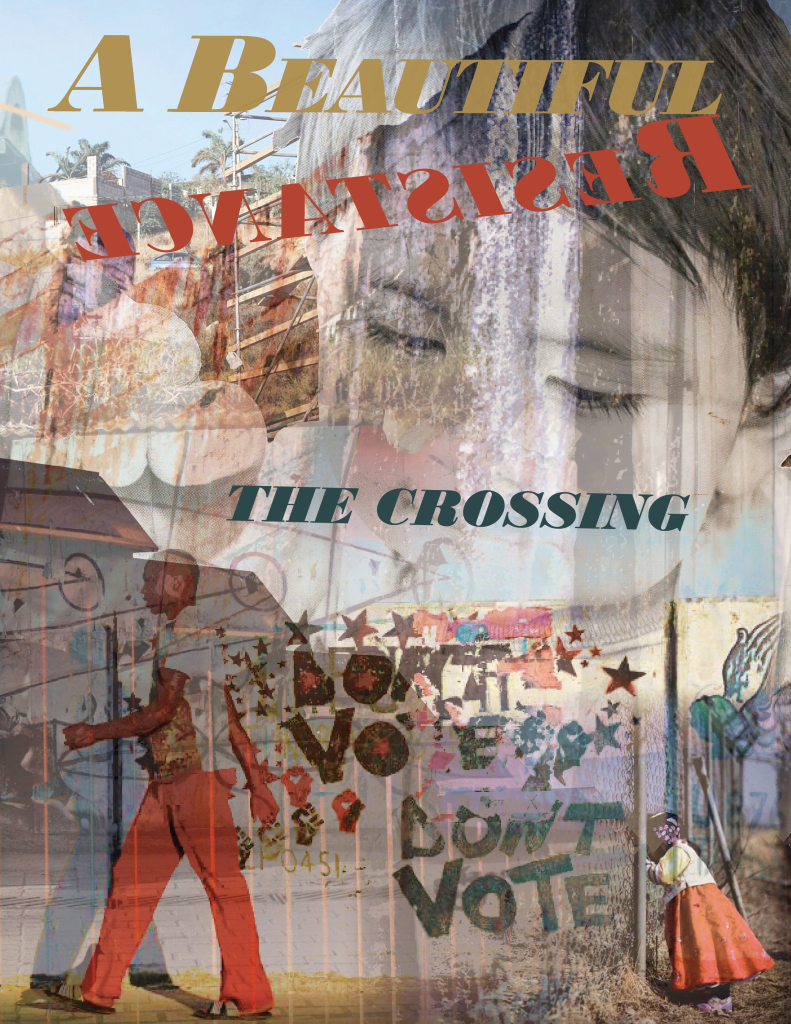
Gods&Radicals is pleased to announce that the fourth issue of our journal, A Beautiful Resistance, will be released into the world 15 November.


Edited by Lorna Smithers and Lia Hunter, foreworded by Peter Dybing, and yet again featuring the brilliant cover artistry of Li Pallas, A Beautiful Resistance: The Crossing features literary and artistic works from Europe, Africa, Asia, and North America, by:

Nina George, Nimue Brown, S. A. O’Hungerdell, Angharad Lois, Nicole Heneveld, Bryan Hewitt, Rex Butters, Rhyd Wildermuth, Lorna Smithers, Dennis Mombauer, Dr. Bones, Boham, Ingi House, Jason Derr, Aicila Lewis, Joe DiCicco, Tahni J. Nikitins, Shane Burley, Innocent Chizaram Ilo, Michael Browne, Nebulosus Severine, Finnchuill, Rune Kjær Rasmussen, Sean Donahue, Sonali Roy, Christine…

View original post 16 more words

WANTED

King Arthur of Camelot Wikipedia Commons

ARTHUR and ARTHUR’S WARBAND for the following CRIMES against the PEOPLE OF ANNWFN –

*The murder of Diwrnarch Gawr, by beheading with his own sword, and the theft of his sword and cauldron.
*The murder of Dillus Farfog, by beheading, and the plucking out of his luxuriant red beard to make the leash that near-strangled Drudwyn, Fierce White, a Hound of Annwfn.
*The murder of Rhitta Gawr, by beheading, and the theft of his cloak of his beards.
*The murder of Ysbaddaden Bencawr, by beheading, and his torture – the shaving of his beloved hawthorn beard, the paring of his skin and flesh to the bone, and the slicing off of both his ears.
*The murder of Orddu, Very Black, Witch of Pennant Gofid, by slicing in half with a lightning-like knife and the draining of her blood into the bottles of Gwyddolwyn Gawr to grease Ysbaddaden’s beard.
*The murder of the Nine Witches of Caer Loyw by splitting their heads and helmets in twain.
*The murder of the dog-heads of Din Eidyn and cutting out of their tongues.
*The murder of Gwrgi Garwlwyd, Leader of the Dog-Heads, deviously assassinated, and the theft of his head.
*The harassment of Rhymi the she-wolf and her two whelps, driven from their sea-cave beneath Aber Daugleddyf and forced into human form.
*The harassment of Ysgithrwyn Pen Baedd, hunted across the North, and his torture as his tusk was pulled from his head to barber Ysbaddaden.
*The harassment of Twrch Trwyth, hunted from Eire to Aber Hafren, and the theft of the comb, shears and razor from between his ears to comb, trim, and shave Ysbaddaden’s beard.
*The disinterment and theft of the head of Brân the Blessed.
*The theft of the Cup of Llwyr ap Llwyrion, the Hamper of Gwyddno Garanhir, the Horn of Gwlgawd Gododdin, the Harp of Teirtu, and the Birds of Rhiannon.
*Breaking and entering into Annwfn and the unlawful docking of one white-prowed ship named Prydwen.
*The murder of the honoured and fair on the plains of Caer Vandwy.
*The theft of the Brindled Ox and his herd.
*The murder of six thousand speechless dead men on the walls of Caer Wydyr.
*The kidnapping of Gweir, Bard of Annwfn, from Caer Siddi.
*The theft of the cauldron of the Head of Annwfn.
*The attempted murder of the Head of Annwfn.

REWARDS will be paid in the FINEST ANNUVIAN GOLD.

***

This piece came to me a few days after finding out that the current exhibition at the National Library of Wales in Aberystwyth, displaying The Black Book of Carmarthen, The Book of Aneurin, and The White Book of Rhydderch, amongst other texts is titled ‘Arthur and Welsh Mythology’.

My heart sank at the mention of Arthur. How can a warlord who, in early Welsh mythology, murders, tortures, and subdues the giants, witches, ancestral animals, and pre-Christian deities associated with our ancient British underworld, Annwfn, still be revered as a national hero?

 Isn’t it time we started looking instead to the ‘colourful characters’ whose stories Arthur has eclipsed for inspiration and wisdom rooted in the deeper mythos of the pre-Arthurian world?

Gwyddbwyll – Why the War Games?

Gwyddbwyll is a Brythonic war game. The name derives from gwydd, ‘wood’, and pwyll, ‘sense’, hence ‘wood sense’. It is played with gwerin, which means both ‘pieces’ and ‘men’.

We find references to gwyddbwyll in a number of medieval Welsh texts. Together these suggest it was played by sovereigns and that the board represented their realm and the gwerin their army and the army of a rival. The board and gwerin are usually carved from gold or silver. The gwerin are anthropomorphic and magically endowed with a life of their own.

In The Dream of Macsen Wledig, the Roman Emperor, Macsen, dreams of a hall in which two lads are playing gwyddbwyll with silver and red gold pieces whilst a grey-haired man sits at a second board carving pieces with steel files from a bar of gold watched over by a beautiful, lavishly dressed maiden who he falls in love with.

Macsen finds out the maiden is Elen Luyddog, ‘Elen of the Hosts’ and her castle is at Aber Saint. He travels from Rome to Elen’s hall where he finds her overlooking the gwyddbwyll boards just as in his dream and marries her. It seems likely the first gwyddbwyll board represents Elen’s old realm and the new one the realm she will rule alongside Macsen.

In Peredur, the protagonist sees a gwyddbwyll board in the Fortress of Wonders. The two sides are playing each other. When the side Peredur supports loses, the other side shouts ‘just as if they were men’. Angry because his side has lost, Peredur takes the pieces in his lap and throws the board into a lake.

A black-haired maiden enters saying, ‘May you not receive God’s welcome. You do evil more than good… You have made the empress lose her board, and she would not wish that for her empire.’ Again we find evidence that the gwyddbwyll board of a sovereign represents her realm.

The Gwyddbwyll Gwenddolau is amongst ‘The Thirteen Treasures of the Island of Britain’ ‘which were in the North’. Gwenddolau ruled Arfderydd and may have been a ‘High King’ of northern Britain during the 6th century. The text states, ‘if the pieces were set, they would play by themselves. The board was of gold, and the men of silver’. It clearly had magical qualities.

Rhonabwy’s Dream features a gwyddbwyll match between Arthur and Owain Rheged. As they play, messengers arrive reporting that Arthur’s men are harassing then wounding and killing Owain’s ‘ravens’. Arthur refuses to call them off saying, “your move” and they play on.

The tides turn. As Owain’s ravens lift Arthur’s men into the skies and drop them in pieces, Owain refuses to call them off saying, “your move” and they play on. When Arthur finally loses his temper and crushes the golden pieces to dust everything becomes peaceful.

This shows gwyddbwyll was related to real wars via the logic of microcosm – macrocosm and suggests that matches had a divinatory function. Perhaps when the gwerin played by themselves they predicted the outcome of future battles.

***

Unfortunately we have no archaeological evidence for the existence of gwyddbwyll. This is odd because boards and counters for the Roman Ludus Latrunculorum, ‘The Game of Little Soldiers’, have been found at Housesteads, Vindolanda, and in the grave of a man from Stanway in AD 50 alongside diving rods suggesting it was buried with its owner and served a divinatory purpose.

Ludus Latrunculorum, modern reconstruction, Museum Quintana, Germany, Wikipedia Commons

Ludus Latrunculorum, modern reconstruction, Museum Quintana, Germany, Wikipedia Commons

These boards were wooden (as ‘wood sense’ might suggest) and have not rotted away. If gold and silver gwyddbwyll sets existed, which indeed might have been possible based on examples of Romano-British silversmithing such as the ‘Empress Pepper Pot’, surely they would have been found?

Empress Pepper Pot, British Museum, Wikipedia Commons

Empress Pepper Pot, British Museum, Wikipedia Commons

In Ireland we find a parallel game called fidchell, from fid, ‘wood’, and ciall, ‘intelligence’, also ‘wood sense’. Again it belongs to sovereigns, the board and pieces are made of gold and silver, and are anthropomorphic and endowed with their own life (in one instance ‘the queen is asleep’). Games are played for high stakes bound up with the livelihood of the realm. Likewise there is no archaeological evidence for its existence.

According to the Lebor Gabala Erenn, the god Lug brought fidchell to Ireland along with ball-play, horse racing and assembling. It seems possible that gwyddbwyll was also perceived to be of divine origin and introduced by the pan-Celtic god Lugus who is euhemerised in the medieval Welsh texts as Lleu Llaw Gyfes, ‘Lleu of the Skillful Hand’ and Lleog, ‘death-dealer’ or ‘flashing light’.

Although gwyddbwyll is the modern Welsh name for chess they should not be equated. Chess originated in India in the 6th century and spread to Spain via Persia, arriving in Britain with the Normans in the 12th century.

***

As I’ve conducted this research I’ve been nagged by a constant question, ‘Why the war games?’

The very concept of gwyddbwyll as a game played by sovereigns predicated on perpetual war between players and realms has felt increasingly problematic.

The gwyddbwyll board symbolises the fact that Britain’s sovereigns have always maintained their power through warfare and by positing a mentality of ‘us’ against ‘the enemy’.

It is no coincidence that Arthur, the first warlord to unite Britain, plays gwyddbwyll. Or that when he raids the Otherworld, subdues its deities, and steals its treasures he is aided by Lleog, the bringer of war games, with his deadly flashing sword.

Arthur’s reign is founded on his defending Britain from enemies within (such as giants, monsters, and the deities of the Otherworld) and from enemies without (such as the Anglo-Saxons).

This gwyddbwyll mentality has led to the Crusades, imperialism, colonialism, and to the War on Terror.

Whereas movements for electoral reform and the rights of minority groups have succeeded, anti-war protests and campaigns have consistently been ignored because war lies at the heart of Britain’s political and economic structure and maintains its hierarchies and elites.

We’re trapped on a gwyddbwyll board growing more terrified of attacks whilst the rulers muster their gwerin.

Where does our hope lie?

In breaking their rules, revealing their war games as ‘wood sense’, refusing to ‘play on’?

Riddles and Howling Monks

In ‘The Spoils of Annwn, after Taliesin has finished narrating Arthur’s raid, he continues to mock the monks (earlier referred to as ‘pathetic men’) because they do not know the answers to certain riddles.

The opening ‘Myneich dychnut val cunin cor / o gyfranc udyd ae gwidanhor’ has been translated ‘Monks congregate like a pack of dogs / because of the clash between masters who know’ and ‘Monks howl like a choir of dogs / from an encounter with lords who know’.

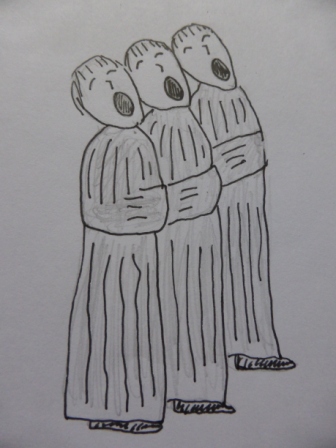
Dychnut may derive from cnut ‘pack of hounds, wolves’ or *dychnudo, an archaism meaning ‘howl’. Cun means ‘pack of dogs’ or ‘lord’. The primary meaning of cor is ‘choir’, but it is also used to refer to groups such as ‘a host of angels’ or ‘a company of bards’. Côr bytheiaid and côr hela  both mean ‘kennel or pack of hounds’. Udyd may be the plural of ud ‘lord’ or relate to udaw ‘howl’.

In these ambiguous, carefully chosen words, dogs/wolves, choirs, lords and howling are cleverly and intricately linked. These intricate connections are unfortunately not conveyed by the English language.

Within Welsh tradition numerous divine ‘lords’ are associated with hounds: Cunomaglus ‘Hound Lord’; Cunobelinus ‘Hound of Belinus’; Nudd who Taliesin refers to as ‘the superior wolf lord’ and his son, Gwyn ap Nudd, who owns a hound called Dormach ‘Death’s Door’ and hunts with the Cwn Annwn. Another is Arawn who, like Gwyn, is a ruler of Annwn and associated with white, red-eared Annuvian hounds. It seems possible Taliesin is comparing the howling monks with their howling hounds.

Cyfranc means ‘clash, contention’ or ‘tale, story’. This brings to mind Taliesin’s clash with the bards of Maelgwn in The Story of Taliesin. Taliesin enters this contest to rescue his master, Elphin, son of Gwyddno Garanhir, from Maelgwn’s imprisonment.

Gwidanhor ‘one who knows’ (from gwybod ‘know’) shares a likeness with Gwyddno Garanhir ‘knowing one’. In The Conversation of Gwyn ap Nudd and Gwyddno Garanhir, Gwyddno converses with Gwyn and meets his hound, Dormach. Gwyn reminds Gwyddno that Dormach ‘was with Maelgwn’. These complex mythic intersections would have been in a medieval Welsh audience’s mind.

Taliesin claims the lords/masters  know, ‘Whether the wind (follows) a single path, whether the sea is all one water, / whether fire – an unstoppable force is all one spark’. In The Story of Taliesin, Taliesin wins the contest with a series of poems including an extended riddle about the wind. He is claiming knowledge of the elements Maelgwn’s bards do not possess.

Taliesin counts himself amongst the ‘knowing ones’ initiated into the mysteries of the universe alongside lords/masters such as Gwyddno and Gwyn. The howling of the monks parodies their otherworldly company.

The next verse continues in a similar vein:

‘Monks congregate like wolves
because of the clash between masters who know.
They (the monks) don’t know how the darkness and light divide,
(nor) the wind’s course, its onrush,
what place it devastates, what land it strikes,
how many saints are in the void, and how many altars.’

The reference to the monks’ lack of knowledge of where darkness and light divide echoes preceding verses where Taliesin mocks them for not knowing the divisions of time nor when Pen Annwn ‘Head of Annwn’ was conceived or born. These questions are intrinsically linked as Pen Annwn is associated with the transitions between night and day, the seasons and the mysteries of death and rebirth.

The line referring to saints and altars being ‘in the void’ is intriguing. This may relate back to the transitional period between paganism and Christianity when the links between Annwn and the dead were severed and Annwn was re-construed as a hellish (hot, cold or empty) place.

In the final lines Taliesin says, ‘I praise the Lord, the great Ruler: / may I not endure sadness: Christ will reward me.’ The ending is undeniably Christian yet in Pendefic mawr, ‘great Ruler’ we find traces of a most un-Christian lord: Pen Annwn.

 So the end of the poem has been reached. Arthur and his men have raided Annwn and slammed its gate shut. As Taliesin returns to his chair in Caer Siddi we’re left contemplating a trail of destruction amongst the howling monks whose choir echoes the howling of the hounds of the Lord(s) of Annwn.

 ***

The monks howl.
We howl with them.
There is no turning back
to when Annwn was unspoilt
before the flashing sword
the stolen cauldron
and trail of death.

No turning back
only howling onwards
into the next chapter
the next myth…

P1170785 - Copy

*The translations of Preiddu Annwn ‘The Spoils of Annwn’ I have used are Marged Haycock’s from Legendary Poems of Taliesin and Sarah Higley’s HERE. With thanks to Heron for notes on cor from The University of Wales Dictionary.

Caer Vandwy and the Theft of the Brindled Ox

A plain of blood where men once stood.
The lights have gone out in Caer Vandwy.
The clashing sea rolls over shield and spear.
The living dead. The dead dead again.

***

The sixth fortress in ‘The Spoils of Annwn’ is Caer Vandwy. This has been translated as ‘Fortress of God’s Peak’ and ‘Fort of the High God’. Marged Haycock uses ‘Mand(d)wy Fort’ but does not explain her re-rendering. It could relate to Manawydan (‘Manawyd’ in ‘Arthur and the Porter’). The connection of a sea-god with an island location seems credible.

In the verse relating to Caer Vandwy, Taliesin again berates ‘pathetic men’ (monks) for their lack of insight into certain mysteries he is knowledgeable about:

‘I don’t deserve to be stuck with pathetic men trailing their shields,
who don’t know who’s created on what day,
when at mid-day God was born,
(nor) who made the one who didn’t go to the Meadows of Defwy.’

The second line suggests the existence of a Bardic riddle enumerating mythic and/or historic figures born on certain days. In line three, Haycock reconstitutes Dwy ‘God’ from Cwy. Caitlin and John Matthews prefer Cyw ‘chick’ whereas Sarah Higley sticks with Cwy as a personal name.

Haycock’s choice fits with the translations of Caer Vandwy as a fortress belonging to (a) God. This may not be the Christian God. In the next verse Taliesin refers to the ‘pathetic men’ as ‘(those) who don’t know on what day the Lord is created’. Lord is translated from Pen ‘Head’. Perhaps this god is Pen Annwn ‘The Head of Annwn’.

Next we come across an unnamed person ‘who didn’t go to the Meadows of Defwy’. Haycock suggests Defwy is a river-name meaning ‘black’ (from def-/dyf) and poses the question ‘Was this imagined as a river between this world and the next?’

The Matthews link the Meadows of Defwy to Gweir ap Gweirioed ‘Hay son of Grassiness’ (the divine prisoner in verse one) and say ‘we may be looking at Doleu Defwy as an otherworldly meadow’.

This brings to mind the Gwerddonau Llion (translated as ‘green meadows of the sea’ and ‘green islands of the floods’). In a triad* referring to ‘three losses by disappearance of the Isle of Britain’ Gavran is said to have gone to sea in search of the Gwerddonau Llion.

Philip Runngaldier connects the Gwerddonau Llion with the sunken land of Cantre’r Gwaelod ‘The Bottom Hundred’ and says they are inhabited by ‘Gwyllion’: ‘the shades of (Llyn) Llion’ ‘the dead’. Perhaps the one who didn’t go to these mysterious meadows escaped death.

***

Taliesin continues to deride the monks:

‘those who know nothing of the Brindled Ox, with his stout collar,
(and) seven score links in its chain.’

Grazing on the Meadows of Defwy we come across an animal of great fame: Ych Brych ‘The Brindled Ox’. He appears in The Triads as one of ‘Three Principal Oxen of the Island of Britain’:

‘Yellow Spring (‘The One of the yellow of spring’)
and Chestnut, of Gwylwylyd (or ‘a meek and gentle ox),
and the Brindled Ox.’

His capture is amongst the ‘impossible tasks’ Arthur and his men must fulfil on Culhwch’s behalf in Culhwch and Olwen. For food to be grown for Culhwch and Olwen’s wedding feast, a field must be ploughed by the divine ploughman, Amaethon.

The plough must be pulled by a team of six oxen: ‘the two oxen of Gwylwlydd Winau, yoked together’, ‘Melyn Gwanwyn and the Ych Brych yoked together’ and ‘two horned oxen… Nyniaw and Peibiaw.’

Two oxen from the triad: Yellow Spring and the Brindled Ox are placed together and Gwylwylyd appears as the owner of two oxen, presumably Chestnut and an unnamed ox. Intriguingly Nyniaw and Peibiaw are the sons of the king of Archenfield ‘whom God transformed into oxen for their sins.’

John Rhŷs records a folkloric story where Nyniaw and Peibiaw are brother kings. One moonlit night, Nyniaw boasts his field is ‘the whole firmament’. Peibiaw says his sheep and cattle are grazing in his fields: ‘the great host of stars, each of golden brightness, with the moon to shepherd them.’ Nyniaw is furious and a terrible battle ensues which leads to their transformation into oxen by God.

This may be a Christianised explanation of their shapeshifting capacities. In The Tain, the two bulls Finnbennach and Donn Cuailnge are ‘pig-keepers’ ‘practiced in the pagan arts’ who can ‘form themselves into any shape’. Tricked into falling out, they battle against each other as birds of prey, whale and seabeast, stags, warriors, phantoms, and as dragons before becoming maggots, being swallowed by cows and reborn as bulls. It seems likely the Brindled Ox was originally a shapeshifter with the capacity to take human and other forms.

***

In the last lines of the verse Taliesin says:

‘And when we went with Arthur, sad journey,
save seven none came back from Caer Vandwy*’.

The final line is repeated as a refrain at the end of each verse. Of three full loads of Prydwen who went to Annwn, only seven survivors return. Some catastrophe has taken place. Lines spoken by Gwyn ap Nudd in The Conversation of Gwyn ap Nudd and Gwyddno Garanhir suggest this was a battle at Caer Vandwy:

‘to my sorrow
I saw battle at Caer Vandwy**.

At Caer Vandwy I saw a host
Shields shattered, spears broken,
Violence inflicted by the honoured and fair.’

It is my growing intuition the names of individual fortresses are in fact different names for the same fort. In the previous verse Taliesin said six thousand men and an incommunicative watchman were standing on Caer Wydyr’s glass walls. Gwyn is referring to the catastrophic battle against the people of Annwn by which Arthur and his men broke into the fort. After breaking in, they took Gweir, stole the Head of Annwn’s cauldron, and captured the Brindled Ox before slamming ‘Hell’s gate’ shut.

A couple of months ago Brian Taylor drew my attention to a passage in James Hillman’s The Dream and the Underworld which illustrates the parallels between Arthur’s raid on the Head of Annwn’s fortress and Hercules’ assault on the House of Hades: ‘drawing his sword, wounding Hades in the shoulder, slaughtering cattle, wrestling the herdsman, choking and chaining Cerberos… the Herculean ego does not know how to behave in the underworld’.

As I continue my own journey through ‘The Spoils of Annwn’ where others see a quest for inspiration, I see violence, desecration, the utmost disrespect for the people of Annwn: a trail of atrocities committed by a power-hungry warlord and ambitious bard.

Far from being a model for seekers of Annwn’s mysteries it advocates the selfish pursuit of objects of desire through deceit and brute force. Our stories of journeys to the underworld are reflected in the upperworld and we have still not outgrown this Arthurian/Herculean mindset.

New ways of approaching Annwn based on respectful relationships with its people are required. Perhaps in time these will yield the stories needed to replace Arthur’s hegemony. But first repairs must be made…

*This is referred to in The Cambro Briton but I can’t find a source. It isn’t in The Triads of the Islands of Britain.
**Rather than using Haycock’s unexplained re-rendering of Gaer Vandwy I have stuck with the name in the Welsh text.
***Heron translates kaer wantvy as Caer Fanddwy. I’ve stuck to Caer Vandwy for consistency.

SOURCES

Caitlin and John Matthews, King Arthur’s Raid on the Underworld, (Gothic Image, 2008)
Heron (transl), ‘Gwyn ap Nudd and Gwyddno Garanhir’
James Hillman, The Dream and the Underworld, (CN, 1979)
Marged Haycock (transl.), Legendary Poems from the Book of Taliesin, (CMCS, 2007)
Philip Runggaldier, Llyn Llion Theory, (Matador, 2016)
Rachel Bromwich (ed), The Triads of the Island of Britain, (University of Wales Press, 2014)
Sarah Higley (transl.), ‘Preiddu Annwn’, (Camelot, 2007)
Sioned Davies (transl.), The Mabinogion, (Oxford University Press, 2007)
Thomas Kinsella (transl), The Tain, (OUP, 1979)
Wirt Sikes, British Goblins, (Lightning Source, 1880)