The Frozen Men of Caer Rigor

‘I’m splendid of fame: songs are heard
in the four quarters of the fort, island of the strong door.
Fresh water and jet are mixed together;
sparkling wine is their drink, set in front of their battalion.
Three full loads of Prydwen we went by sea:
save seven, none came back from Caer Rigor.’
~ The Spoils of Annwn

It’s the middle of summer. We set sail for Caer Rigor beyond the ninth wave and further on to where all waves freeze beneath the turning of the frosty gulls. 

There is no fortress in Thisworld or the Otherworld colder than Caer Rigor. It wears its icicles like the Winter King’s crown upside down when he was cast down. There are frozen birds upon the turrets with songs frozen on their tongues.

The gate of the fortress is frosted shut like the cold lips of the gatekeeper.

Down from a tower swoops a messenger on wide white wings like an albatross. He pours water over jet mixing them together. Whoosh! A rush of flames, like from a flamethrower, burning in a multitude of colours, like a flambeau.

Ice drips from the gate and hinges open like the gatekeeper’s jaw. The giant stares and unclenches his fist but halts not our passage as we enter the frozen corridors of Caer Rigor and are taken to stand before the Strong Door.

“The door to this hall has not been opened for 1500 years,” the messenger speaks solemnly, “the men inside have known not death, nor decay, nor old age.”

He holds the jet-flame to the door and the icy seal around it melts. Inside is a battalion of frozen men, not the seven survivors, no, these are dead men. Young, pitifully young hopefuls who accompanied Arthur on his fateful voyage.

There is wine, sparkling wine, in their cups, they wear the faces of happy drunks. Yet, as the door opens, as the ice begins to thaw, they set down their glasses and the pain of memory appears in their eyes with the onset of sobriety as fire and ice, jet and water mix, fiercely coloured and hallucinatory.

“Where are we?” “Thisworld or the Otherworld?” “Are we alive or are we dead?” “Are we burning or are we freezing?” “Is this reward or punishment?”

“All I remember is the flash of Llenlleog’s sword as it was thrust into the cauldron.”

“Blinding!” “The explosion.” “It blinded us.” “Yet we can see.” 

“I remember the cauldron, tiny, in Lleog’s hand.” 

“Nonsense – that was just an illusion – the cauldron cannot be stolen.”

“Arthur cut off His head! The head of the Head of Annwn.” 

“And it sung to us for nights in this feasting hall.” 

“The Head of Annwn sung of cutting off Arthur’s head and how it was deaf and dumb.”

“What will become of us now?” “How can we return to the cauldron if it is gone?”

“I told you it was all an illusion,” speaks the youngest of the men. 

“You’re no longer trapped in that old myth,” the messenger tells them. 

“That old myth is done,” I am inspired to speak up, “we come as new monastic devotees of the Head of Annwn to set you free from Arthur’s rule. When this castle has thawed to the cauldron you will return to be reborn.”

They raise their cups and embrace – fire and ice, jet and water mix fierce and hallucinatory as from the turrets the birds fly free and burst into song.

~

This piece is based on my experiences during our Monastery of Annwn Brythonic texts meditation group last night. Caer Rigor has been translated as ‘the Petrification Fort’ from the Latin rigor from ‘stiffness’ and also contains connotations of ‘cold’ from frigor. The citation above is from Marged Haycock but replaces her translation of ynys pybrydor as ‘stout defence of the island’ with the more popular translation ‘island of the strong door’. This allows it to be related to the Second Branch of The Mabinogion wherein the seven survivors of the battle between the Britons and the Irish feast and drink blissfully on the Island of Gwales with the head of Bran the Blessed until one of the men, Heilyn, opens the door, and all their losses and ills return.

A Dragon Calming Song

Riots across the North fed by misinformation in the aftermath of the tragic massacre of three little girls. The fiery energy of the Red Dragon perverted into nationalist attacks on asylum seekers and Muslims. The White Dragon, who always carries the label of ‘other’, fighting back.

I sing a song that was sung to calm the red and white dragons during the battles between the Britons and Romans, the Britons and Saxons, by the warrior-women, the prophets, who became known as Witches of Annwn.*

A song, in the Dog Days of Summer, that invokes the aid of our Husband and Winter King, Gwyn ap Nudd, against the fiery energies of His rival Gwythyr ap Greidol, Summer King, ally of Arthur, the first to sow the seeds of British nationalism by uniting the nation under ‘One King, One God, One Law.’

A song that transforms the dragons into monstrous animals, little pigs, two babes in a woman’s arms.

A song that coaxes them back to sleep in deep Annwn.

Sleep babes sleep
daddy’s gone a hunting
he’ll bring us snowy white hares
and ptarmigan; in his wolf furs
we’re so safe and warm.

Sleep babes sleep
daddy’s gone into the cold again
he’ll bring us a white bushy-tailed
snow fox; in his wolf furs
we’re so safe and warm.

Sleep babes sleep
daddy’s gone into the frost again
he’ll bring us the feathers of a snowy
white owl; in his wolf furs
we’re so safe and warm.

Sleep babes sleep
daddy’s gone into the snow again
he’ll bring us the last reindeer
of the North; in his wolf furs
we’re so safe and warm.

*This song was first published in my book Gatherer of Souls in a story called ‘The Purple-Cloaked Empire’ when it is sung by Wind Singer to calm the red and white dragons during the Roman invasions. It has a basis in the medieval Welsh story of Lludd and Llefelys wherein Lludd / Nudd calms the dragons to sleep. I believe the Witches of Annwn, as devotees of Gwyn ap Nudd and His father, had a supporting role.
**A quick note for clarity – whilst I am speaking about British nationalism being rooted in the Roman and Anglo Saxon invasions and the mythos of Arthur I am not drawing parallels between the Romans and Anglo-Saxons as invaders and the asylum seekers and Muslims who come in peace and are a welcome part of our British communities.

The Fractal Mythos of the Sleeping King

In The Way of the Gods Edward Butler speaks of the ‘fractal quality’ of Egyptian cosmogony. He says: ‘There is one way in particular in which I believe that Egypt can still guide us, namely in the coexistence there of a numerous incommensurable cosmogonies, in a system which lacked any overarching structure integrating them, and which was yet highly stable over vast spans of time… If we can grasp how the Egyptians sustained the belief in many different cosmogonies without reducing them to mere images of some single, superior truth, we can scale up that model to apply to the vast number of incommensurable cosmogonies at the heart of the world’s many sacred traditions traditions, and arrive at a genuine solution to the problem of religious pluralism…. Egyptian cosmogony… has a fractal quality, because everything which comes to be does so in the manner in which the cosmos itself came to be, and continues every day to come to be.’ (1)

A fractal is: ‘an irregular geometric structure that cannot be described by classical geometry because magnification of the structure reveals repeated patterns of similarly irregular, but progressively smaller, dimensions.’ (2) The term was coined by the mathematician Benoit Mandelbrot and comes from the Latin fractus ‘broken or fractured’. (3) Fractals occur in mathematics, physics, architecture, decorative art, and natural phenmomena. Examples include tree branches, lungs, lightning, clouds, crystals, and snowflakes. (4)

*

Butler’s identification of cosmogonies as fractal can be applied more broadly to myth and can help us gain a better understanding of British mythology.

Unfortunately, here in Britain, we don’t have knowledge of any of our ancient creation myths. They are merely hinted at in medieval Welsh literature in which Taliesin, who claims to be have been born or created in various ways, is often represented as a microcosm of the macrocosmic world. In some sources he is (re)born from the womb of Ceridwen, the Goddess of the Cauldron, who takes the form of a crested black hen. (5) In others he is created by five enchanters, Math, Gwydion, Eurwys, Euron and Modron ‘from nine forms of consistency’ (fruit, God’s fruit, primroses, flowers, blossom of trees and shrubs, earth, sod, nettle blossom and ‘the ninth wave’s water’) (6) and by God from ‘seven consistencies’ (fire, earth, water, air, mist, flowers, and ‘the fruitful wind’). (7) This suggests the world was seen as originating from the womb of Ceridwen and as being created by the Gods. These stories, like the Egyptain cosmogonies, are incommensurable. This speak of the fracturing of the crochan, womb or cauldron, of Ceridwen, who I see as Old Mother Universe, with the Big Bang, at the beginning of time. Such a beginning perhaps explains the fractal nature of our myths.

Another myth that might be read as fractal is that of Merlin. Many versions of the stories of Merlin Emrys / Merlin Wyllt are located across Britain and in Brittany. Similarly with the story of King Arthur which has been told and retold since the medieval period with his court at Camelot having numerous locations including Caerleon, Celliwig, and Cadbury Castle. He and his knights are also said to be sleeping in various underground caverns.

*

It is little known that Arthur’s fractal mythos as the Sleeping King is a purloined one. This can be read from the fragments portraying Arthur’s raid on Annwn, his defeat of the Head of Annwn and his theft of His cauldron through which he claims leadership of His hunt and His role as the Sleeping King.

In Culhwch ac Olwen Arthur and his men ‘go North’ (then presumably into Annwn) to rescue Gwythyr ap Greidol and a group of northerners from the fortress of Gwyn ap Nudd, the Head of Annwn. In this fragment Arthur wins by negotiating. (8) In other fragments there is carnage, ‘Shields shattered, spears broken, / violence inflicted by the honoured and fair’. (9) Of the ‘three full loads of Prydwen’ (Arthur’s ship) to go into Annwn ‘save seven’ none return. (10) (Lllen)Lleog thrusts his sword into the cauldron and makes off with it (11) and in another fragment grabs Arthur’s sword, killing the Head of Annwn’s cauldron keeper and his retinue and likely the Head himself. (12)

Interestingly, in ‘The Spoils of Annwn’, Arthur raids seven fortresses which might be fragments of a fractal – the Head of Annwn’s fort. There is no original. All are incommensurable. Intriguingly we find Caer Wydyr ‘the Glass Fort’. Our texts are redolent with the imagery of shattering. Shattered shields, shattered forts. The Head of Annwn Himself is conspicious by His absence whereas Arthur’s presence is lauded and sung through all.

Following his victory over the Head of Annwn and theft of His cauldron Arthur usurps the hunt for Twrch Trwyth ‘the King of Boars’. The twrch was originally a human chief turned into a boar because of his sins by God. This is a Christian overlay obscuring that it was a hunt for human souls – the Wild Hunt. Thus Arthur became known as the Leader of the Hunt. 

Finally, Arthur lays claim to the Head of Annwn’s role as the Sleeping King. The battle between Gwyn and Gwythyr likely has its origins in an ancient British seasonal myth wherein Gwyn, Winter’s King, is killed by Gwythyr, Summer’s King, on Calan Mai. When Gwyn dies he returns to His fortress in Annwn to sleep until His return to the world on Nos Galan Gaeaf later in the year. Arthur’s retreat to beneath the Isle of Avalon is a mirror image of Gwyn’s.

As Christianity rose to popularity the fractal mythos of Arthur replaced the fractal mythos of Gwyn. Their fractals might be seen to be like two crystals, their reflections reflecting one another, composed of fragmentary tales.

*

For the past couple of years Gwyn has been appearing to me with a jewel in His forehead. In a meditation with the Monastery of Annwn on His birth at the end of last year He said: ‘There are as many stories of my birth as facets to my jewel’.

When I first came to polytheism it was with the preconception that the Gods had one true story that could be found by piecing together the fragments into one whole or peeling them away to reveal some singular truth. Now I know better. Myths are, in their essence, fractal. There is no one truth or original.

This has been pushed home as, over the past two years, in our meditation and group at the monastery Gwyn has revealed Himself and His stories to us as monastic devotees in many diverse and sometimes contradictory ways. Yet there have also been many reflectings suggestive of their fractal nature. 

I don’t think it’s a coincidence that Gwyn has revealed Himself to be associated with so many fractal things – trees, clouds, jewels, snowflakes. There is a similar beauty in the incommensurability of His myths and mysteries. Every year I look forward to different stories of our Sleeping King.

*Image of quartz crystal from La Gardette mine, Bourg d’Oisans, Isère, France, courtesy of Wikipedia commons.

(1) Butler, E., The Way of the Gods, (Indica 2022), p100 – 104
(2) https://www.dictionary.com/browse/fractal
(3) https://iternal.us/what-is-a-fractal/
(4) Ibid.
(5) ‘The Story of Taliesin’ in Hughes, K. From the Cauldron Born, (Llewellyn Publications, 2013), p32 and ‘The Hostile Confederacy’ in Haycock, M. (transl), Legendary Poems from the Book of Taliesin, (CMCS, 2007), p313
(6) ‘The Battle of the Trees’, Ibid. p180
(7) ‘The Song of the Great World’, Ibid. p516
(8) Davies, S. (transl.), The Mabinogion, (Oxford University Press, 2007), p207
(9) Hill, G. (transl), ‘The Conversation between Gwyn ap Nudd and Gwyddno Garanhir’, Awen ac Awenydd
(10) ‘The Spoils of Annwn’ Haycock, M. (transl), Legendary Poems from the Book of Taliesin, (CMCS, 2007), p435
(11) Ibid. p146
(12) Davies, S. (transl.), The Mabinogion, (Oxford University Press, 2007), p208

Seeing Face to Face

broken-549087_960_720_Pixabay Free Image

In Corinthians Paul famously contrasts seeing ‘through a glass, darkly’ with seeing ‘face to face’. In Revelations we find a series of glassy images leading up to the servants of God seeing his face. We are told, before the throne of God, is ‘a sea of glass like unto crystal’. This is later described as ‘a sea of glass mingled with fire’ with those who have gained ‘victory over the beast’ standing upon it with ‘the harps of God’. The harpers play the song of Moses who ‘the Lord knew face to face’.

The city of New Jersualem is described as ‘pure gold like unto clear glass’, its street ‘pure gold, as it were transparent glass’ and the river of life, running through it, proceeding from the Throne of God ‘clear as crystal’. We are told the Throne of God is in the city and here, where his servants serve him, ‘they shall see his face’.

These images of glass, no longer dark but crystal clear, are bound up with the process of revelation. Of the revealing of the face of God, which is never described, of which his servants are forbidden to make graven images.

This imagery interests me, as a Brythonic polytheist and devotee of Gwyn ap Nudd, because in a number of texts his castle is described as being made of glass or crystal and surrounded by water. In The Life of St Collen, Gwyn is depicted seated on a golden throne in ‘the fairest castle’ Collen ‘had ever beheld’ on Glastonbury Tor. Gerald of Wales notes Glastonbury ‘used to be called Ynys Gutrin… the Island of Glass, no doubt from the glassy colour of the river which flows around it in the marshland.’

In ‘The Spoils of Annwn’ Arthur sails across the sea in his ship, Prydwen, to raid seven otherworldly forts on otherworldy islands. It is my belief they are appearances of the same fort – the abode of Pen Annwn ‘the Head of the Otherworld’ (an older name for the King of Annwn/Faery – Gwyn).

One of the fortresses is named Caer Wydyr ‘the Glass Fort’. The narrator, Taliesin, mocks ‘pathetic men’ (monks) ‘who hadn’t seen Arthur’s feat beyond the Glass Fort’. He tells us ‘six thousand men were standing on its wall; it was hard to communicate with their watchman’. In Nennius’ History of the Britons thirty ships of Spaniards sailing to Ireland find in the midst of the sea ‘a tower of glass, the summit of which was covered with men, to whom they often spoke, but received no answer.’

The Fairy King’s castle is described as being made of crystal in Sir Orfeo:

‘Amid the land a castle tall
And rich and proud and wondrous high
Uprose, and all the outmost wall
Shone as crystal to the eye.
A hundred towers lit up the sky,
Of diamond all battled stout;
And buttresses rose up near by
Arched with red gold and broad about.’

In the Biblical and Brythonic traditions the paradisal abodes where the gods are enthroned, the centres of the mysteries where their faces are revealed, are associated with glassy waters and crystal walls.

One wonders whether there are any stories of people meeting the gods of Annwn face to face. In Sir Orfeo we are told he could not look upon the Fairy King or Queen ‘their crowns, their garments, glistened bright… so hot they shone’. This ‘noble sight’ brings him to his knees before the throne. Afterwards he takes up his ‘merry harp’ and sings the lay that wins his wife, Heurodis, back from Fairyland.

This reverent response is echoed in the First Branch of The Mabinogion when Rhiannon, a Queen of Annwn, unveils herself to Pwyll. This does not take place within a crystal castle, but near the fairy mound Gorsedd Arberth. We are told she ‘drew back the part of her headdress that should cover her face, and fixed her gaze upon him’. ‘And then he thought that the face of every maiden and every woman he had ever seen was unattractive compared with her face.’ He immediately falls in love with her and agrees to marry her, choosing her above all other women.

When I first met Gwyn, he did not reveal his face to me in his glass fortress, but beneath the shadows of a leaning yew tree on Fairy Lane in Penwortham. My response was similar. I recognised him as my patron deity, a god who I chose above all gods, who I could not help but love and serve.

In Ethics and Infinity the French philosopher Emmanuel Levinas notes that the face to face to encounter draws us into service to the Other. Also ‘the face… signifies: “Do not kill me.”’

In the Welsh myths we find this ordainment repeatedly broken by Arthur and his warriors who commit a panoply of acts of defacing. The heads of the witches of Caer Loyw and Pennant Gofid are split in twain. The beard of Dillus Farfog is plucked out whilst he is still alive before his head is cut off. The giants Diwrnach and Wrnach are beheaded. Most horrifically, before Ysbaddaden Bencawr is beheaded, his face is mutilated – Caw of Prydyn shaves off his beard, ‘flesh and skin to the bone, and both ears completely’.

Because Arthur cannot bear the thought of the head of Brân being beneath White Hill as a threat to his sovereignty over Britain he orders it to be dug up and removed. Interestingly Brân’s head lives after his death for eighty-seven years and only when it starts to decay, when he loses his face, is it buried. It seems that Arthur cannot abide even the distant memory of Brân’s face evoked by his head.

The surrounding stories suggest that either Arthur himself or (Llen)lleog beheaded Pen Annwn with Caledfwlch during his raid on Annwn and this was how he gained his cauldron, the leadership of his hunt, and usurped his role as the warrior-protector of Britain. One might see the beheading of the Head of the Otherworld, ‘Arthur’s feat beyond the glass fort’, as the ultimate crime against the Other and the face of the numinous.

This killing blow, with the thrusting of Lleog’s flashing sword into the cauldron, may be seen to bring about the shattering of the glass fortress, the fragmenting of the mythos of Pen Annwn. We are left only with pieces of the narrative like shards of broken glass, the images within like creatures trapped in amber; seeing through glass darkly as the Dark Age is ushered in.

Yet beyond the glass walls Pen Annwn picks up his head and makes himself whole again.

I see his face and he is laughing.

Those are but Devils

Witches dancing with devils from the History of Wizards and Witches 1720

An essay on the demonisation of Gwyn ap Nudd and the Spirits of Annwfn

Gwyn ap Nudd, ‘White son of Mist’, is a god of the dead and ruler of Annwfn, ‘the Deep’, the Brythonic underworld. In two medieval Welsh texts he and the spirits he rules are identified with devils.

In How Culhwch Won Olwen we are told, ‘Gwyn ap Nudd… God has put the fury of the devils of Annwfn in him, lest the world be destroyed. He will not be spared from there.’

The introduction of God’s agency is clearly a Christian attempt to explain Gwyn’s containment of the spirits of Annwfn. These spirits include the restless dead who have died suddenly or violently:

Some headless stood upon the ground,
Some had no arms, and some were torn
With dreadful wounds, and some lay bound
Fast to the earth in hap forlorn.

And some full-armed on horses sat,
And some were strangled as at meat,
And some were drowned as in a vat,
And some were burned with fiery heat,
Wives lay in child-bed, maidens sweet…

…such the fairies seize and keep.

Others such as the Tylwyth Teg, ‘Fair Family’, or ‘fairies’ and ellyllon, ‘spectres’, ‘goblins’, ‘elves’ occupy a liminal position between life and death, humanity and nature, and mitigate between the worlds. Christians identify these complex and ambiguous spirits with dieuyl, ‘devils’.

Gwyn presents a paradox that does not sit easily with Christianity’s black-and-white theology: because he contains the spirits of Annwfn within him and/or within his realm he is the only being who can hold back their aryal, ‘fury’, and prevent them from destroying this world.

In The Life of St Collen, Collen, the abbot of Glastonbury, overhears two men conversing outside his cell saying Gwyn is ‘king of Annwfn and of the Fairies’. Putting his head out he shouts, ‘Hold your tongues quickly, those are but Devils’.

Collen is invited to feast in Gwyn’s castle on the Tor. There he refuses to eat, saying the food is ‘leaves’ and the red and blue clothing of Gwyn’s host signifies ‘burning’ and ‘coldness’; it is hellish. Collen supposedly banishes them with holy water.

***

Gwyn’s association with devils stems from a longstanding Christian tradition of identifying pagan deities with the Devil and demons and the realm of the dead with Hell. Any god who was not the one God, who demanded no other gods be worshipped before him, was seen as demonic.

In The Bible, Beelzebub, a Semitic deity originally called Baal-zebul, ‘Lord of Princes’, is equated with the Devil along with Satan and Lucifer. The ‘false gods’ of the Canaanites are referred to as ‘demons’ and the se’irim ‘hairy beings’ or satyros (ie. satyrs) as ‘goat-demons’.

The concept of Hell developed much later. In The Old Testament the original Hebrew word is Sheol, ‘the place of the dead’ (it is frequently translated as ‘the grave’). In The New Testament, Hell is translated from Hades, Tartarus and Gehenna. Hades means ‘the unseen place’ and is the name of the Greek underworld and its ruler. Tarturus is ‘the deep place’ beneath Hades. Contrastingly, Gehenna is a thisworldly place, the Valley of Hinnom, where the Kings of Judah sacrificed their children by fire, leading to it being cursed.

Hell derives from the Old English hel or helle stemming from Proto-Germanic *haljo ‘the underworld’ or ‘concealed place’. Hel is also the name of its goddess. Ironically it is a borrowed pagan concept which is not of Biblical origin.

The idea of the land of the dead as a place of punishment by eternal fire was developed in the early days of the Church by scholars such as Second Clement, Justin Martyr and Theophilus of Antioch as a means of controlling the populace. Augustine, bishop of Hippo Regus, was the first Christian leader to teach ‘the doctrine of eternal punishment’ during the 4th century.

Annwfn, ‘the Deep’, shares parallels with the other pagan underworlds and places of the dead. In medieval Welsh mythology there is plenty of evidence that, following their Christianisation between the 4th and 7th centuries, the Britons resisted the view that Annwfn was a place of punishment.

In ‘The First Branch’ of The Mabinogion and even in The Life of St Collen it is a place of beautiful courts and castles, lavishly dressed courtiers, and sumptuous feasts. These paradisal depictions are echoed in later fairylore demonstrating Annwfn became byd Tylwyth Teg, ‘Fairyland’ or ‘Faerie’.

Gwyn’s name means ‘White, Blessed, Holy’ and Gwynfa ‘Paradise’. In Barddas, Iolo Morganwg speaks of Cylch y Gwynvyd, ‘the Circle of White’, ‘the Holy World’ noting gwynvyd denotes ‘bliss or happiness’. Gwynfa and Gwynvyd might originate from a tradition wherein, like Hades and Hel, Gwyn and his realm bore identical names.

When Annwfn became Faerie its associations with the dead were severed and it was reduced to a fantasy realm. However, superstitions remain, many of these pertaining to the uncanny and dangerous nature of the fairies and their associations with abductions, madness, and death.

***

The Conversation of Gwyn ap Nudd and Gwyddno Garanhir’ contains Gwyn’s clearest literary representation as a pre-Christian god of the dead. Gwyddno addresses Gwyn as a ‘bull of battle’: a divine warrior and psychopomp. Other epithets include ‘awesome leader of many’, ‘invincible lord, and ‘lord of hosts’.

Gwyn’s identity as a death-god is revealed when he states he comes from ‘many battles, many deaths’. He asserts his presence at the deaths of Gwenddolau ap Ceidio, Bran ap Ywerydd, Llachau ap Arthur, Meurig ap Careian, and Gwallog ap Lleynog before speaking the lines:

I was there when the warriors of Britain were slain
From the east to the north;
I live on; they are in the grave.

I was there when the warriors of Britain were slain
From the east to the south;
I live on; they are dead.

Here Gwyn laments the downfall of the Brythonic kingdoms to the Anglo-Saxons and his living on as a gatherer of souls. He is a venerable figure. The only thing devilish about him is the bull-horns.

Contrastingly How Culhwch Won Olwen presents Gwyn as a sinister being and pits him against Arthur: a champion of Christianity who rose to popularity by slaughtering and subordinating a variety of Annuvian deities, ancestral animals, giants, and witches.

It is my belief that Arthur’s overcoming of Gwyn was a primary step in the destruction of Brythonic Paganism and the assertion of Christianity. Gwyn’s mythos had to be erased and reconfigured in a new literature documenting his defeat and replacement by Arthur as a protector of Britain who fights against the ‘devils’ of Annwfn rather than containing their fury.

In How Culhwch Won Olwen Arthur intercedes in the ancient seasonal struggle between Gwyn, ‘Winter’, and Gwythyr, ‘Summer’, for their beloved, Creiddylad, a fertility goddess. Gwyn takes Creiddylad from Gwythyr by force, presumably abducting her to Annwfn, explaining the coming of winter on Calan Gaeaf.

Gwythyr raises an army and attacks Gwyn. It might be assumed they also descend to Annwfn. Gwyn defeats them singlehandedly and imprisons Gwythyr and seven of his men. The imprisonment of Summer in Annwfn may also be part of a mythos explaining the rule of Winter.

During their imprisonment Gwyn kills Nwython and feeds his heart to his son, Cyledyr, who goes mad. Whether this scene should be read as a punishment for invading Annwfn demonstrating Gwyn’s furious nature, a muddled echo of a rite transferring ancestral strength from father to son, or Christian propaganda demonising Gwyn remains uncertain.

Whatever the case, Arthur comes to the rescue, presumably storming Gwyn’s prison in Annwfn. He defeats Gwyn, then binds Gwyn and Gwythyr in battle for Creiddylad every Calan Mai until Judgement Day. Arthur’s agency is introduced to explain an existing duel on Calan Mai where Winter is defeated and Creiddylad returns to this world, explaining the rule of Summer. The purpose is to display Arthur’s control over these two old seasonal gods and Creiddylad who he locks in her father’s house saying neither can take her until Judgement Day!

The scene where Gwyn and Gwythyr appear together as advisors to Arthur on his assault on Orddu, ‘the Very Black Witch’, who lives in Pennant Gofid, ‘The Valley of Grief’ in ‘the uplands of Hell’ is again designed to demonstrate his power over them and this Annuvian woman, who he slices in half with his knife, Carwennan, before draining her blood.

It is notable that Gwythyr’s father, Greidol, ‘Scorcher’, is one of Arthur’s forty-two counsellors and Gwythyr’s daughter, Gwenhwyfar, is married to Arthur. This is suggestive of a long-standing alliance between Arthur and the powers of summer against winter and death.

The rescued prisoners join Arthur on his hunt for Twrch Trwyth, ‘King of Boars’. That Gwyn must be found before the hunt can start suggests Gwyn was its original leader. Gwyn’s identity as a hunter god is suggested by his ownership of a white stallion, Carngrwn, ‘Round-Hoofed’, and white red-nosed hound, Dormach, ‘Death’s Door’. In Welsh folklore Gwyn and the Cwn Annwfn, ‘Hounds of the Otherworld’, hunt the souls of the dead. He is the Brythonic leader of the Wild Hunt.

Twrch Trwyth’s transformation from a human king into a boar hints at the tradition of a soul hunt. Arthur’s usurpation of Gwyn’s hunt and its depiction as just a boar hunt marks the end of the mythos featuring Gwyn as a god of the dead and leader of the Wild Hunt.

Many of Arthur’s famous landmarks, including Carn Cafall, where the footprint of Arthur’s gigantic dog was left during the hunt for Twrch Trwyth, may formerly have been associated with Gwyn and Dormach.

The Spoils of Annwfn’ shares similarities with Arthur’s attack on Gwyn suggesting they are two different variants of the same story. Taliesin, the narrator, accompanies Arthur on his journey to seven otherworldly fortresses (which I believe may be faces of the same fort) where he takes on Pen Annwfn, ‘the Head of Annwfn’.

Storming the glass walls and defeating six thousand unspeaking dead men in a devastating battle, Arthur and his raiding party rescue Gweir (who may be equated with Graid, one of Gwyn’s prisoners), steal the legendary Brindled Ox, and seize ‘the Cauldron of the Head of Annwfn’. Escaping with only seven survivors Arthur slams ‘Hell’s Gate’ shut.

Arthur’s defeat of the Head of Annwfn and seizure of his cauldron represent the triumph of Christianity over Paganism, the realm of death, the dead and their ruler, and the mysteries of death and rebirth.

It is no coincidence that Arthur’s raid on Annwfn shares parallels with Jesus’ ‘Harrowing of Hell’ (harrow comes from the Old English hergian ‘to harry or despoil’). Between his crucifixion and resurrection, Jesus descended to Hell to preach to ‘the imprisoned spirits’ and liberate the righteous who had been trapped there since the beginning of the world (the damned were left to stay!) triumphing over the realm of the dead and death itself.

It is my intuition that prior to Christianity and Arthur’s rise to popularity the series of fortresses might have formed part of a Brythonic tradition documenting the descent of the soul to Annwfn. They would have been approached respectfully with due ritual rather than assaulted and despoiled, their guardians killed, their treasures stolen.

***

The demonisation of Annwfn is shown by lines from several poems in The Book of Taliesin equating it with Hell (translated from Uffern which originates from the Latin Inferno ‘underworld’).

And in front of the door of Hell’s gate lamps were burned

What is the measure of Hell?
How thick its veil,
how wide its mouth,
how big are its baths?

Madawg…
Was taken by fierce Erof…
Among the hideous fiends
Even to the bottom of Hell.

Gwyn’s loss of status as a god of the dead led to him being demonised as a demon huntsman who hunted the souls of sinners. His role became punitive as he was subsumed within Christianity’s doctrine of fear and control as a devilish figure.

Charles Squire writes, ‘Gwyn… his game is man… the “mighty hunter”, not of deer, but of men’s souls, riding his demon horse, and cheering on his demon hound to the fearful chase’.

John Rhys notes, ‘What Gwyn hunts are the souls of those who are dying; but Christianity has greatly narrowed his hunting ground, as his quarry can now only be souls of notoriously wicked men.’

Folkloric stories featuring horned figures and/or the devil, Tywsog Annwfn, ‘Prince of Annwfn’, might originally have featured Gwyn, a ‘bull of battle’ who wears bull-horns. The following example is recorded by John Rhys:

‘Ages ago as a man who had been engaged on business, not the most creditable in the world, was returning in the depth of night across Cefn Creini, and thinking in a downcast frame of mind over what he had been doing, he heard in the distance a low and fear-inspiring bark; then another bark, and another, and then half a dozen more. Ere long he became aware that he was being pursued by dogs, and that they were the Cwn Annwfn. He beheld them coming: he tried to flee, but he felt quite powerless and could not escape. Nearer and nearer they came, and he saw the shepherd with them: his face was black and he had horns on his head.’

John Rhys argues this black-faced, horned ‘shepherd’ is Gwyn. This representation is clearly influenced by Biblical tradition, perhaps by the following passage containing Cyril of Alexandria’s interpretation of John 10: 12-13:

‘the father of sin used to put us in Hades like sheep, delivering us over to death as our shepherd, according to what is said in the Psalms: but the really Good Shepherd died for our sakes, that He might take us out of the dark pit of death and prepare to enfold us among the companies of heaven, and give unto us mansions above, even with the Father, instead of dens situated in the depths of the abyss or the recesses of the sea.’

Again we return to Jesus’ ‘Harrowing of Hell’ and his triumph over the realm of the dead. This story forms a large part of the hubristic anthropocentric worldview where ‘Man’ (Jesus/Arthur) conquers all, including death and its deities, which has led to the Anthropocene.

***

For many centuries Christianity has cut us off from the magical underworld beneath our feet and from its deities who we have been taught to fear as devils. As the hegemony of Christianity and its bed-partner, Empire, fail, leaving a void filled by consumerism, materialism, right-wing populism, and regressive nationalisms the need arises to reconnect with the gods of the deep.

Within Brythonic culture there is a tradition of spirit-work referred to by Gerald of Wales. He speaks of awenyddion, ‘people inspired’, ‘the soothsayers of this nation’ who are possessed by and speak with the aid of spirits and receive inspiration from dreams.

Following their example we can rebuild our relationship with the spirits of Annwfn. This isn’t an easy path to take as they have long been demonised, shut out, ignored. The restless dead are growing in number as more people die in war and fall victim to the exploitation of capitalism. They can indeed be furious. As can the fairies who mitigate between the worlds and have witnessed our untrammelled destruction of nature and ignorance of Annwfn.

Yet we have a responsibility to them, to the ‘others’, that deserves a response. Their fury demands the destruction of the exploitative systems of this world and the replacement of the shallow facade of consumer culture with a mythos rich and deep in meaning based in respectful relationship with all beings, human and non-human, living and dead.

Within Brythonic tradition Awen, ‘divine inspiration’, the source of mythic meaning, flows from Annwfn.

The Awen I sing,
From the deep I bring it,
A river while it flows,
I know its extent;
I know when it disappears;
I know when it fills;
I know when it overflows;
I know when it shrinks;
I know what base
There is beneath the sea.

Our existing mythology and folklore shows there are ways into Annwfn/Faerie that are not only traversed by the likes of Arthur but by children, drunkards, poets, fiddlers, and dancers. Admittedly the risk is madness or death, but those who pass the initiatory challenges of the Fairy Kings and Queens emerge with the Awen to guide the way into a better world.

Capitalism thrives on its domination of meaning. With Awen from Annwfn we create our own.

/I\

Gwyn ap Nudd
guide of souls
light of the mist
show us Annwfn’s
disturbing beauty:
shining butterflies
worm-faced death.

Let your dragons
grant us Awen from
unquenchable wells.
Let us be possessed
and ride the fury
of your spirits
into the next world.

***

SOURCES

Charles Squire, Celtic Myths and Legends, (Lomond Books, 1905)
Dennis Bratcher, ‘Demons in the Old Testament: Issues in Translation
Edward Eyre Hunt, (transl), Sir Orfeo, (Forgotten Books, 2012)
Gerald of Wales, Description of Wales, Awen ac Awenydd
John Rhys, Celtic Folklore Welsh and Manx, Volume 1, (Forgotten Books, 2015),
John Rhys, Studies in the Arthurian Legend, (Elibron Classics, 2005)
Greg Hill (transl) ‘Gwyn ap Nudd and Gwyddno Garanhir’, The Way of the Awenydd
Iolo Morganwg, Barddas, (Weiser, 2004)
Lady Charlotte Guest (transl), ‘Gwyn and St Collen’, Mary Jones Celtic Literature Collective
Marged Haycock, (transl), ‘The Spoils of Annwfn’, Legendary Poems from the Book of Taliesin, (CMCS Publications, 2015)
Saint Cyril, Saint Cyril Collection, (Aeterna Press, 2016),
Sioned Davies, (transl), The Mabinogion, (Oxford University Press, 2007)
William F. Skene, Four Ancient Books of Wales, (Forgotten Books, 2007)

*This essay was first published in A Beautiful Resistance 4.

Henwen – The Birthing and Devouring Sow

gloucester-old-spot-sow-public-domain

I. Henwen – ‘Old White’

In Triad 26. we find the story of a sow called Henwen ‘Old White’. She belongs to Dallwyr Dalben and is kept in Glyn Dallwyr in Cornwall in the care of Coll, son of Collfrewy, one of three ‘Three Powerful Swineherds.’ She becomes pregnant and it is ‘prophesied that the Island of Britain would be the worse for the womb-burden.’ Therefore Arthur and his warriors set out to destroy her.

When Henwen is ready to farrow she goes into the sea at Penrhyn Awstin and is followed by Coll (and, presumably, Arthur and his men). Landing in Wales she begins to give birth to offspring. Surprisingly, they are not piglets! In Gwent she brings forth a grain of wheat and a bee, giving the name to Wheat Field, and in Pembroke barley, ‘therefore, the barley of Llonion is proverbial.’ In these two instances, in South Wales, Henwen’s births are benign and generative, creating crops and pollinators.

When Henwen reaches North Wales, however, she gives birth to wild creatures. At the Hill of Cyferthwch in Arfon she brings forth a wolf-cub and a young eagle. The wolf is given to Bergaed and the eagle to Breat, princes of the North, and they are both ‘the worse for them.’ We find a contrast between the fertile plains of South Wales and the wilder, more rugged regions of North Wales.

‘At Llanfair in Arfon under the Black Rock’ she gives birth to a kitten who is thrown by Coll into the sea. The sons of Palug foster it in Môn (Anglesey) ‘to their own harm’ and it becomes known as Palug’s Cat. In ‘Arthur and the Porter’ we are told that it was eventually ‘pierced’ by Arthur and his men. However, before they managed to kill it, nine score chieftains fell at dawn and it devoured them. Palug’s Cat was one of Three Great Oppressions of Môn along with Daronwy, and Edwin, King of Lloegr.

II. A Sow’s Feast

It believe that Henwen also makes an appearance in ‘The Fourth Branch’ of The Mabinogion. In this story Gwydion is searching for his nephew, Lleu. Gwydion stays at the house of a peasant in Manor Bennard. He learns his learns his host owns a sow who returns every night to feed her piglets. However, nobody knows where she goes during the day ‘any more than if she sank into the earth’. These lines recall Triad 26. where Henwen sinks into the sea, suggesting her otherworldly nature.

Gwydion follows the trail of the sow to a mighty oak which stands between two lakes and is neither wetted by water nor melted by fire. At its roots the sow is feasting hungrily on rotten flesh and maggots. When Gwydion looks up he sees they are falling from Lleu, who is perching in eagle-form in the top-most boughs, pierced by the spear of his rival, Gronw, the gore dripping from his rancid wound.

In the context of this story it seems significant that Gwydion is led to Lleu by this mysterious sow. Earlier Gwydion stole the seven piglets who were given to Pryderi, son of Pwyll Pen Annwn, by Arawn, King of Annwn (along with Coll and Drystan, Pryderi was one of the ‘Three Powerful Swineherds’).

These piglets were special, ‘some kind of creature that has never been in this island before has arrived in the South’. Gwydion’s theft led to a chase from South to North Wales and several devastating battles between his men and Pryderi’s. Pryderi was finally killed by Gwydion in single combat.

It is my intuition Henwen was the Annuvian mother of the seven piglets. Her devouring of Gwydion’s nephew may represent her taking back from him in exchange for what was stolen from her. The chase South to North and trail of devastation are thematically linked with Henwen’s story.

Another point of note is that Daronwy, ‘The Oak of Goronwy’, is referred to as ‘the radiance of the men of Goronwy’ and therefore associated with Lleu’s rival, Gronw Pebr (pebyr mean ‘radiant’). It could be the oak where Lleu perched after being wounded by Gronw’s spear – a scene based on an older initiatory myth. With Henwen’s clawing child, Palug’s Cat, it is included in the Oppressions of Mon. Thus it makes sense to find Henwen devouring the dying Lleu back into Annwn at its roots.

III. Hwcha Ddu Gwta – ‘Black Short-Tailed Sow’

In Welsh folklore we find a mysterious verse about Hwch Ddu Gwta ‘Black Short-Tailed Sow’:

Black short-tailed sow
On every stile
Spinning and weaving
On Calan Gaeaf night

Get home quick, be the first
The Hwch Ddu Gwta gets the last.

She is said to emerge from the ashes of bonfires on Nos Galan Gaeaf and wait at stiles to prey on people walking home late. It is bad luck to be the last to get home as Hwch Ddu Gwta will eat you.

It seems possible the white Henwen, the birthing mother who provided the harvest, is also the black devourer.

There is a similar legend in southern Sweden. Gloso is a ‘glowing sow’ who appears ‘over the twelve days of Christmas’ with ‘eyes of fire, sparks spring from her bristle, and she travels like a burning flame.’ This recalls Hwch Ddu Gwta’s birth from the embers on Nos Galan Gaeaf.

She is also connected with the harvest. Three blades of wheat are left for her in the field. ‘These are for Gloso: one for Christmas night, one for the night of the new year, one for king’s night.’ This makes me wonder whether similar rituals existed to appease the harvest sow in her darker winter apparel.

IV. Ceridwen – The Old Mother

Greg Hill suggests Hwch Ddu Gwta might be connected with the Ladi Wen ‘White Lady’ who also walks abroad on Nos Galan Gaeaf, and with Ceridwen, the goddess of the cauldron. Robert Graves, in The White Goddess, also identified the sow with Ceridwen, ‘the White Lady of Death and Inspiration.’

It is my personal belief that Ceridwen is the Old Mother of the Universe, the Great Goddess from whose crochan, ‘womb’ or ‘cauldron’, all life is born and to whom it returns at death. This would certainly fit with the Henwen ‘Old White’ as the mother who births harvests and monsters and swallows the dead.

SOURCES

Charles Lecouteux, Phantom Armies of the Night: The Wild Hunt and the Ghostly Processions of the Dead, (Inner Traditions, 2011)
Greg Hill, ‘Traditional Customs for the Calend of Winter’, Dun Brython
Rachel Bromwich (ed), The Triads of the Island of Britain, (University of Wales Press, 2014)
Robert Graves, The White Goddess: A Historical Grammar of Poetic Myth (Faber & Faber, 1999)
Sioned Davies (transl.), The Mabinogion, (Oxford University Press, 2007)
William Skene (transl.), ‘Arthur and the Porter’, Mary Jones Celtic Literature Collective

Gwyn’s Feast

Gwyn ap Nudd is a god of the dead and ruler of Annwn. As the Brythonic leader of ‘the Wild Hunt’ he gathers the souls of the deceased back to his realm to be united in an otherworldly feast. This repast of the dead can, at certain times of the year, be participated in by the living.

Unfortunately this is a tradition that Christians went to great lengths to bring to an end. This article will introduce the evidence for Gwyn’s Feast, how it was abolished, and how it can be reclaimed by modern polytheists.

*

In ‘The Spoils of Annwn’, as Pen Annwn, ‘Head of the Underworld’, Gwyn presides over a feast in Caer Vedwit, ‘The Mead-Feast Fort’. At its centre is the cauldron of Pen Annwn, with its ‘dark trim, and pearls’, which ‘does not boil a coward’s food’: a vessel symbolic of rebirth.

Cauldron

Arthur raids seven Annuvian fortresses, confronting six thousand speechless dead men, inflicting violence on ‘the honoured and fair’ and stealing the Brindled Ox, kidnapping a bard called Gweir, and stealing the cauldron of Pen Annwn before slamming ‘Hell’s Gate’ shut.

I believe Arthur’s raid on Annwn replaced an earlier tradition of the soul’s return to the underworld and journey through seven fortresses (which are faces of the same fort) to Gwyn’s Feast and the Cauldron of Rebirth. Arthur’s defeat of Gwyn and his people and theft of his cauldron represent the triumph of Christianity over the pagan mysteries of death and rebirth.

This story is paralleled in Culhwch and Olwen, where Arthur raids Gwyn’s fortress to rescue Gwyn’s rival, Gwythyr, and his army (who include Graid who might be equated with Gweir), and steals a number of otherworldly treasures including the Brindled Ox and a magical cauldron.

Arthur also usurps Gwyn’s hunt for Twrch Trwyth, ‘King of Boars’, ‘a king and for his sins God changed him into a swine’. This thinly disguises that Arthur takes leadership of Gwyn’s hunt for a human soul in boar-form – ‘the Wild Hunt’ – reducing it to just a boar hunt and again obscuring pagan traditions.

*

Glastonbury Tor Calan Mai 2013

Gwyn is intimately associated with Glastonbury Tor. Excavations have revealed the existence of a building with several hearths dating to the 5th – 7th century. Two north-south aligned graves (not Christian) nearby along with an empty stone cairn and helmeted bronze head with ‘a narrow face’ and ‘slit mouth’ in the ‘long’ Celtic style suggest it may have been a pagan temple.

Bones of cattle, sheep, and pigs, from joints of meat, and Mediterranean amphorae (large jugs for holding wine) suggest feasting took place at this temple on the Tor; a liminal place where Thisworld and Annwn and the living and the dead meet in revels presided over by Gwyn.

Several pernicious accounts in saints’ lives record Christian attempts to abolish this tradition. In The Charter of St Patrick, Patrick and his brother Wellias climb the Tor and find ‘an ancient oratory’. There they fast for three months ‘dominating the devils and wild beasts’ and are rewarded with a vision of Jesus telling them to claim the place in his name and invoke St Michael.

In The Life of St Collen, Collen, Abbot of Glastonbury, derides Gwyn and his host as ‘devils’. When Gwyn invites him to the summit of the Tor to feast in ‘the fairest castle he had ever beheld’, Collen refuses to ‘eat the leaves of trees’, says the red of Gwyn’s people’s clothing signifies ‘burning’ and the blue ‘coldness’, then supposedly banishes them with holy water.

Gwyn appears as Melwas (1) in The Life of Gildas, where he violates Arthur’s wife, Gwenhwyfar, and carries her off to the Tor, which is well fortified by ‘thickets of reed, river, and marsh’. Gildas sides with Arthur and wins Gwenhwyfar back. The tradition of ‘Arthur’s Hunting Path’ from Cadbury to Glastonbury and his burial further illustrate his replacement of Gwyn.

*

The tradition of invoking St Michael on Glastonbury Tor continued. In the 11th century a wooden church dedicated to him was built on the summit. In 1243 Henry III granted permission for an annual fair to be held there for six days around the Feast of St Michael, September 29th.

It is likely St Michael’s Feast replaced a feast day for Gwyn. The 29th of September was the final day of bringing in the harvest. In Cornwall, September is known as Gwynngala, ‘White or Blessed Fields’, a name which contains suggestions that Gwyn, a death-god, is associated with reaping and celebrations for him were held when the fields were cleared at the month’s end.

This date has also become attached to St Michael’s defeat of Satan in a war of Heaven and banishment of him to Hell. It seems this Biblical story was recalled to reinforce St Michael’s defeat of Gwyn on his feast day. According to a folkloric tale the Devil first fell to earth and landed in a blackberry bush and spat or urinated on the blackberries, explaining why they go rotten.

Gwyn was identified with ‘that ancient serpent called the Devil’. This is not surprising as Gwyn’s father, Nodens/Nudd/Lludd is associated with two dragons and Gwyn’s dog, Dormach, ‘Death’s Door’, has two serpent’s tails. It may be suggested Gwyn took serpent-form (2).

On the tower of the 14th century stone church on Glastonbury Tor (the wooden one was unsurprisingly destroyed in an earthquake in 1275!) is an image of St Michael with a set of scales weighted toward him, rather than his opponent, the Devil-as-serpent. St Michael’s taking souls to heaven and weighing them forms an antithesis to Gwyn gathering souls to Annwn where all are united at his feast without moral judgement.

St Michael, Scales, Dragon, Glatonbury Tor 2013

*

I’ve been celebrating Gwyn’s Feast on the 29th of September since 2013 as a way of reaffirming his presence in the place of Arthur and St Michael, who has taken over many other sites sacred to Gwyn and the spirits of Annwn/the fairies, including some in Lancashire (3).

When I asked Gwyn if I could celebrate a feast for him on this date, he agreed. Since then I’ve been joined annually by a friend, and Dun Brython members such as Greg Hill and Lee Davies have held their own celebrations. This year I know of several other devotees of Gwyn, who I’m in contact with online, who will be celebrating Gwyn’s Feast.

A meal I have developed and found Gwyn is happy with (4) is pork with apple sauce, a glass of mead, and offerings of meat for his hounds and apples for his horses. I open the feast by calling to Gwyn and his spirits and acknowledging the connection with all who have feasted with him in the past and those who are feasting with him on September the 29th today. Then we eat.

After the meal I read prayers, poems, and stories, which have been written for Gwyn or remind me of him by myself and others. This is followed by some form of communion with Gwyn such as divination, journeywork, or quiet contemplation. Rather than saying farewell I end by welcoming Gwyn and his spirits back into the landscape as we enter the dark half of the year.

This year I will be holding a feast for Gwyn then afterwards the readings will take place at the launch of Gatherer of Souls at the Black Horse in Preston. The publication of this book, which is dedicated to Gwyn and recovers his mythos, is the culmination of six years of devotion.

*

(1) The identification of Gwyn and Melwas is also backed up by Welsh tradition. In ‘The Dialogue of Melwas and Gwenhwyfar’ Melwas introduces himself: ‘Black is my steed and brave beneath me / No water will make him fear / And no man will make him swerve.’ This is clearly Gwyn’s mount, the legendary water-horse Du y Moroedd, ‘the Black of the Seas’. Other lines suggesting Melwas is Gwyn, referring to his otherworld nature, include, ‘It is I that will ride and will stand, / And walk heavily on the brink of the ebb’, and ‘I would hold against a hundred of myself’.

(2) Robert Graves refers to Gwyn as ‘the Serpent Son’ in The White Goddess. This name is of his own coining based on personal inspiration and does not have any historical basis, yet is fitting.

(3) John Rhys notes Michael ‘was regarded as par excellence the defender of Christians against the sprites and demons with which the Celtic imagination peopled the shades of night, the gloom of the forest, and even the straggling mist on the tops of hills. Perhaps it would not be rash to suppose that most of the old foundations associated with his name occupy sites of sinister reputation, inherited from the time when paganism prevailed in the land, sites which were considered to be dangerous and to form the haunts of evil spirits.’ Here in Lancashire there is a church dedicated to St Michael in Whitewell, which is named for its white well, which many be connected with Gwyn. It is close to Fairy Holes and Fair Oak. In Beetham St Michael’s is the destination of a coffin path/fairy path which is famous for its Fairy Steps.

(4) One small word of advice on something he was very unhappy with… avoid eggs at all cost. In 2014 we decided to add boiled eggs to the arranged meal of ham without asking him. Three times we boiled them for the right amount of time and they were completely uncooked!

An earlier version of this article was published on the Dun Brython blog HERE.

SOURCES

Alex Langstone, ‘The Berwyn Mountains of Poetic Adventure’, Mirror of Isis
Anon, ‘The Charter of St Patrick’, Britannia History
Anon, ‘The Dialogue of Melwas and Gwenhywfar’, Mary Jones Celtic Literature Collective
Ben Johnson, ‘Michaelmas’, Historic UK
Caradoc of Llancarfan, The Life of Gildas, http://www.maryjones.us/ctexts/gildas06.html
Charlotte Guest (transl), ‘St Collen and Gwyn ap Nudd’, Mary Jones Celtic Literature Collective
John Rhys, Studies in the Arthurian Legend, (Adamant Media Corporation, 2001)
Marged Haycock, Legendary Poems from the Book of Taliesin, (CMCS, 2007)
Mary Beth Albright, ‘Michaelmas: The Day the Devil Spit on Your Blackberries’, National Geographic
Nicolas R. Mann, The Isle of Avalon, (Green Magic, 2008)
Sioned Davies (transl.), The Mabinogion, (Oxford University Press, 2007)
Yuri Leitch, Gwyn: Ancient God of Glastonbury and key to the Glastonbury Zodiac, (The Temple Publications, 2007)

The Ghost of Myrddin Wyllt

Mountain ghosts come to me
here in Aber Caraf
A Fugitive Poem of Myrddin in his Grave

He haunts me. He who speaks from his grave at Aber Caraf with other wyllon mynydd, ‘mountain ghosts’ – Myrddin Wyllt.

He entered my life when he broke from a scene we both despise. In Stobo Kirk, in a stained glass window, he kneels before Kentigern, begging for the sacrament, as The Life of St Kentigern claims.

368px-Merlin_and_St_Kentigern,_Stobo_Kirk

“This isn’t true!” the gnosis struck me like shattering glass as Myrddin leapt free in an explosion of splinters; ethereal blue, red, green. The bishop fell in pieces with his chalice and crozier. The light swept in. Not just sunlight but that otherlight, the unendurable brightness that Myrddin gazed upon after the Battle of Arfderydd, which made him gwyllt, ‘wild’, ‘mad’. The light of truth. The ‘White/Clear Light’ of Vindonnus, Vindos, Gwyn ap Nudd, Lord of Annwn.

It illuminated Myrddin in all his naked glory, leafy-haired, bony-limbed, spry and supple as a sapling even in his old age. It glinted in the scintillae of his pupils, declaring him wildman, madman, prophet, awenydd: one who speaks the Awen from the tangled heart of the forest, from the wind-swept mountains where ghosts scream, from the deep wells of Annwn.

The stories of this wild Myrddin have been smothered beneath the fusty robes of Merlin. The popular wizard, who is frequently depicted as an advisor to King Arthur in film and television, was created by Geoffrey of Monmouth in The History of the Kings of Britain (1136) and The Life of Merlin (1150) from the lives of two very different men.

Merlin Ambrosius was based on the Romano-British war leader Ambrosius Aurelianus. He acted as advisor to Vortigern and helped Uther Pendragon to father Arthur by magically disguising him as Gorlois, the husband of Igraine, so he could sleep with her.

Merlin Caledonensis was based on Myrddin Wyllt: a northern British warrior who became gwyllt after the Battle of Arfderydd in 573 and retreated to Celyddon (the Caledonian forest) where he learnt the arts of poetry and prophesy and used them to warn against future wars. The two Merlins became conflated.

In Robert de Boron’s Merlin (1190-1200), Merlin became Uther Pendragon’s advisor and responsible for Arthur’s fosterage, his pulling the sword from the stone, and building the Round Table. The ‘Mage Merlin’ appears as Arthur’s advisor and as a guide to the grail quest in Thomas Malory’s Le Morte D’Arthur (1485). His later depictions draw upon these associations.

The conflation of the two Merlins and the downplaying of Myrddin Wyllt’s stories is deeply problematic. Firstly Myrddin lived after Arthur making their association impossible. Secondly Myrddin would never have supported the warmongering of Arthur and his ‘knights’.

Yet he has been subsumed within the Arthurian tradition and its vile strain of Christian militarism, which brought about the slaying of the dragons, giants, and witches of ancient Britain, then the Anglo-Saxons, then ‘the infidels’ who fell in the Crusades, leading to our War on Terror.

He rages against his identification with Merlin: a political advisor to the warlords of Britain who supports going to war over chemical weapons that don’t exist and approves arms sales to countries using our weapons in attacks that breach international humanitarian law.

He calls to me, a fellow awenydd, to shatter the illusion of his complicity in Arthurian imperialism with the otherlight of Annwn from our god, Gwyn ap Nudd. Here I share his story.

Myrddin grew up amongst the warband of Gwenddolau, the last Pagan warlord of the Old North. He was fierce in those days, blood thirsty, callous, with a love of gold and strong mead. Warring in nothing but the golden torque gifted him by Gwenddolau, his battle-madness was legendary. He piled up corpses for Gwenddolau’s two sea-eagles to strip their flesh.

View from Liddel Strength

Caer Gwenddolau (present-day Liddel Strength)

A great change came over Myrddin after the Battle of Arfderydd. This was fought between the armies of Gwenddolau and Rhydderch, who was married to Gwenddydd, Myrddin’s twin sister. Rhydderch had allied with a number of Gwenddolau’s kinsmen.

Gwenddolau was slaughtered. Aggrieved by the death of his lord Myrddin was consumed by such a battle rage that he killed his niece and nephew, the son and daughter of Gwenddydd and Rhydderch, who were fighting on Rhydderch’s side.

After the battle Myrddin was near-blinded by an unendurable brightness illuminating the carnage. By it he recognised the pale faces of his sister’s offspring who he had hacked apart. Martial battalions filled the sky. To his horror he realised they were the victims he had slaughtered gathered in the form of a cold and angry god staring at him with countless dead eyes.

One of those spirits swept down and tore Myrddin out of himself. With a howl of terror and pain that became a whimper and squeak he leapt and fluttered up like a bird-puppet on a string. He was tossed on the winds of Annwn, on a merlin’s wings, to the forest of Celyddon where he shivered in the branches of an apple tree.

That image of Gwyn ap Nudd containing all the dead who he had killed was indelibly impressed on his mind like an irremovable afterimage from staring foolishly at the sun.

Myrddin does not remember the days when he flitted from tree to tree, a lost soul, birdlike, unable to feel or think or see. He remembers some of his slow return to himself, to chill recumbent flesh, relearning the contours of his body and its need to eat and drink, sights, sounds.

Blog 6. Coille Coire Chuilc

A last remnant of Celyddon at Coille Coire Chuilc

The birds of the forest guided him to tasty berries, the squirrels to hazelnuts, and a happy little piglet to roots and grubs and the most exquisite truffles. When the bleak northern winter brought snow to his hips and icicles to his hair a white-haired wolf taught him the secrets of endurance.

Words came last. Stuttering, stammering, then in a sudden stream. With them the wells of the past opened. Every memory flooded back to him and he poured them out to his apple tree and little pig in a poetry that was only stemmed when each wound had bled, was cauterised, could heal.

Most terrible were his outpourings of guilt and desire for death; his attempts to drown and leaps from trees. Gwyn ap Nudd would not take him. Instead he showed him black holes in the fabric of reality from which the otherlight of Annwn streamed in illuminating future battles.

Myrddin knew then that he must give his suffering a purpose by using his prophetic abilities to warn against those devastating wars. Knowing the influence of Kentigern he took himself to the stone above Molendinar Burn, where the bishop spoke his sermons, to share his prophecies.

Kentigern did not listen. Preoccupied with teaching the word of the one true God he had little time for the words of a wildman naked as a new born rabbit and rambunctious as a rutting stag. Yet the truth of Myrddin’s words pierced some of Kentigern’s followers like antlers. The otherlight in his pine-green eyes terrified and enticed them and some began to believe him.

When Myrddin came to Kentigern to prophesy his death the bishop did not think he could die thrice: by being stoned, pierced by a stake, and drowning. He thought the impossibility of this prediction coming true would put an end to his peoples’ belief in the madman’s prophecies.

Myrddin died as predicted. Kentigern constructed the story of him begging for the sacrament to prove his power over him and his uncanny prophecies, which he claimed were no match for the word of God.

Afterward Myrddin haunted Kentigern with the furore of a soul unable to live out its entelechy because more powerful forces have got in its way.

The poetry of a lonely voice was not enough to stop the rise of Christian militarism seeded by Arthur which dominates Britain to this day. Yet Myrddin opened in many people the portals through which the otherlight comes in, illuminating the horrors Merlin’s illusions cannot conceal.

Myrddin walks amongst us opening doors and haunting us with the countless eyes of the dead until we cannot bear to be complicit with the world of Arthur and the wizard Merlin anymore.

Breaking every window, every text, every screen, he tears us out of ourselves and takes us back to the forest.

The ghost of Myrddin Wyllt sets us free.

*First published in Pagan Dawn, 204, August 2017

SOURCES

Geoffrey of Monmouth, The History of the Kings of Britain, (Penguin Classic, 1973)
Geoffrey of Monmouth, The Life of Merlin, (Forgotten Books, 2008)
Meirion Pennar (transl.), The Black Book of Carmarthen, (Llanerch Enterprises, 1989)
Neil Thomas, ‘The Celtic Wild Man Tradition and Geoffrey of Monmouth’s Vita Merlini: Madness or Contemptus Mundi?’, Arthuriana, Vol. 10, No. 1 (Spring 2000)
Nikolai Tolstoy, The Quest for Merlin, (Sceptre, 1985)
Robert de Boron, Merlin and the Grail: Joseph of Arimathea, Merlin, Perceval (DS Brewer, 2008)
Thomas Malory, Le Morte D’Arthur, (Cassel, 2003)
Tim Clarkson, Scotland’s Merlin, (Berlinn, 2016)
William F. Skene, The Four Ancient Books of Wales, (Forgotten Books 2007)

Caledfwlch

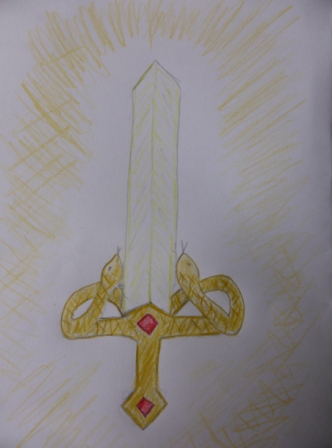
He got up with Arthur’s sword in his hand and the image of two golden serpents on the sword. When the sword was drawn from the sheath, it was like seeing two flames of fire from the serpents’ jaws. And it was not easy for anyone to look at that, because it was so terrifying.’
Rhonabwy’s Dream

On the edge of Celyddon two serpents
danced, ziz-zag bodies tumbling, twining, jaws
bared, jets of fire
hissing from their sword-
like tongues as they rose and fell in terrifying
splendour beneath the golden

sun competing for the favour of a golden-
eyed female. Arthur followed the serpents’
tracks to behold the terrifying
sight. His jaw
dropped as their sword-
like bodies intertwined in deadly combat; fiery

and tempestuous as the fires
of Hell. From the burning undergrowth a golden
lizard scurried to avoid their sword-
play – a flash in a serpents’
eye before jaws
closed over him and a terrifying

darkness. Remembering the terrifying
battle between gods of ice and fire;
Flame-Lipped and Wolf-Jaws,
white and golden-
haired interlocking like serpents
wielding flaming and ice-rimmed swords,

Arthur decided he wanted a sword:
sharp-edged, cloud-lit, to tame those terrifying
rivals. He grasped the serpents,
hissing and spitting fire
in his golden
gauntleted hands beneath their jaws,

took them to the forge of anvil-jawed
Gofannon. “I want a sword
of purest gold,
beaten into the most terrifying
form; living, breathing two flames of fire,
harnessing the strength of these struggling serpents.”

Gofannon plunged the serpents, flickering-eyed, wide-jawed,
into his fire, skins sloughing, blackening, goldening,
intertwining as one terrifying sword.

Caledfwlch

*This is one of the poems that didn’t make it into Gatherer of Souls, but relates to the theme of Gwyn’s opposition to Arthur. The form I have used is the sestina.


Gwythyr and the Lame Ant

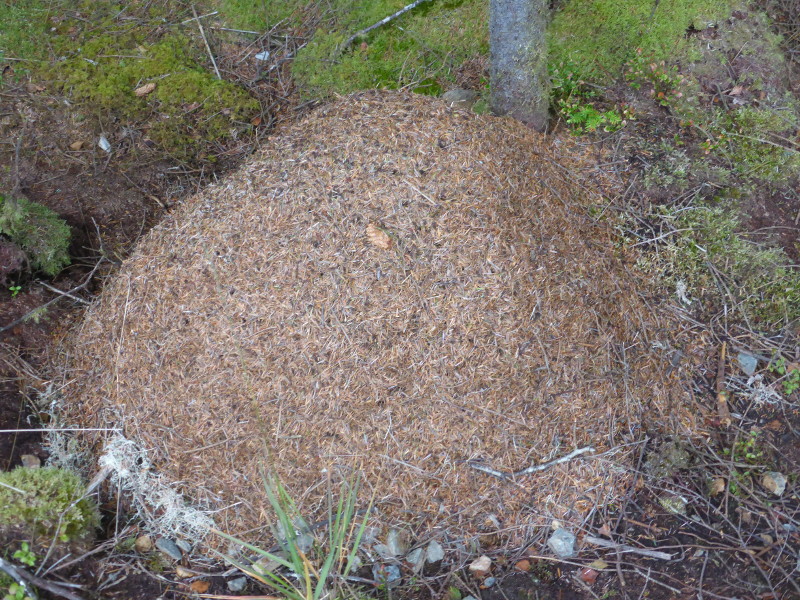
In Culhwch and Olwen there is an episode which opens with a curious scene. Gwythyr ap Greidol, ‘Victor son of Scorcher’, ‘was travelling over a mountain’ and heard ‘weeping and woeful wailing… terrible to hear.’ The source was a burning anthill. ‘He rushed forward, and as he came there he unsheathed his sword and cut off the anthill at ground level and so saved them from the fire.’

anna-popovic-187219-unsplash_med

What to make of this strange opening? Why, on earth, was the anthill on fire? Was Gwythyr having a burning bush moment akin to that of Moses on Mount Sinai? The fire shared a similar revelatory and numinous quality. However, the anthill, unlike the bush, definitely appeared to be burning up.

Did Gwythyr’s scorching feet cause the fire? His patronym suggests that, like his father, he is a god of fire and war. If so, his rescue of the ants shows a softer and more compassionate side to his nature. Or did the anthill catch fire on its own? It’s well known that wood ants orientate their complex homes (which have tunnels, storerooms, bedrooms, nurseries and even a graveyard) south toward the sun as if using solar panels in order to harness the energy for heat. Did it just get too hot?

Wood Ant Nest Coed y Brenin

Whatever the case, Gwythyr, rescued the ants. The symbolism of this act reveals Gwythyr’s connections with fire, the sun, the South, summer, and the building, heating, and saving of civilisation. These underlie the rest of the episode and his role in the narrative of Culhwch and Olwen.

Following their rescue the ants said to Gwythyr, ‘Take with you God’s blessing and ours, and that which no man can recover, we will come and recover it for you.’ ‘After that’ they ‘brought the nine hestors of flax seed that Ysbaddaden Bencawr had demanded of Culhwch, in full measure, with none missing except for a single flax seed, but the lame ant brought that before nightfall.’

1024px-A_Formica_rufa_sideview

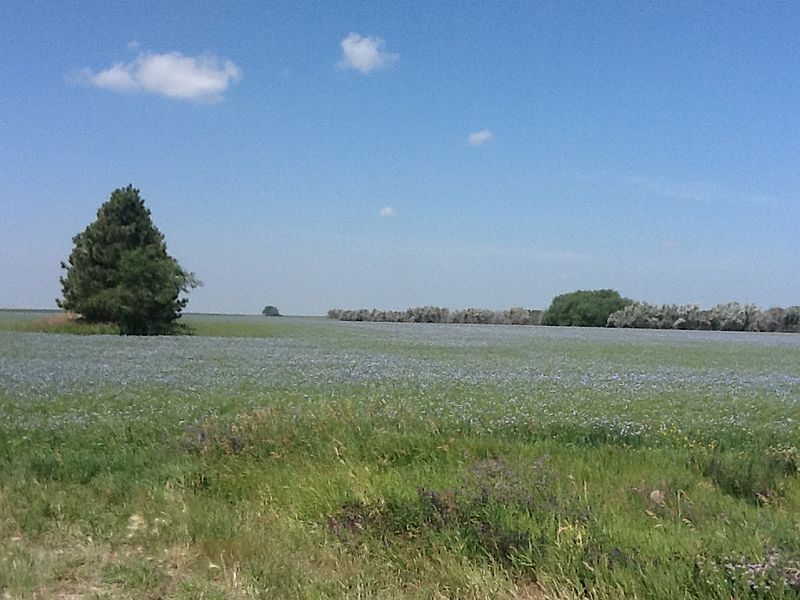
The retrieval of the flax seed was one of the forty amoethau, ‘impossible tasks’, that the giant, Ysbaddaden Bencawr, set Culhwch to win his daughter, Olwen. The flax seed was sown in ‘tilled red soil’ the day Ysbaddaden first met Olwen’s mother yet had never flowered. Culhwch was told he must resow it in a newly ploughed field to make a veil for Olwen in preparation for their wedding day.

Culhwch and Olwen is rooted in the folk motifs of ‘The Giant’s Daughter’ and ‘Six Go Through the World’. However, in this retelling, Culhwch did not fulfil the tasks with six helpers. Instead, his uncle, Arthur, completed them with aid from six warriors and a retinue of outlandish figures with strange abilities (such as Sgilti Sgafndroed who ‘would travel along the tops of trees’, Osla Gyllellfawr whose dagger could bridge a torrent, and Clust son of Clustfieniad ‘if he were buried seven fathoms in the earth he could hear an ant fifty miles away stirring from its bed in the morning’) and pre-Christian gods including Gwythyr, Amaethon the plough-god, and Gofannon the smith-god.

On the surface this narrative is about the overthrow of the primitive and oppressive reign of Ysbaddaden to bring fertility to the land as symbolised by Culhwch and Olwen’s marriage. The story of Gwythyr and the Lame Ant shows how, through an act of kindness, Gwythyr enlisted the aid of helping insects to perform a task no human could accomplish – crawling into the airy interstices of the soil to retrieve the flax seed. It’s possible to imagine that in longer versions there was far more suspense surrounding whether the flax seed was gained by the giant’s deadline and veritable relief when the lame ant finally appeared, limping valiantly, to add the final flax seed to the measure. The sowing and flowering of the seed demonstrates the fertilisation of a barren landscape.

800px-Flax_field

This gentle and benign episode is at odds with the violence pervading the rest of Culhwch and Olwen. Giants were mutilated and beheaded. Orddu the witch was cut in half and her blood drained and bottled. Ysgithrwyn was slaughtered for his tusk, Twrch Trwyth’s seven piglets were killed, and the Twrch only just escaped. Culhwch’s quest to win Olwen was twisted by the narrator to demonstrate Arthur’s civilising of the wild and banishment and all-out slaughter and destruction of the Other.

This conflict is embodied in Arthur’s allegiance with Gwythyr against his rival, Gwyn ap Nudd. In other texts we find out that Greidol was one of Arthur’s forty-two counsellors and that Gwythyr was the father of one of Arthur’s three wives (who are all named Gwenhwyfar!). Gwyn is a ruler of Annwn contrastingly associated with wildness, winter, the North, destructive Annuvian spirits, and death.

In Culhwch and Olwen, Arthur went North to intercede in the battle between Gwyn and Gwythyr for Creiddylad, a fertility goddess. He rescued Gwythyr and his men from Gwyn’s imprisonment, then bound the rivals in combat every May Day and said neither could take the maiden until Judgement Day. This seems to be a Christianised reworking of a seasonal myth in which Gwythyr, Summer, won Creiddylad on Calan Mai and this was surrounded by fertility rites, then she returned to Annwn with Gwyn, Winter, on Nos Galan Gaeaf, and Gwythyr and the powers of summer were imprisoned.

Once Arthur had defeated Gwyn – the Head of Annwn – and the body of Annwn had fallen, he usurped Gwyn’s leadership of the hunt for Twrch Trwyth and slaughtered Ysbaddaden. When his nephew, Culhwch, married Olwen, his civilising hegemony over the wild and the Otherworld was complete.

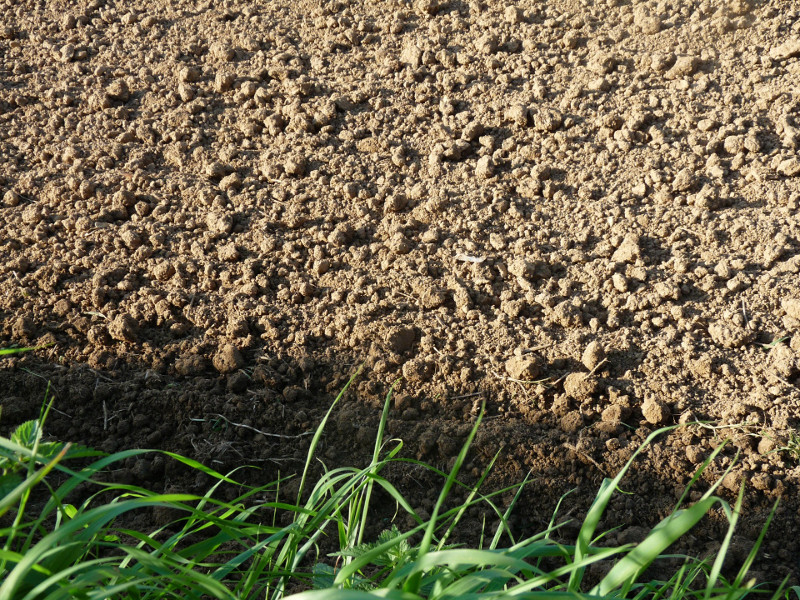
Yet it will not last forever. Otherworld gods don’t stay dead for long and dead giants, witches, and monstrous boars, having joined the furious and vengeful spirits of Annwn, will not remain shut out. Arthur is still dependent on the aid of the gods. And the gods of civilisation are dependent on the Other. Gwythyr depends on the help of the ants to traverse the chthonic regions beneath the red soil to rescue the seeds from the underworld, from the clutches of the spirits of Annwn. And one of those ants is lame. This mission is dangerous and touch-and-go. As more and more of our soil blows away, becomes barren and red, it seems less and less likely the Lame Ant will make the deadline.

soil_free_stock_photo_med