The Cow of Anrhuna

At the head of the line…
the spoil was the cow of An(r)hun(a)
.’
~ The Battle of the Trees

I am the Cosmic Cow.

I am white and red with seven legs,
eleven udders pouring the whitest milk,
a red crown of twelve stars upon my head.

My cow bells sound through the sea of stars.
My milk is the origin of the Milky Way.

I am ever loving and ever giving.

You cannot capture me because
I always come willingly.

You cannot take my milk
because I am always pleased to give.

Milk me until your fingers are bare bone
and my milk will never run dry,
not until you have used
every bucket in the world
and you have emptied every mine.

I am ever living and ever giving.

I can melt the heart
of the cruelest warlord
with one look from my soft eyes
And halt the wars betwen nations
with the scent of cud between my soft lips.

I am the spoil but I cannot be spoilt –
white, blessed, holy am I.


‘The Battle of the Trees’, in The Book of Taliesin, records a conflict between the Children of Don and Arawn, King of Annwn, and His otherworldly monsters.*

We are told ‘At the head of the line / the spoil was the cow of Anhun’. The cow, as the spoil, is absolutely central to the battle but, unfortunately we find out nothing else about her. All we are told is, ‘It caused us no disaster’. This suggests the cow is a benevolent being but we find out nothing more.

Marged Haycock suggests that Anhun is St Anthony and this buch ‘cow’, ‘buck’, ‘buck-goat’ or ‘roebuck’ might be the satyr he met in the wilderness.

This didn’t feel quite right to me – I couldn’t see the Children of Don fighting over a satyr. For a long while I saw this animal as an Annuvian cow akin to the Brindled Ox, who was stolen in ‘The Spoils of Annwn, but could discern no more.

Then, a few months ago, I was sitting looking at the name ‘Anhun’ and saw a couple of spaces between the letters filled in by the name An(r)hun(a). This title means ‘Very Great’ and she is a found Goddess who myself and a number of other awenyddion have come to know as the Mother of Annwn and of its ruler, Gwyn. (It’s my personal belief Gwyn and Arawn are titles of the same God). 

Anrhuna’s association and possible identification with a magical cow ties in with parallels from Irish mythology. Her Irish cognate is Boann or Bó Find, which might derive from the Proto-Celtic *Bou-vindā ‘White Cow’. She is the wife of Necthan (Nuada) who is cognate with Nodens / Nudd ‘Mist’ the father of Vindos / Gwyn ‘White’. *Bou-vindā fits with Her being the mother of Vindos.

Bo Find ‘White Cow’ and Her sisters Bo Rhuad ‘Red Cow’ and Bo Dhu ‘Black Cow’ came from the Western Sea to make barren Ireland green and fertile. 

My personal gnosis around the Cow of Anrhuna presents her as a cosmic cow akin to Auðumbla ‘hornless cow rich in milk’ whose milk fed the primordial giant, Ymir, from whom the world was made in the Norse myths. Also to the sacred cow and bovine appearances of the Divine Mother, Kamadhenu, and the Earth Mother, Prithvi, in the Hindu religion. 

Her loving and giving nature and endless supply of milk also link to later folklore. In the Welsh lore we find Gwartheg y Llyn, ‘Cows of the Lake’ who belong to the lake-dwelling Gwragedd Annwn ‘Wives of the Otherworld’. They are usually white or speckled / brindled and are captured for their milk and, on being mistreated or milked dry, disappear back to their lakes.

In England we find the legend of the Dun Cow who provides plentiful milk until a witch tricks her by milking her with a sieve not a pail and she dies of shock. There are two variants here in Lancashire. In one the dead cow’s rib is displayed at Dun Cow Rib Farm in Longridge. In a happier variant her milk saved the people from the plague and she was buried at Cow Hill in Grimsargh.

I now like to think these stories derive from a deeper myth featuring the Cow of Anrhuna. It also made me smile that the cattle of Annwn, likely the cow’s daughers, are associated with the Wives of Annwn after my marriage to Gwyn.

*Gwydion fashions the trees ‘by means of language and materials of the earth’. Lleu is the battle-leader, ‘Radiant his name, strong his hand, / brilliantly did he direct a host’. Peniarth MS 98B records how the battle was caused by Amaethon stealing a roebuck, a greyhound and a lapwing from Arawn. Arawn’s monsters include a black-forked toad, a beast with a hundred heads and a speckled crested snake.
Dreaming the Monastery of Annwn

When I founded the Monastery of Annwn just over two years ago I feared it would always be a rule of one. To my utter surprise for such a niche interest (Brythonic Polytheistic Monasticism centring on the Annuvian Gods) the monastery is thriving with a dozen members, most of whom participate regularly in group rituals, meditations and check-ins, or on our online forum. Several of us are living by vows and the Rule of the Heart.

Only a few months ago I thought it would be impossible to support myself as a nun of Annwn but I have received glimmers of hope with my soul guidance sessions off to a good start and my Patreon membership growing a little. 

This month my spiritual mentor suggested instead of trying to logically plan my next steps ahead for the future we should open a space for dreaming. She challenged me to dream my biggest dream and set it down without thinking about the ‘real world’ limitations that might prevent it happening. 

Immediately I knew this was to make the Monastery of Annwn a physical reality. I’d already had lots of flashes of inspiration so I set them down then journeyed to the Spirit of the Monastery to ask for guidance for the future. 

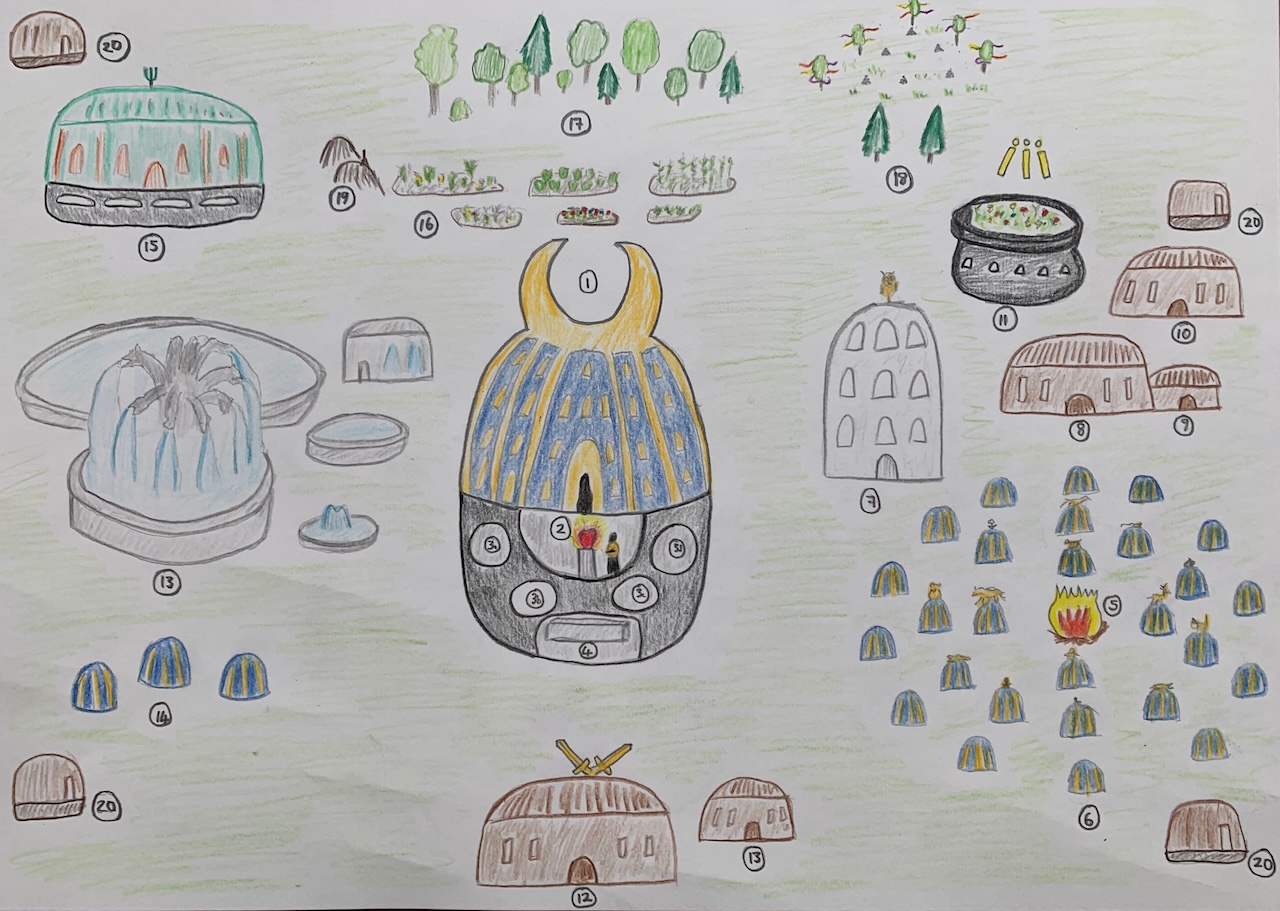
Below is my dream Monastery of Annwn at this point in time. I see it as a centre for worship of the Gods and Goddesses of Annwn, a sanctuary for healing and retreat, and a place for learning about the Brythonic tradition from a polytheistic perspective. It combines above ground, underground, indoor and outdoor spaces.

My hope is that it would sustain itself by growing its own food and making money from healings, retreats, running workshops and courses on Brythonic myths and Deities and polytheistic monasticism and sales of inspired works from monastic devotees.

(1) The Monastery of Annwn – The central temple space containing shrines to the Gods and Goddesses of Annwn and space for worship and ecstatic dance.
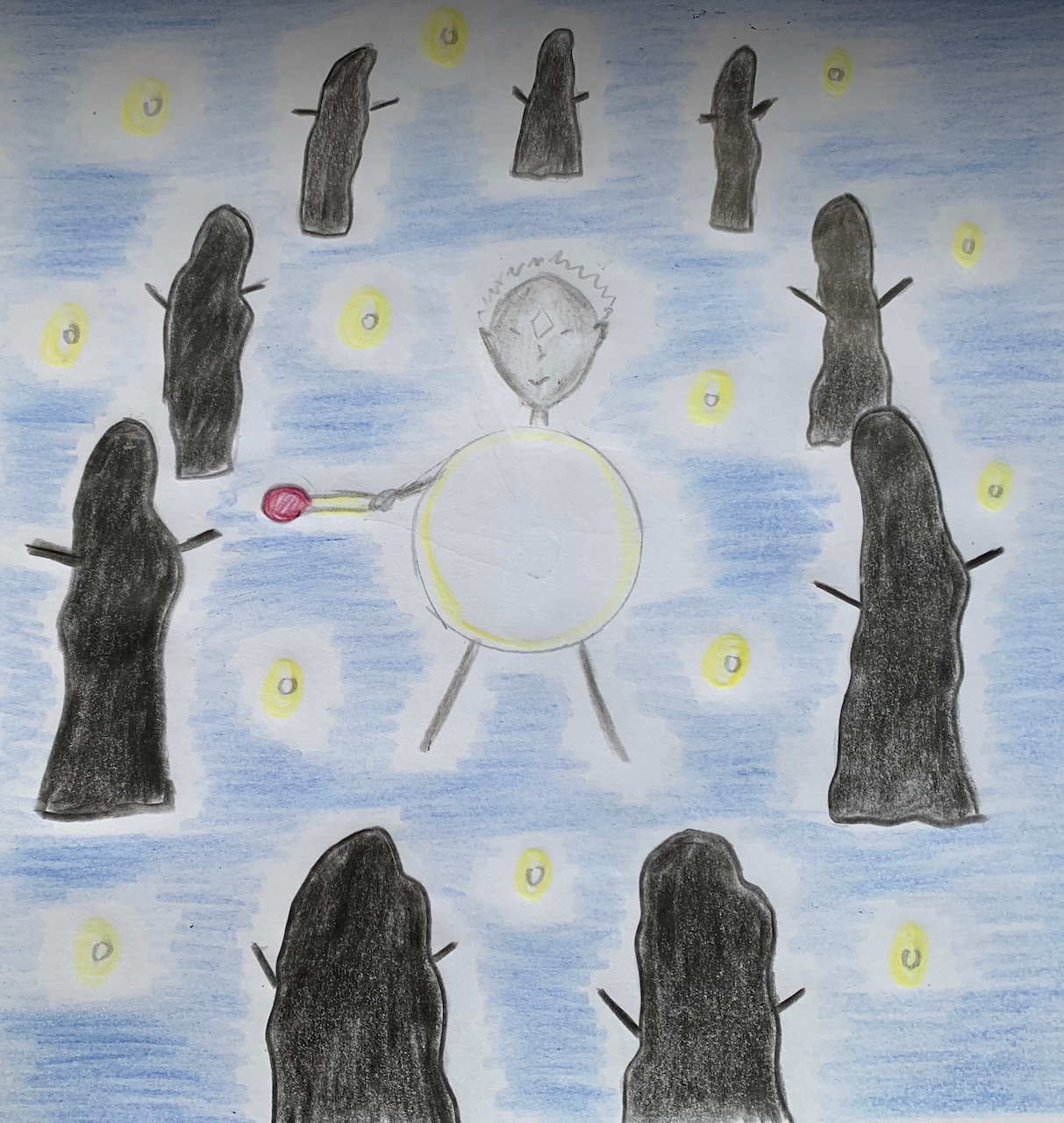
(2) The Chamber of the Heart – At its centre is the Altar of the Heart where  monastic devotees can venerate the Heart of Annwn. There will always be a monastic devotee keeping the beat of the heart day and night.
(3) Underground Caves – For communion a) Orddu’s Cave b) Cave of the Spirits of Annwn c) Cave of Bardic Incubation d) Cave of the Unknown.
(4) Gwyn’s Tomb – This will be where Gwyn symbolically lies in His tomb during the summer and monastic devotees will be able to visit and spend time in silence with Him. In winter the coffin will be removed and this will be a space of initiation involving death and rebirth prior to taking vows.
(5) The Hearth of Annwn –  A space where monastic devotees gather.
(6) Huts of the Monastic Devotees – There are three circles. The first two circles are hut for monastics who have made lifelong vows. On top of each hut is a representation of one of their tutelary spirits. The third circle is for novices and for those who are in the process of discernment.*
(7) Crazy Owl’s Library – A library containing books on Brythonic lore and monastic and mystery traditons along with mythology from around the world.
(8) Gwyn’s Feasting Hall – Here meals are served.
(9) Ceridwen’s Kitchen – Here nutritious food made with local ingredients is cooked. 
(10) Gwyn’s Guest House – A bunkhouse for guests.
(11) Awen Arts – An arts centre with an art gallery and performance space for poetry, singing and music and spaces for crafts and crafting. It will also contain a shop selling inspired works by monastic devotees.
(12) The Training Hall of Gwyn and Gwythyr – A hall for training in martial arts and other kinds of movement including dance and yoga. 
(13) Giant’s Gym – For strength training and rehabilitation. 
(14) The Healing Fountains of Anrhuna – A complex of healing waters including fountains, spas and pools and a shower house and baths for daily use.
(15) Healing Huts – Huts for shamanic healing and various therapies.
(16) The Dream Temple of Nodens – A temple for Nodens with underground dream incubation chambers and healing hounds.
(17) Creiddylad’s Garden – Here vegetables, salad, herbs and fruit are grown.
(18) Gwyn’s Wildwood – A woodland space for meditation, communion and celebration.
(19) The Blessed One’s Burial Ground – A natural burial ground for monastic devotees whose graves will be marked with small cairns. Potentially this might be expanded to provide space for others who support our aims.
(20) Ceridwen’s Compost Toilets – Four sets spaced around the monastery.
(21) Ceridwen’s Compost Heap – For recycling all waste from the garden and feasting hall.

Potentially, off scene, there will be ‘herds of Annwn’ – pigs and cattle for meat and milk and horses for horse riding and equine therapy.

*

Daily Routine

Communal worship will take place in the monastery mornings and evenings. Rather than breaking up the day with regular communal prayers like the Benedictines** prayer will be integrated into daily activities. Each will open with prayers of praise and petition and end with prayers of thanksgiving. For example, prayers to Creiddylad for gardening, prayers to Gwyn and Gwythyr for martial arts, prayers to Anrhuna for healing work. Meals will be preceded by prayers of thanksgiving to the spirits of the land.

Additional rituals will take place for Holy Days and on the dark, new and full moons.

Week Days

5am Communal worship in the monastery – morning prayers and songs for Gwyn ap Nudd and His family, the Spirit of the Monastery, the spirits of place and ancestors. 

5.30am Communal silence in the monastery (the only thing that will be heard is the beat of the Heart of Annwn).

6am Breakfast.

6.30am Communal practice in the monastery – Readings from Brythonic texts followed by meditation and contemplation or a shamanic journey.

7.30am Study in small groups in the library – Brythonic texts and Lectio Divina.

8.30am Exercise – Run, walk, strength training, martial arts, gentle movement (ie. yoga or chair yoga).

9.30am Shower and snack.

10am Study and practice in small groups – Brythonic lore, meditation, journeywork, spiritwork, divination, plant and tree spirit medicine, shamanic healing.

12 noon – Lunch.

12.30pm Devotional creativity or healing work.

2.30pm Manual labour – cleaning, laundry, groundskeeping, gardening.

5pm Baths.

5.30pm Tea.

6pm Free time for private prayer and study and group discussions.

8pm Communal worship in the monastery – evening prayers and songs for Gwyn ap Nudd and His family, the Spirit of the Monastery, the spirits of place and ancestors.

8.30pm Retire for evening prayers to Nodens as God of Dreams.

9pm Bed.

Saturday

5am Communal worship in the monastery – morning prayers and songs for Gwyn ap Nudd and His family, the Spirit of the Monastery, the spirits of place and ancestors. 

5.30am Communal silence in the monastery (the only thing that will be heard is the beat of the Heart of Annwn).

6am Breakfast.

6.30am Communal practice in the monastery – Readings from Brythonic texts followed by longer meditation and contemplation or shamanic journey.

9am – Snack.

9.30am – Ecstatic dance.

11.30am – Shower.

12 noon – Lunch.

12.30 – Free time in which some individuals and groups may choose to spend time in the woods or gardens or go for a longer walk in the local area.

5pm Baths.

5.30pm Tea.

6pm Free time for private prayer and study and group discussions.

8pm Communal worship in the monastery – evening prayers and songs for Gwyn ap Nudd and His family, the Spirit of the Monastery, the spirits of place and ancestors.

8.30pm Retire for evening prayers to Nodens as God of Dreams.

9pm Bed.

Sunday

5am Communal worship in the monastery – morning prayers and songs for Gwyn ap Nudd and His family, the Spirit of the Monastery, the spirits of place and ancestors. 

5.30am Communal silence in the monastery (the only thing that will be heard is the beat of the Heart of Annwn).

6am Breakfast.

6.30am Communal practice in the monastery – Readings from Brythonic texts followed by longer meditation and contemplation or shamanic journey.

9am – Snack.

9.30am – Personal spiritual development.

12 noon – Lunch.

12.30 – Pilgrimage walk involving prayers and offerings to local spirits.

4pm – Community gathering for sharing news and developments.

5pm Baths.

5.30pm Tea.

6pm Free time for private prayer and study and group discussions.

8pm Communal worship in the monastery – evening prayers and songs for Gwyn ap Nudd and His family, the Spirit of the Monastery, the spirits of place and ancestors.

8.30pm Retire for evening prayers to Nodens as God of Dreams.

9pm Bed.

*The Huts of the Monastic Devotees were inspired by Danica Swanson’s ideas around a ‘cottage cluster monastery’ and the bee hive huts of monastics associated with the south-western Irish seaboard.
**Matins / vigils (nighttime), lauds (early morning), prime (first hour of daylight),  terce (third hour), sext (noon), nones (ninth hour), vespers (sunset), compline (end of the day).

If you would like to see the Monastery of Annwn become a physical reality please like or comment.

The Heart of Annwn

Over the past few years the Heart of Annwn has become increasingly important in the mythos Gwyn has gifted me and in my devotional practices. 

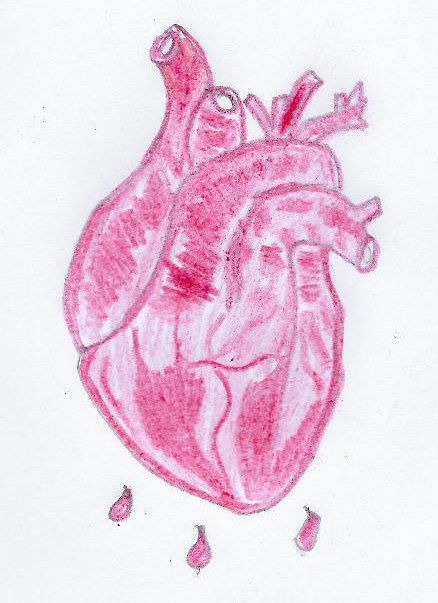
For me, the Heart of Annwn is Gwyn’s heart, inherited from His mother, Anrhuna, Mother of Annwn, and also the ever-beating heart of Annwn itself. 

I believe that, like Hades and Hades, Hel and Hel, are both Deities and Otherworlds, Gwyn, who is associated with Gwynfyd is one with His land as well.

The Heart of Annwn literally became the heart of my practice two years ago when I began playing its beat and chanting to align myself with Gwyn’s heartbeat. This led to the formulation of the Rule of the Heart within the Monastery of Annwn – following our hearts in alignment with the Heart of Annwn.

In this post I will be sharing two of the core stories of the Heart of Annwn.

*

The Heart of the Dragon Mother

Gwyn has shown me that the Heart of Annwn once beat in the chest of His mother, Anrhuna, the Mother of Annwn, when She was a nine-headed dragon. When She was slain Vindos / Gwyn ate Her heart. The Heart of Annwn became His and this gave Him sovereignty over Annwn as King.

“Now,” the ghost of Anrhuna turned to her corpse, “there is a rite amongst the dragons of Annwn – as you are the only one of my children left here you must eat my heart.”

The boy swallowed nervously as with a single bite of her ghost jaws she tore it from her chest and offered it to him, big and bloody, large and slippery, uncannily still beating. “My heart is the Heart of Annwn. If you succeed in eating it all, its power will be yours and you will be king.”

“But it is so much bigger than I and I have little appetite.”

“Little bite by little bite and you will be king.”

The boy very much wanted to be king. He needed his kingship within him. He bared his teeth and bit in, took one bite, then another. As he ate, he grew. He became a mighty wolf, a raging bull, a bull-horned man, a horned serpent, finally, a black dragon. As he tore and devoured the last pieces of the heart he spread his wings to fill the darkest reaches of the Deep. He roared, “I am King of Annwn! I will rule the dead! I will build my kingdom from the bones of dead dragons and the light of dead stars! I will bring joy to every serpent who has known sorrow and I will take vengeance on my enemies!”

Weary and full he slept and when he awoke he was just a boy with a large heart that felt too big for his body.

*

The Hidden Heart

In another story, in which Arthur raids Annwn, killing the King of Annwn and stealing His cauldron, Gwyn instructs His beloved, Creiddylad, to cut His heart from His chest and help hide it so that Arthur cannot take the Heart of Annwn.

Gwyn gave Creiddylad a Knife. “Cut my heart from my chest. Give it to my winged messengers and tell them to hide it in a place that even I could never find It.”

“Do what?” 

“I will not die.” 

“Worse – you will be heartless.”

One of my practices around this story was receiving the honour of finding Gwyn’s heart and returning it to Him and helping Him to return to life.

‘I knew it was a death unlike any other
but still I heard the beating 
of your heart…

Your hounds dug wildly beneath trees,
bloodying their frantic paws
to find only the hearts of 
dead badgers,

sniffed suspiciously at the edge of pools
where I searched through reeds
as if looking for a baby
in the bulrushes,
plunged in 
and emerged draped in duck-weed.

We snatched a still-beating heart 
from a bear’s claws (not yours).

We searched every cave for a heart-shaped box.
When we found one 
and the keys to the lock
inside was only a locket and a love letter in an illegible hand.

When we had searched everywhere in Annwn
we rode across Thisworld following
your fading heart beat.

We found your heart in the unlikeliest of places.

Clutching it tightly, fearing every time it skipped a beat,
we galloped back to Annwn with our hearts
beating just as wildly.

Through the fortresses within fortresses…

Into your empty chest we placed your still-beating heart.’

*

Gwyn has revealed a lot about the Heart of Annwn and I believe there is more to come. Recently I had a vision of Gwyn as a black dragon with His heart visible in His chest bearing an important message. He appears in this form when He brings tidings for the future. What will be the future of the Heart of Annwn? What stories from the past remain to be disclosed? I share what I know with gratitude and await further revealings.

Twelve Days of Devotion to Gwyn ap Nudd – The Birth of Gwyn

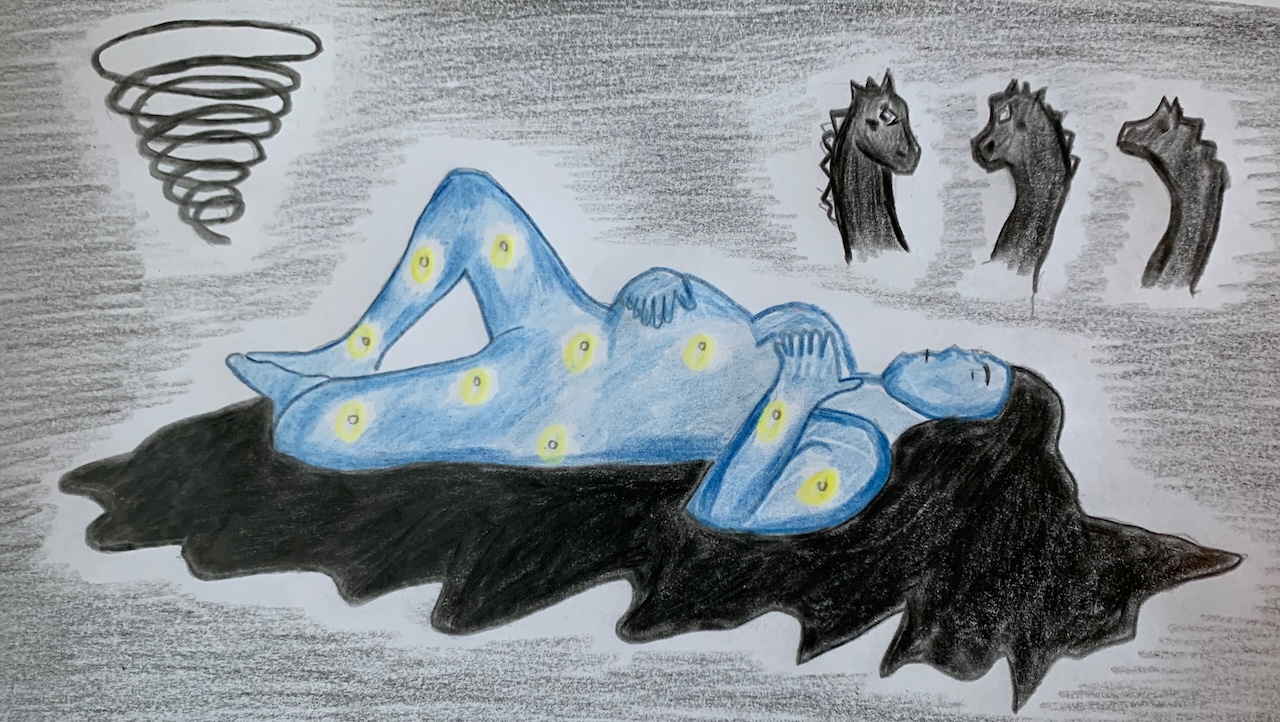
Over the twelve days of devotion (25th of December to 6th of January) I focused on the birth of Gwyn and was guided through a series of practices. I was called to chant, sing, meditate, draw and embody Gwyn and His mother, Anrhuna. On this last day I bring them together to share as an offering to Him and to my online community hoping it will inspire others to delve more deeply into the mysteries of His birth in the future.

Mam Annwfn

Chant: Mam o mam o mam o mam o mam o man Annwfn.

Embodiment practice*: Lying in a modified version of Suptka Baddha Konasana (reclining bound angle pose) with left hand on heart and right hand on belly.

Meditation 1: I am the Deep and I am its mother.

Meditation 2: My heart and His heart beating as one.

Unborn Gwyn

Chant: Gwyn heb ei eini, Gwyn fettws, Gwyn breuddwydio, Gwyn dreaming, foetal Gwyn, unborn Gwyn.

Embodiment practice: Lying in Parsva Savasana (side corpse pose or foetal position). 

Meditation 1: I dream the universe.

Meditation 2: I am promise.

Birth

Meditation 1: 

Where shall I birth You 
into the world, 
my son, my king, 
my patron, my muse, 
my inspiration, my truth? 

Meditation 2: 

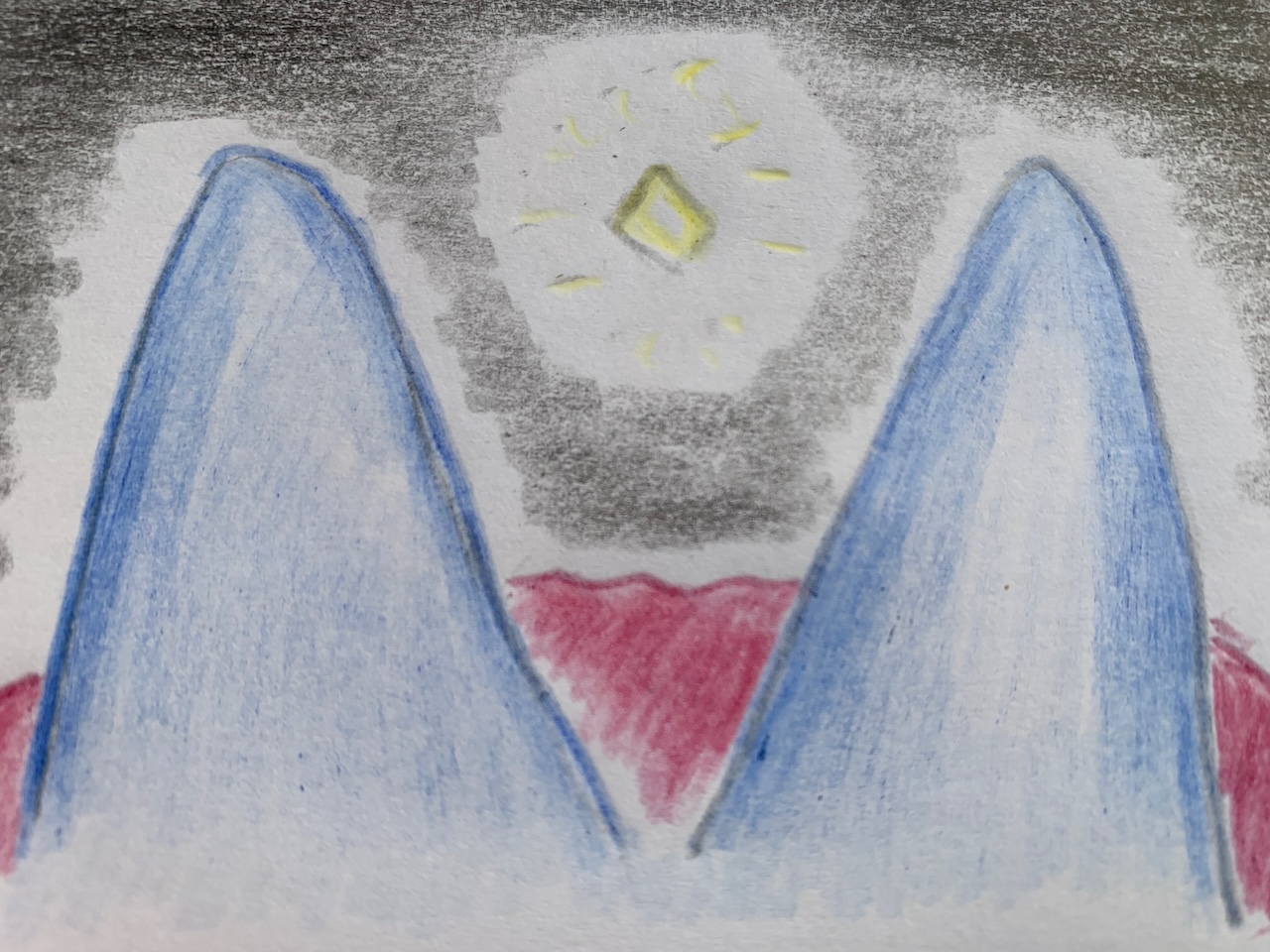
A mother’s longest hours 
like mountains, heaving belly, knees bent, 
reaching the peak, screaming, running down holding a baby
knowing prophecy is born in moments of pain,
the first cry of an infant mouth.

She Holds Her Son

Song: 

She holds Her son 
between space and time
in the place that’s Hers
and His and mine.

The Newborn

Meditation 1:

Born with a laugh 
to change the world
wise a changeling 
speaking in riddles
comes a newborn
to break all the rules.

He sings:

Hear the heartbeat, hear the drumbeat, hear the call.
Feel the heartbeat, feel the drumbeat stir your soul. 

Sing, chant, dance, drum with newborn Gwyn and the shadow nuns. 

WE ARE REBORN
here, now, in this moment, always, forever.

Inspiration

No-one knows the day or hour of Your birth because You were born before the universe.

*

You have as many births as the facets on your jewel – their number is infinite.

*

The geni in ca fi’n geni ‘I am born’ stems from the Proto-Indo-European root *gene that gives us ‘genesis’. With You, with each child, a universe is born. 

*

Each of us contains a universe, like a cauldron, and it’s only when our cauldrons crack and the relationships between the constellations of our presuppositions break down we perceive the sea of stars, the darkness of the Deep, the vastness of Annwfn, the Abyss, the Void. 

*

Floating on the starry tide, the infinite waters, You are always being born.

*I have been drawn to use yoga poses in my practice on the basis of gnosis about shared Indo-European origins of Brythonic polytheism and Hinduism. I have found likenesses between Anrhuna and the Hindu Goddess of primordial waters, Danu, who gave birth to the dragon, Vritra, and the Davanas. Gwyn shares many similarities with Shiva.

Contemplating the Abyss Part Four – The God Beyond the Gods

In the previous post I looked at abyss mysticism in the writing of medieval monastics. Here I shall discuss how it relates to the visions of the Abyss that formed the core of my attempted novel, In the Deep, and to my own experiences.

The Christian abyss mystics of the medieval period perceived the soul and God to be dual abysses. Through a process of annihilation, led by love, the abyss of the soul was dissolved in the abyss of God. Van Ruusbroec conceived this slightly differently suggesting the Abyss was a ‘God beyond God’.

The process of annihilation was one that involved suffering. Penitence, purgation, purification, to varying degrees in different authors but the result was ultimately joyous union with God as the ‘divine’ or ‘blessed’ abyss.

The big difference between my own experiences and visions and those of these Christian mystics is theological as I am a polytheist and not a monotheist and find it difficult to identify the Abyss with the Christian God. 

The Abyss has a presence in my life as something powerful, as something divine, as a deity, but not as a God I can name. Thus Van Ruusbroec’s conception of it as a ‘God beyond God’ resonates deeply with me as does the positing by the Gnostics of a God of the Deep preceding the creator God whose prior existence is suggested in Genesis 1.2 ‘And the earth was without form, and void; and darkness was upon the face of the deep. And the Spirit of God moved upon the face of the waters.’ The terms ‘deep’ and ‘abyss’ stem from the Hebrew tehom and are often used interchangeably.

In the cosmology that has been revealed to me by the Brythonic Godsthe Abyss is part of Annwn, ‘Very Deep’, its deepest part, its bottomless depth. It is a place to where the souls of the dead return and from it are reborn.

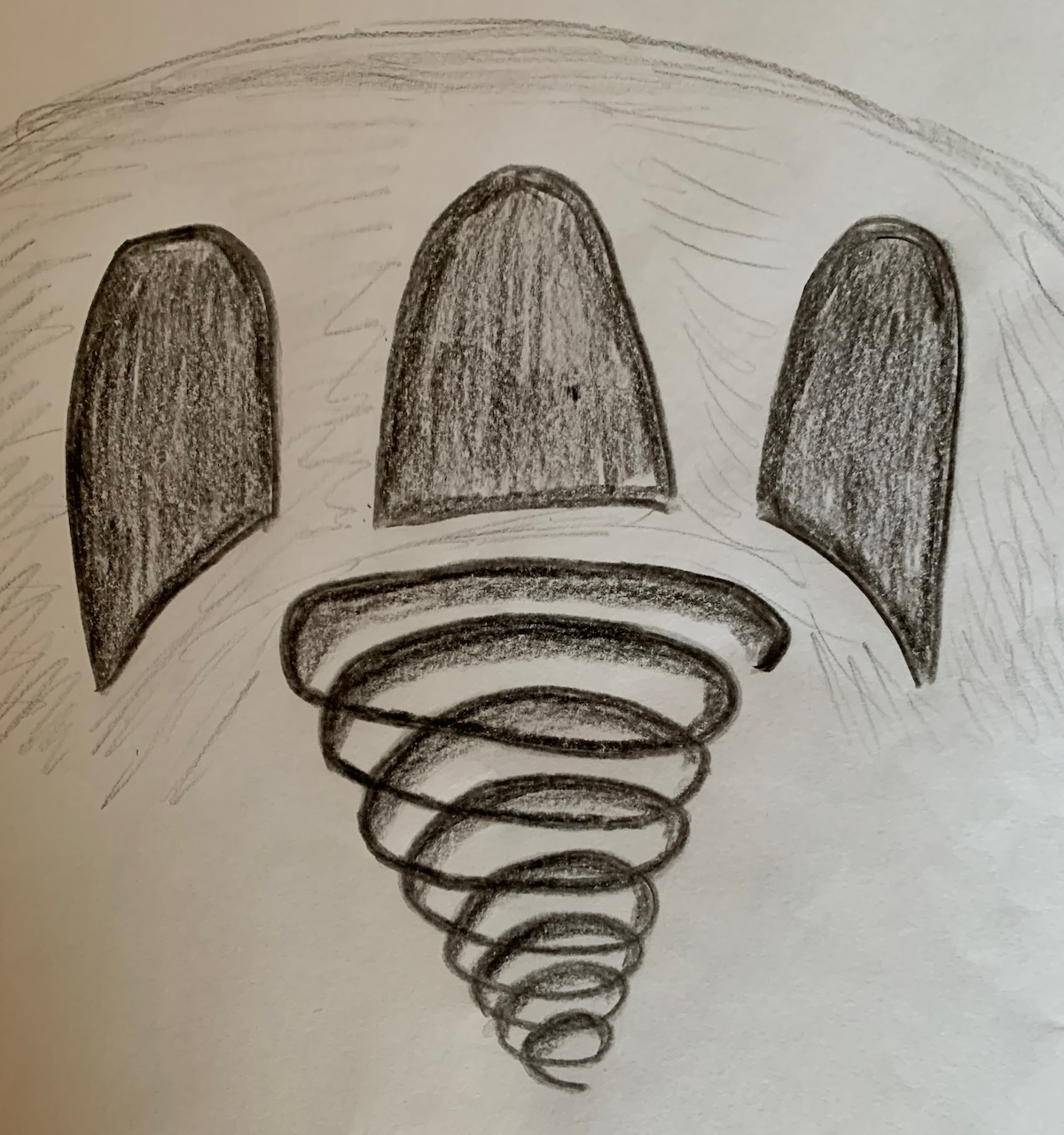
The way I envisage it bears remarkable similarities to the vision of Hadewijch of Antwerp – ‘an unfathomable depth’, ‘a very deep whirlpool, wide and exceedingly dark; in this abyss all beings were included, crowded together and compressed’.

It is associated with deep wisdom that can only be won as a result of sacrifice. In the stories I was shown Nodens / Nudd agreed to give up His sword arm. He hung over the Abyss in the coils of the Dragon Mother, Anrhuna, the Goddess of the Deep, and received the knowledge, ‘There is no up or down or before or after – everything meets here in you the Dragon Mother.’ 

Vindos / Gwyn ap Nudd hung over the Abyss on a yew wounded in raven form and gave every last drop of his blood in exchange for a vision ‘to set the world to rights’. His knowledge was brought out of Him by a series of riddles and He saw Himself as a black dragon before plummeting dead into the Abyss.

At the beginning of the next book in death He was united with ‘the source’:

Vindos fell,
and as he fell he left behind
his shell of bones and black feathers 

and his soul flew free on wider wings
on the winds of the Abyss.
He had won

their favour
through his offering 
of every last drop of his blood.

By his wounding, by his questioning,
agony had become ecstasy.
The bottomless

abyss
was no longer bottomless.
He had mastered its paradoxes and knew

where darkness turns to light
and death to life.
Down was

now up
and he was one
with the source, the spring

from which the ocean of the stars
sprung when the universe
was born.’

These scenes bear similarities with Marguerite Porete’s words about the soul, in annihilation, finding ‘there is neither beginning, middle nor end, but only an abyssal abyss without bottom’ before acheiving ecstatic union with God.

It seems my Gods, Nodens / Nudd and His son, Vindos / Gwyn are presenting to me a tradition of sacrifice to the Abyss in return for its wisdom. By leading the way they are showing what might be expected of Their devotees.

My first experience of the Abyss took place as the result of an unconscious process of self-annihilation – dissolution of the self through the combination of practicing Husserl’s epoche (putting all one’s presuppositions about the nature of reality aside) with drugs and alchohol and all night dancing.

There was a yearning within me, I might now say deep for deep, abyss for abyss, but I didn’t know what it was and when I got to the Abyss it terrified me. I wasn’t ready for abyssal wisdom. I didn’t know what to do. I didn’t understand its choices, to live as I was or to die physically, or to take a third door. 

I see in my own impulses and those of the abyss mystics, love and annihilation, the interplay of eros the ‘life drive’ and thanatos the ‘death drive’ which together lead to the Abyss and to union with the divine if one is prepared to surrender to make some sacrifice of themselves.

I’ve never been good at giving or sacrifice always wanting things my own way.

Ten years ago, Gwyn, my patron God, a King of Annwn, asked me for a sacrifice in exchange for the wisdom of Annwn – to give up my desire to be a professional author. I did so… but not in full… I secretly entertained a hope if I gave it up for a period I might be let off and be able to have my cake and eat it.

My experience of writing In the Deep, spending a year and a half on a novel that has turned out unpublishable and daring to think it might sell more widely than my previous publications has shown this is not the case. 

It’s taken me ten years to realise I must give up my biggest dream in full for good.

This fits with the process of self annihilation found in the medieval mystics. Only by giving up our desires, surrendering our will, can we walk the path of the Gods and with them find a deeper unison with the God beyond the Gods.

I believe this also relates to the need to give up my identity as Lorna Smithers, published author, performing poet, public speaker, to become Sister Patience.

In the Deep was not written purely for self gain. First and foremost it was written for love** of Gwyn, as an origin story for Him, as an offering. I believe it is because of that the awen flowed and I retain these visions as His gift.

That He, ‘White, Blessed’, has led me to the blessed Abyss, the God beyond the Gods, who may or may not be the formlessness of the Mother of the Deep before She took form.

To the third door – to die to his present life, to be annihilated, hopefully like Vindos / Gwyn to be reborn.

He was
the first microbe
and every single tiny thing.

He was an ammonite and a starfish,
He was a silver salmon,
every fish.

He swam
amongst bright creatures
as an eel, as a seasnake, as a snake,

as a horned serpent, as a bull, as a wolf.
Playful as a new-born pup
Vindos

chased his tail
and the trails of starships
and traversed every wormhole

before he emerged from the sea of stars
and climbed out of the cauldron,
naked, dripping, triumphant,

and very much living
to stand beside Old Mother Universe.

*I also wrote the sequel, The Spirits of Annwn, in draft form as a long poem, when possessed by the awen last year.
**Unlike annihilation love is a difficult thing for me to talk about as someone who, after a number of botched relationships, only discovered they were asexual and aromantic late in life. Unlike a number of Gwyn devotees with an intense devotional relationship with Him I am not a God spouse. Much inside me rebels against using the language of marriage found in Christianity such as ‘bride of Christ’ and even ‘love’ with its sexual and romantic connotations in reference to our relationship. I wish there was a word for purely devotional love.

In part five I will be writing about how these insights relate to the Brythonic tradition.

Contemplating the Abyss Part Two – Writing whilst Falling

I write when I fall. It’s a defence mechanism. Like putting out a hand to catch myself. 

I write because writing has saved me and I believe my writing might help others.

But putting out a hand doesn’t always work when one is falling into the Abyss…

*

I cried out to the philosophers, “Philosophers save me!”

When I was 21 and in the second year of my philosophy degree I sat on the edge of the Abyss at the nadir of a quasi-initiatory period during which I’d been foolishly been mixing phenomenology (1) with copious amounts of drugs and alcohol, some unknown part of me striving, reaching for… what?

My ‘friends’ had deserted me because I’d ‘gone west’ and I was sitting on the boot of a car, at the end of the world, staring into the Abyss, feeling I couldn’t go on living but not really, truly, wanting to die either. I couldn’t choose.

I was presented with three gateways but didn’t have the courage to take any.

I moved into the front seat of the car and, as dawn arrived, pinking the front  windows of my friend’s house, with it came three alienesque beings who I now understand in the Brythonic tradition to be ellyllon ‘elves’. They took me into the heavens in what I saw at the time as an alien aduction experience and performed an intricate operation on my brain with silver instruments. 

After that I decided to give up drugs entirely and apply myself to my studies. Not easy. There were after effects. Anxiety. Panic attacks. I ended up on medication but also got subscribed what I really needed – exercise. These things helped me to get my head straight enough to write myself out of the Abyss. 

My philosophy studies gave me the tools I needed. I saw my inability to choose life or death as akin to Kant’s antimonies (2) which stem from the use of reason to comprehend sensible phenomena beyond its application. I wrote my dissertation on the concept of the sublime in Burke, Kant, and Lyotard, focusing on how experiences of the sublime depose the rational mind (3).

This helped me to understand the breakdown of my rational faculties but not the visions I encountered as the flip side. It was only when I was studying for my MA in European Philosophy and writing my dissertation on Nietzche’s The Birth of Tragedy I found the clues. Dionysian ecstasy gives way to Apollonian visions. But I wasn’t seeing Dionysus or satyrs. I realised, like Greece, Britain, must have its Gods and spirits, finally met my patron God, Gwyn ap Nudd, a King of Annwn, realised my visions had been of His realm.

Nietzsche, a philosopher, who also stared into the Abyss (4), saved me.

*

The medieval Welsh term Annwn stems from an ‘very’ and dwfn ‘deep’. I believe it shares similarities with the Hebrew term tehom which means ‘deep’ and was translated as abyssos, ‘abyss’, ‘bottomless depth’, in the Septugaint, the earliest Greek translation of the Hebrew Bible in 285–247 BCE.

The Mesopotamian Goddess of the primordial waters, Tiamat, has been linked to tehom. Several years ago myself and other awenyddion found a Goddess named Anrhuna who takes dragon form and is the mother of Gwyn. She plays a similar role as the personification of Annwn. In my visions She, Gwyn, and Nodens/Nudd are associated with the Abyss and its mysteries.

Gwyn was the God who taught me how to fall. He’s fallen too. And I’ve fallen with Him. I’ve crawled out of the Abyss with Him, claw by claw, word by word.

That damned book. It came first when I was falling during the first covid pandemic. I’d given up my supermarket job to volunteer my way into paid work in conservation and my volunteering had been cancelled leaving me with no paid or voluntary role. Utterly unpublishable but writing it got me through.

It came again when I realised I couldn’t cope in a career in the environmental sector. For the last year and a half I’ve worked on it full time, realised it is no good. 

That crutch has gone but I’m still putting my hand out – writing whilst falling.

*

I’m back in another antinomy – I love writing but can’t make a living from it. 

When I first met Gwyn He asked me to promise to give up my ambition to be a professional author in return for journeying with Him to Annwn. I did it for a while. I took various jobs, cleaning, packing, supermarket, wrote as service for my Gods.

But, sneakily, oh so sneakily, in the back of my mind, I never got rid of the treacherous hope that promise would only be temporary. If I worked hard well enough the veto might come off, I might be able to have my cake and eat it.

I published three books. Sold more copies than I hoped for such niche work. Even got professionally published. Not enough to make a living of course but enough to convince me I might be able to write something that did better. 

Ten years after my initial dedication to Gwyn I asked Him by divination about whether that promise still holds and got 1. The Wanderer and thought I was free of it. It’s notable here I asked through the tarot rather than asking Him directly. Consciously I did this because I feared my discernment might be off. Maybe unconsciously, I feared, knew, he’d say, ‘No’. I read the card wrong. In the traditional tarot The Wanderer is the The Fool. I was fooling myself. As I write these words I hear the laughter of my God and realise what a fool I was.

At one point I hoped In the Deep might not only sell to my small Polytheist and Pagan audience but might also appeal to fantasy readers, taking the stories of Gwyn and the other Brythonic Gods into the mainstream.

Hubris. It didn’t work. An individual can’t write myth. And I’m not that good a writer.

A difficult lesson learnt. My ambition to be a professional writer given up for good, vomited up, committed to the Abyss, I’m falling again, writing whilst falling.

I’m remembering my vision of the three gates. I can’t make a living as a writer. I don’t want to die either. I’m asking what lies beyond the third gate.

In the next part I will be writing about the ‘Abyss Mystics’ who, unlike me did not try to cling on, to write themselves out of the Abyss, were not afraid of falling.

(1) In particular using Husserl’s epoche (setting aside all assumptions of existence) as an experiential practice.
(2) https://en.wikipedia.org/wiki/Kant’s_antinomies
(3) In ‘Scapeland’ Lyotard writes of the ‘The Thing’ as sublime – ‘the mind draws itself up when it draws a landscape, but that landscape has already drawn its forces up against the mind, and that in drawing them up, it has broken and deposed the mind (as one deposes a sovereign), made it vomit itself up towards the nothingness of being-there.’
(4) In Beyond Good and Evil Nietzsche wrote, ‘Battle not with monsters lest ye become a monster; and if you gaze into the abyss the abyss gazes into you.’

Contemplating the Abyss Part One – ‘In the Deep’

The Abyss was its spiralling core and its beginning and its end. 

The Beginning

It began with a boy falling, falling, falling into the Abyss.

The boy dreamt of the birth of his Dragon Mother from the infinite waters of the Deep with nine heads and nine-hundred-and-ninety-nine coils and her giving birth to an infinitude of dragons, serpents, monster-serpents and monsters.

*

The boy dreamt of the birth of the stars – each the eye of a fiery giant. He watched them mating, spawning bright gods, who built their fortresses in the skies. The King of the Gods ordering the constellations with a turning sword. This god cast out, plummeting like a comet with an icy tail, down to the Deep. 

*

The boy dreamt of the god hanging in his mother’s coils over the Abyss to gain its wisdom. ‘There is no up or down or before or after – everything meets here in you the Dragon Mother.’ He watched them mate and knew he was conceived.

*

The boy dreamt of the Children of the Don descending from the stars to slaughter the Dragons of the Deep. Lugus, their leader, cut off the arm of his father, Nodens and slaughtered his Dragon Mother, Anrhuna. Lugus then tore the boy, Vindos, and his sister, Kraideti, from the womb. He stole Kraideti ‘the Girl who will Bring Life’ to the stars and threw Vindos ‘the Boy who will bring Death’ into the Abyss.

*

The boy awoke and crawled from the Abyss to eat his Dragon Mother’s heart in a rite that made him King of Annwn (he later gained his name – Vindos / Gwyn ‘White, Blessed, Holy’).

The End

Vindos killed Lugus as vengeance for slaying his Dragon Mother. Lugus took flight in the form of an eagle and perched wounded in an oak tree for nine nights with a sow beneath feasting on the rotten flesh and maggots from his wound. 

Uidianos sang Lugus down from the oak with three englyns and restored him to life.

Lugus returned the blow, shattering the Stone of Vindos, to pierce his enemy’s side. Vindos took the form of a raven and flew to Annwn where he hung wounded on a yew tree upside down over the Abyss and answered its riddles.

Night One: 

“Tell me
the hour the King
and Queen of Annwn
were born.”

“Not easy –
we were not born 
but ripped from the womb 
on the hour of the death 
of dragons.”

*

Night Two:

“Tell me
in your eternal
battle who killed
who?

“Not easy,
summer and winter
are mirrors – when one
kills the other kills 
too.”

*

Night Three:

“Tell Me
how many trees
are in the forests
of Annwn?”

“Not easy,
for they are without
number but ask me again
and I will name
them.”

*

Night Four: 

“Tell me
how many doors
there are to
Annwn.”

“Not easy,
for they are without
number but ask me again
and I will open
them.”

*

Night Five:

“Tell me
where divide 
darkness and light,
day and night?”

“Not easy,
for there are no
divisions – each follows
each in an endless
procession.”

*

Night Six: 

“Tell me
where the restless wind 
comes from and where
he rests.”

“Not easy,
for no-one but he
knows the location of the Lands
of the First and Last
Breaths.”

*

Night Seven:

“Tell me
how many 
stars are in the
Heavens.”

“Not easy,
for they will not
be counted until all
souls are in the
cauldron.”

*

Night Eight:

“Tell me
the fate of
your last drop 
of blood.”

“Not easy,
for I cannot divide it
from the ocean of blood
that will drown
the world.”

*

Night Nine:

“Tell Me
the hour the King 
and Queen of Annwn
will die.”

“Not easy –
we cannot live without 
each other and thus will die
together when all souls
are gathered.”

*

Vindos then fell into the Abyss.

These scenes had a basis in my personal encounters with the Abyss. I will be talking about those in part two, then in part three and four presenting my recent discovery of ‘Abyss Mysticism’ in the writing on medieval monastics and how this has helped me make a little sense of the abyssal visions behind this book.

I Awenydd

“Remember who you are.”

I am an awenydd of Annwn.

I am a keeper of an ancient monastery
(yes this monastery is ancient although
its builders only built it yesterday).

Likewise I am born from the Deep.

I am forged in Annwn’s fires.

I am the creation of a myriad creatures
who continue to live within me,
barking, stampeding.

I am born of the Dragon-Headed Mother.
The nine elements swirl within me.

I live by the rule of awen*.

My destiny lies before me.

~

This poem was born from a time of crisis and struggle as I have suffered from poor mental health as a result of working a late shift as I find it very difficult to cope with changes in routine and sleeping pattern as an autistic person.

Following the realisation I can’t make a living from my vocation as an awenydd, for the last three years I have poured most of my energy into pursuing a career that is in alignment with my spiritual values. I’ve volunteered my way into paid work in conservation, completed a year-long conservation traineeship, and gained a permanent job as an ecologist.

There is a lot to like about ecology. There is much to learn. I get to visit varied sites. There is an art to getting the best deal for people and nature. But the job is also high pressure and, in many consultancies, (thankfully not mine) there is a complete disregard for mental health with junior ecologists working several nights a week and being expected to keep up with day work

I have been lucky to gain work with a team who are not only friendly and professional but aware of and supportive around mental health problems and have allowed me to cut down nights and take time out for counselling.

Over the period I have been developing my career I have had less time for my spiritual vocation and, it’s sad to say, have only fallen back on it at a time of crisis, when my work alone has not been enough to pull me through.

Having realised that my difficulties with night work will mean I cannot become a good all round ecologist (I will not be able to get my great crested newt and bat licences and will be limited to developing my abilities with habitat and vegetation surveys and protected species I can survey by day) I’ve been questioning if this is the right career path and assessing where my talents lie.

“Remember who you are,” I have heard the voice of my God, Gwyn, on a few occasions, reminding me of my vow to Him, to serve as His awenydd.

This has led to the realisation that I’ve been living an unbalanced life. Devoting too much time to Thisworld and not enough to Annwn, the Deep.

This doesn’t mean that I’ve made a poor choice of job, but outside it, whereas I was spending all my free time reading ecology books and articles, trying to record and memorise plants, and carrying out extra surveys, I need to make room for the soul-world.

From this has been born the Monastery of Annwn as a sanctuary to retreat to; where the Gods and the Deep are revered and honoured and put first; as a place that provides the strength to return to Thisworld and pursue one’s awen/destiny**.

*The phrase ‘the rule of awen’ is not my own but is one of the principles of the Gnostic Celtic Church which resonates deeply with me. 
**In Medieval Welsh poetry ‘awen’ means not only inspiration but destiny.

My Lady Verdant

I shall follow
the threads of her hair –
her hair is verdant.

I shall follow
the bats to her lair –
my Lady Verdant.

I shall follow
the ancient pathways
to Peneverdant.

I shall meet her 
there ivies in my hair –
my Lady Verdant.

*A poem and image for Anrhuna, the goddess who I believe to be the mother of my patron god, Gwyn ap Nudd, appearing in her localised form as the Lady of Peneverdant.

She Spreads Her Mossy Cloak

This is an image of Anrhuna in her guise as ‘the Mother of the Moss’ through which she has been speaking strongly to me over the past year. Anrhuna is not known from Brythonic lore but has presented herself to me and a couple of other awenyddion as an ancient goddess, who is the mother of my patron god, Gwyn ap Nudd. It’s my intuition that she was the driving force behind the earliest colonisation of the land by mosses.