Caer Golud: The Guts of Annwn

In verse four of ‘The Spoils of Annwn’ the lines about Caer Wydyr (‘Glass Fort’) are followed by a single reference to Caer Golud (‘Fortress of Impediment’).

‘Three loads of Prydwen went with Arthur:
save seven, none came back from the Fort of Impediment.’

Nothing more is said about Caer Golud. To the best of my knowledge it does not appear in any other literature. Marged Haycock translates golud as ‘impediment’ from goludd. This suggests Caer Golud is another name for the impenetrable Caer Wydyr, which is guarded by six thousand men and an incommunicative watchman.

An alternative translation is from coludd (which mutates from ‘g’): ‘guts’, ‘bowels’ or ‘entrails’ This is a fascinating possibility and fits with links between the Glass Fort and Glastonbury (‘the Glass Island’) as a place the 6thC prophet, Melkin, claims is ‘greedy for the death of pagans, above others in the world.’

Melkin’s words suggest pagan beliefs and practices survived in Glastonbury into the 6thC. The word ‘greedy’ evokes devouring and the digestive processes of the guts. This would certainly tie in with other descriptions of the Brythonic otherworld.

In ‘The First Address of Taliesin’ the bard inquires into the width of ‘the mouth’ of Uffern (‘inferno’). ‘Kat Godeu’ refers to ‘a great-scaled beast’ with ‘a fierce battalion / beneath the roof of his tongue’ and ‘A speckled crested snake’ with ‘a hundred souls, on account of (their) sin… tortured in its flesh.’

snake-water-river-sketch-cartoon-big-wild-animal

Public Domain

Both poems are heavily Christianised yet if we remove the punitive connotations resulting from Annwn’s identification with Uffern/Hell and thus sin, it is possible to find traces of a shamanistic standpoint far more visceral than courtly medieval portrayals of the otherworld.

We recall Gwion Bach (as a grain of wheat) was swallowed by Ceridwen (as a black hen). A sow feeds on Lleu Llaw Gyfes’ rotten flesh when, mortally wounded, he takes the form of an eagle. The Hounds of Annwn hunt down and devour souls.

Gwion’s swallowing by Ceridwen leads to his rebirth as Taliesin. In a similar Irish story, Dechtire swallows a small animal whilst drinking a glass of water and is then told she is pregnant by Lugh with the son who will grow up to become Cu Chullain.

It is possible these stories date back to a time people didn’t causally connect sex and pregnancy due to the time lapse. The belly is not only the place of digestion but gestation: eating the ‘dead’ and birthing life were connected with this mysterious place.

***

In From The Cauldron Born, Kristoffer Hughes notes that in Welsh the word for cauldron is pair or crochan, which resembles croth ‘womb’. Ceridwen’s cauldron, her belly, is where Gwion is devoured and reborn as Taliesin.

Taliesin describes his fate in language evocative of malting and brewing in ‘The Hostile Confederacy’:

‘I was a grain…
A hen got hold of me –
a red-clawed one, a crested enemy;
I spent nine nights
residing in her womb.
I was matured,
I was a drink set before a ruler,
I was dead, I was alive,
a stick went into me;
I was on the lees,
separated from it, I was whole;
and the drinking-vessel stiffened resolve,
(for) the red-clawed one imbued me with passion.’

In ‘Lake of the Cauldron’ Charlotte Hussey glosses lines from The Second Branch where the giant, Llasar, emerges from a lake in Ireland with the Cauldron of Rebirth on his back to depict a similar process.

The cauldron is described as decorated with animals and divinities including a woman with ‘long-breasts’ and a ‘sweaty belly’ stirring it ‘as if it were a pan’. The woman pushes the narrator ‘into the boil’. Llasar watches as

‘…She hacks
shoulder blades, buttocks apart,
scrapes off chunks of flesh,
bones sinking then surging to the rim,
tossed by the churning waters.’

This bears similarities with scenes of initiation from shamanic cultures. Mircea Eliade records that a Samoyed shaman was decapitated and chopped into bits by a blacksmith who boiled him in a cauldron ‘big as half the earth’ then reforged him with magical capacities. In some traditions the initiate is eaten.

In relation to the devouring snake in ‘The Spoils of Annwn’ it’s of interest amongst the Negritos there is great snake named Mat Chinoi. Thirty female Chinoi ‘of the utmost beauty’ live in its belly with their ornaments and combs. By passing two ordeals it is possible to enter the snake to find a wife.

It’s noticeable none of the Brythonic texts mention bowels or excrement. This may be because they were penned by Christian scribes in the medieval period. This contrasts with the bawdy toilet humour of the Norse myths and the mythologies of other cultures.

In Dream and the Underworld, James Hillman notes that in a late Orphic hymn the name of ‘the Goddess of the realm of death’ is ‘borborophoba, which was can render in the double-sense of shit-fearing: she who keeps it at bay, and she who makes it flow in panic.’ In the Egyptian Otherworld, where everything is reversed, people defecate through their mouths.

Hillman refers to dreams of diarrhea as ‘radical compelling movements into the underworld or as an underworld that has come to sudden irrepressible life within us, independent of who we are and what we are. Like death, diarrhea strikes when it will and all alike. Shit is the great leveller… Toilet dreams… can be read as underworld initiations.’

***

Our lack of knowledge of Caer Golud parallels the lack of attention our cerebrally obsessed culture has paid to the gut over the last few centuries. Thankfully over the past few decades scientists have begun to pay attention to this long neglected area.

In the 1960’s Michael Gershon published a ground-breaking book called The Second Brain. He draws attention to the fact that if the major nerve between the brain and gut is cut, the gut continues to work, and can function independently of the central nervous system.

The Enteric Nervous System ‘the brain below’ regulates peristalsis. One of the most important neurostransmitters in this process is serotonin. Serotonin plays an important role in the regulation of mood and 95% lies in the gut.

More recently scientists have been studying the microbiota of the gut as a ‘collective unconscious’, their symbiotic relationship with their host, and their influence on behaviour. Gut microbiota affect memory, sociability, and levels of stress and anxiety.

I’ve suffered from anxiety most of my life and a few months ago got diagnosed with IBS (Irritable Bowel Syndrome). Finding out these links was a eureka moment. When I get stressed I have bowel problems which upset my gut making me more stressed: it’s a vicious cycle.

Frighteningly 10% of people in the UK suffer from IBS and it’s the second biggest cause of absence from work yet nobody talks about it. As I’ve also done in the past, they just make excuses or take Immodium and pretend it isn’t an issue. I can’t help thinking such a high percentage of people suffering from IBS results from living in such a stressful world.

I can’t see an easy or immediate way out of this cycle. However, I do believe the root cause can be addressed. We need to stop participating in the stressful worlds our guts cannot tolerate and which are indigestible to the deities of Annwn and work toward creating alternatives.

The time has returned to learn to listen again to the forgotten worlds of our guts which are paralleled by Caer Golud and its great-scaled beasts and speckled crested snakes in the realm of our Annuvian borborophoba, Ceridwen.

P1160376 - Copy

SOURCES

Charlotte Hussey, Glossing the Spoils, (Awen Publications, 2012)
Cryan, Dinan, Stilling, Stanton, ‘Collective Unconscious: How Gut Microbes Shape Human Behaviour’, Journal of Psychiatric Research 63, (2015)
James Hillman, The Dream and the Underworld, (CN, 1979)
Kristoffer Hughes, From the Cauldron Born, (Llewellyn, 2013)
Marged Haycock, Legendary Poems from the Book of Taliesin, (CMCS, 2007)
Michael D. Gershon, The Second Brain, (Harper Collins, 1999)
Mircea Eliade, Shamanism, (Princeton, 2004)
Nicolas R. Mann, The Isle of Avalon, (Green Magic, 2001)
Thomas Kinsella (transl), The Tain, (OUP, 1979)

Caer Rigor and the Closed Door

In the second verse of ‘The Spoils of Annwn’ Taliesin, Arthur and his men stole the cauldron of the Head of Annwn, escaped from Caer Vedwit, slammed ‘Hell’s gate’ shut and lit lamps outside. By their flickering light they saw only seven survivors remained.

At the opening of the third verse Taliesin says:

‘I’m splendid of fame: songs are heard
in the four quarters of the fort, stout defence of the island.’

Taliesin’s reference to songs heard ‘in the four quarters of the fort’ echoes the opening of the second verse. Here the fortress is not revolving. Instead, its defensive function is emphasised.

Marged Haycock translates ynys pybyrdor as ‘stout defence of the island’. However, it is more commonly translated as ‘island of the strong door’ (from ynys ‘island’, pybyr ‘strong’ and dor ‘door’).

This suggests it bears relation to the feasting hall on the island of Gwales in ‘The Second Branch’. Taliesin was one of seven survivors from the battle between the armies of Brân (King of Prydain) and Matholwch (King of Ireland). He and his companions feasted with Brân’s head. Beforehand Brân told them:

‘And you will stay for eighty years in Gwales in Penfro. And so long as you do not open the door towards Aber Henfelen, facing Cornwall, you can remain there and the head will not decay. But as soon as you enter that door you can stay no longer.’

After eighty years, Heilyn’s curiosity got the better of him and he opened ‘that door’. When he looked out at Cornwall and Aber Henfelen ‘every loss they had ever suffered, and every kinsman and companion they had lost, and every ill that had befallen them was as clear as if they had encountered it in that very place; and most of all concerning their lord.’

Robin Melrose says ‘The ‘strong door’… seems to be the door between the otherworld and the world of the living – strong because in this case it prevents the dead from regretting all that they have left behind in the world of the living.’

When Taliesin and his companions feasted with Brân’s head, they entered the timeless state of the otherworld host; of the dead. Contrastingly in ‘The Spoils of Annwn’ they raid the otherworld, assault its people, steal their treasure then slam ‘the strong door’ shut behind them.

The shift in narrative from participation to raiding, assault and theft is symbolic of how views of Annwn differed between the British Foretime and Arthurian period. In the former, Pwyll and Arawn, a King of Annwn, struck up an honourable alliance. The gargantuan Brân was considered a hero. In the latter, giants and the rulers of Annwn appear as adversaries.

Haycock notes there is scribal confusion between pybyr and pefr. Pefrdor has been translated as ‘radiant door’, ‘shining door’ and ‘flaming door’. Perhaps because of its fiery connotations the door was labelled as ‘porth Vffern’ (Vffern is from Latin inferno) ‘Hell’s gate’.

flaming_door_by_dull_stock

Flaming Door by Dull Stock on Deviant Art

The closing of the door seems symbolic of the way relationships with Annwn and its deities were shut off during the Arthurian period. Annwn was equated with hell and its people with demons. They later became known as fairies.

In the next lines, Taliesin refers to what is going on in the fortress whilst they stand outside the door listening to the songs:

‘Fresh water and jet are mixed together;
sparkling wine is their drink, set in front of their battalion.’

The lines about the otherworldly battalion drinking wine are self-explanatory but what about the mixing of jet and water? Jet is a lignite, like coal formed from trees decaying under extreme pressure, which was used in jewellery during the Bronze Age and late Roman period.

Jet’s chthonic nature links it with the otherworld. It is frequently found in ancient burials. As the dead were buried with jet to wear in the next life, it seems possible some of the otherworld host are wearing jet.

However, this doesn’t explain its mixing with water. A possible source is the Archbishop of Seville’s Etymologiae (600-625): ‘(Jet) is black, flat, smooth, and burns when brought near fire. Dishes cut out of it are not destructible. If burned it puts serpents to flight, betrays those who are possessed by demons, and reveals virginity. It is wonderful that it is set on fire by water and extinguished with oil.’

The main focus is on jet’s combustible nature. Caitlin and John Matthews describe the effect of jet being set on fire by water as ‘like a flambeau’. The term ‘flambeau’ may refer to a burning torch or to a cocktail to which a splash of Grand Mariner is added before it is ignited. This certainly fits with the imagery of the lamps outside ‘Hell’s Gate’ and the drinking party within illuminated by the hallucinatory effect of water and jet mixing.

Haycocks translates muchyd as ‘jet’ and echwyd as ‘fresh water’. She says echwyd could also mean ‘mid-day’, thus contrasting the darkness of jet with the light of the mid-day sun. This fits with the later question of ‘when, at noon, the Ruler (of Annwn?) was born’.

At the end of the verse we find out this fortress is called Caer Rigor. This is from the Latin rigor ‘stiffness, rigidity’ hence Haycock translates Caer Rigor as ‘The Petrifaction Fort’. For me this represents the hardening of the fluidity of the otherworld, the closing of doors and the end of relationship.

Additionally, frigor means ‘cold’ which contrasts with porth Vffern. Annwn is both fiery and icy. This is paralleled in The Life of St Collen where Collen says the garments of the host of the Annuvian King, Gwyn ap Nudd, are ‘red’ to signify ‘burning’ and ‘blue’ to signify ‘coldness’.

In Norse mythology, Muspel: ‘bright and hot’ and Niflheim: source of all things cold and grim, were the first two worlds to come into existence from Ginnungagap ‘the great void before creation’. The fierceness and intensity of fire and ice originated from other worlds. Only under Christianity did these qualities become punitive.

Later in ‘The Spoils of Annwn’ Taliesin poses questions about the nature of the elements:

‘… whether the sea is all one water,
whether fire – an unstoppable force is all one spark.’

The mixing of jet and water may well be connected with the mysteries of creation. In an earlier post, I noted that Caer Vedwit ‘is bound up with the passage of day and night and the seasons and the cycles of birth, life, death and rebirth, time itself.’

The door to Annwn is now closed yet Taliesin, Arthur and their party possess the cauldron: the vessel of its mysteries. To what use will they put it now they have shut themselves off from the advice of the deities of the otherworld?

~

Caer Rigor

This is Caer Rigor
(from the Latin rigor:
rigid, stiff, petrified,
frigid, cold).

Rigor mortis has
set in to this dead fort.
This is the body
post mortem.

The revolving fort
does not move.
When it turns
it turns backwards.

The song in its quarters
is sung backward
like a record
on loop.

Caer Rigor is dying
into itself:
a sword blow
to the sacred place,

the desecrated cauldron
borne away.
In the vortex
jet and water mix.

The song of the dead
is deafening.
Taliesin,
how will you explain?

How will you craft
your verses
so you are the hero
and no-one hears

Caer Rigor?

The Theft of the Cauldron

In the second verse of ‘The Spoils of Annwn’ the cauldron of the Head of Annwn is stolen in one swift move:

‘Lleog’s flashing sword was thrust into it,
and it was left behind in Lleminog’s hand.

These lines have been interpreted in many different ways. Cledyf means ‘sword’ and lluch ‘flashing’. Lleawc (‘Lleog’) has been taken to mean ‘destroyer’ or ‘death-dealer’.

Lluch Lleawc has been identified with Llen(n)l(l)eawc Wyddel ‘Llenlleog the Irishman’ from Culhwch and Olwen. There is a strong case for this because parallels exist between Lleog’s role in the theft of the Head of Annwn’s cauldron and Llenlleog’s in stealing the cauldron of Diwrnarch Wyddel.

In Culhwch and Olwen, Arthur and his men must attain Diwrnarch’s cauldron to boil food for the guests at Culhwch’s wedding feast. (In an earlier post I mentioned that the cauldrons of Diwrnarch and the Head of Annwn share the quality of only boiling meat for the brave).

Arthur sends a message to Odgar, King of Ireland, to tell Diwrnarch, his steward, to hand the cauldron over. Diwrnarch refuses. Arthur and his men set sail for Ireland and make for Diwrnarch’s house where they eat and drink. After feasting, Arthur asks for the cauldron.

Diwrnach says no again. Bedwyr seizes the cauldron and puts it on the back of Hygwydd, Arthur’s servant. Llenlleog Wyddel grabs Caledfwlch (‘hard breach / cleft’ Arthur’s sword) and by swinging it round kills Diwrnarch Wyddel and all his retinue. They escape with the cauldron filled with Irish treasure.

It seems possible the flash of Lleog’s sword as he thrusts it into the cauldron parallels its death-dealing swing, killing or blinding and incapacitating the Head of Annwn and his company as they feast and drink in Caer Vedwit.

Some scholars equate Lleog with the Irish god Lugh whose name may derive from the Proto-Indo-European *leuk ‘flashing light’. Lugh’s epithets include Lámhfhada ‘long arm’ or ‘long hand’, Lonnbeimnech ‘fierce striker’ and Ildánach ‘skilled in many arts’.

To complicate matters further, Lleog has been identified with Lleminog, in whose hand the cauldron of the Head of Annwn is left. Lleminawc may be translated as ‘leaping (one)’ or ‘leaper’.

In ‘Teithi etmygant’* (‘They admire qualities’) Llyminawc bears the meaning ‘keen, eager, ready.’ It refers to ‘an eager leader of an army’ who is a prophetic figure. Some scholars identify Lleminog with Arthur.

So… the Head of Annwn and his people are defeated by Lleog’s flashing sword and the cauldron is left in the hand of Lleminog (who may be Lleog or Arthur). We don’t find out whether there is further conflict or how Arthur and his men escape with the cauldron.

The next line of ‘The Spoils of Annwn’ reads: ‘And in front of the door of Hell’s gate lamps were burned’.

One assumes the escape has been made, ‘hell’s’ door slammed shut and lamps lit outside it. The word translated as Hell here is Vffern. ‘Uffern’ is borrowed from the Latin inferno and appears frequently in medieval Welsh poetry as a negative appellation for the otherworld.

‘What is the measure of Hell? (translated from Uffern)
how thick its veil,
how wide its mouth,
how big are its baths?’**

‘Madawg…
Was taken by fierce Erof…
Among the hideous fiends
Even to the bottom of Uffern.’***

Doors between the worlds are also a regular feature in Welsh mythology. In ‘The Spoils of Annwn’, Ynys pybyrdor has been translated as ‘isle of the strong door’ (ynys ‘island’, pybyr ‘strong’ + dor ‘door’). In ‘The Second Branch’ the Assembly of the Noble Head takes place in an otherworldly stasis on the island of Gwales until a forbidden door is opened.

The name of Dormach, the dog of Gwyn ap Nudd, has been translated as ‘death’s door’ by John Rhys (dor ‘door’ and marth ‘death’). Dogs are frequently guardians of the otherworld. There are no dogs in ‘The Spoils of Annwn’ but Taliesin speaks of monks congregating and howling like wolves and dogs in the final two verses.

Emphasis is placed on closing the door between the worlds and keeping it shut. The people of Annwn and its spatio-temporal laws must be kept separate. We recall that if Gwyn did not contain the fury of the spirits of Annwn, they would destroy thisworld.

The second verse of ‘The Spoils of Annwn’ ends with the refrain ‘save seven, none returned from the Mead-Feast Fort’. This is repeated after the visit to each fort and conveys the terrible cost of raiding the otherworld. Its repetition suggests the names of seemingly individual fortresses are perhaps names for one fort and the verses refer to different parts of the same journey.

The forces of Annwn are shut out yet the presence of the cauldron represents the destabilising power of Annuvian magic in thisworld. The cauldron of the Head of Annwn has been stolen from the mead feast in Caer Vedwit: the revolving fortress, centre of the mysteries of day and night, the seasons, birth, life, death and rebirth, time itself.

Diwrnarch’s cauldron is taken from Ireland to the house of Llwydeu son of Cilcoed in Dyfed where it is remembered by Mesur y Pair (‘the measure of the cauldron’). It is then presumably used to brew food for Culhwch and Olwen’s guests at their wedding feast. Later it is taken by Myrddin to ‘the glass house’ with the other Treasures of the Island of Britain.

What happens to the cauldron of the Head of Annwn after it is stolen next nobody knows. It is never seen again. It may be worth contemplating the question “where is it now?”

P1140789 - Copy

*In Skene’s translation this is the second part of ‘Canu y Cwrwf’ (A Song to Ale’)
**‘The First Address of Taliesin’ (transl. Marged Haycock)
***‘The Death-song of Madawg’ (transl. William Skene)

SOURCES

Caitlin and John Matthews, King Arthur’s Raid on the Underworld, (Gothic Image, 2008)
Marged Haycock (transl.), Legendary Poems from the Book of Taliesin, (CMCS, 2007)
Rachel Bromwich (ed), The Triads of the Island of Britain, (University of Wales Press, 2014)
Sarah Higley (transl.), ‘Preiddu Annwn’, (Camelot, 2007)
Sioned Davies (transl.), The Mabinogion, (Oxford University Press, 2007)
William F. Skene (transl), The Four Ancient Books of Wales, (Forgotten Books 2007)

Caer Vedwit: The Fortress of the Mead-Feast and its Revolutions

The second sea fortress raided by Arthur, Taliesin and ‘three full loads’ of Prydwen in ‘The Spoils of Annwn’ is Caer Vedwit ‘The Mead-Feast Fort’.

Opening the second verse Taliesin says:

‘I’m splendid of fame – song was heard
in the four quarters of the fort, revolving (to face) the four directions.’

Kaer pedryuan, ‘four quarters of the fort’ has also been translated as ‘Four-Cornered Fort’, ‘Four-Pinnacled Fort’, ‘Four-Peaked Fort and ‘Four-Turreted Fort’. The latter suggests it bears relationship with Caer Siddi: ‘around its turrets are the wellsprings of the sea’.

The image of a four-quartered, revolving fortress filled with song is fascinating and compelling. So far I have not come across the name Caer Vedwit or revolving fortresses in any other medieval Welsh literature. However fortresses that disappear, recede, or can only be entered under special conditions feature in numerous stories.

A close parallel with Caer Vedwit is found in the Ulster Cycle. In ‘The Feast of Bricriu’, Cú Roí has a fortress which revolves to his chant throughout the night so that nobody can enter:

‘In what airt soever of the globe Curoi should happen to be, every night o’er the fort he chaunted a spell, til the fort revolved as swiftly as a mill-stone. The entrance was never to be found after sunset.’

Caer Vedwit is associated with the Head of Annwn. It seems possible its revolutions are brought about by his spell-song.

The mead-feast is a central feature of medieval stories set in thisworld and Annwn. The status of a lord was judged by his capacity to maintain large groups of warriors feasting and drinking in his hall. The consumption of copious amounts of mead could provide a more prosaic explanation for the songs in Caer Vedwit and its revolutions.

The Cauldron of the Head of Annwn

The purpose of raiding Caer Vedwit is the theft of the cauldron of the Head of Annwn, which no doubt formed the centre of the mead-feast. Taliesin says:

‘My first utterance was spoken concerning the cauldron
kindled by the breath of nine maidens.
The cauldron of the Head of Annwn, what is its disposition
(with its) a dark trim, and pearls?
It does not boil a coward’s food, it has not been destined to do so;’

A cauldron with similar qualities appears in ‘The Thirteen Treasures of the Island of Britain’. It is owned by Dyrnwch the Giant ‘if meat for a coward were put in it to boil, it would never boil; but if meat for a brave man were put in it, it would boil quickly (and thus the brave could be distinguished from the cowardly.’

The cauldron’s special ‘disposition’ of only brewing food for the brave shares similarities with the Irish tradition of the champion’s portion. In ‘The Feast of Bricriu’, Bricriu invites a group of champions to his house to fight for ‘a cauldron full of generous wine with room enough for the three valiant braves of Ulster’ along with a seven-year-old boar and other delicacies.

Cú Chulainn wins but his right to the champion’s portion is not settled until he has defended Cú Roí’s fortress and proved his courage to Cú Roí in the beheading game*.

The Blue Smith and the Cauldron of Rebirth

Haycock says gwrym am y oror a mererit (‘a dark trim and pearls’) refers to a dark substance decorating the rim of the cauldron such as ‘an iron band, or enamel, jet or niello (black sulphide of silver)’. Mererit is borrowed from Latin margarita and means ‘pearl’.

John and Caitlin Matthews translate gwrym am y oror a mererit as ‘Ridged with enamel, rimmed with pearl’ and suggest the cauldron was crafted by Llasar Llaes Gyfnewid (‘Blue Smith who Reforges the Weak’).

In ‘The Second Branch’ of The Mabinogion, Llasar emerged from the Lake of the Cauldron in Ireland with the cauldron of rebirth on his back. After he and his wife were driven out of Ireland, he took it to Britain and gifted it to Brân then taught Manawydan the art of enamelling.

Brân gave the cauldron to Matholwch, King of Ireland, as recompense for an insult. Matholwch later used it to bring life to dead Irish warriors who were killed by Brân’s army. The cauldron was shattered when a living man was thrown into it.

We hear nothing else about Llasar except that his son, Llashar, was one of seven men left by Brân to guard Britain. Bryn Saith Marchog ‘The Hill of the Seven Horsemen’ is named after them.

Whether the cauldron of rebirth and the cauldron of the Head of Annwn are the same remains a matter of speculation. Their magical properties and elaborate craftmanship suggest they were forged by an otherworldly being, perhaps a gargantuan blue smith, in Annwn’s depths.

The Head of Annwn

Who is the Head of Annwn? In ‘The First Branch’, Pwyll wins the title Pen Annwn by taking the form and role of Arawn, a King of Annwn, winning his yearly battle and resisting the temptation of sleeping with his wife. It’s my intuition Pwyll’s acquisition of the title is based on his assumption of Arawn’s identity and Arawn was formerly Pen Annwn.

Another candidate for the title is Gwyn ap Nudd. In Culhwch and Olwen, Gwyn is introduced as the deity who contains the fury of the spirits of Annwn to prevent the destruction of the world and adversary of Arthur.

Arthur sides with Gwyn’s rival, Gwythyr, during their struggle for Creiddylad and binds them in battle for her every May Day. Gwyn and Gwythyr also act as tricksters when Arthur goes to kill Orddu ‘The Very Black Witch’.

In ‘The Conversation of Gwyn ap Nudd and Gwyddno Garanhir’ Gwyn refers to witnessing a battle at Caer Vandwy:

‘… I saw a host
shield shattered, spears broken,
violence inflicted by the honoured and fair.’

Caer Vandwy is the sixth fortress in ‘The Spoils of Annwn’. It seems likely Gwyn refers to the battle between Arthur and the people of Annwn for the Brindled Ox.

Seasonal Revolutions

In the sixth verse we find a second reference to the Head of Annwn:

‘(those) who don’t know on what day the Head** is created,
(nor) when, at noon, the Ruler was born,
(nor) what animal is it they guard, with his silver head.’

It’s likely the silver-headed animal is the Brindled Ox guarded by the people of Annwn and the ‘Ruler’ is the Head of Annwn. This riddle pertains to his conception and birth. In his Gallic Wars (58-49BC) Julius Caesar said:

‘All the Gauls assert that they are descended from the god Dis, and say that this tradition has been handed down by the Druids. For that reason they compute the divisions of every season, not by the number of days, but of nights; they keep birthdays and the beginnings of months and years in such an order that the day follows the night.’

Dis was a Roman god of the underworld who presided over its wealth. Whilst it seems unlikely the Gaulish deity was called Dis this identification suggests he performed a similar role and had deep connections with how people perceived the passage of time and the seasons.

Caesar says the ‘institution’ of the Druids ‘is supposed to have been devised in Britain, and to have been brought over from it into Gaul; and now those who desire to gain a more accurate knowledge of that system generally proceed thither for the purpose of studying it.’

It seems possible Gaulish beliefs about ‘Dis’ derive from the mythos of the Head of Annwn. Arawn and Gwyn both fight yearly battles against opponents associated with summer: Hafgan (haf means ‘summer’) and Gwythyr ap Greidol (‘Victor son of Scorcher’) placing them in the role of the Winter King who must be defeated for summer to come.

In The Death of Cú Roí, Cú Roí carries off a maiden called Blathnat (‘Blossom’) along with a cauldron that is the child of three cows who carry three men/birds on their ears. Cú Chulainn’s army behead Cú Roí and win Blathnat, cattle and treasure.

Parallels with Gwyn’s abduction of Creiddylad, Arthur rescuing her and taking the cauldron and Brindled Ox are obvious. Of course these wintry deities don’t stay ‘dead’ long.

It may be suggested the revolutions of Caer Vedwit, home of the Head of Annwn, are bound up with the passage of day and night and the seasons and the cycles of birth, life, death and rebirth, time itself.

The Nine Maidens

Taliesin says the cauldron of the Head of Annwn is kindled by the breath of nine maidens. There are numerous references to groups of nine women connected with underworld gods in Gallo-Brythonic tradition.

In 1AD, Pomponius Mela wrote of nine priestesses serving a Gaulish god on the island of Sein. Known as Senes, they could create storms, shift shape, cure illnesses and foretell the future.

A Gaulish tablet from Larzac dated 90AD provides evidence of a coven of nine sorceresses working underworld magic:

‘Herein-:
– a magical incantation of women,
– their special infernal names,
– the magical incantation of a seeress who fashions this prophecy…

…Below, there they shall be impressed, the prophetic curse of these names of theirs is a magical incantation of a group of practitioners of underworld magic: Banona daughter of Flatucia, Paulla wife of Potitos, Aiia daughter of Adiega, Potitos father of Paulla, Severa daughter of Valens (and) wife of Paullos(?), Adiega mother of Aiia, Pottita wife of Primos daughter of Abesa.’

Here anderna is used to refer to the underworld and andernados to a group of practitioners working underworld magic. A similar tablet from Chamalières invokes andedion ‘underworld gods’ and anderon ‘infernal beings’. These Gaulish terms bear similarities with the Irish Andeé ‘non-gods’ and Brythonic Annwn ‘the deep’ ‘the not-world’.

Superstitions surrounding witchcraft and the underworld no doubt lie behind Arthur’s slaughter of Orddu and the nine witches of Caer Loyw and Cai’s killing of nine witches in Arthur and the Porter.

In Geoffrey of Monmouth’s The Life of Merlin, Morgan and her sisters: Moronoe, Mazoe, Gliten, Glitonea, Gliton, Tyronoe, Thitis and Thitis with her lyre, are presented in a more positive light. They inhabit the paradisal island of Avalon. Morgan is a shapeshifter adept in herbalism and the healing arts who tends Arthur’s fatal wound after Camlan.

Bringing Life to the Dead

A man named Morgan Tud appears as Arthur’s physician in Geraint son of Erbin. It’s my suspicion this is Morgan in male guise. Morgan acts as healer to Gwyn’s brother, Edern ap Nudd. Edern is defeated by Geraint in another seasonal battle at Whitsuntide.

Geraint strikes Edern what sounds like a killing blow: ‘he summoned up his strength and struck the knight on the top of his head so that all the armour on his head shatters and all the flesh splits, and the skin, and it pierces the bone and the knight falls on his knees.’

However Edern gets up and ride to Arthur’s court. Upon his arrival the gatekeeper says: ‘no one has ever seen such a terrible sight to gaze upon as he. He is wearing broken armour, in poor condition, with the colour of his blood more conspicuous on it than its own colour.’

Edern’s invincibility indubitably stems from his identity as an Annuvian deity like Gwyn. Morgan is assigned the task of healing Edern, which is analogous to bringing him back to life.

The capacity of women not only to heal but bring life to the dead is shown in Peredur. At the court of the King of Suffering, Peredur sees ‘only women’ then:

‘a horse approaching with a saddle on it, and a corpse in the saddle. One of the women got up and took the corpse from the saddle, and bathed it in a tub of warm water that was by the door, and applied precious ointment to it. The man got up, alive, and went up to Peredur, and greeted him, and made him welcome. Two other corpses entered on their saddles, and the maiden gave those two the same treatment as the previous one.’
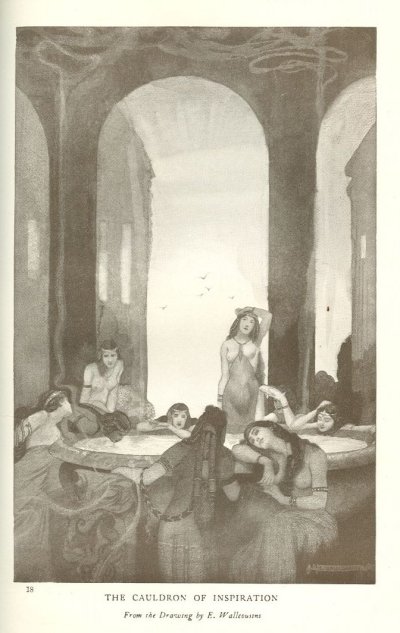
E. Wallcousins 'In Caer Pedryvan' (1912) Wikipedia Commons

Wikipedia Commons

Morgan is also associated with the mysteries of death and rebirth represented by the cauldron. It may be suggested the scene where she heals Arthur is based on an older myth wherein she and her sisters tended the Head of Annwn after his seasonal death.

Glastonbury Tor and the Mead-Feast

The sacred complex associated with Caer Vedwit: the cauldron, the Head of Annwn, and the nine maidens came together for me several years ago at Glastonbury Tor.

The isle of Avalon (‘apples’) is frequently identified with Glastonbury in the apple-growing summerlands of the Somerset Levels. Prior to the fall in sea levels, Glastonbury was an island; the area is still prone to flooding. It is easy to see how the story of Arthur being taken to Morgan and her sisters on Avalon by boat emerged from the landscape.

In The Life of St Collen whilst Collen was abbot of Glastonbury he supposedly banished Gwyn and his fairy host whilst they were feasting in the hall of his magical castle on the Tor. It seems likely the cauldron formed the centre of their mead-feast.

My first vision of the otherworld took place at Glastonbury Festival. After thirteen years of searching for an explanation, Gwyn finally appeared in my life and I realised he was my patron. Identifying the nine maidens as Morgan and her sisters and the Head of Annwn as Gwyn led me back to Glastonbury to devote myself him.

When I entered the Well House of the White Spring I could barely believe my eyes. The scene depicted in Caer Vedwit was there before me. In the centre of a subterranean cavern was the cauldron overflowing with thundering water. A dark haired woman in long skirts kindled candles around its rim. In the centre was a shrine to the Lady of Avalon and to the right and left altars for Gwyn and Brigid***.

For one day of my life everything went beautifully to plan. I made my vow to Gwyn beside the candle-lit cauldron as shadows of otherworlds and othertimes circled around me. The world spun around my resolution and my life has never been the same.

However Caer Vedwit has revolved since. Last time I went to Glastonbury the White Spring was barred. Shortly afterward I witnessed a vision where the cauldron lay shattered, its poison streaming throughout the land. I’d tasted the Awen. The time had arrived to look at the consequences of bringing forth Annuvian magic into thisworld.

The theft of the cauldron will be covered in upcoming posts.

* Cú Roí arrives at the Royal Court in Emain and challenges the Ultonians to behead him if he can return the blow. Presuming Cú Roí will die, Fat Neck agrees. Afterward Cú Roí picks up his head and returns the next night for his recompense. Fat Neck refuses. Loigaire and Conall Cernach also play the game but refuse to accept the blow. The only person brave enough to proffer his neck to Cú Roí is Cú Chullain who through his bravery wins the champion’s portion. The beheading game also forms the central plot of Gawain and the Green Knight.
**ny wdant py dyd peridyd Pen is translated by Marged Haycock as ‘(those) who don’t known on what day the Lord is created’ but I’ve chosen the more literal translation of ‘Pen’ as ‘Head’. An alternative used by Sarah Higley and John and Caitlin Matthews is ‘Chief’.
***Some scholars have connected the role of the nine maidens kindling the flames beneath the cauldron with their breath with the work of St Brigid’s flamekeepers at Kildare. In his 12th C The History and Topography of Ireland, Giraldus Cambrensis ‘it is only lawful for women to blow the fire, fanning it or using bellows only, and not with their breath.’ It seems possible this was a ban on older pagan practices.

SOURCES

Caitlin and John Matthews, King Arthur’s Raid on the Underworld, (Gothic Image, 2008)
Geoffrey of Monmouth, The Life of Merlin, (Forgotten Books, 2008)
Geraldus Cambrensis, The History and Topography of Ireland, (Penguin Classics, 1982)
George Henderson (transl.), Fled Bricend (The Feast of Bricriu), (Parentheses Publications, 1999)
John Koch (transl.), ‘The Tablet of Larzac,’ The Celtic Heroic Age (CSP, 2003)
Lady Charlotte Guest, ‘St Collen and Gwyn ap Nudd
Heron (transl), ‘Gwyn ap Nudd and Gwyddno Garanhir
Marged Haycock (transl.), Legendary Poems from the Book of Taliesin, (CMCS, 2007)
Maria Tymoczko, Two Death Tales from the Ulster Cycle: The Death of Cu Roi and the Death of Cu Chulainn, (Dolmen Press, 1981)
Rachel Bromwich (ed), The Triads of the Island of Britain, (University of Wales Press, 2014)
Sarah Higley (transl.), Preiddu Annwn, (Camelot, 2007)
Sioned Davies (transl.), The Mabinogion, (Oxford University Press, 2007)
William F. Skene (transl), The Four Ancient Books of Wales, (Forgotten Books 2007)
Will Parker, The Four Branches of the Mabinogi, (Bardic Press, 2005)
W. A. W.A. McDevitte and W.S. Bohn (transl.), The Works of Julius Caesar, (Sacred  Texts, 1869)

Not Getting to Caer Siddi: Sea Fortresses, Warships and Prisoners of War

Last year I attempted some journeywork with the otherworldly sea fortress Caer Siddi which did not go to plan. Setting out from the beach and swimming out to sea aboard my white mare, I noticed the waves becoming increasingly turbulent.

A horn blew and I saw a white sleek-prowed warship cutting through the water ahead. I recognised this as Prydwen (‘Fair Form’) the vessel of Arthur and his warriors. The horizon turned red and flashed with explosions. I saw the dark forms of other warships.

The waters rocked. At this point I knew I wasn’t getting to Caer Siddi. I turned my mare back to the beach and slipped from the otherworld dumbfounded. Reading medieval Welsh stories about Caer Siddi hadn’t prepared me for modern warships and warfare.

***

What did this mean? I started looking for clues in the world around me. In an entirely unrelated e-mail, a friend mentioned the sinking of the Lancastria off the French Port of St Nazaire on the 17th of July, 1940, whilst evacuating British nationals and troops from France.

At least 6,000 people (9,000 has been estimated) were aboard the Lancastria when she was bombed by a German aircraft. Three hits to the hold caused the spillage of 300 tons of oil. Twenty minutes later the ship capsized and sank. As the passengers struggled for their lives in the oily water they were strafed by machine gun fire from German planes and tracer bullets fired to set light to the oil.

The_Sinking_of_the_Cunard_Liner_Ss_Lancastria_Off_St_Nazaire_HU3325

Sinking of the Lancastria, Wikipedia Commons

2447 survivors were rescued, many of whom were shipped to Plymouth. Twice that number perished, making the sinking of the Lancastria Britain’s worst maritime disaster and the largest loss of British forces in a single engagement in World War II.

Great controversy surrounds Winston Churchill’s cover-up of this tragedy. A D-Notice prevented newspapers and broadcasters reporting it because two weeks after the Dunkirk Evacuation, British people ‘had had enough bad news’.

Since then the British government have refused to acknowledge the site of the wreck as a war grave. As the result of an extended campaign, the sinking of the Lancastria was finally marked by the government in July last year: 75 years on.

There seems to be some meaning in my vision of warships in the year the Lancastria’s sinking was acknowledged. Lines from ‘The Spoils of Annwn’ stating that of ‘three full loads of Prydwen’ that went into Caer Siddi only seven came back recall the terrible death toll of seaborne warfare.

***

At the same time I was led to re-reading Eternity by the Stars by Louis Auguste Blanqui. This was written in 1871 whilst he was imprisoned in the Fort Du Taureau ‘Castle of the Bull’ (a sea-fortress off the north of Morlaix in France) for his radical political beliefs during the reign of the transitional government of Adolphe Thiers.

1280px-Chateau_du_Taureau

Chateaux du Taureau, Wikipedia Commons

Kept in solitary confinement as the only prisoner of the island and banned from approaching his window on pain of death, Blanqui penned a philosophical treatise that would inspire Nietzsche’s eternal return and Walter Benjamin’s critique of progress.

Some of Blanqui’s insights are hauntingly Taliesin-like. The consensus amongst scholars is that Taliesin’s time in the prison of Arianrhod and acquisition of his chair in Caer Siddi are metaphors for Bardic initiation. Taliesin’s omnipresence is connected with his imprisonment.

Blanqui’s claims are equally profound. However the voice of a lonely 19thC radical in his sea-dungeon possesses none of the bravado of the Taliesin persona:

‘The universe is eternal, the stars are perishable, and since they form all matter, every one of them has passed through billions of existences. Gravity, thanks to its resurrecting shocks, divides, blends and kneeds them incessantly to the point that every one is a compound of the dust of others. Every inch of the ground that we walk has been part of the whole universe.’

‘Every human being is eternal at every second of its existence. That which I am writing in this moment, in a dungeon of the Fort de Taureau, I have written and shall write forever, on a table, with a quill, under clothes and in entirely similar circumstances. And so it is for all of us.’

‘At heart, man’s eternity by the stars is melancholic, and even sadder this estrangement of brother-worlds caused by the inexorable barrier of space. So many identical populations come to pass without having suspected each other’s existence! Well, not really: this shared existence is discovered at last in the 19th century but who shall believe it?’

Is it mere coincidence that I’m led to Eternity by the Stars as I’m trying to work out why I didn’t get to Caer Siddi: The Fortress of the Zodiac?

***

My insights have led me to believe that the medieval Welsh material about Caer Siddi is not only a metaphor for the initiatory journey of bards but may have a basis in the realities of seaborne warfare and prisoners of war.

If it does not refer to historical events it perhaps originated from the efforts of people to make sense of disastrous military expeditions from which only a handful of friends and kinsmen returned and what they endured whilst imprisoned by their enemies.

The stories of Brân’s battle in Ireland, Cunedda driving the Irish out of Wales and Arthur’s theft of the cauldron of Diwrnarch Wyddel (‘the Irishman’) refer to hostilities between the Welsh and Irish that no doubt had maritime dimensions.

Initiatory experiences during periods of imprisonment are rare but the number of existing testimonies (others include Aneirin, Jean Genet and Nicholas R. Mann) demonstrate their reality and provide hope and inspiration for prisoners of today.

I didn’t get to Caer Siddi yet, blown off course, I discovered valuable stories from the modern era which sadly continue to echo the ancient themes of sea-fortresses, warships and prisoners of war.

The Changing Faces of Caer Siddi

Caer Siddi is a legendary fortress in the enigmatic medieval Welsh poem ‘The Spoils of Annwn’, which is written from the perspective of Taliesin and describes his journey with Arthur and his men aboard the warship, Prydwen (‘Fair Form’) to seven fortresses in Annwn (‘the deep’).

Their aim is to accomplish a series of tasks including the rescue of the divine prisoner, Gwair, the theft of the cauldron of the Head of Annwn and capture of the Brindled Ox. Parallels with the anoethau (‘impossible tasks’) in Culhwch and Olwen suggest a shared source in Brythonic tradition.

Caer Siddi is the first fortress Arthur’s party raid. The name Caer Siddi has been translated as ‘Fortress of the Mound’ or ‘Fortress of the Fairies’ from the Welsh caer ‘fortress’ and Irish síd which refers both to the aos sí ‘fairies’ and the sídhe ‘mounds’ they inhabit. Another translation is ‘Fortress of the Zodiac’ from the Welsh siddi ‘zodiac’.

In ‘The Spoils of Annwn’ Taliesin says:
‘Maintained was Gwair’s prison in Caer Siddi,
throughout Pwyll and Pryderi’s story.
No-one went there before he did –
into the heavy grey chain guarding the loyal lad.
And before the spoils/herds of Annwfn he was singing sadly.’

Caer Siddi is presented as a prison and Gwair is its first prisoner. Gwair’s imprisonment takes place throughout the story of Pwyll and Pryderi, which is set in the ‘British foretime’ preceding the Roman invasion. Gwair’s prison is magically maintained until Arthur’s day.

The line referring to ‘the spoils/herd of Annwfn’ links the first verse to ensuing verses where the cauldron is stolen, no doubt filled with Annuvian treasure, and the Brindled Ox is towed away from his custodianship of Annwn’s herds.

Gwair’s sad song may be likened to the lamentation of Mabon son of Modron in ‘a house of stone’ in Culhwch and Olwen. Mabon and Gweir son of Gweirioed (Gwair) are listed alongside Llŷr Half-Speech as ‘Three Exalted Prisoners of the Island of Britain’ in The Triads.

Mabon provides an alternative triad of prisoners: ‘he who is here has reason to lament… no-one has been so painfully incarcerated in a prison as I, neither the prison of Lludd Llaw Eraint nor the prison of Graid son of Eri.’

There are clear parallels between the trios Mabon, Llŷr, Gweir / Mabon, Lludd, Graid. Some scholars claim Llŷr / Lludd and Gweir / Graid are the same people.

Lundy's Jetty and Harbour by Michael Maggs, Wikipedia Commons

Lundy’s Jetty and Harbour by Michael Maggs, Wikipedia Commons

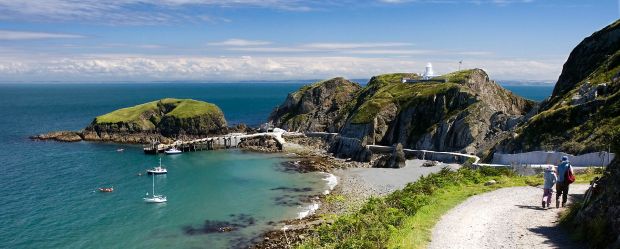
The name Gweir ap Gweirioed has been translated as ‘Hay son of Grassiness.’ Gwair means ‘hay’, gweirglodd ‘meadow’ and gweiryn ‘blade of grass.’ The green island of Lundy is known as Ynys Weir. Whether this was Gwair’s place of origin or imprisonment remains uncertain. Perhaps Gwair is a deity of grasslands and meadows and his imprisonment is representative of a barren or winter landscape.

In Culhwch and Olwen, Graid son of Eri is part of an army imprisoned by Gwyn ap Nudd, a ruler of Annwn and god of winter. Arthur rescues Graid and the other prisoners along with Graid’s dog, Drudwyn, the leash of Cors Cant Ewin to hold him with, and a steed called Myngddwn for Mabon to use on the hunt for Twrch Trwyth.

Whether these are two different tellings of the same narrative is unclear. However we can assert that imprisonment in Annwn is a longstanding theme in medieval Welsh literature.

***

Caer Siddi is also mentioned by Taliesin in ‘The Chair of Taliesin’:

‘Harmonious is my song in Caer Siddi;
sickness and old age do not afflict those who are there,
as Manawyd and a Phryderi know.
Three instruments/organs around a fire play in front of it
and around its turrets are the wellsprings of the sea;
and (as for) the fruitful fountain which is above it-
its drink is sweeter than white wine.’

Contrastingly, for Taliesin, Caer Siddi is a paradisal place where he has attained a Bardic chair. This has been linked to his claim to have spent ‘three times in the prison of Arianrhod’ in The Story of Taliesin. He also says ‘My darling is below / ‘Neath the fetters of Arianrhod’.

Arianrhod (‘Silver Wheel’) and her home, Caer Arianrhod, an island off the coast of Gwynedd seven miles south west of Caernarvon, are described by Taliesin in ‘The Chair of Ceridwen’:

‘Arianrhod, famed for her appearance surpassing the radiance of fair weather,
her terrifying was the greatest shame (to come) from the region of the Britons;
a raging river rushes around her court,
a river with its savage wrath beating against the land:
destructive its snare as it goes round the world.’

Here she appears as a beautiful yet imposing deity. This description fits with her representation in the Fourth Branch of The Mabinogion where she refuses to give her son, Lleu, a name, arms or a wife.

Unfortunately nothing is written about what happened to Taliesin during his imprisonment in Caer Arianrhod, whether he rescued his ‘darling’ and how this links to his chair in Caer Siddi. Analogies between the ‘heavy grey chain’ and ‘snare’ of a river may suggest Caer Arianrhod is Caer Siddi.

Many scholars and modern Druids interpret Taliesin’s period of imprisonment as a form of Bardic initiation giving rise to his shapeshifting capacities and omnipresence:

‘I was in a multitude of forms
before I was unfettered:
I was a slender mottled sword
made from the hand.
I was a droplet in the air,
I was the stellar radiance of the stars.’

‘I was revealed
in the land of the Trinity;
And I was moved
through the entire universe;
And I shall remain till doomsday
upon the face of the earth.’

***

It is of interest that Taliesin says Manawydan and Pryderi know Caer Siddi. In the Third Branch, Manawydan, his wife Rhiannon, Pryderi and his wife Cigfa follow a white boar to a fortress that belongs to Llwyd Cil Coed, a powerful enchanter who has put a spell on Dyfed.

In spite of Manawydan’s warnings, Pryderi enters. Captivated by a golden bowl hanging over a well he touches it and gets stuck. Rhiannon follows and meets the same fate. A blanket of mist descends and with a tumultuous noise the fortress disappears.

When Llwyd sends his people as mice to devour Manawydan’s wheat fields, Manawydan captures his pregnant wife in mouse form. By threatening to hang her on a miniature gallows, he persuades Llywd to remove the enchantment and release Rhiannon and Pryderi.

Afterward, Llwyd reveals he enchanted Dyfed as revenge for the violence inflicted by Pwyll, Rhiannon’s first husband and Pryderi’s father, on his friend Gwawl ap Clud. As Rhiannon is a divinity associated with Annwn, it may be suggested Gwawl and Llywd are Annuvian figures too.

This is backed up by Llwyd’s reappearance in Culhwch and Olwen. After Arthur and his men return from Ireland with the cauldron of Diwrnarch Wyddel, they land ‘at the house of Llwydeu son of Cilcoed at Porth Cerddin in Dyfed. And Mesur y Pair (‘the measure of the cauldron’) is there.’

The cauldron of Dyrnwch the Giant is listed amongst ‘The Thirteen Treasures of the Island of Britain’ and its property of not brewing meat for a coward identifies it with the cauldron of the Head of Annwn. The symbolic links between ‘the measure of the cauldron’ at Llwyd’s house and the well and golden bowl in his enchanted fortress are intriguing.

***

Caer Siddi is mentioned again in Ellis Gruffydd’s Chronicle of the Ages (16th C). Gruffydd claims that ‘Merlin was a spirit in human form’ who appeared in ‘the time of Maelgwn Gwynedd’ as Taliesin ‘who is said to be alive yet in a place called Caer Sidia.’

He appeared a third time as the son of Merfyn Frych son of Esyllt and ‘was called Merlin the mad. From that day to this, he is said to be resting in Caer Sidia, whence certain people believe firmly he will rise up once again before doomsday.’

An alternative story about Merlin’s resting place is found in Pen. 147. Myrddin (an earlier name for Merlin) sets out to acquire the Thirteen Treasures of the Island of Britain. The owners of the treasures agree to hand them over if Myrddin can obtain the Horn of Brân the Niggard.

Surprisingly, Brân agrees. Myrddin obtains all Thirteen Treasures and takes them to ‘the Glass House’, which is frequently identified with Bardsea Island.

Bardsey Island by Mynydd Mawr, Wikipedia Commons

Bardsea Island by Mynydd Mawr, Wikipedia Commons

***

Caer Siddi has many faces. It is the place where Gwair sings sadly fettered by a heavy grey chain. It disappeared with Rhiannon and Pryderi whilst they stared entranced into a golden bowl. Taliesin holds a Bardic chair there beneath a fountain of mead ever remembering when its rivers were a savage snare. Myrddin rests with an old, battered cauldron filled with rescued treasure beside the well where the golden bowl once hung.

These faces of Caer Siddi were known in medieval Wales. What are its faces now? I can’t tell you because I haven’t got there yet. Not getting there led to some surprising discoveries and I’ll share them in the next post.

SOURCES

Heron, ‘Merlin, Taliesin and Maponus’
John and Caitlin Matthews, King Arthur’s Raid on the Underworld, (Gothic Images, 2008)
Marged Haycock, Legendary Poems from the Book of Taliesin, (CMCS, 2007)
Patrick Ford, Mabinogi and Other Welsh Tales, (University of California Press, 2008)
Rachel Bromwich (ed), The Triads of the Island of Britain, (University of Wales Press, 2014)

The Bull of Battle and the Great Horned Bull

Auroch Skull, the Harris Museum

Auroch Skull, Harris Museum, Preston

I. Bull of Battle: Tracing an Epithet

In the opening line of The Conversation of Gwyn ap Nudd and Gwyddno Garanhir, Gwyddno addresses Gwyn as tarv trin* ‘bull of battle.’ This has always struck me as a sacred title suitable for Gwyn (‘White’ ‘Blessed’) as a divine warrior-huntsman and psychopomp on an intuitive level. Tracing its origin has led to fascinating discoveries.

Gwyn is not the only one awarded this title. In The Gododdin, a poem from The Book of Aneirin which praises the exploits of the warriors who died in the catastrophic battle of Catraeth, Eithinyn is called tarw trin twice. Caradog and ‘a man of Gwynedd’ are referred to as tarw byddin ‘bull of an army’.

In The Triads we find Tri Tharw Unben ‘Three Bull-Chieftains’ and Tri Tharw Caduc ‘Three Bull-Protectors’. Amongst them are several famous warriors of the Old North: Cynfawr ap Cynwyd Cynwydion, Gwenddolau ap Ceidio, Urien ap Cynfarch, Gwallog ap Lleenog and Afaon, son of Urien’s bard, Taliesin.

More strangely we find Tri Tharw Ellyll ‘Three Bull-Spectres’. Ellyll means ‘spirit, phantom, ghost,’ ‘goblin, elf’ or ‘wraith’ whilst gwyd ellyll refers to ‘furious activity in battle’ and is related to gwyllt ‘wild’ ‘mad’. ‘Bull-Spectres’ may be bull-epitheted warriors who went mad through battle-trauma or their ghosts.

These bull-epithets are more than poetic metaphors. Anne Ross says their underlying significance is ‘an especially apposite title for eminent warriors in a society which at one stage likened its tribal god, leader in war and protector of his people, to a great horned bull, possessing all the most impressive and desirable qualities of the animal.’

Gwyddno addresses Gwyn as ‘awesome / Leader of many’ and enters his protection. Gwyn’s rulership of Annwn and recitation of the names of prominent warriors whose deaths he attended demonstrate his role as a psychopomp and tribal or ancestral deity.

If Gwyn is the ‘tribal god’ of the men whose souls he gathers and other bull-epitheted warriors, who is the ‘great horned bull’ to whom he is likened?

II. The Great Horned Bull

Cattle played a central role in Celtic society and bulls were highly valued for their virility and strength. Therefore it is surprising we do not have an equivalent of Deiotarus ‘Divine Bull’ or Donnotaurus ‘Lordly Bull’ in Britain.

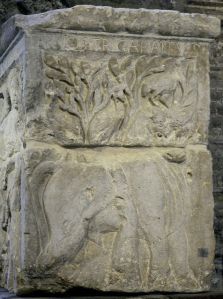
However in Paris we find a sculpture named Tarvos Trigaranus (‘The Bull with Three Cranes’). He is depicted on ‘The Pillar of the Boatmen’ (1AD) thick-set, heavy-chested, with two cranes back-to-back on his back and a third crane on his head. He stands in front of a willow. On an adjacent panel Esus (‘Lord’) is pictured cutting a willow-branch.

Tarvos Trigaranus, Wikipedia Commons

Tarvos Trigaranus, Wikipedia Commons

On a similar monument from Triers on a single stone a man cuts down a tree with a bull’s head and three cranes or egrets in it. At Maiden Castle in Dorset a bronze bull with three horns carrying three female figures was found at a 4AD shrine and may have a basis in legends of shapeshifters who took the form of cranes.

This intrigues me because with Gwyn as a bull of battle we find Gwyddno Garanhir (‘Crane-Legs’). In a personal vision, after their conversation, Gwyddno took the form of a crane and flew to Annwn with his wife and mother who were also cranes. I saw a bull and three cranes before knowing anything about Tarvos Trigaranus.

Miranda Green suggests a naturalistic explanation for the Bull with Three Cranes: ‘egrets and cattle are symbiotically linked in that the birds feed on tics and other pests which infest the hides of the cattle.’ The cattle egret is variously named ‘cow crane’, ‘cow bird’, ‘cow heron’, ‘father of ticks’ and performs this role. Could an egret picking tics from a bull’s back be the source?

Cattle egrets are native to Africa, Spain and Portugal and only spread to northern France in 1981 and Britain in 2007 so it appears this is not the case. Cranes migrate from Sweden through Germany and France to Spain and Mexico but their stops are only temporary and wouldn’t explain a long-term link with local cattle.

Although cattle egrets have only just arrived in Britain, lasting relationships exist between longhorned cattle and wetland birds. English Longhorns originate from Craven and were popular before Holstein Friesians were imported in the 19th C. They are currently being revived as ‘wetland lawnmowers’ at nature reserves because their grazing of long grasses leaves tufts for wildfowl to feed on and hollows left by their hooves are used by nesting lapwings and redshanks.

P1130794 - Copy

Longhorned Cow, Brockholes Nature Reserve

It seems possible such relations date back two thousand years to when aurochs existed alongside wetland birds. Paris’s ancient name was Lutetia (‘marsh’). The image of the ‘great horned bull’ Tarvos Trigaranus was no doubt born from Lutetia’s landscape and inhabitants.

III. The Sacrificial Bull

Auroch bulls could stand two metres high at the shoulder and weigh 1000kg. In his Gallic Wars (48-49BC), Julius Caesar describes an aurochs as ‘a little below the elephant in size, and of the appearance, colour, and shape of a bull.’ These mighty beasts were prized prey for hunters and sadly hunted to extinction in Britain in the Iron Age.

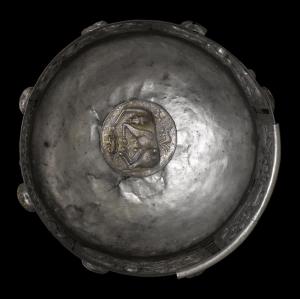
The hunting and killing of an aurochs-like bull is depicted in the bottom of the Gundestrup Cauldron. A hunter or huntress aided by three hounds prepares its slaughter with a blade. Cleverly this death-scene is also one of regeneration. The dead bull lies in a near foetal position surrounded by foliage. On a separate panel three bulls are killed by three hunters accompanied by hounds above and beneath.

'The Bull Fight' National Museum of Denmark

‘The Bull Fight’ National Museum of Denmaek

A sculpture of a sacrificial bull in the same position is found in Paris. On two altars from Alpraham near Chester we find the same bull sculpture and a hound with a close resemblance to one of the three in the bottom of the Gundestrup Cauldron.

We possess several written records of bull sacrifices. Pliny’s Natural History (1AD) refers to a complex Druidic healing ceremony in Gaul where a white-robed Druid climbs a tree and cuts mistletoe with a golden sickle on the sixth day of the moon. Afterward two white bulls ‘whose horns are bound for the first time’ are sacrificed with prayers to an unnamed god. This is followed by ritual feasting.

In Tara the way of selecting a new king was through a tarbhfhess (‘bull feast’). A bull was slaughtered then a medium ate its meat and drank its broth. Four Druids chanted a truth-spell whilst he slept and received a vision of the king. A trace of similar rites in Britain is found in Rhonabwy’s Dream where Rhonabwy experiences a prophetic vision sleeping on an ox-hide.

Stories of bull sacrifices are supported by archaeological evidence. At the war sanctuary of Gournay-sur-Aronde, cattle (including bulls) were led to a pit, killed by a single blow to the nape of the neck then left to decompose; their blood and rotting flesh feeding the earth and underworld deities. Broken weapons were piled in pits surrounding the dead animal.

Afterward the cattle bones were separated. The heads were removed and stored whilst the neck, shoulder and spine were deposited in ditches either side of the entrance with the weapons. About 3,000 bones and 2,000 bent and broken weapons were found. This provides clear evidence of associations between bulls, battle and the underworld gods.

In Britain a complete bull was found interred in a subterranean Cambridge shrine which may have been a sacrifice to the chthonic deities. A West Yorkshire chariot burial surrounded by bones from 300 cattle is suggestive of ritual feasting taking place over hundreds of years. At Maiden Castle human burials were discovered with joints of beef.

This accumulation of evidence shows the importance of the bull as a sacrificial animal whose flesh was deemed incredibly sacred as food for humans and the gods. The sacrifice of a bull would have been a considerable cost for a community. From it powerful magic stemmed for healing, prophecy and war.

IV. Magical Bulls and the Underworld

A pair of magical bulls: Finnbennach (‘White-horned of Connacht’) and Donn Cúailnge (‘Brown Bull of Cooley’) appear in the Táin Bó Cúailnge (‘The Cattle Raid of Cooley’) and fight to their deaths at the end. These bulls were originally divine herdsmen and also took the forms of ‘ravens, stags, champions, water-beasts, demons and water-worms.’

Their capacity to shift shape suggests they were theriomorphic bull deities and progenitors and protectors of their herd (which may be extended metaphorically to people). Donn Cúailnge bears resemblances to Donnotaurus ‘Lordly Bull’ whereas Finnbennach may be connected to the special white cattle sacrificed by the Gaulish Druids.

In Culhwch and Olwen, the impossible tasks fulfilled by Arthur and his men for Culhwch include the capture and yoking together of three pairs of legendary oxen: ‘two oxen of Gwylwlydd Winau’, ‘the Melyn Gwanwyn (‘The one of the yellow of spring’) and the Ych Brych (‘Brindled Ox’)’ and ‘Two horned oxen… Nyniaw and Peibiaw.’

Nyniaw and Peibiaw are the sons of Erb, King of Archenfield, ‘whom God transformed into oxen for their sins.’ I suspect this is a Christian overlay for divine herdsmen who defied the boundaries of man and ox like Finnbennach and Donn Cúailnge.

In Culhwch and Olwen it is not explained how the Brindled Ox is captured or where from. This may be derived from his appearance in The Spoils of Annwn at Caer Fanddwy (‘Fortress of God’s Peak’). Along with seven other Caers, Caer Fanddwy is located in Annwn. The Brindled Ox is described: ‘thick his headband / Seven score links / on his collar’.

The headband gives him a human-like apparel and puts me in mind of Anne Ross’s description of bronze heads on Bronze and Iron Age bucket mounts. One has a ‘hair-line defined by means of a narrow, notched band.’ Human heads with bull’s horns and birds emerging from bull’s heads appear together and are suggestive of shapeshifting bull deities. Such ancient iconography may lie behind the Brindled Ox.

In The Conversation of Gwyn ap Nudd and Gwyddno Garanhir, Gwyn speaks of his sorrow at witnessing battle at Caer Fanddwy: ‘a host / Shields shattered, spears broken, / Violence inflicted by the honoured and fair.’ It seems likely Gwyn refers to the struggle between Arthur and the people of Annwn for the Brindled Ox and this is how he was captured. Of Arthur’s side ‘except seven / none rose up.’

I believe it is no coincidence Gwyn, a bull of battle and ruler of Annwn, is present at the capture of the Brindled Ox. The Chief of Annwn is a central figure in The Spoils of Annwn and Gwyn is a potential candidate for this title. The Chief of Annwn possesses a magical cauldron. This could well be connected with a bull sacrifice and feast.

V. Fairy Kine

The notion cattle come from the underworld is deeply ingrained in the lore of Ireland and Wales. In Cruachan, King Conn steals cattle from the Sidhe then covers his land with magical snow. To melt the snow, the Sidhe kill three hundred white cows with red ears and spread their livers across the plains. For this reason, Magh Ai is called ‘The Plain of Livers’.

Here we find white cows with red ears belonging to the Sidhe (‘fairies’) which presumably come from the Sidhe (‘mounds’). A shining white coat and red ears are traditional significators of otherworldly origins.

Several Welsh stories refer to Gwartheg y Llyn (‘Kine of the Lake’) watched over by divine herdswomen called Gwragedd Annwn (‘Wives of the Underworld’). Wirt Sikes says their favourite haunts are ‘lakes and rivers… especially the wild and lonely lakes upon the mountain heights’ which ‘serve as avenues of communication between this world and the lower one of Annwn, the shadowy domain presided over by Gwyn ap Nudd.’

Cairn adjacent to Llyn Barfog, geograph.org.uk, by andy, Wikimedia Commons

‘Cairn adjacent to Llyn Barfog’, geograph.co.uk, by Andy, Wikipedia Commons

Gwragedd Annwn were rumoured to appear at dusk close to Llyn Barfog, in the hills behind Aberdovey, clad in green with hounds and ‘beautiful milk white kine’. When one of these cows strayed, falling in love with cattle from a thisworldly herd, a farmer managed to catch her. She produced calves, milk, butter and cheese like none seen in Wales.

Unfortunately the farmer decided to fatten her up to eat. Once she was fatter than the fattest cow he’d ever seen he called for the butcher. As the butcher raised his ‘red right arm’ and ‘struck fair and hard between the eyes’ with his bludgeon the blow went straight through the cow’s ‘goblin head’ raising a deafening shriek and knocking over nine men. A green Graig appeared on a crag above the lake crying:

‘Dere di felen Emion,
Cyrn Cyfeiliorn-braith y Llyn,
A’r foci Dodin,
Codwch, dewch adre.

Come yellow Anvil, stray horns,
Speckled one of the lake,
And of the hornless Dodlin,
Arise, come home.’

The milk white cow returned with all her progeny, leaving only one cow who turned from white to black. This legend explains the origin of Welsh black cattle.

VI. White Park Cattle

Historical records exist of payments of ‘real’ white cows with red ears. An Irish law tract states the penalty for satirising King Cernodon of Ulster included ‘seven white cows with red ears’.

In Wales The Laws of Hywel Dda (10th C) determined fines by numbers of colour-pointed cattle. The honour price for an insult to the King of Aberffraw was ‘100 cows for each cantref (‘hundred town’) in his dominion; a white bull with red ears for every hundred cows.’

The Lord of Dinefwr’s honour price was ‘as many white cattle with red ears that will extend, the head of the one to the tail of the other from Argoel to the palace of Dinefwr, with a bull of the same colour for every score.’ The Welsh sent 400 white colour-pointed cows and a bull to King John (who reigned 1199 – 1216AD) in a failed attempt at appeasement.

A fascinating fact that emerged from my research is that white cattle with red ears really existed and are still with us in Britain today. On Dinefwr Park in Carmarthenshire, Cadzow in Lanarkshire and Chartley in Staffordshire herds of White Park cattle are thriving. They are white and ‘have a pigmented skin with red or black ears, eyelids, muzzle, feat and teats. Sometimes there are freckles on the face, neck or shoulders. Sometimes the tail switch is white.’

White Park cow with calf on Hambledon Hill 1 Marilyn Peddle,  flickr.com. Wikipedia Commons

White Park cow with calf on Hambledon Hill 1, Marilyn Peddle, flickr.com, Wikipedia Commons

White Parks could be the source of the laws and earlier stories about white bulls and fairy kine. They even carry a recessive gene resulting in black calves which could explain the remaining black cow in the story from Llyn Barfog. Although scholars have speculated they were brought by the Romans, genetic research has proved this is not true. These Ancient British cattle could come from the underworld.

VII. The Bull and the Portal

In September 2012, Gwyn appeared to me as a bull of battle: a white warrior in a bull-horned helmet stepping with spear and shield straight out of 6th C Wales into 21st C Preston to gift me the imperative of ‘enchanting the shadowlands.’ Now my book is complete I’m being led through the portal opened on that day to explore the connections between the modern world and ‘Heroic Age’.

The image of Gwyn in the numinous prophetic aegis of tarv trin emerged from a Brythonic society not only at war with the Anglo-Saxons but plagued by bloody internecine warfare between its rulers. Gwyn served as a psychopomp to the Men of the North and the death of an era.

1500 years on thankfully wars between rival kingdoms in Britain are at an end. However we still face battle and conflict in relation to environmental and political issues.

Gwyn appears again in the Old North calling me to enter Annwn, learn to shift shape like his herdsmen and women. To seek the friendship of a great horned bull with horns of willow filled with singing birds, an island of dancing cranes, stampedes of wild white red-eared cattle careering from lakes stopping traffic on country lanes. To return with horns and hair full of birds and twigs to speak visions of hope for a new world alongside the marsh and the gods of the deep.

P1130785 - Copy

*The change in spelling from tarv to tarw results from the transition between Old and Middle Welsh. Tarv would have been pronounced ‘tarb’ whilst tarw is ‘tar-oo’. The shift from tarw to tharw is caused by the spirant mutation. Many thanks to Heron for this information and help with understanding Jarman’s translations in The Gododdin.

SOURCES

A.O.H. Jarman (transl), Aneirin – Gododdin, (Gomer Press, 1998)
Anne Ross, Pagan Celtic Britain, (Cardinal, 1974)
Anne Ross & Don Robins, The Life and Death of a Druid Prince, (Touchstone, 1991)
Heron (transl), Gwyn ap Nudd and Gwyddno Garanhir (2015)
Janet Vorwald Dohner, The Encyclopedia of Endangered and Historic Lifestock and Poultry Breeds, (Yale University Press, 2002)
Jean Sprackland, Strands: A Year of Discoveries on the Beach, (Vintage, 2013)
Lady Augusta Gregory (transl), Cuchulain of Muirthemne, (Sacred Texts, 1902)
Miranda Green, Animals in Celtic Life and Myth, (Routledge, 1998)
Miranda Green, Dying for the Gods, (The History Press, 2002)
Peter Thomas Ellis, Welsh Law and Custom in the Middle Ages, (University of Bristol)
Rachel Bromwich (ed), The Triads of the Island of Britain, (University of Wales Press, 2014)
Rachel Bromwich and Simon D. Evans (eds), Culhwch and Olwen, (University of Wales, 1998)
Sarah Higley (transl), Preiddu Annwn: The Spoils of Annwn, (The Camelot Project, 2007)
Sioned Davies (transl), The Mabinogion, (Oxford University Press, 2007)
Thomas Kinsella (transl), The Tain, (Oxford University Press, 1969)
W.A.McDevitte & W.S.Bohn (transl.), Julius Caesar, Gallic Wars, (Sacred Texts, 1859)
Wirt Sikes, British Goblins, (Lightning Source, 1880)

Thirteen calves born at WWT Martin Mere‘, Wetland and Wildfowl Trust
Ancient chariot burial excites experts‘, BBC News
The famous white cattle of Carmarthenshire’s Dinefwr’ Park‘, Wales Online

Dôn and Returning to the Source

Creatures by Greg Hill

On the cover of Greg Hill’s poetry collection, Creatures, is an image of a sculpture by Fidelma Massey called ‘Water Mother’. The first ekphrastic poem bears the same name. Rivers flow through the book with rain and turning tides.

When I reviewed Creatures in November 2014 I didn’t think I’d ever meet a mother goddess; I decided not to have children at an early age and don’t have a nurturing bone in my body.

However I’ve long been drawn to local rivers, streams and wells, above ground and those unseen, been haunted by the songs of their spirits whether rippling in sunshine, hurtling through darkness, rattling against culverts or running free.

I’ve seen a water dragon shrink and die because we shattered her aquifer, heard the screams of her daughters, stood before the empty greyness of her ghost.

In retrospect it’s not that surprising I should meet a water mother: the primal source from whom every river flows and returns. The fountainhead of all water. She who gives and draws back into the abyss.

***

Her name is Dôn. I met her last October in a vision where I was surrounded by hills filled with people. Somehow the hills became the folds of my coat and I was privileged with custodianship of these people whilst together we witnessed a primordial creation scene.

A dark orb appeared, then pupil-like, placenta-like, emerged the diaphanous form of a goddess. After her appearance the orb came to life: amoeba, green moving swards of vegetation, trees, people, marching through a labyrinthine kingdom back into the void carrying houses and entire civilisations.

Sometimes people get stuck, I heard them knocking, felt they wanted to shout out through me. From a huge crow watching above I received the gnosis my patron, Gwyn, carries the lost ones under his wings, that I too bear some responsibility for them; albeit by carrying their stories.

At the end the goddess’s name rang through the hills, from the spiralling abyss of the deep, echoing in the minds of her people, in the vow I’d made to Gwyn who flies between them: Dôn Dôn Dôn. I had the feeling of being part of her family.

***

Little is known about Dôn from Brythonic tradition. The rivers Don in south Yorkshire and Aberdeenshire bear her name suggesting she is a water goddess. In The Mabinogion we find her children: Gwydion, Gilfaethwy, Arianrhod, Gofannon, Amaethon, Eufydd and Elestron.

To learn more it is necessary to turn to Irish parallels and Danu, mother goddess of the Tuatha Dé Danaan (‘Tribe of the Goddess Danu’). Danu derives from proto-Celtic *Dānu ‘fluvial water’ and is associated with the ‘Indo-European heartland’ of the river Danube. Liz Greene says her ‘dark face was Domnu, which means “abyss” or “deep sea”.

The Tuatha Dé Danaan arrived in dark clouds from islands in the north and took the kingship of Ireland from the Fir Bolg. In turn they were defeated by the sons of Míl Espáne who took the surface whereas the Tuatha were forced underground into the sídhe (‘mounds’) becoming the aos sí (‘people of the mounds’).

Will Parker suggests the Tuatha’s arrival from the north is based on a migratory route from Greece via Scandinavia and says Neolithic Grooved Ware and Bronze Age Bell Beaker cultures show Indo-European influence.

There are no records of how the Children of Don arrived. In the Fourth Branch, Dôn has fallen into the background and her son, Gwydion, is lord of Gwynedd. Similarly we find out little about Beli, grandfather of Brân and father of Caswallon and Lludd, who become rulers of Britain.

In contrast with the Irish myths, the sons of Beli do not defeat the children of Dôn. Instead, Dôn and Beli marry and their children are seen as one family belonging to the House of Dôn.

After the death of Nudd / Lludd Llaw Eraint (‘Lludd of the Silver Arm’), like the Tuatha Dé Danaan, the Children of Dôn retreat into the Brythonic ‘underworld’ Annwn (‘not-world’ ‘the deep’). Gwyn ap Nudd appears as Annwn’s ruler and later as a Fairy King.

***

I’ve been devoted to Gwyn for three years and have gradually been getting to know him and Annwn. My explorations have led me through the deep memories of the landscape to his realm where history and myth blur and are never wholly separate

My initial work (which remains important) involved recovering the memories of my locality. Now I am being led deeper into the underworld where Nudd / Nodens, keeps the matter of dream and Dôn presides over the waters of creation and destruction.

Although earlier worlds and their children have sunk into Annwn they remain in our sacred landscape: in the hollow hills, in deep lakes and the sea, in our flowing rivers and their names.

Although barrow mounds have been ploughed over, rivers culverted, lakes drained, they are still with us in Annwn’s memory which will not let us forget their presence and what we’ve done.

Old bonds split and severed by centuries of Christianity, industrialisation, commodification, hyper-rationalism can be reknit and renewed by swimming back down the labyrinthine ways to where we’re unified with our ancestors, the old gods, their primal source: the water mother Dôn.

SOURCES

Liz Greene, The Astrological Neptune and the Quest for Redemption, (Weiser, 1996)
Robert Alexander Stewart Macalister, Lebor Gabála Érenn, (Dublin University Press, 1937)
Sioned Davies (transl.), The Mabinogion, (Oxford University Press, 2007)
Will Parker, The Four Branches of the Mabinogi, (Bardic Press, 2005)

Cwn Annwn and the Passage of Souls

Cwn Annwn Tattoo Design by Nixie

Gwyn ap Nudd… he went between sky and air.’
Peniarth MS. 132

Have you heard them howling through the skies?
Have you heard them howl of distant worlds?
Have you felt the howling fear you’ll die?
Have you feared they’re howling for your soul?
If you have, your soul is no longer yours, my friend,
It has never been and will never be until the end.
And never is never as the howling winds
That carry us between sky and air.

Dormach and Death’s Door

Gwyddno Garanhir (‘Crane-Legs’) stands in a misty hinterland before the divine warrior-huntsman and psychopomp Gwyn ap Nudd (‘White son of Mist’) and his white stallion, Carngrwn.

Beside Gwyn is Dormach, his hunting dog, ‘fair and sleek’ and ruddy-nosed. Dormach’s gaze is commanding. His nose shines like a torch-fire; a beacon; a setting sun. Although he appears as a dog his shape somehow exceeds dog-like proportions. Gwyddno says:

‘Dormach red-nose – why stare you so?
Because I cannot comprehend
Your wanderings in the firmament.’

Gwyddno’s sensory perception is distorted. Dormach is close enough for his nose to be seen yet distantly wandering across the heavens.

This is due to the misty shape-shifting nature he shares with Gwyn. J. Gwengobryn Evans tells us Dormach ‘moved ar wybir, i.e. rode on the clouds which haunt the mountain-tops.’ ‘Wybir‘ is ‘condensed floating white cloud’ referred to as Nuden and ‘serves as a garment for Gwyn.’

In a remarkable image beside the poem, Dormach appears as a strangely grinning dog with forelegs but instead of back legs he possesses two long and tapering serpent’s tails! This illustrates Dormach’s capacity to be near and distant and shows he is clearly not of this world.

Dormach Sketch - Copy

From J. Gwenogbryn Evans, The Black Book of Carmarthen, (1907)

Dormach is a member of the Cwn Annwn (‘Hounds of the Otherworld’) who are sometimes known as Cwn Wybyr (‘Hounds of the Sky’). They occupy a liminal position between the worlds and play an important role in the passage of souls.

This is represented beautifully by John Rhys’ translation of Dormach (re-construed as Dormarth) as ‘Death’s Door’. He links this to the Welsh paraphrase for death Bwlch Safan y Ci ‘the Gap or Pass of the Dog’s Mouth’, the English ‘the jaws of death’ and the German Rachen des Todes and suggests Dormach’s jaws are the Door of Annwn. Although this translation is disputed by scholars it possesses poetic truth. Death is not an end but a passage to the next life.

Gwyddno’s passing is not depicted in ‘The Conversation of Gwyn ap Nudd and Gwyddno Garanhir’. I’ve been meditating on this poem for several years and had a break-through when I realised Gwyddno’s epithet, Garanhir, was an indicator of his inner crane-nature.

In a personal vision following from the poem Gwyddno donned his red crane’s mask, grew wings and followed the red sun of Dormach’s nose to be re-united with his kindred on an island of dancing cranes in Annwn.

Transformation

Physical death is not always a prerequisite of passage to Annwn. This is shown in the story of Pwyll and Arawn in the First Branch of The Mabinogion. Pwyll’s life-changing encounter with a King of Annwn called Arawn is heralded by the ‘cry of another pack’.

Although Pwyll notices Arawn’s hounds are ‘gleaming shining white’ and red-eared he fails to recognise their otherworld nature. He commands his pack to drive them off their kill: a grand stag, and feasts his own pack on it.

As recompense Arawn asks Pwyll to take his form and role in Annwn and fight his ritual battle against his eternal foe: Hafgan. By defeating Hafgan and resisting the temptation to sleep with Arawn’s wife, Pwyll wins the title of Pwyll Pen Annwn (‘Pwyll Head of Annwn’).

In the liminal space opened by the cries of Arawn’s hounds, Pwyll does not die but is transformed. Where passage to Annwn does not demand physical death it demands the death of one’s former identity and birth of a new one in service to the powers of Annwn.

Cwn Annwn

In later Welsh folklore Cwn Annwn are known by a number of names: Cwn Wybyr, Cwn Cyrff ‘Corpse Dogs’, Cwn Toili ‘Phantom Funeral Dogs’, Cwn Mamau ‘Mother’s Dogs’, ‘Hell-Hounds’ and ‘Infernal Dogs’. Here we find an admixture of pagan and Christian folk beliefs.

Annwn is identified with hell, its gods with demons, and its hounds with hell-hounds. Christianity’s dualistic logic limits the transformative potency of encounters with Annuvian deities by reducing them to objects of fear and superstition.

Yet the lore of Cwn Annwn endures with startling vivacity. They are famed for barking through the skies pursuing the souls of the dead. Therefore to hear them is a death-portent. They often fly the ways corpses will follow: hence their associations with teulu (‘phantom funerals’).

Their magical and disorientating qualities prevail. The 14th C poet Dafydd ap Gwilym speaks of encountering ‘the dogs of night’ whilst lost in ‘unsightly fog’ after hearing Gwyn’s ‘Crazy Owl’. In a report from Carmarthenshire the closer Cwn Annwn get the quieter their voices until they sound like small beagles. The further away the louder their call. In their midst the ‘deep hollow voice’ of a ‘monstrous blood hound’ is often heard.

Like Dormach they delight in a Cheshire-cat-like ability to shift their shape. Some appear as white dogs with red ears or noses. One is a ‘strong fighting mastiff’ with a ‘white tail’ and ‘white snip and ‘grinning teeth’ able to conjure a fire around it. Others are ‘the size of guinea pigs and covered with red and white spots’, ‘small’, ‘grey-red or speckled’. Some are ‘mice or pigs’.

At Cefn Creini in Merioneth they are accompanied by a ‘shepherd’ with a black face and ‘horns on his head’ who sounds remarkably like Gwyn: a horned hunter-god who blacks his face. He is supposedly fended off with a crucifix. In certain areas of Wales the ‘quarry’ of Gwyn and the Cwn Annwn is restricted to the souls of ‘sinners’ and ‘evil-livers’.

Gabriel Ratchets

In northern England we find the parallel of Gabriel Ratchets. Although they are nominally Germanic and rooted in the Wild Hunt there are striking resemblances with Cwn Annwn.

According to Edward A. Armstrong ‘Ratchet’ derives from the ‘Anglo-Saxon raecc and Middle English… rache, a dog which hunts by scent and gives tongue’. Rachen also means jaws: we recall ‘Rachen des Todes’ ‘Jaws of Death’.

In Yorkshire they are known as ‘gabble-ratchets’. Armstrong says ‘Gabble’ is a corruption of ‘Gabriel’ and ‘is connected with gabbara and gabares, meaning a corpse’. We find similarities with Cwn Cyrff ‘Corpse-Dogs’.

Gabriel Ratchets are also defined as packs of dogs barking through the skies portending death. Intriguingly they are identified with noisy flights of nocturnal birds who sound like beagles. In Lancashire James Bowker equates them with ‘whistling’ Bean Geese* flying over lonely moors.

In Burnley, Gabriel Ratchets are connected with the Spectre Huntsman of Cliviger Gorge. A maiden called Sibyl hears ‘wild swans winging their way above her’ before she is swept through the air by a ‘demon’. Poet Philip Hamerton shares the evocative lines ‘Wild huntsmen? Twas a flight of swans, / But so invisibly they flew.’

Thousands of Bewick’s swans and Pink-footed Geese arrive to over-winter on Martin Mere between September and November: the time ‘the Wild Hunt’ flies and may form the root of these Lancashire legends.

In Nidderdale the Gabble Ratchet is equated with the ‘night-jar, goat-sucker, screech-owl, churn-owl, puckbird, puckeridge, wheelbird, spinner, razor-grinder, scissor-grinder, night-hawk, night-crow, night-swallow, door-hawk, moth-hawk, goat-hawk, goat-chaffer… and lich-fowl’

We also find the ‘Ratchet Owl’: the ‘death-hound of the Danes’ and ‘night crow’: ‘This kind of owl is dog-footed and covered with hair; his eyes are like the glistering ice; against death he uses a strange whoop.’

Gabble Ratchets also take the form of birds with burning eyes and appear to warn of death. In some cases they are identified with the souls of un-baptised children.

Cwn Annwn and the Passage of Souls

In stories of Cwn Annwn and Gabriel Ratchets we find an astonishing menagerie of imaginal ‘hounds’. These rich folk beliefs, rooted in wild moorlands and piping wetlands, were not extinguished by Christianity.

Industrialisation forced country dwellers into towns to work in factories. 12 hour shifts in ‘dark Satanic mills’ crushed imagination. Wild places disappeared with the wild mind beneath red bricks of housing developments and asylum walls of schools and universities and secular careers.

Yet through the concrete of office-blocks and head-phones of call-centres over the white-noise of television we still hear the Cwn Annwn howling. The harder we try to shut them out the louder they howl.

The stoppers in Death’s Door tremble as they bark back the liminal spaces where the gods of Annwn are encountered and souls are transformed.

An increasing number of people are encountering hounds and gods of Annwn and having their lives turned around. I met Gwyn at a local phantom funeral site when I was lost. Passing through Death’s Door with him confirmed the reality of the afterlife and has given me a deeper appreciation of life in thisworld.

As I have striven to uncover Gwyn’s forgotten mythos from the British landscape I have been unfailingly drawn to flight paths of migratory birds and recovering wetlands. Locally, the Ribble Estuary and Martin Mere; further afield, Nith’s Estuary and Caerlaverock, Glastonbury Tor and the Somerset Levels, Cors Fochno (‘Borth Bog’) in Maes Wyddno (‘Gwyddno’s Land’).

This has led me to believe that as Brythonic King of Winter Gwyn presides over wintering birds and the passage of souls. This seems significant at a time migratory birds are threatened by melting glaciers and drained wetlands and floods have wrecked havoc across the UK. Our fates are intrinsically linked.

One of the most powerful lessons trusting my soul to Gwyn taught me was it has never been my own. I have always been one of his pack, one of his flock passing between worlds between sky and air.

Arfderydd, River Nith and Caerlaverock 220 - Copy

Swans over Nith Estuary

SOURCES

Charles Hardwick, Traditions, Superstitions and Folklore, (Chiefly Lancashire and the North of England) (1872)
Dafydd ap Gwilym, Rachel Bromwich (ed.), A Selection of Poems, (1982)
Edward A. Armstrong, The Folklore of Birds (1958)
Heron (transl.) ‘The Conversation of Gwyn ap Nudd and Gwyddno Garanhir’ (2015)
Jacqueline Simpson and Steve Roud, A Dictionary of English Folklore, (2003)
James Bowker, Goblin Tales of Lancashire, (1878)
J. Gwenogbryn Evans, The Black Book of Carmarthen (1907)
John Billingsley, West Yorkshire Folk Tales, (2010)
John Rhys, Studies in the Arthurian Legend, (1841)
John Roby, Traditions of Lancashire: Volume 2 (1829)
John Webster, The Displaying of Supposed Witchcraft, (1677)
Miranda Green, Animals in Celtic Life and Myth, (1998)
Philip Gilbert Hamerton, The Isles of Loch Awe and Other Poems of My Youth, (1855)
Sioned Davies, The Mabinogion, (2007)
T. Gwynn Jones, Welsh Folklore and Folk-Custom, (1930)
Wirt Sikes, British Goblins, (1880)
Nottingham Evening Post, Monday 23rd August, 1937

*This seems odd as Bean Geese over-winter in south-west Scotland and Norfolk.
**With thanks to John Billingsley and Brian Taylor for providing some helpful pointers on Gabriel Ratchets, particularly sections from Edward A. Armstrong’s The Folklore of Birds.

The lump of my ‘workshyness’ and wanting to change the world

“I want to change the world.”

I state my desire to my deity in meditation at 7am aware as I do so of the rest of the world getting up, feeding the cats, walking the dog, jamming down breakfast, starting the car and joining the endless chug of exhaust fumes to offices and retail centres.

I’m not going to work today. My statement is laden with guilt. As I’m not working and have the luxury of sitting in meditation I feel driven to make my focus changing the world which forces so many other people into mind-numbing meaningless jobs:

sitting in call centres 9-5 Monday to Friday wired up to head phones trying to sell double glazing and insurance;

cleaning the crumbs and greasy handprints off the computers and desks and emptying the bins spilling sandwich and crisp wrappers of the people selling double glazing and insurance;

taking complaint after complaint about benefit fraud and dealing with the pettiness of complaints regarding people claiming to have had a heart attack or to be suffering from depression daring to go outside in the garden or take a walk.

I’m speaking from experience. I’ve done all these jobs: call centre, cleaner, benefit fraud hotline. I’ve also been a chamber maid, shelf-stacker, packer and administrative assistant. I’ve done what is necessary to support my study and later my writing and performing but never managed to stick such jobs because they conflict with what I really want to do.

It’s a vicious cycle and not one I can escape by earning money from my vocation. It’s extremely rare I get paid for my writing and performances or facilitating workshops. Occasionally I sell a book. My yearly income would barely keep me for a month.

If I lived in Nazi Germany I would no doubt be classified as ‘arbeitsscheu’ ‘workshy’ and incarcerated in a concentration camp. Horribly across the UK a similar phenomenon is recurring as people on disability benefits due to physical or mental illness are being reclassified as fit for work. In many instances this has led to suicide.

I’m lucky as I’m not forced to work full-time because my parents put me up. I’m not too ill to work at the moment but I have suffered from anxiety and depression (and still do on and off) and know soul-destroying jobs unfailingly grind me down to tears and hopelessness.

My desire to write goes first. Then my ability to commune with nature and hear the voices of the gods. Meaning and purpose swiftly departs and with that any reason to be alive. If I didn’t have the back-stop of my parents’ home and their support I don’t know what position I’d be in or if I’d be here at all.

Which is why I want to change the world. I want to live in a world where the life of every individual is intrinsically valued. Not this world where a person’s value is determined by their capacity to work in a meaningless job supporting an economy which benefits only the rich and is destroying the earth and human society. A world epitomised by the small-minded vindictiveness of someone who despises their job grassing up the person unable to work because of their depression for taking a walk.

Realistically I don’t possess many qualities suited to changing the world. I’m impractical, illogical and socially inept. I beat myself up continuously because I’m not cut out to be an activist or legislator. Attempting to take a stand on environmental issues at local council meetings I stumble on facts and figures and get the names of councillors wrong to smothered laughs. Unlike some people who buzz off social situations I find them draining and buckle quickly under pressure. I feel like a spare part at protests.(Although I still attend local meetings and protests and will continue to).

What I am good at is poetry and myth. Not the first places you’d look at a time when the greatest need is for manufacturers of pikes, rioters to wield them and thinkers who can traverse the lies and double-speak of parliament with the grace and dexterity of an otter.

Is there anything more useless to this world than a poet? I can think of nothing more useless and could not find a way out of my feelings of uselessness this morning when I dumped the statement of my desire to change the world like a lump of plasticine unformed and unceremoniously at the altar of my god.

Within this monstrous cacophany of thoughts you’re probably wondering whether he got a word in edgeways.

Gwyn ap Nudd’s a King of Annwn: a master of visions and glamoury renowned for his interruptions of hunting horns and a hundred hounds howling on otherworldly winds with a chill to stop one’s heart, his shining beauty and cauldron full of stars.

Today he’s silent. All I see is a depth of indigo and at its edges the melee of my thoughts rattling their pikes. Then further into the deep other pike rattlers throughout the ages who have stated the same desire albeit probably not to Annwn’s King.

Gwyn’s half-smile creases the indigo like a wave. Rattling through the ages comes the answer: there’s no easy solution.

I’m angry. That was not the answer I wanted to hear. I want to throw the ugly unformed plasticine lump of “I want to change the world” out of the window or into the deep.

Sensing my wish curious voices rise. Restless spirits reach forward to examine the plasticine with what may be hands or serpentine tails or wings. I get the impression they want to take it and mould it in their world.

Now it comes down to it I’m not sure I want to give my lump to them. I clutch it close to me. It’s my lump. My problem. My burden. What’s more I want to be seen carrying it and I want to be in control.

They prise it from my fingers. Hold it up to the starlight shining from the seas of Annwn. I see it for what it is. A desire in itself authentic but baked clumsily in the crucible of work and workshyness to the chant of uselessness and guilt. They dive with it back into the deep still indigo.

My guilt and uselessness dissolve and I realise they stem from taking on the values of a system set on devaluing all religion that it cannot harness for political control and all art that does not beg to the custodians of the establishment or market itself as mass entertainment. A system founded on the destruction of mytho-poetic worldviews.

I catch a glimmer of the Awen in what the system needs to keep destroyed. No easy solution but I see what I need to do.

I speak farewell to the lump of my ‘workshyness’ and wanting to change the world.

I assert the value of myth and poetry and the value of a poet ‘useless’ and ‘workshy’.

I pour a libation for Gwyn, the spirits of the deep, the pike-wielding ancestors and walk in trust with a pike in my hand to change the world.

***

*This piece was written yesterday and was provoked by two excellent articles on contemporary political issues: one by Brian Taylor ‘Austerity Watch, Cut to Death‘ and one by Mark Rosher ‘Living with Madness‘ and an awful article condemning ‘otherworldy polytheism’ by John Halstead ‘If It Doesn’t Help Me Save This World, I Don’t Want Your Polytheist Revolution‘.