Twrand o’r Gyre

A hen got hold of me –
a red-clawed one, a crested enemy;
I spent nine nights
residing in her womb
The Hostile Confederacy

Bird-Head

“The witch Ceridwen made me like this.”

He reminds me of one of Baskin’s cave birds:
the bare white skull with its long maxilla,
the sclerotic ring,

the way he stares just ‘so’ like a raptor,
cervical vertebrae twisting down

to feathered shoulders.

Immediately I have questions
I know I shouldn’t ask –

like where he got his cloak,
whether it’s part of him,
what’s beneath.

I keep my beak well shut,

follow with respect up the mountain
to the tap-tap-tap of his stick

as he points out bones picked clean by birds,

the skeleton still sitting waiting for death.

When I grow weary I think of how the dying
made it higher with their last breath
and stumble on to the summit.

Will I fall apart in a heap of bones
or crumble into a pile of dust?

Only his sunken eyes know.

Gyre

I totter like an old woman.

Before I’ve had the chance to look down
at what I’ve left behind I’m swept

into a gyre,
circling and circling
with the last things of Thisworld –
a wardrobe emptying of clothes,
a cupboard spilling chutnies,
jams, ketchups, vinegar.

Things I’ll dimly miss.

A new set of wings
is beating in my chest
carrying me higher higher.
The sun is my new head
illuminating the plains
of a new horizon.

Its brightness is beyond pain,
understanding, words such as ‘firmament’,
‘cloud’,‘cirrocumulus’, ‘Heaven.’

Here

the winged souls are busy,

half human, half bird,

hollowing out their bones
with the chink, chink, chink
of tiny chisels, breaking

and re-fixing humerus,
ulna, radius, fusing carples
and phalanges into wings.

Separating toes into claws.

Stretching lungs into air sacs
and filling lightened bodies full
of soulful air and otherlight.

Far Above

they are greeted by elders
who teach them to build nests

with sticks and clothes pegs,
moss, spit, newspaper cuttings
of past lives they wished they had,
toys, shoes, watch hands, fluff
from the bellies of teddy bears.

Like little old women or foetuses
they climb back into the eggs,

back into a chick-like slumber,

back into the womb of an old hen,
back into the cauldron of Ceridwen,
back into before they were born.

Nine Nights

Finally Twrand tells his story:

“For nine nights and nine days
I resided in her womb asleep like
a feather in the skies drifting from
planet to planet learning stories
of other worlds beyond her dreams
and all her deepest imaginings.

I saw the trajectory of Thisworld.

I plucked the feather of my Awen
from the side of a red-clawed hen.

When I was born she killed me:

wrung my neck, bent me out of shape.
I raised my skeleton from the sand,
fixed my wings and learnt to ride
the winds of the gyre unreturning.”

Twrand o'r Gyre MML

Dormach and the Jaws of Annwn

Dormach is the dog of Gwyn ap Nudd, who aids him hunting the souls of the dead. We have only one reference to Dormach by name in medieval Welsh literature. This is from ‘The Conversation Between Gwyn ap Nudd and Gwyddno Garanhir’ in The Black Book of Carmarthen (1350).

In this poem Gwyddno has died and is wandering the misty hinterlands between Thisworld and Annwn. There he meets with Gwyn, who offers him protection and slowly reveals his identity as a gatherer of souls. Gwyn introduces Dormach, then Gwyddno addresses the dog.

In Welsh this reads:

Ystec vy ki ac istrun.
Ac yssew. orev or cvn.
Dorma ch oet hunnv afv y Maelgun.

Dorma ch triunrut ba ssillit
Arnaw canissam giffredit.
Dy gruidir ar wibir winit.

Over the past two centuries this verse has been translated into English in various ways. The most recent and best translation is by Greg Hill (2015):

My hound is sleek and fair,
The best of hounds;
Dormach he is, who was with Maelgwn.

Dormach rednose – why stare you so?
Because I cannot comprehend
Your wanderings in the firmament.

Much controversy has surrounded the name, which is written twice as ‘Dorm ach’, with a letter erased. John Rhys assumed this was an ‘r’ giving ‘Dormarch’ with march meaning ‘horse’ ‘wholly inapplicable to a dog’.*

Rhys suggested ‘Dormach’ should instead be written as ‘Dormarth’, ‘a compound made up of dôr, ‘door,’ and marth.’ He went on to claim that marth is a ‘personification of death’ ‘of the same origin as the Latin mors, mortis… perhaps, the Marth which was the door of Annwn.’ Dormarth means ‘door-death’.

Rhys’s translation is now considered unconvincing. There is no evidence the letter was an ‘r’ and its erasure is viewed as a genuine correction. According to The Dictionary of Welsh Language, ‘Dormach’ means ‘burden, oppression’. There is textual evidence of its use from the 14th century until the 18th century. These meanings fit with medieval Christian conceptions of Gwyn and his dog(s).

Rhys notes that in Wales Bwlch Safan y Ci, ‘the Gap or Pass of the Dog’s Mouth’, is a metaphor for death and bears similarities with the English ‘jaws of death’ and German Rachen des Todes ‘jaws of death’. This argument for Dormach’s association with death and the door of Annwn seems sound. In the Brythonic and Germanic traditions we find corpse-dogs: Cwn Annwn (of whom Dormach is a member and perhaps their leader being ‘the best’) and Gabriel Ratchets, who hunt the souls of the dead and are viewed as death portents. To pass through the jaws of these dogs is to die and go to the next world.

In many world myths, dogs act as guardians to the lands of the dead. The most famous is Cerberus, who guards Hades in Greek mythology. He is variously depicted with one, two, three, or fifty(!) heads, one or more stinging serpent tails, and sometimes with a mane of snakes or snakes down his back.

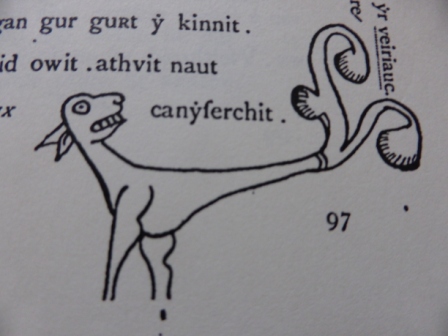
Intriguingly, in The Black Book of Carmarthen, the scribe has sketched an image of Dormach with a dog’s head and near Cheshire cat-like grin, a dog’s forelegs, and a long body tapering to two serpent tails. He bears a striking similarity to Cerberus and may also have been viewed as a guardian of Annwn.

Dormach Sketch - Copy

Part-dog, part-serpent, this image reminds me of the watery, subliminal imagery from the temple of Nodens/Nudd, Gwyn’s father. On a mosaic are two sea-serpents or icthyosaurs. On a mural crown Nodens is accompanied by icthyocentaurs with heads of men, front hooves of horses, and fish-tails.

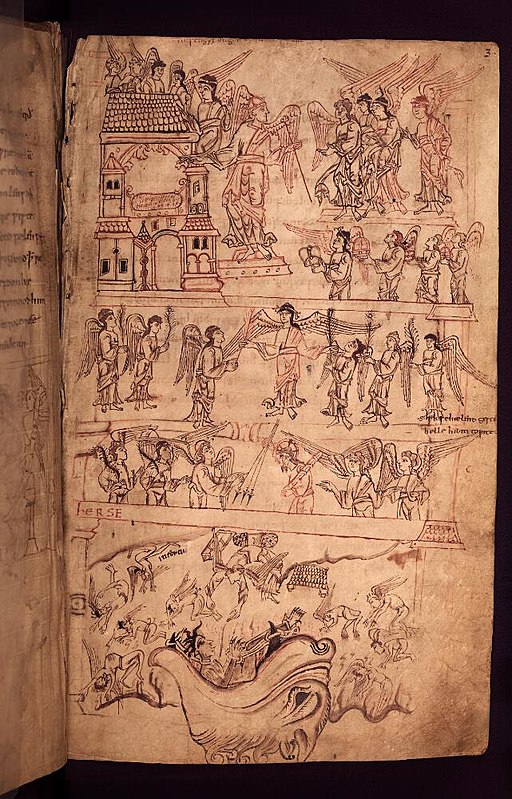
Rhys notes by Dormach he is ‘reminded of the the medieval pictures of hell with the entrance thereinto represented as consisting of the open jaws of a monster mouth.’ He refers to the tenth century Anglo-Saxon Caedmon manuscript where the devil lies chained to a tooth and demons deliver sinners into the gaping maw.

Bodleian_Libraries,_Cædmon_Manuscript_3_Wikipedia_Commons

Caedmon Manuscript

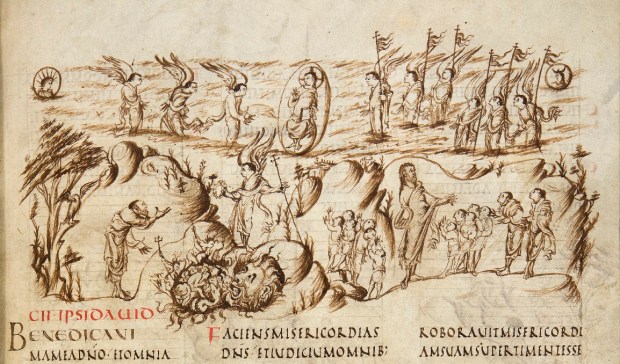
This shares similarities with the Urtecht Psalter (1055) from the Netherlands which features not only Hell Mouths but a ‘Hades Head’ (could we be looking at shared cultural representations of Pen Annwn, ‘Head of the Otherworld’?). The 11th century Anglo-Saxon Harley Psalter replaces the Hell Mouths with clefts, pits, vents, and chimneys leading into hollow hills where souls are tortured.

Utrecht124_(cropped)_Wikiwand.jpg

Utrecht Psalter with Hades Head

In these representations we find a mixture of pre-Christian Brythonic and Anglo-Saxon beliefs about the dead passing through the jaws of death to a world beneath the earth demonised and made hellish. Hell Mouths also appear on the left-hand side of Christ in the bottom corner surrounded by the demonic imagery of Hell (Heaven is on his right) in Doom paintings from across medieval Europe.

These depictions are clearly influenced by the Bible. In Isaiah 5:14 we find the lines: ‘Therefore Death expands its jaws, opening wide its mouth; into it will descend their nobles and masses with all their brawlers and revelers’ and in Numbers 16.32: ‘and the earth opened its mouth and swallowed them and their households, and all those associated with Korah, together with their possessions.’

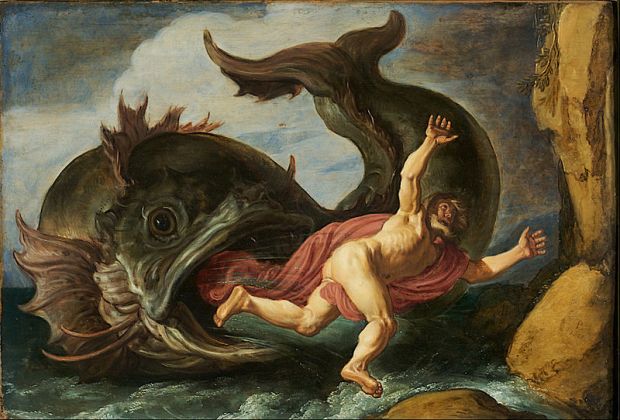
In the Book of Jonah, Jonah was swallowed by a gigantic sea creature. In the Hebrew text it is called a dag gadol, ‘huge fish’, in the Greek ketos megas ‘huge fish’, a term associated with sea-monsters, and in the Latin ketos is translated as cetus ‘whale’. Jonah is described as being in ‘the belly of hell’, ‘cast into the deep’: ‘The waters compassed me about, even to the soul: the depth closed me round about, the weeds were wrapped about my head. I went down to the bottoms of the mountains; the earth with her bars was about me for ever.’ Jonah’s ‘soul fainted’, he offered up a prayer to God, and the whale vomited him up. Here we have a clear depiction of Jonah passing to and returning from another world. ‘Hell’ is translated from Sheol, the Hebrew name for the land of dead.

800px-Pieter_Lastman_-_Jonah_and_the_Whale_-_Google_Art_Project_Wikiepedia_Commons

‘Jonah and the Whale’ by Pieter Lastman (1621)

In Matthew 12:40 Jesus compares his death, journey to Hell, and resurrection with the story of Jonah: ‘For as Jonah was three days and three nights in the belly of a huge fish, so the Son of Man will be three days and three nights in the heart of the earth.’ The sea-monster’s belly and Hell are equated.

In ‘The First Address of Taliesin’, in The Book of Taliesin, the riddling bard poses the question:

Pwy vessur Uffern,
pwy tewet y llenn,
pwy llet y geneu,
pwy mein enneinheu?

What is the measure of Hell,
how thick is it veil,
how wide is its mouth,
how big are its baths?

Here ‘Hell’ is translated from Uffern, which derives from the Latin Inferno, and is used synonymously with Annwn. Margaret Hancock links the geneu ‘maw, jaws’ with the Hell Mouth and the ‘Hell monster’ in ‘The Battle of the Trees’: a ‘great-scaled beast’ with one hundred heads who carries fierce battalions ‘beneath the roof of his tongue’ and ‘in (each of) his napes.’ This beast, like the ‘black-forked toad’ and ‘speckled crested snake’ in whose flesh a hundred souls are tortured ‘on account of (their) sins’ is evidently a death-eater and it seems likely Dormach played a similar role.

These creatures appear to be native to the Brythonic pagan tradition and to Annwn. Whilst they appear monstrous to Christians, from a pagan standpoint, they might be seen as having an essential, albeit unpleasant, function in devouring the dead and acting as vehicles for their passage to the Otherworld.

Of course, such passages are not limited to the dead. As the journeys of Jonah, Jesus, and Taliesin show, the living can pass to Annwn and one of those ways is by entering the jaws of a devouring creature.

Is there some deep and universal truth in the image of the jaws of death? Are pursuit by a monstrous beast, being swallowed, devoured, spat out, integral to the journeys of our souls in life and in death? If this is the case should the ‘oppression’ of Dormach ultimately be seen as liberating, his ‘burden’ the key to release from our fear of death as we pass through his jaws to gain knowledge of the Otherworld?

*Rhys gives no argument for this and I disagree. The name of Arthur’s dog, ‘Cafall’, may derive from the the Latin for horse, Caballus, and mean he was as big as a horse. Bran, the dog of Gwyn’s Irish cognate, Finn, shared Dormach’s colouring with ‘two white sides’ and ‘a fresh crimson tail’ and his head was shoulder high. In the Irish myths we also find dog-headed figures with horse’s manes. There is therefore no good reason why Dormach should not be seen as horse-sized or even as horse-like.

SOURCES

Greg Hill, ‘The Conversation Between Gwyn ap Nudd and Gwyddno Garanhir’, Awen & Awenydd
J. Gwenogbryn Evans, The Black Book of Carmarthen, (Boughton Press, 2008)
John Rhys, Studies in the Arthurian Legend, (Adamant Media Corporation, 2001)
Marged Haycock, Legendary Poems from the Book of Taliesin, (CMCS, 2007)
Philip A. Bernhadt House, Werewolves, Magical Hounds, and Dog-Headed Men in Celtic Literature, (The Edwin Mellen Press, 2010)
Sarah Kemple. ‘Illustrations of damnation in late Anglo-Saxon manuscripts’, Anglo Saxon England, (2003)
Biblical quotes from Bible Hub

With thanks to Linda Sever for passing on Sarah Kemple’s illuminating article.

Between Texto and Gloss

I. The Glosa

As an awenydd and polytheist writing and sharing poetry is an essential part of my path. Of all the poetic forms I have experimented with, including English, Welsh, Irish, French, and Italian metres, I have found the Spanish glosa the most conducive to religious practice.

The glosa was invented by the Spanish court poets during the Golden Age. It takes the form of four lines of text (texto) from an existing poet and four ten line stanzas of commentary (gloss) written by the glosser with the final line taken consecutively from the quatrain. The conventional rhyme scheme is ABBAACCDDC.

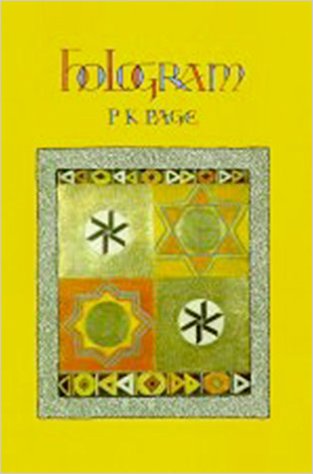
This versatile form was popular in Parisian literary salons during the reign of Louis XVI, in Germany in the Romantic period, and in Latin America throughout the struggles for independence. It was introduced into the English language comparatively recently by the Canadian poet P. K. Page in 1994.
Hologram by P.K.Page

In Hologram, Page used a series of glossae to pay homage to other poets. Her use of a rhyme scheme where the sixth and ninth lines rhyme with the borrowed tenth, and italicisation of the text and its repetitions, has set the form for poetry in English.

Page’s work prepared the ground for Charlotte Hussey, another Canadian poet, who teaches Old Irish and Arthurian literature and studied Celtic Shamanism with Tom Cowan. Her collection of glossae, Glossing the Spoils (2012), glosses the ‘earliest Western European texts’ to ‘mend a break in tradition and time’, thereby reweaving the ancient myths into modernity.

Glossing the Spoils by Charlotte Hussey

In these glossae Hussey opens a visionary space between texto and gloss where it is possible for conversations with mythic personages and experiences of the transformative qualities of ‘the spoils’ to take place. In ‘Lake of the Cauldron’ she glosses lines from ‘Branwen Daughter of Llyr’. After watching a ‘huge man with yellow-red hair’ emerging ‘from the lake with the cauldron on his back’ the narrator is pushed ‘into the boil’ by a woman with ‘dreadlocks’, ‘long breasts’, and ‘a sweaty belly’ who ‘hacks / shoulder blades, buttocks apart, / scrapes off chunks of flesh / bones sinking then surging to the rim’. The ‘great monstrous man’ from the text watches her dismemberment ‘with an evil thieving look about him’.

Many of the poems reveal the subliminal influence of these near-forgotten myths on our time. ‘Trolls’ is based on lines spoken by the Loathly Lady in Parzival. It ends with ‘The knight, lifting his fluted, iron / visor with its narrow sights’ to ‘stare out’ for ‘a crusading convoy / to join, another holocaust to start, / or a melancholic witch to burn’. Glossing Perlesvaus, Hussey draws parallels between the animistic qualities of the ghastly black shield of the knight’s aggressor with its ‘dragon’s head throwing out / fire and flame with a terrible force’ and the atom bomb – a weapon of destruction she notes cannot be contained or exorcised (1).

I read Glossing the Spoils for the first time in 2012. Discovering the glosa and Hussey’s use of it as a gateway to visionary experience has had a profound effect on my spiritual path and my approach to the medieval Welsh texts that are central to my tradition as an awenydd.

II. The Bull of Conflict

I wrote my first glosa in September that year after an initiatory encounter with Gwyn ap Nudd, a god of the dead and ruler of Annwn, the Brythonic Otherworld. Desiring to honour and thank him for pulling me back from the brink of an abyss and to learn more about him, I decided to gloss four lines from ‘The Dialogue of Gwyn ap Nudd and Gwyddno Garanhir’ (2).

This poem, from The Black Book of Carmarthen (1350) documents a conversation that takes place in the misty hinterland between the worlds following Gwyddno’s death. Gwyn appears as a ‘bull of conflict’ – a divine warrior and psychopomp – to guide Gwyddno back to Annwn. Set during the fall of northern Britain to the Anglo-Saxons it contains some of the most powerful and poignant lines in Western European literature, ending with Gwyn’s lament:

I was there when the warriors of Britain were slain
From the east to the north;
I live on; they are in the grave.

I was there when the warriors of Britain were slain
From the east to the south;
I live on; they are dead.

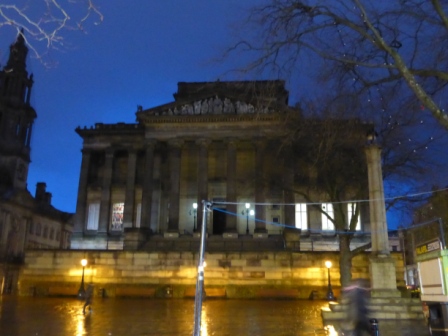
Choosing four lines I started by meditating on the first and was taken back to walking the streets of Preston that afternoon in the aftermath of the Preston Guild Festival (4) and the pervading melancholy. Drifting amongst shadow-people I found myself in the Harris Museum surrounded by the spoils of war and face-to-face with Gwyn stepping from the poem.
The Harris

The Harris Museum

In this familiar yet unfamiliar space, between texto and gloss, between poet and god a conversation took place that would change my life. Gwyn’s imperative of ‘enchanting the shadowlands’ gave me a purpose, became the title of my first book, and has guided my path ever since.

The Bull of Conflict

I come from battle and conflict
With a shield in my hand;
Broken is the helmet
By the pushing of spears.
‘The Dialogue of Gwyddno Garanhir and Gwyn ap Nudd’

On an empty day automata drift,
Wending suit shapes through the mist.
Touchless I fade like a symbol unhitched.
The spoils of war quake in the museum.
Piercing the grey wearing horns of a bull
A white warrior blackened and bloodied
Disguises his limp in an infinite gloom,
On his spear leans, softly says:
“My comrades are slain and yet I live,
I come from battle and conflict.”

His dire avowal brings howling winds,
Chill clutch at my shoulders their lament dins
Of hero light fading from mortal skin.
In glass cabinets swords clash savage,
Raging figures thrash on ragged pages
Chanting the desolate past of ravaged war bands.
With war-torn wisdom, sombrely he whispers:
“These gathered memories to you I give.
Gone are the days I crossed this land
With a shield in my hand.”

His barrage of sadness barks in my mind
Like hapless hounds on a winter’s night.
Fierce their madness, dark their plight,
For the perishing souls they collect,
The past’s great spirit protect.
Like thundering wind obligation overwhelms me.
The blade of futility threatens to unfasten me.
“How do I cherish and defend these memories
When like the kingdoms of Rheged and Elmet
Broken is the helmet?”

I ask the Bull of Conflict.
His tears run bright with the passing of time,
Chariots wheeling in multihued light,
Victims reflected in star lit skies.
He says: “this shadow land needs enchantment
To banish the blight of despair.
Nurture the memories with magic
And they’ll sing a blessed new year.
Do not be pressed into fear
By the pushing of spears.”

This was a once-in-a-lifetime experience which led me to devote myself to Gwyn as my patron god. Nothing quite like it has happened since and I have written many glosa, good and bad.

III. The Spoils

Hussey’s title, Glossing the Spoils, works on many levels. By ‘the spoils’ it refers to the spoils of war, the spoils of the distant past gathered in museums, and the spoils of our literary heritage. It also subtly alludes to ‘The Spoils of Annwn’, from The Book of Taliesin (14th C). Taliesin, the narrator, accompanies Arthur and his men on a raid on Annwn to plunder its treasures, including the cauldron of Pen Annwn, ‘Head of the Otherworld’ (Gwyn). There a catastrophic battle takes place, which Gwyn later describes to Gwyddno:

And to my sorrow
I saw battle at Caer Fanddwy.

At Caer Fanddwy I saw a host
Shields shattered, spears broken,
Violence inflicted by the honoured and fair.

Arthur assaults ‘the honoured and fair’: the fair folk ruled by Gwyn, who are forced to retaliate. In a moment suggestive of both pillage and rape Lleog thrusts his ‘flashing sword’ into the cauldron and it is ‘left behind in Lleminog’s hand’. Arthur escapes from Annwn with the spoils, slamming ‘Hell’s Gate’ shut. Only seven of three ship-loads of his men survive the conflict.

Analogously most of the spoils in our museums have been plundered violently from other lands. The literary heritage of Western Europe is largely based on a history of the victors, mythic and real, crusading, conquering, colonising. As Walter Benjamin says: ‘There is no document of civilization which is not at the same time a document of barbarism.’

These thoughts were on my mind when I embarked on a quest to explore the contemporary relevance of the Thirteen Treasures of the Island of Britain (3). They include the cauldron (which is kept by Dyrnwch the Giant), the Hamper of Gwyddno Garanhir, vessels for eating and drinking, weapons, items of clothing, and vehicles for transport. It is likely most of them were won or stolen from Annwn by the northern British warlords who own them.

Like the spoils evoked by Hussey the treasures are animate, inspirited, alive, expressing their agency through magical qualities. The cauldron will only brew meat for the brave. Brân’s horn provides any drink one wishes. Morgan’s chariot takes a traveller wherever they wish quickly. Rhydderch’s sword bursts into flames in the hand of any man who is well-born.

The Gwyddbwyll Gwenddolau, ‘Chessboard of Gwenddolau’ (4), is made of gold and has silver gwerin, ‘men’, who play by themselves. The men represent Gwenddolau’s army and his enemy and serve a divinatory function – the outcome of the game predicts the result of real battles.

Writing a glosa based on four lines about the chessboard took me on a visionary journey to Gwenddolau’s seat of rule in Arfderydd (modern day Arthuret in Scotland) and gave me a glimpse of its magic outliving Gwenddolau to predict the outcomes of upcoming wars.

View from Liddel Strength

Caer Gwenddolau

The Chessboard of Gwenddolau

The Chessboard of Gwenddolau…
if the pieces are set,
they play by themselves.
The board is gold and the men silver
(5).
The Thirteen Treasures of the Island of Britain

I leave my world behind at Carwinley Burn
to follow the feral steps of a girl,
red-haired, torqued, coloured-trousered,
a wild thing with fox’s teeth at her neck
down a fox-hole to the grave
of Gwenddolau.
Beside his bull-horned corpse
stands a table and upon it a golden board.
Round its edges silver dead men lie.
The Chessboard of Gwenddolau

has lain here as long as my father,”
she says. “It predicts the outcome of battles.
It played before Arfderydd, Catraeth,
when Britain’s air force clashed
with the Luftwaffe,
on the eve of the invasion of Iraq. As yet
it has never mispredicted an event.
At times of peace it sleeps.
At times of threat
if the pieces are set

they play out every move in the coming conflict.”
As she speaks the eyes of a warrior
jerk open and his spasmodic
hand grips his spear.
A warhorse rises from a tangle of stirrups and mane.
A bishop shakes off his robes and delves
for fireballs and mist in his pockets.
Caers rebuild their ramparts.
Returning to health
they play by themselves

speechless as automata resuming their positions.
Warriors move forward two squares
spearing on the diagonal.
Warhorses leap
over the mounting carnage,
on a fiery blast fall into splinters.
A king drags his queen into a caer.
As the bishops prepare the final spell
I am shaken by a premonitory shiver.
The board is gold and the men silver.

For me this glosa reveals the sad fact that since the war-torn period when Gwenddolau lived and now there has barely been a time when the warriors of Britain have not been at war. The uncanny battles fought between the gwerin, beneath the earth, in Annwn, represent our militant history.

As modern glossers we are faced with a past of ravaging, wounding, spoiling: a world spoilt by Arthurian warlords. How, between texto and gloss, can we enchant its shadows, heal its wounds?

Footnotes

(1) In ‘Glossing Faery
(2) At this point I was working with William Skene’s 1868 translation. I recommend the 2015 translation by Greg Hill. The title and glossed lines are from Skene, but the other two are from Hill.
(3) The Thirteen Treasures of the Island of Britain appear in several medieval Welsh manuscripts. The earliest is the autograph of Gwilym Tew in Peniarth Manuscript 51 (1460).
(4) Gwyddbwyll means ‘wood-sense’. Its translation as ‘Chessboard’ isn’t entirely correct because chess originated in the Arab world and was imported to Britain by the Normans in the 11th century.
(5) Here I took the poetic liberty of changing the form and tense of the original quote.

Sources

Charlotte Hussey, Glossing the Spoils, (Awen Publications, 2012)
Charlotte Hussey, ‘Glossing Faery’, Awen ac Awenydd
Greg Hill, ‘The Conversation Between Gwyn ap Nudd and Gwyddno Garanhir’, Awen ac Awenydd,
Keith Ellis, ‘The Glosa: A Genre to be Noticed for its Constructive Values’, Comparative Literature and World Literature, Vol 1. No. 2 (2016)
Marged Haycock, Legendary Poems from the Book of Taliesin, (CMCS, 2007)
P. K. Page, Hologram, (Brick Books, 1995)
Walter Benjamin, ‘On the Concept of History‘, Marxists.org
William Skene, ‘The Dialogue of Gwyn ap Nudd and Gwyddno Garanhir’, The Four Books of Ancient Wales, (Forgotten Books, 2007)

How to Pray

After Rilke’s First Duino Elegy

In Annwn below the earth…
There is one who knows
what sadness
is better than joy
The Hostile Confederacy

Who, if I cried out, would hear me
in the depths of Annwn? Its spirits
have wings yet are not Rilke’s angels.
I am all alone in my dark sobbing.
My hands are clasped. How to pray
when told prayer has little worth?
How to fling out this heartfelt cry
on the unclipped wings of a bird,
throughout Prydain make it heard
and in Annwn below the earth?

Voices, voices, whisper in my ears.
I, unsaintly, do not know how to hear.
How to listen as saints have heard
to voices of spirits derided as devils,
denied, defied on summits of hills,
chthonic shrines now unhallowed?
How to respond to spirits of Annwn
cast out with their unangelic terror?
Deep below, so very deep below
there is one who knows.

Oh what does he know?
Speak, please, not of sorrow,
the hardness of being dead and those
who move between the dead and living,
who died violently and could not rest,
wandered lost to their madness
until he called them home.
Speak instead of the glow
of his mead hall, the gladness
of his poetry, not what sadness

lies within his soul of many souls.
It’s said he contains the fury of the devils
of Annwn within him – an eternal current
sweeping through all the ages,
both worlds. Swept along
only knowing him when we die,
we have lost so much and are so lost.
How to pray to him in his immensity?
Fling out my cry knowing his reply
will be better than joy?seagull-flying-3-public-domain-photos

My Annuvian Path

I’m at liberty to share this because I don’t live in the age of Queen Victoria, King James, or King Arthur. I’m not Orddu, ‘the Very Black Witch’, in her cave waiting for the knife to cut her in twain. I’m not Elizabeth Southerns, Anne Whittle, Isobel Gowdie, or Isabella Rigby. Nobody blinks an eyelid when I say I worship a god of Annwn and speak with otherworldly spirits and in this I am blessed.

Still, my path is a lonely one not many choose to walk. Annwn means ‘the Deep’, ‘the Otherworld’. In this age the reign of superficiality and normalism is stronger than the influence of any monarch. There’s an inner policing – not a hanging or burning at the stake, just dismissal, lack of interest, in the mystical, the magical, the mythic, when they’re not reduced to cosplay or methods of self-development.

Paganism and Druidry have been demystified and the mystical systems that exist (in Druidry) still hinge around Taliesin and Arthur, ‘heroes’ who slaughtered and oppressed the gods and ‘monsters’ of Annwn. I keep returning to these traditions like a restless horse pacing its box, like I’m picking a scab, each time find myself more deeply disappointed; an outsider, a black sheep amongst the white-robed herds.

Perhaps our deepest myths died when Taliesin and Arthur stole the cauldron from the Head of Annwn. Something big must have perished to leave the void, filled for 1500 years by Christianity, now filled instead by the new religion of the self, the selfie, everyone wanting to be a celebrity bard in the virtual otherworlds, in the god-sized holes in their heads, which no longer have room for real gods. I have only a dim intuition what that was. If it is contained in our existing texts, it’s very well concealed. Seeking it out feels important and I can’t do so whilst wrestling with wider disillusionments.

I’ve finally reached the point my box-walking is at an end. A knowing I’ll never feel at home in mainstream Paganism or in Druidry. That my dream of being part of a physical community who get together for devotions, to work with myths, to discuss how such work can change the world, is unlikely to happen. I’ve complained of my disappointments and voiced my criticisms for the last time.

Now for some affirmations: I am an awenydd. I walk an Annuvian path. I will make the most of this opportunity my spiritual ancestors such as Orddu never had. I will reclaim our deepest myths. I will learn to live by them.

Annuvian Awen - Awen Ac Awenydd

My Scream Over Annwn

If the ninth person comes to ask for land, his proprietorship is extinguished, and he gives a shriek… and that is called diasbad uwch Annwfn.’
The Laws of Hywel Dda

Every May Eve… your dragon gives out a horrible scream.’
Lludd and Llefelys

I.
I am not a ninth son.
I am not an only daughter.
I am not dispossessed but I will scream.

I will scream in dragon’s fire.
I will scream in dragon’s blood.
I will scream myself dry

for those who have lost their land,
their kin, their deepest dreams.

II.
I will scream because I have walked
where harpers play in the stars, looked down
on the beauty of our mother earth
and seen her dirtied

by petrochemical giants with top hats of fracking rigs,
oil rigs, gas rigs, refineries, distilleries lit up
like the Blackpool Illuminations
along our coastlines

great big selfish hands throwing plastic into the seas.

III.
I will scream because I have walked
countless cities wrecked by war planes hearts hanging out
like the untied shoelaces of civilians
who had no chance to flee

seen the bombs, the bullets, the missiles,
plastic water bottles bouncing down the streets,
schools and hospitals in flames,
burning aid-workers

and the long long trains of landless refugees.

III.
I will scream because I have walked
where ice caps melt the Polar Vortex melts down
and the Polar Night Jet unravels
unleashing a Yeatsian Beast

leaving a trail of the withered dead –
tired old trees, frail crocuses, the homeless.

How we demonise the weather and refuse to face our demons!

This is madness, madness, madness, madness, madness pumping
through my searing veins and heaving in my dragon’s chest.

V.
I will scream and wish myself possessed by the spirits of Annwn.

Spirits of Annwn I call on you. Spirits of Annwn I summon you.
Bring terror to all who profit from the desecration of our mother.

Spirits of Annwn I call on you. Spirits of Annwn I summon you.
Make their businesses barren, make their money dust and leaves.

Spirits of Annwn I call on you. Spirits of Annwn I summon you.
Drain them of strength and colour and bring them to their knees.

Spirits of Annwn I call on you. Spirits of Annwn I summon you.
Bring them to kneel at altars of compost and resurfacing streams.

Let me be your dragon and I will scream ‘til the end of this world.

Let me be your dragon

You can find out more about the Scream Over Annwn and its connection with the red dragon HERE.

Methanogens and the End of the World

I. In the Deepest of Places…

They’re possibly the oldest living beings on earth. They possess the power to create and destroy life-giving climates. They thrive in the deepest of places and most extreme conditions – submarine springs, volcanic vents, hot desert sands, glacial ice – as well as in marshlands, rice paddies, landfills, sewage plants, and in the guts of termites, ruminants, and humans. Discovering their existence forced scientists to restructure the phylogenetic tree and rethink the origins of life.

Their name is only just beginning to make it into our mainstream vocabulary. They are methanogens.

Methanogens are methane generating microorganisms who can only survive in anaerobic environments. Because of their microscopic size and inability to survive in air containing oxygen they weren’t identified until the 20th century. Yet suspicions about their existence had been inferred.

Gas collecting in the marshes near Angera JPEG

In 1776 Alessandro Volta discovered the flammability of marsh gas on Lake Maggiore. Poking the reedy bottom of the marsh with his cane he collected the bubbles in a gas container then set fire to it, producing ‘a beautiful blue flame’. Natural scientists called this ‘swamp air’ ‘carbonated hydrogen’ and in 1865 ‘methan’ was proposed. ‘Methane’ was accepted in 1892.

Pierre Jacques Antoine Béchamp was the first to suspect methane was formed by a microbiological process as the result of a fermentation experiment in 1868. It was not until 1936 that the first methanogen, Methanobacillus omelianskii, was isolated with Delft canal sediment by Horace Albert Barker. This marked ‘the beginning of the modern era for the study of methanogenesis.’

Scientists went on to find out methanogenesis, a form of anaerobic respiration which uses carbon rather than oxygen as an electron acceptor, takes place in three ways: carbon dioxide reduction (hydrogenotrophic methanogenesis), cleavage of acetates (acetoclatic methanogenesis), and the breakdown of methylated compounds (methylotrophic methanogenesis).

II. Ancient Things

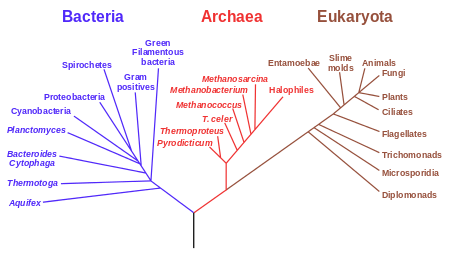
In 1997, during an experiment with RNA, Carl Woese discovered that methanogens are phylogenetically different from bacteria and eukaryota (this branch includes fungi, plants, and animals) establishing a third domain on the phylogenetic tree.

450px-Phylogenetic_tree.svg

This new group of microorganisms was named archaea, ‘ancient things’. Because their ‘methanogenic metabolism is ideally suited to the kind of atmosphere thought to have existed on the primitive earth: one that was rich in carbon dioxide and included some hydrogen but virtually no oxygen’, Woese asserted they could be the earliest living beings on our planet.

According to James F. Fasting their generation of methane, a greenhouse gas, from carbon dioxide and hydrogen, kept the young earth warm between 3.5 and 2.5 billion years ago when the sun burnt only 80 per cent as brightly as today. They played a significant role in the chain of events that led to the development of other life forms.

Methanogens were driven underground by the great oxygenation event 2.3 billion years ago – a time that corresponds with the first Global Ice Age. The world-changing effects of methanogenesis were felt again 252 million years ago when a bacteria transferred two genes to methanosarcina. This allowed them to feed on carbon on the sea floor, releasing immense amounts of methane into the atmosphere, raising the temperatures and acidifying oceans, leading to the Permian-Triassic Extinction Event, which killed 96% of species on the earth.

III. A Dangerous Game

The greenhouse gases responsible for global warming in our current era are carbon dioxide (82%), methane (10%), nitrous oxide (5%), and fluorinated gases (3%). Although methane only accounts for 10% ‘it is 25 times more powerful than carbon dioxide in global warming potential’.

74% of methane emissions in our atmosphere are produced by methanogens. The main sources are wetlands (22%), coal and oil mining and natural gas (19%), enteric fermentation (16%), rice cultivation (12%), biomass burning (8%), landfills (6%), and sewage treatment (6%). Our ability to understand and work with methanogens will play a crucial role in our future. A great deal of research has been carried out into the pros and cons of methanogenesis.

A study by Susannah G. Tringe et al. focuses on ‘a pilot-scale restored wetland in the Sacramento-San Joaquin Delta of California.’ Tringe notes that wetlands are effective carbon sinks, but methane production can outweigh the benefits in terms of emissions of greenhouse gases. By mapping the relationships between microbial communities and gas measurements her group aims to ‘reduce methane flux to the atmosphere and enhance belowground carbon storage.’

Several studies have been carried out on methanogenesis in coal mines. It has been discovered that the majority of emissions from mines are biogenic as opposed to thermogenic and take place by acetoclastic methanogensis from hard coal and mine timber. Ways of using the methane for energy are being explored. Methanogenesis also occurs in shale and experiments in biostimulation to improve productivity in combination with fracking are in progress.

Studies on landfills, a new source of organic (and inorganic) matter for these ingenuous microorganisms, show that methanogenesis, which follows hydrolysis, acidification, and acetogenesis, is an essential process in the breakdown of ‘municipal solid waste’. In landfills, as well as in wetlands, coal, and shale, acetoclastic methanogens work with acetate-producing bacteria in a syntrophic relationship. This also occurs in the breakdown of sewage. Again, ways of using the methane for energy and thus reducing emissions are being explored.

A common theme that cropped up in all these studies is that the complex interrelationships between methanogens and other bacteria and the role of methanogenesis in the global cycles are not fully understood. Nothing is said about the intelligence and agency of these secretive near-invisible beings who have played a key role in the shaping of our climate for billions of years.

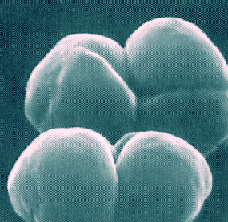
Methanosarcina, Wikipedia

Science, measuring, quantifying, postulating, manipulating, rarely listens to or respects its subjects. The Permian-Triassic extinction, which took place as the consequence of a small genetic change, highlights the potential dangers of attempting to manipulate these complex microorganisms. Without understanding, without relationship, we are playing a dangerous game.

IV. Listening to the Deep

For me as an awenydd working with Brythonic cosmology, methanogens, chthonic beings who inhabit the deepest of places and feed on organic matter composed of dead organisms, seem associated with Annwn, ‘the Deep’, the Otherworld, where the dead and dead worlds reside. Death-eaters par excellence, their activities release the gaseous spirits of the dead into the air.

These processes are essential on both physical and spiritual levels and are part of the earth’s innate balance. When this is disturbed, as now, by mankind’s raiding of Annwn for fossil fuels and release of its spirits, extinction events swiftly follow to correct the disequilibrium.

This knowledge from the depths of time is embodied in Brythonic mythology wherein Gwyn ap Nudd is said to contain the spirits of Annwn in order to prevent their destruction of the world.

Whereas we once mined with due reverence for the rules of the gods of the deep (Nodens/Nudd,‘Lord of the Mines’ was venerated at an iron ore mine at Lydney), who keep its spirits in check, their forgetting has led to all-out ravaging with disastrous consequences.

Over two thousands miners in Lancashire alone have lost their lives, many as a result of explosions caused by methane, which is also a threat at landfill sites. Flammable methane haunts the taps of people whose water has been contaminated by fracking. Global warming, caused by greenhouse gases, is claiming the lives of at least ten thousand species a year.

As the death toll rises I believe it is no coincidence that methanogens have begun to reveal themselves to us (as opposed to us thinking we are so clever finding them); coccoid, baccilic, in enigmatic strings and webs, under the UV illumination of fluorescence microscopes. These 3.5 billion year old microorganisms who dwell deep in our guts are clearly communicating.

Methanogen Microwiki

Will we learn their language? Will we listen? If we do will they lead us to redemption or destruction?

Gwyn ap Nudd,
you who have travelled time
to know the secrets of archaea:
their containment and release,

you who exist in the no-time
of Annwn between life and death
please teach us to listen
with reverence again

before you and your spirits
decide our end.

SOURCES

Carl Woese, ‘Archaebacteria: The Third Domain of Life Missed by Biologists for Decades’, Scientific American, (2012, originally published 1981)
Colin Schultz, ‘How a Single Act of Evolution Nearly Wiped Out All Life on Earth’, Smithsonian
Daniela Buckroithner, ‘Microbiology of Landfill Sites’, University of Natural Resources and Life Sciences, Masters Thesis, (2015)
Fabrizio Colozimio et al.,‘Biogenic methane in shale gas and coal bed methane: A review of current knowledge and gaps’, International Journal of Coal Geology, Vol. 165, (2016)
James F. Kasting, ‘When Methane Made Climate,’ Scientific American, (2015)
Ralph S. Wolfe, ‘A Historical Overview of Methanogenesis’, Methanogenesis: Physiology, Biochemistry & Genetics, (Chapman and Hall, 1993)
Sabrina Beckman et al, ‘Acetogens and Acetoclastic Methanosarcinales Govern Methane Formation in Abandoned Coal Mines’, Applied and Environmental Biology, (2011)
Shaomei He et al., ‘Patterns in Wetland Microbial Community Composition and Functional Gene Repertoire Associated with Methane Emissions’, American Society for Microbiology, (2015)

The Defwy – A Brythonic River of the Dead

In the sixth verse of ‘The Spoils of Annwn’ Taliesin berates ‘pathetic men’ (monks) for their lack of knowledge of the answers to riddles which in his day must have been well known. He says they do not know ‘who made the one who didn’t go to the meadows of Defwy’.

The meadows of Defwy are clearly in Annwn. Marged Haycock notes it has been suggested Defwy is a river-name from def-/dyf- ‘black’ ‘as in Dyfi’ and may be ‘a river between this world and the next’. Taliesin also sings of this river in a list of fine things in ‘The Spoils of Taliesin’: ‘Fine it is on the banks of the Dyfwy / when the waters flow’.

Rivers dividing Thisworld and the Otherworld, the realms of the living and the dead, are found in many world cultures. In Greek mythology the Styx ‘Hatred’ divides Thisworld and Hades, the dead must cross the Acheron ‘Woe’ to reach their destination, and surrender their memories to the Lethe ‘forgetfulness’ to be reborn. There are another two rivers: Cocytus ‘Lamentation’ and Phlegyton ‘fire’. All originate from Oceanus ‘Ocean’. Each is a deity. Each flows through both worlds: the Styx is a stream in Arcadia, the Acheron and Cocytus flow through Thesprotia, the Lethe through Boetia, and the Phlegethon near to Avernus.

In Norse mythology eleven rivers called Elvigar ‘Ice Waves’ arise from Hvergelmir ‘Boiling Bubbling Spring’ in Niflheim ‘Mist-World’. Amongst them is Gjǫll, which flows past Hel’s Gate and separates the living from the dead. There are forty-two rivers in total. Some flow into the ‘fields of the gods’. Others ‘go among men’ before falling into Hel. Midgard, Thisworld, is encircled by an impassable ocean where Jörmungandr, the world-serpent, lives.

Unfortunately in Brythonic tradition we possess far less lore about the cartography of Annwn. Whether it was simply lost or actively erased by Christian scribes is impossible to know. Much of what we have is obscured by Taliesin’s riddling. In ‘The Hostile Confederacy’ he speaks of:

‘the connected river which flows (around the world)
I know its might,
I know how it ebbs,
I know how it flows,
I know how it courses,
I know how it retreats.
I know how many creatures
are under the sea’

It seems the Britons shared with the Greeks and the Norse a concept of a river/ocean encircling the world. To me this speaks of an intuitive knowledge of the oceanic currents of our ‘global conveyor belt’ which flow through the world’s oceans maintaining its ecosystems.

Another riddle suggests we once possessed knowledge of many rivers thisworldly and otherworldy:

‘how many winds, how many waters,
how many waters, how many winds,
how many coursing rivers,
how many rivers they are’

It’s my intuition that, like the Greek and Norse rivers, the rivers of Annwn flow through Thisworld and the Otherworld too. In ‘The Conversation of Gwyn ap Nudd and Gwyddno Garanhir’, Gwyn, a ruler of Annwn and gatherer of souls, says he is:

‘Hurrying to battles in Tawe and Nedd.

Not the Tawe here in this land
But the one far away in a distant land
Where the tide ebbs fiercely on the shore.’

The Tawe is a river in Thisworld that flows through ‘a distant land’ – Annwn – too. It seems likely the Defwy, which might be identified with the Dyfi, appears in both worlds.

Afon_Dyfi_-_geograph.org.uk_-_242012

Afon Dyfi – the Defwy here in this land?

It is notable that Gwyn speaks to Gwyddno of his ‘sorrow’ at seeing ‘battle at Caer Vandwy’, ‘Shields shattered, spears broken / Violence inflicted by the honoured and fair’. Caer Vandwy ‘The Fortress of God’s Peak’ is mentioned in the same verse as ‘the meadows of Defwy’ with the legendary Ych Brych ‘Brindled Ox’.

Gwyn is speaking of a devastating battle between his people ‘the honoured and fair’ (the dead) and Arthur and his men who Taliesin accompanied on their raid on Annwn to plunder its spoils, which included the Brindled Ox and cauldron of Pen Annwn ‘Head of the Otherworld’ (Gwyn).

Even the impervious Taliesin describes this part of the raid of a ‘sad journey’ and says ‘save seven none returned from Caer Vandwy’. Arthur set out with ‘three loads full of Prydwen’ (his ship).

It seems Gwyn is sorrowful because the dead, who should be free of sorrow, were forced to fight and die again and he had again to gather their souls – a task he performs at battles in both worlds.

On a journey to the Defwy with Gwyn I saw people approaching the river, some to kneel and pray, some to cry, some to pour into it great jugs of tears. He told me that the Defwy is the place where the dead discard their sorrowful memories so they can move on to the lands of joy.

He also said the living can come here to do the same, but discarding one’s sorrows is a dangerous process, a form of death, and that they can never be regained because they flow away into the ocean to be reborn in new shapes walking abroad in forms unrecognisable to us.

In ‘The Hostile Confederacy’ Taliesin says in Annwn ‘There is one that knows / what sadness is / better than joy’. I believe this is Gwyn, who knows too well the sorrow of the dead who leave their memories at the Defwy in order to travel onward into his joyful realm.

Taliesin is, of course, ‘the one who didn’t go to the meadows of Defwy’, the one who continues to evade death, who claims to know all, remember all, yet in spite of this feels little sorrow, little guilt, for the catastrophes that he has witnessed and played a role in.

Knowing neither sorrow nor death will this mysterious glib-tongued entity, who was created by the magician-gods from fruit, blossoms and flowers, earth and water, ever truly know life or joy?


Mist and Darkness and the Road to Joy – The Completion of Gatherer of Souls

P1240462 - Copy - Copy - Copy

Over the past three years I have been working on a book for Gwyn ap Nudd, my patron god, to whom I devoted myself five years ago in January at the White Spring in Glastonbury.

At first I wasn’t sure what it was going to be about. It began simply as ‘Gwyn’s Book’. Because I am based in Lancashire and so many other writers have explored his connections with Glastonbury and Wales I decided to focus on his stories originating from the Old North, which are found in The Black Book of Carmarthen and Culhwch and Olwen.

After some time he made it clear that he did not want me to write an academic book (I therefore published my research on my website HERE) or  simply repeat the old tales penned by Christian scribes. Instead he wanted me to peel back the golden patina, expose the atrocities committed against him and the people of Annwn by Arthur, and journey back to the roots of his mythos in pre-Christian times when he was venerated as a god of the dead and gatherer of souls.

I met with other Inspired Ones who served him and whose souls he gathered such as the ancient ancestors of Orddu, ‘Very Black’, the Last Witch of Pennant Gofid; the northern British prophets Myrddin and his sister Gwenddydd; witches who flew with him between sky and air; wild women, madmen, poets, broken dreamers whose dreams have never been recorded.

I was prompted to explore how the closing of the doors of Annwn led to the sense of disconnection and soul loss that forms the void at the heart of the Anthropocene and to see the wonder in Gwyn’s reappearance on the brink of time as the Anglo-American Empire, which has its roots in Arthur uniting Britain under ‘One King, One God, One Law’, begins to fall.

My devotional journey has had its ups and downs. Sometimes it has felt like an endless ‘wow’ as I’ve discovered faces of Gwyn as yet unrecorded and hidden facets of his nature. At others, when I’ve been stuck in the Arthurian stories, unable to see beneath or get a break through, or I’ve written Gwyn’s voice wrong, I’ve felt frustrated, awkward, unworthy, and utterly inept. Yet I never once thought about giving up as I knew it was something I had to do.

Because there are no groups in the North West of England who venerate the Brythonic gods and goddesses or work experientially with our native myths my journey has been a lonely one. At low points I have contemplated joining the Anglesey Druid Order and even becoming a nun (when I hit thirty-five I realised it was my last chance!) although within I have known that my path in life is to walk with Gwyn even when all he can offer is “mist, darkness, and uncertainty”.

I’ve seen writing this book through to the end because serving him as an awenydd, although sometimes tough – Gwyn is the god who contains the fury of the spirits of Annwn and he is that fury just as he is the god who gathers the dead with love and compassion – is a source of deep and profound joy. Walking with him, whether through the starlit skies, or industrial smog, or blood-strewn battlefields, or the healing woodlands of Celyddon has always felt utterly right.

Gatherer of Souls is a book of new visions of the forgotten mythos of Gwyn ap Nudd  recorded in poems and stories to be published on Gwyn’s Feast, September the 29th, this year.

Over the past week I have read it out loud to Gwyn and it feels fitting that he has approved it as we approach the eclipse of the super blue wolf moon.

The One Who Didn’t Go To The Meadows of Defwy

In the fifth verse of ‘The Spoils of Annwn’ Taliesin berates ‘pathetic men’ (monks) who do not know ‘who made the one who didn’t go to the Meadows of Defwy’. I have been perplexed for several months by these lines, which pose the questions: Where and what are these mysterious meadows? Who didn’t go? What is the significance of not going? Who is his/her maker?

The Meadows of Defwy

Both my research and spirit-journeys suggest the Meadows of Defwy are in Annwn, ‘the Deep’, the Brythonic Otherworld. ‘The Spoils of Annwn’ depicts Arthur’s raid on seven otherworldly fortresses and his plundering of its treasures. Arthur’s adversaries are Pen Annwn, ‘the Head of the Otherworld’, and his people.

In the fifth verse, the Meadows of Defwy are connected with the Brindled Ox and Caer Vandwy, ‘the Fortress of God’s Peak’. In ‘The Conversation of Gwyn ap Nudd and Gwyddno Garanhir’, Gwyn (Pen Annwn) speaks of his ‘sorrow’ at witnessing ‘a battle at Caer Vandwy’ where ‘the honoured and fair’ fought Arthur’s raiding party and lost. This resulted in the theft of the Brindled Ox.

The first time I journeyed to the Meadows of Defwy I walked straight into the aftermath of the Arthur’s battle and recorded what I saw in the following verse:

A plain of blood where men once stood.
The lights have gone out in Caer Vandwy.
The clashing sea rolls over shield and spear.
The living dead. The dead dead again.

The Brindled Ox had been stolen, leaving only the deep trails of his struggling hooves as he was hauled aboard Prydwen, Arthur’s ship. His herd were frightened witnesses who had watched from a distance.

The association of the Brindled Ox with the Meadows of Defwy suggests it is a place where the animals of Annwn graze. This is backed up by the folktale Childe Roland, in which Roland found herds of horses, cows, sheep, goats, swine, and a flock of hens in Fairyland/Annwn. Roland beheaded each of their herders before assaulting the Fairy King’s castle.

wild-flowers-1363733002BId

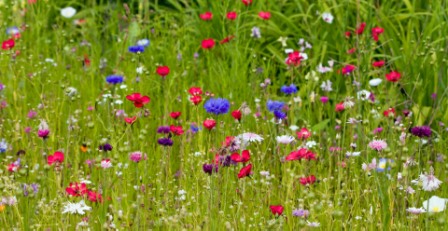
In more recent journeys I have found myself galloping through the Meadows of Defwy as a horse with the horse-herds. The meadows have appeared as a paradisal place of endless grassy plains alive with meadowflowers, bees, butterflies, grasshoppers, crickets.

It shares a kinship with ‘the Plains of Annwn’, which are written about by modern polytheist Nick Ford:

Broad and wide the plains of Annwn,
Sweet and thick, the grass thereon;
Fragrant with a million flowers,
Where graze the herds of Riganton.

Mild the breeze breathes on the pastures,
Blows the grasses that way, this;
As the horse-herds, like the wind, race
Further than the mind can guess.

The Meadows of Defwy are connected with the mare goddess Rigantona/Rhiannon and seem to bear some resemblance to the Elysian Fields of Greek mythology where the souls of the dead go to lead a blessed and happy afterlife.

Marged Haycock suggests Defwy is a river-name deriving from def-/dyf ‘black’ and may have been viewed as a river of the dead. A river Dyfwy is referred to in ‘The Spoils of Taliesin’: ‘Fine it is on the banks of Dyfwy / when the waters flow’. The Elysian Fields are located by the river of Oceanus, which separates this world from the underworld.

This ties together to suggest the Meadows of Defwy are a liminal place where the dead reside happily alongside the animals of Annwn (unless assaulted by thisworldly raiders!).

The One Who Didn’t Go

 It is my belief the phrase ‘the one who didn’t go the Meadows of Defwy’ does not literally mean someone who has not visited the meadows, but refers figuratively to someone who has escaped death.

Who could that be?

After pondering this question for a long while I received an answer from Greg Hill’s new translation of ‘The Conversation Between Taliesin and Ugnach’. When I first read this poem, which opens: ‘Horseman who rides to the fortress, / With white hounds and great horns’ I had a strong feeling the horseman was Gwyn, but was confused by his revelation of his name as Ugnach.

My confusion was laid to rest by Greg’s explanation that the suffix -ach signifies a supernatural character. It’s therefore likely to be another title of Gwyn/Pen Annwn. Greg added in a discussion that when Ugnach identifies himself he uses the word ‘heno’, a variant on ‘name’, but that ‘heno’ also means ‘tonight’. He might be saying ‘he is Ugnach just for tonight’.

The identification of Ugnach with Gwyn/Pen Annwn makes perfect sense in the context of the poem. Ugnach repeatedly extends his invitation to Taliesin to visit his fortress, promising ‘shining mead’, ‘wine flowing freely’, ‘fine gold for your spear-rest’ and a ‘bed’. Taliesin refuses to be lured by his ‘speech honeyed and fair’ and repeatedly states he does not know Ugnach. Whilst acknowledging Ugnach’s feast he insists he cannot stay.

Taliesin is refusing to stay with Ugnach in the lands of the dead; to accept death; to go to the Meadows of Defwy.

Taliesin is the One Who Didn’t Go To The Meadows of Defwy. Characteristically he is riddling about himself!

Who then is his maker?

Taliesin describes his making in ‘the Battle of the Trees’:

It was not from a mother and a father
that I was made,
and my creation was created for me
from nine forms of consistency:
from fruit, from fruits,
from God’s fruit in the beginning;
from primroses and flowers,
from the blossom of trees and shrubs,
from earth, from the sod
was I made,
from nettle blossom,
from the ninth wave’s water.
Math created me
before I was completed.
Gwydion fashioned me –
great enchantment wrought by a magic staff.

It seems this story refers to his making prior to his incarnation as Gwion Bach and rebirth from the womb of Ceridwen as Taliesin. He believes himself to have been created by the magician gods ‘before the world (was made)’ ‘when the extent of the world was (still) small’.

Thus he places himself above the processes of death and rebirth symbolised by the cauldron of Ceridwen which stands at the centre of the feast of Pen Annwn. Refusing to go to the fortress of Ugnach, Taliesin goes instead to ‘the fortress of Lleu and Gwydion’. Caer Gwydion is located in the Milky Way. There he hopes to reside in eternal life with his makers.

Taliesin escapes the fortress from which he helped steal the cauldron, the meadows where he fought ‘the honoured and fair’, the god of many names he refuses to know, but for how long?…

SOURCES

 Greg Hill, ‘The Conversation Between Gwyn ap Nudd and Gwyddno Garanhir’, The Way of the Awenydd
Greg Hill, ‘The Conversation Between Taliesin and Ugnach’, The Way of the Awenydd
Marged Haycock, Legendary Poems from the Book of Taliesin, (CMCS, 2007)
Nick Ford, ‘The Plains of Annwn’, Association of Polytheist Traditions