The Scarecrow in the Storm

On the 2nd of July I attended Pagancon and participated in a shamanic workshop with Nicola Smalley from Way of the Buzzard. Nicola opened with an introduction to shamanism then told us she had been advised by her guides to lead a journey to find out ‘how to weather the storm’.

This interested me as a number of pagans have recently received communications from the gods and spirits about ‘the storm’. This could be our environmental and political situation and/or something more…

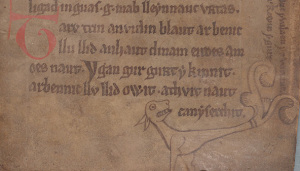
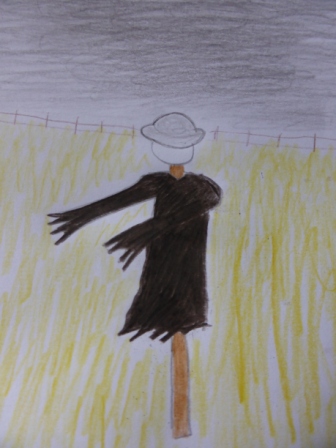
After the journey several of the other participants shared their experiences. I didn’t share mine as I didn’t know what to make of it. Beneath a storm-dark sky in a field of wind-blasted wheat I met a scarecrow clothed in black rags with a burlap sack for a head.

P1170026 - Copy

“Are you the guide who can help me weather the storm?”

No reply from the featureless sack-face as wind tore at the scarecrow’s ragged clothing and he swayed on his stick.

I rode on. And the scarecrow took flight and rode the horseless wind beside me.

“So you are my guide…”

We rode to a cliff edge to look down on a city encased in stone where the people hunkered down, cowering, gnome-like, senses closed to hope and beauty.

“What’s an awenydd to do in such a place?”

Silent the scarecrow. I’m the one with the words it seems… then the drumbeat changed and it was time to return to thisworld.

***

That’s not the first time a scarecrow has appeared in my life. Since I studied a poetry module as part of my degree they’ve been showing up. I’ve written about scarecrows at summer’s end, scarecrow arguments, humans reduced to a scarecrow-like existence. I’ve written in the voice of a bird-scarer.

When I looked up the history of scarecrows I found out they were not used in Britain until many of the children who worked as bird-scarers (armed with a clacker from dusk to dawn to scare away the birds) died during the plague in the 13thC. It was only then that farmers started creating straw men with gourd faces and propping them on poles.

I also discovered they had an abundance of names. In Devon ‘Murmet’, Somerset ‘Mommet’, here in Lancashire and in Yorkshire ‘Mammet’. ‘Mawkin’ in Sussex and ‘Hodmedod’ in Berkshire. ‘Hayman’ across England. ‘Bwbach’ in Wales. On the Isle of Skye ‘Gallybagger’ and on the Isle of Wight ‘Tattie Bogal’. In Scotland ‘Bodach-rocais’ ‘Old man of the rooks’.

Names such as ‘Bwbach’ and ‘bogal’ are synonymous with bogies and ‘Mammet’ was used from the 13th-17thCs to denote a ‘false god or idol’ and later applied to ‘a doll or puppet, a lifeless figure, an effigy, a scarecrow’. All hold an otherworldly resonance. It’s no wonder in many of our stories scarecrows come to life.

***

In relation to weathering the storm it struck me that scarecrows stand strong in all weathers. This is exemplified by Walter de la Mare’s poem ‘The Scarecrow’.

The Scarecrow

All winter through I bow my head
beneath the driving rain;
the North Wind powders me with snow
and blows me black again;
at midnight ‘neath a maze of stars
I flame with glittering rime,
and stand above the stubble, stiff
as mail at morning-prime.
But when that child called Spring, and all
his host of children come,
scattering their buds and dew upon
these acres of my home,
some rapture in my rags awakes;
I lift void eyes and scan
the sky for crows, those ravening foes,
of my strange master, Man.
I watch him striding lank behind
his clashing team, and know
soon will the wheat swish body high
where once lay a sterile snow;
soon I shall gaze across a sea
of sun-begotten grain,
which my unflinching watch hath sealed
for harvest once again.

Made from the leftovers of thisworld yet imbued with the spirit of the otherworld, undignified yet strangely maintaining dignity, the scarecrow is a liminal figure who stands as an unspeaking guardian to the changing seasons and cycles of the crops.

He knows how to weather the storm.

What he lacks is a voice and expression on his burlap face. Perhaps we can work together: the awenydd and the scarecrow in the storm.

Dumbarton Rock

Consolidating Gwyn ap Nudd’s links with the Strathclyde Britons

In October after the ritual to Epona I stayed overnight with Potia and Red Raven in Glasgow. The next morning, Red Raven kindly took me to visit Dumbarton Rock: Dun Breatann ‘Fortress of the Britons’ to continue my research on Gwyn ap Nudd’s lost connections with the Old North.

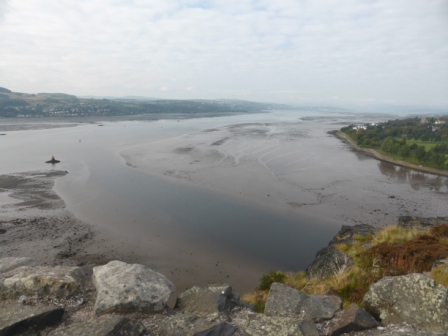
Dumbarton Rock stands on the estuary of the river Clyde beside the river Leven, stern, stony, commanding, cloven into two peaks, White Tower Crag and The Beak. Its proximity to an ancient hill fort on Carman Hill and Roman Forts such as Whitemoss guarding the estuary suggest its use as a defensive position from at least the Iron Age and Romano-British periods. Looking up at its vertical cliff face from beneath and climbing its 557 steps provided a distinct impression of how difficult it would have been to attack.

Dunbreatann emerged as the capital of Strathclyde, controlling south-west Scotland after the Romans withdrew from the Antonine Wall, in the 4th century. Later it was known as Alt Clut ‘Clyde Rock’. The first written reference comes from St Patrick from Ireland between 453 and 493AD, reprimanding Coroticus (Ceretic, ruler of Alt Clut) for taking his new Christian converts and selling them as slaves to the Picts.

The majority of its rulers were descendants of Ceretic: notably Dyfnawl Hen, Cinuit, Clinoch, Tutagual then Rhydderch Hael. After Rhydderch’s death in 612, rulership passed to another line stemming from Ceretic: Neithon son of Guipno and his lineage ruled until Dumbarton Rock was taken by the Vikings in 869.

A fragment in The Black Book of Chirk states that following the death of Maelgwn Gwynedd in 547, Elidyr Mwynfawr (first cousin of Tutagual and husband of Eurgain, Maelgwyn’s oldest legitimate daughter) attempted to seize the throne from Maelgwn’s illegitimate son, Rhun. Elidyr was killed at Arfon. This led to Rhydderch Hael, Clydno Eiddin, Nudd Hael and Mordaf Hael burning Arfon in revenge and being pursued north by Rhun’s forces to the river Gweryd.

Elidyr’s journey is recorded in a triad of ‘Horse-Burdens’ where the eponymous water-horse Du y Moroedd (‘The Black One of the Seas’) is said to have carried Elidyr and his party (seven and a half people including a cook hanging onto the crupper- hence the half!) from an unknown Benllech in the north to Benllech on Anglesey. Du is notably the steed ridden by Gwyn ap Nudd in the hunt for Twrch Trwyth (‘King of Boars’).

Rhydderch Hael (‘the Generous’) is the most famous of Strathclyde’s rulers. He was renowned as one of ‘Three Generous Men of Britain’ and owned a sword called Dyrnwyn ‘White Hilt’ which burst into flames when held by a well-born man and was numbered amongst the Thirteen Treasures of Britain.

The extent of Rhydderch’s generosity is hinted at by the third ‘Unrestrained Ravaging’ where Aeddan Fradog (‘the Wily’) came to his court and left no food, drink nor living beast (if Rhydderch was exceedingly generous and Aeddan took everything he must have been greedy and unrestrained indeed: one can sense the shock and disbelief of a contemporaneous audience).

Rhydderch championed Christianity and was the patron of St Kentigern. He came to power in 573, which coincides with the Battle of Arfderydd. Poems attributed to Myrddin Wyllt in The Black Book of Carmarthen suggest Rhydderch played a leading role in the defeat of the pagan ruler, Gwenddolau at Arfderydd and this was a factor in his rise to power.

In The Black Book of Carmarthen Gwyn ap Nudd states his presence at Gwenddolau’s death. Gwyn’s appearance to gather the soul of Gwenddolau and other dead warriors played a role in Myrddin’s madness and flight to Celyddon. The ex-warrior become wild man and prophet was hounded by Rhydderch Hael and supposedly converted to Christianity by St Kentigern.

Rhydderch also played a prominent part fighting against Theodric of Anglo-Saxon Bernicia with his Brythonic allies Urien Rheged, Gwallog ap Llenog and Morcant Bulc. During the campaign, whilst the Anglo-Saxons were successfully blockaded on Lindisfarne, Morcant assassinated Urien; a move which eventually led to the fall of the Old North.

Rhydderch’s successor, Nwython (Neithon) and his family feature prominently in the episode of Gwyn, Gwythyr and Creiddylad in How Culhwch won Olwen. After Gwyn ‘abducts’ Creiddylad from Gwythyr and takes her to Annwn, Nwython, his sons Cyledyr and Pen, Dyfnarth (Dynfawl?) and his Dyfnarth’s father Gwrgst Ledlwm join Gwythyr in an assault on Gwyn to win her back (four generations of Strathcylde Britons!).

Gwyn defeats Gwythyr and his army and imprisons them. During their imprisonment, Gwyn kills Nwython and feeds his heart to Cyledyr, who becomes wyllt (‘wild’ ‘mad’). Arthur then rescues Gwythyr and his men and places a command on Gwyn and Gwythyr to battle for Creiddylad every May Day until Judgement Day.

It is my intuition this story originates from an earlier seasonal myth where a hero (‘the Summer King’) challenged the god of Annwn (‘the Winter King’) for the love of a goddess of fertility and sovereignty who may originally have been revered as a free agent in a sacred marriage.

This episode is only one variant, fixed in 6th C Strathclyde, known because of its incorporation within the narrative of How Culhwch won Olwen (14th C). It is clear Gwyn has lost his status as a god of Annwn and Creiddylad her independence as a fertility goddess. Its fixity may be read to mark the death of a seasonal rite and its transition into story.

No doubt this coincided with the rise of Christianity, which led to Gwyn’s demonisation as the representative and literal embodiment of the ‘demons’ of Annwn and Creiddylad’s demotion to a helpless maiden flung like a ragdoll between two male lovers and finally locked away, powerless, in her father’s house.

The seasonal myth is thus replaced in the 6th century with a story designed for the political purpose of cementing alliances between the Strathclyde Britons, Gwythyr ap Greidol (deified as ‘the Summer King’) and Arthur against a common enemy: the demonised King of Winter and Annwn, Gwyn ap Nudd.

The disturbing sequence of Gwyn’s murder of Nwython and torture of Cyledyr has led me to question whether it has any historical basis. From my research so far there is nothing to suggest Nwython died a sudden or inexplicable death or disappeared during a campaign (often attributed to otherworldly forces).

However this does not mean such stories did not exist. Another explanation is that it was cited by the bards of Christian rulers to highlight the atrocities Gwyn committed against the lineage of Strathclyde to keep paganism at bay. One can only imagine the fear and repulsion of Strathclyde’s people and in particular Nwython’s descendants when it was voiced.

P1110994

It seems possible early variants of these stories were told in the fortress on The Beak alongside inaugural poems which would form Y Gododdin and The Black Book of Carmarthen. The existing texts suggest belief in Gwyn as a psychopomp lingered on beside the Christian faith for a long while. As a guide and warrior-protector to some and a cruel, demonic figure to others, he haunted the margins of every recital of battle-tales.

After Dumbarton Rock was taken by the Vikings, the kingdom of Strathclyde re-emerged up-river at Govan and stretched from Glasgow into Penrith in Cumbria. During this transition and, later, when Strathclyde was finally integrated into Scotland in 1034 many Britons went into exile and settled in Wales. In medieval Wales the oral tales about Gwyn ap Nudd and the fall of the Old North were finally penned.

Since then Dumbarton Rock has seen various uses; most notably as a medieval royal castle with its famous Wallace Tower. It is now primarily a tourist attraction within the custodianship of Historic Scotland.

Time passes. History fades into story into myth and even myth is forgotten. Yet the deepest myths are fated to return from the most distant edges of the otherworld like a boomerang.
P1110997

Looking out across the Clyde and Leven from the Fortress of the Britons I saw a pair of ravens who have lived forever on that ancient rock flying on the winds from there into poetry to the realm of the gods and back again.
P1120006

On that note I’ll thank Red Raven for taking me to Dumbarton Rock and bring this piece to end.
Breaking the Silence

Two months ago I decided to take a break from blogging. I’d returned from Wales after climbing mist-ensorcelled hound-haunted Cadair Idris. Standing on the shoulder of a giant dizzied by his mad dreams. Staring down into Llyn Cau and Llyn y Gadair. Finding refuge in the hut of the mountain guide.

In Wales the gods are huge. Their names and stories echo from deep valleys and massive mountains and are carried in streams and rivers to where the immensity of the sky meets the immaculate sea on the western coast. From Pen y Gadair the mists of Gwyn ap Nudd never leave.

On Borth beach I read Heron’s new translation of ‘The Dialogue of Gwyn ap Nudd and Gwyddno Garanhir’. The name Borth derives from Porth Wyddno and is the location of Cantre’r Gwaelod (The Bottom Hundred); Gwyddno’s drowned kingdom. It was my intuition Gwyddno died there and the poem records a conversation between the worlds where Gwyn offers Gwyddno protection and guides him to Annwn (the Brythonic otherworld).

Reading the poem was immensely powerful. I experienced vividly the presence of these two great mythic figures speaking against the backdrop of the pebbled beach and roaring sea. Afterward at sunset I saw the otherland of which Gwyn speaks ‘where the tide ebbs fiercely on the shore’ appear on the horizon.

Borth VI returned to Penwortham mind-blown with much to absorb in thought and dream only to experience another immensity. This time a crushing one. Walking the section of the old pilgrim’s path that leads across the A59 from the site of St Mary’s Well to the War Memorial I got trapped in the middle of the road: unable to cross because of the heavy rush of traffic at school pick-up time.

A59 between site of St Mary's Well and Penwortham War MemorialI knew this was the result of the widening of Penwortham By-Pass. A rush which will only increase when a new stretch of by-pass is built leading over the river Ribble to Junction 2 of the M55 (which exists only in name having been planned over 40 years ago). That this was linked to the expansion of BAE, the University of Central Lancashire, to the building of new housing developments and employment sites throughout Preston and South Ribble.

I was struck by the overwhelming gnosis it was beyond me to stop the growth of this monster. I could not stop the City Deal. I’d known for a while the City Deal was something not even the most seasoned campaigners would dare take on as a whole. That each of us must find our own way of protecting what we value within the realms of possibility whether it’s by campaigning against individual developments, fracking (which will not only ruin the landscape and poison our sacred watercourses but fuel the monster), austerity, defending and caring for an area of green space or growing and nurturing a community group.

Acknowledging this insight has taken a lot of readjustment during which I realised attempting not even to save the world but just South Ribble and Preston, Penwortham even, was beyond my capability and making me ill. Not only that, Peneverdant ‘the green hill on the water’ with its aquifer shattered in 1884, its holy wells dry, its banks subsiding with falling trees and gravestones under increasing duress from the By-Pass wanted to close down. Hence the closure of ‘From Peneverdant.’

What did I have left? The Friends group I run in Greencroft Valley with its wildflowers and apple trees. The monthly poetry night I play a lead role in organising at Korova Arts Cafe & Bar which provides a safe and welcoming space for newcomers and established poets to perform. The Oak and Feather Grove.

My relationship with the land and the gods which my recent travels north and to Wales have taught me need not be limited to Penwortham. The inspiration and awe I find in my path as an awenydd devoted to Gwyn ap Nudd. The depth and magic of his known and unknown stories. A growing awareness of other Brythonic gods and goddesses and their myths.

Whilst I’ve had support and companionship from friends and family and other poets and pagans, until the past couple of months my path as an awenydd and Brythonic polytheist has been a lonely one. However, in October I went to Glasgow to a ritual to Epona-Rigantona led by Potia and last week returned to Borth and finally met Heron, whose writing has guided and inspired me for several years.

Together on Borth beach Heron and I read my story ‘The Crossing of Gwyddno Garanhir’ which I wrote after my previous visit to Borth based on his translation of Gwyn and Gwyddno’s dialogue. It was moving and beautiful reading and listening to the words, born from the place, from an ancient poem passed on from poet to poet, feeling it live on the sea breeze and the rolling tides, honouring Gwyn’s role as a psychopomp, Gwyddno’s passing and the absent cranes (‘garan’ from Garanhir means crane in Welsh) who I gave the role of soul-birds. Afterward we walked across Cors Fochno (Borth Bog), where cranes may have nested, up Cwm Clettwr and to Taliesin’s grave.

I returned nourished with my feeling of the increasing import of the Brythonic myths juxtaposed with my frustration so few people have an interest in them. Of having much to share but no-one to share with. Which led once again to despair until I had a dream which somehow I knew took place ten years in the future.

I was leading a guided tour of one or two disinterested people to ‘Cockersand Fields’ (which I interpreted to be the fields near Cockersand Abbey where a statue to Mars-Nodens was found) and was feeling ready to give up on this task and life altogether. I hadn’t put my heart into it for several years. Then I saw a group of young backpackers approaching from boats on a sunset beach with smiles and eyes filled with hope. They’d come searching for stories about Gwyn, which I’d failed to write: a failure I suddenly regretted and a friend pushed me to rectify.

The dream seemed to be telling me not to lose hope in a vocation that nurtures my soul, brings me joy and could likewise bring meaning and purpose to others because my writing doesn’t provoke immediate responses or recognition. To think of the long term rather than satisfaction in the now.

Thus for the first time since the closure of ‘From Peneverdant’ I break my silence. Whilst I can’t promise my words will save the world or even Penwortham, I hope for others led down strange paths by little-known gods they may provide signposts in the mist that lead to the strength and inspiration to live with joy and depth in this troubled world.

Borth III

Hoddom and Brydekirk: The Fire of the Gods Endures

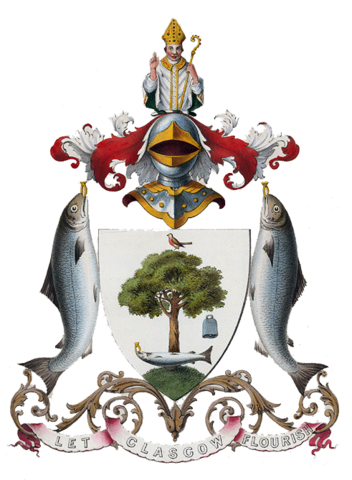
St Kentigern on Glasgow Coat of Arms, Wikipedia Commons

In Jocelyn’s The Life of St Kentigern there is a story about the saint’s recall from Wales to the Old North by Glasgow’s ruler, Rhydderch Hael. Following an angelic vision, Kentigern sets out with 665 disciples and arrives in Hoddom where he is greeted by a multitude of people.

Drawing a cross and invoking the Holy Trinity, Kentigern orders anyone against the word of God to depart. This results in ‘a vast multitude of skeleton-like creatures, horrible in form and aspect’ departing from the assemblage and fleeing from sight.

Reassuring the terrified crowd Kentigern ‘lays bare’ what they believe in. He condemns their idols to the fire and tells them their principal deity ‘Woden’ from whom they claim descent is nothing more than a mortal man of a pagan sect whose body is ‘loose in the dust’ whilst his soul ‘endures the eternal fire’ in the underworld.

As Kentigern preaches faith in Jesus Christ the flat plain of ‘Hodelm’ rises into a hill which remains to this day. The people ‘renounce Satan’ and are washed in the waters of baptism.

This foundation legend explains the association of the site of the church and the graveyard beside the river Annan across from Woodcock Air (the hill) at Hoddom with St Kentigern.

Woodcock Air Hill

The Life of St Kentigern was commissioned by Jocelyn, Bishop of Glasgow, and written by Jocelyn, a monk of Furness, in the 12th century. As a literary hagiography it was clearly designed to promote the life of Kentigern (who lived in the 6th century) and vilify paganism. As a historical document it should be approached with caution, particularly in light of the anachronism concerning Woden.

Whilst there is archaeological evidence of a Northumbrian monastery based around St Kentigern’s church at Hoddom it was not founded until the 8th century. (This is evidenced by an 8th century letter sent by Alcuin to Wolfhard, Abbott of Hodda Helm). The Anglo-Saxons did not arrive until long after Kentigern died. It seems Jocelyn wove later tales concerning the conversion of Woden’s worshippers into the text.

This leaves us with the question of who the people of Hoddom venerated prior to Kentigern’s arrival. The existence of a local cult is evidenced by a Roman altar stone found in the wall of the church at Hoddom Cross and built into the porch in 1817. Unfortunately when it was found the sides could not be seen and the ‘mouldings of the capital and base’ had been ‘dressed off’. There are no clues who it was dedicated to.

However the surrounding area echoes with pagan memories: the place-names Brydekirk and Lochmaben; an altar to Vitris and a ram’s head at Netherby; the story of Gwenddolau, the last pagan Brythonic king, whose soul was gathered by Gwyn ap Nudd after he was killed at the Battle of Arfderydd. Myrddin Wyllt’s flight from Arfderydd in battle-madness to Celyddon.

Intrigued and troubled by the story of Kentigern’s conversion of the people of Hoddom, wondering whether between the lines and beneath the Hollywood-style Biblical pyrotechnics any ‘truths’ (or at least personal gnoses) about their pagan religion may be intuited from the land, I returned to the area North of the Wall.

Walking from Ecclefechan to Hoddom, the first thing that struck me was the teeming of nature in the Scottish villages and fields. Flocks of spotted starlings on the roofs and telephone wires. Droves of sparrows flitting in and out of the hedgerows. The un-mowed roadsides were alive with flowers and every flower was covered with bees. Slick black slugs wandered through long grasses. I felt an unusual liberty in ‘the right to roam’.

Hoddom CrossMy first stop was at the church at Hoddom Cross. Roofless and derelict due to a fire, ivy climbed its walls and mausoleums. Ferns and wildflowers pushed through the railings to adorn older graves marked by sandstone gravestones. Newer graves with shiny porcelain headstones adorned with freshly wrapped bouquets glimmered in the background.

Something birch-white caught my eye. Going to investigate I found myself blinking in disbelief. In a Christian graveyard a couple of miles from any village I was staring at what to all appearances was a carving of a white dog with a purposively painted red nose. Dormach red-nose! I thought immediately of Gwyn ap Nudd’s famous hound who accompanies him as he guides the dead to the otherworld.

Admittedly it had antler-like twigs for ears and might have been a representation of Rudolph the red-nosed reindeer. But why carve it white from birch? It looked far more like a dog and a hound of Annwn at that. Too strange a find in a graveyard to be pure coincidence when I was tracing the deity(s) associated with the Roman altar (which I did not see).
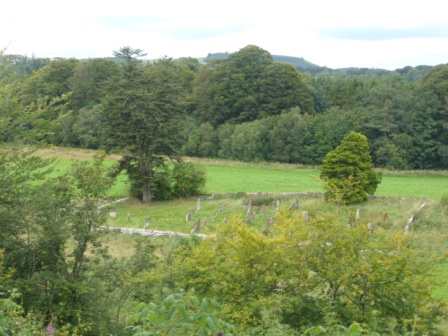
River AnnanAfter visiting the ‘new’ church I walked to St Kentigern’s graveyard at Hoddom across the Annan from Woodcock Air. Watched over by a tall fir (or pine?) tree it was blissfully overgrown with ferns, yarrow, willowherb, bee-humming knapweed, decorated by harebells.

St Kentigern's Graveyard

Wandering amongst the gravestones I noticed carved images of skulls and crossbones and remarkable winged souls which a notice recorded as ’18th century folk art’. So here are Kentigern’s skeletons, I thought, unbanished. Symbols of death and our transition to the otherworld living on through years of Christian rule.

From the vantage point on Woodcock Air as I looked down on St Kentigern’s graveyard the sandstone gravestones shifted into brown-clad people. I gained a sense of the slowness of lives decanted by prayer, steady seasonal work in the fields, the slow turning of cart wheels, the satisfaction of self-subsistency and knowing you would die and be buried in your land close to your community.

St Kentigern's Graveyard from Woodcock AirAnd beneath the Northumbrian monastery did I gain a sense of St Kentigern’s church? The scene of conversion? The deity(s) to whom the ‘idols’ were dedicated? The ‘truth’ felt buried deep. Momentarily seeing the raised area where the church stood as a burial mound I thought back to Jocelyn’s words about ‘Woden’ being a mortal man of a pagan sect whose body is in the dust whilst his soul ‘endures the eternal fire’ in the underworld.

Could these words be read obliquitously to refer to a deified ancestor or ancestral deity believed to live on in the brightness of the world beyond this world? Perhaps even to Gwyn who as a psychopomp and leader of ‘the Wild Hunt’ is Woden’s closest Brythonic equivalent?

BrydekirkI also had the opportunity to visit Brydekirk. Intriguingly Ronald Cunliffe Shawe claims Gwenddolau worshipped ‘Woden’ and ‘a fire goddess’. His reference leads to the passage about Woden in The Life of St Kentigern. I can’t find anything mentioning a fire goddess. However Gwenddolau’s worship of such a deity would make perfect sense if Brydekirk is named after Bride or Brigid. Brigid was later venerated as St Brigid and her priestesses tended an eternal flame.

At the church I was told by one of the parishioners it was indeed named after St Brigid of Ireland. I also learnt St Bryde’s Well was a natural spring and was gifted with an indispensable description of its location.

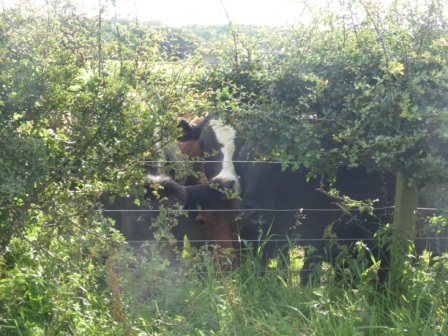
My walk to the well down the Annan then alongside fields was accompanied by a curious herd of cows who followed peeping out through gaps in the hedge. Their strange behaviour led me to recall the story of how St Brigid was raised by a white cow with red ears: another otherworldly animal.

CowsThe area surrounding St Bryde’s Well was hopelessly overgrown with brambles, nettles and Himalayan Balsam. With the guidance of the parishioners I still couldn’t find it. Ready to give up I saw what looked like a pink veil. I first assumed it was a votive offering marking the spring. When I got closer I realised it was a balloon strung with pale gauze. Another extraordinary marker that proved to be no mere coincidence.

Turning round, I noticed a water dispenser and beyond heard running water. Seeing a rivulet at the bottom of a steep bank running into the Annan, I followed its course to find a small stream leading to the natural spring pouring from amongst mosses and ferns into an orangey circular basin: St Bryde’s Well.

Across the river I also visited the remains of St Bryde’s tower. All I found was a single flight of steps climbing upward into the fire of the sun. Could this has have been a stairway walked by Brigid’s priestesses who maintained her eternal flame?

St Bryde's TowerI returned to Penwortham with no clear answers about how or whether St Kentigern converted the people of Hoddom or what they experienced and believed. Such ‘truths’ can only be conjectural and are always determined by our questions, assumptions and  beliefs.

What I gained was a deeper understanding of how our physical and literary landscapes interweave. How sign and signified lead the dance of a journey which is led by the gods who lead us to places where all distinctions break down in the numinosity of their presence.

At Hoddom and Brydekirk I met a myriad inhabitants of a northern land and I met Gwyn and Bride (who I know here in Lancashire as Brigantia) in new ways. I learnt that within the land and its stories and even in the most depredatory of Christian texts the fire of the gods endures.

After the late-night meeting

my head was pale and flashing
a tawdry halo a broken circuit
a worn out lighthouse
behind my eyes.

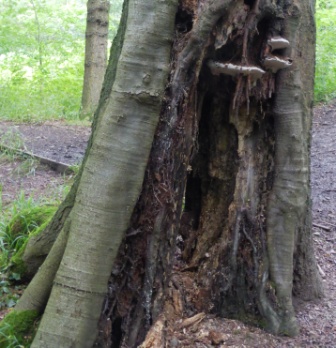
I went to a hollow tree
and sat myself within it.
In the slow drip of mulch
and closeness of fungus
a full moon overhead.

The ants came inexorably
shiny-black shivering over
my skin. When I clamped
my mouth they lanced
my ears. Clambered in.

Tiny mouths chewing
like an orchestra of saws
they ate the nil-light
and came out glowing.
Pouring from my mouth

in an illuminated stream
crackling legs growing distant.
A million bright footprints
teeming from my head:
an empty mulch, a hollow tree.

Beech Tree, Carr Wood

Gwyn ap Nudd and Gwyddno Garanhir

This is a link to Heron’s translation and interpretation of ‘The Dialogue of Gwyn ap Nudd and Gwyddno Garanhir,’ found in The Black Book of Carmarthen. This dramatic dialogue is one of the earliest pieces of known literature featuring Gwyn ap Nudd, who appears as a divine warrior and gatherer of the battle-dead.

Heron has undertaken an important task, as the only translation currently available to the public on the internet is William Skene’s (1868), which is both dated and considered flawed. His hard work and understanding of this poem on historical and mythic levels is highly appreciated.

Greg Hill's avatar

IMG_0109
The beginning of the Exchange Between Gwyn ap Nudd and Gwyddno Garanhir in the manuscript of The Black Book of Carmarthen

An interpretation of the conversation between 
Gwyn ap Nudd and Gwyddno Garanhir.

 This conversation appears in a manuscript collection known as The Black Book of Carmarthen which is a collection of copies from earlier manuscripts made by a monk in Carmarthen in the Thirteenth Century, some of which are verses which may have originally been embedded in lost prose sagas. As with much early Welsh verse some parts of it are difficult to interpret and the only easily available version in English is that contained in Skene’s Four Ancient Books of Wales, a pioneering translation which is now regarded as flawed. I’ll provide my own attempt to translate it during the course of the ensuing discussion based on consulting modern editions and commentaries in Welsh. There are some…

View original post 1,690 more words