Trampled like Cut Reeds to the Ground

‘Gwyn ap Nudd, helper of hosts,
Armies fall before the hooves of your horse
As swiftly as cut reeds to the ground.’
~ ‘The Conversation of Gwyn ap Nudd and Gwyddno Garanhir’

So far it’s been a grim month. Grey skies. Heavy rain. Storms. 

The scythe of the Reaper has been swinging, chopping, cutting. The cut reeds have been falling swiftly. The huge round hooves of His horse, of the horses of Annwn have been trampling them into the rain-soaked ground.

Sister Patience, chop, cut, gone. The Monastery of Annwn, chop, cut, gone. My dream of living the rest of my life as a nun of Annwn, chop, cut, gone

It’s happened so suddenly. Yesterday I spent a moment, like waking in the morning after a night I’d self-harmed, in shock, thinking what have I done? 

Yet this was not the work of my blade but the Reaper’s blade…

Gwyn was there to reassure me, His hand on my shoulder (slightly bony) letting me know that it was for the best, that dying reeds have got to fall. 

I could see the monastery was dying but Sister Patience felt alive to me.

“Sometimes you don’t know you’re dying until it’s too late.” 

I trust His wisdom in taking a part of me – a sacrifice to save the whole. 

What now? I stare down at crushed reeds in the muddy churned-up ground, attempting to scry a message from the mess of my life – the mash of criss-crossed stalks and the rain-filled half moons of the hoofprints spilling into pools.

There’s always been an obvious road that I’ve never managed to take. Write that much-needed book on Brythonic polytheism or Brythonic shamanism. Write some how-tos on how to meet the Brythonic Gods. It’s always been blocked. That dark hooded figure with His scythe in the way.

“That is not your work,” he slides a whetstone along the curved blade. “I want you to write the words that cut to the truth, that hurt, that have edge.”

I see I’ll always be an edge person. Not salesy enough to sell. Not humble or practial enough to crawl away from the blogosphere and get a proper job. Suburban in the sense of lower down rather than rows of identical houses with cut lawns (although I live in one). Far too English to be properly Brythonic.

I’ll never be able to say, “Look at my bright shiny life you can have this too!”

Yet, in giving voice to uncomfortable edges, to exploring the messier, lesser-spoken side of relationship with Gods and spirits I feel I have a place as a writer and guide.

A place of cut and trampled reeds, muddy waters, dark hooves, forever shadowed by the Reaper’s hooded form and His skeletal touch.

Photograph from when I was cutting reeds during a fen cut (albeit with a brushcutter rather than a scythe) when I worked for the Lancashire Wildlife Trust on the Wigan Flashes.

Notes on Being a Bad Nun

I.
I didn’t make a very good nun. The Dark Magician mocked me when I told him I was going to be a holy woman. I think he knew I did it to escape my name. 

“Loo-nar,” they called me at school. Somehow they knew I’d be a loner. Loony. Pulled and pushed, against my will, by the tides of the moon.

How I wanted to get rid of that name. How I wanted to get rid of my memories: of how it was spoken with mockery, of how it was used by my parents and teachers to order me about as if they were magicians summoning and ordering a spirit, of how lovers I couldn’t satisfy spoke it.

I think I preferred ‘pig’ even in the mouths of the bullies and those who spoke it more jokingly because I snaffled up the leftovers using a hatred of food waste as an excuse because I couldn’t control my hunger when I was drunk.

And ‘Smithers’ was far too English for someone who worshipped a Welsh God.

To escape her lowliness, upon the calling of the Gods, Lorna Smithers tried to make a name for herself; standing on a stage in the centre of the Flag Market in Preston, in cafés, in pubs; posting on social media. 

It was all too much – she vanished into the land and reappeared as Sister Patience.

II.
Sister Patience sprung up like a mushroom from an invisible mycelial network. Nuns of Annwn and Fruits of Annwn are similar things. They appear with birch trees – a pioneer species. Neither lasts for long. But they both prepare the way for future dreams, strange and hallucinatory, then they disappear.

III.
What can I say of monastic life? I might have learnt to play the Heartbeat of Annwn but did I live truly live in alignment with it? Was I truly alive? 

Or did I just obsess about how well I did with giving up things?

I battled with food, alcohol, exercise, emails, blogging, books, all my addictions…

And some of them I conquered and some of those things I could not give up. 

Exercise – the gym. The satisfaction of shifting more than my body weight on the leg press, getting one more rep in on my barbell bench press without dropping the bar on myself, removing another 2.3kg towards an unassisted pull-up. 

Food – Gods damnit, I love food. I managed to eliminate all added sugar. I weaned down to oats, fish, meat, cheese, eggs, multicoloured fruit and veg – to what my body, my gut, spoke it truly needed. But could I fast for a day or even or a half day? No.

I came to realise that, as an active person, fasting is not my ascesis. I was not destined, like the saints, the boddhisatvas, the gurus, to be like a bee or a hummingbird, living lightly, drifting that way into inebriation.

I had too much guilt to carry. Like my running shoes. Deceivingly light. My final confession. Brooks Ghosts, women’s size 7.5, every 500 miles. Now I’m not running so much, I’ve cut down, but I still get my steps in on the treadmill, the elliptical, the stairstepper…

“Ghosts on your feet, my beloved,” the King of Annwn speaks with irony, hinting at the petroleum-based materials taken from the Underworld.

Yet, the original meaning of ascesis related to athleticism. Maybe I can be redeemed?

IV.
And what of those other athleticisms of monks and nuns for which they are revered? Of prayer and meditation? In my experiments, did I fail or succeed?

Unfortunately, there are few words to describe the silence that one enters into in deep prayer or deep meditation, but there were times I got there.

Instead, I might tell you of a rather guilty and hubristic dream in which Sister Patience and Saint Theresa of Ávila were both the recipients of offerings beside a pool in a woodland grove. Afterwards, they ran ecstatically, barefoot, in their habits, into the woodland, and I never saw them again. 

Once, in the silences between chanting Om, I gained a sense of Absolute Consciousness. Was this Brahman, Bhairava, Shiva? Was Gwyn the equivalent in our Brythonic tradition? I have no answers. 

The Christian tradition of kenosis, ‘self-emptying’, in order to be filled with the divine, relates to the shamanic concept of the ‘hollow bone’, to being an empty cauldron or vessel in the Brythonic tradition and still intrigues me. 

I gained access to the witness part of oneself, which features in Eastern and Western traditions and is summarised in the Camoldolese rule: ‘Sit in your cell as in paradise. Put the whole world behind you and forget it. Watch your thoughts like a good fisherman watching for fish.’ In my personal mythos, this relates to Gwyn’s father, Nodens / Nudd ‘the Fisher King,’ to the patient Heron.

V.
I wasn’t a very good nun. I had no prospects of being a saint. Yet the insights I gained will be carried with me into being a good devotee of Vindos / Gwyn. Into being a good shamanic practitioner. I’m hoping that, in the future, the impulse to be holy will be tempered by the impulse to be human, and this will help me to serve my Gods and others better through my writing and shamanic work.

An Introduction to Vindos / Gwyn ap Nudd

I am writing this article for those who are new to the Sanctuary of Vindos and for those who have been following me for a while who might enjoy reading an article that brings together my research on Vindos / Gwyn in one place. 

Vindos

Vindos is the reconstructed Proto-Celtic name of the medieval Welsh God, Gwyn ap Nudd, ‘White son of Mist’. It stems from the root *Windo ‘White’ (1). It is possible that Vindos was worshipped at Vindolanda ‘the Land of White Springs’ (a Roman auxiliary fort on Hadrian’s Wall) and, like His father, Nodens (2), more widely across Britain during the prehistoric and Romano-British periods. 

From Gwyn’s role as a ruler of Annwn ‘Very Deep’ (the Brythonic Otherworld / Underworld) and gatherer of souls, we might derive that Vindos, too, ruled the chthonic regions and was associated with the dead.

It’s my personal intuition that the chalk God found at the bottom of a ritual shaft in Kent and recorded by Miranda Aldhouse Green might be Vindos: 

‘At the bottom of this shaft… all some 2.5 metres deep, was an oval chamber containing a complete figurine, composed of a featureless block of dressed chalk from which rises a long, slender neck and a head with a well-carved, very Celtic face. This figure may have stood in a niche high up in one wall of the chamber… Pottery would indicate a first or second-century AD date’ (3).

It is possible that prehistoric burial monuments with stonework made from chalk and limestone, described by Rodney Castleden as ‘bone-white buildings… temple-tombs… sharply defined with deep boundaries and blinding chalk-domes visible for many miles,’ (4) were associated with Vindos.

Vindos might be equated with the Gaulish Vindonnus ‘Clear Light, White’. According to James McKillop, Vindonnus was worshipped at ‘a site coextensive with Essarois in Burgundy, eastern France. Bronze plaques nearby depicting eyes suggest he was attributed curing powers for eye diseases’ (5).

It is likely that the coming of Christianity played a role in expunging the evidence for veneration of Vindos on the basis of His associations with the Underworld and death. Luckily, as Gwyn, His stories lived on in medieval Wales.

Bull of Battle – Warrior-Protector and Psychopomp

Gwyn’s clearest representation comes from a medieval Welsh poem called ‘The Conversation of Gwyn ap Nudd and Gwyddno Garanhir’ from The Black Book of Carmarthen (1250). Herein Gwyn and Gwyddno (6) converse at an undisclosed location. I believe the poem implicitly suggests that Gwyddno is dead and Gwyn has appeared to guide his soul to Annwn. This is also the interpretation of translator, Greg Hill, whose translation I have used below (7).

In this poem, Gwyn is addressed with deep reverence and respect by Gwyddno as a ‘fierce bull of battle’, ‘leader of many’, and ‘lord of hosts’. This fits with Gwyn’s name not only meaning ‘White’ but ‘Blessed’ and ‘Holy’. Gwyddno petitions Gwyn for protection, and Gwyn replies that from Him, an ‘invincible lord’ (hinting at His divine status), ‘He who asks shall have protection’. As a ‘bull of battle’, Gwyn is a warrior-protector.

At first, Gwyddno does not recognise Gwyn and thus asks what land He comes from. Gwyn replies: ‘I come from many battles, many deaths’. These words are suggestive of His role as psychopomp gathering the souls of the battle-dead. Only when Gwyddno asks Gwyn of His descent does He reveal His identity: ‘My horse is Carngrwn from battle throng / so I am called Gwyn ap Nudd / the lover of Creiddylad, daughter of Lludd.’ There is a sense here that it is only when Gwyddno recognises Gwyn that he realises that he is dead. ‘I will not hide from you.’ He realises he cannot hide either from Gwyn or the truth that he is deceased and states his own name, ‘I am Gwyddno Garanhir.’

Gwyn is then drawn away by His restless horse and red-nosed hound, Dormach, who is wandering away across the firmament, to further battles. Before He departs, He recites a series of verses recording the names of a number of famous warriors, mainly from Yr Hen Ogledd ‘the Old North’ (8), whose souls He has gathered from the battlefield. He then ends by speaking two of the most haunting verses in medieval Welsh literature. 

‘I was there when the warriors of Britain were slain
From the east to the north;
I live on; they are in the grave.’

I was there when the warriors of Britain were slain
From the east to the south;
I live on; they are dead.’

Here, Gwyn laments His role as an undying God fated to witness the deaths of his people and gather their souls until (as we shall soon see) the end of the world.

Leader of the ‘Demons’ of Annwn and the Wild Hunt

In Culhwch and Olwen (1100), Gwyn is contrastingly represented as a sinister figure. Herein we find the lines, ‘Twrch Trwyth will not be hunted until Gwyn son of Nudd is found – God has put the spirit of the demons of Annwfn in him, lest the world be destroyed. He will not be spared from there’ (9). 

These lines, penned by a Christian scribe, allude to Gwyn’s rulership of the spirits of Annwn. They suggest that Gwyn contains the aryal ‘spirit’ or ‘fury’ of beings seen as demons by the church both within His realm and within His person. Paradoxically, it is only because Gwyn partakes in their nature that He can hold them back in order to prevent them from destroying the world.

The lines about the hunt for Twrch Trwyth ‘Chief of Boars’ also contain darker allusions. The Twrch is not just any old boar but a human chieftain who was supposedly turned into a boar by God on account of his sins (10). That Twrch Trwyth is a human shows this is not a boar hunt but a hunt for human souls. That it cannot begin until Gwyn is found demonstrates He is the leader of the Brythonic variant of the Wild Hunt (which occurs across Europe).

Gwyn’s leadership of the Wild Hunt is further evidenced in the works of John Rhys. He refers to Iolo ap Huw, Gwyn’s chief huntsman, ‘cheering cwn Annwn over Cadair Idris’ every Nos Galan Gaeaf / Halloween (11). Rhys also refers to a horned figure with a black face, likely Gwyn, with the cwn Annwn ‘Hounds of the Otherworld’ hunting down a sinner ‘across Cefn Creini’ (12). As a devilish huntsman with His hounds and demonic followers He rides out through the winter months to hunt down not only the dead but living sinners.

Gwyn’s associations with winter and destruction are also hinted at in Culhwch and Olwen. Creiddylad, His sister, goes off with Gwythyr ap Greidol ‘Victor son of Scorcher’ but before He can sleep with Her, Gwyn takes Her by force (presumably to Annwn). Gwythyr gathers an army, attacks Gwyn, fails and is imprisoned. During their period of imprisonment, Gwyn kills the northern king, Nwython, cuts out his heart and feeds it to his son, Cyledyr, who goes mad. Arthur is brought in to intervene, calling Gwyn to him and determining that from thereon Gwyn and Gwythyr will battle for Creiddylad every May Day until Judgement Day and only then one may take her (13).

This Christianised episode is likely based on a pre-Christian seasonal myth wherein Gwyn, a Brythonic Winter King, takes Creiddylad, a Goddess of fertility and sovereignty, to Annwn for the duration of the winter months. On May Day, Gwythyr, a Brythonic Summer King, wins Her back for the summer.

Arthur’s intervention is employed to show the Christian warlord’s power over Gwyn. Throughout the tale, Arthur is demonstrated to have power over giants, witches, and magical white animals who are associated with Annwn. 

In another episode, Gwyn and Gwythyr accompany Arthur to slay Orddu, ‘Very Black’, a witch who lives in Pennant Gofid ‘the Valley of Grief’, ‘in the uplands of Hell’ (14). Gwyn attempts to stop Arthur from attacking Orddu to no avail, and Arthur cuts her in half and drains her blood. It is likely that Orddu was a ‘witch of Annwn’ (15) who worked magic with Gwyn and His spirits. 

Again, Arthur is shown to have power over Gwyn and His followers. Ultimately, Arthur usurps the hunt for Twrch Trwyth, seizing Gwyn’s role and replacing Him as warrior-protector of the Island of Britain. Yet, in the story and now, Arthur fails to hold back the forces who threaten to destroy the world. It is only Gwyn who can contain the furious spirits, who number the spirits of Annwn and the dead, until the world’s end.

King of Annwn and the Fairies

In The Life of St Collen (1550), Gwyn is described as ‘King of Annwn and of the fairies’, and He and His people are once again derided as ‘devils’. Gwyn summons Collen to His fair castle, which is described as being filled with ‘appointed troops, ‘minstrels’, ‘steeds with youths upon them’, and comely maidens. There, from his seat upon a golden chair, Gwyn invites Collen to feast upon His bountiful feast of delicacies, dainties, drinks, and liquors. Collen refuses, saying he will not ‘eat the leaves of trees’, suggesting the food is an illusory conjuration. He then says the red and blue clothing of Gwyn’s people signifies ‘burning’ and ‘coldness’ (it is hellish). Finally, he throws holy water over the heads of Gwyn and His people, and they vanish (16). Once again, we find a legend showing the power of a Christian over Gwyn.

The description of Gwyn’s castle is similar to the fortress of the King of Annwn / Faerie in other sources. In ‘The Spoils of Annwn’, we find seven fortresses, which I believe to be fragmented appearances of the same fort. This fortress, as Caer Wydyr ‘the Glass Fort’, is made of glass. As Caer Siddi ‘the Fairy Fort’, it contains the treasures of Annwn, and above it is a fountain that pours a drink sweeter than wine. As Caer Wedwit ‘the Mead Feast Fort’, it holds the ‘cauldron of the Head of Annwn’, which is ‘kindled by the breath of nine maidens’ and will not boil food for a coward (suggesting an initiatory function). Again, Arthur assaults Annwn and its people, stealing the spoils (17). 

In spite of Christian intervention, Gwyn and the spirits of Annwn live on as Y Tylwyth Teg ‘the Fair Family’ in later folk and fairylore. Like the Greek Furies, who are referred to as the Eumenides ‘Kindly Ones’ or ‘Benevolent Ones’ (with whom They are equated), this is likely a euphemism used to conceal Their contrary nature. They continue to steal or entice people to Their realm; curing, cursing, driving to madness, turning space and time and lives around.

Protector of the Sanctuary

Gwyn is a paradoxical God. On the one side, dark and furious. On the other, blessed and holy. Only because He is both can He offer protection and healing.

In The Speculum Christiani, Gwyn is invoked to heal the evil eye. ‘Some stupid people also go stupidly to the door holding fire and iron in their hands when someone has inflicted illness, and call to the King of the Benevolent Ones and his Queen, who are evil spirits, saying: ‘Gwyn ap Nudd, who are far in the forests for the love of your mate, allow us to come home’ (18). 

This might be seen to relate to the ability of Vindonnus to cure eye ailments. The father of Vindos / Gwyn, Nodens, was a God of healing dreams. Thus, it makes sense that Gwyn is not only a God of death and destruction, but of healing. 

In my experience, Gwyn is a powerful God of transformation who invites us to put to death the parts of ourselves we no longer need to become more whole.

“You who ask shall have protection,” He speaks. “I shall help you to come home.”

~

Footnotes and References

(1) Proto-Celtic – English https://web.archive.org/web/20060114133008/http://www.wales.ac.uk/documents/external/cawcs/pcl-moe.pdf
(2) Nodens, ‘the Catcher’, later known as Nudd or Lludd Llaw Eraint ‘Mist Silver-Arm’, was venerated at Lydney ‘Lludd’s Isle’ and two silver Romano-British statuettes dedicated to Him as Mars-Nodontis were found on Cockersand Moss in my home county of Lancashire.
(3) Aldhouse-Green, M., The Gods of the Celts, (1986, Sutton Publishing), p134
(4) Castleden, R., Britain in 3000 BC (Sutton Publishing, 2003), p90-91
(5) McKillop, J., Dictionary of Celtic Mythology, (Oxford University Press, 1998)
(6) Gwyddno Garanhir ‘the Knowing One with Crane-Legs’ is a legendary figure most famously associated with Cantre’r Gwaelod, ‘the Lowland Hundred’, a sunken land off the coast of Wales extending from Borth Beach (Porth Wyddno). He also had a port in the North and his hamper is listed in ‘The Thirteen Treasures of the Island of Britain’ which were in the North.
(7) https://awenydd.weebly.com/the-conversation-between-gwyn-ap-nudd-and-gwyddno-garanhir.html
(8) This name refers to the post-Roman Brythonic kingdoms of northern England and southern Scotland, which eventually fell to the Anglo-Saxons.
(9) Davies, S. (transl.), The Mabinogion, (Oxford University Press, 2007), p. 199
(10) Ibid., p. 209
(11) Rhys, J., Celtic Folklore, Welsh and Manx, (Oxford: Clarendon Press, 1901), p. 180-181
(12) Ibid., p. 281
(13) Davies, S. (transl.), The Mabinogion, (Oxford University Press, 2007), p. 207
(14) Ibid., p. 212
(15) Dafydd ap Gwilym refers to ‘witches of Annwn’ in his poem ‘The Mist’. Browich, R., (ed.), Dafydd ap Gwilym Poems, (Gomer Press, 1982), p. 134
(16) https://www.maryjones.us/ctexts/collen.html
(17) Haycock, M., Legendary Poems from the Book of Taliesin, (CMCS, 2015), p. 435-438
(18) Roberts, B.F., ‘Gwyn ap Nudd’, Llên Cymru, XIII (Jonor-Gorffennaf, 1980-1), pp.283-9.

Six s’s of Sister Patience that will live on

With the Monastery of Annwn, I took vows of simplicity and sustainability. I simplified my wardrobe, cutting it down to three sets of winter clothes, three sets of summer clothes, a couple of things for in between, and gym kit. All but my fleeces, coats, and waterproofs fit into my great-grandmother’s chest of drawers. I never buy clothes or shoes unless I need them. I once had altars to many Brythonic gods and various spirits, but as they were little used (the only thing worse than no altar is a neglected one), I rearranged them to reflect my near-henotheistic devotion to my patron God, Gwyn ap Nudd. I walk or cycle within my limitations as someone with knee issues and a cheap bike (after my last one was stolen), and do my best to buy local or at least British food.

Solitude has always come naturally to me. I love being alone (with my Gods), and only the call of the awen or the fulfilment of my shamanic vocation can happily draw me out of this state. Silence has been one of the greatest blessings. As an autistic person, exterior quiet has long been essential for me, but it’s only since exploring Eastern methods of meditation and Christian methods of prayer that I have managed, on occasion, to attain the inner silence needed to truly listen to the Gods.

I’ve lived in the same house in Penwortham pretty much since I was four years old, so stability really accords with me. Increasingly, I have no desire to travel. I’m happier and happier deepening my relationship with my home, garden, local valley, and walking and cycling in the local area. 

When I learnt I must give up the name Sister Patience, I feared her sanctuary would have to go with her. I was saddened to think of the departure of its spirit. Yet Gwyn came along and asked that I dedicate it to Him by His older name Vindos. I was absolutely delighted. It felt so right (although I had a sneaking feeling that He might have been planning for this all along…).

Another word, which I can’t include as it doesn’t begin with an ‘s’ but does have ‘s’s’ in it, and forms the spiritual core of all the ‘s’s’ is godspouse. It was as Sister Patience I married Gwyn, as a nun of Annwn, similarly to a Bride of Christ. I’m glad to say that we’re still happily wed and our relationship will live on. In retrospect I guess it makes sense that a year after we get married He moves in!

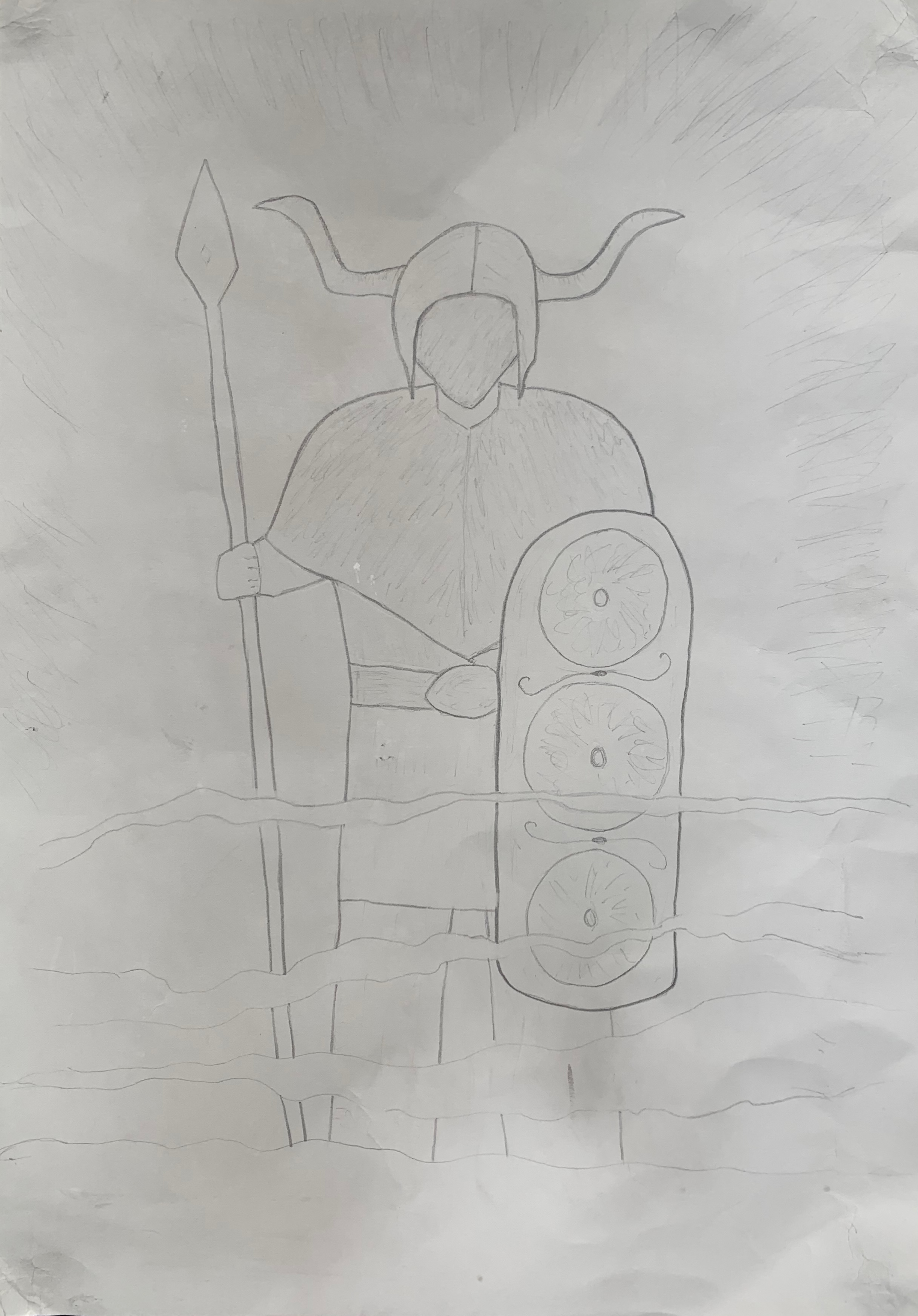
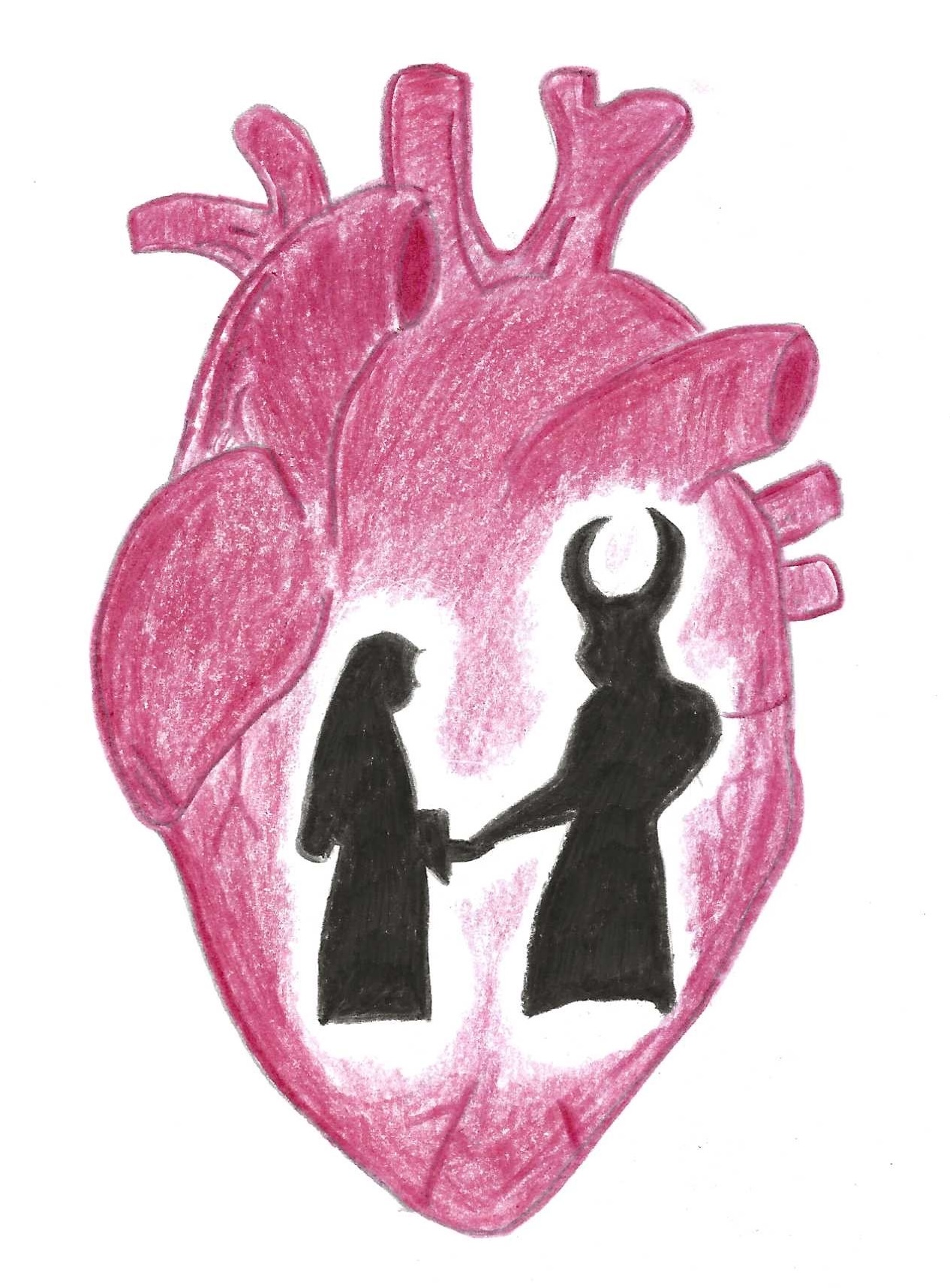
Beneath is an image from the cover of a poetry book about our marriage called ‘The Heart of Annwn’ that I wrote for Gwyn and was planning to offer to Him when I retook my temporary monastic vows this year. The book wasn’t quite good enough and the vows will not be made, but I’m hoping I might one day rework it. For now, here is the image I was planning to use as cover art.

The Sanctuary of Vindos Dedication

Beloved Vindos,
my patron, inspiration and truth,
on this night of the Reaping Month,
on the total eclipse of the full moon,
I hereby dedicate this Sanctuary to You.

May I honour You well
with my prayers and inspiration.

Through Your guidance as a Guide of Souls
may I guide and heal others too.

Together may we reweave 
the ways between Thisworld and Annwn.

Who Am I After Sister Patience?

Letting go of my identity as Sister Patience has been somewhat of a relief. In many ways I felt like I was living a double life. I had to keep my birth name, Lorna Smithers, for financial purposes and appointments such as the doctor and dentist. Although my mum accepted my name change, my dad refused to (although he has recently started referring to me as ‘her’ rather than ‘Lorna’ to escape my admonishments). Other family members ignored my request. Whilst I felt comfortable telling my friends and personal trainer at the gym, I never found the right moment to tell my doctor, dentist, physio, hairdresser or former colleagues at the supermarket where I worked and still shop. It was a nightmare managing two email addresses (when you’re autistic and every single message has to be replied to, removed from the inbox and filed correctly before you can relax, one is more than enough!).

I also felt like I was trying to live up to an ideal I couldn’t match. No amount of positive affirmations or metta ‘loving kindness’ or tonglen ‘giving and receiving’ practice made me as patient and kind as I wanted to be. I’d think I was improving then have another blow up with my dad and be doubly angry with myself because it demonstrated he was right – that I’m not Sister Patience.

Yet without Sister Patience who am I? Settling back into the skin of Lorna Smithers has felt rawer and truer but hasn’t been a wholly comfortable experience. I’ve once again had to confront my past – something that from the perspective of modern society looks like a series of failures (failed philosopher, failed poet, failed author, failed nun…) but from an alternative one might look an authentic spiritual journey well lived. 

And, of course, the definition of ‘failure’ is subjective. I might have failed to be an author in terms of making a living from it but I’ve still had books and articles published and received small payments along the way whether they are from book sales, Patreon support, or free subscriptions to magazines. So I can still claim to be an author. I’m also succeeding with my shamanic practitioner training and shamanic guidance and healing sessions along with running circles so can also claim to be a shamanic guide.

In my last couple of posts I’ve mentioned that I recently received the gnosis that I’m more of a hermit than a nun. I feel that’s true in my soul but it doesn’t match my outer reality yet – I still live with my parents and do not make enough money to cover my food and board let alone to live self-sufficiently. One of my readers, Caer, recently signposted me to a book called Consider the Ravens and therein it noted that any true hermit wouldn’t advertise themselves as such. There’s a dichotomy between being an author and shamanic guide who has to market themselves online and a hermit. There’s also a restless feeling I have unfinished business in the world. So, whilst hermithood is an inner reality and dream for the future, it isn’t something I can identify with wholly at present.

Author, shamanic guide, would-be-hermit, are the roles I now identify with, along with my devotion to my patron God, Gwyn ap Nudd, which has been ongoing throughout these upheavals (thinking about it, damn Him, He’s the one who has caused all of them!).

Being Sister Patience has made me a little stronger, a little kinder, a little more patient, likely in preparation for further challenges and tumult along the way…

The Death of Sister Patience

The wind is blowing. The Reaper is busy with His scythe. After my insights about being more of a hermit than a nun a whisper on the wind, ‘Sister Patience must die.’ Three years ago I took temporary vows by this name as a nun of Annwn and, as the time comes to renew them approaches, I realise I will not be taking them again this year. Instead I must surrender this name, this identity, disrobing over the next few weeks, then giving it entirely back to Gwyn, from whom it came, on His feast day on September the 29th. I have learned many lessons and received many blessings from this name. Hopefully some of the virtues of Sister Patience will live on as I return to my birth name and continue to serve Gwyn as a hermit and shamanic practitioner.

Fascia – the Missing Link

“You haven’t pulled anything,” said my physio, “it’s just a myofascial knot that needs trigger-pointing out.” 

“Oh, well that’s a relief,” I said. 

That was the first time. I’d thought I’d pulled a muscle in my quad when I was straining with my foot on a spade trying to remove a huge juncus effusus rushfrom Little Woolden Moss on the Manchester Mosslands. 

He said the same thing when I went to him thinking I’d strained my neck overdoing a shoulder press at the gym. It turned out it was transferred pain from a knot in my shoulder and once he had done his work I could move my neck pain-free.

Since then I’ve got a lot better at recognising myofascial knots and at least partially releasing them myself by applying pressure and by foam rolling. 

But what are they? How and why do they form? My research into fascia provided the missing link between my intutions about how stress and trauma are stored in the physical body and how this relates to the energy body.

‘Myo’ refers to muscle. We all know what muscles are. But less people know about fascia. We certainly weren’t taught about it in biology lessons at school. Skeleton – yes. Muscles – yes. Organs – yes. But the importance of the connective tissue that holds them together received barely a mention. In fact, surgeons used to cut it out and throw it away thinking it was useless! Fascia was also ignored by anatomists as it swiftly dries up after death and can only be studied in a living person during operations or a very fresh corpse.

Research on fascia began in the 1970s and it’s only over the past decade or so the findings have come into the mainstream and it has become a buzz-word.

Fascia is made of collagen, elastin and a gel-like ground substance composed of hylauronic acid. It includes the superficial fascia beneath our skin, the deep fascia around and interpenetrating our muscles, and the visceral fascia around our organs. As such it forms a single living web, interweaving the inner parts of our body together.

Fascia provides a support structure for our body and allows for the smooth gliding of muscles, tendons and ligaments. It is also, in the words of Dr Robert Schleip, ‘our richest sensory organ’. It is filled with nerve endings – encapsulated nerve endings for proprioception (telling us where our body is) and free nerve endings for introception (transmitting information about how we feel). According to Schleip 40% of the nerves of our sympathetic nervous system are in the fascia, which explains why it can become so tight and tense. Our fascia is alive and has its own innate intelligence.

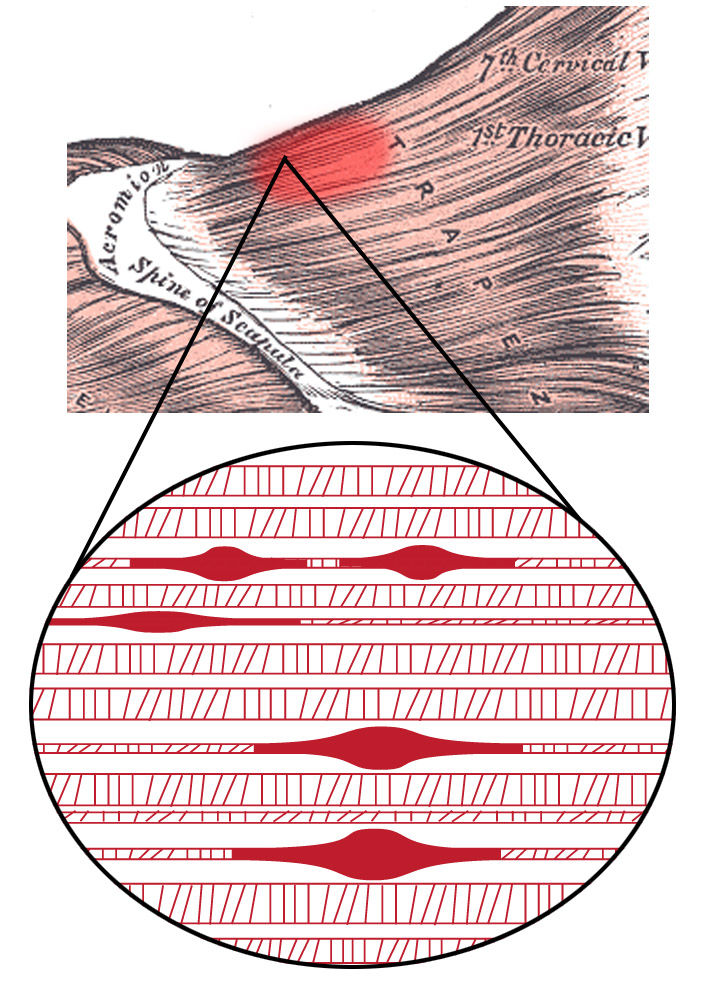
Myofascial knots are contracted areas in bands of muscle / fascia (remember they are interwoven) caused by overuse, injury and stress. They form irritable nodes where toxins build up and pain from them is often referred elsewhere. I didn’t get how pain could refer until I found out fascia is one continuous organ.

Trauma can be stored in the fascia if, after a traumatic event, there is no release. This can be for large traumas like accidents and severe injuries or smaller traumas like mine where I’ve felt a sudden pull and thought, “Oh shit.” The holding of trauma is often accompanied by holding the breath. Stress from work and relationships can also accumulate and be held in the fascia.

Finding this out helped to explain a number of my problems. I have runner’s knee in my left knee and deep gluteal syndrome in my left buttock. These two related problems come from having spent twenty years running on and off (with the off being due to these issues) without doing any strengthening. Since starting strength training at the gym they are greatly improved but have not gone away and I’ve realised that is because I’m still holding and moving my body in a certain way and this is due to trauma still held in my fascia.

Also, I’m prone to stiffness and knots in my neck and shoulders along with tightness in my jaw and squinty and achy eyes. These result from, like most Westerners, having spent most of my childhood and adult life hunched over a desk, squinting at words, under pressure to pass exams and meet deadlines. 

Even though I’m now only a victim of my own deadlines I find it difficult to destress and to spend time away from my computer as the programming of society that I should be here, working, is so strong within me. And I’ve managed to eliminate social use, using my computer only for research and writing. I’m aware others spend many more hours on their laptops or phones.

All these pressures have accumulated in my fascia over the years and congealed into a structure I am concerned might take just as long to release!

As well as working with myofascial knots on the level of the physical body it is possible to work with them on the level of the energy body as well. Dr. Daniel Fenster provides evidence that over 90% of myofascial knots can be mapped onto accupuncture points and this is why accupuncture works so well. Accupuncture needles go deeper than the skin but not into muscle – into the fascia. This is where the meridians or nadis, river-like channels carrying chi or prana ‘vital life energy’ run. In yoga the energy body is called the prana-maya kosha ‘breath-filled sheath’ – it is associated with breath.

Whereas physiotherapists simply remove the knots some practitioners, such as Schleip, work with clients in a more holistic way that involves the use of breath and sound to release trauma that is held in the body. This makes complete sense because, if holding the breath played a role in the contraction causing the knots, then breathing out helps to undo them. 

For much of my life I’ve existed in a constant sympathetic state in which I’ve been breathing in shallow into my chest exacerbarting panic and anxiety. For the past couple of years, since discovering yoga and polyvagal theory, I have been working to shift from a sympathetic to a parasympathetic state by slowing and deepening my breathing and extending my exhales. Trying to relax and breathe deeply in the gym, where I get overexcited if I’m doing well or tense up if I’m anxious about injury, is proving to be one of my biggest challenges.

As a shamanic practioner-in-training I am learning to feel and see blocked and congealed energies and to move them through vision, feel and breath. This new knowledge about how fascia relates to the energy body is something I intend to incorporate into my practice when healing myself and others.

One of the things I am learning from experience is that it’s no use doing energy work if I’m not also making changes in physical reality too. There’s no point removing congealed energy from the knot in my shoulder if I’m going to sit bent over my computer clicking on my mouse for several hours a day. Lifestyle changes to restructure my fascia for longevity.

SOURCES

Fenster, Daniel. Free Your Fascia: Relieve Pain, Boost Your Energy, Ease Anxiety and Depression, Lower Blood Pressure, and Melt Years Off Your Body with Fascia Therapy (Hay House, 2020)
Kusheva, Tatyana, ’Fascia – The Mysterious World Under Your Skin’ on Youtube, (Tatyana Kusheva, 2021)
Schelip, Robert, ‘The Bodywide Fascial Network’ on Youtube, (Inner Sense, 2021)

I Am Home

‘I have finally arrived. I am home.’ 

This insight came to me after I had been considering taking my monastic vows for the third time this year whilst looking ahead to lifelong vows next year. If I am to pledge to being a nun of Annwn for life what will this life look like?

When I founded the Monastery of Annwn at first I dreamt it might become a physical reality. I drew up an ambitious plan with a central temple, underground shrines, healing huts, an arts centre, circles of huts for the monastic devotees, a garden, compost loos, a burial ground…*. Shortly afterwards I realised living in, let alone running, such a large and busy place would be more Uffern ar y Ddaer ‘Hell on Earth’ than abiding close to Annwn for me.

Still, as I continued to follow as monastic-a-path as I could while living with my parents in suburban Penwortham, I spent a lot of time dreaming of alternatives for a physical monastery. What about a large house with land? What about beginning with a small house with 2 – 3 monastics sharing the space? 

As my practice of being present and aware for Gwyn has progressed and I’ve got a lot better at watching and knowing myself as I undertake my daily activities I’ve come to realise that although I enjoy spending a limited amount of time holding sacred space for others I really appreciate having my morning and evening prayer and meditation times solely with my Gods and spirits.

Also, as I’m autistic and thrive on order and routine, in spite of my meditation practices helping me become more responsive and less reactive, I still get incredibly irritable and resentful if others make a mess or interrupt me. This is with my parents, who are relatively quiet and orderly. I dread to think of what I might be like with others with different personalities. I wouldn’t be prepared to change my diet or routine and thus couldn’t expect others to fit with mine. I’m also aware that my main trigger for autistic burnout and meltdowns is organising other people to do things and even worse doing things by committee.

So, finally, I have come to terms with the fact that I am not cut out to run or even be in a monastery. And this is fine because a few months ago I discovered the Carmelite model for lay monasticism and have since then been exploring how this suits me. Perfectly it turns out. I have a couple of hours in the morning and evening for prayer and meditation and the rest of my day is dedicated to shamanic work, studying, writing, housework, gardening and occasional conservation volunteering. I’m still ‘allowed’ to go to the gym.

I recently put forward the model of the monastery functioning as a support structure enabling us to serve our Gods as lay monastics bringing inspiration and wisdom from Annwn to the world, to the other members. Those who replied agreed it fits with them as most have family and work commitments.

Putting aside my hopes and fears around founding a physical monastery has allowed me to fully come home to my life as a lay nun in present-day Penwortham. It allows me to be happier and more present for Gwyn. And, most importantly, it pleases Gwyn too, because the more present I am in the world, the better I am at presencing Him and being of service to Him and my communities.

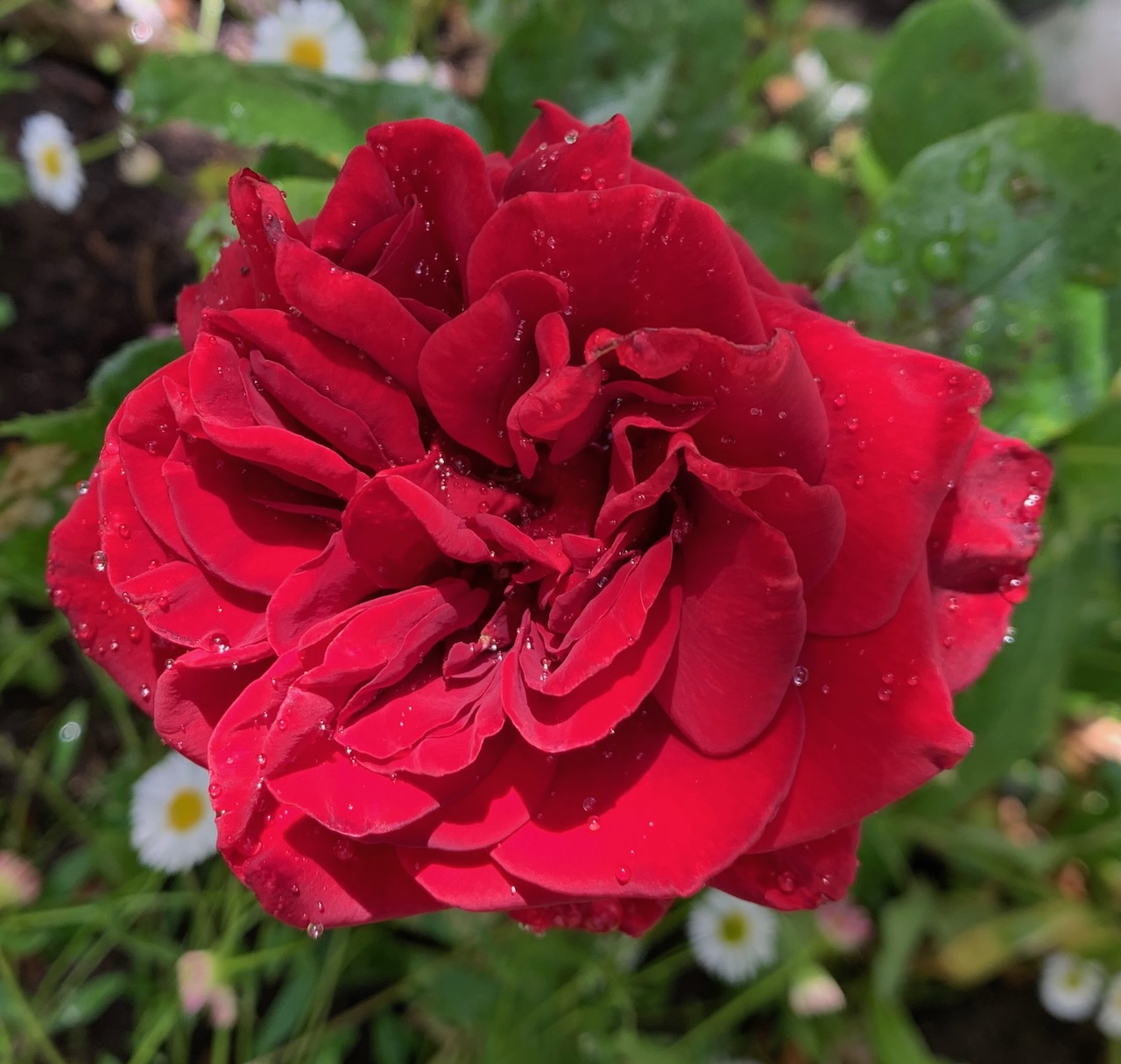
And my recently planted sanctuary rose bush has bloomed which I take to be a good sign.

*https://lornasmithers.wordpress.com/2024/05/17/dreaming-the-monastery-of-annwn/

Power Animals and Power Animal Retrieval

The term ‘power animal’ was introduced to the West by Michael Harner as one of the central concepts within core shamanism. It is borrowed from the native North American peoples and is interchangeable with ‘guardian spirit’.

A power animal helps us to connect with the natural world and the spirit world. According to Harner its presence provides us with energy and good health, whereas when we lack a guardian spirit, we are no longer power-filled and this leaves us open to the intrusive energies that cause illness.

Harner notes ‘the individual characters represent entire species or larger classes of animals… the entire genus or species… a person usually possesses not just the power of a bear, or of an eagle, but the power of Bear or of Eagle.’

Power animals or guardians spirits can be found across cultures. It’s a concept I relate to deeply because I connect so strongly with Horse. When I was little I used to run round the playground playing horses (until I got it bullied out of me). I managed to persuade my parents to let me go horseriding and spent all my time outside school helping out at a local riding school in exchange for free rides and later in life worked with horses.

When I was eighteen I got a tattoo of a white winged unicorn on my back and, later, when I discovered shamanism, she appeared as my guardian spirit. It didn’t take me long to work out that my power animal was Horse.

Since our ‘meeting’ (I believe she’s always been there) she has brought an abundance of joy and energy into my life whether out walking or at the gym or when she carries me between the world in my shamanic journeywork.

I’ve had relationships with other power animals and have a regular ‘team’. It’s common to have one or more power animals who stay for life and others who appear to guide us through certain life lessons then depart once they are done. For example, a one-legged raven guided me on my explorations of the Old North then disappeared and I haven’t seen him since.

Different power animals bring different powers and qualities into our lives. We can call on their power and shapeshift into them – a practice seen in the Brythonic culture wherein warriors invoked their energy as bulls of battle, wolves of war and ravening ravens when they fought on the battlefield and in the Anglo-Saxon and Norse cultures where we find the Berserkers ‘Bear Shirts.’

Such relationships are reciprocal with the human benefiting from the animal’s power and the animal benefiting from being able to express its power in the world.

The absence of a power animal results in power loss, which can cause ill health. The shamanic healing for this is a power animal retrieval. This is a practice that Harner borrowed from the native North American peoples. Herein a shamanic practitioner journeys to the Lower World to bring back a power animal for the client. Harner tells us, ‘the secret to recognizing the power animal is a simple one: it will appear to you at least four times in different aspects or at different angles.’ For example, one might see Stag at a distance, shapeshift into Stag, see Stag on a cave wall, then ride on Stag. Once the identity of the power animal is established, the practitioner gathers the power animal into their arms and returns to blow them into the body of the client (Harner notes the Jívaro blow the animal into the chest and then into the fontanelle but I have been guided to blow them into one of the chakras) and then rattles around the client to seal them in.

I first learnt power animal retrieval at The Shaman’s Pathway workshop with the Sacred Trust and have progressed towards using it to heal clients in my one-to-one shamanic training. Including the person I worked with in the introductory workshop I have so far completed six power animal retrievals. I have found these healings to be a source of power and wonder for both the client and myself as I have helped (re)unite them with their guardian spirits.

I have used the traditional way of journeying for a client then reporting back and other methods taught to me by my mentor which provide more scope for agency and participation for the client. These are speaking out loud as I journey so the client is more immersed, taking them with me on the journey so they can look around and interact, and holding space for them to journey.

Each journey was unique and ranged from one client being courted by every animal in the forest to another to whom only one animal appeared. In some instances the client’s power animal turned out to be the one who had consistently shown itself as the most powerful presence in their lives, whereas others were less frequent guides or a complete surprise.

I was astounded by the immense power and intelligence of other people’s guardians. Each was unique and it was a privilege to meet and interact in such a close way and to play a role in helping clients to establish and deepen their relationships with them. When I was sealing agreements between the client and their animal I felt a sense of being a bridge between the worlds and, somewhat laughably, like a celebrant, as they made their ‘vows’.

This work was a step up from the guidance journeys as there was more responsibility in finding a power animal who would bring energy and health to the client and might be a friend and source of guidance and wisdom for life. I feel I met the demands, ensuring that I was fully present for each person, listening to their needs, and paying full attention during the journeys.

One of the things I was slightly uncertain about was Harner’s method of recognising the power animal from four angles. In an introductory workshop to core shamanism I got an animal who showed themselves in four different ways (Panther) but who didn’t turn out to be my power animal (Horse). 

I was also unsure about this method of recognition because there is no evidence that it was ever used in British or other Western European traditions. However, I went with it for the journeys and found when doing  power animal retrievals for clients it was integral for identifying the power animal from all the other animals and could think of no better method.

The greatest challenges I faced were self-doubt and the desire of my ego to get things ‘right’ by providing a journey that matched those of shamanic authors. Being aware of these tendencies I made sure I trusted and stayed with what was shown by my guides, the spirit world, and the spirits we met.

The effects of the healings for the clients have varied from experiencing more power and joy in their lives and new or deeper connections with their power animals, to ailments easing and being able to come of some medications. It has been a beautiful and edifying experience for clients, their guardians and myself.

I’m very happy to announce that I have now completed my power animal retrieval training and am offering this healing at a student rate of £30 HERE.