Review: The Torch of Brighid by Erin Aurelia

The Torch of Brighid is a book by Erin Aurelia who has tended the sacred flame of the Celtic Goddess Brighid for over twenty years. The book provides historical information about Brighid based on existing sources and introduces a transformational flametending practice that is rooted in tradition and inspired by mythic connections and by Brighid herself. The author makes it clear at the beginning that she is not reconstructing a past Pagan practice.

Working with traditional material Erin has produced a series of meditations forming a transformational journey based upon Brighid’s roles as smith, healer and poet (and dreamer*), the ogam, the three cauldrons and the celebration of Imbolc. 

She begins by providing Brighid’s historical background followed by guidance for setting up an altar to Brighid and beginning a flame tending practice through making a Brighid-flame candle ‘to light and tend Brighid’s fire’. 

As further preparatory work there are meditations in the form of visits to the Inner Temple, the Well of Wisdom and opening to Brighid’s energy through the Mantle of Brighid. These felt like a firm foundation for a flametending practice.

Erin bases the twenty day flametending journey on the ogam and the life cycle of a tree (relating to St Brighid’s sanctuary Cill Dara ‘The Church of the Oak). The first five days focus on growth, the next five on fruiting, the next five on ripening, the last five on seeding. Meditations are given for each of the days guiding the devotee through the transformational processes.

The ritual year is based around the four Celtic festivals Imbolc, Beltane, Lughnasadh and Samhain which are identified with four ogam characters and mapped onto the Celtic cross with the fifth in the middle.

A new rite Erin introduces that particularly resonated with me was holding an ‘advent’ for Brighid’s return to the land at Imbolc based upon Her four faces.

Although I am not a Brighid devotee or a flametender myself so haven’t been called to participate in the practices outlined in the book I can see that they would provide an excellent grounding for both newcomers and practicing Polytheists to meet Brighid and begin flametending as a devotional practice. 

I admired the way Erin has reimagined this series of rites from traditional material. I would recommend this book to anyone interested in Brighid and flametending and to all Polytheists seeking inspiration on how to create new rituals from existing sources with the guidance of their Gods and Goddesses.

The Torch of Brighid is available from Moon Books HERE.

*This is based on gnosis surrounding Brighid as the serpent who sleeps in winter and comes out of the mound in Scottish folklore.

Review: The Ghosts of the Forest by William A. Young

In The Ghosts of the Forest – The Lost Mythology of the North, Edinburgh-based writer William A. Young traces the folklore and legends of southern Scotland and the Borders and the figures within them back into the Brythonic past of Yr Hen Ogledd ‘The Old North’* and prehistoric Britain. 

William follows a number of ghosts in literature and on foot, across the landscapes where the stories are set, to trace how they have arisen from the land – from a ‘Dreaming North’. He begins with Walter Scott and notes that his own collecting of the tales echoes Scott’s ‘raids’. 

His first journey is to Eildon Hill, the Eildon Tree, and the Rhymer’s Stone. Here he finds connections between the legends of Cannabie Dick and Thomas the Rhymer and conjectures that the Fairy Queen might be linked to the Roman Diana, goddess of hunting and the wilds, to whom stood an altar less than 1km away. 

He then journeys with the ghost of Myrthin* Wyllt the ‘surest guide’ to the lost world of the North’. This ‘wild Merlin of the Tweed’ and ‘madman’ is contrasted with ‘the Arthurian Merlin’ and ‘Archdruid’. 

The quest to find Myrthin forms the heart of the journey. William begins with a visit to Myrthin’s grave in Drumelzier then follows William Skene and Nicolas Tolstoy in travelling to Arthuret, Liddel Strength and Caer Gwentholye where the tragic battle of Arfderyth took place and Myrthin went mad. 

Like Tolstoy he makes links between the black mountain in Fergus and Myrthin’s Peak. These leads and the story of Owain take him not to Hart Fell but to the Bewcastle Fells and the complex of Glen Dhu (Black), Marven’s (Myrthin’s) Peak and Cleugh and Capelstone Fell.

William draws connections between the ‘Dark Man’ in Owain and the churl in Fergus. He identifies these figures with the Brythonic deity Cocidius who was worshipped at a shrine at Bewcastle known as Fanocodi. The spirit of the grove with whom Myrthin associates is tentatively identified with Nemetona, who is known as Diana Nemorensis under Intepretatio Romana. Owain’s links with the Brythonic deities Mabon and Modron and his father, Urien’s, with Nevyd, are also explicated. Here we find a potential ‘pantheon’ underlying these tales and this sacred landscape. 

Cocidius is then further traced to legends featuring the ‘Brown Man of the Moors’ whose sacred home might have been the house-sized Kielder stone appearing in the legend of the ‘Colt of Kielder’. William then has a potent encounter with Cocidius ‘the Red God’ at his shrine at Yardstone where he comes ‘face to face’ with the God in a remarkable carving. 

These journeys takes us into the heart of the Forest of Celython where Myrthin fled in his madness. William notes that here he finds not only plantation woodlands but, more encouragingly, areas of restoration such as Kielderhead Wildwood and areas owned by the Borders Forest Trust.

Suggestions based on William’s findings are finally made for further archaeolgical research.

This 606 page book is a labour of love crafted from poring over old texts and following them across the land, walking, camping, holding vigil in wild places, showing how by offering his ‘sweat’ and ‘time’ William has come closer to the old Gods. It gives voice to a quest and is the culmination of many years of dedication. I would recommend it to all who have an interest in the folklore and legends of Britain and how they might be traced to their prehistoric origins.

You can buy Ghosts of the Lost Forest HERE.

*William substitutes ‘th’ for the Welsh ‘dd’ in his spellings. 

Review – The Path of the Sacred Hermit by Avallach Emrys

The Path of the Sacred Hermit: Exploring Monasticism in Modern Pagan Spirituality is the first book by Avallach Emrys. Avallach is a novice monk with the Gnostic Celtic Church of the Ancient Order of Druids of America and  the Order of the Sacred Nemeton. He is also a monk with the Monastery of Annwn and has played a much appreciated role in setting up our forum.

This is the third book I know of that has been published over the past few years on the topic of Pagan and Polytheistic Monasticism (1) as the movement, originating in the early 2000s (2), continues to grow and define itself.

In his introduction Avallach makes it clear this is not a scholarly book but one created ‘as a novice… for other novices’. It is a ‘book for beginners’.

He defines Pagan Monasticism as: ‘A way of life that returns us to a focus on the simple things: our connection to the natural world, our connection with the Divine, and our connection to each other. It is a life of service, devotion, and contemplation.’

Speaking of what Pagan Monastics do in terms of monastic spiritual practices he lists prayer, meditation, ritual, ceremony (including celebrating Holy Days), making offerings, shrine tending, divination, and keeping daily offices/a monastic horarium. He notes that ‘Pagans also engage in study and learning’, service to the community and environment, and self-care and self-improvement such as regular exercise and healthy eating. 

It is of interest, that in contrast to monastic traditions in other religions and the definition of Polytheistic Monasticism put forward by Janet Munin (3), that Afallach does not mention renunciation or any strict rules controlling behaviour.

Avallach goes on to say that Pagan monastic practice is based on four components – ‘discernment, discipline, devotion and contemplation’. I thought this explicated a strong and firm foundation and has led me to contemplate how these four components manifest in my own spiritual path.

A brief history of monasticism is provided. Also coverered are key elements of monasticism one would expect to find in a beginner’s book such as monastic vocation (and suitable vocations for paid work), commitments and vows, life as a monastic and the challenges of creating physical Pagan monasteries.

In the Appendix are writing exercises and prayers by the author written for commitments and Holy Days and for honouring individual deities such as Brighid and Cernunnos. Some of these include Latin translations. As I can’t read Latin I can’t vouch for their accuracy but I found this impressive as a devotional act in itself. 

I felt this book covered the basics of Pagan Monasticism very well and provided some sound components to help a beginner to start practicing. Much of it resonated with me as Brythonic Polytheist, such as the section of devotion. ‘Devotion means giving your heart and mind to the deity or deities you worship and committing yourself to their service. It means making them the focus of your life and seeking to live in accordance with their will.’ 

Another thing I liked was the repeated emphasis on doing ‘what works for you.’ The following passage, I felt, was of utmost importance for a beginner – ‘don’t feel like you must do everything that traditional Monastics do in order to be considered a “real” monastic. Instead focus on small commitments that work for you.’ Not feeling monastic enough is an obstacle that has hampered my own spiritual progress and taken joy from my path.

This book is not without its flaws. The language is quite repetitive and the author explains that in the introduction, stating that he chose that style to convey a ‘concise and easily-readable message’.

Whilst in some places the approach to deity resonates in others I found it a little problematic. Avallach says, ‘One way that pagans connect with the divine through devotional prayer is by honouring deities associated with different aspects of life such as love, fertility, or protection. For example, a pagan seeking to improve their love life might choose to honour Aphrodite, the Greek goddess of love’ or when ‘trying to conceive’ honour Freya ‘for fertility’. Whilst understanding the need to keep things simple I thought it might be worth adding a cautionary note that one needs to build a relationship with deities before asking for ‘blessings and guidance’ and it’s not always the obvious deities who choose to relate to us and answer our prayers.

I was also a little unsure about the author’s claims about the existence of historical ‘monastic magick’. He notes it has been found in ancient Egypt in the ceremonies of ‘temple priests and priestesses’ and in ancient Greece in the context of the mystery cults but I’m not sure how many of these practitioners identified as monks or nuns. However, this isn’t my area of expertise, and as there are no footnotes, I couldn’t check the sources.

Overall I feel this book makes a valuable contribution to the Pagan and Polytheistic Monastic movement and succeeds in fulfilling the aim outlined in the introduction of providing a guide for novices written by a novice monk.

The Path of the Sacred Hermit is available through Barnes & Noble HERE.

  1. The first is A New Monastic Way: Modern Polytheistic Celtic Monasticism by Oisin Dolye (2017) and the second is Polytheistic Monasticism: Voices from the Pagan Cloisters edited by Janet Munin (2022).
  2. With Matreum of Cybele which has been running for 20 years https://www.gallae.com/
  3. ‘Monastics are those who take solemn vows to live centred on their relationship with one or more Holy Power. Anything which impedes or compromises that relationship is left behind or minimized as much as possible. They are renunciates, offering up wealth, social status, a conventional career, and family life on the altar of devotion.’ Polytheistic Monasticism: Voices from the Pagan Cloisters edited by Janet Munin (2022), p.2
Review: Gods-Speaking by Judith O’Grady

Gods-Speaking is by Judith O’Grady, an elderly druid and biologist who had a career in veterinary medicine and lived on a tiny urban farm in Ottawa, Canada. She sadly passed away in December 2020.

Judith, like myself, was one of the long-standing writers for Gods & Radicals and I felt a kinship with her as somebody who honoured the old gods and had a deep relationship with the land and its spirits, upheld not only in ritual but in action such as going out and litter picking and planting trees. It is with regret I write this review after her passing. I hope, somehow, my words may still reach her.

In the first section of this readable little book Judith outlines what it means to be a ‘God-Speaker’. She relates this word, which she coined herself, to the better-known terms ‘visionary’, ‘seer’, and ‘mystic’ and says this is about ‘the belief in the Gods that I believe that are speaking to me, the belief that They can and do speak to me, and the belief that our communication has some purpose’.

Judith describes the ‘process of God-Speaking’ as ‘two-way communication’ and also refers to it as ‘Gods-Bothered’ as ‘the Gods don’t enter communication with us to pat us on the back or congratulate us on a job well done, but instead to give us difficult tasks and teach us unpleasant truths.’

She speaks of how most societies ‘have a place for the person who troubles hirself to speak with the Gods and whom They trouble in return’ and notes most Gods-Bothered people are segregated in some way, for example, in ‘the detached dwelling of the shaman’, ‘the hut of the hermit’ and ‘the monastery’. This draws to attention the lack of a place for the God-Speaker outside traditional religions.

She outlines some of the problems faced by the Gods-Bothered, one of the most common, for those who see visions and hear voices, being walking the fine line between being a seer and being crazy. This is distinguished by the ability to use discernment and free choice in accepting advice from the gods for the better of themselves and their communities rather than engaging in destructive behaviour.

One of the helpful analogies she uses is the ‘crazy train’ – it is always possible to ‘get off at “ask a question junction” or “find a guide halt” and refuse to descend to “the platform of destructive thinking”’.

Judith outlines how her conception of how God-Speaking relates to biology. ‘Imaging technology’ shows that when a person is having a mystical experience ‘a tiny part of the brain’ ‘lights up’. She calls this the ‘God-Speaker’ and suggests there is an evolutionary purpose to speaking with the Gods.

As an awenydd, an ‘inspired one’ or ‘seer’ in the Brythonic tradition, I found this section insightful and relatable and imagine anyone who speaks with or has been spoken to by the gods would also relate.

In the second section Judith speaks of her personal experiences with the gods and spirits of the land. As someone with an important relationship with my local river goddess and her ‘daughters’ (my local streams), I empathised strongly with Judith’s account of getting to know the spirit of her creek, Pinecrest Creek, which is piped from near her home, under a bus transitway and shopping centre, into a Parkway, then ‘comes out into a pool to flow for a brief free stretch before flowing into the Ottawa river.’

Judith provides an account of how her Druid Grove came to honour the Spirit of the Creek by collecting water and using it as an offering in ritual and by litter picking. Her vision of this spirit, who they came to know as Sionnach Du ‘Black Fox’ stood out to me as vivid and very real.

‘Ze steps out from the shadows, taking the form of an urbanized wild creature, a fox, to personify to me. But it was a humanoid-shaped being, apart from the fox face, and dressed in dark colours, black, and heavily cloaked as befitting a land spirit largely confined to sewer pipes and storm drains. Androgynous…’

Judith speaks of how the spirits of the grove, Black Fox Watershed, Singing Memory Frog, the ghost of large Snapping Turtle and the dragons, were slowly and organically gathered. I related to this way of discovering gods and spirits within the land rather than calling them from outside.

Throughout the book Judith, who is clearly not only wise but well-read in philosophy, outlines her conception of the gods. She says that rather than being ‘friends’, ‘allies’, or ‘partners’ to ‘work with’ they are ‘timeless, wise, philosophical, powerful and motivated by a greater understanding and comprehension than I have access to.’ The come from ‘Gods-Land’ and speak ‘God-ish’ not English or any other language (it is a function of our human minds that translates their language into our own).

Most profoundly: ‘I do not think that my belief or the lack of belief of others affects the beings of place or the Gods; I believe that They are present whether believed in or not. They see us regardless of what we see when we look towards Them. Their world lies behind ours like a bright shadow of reality: the shadow does not reflect what we have built (or destroyed), but what might be.’

These are the words of a true God-Speaker, a seer, a wise woman in the modern Druidic tradition.

This book is essential reading for all who are new to God-Speaking, for in Judith you will find an older, wiser guide whose voice is filled with love of the land and the gods, rich in counsel and humour. It will also resonate with those who have been speaking with the gods for a long while. I would recommend it, too, to those who are curious about whether they can speak with the Gods (yes, you can – I believe, with Judith, this is a capacity we all have and can develop with practice) and to those who don’t want to try it, but would like to find out more from an experienced practitioner.

Gods-Speaking is available through Gods & Radicals Press HERE.

Review – After My Vows by Thornsilver Hollysong

‘After My Vows (Love Songs from a New Godspouse)’ is the second album from Thornsilver Hollysong. Thorn is a fellow awenydd and devotee of Gwyn ap Nudd who I met through the Awen ac Awenydd Facebook group in September 2019. He hosts Gwyn Day Thursdays on Land Sea Sky Travel and we have since worked together on conferences and workshops for Gwyn and his ‘family’.

It has been spiritually affirming to form a friendship with someone else who shares my devotion to Gwyn. Whilst my relationship with Gwyn is primarily devotee to god, Thorn is also a godspouse, thus Gwyn’s lover and husband. Godspousery is an ancient tradition which has probably been around since humans met gods and entered liaisons and marriages with them. Its best-known form is Christian nuns becoming Brides of Christ and it is particularly deeply embedded in the Brythonic tradition, which contains numerous stories of the Fairy King and his people taking humans as lovers. It has been illuminating listening to this album and hearing of experiences familiar and unfamiliar.

‘After My Vows’ was composed by Thorn with his own piano-playing and vocals. There is a rawness and immediacy to this music, a heartfelt passion, an outpouring of devotion. Whereas some songs are waltz-like, others are operatic, some put me in mind of a monk’s voice from a polytheistic cloister.

If there is one line from the album that summarises it for me it is: ‘Come to the ballroom of waltzing shadows’. This is from ‘Won’t You Dance’, a song that, although the tunes differ, put me in mind of David Bowie’s ‘Let’s Dance’. Here Thorn relates meeting Gwyn as ‘Black shade, silver mist / In a raven’s mask’ ‘At the Faery Ball / Sparkling shadows darkling as the moonbeams fall.’ It took me back to my own clubbing days, dancing alone, melting into the oneness of Faery. It gives voice to the timeless truth that gods are not only met at the altar or out in nature, but on the dance floor. In other songs this moonlit ballroom becomes Gwyn’s Hall in ‘the Castle of ice and bone’ where Thorn sings before his Fairy King like Gweir in his heavy blue-grey chain.

In ‘Greensleeves (He’s My Heart of Gold)’ Thorn takes the tune and rewrites the lyrics from the traditional English Folk Ballad, replacing Lady Greensleeves with Gwyn in an incredibly catchy chorus that I’ve been singing along to since I heard it. The following lines felt deeply familiar:

He rode with grace and I knew his face
Though I had no reason to know him–
The songs I sing have crowned him King
With a pathway of stars strewn below him.

Another song which stirred this sense of familiarity was ‘Reunion’:

Was I a monk or mystic? Did I meet You?
Was I a cunning man or woman? Did I know You?
Was I a heretic or witch who dared to greet You?
And for me, to put the holy Church below You?

It put me in mind of my own feeling, upon meeting Gwyn, that I’d known him in other lives, since the beginning of time. This is also conveyed in Thorn’s songs and his vows to love him ‘forever’.

‘Light of the Mist’, with its softly song couplet ‘Light of the Mist / Ghost of the Void’, sent shivers down my spine. Here ‘ghosts stars’ burn in ‘Inspired art’ and we find untold stories only hinted at such as the tale of ‘the Star who gave his Wings’ and how ‘He kissed the dead/ To bring me back’.

In other songs, like ‘As I Made My Vows (It Felt Like a Wedding)’ and ‘Just a Life with You’ I found lines that, as someone without a romantic or sexual relationship with Gwyn (or a human partner), it was harder to relate to. However, I appreciated their craftsmanship and aesthetic beauty.

And You take my hand
Saying “Come, lie down
Where the fruit trees stand
Each with blossoming crown–
In the winter sun
Under apples sweet
With our hair undone
And our joy complete.”

The album is filled with instances anyone who has sat with Gwyn in a woodland or the forests of Annwn would ‘get’: ‘You’re taller than a man could be– / Your antlers, like an ancient tree / Branch out and cover up the distant cross.’ ‘I dream of stars in a forest sky / I dream we watch them, You and I.’

I would recommend ‘After My Vows’ to polytheists who have devotional relationships with Gwyn or other gods, to those who are called to godspousery and to those who are not, and to all who appreciate beautiful music.

‘After My Vows’ is available on Bandcamp for $3 HERE.

Thorn also blogs at Starstruck Awenydd HERE.

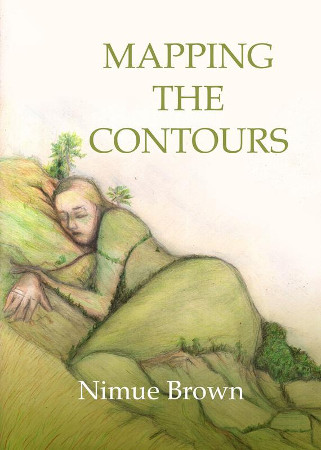
Review: Mapping the Contours by Nimue Brown

mapping the contours by nimue brownThere’s something old about the poems in this book, a bone-deep knowing, a merging of self and land which is reflected in the cover image. It speaks of a time when the hills were the contours of giantesses, the curves of beautiful goddesses, a time that still is and is not with us now.
‘Walking myself into the landscape, and walking the landscape into myself’ is the way bard and druid author Nimue Brown describes the process behind her new poetry collection Mapping the Contours. In the poem that provides the title she says ‘Human bodies are much like landscapes.’

In ‘Raised upon these hills’, one of the most beautiful hymns to a landscape I have ever read, Nimue evokes her lifelong relationship with the Cotswold Edge:

I was raised upon these hills,
My bones are made of limestone,
Sweet Jurassic limestone,
Grown from ancient seas.
I was raised upon these hills
My body made of fossils
Where the Cotswolds meet the Severn,
And the Severn seeks the sea.

She, land, and goddess are inseparable. In ‘Seeking Goddess’ Nimue speaks of going to the forest, rooting with the boar, sleeping with the lynx, making love with the trees, becoming ivy-templed and bird-haired, sharing milk and giving birth to bees. Inseparable too are the local animals and plants: urban foxes, an otter on a bus station, wild swans over the Severn, brambles, orchids, fly agaric. And most strangely a lonely ‘telephone bird’ ‘Outside my window impersonating / A ringing phone.’

There is a lot more uncanniness in this collection encountered in both the seen and unseen worlds. Trolls long to drink ‘the elixir of your terror’ and ‘dead things’ fall from the mouths of the dark siblings of the Shining Ones. In ‘Granny’s house’ ‘All chicken magic and bones’ Baba Yaga

…bears the knife
Opening bone truths
My shoulder blades
My wings
Beauty never dared
Whilst living.

As well as engaging with folklore Nimue provides a more homely and nourishing alternative take on old British myths originating from the Dark Ages of warlords and shining-browed bards. Her cauldron does not brew potions for ‘blinding flashes or ‘burning heads’ but ‘soil food, soul food’, ‘everyday gifts’. Her thirteen treasures are not weapons but a loom, a log, a seed, a cup, a candle…

Tongue-in-cheek she speaks of becoming ‘indigenous English’, a ‘Dirty Briton’, claiming back soil and soul. This act of reclaiming forms the heart of the book. I’d recommend it to all poets, Pagans, and nature lovers as a paradigmatic record of recovering an ancient way of being that lies within our bones and the bones of the land.

You can buy Mapping the Contours HERE and read Nimue’s blog, Druid Life, HERE.

Review: The Book of Onei by Christopher Scott Thompson

The Book of Onei by Christopher Scott Thompson is ‘an antinomian dream grimoire, providing deceptive yet true information about the art of Oneiromancy or dream magic in the form of poetry, fantasy, and intentionally ambiguous instructions.’

It is narrated in the voice of a ‘dark seer’, a ‘night wanderer’ drawn to seek the wisdom of the ‘beautiful chaos’ and ‘primal darkness’ and its ‘chthonic and horrifying entities’ rather than the light. Unlike similar narratives involving journeys to otherworlds he does not go with a benevolent aim such as bringing back a dead lover or relative. Following in the footsteps of his father, who stole The Book of Onei from the Great Library, this Promethean anti-hero goes instead to steal a secret – the knowledge of how to understand the book. “Prometheus didn’t give the fire back,” he tells his wife before setting out through the door in the basement.

The main thread of the narrative is this unnamed dark seer’s journey. The rest is composed of lore from The Book of Onei. This includes stories which take the form of powerful parables in a similar strain to Nietzsche’s Thus Spake Zarathrustra, riddling poems, and lists of the Powers of Onei and how they might be invoked or exorcised through prayers, offerings, charms, symbols, and rituals.

The visionary scope of this book is immense and could only have been channelled from the depths of dream. One of the most striking characters is the prophet Eyes For Flowers, one of the Sons of Crow, who has huge sunflowers spilling through the eye-holes of his crow-mask. This image and the depiction of demons transformed into angels who ‘rose up from the husks of their bodies as burning wheels, as gears and eyes and wings’ put me in mind of the raw genius of Blake and Ted Hughes.

There is also a lot of animistic wonder. I was mesmerised by the song of the spider who sung to the Fool who would become Three-Times Exiled in his cage and by the words of the swaying serpent who teaches that ‘the Chaos Ocean is not a place you can walk to’ but lies ‘in the crevices between moments.’

As you might have guessed this book is packed with paradoxes. The places and powers in the Book of Onei may not exist in Onei itself and it remains unclear whether there is ‘a secret to be uncovered, or only lies within lies.’ The only way to discover the truth is ‘to go there in person.’ Deep contrary wisdom is conveyed about travelling otherworlds, drawn from fairylore, grimoires, alchemy, demonology, and, forthmost from the author’s experiences as a dreamwalker and visionary.

As a kindred spirit drawn to the beauty of the darkness I fell in love with The Book of Onei when it first started out as a series of blog posts and was delighted to hear it has been published in book form. When I read it in full I was not disappointed. It is a valuable contribution to visionary literature and dark mysticism that deserves to be preserved for longevity. Although not explicitly political it is a work that provides gnosis and guidance for facing dark truths in troubled times.

I would recommend it to anyone who has heard the call of the Veiled One who stirs her ‘cauldron made of swirling stars and galaxies’ or been haunted by the ‘eerie, dreadful dead’ of the Host. I don’t want to give away how it ends, only that it begs a follow up – more!!!

The Book of Onei can be purchased HERE.

Review: When We Are Vanished by Nimue Brown

42497_original_9dfb889b-31ef-4c08-803a-a044d1cf1a21_largeNimue Brown is a Druid author based in Stroud. I’ve enjoyed a number of her publications on Paganism and Druidry and her Bardic poetry books. When We Are Vanished is the first of her works of fiction I have got my hands on. It is a speculative mystery novel set in a not-so-distant future where hackers have shut down the global computer network to bring an end to ‘war, finance and government’. When the book opens, the system is in its death throes. Job centres, the police force and scientific laboratories are just about hanging on, relying on new ‘cellulose tech’, which has a mind of its own and a wicked sense of humour. And people are vanishing, suddenly, inexplicably, from the outskirts of civilisation one by one…
At the core of the story is a family: a father who has vanished; three sisters at various stages of vanishing named Kim, Epona and Maria; and their mother, Amanda, who is struggling to deal with it all. The character who I connected with most was the intelligent, erratic Epona. On several occasions her connections with her namesake, the Gallo-Roman horse goddess and psychopomp, are subtly referenced. For example, a computer screen run on the tricksy cellulose tech reads, ‘Eponine Matthews will tell you she is made of chalk’ (referencing the White Horse of Uffington). ‘Tell her to go home and not show her long face again.’ More deeply, Epona is the user of a technical device which allows her to plug into other realities, relating to the horse goddess’s movement between worlds. As I followed the plot, I was intrigued by how this would play out. It did not turn out how I expected!

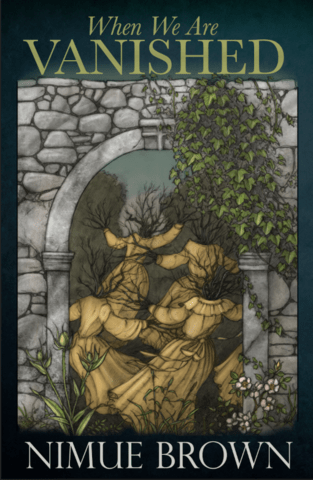
Nimue has worked extensively with dreams and this shows throughout the book. Its twists and turns and much of the language evoke the non-logic of the dreamworld; metaphorical, absurdly funny, frightening, exquisitely beautiful. As Kim vanishes, ‘Meanings floated away from her. Fish, fish, fish. Sounds like wish… Set the wish fish swimming into the skies. Wish fish, wish fish and if you stare at the clouds for long enough, they would vanish too… She feels threadbare, a word too often repeated. A cloud stared out of the sky.’ Kim’s reflections on time also touch on the mystical. A recurring scene that haunted me was the one pictured on the front cover, ‘yellow dresses and ancestral women made of twigs, turning in a tight circle dance.’

When We Are Vanished succeeds in combining the numinous with an implicit critique of the flaws of our current civilisation: our over-reliance on technology and an inhuman system, our misplaced faith in irritating and badly written self-help books, the impossibility of shutting out wild nature and our wild selves, and the illusion that this world is the only reality. I would recommend it to readers who enjoy a plot rich in references to mythology, folklore and fairytales with surprising twists and to those who are fascinated by the possibilities of future worlds and other realities. As the illusion of liberal democracy slowly melts away from the Western world and alternatives awaken, the situation evoked does not feel far off…

You can purchase When We Are Vanished HERE.

Review: ‘Brigantia: Goddess of the North’ by Sheena McGrath

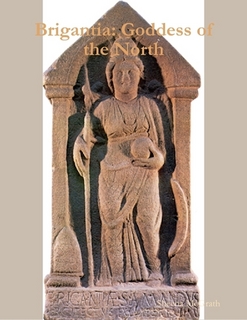
BrigantiaBrigantia: Goddess of the North is a short e-book (81 pages long) by Sheena McGrath. As far as I am aware it is the first book to focus on Brigantia as an individual northern British goddess; there are many books about Brigit which cover her relationship with Brigantia but none, until now, focusing on Brigantia alone.
Our information about Brigantia is limited to seven Romano-British inscriptions, one (or maybe two) statues and the writings of the Roman historian, Tacitus, who records the tribal name of the Brigantes ‘High Ones’ of whom Brigantia is believed to be the tutelary goddess. I live in Lancashire and have experienced Brigantia’s presence on the West Pennine Moors. I’ve researched her background but never investigated the context of her dedications. This is where Sheena’s work excels and provides an original contribution to scholarship on Brigantia.

One of the most fascinating things Sheena reveals is that several of the inscriptions and the famous statue from Birrens date to around the time the Roman Emperor Septimus Severus lived in Britain (208 – 211CE). His base was at Eboracum (York). The Severans played a central role in shaping the Roman cult of Brigantia.

This is evidenced not only by the dates but by Brigantia’s identification with Caelisti and pairing with Jupiter Dolichenus in one of the inscriptions. Septimus was of African origin. He and his wife brought their deities to Britain. One of them was Tanit, an African goddess who was venerated by the Romans as Dea Caelistis. Another was the Romano-Syrian Jupiter Dolichenus. This inscription results from Brigantia’s assimilation into the Imperial cult. The statue borrows attributes from Caelisti and Juno (Jupiter’s consort) as well as Minerva, Victory and Fortuna. Sheena also examines the political motivations behind the inscriptions pairing Brigantia with Victory.

In the later part of the book, Sheena discusses what can be conjectured about Brigantia’s role as the goddess of the Brigantes tribes. She focuses in particular on Tacitus’ account of the Roman invasion of Britain and the conflict between Cartimandua, Queen of the Brigantes, and her husband, Venutius. One idea (unfamiliar to me) is that Cartimandua was an exile from south. This explains why she favoured peace with the Romans whereas her husband was hostile toward them. Another consideration is the possibility of a ‘special relationship’ between Cartimandua as Queen of the Brigantes and Brigantia as their sovereign goddess,

Brigantia provides a detailed and enticing examination of the context of Brigantia’s worship in ancient British and Romano-British culture. I’ve been learning about Brigantia for over five years and there were many facts I was unaware of and points I will be researching further. Sheena also provides an extensive bibliography. I would recommend this book as an excellent starting point for all polytheists wanting to learn about Brigantia from a scholarly perspective and to students of Celtic and Roman history and religion.

You can purchase a copy of Brigantia HERE.

*I reviewed this book as a PDF so cannot comment on how it looks or reads on an e-book reader.

Review: A Kindness of Ravens by Rhyd Wildermuth

product_thumbnail.phpRhyd Wildermuth is a writer, anarchist, theorist, bard, and the co-founder of Gods&Radicals. A Kindness of Ravens is his second book. At its core lie Rhyd’s struggles to re-establish the cultus of Brân ‘the Raven King’ and bring an end to capitalism. These quests go hand-in-hand.

The book’s based around a haunting vision of ‘The City At The Gates Of The Dead’ where Rhyd stands beside a dead bard of Brân’s and sees a settlement, a town, a city, built and destroyed then a ‘last city… encompassing the world… And I saw what was coming.’

The cause of this destructive cycle is disenchantment which ‘follows disinheritance, displacement from the land into factories and mills and offices.’ Capitalism cuts us off from the land and creates cities where there is no place for gods, spirits, the dead, poets or the poor.

Rhyd’s work is inspirational because it not only elucidates the problem but offers solutions: ‘a change of place consciousness and a resurrection of class-consciousness, a solidarity between peoples and the spirits of place, a new treaty with the land and its inhabitants (living and dead, seen and unseen)…. we must see every place our home and a site of beautiful resistance.’

One of my favourite pieces, which has been a continuing influence on my thought and work, is ‘Awakening the Land: Madness and the Return of the Welsh Gods’. Narrated from a cliff-face in Snowdonia (which Rhyd climbed to ask advice from giants!) it seamlessly interweaves the stories of Brân with the personal and political.

Rhyd says ‘to know a god you must go mad’ and contrasts the divine madness of the awenyddion with the ‘sanity’ of waging out time for work and waging war. Against ‘the desolation of disenchantment’ he evokes Brân as a revolutionary figure who ‘embodies the land and its power’.

A problem Rhyd draws attention to is ‘trying to world in a god most don’t know’. Elsewhere Rhyd speaks of worlding the gods into existence: a process by which the gods come into the world through us. This can be beautiful and awe-inspiring but also frightening and disruptive.

Unlike members of older religions, contemporary polytheists have few scriptures or predecessors to turn to. It’s even more difficult when communications come from gods only a handful of people have written about from a polytheistic perspective. In the Welsh myths, Brân acts as a bridge for his people. In A Kindness of Ravens, Rhyd acts as a bridge for Brân and the revolutionary potency of his mythos.

Much of this book is intense: written with the raw, uncensored force of the untrammelled Awen. Rhyd’s masterful at taking you into his world to see through his eyes vast seams of injustice, the anger of his gods and the dead, the sorrow of ‘the Singers in the Dark.’

There are plenty of ravens and examples of kindness and care for others too. Rhyd writes ‘As long as we’re happy to enjoy the safety and protection of systems-of-meaning which devalue forests and Black bodies, our gods will be our own personal secret story.’

Rhyd advocates a polytheism wherein the land, gods, ancestors, our communities, the personal and political are intrinsically linked. The fates of all are bound up with the hegemony of capitalism and the imperative to resist it and build a better world.

A Kindness of Ravens is a revolutionary book: an inspiration for artists and activists and a way-marker for polytheists. I return it to my shelf with the firm belief it will be influential for many years to come.

Available through Lulu HERE.