The Oracle of Old Craft Crow

I am the one who knows
of the craft that strung bones together
before there were sinews

and animated matter before the first breath.
Before the primordial darkness 
there was a crow. 

Don’t believe me? 
Ask the Old Mother –
she didn’t believe her eyes

but there I was and from me she learnt
the art of stirring her cauldron birthing the stars.
Still don’t believe me? Know this –

I can bring back the bones of forgotten monsters,
reassemble them to look like angels,
retrieve the words of lost books,

repair your dying world.
Still don’t believe me? Cah! 
Fill your mouth with my feathers,

spit them out and read my oracle.
Then you’ll see how in the darkness between worlds,
in the depths of all the pollution your kind have siphoned off,

at the end of all ends flies a crow and I am love.
Still don’t believe me? Cah! Cah!
You’re not the first.

The Speaking Ones

Several years ago I had a vision of the world becoming as a whirlpool from the source. ‘Green moving swards of vegetation, trees, people, marching through a labyrinthine kingdom back into the void carrying houses and entire civilisations.’ Sometimes people got stuck. With bird-headed ones they came knocking on the back of my head trying to shout through me. I was on Psylocybe mushrooms and alone at the time and didn’t dare let them.

The practice of a person allowing spirits to speak through them is found in many world religions from Voodoo to Evangelical Christianity. It was likely to have been an important component of pre-Christian Brythonic polytheistic religion and survived into the 12th century as recorded by Gerald of Wales.

Gerald writes of awenyddion ‘people inspired’. ‘When consulted upon any doubtful event, they roar out violently, are rendered beside themselves, and become, as it were, possessed by a spirit.’ Their speeches are ‘nugatory, ‘incoherent’, ‘ornamented’. When ‘roused from their ecstasy, as from a deep sleep’ they cannot ‘remember the replies they have given’. He conjectures: ‘perhaps they speak by the means of fanatic and ignorant spirits.’ (1)

Gerald’s words provide evidence for a Brythonic tradition of spiritwork in which there exist ‘soothsayers’, referred to as awenyddion, who are possessed by spirits by whom they speak in the metaphorical language of poetry.

I first came across the term ‘awen’ for ‘poetic inspiration’ in the Druid communities and saw myself as a bard before my patron God, Gwyn ap Nudd, initiated me as an awenydd. I have served Gwyn in this role for over ten years by journeying to Annwn to bring back inspiration for my communities. 

I have prayed for awen and for the Gods and spirits to inspire and come into me when writing in a similar way to the ancient Greek poets calling on the Muses and to William Blake asking the Daughters of Beulah to come into his hand. (2) I’ve also experimented with trance singing, letting go, just letting any words and tune flow. But, until recently, I hadn’t dared speak the voices of spirits.

This changed after a conversation with a fellow member of the Monastery of Annwn, who told me of his calling to channel Gwyn. It reminded me of the bird-headed spirits, who’d come knocking, whose desire to speak I had denied. I felt the time to offer my voice had come and journeyed to them.

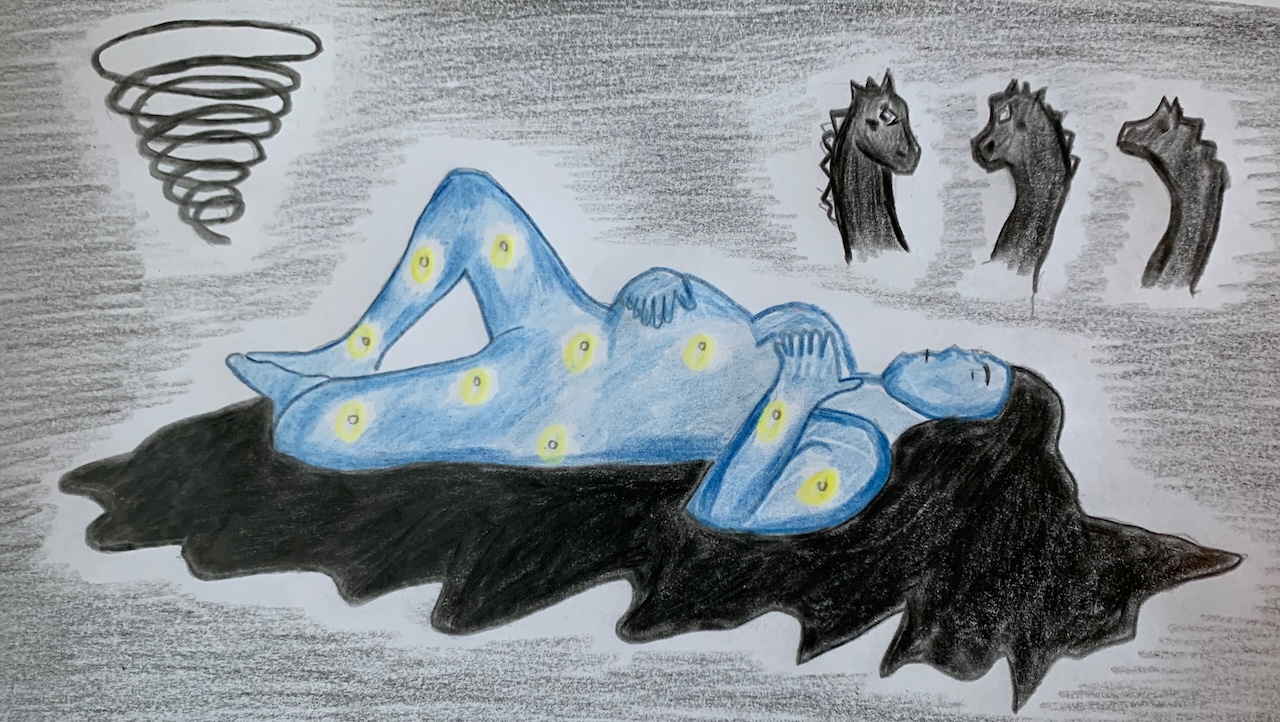
I saw them as crows flocking in the sky in the shape of infinity then crossed bones. Their home appeared as the floating skeleton of a great raven. I offered to gift them my voice and they gave me some instructions. They would stand behind me. Then I must open the door and loosen my tongue. I tried it whilst in the Otherworld and received a prophecy about a distant son of Don.

Several days later on their prompting I composed a song to enter the trance state:

Crows, crows, the Speaking Ones
Y rhai sy’n siarad

Come, come from Annwfn
Come, come your will be done

Crows, crows, the Speaking Ones
Y rhai sy’n siarad

Come, come bring your words
Come, come you will be heard

Crows, crows, the Speaking Ones
Y rhai sy’n siarad

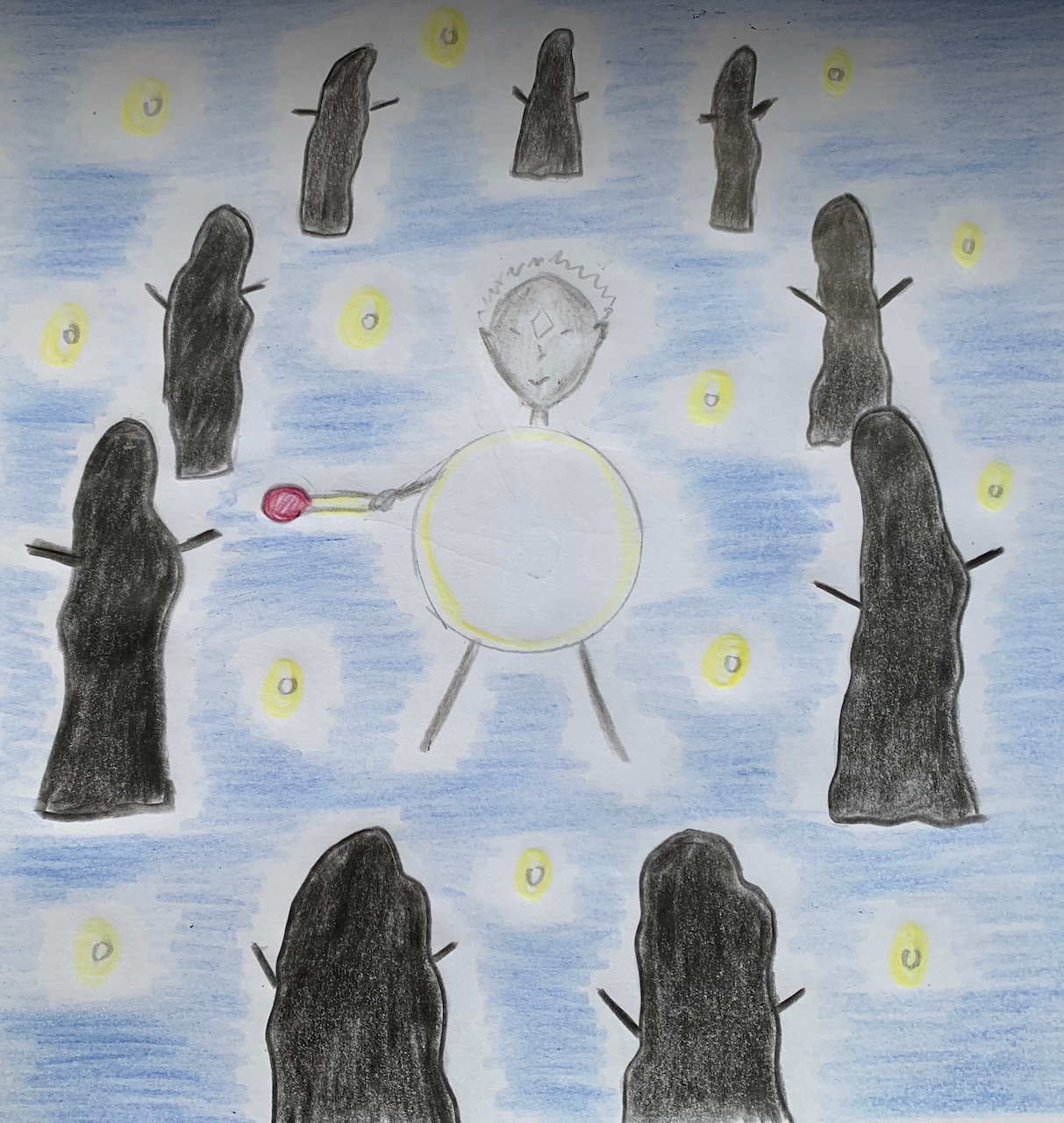
When I tried it the first time and asked who wanted to speak they told me they would take it in turns and each wanted me to make their words into an oracle. I did this by letting them speak out loud through me first then writing down what I could remember and putting it into more poetic form. (3)

On completion of the oracles I read them to the Speaking Ones and gained their approval. At first I wasn’t planning to make any of this work public but I was told they wanted their voices to be heard so I will be posting the oracles of these seven crow-guides over the course of the next week. 

(1) https://awenydd.weebly.com/giraldus-cambrensis-and-the-awenyddion.html
(2) ‘Daughters of Beulah! Muses who inspire the Poets Song… 
Of varied beauty, to delight the wanderer and repose 
His burning thirst & freezing hunger! Come into my hand 
By your mild power; descending down the Nerves of my right arm 
From out the Portals of my Brain, where by your ministry 
The Eternal Great Humanity Divine, planted his Paradise’
~ William Blake, ‘Milton’
(3) As a note I don’t consider this to be full trance possession because, whilst working alone, I don’t dare let go of my conscious faculties fully. Also, for this particular work, I have been asked to record the words so need to be aware enough to remember them. During this process I’ve felt something other has come through, but that I’m not fully out of the way, and suspect my consciousness might have coloured some of the content.

The Challenges of Taking a Polytheistic Monastic Name

In the mainstream religions it is traditional for monastics to take a monastic name when they are ordained into a monastery on taking their vows.

When Christians monks and nuns take temporary vows they take a new name. This must be the name of a saint, monastic or Old Testament figure. The name is preceded by ‘brother’ or ‘sister’ as they see each other as family. For example Brother David, Sister Mary, Brother John. Three choices are handed to the Abbot who makes the final decision on the name.

Buddhist monastics are given a Dharma name, usually by the head of the monastery or by their teacher, and may have several different names during a lifetime. For example Shinran’s first name was Matsuwakamaru and his other monastic names were Hanen, Shakku, Zenshin, Gutoku Shinran and Kenshin Daeshi.

In Hindiusm monastics also take a new name when initiated by a guru. For example Paramahansa Yogananda was born Mukunda Lal Ghosh.

When a monastic name is taken it symbolises giving up one’s old identity, wealth and ties with family and friends to enter the community of the monastery. One’s secular life is renounced for a religious life.

*

Modern Polytheism began to emerge in the 1960s and to grow in the 1990s. Polytheistic monasticism has developed more recently with the first book, Polytheistic Monasticism: Voices from the Pagan Cloisters, published in 2022. It has precedents in Pagan and Druidic monasticism.

The only physical Pagan monastery in existence is the Matreum of Cybele. Online Druidic monastic organisations include the Order of the Sacred Nemeton and Gnostic Celtic Church Monastery. Unfortunately I couldn’t find any information on their websites about whether monastics are required to take a monastic name or if they renounce their former life in any way.

In Paganism, more widely, it is common to take a craft name or magical name. This can be chosen through contemplating which animals, herbs, myths and Deities one has an affinity with or can be gifted by the Gods and spirits. Some well known examples are Greywolf, Starhawk, Bobcat, Robin Herne and Nimue Brown. This is used in the Pagan community and does not involve changing one’s identity and ties with secular sociey in which one’s regular name is retained.

*

I am a Brythonic Polytheist and received my monastic name from my patron God, Gwyn ap Nudd, before I took vows as a nun. It started as a joke. Lockdown reawakened my longings for a monastic life. I’m an incredibly impatient person and, when I was being impatient with the weeds, Gwyn chided me, “Sister Patience.” I took it as a challenge, telling him “I will become Sister Patience.” It was a self-fulfilling prophecy for three years later I founded the Monastery of Annwn and took vows by that name.

For me the shift in name and identity from Lorna Smithers to Sister Patience has been a gradual one. I first started using my monastic name in the monastery only, then, as I began to change and grow to own it, I renamed my blog ‘The Cell of Sister Patience’ using it more widely in online spaces.

In February 2024 I was faced with the decision of whether to return to a regular job, which would have meant staying as Lorna Smithers and likely returning to old habits like shopping and drinking due to the stress and having more money, or to fully commit to a monastic life as Sister Patience.

My ability to choose the latter was made possible by mum offering to support me financially if my savings run out before I have found a way of supporting myself through a combination of writing and spiritual work.

This gave me the security to take the step of using my monastic name in all my communities, keeping my birth name only for financial and legal purposes.

It hasn’t been an easy process. Everyone who knows me knows I’m very impatient, thus Sister Patience would be the last name they would call me. My mum’s first reaction was, “I’m not calling you that!” before I explained. She still keeps calling me Lorna or, bizarrely, Beatrice, but is getting better. My dad won’t use it. My uncle on my mum’s side and his partner have been accepting. Most of my friends and the horticultural groups I volunteer with along with my personal trainer at the gym have been supportive. 

As a polytheistic monastic without a physical monastery it is impossible for me to make the break with the secular world made by other monastics. Ethically I am currently unable to make such a break as my eldery parents are dependent on me for support around the house and in the garden. 

Instead I strive to live as monastically as I can considering my circumstances. I serve my Gods through my spiritual practices and creativity and treat my room as a monastic cell and my home and garden as a monastery. My engagement with the wider world is limited to occassionally seeing friends for a walk and / or a brew and to attending spiritual groups. I don’t use social media and limit my online time to engaging with others for spiritual discussions and research for my writing along with learning yoga.

Taking a monastic name hasn’t changed how I am around people. I’m not putting on airs and graces. I’m not pretending to be something I’m not. I still swear. I still get angry. I still get impatient. But, looking back, not quite so much. There is power in taking a name and perhaps, one day, I will live up to it.

Defining my Role as a Nun of Annwn

At the Monastery of Annwn we do not have a set definition of the role of a monastic devotee or any rules except to follow the Rule of the Heart (1). Our ethos is egalitarian and our paths are fluid and led by the Gods and spirits. However, as I step into deeper commitment to becoming a nun of Annwn, I feel drawn to define my personal role.

What is a Polytheistic Monastic?

I will begin by citing the existing definition of a polytheistic monastic from Janet Munin in Polytheistic Monasticism: Voices from the Pagan Cloisters.

‘Monastics are those who have taken solemn vows to live centred on their relationship with one or more Holy Power. Anything which impedes or compromises that relationship is left behind or minimised as much as possible. They are renunciates, offering up wealth, social status, a conventional career, and family life on the altar of devotion.’

This is echoed and expanded upon later on: 

‘The monastic’s life is focused on devotion to one or more Holy Powers, usually formalised with vows. Because of this focus, the monastic practices some agree of asceticism, removing distractions to spiritual life which are taken for granted by others: wealth acquisition, social life, social media consumption, etc.

‘The monastic lives according to a Rule or other structure which supports and reinforces their vowed life. Some of these are formal, breaking each day and season down into deliberate, repetitive order. Contemplation, prayer, study, worship, chores, rest and recreation all have a place and are engaged in deliberately, at the appropriate time. Others are less formal and detailed, but still serve as a mindful framework for the monastic’s daily life.’ 

Here we see, first and foremost, what defines a polytheistic monastic is leading a life of devotion centred on one or more Deities formalised by vows. For me this perfectly defines the heart of polytheistic monasticism. I’m also in agreement with the description of living by a rule and leading a structured life.

I agree a little less with the stress on renunciation. This is because renunication is a negative word. Its origins lie in the Latin renuntiare ‘protest against’. It carries overtones of negativity and against-ness and in my experience acting against most often causes undue conflict and waste of energy.

I propose instead a different word, ‘sacrifice’, which might sound more extreme with its connotations of offering one’s most precious things, desires, ambitions, at the most extreme end one’s life to the Gods. Yet, when we look at the root of the word we find a more positive sense than renouncing or giving up. The term originates from sacer ‘holy’ (2) and facere ‘to make, do’. Thus to sacrifice is to make holy all aspects of our lives for the Gods.

I do not agree, particularly when at present polytheistic monastics do not have the support of fellow devotees in a physical monastery, that it is healthy to renounce ties to family and friends unless they are insurmountable impediments to a monastic life. I think, instead, we should strive to sacredise these relationships and bring our devotion and inspiration into the lives of others.

I do agree that the rules and norms of modern capitalist Western society (ie. consumerism which brings about the exploitation of the earth and the underworld and social media which causes distractions that prevent communion with the Gods and the Deep) should be renounced because they are antithetical to the sacred and cannnot possibly be sacredised.

My personal working definition of a polytheistic monastic is as follows:

‘A polytheistic monastic leads a life centred on devotion to one or more Deities formalised by vows. This is supported by a rule and the order and discipline of daily, monthly and seasonal practices including prayer, meditation and ritual. It is a life of sacrifice, in the sense of making holy all acts and relationships as an offering to the Gods.’ 

What is a Monastic Devotee of Annwn?

When I founded the Monastery of Annwn in 2022 its main purpose was to provide ‘a virtual space and place of sanctuary for those who worship and serve the Gods and Goddesses of Annwn’.

This has been achieved. We number twelve members with several living under vows. We communicate through a private forum and have a monthly online check-in and run open online meditations and seasonal rituals.

We are bound as a monastery by our Nine Vows and the Rule of the Heart, along with daily and monthly prayers (many of which have been co-written and include a new moon prayer and a novena practice over the full moon) and our ritual year based around the mythos of our patron God, Gwyn ap Nudd.

Where Annuvian monasticism differs from more traditional forms is its combination of contemplative and meditative practices with the shamanic and ecstatic practices of spiritwork and journeying to Annwn. Devotional creativity, questing and sharing awen ‘inspiration’, is also central.

Whereas communication with underworld Gods and spirits and ancestors and artistic expression along with physical exercise are banned or restricted in other traditions these are encouraged in our monastery as sacred.

My personal working definition of a monastic devotee of Annwn is as follows: 

‘A monastic devotee of Annwn leads a life centred on devotion to one or more Gods and Goddesses of Annwn formalised by Nine Vows and the Rule of the Heart. Life is structured by daily and monthly prayers and seasonal rituals. By a balance of contemplative and shamanic practices (3) sacred relationships are formed with all beings in the world and the spirits of the Deep. Each devotee is an awenydd, questing awen, and sharing it in community.’ (4)

What is my role as a Nun of Annwn?

I see my role as a nun of Annwn as having many aspects. These have shown themselves as I have walked my path, from serving an apprenticeship to Gwyn as an awenydd, taking lifelong vows to Him, to becoming a nun. 

Devotee – At the heart of my path lies my devotion to Gwyn and I also venerate His family and my local river Goddess and spirits and the ancestors.

Inspired One – I first served Gwyn and other Brythonic deities and the spirits of my local landscape as an inspired poet and storyteller bringing their little-known myths and tales back to the world. This has changed slightly since I became a nun for I now primarily create devotional poems, songs and art.

Spiritworker – When I met Gwyn He taught me to journey in spirit with Him to Annwn and introduced me to the spirits of His magical realm. This is an ongoing process of building relationships and deepening into mystery. I also strive to build good relationships with the spirits of my home, garden, and local land. My ancestral guide is Orddu. With her I am learning to speak with the voices of spirits as recorded by Gerald of Wales amongst the awenyddion.

Wisdom-Keeper – This refers to my researching and sharing Annuvian lore.

Strong Vessel – For the strength to hold the awen I maintain the disciplines of a regular meditation practice including breathwork and physical exercise such as running and strength training along with yoga which combines both.

Guide of Souls – This is a newer role which Gwyn told me I must step into when I took initial vows. I have already been fulfilling it and continue to do so by my writing. More formally I have begun offering one-to-one soul guidance sessions for other people. I occassionally act as a guide to those passing through the Otherworld and between worlds too.

Sacristan – I first came across this term in the work of of fellow polytheistic Danica Swanson who runs Black Stone Sanctuary (5) but only recently realised it fits my vocation. For me it refers to someone who tends sacred spaces. I see it to include my altars and monastic cell and to be expandable to my home and garden (which I am striving to treat as a monastery). I also see it to relate to my work building and administering the Monastery of Annwn and to co-organising and often leading rituals and meditations.

In each of these roles I serve Gwyn and the Spirit of the Monastery. Although one or more might come to the forefront at certain times and others be backgrounded they are all inspired by the breath of awen and heartbeat of Annwn. I expect there to be more challenges and changes as I grow into the role.

(1) To follow our hearts in alignment with the heart of Annwn.
(2) When I saw sacre translated as ‘holy’ it made me smile as Gwyn’s name means ‘white, blessed, holy’ and I like to think when we sacrifice, when we make sacred, we make things a little more Gwyn. 
(3) I first saw the terms ‘contemplative and shamanic’ used together to describe the way of Mycogenous Dionysus by Dver and thought how well this fits with Annuvian monasticism too. https://forestdoor.wordpress.com/2023/10/02/mycogenous/
(4) Community can be human and / or other-than human.
(5) https://blackstonesanctuary.substack.com/

Twelve Days of Devotion to Gwyn ap Nudd – The Birth of Gwyn

Over the twelve days of devotion (25th of December to 6th of January) I focused on the birth of Gwyn and was guided through a series of practices. I was called to chant, sing, meditate, draw and embody Gwyn and His mother, Anrhuna. On this last day I bring them together to share as an offering to Him and to my online community hoping it will inspire others to delve more deeply into the mysteries of His birth in the future.

Mam Annwfn

Chant: Mam o mam o mam o mam o mam o man Annwfn.

Embodiment practice*: Lying in a modified version of Suptka Baddha Konasana (reclining bound angle pose) with left hand on heart and right hand on belly.

Meditation 1: I am the Deep and I am its mother.

Meditation 2: My heart and His heart beating as one.

Unborn Gwyn

Chant: Gwyn heb ei eini, Gwyn fettws, Gwyn breuddwydio, Gwyn dreaming, foetal Gwyn, unborn Gwyn.

Embodiment practice: Lying in Parsva Savasana (side corpse pose or foetal position). 

Meditation 1: I dream the universe.

Meditation 2: I am promise.

Birth

Meditation 1: 

Where shall I birth You 
into the world, 
my son, my king, 
my patron, my muse, 
my inspiration, my truth? 

Meditation 2: 

A mother’s longest hours 
like mountains, heaving belly, knees bent, 
reaching the peak, screaming, running down holding a baby
knowing prophecy is born in moments of pain,
the first cry of an infant mouth.

She Holds Her Son

Song: 

She holds Her son 
between space and time
in the place that’s Hers
and His and mine.

The Newborn

Meditation 1:

Born with a laugh 
to change the world
wise a changeling 
speaking in riddles
comes a newborn
to break all the rules.

He sings:

Hear the heartbeat, hear the drumbeat, hear the call.
Feel the heartbeat, feel the drumbeat stir your soul. 

Sing, chant, dance, drum with newborn Gwyn and the shadow nuns. 

WE ARE REBORN
here, now, in this moment, always, forever.

Inspiration

No-one knows the day or hour of Your birth because You were born before the universe.

*

You have as many births as the facets on your jewel – their number is infinite.

*

The geni in ca fi’n geni ‘I am born’ stems from the Proto-Indo-European root *gene that gives us ‘genesis’. With You, with each child, a universe is born. 

*

Each of us contains a universe, like a cauldron, and it’s only when our cauldrons crack and the relationships between the constellations of our presuppositions break down we perceive the sea of stars, the darkness of the Deep, the vastness of Annwfn, the Abyss, the Void. 

*

Floating on the starry tide, the infinite waters, You are always being born.

*I have been drawn to use yoga poses in my practice on the basis of gnosis about shared Indo-European origins of Brythonic polytheism and Hinduism. I have found likenesses between Anrhuna and the Hindu Goddess of primordial waters, Danu, who gave birth to the dragon, Vritra, and the Davanas. Gwyn shares many similarities with Shiva.

Contemplating the Abyss Part Five – Saints in the Void?

In this final part of the series I will be looking at how abyss mysticism and the visions of the Abyss shown to me by my Gods relate to the Brythonic tradition.

The Welsh term for ‘abyss’ is affwys ‘depths, bottomless pit, precipice’ (1).

In the Welsh Bible (2) the term tehom is translated as dyfnder ‘deep’ rather than afwyss ‘abyss’. In Genesis 1.2 ‘And the earth was without form, and void; and darkness was upon the face of the deep. And the Spirit of God moved upon the face of the waters’ – ‘Yr oedd y ddaear yn afluniaidd a gwag, ac yr oedd tywyllwch ar wyneb y dyfnder, ac ysbryd Duw yn ymsymud ar wyneb y dyfroedd.’ And in Psalm 42.7 ‘deep calls to deep’ – ‘geilw dyfnder ar ddyfender’.

The first recorded usage of affwys is in the 13th century in The Book of Aneirin. ‘Disgennwys en affwys dra phenn’ ‘descend into a deep abyss’ (3). This seems significant as Aneirin was one of the Cynfeirdd, a ‘prince of bards’, along with Talhaearn and Taliesin. It is also of interest in relation to Aneirin speaking of undergoing an underground initiation in this poem (4). 

From thereon its use continues particularly in relation to Uffern ‘Hell’. ‘Yno y cloir ac rhoir rhwys yn Uffern a’i ffwrn affwys’ ‘there he will be locked up and cast into Hell and its abyssal oven.’ ‘Yn Uffern erwin aphwys’ ‘in Hell a harsh abyss.’

In The Book of Taliesin the term dwfyn is used to mean ‘depth’, ‘profound’ and ‘abyss or depths of Hell’ in the lines ‘dogyn dwyfn diwerin’ ‘the evil lot of the abyss.’ We also find the term diuant ‘space, void, annihilation, death’ as in ‘gogwn… pan ergyr diuant’ ‘I know why annihilation comes all of a sudden’ and ‘bet sant yn diuant ‘how many saints are in the void?’

Another term is agendor ‘abyss, gulf, depth’. Its earliest recorded use is in 1604. In a poem by Hugh Jones, written in 1759, we find the lines ‘Yna traflynca Annwfn / Y dorf i’r agendor dwfn’ ‘Then pass through Annwfn / the crowd to the deep abyss.’ These are suggestive of a group of people (the dead?) passing through Annwn to the Abyss and resonate with my experiences.

The notion of saints being in the void in the Taliesin poetry is also a fascinating one as we usually assume that saints ascend to Heaven. 

Could this line instead refer to monastics who practice abyss mysticism? Who go to annihilation in the void? Monks of Annwn outside the Christian orders?

Because they wrote nothing down we know precious little about the religious practices of the pre-Christian Brythonic peoples and nothing at all about their inner experiences, relationships with their Gods, what went on in their souls.

There is no evidence for beliefs about Anrhuna, Nodens / Nudd and Vindos / Gwyn being deities who act as custodians of the mysteries of the Abyss or monastics who practiced abyss mysticism but it can’t be ruled out. Whether this tradition is old or new I have been called to it as a nun of Annwn by my Gods.

(1) https://geiriadur.ac.uk/gpc/gpc.html
(2) https://www.bible.com/versions/394-bcnd-beibl-cymraeg-newydd-diwygiedig-2004
(3) https://geiriadur.ac.uk/gpc/gpc.html I couldn’t find a full copy of The Book of Aneirin in modern Welsh let alone a translation into English to check the context. 
(4) ‘I do not laugh the laugh
under the feet of creepy crawlies.
My knees stretched out in an earthen cell,
an iron chain
around my knees.’
Cited in Lawrence Eson, Merlin’s last cry: ritual burial and rebirth of the poet in Celtic and Norse tradition, January 2007, Zeitschrift fur celtische Philologie 55 (1)

Contemplating the Abyss Part Four – The God Beyond the Gods

In the previous post I looked at abyss mysticism in the writing of medieval monastics. Here I shall discuss how it relates to the visions of the Abyss that formed the core of my attempted novel, In the Deep, and to my own experiences.

The Christian abyss mystics of the medieval period perceived the soul and God to be dual abysses. Through a process of annihilation, led by love, the abyss of the soul was dissolved in the abyss of God. Van Ruusbroec conceived this slightly differently suggesting the Abyss was a ‘God beyond God’.

The process of annihilation was one that involved suffering. Penitence, purgation, purification, to varying degrees in different authors but the result was ultimately joyous union with God as the ‘divine’ or ‘blessed’ abyss.

The big difference between my own experiences and visions and those of these Christian mystics is theological as I am a polytheist and not a monotheist and find it difficult to identify the Abyss with the Christian God. 

The Abyss has a presence in my life as something powerful, as something divine, as a deity, but not as a God I can name. Thus Van Ruusbroec’s conception of it as a ‘God beyond God’ resonates deeply with me as does the positing by the Gnostics of a God of the Deep preceding the creator God whose prior existence is suggested in Genesis 1.2 ‘And the earth was without form, and void; and darkness was upon the face of the deep. And the Spirit of God moved upon the face of the waters.’ The terms ‘deep’ and ‘abyss’ stem from the Hebrew tehom and are often used interchangeably.

In the cosmology that has been revealed to me by the Brythonic Godsthe Abyss is part of Annwn, ‘Very Deep’, its deepest part, its bottomless depth. It is a place to where the souls of the dead return and from it are reborn.

The way I envisage it bears remarkable similarities to the vision of Hadewijch of Antwerp – ‘an unfathomable depth’, ‘a very deep whirlpool, wide and exceedingly dark; in this abyss all beings were included, crowded together and compressed’.

It is associated with deep wisdom that can only be won as a result of sacrifice. In the stories I was shown Nodens / Nudd agreed to give up His sword arm. He hung over the Abyss in the coils of the Dragon Mother, Anrhuna, the Goddess of the Deep, and received the knowledge, ‘There is no up or down or before or after – everything meets here in you the Dragon Mother.’ 

Vindos / Gwyn ap Nudd hung over the Abyss on a yew wounded in raven form and gave every last drop of his blood in exchange for a vision ‘to set the world to rights’. His knowledge was brought out of Him by a series of riddles and He saw Himself as a black dragon before plummeting dead into the Abyss.

At the beginning of the next book in death He was united with ‘the source’:

Vindos fell,
and as he fell he left behind
his shell of bones and black feathers 

and his soul flew free on wider wings
on the winds of the Abyss.
He had won

their favour
through his offering 
of every last drop of his blood.

By his wounding, by his questioning,
agony had become ecstasy.
The bottomless

abyss
was no longer bottomless.
He had mastered its paradoxes and knew

where darkness turns to light
and death to life.
Down was

now up
and he was one
with the source, the spring

from which the ocean of the stars
sprung when the universe
was born.’

These scenes bear similarities with Marguerite Porete’s words about the soul, in annihilation, finding ‘there is neither beginning, middle nor end, but only an abyssal abyss without bottom’ before acheiving ecstatic union with God.

It seems my Gods, Nodens / Nudd and His son, Vindos / Gwyn are presenting to me a tradition of sacrifice to the Abyss in return for its wisdom. By leading the way they are showing what might be expected of Their devotees.

My first experience of the Abyss took place as the result of an unconscious process of self-annihilation – dissolution of the self through the combination of practicing Husserl’s epoche (putting all one’s presuppositions about the nature of reality aside) with drugs and alchohol and all night dancing.

There was a yearning within me, I might now say deep for deep, abyss for abyss, but I didn’t know what it was and when I got to the Abyss it terrified me. I wasn’t ready for abyssal wisdom. I didn’t know what to do. I didn’t understand its choices, to live as I was or to die physically, or to take a third door. 

I see in my own impulses and those of the abyss mystics, love and annihilation, the interplay of eros the ‘life drive’ and thanatos the ‘death drive’ which together lead to the Abyss and to union with the divine if one is prepared to surrender to make some sacrifice of themselves.

I’ve never been good at giving or sacrifice always wanting things my own way.

Ten years ago, Gwyn, my patron God, a King of Annwn, asked me for a sacrifice in exchange for the wisdom of Annwn – to give up my desire to be a professional author. I did so… but not in full… I secretly entertained a hope if I gave it up for a period I might be let off and be able to have my cake and eat it.

My experience of writing In the Deep, spending a year and a half on a novel that has turned out unpublishable and daring to think it might sell more widely than my previous publications has shown this is not the case. 

It’s taken me ten years to realise I must give up my biggest dream in full for good.

This fits with the process of self annihilation found in the medieval mystics. Only by giving up our desires, surrendering our will, can we walk the path of the Gods and with them find a deeper unison with the God beyond the Gods.

I believe this also relates to the need to give up my identity as Lorna Smithers, published author, performing poet, public speaker, to become Sister Patience.

In the Deep was not written purely for self gain. First and foremost it was written for love** of Gwyn, as an origin story for Him, as an offering. I believe it is because of that the awen flowed and I retain these visions as His gift.

That He, ‘White, Blessed’, has led me to the blessed Abyss, the God beyond the Gods, who may or may not be the formlessness of the Mother of the Deep before She took form.

To the third door – to die to his present life, to be annihilated, hopefully like Vindos / Gwyn to be reborn.

He was
the first microbe
and every single tiny thing.

He was an ammonite and a starfish,
He was a silver salmon,
every fish.

He swam
amongst bright creatures
as an eel, as a seasnake, as a snake,

as a horned serpent, as a bull, as a wolf.
Playful as a new-born pup
Vindos

chased his tail
and the trails of starships
and traversed every wormhole

before he emerged from the sea of stars
and climbed out of the cauldron,
naked, dripping, triumphant,

and very much living
to stand beside Old Mother Universe.

*I also wrote the sequel, The Spirits of Annwn, in draft form as a long poem, when possessed by the awen last year.
**Unlike annihilation love is a difficult thing for me to talk about as someone who, after a number of botched relationships, only discovered they were asexual and aromantic late in life. Unlike a number of Gwyn devotees with an intense devotional relationship with Him I am not a God spouse. Much inside me rebels against using the language of marriage found in Christianity such as ‘bride of Christ’ and even ‘love’ with its sexual and romantic connotations in reference to our relationship. I wish there was a word for purely devotional love.

In part five I will be writing about how these insights relate to the Brythonic tradition.

Contemplating the Abyss Part Three – Abyss Mysticism

Abyssum abyssum invocat’ ‘Deep calls to Deep’
– Psalm 42:7

In the previous part of this series I wrote about the links I perceived between the Brythonic term for the ‘otherworld’, Annwn, ‘Very Deep’ and the Hebrew tehom ‘deep’ which is translated as abyssum ‘abyss’, ‘bottomless depth’ in Greek. 

My personal experiences with the Abyss and its appearances in the visions that formed the core of my attempted novel In the Deep suggest it holds profound significance for my calling as a nun of Annwn. Yet I’ve rarely come across other Polytheists and Pagans speaking of encounters with the Abyss*.

Therefore I was intrigued to find out not only that ‘abyss language’ occurs in the writings of medieval Christian mystics but that it has been conceived as ‘abyss mysticism’.

Bernard McGinn traces this movement from the twelth to the sixteenth century. ‘In the Psalm phase ‘abssyum abyssum invocat’ medieval mystics found a mantra for their meditations in the startling claim that the unknowable God and the human person could somehow become a single pure Abyss.’

One of the earliest proponents of these ideas was the Flemish Beguine Hadewijch of Antwerp (13th C). In Vision 11 she says:

‘I was in a very depressed frame of mind one Christmas night when I was taken up in the spirit. There I saw a very deep whirlpool, wide and exceedingly dark; in this abyss all beings were included, crowded together and compressed. The darkness illuminated and penetrated everything. The unfathomable depth of the abyss was so high that no-one could reach it… It was the entire ominoptence of the beloved.’ 

And in Song 7:

‘My soul melts away
in the madness of Love;
the Abyss into which she hurls me
is deeper than the sea;
for love’s deep new abyss
renews my wound.’

Marguerite Porete, a French Beguine executed as a heretic in 1310 writes of her experiences of the Abyss in The Mirror of Annihilated Souls. For her love leads through six levels of purificatory practices to a state of self-annihilation in which she becomes ‘nothing’ and ‘finds there is neither beginning, middle nor end, but only an abyssal abyss without bottom.’ Finally the soul, ‘purified, clarified, sees neither God nor herself, but God sees himself in her, for her, without her.’ God sees himself in the mirror of her soul. 

The practice of annhilatio as a path to the Abyss and union with God also appears in the Liber specialis gratiae of Mechtilde of Hackeborn (1242 – 1298). Her friend, Gertrud, at her death bed realises why she cannot pass. She ‘would not be received into heaven until her strength had been utterly consumed and annihilated by divine power… Then putting off all insipidity of human nature, she would be plunged into that abyss of blessedness and deserve to be made one spirit with God.’

Angela of Foligno (1248 – 1309) follows a more penential practice of self-annihilation, following Christ in ‘poverty, suffering and contempt’, leading to the revelation of Christ as ‘Uncreated Love’ and a state of ecstasy referred not as annihilation but inabyssare. Angela speaks of a vision of her spiritual children ‘transformed into God… now glorious, now suffering… abyssated’ ‘into himself.’

The ideas of these radical medieval nuns were taken up by Meister Eckhart and his successors. The Dominican priest John Tauler (1300 – 1361) speaks of Psalm 42:7 in his sermons. In Sermon 21: ‘Here the word the prophet taught in the Psalter becomes true: “Abyssum abyssum invocat, the abyss draws the abyss into itself.” The abyss that is the created (thing) draws the Uncreated Abyss into itself, and the two abysses become a Single One… a pure divine being, so that the spirit is lost in God’s Spirit. It is drowned in the bottomless sea.’ In Sermon 45 he speaks of how annihilation leads into ‘the divine Abyss.’

Dominican friar Henry Suso (1295 – 1366) was the first to pray to God as Abyss. ‘O endless Abyss, come to my aid or I am lost.’ In the Life he speaks of the goal of the soul as ‘the Deep Abyss’. Intriguingly he speaks of a ‘God beyond God’. ‘In this wild mountain region of the where beyond God there is an abyss full of play and feeling for all pure spirits, and the spirit enters into this secret namelessness… it is a deep bottomless abyss for all creatures and is intelligible to God alone.’

In the work of Flemish canon Jan Van Ruusbroec (1233 – 1381) the Abyss performs a healing function. In a poem in Seven Enclosures he addresses God:

‘O mighty jaw
without any mouth,
conduct us into your abyss
and make us know your love,
for though we be wounded mortally
when grasped by love we are sound.’

When reading about these medieval conceptions of the Abyss I was struck by the notion of the soul annhilating itself for love to gain union with God. I found Van Ruusbroec’s idea of the Abyss as a ‘God beyond God’ (or beyond the Gods) fascinating. I was also surprised to see the Abyss, which for me has been terrifying, to be described as ‘divine’ and ‘blessed’, as a place ‘full of play’ and healing. 

In the final two parts I will be speaking about how the experiences of these medieval mystics relate to my own and to the Brythonic tradition.

*An exception is fellow polytheistic monastic Danica Swanson who writes of her encounter with ‘the Void, the Abyss’ in her essay ‘Of Hearth and Shadow’ in Polytheistic Monasticism (2022).

SOURCES

Barbara Newman, ‘Annihilation and Authorship: Three Women Mystics of the 1290s’, Speculum, Volume 91, No 3, (2016)

Bernard McGinn, ‘Lost in the Abyss: The Function of Abyss Language in Medieval Mysticism’, Franciscan Studies, Vol. 72 (2014), pp. 433-452

Grace M. Jantzen, ‘Eros and the Abyss: Reading Medieval Mystics in Postmodernity’, Literature and Theology, Vol 17, No. 3,pp. 244-264

Contemplating the Abyss Part One – ‘In the Deep’

The Abyss was its spiralling core and its beginning and its end. 

The Beginning

It began with a boy falling, falling, falling into the Abyss.

The boy dreamt of the birth of his Dragon Mother from the infinite waters of the Deep with nine heads and nine-hundred-and-ninety-nine coils and her giving birth to an infinitude of dragons, serpents, monster-serpents and monsters.

*

The boy dreamt of the birth of the stars – each the eye of a fiery giant. He watched them mating, spawning bright gods, who built their fortresses in the skies. The King of the Gods ordering the constellations with a turning sword. This god cast out, plummeting like a comet with an icy tail, down to the Deep. 

*

The boy dreamt of the god hanging in his mother’s coils over the Abyss to gain its wisdom. ‘There is no up or down or before or after – everything meets here in you the Dragon Mother.’ He watched them mate and knew he was conceived.

*

The boy dreamt of the Children of the Don descending from the stars to slaughter the Dragons of the Deep. Lugus, their leader, cut off the arm of his father, Nodens and slaughtered his Dragon Mother, Anrhuna. Lugus then tore the boy, Vindos, and his sister, Kraideti, from the womb. He stole Kraideti ‘the Girl who will Bring Life’ to the stars and threw Vindos ‘the Boy who will bring Death’ into the Abyss.

*

The boy awoke and crawled from the Abyss to eat his Dragon Mother’s heart in a rite that made him King of Annwn (he later gained his name – Vindos / Gwyn ‘White, Blessed, Holy’).

The End

Vindos killed Lugus as vengeance for slaying his Dragon Mother. Lugus took flight in the form of an eagle and perched wounded in an oak tree for nine nights with a sow beneath feasting on the rotten flesh and maggots from his wound. 

Uidianos sang Lugus down from the oak with three englyns and restored him to life.

Lugus returned the blow, shattering the Stone of Vindos, to pierce his enemy’s side. Vindos took the form of a raven and flew to Annwn where he hung wounded on a yew tree upside down over the Abyss and answered its riddles.

Night One: 

“Tell me
the hour the King
and Queen of Annwn
were born.”

“Not easy –
we were not born 
but ripped from the womb 
on the hour of the death 
of dragons.”

*

Night Two:

“Tell me
in your eternal
battle who killed
who?

“Not easy,
summer and winter
are mirrors – when one
kills the other kills 
too.”

*

Night Three:

“Tell Me
how many trees
are in the forests
of Annwn?”

“Not easy,
for they are without
number but ask me again
and I will name
them.”

*

Night Four: 

“Tell me
how many doors
there are to
Annwn.”

“Not easy,
for they are without
number but ask me again
and I will open
them.”

*

Night Five:

“Tell me
where divide 
darkness and light,
day and night?”

“Not easy,
for there are no
divisions – each follows
each in an endless
procession.”

*

Night Six: 

“Tell me
where the restless wind 
comes from and where
he rests.”

“Not easy,
for no-one but he
knows the location of the Lands
of the First and Last
Breaths.”

*

Night Seven:

“Tell me
how many 
stars are in the
Heavens.”

“Not easy,
for they will not
be counted until all
souls are in the
cauldron.”

*

Night Eight:

“Tell me
the fate of
your last drop 
of blood.”

“Not easy,
for I cannot divide it
from the ocean of blood
that will drown
the world.”

*

Night Nine:

“Tell Me
the hour the King 
and Queen of Annwn
will die.”

“Not easy –
we cannot live without 
each other and thus will die
together when all souls
are gathered.”

*

Vindos then fell into the Abyss.

These scenes had a basis in my personal encounters with the Abyss. I will be talking about those in part two, then in part three and four presenting my recent discovery of ‘Abyss Mysticism’ in the writing on medieval monastics and how this has helped me make a little sense of the abyssal visions behind this book.

Review – The Way of the Gods by Edward Butler

In The Way of the Gods philosopher and polytheist Edward P. Butler provides an introduction to polytheisms around the world. This book originated as a course he delivered for the Center for Global Polytheist and Indigenous Traditions at INDICA*.

It contains fifteen chapters covering India, the Mideast, Hellenic and Roman Polytheism, Northern Europe, Ancient Egypt, African Traditional Religions, South America, Mesoamerica, the African Diaspora, North America, Oceania and New Zealand, Australia, Southeast Asia, Japan and Korea and China. 

It is unique within academia as, from the start, Butler states his standpoint as a polytheist who believes the Gods of all the world’s traditions are real**. Thus for him these religions are not ‘solely a matter for historical study’ but embody ‘eternal relationships to the Gods whom they address.’ 

Throughout the book Butler makes clear that the terms ‘polytheism’ and ‘Gods’ are not used to ‘determine the self-understanding’ of non-Western cultures. Consistently he provides the indigenous terms for the religions and deities of each culture. He notes his use of ‘Gods’ is to ensure their divinities are not seen as lesser than the Christian God or reduced to pantheistic concepts. He also notes the Western mistake in the labelling of cultures as animistic in a way that sets up a false opposition between animism and polytheism, leading to the supposition that cultures that have spirits have no Gods.

In each chapter Butler provides a history of the polytheistic traditions of the cultures of his chosen geographical areas. It is noted that whilst some have continuity (such as ‘India, ‘home of the largest polytheistic tradition in the world… Hinduism’ and Australia ‘the longest continuous tradition on Earth) many others (such as Greek and Roman and Egyptian) are sundered. Butler does not flinch from speaking of the oppression most polytheistic traditions have suffered, and some still suffer, under the hegemony of Christianity. 

The chapters begin with core readings and many are on creation myths such as Enuma Elish, Theogony, Gylfaginning, Kumalipo and the Popol Vuh. Butler provides studies of these cosmogonies showing how several originate with ‘water’ as ‘a much broader cosmic phenomenon’ and ‘result in the emergence of a hierarchical or layered reality’. ‘Every cosmogonic myth is a doctrine concerning Being’. He notes the similarities and differences between the African cosmogonies where the Creator withdraws into the sky opening up a space for further action and the threat of the falling sky in South America due to the decline of spiritwork which maintains the supports. 

Throughout Butler emphasises that myth does not relate to some distant past but is ‘always now’. Western scholarship has tended to favour diachronic interpretations and linear narratives to those that are synchronic. Rituals, such as the recitation of Enuma Elish ‘on the fourth day of the Babylonian New Year’, allow for participation in this eternal now with the Gods.

Different approaches to ritual and spiritwork are presented. One of these is the Yoruba tradition of Vodou from the African Diaspora. Herein there is a single pantheon of Orishas (from ori ‘head’ and sa ‘selection or choice’). Divination reveals the patron deity as ‘the owner of the head’. One of the practices is the mounting or possession of the devotee by one’s God.

This book provides a fascinating introduction to polytheisms around the world. It is meticulately researched and respectful to each of the cultures and their Gods. As a philosophy post-graduate I particularly enjoyed Butler’s analyses of the cosmogonies in the creation myths and discussions about the rich philosophical traditions these polytheisms have given birth to.

I would recommend The Way of the Gods to all polytheists who want to learn more about our world-wide polytheisms and to anyone interested in the subject. I found having prior knowledge of basic philosophical concepts helpful but it is accessible to all with a dictionary to hand.

It also a beautiful act of devotion in itself from a practicing polytheist who states his ‘life work is the study of polytheism and polytheistic traditions’.

*https://indica.in/
** This contrasts with the majority of academics who keep their personal spiritual and religious beliefs separate from their academic work.