Interior Castles – The Journeys of Saint Teresa and Arthur

Two castles – crystal, shining, illumined from within by the light of a glorious King. Each has seven appearances. Outside are venomous monsters. 

Two journeyers – a nun and a warlord. One goes to marry the King, one to kill Him.

The Vision

Theresa

She is gifted a vision of a ‘beautiful crystal globe’ ‘in the shape of a castle’ ‘containing seven mansions, in the seventh and innermost’ ‘the King of Glory, in the greatest splendour, illuminating and beautifying them all.’ (1)

‘A castle made of a single diamond or of very clear crystal, in which there are many rooms, just as in Heaven there are many mansions… some above, others below, others at each side; and in the centre and midst of them all is the chiefest mansion where the most secret things pass between God and the soul.’ (2)

Outside ‘foul, dark, infested with toads, vipers and other venomous creatures’. (3)

Arthur

He hears rumours of ‘the Glass Fort’ (4) ‘a tower of glass’ ‘in the middle of the sea’ (5). ‘Amid the land a castle tall’, shining as ‘crystal’, a hundred towers lighting the sky, ‘of diamond… battled stout’, lit from within, sparkling with ‘unearthly light’. Jewelled stones shining forth a light ‘like sunbeams.’ (6) The King glistening so bright, shining so hot none can gaze upon him. (7)

‘The fairest castle’ with ‘the best appointed troops,’ ‘minstrels,’ ‘music,’ comely youths, elegant maidens, in the midst ‘the king sitting in a golden chair’ offering ‘every dainty and delicacy’, ‘every drink and liquor,’ ‘every luxury of courtesy and service, of banquet and of honourable entertainment.’ (8)

Outside ‘a great scaled beast’ with ‘a hundred heads’, a battalion ‘beneath the root of his tongue’ and ‘in each of his napes’. ‘A black forked toad’ with ‘a hundred claws’. ‘A speckled crested snake’ torturing a hundred souls in her flesh. (9)

The Fortress of Impediment

Teresa

She goes with her sisters and tells them not to fight against the ‘snakes and vipers and poisonous creatures’ who ‘prevent the soul from seeing the light.’ She tells them they are nothing but dust in their eyes obscuring their vision. (10)

Here the soul is deaf and dumb. The ears must be opened, the tongue loosened. ‘The door of this castle is prayer’. (11) Not just vocal prayer, but mental prayer, ‘for if it is prayer at all, it must be accompanied by meditation. If a person does not think Whom he is addressing, and what he is asking for, and who it is that is asking and of Whom he is asking it, I do not consider that he is praying at all even though he be constantly moving his lips.’ (12)

Teresa and her sisters open the door with their prayers and are guided in.

Arthur

He takes ‘three loads of Prydwen’ and storms ‘Hell’s gate’ without a prayer. (13) Taliesin, with ‘two keen spears’ ‘from Heaven’ from ‘the streams of Annwn’ (14) pierces the monsters (15) but they do not die. They grow more heads and form a dark fog swelling like motes in the corners of every eye.

Battle-weary at last they find, or are found by, the glass fort, ‘six thousand men’ ‘standing on its wall’, its uncommunicative watchman. ‘Covered with men, to whom they often spoke, but received no answer.’ (16) Who is deaf and dumb?

Arthur and his warriors fight and break their way through the fortress door. 

The Four-Cornered Fortress

Teresa

Teresa and her sisters still find it hard to speak yet can hear. ‘These souls’ ‘understand the Lord when He calls them; for, as they gradually get nearer to the place where His Majesty dwells, He becomes a very good Neighbour.’ ‘He calls them ceaselessly, time after time, to approach Him; and this voice of His is so sweet that the poor soul is consumed with grief at being unable to do His bidding immediately’ so ‘suffers more than if it could not hear Him.’ (17)

It seems to come from all four corners of the fortress and Teresa’s sisters rush from one to the next in longing and she is forced to still them, tell them to listen. She reminds them their King is in the centre, the midst, infinitely patient. ‘His Majesty is quite prepared to wait for many days, and even years, especially when He sees we are persevering and have good desires.’ (18)

Arthur

A song is heard ‘in the four quarters of the fort revolving to face the four directions’. (19) Arthur tells his men to put their hands over their ears, to ignore its sweetness, the seductive music of the minstrels, the pipes and harp.

‘A song is heard in the four quarters of the fort, stout defence of the island.’ (20) The calling of the King is ceaseless and Arthur’s men rush from corner to corner, until Arthur takes the middle, tells them ‘I am King’, ‘hear no more.’

The Petrification Fort

Teresa

They spend ‘long periods of aridity in prayer’ (21) learning to be ‘humble’ not ‘restless’ (22). They face the testing of when His Majesty ‘withdraws His help’ (23)

It’s cold, so cold, in the Petrification Fort, they are tempted to close their hearts. To make them hard and solid as ice when their prayers are not fulfilled. 

They progress at a slow pace by penance and renunication of themselves.

When all their desires have run dry they hear the flow of fresh water mixing with jet and know their petrified hearts are melting and opening to the source.

Arthur

Cold and hard the fortress. Cold and hard the walls. But not cold and hard as the hearts of Arthur and his warriors who have slain a hundred witches and giants.

They listen not. They pray not. When ‘fresh water and jet are mixed together’ (25) they hear it not. When servants dressed in blue and red arrive to set ‘sparkling wine their drink’ ‘in front of their battalion’ (24) they slaughter them.

Blood and wine run crimson through the frozen corridors of the fort. 

The Fortress of the Silver-Headed Beast

Teresa

Teresa and her sisters ‘are now getting near to the place where the King dwells, they are of great beauty and there are such exquisite things to be seen and appreciated in them that the understanding is incapable of describing them’ ‘without being completely obscure to those devoid of experience.’ (26)

‘The water comes direct from its source, which is God, and, when it is His Majesty’s will and He is pleased to grant us some supernatural favour, its coming is accompanied by the greatest peace and quietness and sweetness’. (27) It enlarges the heart and dilates the soul. No effort is needed ‘for the Lord gives when He wills and as He wills and to whom He wills.’ (28)

The thaw is complete and the water rushes through the veins of the nuns. Teresa perceives a vision of the Lord as a silver-haired child riding a beast with a silver head and He laughs and He whispers to her the answers to the riddles about which day He was created and the mysteries of His birth at noon.

Arthur

Arthur’s frustrated, Taliesin too, at being ‘stuck with pathetic men, with no go in them.’ (29) The fortress is still cold, his warriors bent, buckled, as old men. Their joints creak, there is snow in their hair, hoar frost coats their beards.

A voice mocks ‘those who don’t know on what day the Lord was created, when, at noon, the ruler was born, what animal they guard with his silver head’. (30)

When finally they reach the centre of the fortress and kill the guards they find nothing but a bishop’s crozier, a silver-headed crook, the head of a cold old man.

The Fortress of God’s Peak

Teresa

A lovely land of water-meadows, aurochs grazing, horses on the green hills. A surprise the arrows shooting from the fortress as if from the bow of a Hunter.

Each nun is wounded by an ‘arrow of fire’ not ‘where physical pain can be felt, but in the soul’s most intimate depths. It passes as quickly as a flash of lightning and leaves everything in’ their ‘nature that is earthly reduced to powder.’ (31)

‘The soul has been wounded with love for the Spouse and seeks to be alone.’ (32) ‘It has completely died to the world so that it may live more fully in God.’ (33)

The nuns are prepared for their deaths for, like silkworms, they have fed well on the ‘mulberry leaves’ of prayer and meditation. Now they find their twigs, ‘upon which, with their tiny mouths, they start spinning silk, making themselves very tight cocoons, in which they bury themselves. Then, finally the worm, which was large and ugly, comes out… as a beautiful white butterfly.’ (34)

Teresa and her nuns take flight as white butterflies to the Fortress of God’s Peak.

Arthur

Taliesin’s still cursing the ‘pathetic men with their trailing shields, who don’t know who’s created on what day, when at mid-day God was born, who made the one who didn’t go to the meadows of Defwy.’ (35)

‘Those who know nothing of the Brindled Ox, with his stout collar and seven score links in its chain,’ (36) he berates them as they approach the majestic beast.

Arthur claims the Brindled Ox and sends his men to round up all the cattle – Yellow Spring, Speckled Ox, Chestnut, the Brothers from the Horned Mountain. (37)

From on high a rain of arrows from the bow of the Hunter and His huntsmen. Arthur and his men throw up their shields refusing the blows to pierce their souls.

“Attack!” They scale God’s Peak. ‘Shields shattered, spears broken, violence inflicted by the honoured and the fair’ to the ‘sorrow’ of the fair King. (38)

The Fair Fort

Teresa

They enter the fortress, filled with treasures of the soul, glittering more brightly than gold. Bright, so bright, but none so bright as the throne of the Lord.

‘God suspends the soul in prayer by means of rapture, or ecstasy, or trance.’ (39) It’s as if they’re in chains, blue-grey chains, yet in chains they are more free. ‘When the soul is in this state of suspension the Lord sees fit to reveal to it certain mysteries, such as heavenly things and imaginary visions.’ (40)

The doors of the fortress slam shut and He enters without need of a door with a brilliance ‘like that of infused light or of a sun covered with some material of the transparency of a diamond, if such a thing could be woven. This raiment looks like the finest cambric.’ A ‘terrible sight’  ‘because, though the sight is the loveliest and most delightful imaginable, even by a person who lived and strove to imagine it for a thousand years, because it so far exceeds all that our imagination and understanding can compass, its presence is of such exceeding majesty that it fills the soul with a great terror. It is unnecessary to ask here how, without being told, the soul knows Who it is, for He reveals Himself clearly as the Lord of Heaven and earth.’ (41)

Arthur

They storm into the fair fortress where they see the glistening spoils. Before them, in ‘the heavy grey chain’ is the ‘loyal lad’, ‘Gwair’, ‘singing sadly’. (42)

He’s in an ecstasy, a trance, a rapture, his soul suspended, rapt by a vision.

What could inspire his song, so sad, so beautiful it could melt the heart of the hardest warlord and bring a tear to the eye of one never broken by war?

“Listen not.” Arthur tells his men. “It is a spell. We must free the prisoner.”

None can break the chains, none can break the trance, but another Lord.

“Leave him be,” the voices of nuns, ‘until Doom our poetic prayer will continue.’ (43)

The Fortress of the Feast

Teresa

“These fortresses lie deep within our souls,” Teresa explains to her sisters. “In this seventh fortress we will enter our Spiritual Marriage one and all.”

‘Our Lord is pleased to have pity upon this soul, which suffers and has suffered so much out of desire for Him, and which He has now taken spiritually to be His bride, He brings her into this Mansion of His, which is the seventh, before consummating the Spiritual Marriage. For He must needs have an abiding-place in the soul, just as He has one in Heaven, where His Majesty alone dwells: so let us call this a second Heaven. (44)

‘This secret union takes place in the deepest centre of the soul, which must be where God Himself dwells… the soul remains… in that centre with its God.’ ‘This little butterfly has died’, ‘found rest,’ within her lives the Lord. (45)

They are married. He is their feast, their wine, their bread. They enter Heaven.

Arthur

Arthur and his warriors rush into the hall and bring an end to the feast. In the centre is ‘the cauldron of the Head of Annwn’ ‘kindled by the breath of nine maidens’ ‘with its dark trim and pearls’. ‘It does not boil a coward’s food.’ (46)

“Will you join me for meat?” asks the sovereign. “Bread?” “Wine?” “Mead?”

“I will not eat the flesh of the dead or drink the blood of devils!” 

“That’s no way to speak at the most sacred of weddings.”

“Kill him,” orders Arthur, “kill them all.” Arthur cuts off the King’s head. Lleog thrusts his ‘flashing sword’ into the cauldron and it is left ‘in Lleminog’s hand’. ‘Save seven, none’ return through ‘Hell’s gate’ where ‘lamps burn’. (47)

When he returns with the spoils of Annwn Arthur realises he is in Hell.

~

This prose piece is reconstructed from St Teresa of Avila’s Interior Castle and ‘The Spoils of Annwn’, which documents Arthur’s raid on the Otherworld, and supporting medieval Welsh texts. It attempts to draw out the contrasts between prayerful reverential and exploitative disrespectful approaches to the treasures and rulers of the ‘interior’ realms. Annwn has been translated as ‘inner depth’ and might be seen as a world within and without.

REFERENCES

  1. Saint Teresa of Avila, Interior Castle, (Dover Publications, 2012), p2
  2. Ibid. p15 – 16
  3. Ibid. p2
  4. Haycock, M. (transl), ‘The Spoils of Annwn’, Legendary Poems from the Book of Taliesin, (CMCS, 2007), p436
  5. Nennius, History of the Britons, (Book Jungle, 2008), p14
  6. Hunt, Edward Eyre, Sir Orfeo, (Forgotten Books, 2012), p19 – 20
  7. Ibid. p22
  8. Guest, Charlotte, ‘St Collen and Gwyn ap Nudd’, The Mabinogion, https://www.maryjones.us/ctexts/collen.html
  9. Haycock, M. (transl), ‘The Battle of the Trees’, Legendary Poems from the Book of Taliesin, (CMCS, 2007), p175 – 176
  10. Saint Teresa of Avila, Interior Castle, (Dover Publications, 2012), p25
  11. Ibid. p14
  12. Ibid. p18
  13. Haycock, M. (transl), ‘The Spoils of Annwn’, Legendary Poems from the Book of Taliesin, (CMCS, 2007), p435 – 6
  14. Haycock, M. (transl), ‘The Battle of the Trees’, Legendary Poems from the Book of Taliesin, (CMCS, 2007), p183
  15. Ibid. p175
  16. Nennius, History of the Britons, (Book Jungle, 2008), p14
  17. Saint Teresa of Avila, Interior Castle, (Dover Publications, 2012), p29
  18. Ibid. p29
  19. Haycock, M. (transl), ‘The Spoils of Annwn’, Legendary Poems from the Book of Taliesin, (CMCS, 2007), p435
  20. Ibid. p436
  21. Saint Teresa of Avila, Interior Castle, (Dover Publications, 2012), p38
  22. Ibid. p39
  23. Ibid. p40
  24. Haycock, M. (transl), ‘The Spoils of Annwn’, Legendary Poems from the Book of Taliesin, (CMCS, 2007), p436
  25. Ibid. p436
  26. Saint Teresa of Avila, Interior Castle, (Dover Publications, 2012), p53
  27. Ibid. 49
  28. Ibid. p47
  29. Haycock, M. (transl), ‘The Spoils of Annwn’, Legendary Poems from the Book of Taliesin, (CMCS, 2007), p437
  30. Ibid. p437
  31. Saint Teresa of Avila, Interior Castle, (Dover Publications, 2012), p141 – p142
  32. Ibid. p86
  33. Ibid. p65
  34. Ibid. p44
  35. Haycock, M. (transl), ‘The Spoils of Annwn’, Legendary Poems from the Book of Taliesin, (CMCS, 2007), p437
  36. Ibid. p437
  37. Davies, S. (transl.), The Mabinogion, (Oxford University Press, 2007), p195
  38. Hill, G. (transl.), ‘The Conversation between Gwyn ap Nudd and Gwyddno Garanhir’ https://awenydd.weebly.com/the-conversation-between-gwyn-ap-nudd-and-gwyddno-garanhir.html
  39. Saint Teresa of Avila, Interior Castle, (Dover Publications, 2012), p104
  40. Ibid. p105
  41. Ibid. 132 – 133
  42. Haycock, M. (transl), ‘The Spoils of Annwn’, Legendary Poems from the Book of Taliesin, (CMCS, 2007), p435
  43. Ibid. p43
  44. Saint Teresa of Avila, Interior Castle, (Dover Publications, 2012), p146 – 147
  45. Ibid. p151 – 152
  46. Haycock, M. (transl), ‘The Spoils of Annwn’, Legendary Poems from the Book of Taliesin, (CMCS, 2007), p436
  47. Ibid. p436

BIBLIOGRAPHY

Davies, S. (transl.), The Mabinogion, (Oxford University Press, 2007)
Haycock, M. (transl), ‘The Spoils of Annwn’, Legendary Poems from the Book of Taliesin, (CMCS, 2007)
Hill, G. (transl.), ‘The Conversation between Gwyn ap Nudd and Gwyddno Garanhir’ https://awenydd.weebly.com/the-conversation-between-gwyn-ap-nudd-and-gwyddno-garanhir.html
Nennius, History of the Britons, (Book Jungle, 2008)
Saint Teresa of Avila, Interior Castle, (Dover Publications, 2012)
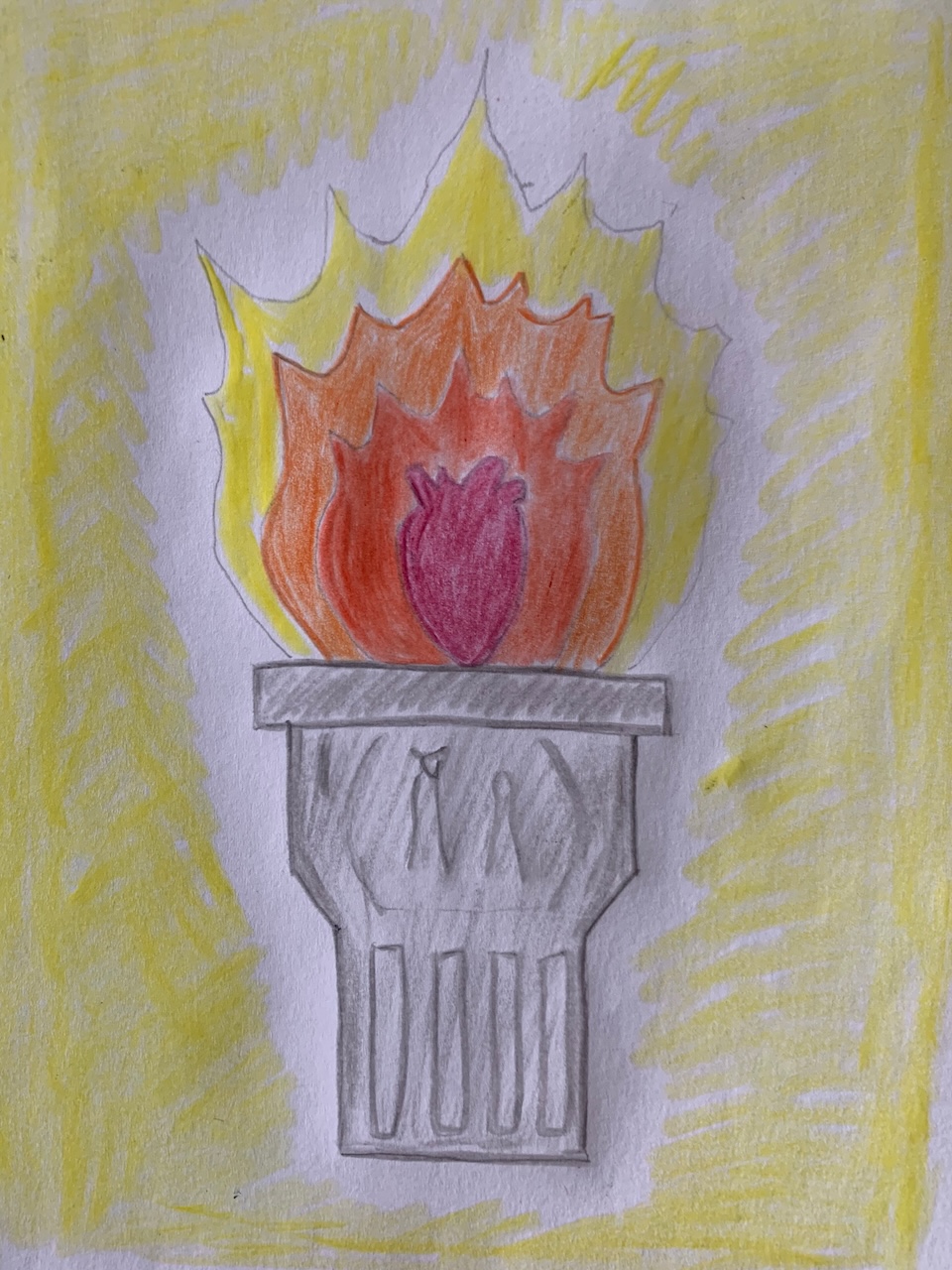
The Altar of the Heart

Through addiction and anxiety,
anger and jealousy

to the Altar of the Heart
I come to make my offering again.

This time You accept it and say:

“May its fire light the way 
to the worship of my family.”

I wrote the words above a few years ago when I offered my heart to Gwyn  on an altar in meditation (I’d tried once before and that time He rejected it!).

Since then my heart has been with Gwyn in the Otherworld. I first saw it again around six months ago in a shamanic journey in an icy pool thawing out.

In a meditation for Gwyn’s Feast with the Monastery of Annwn last September Gwyn returned my heart and said that the Heart of Annwn now beats in my chest as it beats in the chests of all living creatures. 

When I returned to those words in my prayer book and looked at the image it was no longer my heart on the altar but Gwyn’s and I received the gnosis that if I succeed in founding a physical monastery He wants an altar to His heart.

This happened after I finished my ‘Mystics of the Sacred Heart’ series. It seems that an exchange of hearts of sorts has happened between us after all.

Mystics of the Sacred Heart Part Seven – Peggy Allen’s Bible

As a remarkable coincidence at the time of writing this series, whilst I was cleaning, I stumbled across the Bible of my grandmother on my mother’s side, Peggy Allen. My grandmother was sent away to boarding school at a Catholic convent in France when she was 12 years old. Tucked within the pages of her Bible I found two prayer cards relating to the Sacred Heart of Jesus.

The first features a prayer from Thérèse de l’Enfant Jésus called Au Sacré-Cœur with an image of the saint and Jesus showing His Sacred Heart. In England she is known as Therese of Liseux (1841 – 1884) ‘the Little Flower of Jesus’.

The other depicts Blessed Marie Deluil-Martiny (1841 – 1884) a French religious sister who was the Founder of Association of the Daughters of the Heart of Jesus. She was murdered in the convent by a gardener.

Although my grandmother was not religious when I knew her she was obviously familiar with the tradition of the Sacred Heart when growing up.

Might my draw to Gwyn’s Sacred Heart be partially based on ancestral memories?

Mystics of the Sacred Heart Part Six – Sister Mary of the Divine Heart and the Consecration of the World

Mary, born Maria Droste zu Vischering, (1863 – 1899) influenced Pope Leo XIII to consecrate the world to the Sacred Heart of Jesus in 1899.

She was educated at the boarding school of the Sacré-Coeur Sisters in Ridenburg, Bavaria. During a return home from school to recover from pneumonia she had a vision of Jesus who told: ‘Thou shalt be the wife of my heart.’  This led her to join the Sisters of the Good Shepherd aged 25.

For Mary devotion to the Sacred Heart of Jesus and to the Blessed Eucharist were inseparable no doubt as the blood of Christ flowed from His heart.

Whilst on mission in Porto in 1898 Mary received several messages from Jesus requesting that she contact the Pope and request the consecration of the world to His Sacred Heart. In her letter to the Pope she wrote: ‘On the eve of the Immaculate Conception, I seemed to see (interiorly) this light, the Heart of Jesus, this adorable sun, whose rays descended on the earth, first narrowly, then more widely, and finally, lighting up the whole world. I recognized the ardent desire He has to see his adorable Heart more and more glorified and known and to spread His gifts and blessings over the whole world. Our Lord… has shown me the ardent desire he has that his Heart be more and more glorified and loved for the good of the nations.’ (25)

The Pope was persuaded by the promise of a longer life at a time of illness. ‘And He has chosen Your Holiness, prolonging your days, so that you might render Him this honor, console his outraged Heart and draw on your soul the choice graces that come from this Divine Heart, this source of all graces.’ (26)

The Pope agreed to consecrate the world to the Sacred Heart of Jesus saying he expected ‘extraordinary and lasting benefits for Christendom in the first place and also for the whole human race.’ (27) Much controversy surrounded the consecration of all the world including non-Christians. Mary sadly died three days before the world was consecrated in 1899.

REFERENCES

(25) ‘A Forgotten Nun who Influenced the Pope, National Catholic Register, https://www.ncregister.com/blog/a-forgotten-blessed-nun-who-influenced-the-pope
(26) Ibid.
(27) Ibid.

Mystics of the Sacred Heart Part Five – Saint Margaret Mary Alacoque and the Flaming Heart

The devotion to the Sacred Heart only reached popularity amongst Catholics in the 17th century and this was due to the influence of Margaret Mary Alacoque (1647 – 1690).

Margaret lived in France and entered a Visitation convent at Paray-le-Monial aged 24. There Jesus appeared to her four times revealing His love of humanity through visions of His Sacred Heart. These are recorded in her diary.

I. The Flaming Heart

In her first vision she reports that she reposed ‘upon His Sacred Breast’ and ‘for the first time, He opened to me His Divine Heart.’

Jesus said: ‘My Divine Heart is so inflamed with love for men, and for you in particular that, being unable any longer to contain within Itself the flames of Its burning Charity, It must spread them abroad by your means…’ 

This was followed by an exchange of hearts. ‘After this, He asked me for my heart, which I begged Him to take. He did so and placed it in His own Adorable Heart, where He showed it to me as a little atom which was being consumed in this great furnace, and withdrawing it thence as a burning flame in the form of a heart, He restored it to the place whence He had taken it.’

Jesus then said: ‘My well-beloved, I give you a precious token of My love, having enclosed within your side a little spark of its glowing flames, that may serve you for a heart and consume you to the last moment of your life… I now give you that (name) of the beloved disciple of My Sacred Heart.’ (20)

I relate to the imagery of the flaming heart because a few years ago I offered my heart to Gwyn on ‘the Altar of the Heart’ and it burst into flames and He told me that its fire would light the way to the worship of His family.

II. Wearing the Heart

Margaret’s second striking vision is the source of the representation of the Sacred Heart in Catholicism today: ‘The Divine Heart was presented to me in a throne of flames, more resplendent than a sun, transparent as crystal, with this adorable wound. And it was surrounded with a crown of thorns, signifying the punctures made in it by our sins, and a cross above.’

Margaret was told: “This Heart of God must be honored under the form of His heart of flesh, whose image He wanted exposed, and also worn on me and on my heart.’ (21)

This led to Margaret wearing and creating and distributing images of the Sacred Heart which after her death were used to ward off the plague in Marseilles.

This isn’t something Gwyn has called me do… yet…

III. First Friday Devotion

Jesus appeaerd again to Margaret with His breast like a furnace. ‘Opening it, He showed me His loving and lovable Heart as the living source of those flames. Then he revealed to me all the unspeakable marvels of His pure love, and the excess of love He had conceived for men from whom He had received nothing but ingratitude and contempt.’

To make up for their ‘ingratitude’ He asked her to ‘receive Holy Communion on the First Friday of each month’ and tells her that ‘every night between Thursday and Friday I will make you partaker of that sorrow unto death which it was My will to suffer in the Garden of Olives.’ (22) This is the source of the Catholic Holy Hour between 11 and 12 midnight every Thursday.

IV. The Feast of the Heart

In her fourth vision Jesus opens His heart to Margaret again and asks her to inaugurate ‘the first Friday after the octave of Corpus Christi’ as ‘a feast in honor of My Heart.’ This usually takes place in the month of June.

I was called to start celebrating a feast for Gwyn on the 29th of September over ten years ago and began with just one friend. Many Gwyn devotees celebrate His feast on this day and we hold a group rite at the Monastery of Annwn. I feel it is the power of Gwyn’s heartbeat that has drawn us together.

V. Disciple of the Sacred Heart

More controversially, when Margaret dedicated her life to Jesus, ‘she went to her cell, bared her breast, and, imitating her illustrious and saintly foundress, cut with a knife the name of Jesus above her heart. From the blood that flowed from the wound she signed the act in these words: ‘Sister Margaret Mary, Disciple of the Divine Heart of the Adorable Jesus’. (24)

Margaret’s visionary fervor and discipleship quickly spread following her death but the devotion to the Sacred Heart was not approved until seventy years later.

REFERENCES

(21) https://www.churchpop.com/visions-of-the-sacred-heart-of-jesus-4-mystical-messages-to-st-margaret-mary-alacoque/
(22) Ibid.
(23) Ibid.
(24) Monseigneur Bougaud, Revelations of the Sacred Heart of Jesus to Blessed Margaret Mary and the History of Her Life, (New York: Benziger Brothers, 1890), p. 209 – 210

Mystics of the Sacred Heart Part Four – The Graces of Saint Gertrude

Gertrude (1256 – 1302) was a Bendictine nun at the monastery of Helfta and received many of her teachings about the Sacred Heart from Mechtilde.

Like Mechtilde, Gertrude was a ‘Bride of Christ’. He bestowed upon her four graces. The first was the impression of His wounds on her heart. ‘O most merciful Lord, engrave Thy Wounds upon my heart with Thy most Precious Blood, that I may read in them both Thy grief and Thy love; and that the memory of Thy Wounds may ever remain in my inmost heart, to excite my compassion for Thy sufferings and to increase in me Thy love.’ (15) I often feel like with this with Gwyn – His stories being engraved upon my heart.

Her second grace was an arrow of light that shot from the side of Jesus and pierced her heart. ‘After I had received the Sacrament of Life, I saw a ray of light, like an arrow, dart forth from the Sacred Wound in Thy right Side, on the Crucifix . . . It advanced toward me and pierced my heart.’ (16) This resulted in a tide of affection and desire to be united with Jesus rising within her. 

I haven’t had an experience like this but it puts me in mind of the ecstasy of St Teresa of Avila wherein an angel thrusts a ‘long spear of gold’ into her heart and entrails leaving her ‘all on fire with a great love of God.’ (17) 

Like Lutgarde, Gertrude exchanged hearts with Jesus and this was her third grace. ‘Thou hast granted me Thy secret friendship, by opening to me the sacred ark of Thy Deified Heart in so many different ways as to be the source of all my happiness. Sometimes as a special mark of our mutual friendship, Thou didst exchange It for mine!’ (17)

Her fourth grace was the placing of the infant Jesus within her. ‘It was the anniversary of the blessed night of Our Lord’s Nativity. In spirit, I tried to fulfill the office of servant of the glorious Mother of God when I felt that a tender, new-born Infant was placed in my heart. At the same instant, I beheld my soul entirely transformed. Then I understood the meaning of these sweet words: ‘God will be all in all’ (1 Cor. 15:28).’ (18) I found this vision particuarly beautiful. Over the Twelve Days of Devotion last year I explored Gwyn’s birth and infancy and felt He was very close to my heart although not quite in it.

Jesus further disclosed His heart as a treasury, a harp, a fountain, a golden thurible and an altar. Like Mechtilde she delighted in its ‘harmonious beatings’. He offered His ‘Divine Heart’ to her as an instrument to ‘charm the eye and ear of Divinity’ and said of all those who had asked Gertrude to pray for them, ‘they may draw forth all they need from my Divine Heart.’ (19). 

This imagery is similar to Mechtilde’s and relates to my own delight in the beat of Gwyn’s heart and to the joy and inspiration that I draw from it.

REFERENCES

(15) Anonymous, St. Gertrude the Great: Herald of Divine Love, TAN Books, Kindle Edition
(16) Ibid.
(17) https://en.wikipedia.org/wiki/Ecstasy_of_Saint_Teresa
(18) Anonymous, St. Gertrude the Great: Herald of Divine Love, TAN Books, Kindle Edition
(19) Ibid.
(20) Ibid. 

Mystics of the Sacred Heart Part Three – Saint Mechtilde and the Eternal Praise of the Heart

Mechthilde (1240 – 1298) was born into the wealthy Hackeborn family and entered the Benedictine convent of Helfa in Saxony at the age of seventeen.

She had numerous visions of the Sacred Heart of Jesus, spoken of in The Book of Special Grace, which she compiled after a spiritual crisis aged 50. 

I. The Mighty Beating of His Heart

Mechtilde shares a vision in which she rests against Christ’s bosom, listening ‘with attentive ear to the ceaseless and mighty beatings of His own sweet Heart’. Through these ‘beatings’ He sounds ‘invitations’: ‘Come… my love, and receive all that the Beloved can give to His beloved; come. My sister, and possess the inheritance of heaven, which I have bought for thee with My precious Blood; come, My spouse, and enjoy My Godhead.” (5)

This resonated with me deeply for listening to the sound of Gwyn’s Heart, the Heart of Annwn, mighty, awe-inspiring, deafening sometimes, is one of my core practices. I’ve experienced the Heart calling me, inviting me and other monastic devotees to come to Him and worship Him in the Monastery of Annwn. ‘Hear the heart, the heart of Annwn, / hear the heart oh monk and nun / Hear the heart, the heart of Annwn, / “To the monastery we come.”

II. Eternal Praise

On other occasions Mechtilde lays her mouth on the Divine Heart of Jesus and gains sustenance. ‘Drop by drop’ she is gifted verses to offer to His Mother. (6) She also draws from His heart a ‘sweet fruit’ which she places in her mouth signifying ‘eternal praise’ which ‘floweth forth from Him’. (7)

The praise of God is shown to her in another vision as ‘a tube, as it were, coming out of the Heart of God, to her own heart, and then winding back again from her own heart to that of God, by which was signified the praise of God.’ (8) This is later expanded upon. ‘Then straightway she saw tubes, as it were, going forth from the hearts of the angels to the Heart of God, and they made such sweet melody that no man can utter it’. (9)

In another vision Jesus shows reveals His heart as a lamp ‘overflowing’ with large drops of light yet not ‘anywise lessened’. It overflows ‘by little strings of lamps; some of which seemed to stand upright, and to be full of oil, while others were empty, and hung upside down.’ Mechtilde understands ‘by lamps that burnt upright were signified the hearts of those who were present at Mass with devotion and longing desires, while by the lamps that hung down were signified the hearts of those who refused to be raised up by devotion.’ (10) 

These remarkable visions show how the praise of God / Jesus, flows from His Sacred Heart to the angels and is gifted to His most ardent devotees. This puts me in mind of the gift of awen ‘inspiration’ to awenyddion in the Brythonic tradition, which flows from the cauldron into the cauldrons of those who praise the Gods. Gwyn owns ‘the Cauldron of Pen Annwn’ and is ‘my patron, inspiration and truth’ and my awen from Him also feels like a gift from His heart.

In The Triads of the Island of Britain  we find 90. ‘The Three Perpetual Harmonies of the Island of Britain: One was at the Island of Afallach, and the second at Caer Garadawg, and the third at Bangor. In each of these three places were 2,400 religious men; and of these 100 in turn continued each hour of the twenty-four hours of the day and night in prayer and service to God, ceaselessly and without rest forever.’ (11)

It is notable that one of these ‘Perpetual Harmonies’ was ‘at the Island of Afallach.’ Afallach, from afal, ‘apple’ is another name of Gwyn’s. This makes me wonder if an earlier tradition of eternal praise for Gwyn once existed. Whether that was the case or not I long found a monastery wherein the beat of Gwyn’s heart is played and His praises sung day and night.

III. The Fortress of the Heart

In an astonishing vision Jesus takes Mechtilde into His heart and shuts her in. He shows her the upper part is ‘the sweetness of the spirit of God’ and the lower part ‘the treasury of all good’. In the south is the ‘eternal paradise of all riches’. In the west is ‘eternal peace and joy without end’. In the north is ‘eternal security’. (Jesus does not mention what lies in the east). (12) His heart is elsewhere described as ‘a fair house’ and ‘a house of miraculous beauty’. (13)

This reminds me a little of the depictions of Gwyn’s fortress as filled with fair people and revelry. For me Gwyn’s hall is the heart of the kingdom of Annwn His heart, the Heart of Annwn, beats in its midst. I wonder if there was a mystical tradition wherein His fortress was seen to be the interior of His heart.

When Mechtilde asks how to cleanse her heart Jesus replies: ‘In the love of My divine Heart I will wash thee’ and shows her a ‘river of love’ filled with golden fish. (14)

Here I’m reminded of the sparkling rivers of mead and wine in Annwn and of a personal vision I had of rivers of blood, like veins, pouring from Gwyn’s heart and connecting with the hearts of all beings in Annwn and in Thisworld.

IV. Greet My Heart

Jesus appeared to Mechthilde and said the following: ‘In the morning let your first act be to greet My Heart and to offer Me your own. Whoever breathes a sigh toward Me, draws Me to himself.’ (15)

I found this profoundly beautiful. Every morning Gwyn’s name is the thing I say in my morning prayers and I could imagine incorporating a greeting of His heart and an offering of my heart to Him into my devotions.

There is much modern polytheists could learn from this remarkable saint about the nature of visionary experience and devotion.

REFERENCES

(5) Anon, Revelations of S. Mechtilde, (1875), https://dn790004.ca.archive.org/0/items/selectrevelation00mech/selectrevelation00mech.pdf p117
(6) Ibid. p112 – 113
(7) Ibid. p126
(8) Ibid. p118 – 119
(9) Ibid. p133
(10) Ibid. p136 – 138
(11) Rachel Bromwich (ed), The Triads of the Island of Britain, (University of Wales Press, 2014), p232
(12) Anon, Revelations of S. Mechtilde, (1875), https://dn790004.ca.archive.org/0/items/selectrevelation00mech/selectrevelation00mech.pdf p133 – 135
(13) Ibid. p138, p142
(14) Ibid. 119 – 120
(15) Mechthild, St Joseph’s Abbey, http://spencerabbey1098.blogspot.com/2014/11/mechtilde.html

Mystics of the Sacred Heart Part Two – Saint Lutgarde and the Exchange of Hearts

Lutgarde (1182 – 1246) was born in Tongres, Belgium, and entered the Benedictine convent at Saint Trond aged twelve. During this period a potential suitor visited her and during one of these visits Jesus appeared to her revealing his spear wound and telling her: ‘Seek no more pleasure of this affection… here in this wound I promise you the most pure of joys.’ Lutgarde denounced her suitor saying: ‘Go away from me for I belong to another Lover.’ (3)

Afterwards Lutgarde was blessed with a number of graces including levitation, healing, a miraculous understanding of Latin and illumination about the meaning of the Psalms but none of these made her happy. 

This led to her exchange of hearts with Jesus:

‘Jesus asked her: “What… do you want?”

“Lord… I want Thy Heart.”

“You want My Heart? Well, I too want your heart.” 

“Take it, dear Lord. But take it in such a way that the love of Your Heart may be so mingled and united with my own heart that I may possess my heart in Thee, and that it may always remain there secure in Your protection.”’ (4)

Lutgarde was elected as superior of the convent at the age of twenty-three but left to join the Cistercian convent (known as Trappists) at Aywieres.

Although I haven’t directly exchanged hearts with Gwyn attaining a union of my breath with His breath and my heart with His has long been a part of my practice.

REFERENCES

(3) St Lutgarde of Aywieres, Mystics of the Church, https://www.mysticsofthechurch.com/2015/09/st-lutgarde-of-aywieres-first-known.html
(4) Ibid.

Mystics of the Sacred Heart Part One – The Sacred Heart and the Sacred Wounds

Through my recent visit to London and to the Tyburn Convent I found out about the Roman Catholic devotion to the Most Sacred Heart of Jesus. I have since been reading further on the subject and have been astonised by the parallels between my gnosis of Gwyn’s heart as the Heart of Annwn and the experiences of the Christian mystics of the sacred heart.

In this series I will be sharing the story of the origins of the devotion to the Sacred Heart and discussing how the visions of these mystics relate to my experiences.

*

The devotion to the Sacred Heart originated from the devotion to the Sacred Wounds of Jesus. There were five in total. The first four were the wounds to His hands and feet from the nails when He was crucified. The fifth was the wound in His side from the Spear of Longinus by which He was pierced to ensure He was dead. From this wound poured blood and sweat. 

Associations between the Sacred Wounds and the Sacred Heart began in the Benedictine and Cistercian monasteries in the 11th – 12th centuries. In Sermon 61 St Bernard of Clairvaux (1090 – 1153) speaks of ‘the soul of the martyr’ being ‘safe’ ‘in the heart of Jesus whose wounds were opened to let it in’. (1) 

In the 13th century, in ‘With You is the Source of Life’, St Bonaventure (1221 – 1274) wrote: ‘“They shall look on him whom they pierced”. The blood and water, which poured out at that moment, were the price of our salvation. Flowing from the secret abyss of our Lord’s heart as from a fountain, this stream gave the sacraments of the Church the power to confer the life of grace, while for those already living in Christ it became a spring of living water welling up to life everlasting.’ (2)

The last of Christ’s lifeblood was seen as pouring as an offfering from His heart. This resonates with my vision Gwyn showed me of His death, pierced by a spear, in raven form, hanging upside down on a yew over the Abyss in a sacrifice in which He gave every last drop of His blood to ‘set the world to rights’ following the devastation wrecked by his battling with His rival, Lleu / Gwythyr.

In a follow-up story I wrote Mabon won a cup containing Gwyn’s blood from the Abyss and used it to heal Nudd, Gwyn’s father, ‘the Fisher King’. It is interesting to note that abyss imagery occurs in the writings of Bonaventure.

It seems no coincidence that in a later legend the blood and sweat of Jesus was taken in the Holy Grail by Joseph of Arimathea to Britain and buried near Glastonbury Tor – a site sacred to Gwyn. When Joseph rested wearily on his staff the Glastonbury Thorn sprung up giving name to Wearyall Hill.

In my visions when Gwyn is killed by His rival on Calan Mai the hawthorns blossom from His blood. Could the Christian legend be based on an earlier myth wherein a cup containing the blood from Gwyn’s Sacred Heart was buried?

REFERENCES

(1) ‘Sacred Heart of Jesus – Part One’, Knights of the Precious Blood, https://www.kofpb.org/2020/05/06/sacred-heart-of-jesus-part-1-history-of-the-devotion/
(2) Sister Julie Anne Sheahan, ‘Call includes Consecration to the Sacred Heart of Jesus, Franciscan Sisters, https://fscc-calledtobe.org/2022/06/23/call-includes-consecration-to-the-sacred-heart-of-jesus

The Heart of Annwn

Over the past few years the Heart of Annwn has become increasingly important in the mythos Gwyn has gifted me and in my devotional practices. 

For me, the Heart of Annwn is Gwyn’s heart, inherited from His mother, Anrhuna, Mother of Annwn, and also the ever-beating heart of Annwn itself. 

I believe that, like Hades and Hades, Hel and Hel, are both Deities and Otherworlds, Gwyn, who is associated with Gwynfyd is one with His land as well.

The Heart of Annwn literally became the heart of my practice two years ago when I began playing its beat and chanting to align myself with Gwyn’s heartbeat. This led to the formulation of the Rule of the Heart within the Monastery of Annwn – following our hearts in alignment with the Heart of Annwn.

In this post I will be sharing two of the core stories of the Heart of Annwn.

*

The Heart of the Dragon Mother

Gwyn has shown me that the Heart of Annwn once beat in the chest of His mother, Anrhuna, the Mother of Annwn, when She was a nine-headed dragon. When She was slain Vindos / Gwyn ate Her heart. The Heart of Annwn became His and this gave Him sovereignty over Annwn as King.

“Now,” the ghost of Anrhuna turned to her corpse, “there is a rite amongst the dragons of Annwn – as you are the only one of my children left here you must eat my heart.”

The boy swallowed nervously as with a single bite of her ghost jaws she tore it from her chest and offered it to him, big and bloody, large and slippery, uncannily still beating. “My heart is the Heart of Annwn. If you succeed in eating it all, its power will be yours and you will be king.”

“But it is so much bigger than I and I have little appetite.”

“Little bite by little bite and you will be king.”

The boy very much wanted to be king. He needed his kingship within him. He bared his teeth and bit in, took one bite, then another. As he ate, he grew. He became a mighty wolf, a raging bull, a bull-horned man, a horned serpent, finally, a black dragon. As he tore and devoured the last pieces of the heart he spread his wings to fill the darkest reaches of the Deep. He roared, “I am King of Annwn! I will rule the dead! I will build my kingdom from the bones of dead dragons and the light of dead stars! I will bring joy to every serpent who has known sorrow and I will take vengeance on my enemies!”

Weary and full he slept and when he awoke he was just a boy with a large heart that felt too big for his body.

*

The Hidden Heart

In another story, in which Arthur raids Annwn, killing the King of Annwn and stealing His cauldron, Gwyn instructs His beloved, Creiddylad, to cut His heart from His chest and help hide it so that Arthur cannot take the Heart of Annwn.

Gwyn gave Creiddylad a Knife. “Cut my heart from my chest. Give it to my winged messengers and tell them to hide it in a place that even I could never find It.”

“Do what?” 

“I will not die.” 

“Worse – you will be heartless.”

One of my practices around this story was receiving the honour of finding Gwyn’s heart and returning it to Him and helping Him to return to life.

‘I knew it was a death unlike any other
but still I heard the beating 
of your heart…

Your hounds dug wildly beneath trees,
bloodying their frantic paws
to find only the hearts of 
dead badgers,

sniffed suspiciously at the edge of pools
where I searched through reeds
as if looking for a baby
in the bulrushes,
plunged in 
and emerged draped in duck-weed.

We snatched a still-beating heart 
from a bear’s claws (not yours).

We searched every cave for a heart-shaped box.
When we found one 
and the keys to the lock
inside was only a locket and a love letter in an illegible hand.

When we had searched everywhere in Annwn
we rode across Thisworld following
your fading heart beat.

We found your heart in the unlikeliest of places.

Clutching it tightly, fearing every time it skipped a beat,
we galloped back to Annwn with our hearts
beating just as wildly.

Through the fortresses within fortresses…

Into your empty chest we placed your still-beating heart.’

*

Gwyn has revealed a lot about the Heart of Annwn and I believe there is more to come. Recently I had a vision of Gwyn as a black dragon with His heart visible in His chest bearing an important message. He appears in this form when He brings tidings for the future. What will be the future of the Heart of Annwn? What stories from the past remain to be disclosed? I share what I know with gratitude and await further revealings.