A poetry collection charting the story of a personal alchemy and learning how to love based around my sacred marriage to my patron God, Gwyn ap Nudd, as Sister Patience of the Heart of Annwn.
Published posthumously as a way of saying a final goodbye to Sister Patience at summer’s end HERE.
A memoir in the form of a novella based around my childhood, teens, and twenties. It records a confrontation with the darkness within the land, our culture and in my own psyche and a failed initiation into adulthood and shamanism. Finally, how my patron God, Gwyn ap Nudd, saved me from myself.
Free digital copy HERE. If you enjoy it please share the link to this post.
My article ‘The Gods and Spirits of Annwn’ has recently been published in Sacred Hoop – ‘a leading international magazine about Shamanism, Sacred Wisdom and Earth Spirituality.’
The King of Annwn is now complete. It was gifted to Gwyn and my patrons yesterday. It will not be officially published but is available as a PDF HERE. Donations can be made by emailing sisterpatience22@gmail.com. Below is the introduction.
Fragments of a Lost Mythos
I wrote this book for love of a God. He was known in ancient Britain as Vindos ‘White’ and is still known in Wales and beyond as Gwyn ap Nudd ‘White son of Mist.’
I met Gwyn at a nadir in my life at the head of a fairy funeral procession on Fairy Lane in my hometown of Penwortham in Lancashire. My rational mind refused to believe it. What would a wild Welsh God want with a suburban English poet? Yet, I knew deep within that I knew Him and had always known Him from time’s beginning. I dedicated myself to Gwyn as my patron God and began to serve Him as His awenydd ‘person inspired’ by bringing His stories and veneration back to the world.
In medieval Welsh mythology Gwyn is the King of Annwn, ‘Very Deep,’ the Otherworld, later known as Faery. Two of my books, The Broken Cauldron and Gatherer of Souls, recover and reimagine His stories from existing sources and reweave them back into the landscape of northern Britain from where they have been lost.
This book is different because I have been called to go beyond the existing texts, from the known to the unknown, under Gwyn’s guidance through meditation and journeywork to seek visions of the stories of His birth, His boyhood and how He built His kingdom. I’ve also drawn on Irish, Norse and other Indo-European sources.
What lies herein is an emerging myth, both new and ancient, telling the cycle of the birth and death of Vindos. I don’t believe it’s the only one – He told me there are as many stories of His birth as there as facets on the jewel in His forehead – but it is the one He has inspired me to tell.
In the later sections you will note I have drawn on the Four Branches of The Mabinogion, reading between the lines, finding the King of Annwn in different guises, to reconstruct the later episodes in the story of Vindos. For this I am indebted to Will Parker’s reading of the Four Branches as a plot by which the forces of Annwn are ‘drawn out’ ‘confronted’ and ‘neutralised’ by the Children of Don.
Whereas some of the stories are set in their traditional places I have chosen to locate others within my home county of Lancashire weaving the mythos of Vindos and His family into the landscape where I met and venerate Them.
I decided to use the ancient British names for the Gods rather than their medieval Welsh names to create a more archaic feel. Thus Vindos rather than Gwyn, Nodens rather than Nudd, Uidianos rather than Gwydion, reconstructing with a little poetic licence where I have no scholarship to follow, for instance Kraideti rather than Creiddylad.
I started writing this book in 2019 and it took many forms before I decided on the current format of fragmentary episodes and poems which follows the form of the medieval Welsh sources such as The Mabinogion, The Black Book of Carmarthen and How Culhwch won Olwen.
I share it here, not as an ur-text, as the one truth about Gwyn’s origins, but as one facet of the jewel of His mysteries. I hope it will help and inspire its readers to come to know and love Gwyn and to seek visions of His tales.
~
With the completion of this book I have made the decision to stop blogging and to close my Patreon in order to focus more deeply on my monastic calling and find paid work. For the past couple of years the Gods and spirits have telling me to slow down, calm down and get off the computer and the right time has finally arrived.
Having an online presence has provided the benefit of a platform to share research and devotional material for my Gods but has had significant costs to my mental health in terms of the time and energy used for little financial compensation. It’s addictive and distracting and has formed a substitute for life in the real world and I need to find out who I am without an online persona.
This blog will remain as a static website as an archive of my writing and as a place to offer donation-based soul guidance sessions and shamanic healings (once my training is complete).
In May I began work on a new mythic book which developed the working title The Dragon’s Tongue. In it I set out on an ambitious project to weave together a narrative about the formation and ordering of the world from a struggle between the Brythonic culture gods against the deities and monsters of Annwn.
It was woven from my personal intuitions about links between Anrhuna, a Brythonic dragon goddess* and the mother with Nodens/Nudd of Vindos/Gwyn and Kraideti/Creiddylad and Tiamat in Enuma Elish and the slaying of Tiamat and her monster-serpents by the culture hero, Marduk, and the battles between the giants and monsters of the otherworld and the Tuatha Dé Danann/Children of Don in ‘The Battle of Moytura’ and ‘The Battle of the Trees’ in the Irish and Welsh myths.
In the first section ‘Anrhuna and Nodens’ I told the story of the creation of the universe from the crochan – cauldron or womb – of Ceridwen, Old Mother Universe, and of how Anrhuna slipped into Annwn ‘the Deep’ and gave birth to dragon-children who departed to shape worlds including ours.
The Old Mother birthed Bel and Don and from their union came Nodens, Uidianos/Gwydion, Brigantia, Ambactonos/Amaethon, Gobannos/Gofannon, and Aryanrou/Arianrhod. When these deities desired to bring order to the chaos of our world, ruled by dragons, Nodens went to negotiate with them, fell in love with Anrhuna, and this resulted in the birth of Vindos and Kraideti.
When Nodens failed to return his kindred made war against him and the dragons and Lugus/Lleu, who was begotten on Aryanrou by Uidianos by magic, slew Anrhuna, and her nine heads were bound on the Towers of the Wyrms. This resulted in the weakening and binding of the dragons of the world and the imprisonment of the giants (early children of the Old Mother) in their own fortresses.
In the second section ‘Vindos and Kraideti’ the children watched the defeat of their father and slaughter of their mother from the secret place where Nodens had hidden them and Vindos vowed to take vengeance. The pair rescued their mother’s womb from where it had been taken after her death by the winged serpents at the cost of Kraideti sacrificing her own womb in exchange, leaving her infertile.
From her womb Anrhuna was reborn as Matrona and she married Nodens and they brought life to the world. The rest of this section covered how Kraideti came into her power as a fertility goddess and Vindos as a god of the dead and ruler of Annwn and his battle with Graidos/Gwythyr for Kraideti. This resulted in a strange marriage between the three of them. An added twist was that, whilst Kraideti could not give birth to children in this world, in Annwn her womb gave birth to monsters.
In the third section ‘Lugus the Giant Slayer’ I told of release of the giants from imprisonment in their fortresses after the Ice Age and their alliance with Vindos. Uidianos, Lugus, and their kindred came to battle against the giants and Vindos and the monsters of Annwn who were defeated. Yet Vindos finally gained vengeance on Lugus by seducing his wife and mortally wounding him with a poisoned spear, which led to the scene of his epiphany in eagle form on the oak in the Fourth Branch.
I completed the fourth section ‘The Knowledge of Uidianos’ and the fifth section ‘The Black Dragon’ on the first draft but found there were too many problems with the first three sections to make it worth returning to these on the second draft. Plus… I don’t want to give away all my secrets yet…
My main result, to date, is a second draft of the first three sections that is 50,000 words long. I completed this at the beginning of August and have since been reflecting on it – weighing it both against the existing myths and my personal experiences with the deities whose myths I have retold. I also sent it out to my patrons and have had five sets of feedback, which have been invaluable.
My main problem has been with misfits between the story of Lugus, reconstructed from the stories of Lleu in the Welsh myths and Lugh in the Irish myths, and my version of the slaying of Anrhuna and the giants. Having recently returned to re-read the original sources the meaning at the core of the story of Lugus is that the giant he slays is his grandfather, which is an important element missing from my myth. I believe this can be worked, possibly for the better, by having Lugus opposed to Bel. I’m not sure how this would fit with his slaying of Anrhuna or his rivalry with Vindos yet though.
Whilst I have had positive feedback about the primordial power and significance of Anrhuna as a Dragon Mother, who gives birth not only to dragons and monster-serpents the monsters of Annwn, I don’t feel I’ve got her death scene right yet. I not sure she was really slain by Lugus. Or if she was slain at all. For she is very much alive to me in the here and now (something I got round in the book by having the Spirit of Anrhuna tutor Vindos and raise him to the position of King of Annwn).
Another problem I encountered was in my depiction of Anrhuna giving birth to monsters. There is a fundamental difference between viviparity (live birth) and oviparity (egg laying). If she is a dragon, and hence reptilian, would she not be laying eggs rather than giving birth? However I hazarded this could be set aside as I’m working with myth, which contains births from heads and thighs, not biology.
I also wondered whether my story about Kraideti giving up her womb and it birthing monsters in Annwn was a subconscious reflection of my choice not to have real children but to dedicate my life to creativity. In particular to giving voice to the gods and monsters of Annwn whose stories are untold.
Whilst I was reflecting on this Goya’s painting and its title ‘The Sleep of Reason Produces Monsters’ kept popping into my head and it felt like a fitting phrase summarising my decision when I set out to write the first draft of eschewing critical reflection and allowing the awen to flow wherever it willed at the outset.
I produced a lot of monsters. I don’t think that’s a bad thing. It also fits with stories about monstrous births in the Welsh myths. Some are only hinted at. Goleuddydd gives birth to Culhwch ‘Slender Piglet’. Rhiannon, a Queen of Annwn, is punished for suspected cannibalism of her own son who like his mother, the Mare Goddess, may have taken the form of a foal.
Some are more explicit. The brothers Gwydion and Gilfaethwy are forced to shapeshift into male and female animals and together they give birth to a deer, a boar, and a wolf, ‘three hideous sons’. Henwen, the White Sow, births a grain of wheat, a bee, a wolf, an eaglet and the monstrous Cath Palug.
Whilst I am in no way happy with the second draft and am aware I have a lot more reading and reflection ahead I have experienced a number of gains from the process. Firstly I have proved to myself that when I am immersed in something I am capable of working on it almost every hour of the day from when I get up at 5am until I go to bed 9pm and of producing 50,000 words that fit together by their own internal logic within three months.
Secondly, whilst I set out to write a personal myth due to my fears about being unable to write on the Brythonic tradition due to insecurities caused by the debates around cultural appropriation, I’ve found working through the problems with this approach has taken me back to the original sources and deeper. I’ve experienced feelings of acceptance by the family of Bel and Don as I share their stories, this has enlivened my awenydd path, and I’ve started learning Welsh again after a six month hiatus.
Thirdly, my writing of Creiddylad/Kraideti’s story along with personal experiences with her as a goddess of flowers this year in my garden has filled in a black hole in my personal mythos. For a long time I have been aware of the absence of Rhiannon by that name as a horse goddess who I’ve paradoxically felt is very much with me as my white winged mare and the horses who haunt my dreams.
Creiddylad’s revelation of her epithet ‘First Rose’ and her appearance to me riding a white winged mare in association with the moon have suggested she may be identical with Rhiannon. This would fit with both of them being Queens of Annwn who I have perceived giving monstrous births.
This opens the possibility and perhaps the necessity of incorporating material about Gwyn/Arawn and Creiddylad/Rhiannon and their son from the other branches of The Mabinogi into my book. It is implicit that Arawn is the otherworld father of Pryderi in the First Branch and Pryderi’s slaying by Gwydion would certainly provide added meaning to the conflict between Uidianos/Gwydion and Vindos/Gwyn/Arawn.
So this is where I am right now. On the brink of reason, pondering, if not producing monsters. If you would like to hear more about my creative processes, have access to unseen work from my drafts, and play a part in my creations by giving feedback, please consider becoming a patron HERE.
*Anrhuna is not known from existing sources but she has revealed herself to me within my landscape and in the iconography surrounding Nodens/Nudd/Lludd – in a mosaic of sea serpents with intertwined necks from the temple at Lydney and Lludd’s associations with two dragons.
speak of dragons when dragons from the world are gone?
How can I be your inspired one when the myths of the gods are lost?
To sing them back from the void before creation I will need a dragon’s tongue!
Lord of Annwn grant me the strength by the breath of dragons to write this book.
Over the past few weeks I have known possession by the awen; the inspiration, the divine breath that flows from Annwn, the breath of the gods, the breath of dragons; like I have never known it before.
It’s come after a couple of fallow years; sowing, reaping, dissatisfaction with flawed and failed crops.
I was beginning to fear that, after making my lifelong vows to Gwyn ap Nudd, to serve him as his awenydd, that the awen had dried up. What irony! A tiny part of me had begun to wonder if I’d made a mistake. Whether my powers of discernment were off. Whether he’d been having a laugh with me.
But my soul, to him eternally present, spoke otherwise. Only now I’ve realised I’d experienced a time of labouring, harrowing, preparing the ground for the oak to rise and the lightning to strike. For my fall from the tree amidst this collective shattering of the grounds of our society brought about by COVID-19 and into Annwn, the Deep, where I was to find the Prophet with the Dragon’s Tongue.
Thus has been born my next mythic book – The Dragon’s Tongue. Much of it has been gifted to me at dawn, in response, I believe to my evening prayers, in particular to Gwyn, Gwyn’s father, Nodens, Lord of Dream, Gwyn’s mother, Anrhuna, Dragon Mother of Annwn, and Gwyn’s beloved, Creiddylad.
You will probably not be surprised when I say their stories are central, with those of the dragons, and their conflict with the Children of the Stars*. There isn’t much evidence for dragons in the Brythonic/Welsh myths aside for an episode where Lludd/Nudd/Nodens ends a plague by ending the battle between two dragons and another where they appear, red and white, in a vision of Merlin Emrys. But there is the red dragon is on the Welsh flag and dragons are all around us in our folklore.
I’ve been reading mythic literature, journeying with the deep gods, the dragon-gods, long enough to know, when you get to the bottom of any myth, as Gordon White says, it is ‘dragons all the way down’.
I have long wanted to write the story of Anrhuna, the forgotten Dragon Mother, and also a creation myth. I have wanted what is lacking in the Brythonic/Welsh stories penned by medieval Welsh scribes. Something polytheistic, something penned by an inspired one of the gods, that provides insights into the mysteries of creation, of life, death, and rebirth, without the patriarchal Christian overlay.
Finding nothing else I realised I would have to do it myself. Following being gifted with the voice of the Prophet with the Dragon’s Tongue I started in the beginning, in the Deep, with Old Mother Universe and her Cauldron and how a dragon slipped from it and fell into the Abyss. How, from formlessness, she gave birth to the elements in dragon-form to form the world (yes – the world was made by dragons and not by God or some other demiurge). How the Children of the Stars slew Anrhuna, cut off her nine dragon heads with their long necks, and bound them on the Towers of the Wyrms…
From this flowed the story of the conflict between the Children of Annwn and the Children of the Stars, a tale of love and war, the mysteries of birth, death, and rebirth, of the coming of the Black Dragon.
After I swore to Gwyn that I would complete it beneath the leaning yew, where I met him, I got most of the first draft written over those days of thunder. When the lightning from the Spear of Lugus which killed Anrhuna lit the skies, when the rain poured, when the energy was strange and high.
This, I believe, would not have been possible if we were not in lockdown due to COVID-19. If I had not had this time without the pressures of finding paid work by volunteering with the Wildlife Trust and helping organise local poetry nights. If I had not stopped drinking, got off social media, started counselling for my anxiety and found out its root is having Asperger’s, which has helped me to stop blaming myself for my failures in ‘the real world’ and to cultivate space for my gods and my soul.
The birth of this book has restored by faith in my gods and through it I finally feel reborn as Gwyn’s awenydd. The first draft is complete, but is far from perfect, and I am predicting it may take months, even a year or so to firm it up. But, it has been born, and I am incredibly excited about it.
So if you’re interested watch this space and if you’re really interested you can find out more about my creative processes and see unseen work, including some of the drafts, by supporting me on Patreon HERE.
Over the past three years I have been working on a book for Gwyn ap Nudd, my patron god, to whom I devoted myself five years ago in January at the White Spring in Glastonbury.
At first I wasn’t sure what it was going to be about. It began simply as ‘Gwyn’s Book’. Because I am based in Lancashire and so many other writers have explored his connections with Glastonbury and Wales I decided to focus on his stories originating from the Old North, which are found in The Black Book of Carmarthen and Culhwch and Olwen.
After some time he made it clear that he did not want me to write an academic book (I therefore published my research on my website HERE) or simply repeat the old tales penned by Christian scribes. Instead he wanted me to peel back the golden patina, expose the atrocities committed against him and the people of Annwn by Arthur, and journey back to the roots of his mythos in pre-Christian times when he was venerated as a god of the dead and gatherer of souls.
I met with other Inspired Ones who served him and whose souls he gathered such as the ancient ancestors of Orddu, ‘Very Black’, the Last Witch of Pennant Gofid; the northern British prophets Myrddin and his sister Gwenddydd; witches who flew with him between sky and air; wild women, madmen, poets, broken dreamers whose dreams have never been recorded.
I was prompted to explore how the closing of the doors of Annwn led to the sense of disconnection and soul loss that forms the void at the heart of the Anthropocene and to see the wonder in Gwyn’s reappearance on the brink of time as the Anglo-American Empire, which has its roots in Arthur uniting Britain under ‘One King, One God, One Law’, begins to fall.
My devotional journey has had its ups and downs. Sometimes it has felt like an endless ‘wow’ as I’ve discovered faces of Gwyn as yet unrecorded and hidden facets of his nature. At others, when I’ve been stuck in the Arthurian stories, unable to see beneath or get a break through, or I’ve written Gwyn’s voice wrong, I’ve felt frustrated, awkward, unworthy, and utterly inept. Yet I never once thought about giving up as I knew it was something I had to do.
Because there are no groups in the North West of England who venerate the Brythonic gods and goddesses or work experientially with our native myths my journey has been a lonely one. At low points I have contemplated joining the Anglesey Druid Order and even becoming a nun (when I hit thirty-five I realised it was my last chance!) although within I have known that my path in life is to walk with Gwyn even when all he can offer is “mist, darkness, and uncertainty”.
I’ve seen writing this book through to the end because serving him as an awenydd, although sometimes tough – Gwyn is the god who contains the fury of the spirits of Annwn and he is that fury just as he is the god who gathers the dead with love and compassion – is a source of deep and profound joy. Walking with him, whether through the starlit skies, or industrial smog, or blood-strewn battlefields, or the healing woodlands of Celyddon has always felt utterly right.
Gatherer of Souls is a book of new visions of the forgotten mythos of Gwyn ap Nudd recorded in poems and stories to be published on Gwyn’s Feast, September the 29th, this year.
Over the past week I have read it out loud to Gwyn and it feels fitting that he has approved it as we approach the eclipse of the super blue wolf moon.


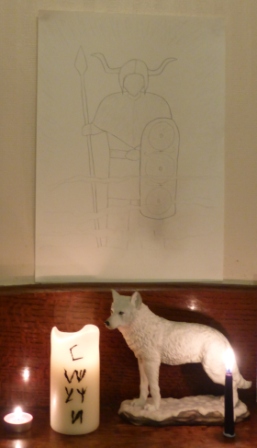
 The Sanctuary of Vindos