Afagddu’s Sorrows

I.

Oh bone bird mother
do you not see my skeleton on the beach?

Do you not know which cormorant I was?

Do you not know how many stones I ate?
Do you not know of the sorrow of plastic I choked on?
Do you not know how I swallowed enough poison
to save the world but it was still not enough?

Whatever I did I could never gain perfection
with my oily wings, my puddling feet,
my shuffling look of misery.

II.

When I fought I flew into
a blind unchannelled rage like a primeval bird
and no-one could bring me back, could call me back again…

thus I was better as an attendant demon believed malevolent.

I could have been a bard if I had not sung the wrong songs –
the antithesis of the music of the tongue, disharmony, un-cynghanedd.

If my words had not creaked like a broken wing beating and beating
up above as I went about picking up loose pieces of words
that had been discarded like the limbs of dolls
and sad squashed teddies.

III.

In my childhood I had no hug, no cot, no mobile, no talking abacus,
and my mum did not leave the television on.

I didn’t really get to know the village where I was born
down beneath Lake Bala from which only
a harper and robin escaped.

I was more interested in the secret tunnel
between the worlds into which I could drag my ‘belongings’
and keep them safe – the rubbery Wellingtons,
the scribbly marker pens and notes.

Bala has always led to Tryweryn –

to the sunken villages and the empty beds
into which I climbed longing for mum and dad,

to the empty post office, school, chapel, chapel house,
to the cemetery and the new memorial chapel.

IV.

Black, ragged, bloated on November nights
I cannot remember my birthday but only the birthday
of my sister and how this was celebrated with whistles and balloons.

I instead was tarred and feathered and pecked to death

until I was rags and banners of intestine
and of course the cold dry bones,

until the door was opened
and I was bidden go.

Oh bird bone mother
if only you could see me now –

I am flying high beyond perfection.


Shattering the Nunnery

Somewhere between here and Annwn

a part of me is cloistered

thinking already
about the spring flowers

as she paints another saintly visage.

In another life she has been drinking
the truth from a forbidden cup.

The saints no longer look the same:

their hands are red with blood and filled
with splinters and chips of stone
from shattered pagan idols.

The stained glass is blood stained.

Her voice catches on the songs and tears
as if upon nails – she SCREAMS

and the stained glass shatters.
The nunnery falls down.

~

This poem, which is based on a spirit-journey, signals my release from a malaise I have been calling ‘nun envy’. Although I realised Christianity was not for me when I experienced its dull and stuffy sermons and the patriarchal presence of the Christian God in my local C of E church as a Brownie at church parade a part of me has longed for learning and ritual and shared devotion in a religious community.

I have been deeply jealous of Christians because they have a system of support for people who have a sense of vocation. For those who are called to serve God there are ways of living by this calling. Vicars and priests receive an education and a salary for their work and nuns and monks lead lives of dedication to God based around prayer, manual labour, and artistic and intellectual pursuits without worrying how to pay for housing or food. When I hit thirty-five I realised that was the last chance I would have of becoming a Christian nun and living what looked the ideal life except for… the Christianity.

Of course, I decided against, because I did not want to betray my god to the God and saints of the religion that destroyed the pagan traditions and, in particular, demonised him and the Otherworld he rules.

Yet, still I kept yearning for what Christian monastics have. Researching local monasteries and abbeys. Finding myself drawn to Preston’s Carmelite monastery.


Visiting the Tabor Retreat Centre, which was once a Carmelite nunnery but is now run by the Xaverian Missionaries (this provides regular meditation classes, Lectio Divina, short courses and even a book club as well as retreats which I’d have loved to go to … if only I was Christian!).


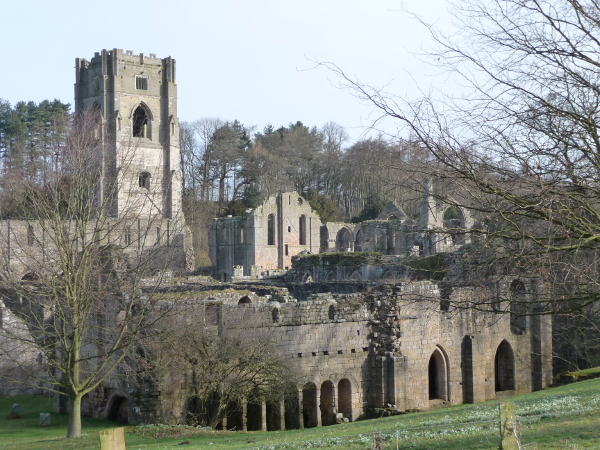
Wanting to go back to the ruins of Fountains Abbey (which I visited every weekend when I worked at the Yorkshire Riding School) to sit and mourn something I will never have.

Fountains Abbey II
A strange impulse I believe may be rooted in a past life as a nun. A few years ago when I read in a biography about the ritual burial of Julian of Norwich – entombed like Christ to become his bride and an anchoress who would never see the outside world again I felt like I was being buried alive. As if I’d experienced something similar before. I flung the book into my wardrobe, slammed the door, and went for a walk feeling immensely grateful for my freedom to see trees and taste the fresh air.

I’ve always had a push-pull relationship with Christian mysticism, art, literature, and song. A yearning for its richness and beauty but a dislike of its unhealthy obsession with suffering and punishment.

As a consequence of years of learning about how nearly every splendid church and cathedral is based on the takeover (violent or non-violent) of a pagan sacred site; how nearly every haloed saint is associated with the defeat of a pagan mythic figure or with the slaughter or conversion of pagans; how the Christian tradition is founded on the death of paganism, it has finally lost its fusty-fingered hold on me.

Being an awenydd attempting to reweave the ways between Annwn and This-modern-world isn’t easy. But I think I will be able to do it better and more happily now my yearning for what Christians have and my nun envy is gone. From the ruins of the shattered nunnery may new shoots and tendrils grow.

Fountains Abbey


A Great Scaled Beast

Gweint mil mawren
arnaw yd oed canpen
a chat erdygnawt
dan von y tauawt
a chat arall yssyd
yn y wegilyd

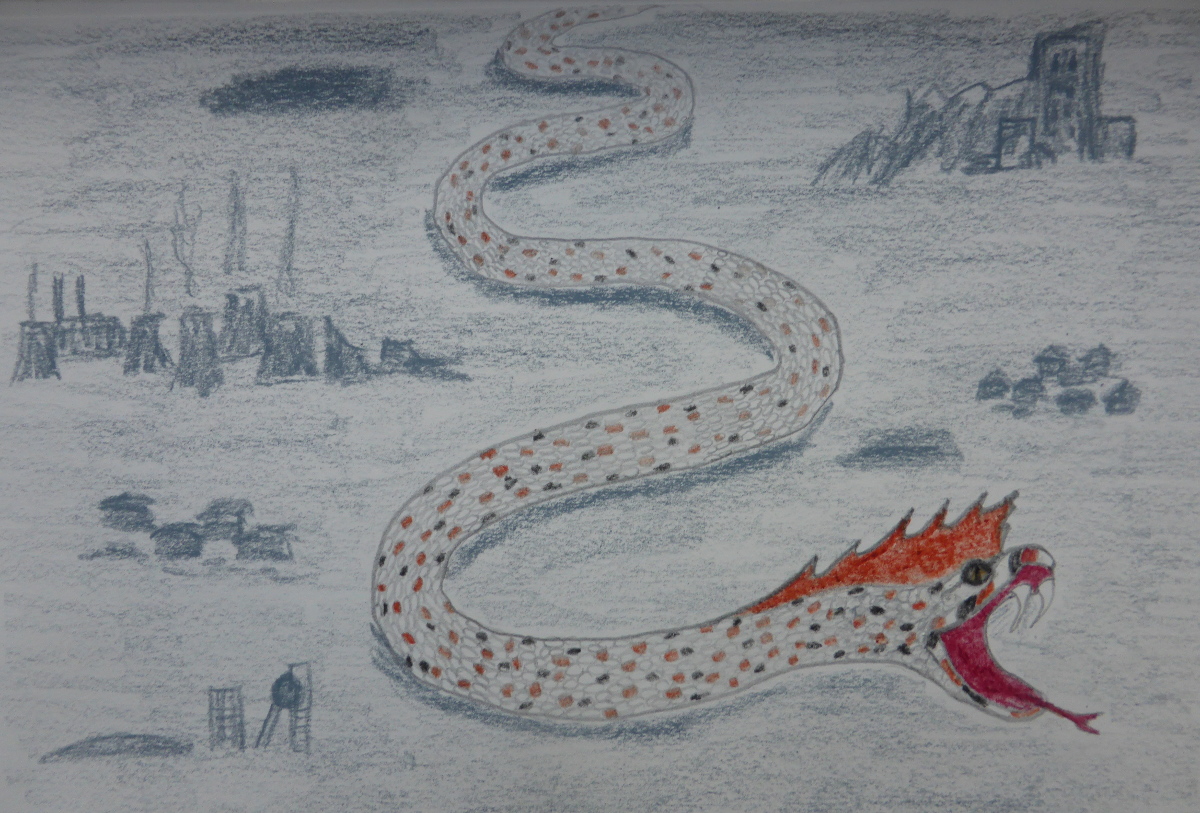
I pierced a great-scaled beast:
there were a hundred heads on him,
and a fierce battalion
beneath the roof of his tongue;
and another battalion is
in (each of) his napes
The Battle of the Trees

A great scaled beast sees
wars across the worlds: these
last days of Empire’s fall
beautiful, terrible…
Heads burn East, West, North, South.
Everywhere a Hell Mouth.

On the howl of Dormach
fierce battalions march
forth from beneath the rooves
of his tongues sent to prove
the world’s end to itself
and lead each frightened self

into the great beast’s maw.
Entering his gaping jaws
every step is further
down his throat – surrender
would be bliss if it weren’t
for regret, guilt, the hurt

of leaving all we loved.
Our work was not enough.
This is a night of tears.
This is a night of fear.
This tongue a road we must
walk – perfect faith and trust

keep us strong as we go
where only the gods know
splitting East, West, North, South –
all into the Hell Mouths.
In the maw of the beast
will we relearn to speak?

Will we each be reborn?

A Great Scaled Beast Black, White, Red Final Sml

‘A great scaled beast / there were a hundred heads on him’

A Black Forked Toad

Llyffan du gaflaw
cant ewin arnaw

A black forked toad:
a hundred claws upon him
The Battle of the Trees

As dusk darkens the skies
a black forked toad will rise

from his underworld throne
beneath a cold dark stone,

slow, ponderous, alone,
napes filled with poison,

his long and roving tongue
seeking souls old and young.

His hundred trailing claws
with shrieks like owls will score

the black and tarmaced roads
that killed a hundred toads –

green, brown, grey, mottled, black,
males riding piggy-back

in a sacred parade
plodding to pools to mate.

He will trawl the cracked roads
where cars crash and explode,

movement drawing the lick
of his lips before the flick

of that forked tongue lashes
whip-like, savage, catches

the fleeing souls. No-one
will escape his mouth – run

hide, stand, fight, parry, miss.
One gulp they will be his.

When falls the last swallow
toothless he will swallow

everything that moves.

A Black Forked Toad Med II

‘He will trawl the cracked roads / where cars crash and explode’

A Speckled Crested Snake

Neidyr vreith gribawc:
cant eneit trwy bechawt
a boenir yn y cnawt.’

A speckled crested snake:
a hundred souls, on account of (their) sin,
are tortured in its flesh.’
The Battle of the Trees

A speckled crested snake
rises, falls, slips, like heartache
through ashes in the wake

of worlds that rise and fall.
Handless, legless, she crawls
writhed by agonised calls

of a hundred doomed souls
that hang like birdsong – whole
legions swallowed in halls

where the live can’t follow
where they’re pierced by sorrows –
sins lined in endless rows.

They drown in her venom
which sears, abrades, strips them
of skin, flesh, bone, wisdom

of pain making them one
with her: scaled, speckled. None
escapes as she writhes on.

She seeks a hundred more.
Feeds, grows, fattens, on war.
No-one can stop her maw

devouring what we’ve left.
No spear can bring her death.
No word can end her breath.

We’ll be inside her soon.

A Speckled Crested Snake Large

‘A speckled crested snake / rises, falls, slips like heartache / through ashes in the wake / of worlds that rise and fall.’

The Forest at the Back of the World

Leaning Yew

Yng nghysgod yr ywen wyrol
saif y goedwig yng nghefn y byd.

In the shadow of the leaning yew
stands the forest at the back of the world.

***

Easeful
easeful the forest.

Easeful
easeful its mansions perfected.

Where we grow
where we grow
where we grow
and decay no longer.

Easeful
easeful the forest.

***

Fairy Lane August 2018

Do you remember walking or riding through a forest
down a path that never ends with sunlight dappling the shade
and crunchy leaves and woodland winds
and a feeling of infinite freedom?

Do you remember sleeping beneath the boughs
on summer nights or watching the passage of the stars
whilst the blackbirds continued to sing past midnight
into the early hours never ceasing at dawn?

Do you remember the feeling of unease,
as if someone was trying to shake you awake from a dream,
turning back over, dreaming, dreaming, dreaming on?
Does it trouble you that these memories are not your own?

***

Easeful
easeful the forest.

Easeful
easeful its mansions perfected.

Where we grow
where we grow
where we grow
and decay no longer.

Easeful
easeful the forest.

***

Branches Fairy Lane

In the perfection of memory they walk
through the infinite houses
room for everyone

the clatter of factories forgotten
the feuds between families and gangs
the arguments of politicians.

In the perfection of memory they walk
through the infinite houses
room for everyone

the hours behind glass and bars forgotten
free as gods or ghosts drifting
like pollen or birdsong.

In the perfection of memory they walk
through the infinite houses
room for everyone

until the butterfly on the shoulder
or the lizard emerging from the mouth
calls them to move on.

***

Easeful
easeful the forest.

Easeful
easeful its mansions perfected.

Where we grow
where we grow
where we grow
and decay no longer.

Easeful
easeful the forest.

***

Yng nghysgod yr ywen wyrol
saif y goedwig yng nghefn y byd.

In the shadow of the leaning yew
stands the forest at the back of the world.

Leaning Yew

***

*The song repeated three times is based on lines from ‘The Birdsong of the Wayreth Forest’ by poet Michael Williams in the Dragonlance series, ‘Easeful the forest, easeful its mansions perfected / Where we grow and decay no longer, our trees ever green.’
**With thanks to Greg Hill for the Welsh translations.

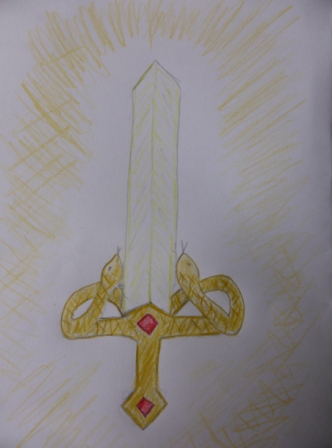
Caledfwlch

He got up with Arthur’s sword in his hand and the image of two golden serpents on the sword. When the sword was drawn from the sheath, it was like seeing two flames of fire from the serpents’ jaws. And it was not easy for anyone to look at that, because it was so terrifying.’
Rhonabwy’s Dream

On the edge of Celyddon two serpents
danced, ziz-zag bodies tumbling, twining, jaws
bared, jets of fire
hissing from their sword-
like tongues as they rose and fell in terrifying
splendour beneath the golden

sun competing for the favour of a golden-
eyed female. Arthur followed the serpents’
tracks to behold the terrifying
sight. His jaw
dropped as their sword-
like bodies intertwined in deadly combat; fiery

and tempestuous as the fires
of Hell. From the burning undergrowth a golden
lizard scurried to avoid their sword-
play – a flash in a serpents’
eye before jaws
closed over him and a terrifying

darkness. Remembering the terrifying
battle between gods of ice and fire;
Flame-Lipped and Wolf-Jaws,
white and golden-
haired interlocking like serpents
wielding flaming and ice-rimmed swords,

Arthur decided he wanted a sword:
sharp-edged, cloud-lit, to tame those terrifying
rivals. He grasped the serpents,
hissing and spitting fire
in his golden
gauntleted hands beneath their jaws,

took them to the forge of anvil-jawed
Gofannon. “I want a sword
of purest gold,
beaten into the most terrifying
form; living, breathing two flames of fire,
harnessing the strength of these struggling serpents.”

Gofannon plunged the serpents, flickering-eyed, wide-jawed,
into his fire, skins sloughing, blackening, goldening,
intertwining as one terrifying sword.

Caledfwlch

*This is one of the poems that didn’t make it into Gatherer of Souls, but relates to the theme of Gwyn’s opposition to Arthur. The form I have used is the sestina.


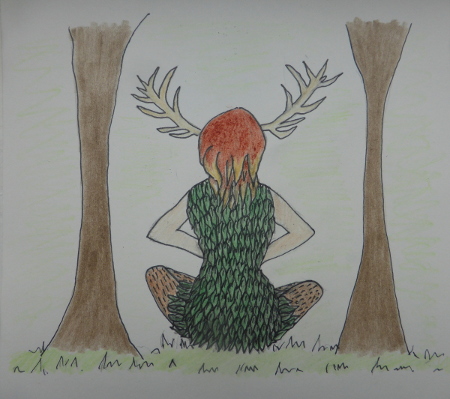
Elen’s Daughter

She’s sitting in a glade
antlered head bowed in concentration
patiently carving patterns
on a piece of bone.

Then in a deer-like leap
she’s up on cloven hooves,
spinning around in a whirlwind
of auburn hair, wild freckles,
eyes full of leaves and me.

Anger quivers in her skin.

She reminds me of a compass
straining toward north but unable
to get there trembling green.

“I have lost my way,” she speaks
softly but from a deep well of loss,
“Because you have lost your way.

On one bone I mapped the world
but now I can’t fit one of your cities
on a map the size of this forest.

You wander through them lost.

The ways have been broken
and all the maps are gone.”

She stares as if it’s my fault.

“I’ve been told I must re-weave
the ways between the worlds…”

“You and your people need to
fix your ways for certain!”

She scratches at a line on the bone.

Elen's Daughter 450

The Wishbone of the Lord of Desolation

Wishbone – A forked bone (the furcula) between the neck and breast of a bird. According to a popular custom, this bone from a cooked bird is broken by two people and the holder of the longer portion is then entitled to make a wish.’
Oxford English Dictionary

The Wishless

cry out from the city
where the long lines of cars
and the chugging of exhausts never ends.

It always 9am on a Monday and always the morning rush.

A woman with ruffled feathers is trapped in a lift going up
and down and up and down and up and down,
her image in her compact mirror setting
and sticking like hair spray.

A man wearing headphones
is convulsing like an electrocuted bird.

A manager is on the roof of a tower block
switching off his mobile before taking a final breath.

Oh city of flightless wingless birds how many wishes
have been tugged from your chests and left festering in backyards?

A man is flying now like a bird without a wishbone –
no lift, no ‘strengthening of the thoracic skeleton
to withstand the rigors of flight’.

“How can I help the wishless?”

The Lord of Desolation

“You must find the Wishbone
of the Lord of Desolation.”

I go through the fortress that guards
the mountain pass where the waterwheel
is turned by the river that turns time.

In the Land of Desolation wind
and sand scour the broken skeleton
of the Lord who is the desert land
and the scouring inseparable.

Each rib-bone is an archway
of the cathedral of a once mighty chest
from which the bellow of lungs has fled
to the tortuous winds and the heart
to a dull thud thud like a hammer
in the head slowly fault-lining
the small misshapen skull.

I look for the wishbone between
the neck and the breast – the furcula,
‘little fork’, fused to two scapulae
for stable flight, more lift when
the thoracic cavity is under stress.

The wish lifting the bird until the fall.

The wishbone is gone, stolen, leaving
the Lord wishless, fallen, desolate.

“There is nothing in the Land of Desolation.”

The Endless Scrapyard

The wind that exposed bones blows
back sand to reveal the endless scrapyard –
a sprawling conurbation of tyres, hubcaps,
headlights, broken wing mirrors, windscreens,
the ceaseless grind of the crushing machine.

I crawl over piles of pots, pans, sinks,
laptops, TVs, radios, catch my trouser leg on
an aerial, fighting not to be lulled to sleep
by the fishing forecast or driven mad
by the news or the canned laughter.

Ignoring messages on walkie-talkies,
not running from blaring sirens flashing
blue-and-red blue-and-red blue-and-red,
I reach the household waste and dig
down through the years throwing

away layers of plastic and styrofoam,
digging down to old shell middens and shards
of broken pottery, finding to my frustration
that all the wishbones have been stolen.
“Leave the scrapyard well alone.”

The Thieves of Wishes

I know, of course, where to find to them.

The circle is made whole – the centre
of wishlessness is in the bowels of the city
where brothels, slot machines, casinos,
temples to golden gods are found.

There, in the inner sanctum, they are gathered
around the Wishbone of the Lord of Desolation.

The floor is littered with broken wishbones,
empty bottles, dog ends, silver foil, faeces.

They are bare and empty skeletons arguing
over fake bank notes, gaming chips, the last line
of coke that gets blown off the table sending them
sniffing like desperate dogs amongst the debris.

All except the two who shot each other in the head.
Their skulls are shattered, jaws still jabbering.

White, obdurate, horrible, like a standing stone,
almost holy, it has resisted them completely.

“The thieves have stolen nothing but desolation
and broken everything except this wishbone.”

It is not hard to wrest it back from trembling
phalanges and evade their palsied gun shots as we fly
up, up, up, to where the thieves can never go.

Ceremony

I go through the city banging a pan,
driving the wishlessness from the wishless,
rousing them from their offices and pointing
them to the elevators that fly beyond the rooftops,
grabbing the flightless before they hit concrete,
granting them a set of wings and second life.

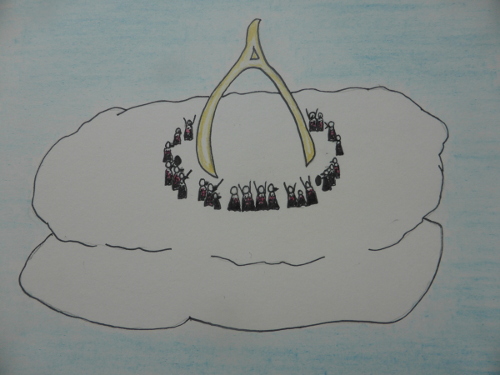
When we are assembled on a cloud at noon
around the Wishbone of the Lord of Desolation
the voice box of the wind announces the ceremony
is begun and the stars above nod their assent.

The bird-headed men and women play
xylophones crafted from the bones of their ancestors
and whistles that were once whistling beaks.

The wishless raise their voices recanting
every single wish they have never made remaking
them on the bone as to the exhortation of noise
it breaks and with a thrust of bony wings

the Lord of Desolation flies free and is gone.
The Wishbone of the Lord of Desolation Med


Twrand o’r Gyre

A hen got hold of me –
a red-clawed one, a crested enemy;
I spent nine nights
residing in her womb
The Hostile Confederacy

Bird-Head

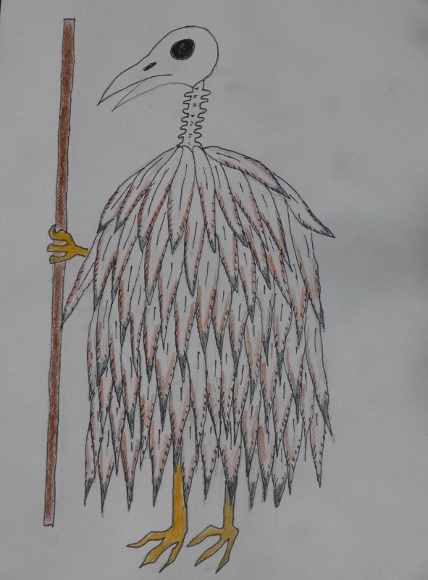
“The witch Ceridwen made me like this.”

He reminds me of one of Baskin’s cave birds:
the bare white skull with its long maxilla,
the sclerotic ring,

the way he stares just ‘so’ like a raptor,
cervical vertebrae twisting down

to feathered shoulders.

Immediately I have questions
I know I shouldn’t ask –

like where he got his cloak,
whether it’s part of him,
what’s beneath.

I keep my beak well shut,

follow with respect up the mountain
to the tap-tap-tap of his stick

as he points out bones picked clean by birds,

the skeleton still sitting waiting for death.

When I grow weary I think of how the dying
made it higher with their last breath
and stumble on to the summit.

Will I fall apart in a heap of bones
or crumble into a pile of dust?

Only his sunken eyes know.

Gyre

I totter like an old woman.

Before I’ve had the chance to look down
at what I’ve left behind I’m swept

into a gyre,
circling and circling
with the last things of Thisworld –
a wardrobe emptying of clothes,
a cupboard spilling chutnies,
jams, ketchups, vinegar.

Things I’ll dimly miss.

A new set of wings
is beating in my chest
carrying me higher higher.
The sun is my new head
illuminating the plains
of a new horizon.

Its brightness is beyond pain,
understanding, words such as ‘firmament’,
‘cloud’,‘cirrocumulus’, ‘Heaven.’

Here

the winged souls are busy,

half human, half bird,

hollowing out their bones
with the chink, chink, chink
of tiny chisels, breaking

and re-fixing humerus,
ulna, radius, fusing carples
and phalanges into wings.

Separating toes into claws.

Stretching lungs into air sacs
and filling lightened bodies full
of soulful air and otherlight.

Far Above

they are greeted by elders
who teach them to build nests

with sticks and clothes pegs,
moss, spit, newspaper cuttings
of past lives they wished they had,
toys, shoes, watch hands, fluff
from the bellies of teddy bears.

Like little old women or foetuses
they climb back into the eggs,

back into a chick-like slumber,

back into the womb of an old hen,
back into the cauldron of Ceridwen,
back into before they were born.

Nine Nights

Finally Twrand tells his story:

“For nine nights and nine days
I resided in her womb asleep like
a feather in the skies drifting from
planet to planet learning stories
of other worlds beyond her dreams
and all her deepest imaginings.

I saw the trajectory of Thisworld.

I plucked the feather of my Awen
from the side of a red-clawed hen.

When I was born she killed me:

wrung my neck, bent me out of shape.
I raised my skeleton from the sand,
fixed my wings and learnt to ride
the winds of the gyre unreturning.”

Twrand o'r Gyre MML