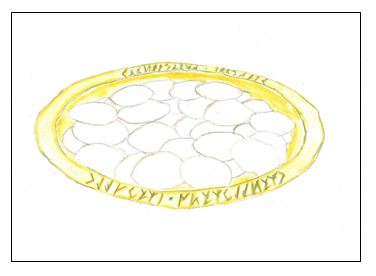
Nodens Silver Hand

Silver Hand of Nodens Med

Nodens ‘the Catcher’ was worshipped across Britain in the Romano-British period. This is evidenced by his temple at Lydney, an inscription at Vindolanda on Hadrian’s Wall, and two silver statuettes found in Lancashire on Cockerham Moss suggesting the existence of a nearby shrine.

In medieval Welsh literature Nodens appears as Lludd Llaw Eraint. Lludd originates from Nudd ‘Mist’ and ‘Llaw Eraint’ means ‘Silver Hand’. A bronze arm found in Nodens’ temple in Lydney supports this link. His iconography and identifications with Mars and Neptune suggest he was a sovereignty figure associated with hunting, fishing, war, mining, healing, water, weather, and dreams. Many of these skills would have depended on his catching hand, which was lost and replaced in silver. Sadly we have no Brythonic stories explaining how Nodens/Nudd/Lludd got his silver hand.

Therefore we must turn to the Irish myths and the story of Nodens’ cognate Nuada Airgetlám ‘Silver Hand’ in The Battle of Moytura. This opens with the Children of Nemed departing from Ireland to escape the oppression of the Formorians, their exile in Greece, and return to Ireland to reclaim their land as the Fir Bolg at the time ‘the children of Israel were leaving Egypt’ (around 1000BCE*).

The Lebor Gabála Érenn informs us that the Children of Nemed split into three groups – the Fir Bolg, one that went to Britain, and one that went North and became the Tuatha Dé Dannan. It is amongst the Tuatha Dé Dannan, ‘People of the Goddess Danu’, that we find Nuada as High King.

In The Battle of Moytura we are told the Tuatha Dé Dannan returned to Ireland from the North to reclaim their share of the land from the Fir Bolg ‘in a cloud of mist and a magic shower’. Nuada made the demand: ‘They must surrender the half of Ireland, and we shall divide the land between us.’

The Fir Bolg refused and this led to a fearsome battle. Nuada played a central role. He ‘was in centre of the fight’ with ‘his princes’, ‘supporting warriors’ and ‘bodyguard’ and took on Sreng, the Fir Bolg’s champion. Sreng ‘struck nine blows on the shield of the High-King Nuada, and Nuada dealt him nine wounds.’ During this combat Nuada lost his hand, which is described dramatically in vivid detail. ‘Sreng dealt a blow with his sword at Nuada, and, cutting away the rim of his shield, severed his right arm at the shoulder; and the king’s arm with a third of his shield fell to the ground.’

Nuada was carried from the battlefield. This is followed by a striking and grotesque scene: ‘His hand was raised in the king’s stead on the fold of valour, a fold of stones surrounding the king, and on it the blood of Nuada’s hand trickled.’ What to make of this? I’ve heard of severed heads put on stakes and revered due to the belief the soul resides in the head, but not of severed limbs raised on folds of stones. Perhaps this represents a tradition where a ruler or warrior’s strength was believed to reside in his sword arm/hand. For this reason the hand/arm received reverence whilst its mutilated owner was seen as lacking in strength (this would explain Nuada’s later demotion).

Afterwards the Tuatha Dé Dannan gained ascendancy. A truce was called and the Fir Bolg were given three options: to leave Ireland, share the land, or continue fighting. Sreng decided to fight and challenged Nuada to single combat. ‘Nuada faced him bravely and boldly as if he had been whole.“If single combat on fair terms be what you seek, fasten your right hand, as I have lost mine; only so can our combat be fair.” This shows Nuada was seen as unwhole yet still acted bravely and fairly.

Sreng refused. Taking counsel, the Tuatha Dé Dannan decided to offer Sreng ‘his choice of the provinces of Ireland’. ‘A compact of peace, goodwill, and friendship’ was made and Sreng chose Connacht.

Because he was not whole Nuada was forced to step down from his position as High King. He was replaced by the half-Formorian half-Dannan prince Bres. Bres oppressed the Tuatha Dé Dannan: ‘their knives were not greased by him… their breaths did not smell of ale; and they did not see their poets nor their bards… nor did they see their warriors proving their skill at arms before the king.’ Ogma was forced to carry fire-wood and the great father-god, the Dagda, served as a rampart-builder.

During this period a silver hand was made for Nuada through the combined efforts of the physician, Dian Cecht, and the brazier, Credne. It seems both an intimate knowledge of human anatomy and skill at silver-work were required for this process. Successfully crafted, it ‘moved as well as any other hand’. This scene is uncannily reminiscent of modern bionic technologies.

What follows is even more uncanny. Credne’s son, Miach, felt an inexplicable disliking for Nuada’s silver hand. We are told ‘he went to the hand’ (here, frustratingly it is not clear if he is speaking to the severed hand or to the silver hand) ‘and said “joint to joint of it, and sinew to sinew”; and he healed it in nine days and nights. The first three days he carried it against his side, and it became covered with skin. The second three days he carried it against his chest. The third three days he would cast white wisps of black bulrushes after they had been blackened in a fire.’

Here we find a complex ritual for the regeneration of a flesh-and-blood hand! Again, this seems to predict modern stem cell research; scientists are still struggling with complex processes of decellurisation and recellurisation in order to grow ‘ghost limbs’. Another example of a regenerating hand from the Welsh myths is the monstrous appendage that snatched Pryderi and Teyrnon’s foal and was chopped off by Teyrnon no doubt to reappear the next Calan Mai for more victims.

Similar miraculous healings took place in The Battle of Moytura. Both the Fir Bolg and the Tuatha Dé Dannan dug Wells of Healing. The Fir Bolg’s physicians ‘brought healing herbs with them, and crushed and scattered them on the surface of the water in the well, so that the precious healing waters became thick and green. Their wounded were put into the well, and immediately came out whole.’

The Tuatha Dé Dannan’s well was called Slaine. Dian Cecht and his sons Octriul and Miach chanted spells over it ‘to kindle the warriors who were wounded there so that they were more fiery the next day.’ It not only healed the wounded, but the mortally wounded and brought the dead back to life! ‘They would cast their mortally-wounded men into it as they were struck down; and they were alive when they came out.’ It shares qualities with the Cauldron of Regeneration in the Welsh myths.

Returning to the narrative, Bres was deposed. Nuada, with his flesh-and-blood sword hand, now whole, and thus seen as capable of rulership, was returned to his position of High King, now ruler of Ireland. Bres journeyed to the lands of his Formorian father and raised an army, led by Balor of the Piercing Eye.

As they approached, ‘making a single bridge of ships from the Hebrides to Ireland’, ‘terrifying’, ‘dreadful’, ‘a handsome well-built young warrior wearing a king’s diadem’ arrived at the gates of Nuada’s court. Cue the entry of Lug Lormansclech, ‘the son of Cian son of Dian Cecht and of Ethne Daughter of Balor’. Lug was half Danann and half Formorian. ‘Lormanslech’ means ‘Long-Handed’. It was revealed the youth is Samildanach, ‘many-skilled’. Like Nuada, many of his talents, such as building, smithing, fighting, playing a harp, were dependant on his sword-hand.

Nuada welcomed Lug and, perceiving his superior skill in combat, surrendered his kingship to him on the condition he released the Tuatha Dé Dannan from the oppression of the Formori. In the following battle Nuada was defeated and killed by Balor. Lug avenged Nuada by slaughtering Balor, his grandfather, by shooting a stone into his single eye with a sling and became the High King.

This epic story speaks clearly of Nuada’s bravery in combat, the slicing off of his arm and its raising on a fold of stones, the crafting of his silver hand and the magical regeneration of his flesh-and-blood hand, his loss and regaining of his sovereignty, his special friendship with Lug, and his death.

We might expect to discover a parallel mythos in ‘The Fourth Branch’ of The Mabinogion, which tells the story of the House of Dôn, who are cognate with the Tuatha Dé Dannan. Lleu Llaw Gyfes ‘Skilful Hand’ is a central figure and his story shares similarities with his cognate, Lug**. However, Lludd is not mentioned at all. Math is the sovereign of the House of Dôn and the grandfather of Lleu.

Will Parker suggests a parallel with the battle against the Formorians may be found in the ‘The Battle of the Trees’, from The Book of Taliesin, where the House of Dôn took on the forces of Annwn, the Otherworld. According to Triad 84 this ‘Futile Battle’ was initiated when Amaethon stole a lapwing, a dog, and roebuck from Arawn, King of Annwn. Gwydion enchanted the trees*** and Lleu was the battle-leader, ‘Radiant his name, strong his hand, / brilliantly did he direct a host’.

Amongst the enemy were ‘a great-scaled beast’, a ‘black-forked toad’, and ‘speckled crested snake’. Two englyns**** suggest Brân the Blessed, a gigantic son of Llyr previously associated with moving woodlands, now dead, fought amongst the people of Annwn. Once again, frustratingly, Lludd is conspicuous by his absence. If this was the battle where he lost his hand, his story has been lost.

Lludd appears instead in Lludd and Llefelys. He is introduced as Lludd Llaw Eraint, King of Britain. He already has his silver hand. The narrator presupposes the audience know the back story. We are told Lludd was a son of Beli Mawr, the father of Caswallon, who usurped the throne from Caradog, son of Brân, in ‘The Second Branch’. Assuming Lludd’s mother was Dôn this places him in a medial position between the Houses of Dôn and Beli. His power of mediating forms the heart of the tale.

We learn that, with advice from his brother, Llefelys, King of France, Lludd defeated three plagues, which bore some resemblance to the oppressions of Bres and the Formorians. The first was a people called the Coriniaid who were undefeatable because they could hear everything. The second was the scream of a dragon that blighted the land, causing loss of strength, miscarriages, barrenness, and crop failure. The third was a ‘powerful magician’ of ‘enormous stature’ who carried off Lludd’s provisions.

Lludd defeated them, not in epic battles, but through wit and magic. He banished the Coriniaid with a poison made from insects mixed in water. He calmed the two battling dragons by luring them into a well filled with mead, wrapped them in silk, and buried them in a stone chest. He caught the magician, who used a sleep spell, by standing in a tub of cold water to stay awake, defeated him in combat, then made him his vassal. Lludd then ruled Britain ‘in peace and prosperity’ until his death.

This story is set during the time of the Roman invasions. The Coriniaid (or Caesariad) were the army of Caesar who invaded in 55BCE and were driven from Britain by a wintry storm. Lludd’s dragon screamed because it was battling the dragon ‘of a foreign people’. Lludd’s calming of the dragons possibly represents him making peace between the Britons and Romans many years later. These historicised stories, particularly that of the battling dragons who fight again during the Anglo-Saxon invasion, are likely to have a deeper mythic basis. The magician was a purely otherworld figure.

Lludd mediated between threats from other lands and from the Otherworld and made peace with Llefelys’ aid. Their relationship bears similarities to the special friendship between Nuada and Lug.

In Britain Lludd’s role as a peacemaker rather than as a warrior was emphasised. The focus of his temple was not war but healing dreams. It’s my intuition his associations with healing may stem from his wounding, from the loss of his hand, his status as a wounded king. Silver-handed, he is whole-and-not-whole, and occupies a liminal and dreamlike position between Thisworld and the Otherworld.

It is of interest that Nodens/Nudd/Lludd’s son, Gwyn ap Nudd, is a ruler of Annwn. His role is to contain the fury of the spirits of Annwn to prevent their destruction of Thisworld. Gwyn is also a mediator.

Putting the evidence together we can conclude that Nodens lost his hand in a battle against some form of oppressor, possibly an Annuvian giant with a single eye, during ‘the mythic foretime’. His severed hand was raised on a fold of stone or paraded through the land with reverence and solemnity. Somebody, perhaps Gobbanus the smith-god, with the help of a physician, crafted him a silver arm. During this process he lost and regained his sovereignty. In the face of another threat Lugus arrived at his court and, in the ensuing battle, Nodens was killed and Lugus took his place.

Resurrected as King of Britain at the time of the Roman invasion Nodens/Nudd/Lludd worked with Lugus/Llefelys to bring peace to the island. Both deities were revered by the Roman Britons. After their veneration died their stories lived on and form an important part of the text we know as The Mabinogion.

And this was not Lludd’s only rebirth. In the name of King Lud, the eponymous leader of the Luddites, who struggled against the oppression of the Cotton Lords, we find echoes of Lludd’s name.

Again, as we are faced with oppression from right-wing groups and governments, he is invoked: “No King but Lludd!” As the sovereignty of the gods is affirmed against the corrupt rulers of Thisworld a fitting symbol of this time might be a silver hand; dealing blows, healing, bringing peace.

*Scholars have traced the story of the exile of the Israelites to prophets in 700BCE and suggest it may have happened around 1000BCE, although no archaeological evidence has bd een found to support.
** The attempts of Arianrhod, Lleu’s mother, to prevent him from winning a name, arms and a wife share parallels with Balor trying to stop Lug gaining a name and wife in order to prevent his prophesied death. Lleu’s defeat of his rival in love, Balor, with a spear-blow is similar to Lug killing Balor with a sling-shot or, in some cases, an enchanted spear.
***In The Battle of Moytura, Be Chuille and Dianaan, Lug’s ‘two witches’ said: “We will enchant the trees and the stones and the sods of the earth so that they will be a host under arms against them; and they will scatter in flight terrified and trembling.”
****These englyns are found in the Myvyrian Archaeology:

Sure-hoofed is my steed impelled by the spur;
The high sprigs of alder are on thy shield;
Bran art thou called, of the glittering branches.

Sure-hoofed is my steed in the day of battle:
The high sprigs of alder are on thy hand:
Bran by the branch thou bearest
Has Amathaon the good prevailed.

SOURCES

Edwin Hopper (transl), ‘The Battle of Moytura’, Edwin Hopper
John T. Koch (ed), The Celtic Heroic Age, (Celtic Studies Publications, 2003)
Marged Haycock, Legendary Poems from the Book of Taliesin, (CMCS, 2007)
Robert Graves, The White Goddess: A Historical Grammar of Poetic Myth, (Faber & Faber, 1999)
Sioned Davies (transl.), The Mabinogion, (Oxford University Press, 2007)
Will Parker, The Four Branches of the Mabinogi, (Bardic Press, 2005)
Cad Godau’, Mary Jones Celtic Literature Collective
Dormach and the Jaws of Annwn

Dormach is the dog of Gwyn ap Nudd, who aids him hunting the souls of the dead. We have only one reference to Dormach by name in medieval Welsh literature. This is from ‘The Conversation Between Gwyn ap Nudd and Gwyddno Garanhir’ in The Black Book of Carmarthen (1350).

In this poem Gwyddno has died and is wandering the misty hinterlands between Thisworld and Annwn. There he meets with Gwyn, who offers him protection and slowly reveals his identity as a gatherer of souls. Gwyn introduces Dormach, then Gwyddno addresses the dog.

In Welsh this reads:

Ystec vy ki ac istrun.
Ac yssew. orev or cvn.
Dorma ch oet hunnv afv y Maelgun.

Dorma ch triunrut ba ssillit
Arnaw canissam giffredit.
Dy gruidir ar wibir winit.

Over the past two centuries this verse has been translated into English in various ways. The most recent and best translation is by Greg Hill (2015):

My hound is sleek and fair,
The best of hounds;
Dormach he is, who was with Maelgwn.

Dormach rednose – why stare you so?
Because I cannot comprehend
Your wanderings in the firmament.

Much controversy has surrounded the name, which is written twice as ‘Dorm ach’, with a letter erased. John Rhys assumed this was an ‘r’ giving ‘Dormarch’ with march meaning ‘horse’ ‘wholly inapplicable to a dog’.*

Rhys suggested ‘Dormach’ should instead be written as ‘Dormarth’, ‘a compound made up of dôr, ‘door,’ and marth.’ He went on to claim that marth is a ‘personification of death’ ‘of the same origin as the Latin mors, mortis… perhaps, the Marth which was the door of Annwn.’ Dormarth means ‘door-death’.

Rhys’s translation is now considered unconvincing. There is no evidence the letter was an ‘r’ and its erasure is viewed as a genuine correction. According to The Dictionary of Welsh Language, ‘Dormach’ means ‘burden, oppression’. There is textual evidence of its use from the 14th century until the 18th century. These meanings fit with medieval Christian conceptions of Gwyn and his dog(s).

Rhys notes that in Wales Bwlch Safan y Ci, ‘the Gap or Pass of the Dog’s Mouth’, is a metaphor for death and bears similarities with the English ‘jaws of death’ and German Rachen des Todes ‘jaws of death’. This argument for Dormach’s association with death and the door of Annwn seems sound. In the Brythonic and Germanic traditions we find corpse-dogs: Cwn Annwn (of whom Dormach is a member and perhaps their leader being ‘the best’) and Gabriel Ratchets, who hunt the souls of the dead and are viewed as death portents. To pass through the jaws of these dogs is to die and go to the next world.

In many world myths, dogs act as guardians to the lands of the dead. The most famous is Cerberus, who guards Hades in Greek mythology. He is variously depicted with one, two, three, or fifty(!) heads, one or more stinging serpent tails, and sometimes with a mane of snakes or snakes down his back.

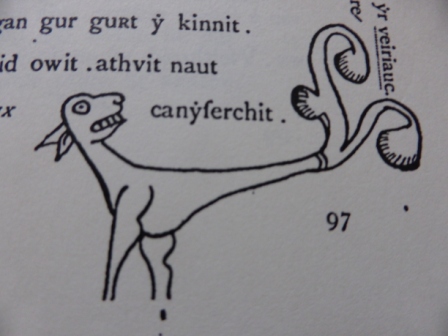
Intriguingly, in The Black Book of Carmarthen, the scribe has sketched an image of Dormach with a dog’s head and near Cheshire cat-like grin, a dog’s forelegs, and a long body tapering to two serpent tails. He bears a striking similarity to Cerberus and may also have been viewed as a guardian of Annwn.

Dormach Sketch - Copy

Part-dog, part-serpent, this image reminds me of the watery, subliminal imagery from the temple of Nodens/Nudd, Gwyn’s father. On a mosaic are two sea-serpents or icthyosaurs. On a mural crown Nodens is accompanied by icthyocentaurs with heads of men, front hooves of horses, and fish-tails.

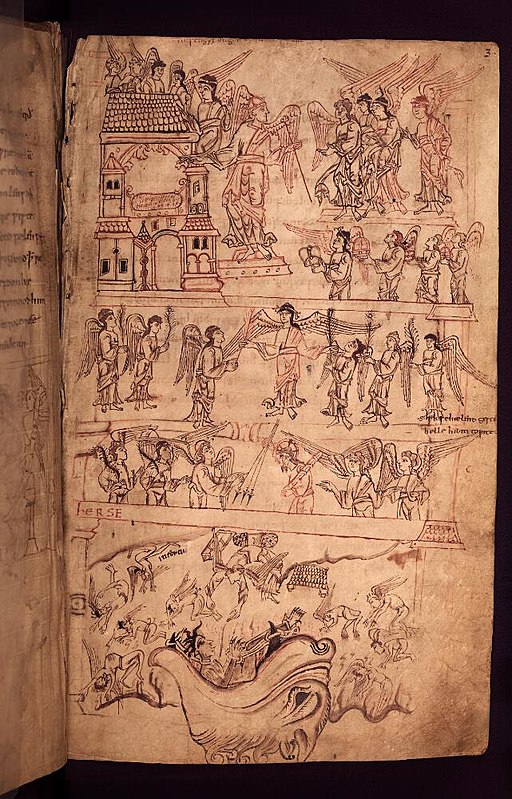
Rhys notes by Dormach he is ‘reminded of the the medieval pictures of hell with the entrance thereinto represented as consisting of the open jaws of a monster mouth.’ He refers to the tenth century Anglo-Saxon Caedmon manuscript where the devil lies chained to a tooth and demons deliver sinners into the gaping maw.

Bodleian_Libraries,_Cædmon_Manuscript_3_Wikipedia_Commons

Caedmon Manuscript

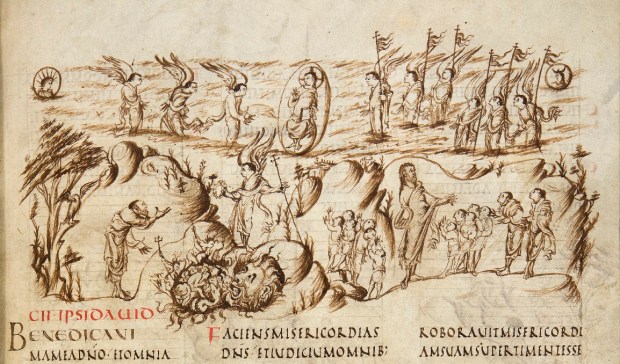
This shares similarities with the Urtecht Psalter (1055) from the Netherlands which features not only Hell Mouths but a ‘Hades Head’ (could we be looking at shared cultural representations of Pen Annwn, ‘Head of the Otherworld’?). The 11th century Anglo-Saxon Harley Psalter replaces the Hell Mouths with clefts, pits, vents, and chimneys leading into hollow hills where souls are tortured.

Utrecht124_(cropped)_Wikiwand.jpg

Utrecht Psalter with Hades Head

In these representations we find a mixture of pre-Christian Brythonic and Anglo-Saxon beliefs about the dead passing through the jaws of death to a world beneath the earth demonised and made hellish. Hell Mouths also appear on the left-hand side of Christ in the bottom corner surrounded by the demonic imagery of Hell (Heaven is on his right) in Doom paintings from across medieval Europe.

These depictions are clearly influenced by the Bible. In Isaiah 5:14 we find the lines: ‘Therefore Death expands its jaws, opening wide its mouth; into it will descend their nobles and masses with all their brawlers and revelers’ and in Numbers 16.32: ‘and the earth opened its mouth and swallowed them and their households, and all those associated with Korah, together with their possessions.’

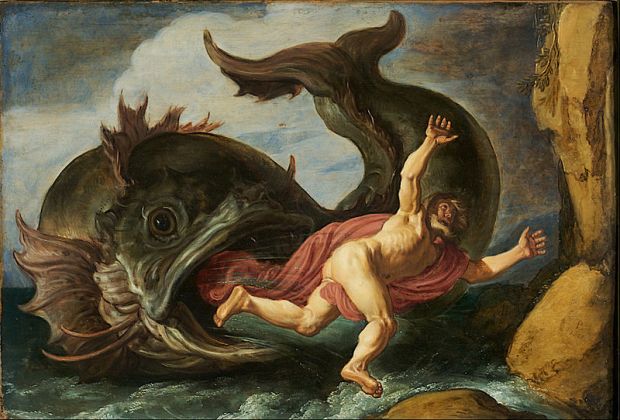
In the Book of Jonah, Jonah was swallowed by a gigantic sea creature. In the Hebrew text it is called a dag gadol, ‘huge fish’, in the Greek ketos megas ‘huge fish’, a term associated with sea-monsters, and in the Latin ketos is translated as cetus ‘whale’. Jonah is described as being in ‘the belly of hell’, ‘cast into the deep’: ‘The waters compassed me about, even to the soul: the depth closed me round about, the weeds were wrapped about my head. I went down to the bottoms of the mountains; the earth with her bars was about me for ever.’ Jonah’s ‘soul fainted’, he offered up a prayer to God, and the whale vomited him up. Here we have a clear depiction of Jonah passing to and returning from another world. ‘Hell’ is translated from Sheol, the Hebrew name for the land of dead.

800px-Pieter_Lastman_-_Jonah_and_the_Whale_-_Google_Art_Project_Wikiepedia_Commons

‘Jonah and the Whale’ by Pieter Lastman (1621)

In Matthew 12:40 Jesus compares his death, journey to Hell, and resurrection with the story of Jonah: ‘For as Jonah was three days and three nights in the belly of a huge fish, so the Son of Man will be three days and three nights in the heart of the earth.’ The sea-monster’s belly and Hell are equated.

In ‘The First Address of Taliesin’, in The Book of Taliesin, the riddling bard poses the question:

Pwy vessur Uffern,
pwy tewet y llenn,
pwy llet y geneu,
pwy mein enneinheu?

What is the measure of Hell,
how thick is it veil,
how wide is its mouth,
how big are its baths?

Here ‘Hell’ is translated from Uffern, which derives from the Latin Inferno, and is used synonymously with Annwn. Margaret Hancock links the geneu ‘maw, jaws’ with the Hell Mouth and the ‘Hell monster’ in ‘The Battle of the Trees’: a ‘great-scaled beast’ with one hundred heads who carries fierce battalions ‘beneath the roof of his tongue’ and ‘in (each of) his napes.’ This beast, like the ‘black-forked toad’ and ‘speckled crested snake’ in whose flesh a hundred souls are tortured ‘on account of (their) sins’ is evidently a death-eater and it seems likely Dormach played a similar role.

These creatures appear to be native to the Brythonic pagan tradition and to Annwn. Whilst they appear monstrous to Christians, from a pagan standpoint, they might be seen as having an essential, albeit unpleasant, function in devouring the dead and acting as vehicles for their passage to the Otherworld.

Of course, such passages are not limited to the dead. As the journeys of Jonah, Jesus, and Taliesin show, the living can pass to Annwn and one of those ways is by entering the jaws of a devouring creature.

Is there some deep and universal truth in the image of the jaws of death? Are pursuit by a monstrous beast, being swallowed, devoured, spat out, integral to the journeys of our souls in life and in death? If this is the case should the ‘oppression’ of Dormach ultimately be seen as liberating, his ‘burden’ the key to release from our fear of death as we pass through his jaws to gain knowledge of the Otherworld?

*Rhys gives no argument for this and I disagree. The name of Arthur’s dog, ‘Cafall’, may derive from the the Latin for horse, Caballus, and mean he was as big as a horse. Bran, the dog of Gwyn’s Irish cognate, Finn, shared Dormach’s colouring with ‘two white sides’ and ‘a fresh crimson tail’ and his head was shoulder high. In the Irish myths we also find dog-headed figures with horse’s manes. There is therefore no good reason why Dormach should not be seen as horse-sized or even as horse-like.

SOURCES

Greg Hill, ‘The Conversation Between Gwyn ap Nudd and Gwyddno Garanhir’, Awen & Awenydd
J. Gwenogbryn Evans, The Black Book of Carmarthen, (Boughton Press, 2008)
John Rhys, Studies in the Arthurian Legend, (Adamant Media Corporation, 2001)
Marged Haycock, Legendary Poems from the Book of Taliesin, (CMCS, 2007)
Philip A. Bernhadt House, Werewolves, Magical Hounds, and Dog-Headed Men in Celtic Literature, (The Edwin Mellen Press, 2010)
Sarah Kemple. ‘Illustrations of damnation in late Anglo-Saxon manuscripts’, Anglo Saxon England, (2003)
Biblical quotes from Bible Hub

With thanks to Linda Sever for passing on Sarah Kemple’s illuminating article.

Scorched

The UK is in the throes of a heat wave. Here in Lancashire temperatures have reached a scorching 30 degrees for four consecutive days. It’s been uncharacteristically warm and dry for two months. Preston, dubbed the ‘wettest city in England’, has barely seen an inch of rain since the beginning of May. Our lawn is scorched, our raspberries are shrivelled, the rivers and streams are running low.

In northern British mythology the first of May is the day that Gwythyr ap Greidol ‘Victor son of Scorcher’ beats Gwyn ap Nudd ‘White son of Mist’ in a ritual battle to win the hand of Creiddylad, a fertility goddess whose name may stem from creir/crair ‘treasure… object of admiration or love.’

Scorched Fire Sign

Gwythyr ap Greidol’s name suggests he is a god of victory in combat, the scorching fire of war and the heat of passion. His is the spark that gives life to the land but also initiates the wildfire. Over the last week wildfires have raged across Saddleworth Moor, Rivington Moor, and Winter Hill. The latter seems symbolic of Gwythyr, Summer’s King, beating Gwyn, Winter’s King, on his home ground. Of course I haven’t been up to Winter Hill whilst it is ablaze (last night it reignited in multiple locations), but I noticed the portent of the full moon over the mast, lit up red like a warning sign.

Scorched Winter Hill Warning

People have been evacuated from their houses and schools closed. Less has been said about the numerous birds, small mammals and insects who have lost their lives or been driven from their homes.

Just as concerning is the Ribble running the lowest I have ever seen, banks of silt and sandstone bedrock exposed, tributaries becoming drier and drier, pond water getting lower and lower. Water shortages have already hit in the South East and Staffordshire. In the North West United Utilities are recommending that we cut down on water use. On next week’s forecast there is not a drop of rain in sight.

Scorched Ribble

May 2018 was the hottest on record in the UK and June looks set to be a record breaker too. What is causing this uncharacteristic heat, empowering Gwythyr, the Victor, to increasingly destructive victories?

***

Research suggests this long period of hot weather results from the effects of man-driven global warming on the North Atlantic Polar Front Jet Stream. The Jet Stream is a ‘ribbon’ of winds blowing east to west at up to 200 miles an hour 9 to 16 kilometres above the earth’s surface over the mid-latitudes. It arises due to the contrast between warm tropical air and cold polar air. The differences in the pressure of warm and cold air produce a ‘pressure gradient force’. These winds would blow from high to low pressure, from south to north, if it wasn’t for the Coriolis effect.

jet_streams_wpclipart

The higher the contrast in temperature the stronger the Jet Stream. It is strongest in winter due to the cooling of the poles and weakest in summer due to their warming. Low pressure systems causing wet windy weather occur to the north of the Jet Stream and high pressure systems causing warm settled weather to the south. During the winter, when it’s strong, the Jet Stream lies south of the UK and gives us rain and wind. If it remains to the south we tend to have wet summers too. If the Jet Stream weakens in the summer and shifts north of the UK we are more likely to have hot still weather.

According to Dr. Jennifer Francis and Stephen Vavrus the warming of the Arctic is lessening the temperature gradient between the equator and the North Pole and causing the jet to slow and become ‘wavier’. James Mason explains that when ‘the eastwards progression of these upper waves becomes sluggish or stalls’ this ‘leads to prolonged weather-conditions of one type or another’ like this heat wave, which is dangerous not so much due to its temperature but the length of time without rain leading to wildfires and water shortages and potentially to drought and crop failure.

***

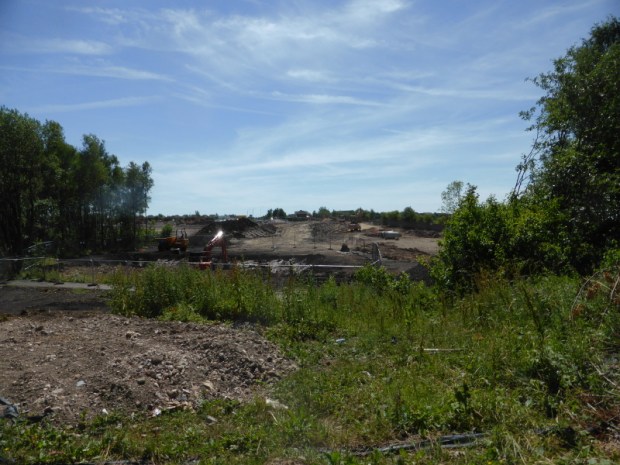
The root of global warming is humanity’s reckless drive for economic growth at the cost of the environment. Our government are aware of the increasing dangers of drought in the summer and flooding in the winter and are taking steps to deal with the effects but not the cause. Instead they are pushing ahead with plans to create more houses, more roads, more jobs; pumping out more greenhouses gases, removing more green space, causing more warming. Here in South Ribble alone 9000 houses are being built along with new and expanded roads and business parks. Preston, South Ribble, and Chorley are being merged into one urban conglomerate with parks as our only green spots.

Lostock Hall Gasworks Development

Dissenting voices are not listened to by the victors. From their positions of wealth and comfort they refuse to see, acknowledge, care about the effects their victory is having on the land and its creatures.

In British mythology Gwythyr and his father sided with Arthur against Gwyn and his spirits, the ancient animals, the monsters, the giants, the witches, and were victorious. In modern Britain the Arthurian court of war-mongering treasure-hoarding politicians and business leaders reign supreme.

800px-Holy-grail-round-table-bnf-ms-120-f524v-14th-detail

What to do in a world where history is determined and written by the victors, when, as Gwyn knows before going into battle every May Day, as Walter Benjamin says, ‘this enemy has not ceased to be victorious’?

Perhaps we must look beyond battle, beyond victory, which can only makes us the next victors, for other ways to our bit for the scorched land, the drying rivers, the dying creatures, the cast-out gods.

SOURCES

Ed Walker, ‘Winter Hill fire reignites and is in multiple locations’, Blog Preston,
John Mason, ‘A Rough Guide to the Jet Stream’, Skeptical Science,
Francis Perraudin, Helen Pidd and Kevin Rawlinson, ‘A hundred soldiers sent in to tackle fire on Saddleworth Moor’, The Guardian
Walter Benjamin, ‘On the Concept of History’, Marxists.Org
BBC Weather, Penwortham, BBC website
Climate change the jet stream’, Climate Central
Preston’s named wettest place in England’, Lancashire Evening Post,
UK weather: Water shortage warnings and hosepipe bans as heatwave intensifies’, The Indepedent
What is the jet stream?’, Met Office

Afagddu, Prophet of Darkness

I. The Dark Son

Afagddu, ‘Utter Darkness’, is a minor figure in Welsh mythology whose significance has not been recognised because he was pushed out of the way by Gwion Bach, who became the celebrated bard, Taliesin.

Afagddu’s mother is Ceridwen. She and God are called on interchangeably as the ultimate source of awen, divine inspiration, by the medieval bards. This suggests she is the greatest of the Brythonic deities, the Great Goddess closest to a creator God, Old Mother Universe, the creatrix and destructrix from which all life is born and to whom it returns at the moment of death.

If this is the case, then surely her son, Afagddu, should hold a greater position within Brythonic tradition? Why is his story shoved aside like a dirty secret? Why is his name not better known?

I believe this is partly due to his hideous apparel. In Elis Gruffudd’s recording of ‘The Story of Taliesin’ we are told his ‘looks, shape and carriage were extraordinarily odious’. Firstly they named him Morfran, ‘Great Crow’ or ‘Sea Raven’ but ended up calling him Afagddu ‘Utter Darkness’ ‘on account of his gloomy appearance’. John Jones’ redaction describes him as ‘the most ill-favoured man in the world’ and compares him to his sister, Creirwy, ‘Living Treasure’, ‘the fairest maiden in the world’.

Afagddu’s ancestry goes some way to explaining his looks. Ceridwen’s name can be translated as ‘crooked wife’ (from cwrr, ‘crooked’, and fen, ‘wife’) and ‘fair and loved’ (from cerid, ‘love’ and wen, ‘fair’). Perhaps because she is both crooked and fair she gave birth to crooked and fair children. Afagddu’s father is Tegid Foel, ‘the Bald’, whose patrimony is Llyn Tegid. Tegid’s baldness, along with his rulership of a lake rather than a human kingdom, suggest he is a monstrous water deity.

Unfortunately for Afagddu he was born ‘in the days when Arthur started to rule’ – a period when Christianity was the religion of warrior elites who built their status through the repression of the gods, monsters, ancestral animals, and witches of the ancient British pagan traditions. Ceridwen was allegedly keen for Afagddu to ‘win acceptance amongst the nobility.’ It’s my suspicion this was the addition of a Christian interculator who was either ignorant of Ceridwen’s identity as a goddess or purposefully erased it. At some point she was reduced to a ‘magician’ and Tegid to a ‘nobleman’.

II. The Spirit of Prophecy

In Gruffudd’s recording, after realising that Afagddu will not be recognised for his looks, Ceridwen decided instead to ‘make him full of the spirit of prophecy and a great prognosticator of the world to come.’ The link between his ‘ugliness’ and being chosen for a prophetic vocation may date back to traditions of pagan Britain wherein differences were celebrated and revered rather than despised.

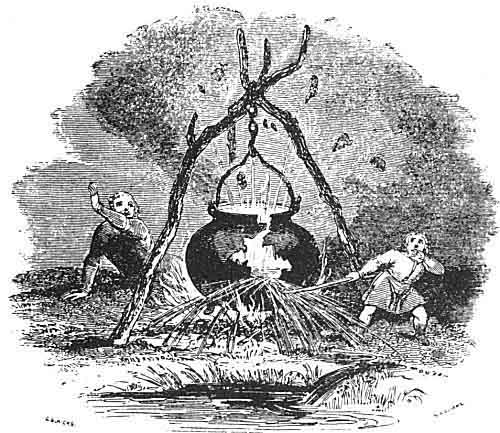
After ‘labouring long in her arts’ Ceridwen discovered a way of achieving prophetic knowledge by choosing certain herbs on certain hours and days and brewing them in a cauldron for a year and a day. Resultingly ‘three drops containing all the virtues of the multitude of herbs would spring forth; on whatever man they fell… he would be extraordinarily learned and full of the spirit of prophecy.’

Interestingly, in John Jones’ version, Ceridwen learnt to ‘boil a cauldron of awen’ from the book of the Fferyllt, ‘Alchemists’, and books of astrology. We find a steady shift from a pagan standpoint where Ceridwen was the omniscient mother of the stars and planets and herbs and well aware of their motions and qualities, to her working hard at her art, to her learning it from the books of human mages.

In both variants Ceridwen made the fatal mistake of recruiting a young man called Gwion Bach to stir the cauldron. In Gruffudd’s, after a year and a day had passed, she stationed Afagddu beside the vessel to receive the drops on the allotted hour then… fell asleep!!! When the trio sprang forth, Gwion shoved Afagddu out of the way and received their blessings. In Jones’s, ‘three drops of liquid accidentally leapt from the cauldron onto the thumb of Gwion Bach; lest he be burnt, he thrust the digit into his mouth.’ In the former Gwion was an active thief and in the latter an innocent bystander.

From 'The Story of Taliesin' on Sacred Texts

In both retellings the cauldron shattered and the remains of the brew spilled out and poisoned the land. Ceridwen was, understandably, furious. After finding out what happened from Afagddu she chased Gwion through a variety of shapes (he fled as hare, she pursued as a greyhound, he leapt into a river as a salmon and she dived as an otter, he took flight as a bird and she followed as a hawk) before he became a grain of wheat and she became a black hen and swallowed him whole.

For Afagddu her reaction was too late. Pushed aside by Gwion, who was reborn all-knowing and shiny-browed to take centre stage as Taliesin, erased from the story, he fell into utter darkness. We never find out how he felt or reacted to the theft of the awen. Imagining our own emotions we can assume he was disappointed, angry, jealous, bitter, consumed by wrath. Bereft of the spirit of prophecy, abandoned by his mother in a poisoned land, disparaged by the nobility, Afagddu chose another path.

III. The Man With Stag’s Hairs

From other texts we learn ‘Morfran son of Tegid’ became a fearsome warrior. In The Triads of the Island of Britain, Triad 24, he is listed with Gilbert son of Cadgyffro and Gwgawn Red-Sword as one of ‘Three Slaughter-Blocks of the Island of Britain’. Someone who is an ysgymyd aeruaeu, ‘slaughter block’ or ‘chopping block of battles’ ‘holds his ground firmly… in spite of the enemy’s blows’.

Morfran son of Tegid appears in the court list in Culhwch and Olwen:‘no-one wounded him at the battle of Camlan because of his ugliness. Everyone thought he was an attendant demon; he had hair on him like a stag.’ He is compared, this time, with ‘Sanddef Pryd Angel angel-face – no-one wounded him at the battle of Camlan because of his beauty. Everyone supposed he was an attendant angel.’

Morfran is still clearly despised. The reference to him having ‘stag’s hair’ connects him with other warriors who became wyllt ‘mad’ or ‘wild’ in battle and took the forms of wild animals. In The Gododdin combatants are described as ‘bull of an army’, ‘wolf in fury’, ‘terrible bear’ and ‘celebrated stag’.

He shares a kinship with the shapeshifters who Arthur captured and forced to join his hunt for Twrch Trwyth ‘King of Boars’. These include Rhymi who took ‘the form of a she-wolf’ and gwyllon such as Cynedyr Wyllt who was ‘nine times wilder than the wildest beast’. Whether Afagddu fought on Arthur’s side freely or was coerced remains uncertain. Whatever the case his description suggests he became wyllt and battled in a stag-like guise.

The comparison of Morfran to an ‘attendant demon’ is evocative of the ‘devils of Annwn’ led by Gwyn ap Nudd, a pagan god, who gathers the souls of the dead from the battlefield. Gwyn’s epithet is ‘Bull of Battle’ and he has ‘horns on his head’. His host, members of his ‘Wild Hunt’, are part animal.

The evocation of attendant demons and angels gathering souls from the battlefield presents us with a vivid depiction of the conflict between paganism and Christianity. Morfran is placed on the side of Gwyn.

IV. The Bird of Wrath

We find further evidence of Morfran/Afagddu’s connections with battlefield demons in ‘The Death Song of Uther Pendragon’ in The Book of Taliesin. Uncannily the celebrated bard channels Uther’s voice:

I broke a hundred forts.
I slew a hundred stewards.
I bestowed a hundred mantles.
I cut off a hundred heads.

Later lines refer to Afagddu:

The unskillful
May he be possessed by the ravens and eagle and bird of wrath.
Avagddu came to him with his equal,
When the bands of four men feed between two plains.

These lines are obtuse and require unpacking. Firstly we find a reference to an unskillful warrior who Taliesin-as-Uther calls for to be ‘possessed by the ravens and eagle and bird of wrath’. This seems, again, to be evoking the tradition of shapeshifting wherein warriors were possessed by a bird or animal.

The ‘bird of wrath’ is Morfran/Afagddu; he appears in the next line and Morfran means ‘Great Crow’ or ‘Sea Raven’, a name for a cormorant. His approach with his ‘equal’ refers to his bird-form.

The final line is the most difficult to comprehend. Its reference to bands of four men feeding is suggestive of bird-like or animal-like behaviour. In the context of the poem I believe it refers to men-in-bird-form feeding on the corpses of the dead on a battlefield ‘between two plains’.

References to corpse-eating birds are prevalent throughout medieval Welsh literature. Gwenddolau owns two birds: ‘two corpses of the Cymry they ate for dinner, and two for their supper’. The Eagle of Pengwern is ‘greedy for the flesh of Cynddylan’. Gwyn’s ravens ‘croak over gore’. In Rhonabwy’s Dream, Owain’s warband, who are described as ravens, not only kill Arthur’s army but carry off their heads, eyes, ears, and arms. The Papil Stone depicts two bird-headed men bearing a human head between their long beaks, which make them look more like cormorants than carrion birds.

The image of men-as-birds feeding on the dead is a horrific one and perhaps portrays fearful superstitions about warriors who become wyllt. These may not be entirely ungrounded. Bones bearing human teeth marks from Gough’s cave show some of the early Britons practiced cannibalism. In Culhwch and Olwen, Gwyn forced Cyledyr to eat his father’s heart, making him wyllt.

The evidence suggests Afagddu not only partook in the slaughter at numerous battles but may also have joined the birds who feasted on the corpses of the dead. His name became a self-fulfilling prophecy. Driven over the edge by losing the awen he lost himself in war and surrendered to utter darkness.

V. A Night of Unordinary Darkness

Afagddu’s name is derived from y faggdu, ‘a night of unordinary darkness’. What happened to him after he was seen at Camlan amongst the battlefield demons remains unknown. If, as I have surmised, he killed other men and ate their flesh, we can guess he descended traumatised into a long dark night.

That most famous of the gwyllon, Myrddin Wyllt, slew his sister’s son and daughter whilst battle-mad. After the Battle of Arfderydd he witnessed Gwyn and his host arriving to gather the souls of the dead. One of Gwyn’s spirits tore him out of himself and assigned him to the forest of Celyddon where he recovered from trauma, guilt, and grief and learnt the arts of poetry and prophecy.

Is it possible Afagddu also made a recovery and became a poet and prophet? Lines from ‘The Hostile Confederacy’, from The Book of Taliesin, suggest he did:

Until death it shall be obscure –
Afagddu’s declamation:
skilfully he brought forth
speech in metre.

Here we find references to the obscurity of his prophetic speech and to his mastery of poetic metre. Afagddu has become a poet-prophet. How he won his awen and became filled with the spirit of prophecy remains obscure as his declamation. I have only my own experiences and intuitions to go on.

Three years ago, during a conversation with Gwyn, I was transported into ‘The Story of Taliesin’. I found myself in Afagddu’s shoes, watching as the cauldron shattered and the contents spilled out, poisoning the streams and rivers, killing Gwyddno Garanhir’s horses and other animals and birds. I walked with Afagddu as he attempted to comfort the dying. Since then I have been inspired to write about him visiting other areas polluted by man-made disasters, helping those affected, cleaning up the land.

Whereas Myrddin found healing in the forest of Celyddon, Afagddu found it in the darkest of places. Perhaps undoing the damage caused by his mother’s cauldron is his way of making reparations, not only for the toxic effects of her attempt to brew the awen for him, but for his own atrocities.

Afagddu’s awen arises from nights of darkness and poisoning and death in which he sees his own nature reflected. They have their own poetry, which seems ugly to an Arthurian eye, but less so from an Annuvian perspective that embraces what our society derides as hideous as poetic and prophetic.

Afagddu’s story is not without happiness. He owns a horse, ‘Silver-White, Proud and Fair’, one of ‘Three Beloved Horses of the Island of Britain’. Her fairness speaks of faerie/Annuvian qualities. I believe she was a gift from Annwn, from Gwyn, in return for his help with the dead and dying lands. She represents his awen, galloping silver-white, proud and fair, from the longest and darkest of nights.

SOURCES

A.O.H. Jarman (transl.), Aneirin – Gododdin, (Gomer Press, 1998)
Charlotte Guest, The Mabinogion, (1877)
Kristoffer Hughes, From the Cauldron Born, (Llewellyn, 2013)
Marged Haycock, Legendary Poems from the Book of Taliesin, (CMCS, 2007)
Patrick Ford, Mabinogi and Other Welsh Tales, (University of California Press, 2008)
Rachel Bromwich (ed), The Triads of the Island of Britain, (University of Wales Press, 2014)
William F. Skene (transl), The Four Ancient Books of Wales, (Forgotten Books 2007)

The One Who Didn’t Go To The Meadows of Defwy

In the fifth verse of ‘The Spoils of Annwn’ Taliesin berates ‘pathetic men’ (monks) who do not know ‘who made the one who didn’t go to the Meadows of Defwy’. I have been perplexed for several months by these lines, which pose the questions: Where and what are these mysterious meadows? Who didn’t go? What is the significance of not going? Who is his/her maker?

The Meadows of Defwy

Both my research and spirit-journeys suggest the Meadows of Defwy are in Annwn, ‘the Deep’, the Brythonic Otherworld. ‘The Spoils of Annwn’ depicts Arthur’s raid on seven otherworldly fortresses and his plundering of its treasures. Arthur’s adversaries are Pen Annwn, ‘the Head of the Otherworld’, and his people.

In the fifth verse, the Meadows of Defwy are connected with the Brindled Ox and Caer Vandwy, ‘the Fortress of God’s Peak’. In ‘The Conversation of Gwyn ap Nudd and Gwyddno Garanhir’, Gwyn (Pen Annwn) speaks of his ‘sorrow’ at witnessing ‘a battle at Caer Vandwy’ where ‘the honoured and fair’ fought Arthur’s raiding party and lost. This resulted in the theft of the Brindled Ox.

The first time I journeyed to the Meadows of Defwy I walked straight into the aftermath of the Arthur’s battle and recorded what I saw in the following verse:

A plain of blood where men once stood.
The lights have gone out in Caer Vandwy.
The clashing sea rolls over shield and spear.
The living dead. The dead dead again.

The Brindled Ox had been stolen, leaving only the deep trails of his struggling hooves as he was hauled aboard Prydwen, Arthur’s ship. His herd were frightened witnesses who had watched from a distance.

The association of the Brindled Ox with the Meadows of Defwy suggests it is a place where the animals of Annwn graze. This is backed up by the folktale Childe Roland, in which Roland found herds of horses, cows, sheep, goats, swine, and a flock of hens in Fairyland/Annwn. Roland beheaded each of their herders before assaulting the Fairy King’s castle.

wild-flowers-1363733002BId

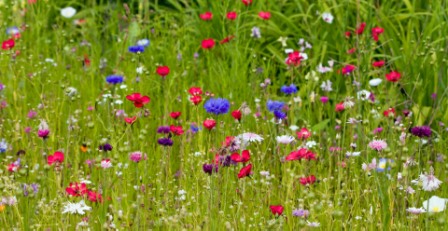
In more recent journeys I have found myself galloping through the Meadows of Defwy as a horse with the horse-herds. The meadows have appeared as a paradisal place of endless grassy plains alive with meadowflowers, bees, butterflies, grasshoppers, crickets.

It shares a kinship with ‘the Plains of Annwn’, which are written about by modern polytheist Nick Ford:

Broad and wide the plains of Annwn,
Sweet and thick, the grass thereon;
Fragrant with a million flowers,
Where graze the herds of Riganton.

Mild the breeze breathes on the pastures,
Blows the grasses that way, this;
As the horse-herds, like the wind, race
Further than the mind can guess.

The Meadows of Defwy are connected with the mare goddess Rigantona/Rhiannon and seem to bear some resemblance to the Elysian Fields of Greek mythology where the souls of the dead go to lead a blessed and happy afterlife.

Marged Haycock suggests Defwy is a river-name deriving from def-/dyf ‘black’ and may have been viewed as a river of the dead. A river Dyfwy is referred to in ‘The Spoils of Taliesin’: ‘Fine it is on the banks of Dyfwy / when the waters flow’. The Elysian Fields are located by the river of Oceanus, which separates this world from the underworld.

This ties together to suggest the Meadows of Defwy are a liminal place where the dead reside happily alongside the animals of Annwn (unless assaulted by thisworldly raiders!).

The One Who Didn’t Go

 It is my belief the phrase ‘the one who didn’t go the Meadows of Defwy’ does not literally mean someone who has not visited the meadows, but refers figuratively to someone who has escaped death.

Who could that be?

After pondering this question for a long while I received an answer from Greg Hill’s new translation of ‘The Conversation Between Taliesin and Ugnach’. When I first read this poem, which opens: ‘Horseman who rides to the fortress, / With white hounds and great horns’ I had a strong feeling the horseman was Gwyn, but was confused by his revelation of his name as Ugnach.

My confusion was laid to rest by Greg’s explanation that the suffix -ach signifies a supernatural character. It’s therefore likely to be another title of Gwyn/Pen Annwn. Greg added in a discussion that when Ugnach identifies himself he uses the word ‘heno’, a variant on ‘name’, but that ‘heno’ also means ‘tonight’. He might be saying ‘he is Ugnach just for tonight’.

The identification of Ugnach with Gwyn/Pen Annwn makes perfect sense in the context of the poem. Ugnach repeatedly extends his invitation to Taliesin to visit his fortress, promising ‘shining mead’, ‘wine flowing freely’, ‘fine gold for your spear-rest’ and a ‘bed’. Taliesin refuses to be lured by his ‘speech honeyed and fair’ and repeatedly states he does not know Ugnach. Whilst acknowledging Ugnach’s feast he insists he cannot stay.

Taliesin is refusing to stay with Ugnach in the lands of the dead; to accept death; to go to the Meadows of Defwy.

Taliesin is the One Who Didn’t Go To The Meadows of Defwy. Characteristically he is riddling about himself!

Who then is his maker?

Taliesin describes his making in ‘the Battle of the Trees’:

It was not from a mother and a father
that I was made,
and my creation was created for me
from nine forms of consistency:
from fruit, from fruits,
from God’s fruit in the beginning;
from primroses and flowers,
from the blossom of trees and shrubs,
from earth, from the sod
was I made,
from nettle blossom,
from the ninth wave’s water.
Math created me
before I was completed.
Gwydion fashioned me –
great enchantment wrought by a magic staff.

It seems this story refers to his making prior to his incarnation as Gwion Bach and rebirth from the womb of Ceridwen as Taliesin. He believes himself to have been created by the magician gods ‘before the world (was made)’ ‘when the extent of the world was (still) small’.

Thus he places himself above the processes of death and rebirth symbolised by the cauldron of Ceridwen which stands at the centre of the feast of Pen Annwn. Refusing to go to the fortress of Ugnach, Taliesin goes instead to ‘the fortress of Lleu and Gwydion’. Caer Gwydion is located in the Milky Way. There he hopes to reside in eternal life with his makers.

Taliesin escapes the fortress from which he helped steal the cauldron, the meadows where he fought ‘the honoured and fair’, the god of many names he refuses to know, but for how long?…

SOURCES

 Greg Hill, ‘The Conversation Between Gwyn ap Nudd and Gwyddno Garanhir’, The Way of the Awenydd
Greg Hill, ‘The Conversation Between Taliesin and Ugnach’, The Way of the Awenydd
Marged Haycock, Legendary Poems from the Book of Taliesin, (CMCS, 2007)
Nick Ford, ‘The Plains of Annwn’, Association of Polytheist Traditions

Myrddin’s Museum

Afterthoughts on the Thirteen Treasures of the North

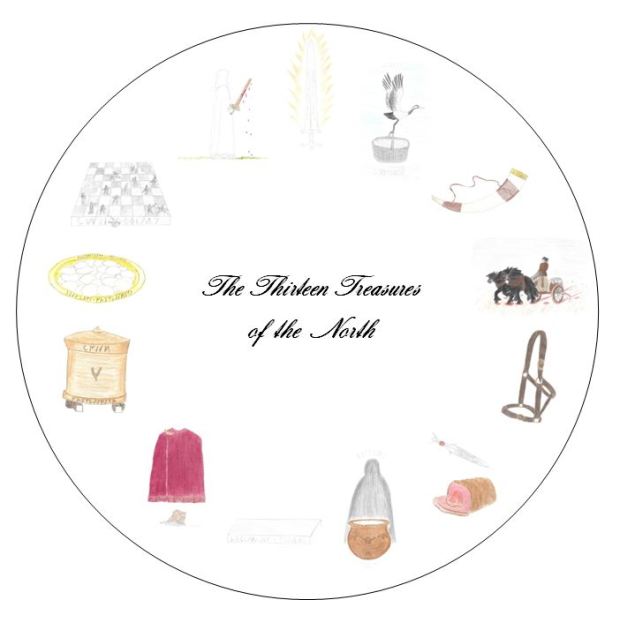
When I set out researching, meditating on, journeying to, and writing about the Thirteen Treasures of the North it was with the aim of assessing their value for the modern world. I aimed to answer the question of whether they are ‘hallows’: holy artefacts associated with the gods and the Otherworld or the rich boy’s toys of a forgotten age.

I certain felt a sense of the aura of the numinous about some of the treasures and, unsurprisingly, connected with some better than others. During the process I became aware my reactions to being in their presence were based on my values. I took an instant disliking to the Sword of Rhydderch and the Cloak of Padarn due to their associations with war and the Tyrian purple of the Roman Empire. Yet I was carried away by the Chariot of Morgan, struck by a premonitory shiver by the Chessboard of Gwenddolau, and could happily have joined Rhygenydd drinking from his Vat.

Whilst the only treasure that can authoritatively be connected with a deity is the Cauldron of Dyrnwch, through its parallels with the Cauldron of Pen Annwn, I received hints about the possibilities of their divine origin from my research and experiences and suggestions from readers in the comments. Most of the treasures can tentatively be associated with Brythonic deities:

1. The Sword of Rhydderch – Forged by Gofannon and symbolic of a bond between the kings of Strathclyde and a goddess of the land, most likely Clutha, goddess of the Clyde.
2. The Hamper of Gwyddno – Woven by a goddess-in-crane-form on the Island of the Dancing Cranes. I suspect this might be Ceridwen, who wove the wicker basket in which Taliesin was found in Gwyddno’s fish weir. The basket and hamper could be the same treasure.
3. The Horn of Brân – This may have been taken from an otherworldly bull or ox like the Brindled Ox and may be connected with the bull-god who is known in Gaul as Tarvus Trigaranus, ‘The Bull With Three Cranes’. His image also appears in Romano-British sculptures.
4. The Chariot of Morgan – Forged by Gofannon (Potia’s suggestion) possibly with Amaethon’s help.
5. The Halter of Clydno – My vision of the halter summoning horses from the Plains of Annwn suggests it might be connected with Rhiannon. Alternatively the appearance of halters in Kelpie legends might be suggestive of associations with water-horses such as Du Y Moroedd.
6. The Knife of Llawfrodedd – ???
7. The Cauldron of Dyrnwch – Pen Annwn (Gwyn/Arawn/Ogyrven). Brân the Blessed is another keeper and ultimately it is the womb of Ceridwen.
8. The Whetstone of Tudwal – This was possibly created at the same time as the Sword of Rhydderch (both belong together in Strathclyde) but I’m not sure who by.
9. The Cloak of Padarn – ???
10, 11. The Vat and Dish of Rhygenydd – These may have belonged to Rosmerta who is depicted with a vat and straining spoon and holding a dish (suggested by Greg).
12. The Chessboard of Gwenddolau – A gift from Lugus.
13. The Mantle of Arthur – ???

Unfortunately we do not know how the Thirteen Treasures came to belong to the Men of the North. The development of the tradition, which might once have been fluid, with the stories changing as the treasures passed through the hands of various owners, ended in the seventh century with the fall of the North.

Thus it seems fitting that a story exists wherein Myrddin managed to procure the Thirteen Treasures and took them to a glass house on Bardsea Island which is often described as a museum. This shows they were removed from use in the post-Roman period when the North fell and became historical objects frozen in time. It also symbolises their removal from the living storytelling tradition to one that was repeated by rote then written down in the 15th century.

Will the Thirteen Treasures of the North remain behind the glass windows of Myrddin’s museum or can they be reclaimed as hallows with the stories of their divine origin shining with relevance for the 21st century? Only time will tell…

The Thirteen Treasures of the North

10, 11. The Vat and Dish of Rhygenydd

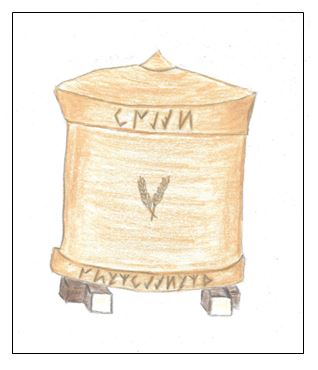
The Vat and Dish of Rhygenydd the Cleric: whatever food might be wished for in them, it would be found.’
Thirteen Treasures of the Island of Britain

It’s a secret knowledge
passed down by generations:
the perfection of malt, mash, wort,
the duration of fermentation,
the best flavouring herbs.

Rhygenydd kept the doors
of his brewery shut – the people
of the North imagined him winnowing,
threshing, malting, sparging, boiling,
praying as he added yeast

and closed the lid of the vat.
They wondered if he knelt palms
pressed together in prayer to God
or petitioned pagan grain gods,
for the Vat of Rhygenydd

brewed Britain’s finest food.
Little did they know with one wish
the cleric could summon any ale:
pale, light, malty, dark, bitter
with bog myrtle or sweetened

with heather or meadowsweet,
that behind closed doors he liked
to sample each tipple and could
be found snoring contentedly,
an empty tankard in his hand.

To which monastery did he pass on
his secret and who owns the vat now?
I’m doing a round of the breweries,
comparing pales, IPAs, stouts,
amassing my tasting notes…

The Vat of Rhygenydd

~

If I was a cleric
with a magical dish
would I take it round
the cities of the North:
Liverpool, Manchester,
York, Carlisle, Newcastle,
Glasgow, Edinburgh,
in each square wish up
bread, fruit, stew, soup,
feed all the homeless
or keep it locked up
in a gold-adorned box
opened only on Sundays
and offer one thin wafer
to melt on each tongue?

The Dish of Rhygenydd

~

Rhygenydd Ysgolhaig ‘the Cleric’ does not appear by that name in any other sources. Rachel Bromwich notes the resemblance of the name to Renchidus episocpus who with Elbobdus episcoporum sanctissmus (Saint Elfoddw) gave Nennius the information about the baptism of Edwin of Deira by Rhun ap Urien, which appears in The History of the Britons.

 Nennius notes Edwin seized the kingdom of Elmet from Ceretic (son of Gwallog) and a year later received baptism by Rhun along with twelve thousand of his subjects within forty days. This took place in York in 627. By this time Rheged had been integrated into Northumbria. It seems Rhun maintained a position of power as a bishop. As Rendichus gives such importance to Rhun baptising Edwin it is possible he was connected with former Rheged and supported the taking of Elmet from Ceretic, whose father, Gwallog had turned against Urien and his sons.

Vat is translated from gren, ‘big vat or vessel, tub, pail, pitcher’. I found this somewhat confusing in relation to its property of generating ‘food’ until I realised that, well into the medieval period, ale was seen as a food-like source of nourishment and the vat was likely used for brewing.

People have been brewing in Britain since grain has been cultivated. In Skara Brae on Orkney,  Neolithic buildings were found with a malting floor, kiln flue, pots for mashing, and huge Grooved Ware pots with stone lids for fermentation that contained 30 gallons. ‘Vats’ of this nature have been found near a number of Neolithic henges and stone circles demonstrating the longevity of our tradition of drinking at seasonal rituals.

Although wine was imported into Britain in the Roman period, it was mainly drunk by the ruling classes. Soldiers and non-Romans, particularly the Britons, drank ale. Wine was consumed less in the North because of the difficulties transporting it. One of the tablets from Vindolanda is inscribed with a request to ‘order beer’ for the soldiers and our earliest reference to a brewer: Atrecus cervesarious, is from the Roman town.

When the Roman Empire collapsed it was the monasteries who retained the knowledge of brewing and wine-making. This fits perfectly with Rhygenydd the Cleric owning a magical vat.

It’s difficult to pinpoint when people began eating from wooden plates or dishes because wood rots. One of the earliest examples in Britain comes from the Bronze Age settlement at Must Farm where ‘a number of wooden platters… carved from a single piece of wood’ were preserved due to a fire.

Although people began hand-making pots from clay by the open fire method during the Neolithic period we do not find any earthenware plates. Wheel-made Samian tableware along with silver and pewter dishes were imported by the Romans. One of the best known dishes is the Great Dish, which was made of silver, weighed 8 kilograms, and was decorated with the face of Neptune and other Roman deities including Bacchus, Pan, Silenus, maenads, and nymphs.

Was Rhygenydd’s dish of similar make and proportions, perhaps minus the pagan deities, or was it humbler? Within the Christian tradition bread is served on a ‘paten’, a small plate, usually made of silver or gold’ as part of the mystery of the Eucharist alongside wine.

 ~

SOURCES

Kenneth Jackson, ‘On the Northern British Section in Nennius,’ Celt and Saxon: Studies in the Early British Border, (Cambridge University Press, 1964)
Michelle of Heavenfield, ‘PW Rhun ap Urien of Rheged, Heavenfield
Merryn Dineley and Graham Dineley, ‘From Grain to Ale: Skara Bra, a Case Study’, Neolithic Orkney in its European Context, (McDonald Institute for Archaeological Research, 2000)
Robin Wood, ‘History of the Wooden Plate’
Rupert Millar, ‘Send beer! The Romans in North Britain’, The Drinks Business
Alcohol in the Middle Ages, Dark Ages, or Medieval Period’, Alcohol Problems and Solutions
Dig Diary 25: Wooden Objects’, Must Farm
Gren’, Geiriadur Prifysgol Cymru
Paten’, Wikipedia
Mildenhall Treasure’, Wikipedia

9. The Coat of Padarn

The coat of Padarn Red-Coat: if a well-born man put it on, it would be the right size for him; if a churl, it would not go upon him.’
Thirteen Treasures of the Island of Britain

I don’t want to look at it,
let alone touch it,
try it on.

Padarn’s ‘red coat’
is Tyrian purple:

colour of the Roman Empire;
its emperors, consuls, priests.

If it touched my shoulders
one of us would
shrivel

like bolindus brandaris
boiled in a vat.

At Tyre are mountains
of snail shells –

it took twelve thousand
just to dye the trim.

I’m spitting mucus.

I’d rather go naked
than wear that thing!

~

The Coat of Padarn - drawing - border

~

Padarn (Paternus) Beisrudd ‘Red Coat’ was born around 300 and was the son of Tegid (Tacitus). He was the ruler of Manaw Gododdin, a kingdom that may have centred on present-day Clachmannan ‘stone of Mannan/Manaw’ and perhaps extended to include Din Eidyn. His son, Edern (Aeternus), was the father of Cunedda Wledig, founder of Gwynedd.

The Latin names in Padarn’s pedigree suggest his rulership was subject to Roman authority. John Rhys argues Padarn’s ‘red coat’ was a purple robe worn by Roman officials. This fits with the fact the Tyrian purple symbolic of power in the Roman Empire ranged from red to purple to dried blood.

The dye was made from the mucus of a snail called bolinus brandaris, which was extracted by boiling the creatures in a vat for several days. To make 1.4g – enough to provide pigment for the hem of one robe – took twelve thousand snails. Mountains of their shells have been found in Tyre.

Padarn’s fame and his red coat seem to be bound up with him being held in favour by Rome. The descent of the rulers of Gwynedd from the northern lineage of Padarn is held important in Wales to this day. This is probably the source of the lines about his coat only fitting well born men.

In other lists of the Thirteen Treasures it is stated the coat will fit anyone whether they are well born or a churl or large or small or, obversely, that it will only fit Padarn. An additional property is that it will prevent its wearer from coming to harm. These might stem from older lore about magical garments originating from Annwn.

Curiously, in The Life of St Padarn, Padarn, who lived during the 6th century, is named as the owner of a tunic that Arthur longs for. Padarn refuses to give it to Arthur because it is ‘not fitting for the habit of a malign person, but for the habit of the clerical office’. Arthur storms away and returns levelling the ground with his feet. Padarn asks the earth to swallow Arthur, who he is buried to his chin until he acknowledges his guilt and begs forgiveness. This strange tale perhaps originates from the earlier Padarn’s red coat.

~

SOURCES

Colin Schultz, ‘In Ancient Rome, Purple Dye Was Made From Snails’, Smithsonian
Mark Bradley, ‘The Colour Purple in Ancient Rome’, Issuu
Peter Bartrum, A Welsh Classical Dictionary: People in History and Legend up to about A.D. 1000, (National Library of Wales, 1993)
Rachel Bromwich (ed), The Triads of the Island of Britain, (University of Wales Press, 2014)
Padarn’, Wikipedia
Tyrian Purple’, Wikipedia

8. The Whetstone of Tudwal

The whetstone of Tudwal Tudglyd: if a brave man sharpened his sword on it, if he (then) drew blood from a man, he would die. If a cowardly man (sharpened his sword on it), he (his opponent) would be no worse.’
The Thirteen Treasures of the Island of Britain

This is not
a Naniwa 5000
Shapton Glass 8000,
or DMT Diamond Hone.

Cut, sawed, planed, smoothed,
in a factory unknown
to its owner

it is not sandstone, siltstone,
gritstone, quartzite or schist.
Nobody has graded the grit –
the sharpness of the weapon
is dependent on the courage
of its wielder.

If I could sharpen my tongue
on this magical bar,

keening across its smoothness
like a sword,

would my words draw blood
from the villains everyone hates:
the bankers, the frackers, the president
even old ladies long to assassinate?

Would they fall down dead?

Or would my cowardice be proved
by the dullness of my blade
ringing in deaf ears?

~

The Whetstone of Tudwal

~

Tudwal Tudglyd, ‘defender of the people’* was a ruler of Alt Clut. His estimated date of birth is 510. His father is Clynog ap Dynfwal and he is part of the Macsen Wledig lineage. Rhydderch Hael and Morgan Mwynfawr (owners of the Sword and Chariot) are his sons. It seems possible the whetstone was passed on by Tudwal to Rhydderch to keep Dyrnwyn, the Sword, sharp. According to an eighth century poem and The Life of St Ninian Tudwal was blinded by Ninian for his rejection of Christianity then healed by the saint, presumably when he agreed to convert. Nothing else is known about him.

The need for whetstones originated with the invention of metal weapons in the Bronze Age. They were made from sandstone or gritstone. After the stone had been quarried, the slabs were sawed, cut into bars, planed, and smoothed by metal tools. Whetstones held an important place in post-Roman society: without a whetstone a warlord and his warriors could not sharpen their swords and maintain their power. A good whetstone was highly treasured for its magical capacity to sharpen a blade and passed down through generations with its stories.

The skills of a talented furbisher were also valued. This is shown in Culhwch and Olwen. Cai is allowed into the castle of Wrnach/Dyrnwch the Giant (owner of the Cauldron) because he possesses the skill of furbishing swords. Taking a ‘striped whetstone’ he asks Wrnach whether he would prefer his sword ‘white-bladed or dark blue-bladed’. The colour of a sword determines its value**. Cai’s ability to produce either result suggests that, like Tudwal’s whetstone, it is magical. It may even be the same whetstone. Wrnach allows Cai to choose how he furbishes the sword. We might assume that, like other sharp weapons in the tale, it can draw blood from the wind once Cai is done. Cai uses Wrnach’s newly sharpened sword to behead him and claims it for Culhwch in fulfilment of one of the impossible tasks.

*Rachel Bromwich explains her translation: ‘With tud cf. Ir. túath ‘tribe, people’, and the corresponding personal name Tuathal; Tutklyd ‘defender of the people’. Gwâl = ‘leader, ruler; so Tudwal ‘leader of the people’.
**In the law texts it states that a dark blue-bladed sword is worth sixteen pence and a white-bladed sword twenty-four pence. A blue blade is produced by tempering and a white blade by polishing and burnishing.

~

SOURCES

Aurélie Thiébaux, Marc Feller, Bruno Duchêne, Eric Goemaere, ‘Roman whetstone production in northern Gaul’
Peter Bartrum, A Welsh Classical Dictionary: People in History and Legend up to about A.D. 1000, (National Library of Wales, 1993)
Peter Nowlan, ‘The Best Sharpening Stones’
P.F. Whitehead, ‘A pictorial field guide to whetstones and related artefacts in Worcestershire during the past 4000 years’
Rachel Bromwich (ed), The Triads of the Island of Britain, (University of Wales Press, 2014)
Sioned Davies (transl.), The Mabinogion, (Oxford University Press, 2007)

7. The Cauldron of Dyrnwch

The Cauldron of Dyrnwch the Giant: if meat for a coward were put in it to boil, it would never boil; but if meat for a brave man were put in, it would boil quickly (and thus the brave could be distinguished from the cowardly).’
The Thirteen Treasures of the Island of Britain

A warrior-bard rides his motorcycle across the north,
his words like his weapons bold and defiant,
seeking to prove his worth
at the Cauldron of Dyrnwch the Giant.

Will he lose his defiance with his stuttering rifle,
like a broken mike stammer and stall?
If meat for a coward were put in
it would never boil.

Or will he proclaim his exploits on a megaphone
whilst miming each gun-shot wittily?
If meat for a brave man were put in
it would boil quickly.

Either way in the depths of the cauldron
his youthful flesh will be devoured most thoroughly
(and thus the brave could be distinguished
from the cowardly).

~

The Cauldron of Dyrnwch

~

Dyrnwch the Giant is a legendary figure associated with the Old North. His epithet gawr ‘giant’ poses the question of whether he was a large human or belonged to a mythic race. References to giants such as Brân the Blessed shows they held an important position in Brythonic mythology. More confusingly, human chieftains such as Maelor Gawr, who was killed in a raid on his fortress at Pen Dinas by Gwerthmwl Wledig, were given the epithet ‘giant’.

Dyrnwch appears by the name Diwrnach Wyddel ‘the Irishman’ in Culhwch and Olwen. Here the getting of his cauldron to boil food for his wedding guests is one of the impossible tasks Culhwch must fulfil to win the hand of Olwen, daughter of Ysbaddaden Bencawr, ‘Chief Giant’.

Diwrnach is the steward of Odgar King of Ireland. Arthur fulfils the task for Culhwch. He sails to Ireland on his ship, Prydwen, with his men. Diwrnarch invites them into his house to feast. When Arthur asks Diwrnach for the cauldron he refuses to hand it over. Llenlleog Wyddel, one of Diwrnach’s men, betrays him by grabbing Arthur’s sword, Caledfwlch, and killing Diwrnach and all his retinue. Arthur and his men flee with the cauldron filled with Irish treasure.

In Brythonic mythology Ireland is sometimes a synonym for Annwn, the Otherworld, because it is likewise across the sea. If this is the case, ‘Odgar’ is a name for the ruler of Annwn and Diwrnach is his steward. This reading is backed up by the fact that in ‘The Spoils of Annwn’ the Head of Annwn owns a cauldron just likes Diwrnach’s with a pearly rim that will not boil a coward’s food, which is again seized by Arthur.

Dyrnwch also appears by the name Wrnach in Culhwch and Olwen. Culhwch is told he must get Wrnach’s sword, which is the only weapon that can kill him. In this story he is most definitely a giant for he owns ‘the largest fort in the world’ and from it comes a ‘a black-haired man, bigger than three men of this world’. Cai fulfils the task for Culhwch by posing as a furbisher of swords and killing Wrnach with his own perfectly honed blade.

‘Arthur and the Porter’ mentions Arthur fought with a hag in Awrnach’s hall. This is another variant on the spelling of Dyrnwch and perhaps associates Dyrnwch with Orddu, ‘Very Black’, a ‘hag’ who dwelled in Pennant Gofid, ‘in the uplands of Hell’. Arthur went to the North to kill her. The boundaries between the North, Ireland, and Annwn blur. All are ‘not here’.

From this proliferation of stories we can conjecture that Dyrnwch was an important figure who guarded the cauldron of the Head of Annwn and died attempting to defend it in a liminal place.

From the Bronze Age, cauldrons literally held a central role in Brythonic culture at the centre of the feast. They were essential for cooking meat, which would have been seen as a magical process. The cauldron’s property of distinguishing the brave from the cowardly seems related to ‘the champion’s portion’ in which the bravest warrior was given first choice and the finest meat.

On a deeper level, in Welsh mythology, the cauldron is associated with death and rebirth. Brân the Blessed was gifted a cauldron which had the power to bring dead warriors back to life. Taliesin was reborn from the crochan ‘cauldron’ or ‘womb’ of Ceridwen from which the Awen* originates.

It seems likely the magical property of Dyrnwch’s cauldron and the champion’s portion had a deeper origin in an initiatory function wherein only a brave person could be initiated into the mysteries of death and rebirth in the depths of Annwn and thus receive his or her Awen.

*Divine inspiration. In some medieval Welsh poems it is synonymous with one’s destiny.

~

SOURCES

Kristoffer Hughes, From the Cauldron Born, (Llewellyn, 2013)
Marged Haycock, Legendary Poems from the Book of Taliesin, (CMCS, 2007)
Patrick Ford, Mabinogi and Other Welsh Tales, (University of California Press, 2008)
Peter Bartrum, A Welsh Classical Dictionary: People in History and Legend up to about A.D. 1000, (National Library of Wales, 1993)
Rachel Bromwich (ed), The Triads of the Island of Britain, (University of Wales Press, 2014)
Sioned Davies (transl.), The Mabinogion, (Oxford University Press, 2007)
William Skene (transl.), ‘Arthur and the Porter’, The Black Book of Carmarthen, Mary Jones Celtic Literature Collective