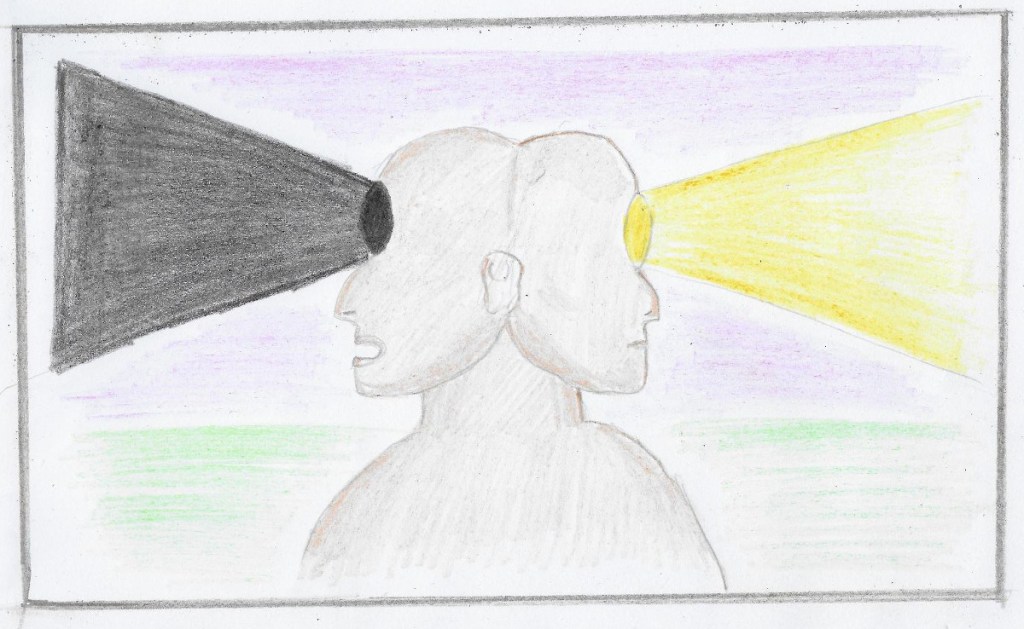
The Heart of Annwn

Over the past few years the Heart of Annwn has become increasingly important in the mythos Gwyn has gifted me and in my devotional practices. 

For me, the Heart of Annwn is Gwyn’s heart, inherited from His mother, Anrhuna, Mother of Annwn, and also the ever-beating heart of Annwn itself. 

I believe that, like Hades and Hades, Hel and Hel, are both Deities and Otherworlds, Gwyn, who is associated with Gwynfyd is one with His land as well.

The Heart of Annwn literally became the heart of my practice two years ago when I began playing its beat and chanting to align myself with Gwyn’s heartbeat. This led to the formulation of the Rule of the Heart within the Monastery of Annwn – following our hearts in alignment with the Heart of Annwn.

In this post I will be sharing two of the core stories of the Heart of Annwn.

*

The Heart of the Dragon Mother

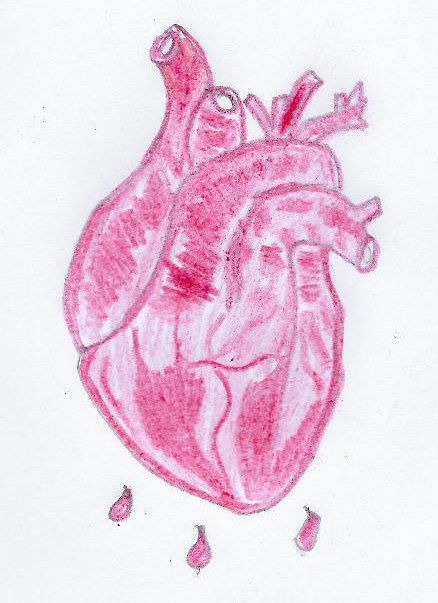
Gwyn has shown me that the Heart of Annwn once beat in the chest of His mother, Anrhuna, the Mother of Annwn, when She was a nine-headed dragon. When She was slain Vindos / Gwyn ate Her heart. The Heart of Annwn became His and this gave Him sovereignty over Annwn as King.

“Now,” the ghost of Anrhuna turned to her corpse, “there is a rite amongst the dragons of Annwn – as you are the only one of my children left here you must eat my heart.”

The boy swallowed nervously as with a single bite of her ghost jaws she tore it from her chest and offered it to him, big and bloody, large and slippery, uncannily still beating. “My heart is the Heart of Annwn. If you succeed in eating it all, its power will be yours and you will be king.”

“But it is so much bigger than I and I have little appetite.”

“Little bite by little bite and you will be king.”

The boy very much wanted to be king. He needed his kingship within him. He bared his teeth and bit in, took one bite, then another. As he ate, he grew. He became a mighty wolf, a raging bull, a bull-horned man, a horned serpent, finally, a black dragon. As he tore and devoured the last pieces of the heart he spread his wings to fill the darkest reaches of the Deep. He roared, “I am King of Annwn! I will rule the dead! I will build my kingdom from the bones of dead dragons and the light of dead stars! I will bring joy to every serpent who has known sorrow and I will take vengeance on my enemies!”

Weary and full he slept and when he awoke he was just a boy with a large heart that felt too big for his body.

*

The Hidden Heart

In another story, in which Arthur raids Annwn, killing the King of Annwn and stealing His cauldron, Gwyn instructs His beloved, Creiddylad, to cut His heart from His chest and help hide it so that Arthur cannot take the Heart of Annwn.

Gwyn gave Creiddylad a Knife. “Cut my heart from my chest. Give it to my winged messengers and tell them to hide it in a place that even I could never find It.”

“Do what?” 

“I will not die.” 

“Worse – you will be heartless.”

One of my practices around this story was receiving the honour of finding Gwyn’s heart and returning it to Him and helping Him to return to life.

‘I knew it was a death unlike any other
but still I heard the beating 
of your heart…

Your hounds dug wildly beneath trees,
bloodying their frantic paws
to find only the hearts of 
dead badgers,

sniffed suspiciously at the edge of pools
where I searched through reeds
as if looking for a baby
in the bulrushes,
plunged in 
and emerged draped in duck-weed.

We snatched a still-beating heart 
from a bear’s claws (not yours).

We searched every cave for a heart-shaped box.
When we found one 
and the keys to the lock
inside was only a locket and a love letter in an illegible hand.

When we had searched everywhere in Annwn
we rode across Thisworld following
your fading heart beat.

We found your heart in the unlikeliest of places.

Clutching it tightly, fearing every time it skipped a beat,
we galloped back to Annwn with our hearts
beating just as wildly.

Through the fortresses within fortresses…

Into your empty chest we placed your still-beating heart.’

*

Gwyn has revealed a lot about the Heart of Annwn and I believe there is more to come. Recently I had a vision of Gwyn as a black dragon with His heart visible in His chest bearing an important message. He appears in this form when He brings tidings for the future. What will be the future of the Heart of Annwn? What stories from the past remain to be disclosed? I share what I know with gratitude and await further revealings.

The Dragon’s Gate

In the medieval Welsh story Lludd ac Llefelys the island of Britain is beset by three plagues. The second is a scream which is ‘heard every May eve… It pierced people’s hearts and terrified them so much that men lost their colour and strength, and women miscarried, and young men and maidens lost their senses, and all animals and the earth and the waters were left barren.’ (1)

Lludd finds out from Llefelys the plague ‘is a dragon, and a dragon of another foreign people is fighting it and trying to overthrow it, and because of that… your dragon gives out a horrible scream.’ (2) It is likely the ‘foreign people’ are ‘the Coraniaid’, the Romans, who are the cause of the first plague.

Following the advice of Llefelys, Lludd digs a pit in the centre of Britain and fills it with mead. After the dragons have stopped fighting, firstly as dragons, then in the shapes of ‘monstrous animals’ and finally ‘two little pigs’, they fall into the vat, drink the mead and sleep. Lludd wraps them in ‘a sheet of brocaded silk’, puts them in a stone chest, and buries them at Dinas Emrys. (3)

The dragons battle again during the invasions of the Anglo-Saxons. At this time Vortigern attempts to build a tower at Dinas Emrys and it will not stand. Merlin tells Vortigern this is because there is a pond beneath the foundations and when the pond is drained two dragons will be found in hollow stones. 

Whilst Vortigern is sitting on the bank, the two dragons, one red, one white, begin a ‘terrible fight’ casting ‘forth fire with their breath’. The white wins. Merlin says this predicts the defeat of ‘the British nation’ by ‘the Saxons’. (4)

The scream of the red dragon and the battle between the red and white dragons takes place at times of war and potentially during other periods of upheavel. I believe it is connected with the diasbad uwch Annwfn ‘scream over Annwn’ or ‘cry over the abyss’ which is found in several of the Welsh law texts including The Laws of Hywel Dda. It is uttered by a claimant who is threatened by the loss of their claim to ancestral land. (5) It perhaps has its origins as an invocation of the spirits of Annwn, those who were held back by the King of Annwn, Gwyn ap Nudd, to prevent their destruction of the world. These spirits may well include the dragons who Gwyn’s father, Nudd / Lludd subdued.

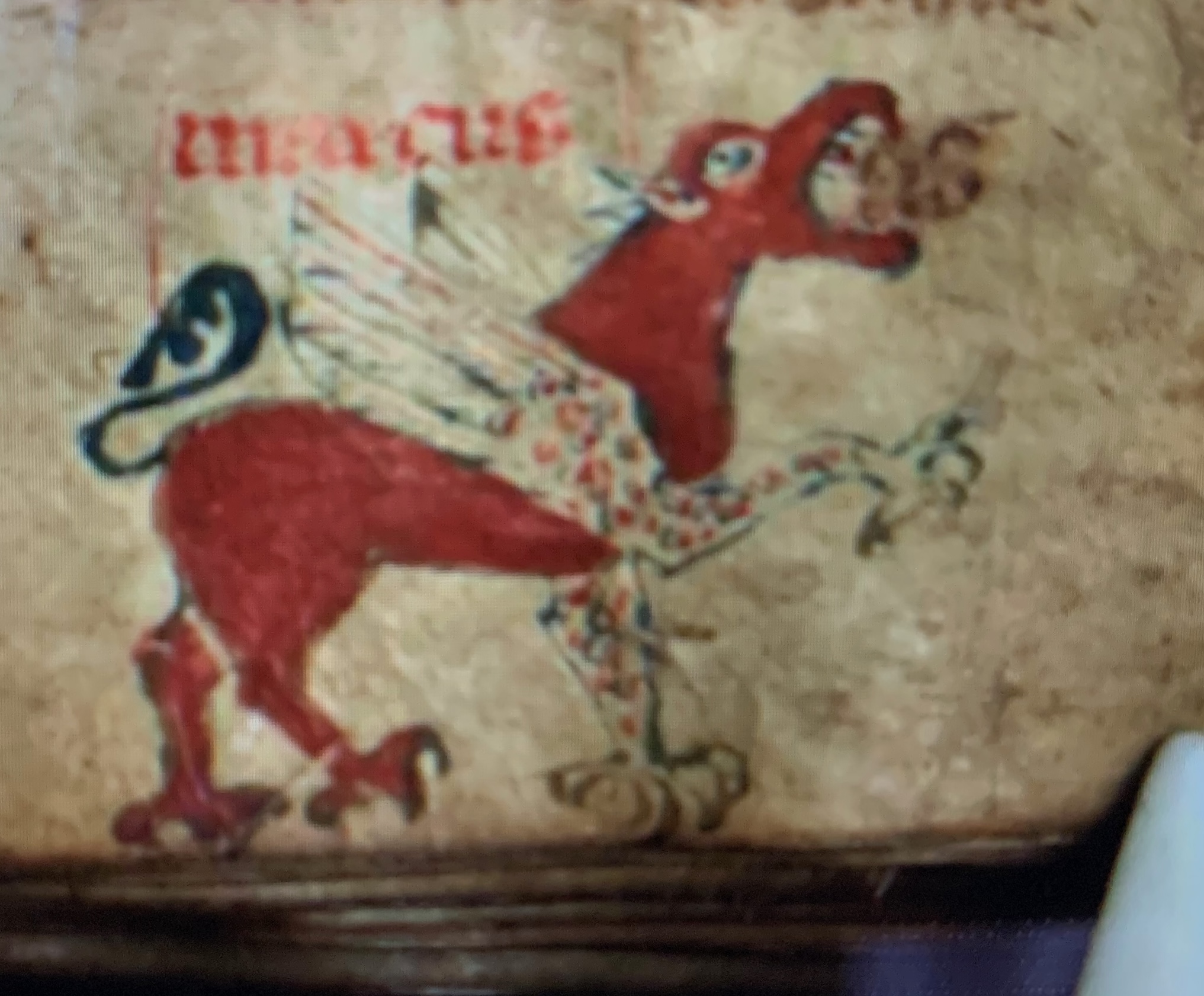
According to the National Library of Wales The Laws of Hywel Dda features an illustration of a two-headed dragon. (6) I couldn’t find this image but did find two of the red dragon, from f.21.r and f.51.r, which are in the public domain. 

*

I’m returning to this lore after a journey circle with the Way of the Buzzard wherein we discussed the connection between dragons and voice and journeyed to the underworld to ask a dragon for guidance around personal power.

I met a black dragon who instructed me to ‘put on my dragon skin’. I shapeshifted into a dragon and we flew over the volcanoes with the smoke cleansing my skin. I was then taken to an iron grate with forms behind it. I was told I ‘must learn to release the prisoners’. The black dragon’s final message was: ‘Those who are denied are needed.’ I’m not sure if they are parts of myself who I have shut away, people, or spirits, or perhaps might be all.

Other participants reported visions of a dragon’s golden eye and dragon’s heart. This really struck me as it fit with the black dragon who I met, who I suspect to be Gwyn, the King of Annwn, in dragon form, His heart the Heart of Annwn. Several years ago my aunt sent me a birthday card with a golden dragon eye on it and it watches over me here in my monastic cell. 

My vision of a black dragon fits with the legends of the red and white dragons because white, red and black are the colours of the Otherworld.

I later received the gnosis that the iron grate is ‘the Dragon’s Gate’. I believe behind it lie the spirits of Annwn who Gwyn keeps shut up until the end of the world because of their furious and nature which can harm or possess us.

That these spirits, ‘who are denied are needed’, feels like a big revelation although not an entirely unexpected one. The story of Lludd and Llefelys and the scream over Annwn teach us that occassionally these spirits need to be released.

I’m going to be talking with Gwyn further about safe ways of releasing these spirits with His guidance and how this might relate to my personal power.

(1) Davies, S. (transl.), The Mabinogion, (Oxford University Press, 2007), p112
(2) Ibid. p113
(3) Ibid. p113 – 4
(4) Thompson, A. (transl.) Monmouth, G. History of the Kings of Britain, (In Parentheses Publications, 1999),p110 – 133
(5) https://awenydd.weebly.com/the-scream-over-annwfn.html
(6) https://www.library.wales/discover-learn/digital-exhibitions/manuscripts/the-middle-ages/laws-of-hywel-dda

    Why I failed to write a Brythonic creation myth

    In my attempted novel, In the Deep, I tried to imagine a story for the origins of Vindos / Gwyn, His kingdom in Annwn, and for the creation of the world. This was based on a combination of my readings of Brythonic and other Celtic and Indo-European and world myths and my personal gnosis. 

    I worked for a year and a half on a story that had meaning for me and I felt Gwyn wanted me to write as the awen kept on flowing. Yet it didn’t speak to many humans and, in retrospect, although coherent, contained a lot of flaws.

    Looking back, I feel it was a process I needed to go through. I genuinely believe I saw faces of Gwyn, such as the Boy in the Serpent Skins, that were meaningful for me and needed to journey with Him and write those tales.

    Yet there were elements of the story I could never quite make work. My personal gnosis led me to perceive parallels between Tiamat in the Enuma Elish and a ‘found’ Goddess I know as Anrhuna who takes the form of a nine-headed dragon and is Gwyn’s mother and the Mother of Annwn.

    In the Deep was written as an inversion of Enuma Elish ‘When on High’ reimagining what might have been a wider Indo-European origin myth centring on the slaying of a dragon from the side of the Deep rather than the victors.

    It opens with a battle between the Dragons of the Deep (Annwn) and the Children of Don wherein Lugus / Lleu slays Anrhuna, the Dragon Mother. By cutting off Her nine heads He releases the dragon children of the nine elements*. He then cuts open Her womb and tears out Kraideti / Creiddylad (the Girl who will Bring Life) and Vindos / Gwyn (the Boy who will Bring Death). Lugus takes Kraideti to the stars and flings Vindos into the Abyss. Uidianos / Gwydion steals the magical jewels from Anrhuna’s foreheads and with them commands the dragon children to create the world. 

    Although I’ve been able to picture the dragon slaying scene quite vividly I’ve never quite managed to see or write the creation of the world. I’ve ‘seen’ Uidianos and a circle of enchanters with their wands conjuring with the elements to form a world but can’t seem to connect it with the dragons.

    The role of Gwydion as demiurge I derived from His creation of Taliesin in ‘The Battle of the Trees’ from ‘nine forms of consistency’ – ‘fruit’, ‘fruits’, ‘God’s fruit in the beginning’, ‘primroses’, ‘flowers’, ‘the blossoms of trees and shrubs’, ‘earth’ / ‘sod’, ‘nettle blossoms’, and ‘the ninth wave’s water’. 

    In ‘The Song of the Great World’ Taliesin is created by God from ‘seven consistencies’ – ‘fire and earth, / and water and air, / and mist and flowers, / and the fruitful wind’. Like the the microcosmic Adam** his creation may be seen to mirror the creation of the world by God in this poem. It seems possible Gwydion was earlier seen as creating Taliesin and the world.

    In ‘A British Myth of Origins’ John Carey suggests the Fourth Branch of The Mabinogion might contain an origin myth with Math’s kingdom whilst He has His feet in the lap of a virgin, Goewin, representing a timeless paradisal state. Gwydion’s scheming with Gilfaethwy to bring about her rape represent a fall. Gwydion and Gilfaethwy’s transformation by Math into a deer and a pig and a wolf, and their bearing of offspring, may explain the origin of animals.

    Carey also suggests the story of Taliesin shapeshifting into various animals after stealing the awen from the cauldron of Ceridwen and the animal transformations of figures such as Mongan in the Irish myths function ‘as a device to connect the present with its origins, whether the beginnings of history or the transtemporal eternity of the Otherworld.’

    It’s my personal intuition that Ceridwen may be a creator Goddess. That Her crochan ‘cauldron’ or ‘womb’ could be the vessel from which the universe was born. This is another strand that I attempted to weave into my book. 

    If we look back beyond medieval Welsh mythology to the Roman sources we find no evidence whatsoever of a creation myth. Instead Strabo reports that the Gallic peoples (who according to Caesar derived their beliefs from the Britons) believe ‘men’s souls and the universe are imperishable’. Several authors speak of the belief that the soul is immortal. According to Caesar it ‘does not die but crosses over after death from one place to another’ showing existence in an ‘otherworld’ (potentially Annwn). Diodorus Siclus claims the Gauls ‘subscribe to the doctrine of Pythagoras that the human spirit is immortal and will enter a new body after a fixed number of years’. The key doctrine of Pythagoras is metempychosis and we find this throughout the Taliesin material wherein he speaks of his transformations. 

    It seems possible we don’t have a Brythonic creation myth as the universe was viewed as ‘imperishable’ and the eternal soul as shifting through different shapes, potentially crossing from this world to Annwn and back again.

    One of the things that has stood out to me whilst returning to the Taliesin material is that rather than telling of creation as given he instead poses riddles.  ‘How is the sun put into position? / Where does the roofing of the Earth come from?’ ‘Where do the day and the night come from?’ He mocks Christian scribes for not knowing ‘how the darkness and light divide, / (nor) the wind’s course’.

    Taliesin seems to be claiming to know yet he leaves the answers a mystery. Could it be that our Brythonic ancestors treated these issues as mysteries rather than having clear cut myths and stories and explanations? 

    If so could my failure to create a myth that works be based on the fact there have never been any direct answers and these things should be left mysterious?

    If so it seems this book idea has played itself out for what it is but can go no further. I fulfilled my promise to Gwyn to write Him an origin story (something He didn’t ask for but that I did as an act of devotion to Him). It just didn’t turn out to be a novel sellable to humans. Which is ok. 

    Where to go from here I’m not sure. I still want to write, I still need to write, in service to my Gods and to give voice to the awen from Annwn and within. To provide content for my patrons who continue to support me. But it might be that now I’ve become a nun of Annwn, Sister Patience, what I write will change.

    It seems possible I will be taking a more meditative approach with a focus on mystery, which feels fitting for a nun dedicated to a God of the Deep.

    *Stone, earth, water, ice, mist, wind, air, fire, magma.
    **In her notes to ‘The Battle of the Trees’ Marged Haycock adds some references to medieval Christian texts where Adam is said to be created from ‘eight consistencies’ – ‘land, sea, earth, clouds of the firmament, wind, stones, the Holy Spirit and the light of the world’ or ‘earth (flesh), fire (red, hot blood), wind (breath), cloud (instability of mind), grace (understanding and thought) blossoms (variety of his eyes), dew (sweat), salt (tears).’

    Evidence of Monks of Annwn in The Book of Taliesin?

    Inbetween my decision to rewrite In the Deep and beginning I decided to return to some of the source material. I had been avoiding The Book of Taliesin for a long long time because, as a devotee of Gwyn ap Nudd, a King of Annwn, I find his support of Arthur in the raiding of Annwn (1) and of Lleu and Gwydion in battling against Annuvian monsters (2) incredibly emotive.

    Still, I took another look, and didn’t find anything I hadn’t remembered. And Taliesin’s warmongering and bragging had got no less annoying.

    Then, when, I was out running this morning I found my mind wandering to Taliesin mocking ‘pathetic men’ (monks) who do not know when God / the Lord, potentially Pen Annwn ‘Head of the Otherworld (3), was born / created then referring to monks who ‘congregate’ or ‘howl’ (4) like a pack of dogs’ and ‘like wolves’ ‘because of the masters who know’ the answers to certain riddles such as ‘the wind’s course’, ‘how the light and darkness divide’.

    I had always assumed those monks were Christians but as I was running the question came into my mind, ‘What if they were monks of Annwn?’ 

    *

    My first intimation of the possibility of the existence of previous monks and nuns of Annwn occurred during my night long vigil for my lifelong dedication to Gwyn.

    I spent the first six hours alone in my friend’s living room drawing a card from the Wildwood Tarot for each hour. My first card was the Four of Vessels – Boredom. Disappointing. But not unexpected. So I sat and surrendered to the likelihood the first hour was likely to be very boring. But instead of getting bored I got very lonely and found myself lamenting that I had no tradition to follow, no-one else for support in making such deep vows to Gwyn.

    Then I had a vision. I was no longer alone. I was in some kind of underground shrine, chapel, or tomb, with long lines of monks and nuns wearing dark robes carrying candles before and behind me. 

    I had always thought they were monastics from other traditions who walked similar paths and had come to provide me with company but now I’m wondering if they might have been past and future monastic devotees of Annwn.

    *

    This reasoning might seem a bit wild particularly considering there is no evidence for monks or nuns of Annwn in Brythonic literature or lore. 

    However, if we look at those lines from Talieisn, first off we find them in Preiddeu Annwn ‘The Spoils of Annwn’ wherein the bard accompanies Arthur on his devastating raid on Gwyn’s realm from which only seven return. 

    Secondly, the monks are exhibiting extremely strange behaviour for Christians – congregating or howling like dogs or wolves. This would make far more sense if they were devotees of Gwyn who is associated with a red-nosed hound called Dormach (5) and the Cwn Annwn ‘Hounds of the Otherworld’ (6) and whose father, Nudd, is referred to as ‘the superior wolf lord’ (7).

    Thus, it might be argued, Taliesin is taunting monks of Annwn with accusations of not knowing the mysteries of their God – Pen Annwn – when He was born / created, of the source of the wind, the division of light and darkness. These seem bound up with Annw(f)n (from an ‘very’ and dwyfn ‘Deep) as the primordial reality that ‘underlies or underpins our known universe’ (8).

    *

    Even further, another of Taliesin’s taunts, is that they do not know ‘how many saints are in the void, and how many altars’. Again it would seem odd if saints and altars were consigned to ‘the void’ rather than raised to the Christian Heaven. If they were Christians… yet the consignment to the void of Annuvian saints and altars would make a lot more sense. 

    Read into this more deeply and we find the disturbing possibility there existed monastic devotees of Annwn with saint-like qualities who with the altars of their Gods were committed by the likes of Taliesin and Arthur to the void. 

    It is notable here ‘void’ is translated from diuant ‘space, void, annihliation, death’. These monastics have not returned to Annwn, ‘the Deep’, the regenerative deep home of their God but have instead been annihilated. Their names and memories chillingly wiped by Christianity from existence. 

    Could it be their voices I hear from the void at this time the veil is thin?

    (1) In ‘The Spoils of Annwn’, 
    (2) In ‘The Battle of the Trees’.
    (3) Potentially the Christian God but another possibility is Pen Annwn, the Head of the Otherworld, as in the second instance ‘Lord’ is translated from Pen.
    (4) Margeret Haycock’s translation reads ‘congregate’ and Sarah Higley’s ‘howl.’
    (5) In ‘The Conversation of Gwyn ap Nudd and Gwyddno Garanhir’.
    (6) In the story of Iolo ap Huw in John Rhys Celtic Folklore. 
    (7) In ‘The Pleasant Things of Taliesin’. 
    (8) Kristoffer Hughes, ‘The Thirteenth Mount Haemus Lecture: Magical Transformation in the Book of Taliesin and The Spoils of Annwn’.

    The King of Distractions

    He came into my life around 2012 when I started this blog and joined the strange world of the blogosphere. His presence was invisible at first and it took me a few years to perceive his influence. I started this blog to share inspiration and find and connect with like-minded people and I succeeded in those aims. Only I found that during that process ‘something’ had gained power over me. I was not only reading what inspired me and felt important but trying to keep up with every last thing on the blogosphere, on social media, not wanting to miss out or get left behind.

    In 2015 when I was doing my best to fit the mould of being a politically-engaged Pagan there were days when I did nothing but scroll the internet for information to make the right replies on blogs and Facebook and Twitter feeds. 

    Around that time there were some really nasty arguments between right and left-wing polytheists that led to the breakdown of the polytheist movement. It was a horrible thing to see and this, on top of being burnt out from having forced myself into activism, led me to stop blogging and abandon social media.

    I went to Wales. I had some experiences with Gods and giants. I came back. 

    Since then I have been more mindful of my internet use and how it uses me. After a couple of brief flirtations I have abandoned Facebook and Twitter. I follow only blogs that inspire me. I steer clear of arguments. I limit my engagements to old-fashioned forums at the Monastery of Annwn and The Cloister.

    Yet still I’m distracted which I find to be a terrible irony for a nun of Annwn, one who is devoted to the Gods of the Deep, is writing a book called ‘in the Deep.’ When I need a break or when I get stuck I’m tempted to check my emails or look at a blog, then one thing leads to another and I’ve lost half an hour. 

    The problem of attention theft, of stolen focus, and the resulting atrophy of our deep work muscles is something we have been working with at the Way of the Buzzard Mystery School* and has been picked up on by fellow Polytheist Monastic Danica Swanson.**

    Since then reclaiming my attention and retraining my deep work muscles has been a large part of my personal spiritual development as a nun of Annwn. But it hasn’t been easy. I’ve had a lot of resistance to keeping my focus on one thing at a time, whether it is meditation, writing, gardening, running or a gym work out. I’ve had a lot of minor things go wrong recently from personal and family health issues to a stolen bike and a troublesome member at the monastery. I’ve used them as excuses for letting distractions have their way.

    In spite of my best efforts I have been struggling to focus on one thing at a time to the point I have felt that ‘something’ is actively stealing my attention.

    Returning to look at the Way of the Buzzard journey circle in January 2022 ‘Reclaim your Attention’ last night I noticed the intention was to journey on ‘what is getting in the way of your attention?’ I intended to do so this morning but instead woke up with the answer – ‘the King of Distractions.’

    Having dreamt a couple of days ago about our house being burgled and linking this to the man of enormous stature with a huge hamper who stole food and drink from Lludd in Lludd ac Llefelys I realised I had found the culprit. 

    I then had the gnosis that the King of Distractions has been here, not only in my house, but in my very room since I started blogging. He has been sitting beside me, stealing my attention and focus away from the things that really matter, putting them into his huge hamper, filling it full, as my mind grows weak. 

    (‘And nothing amazed Lludd more than that so much could fit into that hamper!’)

    He’s been following me about taking my mind from nature on a walk, bike ride, or run, from what I’m doing with my body at the gym. He’s been next to me when I sleep, waking me up with distractions, robbing me of my dreams. 

    It thus seems meaningful that Lludd/Nudd/Nodens, God of Dreams, defeats this man and that his identity has been revealed to me by sleeping and dreaming.

    In Lludd ac Llefelys the man achieves his theft by sending everyone to sleep. As the King of Distractions he makes himself invisible by putting us into a sleep-like trance in which we are barely aware of what we’re doing as we flick onto our emails or onto the internet and begin scrolling from this to that.

    On Nos Galan Mai Lludd manages to defeat the man by immersing himself in a tub of cold water every time sleep comes upon him. He then confronts him in a violent battle in which sparks fly from their weapons, throws him to the ground, and demands that all his losses are restored and the man becomes his vassal. 

    Whilst immersing myself in a tub of cold water every time I’m distracted isn’t very practical it could serve as a good visualisation aid against the King of Distractions. As could visualising beating him off, sparks flying, forcing him to give back what is in his hamper and putting him in his place. 

    An additional tactic is to put up some defences. Thus I’ve drawn up a schedule in which I’ve restricted my internet usage to checking emails once a day in the late afternoon when my other work is complete and limiting catching up on blogs and reading articles online to Saturdays.

    I’m hoping this will help me reclaim my focus and strengthen my deep work muscles so I can make better progress with ‘In the Deep’ and my spiritual practices.

    *Nicola at the Way of the Buzzard blogs about stolen focus in her post ‘Attention’ HERE.
    ****Danica Swanson proposes ‘Creative Incubation’ as a remedy for stolen focus and the atrophy of deep work muscles HERE.

    New Life

    It’s been a few days now since I left my ecology job behind along with my somewhat misguided dream of finding a suitable career in the environmental sector. 

    Returning to my vocation, to being a good awenydd, ‘person inspired’, after a time during which my path had lost its meaning, invigorated with new life. I’d turned away because I thought I’d lost my inspiration after several years of writing nothing of note without realising even unworthy notes fuel the Cauldron.

    I didn’t realise my research into the British and Irish and wider myths along with my first attempt to bring them together in The Dragon’s Tongue would eventually lead to the trilogy of books which I am near-certain will be right.

    It’s going to be called ‘The Forgotten Gods’ trilogy. The impetus behind it is a long-standing sadness that people in Britain know the names of the Greek, Roman and Norse Gods but nothing of the ancient British Gods and Goddesses. Zeus, Athena, Hermes, Mars, Venus, Pluto, Thor, Odin, Loki are all well known but no-one knows of Nodens, Vindos, Rigantona, Brigantia, Bel, Belisama, Lugus, Ambactonos, or Gobannos.

    The first book, In the Deep, is an attempt to re-imagine an ancient British creation myth based on the stories about a primordial conflict between the deities of Annwn (the Otherworld) and the Children of Don in British and Irish mythology.

    The second book, The Gates of Annwn, tells of how the Roman Invasions and the coming of Christianity led to the ancient British Gods becoming overwritten by new Gods, demonised, and forgotten, of how the people of Britain turned to Christianity, believing their souls went to Heaven or Hell rather than to Annwn.

    The third book, The Black Dragon, which I haven’t written yet and will be the apocalyptic finale will tell of the return of the Gods and provide a vision of the future.

    I’ve never felt more alive, since I finished Gatherer of Souls at least, as I have whilst I’ve been writing these books, becoming the Cauldron and in it walking with my Gods in their stories, with Vindos/Gwyn through His Dreams as He sleeps through the Summer.

    There’s such excitement and magic in writing a story, not knowing where it’s going, being somehow in control and somehow not. Learning when a plot choice is right, when it is not, divining the guidance of the Gods. Being one with Them in the act of co-creating.

    On a more mundane level I’ve had some ideas about how I might reach a wider audience with Their stories and make a little income to support myself whilst I devote my time to writing them by making some videos of excerpts from my books.

    I’m looking into how to use Photo Booth on my Mac and planning on re-opening my Patreon with the aim of sharing video excerpts of readings from my books and poetry read around my local landscape along with general news and views.

    My Green Chapel

    I watch through the window
    of the only house on this street not lit 
    by party lights, the only one where ivy grows,
    the one that seems shrouded by darkness and by sorcery.

    The steady sound of hoofbeats has been coming to the North
    since before the beginning of time, the beginning of myth,
    the court of Arthur, and still he comes, the one we call Gawain.

    He does not expect a woman this time crowned in holly and ivy.

    He cowers away from the blood-red berries of my eyes 
    and averts his gaze from the scars on my arms, 
    imagining some distant rite of passage
    even I can no longer remember.

    I have been sharpening my axe
    for a long, long time, waiting for the day
    my Lord will no longer have the time to play this game.

    I commend his courage, speak of the mathematical percentages
    of the people who would take the Green Knight’s challenge,
    those who would return to meet their fate.

    “You’re the only one,” I laugh aloud.

    His eyes are big as portals to the Otherworld. 

    One day I will step through them and he will follow.

    But not today because the blade of my axe just nicks
    his neck, a small cut, which will leave a scar beside the others.

    I straighten up with a blood-red stare and send him on his way
    because my Lord and I have no more time for games.

    Monsters of the Mere

    In Beowulf, after the protagonist has defeated the monstrous Grendel in the hall of Heorot, he travels beyond the safety of its walls to the mere from which the monsters come to slay Grendel’s mother.

    Beforehand, Hrothgar, King of the Danes, whose hall Beowulf is defending, describes ‘the haunted mere’:

    ‘a frost-stiffened wood waits and keeps watch
    above a mere; the overhanging bank
    is a maze of tree-roots mirrored in its surface.
    At night there, something uncanny happens:
    the water burns. And the mere-bottom
    has never been sounded by the sons of men.’

    When Beowulf and his warriors arrive they find:

    ‘… The water was infested
    with all kinds of reptiles. There were writhing sea-dragons
    and monsters slouching on slopes of the cliff,
    serpents and wild things…’

    These quotes reflect a view of the wild land beyond the hall as uncanny and peopled by monsters. Beowulf is set in sixth century Scandinavia, but was composed in East Anglia during the seventh century and written down in the tenth century. I believe it was popular amongst the Anglo-Saxons due to the similarities between the landscapes and beliefs in Scandinavia and England.

    Grendel is described as a ‘dark death shadow / who lurked and swooped in the long nights / on the misty moors’. The ‘shadow-stalker’ comes ‘In off the moors, down through the mist bands… greedily loping’. His mother is a ‘monstrous hell-bride’, a ‘hell-dam’, a ‘swamp thing from hell’, ‘a tarn-hag in all her terrible strength’, a ‘she-wolf’, and a ‘wolf of the deep’ who lurks in the mere. We find repeated associations between monsters and an untamed landscape viewed as hellish.

    No doubt the descriptions of the Danish landscape and its monsters resonated with the people of East Anglia with its extensive fenlands and lowland moors and bogs and its many meres – Trundle Mere, Whittlesey Mere, Stretham Mere, Soham Mere, Ug Mere, and Ramsey Mere, now sadly drained.

    It’s likely the Anglo-Saxons and the Brythonic people whose culture they replaced here in Lancashire viewed the Region Linnuis, ‘the Lake Region’, where Martin Mere (at twenty miles in diameter once the largest lake in England), Shoricar’s Mere, Renacres Mere, Gettern Mere, and Barton Mere once lay, as similarly haunted, before they were all drained with the bogs and marshes.

    In the fourteenth century Middle English story Sir Gawain and the Green Knight the protagonist battles against an array of monsters as he travels north ‘into the wilderness of the Wirral’ and beyond.

    ‘He had death-struggles with dragons, did battle with wolves,
    Warred with wild trolls that dwelt among the crags,
    Battled with bulls and bears and boars at other times,
    And ogres that panted after him on the high fells.’

    Memories of Grendel-like monsters might be retained in Lancashire’s rich boggart lore. Boggarts are malevolent spirits who haunted the bogs then later the farmhouses when the land was drained. Some merely caused mischief, scaring children with their penny-whistle like voices, breaking pots and pans or curdling milk but others made livestock lame or ill and even killed animals and humans.

    King Arthur’s Pit, on the shore of Martin Mere near Holmeswood Hall, was haunted by ‘boggarts and ghouls’. There are traditions of ‘shadowy night-time figures passing marl-pits near the old mere edge’.

    Roby records the story of a ‘mermaid’ or ‘meer-woman’ abducting a baby from its natural father then leaving the child with a fisherman who gives him to a Captain Harrington to be fostered. This puts me in mind of the monstrous claw that steals a foal and, implicitly, Pryderi in the First Branch of The Mabinogion then leaves the boy in the care of Teyrnon who raises him as a foster-father.

    Coupled with Martin Mere’s associations with the nymph, Vyviane, disappearing into the lake with the infant Lancelot du Lac (who is said to give his name to Lancashire) and with Arthur’s sword we might intuit these stories originate from the presence of a female water deity or monster who stole children.

    During the digging of the sluice to drain Martin Mere ‘human bodies entire and uncorrupted’ were found and its seems possible they were deliberately deposited in the water. From the surrounding area we have evidence of bog burials at North Meols and, further afield, Lindow and Worsley Man. Lindow Man was sacrificed, dying a ‘three fold death’, and others may have been sacrifices to water deities.

    Bog burials took place from the Bronze Age through the Romano-British period in Britain and were common across Germany and Denmark showing shared practices and beliefs surrounding wet places.

    Unfortunately we do not know for certain who these sacrifices were to or how these people perceived their deities. It is clear that by the sixth century, due to the influence of Christianity, both Grendel and his mother and the wild landscape they inhabited had been heavily demonised.

    This is evidenced by the Christianised explanation of the origins of these ‘fatherless creatures’ as springing from the exile of Cain for killing Abel with ‘ogres and elves and evil phantoms / and the giants too’.

    The pagan beliefs of the Danes are referred to and condemned in Beowulf:

    ‘Sometimes at pagan shrines they vowed
    offerings to idols, swore oaths
    that the killer of souls might come to their aid
    and save the people. That was their way,
    their heathenish hope; deep in their hearts
    they remembered hell.’

    Yet these explanations come up against the conflicting belief these ‘huge marauders’ are ‘from some other world’ and that their origin ‘hidden in a past of demons and ghosts’, defies explanation.

    The grendelkin, like the later boggarts, occupy liminal places in the landscape and between the worlds. A wonderful verb, scripan, ‘meaning a sinewy and sinister gliding movement’ is used to describe the way they move and may also apply to the way they shift between the worlds. The dobbie, our northern British waterhorse, a similar kind of being, ‘is described as a big, black, horrible, misshapen thing that “slips about”’ and is ‘more likely to be seen out of the corner of the eye’.

    Here, in Lancashire, the deities of the lake were not slain by a dark age ‘hero’ but met a slower, more ignominious end at the hands of the wealthy landowners who drained the mere. The first was Thomas Fleetwood who secured an Act of Parliament in 1694. He employed 2,000 workers to dig the 1.5 mile channel known as the Sluice to the coast at Crossens. His draining of the mere was completed by 1697.

    Fleetwood died in 1717 and the following is written on his monument in the church in Churchtown:

    ‘He wished his bones to be here laid, because he made into dry and firm land the great Martinesian Marsh, by the water having been conveyed through a fosse to the neighbouring sea – a work, which, as the ancients dared not to attempt, posterity will hardly credit… These labours having been accomplished, he at length, alas! Too soon, laid down and died, on the 22nd April, A.D. 1717, in the 56th year of his age.’

    Fleetwood’s success was short lived. The flow of the water was not strong enough to prevent the Sluice from silting up and the floodgates were breached leading to winter flooding. In 1778 Thomas Eccleston employed Mr. Gilbert (who built the Bridgewater Canal) to redesign and rebuild the drainage system, which again was successful for a while, until the mere was inundated by the Douglas.

    So continued the cycle of rebuilding and flooding until the new pumping station at Crossens was built in 1961 which is capable of 373,000 gallons per minute and is already running to full capacity at peak times.

    This leads me to wonder whether the deities of the mere and its monsters are dead or merely waiting beyond the lumbs and deeps of the mere bottom in places ‘never sounded by the sons of men’.

    Boleros of the Burning Eye

    In the Irish myths we find a giant named Balor whose name derives from the common Celtic *Boleros ‘the Flashing One’. He is best known for the destructive power of his eye, which burns or poisons.

    In ‘The Second Battle of Mag Tuired’ Balor fights on the side of the Formorians ‘underworld giants’, who come from beneath the earth or sea, to fight against the culture gods, the Tuatha Dé Danann.

    Balor has ‘a destructive eye’ which is ‘never opened except on the battlefield’ by four men pulling a ring on the lid. We are told that any host which looked into his eye, even if there were thousands, ‘would offer no resistance to warriors’. Its ‘poisonous power’ originates from an accident. When Balor’s father’s druids ‘were brewing magic’ the fumes ‘affected the eye’ and ‘the venomous power of the brew settled in it.’

    Balor kills the king and battle leader of the Tuatha Dé Danann, Nuadu Silverhand. Yet the moment the lid on his eye is raised Lug Lormanslech (who is elsewhere known as Lug Lámfada ‘of the Long Hand’) kills him by firing a slingstone from his slingshot into his eye and causing him to fall backwards and kill twenty-seven men. Lug later takes the place of Nuada as king of the Tuatha Dé Danann

    In ‘Balor on Tory Island’ he has a burning eye which is covered by nine leather shields or seven coverings which he removed one by one: ‘With the first covering the bracken began to wither, with the second the grass became copper-coloured, with the third the woods and timber began to heat, with the fourth smoke came from the trees, with the fifth everything grew red, with the sixth it sparked. With the seventh, they were all set on fire, and the whole countryside was ablaze!’ Balor is killed by Lug, with a a red spear crafted by Gavidin Gow, which pierces through all the coverings.

    In this Formorian giant it is possible to find some parallels with the British giants and forces of Annwn ‘the Deep’, the Otherworld or Underworld. Llasar, described as ‘a huge, monstrous man’ with ‘yellow-red hair’ and ‘an evil, ugly look about him’ emerges from ‘the Lake of the Cauldron’. The scream of a dragon causes men to lose their strength and makes the land and its inhabitants barren.

    There are also similarities between Battles of Mag Tuired and ‘The Battle of the Trees’. Like the Tuatha Dé Danann, the Children of Don, Lleu (cognate with Lug) ‘radiant his name, strong his hand’, the magician-god, Gwydion, and the plough-god, Amaethon, battle against the forces of the King of Annwn and these include giants such as Bran the Blessed and Annuvian monsters.

    However, neither Nodens/Nudd (cognate with Nuada) or Boleros (who would be cognate with Balor) are mentioned. This leaves me wondering whether we had a similar story in which Nodens was killed or injured by Boleros and Lugus/Lleu triumphed over the giant and his destroying eye.

    A similar story about how Boleros gained the destructive powers of his eye would certainly fit with narratives in which the cauldron which brews the awen and revives the dead also produces poison.

    The tale of Boleros of the Burning Eye is one of the stories I am striving to re-imagine in my new book.

    Caledfwlch

    He got up with Arthur’s sword in his hand and the image of two golden serpents on the sword. When the sword was drawn from the sheath, it was like seeing two flames of fire from the serpents’ jaws. And it was not easy for anyone to look at that, because it was so terrifying.’
    Rhonabwy’s Dream

    On the edge of Celyddon two serpents
    danced, ziz-zag bodies tumbling, twining, jaws
    bared, jets of fire
    hissing from their sword-
    like tongues as they rose and fell in terrifying
    splendour beneath the golden

    sun competing for the favour of a golden-
    eyed female. Arthur followed the serpents’
    tracks to behold the terrifying
    sight. His jaw
    dropped as their sword-
    like bodies intertwined in deadly combat; fiery

    and tempestuous as the fires
    of Hell. From the burning undergrowth a golden
    lizard scurried to avoid their sword-
    play – a flash in a serpents’
    eye before jaws
    closed over him and a terrifying

    darkness. Remembering the terrifying
    battle between gods of ice and fire;
    Flame-Lipped and Wolf-Jaws,
    white and golden-
    haired interlocking like serpents
    wielding flaming and ice-rimmed swords,

    Arthur decided he wanted a sword:
    sharp-edged, cloud-lit, to tame those terrifying
    rivals. He grasped the serpents,
    hissing and spitting fire
    in his golden
    gauntleted hands beneath their jaws,

    took them to the forge of anvil-jawed
    Gofannon. “I want a sword
    of purest gold,
    beaten into the most terrifying
    form; living, breathing two flames of fire,
    harnessing the strength of these struggling serpents.”

    Gofannon plunged the serpents, flickering-eyed, wide-jawed,
    into his fire, skins sloughing, blackening, goldening,
    intertwining as one terrifying sword.

    Caledfwlch

    *This is one of the poems that didn’t make it into Gatherer of Souls, but relates to the theme of Gwyn’s opposition to Arthur. The form I have used is the sestina.