Black Poplars at the Source

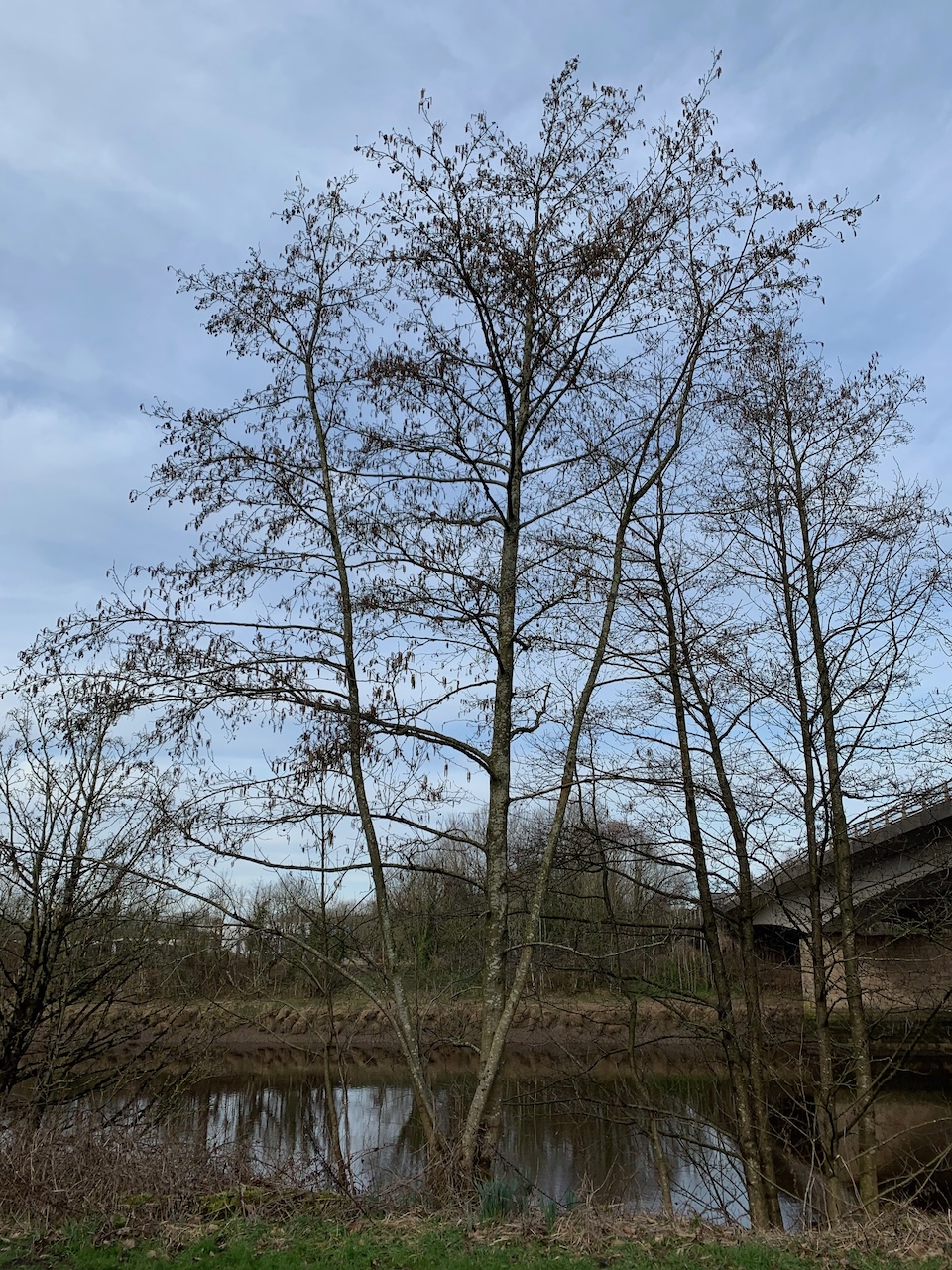
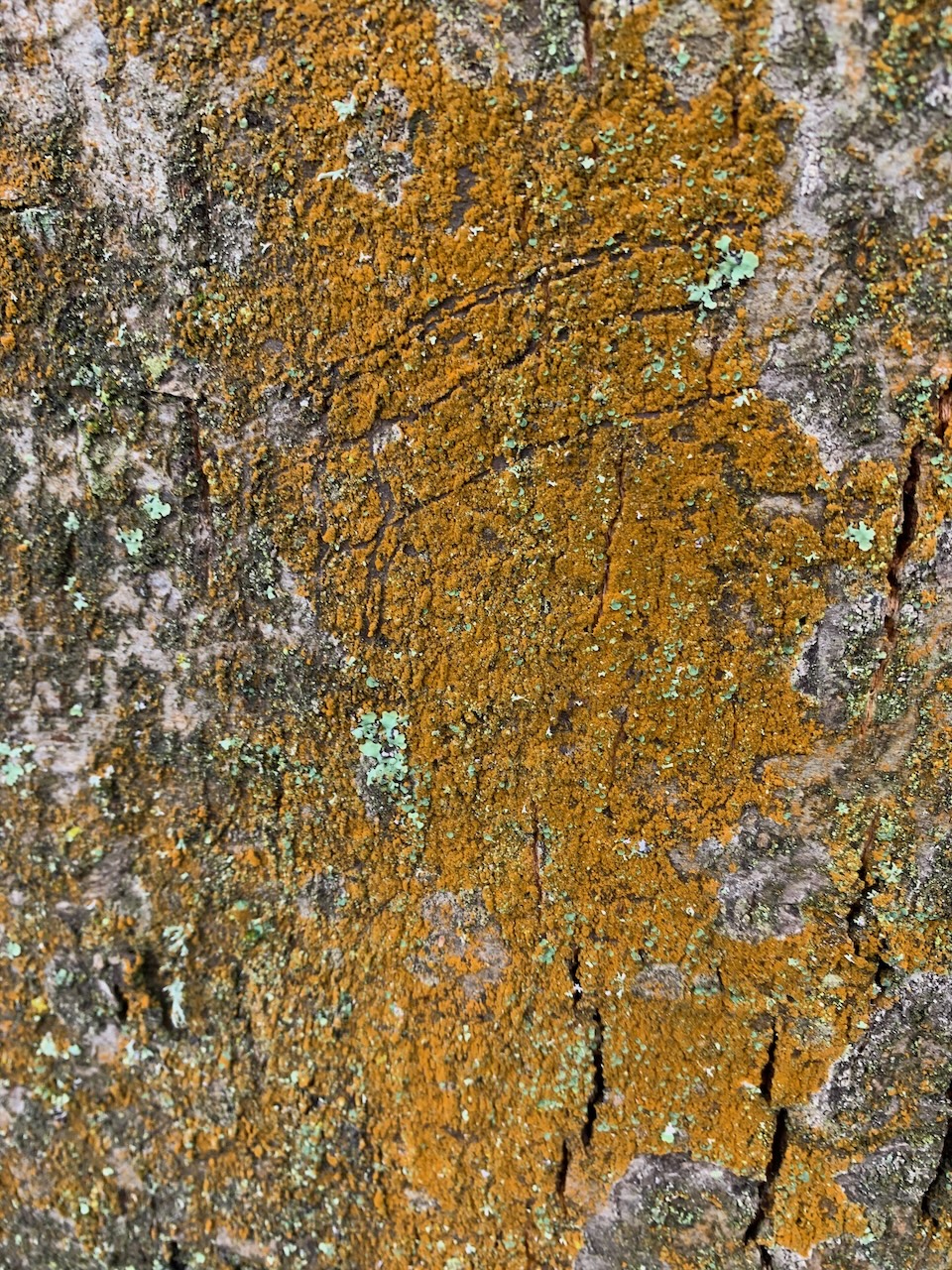
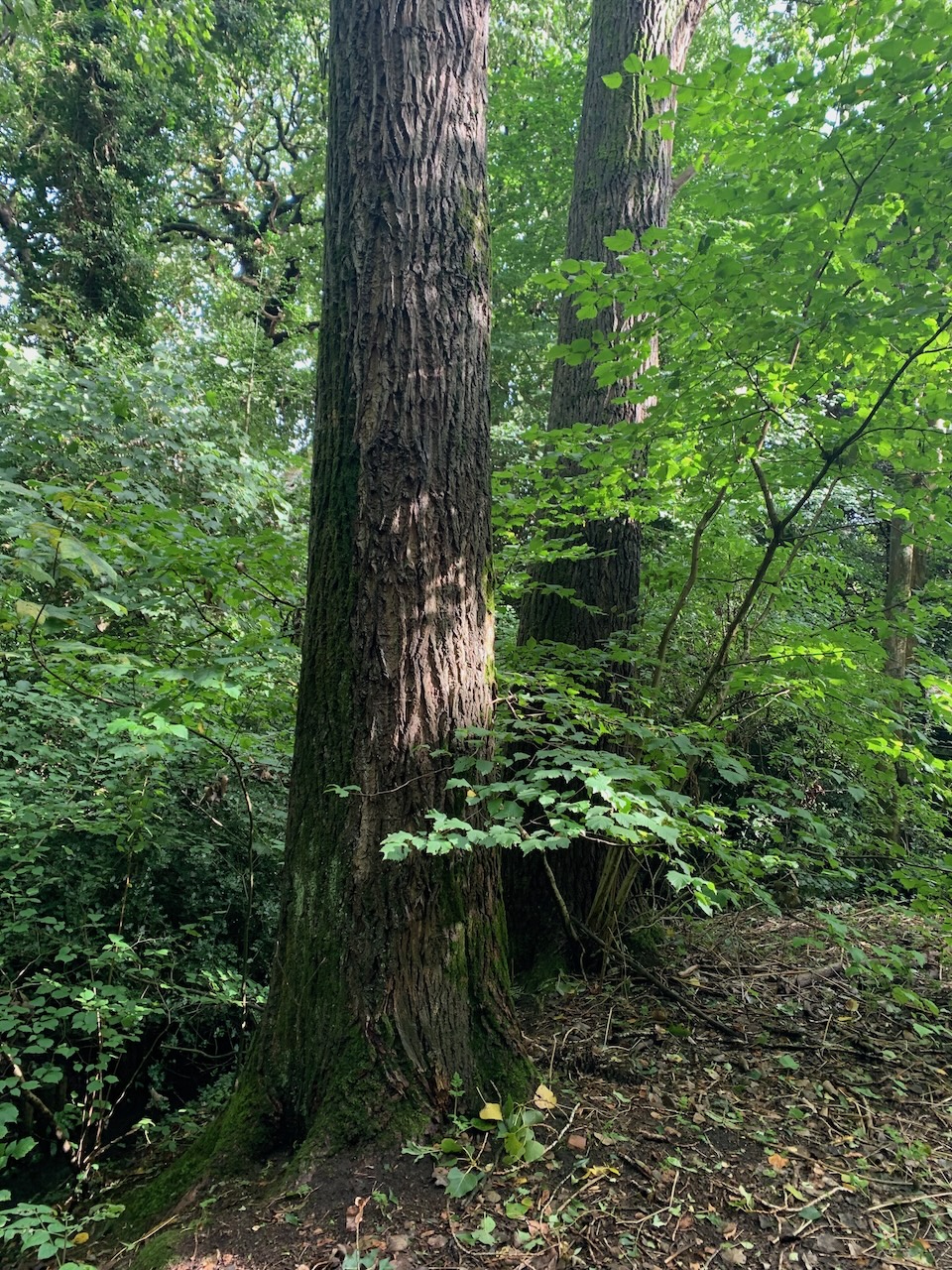
Beside the source of the brook in Greencroft Valley stand two black poplars. There aren’t any known British myths about black poplars but, in Greek myth, they are associated with Hades (the Underworld) and death. 

In Homer’s Odyssey, poplars, described in different translations as ‘tall’ and ‘dusky’, so likely black, with willow, form Persephone’s Grove. Springs, throughout world myth, are seen as entrances to the Underworld.

In another story from ancient Greece, Phaethon, son of the sun God, Helios, drives his father’s chariot too close to the sun. His blazing end brings deep grief to his sisters, who are transformed into black poplar trees. The amber sap is said to be their tears. Thus its associations with death and sorrow. 

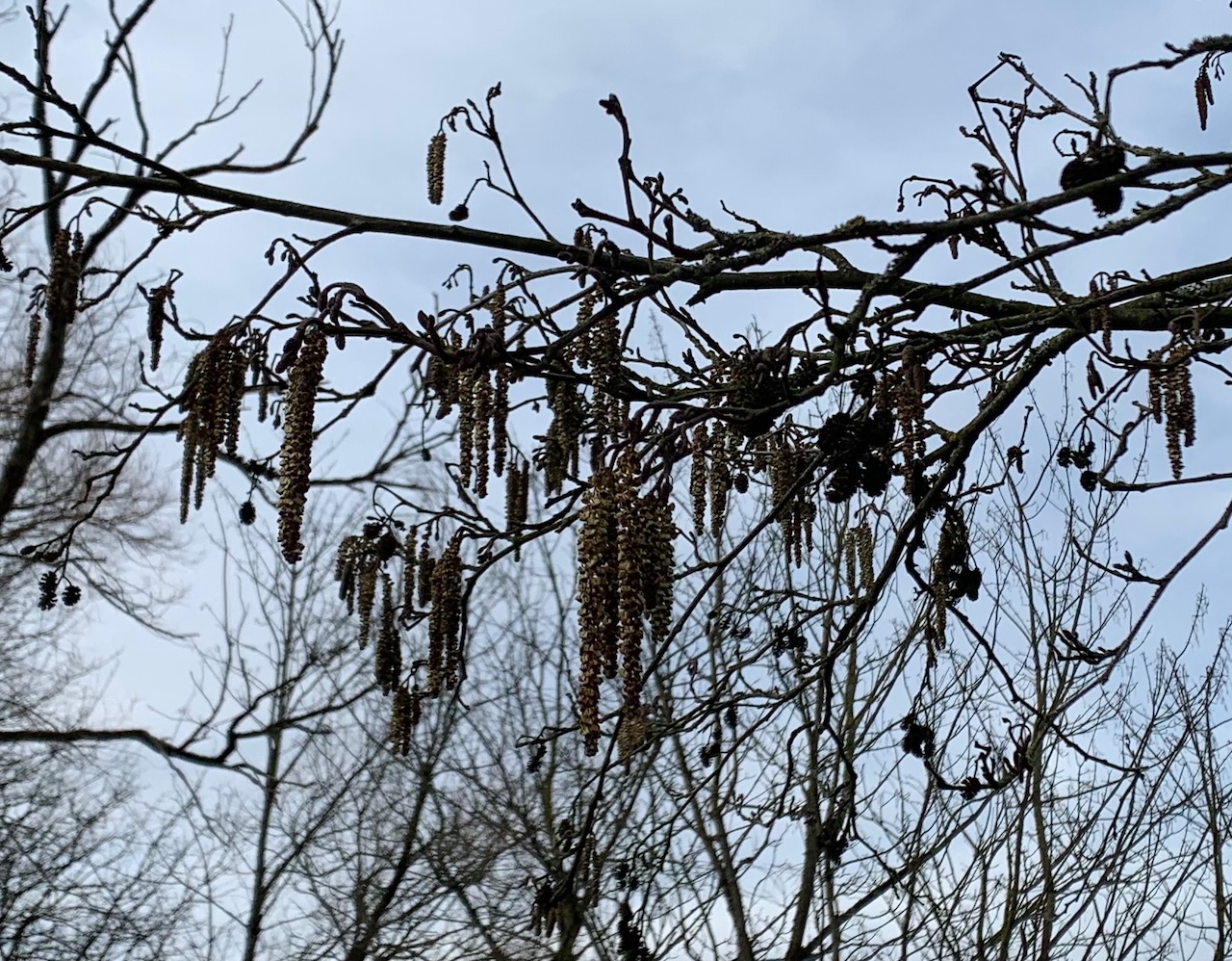
In more recent folklore the red male catkins are referred to as ‘Devil’s Fingers.’

This leads me to believe that there might have once been parallel British myths about black poplar, connecting it with springs at the entrance to Annwn and with the groves of Annwn’s Queen. Perhaps there was once a story in which the red male catkins were the bloody fingers of Annwn’s King?

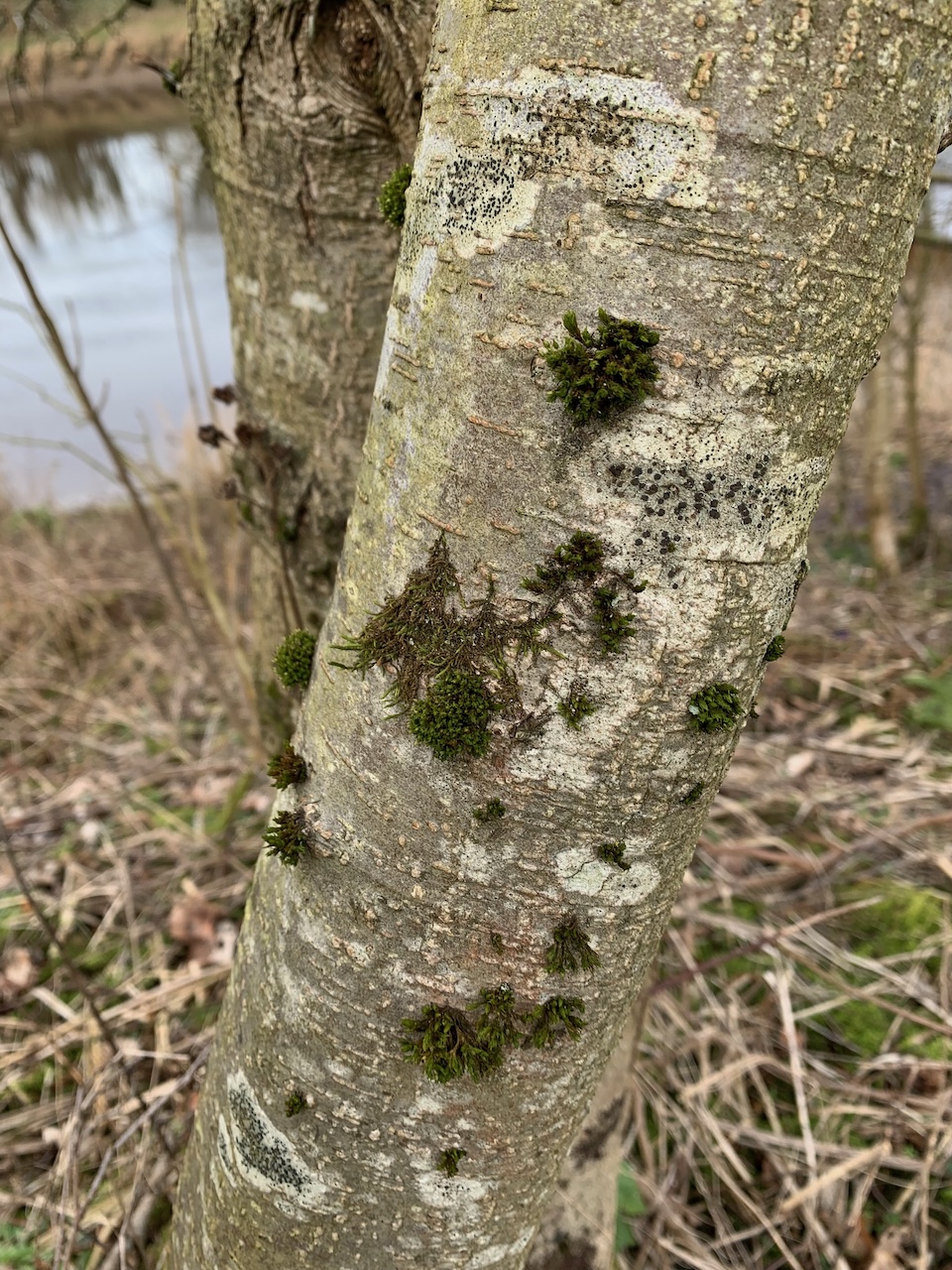
I will admit that I’m not sure if these trees are true black poplars (Populus nigra) or hybrids because black poplars are rare. Plus, I’m not referring to the true source of Fish House Brook but to the outflow pipe that the culverted brook emerges from. The original source would have lain further south, somewhere on Penwortham Moss, which has been drained and replaced by housing. The brook is culverted under the gardens on the other side of my street, Bank Parade, also giving its name to Burnside Way. I feel this relates to my founding of the Sanctuary of Vindos / Gwyn ap Nudd, a King of Annwn, very near to the ‘black poplars’ at the ‘source’.

In a shamanic journey I visited the poplars for advice on descending to the ancestors in preparation for some ancestral healing work. I was shown the left tree represented my mother line and the right my father line. I slid down the roots of the left into a cavern where a group of spirits were drinking from cups from the same source. I was told that on the new and full moons I must consecrate a cup of water and make an offering:

“To the Gods,
spirits and ancestors –
we all drink from the same source.”

I felt this related to keeping the source clean – something I have been trying to do as a volunteer in Greencroft Valley with the Friends group I set up (now part of Guardians of Nature).

By Your Anger and Your Arrow – On Invoking Rudra and Gwyn

In a recent article I mentioned my discovery that yoga and tantra originate from Shaivism, ‘the Path of evoking Shiva’, ‘a system of mysticism rooted in indigenous shamanism’ which existed before the beginning of the Vedic period (1).

This got me really excited as it provided evidence that yoga has shamanic origins and that Shiva, ‘Lord of Yoga,’ was the God of this pre-vedic system. As a Brythonic polytheist and shamanic guide I associate my patron God, Gwyn ap Nudd, a King of Annwn (the Otherworld) with shamanic practices and have come to know Him as a ‘Master of Meditation’.

These similarities led me to looking for the earliest textual references to Shiva. I found out that He was earlier known by the name Rudra – ‘Roarer’ or ‘Howler’. By this name He shares many similarities with Gwyn as a God of hunting, wind and storms, and healing. Rudra is the leader of the Maruts or Rudras – storm Deities who are His sons. Gwyn and His ‘family’ are associated with ‘the province of the wind’ (2). Gwyn is a leader of the Wild Hunt, which is a similar phenomenon.

The oldest hymns to Rudra appear in the Rig Veda (1500BCE). In her introduction Wendy Doniger describes Him as follows: ‘Rudra is a liminal figure… invoked with Vedic hymns but not invited to partake in the regular Vedic sacrifice; as the embodiment of wildness and unpredictable danger, he is addressed more with the hope of keeping him at bay than with the wish to bring him near… Though only three entire hymns in the Rig Veda are addressed to Rudra, the rich ambivalence of his character is the basis of an important line of Indian theology that culminates in the Hindu god Śiva. Rudra is fierce and destructive like a terrible beast, like a wild storm; the sage begs him to turn his malevolence elsewhere. Yet Rudra is not merely demonic, for he is the healer and cooler as well as the bringer of disease and destructive fever’ (3).

I found this description striking and it reminded me very much of Gwyn, who shares an outsider status as a wild God who is revered and feared. Gwyn and the spirits of Annwn, like the Irish andedion ‘ungods’, also exist outside the ‘pantheons’ of culture Gods – the Children of Don  and the Tuatha De Dannan (4). This is suggestive of their origins in an earlier wilder shamanic culture.

Gwyn shares with Rudra a ‘rich ambivalence’. As the leader of the spirits of Annwn He contains their aryal ‘fury’ and demonic nature yet, at the same time, He is the Deity who holds it back to prevent the destruction of the world (5). These spirits share many similarities with the Maruts, or Rudras, the sons of Rudra. Rudra is also said to have power over the Asuras, ‘demons’.

Like Rudra, Gwyn is viewed as being able to bring disease and destruction and, contrastingly, is seen as a healer. In the fourteenth century He was invoked to heal the effects of the Evil Eye as recorded in The Speculum Christiani: ‘Some stupid people also stupidly go to the door holding fire and iron in the hands when someone has inflicted illness, and call to the King of the Benevolent Ones and his Queen, who are evil spirits, saying, “Gwyn ap Nudd who are in the forests for the love of your mate allow us to return home” (6).

It is very interesting to see Gwyn referred to as the King of the Benevolent Ones. This, like the term Tylwyth Teg, ‘Fair Family,’ is a euphemism for His spirits similar to how the Greek furies are referred to as the Eumenides, ‘Kindly Ones’. Likewise, Rudra is implored for His ‘kindness’. Gwyn’s name, which means ‘white, blessed, holy,’ might be seen as a similar appellation.

In ‘Rudra, Father of the Maruts’, Rudra is called upon to send ‘kindess’ and ‘healing medicine’, to drive away ‘hatred’, ‘anguish’ and ‘disease’ and to ward off ‘attacks and injury’. He is petitioned as ‘the best healer’ and as a protector who takes the form of a ‘tawny and amazing bull’ carrying ‘arrows and bow’ (7). In this apparel He bears striking similarities with Gwyn, who appears as a warrior-huntsman and ‘bull of battle’ in The Black Book of Carmarthen (8).

In ‘Have Mercy on us Rudra’ He is again petitioned to show ‘kindness’, to offer ‘protection, shelter, refuge’ and to hold back His destructive power. ‘Do not kill our father or our mother, nor harm the bodies dear to us.’ ‘Keep far away from us your cow-killing and man-killing power, O ruler of heroes’ (9). Here, like Gwyn, whose horse tramples armies like felled reeds to the ground (10) He brings death. ‘Ruler of heroes’ resembles Gwyn’s epithet ‘Lord of Hosts.’

Intriguingly we find the lines: ‘We call down for help the dreaded Rudra… the sage who flies.’ (11) This might refer to Rudra’s mastery of shamanic soul-flight. 

In the Yajur Veda we find a hymn to Rudra called ‘Shri Rudram’ which is divided into two parts. In the Namakam, Rudra is invoked by a number of names to stay His bow and arrow and destructive tendencies and to bring happiness and peace. ‘Oh! Rudra Deva! My salutations to your anger and your arrows. My salutations to your bow and to your pair of hands. Oh! Destroyer! By that arrow of yours, that bow of yours and that quiver of yours which have become the most peaceful make us happy’ (12).

Here Rudra and the Rudras are intimately associated with forests and trees. We find lines where They share similarities with the spirits of Annwn or fairies who, in The Life of St Collen, wear garments of red and blue and offer a delicious banquet (13). ‘Those Rudras who exist in trees as their overlords, yellow-hued, like tender grass, crimson and blue-necked… lords of ghosts and spirits… those Rudras who are protectors of the pathways, the givers of food’ (14).

The Chamakan is a series of petitions to Rudra for health and good fortune. ‘Let the life forces and vital airs of Prana, Apana and Vyana function properly in me.’ ‘Let me have well functioning sense organs with clear eye sight and clear hearing.’ ‘May I be granted happiness in this world and the other world’ (15).

These early hymns show how Rudra was invoked in the vedic times and hint at His function in an earlier wilder shamanic culture. At their heart lies Rudra’s ambivalent nature – His fierceness and His kindness – qualities He shares with Gwyn. Thus, they offer clues to how Gwyn (by His earlier name Vindos) might have been praised and called upon by the Brythonic people around 1500BCE and might serve as inspiration for new hymns from modern devotees.

REFERENCES

  1. Swami Nischalananda, Insight into Reality, (Kindle Edition, 2019), p387
  2. Dafydd ap Gwilym, Poems, (Gomer Press, 1982), p131
  3. Wendy Doniger (transl), The Rig Veda (Penguin Classics, Kindle Edition), p219 – p222
  4. Similar wild outsider Gods are found in other Indo-European cultures such as Dionysus to the Olympian Gods in the Greek tradition and the Vanir to the Aesir in the Norse tradition.
  5. ‘Gwyn ap Nudd… God has put the spirit of the demons of Annwfn in Him, lest the world be destroyed.’Sioned Davies, The Mabinogion, (Oxford University Press, 2007),p199
  6. Angelika H. Rudiger, ‘Gwyn ap Nudd: Transfigurations of a character on the way from medieval literature to Neo-pagan beliefs’, Gramayre: The Journal of the Sussex Centre for Folklore, Winter 2012, Issue 2 
  7. Wendy Doniger (transl), The Rig Veda (Penguin Classics, Kindle Edition), p222 – 223
  8. https://awenydd.weebly.com/the-conversation-between-gwyn-ap-nudd-and-gwyddno-garanhir.html
  9. Wendy Doniger (transl), The Rig Veda (Penguin Classics, Kindle Edition), p224 – 225
  10. https://awenydd.weebly.com/the-conversation-between-gwyn-ap-nudd-and-gwyddno-garanhir.html
  11. Wendy Doniger (transl), The Rig Veda (Penguin Classics, Kindle Edition), p224 – 225
  12. https://www.sathyasai.org/sites/default/files/pages/eternal-companion/vol-4/issue-3/rudram-namakam-chamakam.pdf p1-2
  13. https://www.maryjones.us/ctexts/collen.html
  14. Ibid. p23

The Universe Unrolls from His Heart – Thoughts on Kashmir Shaivism and Annuvian Monasticism

‘He becomes intent to roll out the entire splendour of the Universe that is contained in His heart…’
~ Swami Maheshwarananda

When I first started practicing yoga in 2022 in the hope it would help with my hip and knee problems I had no idea that I would fall in love not only with the asana ‘postures’ but with pranayama ‘breathwork’ and dhayana ‘meditation’. I never guessed that I would find such astonishing parallels between the Hindu God Shiva, ‘Lord of Yoga’, and my patron God, Gwyn ap Nudd, who presented Himself to me as our Brythonic ‘Master of Meditation’. Both, I realised, come from a shared Indo-European origin.

I found similarities exist between Shiva and Gwyn on a symbolic level. Both are associated with bulls and serpents and with intuitive insight and visionary experience. Shiva’s often seen as a destroyer and Gwyn has destructive potency as a leader of the Wild Hunt and the God who holds back the fury of the ‘devils’ of Annwn in order to prevent their destruction of the world.

There’s a story about Shiva riding down the mountain to His wedding feast on a huge bull ‘covered in snakes and ash’ ‘with ghosts and demons’ ‘some had their mouths in their stomachs, some had only one foot and some had three’. Yet when He and His company ‘crossed the wedding portals’ and entered the presence of His bride, Shakti, they were transfigured into ‘a handsome young man’ and ‘divine beings’ (1). This spoke immediately to me of the paradoxical nature of Gwyn and the spirits of Annwn who are referred to both as furious ‘devils’ and as beautiful and beneficent fair folk.

Whilst studying yogic meditation in more depth with the Mandala Yoga Ashram I discovered an incredible text called the Vigyana Bhairava Tantra from the Kasmir Shaivite tradition.The ashram founder, Swami Nischalanda, refers to it as his Bible and many of the practices within the ashram derive from it. Over recent months I have taken a short course (2) and read Swamiji’s exposition of it in Insight Into Reality from which I gleaned many insights.

Bhairava ‘Fearsome’ or ‘Awe-Inspiring’ is another name for Shiva which evokes qualities of Gwyn, whilst vigyana means ‘insight’ and tantra ‘techniques’. The text is also known as Shiva Vigyana Upanishad ‘The Secret Teachings of Shiva’. Within, Bhairava addresses His consort, Bhairavi as His Beloved and student, teaching Her in 112 dharanas ‘concentrations / lessons’ how to gain insights into the fundamental nature of reality. As I’ve been listening to and practicing the dharanas I have felt that Gwyn is speaking through it to me as His student and beloved as a nun of Annwn.

In The Edge of Infinity Swami Nischalananda provides an account of the history of Kashmir Shaivism. He says: ‘In the past, tantra was widely known as Shaivism, ‘the Path of Evoking Shiva’, a system of mysticism rooted in indigenous shamanism. It existed  throughout India well before 1500 CE, the start of the vedic period’ (3). Tantra, as an oral tradition, predates the Vedic texts, with its first scriptures emerging in the first millenium CE. Kashmir Shaivism originated in 850 CE with one of the main texts being the Shiva Sutras which were gifted to Vasugupta by Shiva in a dream. The Vigyana Bhairava Tantra is central and was written down around 7 – 800CE.

I was incredibly excited to find out that a number of texts, such as Pratyabhijna Hridayam ‘The Heart of Recognition’ and The Triadic Heart of Shiva, refer to the universe unfolding from Shiva’s heart and to His residence in the heart. 

‘When He becomes intent to roll out the entire splendour of the Universe that is contained in His heart… he is designated as Sakti.’ (4)

‘The Heart, says Abhinavagupta, is the very Self of Siva, of Bhairava, and of the Devi, the Goddess who is inseparable from Siva. Indeed, the Heart is the site of their union (yamala), of their embrace (samghata). This abode is pure consciousness (caitanya) as well as unlimited bliss (ananda)… The Heart, says Abhinavagupta, is the sacred fire-pit of Bhairava. The Heart is the Ultimate (anuttara) which is both utterly transcendent to (visvottirna) and yet totally immanent in (visvamaya) all created things. It is the ultimate essence (sãra). Thus, the Heart embodies the paradoxical nature of Siva and is therefore a place of astonishment (camatkara), sheer wonder (vismaya), and ineffable mystery. The Heart is the fullness and unboundedness of Siva (purnata), the plenum of being that overflows continuously into manifestation. At the same time, it is also an inconceivable emptiness (sunyatisunya). The Heart is the unbounded and universal Self (purnahantä).’ (5)

‘He, truly, indeed, is the Self (atman) within the heart, very subtle, kindled like fire, assuming all forms. This whole world is his food. On Him creatures here are woven. He is the Self, which is free from evil, ageless, deathless, sorrowless, free from uncertainty, free from fetters, whose conception is real, whose desire is real. He is the Supreme Lord. He is the ruler of beings. He is the protector of beings. This Soul, assuredly, indeed, is Isana, Sambhu, Bhava, Rudra.’ (6) (The names at the end are all epithets of Shiva).

Reading these words was meaningful for me because Gwyn revealed to me that His heart is the Heart of Annwn ‘Very Deep’ (the Brythonic Otherworld). During my practice of playing the heartbeat of Annwn on my drum for an hour every week I have experienced visions of the universe and its people being born from Annwn like red blood pouring from His heart and returning at death like blue blood. When we entered a sacred marriage He came to dwell within my heart as ‘the Heart of my Heart’. I was told that my heart is also the Heart of Annwn and the universe unrolls from my heart (which fits with the practices emphasising the importance of the heart-space in yoga).

As I read more about Kashmir Shaivism I found further similarities with the cosmology I have been gifted in visions from Gwyn. In Kashmir Shaivism the fundamental ground of reality is Brahman or Parama ‘Ultimate’ Shiva. In mythology it is represented as the serpent-king Nagaraja ‘the infinite… who spreads out the universe with thousands of hooded heads, set with blazing, effulgent jewels’ (7). Before I had read these lines I was shown that the ground of reality is Anrhuna, the Mother of Annwn, the Dragon Mother, who has nine dragon heads with jewels in their foreheads and an infinite number of coils. 

In a vision I was shown how Anrhuna was slaughtered and Gwyn and His sister, Creiddylad, were torn from Her womb. Through eating His mother’s heart Gwyn inherited the Heart of Annwn and became King of Annwn (8). Creiddylad brought life to the world as the energy behind creation – the ‘green fuse’ of vegetative life and by breathing life into living creatures. 

This bears a resemblance with Kashmir Shaivism wherein Brahman divides into Shiva (Consciousness) and Shakti (energy and matter). There are parallels between the Heart of Annwn being the source of the universe from which all living beings are born and to which they return and the Heart of Shiva being the source of all energy and matter manifesting as Shakti.

Intriguingly, the first three dharanas in the Vigyana Bhairava Tantra focus on the origin and end points of the breath. When I practice these exercises I find myself contemplating how Creiddylad gave breath to life and Gwyn takes it away.

Finding these similarities between Kashmir Shaivism and the Annuvian monasticism I am developing for Gwyn has been revealing and exciting. I’m sure there is much more to be discovered as I continue with my research and practices.

REFERENCES

(1) Swami Nischalananda, Insight into Reality, (Kindle Edition, 2019), p393
(2) https://www.mandalayogaashram.com/self-study-course-vigyana-bhairava-tantra
(3) Swami Nischalananda, Insight into Reality, (Kindle Edition, 2019), p387
(4) Jaideva Singh, Pratyabhijna Hridayam, (Sundar Lal Jain, 1963), p30
(5) Paul Eduardo Muller-Ortega, The Triadic Heart of Siva, (State University of New York Press), p71
(6) Ibid. p82
(7) Richard Freeman, The Mirror of Yoga: Awakening the Intelligence of Body and Mind, (Kindle Edition, 2019) p19
(8) This story has a basis in medieval Welsh mythology. In Culhwch and Olwen, Gwyn kills a king called Nwython then feeds his heart to his son. I believe this might evidence an earlier ‘Cult of the Heart’ that preceded the ‘Cult of the Head’ wherein the soul was seen to dwell in the heart and the wisdom of one’s ancestors could be passed on by eating their hearts.

The Frozen Men of Caer Rigor

‘I’m splendid of fame: songs are heard
in the four quarters of the fort, island of the strong door.
Fresh water and jet are mixed together;
sparkling wine is their drink, set in front of their battalion.
Three full loads of Prydwen we went by sea:
save seven, none came back from Caer Rigor.’
~ The Spoils of Annwn

It’s the middle of summer. We set sail for Caer Rigor beyond the ninth wave and further on to where all waves freeze beneath the turning of the frosty gulls. 

There is no fortress in Thisworld or the Otherworld colder than Caer Rigor. It wears its icicles like the Winter King’s crown upside down when he was cast down. There are frozen birds upon the turrets with songs frozen on their tongues.

The gate of the fortress is frosted shut like the cold lips of the gatekeeper.

Down from a tower swoops a messenger on wide white wings like an albatross. He pours water over jet mixing them together. Whoosh! A rush of flames, like from a flamethrower, burning in a multitude of colours, like a flambeau.

Ice drips from the gate and hinges open like the gatekeeper’s jaw. The giant stares and unclenches his fist but halts not our passage as we enter the frozen corridors of Caer Rigor and are taken to stand before the Strong Door.

“The door to this hall has not been opened for 1500 years,” the messenger speaks solemnly, “the men inside have known not death, nor decay, nor old age.”

He holds the jet-flame to the door and the icy seal around it melts. Inside is a battalion of frozen men, not the seven survivors, no, these are dead men. Young, pitifully young hopefuls who accompanied Arthur on his fateful voyage.

There is wine, sparkling wine, in their cups, they wear the faces of happy drunks. Yet, as the door opens, as the ice begins to thaw, they set down their glasses and the pain of memory appears in their eyes with the onset of sobriety as fire and ice, jet and water mix, fiercely coloured and hallucinatory.

“Where are we?” “Thisworld or the Otherworld?” “Are we alive or are we dead?” “Are we burning or are we freezing?” “Is this reward or punishment?”

“All I remember is the flash of Llenlleog’s sword as it was thrust into the cauldron.”

“Blinding!” “The explosion.” “It blinded us.” “Yet we can see.” 

“I remember the cauldron, tiny, in Lleog’s hand.” 

“Nonsense – that was just an illusion – the cauldron cannot be stolen.”

“Arthur cut off His head! The head of the Head of Annwn.” 

“And it sung to us for nights in this feasting hall.” 

“The Head of Annwn sung of cutting off Arthur’s head and how it was deaf and dumb.”

“What will become of us now?” “How can we return to the cauldron if it is gone?”

“I told you it was all an illusion,” speaks the youngest of the men. 

“You’re no longer trapped in that old myth,” the messenger tells them. 

“That old myth is done,” I am inspired to speak up, “we come as new monastic devotees of the Head of Annwn to set you free from Arthur’s rule. When this castle has thawed to the cauldron you will return to be reborn.”

They raise their cups and embrace – fire and ice, jet and water mix fierce and hallucinatory as from the turrets the birds fly free and burst into song.

~

This piece is based on my experiences during our Monastery of Annwn Brythonic texts meditation group last night. Caer Rigor has been translated as ‘the Petrification Fort’ from the Latin rigor from ‘stiffness’ and also contains connotations of ‘cold’ from frigor. The citation above is from Marged Haycock but replaces her translation of ynys pybrydor as ‘stout defence of the island’ with the more popular translation ‘island of the strong door’. This allows it to be related to the Second Branch of The Mabinogion wherein the seven survivors of the battle between the Britons and the Irish feast and drink blissfully on the Island of Gwales with the head of Bran the Blessed until one of the men, Heilyn, opens the door, and all their losses and ills return.

The Breath of Nine Maidens and the Kindling of the Cauldrons

‘My first utterance was spoken concerning the cauldron
kindled by the breath of nine maidens.
The cauldron of the Head of Annwn, what is its disposition
(with its) a dark trim, and pearls?
It does not boil the food of a coward, it has not been destined to do so.’
~ ‘The Spoils of Annwn’

In ‘The Spoils of Annwn’, a medieval Welsh poem from The Book of Taliesin, we find mysterious lines about the breath of nine maidens kindling the cauldron of the Head of Annwn. The cauldron, the source of awen, ‘poetic inspiration’, is a central symbol within Celtic mythology. 

In ‘The Story of Taliesin’ the cauldron belongs to Ceridwen. In this tale Ceridwen is referred to as a witch but it’s my intuition She is a Goddess whose crochan – cauldron / womb is a sacred vessel of rebirth (1). In Her cauldron she brews a potion from 365 herbs (one picked on each day of the year) to provide her ugly son, Afagddu ‘Utter Darkness’ with the ‘Prophetic Spirit’. She assigns a blind man called Morda to bring kindling for the cauldron and to stir the cauldron she summons a boy called Gwion. After a year and a day Gwion shoves Afagddu out of the way and steals the awen. After a shapeshifting chase he is swallowed by Ceridwen (he as a grain and She as a black hen) then reborn from her womb as Taliesin.

In ‘The Spoils of Annwn’ the model is slightly different. The cauldron of Ceridwen, the magical vessel associated with inspiration and rebirth, is in the custodianship of the Head of Annwn – the ruler of the Brythonic Otherworld. Here there is no need for kindling or a person to stir the cauldron as the breath of the nine maidens is enough to set the processes within it into motion. The ‘food’ ‘not for a coward’ that it brews no doubt refers to the awen. Taliesin accompanies Arthur and his men not only to steal the awen, but the cauldron itself, bringing it back through ‘Hell’s Gate’ to the world.

This shows that when a potential awenydd, ‘person inspired’, proves their courage to the Head of Annwn, the breath of the nine maidens or awenau, ‘muses’ (2), kindles the cauldron, then the awen is received as a gift from the Gods.

This feels like an older and deeper model for the origins of awen. The significance of the breath of the nine maidens can be further elucidated by looking at the etymology. The medieval Welsh term used for breath is anadyl and this derives from the proto-Celtic anatla which shares a resemblance with anaman the proto-Celtic word for ‘soul’. The Indo-European *uel is closely related giving us the root form of awel ‘breeze’ and awen ‘inspiration’. There seems to be something fundamental this myth is telling us about how, in Annwn, on the soul-level, the breath of the nine maidens kindles the cauldron and sets in motion the processes within the cauldron that create the awen.

It’s my personal intuition that the cauldron / womb of Ceridwen, who I know as Old Mother Universe, is a macrocosm of the universe. That it lies in Annwn ‘Very Deep’ shows the Otherworld is a deeper reality underlying the universe. 

On a microcosmic level each awenydd might too be seen as a cauldron which is kindled by the breath of the nine maidens producing awen for poetic works. The breath itself might be seen as a gift from the awenau. 

Microcosm within microcosm a number of Celtic Pagans have come to relate the three cauldrons in the seventh century Irish text ‘The Cauldron of Poesy’ to the three main energy centres or chakras in our belly, heart and head (3). Interestingly the Irish term coire ‘cauldron’ or ‘whirlpool’ might be seen to relate to the spiralling manifestation of the universe and the turning of the chakras.

In yogic meditation the breath is used to awaken the chakras. I was once dubious about the existence of ‘Celtic Chakras’ but I am now coming to perceive the resonsances between these shared Indo-European traditions. I wonder whether anatla ‘breath’ is the Celtic equivalent of the yogic prana ‘breath’ or ‘life force’ which Celtic Pagans have long been searching for (4). 

(1)These insights derive from Kristoffer Hughes’ From the Cauldron Born.
(2)This term is borrowed from Greg Hill who uses it in his poem ‘The Muses’ in his poetry collection The Birds of Rhiannon – ‘O Muses / O Awenau / You whose breath kindled the cauldron of awen in Ceridwen’s keeping.’
(3) For example see Erynn Rowan Laurie’s ‘The Cauldron of Poesy’ – https://www.obsidianmagazine.com/Pages/cauldronpoesy.html
(4) Some druids have in the past mistakenly identified prana with nwyfre ‘sky, firmament’ which Mhara Starling explains is erroneous on her Youtube channel – https://www.youtube.com/channel/UCkc4iRymvz4t619FEk5dFfA/videos Interestingly the proto-Celtic anatla ‘breath’and anaman ‘soul’ share similarities with the Sanksrit atman which is sometimes translated as ‘soul’ but refers to the Self or witness-consciousness beyond phenomena and ananda which refers to bliss at escaping the cycle of mortality or uniting with a God.

On Singing in Chains

In the Monastery of Annwn meditation group we have recently been exploring the medieval Welsh poem ‘The Spoils of Annwn’ from an Annuvian perspective rather than from the views of the ‘victors’ Arthur and Taliesin.

Last week, in the guided visualisation meditation, we journeyed to the first fortress, Caer Siddi ‘the Fairy Fort’, on our magical monastic boat and gained personal visions based on lines from the poem:

Maintained was Gwair’s prison in Caer Siddi
throughout Pwyll and Pryderi’s story.
No-one went there before he did –
into the heavy grey chain guarding the loyal lad.
And before the spoils / herds of Annwn he was singing sadly,
and until Doom shall our poetic prayer continue.

I found myself standing before Gwyn wearing chains with Gwair in a scene resembling the Devil card from the Rider Waite Tarot. Whilst Gwair was imprisoned in a heavy grey chain I was wearing only toy-like silver handcuffs and felt they were close to breaking and to my being released.

Gwyn said:

‘As long as you sing you will be in chains.
In the silence of meditation you will be free.’

Gwyn’s words reminded me of the shift in my path from being a bard in the mead hall to becoming a Nun of Annwn. To moving away from performing poetry to a more monastic and shamanic path.

Another way of looking at it was that the singing is the voice of the incessant thoughts in my head and that only when I’m silent in meditation will their song and the chains be gone.

Nodens Father of Sea Horses

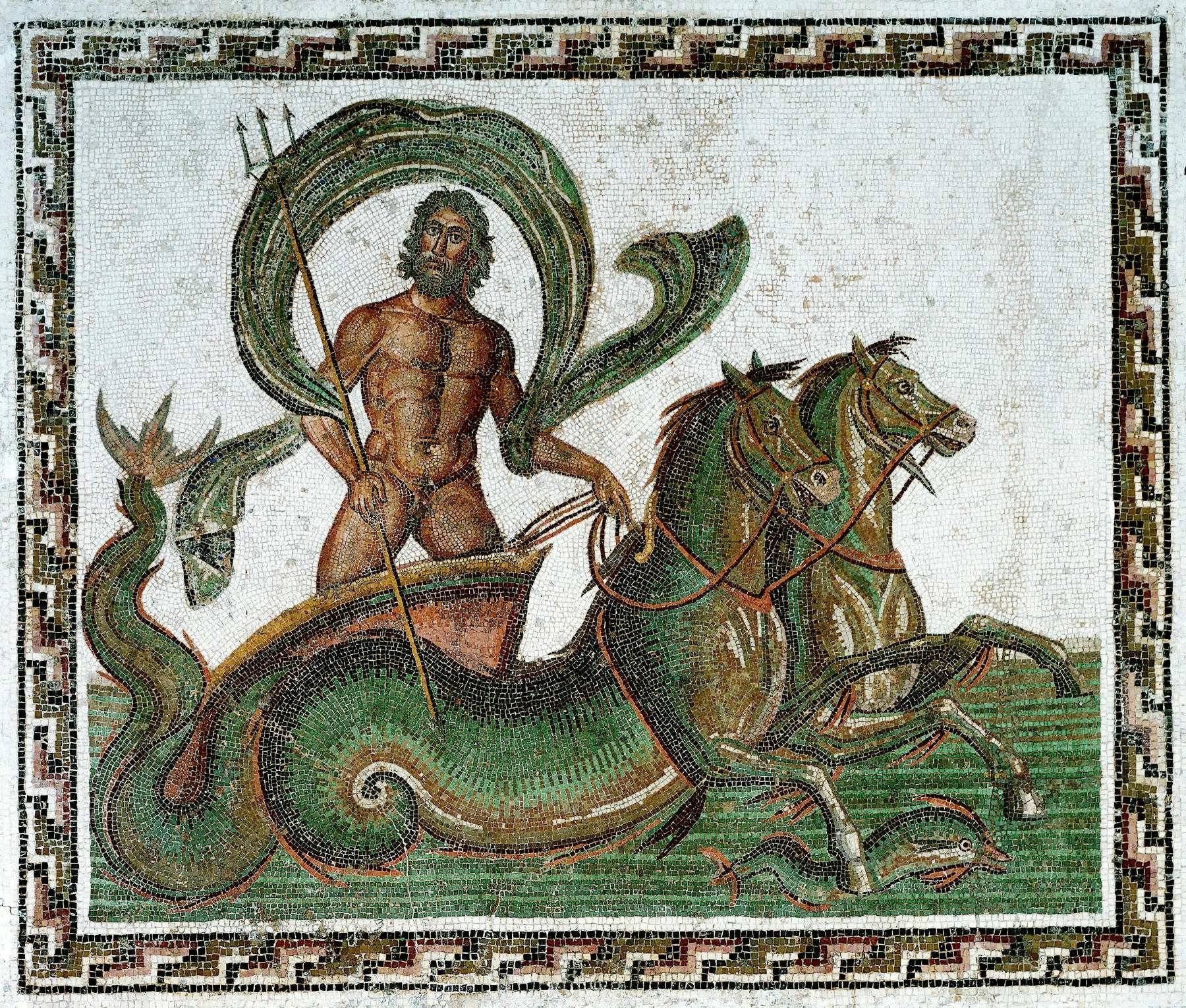
Recently, in one-to-one sessions with another monastic devotee of Annwn, we have been exploring her intuitions about Gwyn ap Nudd’s associations with the sea. Gwyn’s father, Nodens / Nudd, is equated with Neptune at Chesterholm in an inscription which reads Deo No / Neptu. This suggests, like Neptune, He is associated with freshwater and the sea, seahorses, and with horses more widely (Neptune was worshipped as Neptunus Equestris – God of horse racing).

Little is known about the myths of Neptune but there are many about His Greek counterpart, Poseidon Hippios ‘of the horse’, the Father of Horses. When Demeter fled Poseidon’s lust in the form of a mare He took the form of a stallion and mated with Her and She bore a colt called Arion ‘Very Swift’. In another tale He mated with Medusa and She gave birth to Pegasus.

These stories remind me of my personal gnosis about Nodens mating with Anrhuna, the Dragon Mother of Annwn, to bear Gwyn and Creiddylad and other children who might have included horses and seahorses. Intriguingly Rhiannon, who like Creiddylad is a Queen of Annwn, is a Horse Goddess. I often wonder if Creiddylad and Rhiannon are titles for the same Goddess who takes horse form. If so this would suggest that Nodens is the Father of Horses and likely Sea Horses here in Britain. That He might be the father of Gwyn’s sea-going steed, Du y Moroedd, ‘the Black of the Seas’.

It also make me wonder if Nodens and Anrhuna might be the parents of white winged horses like pegasus from whom my closest spirit animal, a white winged mare, is descended. March allelog, ‘flying horses’, are known in Wales.

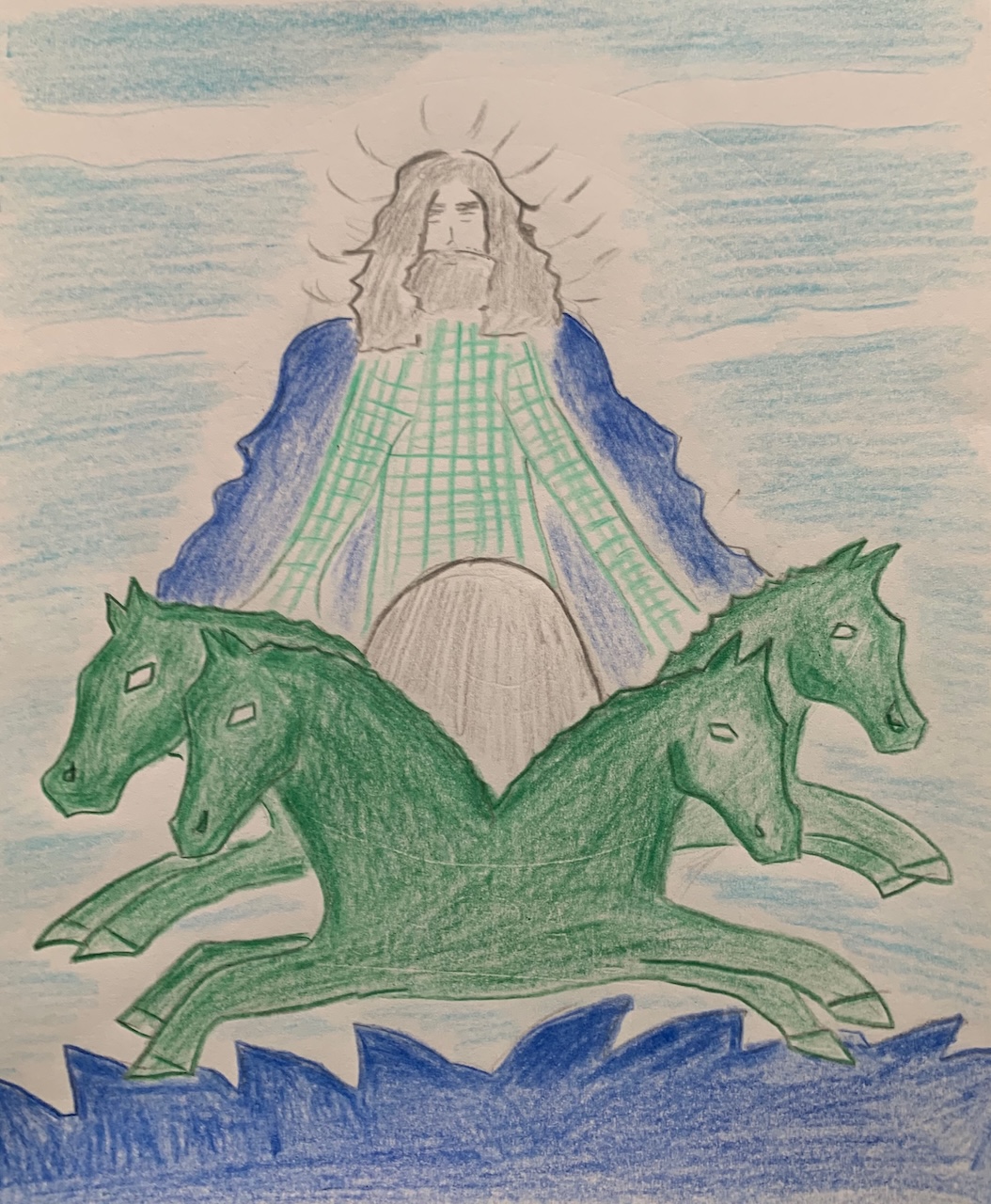
The devotional art above was born from these musings and is based on the mural crown depicting Nodens on a chariot pulled by four seahorses from Lydney and a triumph of Neptune in a chariot drawn by two seahorses from Sousse Archaeological Museum.

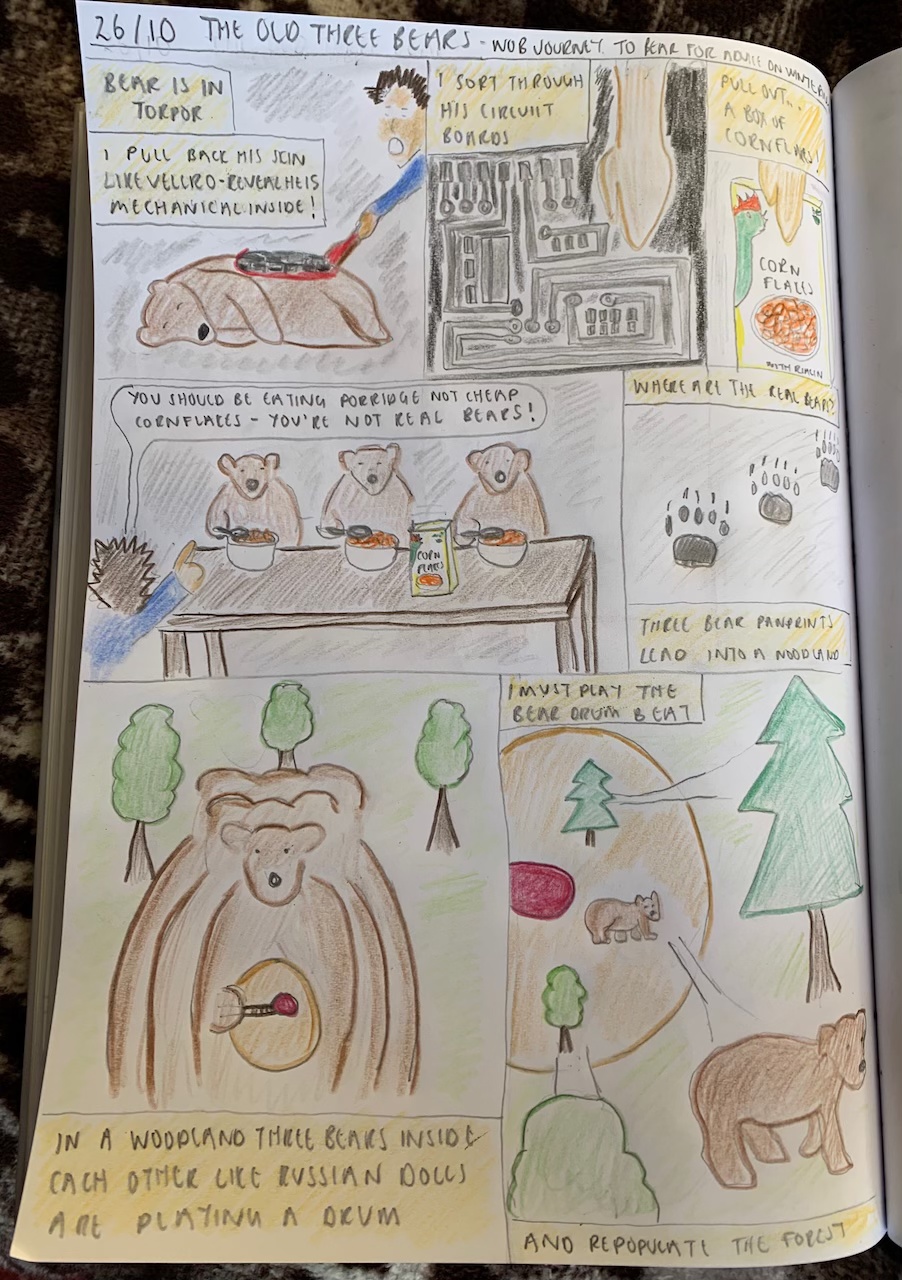
The Old Three Bears

In a recent journey circle at the Way of the Buzzard Mystery School we journeyed to Bear to ask for advice on overwintering. I was expecting to receive my usual guidance on slowing down and making time for rest. What happened was surprising. 

When I got to the cave Bear was in a torpor. I pulled back his skin, like velcro, and found to my shock that he was mechanical inside. I searched inside his insides, which were like circuit boards and pulled out a box of cornflakes! I then found myself in a cottage with the three bears shouting at them: “You should be eating porridge not cheap cornflakes!” This made me realise they were not real bears. In the basement of the cottage I found three bear pawprints leading into a woodland. There I found the three bears inside each other like Russian Dolls playing a drum. I was told I must play ‘the Bear Drumbeat.’ As they drummed images came from the drum and were made manifest. I was told, this way, I must ‘repopulate the forest.’ 

This got me wondering if the Goldilocks and the Three Bears story has roots in an older myth about the Old Three Bears from the time between when the Romans imported oats to Britain to feed their horses and potentially to make porridge and bears became extinct 1,500 years ago. Could the Three Bears within each other be a triple form of the Celtic Bear God or Goddess, Artaios or Artio? 

Their advice is suggestive of how images of the Otherworld are evoked by a shamanic drumbeat and of the power of durmming and imagination to create more ecologically viable futures to which extinct animals like Bear might return.

The Cow of Anrhuna

At the head of the line…
the spoil was the cow of An(r)hun(a)
.’
~ The Battle of the Trees

I am the Cosmic Cow.

I am white and red with seven legs,
eleven udders pouring the whitest milk,
a red crown of twelve stars upon my head.

My cow bells sound through the sea of stars.
My milk is the origin of the Milky Way.

I am ever loving and ever giving.

You cannot capture me because
I always come willingly.

You cannot take my milk
because I am always pleased to give.

Milk me until your fingers are bare bone
and my milk will never run dry,
not until you have used
every bucket in the world
and you have emptied every mine.

I am ever living and ever giving.

I can melt the heart
of the cruelest warlord
with one look from my soft eyes
And halt the wars betwen nations
with the scent of cud between my soft lips.

I am the spoil but I cannot be spoilt –
white, blessed, holy am I.


‘The Battle of the Trees’, in The Book of Taliesin, records a conflict between the Children of Don and Arawn, King of Annwn, and His otherworldly monsters.*

We are told ‘At the head of the line / the spoil was the cow of Anhun’. The cow, as the spoil, is absolutely central to the battle but, unfortunately we find out nothing else about her. All we are told is, ‘It caused us no disaster’. This suggests the cow is a benevolent being but we find out nothing more.

Marged Haycock suggests that Anhun is St Anthony and this buch ‘cow’, ‘buck’, ‘buck-goat’ or ‘roebuck’ might be the satyr he met in the wilderness.

This didn’t feel quite right to me – I couldn’t see the Children of Don fighting over a satyr. For a long while I saw this animal as an Annuvian cow akin to the Brindled Ox, who was stolen in ‘The Spoils of Annwn, but could discern no more.

Then, a few months ago, I was sitting looking at the name ‘Anhun’ and saw a couple of spaces between the letters filled in by the name An(r)hun(a). This title means ‘Very Great’ and she is a found Goddess who myself and a number of other awenyddion have come to know as the Mother of Annwn and of its ruler, Gwyn. (It’s my personal belief Gwyn and Arawn are titles of the same God). 

Anrhuna’s association and possible identification with a magical cow ties in with parallels from Irish mythology. Her Irish cognate is Boann or Bó Find, which might derive from the Proto-Celtic *Bou-vindā ‘White Cow’. She is the wife of Necthan (Nuada) who is cognate with Nodens / Nudd ‘Mist’ the father of Vindos / Gwyn ‘White’. *Bou-vindā fits with Her being the mother of Vindos.

Bo Find ‘White Cow’ and Her sisters Bo Rhuad ‘Red Cow’ and Bo Dhu ‘Black Cow’ came from the Western Sea to make barren Ireland green and fertile. 

My personal gnosis around the Cow of Anrhuna presents her as a cosmic cow akin to Auðumbla ‘hornless cow rich in milk’ whose milk fed the primordial giant, Ymir, from whom the world was made in the Norse myths. Also to the sacred cow and bovine appearances of the Divine Mother, Kamadhenu, and the Earth Mother, Prithvi, in the Hindu religion. 

Her loving and giving nature and endless supply of milk also link to later folklore. In the Welsh lore we find Gwartheg y Llyn, ‘Cows of the Lake’ who belong to the lake-dwelling Gwragedd Annwn ‘Wives of the Otherworld’. They are usually white or speckled / brindled and are captured for their milk and, on being mistreated or milked dry, disappear back to their lakes.

In England we find the legend of the Dun Cow who provides plentiful milk until a witch tricks her by milking her with a sieve not a pail and she dies of shock. There are two variants here in Lancashire. In one the dead cow’s rib is displayed at Dun Cow Rib Farm in Longridge. In a happier variant her milk saved the people from the plague and she was buried at Cow Hill in Grimsargh.

I now like to think these stories derive from a deeper myth featuring the Cow of Anrhuna. It also made me smile that the cattle of Annwn, likely the cow’s daughers, are associated with the Wives of Annwn after my marriage to Gwyn.

*Gwydion fashions the trees ‘by means of language and materials of the earth’. Lleu is the battle-leader, ‘Radiant his name, strong his hand, / brilliantly did he direct a host’. Peniarth MS 98B records how the battle was caused by Amaethon stealing a roebuck, a greyhound and a lapwing from Arawn. Arawn’s monsters include a black-forked toad, a beast with a hundred heads and a speckled crested snake.

The Fractal Mythos of the Sleeping King

In The Way of the Gods Edward Butler speaks of the ‘fractal quality’ of Egyptian cosmogony. He says: ‘There is one way in particular in which I believe that Egypt can still guide us, namely in the coexistence there of a numerous incommensurable cosmogonies, in a system which lacked any overarching structure integrating them, and which was yet highly stable over vast spans of time… If we can grasp how the Egyptians sustained the belief in many different cosmogonies without reducing them to mere images of some single, superior truth, we can scale up that model to apply to the vast number of incommensurable cosmogonies at the heart of the world’s many sacred traditions traditions, and arrive at a genuine solution to the problem of religious pluralism…. Egyptian cosmogony… has a fractal quality, because everything which comes to be does so in the manner in which the cosmos itself came to be, and continues every day to come to be.’ (1)

A fractal is: ‘an irregular geometric structure that cannot be described by classical geometry because magnification of the structure reveals repeated patterns of similarly irregular, but progressively smaller, dimensions.’ (2) The term was coined by the mathematician Benoit Mandelbrot and comes from the Latin fractus ‘broken or fractured’. (3) Fractals occur in mathematics, physics, architecture, decorative art, and natural phenmomena. Examples include tree branches, lungs, lightning, clouds, crystals, and snowflakes. (4)

*

Butler’s identification of cosmogonies as fractal can be applied more broadly to myth and can help us gain a better understanding of British mythology.

Unfortunately, here in Britain, we don’t have knowledge of any of our ancient creation myths. They are merely hinted at in medieval Welsh literature in which Taliesin, who claims to be have been born or created in various ways, is often represented as a microcosm of the macrocosmic world. In some sources he is (re)born from the womb of Ceridwen, the Goddess of the Cauldron, who takes the form of a crested black hen. (5) In others he is created by five enchanters, Math, Gwydion, Eurwys, Euron and Modron ‘from nine forms of consistency’ (fruit, God’s fruit, primroses, flowers, blossom of trees and shrubs, earth, sod, nettle blossom and ‘the ninth wave’s water’) (6) and by God from ‘seven consistencies’ (fire, earth, water, air, mist, flowers, and ‘the fruitful wind’). (7) This suggests the world was seen as originating from the womb of Ceridwen and as being created by the Gods. These stories, like the Egyptain cosmogonies, are incommensurable. This speak of the fracturing of the crochan, womb or cauldron, of Ceridwen, who I see as Old Mother Universe, with the Big Bang, at the beginning of time. Such a beginning perhaps explains the fractal nature of our myths.

Another myth that might be read as fractal is that of Merlin. Many versions of the stories of Merlin Emrys / Merlin Wyllt are located across Britain and in Brittany. Similarly with the story of King Arthur which has been told and retold since the medieval period with his court at Camelot having numerous locations including Caerleon, Celliwig, and Cadbury Castle. He and his knights are also said to be sleeping in various underground caverns.

*

It is little known that Arthur’s fractal mythos as the Sleeping King is a purloined one. This can be read from the fragments portraying Arthur’s raid on Annwn, his defeat of the Head of Annwn and his theft of His cauldron through which he claims leadership of His hunt and His role as the Sleeping King.

In Culhwch ac Olwen Arthur and his men ‘go North’ (then presumably into Annwn) to rescue Gwythyr ap Greidol and a group of northerners from the fortress of Gwyn ap Nudd, the Head of Annwn. In this fragment Arthur wins by negotiating. (8) In other fragments there is carnage, ‘Shields shattered, spears broken, / violence inflicted by the honoured and fair’. (9) Of the ‘three full loads of Prydwen’ (Arthur’s ship) to go into Annwn ‘save seven’ none return. (10) (Lllen)Lleog thrusts his sword into the cauldron and makes off with it (11) and in another fragment grabs Arthur’s sword, killing the Head of Annwn’s cauldron keeper and his retinue and likely the Head himself. (12)

Interestingly, in ‘The Spoils of Annwn’, Arthur raids seven fortresses which might be fragments of a fractal – the Head of Annwn’s fort. There is no original. All are incommensurable. Intriguingly we find Caer Wydyr ‘the Glass Fort’. Our texts are redolent with the imagery of shattering. Shattered shields, shattered forts. The Head of Annwn Himself is conspicious by His absence whereas Arthur’s presence is lauded and sung through all.

Following his victory over the Head of Annwn and theft of His cauldron Arthur usurps the hunt for Twrch Trwyth ‘the King of Boars’. The twrch was originally a human chief turned into a boar because of his sins by God. This is a Christian overlay obscuring that it was a hunt for human souls – the Wild Hunt. Thus Arthur became known as the Leader of the Hunt. 

Finally, Arthur lays claim to the Head of Annwn’s role as the Sleeping King. The battle between Gwyn and Gwythyr likely has its origins in an ancient British seasonal myth wherein Gwyn, Winter’s King, is killed by Gwythyr, Summer’s King, on Calan Mai. When Gwyn dies he returns to His fortress in Annwn to sleep until His return to the world on Nos Galan Gaeaf later in the year. Arthur’s retreat to beneath the Isle of Avalon is a mirror image of Gwyn’s.

As Christianity rose to popularity the fractal mythos of Arthur replaced the fractal mythos of Gwyn. Their fractals might be seen to be like two crystals, their reflections reflecting one another, composed of fragmentary tales.

*

For the past couple of years Gwyn has been appearing to me with a jewel in His forehead. In a meditation with the Monastery of Annwn on His birth at the end of last year He said: ‘There are as many stories of my birth as facets to my jewel’.

When I first came to polytheism it was with the preconception that the Gods had one true story that could be found by piecing together the fragments into one whole or peeling them away to reveal some singular truth. Now I know better. Myths are, in their essence, fractal. There is no one truth or original.

This has been pushed home as, over the past two years, in our meditation and group at the monastery Gwyn has revealed Himself and His stories to us as monastic devotees in many diverse and sometimes contradictory ways. Yet there have also been many reflectings suggestive of their fractal nature. 

I don’t think it’s a coincidence that Gwyn has revealed Himself to be associated with so many fractal things – trees, clouds, jewels, snowflakes. There is a similar beauty in the incommensurability of His myths and mysteries. Every year I look forward to different stories of our Sleeping King.

*Image of quartz crystal from La Gardette mine, Bourg d’Oisans, Isère, France, courtesy of Wikipedia commons.

(1) Butler, E., The Way of the Gods, (Indica 2022), p100 – 104
(2) https://www.dictionary.com/browse/fractal
(3) https://iternal.us/what-is-a-fractal/
(4) Ibid.
(5) ‘The Story of Taliesin’ in Hughes, K. From the Cauldron Born, (Llewellyn Publications, 2013), p32 and ‘The Hostile Confederacy’ in Haycock, M. (transl), Legendary Poems from the Book of Taliesin, (CMCS, 2007), p313
(6) ‘The Battle of the Trees’, Ibid. p180
(7) ‘The Song of the Great World’, Ibid. p516
(8) Davies, S. (transl.), The Mabinogion, (Oxford University Press, 2007), p207
(9) Hill, G. (transl), ‘The Conversation between Gwyn ap Nudd and Gwyddno Garanhir’, Awen ac Awenydd
(10) ‘The Spoils of Annwn’ Haycock, M. (transl), Legendary Poems from the Book of Taliesin, (CMCS, 2007), p435
(11) Ibid. p146
(12) Davies, S. (transl.), The Mabinogion, (Oxford University Press, 2007), p208