Barbed Points

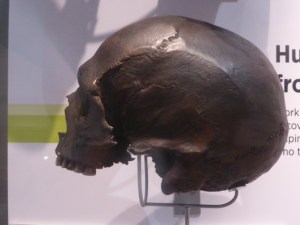
An antlered skull
over

a
slither
of eternity

two bare feet

the
grooving
splintering
of bone

plucked
from your crown
and worked

into
a point
of beauty
and

barbarity

killed
and killer
as one
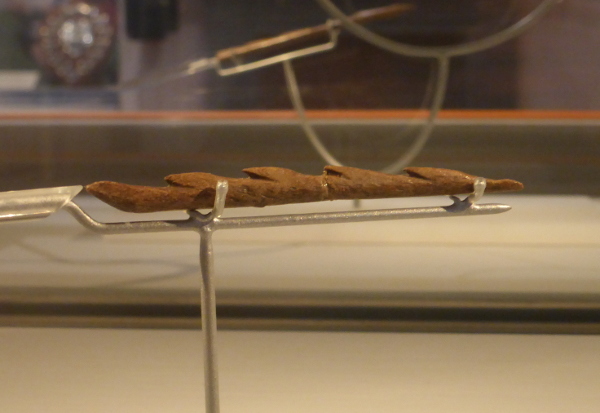
In 11,500BC Horace the Elk was killed by a combination of flint-tipped instruments and a barbed point that had lodged in his rib cage. Another barbed point was found embedded in the metatarsal bone in his left foot. The lesion formed around it suggests it had been there for around two weeks.

The barbed points used to kill Horace the Elk are the oldest known in Britain. Because they have only one barbed edge they are known as uniserial rather than biserial. Uniserial barbed points have been found across present-day England and Scotland and have been dated to between 11,500 and 8000BC.

All the barbed points were made specifically from red deer antler with a few examples from elk. I have been unable, as yet, to find out what material was used to killed Horace, but as elk and reindeer were the predominant species rather than red deer in 11,500BC, I suspect it was elk antler.

What intrigues me is the use of antler rather than other bones. This suggests antlers were chosen by the logic of sympathetic magic. As the primary ‘weapon’ of the elk and deer stags they were likely to have been seen as imbued with fierceness and strength and perhaps with the spirit of the dead animal.

Barbed points were made by the ‘groove and splinter’ technique. This involved cutting grooves lengthwise along the antler then splintering out long strips of bone. Afterwards, though processes of cutting, scraping, and filing, the barbs, tip, and haft were shaped before the point was fastened to its shaft.

For an animistic people this was no doubt a sacred process in which the maker of the barbed point engaged with the spirit of the dead animal and perhaps called for aid from the ancestors and hunter gods. A hunter deity may have been seen as a tutelary figure, perhaps part-human, part-animal, who passed on the knowledge of hunting to his or her people. The finished product would have been viewed as alive, inspirited, having its own personhood.

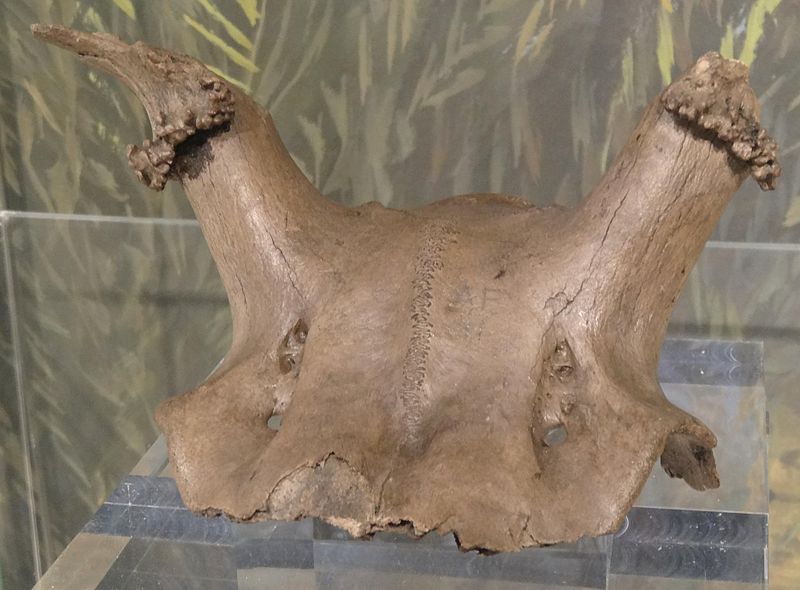
Barbed points have been referred to as ‘the dominant symbol’ of the Mesolithic like the stone axes of the Neolithic. At Star Carr, in the Vale of Pickering, in north Yorkshire, 191 barbed points were deposited in Lake Flixton along with 102 red deer antlers and 21 antler frontlets that may have been used in hunting rites. The points may have been made from the antler removed from the frontlets. Their return to their place of manufacture seems significant as does their ‘making whole’ by their deposition.

Star Carr was occupied from 9335 – 8440BC. It was a place where the identities of human and deer were intertwined. Where dead deer were brought to be eaten, barbed points for hunting deer were created from their antlers, and to which the points were returned. The start and end point of a cycle based around the lives and deaths of humans and deer.

The shift from the Mesolithic barbed point to the Neolithic axe as the primary deposition symbolises the change from the focus on hunting to shaping the land and from the use of bone to stone. Stone was no doubt easier to get hold of and perhaps stronger, but not linked to an animal. The sacred connection between killer and killed was severed and, with the later discoveries of bronze and iron, would not be revived again. An early step on the way to our loss of an animistic worldview and our relationship with the animals we kill and eat and with the hunter gods.

*My main source for this post was Benjamin Joseph Elliott’s massively informative PhD thesis ‘Antlerworking Practices in Mesolithic Britain’ (University of York, 2012).
The Hunting of Horace the Elk

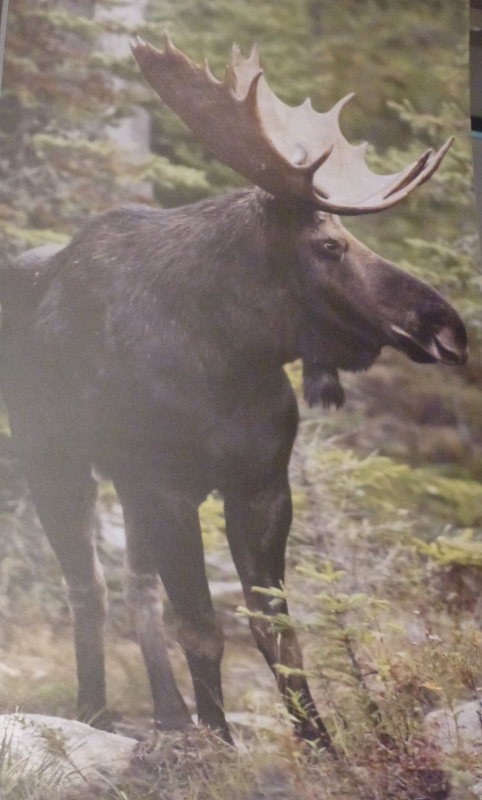
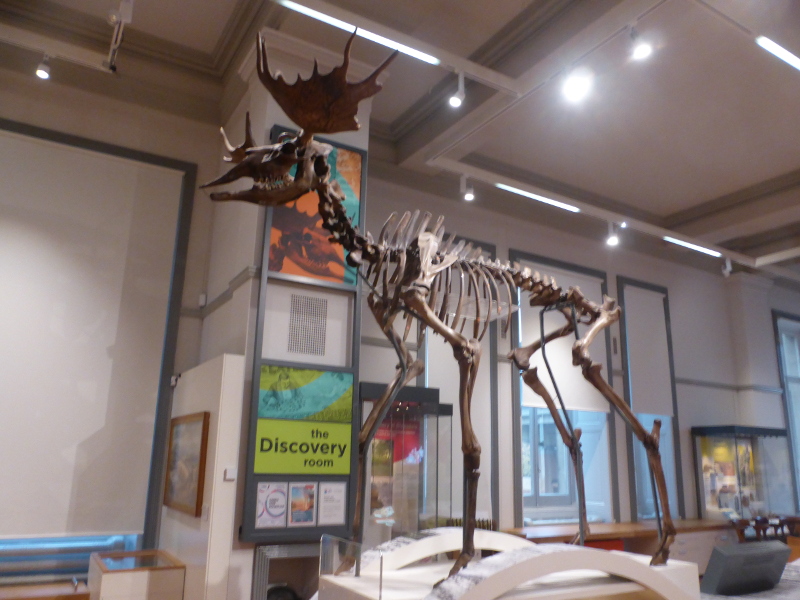
He’s the centrepiece of the Discover Preston Gallery at the Harris Museum. He’s become iconic. His skeleton stands at around 2m at shoulder height and he might have weighed up to 700kg. By his palmate antlers he can be identified immediately as alces alces – a Eurasian Elk. His bones have been radio-carbon dated to 11,500BC, making him one of our oldest ancestral animals at 13,500 years old.

The remains of Horace the Elk were discovered in the 1970s when John Devine of 365 Old Blackpool Road in Carleton, near Poulton-le-Fylde, demolished his old bungalow and began digging the foundations for his new home. He first spotted the skull and a broken antler. With help from his neighbour, Tony Scholey, and Jim Audus of Poulton Historical Society, followed by a more formal excavation carried out by John Hallam, Ben Edwards, Tony Stuart, and Adrian Lewis, Horace’s skeleton was recovered from layers of mud.

Examination revealed that he was four to six years old and, because he was due to shed his antlers, he was killed in winter. He had 17 injuries mainly caused by flint-tipped instruments to the ribs (highlighted by the triangles below).

Most intriguingly two barbed points were found. One of these was with a rib bone. The second was in the metatarsal bones in his left foot. The lesion, which would have taken 1-2 weeks to form, evidences that Horace was injured in an earlier hunt and had managed to escape his hunters on an earlier occasion.

Soil analysis revealed the presence of both ‘tree pollen’ and ‘tiny freshwater shellfish’ showing that Horace died in a shallow lake that was surrounded by trees. This suggests that Horace either fled into or was chased into the water and died from the collapse of his lungs caused by his injuries. Frustratingly for the hunters, but luckily for us, his corpse must have sunk before they could recover it.

Horace’s remains are of national importance because they provide evidence not only for the existence of elk around the end of the Ice Age, but also for our earliest local hunter-gatherer people who were known during the Iron Age as the Setantii and later as ‘the Dwellers in the Water Country’.

Elk became extinct in Britain in during the Bronze Age. The bones of the last known elk were recovered from the river Cree in Scotland in 1997 and have been dated to 2829-2145BC. In other countries of Europe such as Norway, Sweden, and Finland, they have survived, as well as in Asia and North America. Outside of Britain they are somewhat confusingly called moose whereas waipti are called elk.

When I began researching the lifestyle of elk I was fascinated to discover that, like our human ancestors, elk have been described as ‘semi-amphibious’. Their long limbs and broad feet make them particularly suited for traversing wetland landscapes and they are able not only to swim through water but dive down underneath it and eat submerged plants at depths of up to 5 metres below the surface!

At this time there would have been a mixture of birch-pine woodland, alder carr, fen woodland, reed beds, and reed swamp at the edges of the glacial lakes. Through the summer months elk would have fed on aquatic plants and in the winter they would have survived on the twigs and bark of trees. Elk are capable of rearing up and pulling down trees of up to six foot tall to access new growth.

The rutting season for elk is early September to late November. During displays they approach their rivals, tipping their antlers left and right, and calling in rhythm to their steps. Once they’ve defeated their rivals and mated their testosterone levels fall and they lose their antlers. It was at this point in his life that Horace was killed. Calves are born between April and July. The cows are fiercely protective of their offspring having been known to ‘face down wolves, bears and even helicopters’. It is possible that Horace’s sons and daughters wandered this land for several thousand years.

The severity of Horace’s injuries provides evidence both for the determination of the hunters and his will to survive. He was firstly injured by the barbed point of a harpoon which had stuck in his left foot, managing to limp away and survive for 1 – 2 weeks before the second hunt. It seems likely the flint-tipped instruments which struck his ribs were spears and additionally the barbed point of a harpoon lodged in his rib cage. David Barrowclough also speaks of an injury with an axe severing his tendons suggesting that his hunters, at one point, got very close. Perhaps this was how they managed to strike him 17 times in total before he dived, fell, or was chased into the lake.

A male elk in his prime would have been a prized kill. His massive body would have provided food for days, his thick hide clothing, and his bones may have been used to make more barbed points or perhaps elk bone mattocks akin to those used by the people of Star Carr 1000 years later.

How those ancient hunter-gatherers would have viewed these magnificent animals remains unknown. The deer-antlered headdresses from Star Carr are suggestive of rites in which the hunters became one with the animal they hunted, knowing it intimately, acting out its behaviours. It is possible they believed acting out a successful hunt would bring about success in he future.

Of course it’s less likely similar elk dances would have taken place due to the fact elk antlers could grow up to two metres and would have been incredibly heavy. Yet they would have been familiar with the elk’s lifestyle and one can imagine that the preparation for an elk hunt and the hunt itself were highly ritualised acts dependent on the will of the elk as a physical and spirit being and the guidance and support of the hunter deities.

Unfortunately, if a sacred and reverential relationship between elk and humans existed, it did not prevent the extinction of elk from Britain. They died for two main reasons. The first was that the weather grew too warm for them as thick-hided cold-adapted creatures used to surviving snows. They no doubt survived in Scotland for longer because it is cooler. The second reason was human hunting. If the ancient hunter-gatherers were aware of their plight they did not place it above their own needs. Like the equally monumental aurochs they hunted them into extinction.

Elk have not been seen in the British Isles for more than 3000 years. However they were reintroduced at the Alladale Wilderness Reserve in the Scottish Highlands in 2007. A pair were flown by plane from Scandinavia and their first calf was born in 2011. It has been predicted that they will not only enhance biodiversity but tourism and opportunities for hunting in the area.

SOURCES

Alexander Fraser, ‘Country life today: how elk could save the Scottish countryside’, Country Life, (2019), https://www.countrylife.co.uk/news/country-life-today-may-31-2019-197056 (accessed 26/11/2019)
Benjamin Joseph Elliott, ‘Antlerworking Practices in Mesolithic Britain’ (PhD Thesis), University of York, (2012)
Clive Aslet, ‘After 3,000 years, the Highlands delivers a bonny baby elk’, The Telegraph, (2011),https://www.telegraph.co.uk/news/earth/countryside/8555072/After-3000-years-the-Highlands-delivers-a-bonny-baby-elk.html (accessed 26/11/2019)
David Barrowclough, Prehistoric Lancashire, (The History Press, 2008)
Boards at the Discover Preston display in the Harris Museum

*With thanks to the Harris Museum for the information and the images.

Penwortham Lake Dwelling

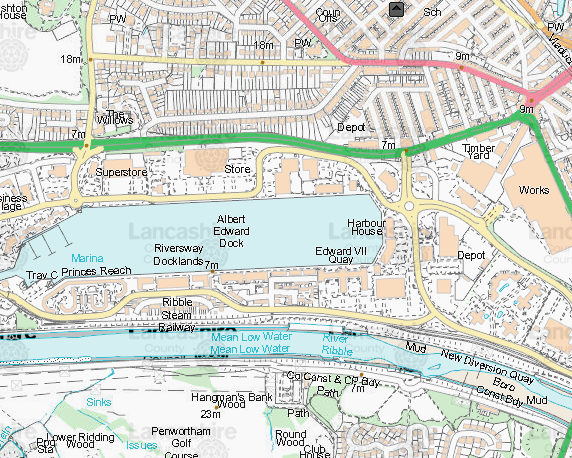
Stand on the mound on Castle Hill, look northwest, and you will see a very different scene to 150 years ago. The flats and retail outlets visible through the gaps in the trees were built after the closure of Riversway Dockland in 1981. The dock closed after only 100 years of use, having been constructed during the 1880s. During its construction the Ribble was moved several hundred yards south.

Today – courtesy of Mario Maps

OS First Edition 1:10,000 1840s courtesy of Mario Maps

Beforehand you would have been looking out across the fields of Marsh Farm and Marsh Grange toward Penwortham Marsh, the distant Ribble, and across it Preston Marsh and the settlement at Marsh End. This landscape, in turn, would have been different to 400 years ago before the marsh was drained.

Since the melting of the glaciers after the Ice Age the tidal stretches beside the Ribble would always have been marsh. Archaeological evidence suggests people have inhabited this area since, at least, 3800BC.

The excavations for Riversway Dockland uncovered evidence of a wooden lake dwelling. A ‘platform some 17m by 7m in extent… formed of brushwood set amidst piles’, a bronze spear head, two dug-out canoes, 23 human skulls, 21 aurochs skulls with horns, 25 red deer skulls with antlers, and bones of wild horse which showed evidence of ‘chop marks’ and gnawing ‘by a large, dog-sized predator’.

John Lamb lists the Preston Docks Findspot as SD12296, meaning it would have been in the northwest of the present dock area, adjacent to the roundabout. Turner et al note that ‘remains were found at various points in the total area excavated’ including ‘two human crania found close to Castle Hill on the south side of the river’.

Riversway Dockfind Spot

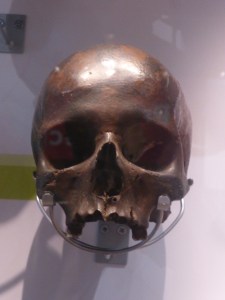
For many years it was the consensus that the human skulls provided evidence of human sacrifice – perhaps a mass murder. In 2002 eight skulls were selected for radio-carbon dating. It turned out that five were Stone Age, one Bronze Age, one from the Romano-British period and one from Anglo-Saxon times.

The latest theory, put forward by Dr Michael Wysocki, is that these people were not sacrificed on Penwortham Marsh. Instead they entered the river system miles away. Their heads settled at a slow-flowing point in the Ribble, a tidal lake, and their bodies floated out to sea. Likewise with the animals. Yet the large number of Stone Age skulls suggests that Neolithic people used the river to dispose of their dead. Even accepting this theory I believe it possible some of the human and animal skulls may have belonged to the lake-dwellers and been deposited in the Ribble in ritual acts.

The carbon dated skulls provide a sample of people who dwelled by the Ribble from between 4000BC – 800AD. The oldest skull, of a ‘mature woman’, is dated to 3820 – 3640 BC. ‘Pitting in the orbit of her left eye’ suggests she ‘suffered from anaemia’. Another, dated to around 3,500 BC, belonged to a man of around 40.

Two of the Stone Age skulls show evidence of violent deaths. An ‘older man’ was killed with a stone axe. The skull of a young woman, dated 3710 – 3510 BC, shows ‘clear evidence of trauma to the right and back of her skull’. This surprised me as I’d thought of Stone Age hunter-gatherers as peaceful people.

Yet it would accord with Roman depictions of the people of Briton and Gaul as savage head-hunters and with poems recording the internecine warfare and raiding that took place in post-Roman Britain. (Notably the northern British bard, Taliesin, describes warriors playing football with the heads of their enemies!). Andrew Breeze has suggested that the root of Setantii set- derives from met- ‘reaping’. In medieval Welsh literature we find a tradition of warriors favouring lethal blows to the head*.

The Romano-British skull is small with ‘distinctive male eyebrow ridges’. It is unclear whether its owner was male or female, Roman or British. However, he or she was killed by ‘a pointed object such as a spear passing through the open mouth and into the skull.’ I wonder if she was killed in the Roman invasion. A Roman ballista ball was found on Castle Hill, suggesting there was a battle there.

The owner of the skull from the Anglo-Saxon period, a female aged between 16 and 25, also died violently. There is evidence of a cut across her face, damaging her right eye, and a lethal blow to the head. Again it seems possible this woman was killed during the invasion of the Anglo-Saxons.

The dock finds show our local lake-dwellers were fearsome warriors and hunters who travelled the Ribble in dug-out canoes and preyed on aurochs, red deer, and and wild horse. After eating them they probably skinned them and used their skins for clothing. Oddly ‘the carbon 13 readings show that their diet consisted of meat and vegetables – but no fish, despite being found near a river’. This fits with the 3rd century Roman writer Dion Cassius’ report: ‘They never cultivate the land, but live on prey, hunting, and the fruits of trees; for they never touch fish, of which they have such prodigious plenty’.

It seems very strange that these people did not eat fish when they were plentiful in the Ribble. I wonder whether this is because it was used to dispose of the dead and to eat from it was seen as taboo. We know from the Roman geographer Ptolemy’s writings in the 2nd century that the Ribble was known as Belisama ‘Most Mighty One’ or ‘Most Shining One’ and was seen as a powerful goddess. Maybe fish were held as sacred to her and ‘totemic’ to the lake-dwellers and were not to be eaten.

Setanta, an Irish hero who may have been of Setantii origins, was later renamed Cu Chulainn (meaning Chullain’s hound). The dog was sacred to him and he was banned from eating dog meat. Breaking this geis led to his death. Perhaps the the lake-dwellers saw fish in a similar manner.

Upriver, between the docks and Castle Hill, on the former site of the Ribble Generating Station stands a ring of wooden carvings – a common darter dragonfly, a brown trout, an otter, a smooth newt (which has been stolen!), and a tawny owl. These creatures have likely inhabited the area since the Stone Age and would have been held as special beings to the lake-dwellers too. I wonder if they recall their stories?

*‘he (Geraint)… raised his sword and struck the knight on the top of the head his head so that all the armour on his head shatters and all the flesh splits, and the skin, and it pierces the bone and the knight falls to his knees.’ (Geraint son of Erbin)

‘Peredur drew his sword and struck the witch on top of her helmet, so that the helmet and all the armour and the head were split in two.’ (Peredur son of Efrog)

SOURCES

Andrew Breeze, ‘Three Celtic Toponyms: Setantii, Blencathra and Pen-Y-Ghent’, Northern History: XLIII, 1 (2006)
Alan Turner, Silvia Gonzalez and James C. Ohman, Journal of Archaeological Science, ‘Prehistoric Human and Ungulate Remains from Preston Docks, Lancashire, UK: Problems of River Finds’ (2002)
John Lamb, ‘Lancashire’s Prehistoric Past’, Linda Sever (ed), Lancashire’s Sacred Landscape, (2010, History Press)
Meirion Pennar, Taliesin Poems, (Llanerch Enterprises, 1988)
Sioned Davies (transl.), The Mabinogion, (Oxford University Press, 2007)
Discover Preston display in the Harris Museum, Preston (with thanks to the Harris for the information and permission to use the photographs of the Riversaway Dockfinds in this blog posts).