Words Found in Stillness

In stillness
strength

in strength
courage

in courage
the will

to serve you
mind body soul

when yours at one
in stillness

I wait to know
your will

***

Of all the challenges in my life that are linked to my path of devotion to Gwyn – poetry, running, fighting, the restoration of wild places and creatures, learning practical skills out in the woodlands – the one that requires the least is probably the hardest, that is spending time in stillness and silence listening.

There’s seldom anything to show from it. Few ways to express the feeling of simply being in the presence of a god yet the subtle realignments of the soul that take place in such a state are slowly revealed.

In moments where once I’d have panicked I find myself falling back instead on those moments of stillness, find my strength in the strength of the bull-horned warrior-hunter god who works tirelessly to gather the souls of the dead back into his realm. I’m beginning to understand that, having led me to my spiritual path, gifted me with its magical core, given me a reason to live, he is now teaching me the means of survival and opening up possibilities of me finding a place within the wider world.

Where exactly that will be I’m not sure but I’m coming to know I’m heading in the right direction when I can find stillness, when my breath is one with my god’s, when my will is aligned with his will.

The Forge of Gofannon

Do you sense your maker, world?
Friedrich Nietzsche

My surname is Smithers. On and off I’ve been aware of the presence of a smith-god. The sound of hammer blows in the back of my mind. A vision of a forge at the fiery core of the world. The chisel-strokes of Nietzsche’s world-artist working in the Blakean moment between Thisworld and Annwn, beyond good and evil, where there is no past or future, but only the eternal of now creation. Making artefacts of great beauty, world-shattering technologies, weapons that are unconscionable, a dire world.

Over the past few years, as I have been working with the Brythonic mythos, Gofannon has been appearing in my stories forging important treasures – Caledfwlch (the sword of King Arthur), the Shield of Urien Rheged, the golden ring of Gwyn ap Nudd and the horse shoes for his horse.

The art of smithing is seen in most cultures as a magical process which literally transforms the world. It brought into being the Bronze Age and Iron Age and played a major role in the Industrial Revolution and Information Age. The smith is a central figure in many world myths. Yet, surprisingly little is known about Gofannon, our Brythonic smith god. This article summarises our knowledge from the Welsh myths and uses Irish parallels and modern gnosis to illuminate this ancient figure at his forge.

***

We know Gofannon is a smith-god as his name derives from the Middle Welsh gof ‘smith’. In Culhwch and Olwen his aid is required to set the plough used by his brother, Amaethon, the god of agriculture. This shows that, like the other children of Don, he was seen as skilled and as a culture god.

This is supported by lines in ‘The First Address of Taliesin’ where the legendary bard says:

I’ve been with skilful men,
with Math Hen, with Gofannon,
with Eufydd, with Elestron,
I’ve been party to privileges.
For a year I’ve been in Caer Gofannon.

In the Fourth Branch of The Mabinogion, Gofannon inexplicably kills his nephew, Dylan, the daughter of Arianrhod, who can swim ‘as well as the best fish in the sea’. This is named as one of ‘Three Unfortunate Blows’. Why he does so is never explained. However, we can go some distance to finding an explanation through a comparison with the story of Gofannon’s Irish cognate, Goibnu.

In the Lebor Gabála Érenn, Goibniu is the metalsmith of the Tuatha Dé Danann, the Children of Dana. Like the children of Don possessing skills is intrinsic to their identity as culture gods. With Credne the silversmith and Luchta the carpenter Goibnu is one of Trí Dée Dána ‘three gods of art’. Goibniu is the half-brother of Brighid. Their mother is Dana and their fathers are Tuirbe Trágma and the Dagda.

Brighid has a son with the Formorian, Bres, called Ruadan. During the Second Battle of Moytura, which takes place between the Tuatha Dé Danann and the monstrous Formorians, Ruadan is sent by the Formorians to find out the secret of how the craftsmen of the Tuatha Dé Danann make their weapons.

Ruadan finds Goibniua at his forge crafting lance-heads with three blows of his hammer, Luchta cutting shafts with three blows of his axe, and Credne fixing the two parts together. After he reports back, Ruadan is sent by the Formorians to kill Goibniu.

Ruadan goes to the forge and asks Goibniu for a spear. Goibniu, unsuspecting, gives a spear to him. Ruadan thrusts it through Goibniu and, to his surprise, the smith-god plucks it out and hurls it at Ruadan, who is mortally wounded, and returns home to die. Brighid mourns Ruadan and this is the origin of keening.

One wonders whether a similar story lies behind Gofannon’s slaying of Dylan with Arianrhod replacing Brighid/Brigantia as his mother. It certainly seems to be no coincidence that Arianrhod’s second son, Lleu, is mortally wounded by Gronw, his rival for his wife, Blodeuedd, with a poisoned spear.

This spear is crafted by a smith (it does not say by who) when ‘people are at Mass on a Sunday’. This is suggestive of a pre-Christian forger working at a liminal time. Lleu then, in turn, strikes a mortal blow to Gronw with his spear. This exchange is not unlike that between Ruadan and Goibniu. That Gofannon is a forger of spears is backed up by lines from ‘The Dialogue of Myrddin and Taliesin’. The ‘seven spears of Gofannon’ are used at the devastating and futile Battle of Arfderydd.

***

In support of the existence of an earlier variant of the story of Gofannon killing Brighid/Brigantia’s son I would like to mention the personal gnosis of Potia Pitchford – a modern devotee of both these deities.

Potia and I were (virtually) together in a guided meditation led by Gemma McGowan at a conference on Brighid earlier in the year. This involved meeting the goddess at a forge deep within the land. Potia had a powerful experience which involved not only Brighid but Gofannon. In her blog post ‘Marked by Gofannon’ Potia writes of Gofannon holding her whilst Brighid pulled from her ‘what was needed to be reworked’ and placed it back inside her in three parts – ‘one band for each of three cauldrons’. Finally Gofannon placed an inch-wide copper band on her upper arm. This led to her to her getting the armband created as an item of devotional jewellery by Runecast Copper.

Potia’s vision of Gofannon and Brighid/Brigantia working together at this forge in the core of the earth spoke deeply to me. I’m tempted to see Brighid/Brigantia (who is both a smith and a poet) and Gofannon as the forces of creativity and smithing that shape our world and its technologies for good and for ill. As I work I am aware of their presence in the words I type and the laptop I type them on.

If Gofannon and Brigid/Brigantia are co-forgers, then Gofannon’s slaying of her son, perhaps as the result of an attack, would certainly add a layer of tragedy and poignancy to their relationship.

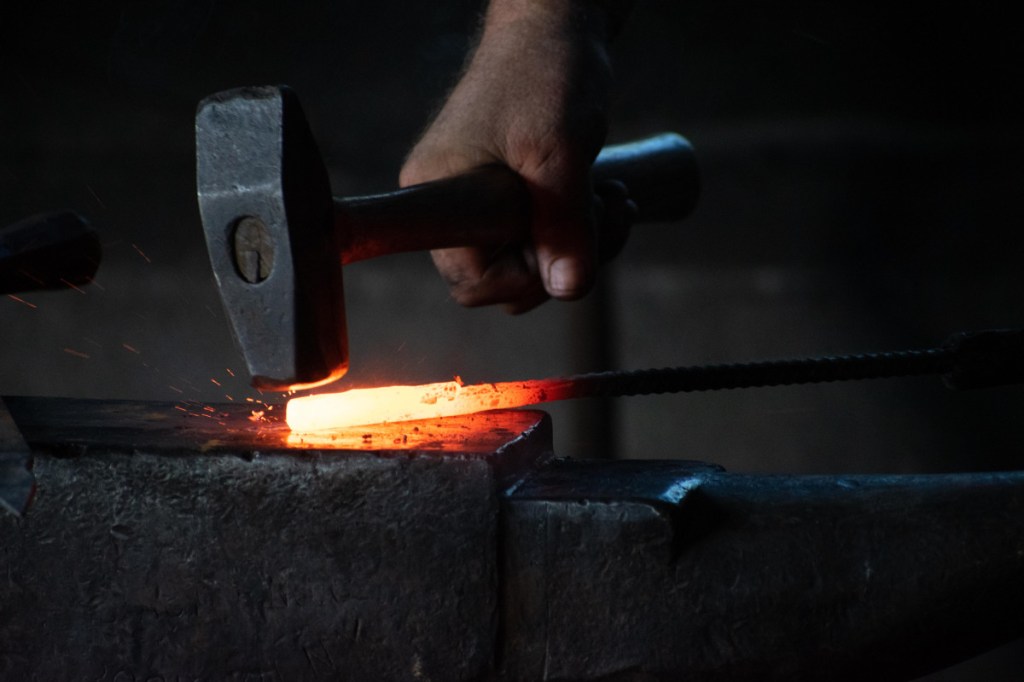
*With thanks to Hannah Gibbs for the image ‘Blacksmith‘ on Unsplash.

The Death of a Dragonfly

Dyed he is with the
Colour of autumnal days,
O red dragonfly.
Hori Bakusui

It was an accident. Still, if I’d accidentally killed a human I’d have been jailed for murder. I’m often killing midges, greenflies, flies, as I cycle down the Guild Wheel along the Ribble to Brockholes Nature Reserve. Not on purpose of course – they just have a terrible habit of getting in my eyes, in my mouth, down my top. It’s said there were more flying insects before cyclists, cars, climate change…

I’m not sure why killing a dragonfly somehow seems worse than killing all those tiny things. I didn’t even see him. I was too busy thinking about the fantasy novel that I was planning to set in a marshland and how the flora and fauna of Brockholes, as a wetland nature reserve, might inspire me.

Thinking not listening. There was just a buzzing at my neck and a kind of crackling against my skin. Without thinking I swatted at it compulsively, then stopped in a panic, fearful of what I’d done. Looking down, for a moment I felt relief, seeing what looked like a twig before I realised it was a ruddy abdomen. Severed from it a furred red-brown thorax, two cobwebby filmy wings, and a head with two huge dark red globular eyes and three small eyes that, between them, didn’t see me coming.

I didn’t know what he was right then, that he was a he, or a common darter. Only that I’d killed a dragonfly. I laid the broken pieces at the side of the cycle way with an apology to dragonfly kind and rode onward more slowly, more aware of other ruddy darters rising from where they were basking on the path. After I’d arrived, locked up my bike, they haunted me for the short period I was there. Flying in front of me, landing on the wooden walkways and handrails.

One, in particular, caught my eye. Beholden by the huge round portals of his eyes I drowned in the utter inadequacy of not knowing what he was thinking. Did he know I was a murderer? Did he know what I was? Could he sense my awkward reaching? My overall impression was one of curiosity. That it seemed likely he was thinking dragonfly thoughts distant from my own – trying to place this gigantic monster with its small eyes within his brief sunlit world of eating and flying and mating.

Dragonflies are old. The oldest fossils date back to the Carboniferous period – 350 million years ago. They spend most of their lives as nymphs, living for up to four years in muddy waters. They then crawl up the stem of a plant and shed their nymph-skin, emerging as dragonflies, leaving behind the exuvia. In the brief six months of their adult life they feed on smaller flying insects and find a mate, in an acrobatic display forming a spectacular mating wheel, then afterwards the female lays her eggs on the leaves of plants or in the water. Death follows shortly and the life cycle begins again.

It’s impossible to know if that dragonfly had fulfilled his life’s purpose before I killed him. And, of course, in that all-too-human way that has reduced the earth and its creatures to resources, I’m searching for a meaning, like nature is here to teach us lessons. I can’t help it. That’s human nature.

And it’s pretty obvious, slow down, listen, maybe just maybe I’m heading off on the wrong path trying to write a fantasy novel about an imaginary marshland when our existing wetlands need our voices. Making up new creatures when it may be more valuable to introduce people to Sympetrum striolatum ‘common darter’, Sympetrum sanguineum ‘ruddy darter’, Anax imperator ‘emperor dragonfly’.

This is leading me to think that, rather than writing second world fantasy, I might be best off writing a novelset in this landscape, but further back in time. Not only before the wetlands, the marshes, the peat bogs, the lakes, were drained off, but before the people lost their spiritual relationship with the land.

I’ve long been drawn to the archaeological evidence for the ancient marsh-dwellers in my local area. During the Romano-British period they were known as the Setantii ‘The Dwellers in the Water Country’ but had lived here far longer. Here, on Penwortham Marsh (now drained) and not far from the river Ribble (now moved) they had a Bronze Age Lake Village evidenced by the remains of a wooden platform, dug-out canoes, a bronze spearhead, 30 human skulls, and skulls of aurochs and deer. There were numerous other settlements such as those beside the great lakes Marton Mere and Martin Mere (now drained), wooden trackways such as Kate’s Pad, and the (now lost) Port of the Setantii.

If I was to write about that time, rather than making up critters and magic and gods and monsters, I would be able to draw upon the real magic of an animistic and shamanistic culture rooted in a lived relationship with the ‘water country’ – its reeds and rushes, its wetland birds, its dragonflies and damselflies. With the spirits of the ancestors, gods we know throughthe Romans, such as Belisama and Nodens, and those who are unknown such as the goddess I know as Anrhuna, Mother of the Marsh.

That dragonfly was one of her children perhaps. She who has been here as the marshland since, at least, the thaw of the Ice Age and thousands of years of water country, these last four centuries of its draining off, and is still here in the last remnants preserved by wetland nature reserves such as Brockholes.

Would it be too very human to read, in an unlucky accident, a message from a goddess?

O red dragonfly,
Colour of autumnal days,
Dyed he is with the

Mother of the Marsh
Returned to mud and water
Rest well O red one.

***

Those who follow this blog will note this event has led me to returning to its old name ‘From Peneverdant’. This was the name of my hometown of Penwortham in the Doomsday Book and signals a homecoming from an exodus through Welsh mythology and Annwn. It makes sense in relation to my lifelong dedication to Gwyn, here, in January.


In Moments of Terror

For beauty is nothing but the beginning of terror
which we are barely able to endure, and it amazes us so,
because it serenely disdains to destroy us
– Rilke

I grew up with negative connotations of prayer and still do not fully understand what it is, only that I prayed reflexively at frightening times in my life and someone answered. It was a long while until I found out who that was, began exploring prayer as a regular practice, and came to realise prayer is a fundamental means of reaching out to the gods essential to our being.

Brought up in a nominally Christian family I was never forced to pray, but vaguely recall sleeping at a friend’s house and both us having to say ‘The Lord’s Prayer’ before we went to bed. We jabbered through it as quickly as we could, not thinking about its meaning. She thought God was called Harold, mistaking ‘hallowed’ for ‘Harold’ in ‘hallowed be thy name’.

I went to Sunday School and attended church parade at St Leonard’s C of E Church with Brownies. Some part of my soul rebelled against the rigid services, punitive black-and-white theology, and the patriarchal presence of the Christian God. Eventually I refused outright to go.

Refusing to worship Jahweh I considered myself an atheist for a number of years even though I was looking for something… somebody… I was drawn to the deities of our world myths, but the mainstream worldview taught they belonged to a naive past, even though I could sense their presences dancing in the back of my mind like sunspots long after I’d put down a book.

Without knowing of the existence of modern Paganism or Polytheism I had no context for the sense of the divine I felt in the landscape, for otherworldly experiences some beautiful, some troubling. In moments of terror I prayed although I did not know who I was praying to.

The root of ‘prayer’ is the Latin precarius, ‘obtained by treaty’, which gives us ‘precarious’, suggesting such treaties are made in ‘risky, dangerous, uncertain’ situations. Non-religious people often pray when their lives or those of their loved ones are threatened; like it’s a base instinct, a mechanism deep-wired within our souls to reach out to the divine when faced with peril.

At times when I had panic attacks or thought I was going mad I prayed. Driving on the motorway in the midst of panic, thinking I was going to lose consciousness or control, I felt strangely held. Despite fears I would never get back I always did. When I was convinced I was mad, that I couldn’t tell what was real and what was not anymore, into my mind came the words, “So you’re mad, what difference does it make?” (I’d thought this was a quote remembered from Nietzsche, who walked with mad gods, but have never been able to find it). Nothing, I realised, nothing at all, and since then madness has held no fear for me.

It wasn’t until I was thirty I met the god who was behind my visions of the Otherworld; who’d led me a chase through poetry, philosophy, drink, dancing, to the brink of the abyss and back: Gwyn ap Nudd, the Hunter, Rider of Insomniac Nights, Gatherer of Souls, Light of the Mist.

This happened at a nadir of despair. After failing to become a philosophy lecturer and succeed in a career with horses, I had realised the fantasy novel I spent two years writing was unpublishable. I couldn’t think of anything else I wanted to do with my life or any reason to go on. Yet something within me put out an entreaty, ‘a cry from the heart’. Summoned by tolling bells I went to weep beneath a leaning yew tree at an old fairy site and sang a sad song.

Leaning Yew

When Gwyn appeared to me I was struck by a sense of awe bordering on panic by his terrible beauty:

His spectral shine shimmers white as moonlight
His hair floats fair about his phantom limbs
His warrior attire is black as night.
The eyes of the hunter of souls are grim
As the howl of his hounds on Annwn’s winds.

This was followed immediately by recognition. It was he who swept me away on the winds of terror like the riders on his hunt – I often felt like I was flying ‘between sky and air’ – yet also held me and taught me I was safe. He was the storm and the calm at its centre. He, the god of the dead, the mad, and poets, was the source of the words that cured my fear of madness. He was the somebody I’d always been looking for. Always. Since the beginning of time.

Some soul-deep entreaty/prayer had been answered. A treaty between us soon followed. I dedicated myself to Gwyn as my patron, vowing to honour him daily, stand by my truth, and walk between Thisworld and Annwn (the Brythonic Otherworld which he rules) with reverence. I became his awenydd ‘person inspired’ and have been praying to him every day since.

My initial cries of “Please, please, please help me!” opened a gateway of communication between my god and I, unlocked my heart to the divine, to sacred relationship. In Judaism prayer is defined as ‘a service of the heart’ (from Deuteronomy ‘You will serve God with your whole heart’), describing beautifully the depth of service my knee-jerk prayers have led to.

Not only do I pray to Gwyn for inspiration and guidance, but I see my role of journeying with him between the worlds to recover the lost stories of my landscape from the mists of time and reveal the roots of his forgotten myths as a heartfelt and prayerful process essential to my being.

Sadly, in secular society, even when prayers are answered too few of us question by whom or fulfil our side of the treaty. Our potential for relationship with the divine – to reach outside our everyday lives and enter the service of somebody or something greater – remains unfulfilled.

Obscured by oppressive state religions and secular norms our ability to pray remains dormant until precarious times when somebody opens a door. Could it be that we are fundamentally prayerful creatures? That prayer is the heart-root of all purpose, meaning, our relationships with the gods?

*This article was published in ‘People of Prayer‘, Isis-Seshat, Issue 41, Vol. 13, Spring 2018
**I will be speaking on ‘Becoming a Devotee of Gwyn ap Nudd’ at the Pagan Federation North West Conference at Preston Grasshoppers on Saturday.

Gwyn’s Feast

Gwyn ap Nudd is a god of the dead and ruler of Annwn. As the Brythonic leader of ‘the Wild Hunt’ he gathers the souls of the deceased back to his realm to be united in an otherworldly feast. This repast of the dead can, at certain times of the year, be participated in by the living.

Unfortunately this is a tradition that Christians went to great lengths to bring to an end. This article will introduce the evidence for Gwyn’s Feast, how it was abolished, and how it can be reclaimed by modern polytheists.

*

In ‘The Spoils of Annwn’, as Pen Annwn, ‘Head of the Underworld’, Gwyn presides over a feast in Caer Vedwit, ‘The Mead-Feast Fort’. At its centre is the cauldron of Pen Annwn, with its ‘dark trim, and pearls’, which ‘does not boil a coward’s food’: a vessel symbolic of rebirth.
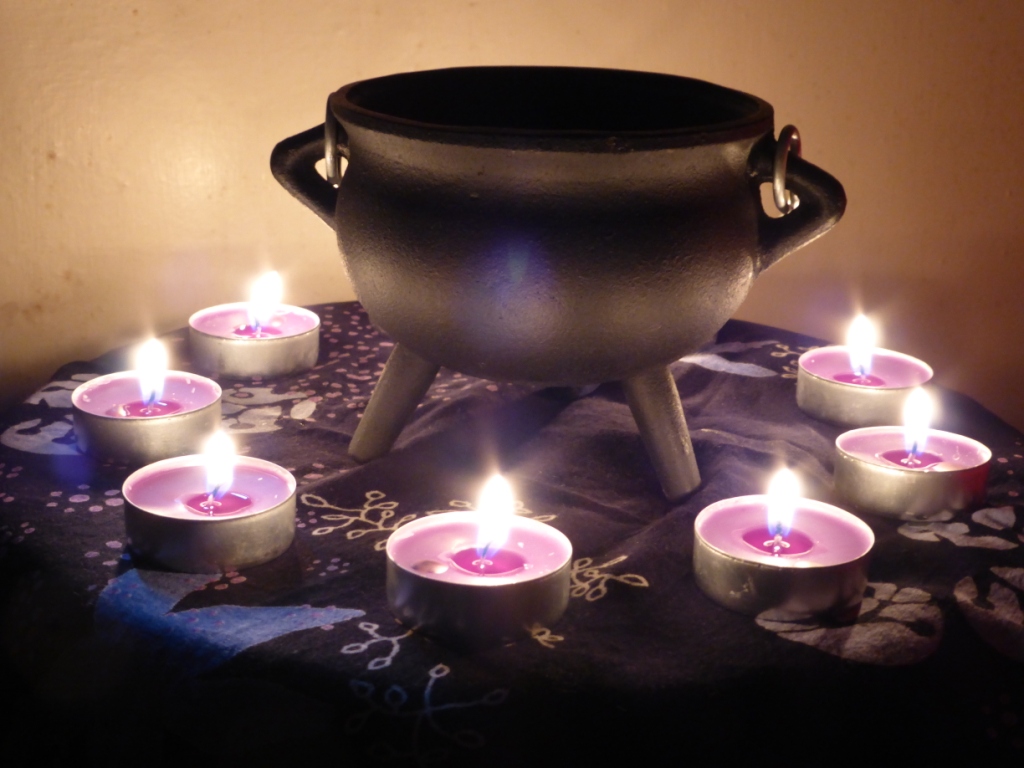
Cauldron

Arthur raids seven Annuvian fortresses, confronting six thousand speechless dead men, inflicting violence on ‘the honoured and fair’ and stealing the Brindled Ox, kidnapping a bard called Gweir, and stealing the cauldron of Pen Annwn before slamming ‘Hell’s Gate’ shut.

I believe Arthur’s raid on Annwn replaced an earlier tradition of the soul’s return to the underworld and journey through seven fortresses (which are faces of the same fort) to Gwyn’s Feast and the Cauldron of Rebirth. Arthur’s defeat of Gwyn and his people and theft of his cauldron represent the triumph of Christianity over the pagan mysteries of death and rebirth.

This story is paralleled in Culhwch and Olwen, where Arthur raids Gwyn’s fortress to rescue Gwyn’s rival, Gwythyr, and his army (who include Graid who might be equated with Gweir), and steals a number of otherworldly treasures including the Brindled Ox and a magical cauldron.

Arthur also usurps Gwyn’s hunt for Twrch Trwyth, ‘King of Boars’, ‘a king and for his sins God changed him into a swine’. This thinly disguises that Arthur takes leadership of Gwyn’s hunt for a human soul in boar-form – ‘the Wild Hunt’ – reducing it to just a boar hunt and again obscuring pagan traditions.

*

Glastonbury Tor Calan Mai 2013

Gwyn is intimately associated with Glastonbury Tor. Excavations have revealed the existence of a building with several hearths dating to the 5th – 7th century. Two north-south aligned graves (not Christian) nearby along with an empty stone cairn and helmeted bronze head with ‘a narrow face’ and ‘slit mouth’ in the ‘long’ Celtic style suggest it may have been a pagan temple.

Bones of cattle, sheep, and pigs, from joints of meat, and Mediterranean amphorae (large jugs for holding wine) suggest feasting took place at this temple on the Tor; a liminal place where Thisworld and Annwn and the living and the dead meet in revels presided over by Gwyn.

Several pernicious accounts in saints’ lives record Christian attempts to abolish this tradition. In The Charter of St Patrick, Patrick and his brother Wellias climb the Tor and find ‘an ancient oratory’. There they fast for three months ‘dominating the devils and wild beasts’ and are rewarded with a vision of Jesus telling them to claim the place in his name and invoke St Michael.

In The Life of St Collen, Collen, Abbot of Glastonbury, derides Gwyn and his host as ‘devils’. When Gwyn invites him to the summit of the Tor to feast in ‘the fairest castle he had ever beheld’, Collen refuses to ‘eat the leaves of trees’, says the red of Gwyn’s people’s clothing signifies ‘burning’ and the blue ‘coldness’, then supposedly banishes them with holy water.

Gwyn appears as Melwas (1) in The Life of Gildas, where he violates Arthur’s wife, Gwenhwyfar, and carries her off to the Tor, which is well fortified by ‘thickets of reed, river, and marsh’. Gildas sides with Arthur and wins Gwenhwyfar back. The tradition of ‘Arthur’s Hunting Path’ from Cadbury to Glastonbury and his burial further illustrate his replacement of Gwyn.

*

The tradition of invoking St Michael on Glastonbury Tor continued. In the 11th century a wooden church dedicated to him was built on the summit. In 1243 Henry III granted permission for an annual fair to be held there for six days around the Feast of St Michael, September 29th.

It is likely St Michael’s Feast replaced a feast day for Gwyn. The 29th of September was the final day of bringing in the harvest. In Cornwall, September is known as Gwynngala, ‘White or Blessed Fields’, a name which contains suggestions that Gwyn, a death-god, is associated with reaping and celebrations for him were held when the fields were cleared at the month’s end.

This date has also become attached to St Michael’s defeat of Satan in a war of Heaven and banishment of him to Hell. It seems this Biblical story was recalled to reinforce St Michael’s defeat of Gwyn on his feast day. According to a folkloric tale the Devil first fell to earth and landed in a blackberry bush and spat or urinated on the blackberries, explaining why they go rotten.

Gwyn was identified with ‘that ancient serpent called the Devil’. This is not surprising as Gwyn’s father, Nodens/Nudd/Lludd is associated with two dragons and Gwyn’s dog, Dormach, ‘Death’s Door’, has two serpent’s tails. It may be suggested Gwyn took serpent-form (2).

On the tower of the 14th century stone church on Glastonbury Tor (the wooden one was unsurprisingly destroyed in an earthquake in 1275!) is an image of St Michael with a set of scales weighted toward him, rather than his opponent, the Devil-as-serpent. St Michael’s taking souls to heaven and weighing them forms an antithesis to Gwyn gathering souls to Annwn where all are united at his feast without moral judgement.

St Michael, Scales, Dragon, Glatonbury Tor 2013

*

I’ve been celebrating Gwyn’s Feast on the 29th of September since 2013 as a way of reaffirming his presence in the place of Arthur and St Michael, who has taken over many other sites sacred to Gwyn and the spirits of Annwn/the fairies, including some in Lancashire (3).

When I asked Gwyn if I could celebrate a feast for him on this date, he agreed. Since then I’ve been joined annually by a friend, and Dun Brython members such as Greg Hill and Lee Davies have held their own celebrations. This year I know of several other devotees of Gwyn, who I’m in contact with online, who will be celebrating Gwyn’s Feast.

A meal I have developed and found Gwyn is happy with (4) is pork with apple sauce, a glass of mead, and offerings of meat for his hounds and apples for his horses. I open the feast by calling to Gwyn and his spirits and acknowledging the connection with all who have feasted with him in the past and those who are feasting with him on September the 29th today. Then we eat.

After the meal I read prayers, poems, and stories, which have been written for Gwyn or remind me of him by myself and others. This is followed by some form of communion with Gwyn such as divination, journeywork, or quiet contemplation. Rather than saying farewell I end by welcoming Gwyn and his spirits back into the landscape as we enter the dark half of the year.

This year I will be holding a feast for Gwyn then afterwards the readings will take place at the launch of Gatherer of Souls at the Black Horse in Preston. The publication of this book, which is dedicated to Gwyn and recovers his mythos, is the culmination of six years of devotion.

*

(1) The identification of Gwyn and Melwas is also backed up by Welsh tradition. In ‘The Dialogue of Melwas and Gwenhwyfar’ Melwas introduces himself: ‘Black is my steed and brave beneath me / No water will make him fear / And no man will make him swerve.’ This is clearly Gwyn’s mount, the legendary water-horse Du y Moroedd, ‘the Black of the Seas’. Other lines suggesting Melwas is Gwyn, referring to his otherworld nature, include, ‘It is I that will ride and will stand, / And walk heavily on the brink of the ebb’, and ‘I would hold against a hundred of myself’.

(2) Robert Graves refers to Gwyn as ‘the Serpent Son’ in The White Goddess. This name is of his own coining based on personal inspiration and does not have any historical basis, yet is fitting.

(3) John Rhys notes Michael ‘was regarded as par excellence the defender of Christians against the sprites and demons with which the Celtic imagination peopled the shades of night, the gloom of the forest, and even the straggling mist on the tops of hills. Perhaps it would not be rash to suppose that most of the old foundations associated with his name occupy sites of sinister reputation, inherited from the time when paganism prevailed in the land, sites which were considered to be dangerous and to form the haunts of evil spirits.’ Here in Lancashire there is a church dedicated to St Michael in Whitewell, which is named for its white well, which many be connected with Gwyn. It is close to Fairy Holes and Fair Oak. In Beetham St Michael’s is the destination of a coffin path/fairy path which is famous for its Fairy Steps.

(4) One small word of advice on something he was very unhappy with… avoid eggs at all cost. In 2014 we decided to add boiled eggs to the arranged meal of ham without asking him. Three times we boiled them for the right amount of time and they were completely uncooked!

An earlier version of this article was published on the Dun Brython blog HERE.

SOURCES

Alex Langstone, ‘The Berwyn Mountains of Poetic Adventure’, Mirror of Isis
Anon, ‘The Charter of St Patrick’, Britannia History
Anon, ‘The Dialogue of Melwas and Gwenhywfar’, Mary Jones Celtic Literature Collective
Ben Johnson, ‘Michaelmas’, Historic UK
Caradoc of Llancarfan, The Life of Gildas, http://www.maryjones.us/ctexts/gildas06.html
Charlotte Guest (transl), ‘St Collen and Gwyn ap Nudd’, Mary Jones Celtic Literature Collective
John Rhys, Studies in the Arthurian Legend, (Adamant Media Corporation, 2001)
Marged Haycock, Legendary Poems from the Book of Taliesin, (CMCS, 2007)
Mary Beth Albright, ‘Michaelmas: The Day the Devil Spit on Your Blackberries’, National Geographic
Nicolas R. Mann, The Isle of Avalon, (Green Magic, 2008)
Sioned Davies (transl.), The Mabinogion, (Oxford University Press, 2007)
Yuri Leitch, Gwyn: Ancient God of Glastonbury and key to the Glastonbury Zodiac, (The Temple Publications, 2007)