The Water Country’s Severed Heads

the severed head represents a discrete category of bog deposit, which appears to be particularly well represented in Lancashire
David Barrowclough

Until recently it was believed that the 23 human skulls found on Penwortham Marsh during the excavations for Riversway Docklands provided evidence for human sacrifice or a mass murder. This was based on the premise that they were all contemporary with the Bronze Age spearhead, the remants of a wooden lake dwelling, and two dug-out canoes, which they were found with.

Since then a sample of the skulls have been radio-carbon dated to between 4000BC and 800AD. Four are from the Neolithic period, one the Romano-British, and one the Anglo-Saxon. The range shows these people died at very different times. This has led professor Mick Wysocki to put forward the theory that the skulls belonged to people who died upriver, their corpses floating down to a tidal pool at Penwortham Marsh where their heavy skulls sank whilst their bodies washed out to sea. Wysocki’s theory is widely accepted among historians and archaeologists.

I believe that, for many cases, Wysocki might be right. However, considering the surrounding evidence, I don’t think we can rule out the possibility that some of the skulls were purposefully deposited in Penwortham Marsh. Lancashire (the historic county) has many examples of ritual depositions of severed heads.

On Pilling Moss was discovered ‘the head of a woman with long plaited auburn hair… wrapped in a piece of coarse woollen cloth and with it were two strings of cylindrical jet beads, with one string having a large amber bead at its centre.’ The jet beads date it to the Early Bronze Age. Another female head with plaited hair, from Red Moss, Bolton, remains undated.

From Briarfield, on the Fylde coast, we have the head of a man aged less than 50 years ‘deposited in a defleshed state without the mandible’ and dated to the Late Bronze Age. Another male skull, of a similar age and date, was found on Ashton Moss, Tameside. A skull from Worsley was dated to between the Bronze Age and Romano-British periods. Found near the famous Lindow Man, the head of Lindow Woman has been dated to 250AD. Heads, as yet undated, were also found at Birkdale, near Southport.

The purposeful deposition of the heads, without their bodies, suggests they were deposited for ritual purposes. The plaited hair of the females seems significant. The jet and amber beads with the woman on Pilling Moss implicates she was an important figure among her people. These burials appear to have been made with great reverence. I wonder whether they are suggestive of the belief that the head is the seat of the soul and if it is treated in a certain way the soul might remain present so that a group of people can commune with the deceased until the time of its burial.

The existence of this belief within Brythonic culture is supported by ‘The Second Branch’ of the medieval Welsh text, The Mabinogion, in which Brân the Blessed’s head continued to speak for eighty years before its burial beneath White Hill in London to protect the Island of Britain from attack (until it was dug up by King Arthur who couldn’t stand anyone defending the country but him). It seems possible these heads also had a apotropaic function, demarking territory, repelling enemies.

Whilst the two female heads appear to have been buried reverently, the head of the man from Briarfield was badly mutilated – defleshed and and the mandible removed. David Barrowclough suggests the ‘separation of the mandible’ might show it was a ‘battle trophy’. That the removal of the flesh and the mandible might have been representative of one group or person over this person. One can imagine this gory spectacle as a symbol of glory over a defeated foe and a warning to an enemy.

Again this tradition is hinted at in medieval Welsh mythology. In Culhhwch and Olwen, prior to his beheading and the placement of his head on a stake the giant, Ysbaddaden Bencawr, had his ears cut off and his flesh was pared down to the bone. In Geraint there is an enchanted game where heads on stakes stand in a hedge of mist and it is implied that any who lose the game end up losing their heads.

In The Red Book of Hergest exists a poem attributed to Llywarch Hen in which the sixth century northern British ruler carries his cousin Urien’s head back to the kingdom of Rheged after his assassination:

A head I bear by my side,
The head of Urien, the mild leader of his army–
And on his white bosom the sable raven is perched…

A head I bear from the Riw,
With his lips foaming with blood–
Woe to Rheged from this day!

It has been suggested that Llywarch Hen ruled Ribchester in Lancashire (amongst many other places!)

Ritualised beheadings, burials (and unburials) of heads continued in Britain until 1747 when the Jacobite leader and Scottish clan chief, Simon Fraser, was publically beheaded at Tower Hill.

I therefore believe it is possible that some of the heads from Penwortham Marsh were ritual depositions. It seems to be of no coincidence that, of the six examined, three died violent deaths. A Neolithic man was killed by a stone axe and a Neolithic woman by ‘trauma to the right and back of her skull’. A Romano-British person (the sex cannot be determined) met his or her death through ‘a pointed object such as a spear passing through the open mouth and into the skull.’

These people could have been killed and their corpses deposited in the Ribble upriver. Or they might be the heads of people in the group of lake dwellers who at one point built a wooden structure on Penwortham Marsh. Perhaps they were locals killed in battle or enemies whose heads they had taken.

A further possibility is that they were human sacrifices. The Lindow Man famously died a ‘three-fold death’. He was struck on the head (with a blow that fractured his skull), garrotted, then drowned. Lindow Man was buried whole, but only Lindow Woman’s head was buried. The reasons why, in one instance, a whole body was deposited and in another only the head remain unknown.

Perhaps examinations of the other 17 skulls from the Riversway Dock Finds would provide further clues?

Another tradition that has lived on here is the deposition of stone heads (perhaps modelled on an ancestor?) rather than the heads of the dead in the Ribble as evidenced by this specimen in the Harris Museum.

*With thanks to the Harris Museum for permission to use the photograph.

SOURCES

David Barrowclough, Prehistoric Lancashire, (The History Press, 2008)Sioned Davies (transl.), The Mabinogion, (Oxford University Press, 2007)William Skene (transl.), ‘Red Book of Hergest XII, Four Ancient Books of Wales, https://www.sacred-texts.com/neu/celt/fab/fab060.htm (accessed 12/01/2020)
Display in the Discover Preston gallery in the Harris Museum
The Forge of Gofannon

Do you sense your maker, world?
Friedrich Nietzsche

My surname is Smithers. On and off I’ve been aware of the presence of a smith-god. The sound of hammer blows in the back of my mind. A vision of a forge at the fiery core of the world. The chisel-strokes of Nietzsche’s world-artist working in the Blakean moment between Thisworld and Annwn, beyond good and evil, where there is no past or future, but only the eternal of now creation. Making artefacts of great beauty, world-shattering technologies, weapons that are unconscionable, a dire world.

Over the past few years, as I have been working with the Brythonic mythos, Gofannon has been appearing in my stories forging important treasures – Caledfwlch (the sword of King Arthur), the Shield of Urien Rheged, the golden ring of Gwyn ap Nudd and the horse shoes for his horse.

The art of smithing is seen in most cultures as a magical process which literally transforms the world. It brought into being the Bronze Age and Iron Age and played a major role in the Industrial Revolution and Information Age. The smith is a central figure in many world myths. Yet, surprisingly little is known about Gofannon, our Brythonic smith god. This article summarises our knowledge from the Welsh myths and uses Irish parallels and modern gnosis to illuminate this ancient figure at his forge.

***

We know Gofannon is a smith-god as his name derives from the Middle Welsh gof ‘smith’. In Culhwch and Olwen his aid is required to set the plough used by his brother, Amaethon, the god of agriculture. This shows that, like the other children of Don, he was seen as skilled and as a culture god.

This is supported by lines in ‘The First Address of Taliesin’ where the legendary bard says:

I’ve been with skilful men,
with Math Hen, with Gofannon,
with Eufydd, with Elestron,
I’ve been party to privileges.
For a year I’ve been in Caer Gofannon.

In the Fourth Branch of The Mabinogion, Gofannon inexplicably kills his nephew, Dylan, the daughter of Arianrhod, who can swim ‘as well as the best fish in the sea’. This is named as one of ‘Three Unfortunate Blows’. Why he does so is never explained. However, we can go some distance to finding an explanation through a comparison with the story of Gofannon’s Irish cognate, Goibnu.

In the Lebor Gabála Érenn, Goibniu is the metalsmith of the Tuatha Dé Danann, the Children of Dana. Like the children of Don possessing skills is intrinsic to their identity as culture gods. With Credne the silversmith and Luchta the carpenter Goibnu is one of Trí Dée Dána ‘three gods of art’. Goibniu is the half-brother of Brighid. Their mother is Dana and their fathers are Tuirbe Trágma and the Dagda.

Brighid has a son with the Formorian, Bres, called Ruadan. During the Second Battle of Moytura, which takes place between the Tuatha Dé Danann and the monstrous Formorians, Ruadan is sent by the Formorians to find out the secret of how the craftsmen of the Tuatha Dé Danann make their weapons.

Ruadan finds Goibniua at his forge crafting lance-heads with three blows of his hammer, Luchta cutting shafts with three blows of his axe, and Credne fixing the two parts together. After he reports back, Ruadan is sent by the Formorians to kill Goibniu.

Ruadan goes to the forge and asks Goibniu for a spear. Goibniu, unsuspecting, gives a spear to him. Ruadan thrusts it through Goibniu and, to his surprise, the smith-god plucks it out and hurls it at Ruadan, who is mortally wounded, and returns home to die. Brighid mourns Ruadan and this is the origin of keening.

One wonders whether a similar story lies behind Gofannon’s slaying of Dylan with Arianrhod replacing Brighid/Brigantia as his mother. It certainly seems to be no coincidence that Arianrhod’s second son, Lleu, is mortally wounded by Gronw, his rival for his wife, Blodeuedd, with a poisoned spear.

This spear is crafted by a smith (it does not say by who) when ‘people are at Mass on a Sunday’. This is suggestive of a pre-Christian forger working at a liminal time. Lleu then, in turn, strikes a mortal blow to Gronw with his spear. This exchange is not unlike that between Ruadan and Goibniu. That Gofannon is a forger of spears is backed up by lines from ‘The Dialogue of Myrddin and Taliesin’. The ‘seven spears of Gofannon’ are used at the devastating and futile Battle of Arfderydd.

***

In support of the existence of an earlier variant of the story of Gofannon killing Brighid/Brigantia’s son I would like to mention the personal gnosis of Potia Pitchford – a modern devotee of both these deities.

Potia and I were (virtually) together in a guided meditation led by Gemma McGowan at a conference on Brighid earlier in the year. This involved meeting the goddess at a forge deep within the land. Potia had a powerful experience which involved not only Brighid but Gofannon. In her blog post ‘Marked by Gofannon’ Potia writes of Gofannon holding her whilst Brighid pulled from her ‘what was needed to be reworked’ and placed it back inside her in three parts – ‘one band for each of three cauldrons’. Finally Gofannon placed an inch-wide copper band on her upper arm. This led to her to her getting the armband created as an item of devotional jewellery by Runecast Copper.

Potia’s vision of Gofannon and Brighid/Brigantia working together at this forge in the core of the earth spoke deeply to me. I’m tempted to see Brighid/Brigantia (who is both a smith and a poet) and Gofannon as the forces of creativity and smithing that shape our world and its technologies for good and for ill. As I work I am aware of their presence in the words I type and the laptop I type them on.

If Gofannon and Brigid/Brigantia are co-forgers, then Gofannon’s slaying of her son, perhaps as the result of an attack, would certainly add a layer of tragedy and poignancy to their relationship.

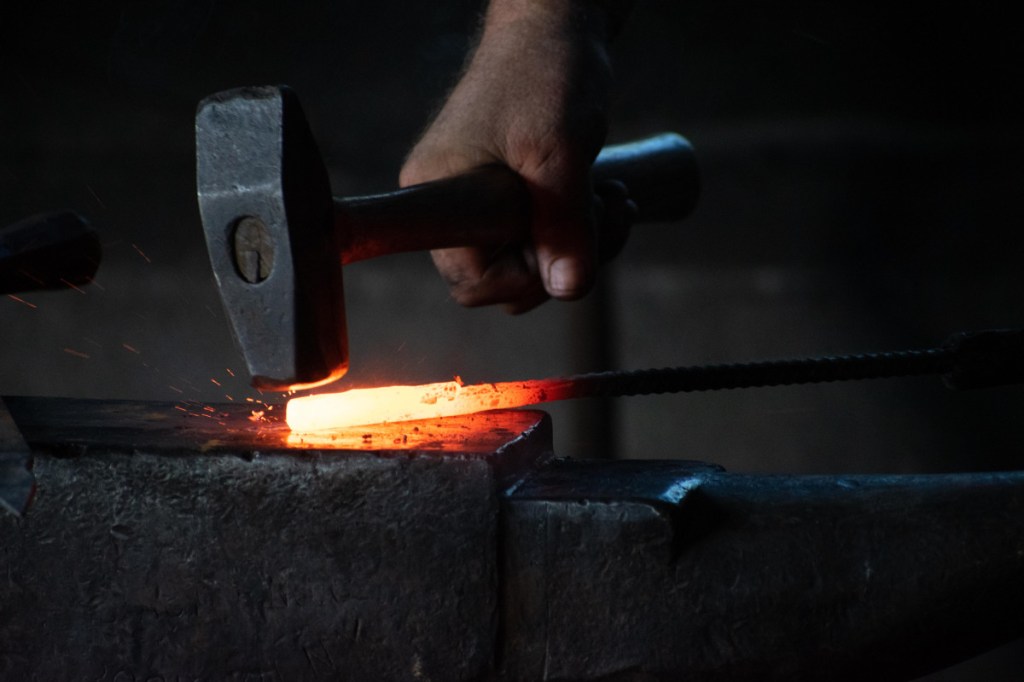
*With thanks to Hannah Gibbs for the image ‘Blacksmith‘ on Unsplash.

The Hunt is Late

I fear
the hunt
is late
this year

because
of the green
canopies

because
of the unfallen
leaves

because
your presence
is just

a whisper
of an antlered
figure in

boughs
not yet shaken
by wind.

You are here.

You are here

I know it
by the black cat
who leaps

into my
arms trembling.
The quick-

ening beat
of my heart and
the shiver

of winter
rain falling by
lamplight.

You are here.

You are here.

I know it
when I recite
my poem –

the rain
falls harder your
night-drum

beating
within me and
the wood.

Shadows
stretch and prowl
yet your

hunters
remain dark to
the seer.

I fear
the hunt
is late
this year.

*This poem is addressed to Gwyn ap Nudd, a Brythonic god whose hunt traditionally rides to gather the souls of the dead on Nos Galan Gaeaf. It is based on my marking of the occasion by reciting my poem ‘When You Hunt for Souls in the Winter Rain‘ (in the winter rain!) for Gwyn in Greencroft Valley. I find it disturbing that some of the leaves are still green and many have not yet fallen at this time of year, which in the Celtic calendars marks the beginning of winter. (The Welsh Nos Galan Gaeaf means ‘The night before the first day of winter’ and the Irish Samhain means ‘Summer’s End’).

You Read of a Smith

who made a pact with the devil
know little of how the story began
or what it implies when he sees the huntsman
galloping out of the fog on a cold dark October night.

You see the sweat dripping from his forehead sizzling
in the flames and are unable to tell what passes
between those dark brows when he sees
the horse he always shoes is lame,
its rider tired, shrouded by desperation,
yet still quiet-spoken when he makes his request
for shoes for running further faster between the worlds
to hunt down something that isn’t dead yet but isn’t living either.

You see the smith shiver as if ice has been dropped down his back
but not waver as he pumps the bellows, heats the furnace,
fires the steel, raises his hammer tries to imagine
what he is shoeing is only a hoof with wall,
toe, sole, tough and sensitive parts,
that this creature might be able to feel,
tries not to count the hooves that keep his forge ablaze all night
as the arched neck towers over him and the eyes flicker and glow.

Instead of counting his heartbeat he counts the beat of his hammer
which steeled his will during his ordeal in the fires that burn
like ice beyond good and evil, where he is working now,
face reddened, straining every muscle, engulfed
in the pain and ecstasy of creation for…
he will only ponder when there is nought but ashes
and hoof prints leading to where he, lame, cannot wander.
To where the stories you have read have come to an end and beyond.

*This poem is a Brythonic retelling of the traditional folkloric tale of a smith shoeing a horse for the devil. It features the smith-god, Gofannon, shoeing Du y Moroedd ‘The Black of the Seas’ for Gwyn ap Nudd. Gwyn is a ruler of Annwn, the Otherworld, and was equated with the devil. He rides out with his hunt to gather the souls of the dead on Nos Galan Gaeaf.

**Image ‘Man Shoeing a Horse’ by Jonathon Bean on Unsplash

The King of Annwn’s Treasures

The golden horn of endless mead.
The golden plates that make even leaves edible.
The golden cauldron that boils the flesh of the dead.
The golden helmet that lends the strength of the bull.
The golden armour that makes its wearer invincible.
The golden shield that deflects not only blows.
The golden spear that pierces every heart.
The golden leashes that hold back the hounds
and the spirits who strain against the possible.
The golden horseshoes for the horse that runs
between worlds and his golden saddle and bridle.
The golden ring that turns time into a circle.
The golden mist that makes terror beautiful.
The golden keys to the gates of every soul.
The golden secret in the stone chest that rattles
and bleats and sings a strange prophetic song.

~

This poem is based around the depiction of Gwyn ap Nudd as a ‘bull of battle’ in ‘The Conversation of Gwyn ap Nudd and Gwyddno Garanhir’ and his role as a King of Annwn presiding over its spoils. It is one of the poems in the narrative of Y Darogan Annwn.

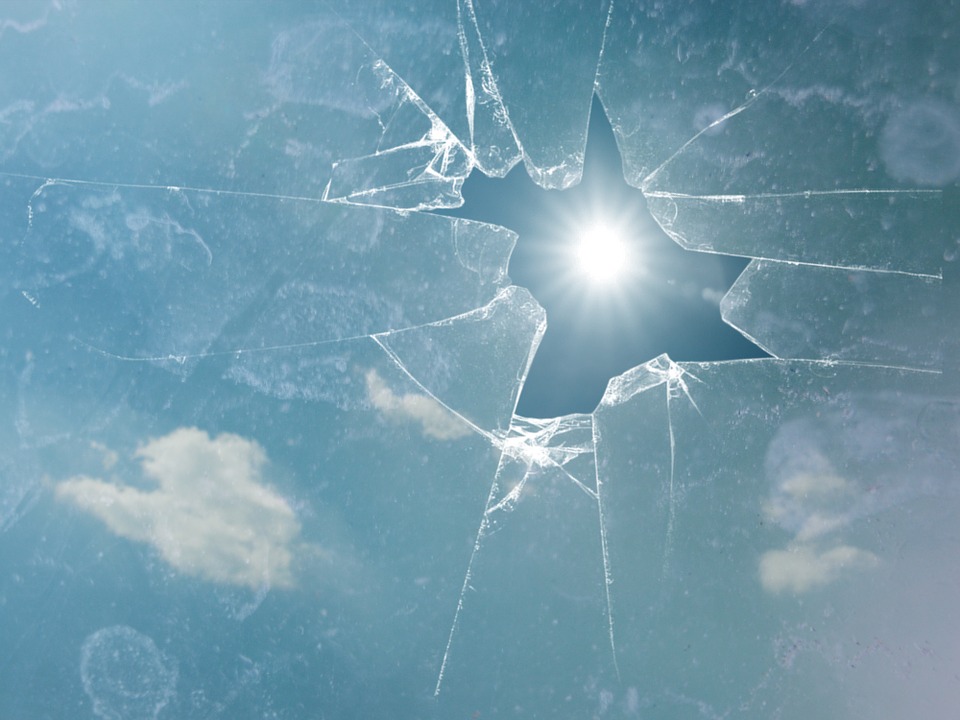
Seeing Face to Face

broken-549087_960_720_Pixabay Free Image

In Corinthians Paul famously contrasts seeing ‘through a glass, darkly’ with seeing ‘face to face’. In Revelations we find a series of glassy images leading up to the servants of God seeing his face. We are told, before the throne of God, is ‘a sea of glass like unto crystal’. This is later described as ‘a sea of glass mingled with fire’ with those who have gained ‘victory over the beast’ standing upon it with ‘the harps of God’. The harpers play the song of Moses who ‘the Lord knew face to face’.

The city of New Jersualem is described as ‘pure gold like unto clear glass’, its street ‘pure gold, as it were transparent glass’ and the river of life, running through it, proceeding from the Throne of God ‘clear as crystal’. We are told the Throne of God is in the city and here, where his servants serve him, ‘they shall see his face’.

These images of glass, no longer dark but crystal clear, are bound up with the process of revelation. Of the revealing of the face of God, which is never described, of which his servants are forbidden to make graven images.

This imagery interests me, as a Brythonic polytheist and devotee of Gwyn ap Nudd, because in a number of texts his castle is described as being made of glass or crystal and surrounded by water. In The Life of St Collen, Gwyn is depicted seated on a golden throne in ‘the fairest castle’ Collen ‘had ever beheld’ on Glastonbury Tor. Gerald of Wales notes Glastonbury ‘used to be called Ynys Gutrin… the Island of Glass, no doubt from the glassy colour of the river which flows around it in the marshland.’

In ‘The Spoils of Annwn’ Arthur sails across the sea in his ship, Prydwen, to raid seven otherworldly forts on otherworldy islands. It is my belief they are appearances of the same fort – the abode of Pen Annwn ‘the Head of the Otherworld’ (an older name for the King of Annwn/Faery – Gwyn).

One of the fortresses is named Caer Wydyr ‘the Glass Fort’. The narrator, Taliesin, mocks ‘pathetic men’ (monks) ‘who hadn’t seen Arthur’s feat beyond the Glass Fort’. He tells us ‘six thousand men were standing on its wall; it was hard to communicate with their watchman’. In Nennius’ History of the Britons thirty ships of Spaniards sailing to Ireland find in the midst of the sea ‘a tower of glass, the summit of which was covered with men, to whom they often spoke, but received no answer.’

The Fairy King’s castle is described as being made of crystal in Sir Orfeo:

‘Amid the land a castle tall
And rich and proud and wondrous high
Uprose, and all the outmost wall
Shone as crystal to the eye.
A hundred towers lit up the sky,
Of diamond all battled stout;
And buttresses rose up near by
Arched with red gold and broad about.’

In the Biblical and Brythonic traditions the paradisal abodes where the gods are enthroned, the centres of the mysteries where their faces are revealed, are associated with glassy waters and crystal walls.

One wonders whether there are any stories of people meeting the gods of Annwn face to face. In Sir Orfeo we are told he could not look upon the Fairy King or Queen ‘their crowns, their garments, glistened bright… so hot they shone’. This ‘noble sight’ brings him to his knees before the throne. Afterwards he takes up his ‘merry harp’ and sings the lay that wins his wife, Heurodis, back from Fairyland.

This reverent response is echoed in the First Branch of The Mabinogion when Rhiannon, a Queen of Annwn, unveils herself to Pwyll. This does not take place within a crystal castle, but near the fairy mound Gorsedd Arberth. We are told she ‘drew back the part of her headdress that should cover her face, and fixed her gaze upon him’. ‘And then he thought that the face of every maiden and every woman he had ever seen was unattractive compared with her face.’ He immediately falls in love with her and agrees to marry her, choosing her above all other women.

When I first met Gwyn, he did not reveal his face to me in his glass fortress, but beneath the shadows of a leaning yew tree on Fairy Lane in Penwortham. My response was similar. I recognised him as my patron deity, a god who I chose above all gods, who I could not help but love and serve.

In Ethics and Infinity the French philosopher Emmanuel Levinas notes that the face to face to encounter draws us into service to the Other. Also ‘the face… signifies: “Do not kill me.”’

In the Welsh myths we find this ordainment repeatedly broken by Arthur and his warriors who commit a panoply of acts of defacing. The heads of the witches of Caer Loyw and Pennant Gofid are split in twain. The beard of Dillus Farfog is plucked out whilst he is still alive before his head is cut off. The giants Diwrnach and Wrnach are beheaded. Most horrifically, before Ysbaddaden Bencawr is beheaded, his face is mutilated – Caw of Prydyn shaves off his beard, ‘flesh and skin to the bone, and both ears completely’.

Because Arthur cannot bear the thought of the head of Brân being beneath White Hill as a threat to his sovereignty over Britain he orders it to be dug up and removed. Interestingly Brân’s head lives after his death for eighty-seven years and only when it starts to decay, when he loses his face, is it buried. It seems that Arthur cannot abide even the distant memory of Brân’s face evoked by his head.

The surrounding stories suggest that either Arthur himself or (Llen)lleog beheaded Pen Annwn with Caledfwlch during his raid on Annwn and this was how he gained his cauldron, the leadership of his hunt, and usurped his role as the warrior-protector of Britain. One might see the beheading of the Head of the Otherworld, ‘Arthur’s feat beyond the glass fort’, as the ultimate crime against the Other and the face of the numinous.

This killing blow, with the thrusting of Lleog’s flashing sword into the cauldron, may be seen to bring about the shattering of the glass fortress, the fragmenting of the mythos of Pen Annwn. We are left only with pieces of the narrative like shards of broken glass, the images within like creatures trapped in amber; seeing through glass darkly as the Dark Age is ushered in.

Yet beyond the glass walls Pen Annwn picks up his head and makes himself whole again.

I see his face and he is laughing.

Mabon Learns to Play the Harp

It was Mabon who played then in the youth of the world
Greg Hill

Take the hand of the invisible
and make it visible.

Pluck a chord of light
like a string from the ball of the sun.

Imagine spiders spinning their webs

between the constellations;
the songs of the stars,

make them audible.

Fashion the nine chords
of my harp – the harp of Teirtu –

do not think of how it will play alone
as you in this House of Stone

in the hall of Pen Annwn.
Think not of the turning of his fortress

‘in Annwn below the earth’
or ‘in the air above’.

Do not ponder the reason
for your imprisonment – why

you must become an awenydd or bard.

Reach into the darkness with the audacity
of youth and imagine the discovery

of the wealthy realms of Pluto.

Ask not why the sun does not shine there,
why a dog’s jaws are the doors

and questions remain unanswered.
Reach deep within for the chord that moves

the hearts of planets – underworld gods.

In the river of tears consume the hazel nut
unknowing if it contains the awen

or countless meteoric souls.

Escape down the trail of a meteor
on the salmon of Llyn Llyw.

Take the hand of the visible
and make it invisible.

Forget this story –
you have always been the harper
and my harp has always played on…

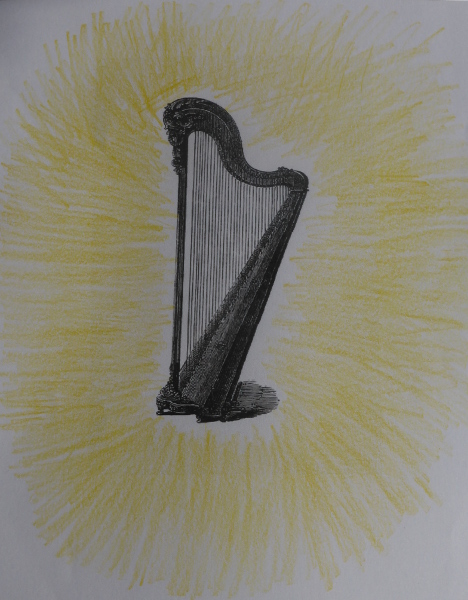
Mabon's Harp

Blodeuwedd and the Owl Kind

I.
I’m wandering through a bleak windswept landscape in Annwn and screaming down from the skies come two haggard-looking owl-women who almost look like harpies with shabby feathers, bare breasts, and long claws. At first I’m afraid of them, but less so as I examine their faces, old, wise, grey.

They tell me they are ‘the Owl Kind’ – those who have gone into owls. They watch over families and communities until they stop watching for them. They watch over lands until they become unrecognisable. They watch over the dead and those who go between worlds – their owl eyes are always on them.

They can often be found in graveyards. They show me how they watch over the spirit of a child who is afraid to leave her grave where she thinks she is safe and wants to sleep forever because she died believing there is no life after death and the owlets who sit in a row on the fence who sing her songs.

They tell me the owl kind are becoming less and less as they are leaving the places families and communities have left, where they are forgotten, and fewer know how to or want to go into owls anymore.

They tell me owls watch over my land and to listen for them.

II.
Only once have I met Blodeuwedd, the woman conjured from flowers by Math and Gwydion, then transformed into an owl as a punishment for her part in the plot to murder her husband, Lleu. It was during a journey when I was tricked into Caer Gwydion and she helped me escape, picking me up in her claws and taking me to the Forest at the Back of the World where the Owl Kind dwell. At this point I knew they were connected, that Blodeuwedd was one of the Owl Kind, perhaps the most significant.

This has led me to suspect that when Gwydion and Math conjured Blodeuedd from the blossoms of oak, meadowsweet and broom, when they imbued the blossoms with spirit, that the spirit they unwittingly summoned to animate them was hers – flowers on the surface, owlish huntress and killer beneath. (Thus it’s no wonder she was attracted to the Hunter when he rode into her kingdom).

Perhaps in an older variant of the tale Gwydion did not turn Blodeuwedd into an owl as a punishment but recognised her true nature, that he, the trickster, had been tricked. She couldn’t be confined by his spell.

III.
In modern Britain owls are, rightly, revered as symbolic of wisdom. Yet, appearing wide-eyed and innocent and slightly goofy-looking on bags, pencil cases, cushions, earrings etc. the darker side of their nature (which was emphasised for many centuries in British folklore) has been forgotten.

In a chapter titled ‘Night’s Black Agents’ in The Folklore of Birds Edward A. Armstrong notes that ‘Over Europe and Asia, indeed, most of the world, the owl is, and has long been, a bird of witchcraft, death and doom’. He notes examples of sightings of owls – ‘the trees were covered with owls’ ‘there were a scret (screech) owl on his roof, scretting something horrible’ as precedents of death.

Spenser refers to the owl as ‘death’s dreadful messenger’. Webster writes ‘The Scritch Owle and the whistler shrill / Call upon our dame aloud / And bid her quickly don her shroud.’ Armstrong notes connections between ‘ratchet owls’ and the corpse-eating Gabriel Ratchets and Hounds of Annwn.

In ‘The Owl’ Dafydd ap Gwilym speaks of the ‘Crazy Owl’ of Gwyn ap Nudd who ‘incites the hounds of night’ and no doubt flies at the head of his hunt heralding the chase of the souls of the dead.

IV.
In The Witch Ronald Hutton suggests our associations between owls and witchcraft derive from the Classical figure of the strix. These large-eyed, hungry-beaked, grey-white feathered birds of ill-omen dwelled on the outskirts of Tartarus, feasted on flesh and blood and snatched away the bodies of the dead. The term striges was also applied to ‘women who practice witchcraft’ and ‘flying women’.

The striges seem closely linked to harpies ‘snatchers’. They are described both as ‘lovely’ and ‘repulsive’. By Virgil as ‘Bird-bodied, girl-faced things… abominable their droppings, their hands are talons, their faces haggard with hunger insatiable’. Their names are evocative – Aello ‘storm swift’, Ocypete ‘swift wing’, Celaeno ‘the dark’, Podarge ‘fleet-foot’. Seen as the embodiments of the destructive winds they served as ‘the Hounds of Zeus’ snatching away evil-doers to the Erinyes.

VI.
In Dante’s Inferno harpies are depicted in the seventh circle of Hell in the ‘Wood of Suicides’:

No green here, but discoloured leaves and dark,
No tender shoots, but writhen and gnarled and tough,
No fruit, but poison galls on the withered bark…

Wide-winged like birds and lady-faced are these,
With feathered belly broad and claws of steel;
And there they sit and shriek on strange trees.

Dante is horrified when he realises that the trees are the souls of suicides. Their transformation and their fate of being tortured by the harpies, who feast on the boughs, is described by Augustus:

When the wild soul leaps from the body, which
Its own mad violence forces it to quit,
Minos dispatches it down to the seventh ditch.

It falls in the wood; no place is picked for it,
But as chance carries it, there it falls to be,
And where it falls, it sprouts like a corn of wheat,

And grows to a sapling, and thence to a wild tree;
Then the Harpies feed on its leaves, and the sharp bite
Gives agony, and a vent to agony.

VI.
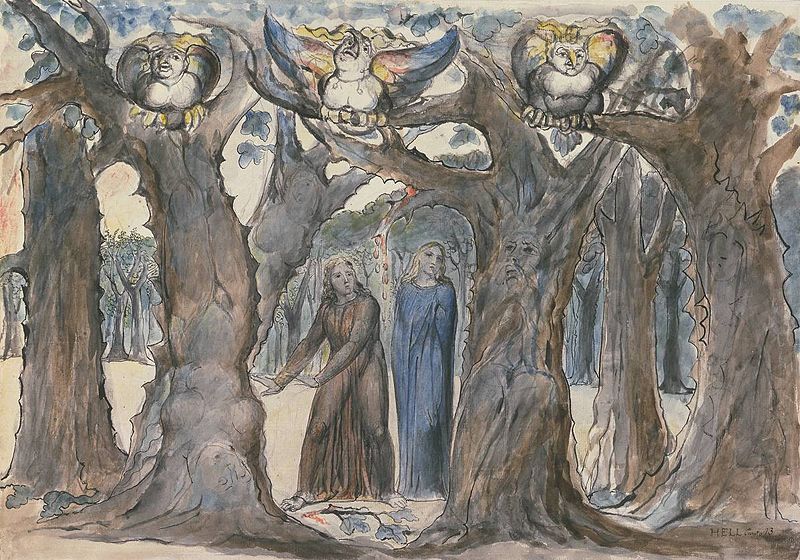
In ‘The Wood of the Self-Murderers: The Harpies and the Suicides’ William Blake provides a vivid depiction of the scene. This partly resonates with my personal vision of the Owl Kind in the Forest at the Back of the World, where the souls of the dead shift into trees, plants, and animals.

800px-The_Wood_of_the_Self-Murderers

Only I do not see the role of the Owl Kind, although they are hunters and devourers of the dead, as punitive. Like the Hounds of Annwn they are simply serving their role hunting down the dead and devouring their dead flesh before bearing their souls back to the otherworldy forest where they can heal.

Perhaps they have always been connected with suicides – teaching them to be tree, plant, flower, blossoming until their bloomy faces are the faces of owls and, like Blodeuwedd, they fly free.

SOURCES

Edward A. Armstrong, The Folklore of Birds, (Dover Publications, 1958)
Dorothy I. Sayers, Dante, Hell, (Penguin Classics, 2001)
Rachel Bromwich (transl), Dafydd ap Gwilym, Poems, (Gomer Press, 1982)
Ronald Hutton, The Witch, (Yale University Press, 2018)
Sioned Davies (transl.), The Mabinogion, (Oxford University Press, 2007)
William Blake, William Blake’s Divine Comedy Illustrations, (Dover Publications, 2008)
Harpy’, Wikipedia
Strix’, Wikipedia

The Trickery of Gwydion

Gwydion's Wand

I. The Trickster

Over the past few months I’ve been thinking a lot about the trickery of the magician-god, Gwydion son of Don, and the trouble he causes within his own family, the House of Don, and to the people of Annwn.

In the Fourth Branch of The Mabinogi, Gwydion and his brother, Gilfaethwy, plot to rape Goewin, the virgin footholder of his uncle, Math. Math cannot live without his feet being in the lap of a virgin except at times of turmoil. Therefore Gwydion steals the pigs gifted to Pryderi by Arawn, King of Annwn, causing a war between Math, ruler of Gwynedd in North Wales and Pryderi, ruler of twenty-one cantrefs in the South. During the conflict Gwydion helps Gilfaethwy to rape Goewin in Math’s bed. Returning to the battle he then kills Pryderi, son of Pwyll Pen Annwn, who is implicitly also Arawn’s son, ‘because of strength and valour, and magic and enchantment’.

Math punishes Gwydion and Gilfaethwy by turning them into animals; deer, boar, and wolves, alternately male and female so that, unable to resist their animal desires, they mate with each other and have offspring. They are named as Bleiddwn, Hyddwn, and Hychddwn Hir, ‘Three sons of wicked Gilfaethwy’.

In spite (or perhaps because of) Math’s punishment Gwydion does not cease to cause trouble. When Math voices his need for a new virgin footholder, Gwydion suggests his sister, Arianrhod. Math tests her virginity by breaking his wand and telling her to step over it. From her drops ‘a large, sturdy, yellow-haired boy’ and ‘a small something’ which Gwydion wraps in silk and hides in a ‘chest at the foot of his bed’.

It is clear Gwydion knows his sister is not a virgin. Arianrhod’s anger with him and the heat of their conflict suggests he played a role in her pregnancy. There exists a variant of the tale in which Arianrhod rather than Goewin is Math’s footholder and is raped by Gilfaethewy with Gwydion’s help. This is shown by the following lines from a poem by Lewys Môn, translated by Gwilym Morus-Baird:

My complaint about a maiden is greater
Than that of Old Math son of Mathonwy;
the arm of a chaste one, white-armed and wise,
was his pillow every night,
Arianrhod the same as the snow,
a man could not live without her.

The ‘small something’ grows up to be a boy as sturdy as an eight-year-old at the age of four. When Gwydion takes him to Caer Arianrhod his mother rejects him as a sign of her ‘shame’. She places three destinies upon him – that he will not get a name, weapons, or a wife, and Gwydion wins each of them through a combination of trickery and magic.

The boy’s name is won when he and Gwydion pose as shoe-makers on a boat conjured from dulse and wrack. Arianrhod names him Lleu Llaw Gyffes ‘the fair one with the skilfil hand’ when he shoots a wren whilst she is having a shoe fitted. By conjuring an illusion of an army attacking Caer Arianrhod and asking for arms for he and Lleu to defend it, Gwydion win Lleu’s weapons. With Math’s help, Gwydion conjures a wife, Blodeuedd ‘Flowers’, from the blossoms of oak, broom, and meadow sweet for his nephew.

After Lleu has been fatally wounded by Gronw, his rival for the love of Blodeuedd, Gwydion searches from him across Gwynedd and Powys. Finally Gwydion finds Lleu in an oak tree in eagle form, sings him down with a series of englyns, and changes him back to his own form.

Even though his trickery has caused Lleu a great amount of sorrow (Gwydion turns Blodeuedd into Blodeuwedd ‘Flower Face’, an owl, and she deserts him) he doesn’t stop playing tricks. Lines from Peniarth Manuscript 98.B tell us that Cad Godeu ‘The Battle of the Trees’ was brought about ‘because of a white roebuck and a greyhound pup which came from Annwfn and Amathaon vab Don caught them’. Rachel Bromwich suggests that Gwydion, rather than his brother, Amaethon, originally won the dog and roebuck along with the swine belonging to Pryderi from Annwn.

Unsurprisingly the theft of his sacred animals infuriates Arawn, who leads an army of trees, shrubs, and Annuvian monsters against Gwydion and the House of Don. At the head of his army marches the giant, Brân the Blessed, possibly raised with other dead warriors from the Cauldron of Rebirth. Taliesin, the narrator of the poem ‘The Battle of the Trees’ speaks of how Gwydion fashioned ‘majestic trees / a hundred forces into a host’ ‘by means of language and (materials of) the earth’. Lleu, ‘radiant his name, strong his hand, / brilliantly did he direct a host’ leads Gwydion’s armies against those of Arawn, ‘the vigorous one, / the wealthy battle-dispenser’. Lines from the Myvyrian Archaeology suggest that Gwydion won by guessing Brân’s name*. Perhaps Gwydion’s singing of two englyns and naming of Brân reversed the magic by which Arawn raised the dead.

The impact of the battle was calamitous. Taliesin speaks of his side fighting with ‘the blood of men up to our thighs’ and claims ‘Four hundred men / did I pierce despite their rapacity’ along with piercing three Annuvian monsters: a hundred-headed beast, a black-forked toad, and a speckled crested snake. He compares it to other cataclysmic events: the Flood, Christ’s Crucifixion, and the Day of Judgement. It is also listed as one of ‘Three Futile Battles’ in The Triads of the Island of Britain.

II. Who can understand gwydd?

My feelings about Gwydion are mixed. I find his assistance in the rape of Goewin/Arianrhod deplorable. His stirring of trouble with Annwn, killing of Pryderi, and bringing about two devastating battles fills me with anger. Yet, unlike Arthur, that other opponent of the Annuvian deities who is little more than a numbskull, Gwydion possesses a number of admirable qualities.

He is the ‘best storyteller in the world’. He is a master magician who conjures shields from toadstools, a ship from dulse and wrack, a wife for Lleu from blossoms, and marching trees from language and earthy materials. With Math, from nine elements, he even created Taliesin, the silver-tongued bard whose spirit still inspires the bardic tradition. He is a caring uncle to Lleu, and shows him deep affection.

Whilst many of Gwydion’s actions, like Arthur’s, are unforgivable, I can’t help but wonder if there is some kind of deeper meaning to Gwydion’s transgressions of boundaries. Without his breaking of rules, mating with his sister (then, shifting form and gender, thrice with his brother!), crossing into and stealing from Annwn, the action of the Fourth Branch and ‘The Battle of the Trees’ would not have taken place.

That Gwydion possesses a certain kind of knowledge is suggested by the etymology of his name. It derives from the mysterious little word gwydd. Gwydd is linked to gwybod ‘to know’ and has many meanings including ‘knowledge’, ‘tree(s), branches, twigs; forest, woods, shrub(s)’, ‘weaver of songs’. It forms the root of gwyddon, which can refer to a ‘knowledgeable one’ or ‘sage’ and to a ‘giantess, female monster; hag, witch… wizard, sorcerer… satyr, nymph’. These meanings seem significant in relation to Gwydion’s enchantment of trees and knowledge of wild magic.

It also possible that Gwydion had a role in creating the chess-like game of gwyddbwyll ‘wood sense’. In the Irish myths its equivalent, fidchell, was a gift from Lugh, the cognate of Lleu. So it would make sense that the knowledgeable Gwydion and his skilful-handed nephew created the game. Iolo Morganwg’s citations from ‘The Chair of Ceridwen’ ‘Gwydion ap Don – / A rithwys gorwyddawd y ar plagawd’, ‘Gwydion son of Don – / Formed wood knowledge upon plagawd’ suggest that Gwydion also played a role in creating the Coelbren alphabet. Both gwyddbwyll and Coelbren had magical and prophetic functions and were bound up with wood and mystical knowledge.

The contrast between Gwydion as knowledgeable sage and pyschopath is a troubling one, but not one that is unfamiliar in modern culture (take Hannibal Lecter from The Silence of the Lambs) or within modern society at large. There are a good number of men (and women) who use their knowledge to evil ends, and to the end retain a certain amount of flair and charm, an allure to their victims.

The psychopathic mind continues to fascinate. We continue to ask ‘who can understand Gwydion?’

III. Gwyddoniaeth

Gwydd is also the root of gwyddoniaeth ‘science’. Other the last few centuries we have seen a shift from the woodland knowledge of gwydd to the mechanistic principles of gwyddoniaeth.

Whereas, in the medieval stories, Gwydion created a woman from flowers by magic, I detect Gwydion’s hand in the genetic engineering of plants and crops and robotic insects to pollinate them.

Whereas, in the medieval stories, Gwydion sang Lleu down from the tree with englyns and turned him back into his own shape and healed his fatal wound by magic, I was shown a vision of him raising Lleu, the lightning god, from the dead, with electric paddles in a Frankenstein-like scene.

If someone was to ask me ‘where is Gwydion now?’ I would say he is at the heart of the mad science that rapes and strives to change nature against its will, but also that he is still trying to look after the little boy, Lleu, one of the appearances of the Divine Son, the Mabon, who may also be humanity.

To where will his madness lead? To devastation again, certainly, like in the battles of the North and South, like the Battle of the Trees, to the forces of Annwn rising up in rebellion, to another world’s end.

*Sure-hoofed is my steed impelled by the spur;
The high sprigs of alder are on thy shield;
Bran art thou called, of the glittering branches.”

“Sure-hoofed is my steed in the day of battle:
The high sprigs of alder are on thy hand:
Bran by the branch thou bearest
Has Amathaon the good prevailed.

*With thanks to Gwilym Morus-Baird for the translation of the poem by Lewys Môn.

SOURCES

Iolo Morganwg, The Barddas, (Weiser, 2004)
Kristoffer Hughes, Natural Druidry, (Thoth Publications, 2007)
Kristoffer Hughes, The Book of Celtic Magic, (Llewellyn, 2014)
Marged Haycock (transl), Legendary Poems from the Book of Taliesin, (CMCS, 2007)
Rachel Bromwich (ed), The Triads of the Island of Britain, (University of Wales Press, 2014)
Sioned Davies (transl.), The Mabinogion, (Oxford University Press, 2007)
Geiriadur Prifysgol Cymru

The Vision of Ceridwen

I’m the broken bird-thing
at her table again

her wizened hand
in my claws

telling her
I’m going to mend
our broken vision

and all will be beautiful.

***

Sometimes you end up in a myth. It’s not the myth you thought you’d end up in or the myth you chose. You’re not who you thought you would be. Nobody else sees the myth the same way you do.

It began when I first started learning about the Bardic Tradition and heard that Ceridwen was the goddess of the cauldron that brews awen, the poetic inspiration that is like mead to the Brythonic bards.

As a poet I thought Ceridwen was a goddess well worth meeting so I drew myself a cauldron, lit a candle, constructed a visualisation. One of those 2D interfaces that sometimes helps you interact with what is. I imagined Ceridwen as a blue-robed, dark-haired, faceless woman stirring a cauldron.

Nothing happened. Then, from nowhere, out leapt a hideous grey-haired hag who put her bony arms around my neck, nearly strangling me. She demanded I go with her to her cottage in her woods. She sat me down at her table in a room with a sun dial and smaller cauldron over the hearth on a wobbly three-legged stool and insisted that I call her ‘grandmother’. Initially I thought she was an ancestor.

I presumed this showed Ceridwen wasn’t interested in me. She already had worthier devotees. Soon afterwards I got found by my patron god, Gwyn ap Nudd, a ruler of Annwn and guardian of the cauldron.

I met ‘grandmother’ again when I was travelling Annwn in search of inspiration on my flighty white-winged mare. She ditched me and I found myself falling downwards through the air, flapping my arms like wings, steadily acquiring black feathers, but not quickly enough to stop me hitting the ground. When I returned to my senses the hag-like woman was standing over me. With a wrinkly smile she told me I was ‘beginning to get my raven’s wings’ before taking me to her cottage again.

There she told me to look into her cauldron, where I saw in vivid blues and reds a Dark Age battle of clashing spears, crashing swords, broken shields, fallen flags, blood crimsoning the nearby waters, then the shades rising in a sorrowful march to depart. Researching it afterwards I realised it was the Battle of the Region Linuis fought by Arthur against the Saxons and wrote a poem about it*.

After this gift of awen from her cauldron I began to suspect the hag was the real (as opposed to my imagined) Ceridwen. The name ‘grandmother’ came to make sense a couple of years later. Gwyn had shown me a cauldron filled with stars and not long afterwards I went to see my friend, Nick Williams, performing an experimental poetry set in a blacked-out room with strobe lights. I had the sensation of being in a cauldron of poesy and also in the womb of the universe. I recalled that Nick refers to a goddess called Old Mother Universe and realised she is Ceridwen – the oldest mother of all.

I went on to write a book called The Broken Cauldron, focusing on how Ceridwen’s crochan ‘cauldron’ or ‘womb’ is shattered in the Welsh myths and of my task of gathering the stars back into it.

Whereas, in the Bardic Tradition and Druidry, Taliesin and Arthur, those responsible for stealing the awen and the cauldron and the shatterings that have brought devastation to the land are hailed as heroes, I found myself standing in the shoes of Morfran ‘Sea Raven’, Ceridwen’s dark and ugly son, who was later known as Afagddu ‘Utter Darkness’.

He for whom she boils her cauldron in the hope the brew will inspire him and cure his imperfections. He who does not get the awen, who cannot win poetic inspiration the quick way, but must work to find the words to heal the lands poisoned by the contents of the broken cauldron, to repair it piece by piece, story by story, so the stars shine in bright new constellations on a new world.

Gwyn is my guide in this task, and in serving him, I am also serving Ceridwen. She does not appear to me often, but when she does, I am often her awkward black-winged child, the dark imperfect one.

As Afagddu I’m learning imperfection is necessary; an understanding of what others find repulsive, whether it’s darkness, death, decay, plastic, the monstrous creatures of Thisworld or the Otherworld. That these hold their own beauty when the concept is not corrupted by our society’s false ideals.

It’s not the Old Mother’s Universe that needs fixing, but the way we perceive it, the collective vision, which guides our acts. When we learn to see clearly both Creirwy* and Afagddu will be beautiful.

A star-forming region in the Large Magellanic Cloud Wikipedia Commons

*’The Region Linuis’ was first published in Heroic Fantasy HERE.
**Creirwy means ‘Lively Darling’. She is Afagddu’s beautiful (twin?) sister.

With thanks to Wikipedia Commons for the image ‘A star-forming region in the Large Magellanic Cloud’ by ESA/Hubble.