‘Gwyn son of Nudd… forced Cyldedyr to eat his father’s heart… Cyledyr went mad.’ How Culhwch Won Olwen
We have eaten the hearts of our ancestors.
We have bitten them down in pieces. We have choked on them, retched on them, tried to refuse to eat them at our peril.
We have swallowed them whole.
We have made them palatable with condiments – ketchups squeezed from blood and mustards from bile.
We have been unable to stop eating even when told to stop.
We have seen our faces with blood dripping from our mouths on the front of the newspapers and pointed our fingers at everyone else – those heartless heart-eaters.
We have blamed the gods who told us to do it.
We have gone mad with grief and guilt.
We have wandered the Forest of Celyddon with Cyledyr, with Culhwch, with Myrddin Wyllt, tried to become poets and we have failed.
We have not heard your whisper in the woods~ in the little cavern within our right atrium, thought of the hunger of the future.
I have no children so to who will you feed my heart?
Gwythyr ap Greidol ‘Victor son of Scorcher’ appears in the medieval Welsh story Culhwch and Olwen as the rival of Gwyn ap Nudd ‘White son of Mist’ for the love of Creiddylad ‘Heart’s Desire’. That he is a fitting opponent for Gwyn and consort for Creiddylad, who are the son and daughter of the ancient British god Lludd/Nudd/Nodens, suggests he is also an important British deity.
Strip away the Christian veneer from Culhwch and Olwen and we have a story in which Gwyn (Winter’s King) and Gwythyr (Summer’s King) battle for Creiddylad (a fertility goddess). On Nos Galan Gaeaf, Winter’s Eve, Gwyn abducts Creiddylad to Annwn* and Gwythyr rides to Annwn and attempts to rescue her and is imprisoned. The abduction of Creiddylad and imprisonment of Gwythyr explain the coming of winter. On Calan Mai, the First Day of Summer, Gwythyr battles Gwyn for Creiddylad, wins, and she returns with him to Thisworld and together they bring fertility to the land. This explains the coming of summer. Gwyn and Gwythyr may earlier have been seen to slay one another on Nos Galan Gaeaf and Calan Mai and take it in turns to enter a sacred marriage with Creiddylad, who acted as a powerful sovereignty figure rather than just a maiden to be fought over.
It is clear from this tale that Gwythyr is our ancient British god of summer. In another episode in Culhwch and Olwen we catch a glimpse of Gwythyr’s associations with fire and sunshine. As he is walking over a mountain he hears ‘weeping and wailing’ and sees its source is a burning anthill. He cuts the anthill off at ground level and rescues the ants from the blaze. We do not know what caused the fire. Did their nest, which ants orientate toward the sun, a little like solar panels, in a summer day, absorb too much heat? Or was the fire caused by Gwythyr’s scorching feet? We have seen that one translation of his father’s name, Greidol, is Scorcher, and we know wildfires break out in the summer. Here we see the dangers of fire and the sun and Gwythyr’s attempt at remediation.
The ants go on to help Gwythyr to gather nine hestors of flax seed which was sown in ‘tilled red soil’, in a field that has remained barren, so it can be ploughed into a new field, to provide the linen for Olwen’s veil in preparation for her marriage to Culhwch. It is possible to read Gwythyr’s association with seed being linked to the ‘male’ side of fertility and with doing the groundwork for the arrival of summer for his bride, Creiddylad, might also require a linen veil for her wedding dress.
The ancient Britons used fire to clear the forest to plant hazel trees and wildfires bring about new growth – in Gwythyr’s associations with fire and seed we find these processes.
These stories show that Gwythyr is a god of summer, fire, and generation in Thisworld who is opposed to Gwyn, a god of winter, ice, and the destructive forces of Annwn, the Otherworld. On the surface one is a bringer of life and the other a bringer of death yet their relationship is one of interdependence. It is necessary they take it in turns to enter a sacred marriage with Creiddylad as an eternal summer or an endless winter would have equally deadly consequences for both worlds.
As Gwythyr’s story was passed on through the oral tradition he and his father were depicted as allying with Arthur against Gwyn and the ‘demons’ of Annwn and playing a role in their demise. Thus Gwythyr is associated with other culture gods like Amaethon, the Divine Ploughman, and Gofannon, the Divine Smith, who help the Christian king to civilise the wild and shut out the Annuvian.
This process may be traced back to the Neolithic revolution when farming began to replace the hunter-gatherer lifestyle, the cultivation of seed hunting and foraging, the grain god (Gwythyr) the hunter (Gwyn). Christians did their best to eliminate the veneration of Gwyn by depicting him and his spirits as demons yet they continued to be loved in folk culture as the fairies and their king.
The stories of Gwythyr, by name, did not survive in the folk tradition, but it possible to find a likeness between him and other grain gods** who die a ritual death at the end of the harvest – when Gwyn, the harvester of souls, reaps down his rival and Gwythyr and the seed return to Annwn.
From the Neolithic period our society as a whole has favoured Gwythyr over Gwyn. We have created an eternal summer with the fire of Gwythyr in the engines of industry creating a society in which the cold and darkness of winter has been eliminated by electric lighting and central heating. Crops grow all year round under artificial lights. This has unsurprisingly led to global heating, to the climate crisis, to the scorching fires on Winter Hill where I perceive Gwythyr battling his rival. Ironically, and tellingly, these two great gods and the great goddess they battle for have been forgotten.
Yet, slowly, the worship of Gwyn and Creiddylad is reviving amongst modern polytheists. I know few who venerate Gwythyr and believe this is because his stories have been subsumed by those of other grain gods. This is a shame, for Gwythyr’s stories contain deep wisdom relating how fire, sun, summer and seed have played a role in the climate crisis from a polytheist perspective.
As a devotee of Gwyn, committed to the otherside, to the Annuvian, to redressing the balance, Gwythyr is a god whose powers I acknowledge through the summer and during the harvest period although I do not worship him. I would be interested to hear how and whether other polytheists relate to Gwythyr at this time.
*Annwn has been translated as ‘the Deep’ and the ‘Not-World’ and is the medieval Welsh Otherworld or Underworld. **Such as Lleu Llaw Gyffes/Lugus and John Barleycorn.
speak of dragons when dragons from the world are gone?
How can I be your inspired one when the myths of the gods are lost?
To sing them back from the void before creation I will need a dragon’s tongue!
Lord of Annwn grant me the strength by the breath of dragons to write this book.
Over the past few weeks I have known possession by the awen; the inspiration, the divine breath that flows from Annwn, the breath of the gods, the breath of dragons; like I have never known it before.
It’s come after a couple of fallow years; sowing, reaping, dissatisfaction with flawed and failed crops.
I was beginning to fear that, after making my lifelong vows to Gwyn ap Nudd, to serve him as his awenydd, that the awen had dried up. What irony! A tiny part of me had begun to wonder if I’d made a mistake. Whether my powers of discernment were off. Whether he’d been having a laugh with me.
But my soul, to him eternally present, spoke otherwise. Only now I’ve realised I’d experienced a time of labouring, harrowing, preparing the ground for the oak to rise and the lightning to strike. For my fall from the tree amidst this collective shattering of the grounds of our society brought about by COVID-19 and into Annwn, the Deep, where I was to find the Prophet with the Dragon’s Tongue.
Thus has been born my next mythic book – The Dragon’s Tongue. Much of it has been gifted to me at dawn, in response, I believe to my evening prayers, in particular to Gwyn, Gwyn’s father, Nodens, Lord of Dream, Gwyn’s mother, Anrhuna, Dragon Mother of Annwn, and Gwyn’s beloved, Creiddylad.
You will probably not be surprised when I say their stories are central, with those of the dragons, and their conflict with the Children of the Stars*. There isn’t much evidence for dragons in the Brythonic/Welsh myths aside for an episode where Lludd/Nudd/Nodens ends a plague by ending the battle between two dragons and another where they appear, red and white, in a vision of Merlin Emrys. But there is the red dragon is on the Welsh flag and dragons are all around us in our folklore.
I’ve been reading mythic literature, journeying with the deep gods, the dragon-gods, long enough to know, when you get to the bottom of any myth, as Gordon White says, it is ‘dragons all the way down’.
I have long wanted to write the story of Anrhuna, the forgotten Dragon Mother, and also a creation myth. I have wanted what is lacking in the Brythonic/Welsh stories penned by medieval Welsh scribes. Something polytheistic, something penned by an inspired one of the gods, that provides insights into the mysteries of creation, of life, death, and rebirth, without the patriarchal Christian overlay.
Finding nothing else I realised I would have to do it myself. Following being gifted with the voice of the Prophet with the Dragon’s Tongue I started in the beginning, in the Deep, with Old Mother Universe and her Cauldron and how a dragon slipped from it and fell into the Abyss. How, from formlessness, she gave birth to the elements in dragon-form to form the world (yes – the world was made by dragons and not by God or some other demiurge). How the Children of the Stars slew Anrhuna, cut off her nine dragon heads with their long necks, and bound them on the Towers of the Wyrms…
From this flowed the story of the conflict between the Children of Annwn and the Children of the Stars, a tale of love and war, the mysteries of birth, death, and rebirth, of the coming of the Black Dragon.
After I swore to Gwyn that I would complete it beneath the leaning yew, where I met him, I got most of the first draft written over those days of thunder. When the lightning from the Spear of Lugus which killed Anrhuna lit the skies, when the rain poured, when the energy was strange and high.
This, I believe, would not have been possible if we were not in lockdown due to COVID-19. If I had not had this time without the pressures of finding paid work by volunteering with the Wildlife Trust and helping organise local poetry nights. If I had not stopped drinking, got off social media, started counselling for my anxiety and found out its root is having Asperger’s, which has helped me to stop blaming myself for my failures in ‘the real world’ and to cultivate space for my gods and my soul.
The birth of this book has restored by faith in my gods and through it I finally feel reborn as Gwyn’s awenydd. The first draft is complete, but is far from perfect, and I am predicting it may take months, even a year or so to firm it up. But, it has been born, and I am incredibly excited about it.
So if you’re interested watch this space and if you’re really interested you can find out more about my creative processes and see unseen work, including some of the drafts, by supporting me on Patreon HERE.
Spoke the Prophet with the Dragon’s Tongue, The Voice of the Goddess with Nine Dragon Heads: “The Dragon Goddess shall be slain and in Human Form She shall be reborn as the Mother of the Son.
In His darkest dreams the King of Annwn will tear Out the Eye of Bel, He will tear down the Sun and put it Inside the Belly of His Dead Mother and the Queen of Annwn Will shape for Her Dead Mother a new Earthen Form
And They will send Her in a boat to Portus Setantiorium Where She will be met on the Western Shore with Reedlights And up the River of Belisama will sail to Ribel-Castre And there the Eye of Bel will once again be reborn
As Maponos ‘the Son’ to Matrona ‘the Mother’. Yes! Throughout Belisama’s Vale in the Sacred Groves At the Springs and Wells and the Roaring Fords at the Roman Altars and in the Temples They shall be Honoured.
At the birth of every child She shall appear Threefold To Breathe the Blessings of the Awen into the Infant Mouth. As the Three Mothers of Destiny She shall be Revered In all the Holy Places in the Hills and Vales of the Old North.
And she shall appear Ninefold the Dragon Daughter Of the King of Annwn as Morgana and her Sisters breathing Life into His Cauldron before spiralling into Serpent Forms. And the Nine shall be Recoiled in Circles of Stone.
And when the Priests of Christendom come armed With Book and Vestment and Mitre treading widdershins Around our Holy Wells with splashings of Unholy Water But failing with their Prayers to undo our Spells.
Henceforth she will be known as Mary in Nine Churches In Belisama’s Vale: at Peneverdant, at Prestatun, at Wahltun, At Euxtun, at Leyeland, at Sceamlburgh, at Bamber Brig, At Ruhford, at Fernihough, she will be Honoured.
At Cockersand Abbey as Mary of the Marsh As the Magdalen in Maudlands in Nine Times Nine Churches Across the Islands of Prydain and beyond she will be Honoured,” Spoke the Prophet with the Dragon’s Tongue.
This poem was written as an early experiment in writing in the voice of ‘The Prophet with the Dragon’s Tongue’ in a Blakean style and brings together some of the mythic overlayerings of mother figures I have perceived within my landscape, in the Brythonic myths, and in visions and journeys.
I recognise this will not accord with everybody else’s perception of these deities and is very much a personal revelation. And, of course, I won’t be attempting to imitate Blake again, which I knew before setting out is impossible and foolhardy. I see it as a first step on the way to creating a myth to live by.
In previous posts I have spoken about how I’ve come to know Anrhuna ‘the Lady of Peneverdant’ or ‘the Mother of the Marsh’ as the ancient British mother goddess associated with marshlands and healing waters who was replaced by Saint Mary the Virgin at the well and church on Castle Hill in Penwortham.
As the mother of Vindos/Gwyn (a ruler of Faerie/Annwn whose presence at Castle Hill may be attested by a local fairy funeral legend) by Nodens/Nudd/Lludd, I have more recently been getting to know her as ‘the Mother of Annwn’ and in this guise she appears to me as a nine-headed dragon.
This is an image I have never come across in Brythonic mythology. However, stories of dragons abound across Britain and Nodens/Nudd/Lludd and Vindos/Gwyn are associated with them. In the Temple of Nodens at Lydney is a mosaic of two sea serpents and Nodens is depicted on a mural crown with ‘icthyocentaurs’ with serpent tails. Plus, as Lludd, he stops the battle of two dragons. Gwyn’s dog, Dormach, is depicted with two serpent tails and Robert Graves calls Gwyn ‘the Serpent Son’.
At the Temple of Nodens, who is surrounded by the watery subliminal imagery of the dream world and where sick people received healing dreams, a statue of a mother goddess holding a cornucopia was found. Pilgrims offered her pins for aid in childbirth. This may be a representation of Anrhuna. Maybe, just maybe, the two sea serpents are Anrhuna and Nodens in more primordial forms. In this context the appearance of Anrhuna, Mother of Annwn ‘the Deep’, as a dragon makes more sense.
Yet her myths are lost. I have recently returned to the Babylonian creation epic, Enuma Elish, which features a dragon-goddess called Tiamat, who shares similarities with Anrhuna, to look for clues. Tiamat is a goddess of the salt sea. Her name may be cognate with the semitic tehom (‘the deep’ or ‘the abyss’) and she appears as a dragon or sea serpent. After she gives birth to the gods they turn on her. Against them she births an army of monster-serpents and puts her son, Kingu in the lead. Following a primal battle she is slain by the storm god, Marduk, and the world is created from her remains.
I’ve long found the following lines about Tiamat’s birthing of monsters beautiful and awe-inspiring:
Ummu-Hubur [Tiamat] who formed all things, Made in addition weapons invincible; she spawned monster-serpents, Sharp of tooth, and merciless of fang; With poison, instead of blood, she filled their bodies. Fierce monster-vipers she clothed with terror,cc With splendor she decked them, she made them of lofty stature. Whoever beheld them, terror overcame him, Their bodies reared up and none could withstand their attack. She set up vipers and dragons, and the monster Lahamu, And hurricanes, and raging hounds, and scorpion-men, And mighty tempests, and fish-men, and rams; They bore cruel weapons, without fear of the fight. Her commands were mighty, none could resist them; After this fashion, huge of stature, she made eleven [kinds of] monsters. Among the gods who were her sons, inasmuch as he had given her support, She exalted Kingu; in their midst she raised him to power.
I’ve wondered whether we once had a story in which Anrhuna gave birth to Monsters of Annwn such as the Great Scaled Beast, the Black Forked Toad, and the Speckled Crested Snake who feature in ‘The Battle of the Trees’. This depicts a conflict between the forces of Annwn and the Children of Don and perhaps records a primordial battle between monsters and culture gods that shaped the world. The parallels suggest Anrhuna gave the kingship of Annwn to her son and made him leader of her armies.
I am currently exploring these ideas in early drafts of my next book ‘The Gods of Peneverdant’. You can find out more about what is going on behind the scenes in my monthly newsletter and see unseen work by supporting me on Patreon HERE.
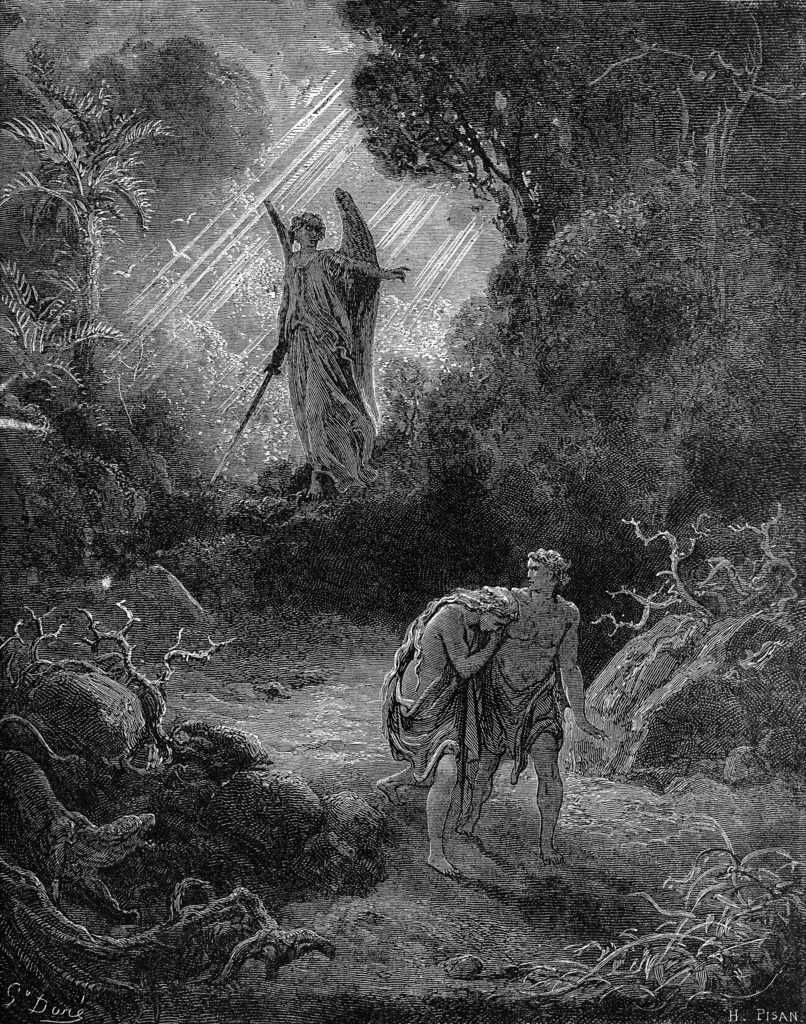
‘… to nobler sights Michael from Adam’s eyes the film removed Which that false fruit that promised clearer sight Had bred, then purged with euphrasy and rue The visual nerve (for he had much to see) And from the Well of Life three drops instilled. So deep the power of these ingredients pierced Even to the inmost seat of mental sight That Adam now enforced to close his eyes Sunk down and all his spirits became entranced. But him the gentle angel by the hand Soon raised and his attention thus recalled: Adam, now ope thine eyes and first behold The effects which thy original crime hath wrought…’ Paradise Lost
I’ve recently been re-reading John Milton’s Paradise Lost (1667). The third or fourth time round this epic vision seems no less powerful in its depictions of Heaven and Hell and Earth both pre and post fall or radical in Milton’s writing the perspective of Satan and his inner motivations and turmoil.
As an Annuvian kind of person I will admit to feeling more sympathy with Milton’s rather magnificent Satan, refusing to serve in Heaven preferring to reign in Hell, the only one amongst the fallen angels (who include many pre-Christian gods) who dares travel to Paradise to thwart God’s plans by bringing about the fall, than the brainless Adam and Eve, Milton’s spoilsport God, or his Son.
The ending, with its deus ex machina, again was disappointing. It turns out the fall was not only predicted but designed by God to make possible and all the more powerful Jesus’ redemption of humanity. Paradise Lost is, in essence, a work of theodicy, written ‘to justify the ways of God to men’.
I’m sharing this because, whilst re-reading the book, I found the lines cited above that seem to contain Christian and pre-Christian Brythonic lore. When the archangel, Michael, purges Adam’s fallen sight he not only uses traditional plants – euphrasy, or eyebright, and rue were used for treating eye ailments – but ‘three drops’ from ‘the Well of Life’. This grants Adam visions of the future, mainly the ill-doings of his offspring until the Flood. As far as I know there is a Tree of Life but not a Well of Life in Paradise in Christian literature, which makes me wonder if it comes from another source.
The most obvious is the Welsh ‘Story of Taliesin’. In this tale Gwion Bach steals three drops of awen ‘inspiration’ from the cauldron of Ceridwen, which grant him omniscience as the all-seeing Taliesin. Milton’s evocative description of these ‘ingredients’ piercing ‘to the inmost seat of mental sight’ and putting Adam into a trance before he opens his eyes to see the future fit shares similarities with the prophetic visions of Taliesin and other awenyddion, ‘persons inspired’ referred to by Gerald of Wales.
However, although this story had been published in Welsh in the mid-16th century, it was not available in English at Milton’s time. Whether he had travelled to Wales (Milton was born in London, studied at Cambridge, lived in Berkshire, and travelled extensively throughout Europe before returning to London) or had heard the story in England in some form remains unknown.
The resemblances are so uncanny that, if he had not, it seems possible he was tapping into some deeper source. It is of interest that Milton refers not to a cauldron, but to a well, a far older image. Throughout the British and Irish myths cauldrons and wells are associated with inspiration and rebirth.
After Gwion tastes the awen Ceridwen pursues him in a shapeshifting chase and swallows him into her crochan ‘cauldron’ or ‘womb’ from which he is reborn, shining-browed, and omniscient as Taliesin. In ‘The Second Branch’ the cauldron brings dead warriors to life. In ‘The Spoils of Annwn’, refusing to ‘boil the food of a coward’ it is associated with the bardic initiation rites of Pen Annwn.
In the Irish myths the Well of Segais is associated with imbas ‘inspiration’. No-one was allowed to approach it except its keeper, Nechtan, and his three cup-bearers on pain of their eyes exploding. However, Boann, Nechtan’s wife, disobeyed. It overflowed and she was dismembered and died. The river created took her name – the Boyne. When Finn burnt his thumb whilst cooking a salmon from this river he received the imbas. In The Battle of Moytura the Tuatha Dé Dannan dig Wells of Healing and throw in their mortally wounded, who not only come out whole but more ‘fiery’ than before (!).
It seems that Milton is, indeed, tapping into a deep source. Here, in Peneverdant we once had a Well of Healing, dedicated to St Mary at the foot of Castle Hill, which I believe was associated with an earlier Brythonic mother goddess of healing waters who has revealed her name to me as Anrhuna. I believe she is the consort of Nodens (cognate with Nechtan) and the mother of Gwyn ap Nudd (cognate with Finn), Pen Annwn. Perhaps we once had a myth based around these deities that has now been lost.
In Paradise Lost, for Adam, as for many who taste the three drops of inspiration (aside perhaps for Taliesin) possessing foreknowledge is both a blessing and curse. At first he laments Michael’s gift:
‘O visions ill foreseen! Better had I Lived ignorant of future, so had borne My part of evil only, each day’s lot Enough to bear! Those now that were dispensed, The burden of many ages, on me light At once, by my foreknowledge gaining birth Abortive to torment me, ere their being, With thought that they must be! Let no man seek Henceforth to be foretold what shall befall Him or his children…’
He is then reconciled by his perception of God’s purpose:
‘… Now I find Mine eyes true op’ning and my heart much eased, Erewhile perplexed with thoughts what would become Of me and all mankind, but now I see His Day in whom all nations shall be blest.’
‘O goodness infinite, goodness immense! That all this good of evil shall produce And evil turn to good more wonderful Than that which by Creation first brought forth Light out of darkness!’
Adam’s visions give him the strength to depart with Eve from Paradise to Earth to beget humankind. The gate to Paradise, to the Tree of Life and the Tree of Knowledge, and no doubt to the Well of Life is barred and guarded by a ‘flaming brand’ ‘the brandished Sword of God’ ‘fierce as a comet’.
In Christian literature, in contrast to the simplistic notion preached to school children that the souls of good people go to Heaven and those of bad people go to Hell, Paradise is not truly regained until after the Apocalypse and Jesus’ harrowing of Hell and the resurrection of the dead.
It may be suggested that, in our Brythonic myths, all souls return to the Well of Life. That, with a little awen to awaken ‘mental sight’, the living can travel in spirit to Annwn and be reborn as awenyddion.
Here, in Peneverdant, where the well has run dry due to the foolishness of humans shattering the aquifer when moving the river Ribble to create Riversway Dockland, it remains possible to traverse the waters of the past, of the Otherworld, to return to the unfathomable source from which Milton drew.
this May Eve, at this time of pandemic, not to speak of the second plague in the tale of Lludd and Llefelys. Of the dragon’s scream heard this night which ‘pierced people’s hearts and terrified them so much that men lost their colour and their strength, and women miscarried, and young men and maidens lost their senses, and all animals and trees and the earth and the waters were left barren.’
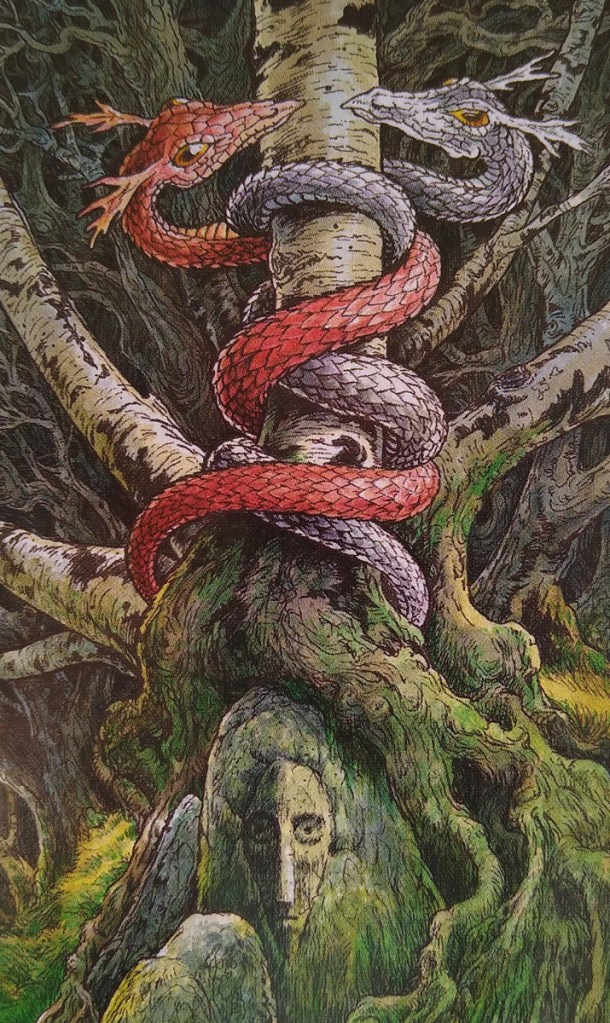
It would be impossible not to recall how Lludd dug a hole in the centre of the Island of Britain, filled it with mead, laid a sheet of brocaded silk on top. How he called down our screaming red dragon, battling with the white dragon, spiralling, spiralling, spiralling down, through the forms of bulls, wolves, boars, into two little pigs who drank the mead and fell asleep before he wrapped them up in the brocaded silk like two little babies and buried them in a stone chest at Dinas Emrys.
It would be impossible not to think of how the image of the serpentine bodies of the dragons intertwining looks like two strands of DNA and one alone like a single strand of RNA and to be reminded of the structure of a virus with its strand or strands carried within the stone chest of its capsid. Of how, like the dragons, viruses shift through a countless series of mutations before they sleep.
It would be impossible not to call to Lludd, to pray to that he, with his serpent-staff propped in the corner of his laboratory as he bends over a microscope, silver as his silver hand, will help us find a vaccine.
It would be impossible not to ask him to bring an end to our being locked up, like Creiddylad in her father’s house, which for some is a dream and for others a nightmare they fear is never going to end.
It would be impossible not to wonder who unlocked the stony chest and set the dragons free. To desire to find some perpetrator, some key, some rational explanation, some meaning to these events. Vengeance by the angry hordes of monstrous animals locked in stone chests or by the gods. The laws of evolution. Science. A balancing act of the Earth as a result of human excess. But it would be impossible.
*The image is from 14. Balance in the Wildwood Tarot.
Creiddylad most majestic maiden in the Islands of Britain, let me know your majesty
in this garden
on my knees two hands clasped together on this trowel making offerings of water
amongst flowers where you walk unveiled, stunning, bees dancing around you.
Let me be your bee!
Feed me when I’m hungry. When I fall exhausted pick me up gently
and I will make the sweetest honey.
“Stay here in this garden,” my patron god, Gwyn ap Nudd, advised me a week before the lockdown. A couple of days before my conservation internship was cancelled and, like many, I was rendered jobless.
We’ve been on lockdown in the UK for over a fortnight now and how I’ve to-and-froed, some days accepting this advice and, on others, after reading the news, wishing I was doing something more important, more heroic, than shopping and cleaning for my parents, tending the garden, doing my best to find the focus to pray, meditate, spend time in devotion to my gods, and to write for my supporters.
My main battle has been against feelings of guilt and uselessness caused by my awareness of the utter contrast between my easy life, touched by the bliss of the spring sun, and the hell that the nurses and doctors are going through on the front line, risking their lives fighting for the lives of others. The risks taken by the funeral services. The chaos and stress faced by supermarket staff. Our dependence on the long hours and monotonous work of fruit and veg pickers usually imported from abroad.
I’ve thought of applying for, have actually applied for, some of these jobs (which may have necessitated moving out of my parent’s house so I do not put them at risk), but nothing has come of it.
“Stay here in this garden.” I accept the gods have their reasons when the Blasted Oak, spelling disaster, appears in a tarot reading on what will happen if I take a veg picking job.
And deep within I know if I took any of the above jobs I’d likely get physically or mentally ill. That there is something fundamentally wrong with this industrialised and militarised system that keeps comparing the ‘fight’ against this virus with the Second World War and tries to inspire a wartime ethos.
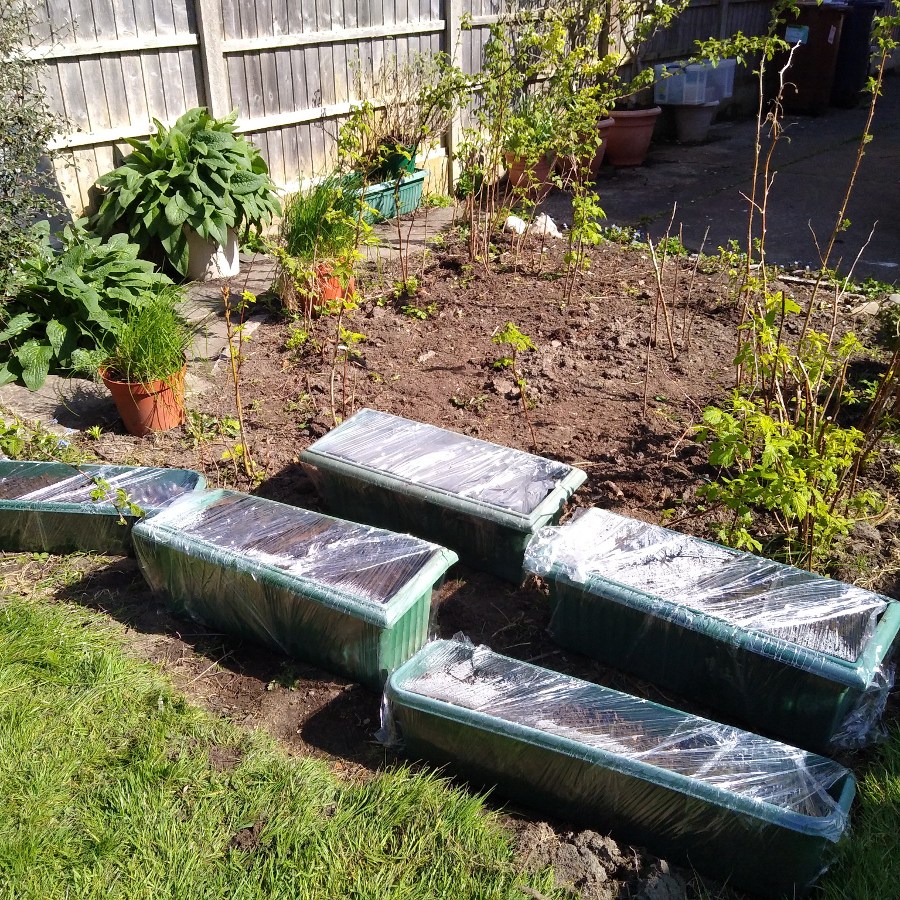
And so I tend my parents’ garden, cutting back years of overgrowth, clearing the paths, weeding amongst the many beautiful flowers that already grow here – hyacinths, daffodils, bluebells, honesty. And the shrubs and trees – apple, pear, rose, quince, camelia. Watering the raspberry canes. Sowing herb and lettuce seeds in troughs and veg seeds – carrot, turnip, onion, cauliflower, broccoli – in the soil.
And somewhere along the way it enters my mind this is ‘Creiddylad’s Garden’. And once the thought has entered it will not leave. I come to see the face of Creiddylad, ‘the most majestic maiden in the islands of Britain’, one of our Brythonic goddesses of flowers and spring, in each flower.
Creiddylad is a sovereignty deity who walks between worlds and lovers. This ‘majestic maiden’ is truly a majesty, a Queen, the lifeforce of nature who inspires great awe in her worshippers and the male deities, Gwyn and Gwythyr, Kings of Winter and Summer, who fight for her every Calan Mai.
Through the Winter she dwells with Gwyn, in the Otherworld, as Annwn’s Queen. In the Summer, with Gwythyr, she is May Queen, a great sovereign in Thisworld, revealing herself slowly flower by flower.
In Creiddylad’s contrary nature I find a better understanding of my own pulls between darkness and light, Thisworld and Otherworld. There is a part of me that wants to walk with Gwyn, a warrior and psychopomp, facing death, disease and sorrow. And at the same time an awareness he and other humans do this so the rest of us can appreciate the flowers and the sunlight and the lives that are our gifts.
It sometimes seems easier, more worthy, to embrace pain than pleasure. Why? I do not know. Only that in Annwn the sadness of the dead is transformed into great beauty and joy, and it this is that Creiddylad brings with her when walks from the Otherworld, into the light, and embraces Gwythyr.
Many of the flowers in my garden speak of similar myths through the correlates of other cultures. The narcissus, or the daffodil, was the plant Persephone was picking before Hades took her to… Hades. The hyacinth was born from the blood of Hyacinth, the lover of Apollo, killed by his rival Zephyrus, and its beautiful petals are inscribed with ‘AI AI’ ‘Alas’. Lungwort’s petals turn from pink to blue as the flowers are pollinated, edging toward death, like flesh, or deoxygenated blood.
Nature and myth, death and life, Thisworld and Otherworld, are deeply intertwined in Creiddylad’s garden. A place where I work slowly, contemplating the mysteries, where I meet flowers, goddess, gods. It seems they don’t want me to be a hero but instead a small suburban bee offering a taste of Creiddylad’s honey.
‘guided by Barinthus to whom the waters and the stars of heaven were well known. With him steering the ship we arrived’ Vita Merlini
What stars will you navigate by when they have fallen from the sky? Where is North when there is no North Star? How will the swans fly?
When your boat is stuck on a turning oar in the blackest of midnights shall I tie my blindfold with a sailor’s knot? Trust your sightless eyes?
Speak the words that have never been heard this side of the sunrise? Place my payment shiny and cold in your spitless mouth that never lies?
Your cloak of stars ragged torn will you wrap around my shoulders tight as you swear by dead sea-gods we will arrive on your boat that flies
on the wings of a swan where the sea is filled with the Northern Lights? Find the frost-dark isle of my mysterious god where the sun escapes the sunrise?
Where the living are dead and the dead alive and the blind no longer blind will we find the oar, the compass, the stars, bring them back with the starlight?
*This image is the Six of Arrows – Transition – from the Wildwood Tarot.
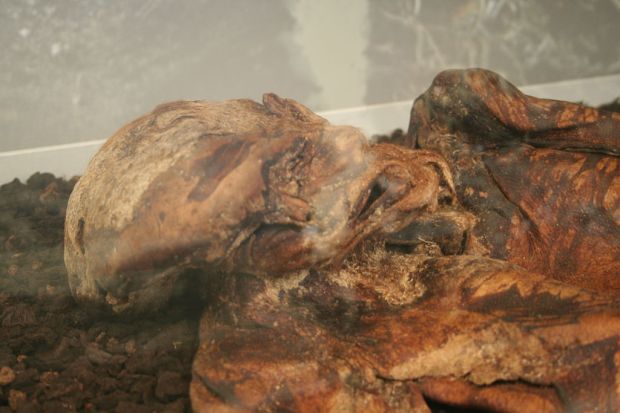
The wetlands of the old counties of Lancashire and Cheshire which were inhabited by the Setantii tribe ‘The Dwellers in the Water Country’ are well known for their bog burials; Lindow Man and Woman, Worsley Man, severed heads from Pilling Moss, Briarfield, Red Moss, Ashton Moss, Birkdale.
The archaeological evidence suggests that Lindow Man and Worsley Man were human sacrifices. Lindow Man (also known as Lindow II) was strangled, hit on the head, and his throat was cut before he was cast into the peat bog. Worsley Man was garotted and his skull fractured before his beheading. These ‘overkill’ injuries are suggestive of ritual killing rather than death in battle or murder.
This is supported by the fact many bog burials from Britain and Europe ate special last meals. The last meal of Lindow Man was a griddle cake baked from finely ground wheat and barley. Lindow III, another man whose remains were found nearby, ate a meal of wheat and rye with hazelnuts. Old Croghan man from Ireland, and Grauballe Man and Tollund Man from Denmark also ate similar meals.
The head from Briarfield was ‘deposited in a defleshed state without the mandible’ ‘with abundant remains of hazel’. Further north, at Seascale Moss in Cumbria, a body was buried in the bog with a hazel walking stick. Miranda Aldhouse Green notes that bog bodies from Gallagh in Ireland and Windeby in Germany wore hazel collars and another from Undelev in Denmark was buried with three hazel rods.
She connects them with a lead defixio of ‘late Roman date’ ‘from the river Ouse near the Hockwold Roman temple’ in Suffolk: ‘Whoever… whether male or female slave, whether freedman or freedwoman… has committed theft of an iron pan, he is to be sacrificed to the god Neptune with hazel’.
The Romans equated Neptune with our ancient British water-god Nodens at Vindolanda on Hadrian’s Wall where an inscription reads ‘DEO NO/NEPTU’. At his Romano-British temple at Lydney, Nodens is depicted on a mural crown driving a chariot pulled by four water-horses accompanied by winged wind-spirits and centaurs with fish-tails and a fish-tailed fisherman.
Nodens gifted pilgrims with healing dreams but was also called upon to remove health. A curse tablet reads: ‘For the god Nodens. Silvianus has lost a ring and has donated one-half [its worth] to Nodens. Among those named Senicianus permit no good-health until it is returned to the temple of Nodens.’
It thus seems possible the people who ingested hazel prior to their deaths or were buried with it were sacrifices to Nodens who was equated with Neptune due to his watery qualities by the Romans.
***
The associations between Nodens and hazel have deep mythic roots. In Ireland Nodens was known as Nuada Airgetlám ‘Silver Hand’ and Nechtan (from the Old Irish necht ‘clean, pure, white’). Nechtan was the keeper of the Tobar Segais ‘Well of Wisdom’. Around it stood nine hazel trees which dropped their hazelnuts, containing imbas ‘inspiration’, into the water. They were eaten by salmon and this special poetic wisdom, known as awen in the Welsh myths, was infused into their flesh.
Only Nechtan and his three cup-bearers: Flesc, Lam, and Luam, were allowed to visit the well. Of those who transgressed their eyes would explode (!) – a possible metaphor for the effects of poetic vision.
When Nechtan’s wife, Boann, disobeyed this command the well overflowed and became the river Boyne. One of its kennings is ‘the forearm of the wife of Nuadhu’ and it was known in the early 2nd century CE as Buvinda (from early Irish *Bou-vinda ‘the white lady with bovine attributes’).
When Finn ‘White’, a descendant of Nuadha, cooked the Salmon of Wisdom for his master, Finnegeas, he burnt his thumb, put it in his mouth, and accidentally imbibed his eye-bursting imbas.
I believe it is likely a similar mythos surrounded Nodens here in Britain. On his mural crown a fisherman is catching a large fish and, on a mosaic on his temple floor at Lydney, two sea monsters are surrounded by salmon. Additionally, in medieval Welsh mythology, Arthur and his men ride up the river Severn, past the Temple of Nodens, on the back of the Salmon of Llyn Llyw, to rescue Mabon.
In the dindsenchas the river flowing from Segais has many names. In Ireland it is not only known as the Boyne, but the Trethnach Tond ‘Ocean Wave’ and Sruth Findchoill ‘Stream of White Hazel’. Abroad it becomes Lunnand in Scotland, the Severn in England, then the Tiber, Jordan, Euphrates and Tigris.
At Lydney we also find iconography depicting Nodens’ wife and our British Boann: a stone statuette, thirty inches in height, left leg crossed over right, holding a cornucopia. Pins were offered to her by women seeking aid with childbirth. Unfortunately we do not know her name but the early Irish Bou-Vinda may relate to Vindos/Gwyn ap Nudd, the son she bore Nodens/Nudd. Gwyn’s name not only means ‘White’, but he is referred to as a ‘bull of battle’ in ‘The Conversation of Gwyn ap Nudd and Gwyddno Garanhir’, suggesting he inherited her bovine attributes.
As Vindonnus, at a spring in Gaul, he was offered bronze plaques depicting eyes. It has been suggested they were for aid curing eye ailments but they may also have been connected with poetic vision.
In medieval Welsh mythology, Gwyn, as Pen Annwn ‘Head of the Otherworld’, is the guardian of a cauldron that is warmed by the breath of nine maidens and will not brew the food of a coward, suggesting it is associated with initiation into the mysteries of the awen tasted from its bubbling waters.
It seems Gwyn, who like Finn, has tasted the wisdom of the salmon from the hazelnuts from the nine hazel trees, and received his awen, later adopts his father’s role as a wisdom-keeper.
***
How, then, does this ancient Celtic mythos appear in and relate to the Water Country? On Cockerham Moss two Romano-British silver statuettes dedicated to Nodens as Mars-Nodontis were found. This suggests that a temple lay nearby. Cockersand Abbey, the closest sacred site, is dedicated to Mary of the Marsh, a Christian overlay on an earlier water-goddess – the wife of Nodens. I know her as Anrhuna which means ‘Very Great’ and is probably only one of her names.
The church on Castle Hill, the pen which gives its name to Penwortham (earlier Peneverdant ‘the Green Hill on the Water’ as it stood on Penwortham Marsh), is dedicated to St Mary the Virgin, as was the holy well at the hill’s foot. The large number of Marian dedications in the marshy areas of Penwortham and Preston with their sacred springs hint at the underlying presence of this water-goddess.
The legend of Penwortham Fairy Funeral, set on Castle Hill, with its fairy leader ringing a passing bell and singing a mournful chant as he leads a procession of little black-clad men in red caps, bearing the fairy-double of an unfortunate young man to his grave suggests the presence of Gwyn.
Past the pen, sacred to Anrhuna, Nodens, and Vindos/Gwyn/Pen Annwn, runs the river Ribble. From Ptolemy’s Geography (2AD)we know Belisama is the goddess of the Ribble. She is the sister and/or consort of Bel, who is later known as Beli Mawr, father of Nudd/Lludd. The Ribble is rich in salmon and Maponos/Mabon and his mother Matrona/Modron were worshipped upriver at Ribchester. Modron is the daughter of Afallach (from afall ‘apple’), King of Annwn, a name of Gwyn.
Here, at the Green Hill on the Water, we find a parallel with Lydney ‘Lludd’s Island’. With salmon swimming upriver past a site associated with Mabon to the source where perhaps once stood nine hazel trees.
These stories run deep through this land as they ran through the land of our ancient British ancestors. Before its draining it was truly a water country of intertidal marshlands, reedbeds, carr, lakes and pools, peat bogs, and a damp oak woodland in which hazel and its nourishing nuts were precious.
It’s no wonder they were associated with Nodens, ‘the Catcher’, the wise fisher-god. Perhaps, by sacrificing their enemies to Nodens with hazel, the water dwellers repaid him for his generosity.
Another possibility is that some of the bog burials were devotees of Nodens sacrificed willingly to their god. Awenyddion who, like his son, had imbibed the hazel-rich awen. Lindow III’s consumption of hazelnuts before his death may have been a last act of communion. The man buried with the hazel staff might have carried it as a symbol of his role as a wisdom-keeper.
Hazel grows on the banks of Fish House Brook, which runs through the area once known as Fish Pan Field in Greencroft Valley into the river Ribble. In autumn its nuts are eaten by grey squirrels before they can drop into the brook where, due to changes in water level and pollution, fish no longer swim.
Still, as I pass, I think of the myth of Nodens and his nine hazel trees, Anrhuna’s transgression, Vindos/Gwyn eating the salmon imbued with awen from the hazelnut and his eye-bursting poetic vision, which he has gifted to me as his awenydd to pass on and share with my communities.
***
SOURCES
Anne Ross, Pagan Celtic Britain, (Cardinal, 1974) Anne Ross, Life and Death of a Druid Prince: The Story of Lindow Man, an Archaeological Sensation, (Touchstone, 1991) David Barrowclough, Prehistoric Lancashire, (The History Press, 2008) Finnchuill, ‘Catching Wisdom: Nuadha, Nechtan, Nodens’, Finnchuill’s Mast, (2016) Jody Joy, Lindow Man, (The British Museum Press, 2009) Kay Muhr, ‘Water Imagery in Early Irish’, Celtica 23, (1999) Miranda Green, Dying for the Gods, (The History Press, 2002)








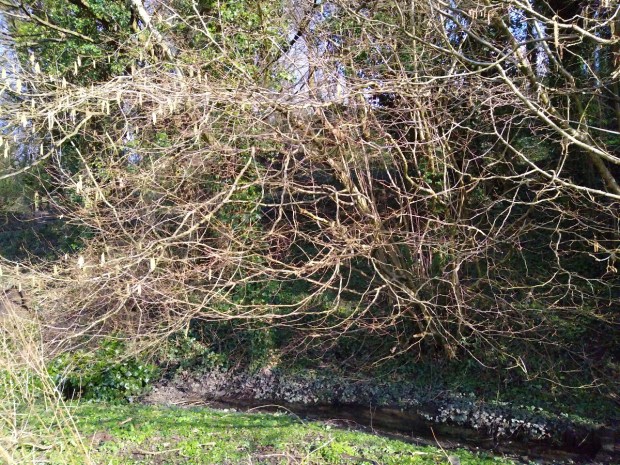
 The Sanctuary of Vindos