Seeking Blodeuedd

Cherry Blossoms Conti April 2019

I.
I seek you
where the petals
of magnolia fall
and cherry blossom
see you fleeing the ideal
of pale flesh

running into the woods
seeing yourself everywhere
dew beads on bluebells.

Doomed to be beautiful
you want to tear off your face.

II.
You want to sink your talons
into Lleu for whom you were made,

who acts like such a mummy’s boy
even though his mother disowned him,
refused to give him a name, weapons, a wife.
You hate this explanation for your being
and sate your hatred on loving Lleu

who did nothing wrong except be a man
in the wrong time and place.

III.
You do not know who Gronw is
until he brings you the stag’s head,
antlers shadowed on your bedroom wall,
until you wake knowing you have

a soul and weep for the first time.

Seeing clearly you choose your fate –
you will kill to have your own way.

Eyes large and wide honeyed beak:
“Tell me how can you be killed?”

IV.
Every Sunday you help to polish
the shaft of the poisoned spear,
try to restrain hysterical laughter
as you round up the goats by the river,
strip him, sponge him in the bath,
help him into that ludicrous position,
one foot on the goat one on the rim,
stark bollock naked shining like the sun.

When the spear strikes the sun falls
from the sky and flies away as an eagle
and you are left in darkness already
a creature of the night – Flower Face,

petals wilting in your marital bed,
flying free embracing your dark truth.

When Gwydion speaks your true name:
Blodeuwedd he does not know what he
called up, bound, and released.

The Vision of Ceridwen

I’m the broken bird-thing
at her table again

her wizened hand
in my claws

telling her
I’m going to mend
our broken vision

and all will be beautiful.

***

Sometimes you end up in a myth. It’s not the myth you thought you’d end up in or the myth you chose. You’re not who you thought you would be. Nobody else sees the myth the same way you do.

It began when I first started learning about the Bardic Tradition and heard that Ceridwen was the goddess of the cauldron that brews awen, the poetic inspiration that is like mead to the Brythonic bards.

As a poet I thought Ceridwen was a goddess well worth meeting so I drew myself a cauldron, lit a candle, constructed a visualisation. One of those 2D interfaces that sometimes helps you interact with what is. I imagined Ceridwen as a blue-robed, dark-haired, faceless woman stirring a cauldron.

Nothing happened. Then, from nowhere, out leapt a hideous grey-haired hag who put her bony arms around my neck, nearly strangling me. She demanded I go with her to her cottage in her woods. She sat me down at her table in a room with a sun dial and smaller cauldron over the hearth on a wobbly three-legged stool and insisted that I call her ‘grandmother’. Initially I thought she was an ancestor.

I presumed this showed Ceridwen wasn’t interested in me. She already had worthier devotees. Soon afterwards I got found by my patron god, Gwyn ap Nudd, a ruler of Annwn and guardian of the cauldron.

I met ‘grandmother’ again when I was travelling Annwn in search of inspiration on my flighty white-winged mare. She ditched me and I found myself falling downwards through the air, flapping my arms like wings, steadily acquiring black feathers, but not quickly enough to stop me hitting the ground. When I returned to my senses the hag-like woman was standing over me. With a wrinkly smile she told me I was ‘beginning to get my raven’s wings’ before taking me to her cottage again.

There she told me to look into her cauldron, where I saw in vivid blues and reds a Dark Age battle of clashing spears, crashing swords, broken shields, fallen flags, blood crimsoning the nearby waters, then the shades rising in a sorrowful march to depart. Researching it afterwards I realised it was the Battle of the Region Linuis fought by Arthur against the Saxons and wrote a poem about it*.

After this gift of awen from her cauldron I began to suspect the hag was the real (as opposed to my imagined) Ceridwen. The name ‘grandmother’ came to make sense a couple of years later. Gwyn had shown me a cauldron filled with stars and not long afterwards I went to see my friend, Nick Williams, performing an experimental poetry set in a blacked-out room with strobe lights. I had the sensation of being in a cauldron of poesy and also in the womb of the universe. I recalled that Nick refers to a goddess called Old Mother Universe and realised she is Ceridwen – the oldest mother of all.

I went on to write a book called The Broken Cauldron, focusing on how Ceridwen’s crochan ‘cauldron’ or ‘womb’ is shattered in the Welsh myths and of my task of gathering the stars back into it.

Whereas, in the Bardic Tradition and Druidry, Taliesin and Arthur, those responsible for stealing the awen and the cauldron and the shatterings that have brought devastation to the land are hailed as heroes, I found myself standing in the shoes of Morfran ‘Sea Raven’, Ceridwen’s dark and ugly son, who was later known as Afagddu ‘Utter Darkness’.

He for whom she boils her cauldron in the hope the brew will inspire him and cure his imperfections. He who does not get the awen, who cannot win poetic inspiration the quick way, but must work to find the words to heal the lands poisoned by the contents of the broken cauldron, to repair it piece by piece, story by story, so the stars shine in bright new constellations on a new world.

Gwyn is my guide in this task, and in serving him, I am also serving Ceridwen. She does not appear to me often, but when she does, I am often her awkward black-winged child, the dark imperfect one.

As Afagddu I’m learning imperfection is necessary; an understanding of what others find repulsive, whether it’s darkness, death, decay, plastic, the monstrous creatures of Thisworld or the Otherworld. That these hold their own beauty when the concept is not corrupted by our society’s false ideals.

It’s not the Old Mother’s Universe that needs fixing, but the way we perceive it, the collective vision, which guides our acts. When we learn to see clearly both Creirwy* and Afagddu will be beautiful.

A star-forming region in the Large Magellanic Cloud Wikipedia Commons

*’The Region Linuis’ was first published in Heroic Fantasy HERE.
**Creirwy means ‘Lively Darling’. She is Afagddu’s beautiful (twin?) sister.

With thanks to Wikipedia Commons for the image ‘A star-forming region in the Large Magellanic Cloud’ by ESA/Hubble.

Those are but Devils

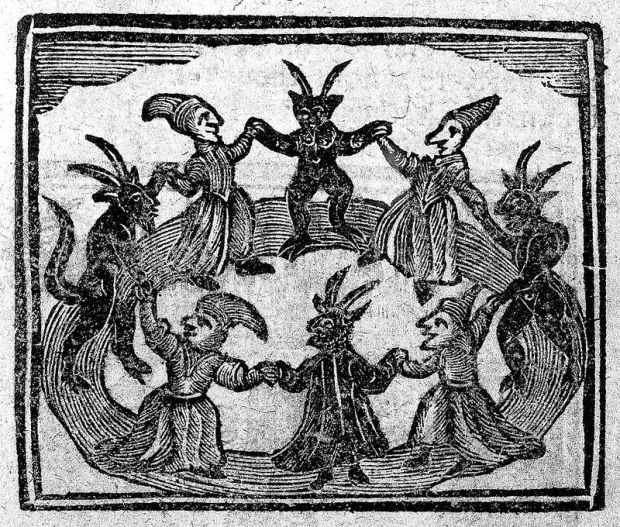
Witches dancing with devils from the History of Wizards and Witches 1720

An essay on the demonisation of Gwyn ap Nudd and the Spirits of Annwfn

Gwyn ap Nudd, ‘White son of Mist’, is a god of the dead and ruler of Annwfn, ‘the Deep’, the Brythonic underworld. In two medieval Welsh texts he and the spirits he rules are identified with devils.

In How Culhwch Won Olwen we are told, ‘Gwyn ap Nudd… God has put the fury of the devils of Annwfn in him, lest the world be destroyed. He will not be spared from there.’

The introduction of God’s agency is clearly a Christian attempt to explain Gwyn’s containment of the spirits of Annwfn. These spirits include the restless dead who have died suddenly or violently:

Some headless stood upon the ground,
Some had no arms, and some were torn
With dreadful wounds, and some lay bound
Fast to the earth in hap forlorn.

And some full-armed on horses sat,
And some were strangled as at meat,
And some were drowned as in a vat,
And some were burned with fiery heat,
Wives lay in child-bed, maidens sweet…

…such the fairies seize and keep.

Others such as the Tylwyth Teg, ‘Fair Family’, or ‘fairies’ and ellyllon, ‘spectres’, ‘goblins’, ‘elves’ occupy a liminal position between life and death, humanity and nature, and mitigate between the worlds. Christians identify these complex and ambiguous spirits with dieuyl, ‘devils’.

Gwyn presents a paradox that does not sit easily with Christianity’s black-and-white theology: because he contains the spirits of Annwfn within him and/or within his realm he is the only being who can hold back their aryal, ‘fury’, and prevent them from destroying this world.

In The Life of St Collen, Collen, the abbot of Glastonbury, overhears two men conversing outside his cell saying Gwyn is ‘king of Annwfn and of the Fairies’. Putting his head out he shouts, ‘Hold your tongues quickly, those are but Devils’.

Collen is invited to feast in Gwyn’s castle on the Tor. There he refuses to eat, saying the food is ‘leaves’ and the red and blue clothing of Gwyn’s host signifies ‘burning’ and ‘coldness’; it is hellish. Collen supposedly banishes them with holy water.

***

Gwyn’s association with devils stems from a longstanding Christian tradition of identifying pagan deities with the Devil and demons and the realm of the dead with Hell. Any god who was not the one God, who demanded no other gods be worshipped before him, was seen as demonic.

In The Bible, Beelzebub, a Semitic deity originally called Baal-zebul, ‘Lord of Princes’, is equated with the Devil along with Satan and Lucifer. The ‘false gods’ of the Canaanites are referred to as ‘demons’ and the se’irim ‘hairy beings’ or satyros (ie. satyrs) as ‘goat-demons’.

The concept of Hell developed much later. In The Old Testament the original Hebrew word is Sheol, ‘the place of the dead’ (it is frequently translated as ‘the grave’). In The New Testament, Hell is translated from Hades, Tartarus and Gehenna. Hades means ‘the unseen place’ and is the name of the Greek underworld and its ruler. Tarturus is ‘the deep place’ beneath Hades. Contrastingly, Gehenna is a thisworldly place, the Valley of Hinnom, where the Kings of Judah sacrificed their children by fire, leading to it being cursed.

Hell derives from the Old English hel or helle stemming from Proto-Germanic *haljo ‘the underworld’ or ‘concealed place’. Hel is also the name of its goddess. Ironically it is a borrowed pagan concept which is not of Biblical origin.

The idea of the land of the dead as a place of punishment by eternal fire was developed in the early days of the Church by scholars such as Second Clement, Justin Martyr and Theophilus of Antioch as a means of controlling the populace. Augustine, bishop of Hippo Regus, was the first Christian leader to teach ‘the doctrine of eternal punishment’ during the 4th century.

Annwfn, ‘the Deep’, shares parallels with the other pagan underworlds and places of the dead. In medieval Welsh mythology there is plenty of evidence that, following their Christianisation between the 4th and 7th centuries, the Britons resisted the view that Annwfn was a place of punishment.

In ‘The First Branch’ of The Mabinogion and even in The Life of St Collen it is a place of beautiful courts and castles, lavishly dressed courtiers, and sumptuous feasts. These paradisal depictions are echoed in later fairylore demonstrating Annwfn became byd Tylwyth Teg, ‘Fairyland’ or ‘Faerie’.

Gwyn’s name means ‘White, Blessed, Holy’ and Gwynfa ‘Paradise’. In Barddas, Iolo Morganwg speaks of Cylch y Gwynvyd, ‘the Circle of White’, ‘the Holy World’ noting gwynvyd denotes ‘bliss or happiness’. Gwynfa and Gwynvyd might originate from a tradition wherein, like Hades and Hel, Gwyn and his realm bore identical names.

When Annwfn became Faerie its associations with the dead were severed and it was reduced to a fantasy realm. However, superstitions remain, many of these pertaining to the uncanny and dangerous nature of the fairies and their associations with abductions, madness, and death.

***

The Conversation of Gwyn ap Nudd and Gwyddno Garanhir’ contains Gwyn’s clearest literary representation as a pre-Christian god of the dead. Gwyddno addresses Gwyn as a ‘bull of battle’: a divine warrior and psychopomp. Other epithets include ‘awesome leader of many’, ‘invincible lord, and ‘lord of hosts’.

Gwyn’s identity as a death-god is revealed when he states he comes from ‘many battles, many deaths’. He asserts his presence at the deaths of Gwenddolau ap Ceidio, Bran ap Ywerydd, Llachau ap Arthur, Meurig ap Careian, and Gwallog ap Lleynog before speaking the lines:

I was there when the warriors of Britain were slain
From the east to the north;
I live on; they are in the grave.

I was there when the warriors of Britain were slain
From the east to the south;
I live on; they are dead.

Here Gwyn laments the downfall of the Brythonic kingdoms to the Anglo-Saxons and his living on as a gatherer of souls. He is a venerable figure. The only thing devilish about him is the bull-horns.

Contrastingly How Culhwch Won Olwen presents Gwyn as a sinister being and pits him against Arthur: a champion of Christianity who rose to popularity by slaughtering and subordinating a variety of Annuvian deities, ancestral animals, giants, and witches.

It is my belief that Arthur’s overcoming of Gwyn was a primary step in the destruction of Brythonic Paganism and the assertion of Christianity. Gwyn’s mythos had to be erased and reconfigured in a new literature documenting his defeat and replacement by Arthur as a protector of Britain who fights against the ‘devils’ of Annwfn rather than containing their fury.

In How Culhwch Won Olwen Arthur intercedes in the ancient seasonal struggle between Gwyn, ‘Winter’, and Gwythyr, ‘Summer’, for their beloved, Creiddylad, a fertility goddess. Gwyn takes Creiddylad from Gwythyr by force, presumably abducting her to Annwfn, explaining the coming of winter on Calan Gaeaf.

Gwythyr raises an army and attacks Gwyn. It might be assumed they also descend to Annwfn. Gwyn defeats them singlehandedly and imprisons Gwythyr and seven of his men. The imprisonment of Summer in Annwfn may also be part of a mythos explaining the rule of Winter.

During their imprisonment Gwyn kills Nwython and feeds his heart to his son, Cyledyr, who goes mad. Whether this scene should be read as a punishment for invading Annwfn demonstrating Gwyn’s furious nature, a muddled echo of a rite transferring ancestral strength from father to son, or Christian propaganda demonising Gwyn remains uncertain.

Whatever the case, Arthur comes to the rescue, presumably storming Gwyn’s prison in Annwfn. He defeats Gwyn, then binds Gwyn and Gwythyr in battle for Creiddylad every Calan Mai until Judgement Day. Arthur’s agency is introduced to explain an existing duel on Calan Mai where Winter is defeated and Creiddylad returns to this world, explaining the rule of Summer. The purpose is to display Arthur’s control over these two old seasonal gods and Creiddylad who he locks in her father’s house saying neither can take her until Judgement Day!

The scene where Gwyn and Gwythyr appear together as advisors to Arthur on his assault on Orddu, ‘the Very Black Witch’, who lives in Pennant Gofid, ‘The Valley of Grief’ in ‘the uplands of Hell’ is again designed to demonstrate his power over them and this Annuvian woman, who he slices in half with his knife, Carwennan, before draining her blood.

It is notable that Gwythyr’s father, Greidol, ‘Scorcher’, is one of Arthur’s forty-two counsellors and Gwythyr’s daughter, Gwenhwyfar, is married to Arthur. This is suggestive of a long-standing alliance between Arthur and the powers of summer against winter and death.

The rescued prisoners join Arthur on his hunt for Twrch Trwyth, ‘King of Boars’. That Gwyn must be found before the hunt can start suggests Gwyn was its original leader. Gwyn’s identity as a hunter god is suggested by his ownership of a white stallion, Carngrwn, ‘Round-Hoofed’, and white red-nosed hound, Dormach, ‘Death’s Door’. In Welsh folklore Gwyn and the Cwn Annwfn, ‘Hounds of the Otherworld’, hunt the souls of the dead. He is the Brythonic leader of the Wild Hunt.

Twrch Trwyth’s transformation from a human king into a boar hints at the tradition of a soul hunt. Arthur’s usurpation of Gwyn’s hunt and its depiction as just a boar hunt marks the end of the mythos featuring Gwyn as a god of the dead and leader of the Wild Hunt.

Many of Arthur’s famous landmarks, including Carn Cafall, where the footprint of Arthur’s gigantic dog was left during the hunt for Twrch Trwyth, may formerly have been associated with Gwyn and Dormach.

The Spoils of Annwfn’ shares similarities with Arthur’s attack on Gwyn suggesting they are two different variants of the same story. Taliesin, the narrator, accompanies Arthur on his journey to seven otherworldly fortresses (which I believe may be faces of the same fort) where he takes on Pen Annwfn, ‘the Head of Annwfn’.

Storming the glass walls and defeating six thousand unspeaking dead men in a devastating battle, Arthur and his raiding party rescue Gweir (who may be equated with Graid, one of Gwyn’s prisoners), steal the legendary Brindled Ox, and seize ‘the Cauldron of the Head of Annwfn’. Escaping with only seven survivors Arthur slams ‘Hell’s Gate’ shut.

Arthur’s defeat of the Head of Annwfn and seizure of his cauldron represent the triumph of Christianity over Paganism, the realm of death, the dead and their ruler, and the mysteries of death and rebirth.

It is no coincidence that Arthur’s raid on Annwfn shares parallels with Jesus’ ‘Harrowing of Hell’ (harrow comes from the Old English hergian ‘to harry or despoil’). Between his crucifixion and resurrection, Jesus descended to Hell to preach to ‘the imprisoned spirits’ and liberate the righteous who had been trapped there since the beginning of the world (the damned were left to stay!) triumphing over the realm of the dead and death itself.

It is my intuition that prior to Christianity and Arthur’s rise to popularity the series of fortresses might have formed part of a Brythonic tradition documenting the descent of the soul to Annwfn. They would have been approached respectfully with due ritual rather than assaulted and despoiled, their guardians killed, their treasures stolen.

***

The demonisation of Annwfn is shown by lines from several poems in The Book of Taliesin equating it with Hell (translated from Uffern which originates from the Latin Inferno ‘underworld’).

And in front of the door of Hell’s gate lamps were burned

What is the measure of Hell?
How thick its veil,
how wide its mouth,
how big are its baths?

Madawg…
Was taken by fierce Erof…
Among the hideous fiends
Even to the bottom of Hell.

Gwyn’s loss of status as a god of the dead led to him being demonised as a demon huntsman who hunted the souls of sinners. His role became punitive as he was subsumed within Christianity’s doctrine of fear and control as a devilish figure.

Charles Squire writes, ‘Gwyn… his game is man… the “mighty hunter”, not of deer, but of men’s souls, riding his demon horse, and cheering on his demon hound to the fearful chase’.

John Rhys notes, ‘What Gwyn hunts are the souls of those who are dying; but Christianity has greatly narrowed his hunting ground, as his quarry can now only be souls of notoriously wicked men.’

Folkloric stories featuring horned figures and/or the devil, Tywsog Annwfn, ‘Prince of Annwfn’, might originally have featured Gwyn, a ‘bull of battle’ who wears bull-horns. The following example is recorded by John Rhys:

‘Ages ago as a man who had been engaged on business, not the most creditable in the world, was returning in the depth of night across Cefn Creini, and thinking in a downcast frame of mind over what he had been doing, he heard in the distance a low and fear-inspiring bark; then another bark, and another, and then half a dozen more. Ere long he became aware that he was being pursued by dogs, and that they were the Cwn Annwfn. He beheld them coming: he tried to flee, but he felt quite powerless and could not escape. Nearer and nearer they came, and he saw the shepherd with them: his face was black and he had horns on his head.’

John Rhys argues this black-faced, horned ‘shepherd’ is Gwyn. This representation is clearly influenced by Biblical tradition, perhaps by the following passage containing Cyril of Alexandria’s interpretation of John 10: 12-13:

‘the father of sin used to put us in Hades like sheep, delivering us over to death as our shepherd, according to what is said in the Psalms: but the really Good Shepherd died for our sakes, that He might take us out of the dark pit of death and prepare to enfold us among the companies of heaven, and give unto us mansions above, even with the Father, instead of dens situated in the depths of the abyss or the recesses of the sea.’

Again we return to Jesus’ ‘Harrowing of Hell’ and his triumph over the realm of the dead. This story forms a large part of the hubristic anthropocentric worldview where ‘Man’ (Jesus/Arthur) conquers all, including death and its deities, which has led to the Anthropocene.

***

For many centuries Christianity has cut us off from the magical underworld beneath our feet and from its deities who we have been taught to fear as devils. As the hegemony of Christianity and its bed-partner, Empire, fail, leaving a void filled by consumerism, materialism, right-wing populism, and regressive nationalisms the need arises to reconnect with the gods of the deep.

Within Brythonic culture there is a tradition of spirit-work referred to by Gerald of Wales. He speaks of awenyddion, ‘people inspired’, ‘the soothsayers of this nation’ who are possessed by and speak with the aid of spirits and receive inspiration from dreams.

Following their example we can rebuild our relationship with the spirits of Annwfn. This isn’t an easy path to take as they have long been demonised, shut out, ignored. The restless dead are growing in number as more people die in war and fall victim to the exploitation of capitalism. They can indeed be furious. As can the fairies who mitigate between the worlds and have witnessed our untrammelled destruction of nature and ignorance of Annwfn.

Yet we have a responsibility to them, to the ‘others’, that deserves a response. Their fury demands the destruction of the exploitative systems of this world and the replacement of the shallow facade of consumer culture with a mythos rich and deep in meaning based in respectful relationship with all beings, human and non-human, living and dead.

Within Brythonic tradition Awen, ‘divine inspiration’, the source of mythic meaning, flows from Annwfn.

The Awen I sing,
From the deep I bring it,
A river while it flows,
I know its extent;
I know when it disappears;
I know when it fills;
I know when it overflows;
I know when it shrinks;
I know what base
There is beneath the sea.

Our existing mythology and folklore shows there are ways into Annwfn/Faerie that are not only traversed by the likes of Arthur but by children, drunkards, poets, fiddlers, and dancers. Admittedly the risk is madness or death, but those who pass the initiatory challenges of the Fairy Kings and Queens emerge with the Awen to guide the way into a better world.

Capitalism thrives on its domination of meaning. With Awen from Annwfn we create our own.

/I\

Gwyn ap Nudd
guide of souls
light of the mist
show us Annwfn’s
disturbing beauty:
shining butterflies
worm-faced death.

Let your dragons
grant us Awen from
unquenchable wells.
Let us be possessed
and ride the fury
of your spirits
into the next world.

***

SOURCES

Charles Squire, Celtic Myths and Legends, (Lomond Books, 1905)
Dennis Bratcher, ‘Demons in the Old Testament: Issues in Translation
Edward Eyre Hunt, (transl), Sir Orfeo, (Forgotten Books, 2012)
Gerald of Wales, Description of Wales, Awen ac Awenydd
John Rhys, Celtic Folklore Welsh and Manx, Volume 1, (Forgotten Books, 2015),
John Rhys, Studies in the Arthurian Legend, (Elibron Classics, 2005)
Greg Hill (transl) ‘Gwyn ap Nudd and Gwyddno Garanhir’, The Way of the Awenydd
Iolo Morganwg, Barddas, (Weiser, 2004)
Lady Charlotte Guest (transl), ‘Gwyn and St Collen’, Mary Jones Celtic Literature Collective
Marged Haycock, (transl), ‘The Spoils of Annwfn’, Legendary Poems from the Book of Taliesin, (CMCS Publications, 2015)
Saint Cyril, Saint Cyril Collection, (Aeterna Press, 2016),
Sioned Davies, (transl), The Mabinogion, (Oxford University Press, 2007)
William F. Skene, Four Ancient Books of Wales, (Forgotten Books, 2007)

*This essay was first published in A Beautiful Resistance 4.

The Riddles of Manawydan

What is the water you cannot drink?
What is the mineral that kills and cures?
What is the ship you cannot sink?
What is the light that warns and lures?
Who sings the song that robs and feeds?
Who are the horses that run without feet?
Where is the cloak that was shaken between?
Why does the sea yearn for the land?
Why is this seafarer land bound?

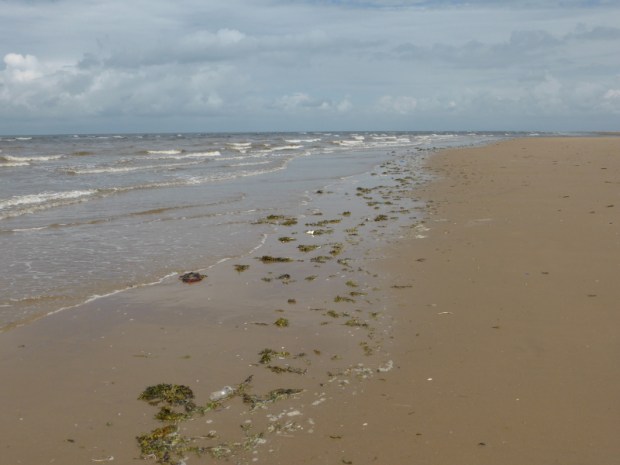
Sea at Blackpool

Ffortiwna

Ffortiwna
you are beautiful
sparkling-eyed
contagious laughter

humming at your wheel
the silver threads of destiny
shimmering between your fingers
your silver thimble dancing
as you sew our garments

your magpies plucking
the threads and cutting them off
with a snap of their beaks.

On your loom we are broken
and rewoven more tightly
into your singing web.

You are spider-like
in your song many-eyed
watching over us.

You are undecipherable.

We count your magpies
but cannot guess your will.

You raise us up and whirl us
through the skies in your chariot
of thundering silver wheels
then you hurl us down.

Still I come to court you
with magpie-feathered hair
on bent trembling knees

in gratitude and acceptance.

Everyone weeps with me.

Wheels and Feather of Ffortiwna

*This poem was written as a response to ‘O Fortuna‘, a complaint about the goddess of Fortune in the Classical myths. A few months ago I had an encounter with the Gallo-Brythonic god Taranis and his daughter, who told me she was known as Fortune by the Romans. I afterwards intuited that in the eyes of the Britons she would have been known as Ffortiwna. This poems attempts to present a more balanced view of this goddess based on my personal gnosis.

On Becoming Gwyn’s Awenydd

Gwyn Altar

In Pum Llyfr Cerddwriaeth (1570) Simwnt Fychan lists three main stages of poet-hood; disgybl ysbâs heb radd, ‘unqualified apprentice’, disgybl disgyblaidd ‘qualified apprentice’, and pencerdd ‘master poet’.

In January 2013 I took vows to Gwyn ap Nudd, a Brythonic god of the dead and ruler of Annwn, embarking on an apprenticeship to him that would lead me to becoming a disgybl disgyblaidd and his awenydd.

Undertaking an apprenticeship to a god is little known or spoken about in the Western world. In English schools the myths of ancient Britain contained in medieval Welsh literature are not taught. The names of the gods and spirits associated with our localities are not told. Nobody speaks of Annwn, the Brythonic Otherworld, as a place of initiation. An apprenticeship is a route to a secular career rather than to a vocation, a word stemming from vocātiō, a call or summons by the divine.

Because of this I did not recognise the first intimations of my calling. I did not understand the impulse that led me to read, walk, dance, drink myself to the heights of ecstatic visions, to the depths of abyssal despair. Lacking the framework of religion or knowledge of shamanistic experience I did not know whether my visions or the beings I saw were real or symptoms of madness.

Not knowing that it was possible to communicate with them (speaking back would mean I was surely mad!), to walk the Otherworld with will and intention, I could neither embrace or shrug off my calling. I stumbled through life like a drunken teenager, failing in my ambitions to become a philosophy lecturer, a riding instructor, or a fantasy writer because none fulfilled this inexplicable urge.

It was only after learning about the revival of animism and polytheism in the West that I realised my experiences were real and meaningful. That it was possible to communicate with gods and spirits. When Gwyn showed up when I was thirty years old I finally put a face to that calling and understood that my visions were of his realm, Annwn/Faerie, and his people, the spirits of Annwn/fairies.

My life suddenly made sense. Following a haunting vision of a satyr-like spirit in my local woodland in the depths of winter who spoke the words ‘a sadness is coming this land – you must become Gwyn’s apprentice’ I knew for sure what was already in my heart and the depths of my soul; that I must devote myself to Gwyn.

So I made three vows to Gwyn at the White Spring beneath Glastonbury Tor: to honour him daily, to stand in my truth, and to walk between the worlds with reverence. I chose this place not only because it is Gwyn’s best known sacred site, but because of powerful experiences at Glastonbury Festival I believe were associated with this enigmatic god and his bright spirits.

Soon afterwards the name of the vocation I was working towards as an apprentice was revealed. I was to become Gwyn’s awenydd – a spirit worker and inspired poet who travels between the worlds questing the awen, the divine breath of inspiration, from the land and the depths of Annwn.

During my apprenticeship to Gwyn I have learnt and done far more than I ever did at university. Gwyn has taught me how to journey back into the land’s deep memories to retrieve stories from distant times, those of ancestors who have left little or no trace, or have been erased by the victors.

Gwyn has taken me deeper into Annwn, where history fades into myth, to reveal the extent of the atrocities committed against his people by Christian warriors such as Arthur and his warband and by ‘saints’ and the effect on our psyche of our violent separation from our ancient deities and the Otherworld. To me he gave the task of revealing and thus beginning the process of healing these wounds.

Gwyn finally called upon me to recover his forgotten mythos from the mists of time, from the pens of Christian scribes bent on portraying him and his spirits as demons; to give voice to the inspired ones who have served him, whose souls he has gathered, since the last of the ice departed from this land.

I have recorded my personal journey since its beginning along with my research and creative writing on my blog and now have nearly a thousand followers and several patrons who support my work. I have shared my poems and stories in individual and group performances in my local area. At Pagan events in the North West of England and beyond I have spoken on the lore of the land and the Brythonic gods.

With the launch of Gatherer of Souls, my devotional book for Gwyn and Annuvian counter-narrative to Arthurian mythology, my apprenticeship is complete. I am now a disgybl disgyblaidd and his awenydd. Whether I will ever reach, or want to reach, the Taliesinic heights of pencerdd is doubtful.

I am currently happy knowing that I am one of the first of a new generation of awenyddion to complete something ancient and profound, with knowing the joy of being devoted to this terrible beautiful god whose mists shroud the mysteries of the Otherworld; that the well of learning is infinite.

I am planning to take new lifelong vows to Gwyn as his awenydd here in Penwortham, where he first appeared to me in person and where most of my work for him takes place, on this January’s full moon.

Discovering Anrhuna

Anrhuna… it’s taken me many years to find out her name… nearly as many years as the many names I’ve known her by: Lady Ivy, Lady Green, Lady of Peneverdant (‘The Green Hill on the Water’), Lady of the Marsh, Mother of the Marsh, Mary of the Marsh, Marian, Mother of Annwn.

At my local sacred site, Castle Hill in Penwortham (Peneverdant in the Domesday Book), the church on the summit is dedicated to St Mary the Virgin, as was the well at the hill’s foot. I have known for a long time a goddess replaced by Mary lies beneath. I’ve felt her presence in the water dripping from the ivy, in ferns, hart’s tongue, enchanter’s nightshade, all the plants that love the damp.

Lady on the Mound - Copy

She’s gifted me with visions of how the land appeared to the ancient Britons who worshipped her. The Bronze Age Lake Village, the way across the marsh to the sacred hill marked out by stakes, the moonlit processions spiralling around the hill to light a beacon fire, the burial mound beneath the castle mound, the grove of trees circling the area where the church now stands, beloved of the druids.

Where the river Ribble (known then as Belisama, ‘Most Shining One’) runs culverted and shifted from her course and on the other side stand the flats and out of town stores around the redundant docks I have listened to widgeon whistling and curlew calling across the marsh. I have seen tall, handsome cranes grazing beside the river and taller, mightier aurochs drinking deep, raising horned heads.

River Ribble, water level

Stranger still, two people from the US have contacted me to share visions of this place. A while back Heather Awen spoke of witnessing women making offerings from a wooden platform, praying for ‘a baby to fill their womb’, and seeing a woman ‘wrapped in burlap… tied with ropes’ lowered into the marsh. More recently Bryan Hewitt reported being drawn to do healing work in the area and seeing people in wooden boats traversing the river. Afterwards I had my first vision of the goddess as a person – a woman in a wooden boat getting bigger and bigger until she filled the skies, then trying to take the hill and docklands, severed by the moved river, in her arms to make her marshland one again.

Mother of the Marsh I

Bryan spoke to me of his relationship with a goddess he knows as the Mother of Annwn. When I met her on a journey she presented me with watery marshland imagery. A number of threads came together and I realised my local marsh goddess is this goddess of the waters of life flowing from Annwn.

Another thread that helped to complete this mysterious tapestry of place and deity is Bryan’s knowledge that the Mother of Annwn is the mother of Gwyn ap Nudd, my patron god, who I met in the damp woodland on the east bank of Castle Hill, where our local fairy funeral legend is set.

It is well known from his patronymic that Gwyn’s father is Nudd/Nodens, but the identity of his mother has fallen into obscurity. In The Descent of the Saints Gwyn is listed as the son of Tywanwedd, a little-known sixth century saint, who is also the father of Gwallog and Caradog, yet this has never rung true. Neither has the ungrounded claim of Robert Graves that Gwyn’s mother is Arianrhod.

The only real clue I have found is Ann Ross’s mention that at Nodens’ temple at Lydney there was found a stone statuette of a mother goddess, thirty inches in height, ‘her left leg crossed over her right’, ‘a corncupia in the crook of her left arm’, her head unfortunately missing. Pins were offered to her by women seeking aid with childbirth. It seems likely she is Nodens’ consort and Gwyn’s mother.

There is also evidence for the worship of Nodens here in Lancashire. Two statuettes dedicated to him were found on Cockersand Moss very close the remains of Cockersand Abbey. This was dedicated to Mary of the Marsh – my marshland goddess Christianised. I realised it was likely she and Nodens were worshipped together both there and here on Castle Hill with their son, Gwyn.

The final thread was finding out the goddess’s name. When guesswork failed I asked her directly and she set me searching for it through the reeds as if for a bird’s egg scaring up whistling ducks, digging down into the peat through layers of history to the age of dug-out canoes and bronze spears, hearing it whispered in my ear as if on the breath of a bog body – “Anrhuna” (tentatively ‘Very Great’).

The tapestry of land and deity at Castle Hill – Anrhuna, Nodens, Gwyn, alongside Belisama, is complete.

Castle Hill Mound Autumn 2018

The Wheels of Taranis and his Daughter

O Fortune,
like the moon
you are changeable,
ever waxing
ever waning;
hateful life
first oppresses
and then soothes
playing with mental clarity;
poverty
and power
it melts them like ice.

Fate – monstrous
and empty,
you whirling wheel,
you are malevolent,
well-being is vain
and always fades to nothing,
shadowed
and veiled
you plague me too;
now through the game
I bring my bare back
to your villainy.

Fate is against me
in health
and virtue,
driven on
and weighted down,
always enslaved.
So at this hour
without delay
pluck the vibrating strings;
since Fate
strikes down the strong,
everyone weep with me.

– Oh Fortuna

I came upon several lines from ‘O Fortuna’ a couple of months ago as epigraphs to the chapters in Margaret Weiss’s Star of the Guardians trilogy. Drawn by their tragic and epic ring I looked them up and found that ‘O Fortuna’, a complaint about fate in the Greek and Roman myths, is one of 254 poems and dramas in Carmina Burana. They were written between the 11th and 13th centuries by clergy who satirized the Catholic Church and found in 1803 in the Benedictine monastery of Benediktbeuern.

‘O Fortuna’ was set to music by Carl Orff in his cantata Carmina Burana. Playing the movement, I recognised the gripping and hair-raisingly powerful music accompanied by Latin lyrics as the score for dramatic film scenes (it has been re-used and parodied so often it has sadly become cliched) and dancing to an electro version in goth clubs. For several days I could not get the tune out of my head.

At the same time I kept getting the Two of Arrows – Injustice card in the Wildwood Tarot. It pictures the figure of Justice enthroned and blindfolded with two arrows crossed across her heart and her foot on a bow. Above her is a set of scales with a feather on one and a pile of coins on the other.

The meaning in the guide is as follows: ‘The scales of natural justice have been skewed by false judgements, ignorance or arrogance. Sitting in judgement with unbalanced scales to an untrue premise, however ardently or sincerely, will not prevail. The bow is broken through prejudice and misuse.’

I couldn’t fathom the card. As far as I knew I wasn’t consciously sitting in judgement of anything. However, I was infuriated by the fact that fracking was due to begin at Preston New Road and wondered whether the card meant I was being blind to injustice by not re-joining the protests, although I knew in my heart I am not cut out to be an activist and would only have made myself ill.

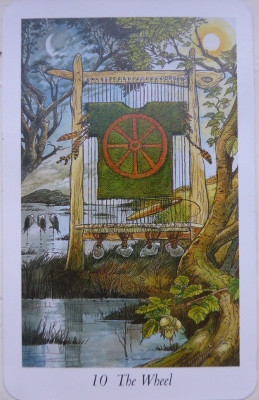
In a further tarot reading Injustice appeared alongside 10 The Wheel. I didn’t understand this until on a spirit-journey I was flying through the sky and heard the thundering roll of chariot wheels. A sky-god with a beard of nimbus clouds rolled up with a stern, stormy woman I knew was his daughter.

Encircling me appeared formidable and judgemental figures who I presumed were a judge and jury. My initial thought was “oh shit – it’s judgement time!” Then I saw there were hundreds of spiralling people beneath and all of them, including the ‘judges’, were being swept away by a hurricane.

When they’d gone I realised I was facing Taranis, but did not recognise his daughter. She told me she was known as Fortune by the Romans and people came to identify her with Justice but were mistaken as justice does not exist. Then Taranis said ‘all souls must pass through the Eye of the Storm’.

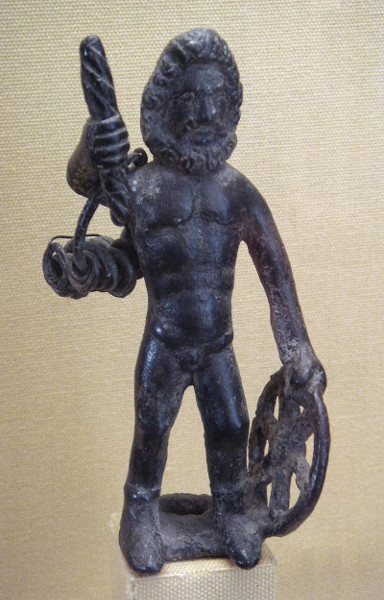
Afterwards I discovered Fortuna was a Roman goddess who was depicted with a Wheel of Fortune, she could be represented as veiled or blind, and she was the daughter of Jupiter. It seems Taranis, a wheel god, and his daughter have similar roles in the Gallo-Brythonic ‘pantheon’. This made perfect sense of Injustice appearing alongside 10 The Wheel and my obsession with ‘O Fortuna’.

I also found out Fortuna was a much earlier deity than Justice, who was introduced by the Emperor Augustus as a personification of a human virtue, and was not actually a goddess in her own right.

“There is no justice,” the words of the daughter of Taranis rang in my ears.

A part of me had intuited that the scales could tip either way. What I didn’t realise was there aren’t any scales at all. Fortuna was never depicted with the Scales of Justice and neither was the daughter of Taranis.


Orddu, the Very Black Witch

There is no document of civilization which is not at the same time a document of barbarism.’
  Walter Benjamin

Orddu has been a powerful presence in my life since I started investigating the story of her death. In the medieval Welsh tale, Culhwch and Olwen (1070AD), she meets a gruesome end. She is cut in twain by Arthur’s knife, then her blood is drained and bottled to dress the beard of the giant, Ysbaddaden Bencawr.

The murder of Orddu is the penultimate act in a trail of bloody atrocities committed by Arthur and his men so Culhwch can win Olwen. Ancient animals are hunted down, giants butchered, otherworldly treasures stolen, numerous historical and mythical figures subordinated and incorporated into Arthur’s court. Finally, Ysbaddaden is barbered and beheaded.

The civilising rule of Arthur as a champion of Christianity unifying Britain is asserted by his barbaric assault on this land’s divinities and those who interact with them. His reign as a national hero is based on his wiping out not only of the lives, but the stories, of a myriad Others cast into an abyss of ignominy from which few of us hear their screams.

Orddu’s death cry has resounded in my ears for several years now. Sadly she does not appear in any other sources. Nothing is known about her outside Culhwch and Olwen, where she takes to the stage for a brief and brutal battle before her life is snuffed from the page and from history. However, clues to her significance can be gleaned by reading the surface text otherwise, from the perspective of Annwn, ‘the deep’, the ancient British Otherworld.

Orddu is introduced as ‘the Very Black Witch, daughter of the Very White Witch’ (Orddu means ‘Very Black’ and Orwen ‘Very White’). This is suggestive of a matrilineal tradition of witchcraft passed on from mother to daughter through the generations. Whether Orddu and Orwen are titles, or refer to the witches’ skin colour, hair colour, or the type of magic they practiced remains unclear. Still, these women can be pictured singing spells, passing on plant knowledge, caring less for labels than the flow of magic that runs in their blood and sings in their souls.

When Arthur embarks on his quest to bottle Orddu’s blood he sets out for the North. Northern Britain, with its rough terrain and cold weather, where the influence of Rome struggled harder to maintain its hold, is traditionally viewed as hostile and dangerous in medieval Welsh literature.

Orddu is located in ‘Pennant Gofid in the uplands of hell’. Pennant Gofid means ‘Valley of Grief’. This may be viewed simultaneously as a place where people come to grief and a place where they come to grieve. ‘Hell’ is translated from ‘Uffern’, ‘Inferno’, a word used synonymously with ‘Annwn’. The associations with mourning and the Otherworld suggest Pennant Gofid was a valley of the dead and that Orddu was its custodian. As such it would have been viewed as profoundly sacred by local ‘pagans’, but as hellish by Christian intruders with no understanding of their beliefs. I have not managed to locate Pennant Gofid within the physical landscape, but when I journey there in spirit it is steep and stony. A white river with foaming rapids roars through it. Through its ever-present mists hardy stumpy trees can be glimpsed, cairns, dolmens and, occasionally, mountain ghosts.

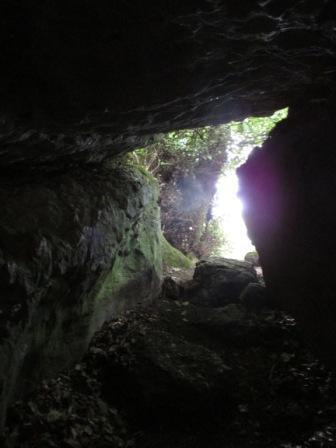
Orddu is found in a ‘hag’s cave’. This signifies her connection with ancient ancestral traditions which have no place in the civilised world of Arthur. Caves are places of access to Annwn and its mysteries. The bones of Orddu’s ancestors may have been buried in the cave’s recesses. In my journeywork it is half way up the valley; a precarious scramble. Nearby a spring emerges from the rock. There I received the gnosis it is the place Orddu and her kindred grieved for their predecessors and the dead who are buried in the valley. Their salt tears are the source of the white waters of the River of Grief. There I mourned Orddu’s death.

To find Orddu’s cave, Arthur is dependent on the guidance of the pre-Christian deities Gwyn ap Nudd (‘White son of Mist’) and Gwythyr ap Greidol (‘Victor son of Scorcher’). Gwyn is a god of Annwn and ruler of its spirits who are referred to as ‘demons’ in Culhwch and Olwen. In The Black Book of Carmarthen (1350AD) he appears as a gatherer of the souls of the dead.

Gwyn and Gwythyr are deadly rivals for the love of a maiden called Creiddylad. In an earlier episode, Arthur put an end to their conflict by placing a command on them to fight for Creiddylad every May Day until Judgement Day. Their appearance together and as advisors to Arthur seems contrived as a way of demonstrating Arthur’s power.

Read beneath the surface and we see that Gwyn’s presence in Orddu’s story has deeper roots. If Orddu is located on the edge of Annwn, then Gwyn is the deity who must be called upon to part the mists to find her. Orddu’s witchcraft may be rooted in her relationship with Gwyn as a god of Annwn and with the spirits and the dead who he presides over.

Evidence of groups working magic with the deities of the Otherworld has been found in Gaul. The Tablet of Larzac (90AD), from a seeress’s grave, refers to a coven of witches practicing andernados brictom ‘underworld-group magic’. The Tablet of Chamalieres (50AD) evidences a group of men calling on ‘Andedion’ ‘Underworld God(s)’ for aid in battle. ‘Annwn’ and ‘Andedion’ share the same stem. The poet Dafydd ap Gwilym refers to ‘witches of Annwn’ suggesting similar groups existed in Britain.

We also have records of a native tradition of prophesy and spirit-work. In his Description of Wales (1194AD), Giraldus Cambrensis refers to ‘Awenyddion’, ‘people inspired’ who are possessed by spirits and perform oracular trance when consulted on ‘doubtful events’. Orddu can be pictured prophesying with the spirits of Annwn and invoking their aid. Arthur’s subordination of Gwyn represents the negation of her source of magic.

When Arthur and his men approach Orddu’s cave she shows no sign of fear. Arthur hesitates until Gwyn and Gwythyr advise him to send in two of his servants, Hygwydd and Cacamwri. Orddu grabs Hygwydd by the hair and wrestles him to the ground, disarms and thrashes them both and beats them out ‘shrieking and shouting’. When Arthur tries to rush the cave, Gwyn and Gwythyr say, “It is not proper and we do not want to see you wrestling with a hag.” They tell Arthur to send another pair of servants in. We do not hear what Orddu does to Hir Amren and Hir Eiddil (Hir means ‘long’ or ‘tall’ – these are formidable men), only that their fate is ‘far worse’ and the four are so severely incapacitated they cannot escape without being put onto Llamrei, Arthur’s gigantic mare. After this, Arthur loses his temper and strikes Orddu dead.

It is uncertain whether Gwyn and Gwythyr are being presented as stupid or as tricking Arthur to defend Orddu. Whatever the case, in spite of being alone in her cave and outnumbered, Orddu displays considerable skill in hand-to-hand combat and puts up a courageous fight.

Comparisons may be drawn with the witches of Caer Lowy who teach Peredur how to ride a horse and handle weapons. Afterward, Peredur turns on them and slaughters them with Arthur’s aid. Conspicuously he kills one of the witches by striking her on the helmet so her head is split in two. As she dies she tells Peredur he was destined to kill her. It may be conjectured that Orddu belonged to a similar lineage of women who were not only witches but also trained the warriors of the North.

Thus it makes sense that for Arthur’s tasks to be completed this powerful woman must be removed from her position at Pennant Gofid where she teaches the arts of warriorship and utters prophecies from the mouth of Annwn. Her death signals the end of a tradition that may be as old as the ancestral remains in the cave where she abides.

Long has she lain there, her skull split in twain, her bones in two weary piles. Long has her story been forgotten, until now, as the rule of Arthur and the hegemonic brand of Christianity that gave us the Crusades, witch hunts and the British Empire united under ‘One King, One God, One Law’ begins to crumble.

The blood of witches does not stay bottled forever even in the bottles of a dwarf. The glass walls that contain magical women are shattering. Orddu’s call is to win back our powers of prophecy and fighting strength, to rebuild our relationships with Annwn and its gods and spirits. To reach into our caves of potential and fulfil our vocations with courage, remembering how her life was cut short.

Picture

*This article was solicited by Kate Large and was first published in Pagan Dawn, No 202, Spring 2017

Gods and Radicals's avatarGODS & RADICALS

We have started rebuilding from the ruins.

We are the children you never knew you would have.

We do not see you but we keep on building

the future you made your crossing for.

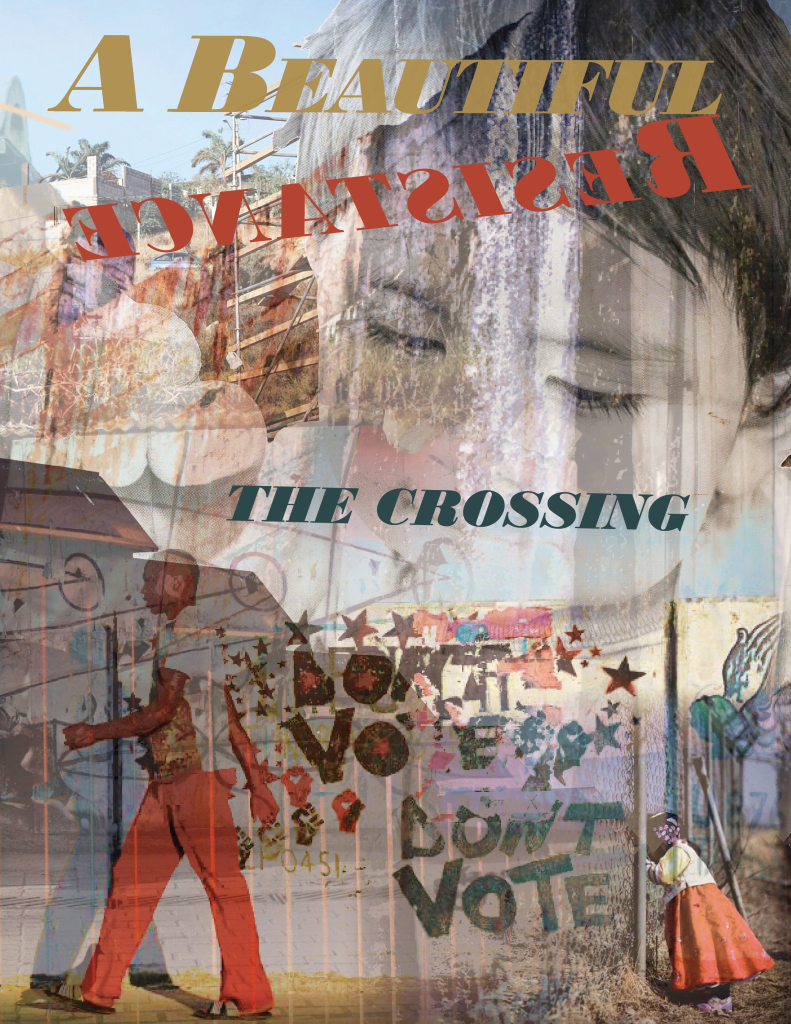
Gods&Radicals is pleased to announce that the fourth issue of our journal, A Beautiful Resistance, will be released into the world 15 November.


Edited by Lorna Smithers and Lia Hunter, foreworded by Peter Dybing, and yet again featuring the brilliant cover artistry of Li Pallas, A Beautiful Resistance: The Crossing features literary and artistic works from Europe, Africa, Asia, and North America, by:

Nina George, Nimue Brown, S. A. O’Hungerdell, Angharad Lois, Nicole Heneveld, Bryan Hewitt, Rex Butters, Rhyd Wildermuth, Lorna Smithers, Dennis Mombauer, Dr. Bones, Boham, Ingi House, Jason Derr, Aicila Lewis, Joe DiCicco, Tahni J. Nikitins, Shane Burley, Innocent Chizaram Ilo, Michael Browne, Nebulosus Severine, Finnchuill, Rune Kjær Rasmussen, Sean Donahue, Sonali Roy, Christine…

View original post 16 more words