‘Gwyn son of Nudd… forced Cyldedyr to eat his father’s heart… Cyledyr went mad.’ How Culhwch Won Olwen
We have eaten the hearts of our ancestors.
We have bitten them down in pieces. We have choked on them, retched on them, tried to refuse to eat them at our peril.
We have swallowed them whole.
We have made them palatable with condiments – ketchups squeezed from blood and mustards from bile.
We have been unable to stop eating even when told to stop.
We have seen our faces with blood dripping from our mouths on the front of the newspapers and pointed our fingers at everyone else – those heartless heart-eaters.
We have blamed the gods who told us to do it.
We have gone mad with grief and guilt.
We have wandered the Forest of Celyddon with Cyledyr, with Culhwch, with Myrddin Wyllt, tried to become poets and we have failed.
We have not heard your whisper in the woods~ in the little cavern within our right atrium, thought of the hunger of the future.
I have no children so to who will you feed my heart?
Gwythyr ap Greidol ‘Victor son of Scorcher’ appears in the medieval Welsh story Culhwch and Olwen as the rival of Gwyn ap Nudd ‘White son of Mist’ for the love of Creiddylad ‘Heart’s Desire’. That he is a fitting opponent for Gwyn and consort for Creiddylad, who are the son and daughter of the ancient British god Lludd/Nudd/Nodens, suggests he is also an important British deity.
Strip away the Christian veneer from Culhwch and Olwen and we have a story in which Gwyn (Winter’s King) and Gwythyr (Summer’s King) battle for Creiddylad (a fertility goddess). On Nos Galan Gaeaf, Winter’s Eve, Gwyn abducts Creiddylad to Annwn* and Gwythyr rides to Annwn and attempts to rescue her and is imprisoned. The abduction of Creiddylad and imprisonment of Gwythyr explain the coming of winter. On Calan Mai, the First Day of Summer, Gwythyr battles Gwyn for Creiddylad, wins, and she returns with him to Thisworld and together they bring fertility to the land. This explains the coming of summer. Gwyn and Gwythyr may earlier have been seen to slay one another on Nos Galan Gaeaf and Calan Mai and take it in turns to enter a sacred marriage with Creiddylad, who acted as a powerful sovereignty figure rather than just a maiden to be fought over.
It is clear from this tale that Gwythyr is our ancient British god of summer. In another episode in Culhwch and Olwen we catch a glimpse of Gwythyr’s associations with fire and sunshine. As he is walking over a mountain he hears ‘weeping and wailing’ and sees its source is a burning anthill. He cuts the anthill off at ground level and rescues the ants from the blaze. We do not know what caused the fire. Did their nest, which ants orientate toward the sun, a little like solar panels, in a summer day, absorb too much heat? Or was the fire caused by Gwythyr’s scorching feet? We have seen that one translation of his father’s name, Greidol, is Scorcher, and we know wildfires break out in the summer. Here we see the dangers of fire and the sun and Gwythyr’s attempt at remediation.
The ants go on to help Gwythyr to gather nine hestors of flax seed which was sown in ‘tilled red soil’, in a field that has remained barren, so it can be ploughed into a new field, to provide the linen for Olwen’s veil in preparation for her marriage to Culhwch. It is possible to read Gwythyr’s association with seed being linked to the ‘male’ side of fertility and with doing the groundwork for the arrival of summer for his bride, Creiddylad, might also require a linen veil for her wedding dress.
The ancient Britons used fire to clear the forest to plant hazel trees and wildfires bring about new growth – in Gwythyr’s associations with fire and seed we find these processes.
These stories show that Gwythyr is a god of summer, fire, and generation in Thisworld who is opposed to Gwyn, a god of winter, ice, and the destructive forces of Annwn, the Otherworld. On the surface one is a bringer of life and the other a bringer of death yet their relationship is one of interdependence. It is necessary they take it in turns to enter a sacred marriage with Creiddylad as an eternal summer or an endless winter would have equally deadly consequences for both worlds.
As Gwythyr’s story was passed on through the oral tradition he and his father were depicted as allying with Arthur against Gwyn and the ‘demons’ of Annwn and playing a role in their demise. Thus Gwythyr is associated with other culture gods like Amaethon, the Divine Ploughman, and Gofannon, the Divine Smith, who help the Christian king to civilise the wild and shut out the Annuvian.
This process may be traced back to the Neolithic revolution when farming began to replace the hunter-gatherer lifestyle, the cultivation of seed hunting and foraging, the grain god (Gwythyr) the hunter (Gwyn). Christians did their best to eliminate the veneration of Gwyn by depicting him and his spirits as demons yet they continued to be loved in folk culture as the fairies and their king.
The stories of Gwythyr, by name, did not survive in the folk tradition, but it possible to find a likeness between him and other grain gods** who die a ritual death at the end of the harvest – when Gwyn, the harvester of souls, reaps down his rival and Gwythyr and the seed return to Annwn.
From the Neolithic period our society as a whole has favoured Gwythyr over Gwyn. We have created an eternal summer with the fire of Gwythyr in the engines of industry creating a society in which the cold and darkness of winter has been eliminated by electric lighting and central heating. Crops grow all year round under artificial lights. This has unsurprisingly led to global heating, to the climate crisis, to the scorching fires on Winter Hill where I perceive Gwythyr battling his rival. Ironically, and tellingly, these two great gods and the great goddess they battle for have been forgotten.
Yet, slowly, the worship of Gwyn and Creiddylad is reviving amongst modern polytheists. I know few who venerate Gwythyr and believe this is because his stories have been subsumed by those of other grain gods. This is a shame, for Gwythyr’s stories contain deep wisdom relating how fire, sun, summer and seed have played a role in the climate crisis from a polytheist perspective.
As a devotee of Gwyn, committed to the otherside, to the Annuvian, to redressing the balance, Gwythyr is a god whose powers I acknowledge through the summer and during the harvest period although I do not worship him. I would be interested to hear how and whether other polytheists relate to Gwythyr at this time.
*Annwn has been translated as ‘the Deep’ and the ‘Not-World’ and is the medieval Welsh Otherworld or Underworld. **Such as Lleu Llaw Gyffes/Lugus and John Barleycorn.
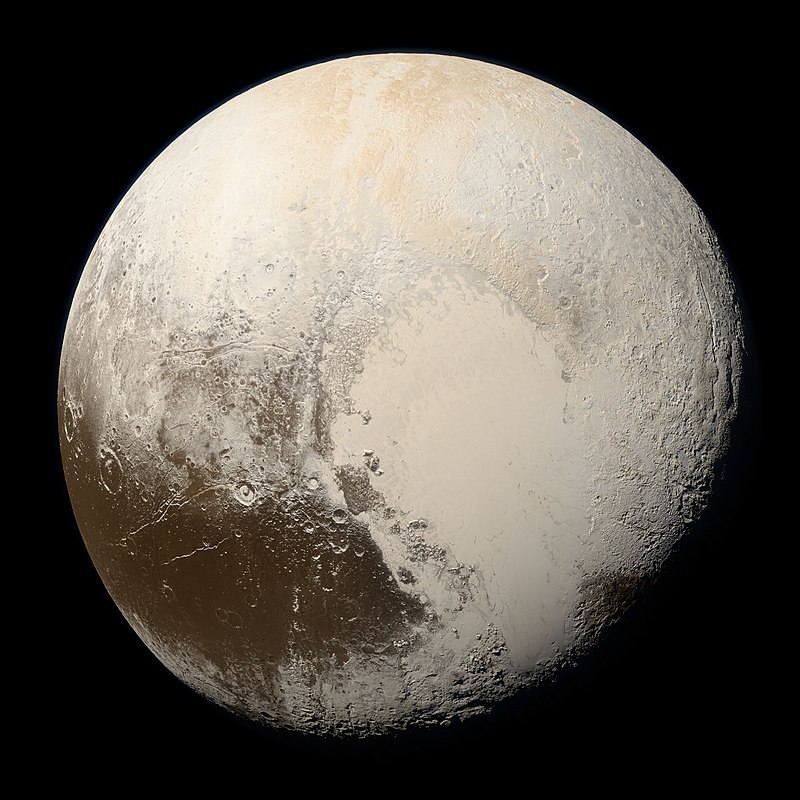
was the night you were furthest away from the world like a distant asteroid – like Pluto.
From now you’re coming back – your land of ice and darkness will thaw and the mists will make it beautiful again.
From the coffin where you dream of nuclear winter you will step into a new suit of armour.
Summer is a’coming to Annwn and winter is already on its way here.
This poem is based on my gnosis that whilst it is summer in Thisworld it is winter in the Otherworld. It is addressed to Gwyn ap Nudd, a Brythonic ruler of the Otherworld and Winter’s King, who is killed by his rival, Gwythyr ap Greidol, Summer’s King, on Calan Mai, and sleeps through the Summer.
After I received this poem in a vision this morning I looked up Pluto, a planet named after the Roman King of the Underworld and saw that, in Japanese its name is Meiōsei – ‘Star of the King of the Underworld’. I thought this was very beautiful and apt for the planet that rules my birth sign, Scorpio, much as Gwyn, my patron god, is the ruling force in my life.
I then returned to an essay by Brian Taylor called ‘Photographing the Underworld? A Note of NASA’s Pluto Fly-by’ which has had a big influence on me. Here he speaks of how the photographing of Pluto ‘ruler of occultation, and protector of the integrity of mystery’ may have been saved from being an act of ‘casual intrusion’ by the plutonium powered spaceship carrying the ashes of Clyde Tombaugh ‘discoverer of Pluto’ (as a kind of offering to the underworld gods?).
Brian also speaks of how he ‘traced the exteriorisation of Pluto in the history of the nuclear era, and found the planet’s signature etched into the geography of the discovery region, most notably in an extraordinary spatial co-incidence. Pluto was discovered in 1930 at the Percevall Lowell Observatory in Flagstaff Arizona. Ten years later Plutonium was manufactured at the Lawrence Livermore Laboratory in California, and five years after that the first atomic bomb was detonated at the Trinity Test Site north of Alamagordo in New Mexico. Curiously these three sites fall in an almost perfect straight line, about a thousand miles long, that maps the connection between the planet and the nuclear project on to the land in the most unexpectedly graphic way.’
Coincidentally I have been returning to these themes, which I touched on in The Broken Cauldron, in the later sections of the new book I am writing, which explores more deeply the influence of the gods within the modern world and Gwyn’s connections with nuclear war and nuclear winter.
At the bottom of the essay I saw an old comment I left for Brian in 2015 mentioning a dream I had about Gwyn and nuclear winter, leading me to recall it. Brian notes that the spaceship made closest contact with Pluto on a dark moon and the moon was dark last night.
I undertake a fool’s quest to understand the origins of the breath of life and in my foolishness am granted an answer. I find myself amongst a crowd singing with them as three Mothers of Destiny breathe the awen (which is at once inspiration and one’s fate) into a baby.
It is suspended over a baptismal font that reminds me of the Roman altar to the Mothers at Lund Church near Springfields around five miles away from me.
Our voices are pre-Roman, Roman, post-Roman, of all the women who have sung their blessings to a child in this ancient gathering place and in churches where Matrona ‘the Mother’ appears as Mary and the Matronae as Faith, Hope and Charity.
They rise and fall as we sing: “Awen bendithion yr awen bendithion yr awen bendithion…”
II.
Sea Maidens
My fool’s quest continues as I cannot, now, resist returning to the mothers to pose the question of my own destiny. They appear as three sea maidens, stormy, stony-faced, amidst a sea of raging waters.
III.
The Web of my Destiny
The goddess in the middle shows me ‘the Web of my Destiny’. She holds it between her hands like a cat’s cradle. It shimmers golden and pulsates with coloured jewels of energy. She tells me that a small tweak can change everything. I realise that making a cat’s cradle is a two-way process, between a person and the gods, and it’s my turn.
this May Eve, at this time of pandemic, not to speak of the second plague in the tale of Lludd and Llefelys. Of the dragon’s scream heard this night which ‘pierced people’s hearts and terrified them so much that men lost their colour and their strength, and women miscarried, and young men and maidens lost their senses, and all animals and trees and the earth and the waters were left barren.’
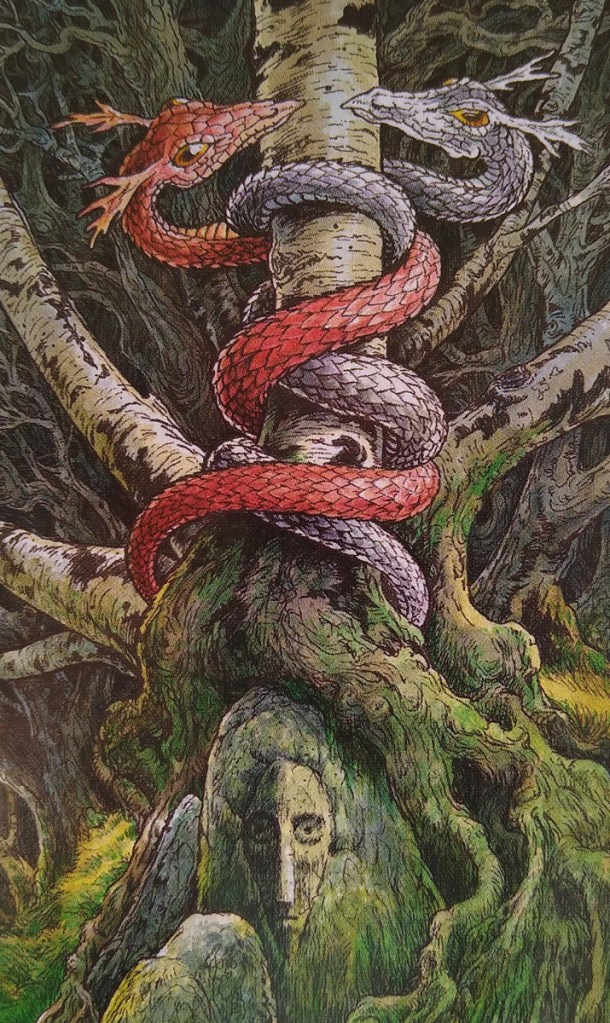
It would be impossible not to recall how Lludd dug a hole in the centre of the Island of Britain, filled it with mead, laid a sheet of brocaded silk on top. How he called down our screaming red dragon, battling with the white dragon, spiralling, spiralling, spiralling down, through the forms of bulls, wolves, boars, into two little pigs who drank the mead and fell asleep before he wrapped them up in the brocaded silk like two little babies and buried them in a stone chest at Dinas Emrys.
It would be impossible not to think of how the image of the serpentine bodies of the dragons intertwining looks like two strands of DNA and one alone like a single strand of RNA and to be reminded of the structure of a virus with its strand or strands carried within the stone chest of its capsid. Of how, like the dragons, viruses shift through a countless series of mutations before they sleep.
It would be impossible not to call to Lludd, to pray to that he, with his serpent-staff propped in the corner of his laboratory as he bends over a microscope, silver as his silver hand, will help us find a vaccine.
It would be impossible not to ask him to bring an end to our being locked up, like Creiddylad in her father’s house, which for some is a dream and for others a nightmare they fear is never going to end.
It would be impossible not to wonder who unlocked the stony chest and set the dragons free. To desire to find some perpetrator, some key, some rational explanation, some meaning to these events. Vengeance by the angry hordes of monstrous animals locked in stone chests or by the gods. The laws of evolution. Science. A balancing act of the Earth as a result of human excess. But it would be impossible.
*The image is from 14. Balance in the Wildwood Tarot.
Creiddylad most majestic maiden in the Islands of Britain, let me know your majesty
in this garden
on my knees two hands clasped together on this trowel making offerings of water
amongst flowers where you walk unveiled, stunning, bees dancing around you.
Let me be your bee!
Feed me when I’m hungry. When I fall exhausted pick me up gently
and I will make the sweetest honey.
“Stay here in this garden,” my patron god, Gwyn ap Nudd, advised me a week before the lockdown. A couple of days before my conservation internship was cancelled and, like many, I was rendered jobless.
We’ve been on lockdown in the UK for over a fortnight now and how I’ve to-and-froed, some days accepting this advice and, on others, after reading the news, wishing I was doing something more important, more heroic, than shopping and cleaning for my parents, tending the garden, doing my best to find the focus to pray, meditate, spend time in devotion to my gods, and to write for my supporters.
My main battle has been against feelings of guilt and uselessness caused by my awareness of the utter contrast between my easy life, touched by the bliss of the spring sun, and the hell that the nurses and doctors are going through on the front line, risking their lives fighting for the lives of others. The risks taken by the funeral services. The chaos and stress faced by supermarket staff. Our dependence on the long hours and monotonous work of fruit and veg pickers usually imported from abroad.
I’ve thought of applying for, have actually applied for, some of these jobs (which may have necessitated moving out of my parent’s house so I do not put them at risk), but nothing has come of it.
“Stay here in this garden.” I accept the gods have their reasons when the Blasted Oak, spelling disaster, appears in a tarot reading on what will happen if I take a veg picking job.
And deep within I know if I took any of the above jobs I’d likely get physically or mentally ill. That there is something fundamentally wrong with this industrialised and militarised system that keeps comparing the ‘fight’ against this virus with the Second World War and tries to inspire a wartime ethos.
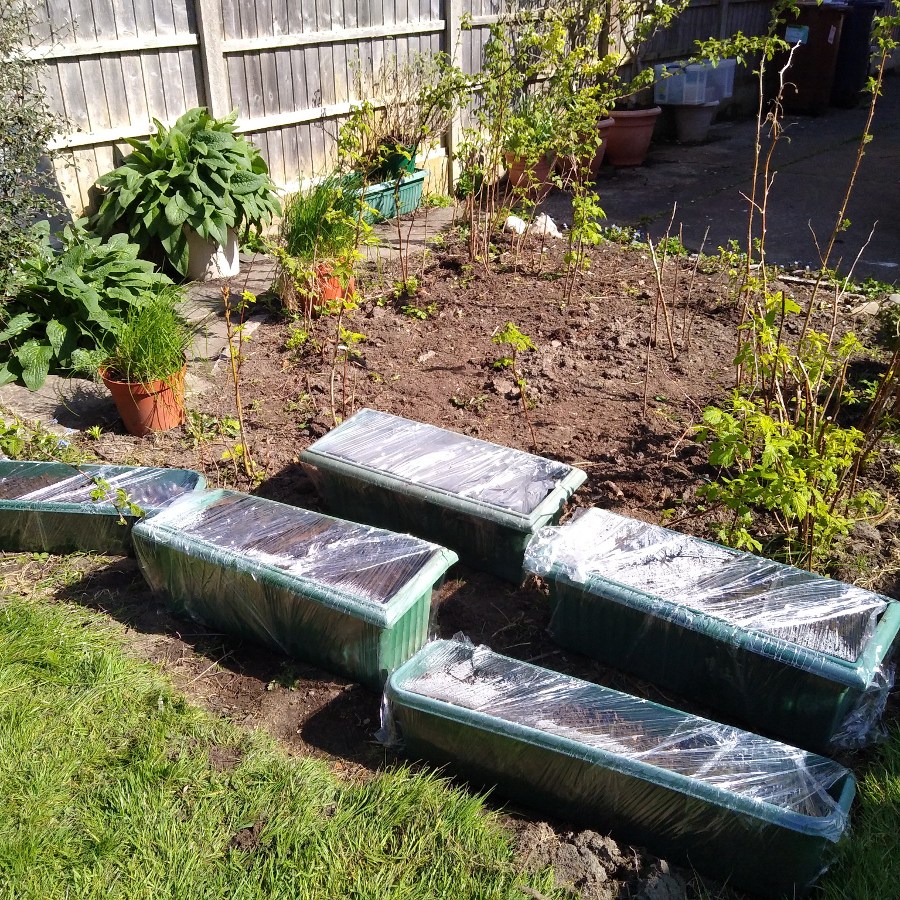
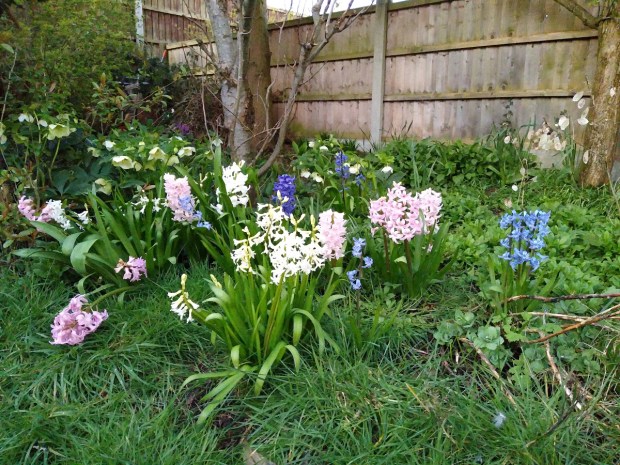
And so I tend my parents’ garden, cutting back years of overgrowth, clearing the paths, weeding amongst the many beautiful flowers that already grow here – hyacinths, daffodils, bluebells, honesty. And the shrubs and trees – apple, pear, rose, quince, camelia. Watering the raspberry canes. Sowing herb and lettuce seeds in troughs and veg seeds – carrot, turnip, onion, cauliflower, broccoli – in the soil.
And somewhere along the way it enters my mind this is ‘Creiddylad’s Garden’. And once the thought has entered it will not leave. I come to see the face of Creiddylad, ‘the most majestic maiden in the islands of Britain’, one of our Brythonic goddesses of flowers and spring, in each flower.
Creiddylad is a sovereignty deity who walks between worlds and lovers. This ‘majestic maiden’ is truly a majesty, a Queen, the lifeforce of nature who inspires great awe in her worshippers and the male deities, Gwyn and Gwythyr, Kings of Winter and Summer, who fight for her every Calan Mai.
Through the Winter she dwells with Gwyn, in the Otherworld, as Annwn’s Queen. In the Summer, with Gwythyr, she is May Queen, a great sovereign in Thisworld, revealing herself slowly flower by flower.
In Creiddylad’s contrary nature I find a better understanding of my own pulls between darkness and light, Thisworld and Otherworld. There is a part of me that wants to walk with Gwyn, a warrior and psychopomp, facing death, disease and sorrow. And at the same time an awareness he and other humans do this so the rest of us can appreciate the flowers and the sunlight and the lives that are our gifts.
It sometimes seems easier, more worthy, to embrace pain than pleasure. Why? I do not know. Only that in Annwn the sadness of the dead is transformed into great beauty and joy, and it this is that Creiddylad brings with her when walks from the Otherworld, into the light, and embraces Gwythyr.
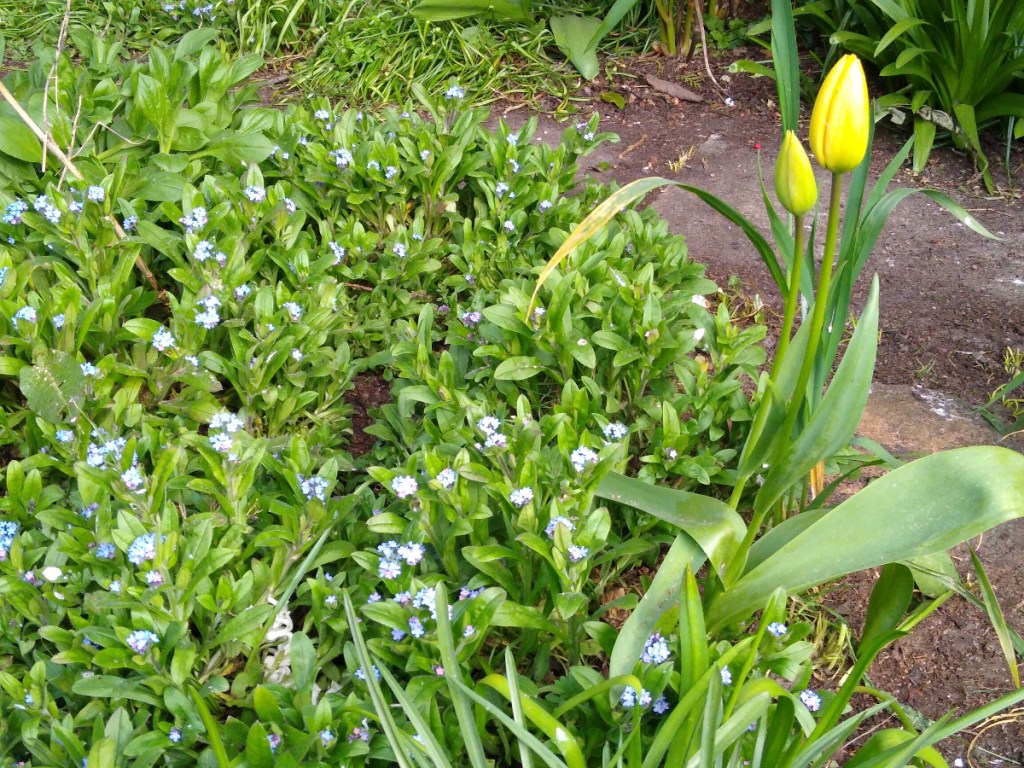
Many of the flowers in my garden speak of similar myths through the correlates of other cultures. The narcissus, or the daffodil, was the plant Persephone was picking before Hades took her to… Hades. The hyacinth was born from the blood of Hyacinth, the lover of Apollo, killed by his rival Zephyrus, and its beautiful petals are inscribed with ‘AI AI’ ‘Alas’. Lungwort’s petals turn from pink to blue as the flowers are pollinated, edging toward death, like flesh, or deoxygenated blood.
Nature and myth, death and life, Thisworld and Otherworld, are deeply intertwined in Creiddylad’s garden. A place where I work slowly, contemplating the mysteries, where I meet flowers, goddess, gods. It seems they don’t want me to be a hero but instead a small suburban bee offering a taste of Creiddylad’s honey.
I. They’ve got jobs – we finally see the key workers:
the paper-clad doctors and nurses saving the sick and the dying (or trying to on the linen streets of the front lines)
the stackers and cashiers within the tin-packed walls of the supermarkets who are saving us from starvation
and the students and unemployed bar staff stepping up to pick and pack berries and lettuces packed with vitamins to keep us healthy
whilst the grave diggers and funeral service pack post-vegetable bodies back into the earth
and the binmen in their bleeping lorry continue to turn up weekly to remove our waste.
II. And no, I have never seen a binwoman, but I was asked if I was one when I was litter picking. Now even this small job has been taken away
I am flicking through job descriptions application forms fingers hovering over wonky letters stuck on keys because the originals were rubbed off over long years of writing (which has never quite been a ‘proper job’) weighing
the balance between making myself enjobbed useful and the risk to my seventy-odd year old parents.
III. All the while the name of a job that I have never seen advertised online or even in a fluffy cloud in a Pagan magazine is pressing its silver lining against the back of my brain:
low risk, innocuous, invisible: ‘MYSTIC.’
“By the Stars of Annwn are you having a laugh?” I rage at my gods before joining them laughing loud and hysterically.
‘We need to remember that our very breathing is to drink our mother’s milk – the air – made for us by countless microbial brothers and sisters in the sea and soil, and by the plant beings with whom we share the great land surfaces of our mother’s lustrous sphere.’ Stephan Harding
Inspire. Expire. Anadlu i mewn. Anadlu i allan. Breathe in. Breathe out.
Respiration (from spirare ‘breath’ and re ‘again’) is participation.
Inspire. Expire. Anadlu i mewn. Anadlu i allan. Breathe in. Breathe out.
Lungs. Two. Right and left. Each enclosed in a pleural sack in the thoracic cavity of the chest. Primary bronchus, secondary bronchi, tertiary bronchi, terminal bronchiole. In the alveoli, ‘little cavities’, across the blood-air barrier, gas exchange takes place.
Breathe in: oxygen 21%, carbon dioxide 0.04%. Breathe out: oxygen 16%, carbon dioxide 4.4%. 6 carbon glucose, oxidised, forms carbon dioxide. Product: ATP (adenosine triphosphate) ‘the molecular unit of currency of intracellular energy transfer’. The spark of all life.
Inspire. Expire. Anadlu i mewn. Anadlu i allan. Breathe in. Breathe out.
Respiration (from spirare ‘breath’ and re ‘again’) is participation.
Inspire. Expire. Anadlu i mewn. Anadlu i allan. Breathe in. Breathe out.
Birds have lungs plus cervical, clavicular, abdominal, and thoracic air sacs. Hollow-boned they are light as balloons, breathing in, breathing out. Then there are the lungless. Through tiny holes in the abdomen called spiracles leading to the trachea, insects fill their air sacs. Earthworms and amphibians breathe in and out through moist skins. Fish breathe water in through gulpy mouth breathe it out through gapey gills.
Plants breathe through their leaves. By daylight they photosynthesise. Stomata breathe carbon dioxide. It mixes with water. The green lions of chlorophyll work their magic by sunlight. Oxygen is released. From glucose the magical hum and buzz of ATP. At night they respire glucose and oxygen back to carbon dioxide and water. 10 times more oxygen produced than used.
Underground fungi breathe the air of the soil through thread-like hyphae that mass as mycelia. They respire aerobically (with oxygen) or anaerobically (without oxygen), changing glucose to ATP (it’s all about ATP!), ethanol, carbon dioxide, and water. This old, old, metabolic pathway dates back to the days before oxygen ruled our breath and is utilised by microbes. The hidden ones of the deep, single-celled, or living colonies, breathe through their single cell walls in ancient ways – acetogenesis, methanogenesis – to gain the blessed ATP.
Inspire. Expire. Anadlu i mewn. Anadlu i allan. Breathe in. Breathe out.
Respiration (from spirare ‘breath’ and re ‘again’) is participation.
Inspire. Expire. Anadlu i mewn. Anadlu i allan. Breathe in. Breathe out.
And what is this creature that does not breathe (in or out) with no metabolism or need for ATP? This simple strand of genes in a designer jacket called a capsid? Does this thing, neither dead nor living, have a spirit? Like all living things was it breathed into life by the gods?
Or is this death-bringer undead? This assaulter of lungs? Lung-cell-killer and causer of coughs – dead lung cells coughed up as sputum, mucus, the yellow remains of what was ours?
By what dark programme does it turn the body against itself – alveoli ‘little cavities’ where the exchange of carbon dioxide and oxygen takes place filling with water – no space to make ATP? No lungs – no breath. The pump of ventilators, breathing in, breathing out, our new iron lungs…
Did it crawl from the cauldron of inspiration like the speechless dead or is it something entirely other?
Inspire. Expire. Anadlu i mewn. Anadlu i allan. Breathe in. Breathe out.
Respiration (from spirare ‘breath’ and re ‘again’) is participation.
Inspire. Expire. Anadlu i mewn. Anadlu i allan. Breathe in. Breathe out.
To whom do we pray? To the gods and goddesses of breath and to the spirits of inspiration? To Ceridwen, Gwyn ap Nudd, Morgana and her sisters, who gave us breath, and take it away?
“Breath always leads to me,” says Gwyn. I find this reassuring and disconcerting from a death-god. From the one who releases the spirits of Annwn from the cauldron and holds them back.
So we breathe together with the lunged and lungless creatures with skin, fur, feathers, shells, scales, leaves, hyphae, the single-celled, the uncelled who ride our breath, until we return to the gods. To the winds that carry the voices of all ancestors over our 4.543 billion year old earth.
Inspire. Expire. Anadlu i mewn. Anadlu i allan. Breathe in. Breathe out.
Respiration (from spirare ‘breath’ and re ‘again’) is participation.
Inspire. Expire. Anadlu i mewn. Anadlu i allan. Breathe in. Breathe out.
*I adapted this meditation from an earlier version ‘The Ways We Breathe‘ previously published on Gods & Radicals following guidance from my deities to focus on my breath and being struck by the realisation that a distinguishing feature of coronavirus and other viruses is that they do not breathe.









 The Sanctuary of Vindos