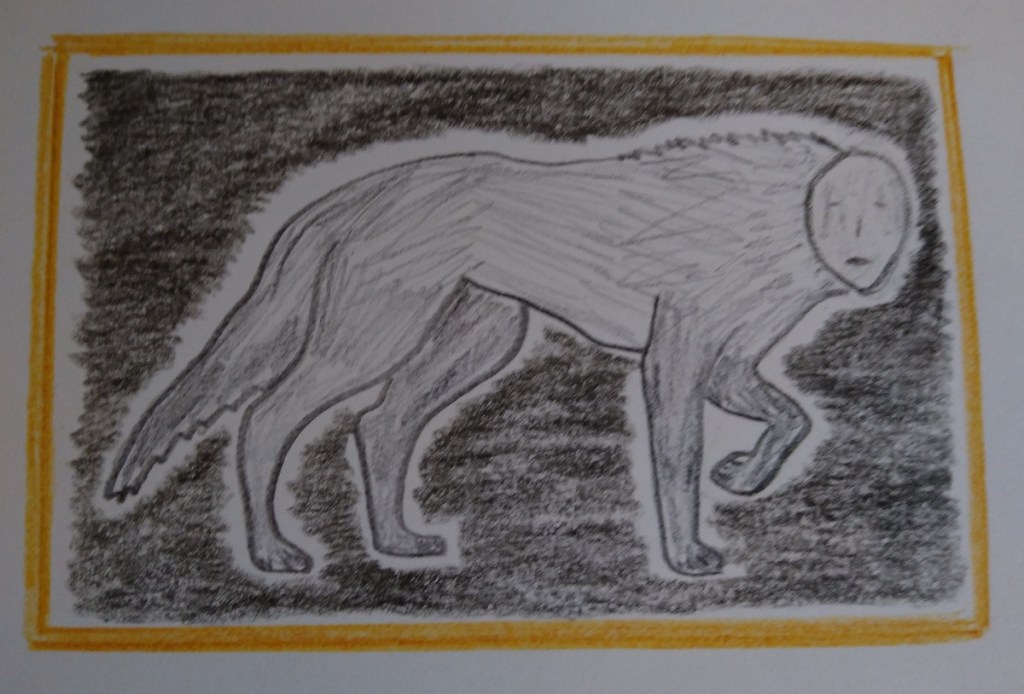
The Lean Wolf

approaches
with a little bit
of Chernobyl
in its deadly
stride.

A big black bell
is ringing inside it.

Its face is a man’s.

There is nothing
behind it.

I wrote this poem following a dream of which I remember little but the vivid image of a lean menacing wolf with a man’s face and the knowing because I’d seen it, been its presence, I was going to die.

I’ve had a handful of dreams in which I’ve had this gnosis. In one I was a captured soldier awaiting execution and Gwyn prepared me for death by telling me I must go into the hazel, and the beetle, and something I can’t recall. In another I was a clawed creature clinging to a lift descending to the abyss. And in another I was and was not a dark magician, who in a magical battle against mechanical forces, was cut into a thousand pieces by whirling blades and resurrected as a vampiric woman.

Through these dreams I know I have lived many lives, died many deaths, in Thisworld and in Annwn, and perhaps in worlds beyond. That a part of me, which I call my soul, carries these memories.

When I was talking to my dad about his funeral plans I was surprised to hear that he, like me a philosophy graduate, had never thought about whether he had a soul or what would happen when he died. He might have theorised about it but had never really contemplated what would happen to him.

Such questions have been on my mind as long as I can remember. Like my dad I theorised about them, attempting to find answers through philosophy, until I met Gwyn and he taught me to journey to Annwn. Until he and his father, the dream-god Nudd/Nodens, helped me to sleep and listen to my dreams.

For the first time since the Second World War people in Britain are suddenly facing death, due to the threat of the coronavirus. This is a complete unknown for people of my mum and dad’s generation, for mine, and the next generation, who might have included my children, if I’d had them.

I understand that one of the reasons Gwyn appeared in my life and taught me to journey was to help me prepare for death. I know a small handful of others who have had similar experiences with him and different gods, and of those who have gained their own understanding without experience of deity.

In contrast to the advice I’ve seen in various places to focus only on the positives, I believe at this time, when so many of us have so much extra time, there is no better time to contemplate the lean wolf.

The Call of the Hooded Man

He started appearing in my tarot readings at the beginning of the year: the Hooded Man. In my reading for 2020 on New Year’s Eve in the place of ‘home’, then again and again, strangely, mysteriously, as we shifted from a stormy winter to a glorious spring and I was spending more time with people outdoors.

In the Wildwood Tarot the Hooded Man occupies the traditional position of the Hermit. His ‘Position on the Wheel’ is ‘the mid-winter solstice’. Dressed in a black cloak adorned with holly he stands amidst the snow with a wren at his side, a staff in one hand, a shining lantern in the other. He points towards a doorway in a great tree with a wreath upon it, offering solace from winter’s harshness.

The main meaning of this card is ‘this is the time of solitude and contemplation’. Why was I getting this card when I was busying myself with work parties five days a week and preparing for an internship at Brockholes, which involved outdoor work and engaging with large groups of volunteers?

The answer came as the arrival of coronavirus, as the lockdown, the perfect reason to respond to his call. But what did I do for the first three weeks? Spend my time watching what everyone else was doing, beating myself up for not being busy, for not having a proper job, resisting the call of the Hooded Man.

And yes, I felt it, and he spoke to me clearly. On one occasion this was through the new module on ‘Holly’ in the Tree Spirit Medicine course on the Way of the Buzzard Mystery School. The course leaders, Jason and Nicola associate holly with ‘sanctuary, resilience, and protection’. These were qualities I felt I needed to draw upon and immediately I associated them with the Hooded Man. I journeyed to holly to ask ‘how to slow down and participate in the Hooded Man’s sanctuary.

Holly said:

The berries of life
are not always yours.

So what is yours?

How will you
grow your berries?

What can you offer?

How will you shape
your sanctuary?

I took this to mean that I couldn’t just barge into the Hooded Man’s sanctuary and assume his berries (the hard-won fruits of many years of solitude and contemplation) are mine for the taking. That I must take the time and effort to shape my own sanctuary, grow my own berries, share them with others.

What was particularly significant about this journey is that the day afterwards, after I had cut back and cleared the blackberry bushes which were taking over the bottom of my parents’ garden, I found a little holly sprig. Immediately I knew this was ‘the Hooded Man’s corner’: a place I could find sanctuary.

But still I resisted for fear that retreating would make me less of an awenydd to my community and gods. When I first set out on the awenydd path it was with the purpose of serving Gwyn and the spirits of the land through sharing poems and research on mythology and my personal journey.

Somewhere along the line, when I was involved with Dun Brython, when Greg Hill and I founded ‘Awen ac Awenydd’ I felt these responsibilities were nudging me toward community leadership. However, Dun Brython never grew due to a lack of interest in Brythonic Polytheism. Whilst the Awen ac Awenydd Facebook group generated some interesting discussions, the participants didn’t mesh enough to develop a shared practice, and the plans for a physical meet-up failed completely.

I reached the conclusion that Facebook is not a suitable platform for building meaningful relationships and left. ‘You’re not a follower but you’re not a leader,’ the words of my wise friend, who read my tarot, haunted me. What am I then? What is the role of an awenydd who neither leads nor follows?

“You must focus on your gift,” the voice of my god from within.

Reflecting on the nature of this gift I realised that it is the awen and the meaning of ‘gift’ is manifold. The awen is not only my gift, my talent, my role in the world, my destiny, but is given by the gods and something I have a responsibility to give back to others. This being gifted with and my giving of awen is of value in itself. I don’t need to be a leader or a spokesperson for my path.

This revelation came as a huge relief and has given me clarity about where I’ve made mistakes in the past. After watching a podcast with Martin Shaw on ‘Pandemic and Mythic Meanings of this Cultural Movement’ in which he posed the question ‘would this not be a good time to re-establish a relationship with our souls?’ I realised over the past few months I have neglected my soul’s journey.

When I journeyed to the Hooded Man for advice on how to focus on this he said I need to ‘clear space outer and inner’ and ‘cultivate a longing for the mysteries’ in the place of my anxieties.

What was of interest, and slightly disturbed me, was that he told me has had burning ambitions, been riddled by doubts, that he has made made mistakes, that his aura of calm is the result of centuries of inner work. That sometimes it is just a facade that covers over the conflicts he feels within.

For some reason I thought he had always been the Hooded Man at perfect peace in his self-mastery. Yet a story, or many stories, lie beneath the the hood of this man who has many faces.

Lost in the Glass Castle – The Rule of the Web in the Year of Coronavirus

It’s the last day of March. It has been a week since the lockdown to contain coronavirus began in the UK. I wake at 4am, as has become my habit, and lie awake with my mind running through all the things I need to do and all the worries that it is useless to worry about and then I beat myself up for worrying about them. By 5.30am I’ve had enough and decide to get up and do something useful.

Breakfast, my morning prayers to my gods and the spirits of place, my daily too often failed attempt to sit and breathe and listen. Then I fire up my laptop, open Firefox, and click on the link to gmail. ‘This webpage is unavailable’. Agh. How the hell am I going to send my patron newsletters? Now my conservation internship has been cancelled until who knows when I have no route into paid work and my Patreon account is my only source of income. My heart’s racing and I can’t breathe as I check the modem (green lights on) and my network connection (fine) then turn the machine on and off.

Thankfully it starts working. I can breathe again. And now I’m looking back at my reaction. What the fuck? How, in the space of a few days, have I gone from being happy in a role that involves making positive changes out in nature alongside likeminded people – building a hibernaculum for newts, planting wildflowers, installing an outdoor classroom – to being completely dependent on something as ineffable and fallible as the internet not only for money but for a place in society?

~

Over the past few days I have been reflecting on how much of my identity and reason for being have become bound up with this blog, which provides a platform for my voice as an awenydd in service to Gwyn and the gods and spirits of my landscape and my online communities, as well as for book sales.

Its small successes have partly been down to my use of social media platforms such as Facebook and Twitter. Over the past few years the former, in particular, has had a massively detrimental effect on my mental health. For me it’s the virtual equivalent of walking into a large, noisy crowd in a magical castle that has no walls but the multiplicity of glass screens that grant us access and contain us.

Attempting to find friends and acquaintances at some illusory fairy feast where the food looks its tastiest but cannot be touched and interacting only with their reflections in their best party gear. Like the speechless dead their mouths do not move and their facial expressions do not change one bit.

Yet words appear on the page and conversations take place, stuttering, dragging on for days, as people blink in and out of existence, moving between the worlds, like ghosts. Being able to flit in and out of the crowd, of groups, creates a perennial nosiness. It takes up an incredible amount of headspace trying to keep up, to find the right answers, to argue against points of disagreement, to read responses in the absence of real faces. When I get offline a part of me remains in the glass castle, a shadow of myself arguing with shades of my own imagining, exhausted, distracted, lost.

I recognise this. But it’s only when coronavirus hits and so many people are forced online for work and to communicate due to the social distancing rules I realise just how powerful the internet has become. To the point we can neither earn a living nor live without it. The web has made it possible for us to work and meet without travelling (which is also greener) and set up groups for mutual support. I admit these are very good things yet something within me is screaming a warning about the surrender of our power to the invisible rulers of the halls of the internet on their glass thrones.

I make the decision to leave Facebook. It’s hard. I know the costs. I will lose contact with people, I will miss events, I will be giving up opportunities for publicity. Less people will see my blog posts and buy my books. These are the teeth, like a monster of Annwn, it has sunk into me. These are the tendrils of dependency that the beast beneath the glass castle has coiled around me, extending from my virtual being to my well being in Thisworld. It hurts when I pull them off, although there is no blood.

I return to Peneverdant, to the green hill in this virtual space between Thisworld and Annwn. I look back at the times I’ve been lost in the ether of pointless arguments and at the good it’s done. Through it I’ve helped real people connect with real lands and real gods and put real books in their hands. But at the cost of the loss of a piece myself, the surrender of part of my identity, to the glass castle.

Looking forward, to the promised ‘when this is all over’, I realise, if I survive, I no longer want to be ruled by the web. I want to walk again amongst the people of Thisworld and Annwn. To put down firmer roots in my land and my community – I determine that I will carry on volunteering for the Wildlife Trust whether it leads to paid work or not and put my name on the waiting list for an allotment. I will continue my service of blogging here but I will not let it rule or define me.

I whistle to that lost piece of my soul and pray to my god, Gwyn ap Nudd, to guide it back to his glass castle in Annwn where our souls are reunited and the dance of the dead reconciles illusion and truth.

~

Only once this process is complete do I feel ready to face the scary now this piece self-indulgently avoids. The escalating infections, the escalating deaths, of course relayed in figures and graphs by the internet. The rising numbers worldwide, across the UK, here in Lancashire. I see people are infected in Liverpool, Salford, Bolton, Wigan, Chorley, Blackpool, dying in the Royal Lancaster Infirmary.

That soon it will be here in South Ribble and Preston. That people will be fighting for their lives and dying in the Royal Preston Hospital, where the day centre has been allocated to coronavirus patients. I fear for my elderly parents, friends who are old or have health problems, know I’m not immune.

I’m asked to provide a pagan perspective on faith requirements in relation to excess deaths as a result of COVID-19 for the Lancashire Resilience Forum (Lancashire County Council’s emergency planning service). A small useful thing I can do. I revive my Microsoft laptop to attend a Skype meeting.

Right now there is no avoiding using the halls of the internet’s glass castle to bring about physical changes. All over the world fellowships are founded with people we may or may not see on the otherside. I walk these spaces more mindfully, my eyes on the goal, not allowing myself to get lost. I pray that one day some of us will meet on the green hills of Thisworld and, if not, on the hills of Annwn.

Slowing Down

It happened when I was gearing up. Having given up my placement with Carbon Landscapes in Wigan as it was too office based I had returned to volunteering with the Lancashire Wildlife Trust closer to home and got the conservation internship at Brockholes.

One hundred per cent practical outdoor work, and just a 6 mile cycle ride away at a place I know and love, it promised to be my dream job. I’d completed my first 10k race in New Longton and was training for the City of Preston 10 miles. I was also preparing for my Taekwondo grading, on the Spring Equinox weekend, to gain my blue belt.

Then it struck. A series of lightning-like strikes. I’d heard the thunder. The first rumblings from China, the news the storm was getting closer, that it had hit Italy, Spain, France, arrived in the UK. We joked about it at first. Me with my perpetually runny nose, like a toddler, in spring, due to my hay fever. Anyone who coughed or sneezed, “I haven’t got coronavirus.” We’d seen it on the news but it didn’t seem real, like our little island with its green hills and fresh air granted some form of immunity. We’re British, right? We won the war. Then people started getting sick and started dying.

Around a fortnight ago hand washing or using antibacterial gel before eating became mandatory. On Monday the 16th of March when I was out with the Mud Pack at Brockholes the next step was stopping sharing PPE. No more slightly musty gloves from the collective stash. I was given my own hi-vis in preparation for beginning my internship on the Thursday. Still we worked together building a hibernaculum for great crested newts and ate our lunch outside on a day bright as coltsfoot.

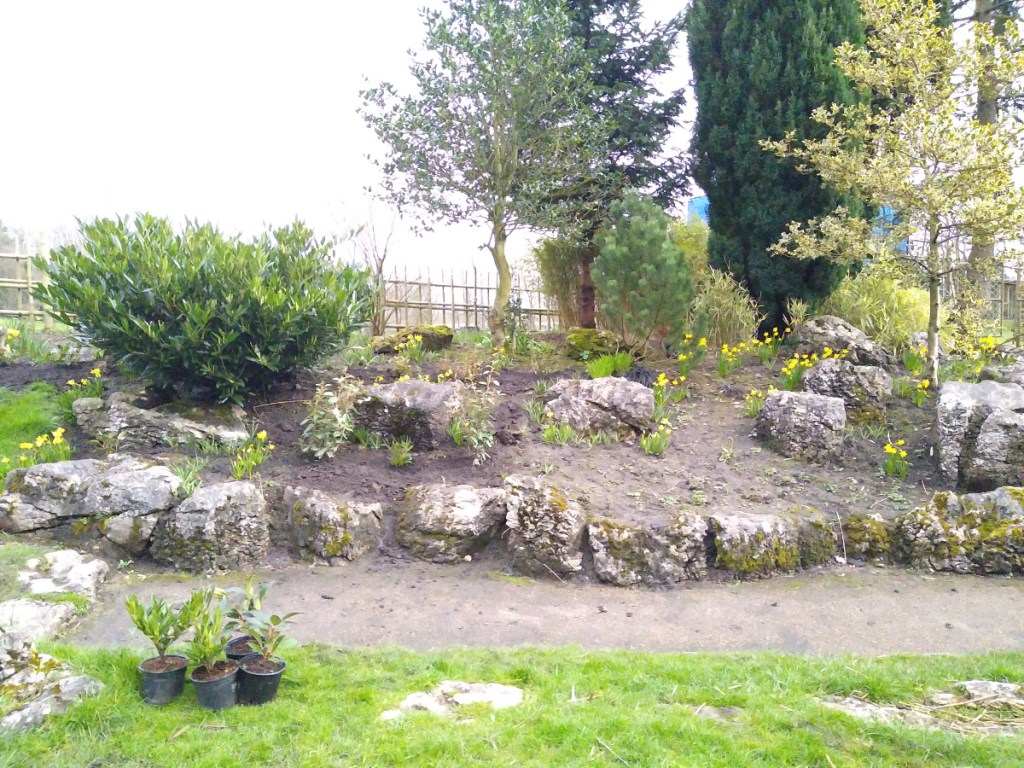
On Tuesday the 17th of March we received an email saying we could no longer share lifts in the van or meet together inside. On Wednesday the 18th of March, another glorious spring day, I went out on another work party planting sarroccoca and eleganus amongst the daffodils on the rock garden on Avenham Park. There was little joking, even amongst the guys from Preston City Council, who were helping out. Everything felt ominous. Still, it came as a shock when I got home to find out all LWT volunteer work parties had been cancelled until the end of April along with my voluntary internship.

In some ways it was a relief because I live with parents who are over 70 and in ill health. I’d been torn between the choices, if I was to continue volunteering, of moving out or risking their lives. So I accepted it was for the best I isolated with them, just going out to do our shopping and to exercise.

Still, I was bitterly disappointed. After winning the struggle to give up alcohol and manage my anxiety without it, and feeling I was finally coming home from my exodus with Carbon Landscapes to the place and the job role in my local landscape where I truly belonged… this!

Yet, I also felt, in some ways my gods had been preparing me for it. If I hadn’t given up alcohol there is no way I would have coped with the situation or with the responsibility of looking after my parents. When considering whether to quit my placement I’d heard a clear voice telling me to “come home.”

Another point is that, at the beginning of January, after I had a mild attack of exercise-induced asthma as a consequence of running my fastest time of 25.21 for 5k on the Avenham Park Run, Gwyn told me during this Taekwondo belt (green with a blue tag representing growth toward the skies) I needed to ‘learn to breathe’. Since then I’ve been trying to discipline myself to spend time in stillness, focusing on my breath, in my morning and evening meditations, but not always managing it.

(What has struck me and many others is that breath is central to this situation on many levels. Coronavirus attacks the lungs and those who get seriously ill face a battle for their breath which, in some cases, can only be won with the aid of mechanical ventilators, and in others not at all. The places worst hit have been cities where the air is badly polluted. Now flights have stopped and most people have stopped commuting by car, the skies are clear of contrails and air pollution has dropped.)

At first, after all that gearing up, I felt like Wily Coyote poised in mid-air off the edge of a cliff with my legs still running. Over the past few days I have been striving to ground myself, to slow down, to process the changes, to find space to breathe. Not easy when surrounded by panic.

My first response was to hit the news and social media to find out what’s happening and what everyone’s doing, leading only to tight chest, shortness of breath. To rush to formulate my own words, to share poems addressing the situation. Like I have some kind of gods-given responsibility… whilst aware of adding to the din of others doing exactly the same and increasing the massive strain on the internet that we forget is causing air pollution as we don’t see the power stations.

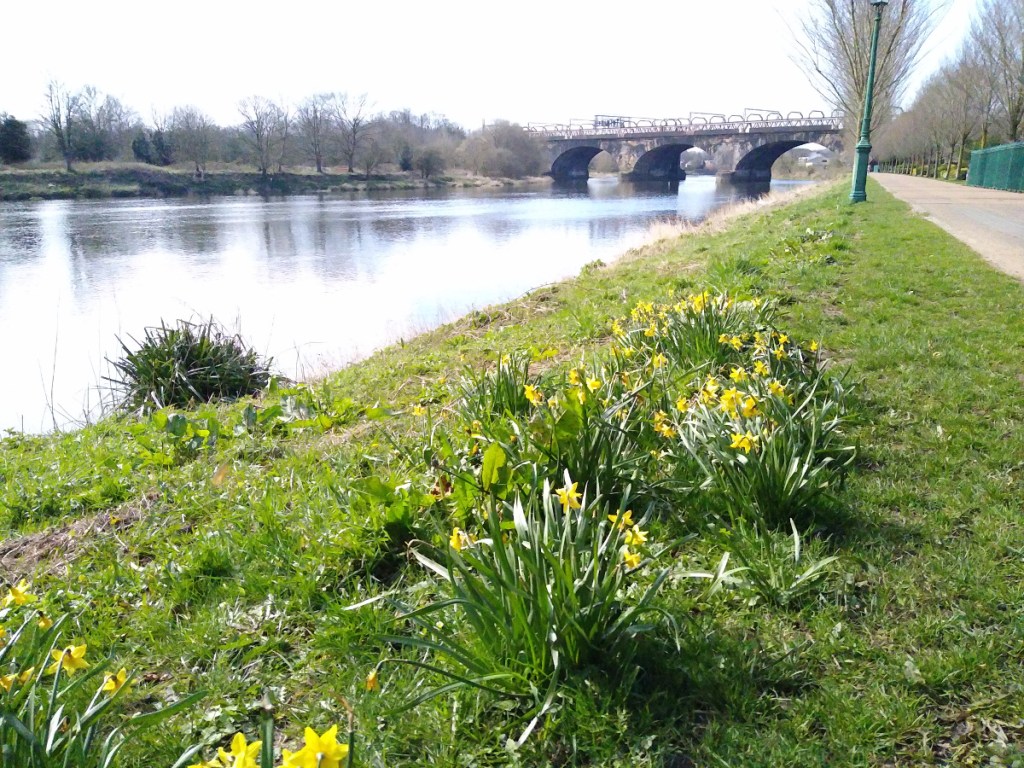
“Slow down,” the message kept coming through, from the stopping of traffic the virus has caused. As I ran more slowly, no longer worried about beating my best times, happy to be in the moment, feet steady alongside the Ribble in time with her flow where the daffodils watch with sad beautiful faces.

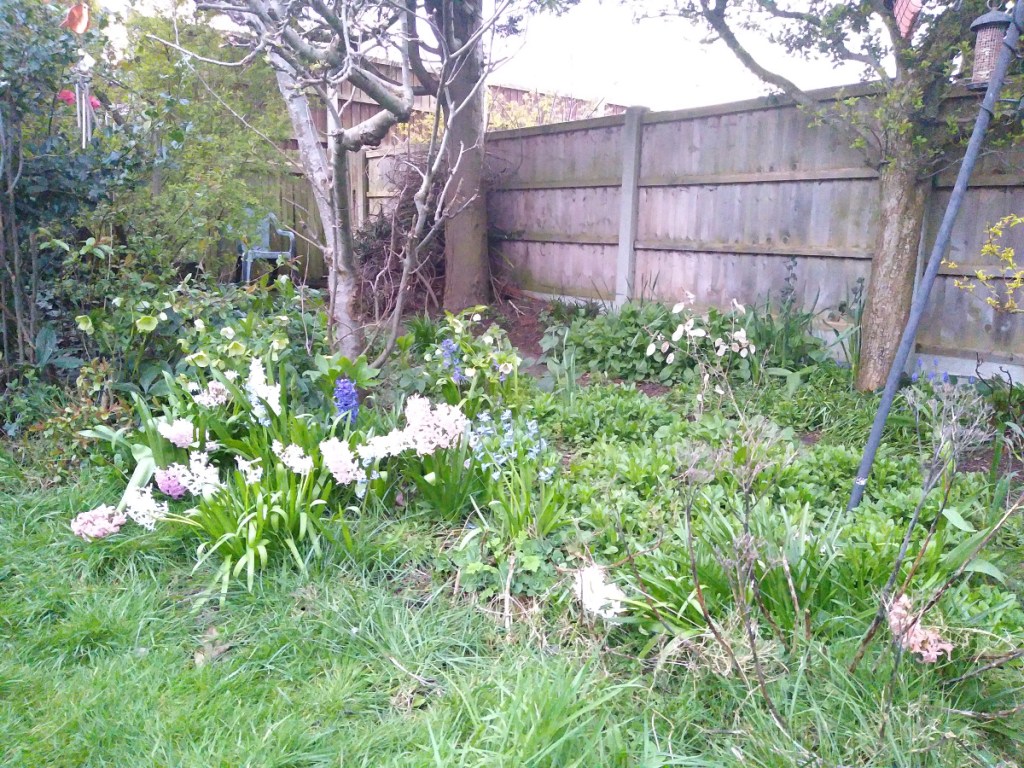
“Slow down,” as I began to take my time in my parents’ garden instead of rushing through the tasks. Appreciating the sunlight on the pastel colours of the hyacinths and the scent of the magnolia, the steady chuck of spade in earth and textures of compost from the bottom of the heap rich from years of decay.

“Slow down,” every time I sat before my mantlepiece in my bedroom where I keep altars to my deities, feathers and stones, to which I’ve recently added photos of my family ancestors knowing I’ll need their help.

I had developed a new routine based around prayer, writing, housework, gardening, shopping, and exercise when lockdown struck. It didn’t hit too hard as I was already living under those rules.

I’m anticipating a greater slowing. Right now I feel like I’m in ‘defence mode’ with my main prerogatives being to tend to the needs of and protect my vulnerable parents and to maintain my own health. I have also offered to run deliveries on my bike for family and friends, including the older members of my poetry group, if they end up isolating either due to illness or the government order.

An important point of support has been the Way of the Buzzard Mystery School online journey circles and coaching calls. I have been involved with Jason and Nicola’s drumming circles at Cuerden Valley and the Space to Emerge camp since they began and have appreciated being able to continue getting together to do journeywork and discuss the current situation from a shamanistic perspective.

With my daily routine and a support network in place I’m hoping for the best and preparing for the worst. If the UK follows Italy’s curve it is possible that my friends, family, and myself, may be not only be slowed down but locked away by illness, that we may be halted by the life-or-death battle for our breath. That we may have to face the final stopping – death – as usual a topic few think or talk about.

I’ve long had a plan for my funeral but am aware it will be invalidated by these circumstances. There is a huge lack of information about what will happen to the bodies of those who die of coronavirus in the UK. How they will be dealt with, where they will go, how their passing will be acknowledged.

Yet this great slowing gives us time to pause for thought – about the fears we’d rather not face and the solace we can find in each moment of these spring days so beautifully bright in contrast.

Fragments of Annwn – Fallings

The Broken Harp

I.
My nerves are timbres.

Taut and tense the ganglia
no longer relay the music.

Weak, worn, frayed, spent,
the tendrils torn and stretched
from the strings of a harp.

Like broken bowstrings
they sting and twitch.

II.
On the empty frame
the ‘devils’ of Annwn sit
and mock and chatter.

I cannot take my eyes
from their neat little fangs
and paper-like origami wings.

I cannot shut out their voices,
low, high, squeaking in the wind,
fat with my stolen melodies,

for I am strangely in love
with my distractions.

I court them feed them daily.

I have become their instrument.

And so I lie broken beneath their claws…

III.
And where is my god? Not the harpist
or the one who taught him but the one who
listens for the song in his eternal hall

where the harp played with no player at all?

Is he still listening? Waiting? For the bow
to be restrung? For the song to be sung? For
the arrow that will pierce his heart fine and true?

~

The Place Where the Sky is Falling

In the place where the sky is falling and the winged and the wingless ones with it I am galloping. The faster I gallop the faster it falls and the faster they chase me, swishing, swooping, on wings and not on wings (yet still sounding torn and leathery and creaky-jointed), with and without teeth and claws.

As a little experiment I touch a rein, a brief half-halt, steady from a flat-out to a slower gallop. The sky-fall slows, the flight of the ‘devils’ of Annwn who pursue me, the winds of the abyss that drive us all. I slow to a canter, to a trot, to a walk, pull up. The sky is still. The winged and wingless ones hang before me like puppets on strings, immobile in the air, without a single wing-beat. I frown. They frown. I move my left hand. They move to the left. I move my right hand. They move to the right.

“Is this some game?”

An eruption of laughter flows through them, breaking the strange spell. They shift, flap, nudge, jest. Some fly away and others descend to look on this strange phenomenon of an awenydd in Annwn.

“What are you?” I ask. “Are you devils?” For that is what Christians have called them for hundreds of years and they do look like something out of Doré’s woodcuts for Milton’s Paradise Lost. Yet I have a feeling they have existed in the Otherworld before the Christian imposition of Heaven and Hell.

They laugh and shriek and pull their grins wider with their foreclaws like demonic Cheshire cats.

“Seriously…”

“Fliers,” squeaks one. “Fliers, fliers,” the others echo. “Fliers.” “Clawers.” “Takers.” “We take…” “We take what you feed us.” “We feed.” “We bring the takings.” “We bring what you feed us to the abyss.”

“Cursed, cursed.” “We cannot set down our feet.” “We have no feet.” “We fly between the worlds knowing nothing but taking.” “We even sleep on the wing.” “Ours is the dream-storm over the abyss.”

“What have you taken from me?” I have no wounds but no teeth and no claws leave no mark…

They cackle, grin, smack their lips. “What you fed us.” Their mouths purse like secrets.

“Then you are welcome to it,” I incline my head in acknowledgement, “add it your storm of dreams.”

I depart at a slow walk knowing gratefully in Thisworld I will dismount onto the ground onto two feet.

~

It’s Easy to Fall

and keep on falling
when there is nothing
to hold on to – no can,
no bottle and its easy

soon empty comfort.

Its gentle guidance
down into oblivion.

(It is an illusion the
abyss has a bottom).

It’s easy to fall
and keep on falling
when you don’t know
how to do anything else.
Because no-one taught you
how to tread empty air.
How to breathe when
there is no oxygen.
How to balance when
there is nothing between
your two empty ears.

How to hear what
when there is nothing
beyond the abyss?

It’s easy to fall
and keep on falling
unless some unexpected
hand reaches out to
shake you from

that free fall before
you wake with a jolt –
upright in your bed.

It’s easy to fall
and keep on falling
before some person
or some god gives

you a task only you
can do. HERE. NOW.
Where there is land to
stand on air to breathe.
Hope on the horizon.

~

Why These Worries

I do not need unlike the wind that moves the washing?

Why the fear that if they stop I will be nothing
like a lump of a coal in the toe
of a Christmas stocking?

Why do I feel worthless
when I am wanted by a god?

Why do I feel like a failure
when I’ve written three books?

Why does it feel more heroic
to be battling on against these thoughts
when I could let them go to the graveyards
of the winds beneath the towers
from which they were born?

How big a grave for a thought?

How great the work of the gravedigger?

How to engrave the gravestones
with suitable death’s heads?

And if I should let them slip away…
If I should carry them like childhood toys
gifted on Christmas morning then broken by bullies
in cardboard boxes like little coffins (each has a face like my own
like in the fairy funeral and the Fairy King sings
a mournful chant as I lower them in)…

how do I know I will let them rest

and not dig them up like a restless hound?

Come, come, a blast on his horn, come away
from my graveyards and away from mourning.
Spring is here and flowers and hares to chase.
In these sunrise mists a new hunt dawning.


~

*These poems are based on journeys to Annwn undertaken during the process of giving up alcohol as self-medication for my anxiety (which I began on New Year’s Day). This forced me to stop falling, face my worries, and see them for what they are – distractions from my work as an awenydd devoted to Gwyn.
**The image is Doré’s ‘The Fall of Lucifer’ (courtesy of Wikipedia Commons).

Lifelong Dedication to Gwyn – A Year and a Day on

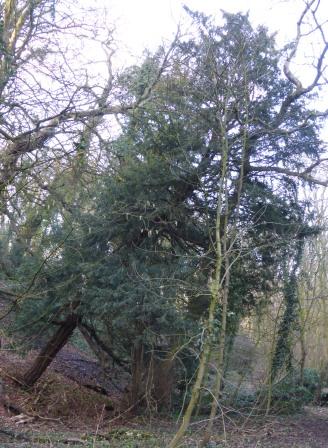
A year and a day ago I made my lifelong dedication to Gwyn ap Nudd, a Brythonic warrior-hunter god and ruler of Annwn, following a vigil on the night of the ‘super blood wolf moon’ beneath the leaning yew on Fairy Lane in my home town of Penwortham.

Unlike my initial dedication to Gwyn as my patron god at the White Spring beneath Glastonbury Tor it wasn’t easy. Beforehand I’d suffered from a stress fracture to my foot and I was awaiting an umbilical hernia repair operation shortly afterwards.

The vigil, of six hours before I went out and made my dedication during the lunar eclipse at around 4am, was based around six tarot cards and took me on an intense journey of death and rebirth.

Looking back and interpreting the meaning symbolically I saw the foot injury forced me to slow down and the operation on my naval, my natal place, was bound up with the rebirthing process.

Once I’d recovered I realised, to my surprise and disappointment, in spite of having been through an intense inner experience my external life had not changed. I was still in the same situation as before. Skint and living with my parents, my book recovering Gwyn’s mythos written, with no idea of what to do with the rest of my life aside from knowing I must live within the parameters of my vows.

To remedy my financial situation I took a job in a supermarket. Frustratingly, in my own work, which I had hoped would take me deeper into Welsh mythology and into Annwn I hit several brick walls.

Firstly, after near-completing a course called ‘The Gates of Annwn’ for Gods & Radicals, seeing myself on the videos attempting to teach in six weeks what has taken me years of questioning, doubt, being torn apart and put back together, I realised I’d made a mistake. An Annuvian path is one people find themselves (or are found by). It cannot be taught.

Secondly, I really wanted to write a book called Porth Annwn documenting my explorations of Annwn. However, the deeper I went, the further away I got from traditional depictions in Welsh mythology and folklore, attaining instead personal visions that were fantastical, paradoxical, and contained elements of ‘faerie’, but could not be linked directly to the Brythonic sources.

My third block was failing to learn Welsh as I am not embedded in the culture. This was accentuated by my awareness of the debates about cultural appropriation and the derogative attitudes of Welsh scholars (who are mainly non-conformist Christians) towards Brythonic polytheists.

My frustrations with my work and my supermarket job reached a nadir and resolution when I accidentally killed a dragonfly whilst cycling to Brockholes. This led me to leave the supermarket to volunteer with the Lancashire Wildlife Trust as a way of finding paid work in conservation and to shifting my creative focus away from Wales and Welsh mythology back to the (once Brythonic-speaking) land where I live.

Both these shifts have helped me to deepen and renew my relationship with Gwyn. I feel far more connected with him in my everyday life when I am outside working on the land, whether I’m tree planting, coppicing, clearing scrub, dead hedging etc. than when I was stacking shelves or, worse, sitting on a till beneath the artificial lights in the supermarket.

My new creative project ‘The Dwellers in the Water Country’, which focuses on the prehistoric people of wetland Lancashire, has guided me back to the earliest hunter-gatherers who may have venerated Gwyn as a hunter god. My outdoor work and research have knitted together as I’ve learnt skills and used tools our ancestors would have used.

This new more physical connection with Gwyn has also manifested in my running and in taking up Taekwondo. Interestingly, the Fianna, the followers of Finn, Gwyn’s Irish cognate, lived in the woodland, and had to master poetry along with physical feats that involved fighting and running*. These and my work outdoors have made me more connected with Gwyn as a warrior-hunter.

I have also experienced a deepening of my personal relationship with him through spending more time at my altar in stillness and prayer as well as continuing to journey with him.

So a year and a day on, after spending eight months lost, I have finally gained a vision of the path ahead and the central facets of a life shaped around my devotion to Gwyn:

*Personal devotions
*Working on the land
*Poetry
*Journeywork
*Practicing a martial art and running

I have moved on from confusion and frustration to feeling excited about a future full of challenges and promise.

*In ‘A Wildness Comes on the Heart of the Deer’ Christopher Scott Thompson cites the initiation tests of the Fianna: ‘And there was no man taken into the Fianna till he knew the twelve books of poetry. And before any man was taken, he would be put into a deep hole in the ground up to his middle, and he having his shield and a hazel rod in his hand. And nine men would go the length of ten furrows from him and would cast their spears at him at the one time. And if he got a wound from one of them, he was not thought fit to join with the Fianna. And after that again, his hair would be fastened up, and he put to run through the woods of Ireland, and the Fianna following after him to try could they wound him, and only the length of a branch between themselves and himself when they started. And if they came up with him and wounded him, he was not let join them; or if his spears had trembled in his hand, or if a branch of a tree had undone the plaiting of his hair, or if he had cracked a dry stick under his foot, and he running. And they would not take him among them till he had made a leap over a stick the height of himself, and till he had stooped under one the height of his knee, and till he had taken a thorn out from his foot with his nail, and he running his fastest. But if he had done all these things, he was of Finn’s people.’

The Death of a Dragonfly

Dyed he is with the
Colour of autumnal days,
O red dragonfly.
Hori Bakusui

It was an accident. Still, if I’d accidentally killed a human I’d have been jailed for murder. I’m often killing midges, greenflies, flies, as I cycle down the Guild Wheel along the Ribble to Brockholes Nature Reserve. Not on purpose of course – they just have a terrible habit of getting in my eyes, in my mouth, down my top. It’s said there were more flying insects before cyclists, cars, climate change…

I’m not sure why killing a dragonfly somehow seems worse than killing all those tiny things. I didn’t even see him. I was too busy thinking about the fantasy novel that I was planning to set in a marshland and how the flora and fauna of Brockholes, as a wetland nature reserve, might inspire me.

Thinking not listening. There was just a buzzing at my neck and a kind of crackling against my skin. Without thinking I swatted at it compulsively, then stopped in a panic, fearful of what I’d done. Looking down, for a moment I felt relief, seeing what looked like a twig before I realised it was a ruddy abdomen. Severed from it a furred red-brown thorax, two cobwebby filmy wings, and a head with two huge dark red globular eyes and three small eyes that, between them, didn’t see me coming.

I didn’t know what he was right then, that he was a he, or a common darter. Only that I’d killed a dragonfly. I laid the broken pieces at the side of the cycle way with an apology to dragonfly kind and rode onward more slowly, more aware of other ruddy darters rising from where they were basking on the path. After I’d arrived, locked up my bike, they haunted me for the short period I was there. Flying in front of me, landing on the wooden walkways and handrails.

One, in particular, caught my eye. Beholden by the huge round portals of his eyes I drowned in the utter inadequacy of not knowing what he was thinking. Did he know I was a murderer? Did he know what I was? Could he sense my awkward reaching? My overall impression was one of curiosity. That it seemed likely he was thinking dragonfly thoughts distant from my own – trying to place this gigantic monster with its small eyes within his brief sunlit world of eating and flying and mating.

Dragonflies are old. The oldest fossils date back to the Carboniferous period – 350 million years ago. They spend most of their lives as nymphs, living for up to four years in muddy waters. They then crawl up the stem of a plant and shed their nymph-skin, emerging as dragonflies, leaving behind the exuvia. In the brief six months of their adult life they feed on smaller flying insects and find a mate, in an acrobatic display forming a spectacular mating wheel, then afterwards the female lays her eggs on the leaves of plants or in the water. Death follows shortly and the life cycle begins again.

It’s impossible to know if that dragonfly had fulfilled his life’s purpose before I killed him. And, of course, in that all-too-human way that has reduced the earth and its creatures to resources, I’m searching for a meaning, like nature is here to teach us lessons. I can’t help it. That’s human nature.

And it’s pretty obvious, slow down, listen, maybe just maybe I’m heading off on the wrong path trying to write a fantasy novel about an imaginary marshland when our existing wetlands need our voices. Making up new creatures when it may be more valuable to introduce people to Sympetrum striolatum ‘common darter’, Sympetrum sanguineum ‘ruddy darter’, Anax imperator ‘emperor dragonfly’.

This is leading me to think that, rather than writing second world fantasy, I might be best off writing a novelset in this landscape, but further back in time. Not only before the wetlands, the marshes, the peat bogs, the lakes, were drained off, but before the people lost their spiritual relationship with the land.

I’ve long been drawn to the archaeological evidence for the ancient marsh-dwellers in my local area. During the Romano-British period they were known as the Setantii ‘The Dwellers in the Water Country’ but had lived here far longer. Here, on Penwortham Marsh (now drained) and not far from the river Ribble (now moved) they had a Bronze Age Lake Village evidenced by the remains of a wooden platform, dug-out canoes, a bronze spearhead, 30 human skulls, and skulls of aurochs and deer. There were numerous other settlements such as those beside the great lakes Marton Mere and Martin Mere (now drained), wooden trackways such as Kate’s Pad, and the (now lost) Port of the Setantii.

If I was to write about that time, rather than making up critters and magic and gods and monsters, I would be able to draw upon the real magic of an animistic and shamanistic culture rooted in a lived relationship with the ‘water country’ – its reeds and rushes, its wetland birds, its dragonflies and damselflies. With the spirits of the ancestors, gods we know throughthe Romans, such as Belisama and Nodens, and those who are unknown such as the goddess I know as Anrhuna, Mother of the Marsh.

That dragonfly was one of her children perhaps. She who has been here as the marshland since, at least, the thaw of the Ice Age and thousands of years of water country, these last four centuries of its draining off, and is still here in the last remnants preserved by wetland nature reserves such as Brockholes.

Would it be too very human to read, in an unlucky accident, a message from a goddess?

O red dragonfly,
Colour of autumnal days,
Dyed he is with the

Mother of the Marsh
Returned to mud and water
Rest well O red one.

***

Those who follow this blog will note this event has led me to returning to its old name ‘From Peneverdant’. This was the name of my hometown of Penwortham in the Doomsday Book and signals a homecoming from an exodus through Welsh mythology and Annwn. It makes sense in relation to my lifelong dedication to Gwyn, here, in January.
 

The Vision of Ceridwen

I’m the broken bird-thing
at her table again

her wizened hand
in my claws

telling her
I’m going to mend
our broken vision

and all will be beautiful.

***

Sometimes you end up in a myth. It’s not the myth you thought you’d end up in or the myth you chose. You’re not who you thought you would be. Nobody else sees the myth the same way you do.

It began when I first started learning about the Bardic Tradition and heard that Ceridwen was the goddess of the cauldron that brews awen, the poetic inspiration that is like mead to the Brythonic bards.

As a poet I thought Ceridwen was a goddess well worth meeting so I drew myself a cauldron, lit a candle, constructed a visualisation. One of those 2D interfaces that sometimes helps you interact with what is. I imagined Ceridwen as a blue-robed, dark-haired, faceless woman stirring a cauldron.

Nothing happened. Then, from nowhere, out leapt a hideous grey-haired hag who put her bony arms around my neck, nearly strangling me. She demanded I go with her to her cottage in her woods. She sat me down at her table in a room with a sun dial and smaller cauldron over the hearth on a wobbly three-legged stool and insisted that I call her ‘grandmother’. Initially I thought she was an ancestor.

I presumed this showed Ceridwen wasn’t interested in me. She already had worthier devotees. Soon afterwards I got found by my patron god, Gwyn ap Nudd, a ruler of Annwn and guardian of the cauldron.

I met ‘grandmother’ again when I was travelling Annwn in search of inspiration on my flighty white-winged mare. She ditched me and I found myself falling downwards through the air, flapping my arms like wings, steadily acquiring black feathers, but not quickly enough to stop me hitting the ground. When I returned to my senses the hag-like woman was standing over me. With a wrinkly smile she told me I was ‘beginning to get my raven’s wings’ before taking me to her cottage again.

There she told me to look into her cauldron, where I saw in vivid blues and reds a Dark Age battle of clashing spears, crashing swords, broken shields, fallen flags, blood crimsoning the nearby waters, then the shades rising in a sorrowful march to depart. Researching it afterwards I realised it was the Battle of the Region Linuis fought by Arthur against the Saxons and wrote a poem about it*.

After this gift of awen from her cauldron I began to suspect the hag was the real (as opposed to my imagined) Ceridwen. The name ‘grandmother’ came to make sense a couple of years later. Gwyn had shown me a cauldron filled with stars and not long afterwards I went to see my friend, Nick Williams, performing an experimental poetry set in a blacked-out room with strobe lights. I had the sensation of being in a cauldron of poesy and also in the womb of the universe. I recalled that Nick refers to a goddess called Old Mother Universe and realised she is Ceridwen – the oldest mother of all.

I went on to write a book called The Broken Cauldron, focusing on how Ceridwen’s crochan ‘cauldron’ or ‘womb’ is shattered in the Welsh myths and of my task of gathering the stars back into it.

Whereas, in the Bardic Tradition and Druidry, Taliesin and Arthur, those responsible for stealing the awen and the cauldron and the shatterings that have brought devastation to the land are hailed as heroes, I found myself standing in the shoes of Morfran ‘Sea Raven’, Ceridwen’s dark and ugly son, who was later known as Afagddu ‘Utter Darkness’.

He for whom she boils her cauldron in the hope the brew will inspire him and cure his imperfections. He who does not get the awen, who cannot win poetic inspiration the quick way, but must work to find the words to heal the lands poisoned by the contents of the broken cauldron, to repair it piece by piece, story by story, so the stars shine in bright new constellations on a new world.

Gwyn is my guide in this task, and in serving him, I am also serving Ceridwen. She does not appear to me often, but when she does, I am often her awkward black-winged child, the dark imperfect one.

As Afagddu I’m learning imperfection is necessary; an understanding of what others find repulsive, whether it’s darkness, death, decay, plastic, the monstrous creatures of Thisworld or the Otherworld. That these hold their own beauty when the concept is not corrupted by our society’s false ideals.

It’s not the Old Mother’s Universe that needs fixing, but the way we perceive it, the collective vision, which guides our acts. When we learn to see clearly both Creirwy* and Afagddu will be beautiful.

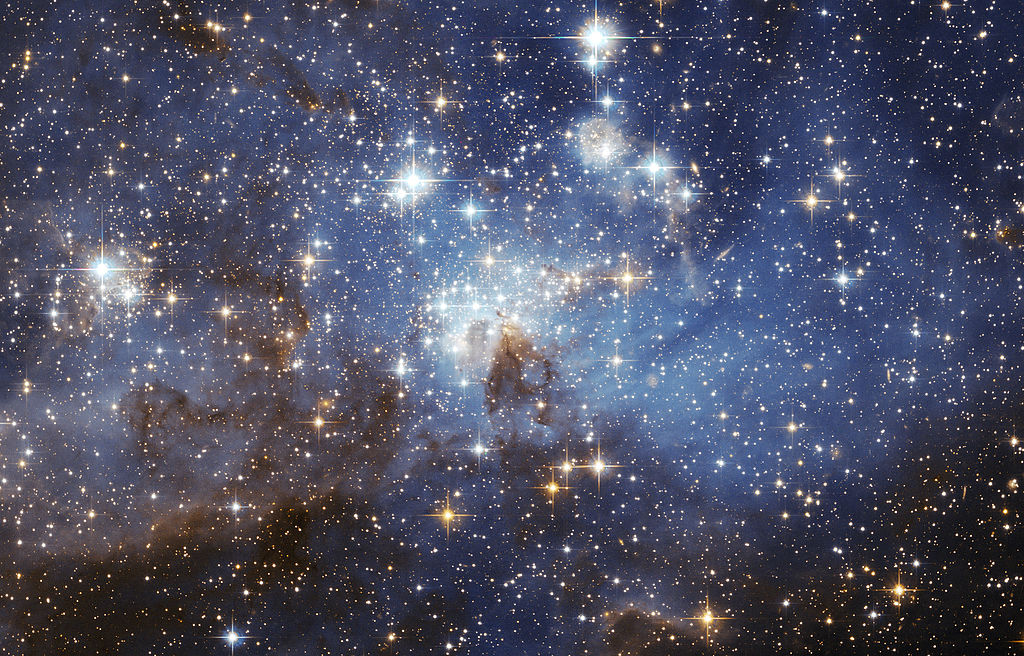
A star-forming region in the Large Magellanic Cloud Wikipedia Commons

*’The Region Linuis’ was first published in Heroic Fantasy HERE.
**Creirwy means ‘Lively Darling’. She is Afagddu’s beautiful (twin?) sister.

With thanks to Wikipedia Commons for the image ‘A star-forming region in the Large Magellanic Cloud’ by ESA/Hubble.

Shattered Vessels and Scattered Sparks

Notes on Welsh Mythology and Lurianic Kabbalah

In 2015 my patron god, Gwyn ap Nudd, showed me a cauldron filled with stars. Shortly afterwards I was transported into the scene in The Story of Taliesin, where Gwion Bach steals three drops of awen (1) and the cauldron breaks, spilling the deadly remnants of the brew across Gwyddno Garanhir’s lands. With it I saw the stars pouring out and was told by Gwyn my task was to gather them.

This story continues to play a guiding role in my path as an awenydd. I was recently astonished when I found similarities between my personal gnoses and Lurianic Kabbalah. This system was created by the Jewish Rabbi, Issac Luria (1534 – 1572) the Ari or the Holy Lion, who lived in Safed in Israel.

According to Luria Or Ein Sof ‘God’s Infinite Light’ was withdrawn in the Tzimtzum ‘contraction’ that made possible the creation of this finite world. The light continued to emanate through the ten eyes of Adam Kadmon ‘Primordial Man’. Each point of light formed the keter ‘crown’ of a sefirot ‘emanation’ in the world of Tohu ‘Chaos’. These lights were contained by ten vessels. Because the seven bottommost vessels could not contain the intensity of the lights they died, shattering, descending into Tohu. This was known as shevirat ha-kelim ‘the shattering of the vessels’. The three vessels at the top were more powerful and those lights continued to shine, emanating the Infinite Light.

Notozin ‘sparks’ of light clung to the fragments of the vessels. By the act of tikkun, the repair of the world above and below by gathering the sparks (seen both as divine light and holy souls)and returning them to the Creator the unity of the shattered God-Head could be re-established.

Parallels can be found between the broken cauldron and the shattered vessels and between tikkun and the task I was assigned by Gwyn, Gatherer of Souls, gathering the stars back into the cauldron. The three remaining vessels, emanating the Infinite Light, resemble the modern symbol for awen /I\.

In the Welsh myths the cauldron is the womb of Ceridwen. She is replaced as the source of awen and as a creator goddess by God in medieval poetry (2). Her cauldron lies in Annwn ‘the Deep’ and its guardian is Gwyn/Pen Annwn ‘Head of the Otherworld’. In ‘The Spoils of Annwn’ it is stolen by Arthur and his men. We find the lines: ‘cledyf lluch Lleawc idaw ry dyrchit, / ac yn llaw Leminawc yd edewit’, ‘Lleog’s flashing sword was thrust into it, / and it was left in Lleminog’s hand’ (3). This potent image of violation is suggestive of the shattering of the cauldron in a lighting-flash and the theft of its pieces.

This scene might originate from an older creation myth akin to the Mesopotamian story of the slaying of the dragon-goddess, Tiamat ‘Deep’, by the lightning-god Marduk, and Indra’s release of the waters from the dragon, Vritra, by a thunderbolt in the Hindu tradition. In Genesis, before God creates the world, we are told ‘the earth was formless and empty, darkness was over the surface of the deep, and the Spirit of God was hovering over the waters,’ suggesting the existence of an older water-deity.

The shattering of Ceridwen’s cauldron is the Big Bang, the moment of creation, when the waters spill out with the stars (4). Ceridwen may have created of her own will before Lleog broke her sacred vessel.

The cauldron is shattered repeatedly in Welsh mythology and these instances are bound up with the near-destruction of the world. In the Second Branch the cauldron breaks after pouring out the speechless dead in a battle that leaves only seven Britons alive and five pregnant women in Ireland. In The Story of Taliesin its breaking poisons Gwyddno’s lands. The survivors are left to pick up the pieces.

My task as an awenydd living in the Anthropocene, this Sixth Mass Extinction, precipitated by Lleog’s sword and Gwion’s theft of the awen shattering the cauldron, is to regather the stars. By gathering constellations of stories in service to Gwyn and Ceridwen I strive to repair the cauldron, the womb of Old Mother Universe, and mend the ways between Thisworld and Annwn. This is my Tikkun.

Photo by Marika Vinkmann on Unsplash

(1) The Welsh word for poetic inspiration stemming from the Indo-European *uel ‘to blow’ and sharing its root with awel ‘breeze’.
(2) This is evidenced in ‘The Chair of Teyrnon’ and ‘The Childhood Achievements of Taliesin’ from The Book of Taliesin and the poems of Cuhelyn Fardd and Prydydd y Moch.
(3) Lleog ‘death-dealer’ (from Lleawc) and Lleminog ‘the leaper’ (from Leminawc) may be names of the same person, who may also be identified with Lleu Llaw Gyffes ‘the Fair-Haired One with the Skilful Hand’. It would certainly take his skill to steal the cauldron. All may be reflexes of the Pan-Celtic god, Lugus.
(4) This was suggested to me by an initiatory experience. After my first dedication to Gwyn, before the star cauldron (the candlelit White Spring at Glastonbury), I experienced swimming through a sea of stars.

SOURCES

Howard Schwartz, ‘How the Ari Created a Myth and Transformed Judaism’, Tikkun
Kristoffer Hughes, From the Cauldron Born, (Llewellyn, 2013)
Laurence Fine, ‘Tikkun in Lurianic Kabbalah’, My Jewish Learning
Marged Haycock (transl), Legendary Poems from the Book of Taliesin, (CMCS, 2007)
Moshe Miller, ‘Shattered Vessels, Kabbalah Online
Patrick Ford (transl), Mabinogi and Other Welsh Tales, (University of California Press, 2008)
Genesis 1., New International Version, The International Bible Society

On Vocation and the Mystical Collage

Vocation, from the Latin vocatio ‘a call or summons’ by God/a god, is rarely discussed in the Pagan communities, yet it is central to other religions. Why the silence? Is it because not all Pagans see Paganism as a religion? Because not all are called to revere and worship and serve the gods? If only a few of us receive such a calling and there is no framework of support within the major Pagan organisations, how do we navigate the highs and lows, the trials and pitfalls, of trying to live a vocation that has no precedent in the modern world and cannot be wholly reconstructed from the ancient?

These are questions I have been faced with, have wrestled with, have returned to time and time again during the last seven years over which I’ve finally responded to my calling by serving an apprenticeship to the Brythonic god Gwyn ap Nudd and making a lifelong dedication to him as his awenydd.

At the very beginning I knew of no-one else who had a received calling from a god. Having discovered the awen and the Brythonic myths through Druidry I met others within the Oak and Feather Grove and the Druid Network who offered support, but only a few who could relate to my experiences.

Only a few people experienced the awen as a burning all-consuming force demanding total dedication, that could only be quenched in the ice of a death-god, that would only be satisfied when its flames were seared as words onto a page, the cost of whose burning is burn-out and the ashes of depression.

Thus, for the most part, I stumbled through the mist and the darkness with the guidance of my god as my only certainty and, in my darkest moments, sometimes wondered if I could even trust him, he of many names and guises, whose realm is one of uncertainty and illusion, whose hounds are not always hounds. (So far his lack of pretences to truth and lack of false promises have always proved true).

Through speaking openly about my experiences and reaching out to others I slowly began to find other polytheists who had experienced a similar calling and shared all the same problems. The main one being that we have no support structure, no guidance, no place within secular society or the big religions. That we all know in our hearts what we are doing by building devotional relationships with the gods and spirits of the land and bringing inspiration to our communities has value, but this cannot be seen or understood by a society that values material wealth and economic growth above all else.

Because of this it is impossible to make a living from such a vocation. Yet some people manage to find careers through which it might be expressed such as teaching, counselling, conservation; some even get paid for their art. Others take any job that pays the bills and leaves the mind free for the true work.

I am currently making a small amount of income from book sales, writing for Gods & Radicals, and from my Patreon supporters, and have been able to live off this because my parents put me up. However, as this ultimately unsustainable, I am aware the time has arrived to return to part-time work.

Perhaps this has always been the case. Mysticism has never spoken to the masses, yet for those who follow such a path, the words of the mystics of the past are like bright shining jewels that glitter above the abyss, and can be life saving. Thus I write to add words born out of dedication to my gods to that glittering collage in the hope they will shine for others in the future.

flower-frost-stone-coral-eye-violet-614138-pxhere.com-creative-commons

The question I pose to others is how can we support each other when there is no institutional support? How can we make our collage outshine the allure of goods and wealth? How can we work together as co-creators of a world in which the gods are honoured and the land and its spirits are respected?

One of the reasons Greg Hill and myself set up the Awen ac Awenydd website and several awenyddion set up the Facebook group was to create an online space for such discussions. I’d be interested to hear the response of people from the wider Pagan and Polytheist communities.