Gwyn Dedication Two Years and a Day On

It has been the worst year
since I have been born.

I have felt hurt, anger,
resentment, abandonment,
wondered if I’ve made a mistake.

If my choice to dedicate myself to you
has brought family sicknesses,
plague, landslips, floods…

But, you reassure me, it has not –

you warned me of the sadness
coming to this land long ago.

In your thereness I have found
strength knowing how tirelessly
you guide the dead (so many!).

You have laughed away my fears.
When I’ve cried, wailed, wallowed
in self pity and uttered every expletive
in Thisworld and Annwn told you:
“I’m afraid I’m going crazy…”

you have shown me the lives and deaths
of your spirits – what true madness is –

Annwn’s multi-sided perspective.

You have been there for me
through the worst year as you are
always there for the living and dead.

I have been blessed in my service to you
as your awenydd whether in words or in work
in the woodlands and the marshlands…

Tonight, in your cauldron, help me transform
my battle-fog into mists of enchantment.

White, Blessed, Holy, be not only
the Wrathful Hunter but the Kindly One.
Help me delight in being yours again.
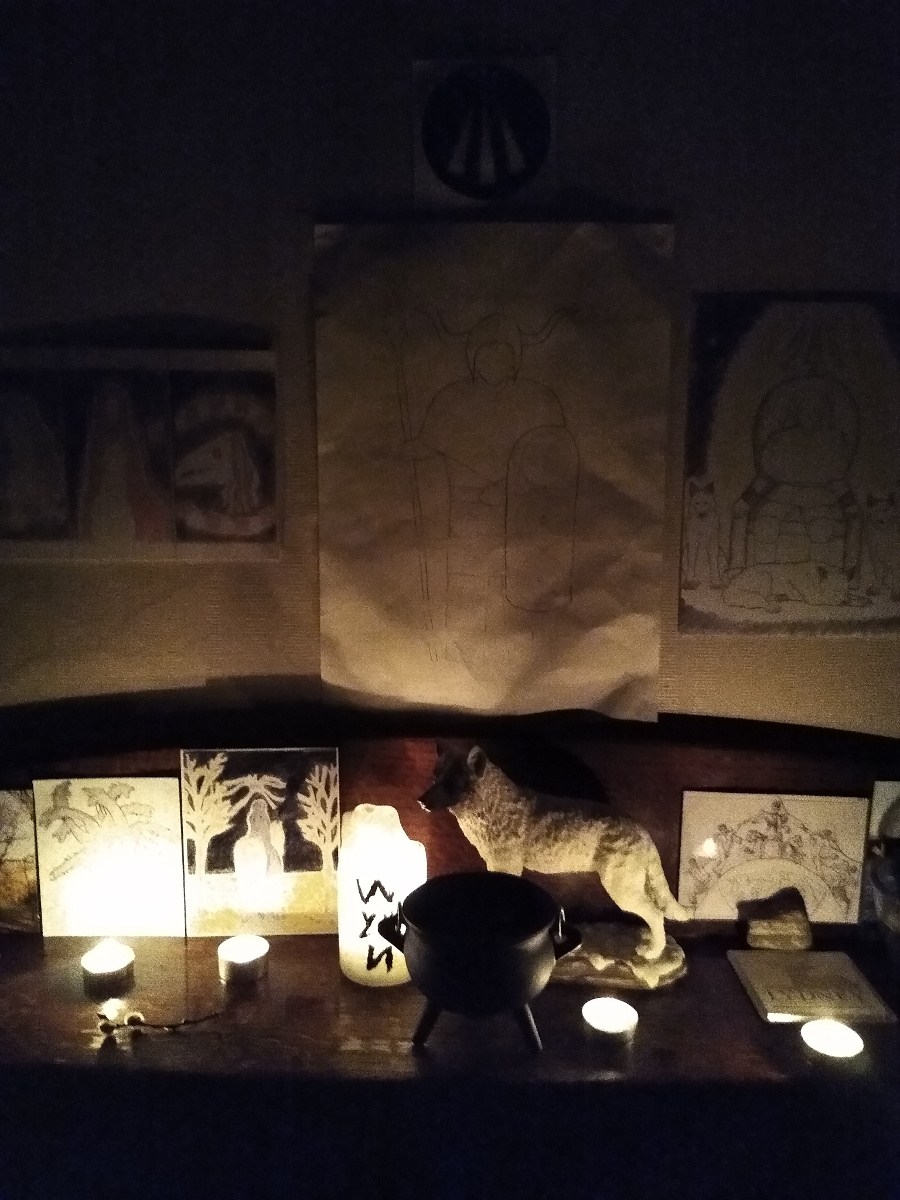
I wrote the poem above, addressed to Gwyn, to mark the two year anniversary of my lifelong dedication to him. This took place beside yew tree on Fairy Lane by the light of the ‘Super Wolf Blood Moon’. I had already served a seven year apprenticeship to him, most of which had been magical and wonderful.

The last two years have been far harder, in particular the last, for all the reasons stated above. Family illnesses, covid, minor natural disasters in my local area and far worse ones further afield.

All of these devastating signs of the consequences of climate change and overpopulation.

Last night, I performed a ritual to mark the anniversary of my dedication to Gwyn, which involved casting these happenings and the feelings of resentment and anger that were getting in the way of our relationship and my service to him as an awenydd into his cauldron to be transformed.

“Know that every thought, like all things, has a soul,” he reminded me, “like you dies and is reborn.”

During our communion Gwyn gave me a combination of warnings, reassurance, and guidance.

“There is harder to come. I will give you no false hope or empty promises. Yet I can provide inspiration. In the journey of the soul you are not alone. Both the living and the dead face these problems. I too, for we all connected. Set aside your resentment and reach out in cooperation. Every thought, word, act, has its effects running through both worlds and throughout time. Know these cannot be predicted but even the worst horrors can turn to awen in the cauldron.”

So the magic of Annwn was worked and this morning I awoke to the full moon shining over my garden.

The Shifting Identities of the Gods

“On an island lives the King of Annwn with a mysterious woman and no-one knows whether she is his sister, his beloved, his wife, his queen, or his daughter.”

These were words gifted to me at the beginning of a drumming journey that I undertook with the guidance of my patron god, Gwyn ap Nudd, a King of Annwn/Faerie, after asking him about the links I have intuited between his sister and beloved, Creiddylad, the mare goddess, Rhiannon, and the mother goddess, Modron.

There is little written about Creiddylad, but we know, like Rhiannon, she is a Queen of Annwn. As I have got to know her Creiddylad has revealed she is also associated with roses and horses. One of her names is ‘First Rose’ and she rides and takes the form of a white winged horse. Parallels exist between Rhiannon giving birth to Pryderi and him disappearing the same night as a foal is captured by a monstrous claw and Modron giving birth to Mabon, who is stolen away when he is three nights old. Whilst Creiddylad and Rhiannon are consorts of the King of Annwn, Modron is his daugher.

My journey resulted in the series of visions recorded in my poem ‘The Baby’s Gone’. My gnosis suggests Creiddylad, Rhiannon, and Modron are the same goddess with shifting identities.

Further, in the ‘Rose Queen Triptych’ I was inspired to draw, Creiddylad, ‘The Rose Maiden’, shifts into Rhiannon, ‘The Rose Queen’, then into the Mari Llwyd, ‘The Bone Mare’.

This didn’t come as a great surprise as I had similar experiences with Gwyn. When I first came to polytheism about ten years ago I regarded myself to be a hard polytheist (someone who believes the gods are real individual persons) as opposed to a soft polytheist (someone who believes the gods are aspects of a single god or goddess or psychological archetypes). I still stand by that belief, however, it has become a lot more fluid.

One of the defining characteristics of the gods across cultures is that individual deities have many names and titles. A prime example is the Norse god, Odin. Over forty of his names are recorded in The Poetic Edda alone and he is known by many more in other texts. The Greek goddess, Demeter, possesses several epithets such as aganippe ‘night mare’ and chloe ‘the green shoot’.

Gwyn first revealed himself to me by that name as the King of Annwn/Faerie in 2012. After our initial meeting I made my main focus the myths in which he is known as Gwyn but swiftly found he lay behind a number of our Fairy King and Wild Huntsman legends in Lancashire and my past experiences with the fay and the faerie realm.

My experience of dedicating myself to Gwyn at the cauldron-like White Spring beneath Glastonbury Tor confirmed the links I had made between Gwyn feasting on Glastonbury Tor in The Life of St Collen and Pen Annwn presiding over a mead-feast with his cauldron were correct.

I was far more cautious about equating Gwyn with other Kings of Annwn. However, as I worked with the myths, intuiting the similarities between Gwyn and Arawn, both of whom are huntsmen who preside over otherworldly feasts, have beautiful brides, and fight a seasonal battle against a summer god each year, I found myself inhabiting their overlapping tales.

In one instance, in a dream, I was thrust into the role of Pwyll, who took the identity of Arawn in Annwn and had to fight Arawn’s battle, in Arawn’s form, against his rival, Hafgan. Only, in my dream I was taking the role of Gwyn and was preparing to battle against Gwythyr. This resulted in my poem ‘If I Had To Fight Your Battle’. In another, as I was walking my local landscape in winter, I felt for a moment like Arawn-as-Pwyll making a circuit of a thiswordly kingdom, only my identity became conjoined, instead, with Gwyn’s as Winter’s King. Again, I recorded my experience in a poem: ‘Winter Kingdom’. To me this proves Gwyn ‘White’ and Arawn (whose name a translation has not been agreed on) are names or titles of the same god who has shifting identities across time and place.

Similar experiences from intuiting links in the myths and being gifted with poems and visions have led me to believe the King of Annwn goes by many other names. These include Afallach, the Apple King who presides over Avalon and Melwas who shares similar associations with Glastonbury, Llwyd ‘Grey’ who puts an enchantment on the land and abducts Rhiannon and Pryderi in The Mabinogion, Brenin Llwyd, ‘The Grey King’ who haunts the misty Snowdonian mountains, Ugnach, a figure with ‘white hounds’ and ‘great horns’ whose otherworld feast Taliesin refuses to attend, and Ogyrven the Giant, who presides over the spirits of inspiration.

Additionally, the King of Annwn spoke to me directly of his shifting identities in this poem:

I speak from the infinite
joining of the circle
as the snake bites its tail

the moment of awen
in every always of the universe

the sea behind the sea
the land behind the land
the sun behind the sun.

I come from many deaths.
From many deaths
I am reborn.

Dis, Vindonnus, Vindos,
Llwyd, Brenin Llwyd, Arawn,
Ugnach, Melwas, Ogyrven.

Across the sea I am Finn.
For tonight I am Gwyn.

Thus it is unsurprising his consort, the Queen of Annwn, has many shifting identities too.

Interestingly, when I was involved with Dun Brython, it was very much Rhiannon/Rigantona who brought the group together in the beginning and I came later as a devotee of Gwyn. One of the other members also had a strong relationship with Gwyn and it was member Greg Hill’s translations of poems featuring Ogyrven and Ugnach that helped me decipher the aforementioned connections. When Greg and I set up the Awen ac Awenydd group many other Gwyn devotees were drawn to it and the King and Queen of Annwn feel very central to the Brythonic tradition in the modern day.

The Dragon’s Tongue

How Can I

speak of dragons
when dragons from the world are gone?

How can I
be your inspired one
when the myths of the gods are lost?

To sing them back from the void before creation
I will need a dragon’s tongue!

Lord of Annwn
grant me the strength
by the breath of dragons
to write this book.

Over the past few weeks I have known possession by the awen; the inspiration, the divine breath that flows from Annwn, the breath of the gods, the breath of dragons; like I have never known it before.

It’s come after a couple of fallow years; sowing, reaping, dissatisfaction with flawed and failed crops.

I was beginning to fear that, after making my lifelong vows to Gwyn ap Nudd, to serve him as his awenydd, that the awen had dried up. What irony! A tiny part of me had begun to wonder if I’d made a mistake. Whether my powers of discernment were off. Whether he’d been having a laugh with me.

But my soul, to him eternally present, spoke otherwise. Only now I’ve realised I’d experienced a time of labouring, harrowing, preparing the ground for the oak to rise and the lightning to strike. For my fall from the tree amidst this collective shattering of the grounds of our society brought about by COVID-19 and into Annwn, the Deep, where I was to find the Prophet with the Dragon’s Tongue.

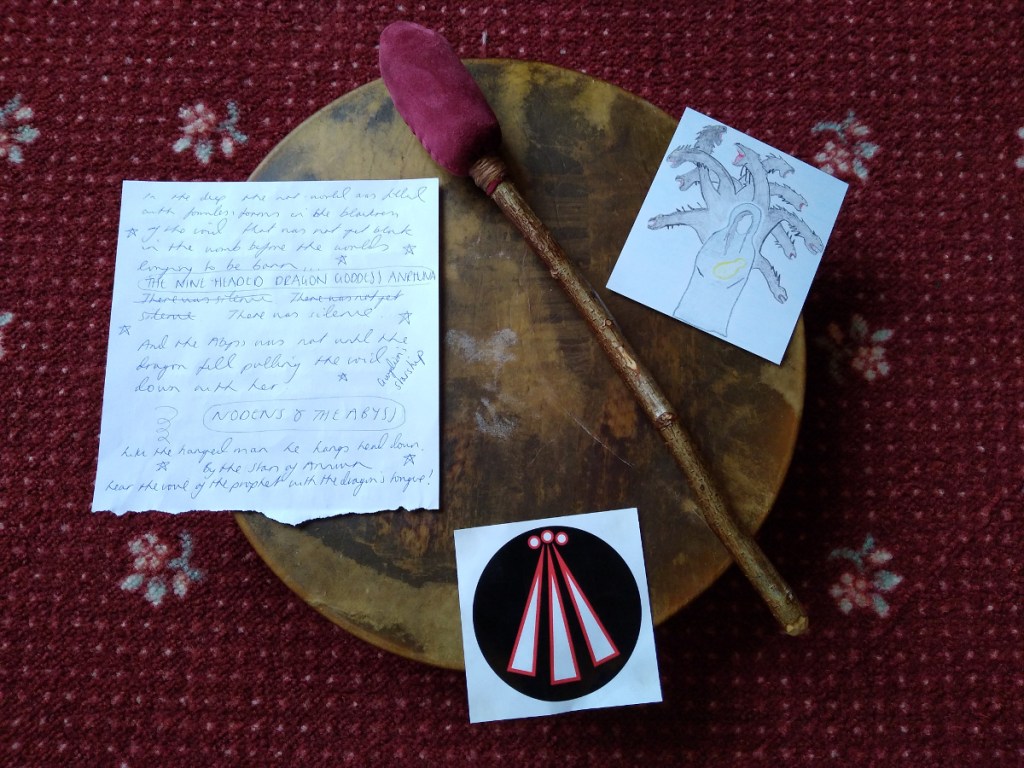
Thus has been born my next mythic book – The Dragon’s Tongue. Much of it has been gifted to me at dawn, in response, I believe to my evening prayers, in particular to Gwyn, Gwyn’s father, Nodens, Lord of Dream, Gwyn’s mother, Anrhuna, Dragon Mother of Annwn, and Gwyn’s beloved, Creiddylad.

You will probably not be surprised when I say their stories are central, with those of the dragons, and their conflict with the Children of the Stars*. There isn’t much evidence for dragons in the Brythonic/Welsh myths aside for an episode where Lludd/Nudd/Nodens ends a plague by ending the battle between two dragons and another where they appear, red and white, in a vision of Merlin Emrys. But there is the red dragon is on the Welsh flag and dragons are all around us in our folklore.

I’ve been reading mythic literature, journeying with the deep gods, the dragon-gods, long enough to know, when you get to the bottom of any myth, as Gordon White says, it is ‘dragons all the way down’.

I have long wanted to write the story of Anrhuna, the forgotten Dragon Mother, and also a creation myth. I have wanted what is lacking in the Brythonic/Welsh stories penned by medieval Welsh scribes. Something polytheistic, something penned by an inspired one of the gods, that provides insights into the mysteries of creation, of life, death, and rebirth, without the patriarchal Christian overlay.

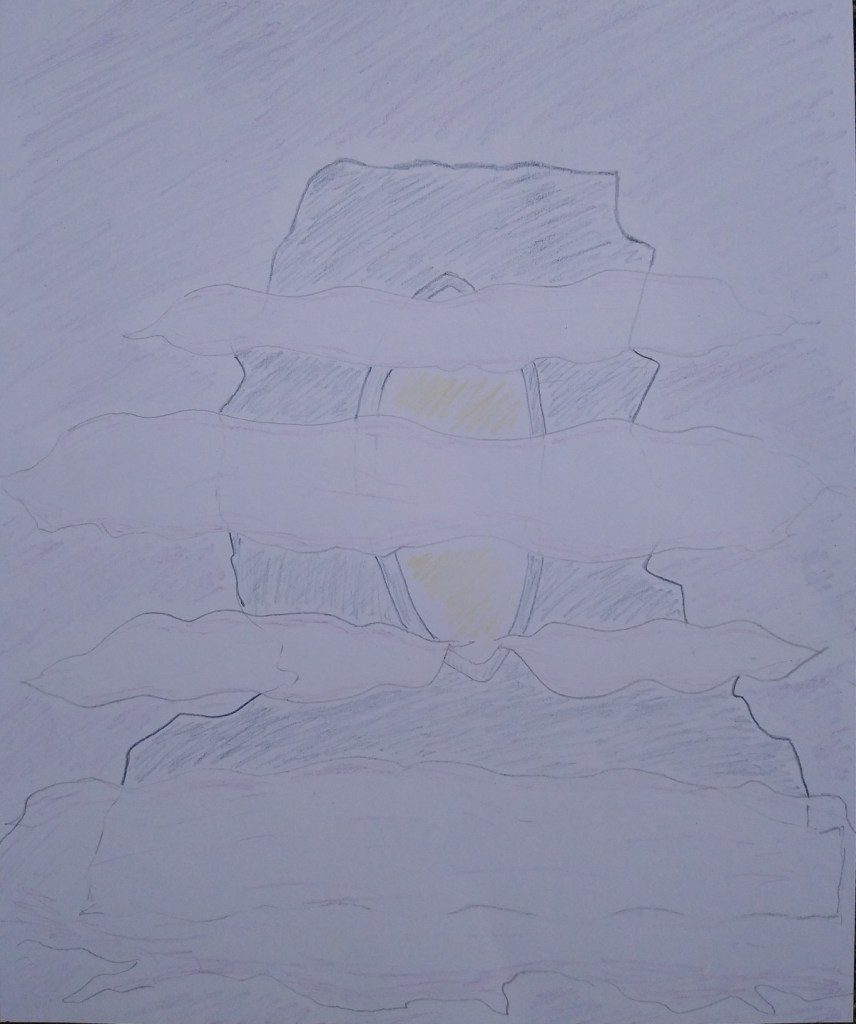
Finding nothing else I realised I would have to do it myself. Following being gifted with the voice of the Prophet with the Dragon’s Tongue I started in the beginning, in the Deep, with Old Mother Universe and her Cauldron and how a dragon slipped from it and fell into the Abyss. How, from formlessness, she gave birth to the elements in dragon-form to form the world (yes – the world was made by dragons and not by God or some other demiurge). How the Children of the Stars slew Anrhuna, cut off her nine dragon heads with their long necks, and bound them on the Towers of the Wyrms…

From this flowed the story of the conflict between the Children of Annwn and the Children of the Stars, a tale of love and war, the mysteries of birth, death, and rebirth, of the coming of the Black Dragon.

After I swore to Gwyn that I would complete it beneath the leaning yew, where I met him, I got most of the first draft written over those days of thunder. When the lightning from the Spear of Lugus which killed Anrhuna lit the skies, when the rain poured, when the energy was strange and high.

This, I believe, would not have been possible if we were not in lockdown due to COVID-19. If I had not had this time without the pressures of finding paid work by volunteering with the Wildlife Trust and helping organise local poetry nights. If I had not stopped drinking, got off social media, started counselling for my anxiety and found out its root is having Asperger’s, which has helped me to stop blaming myself for my failures in ‘the real world’ and to cultivate space for my gods and my soul.

The birth of this book has restored by faith in my gods and through it I finally feel reborn as Gwyn’s awenydd. The first draft is complete, but is far from perfect, and I am predicting it may take months, even a year or so to firm it up. But, it has been born, and I am incredibly excited about it.

So if you’re interested watch this space and if you’re really interested you can find out more about my creative processes and see unseen work, including some of the drafts, by supporting me on Patreon HERE.

*My name for the Children of Bel(i) and Don.

The Spirit of the Depths and the Service of the Soul

My soul, where are you? Do you hear me? I speak, I call you – are you there? I have returned. I am here again.’
Carl Jung

In his Red Book Carl Jung speaks of refinding his soul and rebuilding his relationship with her after a period of soul loss. He was called to do this by ‘the spirit of the depths’ who is opposed to ‘the spirit of this time’:

‘The spirit of this time would like to hear of use and value… that other spirit forces me nevertheless to speak beyond justification, use, and meaning… He took away my belief in science… my understanding and all my knowledge and placed them at the service of the inexplicable and the paradoxical. He robbed me of speaking and writing for everything that was not in his service.’

Jung records how the spirit of the depths opened his eyes to vision – to his soul, the things of the soul, and the soul world. This spirit forced Jung to stop treating his soul as a ‘scientific object’ and told him to ‘call upon her as a living and self-existing being. I had to become aware that I had lost my soul.’

Once he reached that awareness Jung called out to his soul and encountered her as a person and as a living landscape. She appeared to him in a number of guises (all female) – as Salome, as the spirit of a dead girl (who forced him to eat her liver!), as a serpent, and as a ‘small white bird’. She showed him a variety of visions, some of which predicted the First World War, some beautiful, most Hellish. She appeared to him as a desert, and, it may be argued, as the many places in Hell he explored.

Jung learnt that he is merely the ‘symbol and expression’ of his soul. She taught him that everything he does and says ‘comes from and belongs to me’. Ultimately he entered ‘the service of the soul’.

***

Jung’s words are of interest not only because they contain a great deal of mystical depth and wisdom but because they remind me of my own calling to serve Gwyn ap Nudd, a god of Annwn (‘the Deep’ – the soul world in the Brythonic tradition) and to restore my relationship with my own soul.

Like Jung I was called away from service to ‘the spirit of the times’ by ‘the spirit of the depths’.

From doing something ‘of use and value’ to the ‘inexplicable’ and ‘paradoxical’ – to ‘the service of the soul’. This happened when I decided to write my PhD thesis on ‘Imagination’ in William Blake’s prophetic books rather than trending topics and in my choice to write books based on personal visions that challenge the grounds of already obscure Brythonic/Welsh myths rather than a ‘how to’.

It’s only since I’ve accepted I’m never going to be able to make a living from such work and stopped using social media to publicise it I’ve managed to make space to journey and write more deeply.

Over the past month I’ve begun a quest, like Jung’s, for ‘a myth to live by’, that has been calling me even further away from the myths that others recognise from the medieval Welsh texts. To visions of my gods that are more direct, unfiltered by Christianised narratives, but less recognisable and hence relatable (unless, as I hope, I ultimately succeed on touching, through the personal, on the universal…).

In this space, as a way of repairing my own soul loss, I have been reconsidering my relationship with my soul. This began the day I met Gwyn leading the fairy funeral procession on Fairy Lane in my home town of Penwortham. Unlike in the original legend in which the fairies were tiny black-clad men clad with red caps they were taller than me and dressed in Victorian funeral garments. Gwyn, who I didn’t recognise, was wearing a black hat and leaning on a walking cane, his only recognisable feature being his long, silky white hair. As in the original the ‘fairies’ carried a coffin. And, like the hapless protagonist, I looked into the coffin and saw my own corpse. Only she looked ‘other’. Gwyn told me “a part of your soul is trapped in Annwn” before revealing his identity.

When I started journeying to Annwn with Gwyn I was reunited with this lost part of my soul. She appears as a warrior-huntress (who I am and/or watch) aboard my white winged mare with hounds. She’s everything I’m not – practical, courageous, able to fight, hunt her own food, survive in the forest.

At first I wondered whether this is simply facile wish fulfilment. Shouldn’t I, a suburban muppet, be more like my usual bumbling, clumsy, scatter-brained self? To this Gwyn replied with a resounding “No!” and told me this is the exact form my soul needs to take to get work done in his world.

I wasn’t completely certain she was my soul at first and I’m still not sure she’s the whole of my soul. Yet I haven’t found any other parts yet. I’ve has inklings in intuitions and dreams of past lives as a soldier and a nun but they feel like past selves my soul has inhabited rather than soul parts.

There is also the dark magician who sometimes shows up in my dreams and who I’ve chased through a number of books and who I’ve always kind of wanted to be if only I was good at magic. I spent a while wondering if he is my animus* but have reached the conclusion he has his own enigmatic existence, that dark magicians don’t give away their secrets, and accepted him as a guide of sorts.

In contrast to Jung I’ve found that my soul rarely speaks to me. For the past eight years since I’ve journeyed with/as her she hasn’t said a word and it’s only since reading Jung I’ve tried to speak to her. This resulted in her telling me to ‘be silent’ and ‘to come’ (to see what she had to show me). This demonstrates it’s not that she can’t speak but she’s not very talkative. I’m guessing this may be because I’m so full of words and chatter and her silence compensates like with our other qualities.

I think it’s possible that my white winged mare and perhaps my hounds are also parts of my soul. I believe my mare has been with me since birth and am tentatively referring to her as ‘my soul animal’ or ‘my spirit animal’ (as opposed to ‘a spirit animal’) to avoid terms from other cultures such as power animal’ or ‘totem animal’. This manifested early on in me galloping round and round the playground on my own pretending to be a horse when the other children were playing games. Eventually I started horse riding and spending all my time at a local riding school working for rides, training as a riding instructor, and later returning to a career in horses after finishing my PhD.

And with horses there were always yard dogs – labradors, terriers, the crazy cocker spaniel I shared a mobile home with. Unlike with horses I’ve never had my own dog (my parents are cat people) so I’ve never got to know dogs that intimately. Whilst I generally feel at one with my horse I often feel like I’m full of yappy excitable hounds jumping up and down inside me that refuse to calm down. Like the dogs that come and shake all over me or out me when I’m meditating I find them annoying. Whilst I’ve only got one horse** my first hound guide was an old shaggy wolf hound and he was replaced by two young Hounds of Annwn when I decided to make my lifelong dedication to Gwyn.

So my current view contrasts with Jung’s in that my soul appears as many parts at once. Also my soul is both male and female – my huntress is female, my mare is female, and both my hounds are male.

My main challenge in this deepening ‘service of the soul’ is learning to trust my soul. Putting aside my feelings of bitterness and resentment that my soul will never earn me any money and my fears that by following my soul away from known Brythonic mythology I may lose my already small audience.

But what are these fears compared to losing one’s soul?

*Mainly because Jung states that that men have a female anima and women have a male animus – a gendered binary logic that doesn’t ring true to me.
**Ok there’s ‘the dark horse’ but I think he’s a water-horse, a land spirit, rather than a part of my soul.

Who am I?

I am not Taliesin enthroned in Caer Siddi where bardic words are a fountain of wine and mead and are served like sweet pastries and Turkish Delight on golden platters by a whirl of wisp-like spirits.

I am not Myrddin alone and starving in the Forest of Celyddon amongst the gwyllon with icicles for hair and a lean wolf beside him. By pine and root and name of plant and bone of bird laying to rest the skeletons of Arfderydd, healing rib by rib by the wisdom of awen.

I am not Orddu in her cave listening to the slow drip of water counting down to her preordained death.

I am not Afagddu on the shoreline. I have not swallowed stones. I have never tricked a fisherman.

I am not the Dark Magician in his high tower in the woodland at the back of the world where people come and go like the mists whilst his intentions, like the tower, forever remain concealed.

I am not the Nun in her cloister, the Bride of Christ with wedding bells in her head suffocating in his tomb.

I am not the Priestess of Avalon who serves my god lighting candles at the White Spring.

I am a suburban poet. I am Gwyn’s awenydd. I am not quite a hermit. I am possibly almost a mystic.

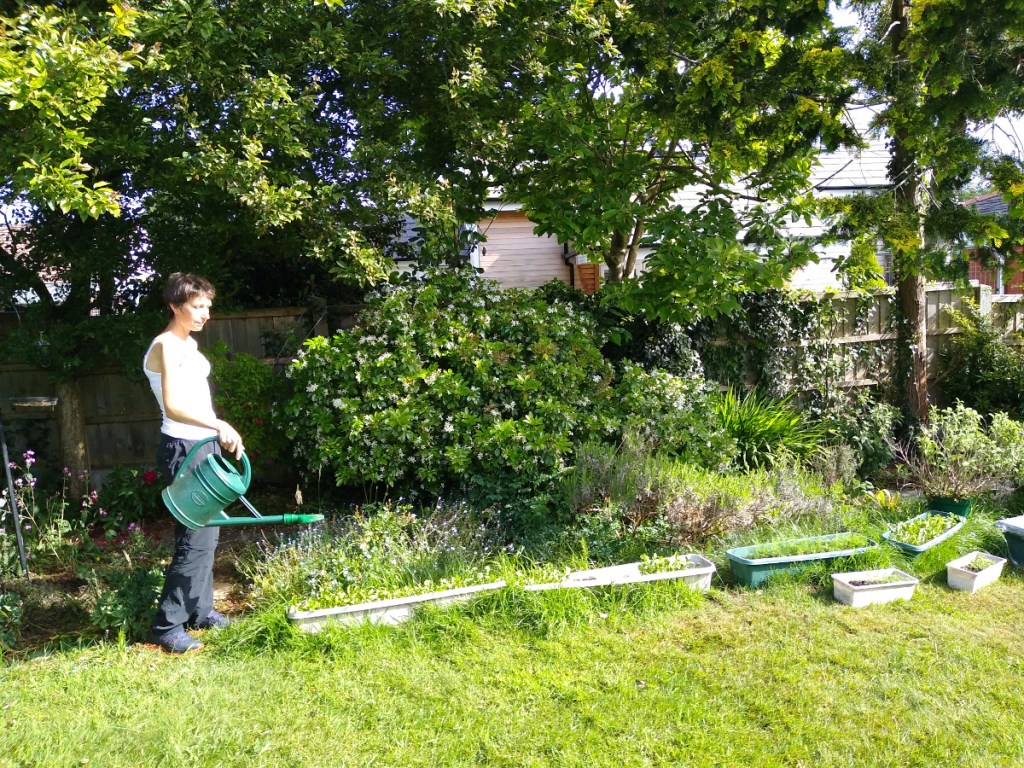
I am a between person. I am at home and not at home here in Peneverdant. I am in Creiddylad’s Garden. I like the slowness of the watering can. I like chloroplasts and slipping into them to learn of light and dark reactions, to become part of the Calvin-Benson Cycle. I like garden gnomes.

Perhaps one day I will wear a robe and shave my head or perhaps I will go naked in spite of the neighbours and the gaps in the garden fence or perhaps I will disappear like a mason bee into a bug hotel.

I know that, one day, like everything in this garden, I will be compost. Food for stinging nettles and beetles.

I am the key to the mysteries for which I have not found the lock yet.

I am the book in my hand that is not yet written.

The Gifts of Solitude

The past few weeks, following my discovery it’s likely I have Asperger’s, have been difficult and revealing, but ultimately rewarding and healing. I feel like this revelation has come at the right time, during this period of lockdown, when I have time alone to process it.

Learning more about autism I have gained some valuable insights for others. I discovered the story of Matthew Tinsley* who, like me, used alcohol as ‘a coping strategy against the extreme anxiety caused by being autistic and living in a non-autistic, social, flexible world.’ ‘His diagnosis gave him the knowledge to realise his own anxiety as an autistic person, and his need to reduce the demands upon him.’

I also watched Chris Packham’s ‘Asperger’s and Me’**. In this programme Chris shares his experiences of sensory overwhelm, struggles with social relationships, and his obsession with the natural world. I was particularly disturbed by his visits to the US to find out more about remedies to eradicate autism and agreed with his conclusion that for many autistic people the best treatment is to be allowed to spend time alone. Chris is blessed with being able to live on his own in a house in the woods.

Looking back at the past I can now see that the periods when I experienced the highest levels of anxiety were those when I was putting the greatest demands to be in social situations upon myself. At the time I was writing and editing for Gods & Radicals and forcing myself to go out to protests and engage in a lot of political debate online I got so ill with anxiety and IBS I didn’t dare go anywhere that wasn’t within 20 minutes of a toilet ‘just in case’ and that lasted for a couple of years.

I also got very stressed when I combined taking an admin job that I found overwhelming (I had mistakenly taken it presuming it would mainly be managing a website and producing posters and a newsletter and hadn’t realised it involved dealing with spreadsheets and… administration… duh!) with a leading role in applying for and gaining funding to organise a series of local events called ‘The Wild and Rural Lives of Poems’. These lines from a poem written at the time describe the effect:

After the late night meeting
my head was pale and flashing
a tawdry halo a broken circuit
a worn out lighthouse
behind my eyes…

I did those things for the right and the wrong reasons. I went to the anti-fracking protests because I genuinely wanted to stand up for the landscape I love – I didn’t want to see Belisama’s river poisoned, more aquifers shattered like the aquifer beneath Castle Hill, more damage to the underworld. I wanted to create beautiful and magical events. But I was also aspiring to fit with a model of the ideal pagan/poet – socially and politically engaged and doing outward service to my community because I felt insecure about the value of my own work, which is more personal and mystical.

Repeatedly I’ve made the mistake of thinking to be a good awenydd and polytheist to my gods I should have a role in a religious community and be promoting the awenydd path and Brythonic polytheism. This drive again, came from good and bad motives, and had mixed results. During my time with Dun Brython we produced some valuable articles and shared some enjoyable meet-ups. Yet we never achieved our aim of growing the group and developing a shared practice due to lack of interest.

At Awen ac Awenydd we’ve done good work collecting and sharing information on the path and personal testimonies on our website and in our anthology ‘The Deep Music’. Yet I failed, after three attempts, to organise a physical meeting in the North West of England. The strain of administering the Facebook group, never knowing what arguments I might have to deal with, outweighed the benefits.

The time arrived to acknowledge it is best for me to be solitary, like many of the awenyddion of the past. Myrddin in his forest, Orddu in her cave, Afagddu hanging out his black wings on the shoreline. That, as I’ve always known, I’m not cut out to be a Taliesin – a celebrity bard.

These insights are the gifts of solitude. Having worked through them I have reached the stage where I can begin, as my gods keep telling me, to focus on ‘my gift’ – my awen. Learning I’m autistic and will always struggle with social relationships has given this imperative the additional strength and urgency needed to blast away my lack of belief in my path born from the arguments about cultural appropriation and my failure to learn Welsh, master the medieval texts, and prove myself a ‘proper’ awenydd.

In my solitude, free of demands, praying, journeying, drumming, drawing, writing, I’ve been thrown back on a far more raw and primal relationship with the awen and with my gods little mediated by the Welsh scribes. Visions of the deep and its deities from before Welsh was spoken, Brythonic, ancient British, before there were humans to speak at all. Of the Annuvian, of the depths, of the Other.

The gift of a mythos that is deeply personal and that I hope to say a little more about soon.

*https://network.autism.org.uk/good-practice/case-studies/autism-and-alcohol
**https://www.youtube.com/watch?v=IjdEJdr-vfs

The Mothers of Destiny

I.

Bendithion yr Awen

I undertake a fool’s quest to understand the origins of the breath of life and in my foolishness am granted an answer. I find myself amongst a crowd singing with them as three Mothers of Destiny breathe the awen (which is at once inspiration and one’s fate) into a baby.

It is suspended over a baptismal font that reminds me of the Roman altar to the Mothers at Lund Church near Springfields around five miles away from me.

Our voices are pre-Roman, Roman, post-Roman, of all the women who have sung their blessings to a child in this ancient gathering place and in churches where Matrona ‘the Mother’ appears as Mary and the Matronae as Faith, Hope and Charity.

They rise and fall as we sing: “Awen bendithion yr awen bendithion yr awen bendithion…”

II.

Sea Maidens

My fool’s quest continues as I cannot, now, resist returning to the mothers to pose the question of my own destiny. They appear as three sea maidens, stormy, stony-faced, amidst a sea of raging waters.

III.

The Web of my Destiny

The goddess in the middle shows me ‘the Web of my Destiny’. She holds it between her hands like a cat’s cradle. It shimmers golden and pulsates with coloured jewels of energy. She tells me that a small tweak can change everything. I realise that making a cat’s cradle is a two-way process, between a person and the gods, and it’s my turn.

My Hawthorn Mind

Beneath the tall blue sky the white-blossomed hawthorns dance. Twisted, gnarled, they are beautiful in their imperfection. They cast no judgement on themselves or others.

People are not like trees with their constrictive norms of body and mind. Look at me from the outside and (aside from the lockdown hair which resembles something between a hedgehog, a mushroom, and a duck’s arse) and you will see a ‘normal’ thirty-eight-year-old woman – able-bodied, physically fit, average-looking. Talk to me at a Pagan or poetry event and I might pass. Get to know me over a few days, a month, a couple of years and you may notice the scars, physical and psychological, catch a glimpse of my hawthorn mind. The twists, the gnarls, the thorns turned out and in.

Since primary school I’ve felt mentally crippled. Highly intelligent but socially inept. Being speccy-four-eyed, pot-bellied in my puppy fat, and lower middle-class with a southern accent at a school on a northern council estate (which was once referred to as ‘the Beirut of Preston’) didn’t help. I was mercilessly bullied.

Eventually I learnt not to talk about the fairies at the bottom of my garden or my imaginary friends. To feign an interest in the other children’s gossip about each other and celebs and to watch the soaps so I could join in (even though I hated them and would much rather have been lost in the imaginal worlds of the Faraway Tree, Narnia, or Krynn).

When I hit my teens I found a crutch. Alcohol. It helped me disguise my social limp, to keep limping along when otherwise I’d have fallen flat on my face in a gormless heap. It quickly became a cure-all. It obliviated, for a while, my feeling of being different. It helped me find words when I had none, to kiss boys when I had no desire to, to find oblivion when I could not sleep, to dance when I wanted to lie down and die.

Between the drink and the drugs and working hard toward my philosophy and English degree I sometimes wondered what was wrong. It wasn’t until my third year when I had a particularly bad meltdown during which, in vision, I was sitting on a rock at the end of the world unable to decide whether to live or die, that I decided to seek help.

I got a standard diagnosis of ‘anxiety and depression’, a packet of anti-depressants, and a referral to a psychiatrist who refused to help me because I wasn’t suicidal at the time, despite having constant panic attacks, suffering from insomnia, and self-harming.

The anti-depressants worked and, perhaps partly because I couldn’t drink on them, I excelled in my final year. I gained a first by getting 80% on my dissertation on the sublime, the writing of which, unknown to my tutors, was my way of understanding the undoing of my own mind by panic brought about by social and/or sensory overwhelm.

After failing to get funding for my PhD, with a career in horses, and to write a fantasy novel, all the while continuing to battle with anxiety and depression and using alcohol again as crutch, I finally met my patron god, Gwyn ap Nudd. He helped me find meaning and purpose in my life as his awenydd, taking me to other worlds, and out of myself to perform poetry. For the first time in my life, in service to him, I did not fail. I wrote three books and the climax was the performance for Gatherer of Souls.

My depression lifted. I found I didn’t hate myself, others, or the world so much any more. When I discovered the possibility of finding paid work that fit with my vocation and hoped wouldn’t be too taxing on my mental health through volunteering with the Lancashire Wildlife Trust I found the strength to kick away the crutch.

Yet the anxiety I had been using alcohol to medicate remained and threatened to be my undoing as my dread of social situations and feeling of being overwhelmed grew. I tried the doctors again and, this time, refusing anti-depressants, was offered counselling.

Three months on, in the midst of lockdown, I’ve started CBT and, during this period, had a revelation that came not from my counsellor but from my mum which explains why I feel so different: she’d always thought I had Asperger’s, but didn’t know how to tell me!

Suddenly everything made sense. My highly focused interests: philosophy, horses, visionary poetry, Brythonic polytheism, my singular devotion to Gwyn. My problems with social communication and human relationships and inability to understand how other people can want to talk about each other and celebrities rather than pursuing ‘that one thing’. That my feelings of panic and overwhelm are symptoms of autistic meltdown.

That this is the reason I have been stuck in a constant cycle of wanting to find paid work and to have a small role in my communities locally and online, but failing because I don’t recognise the limitations brought about by Asperger’s, which lead to me getting anxious, overwhelmed, and burnt out, and giving up, and feeling like a failure.

That it’s likely I have Asperger’s was confirmed when I scored 7/10* in the AQ10 test on the phone with my counsellor a couple of days ago. I’m hoping for a referral to the Lancashire Autism Service (which I understand will take a while particularly at this time).

Looking back a part of me feels bitter. If I’d received a diagnosis as a child perhaps I would have recognised my limitations, wouldn’t have hated myself so much for being different, wouldn’t have got so anxious and depressed, (yet another whispers perhaps I’d have felt worse…).

Another part says I wouldn’t have learnt the lessons I’ve learnt. It’s possible that, living a more sheltered life, ‘the doors of the perception’ to the visionary realms would never have opened, that I’d never have met Gwyn and never become his awenydd.

My gut feeling is that now, during the lockdown, when I’ve got plenty of time to reflect on and process it and work through how it might affect me in the future and plan ahead, is the perfect time to find out. I might have gone to pieces otherwise.

As I walk beside the twisted white-blossomed hawthorns I come to understand my differences. To not only accept but celebrate the twists and gnarls of my hawthorn mind.

*6/10 or above suggests somebody has Asperger’s.

The Other Side of the Door

Porth-Annwfyn. Some numinous, arcane agnomen, but which to my dream cognition was livid as moonshine and did plainly signify: Gate of Elysium.’
David Jones

Porth Annwn ‘Door of the Otherworld’. Porth so easily rolling into ‘portal’. The type of door that not only forms both a barrier and an entranceway between here-and-there but transports elsewhere.

Doors are usually boundaries between rooms in a building or its inside and outside and gates serve a similar function in walls, fences, and hedges. Doors and gates that are portals transport between worlds.

Most famously, in the Brythonic tradition, in the poem ‘The Spoils of Annwn’ we find the lines ‘A rac drws porth Vffern, llugyrn lloscit’ ‘And in front of Hell’s gate lamps were burned.’ This suggests there is a gateway through which Arthur and his warriors travelled from Thisworld to the Otherworld and that lamps were burned in the course of a vigil until he and only seven of his men returned. Annwn, ‘the Deep’, was equated with Uffern ‘Inferno’ or ‘Hell’ by Christians in medieval Wales.

Although there a number of places known as ‘Hell’s Gate’ across the world I’ve never found one in Britain. Although, at liminal times, in liminal places, I have been transported to the Otherworld. I have no control over such events.

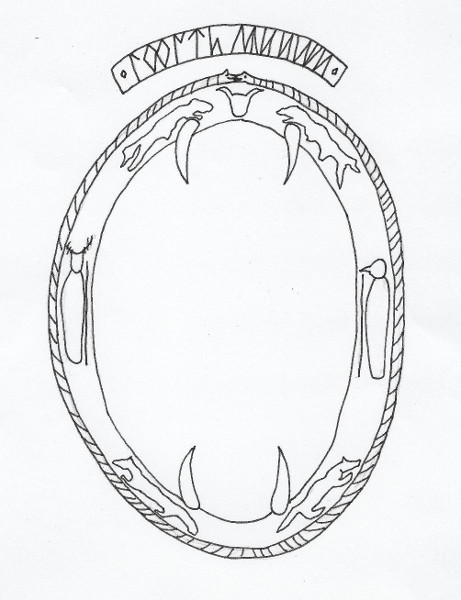
Finally, I was guided by the Witches of Pennant Gofid, who I believe were similarly devoted to Gwyn ap Nudd, my Lord of Annwn, to create my own doorway. They guided my hand in drawing it and decorating it with the head of Gwyn as bull-of-battle, shapeshifting horses and hounds, and two new guides – a bird man and antlered woman. The teeth symbolise it being the maw of Dormach, Gwyn’s Death Hound. the Jaws of Death.

When I step out of the door it is always into a misty hinterland. Occasionally I’m standing on solid ground, but often it’s marsh, and more often I’m on my winged horse treading mist with my hounds beside me. It’s said of Gwyn and Dormach that they travel ar wybir ‘on the clouds that haunt the mountaintops’ and that wybir or nuden ‘condensed floating white cloud’ ‘serves as a garment for Gwyn’.

And so we travel ar wybir, like Gwyn, until the mist clears, or someone appears to guide us out. Setting off right or left, or North, East, South, or West never works as the directions don’t function the same in Annwn (if they exist at all). I often end up in the same places, but never by the same routes. In contrast to other followers of shamanistic paths I haven’t managed to form a stable map of Annwn.

I’ve been told by numerous teachers one should always return by the same route. Some days I manage this, but other days the routes undo themselves as if Annwn is innately resistant to memory. I search instead for the mist, wait for it to come, like my god, to sweep me up, place me back at the portal.

The door is always shrouded by mist and I have only just realised, after two years of constant use, that I have never seen the other side of the door. That I drew only my entryway, on my side, in my room, in Thisworld. That the origin and location of the exit, on Gwyn’s side, in the Otherworld, is a mystery.

All I know is that as I approach through the mist I have a feeling of increasing solidity. There is ground beneath my feet and the door is set within a wall. This creates the impression the door may once have been part of a fortress, shattered, fragmented, still able to float in the mist like Gwyn’s castle.

Could it be a cast-off door from the Fort of Pen Annwn rendered disposable by Arthur’s despoiling? A relic of Hell’s Gate? Or something older, or newer, but nonetheless no less mysterious? No burning of lanterns will shift the mist and again I must trust a gift of Gwyn’s that is incomprehensible.

A Farewell

The ship is tall, leaning. Its only crew are the gulls, who tie the knots in the sails; old, old, sailor souls. On its prow stands Barinthus, the helmsman, dark-cloaked, stern, implacable.

No-one sees if his lips move beneath the shadows of his hood as he reads out the roll call: the names of Londeners, Devonians, Bristolians, Scousers, Mancunians, Lancastrians, Glaswegians, Brummies, whose accents mix in the huge make-shift camp that has grown up in the marshy hinterland between the worlds.

They’re mostly old. Veteran souls move between them, boiling tea on stoves that burn on no gas. They drink from metal cups, pull blankets around them, attempt to recall to one another their stories.

Some of them are funny – drunken exploits – other people’s knickers and roundabouts. Some are tragic – motorcycle crashes, the loss of daughters and sons, spouses who lost their memory yet lived on.

“How did we get here?” few recall that journey or what brought them.

White hounds with red markings on their ears, noses, the tips of their tails, patrol the edges of the camp. If anyone tries to leave they are there. A grin and friendly growl is always enough. The pups like to play amongst the child souls, tongues lolling, letting their bellies be rubbed. When their master calls them, not liking them to get attached, they leave whining with their tails between their legs.

“Where are we going?” few recall that journey they have made so many times before.

“The biggest shipload since the last war,” my god’s voice from where he stands invisible so as not to frighten the souls.

Their leaving seems to take forever, one by one getting up from their camp stools, boarding across a wobbly plank and taking their places in the cabins, more cabins-worth of souls than there are cabins on board?

“The number of cabins, the space of the hold, the expanses of the deck, are limitless, infinitesimal,” Gwyn informs me. Speaking ominously “no matter how many passengers the ship is never full.”

I watch with Gwyn as the camp fires go out and the ship sinks deeper and deeper into the waters.

As a gull flies down and with a practiced twist of her yellow red-spotted beak unties the mooring rope I clasp my hands, bow my head in mourning, say farewell to 980 Britons who I never knew.

As I leave, dropping a tea bag in a pot for the next souls, I see them already beginning to arrive. Some are escorted by their ancestors, others by the hounds, others by white birds. A little boy is carrying a white red-spotted hamster wrapped up in his school blazer.

Their numbers are endless.