Honouring Gwyn ap Nudd

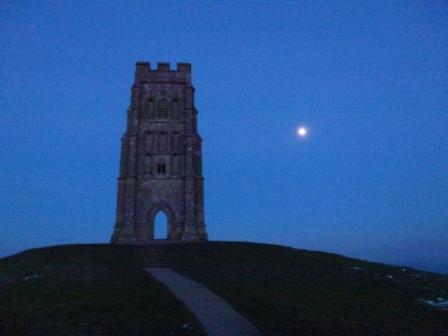
Glastonbury Tor, January 2013On the Winter Solstice a post for Winter’s King.

Samhain has passed. We’re in the dead season. The wild hunt rides the passageways of time and spirit paths lie open. Communities gather and ancestors draw close. Here I feel called to honour Gwyn ap Nudd by telling the story of how he became my muse and patron and made my life whole.

My first meeting with Gwyn took place at the nadir of a crisis. At the end of August 2012 I reached a point of conflict between my spiritual path and ambition to become a professional writer. After two years work completing a fantasy novel I realised its world was too complex and the language too heavy, it held little relevance or hope for a contemporary audience and was at odds with my developing relationship with the land and its myths.

His first appearance was at the head of a fairy procession at a local sacred site. Although I knew of the legend of the fairy funeral I didn’t think I’d encounter it directly nor did I suspect it would be led by a Welsh Fairy King. Yet Gwyn made his name and message clear. The myths of this land are real and he could help me access them. He challenged me to journey with him to the Otherworld, the condition of his guidance being that I lay aside my personal ambitions.

I spent several days considering- could I truly give up my ambition to become a professional writer? How would this change my life? How did I know I could trust him? What if I didn’t come back? Yet this experience, although it was confusing and terrifying felt more powerful and real than anything that had ever happened to me. I knew it was a once in a life time opportunity and I’d only get one chance. I returned to the fairy site and agreed.

Gwyn opened the gates to the past of this land and its myths. With his guidance I learnt how to ride the skies and ancestral pathways on my white mare, viewing the landscape’s lineaments from contemporary suburbia to medieval farmland, oak wood and peat bog to tundra and the age of ice. I met with ancestral people, the ghosts of trees and stampeding aurochs. I entered Faery and descended to Annwn.

Yet I still questioned what a deity associated with Wales and Glastonbury was doing in Lancashire. Reading his myths I realised two of Gwyn’s main stories- the abduction of Creiddylad and Arthur’s slaying of Orddu take place in the North. In the conversation with Gwyddno Garanhir, which depicts his role gathering the souls of the battle dead Gwyn says:

‘I have been where the soldiers of Prydain were slain,
From the East to the North;
I am alive, they in their graves!
I have been where the soldiers of Prydain were slain,
From the East to the South
I am alive, they in death!’

Gwyn is not only a king of Annwn and the fairies but a traveller between the worlds and across the landscape of Britain, maintaining the bonds between nature and humanity, the living and the dead. As a ruler and guide of this isle’s ancestral people his turning up at the head of a local fairy procession was not out of place.

Reassessing my past experiences I realised this wasn’t the first time I’d felt his influence. At Glastonbury festival in my late teens the veil had been lifted to reveal a vision of the Otherworld, a place I now recognise as Gwynfyd, which was coupled with a feeling of truth and ecstatic unity. Thirteen years later he had finally made his presence known, leading me from the cycle of aspiration, failure and frustration caused by my ambition to be a writer back to this magical unison with the land and its myths. He had made my life whole. In January I returned to Glastonbury and made my vow to him at the White Spring.

Since then my relationship with Gwyn has been a constant source of support and inspiration. Whilst the only piece of literature I know of that might link him with the Bardic Tradition is a reference in ‘The Spoils of Annwn’ to the Chief of Annwn possessing a cauldron warmed by the breath of nine maidens, I see him as a god of primal poetry- the wild Awen that thunders like the hunt through space and time and exists in the magic of nature, the songs of the fay and wisdom of the ancestors.

With his guidance I have discovered ways of connecting more deeply with the land and its spirits, its known myths and some unknown ones (a couple of which correspond with factual evidence!). In return I strive to communicate what I have learnt through written and spoken words to maintain the bonds between nature and humanity, this world and the Otherworlds.

And so, as we gather in the dead season, the wild hunt rides and spirit paths lie open I choose this time to tell this story to thank and honour Gwyn ap Nudd.
Greencroft Valley

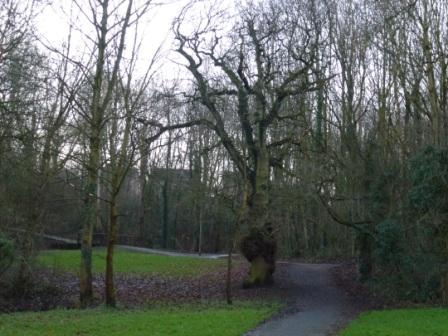
Greencroft ValleyGreencroft Valley is located in Penwortham, and is split down its centre between Kingsfold Ward on the east and Middleforth Green to the west. From (at least) medieval times up until 1984 the valley was farmland. The 1839 Tithe map shows the fields at the south end of the valley (between Pope Lane and the old Oak) as belonging to the Mayor family, who owned Malt Kiln Farm and Cottage. The cottage was originally a water powered mill, where barley from the local fields was made into grain. Following this, grain was soaked in a stone trough, ‘chitted’, germinated, dried in a kiln and ‘riddled’ before being placed in sacks to be taken by horse and cart to the Black Bull Inn. The land was bought by the church in 1860[1].

The fields north of the Oak belonged to the Baker family, who lived in a house called Alderfield, and later became Miss Whittam’s riding school (the site is now covered by Greencroft). The old hedge line can still be seen between the old Oak, the adjacent trees and another oak tree of a similar age near the Malthouse Way entrance. Another visible hedge line divides the green from the woods close to the Maltings. This divided the fields belonging to Alderfield from Fish Pan Pasture.

The presence of the mill combined with the two fishing ponds on the Tithe Map and the large culvert adjacent to Hill Road South, all form evidence that Fish House Brook was several times larger and more forceful than it is now, showing the drastic shifts that have been brought about in the water table over the past 150 years. Another point of note is that there was a well in the valley close to the edge of the brook, to whose steps a path ran from Alderfield; this disappeared with the building of the new estates.

The large and irregular field patterns suggests they date back at least to medieval times. A 1590 map refers to the land that stretches from Pope Lane to Castle Hill as ‘all these ancient and several lands of the manor of Penwortham as well as the Queen’s as of freeholders and copyholders[2]’. The first entry for Penwortham in the Domesday book cites the existence of ‘two ploughs,’ in reference to Penwortham End and Middleforth Green. Evidence from the Dock Finds shows the area adjacent to the Ribble near Castle Hill was occupied from the Neolithic period onward. If this was the case in higher Penwortham, then judging by the population figures (the population of Britain was higher in the Iron Age than it was during the Norman period[3]) it is possible Middleforth Green and the valley have been occupied and farmed just as long.

The occupation and land use changed dramatically between 1979 and 1984 as a result of the Central Lancashire New Towns project. This was set up in 1973 and aimed to draw together Penwortham, Preston, Walton, Leyland and Chorley in a vast urban sprawl with a population of half a million, covering 55 square miles with houses[4]. During this period the estates of Greencroft, Malthouse Way, Alderfield and the Maltings were built- over 300 houses, bringing an approximate number of 600 people[5] into the area, in stark contrast to the small number who occupied Malt House Farm and Cottage and Alderfield. It was during this period that Middleforth School, which was founded in 1861 and was formerly a Chapel-School situated where Church Brook House now stands at the bottom of Marshall’s Brow, was moved to its present site[6]. It seems needless to say that the impact on the nature and wildlife of the area must have been huge.

This open green space and woodland now forms an important habitat for wildlife, a roosting place for birds, a possible swimming place for stream life and a pleasant vista for dog walkers and play area for children, and is the only place amidst the new estates where the traces of so many centuries of our rural past is preserved. Home to a plethora of living things, from those with roots and leaves, to those with legs, tails or wings, it is an eco-system that deserves care and respect, and this is the purpose of the Friends of Greencroft Valley.

[1] Elizabeth Basquill, More Hidden Histories of Penwortham Houses, (The Friends of Hurst Grange Park, 2011), p6-11, 42-44.
[2] Alan Crosby, Penwortham in the Past, (Carnegie Press, 1988), p67
[3] There were 3 million people in 700 BC compared to 2.5 million in 1086 http://www.ukagriculture.com/countryside/countryside_history.cfm
[4] Alan Crosby, Penwortham in the Past, (Carnegie Press, 1988), p145
[5] Going by the average figure of 2.32 people per household http://www.communities.gov.uk/documents/statistics/pdf/1172133.pdf
[6] Penwortham Magazine, Issue 3.

Maponos

Castle Hill Walk April 2012 007 - CopyMaponos is a god of youth, music and hunting who is known from dedications from the Romano-British period in the North of Britain and Gaul. His name, which is Gallo-Brythonic, means ‘the son.’ Of the five dedications, which occur in Northumbria, Cumberland and here in Lancashire at Ribchester, four equate Maponos with Apollo , a Roman god associated with music, healing, prophecy, archery and the sun. In the Pythagorean tradition, the British Isles were seen as the home of the ‘Hyperborean Apollo,’ a sign of the longevity of Maponos’ worship and reputation here.

The dedication at Ribchester (241CE), which can be found in the museum, reads: ‘To the holy god Apollo Maponus, and for the health of our Lord (i.e. the Emperor) and the unit of the Gordian Sarmartian Horse at Bremetenacum, Aelius Antonius, centurion of the Sixth Legion, the Victrix (Victress) from Melitanis (?) praepositus (provost) of the unit and the region, willingly and deservedly fulfilled his vow .’

Within Ribchester’s museum stands a pedestal, which is believed to have ‘carried four figures in relief . On one side is Apollo, clad in a cloak and Phrygian cap, wearing a quiver and resting on his lyre. The side which possibly carried a relief of Maponos has been defaced. On another side are two female figures, whose identity and roles have been interpreted differently. Nick Ford interprets the relief to depict the genius loci of Ribchester making an offering to Belisama, the goddess of the Ribble.

Anne Ross believes the figures might be Maponos’ mother Modron and a native hunter goddess equated with Diana (Diana’s Greek counterpart was Artemis, Apollo’s twin sister). Anne’s theory stems from the identification of Maponos with Mabon, son of Modron in Welsh myth. Modron means ‘mother.’ It is likely she was known earlier as Matrona. An altar from Ribchester bears an inscription to ‘all the mother goddesses’ (the deae matrones) and another, similar, has been found in Kirkham .

Mapon0s has strong associations with the village of Lochmaben in Dumfrieshire. A folk tale from this area tells of ‘the harper of Lochmaben’ who ‘goes to London and steals away King Henry’s brown mare’. Close to the village lies the Clochmabenstone, a tribal gathering place near Gretna where runaway lovers were married . It stands beside the Solway, close to the estuary. Anne Ross suggests this may have been Maponos’ ‘fanum’ (shrine or sacred precinct), which features as the ‘locus Maponi’ of the Ravenna cosmology. The promonotory at Lochmaben may have been his temenos . Another place named after him is ‘Ruabon, the Hill of Mabon, below Wrexham’ on the Severn . Guy Ragland Philips identifies ‘Mapon’ with the spirit known as the son of the rocks, at Brimham Rocks in Yorkshire’.

Most of these places are connected with water and / or stone. A relief from Whitley castle in Cumbria of a ‘native radiate god’ suggests that like Apollo Maponus is connected with the sun. The associations of Maponos with stone, water and the sun recur in the story of the rescue of Mabon in ‘How Culwch won Olwen’ in The Mabinogion.

Before moving on, I’d like to pause to address the question of whether Maponos and Mabon are the same god. The historian Ronald Hutton believes there is no proof to identify figures from the Welsh myths with earlier gods known from archaeological evidence. This is the starting point I usually set out from. However through connecting with both Maponos and Mabon, I have found that although my connection with Maponos feels stronger, their presence feels the same. This suggests to me they are the same god / divine figure, seen and named at different times by different cultures (i.e. Romano-British and Medieval Welsh).

In ‘How Culwch won Olwen’ there are several references to ‘the North,’ suggesting some episodes may have originated from ‘The Old North,’ an area which between the 5th and 7th covered Northern Britain and Southern Scotland and was divided between a number of petty kings.

Mabon’s rescue takes place within the context of Culhwch’s task to win Olwen by hunting down the King of Boars, Twrch Trwth. To hunt the boar, Culwch requires Mabon’s aid. However, Mabon was stolen when three nights old from ‘between his mother and the wall… No one knows where he is, nor what state he’s in, whether dead or alive.’ The search for Mabon takes Arthur’s men, via the story of the ‘Oldest Animals’ (a blackbird, stag, owl, eagle and salmon) through the present day Wirral, Cheshire and parts of Wales to Gloucester on the river Severn. Mabon is found imprisoned lamenting in a ‘house of stone.’ Whilst Arthur and his men fight, Cai tears down the walls and rescues Mabon aboard the back of the salmon. With the dog Drudwyn (‘fierce white’) and steed- Gwyn Myngddwn (‘white dark mane’) who is ‘swift as a wave’ Mabon joins the hunt for Twrch Trwth, riding into the Hafren to take the razor from between the boar’s ears . It is possible to read from this traces of an older myth of the rescue of the sun from its house of stone in the earth, at dawn appearing shining in the river.

A number of tales / poems connect Mabon and Modron to the Kingdom of Rheged, which covered Cumbria, Lancashire and northern Cheshire. In one story Urien Rheged travels to ‘the Ford of Barking’ in Llanferes, where he meets Modron, ‘daughter of Avallach’ washing in the ford. He sleeps with her and she conceives his children, Owein and Morfudd . In The Black Book Carmarthen, Mabon appears as ‘the son of Myrdon the servant of Uther Pendragon’ . References to Mabon also appear in The Book of Taliesin (who was Urien Rheged’s Bard). ‘Will greet Mabon from another country / A battle, when Owain defends the cattle of his country.’ ‘Against Mabon without corpses they would not go.’ ‘The country of Mabon is pierced with destructive slaughter.’ ‘When was caused the battle of the king, sovereign, prince / Very wild will be the kine before Mabon . However it is unclear whether Mabon is himself taking part in the battle, whether Mabon is being used as a title for Owain ‘the son,’ or whether Mabon is referred to as a location.

In Brigantia, Guy Ragland Phillips mentions a ‘written charm’ found at a Farmhouse at Oxenhope in 1934 beginning ‘Ominas X Laudet X Mapon.’ He translates this as ‘everybody praises Mapon.’ When Ross Nichols and Gerald Gardner invented to the pagan wheel of the year in the 1950’s the autumn equinox was dedicated to Mabon, showing the continuity of his influence into the twenty first century. His largest festival takes place at Thornborough Henge . With the number of pagans in England and Wales increasing from 42K in 2001 to 82K in 2011, my guess is that the following of our native god of youth, music and happiness will grow and continue for many years to come.

(1) Nick Ford, ‘Ribchester (Bremetenacum Veteranorum): Place of the Roaring Water’ Lancashire’s Sacred Landscape, ed. Linda Sever, 2010, p87.
(2) Anne Ross, Pagan Celtic Britain, (1974) p463- 4
(3) Caitlin Matthews, Mabon and the Guardians of Celtic Britain, (2002), p179.
(4) Nick Ford, ‘Ribchester (Bremetenacum Veteranorum): Place of the Roaring Water’ Lancashire’s Sacred Landscape, ed. Linda Sever, 2010, p87.
(5) Anne Ross, Pagan Celtic Britain, (1974) p276
(6) Nick Ford, ‘Ribchester (Bremetenacum Veteranorum): Place of the Roaring Water’ Lancashire’s Sacred Landscape, ed. Linda Sever, 2010, p88
(7) Ibid. p277
(8) Nick Ford, ‘Ribchester (Bremetenacum Veteranorum): Place of the Roaring Water’ Lancashire’s Sacred Landscape, ed. Linda Sever, 2010, p86.
(9) Anne Ross, Pagan Celtic Britain, (1974), p270.
(10) Caitlin Matthews, Mabon and the Guardians of Celtic Britain, (2002), p178.
(11) Anne Ross, Pagan Celtic Britain, p458
(12) Caitlin Matthews, Mabon and the Guardians of Celtic Britain, (2002), p178.
(13) Guy Ragland Phillips, Brigantia: A Mysteriography, (1976), p128
(14) Anne Ross, Pagan Celtic Britain, (1974), p477
(15) Sioned Davies, The Mabinogion, p 198 – 212
(16) http://www.maryjones.us/ctexts/modron.html
(17) Ed. William F. Skene, ‘The Black Book of Caermarthen XXXI’. ‘Pa Gur. Arthur and the Porter.’ The Four Ancient Books of Wales, (1868), p179.
(18) Ibid. ‘The Book of Taliessin XVIII’ ‘A Rumour had come to from Calchvynd’ p277.
(19) http://www.celebratemabon.co.uk/

Belisama: Goddess of the Ribble

Belisama is the goddess of the river Ribble, which runs from Ribble Head in North Yorkshire, through Ribblesdale, Central Lancashire and out to the Irish Sea. Her name is known from Ptolemy’s Geography 2AD, where at co-ordinates corresponding to the Ribble’s estuary he places ‘Belisama aest[1]’. Inscriptions to Belisama have also been found in Vaison-la-Romaine in Provence and Saint-Lizier, in the Pyrenees[2].

Her name has received a number of interpretations. Nick Ford translates ‘Rigabelisama (Riga-, a queen, and Belisama)’ as ‘Most Shining One’ making her the ‘Most Shining Queen’ or ‘Most Mighty Queen’[3]. Seeing the dazzling beauty of the Ribble illumined by sunlight or moonlight confirms the legitimacy of this epithet to me. However Delamarre claims the translation of bhel as ‘white or brilliant’ is based on a false interpretation of Belinus’ identification with Apollo. Belinus is ‘the Powerful One’ and Belisama is the ‘Most Powerful One’[4]. Watching the Ribble after heavy rain, particularly at high tide conveys a sense of her power, as does observing the landscapes she has shaped.

The town of Ribchester has a close connection with the Ribble. It’s native name Bremetonacon means ‘place by the roaring river[5].’ In Saint-Lizier Belisama is identified with the Roman goddess Minerva. A bust of Minerva was found at Ribchester and it was once largely accepted the town had a temple to Minerva-Belisama[6]. Whilst it would make sense that a place of worship dedicated to Belisama was located in the heart of the Ribble Valley beside the roaring ford this is based on a mistranslated inscription[7]. To whom the temple was dedicated is unknown. As a large part has been washed away by the Ribble it might be assumed either that it didn’t belong to Belisama or she didn’t want one.

A question I’ve pondered is how much to read into Belisama’s possible identification with Minerva at Ribchester- when the Romans built the fort in 70AD they were polytheists, and their experiences of Belisama may have led to this equation. Minerva is a goddess of wisdom, crafts and healing. From the Norman period (and indubitably before), until the end of the 18th century the Ribble was renown for being rich in salmon, the quintessential fish of wisdom, with the most important of the fish garths being located at Fish House Bridge in Penwortham[8]. Another possible reason for this identification is that wisdom can be gained from watching and listening to the flow of the Ribble in different spots. One of the lessons I’ve learnt from Belisama is dynamism and change; due to a combination of the tides, rain fall and the position of the sun or moon her waters never look the same in any place.

In terms of crafts, Belisama has inspired a good deal of creative writing from the poems of Richard Dugdale (the Bard of Ribblesdale 1849), James Flockhart’s ‘The River’ (1854), Gerard Manley Hopkins’ ‘Ribblesdale’ (1876) and John Heath-Stubb’s ‘The Green Man’s Last will and Testament’ – ‘the cruel nymphs / Of the northern streams, Peg Towler of the Tees / And Jenny Greenteeth of the Ribble, / Sisters of Belisama, the very fair one’ (1973)[9]. Jane Brunning, a Penwortham based author blogging as Reigh Belisama runs a site called ‘Save the Ribble,’ which played a leading role in preventing the river barrage at Brockholes and continues to oppose fracking on the Ribble Estuary[10].

Belisama’s influence on the cotton industry can be recalled by the number of old mills on her tributaries. Without Riversway Dockland, which was created by moving the Ribble from Strand Road to her present course beside Castle Hill, Preston could not have played its huge role in the industrial revolution. Whilst I’m unaware of any associations linking Belisama with physical healing, spending time beside the Ribble usually has a calming, cleansing effect on me.

Moving from Belisama to the Ribble, the first mention of the change of name is in ‘the Latin Life of St Wilfrid’ (patron saint of Preston) where ‘lands identified as ‘round Ribble’ (iuxta Rippel), Yeadon, Dent and Catlow’ are granted by the English ruler to ‘the community at Ripon’[11]. The Saxon Ripel was taken by Ekwall to mean ‘tearing, reaping’ making the Ribble ‘the tearing one’[12] relating Belisama’s qualities of power and might. Andrew Breeze suggests that Ribble may derive from the Welsh rhybwyll, which combined with the prefix ri could mean very great wisdom[13]. The name change and it’s interpretations demonstrate the qualities of flux and continuity innate to Belisama.

For me in present day Penwortham, (which without Belisama, in its current form would not exist), Belisama and her tributaries continue to shape the valleys and plains, as well as the lives of the wildlife and people who inhabit them. Belisama’s power and wisdom shine throughout her ever changing course and in those by which it is transmitted, whether by the spoken or written word, craftsmanship, or in the actions of those who stand against her exploitation and pollution.


[1] http://www.roman-britain.org/ptolemys-geography.htm
[2] Whilst this might be seen to indicate the presence of a goddess worshipped across Britain and Gaul, Nick Ford reminds us ‘most, if not all, the names of Celtic divinities seem to be descriptive epithets rather than real names.’ Nick Ford ‘Ribchester (Bremetenacum Veteranorum): Place of the Roaring Water’ Lancashire’s Sacred Landscape, ed. Linda Sever, 2010, p82.
[3] Ibid.
[4] http://theses.univ-lyon2.fr/documents/getpart.php?id=lyon2.2009.beck_n&part=159190
[5] Nick Ford ‘Ribchester (Bremetenacum Veteranorum): Place of the Roaring Water,’ Lancashire’s Sacred Landscape, ed. Linda Sever, The History Press, 2010, p82
[6] Malcolm Greenhalgh, Ribble River and Valley: A Local and Natural History, Carnegie Book Production, 2009, p83.
[7] ‘commander of the unit and region’ was mistranslated as ‘to the very mighty numen and queen’ Nick Ford ‘Ribchester (Bremetenacum Veteranorum): Place of the Roaring Water,’ Lancashire’s Sacred Landscape, ed. Linda Sever, The History Press, 2010, p82
[8] Alan Crosby, Penwortham in the Past, Carnegie Press, 1988, p48
[9] John Heath-Stubbs ‘The Green Man’s Last Will and Testament,’ Earth Shattering: Eco-Poems, ed. Neil Astley, Bloodaxe Books, 2007.
[10] http://save-the-ribble.blogspot.co.uk/
[11] Andrew Breeze, ‘Communications Yrechwydd and the River Ribble,’ Northern History, XLVII; 2, September 2010, p324.
[12] Ibid. p324
[13] Ibid. p326.