The Favour of Creiddylad, May Queen and Queen of Annwn

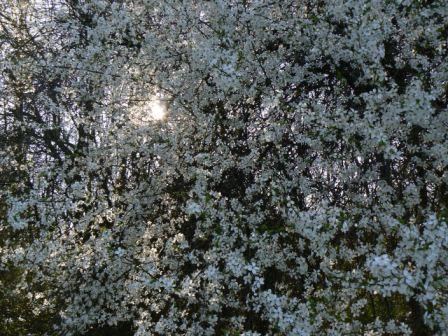
Wood anenomeA few weeks ago I published an article on the story of Gwyn, Gwythyr and Creiddylad, which highlighted its significance as an ancient British seasonal myth originating in the Old North. This showed Creiddylad’s importance as a Brythonic goddess connected with the sovereignty of the land, outlined a depiction of her viewpoint and described her nature as a spring maiden and queen of Annwn.

It was my intuition Gwyn’s pride in being Creiddylad’s lover and references to his invocation in her name suggested she was an important fertility goddess in her own right. More recently I found this idea backed up by analogy with Ann Suter’s reading of The Hymn to Demeter. Like Persephone with Hades, Creiddylad is a free agent in a sacred marriage with Gwyn. As king and queen of Annwn they form a divine couple equal in power and independence.

To win Creiddylad’s favour on Calan Mai, Gwythyr, a human ruler, must descend to Annwn and battle against Gwyn. His willingness and skill are conditions of Creiddylad’s becoming his May Queen. Thus she returns to this-world to bring fertility to the land and makes him her king for the summer. Gwythyr’s reign is only temporary. On Nos Galan Gaeaf Gwyn takes her back to Annwn where in turn she presides over the processes of life and death.

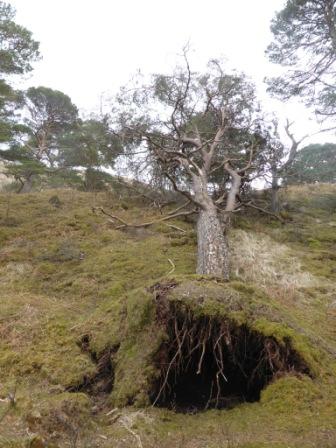
One of the important lessons of this story is that all life comes from and returns to Annwn. The fertility of this-world is dependent on the underworld and its deities. This is reflected in the simple necessity of planting a seed underground and in offerings our ancient ancestors made in ritual shafts and pits. All trees and plants come from and decay back into the soil. This is ultimately the fate of our flesh and bones.

The beauty of the flowers of May is dependent on the deaths of many others. This applies to human ancestry. Our fruitful modern existence is founded on the death and toil of countless people. As is our creativity. Thus the Awen can only be won by making Gwythyr’s descent down through the ancestral heritage of our soil, establishing our own relationships with the underworld deities. Personal sacrifices must be made and their bounty shared.

Only then will our hawthorns blossom and the favour of Creiddylad, May Queen and Queen of Annwn be won.

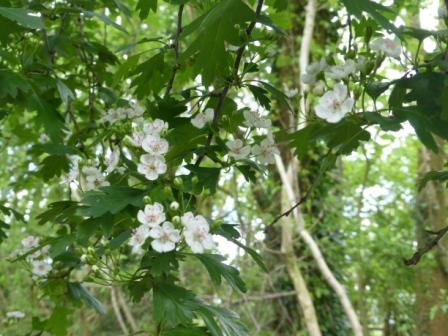
Hawthorn*With thanks to Brian Taylor for pointing me toward Sarah Pike’s review of Ann Suter’s The Narcissus and the Pomegranate.

Coille Coire Chuilc: Seeking Annwn in Caledon

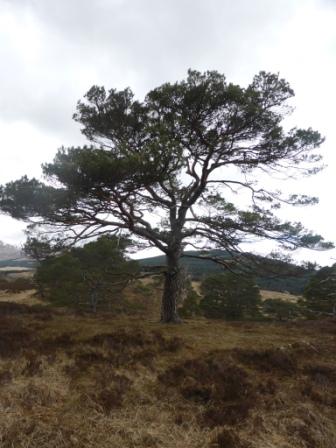
Coille Coire ChuilcThere once existed a tradition amongst the northern Britons of locating Annwn north of Hadrian’s wall. Its origins may be found in the writings of Tacitus about tribes beyond the northern frontier who spoke a different language to the Britons and were impossible to subdue. Ptolemy was the first person to refer to this area as Caledonia Silva.

The 6th C classical writer Procopius said: ‘Now in this island of Britain the men of ancient times built a long wall, cutting off a large part of it; and the climate and the soil and everything else is not alike on the two sides of it… on the north side… it is actually impossible for a man to survive there even half an hour, but countless snakes and serpents and every other kind of wild creature occupy their area as their own. And, strangest of all, the inhabitants say that if a man crosses this wall and goes to the other side, he dies straight away… They say, then, that the souls of men who die are always conveyed to this place.’

These writings show within the Romano-British culture of the Old North the Caledonian forest was considered to be a wild, hostile place associated with death.

Culhwch and Olwen (1350), a medieval Welsh text set during the Arthurian period preserves remnants of these superstitions. In the stories of Gwyn, Gwythyr and Creiddylad and the Very Black Witch, Arthur ‘goes north’ to inhospitable lands. Both stories feature Gwythyr ap Greidol, a northern ruler and warrior of Arthur’s court and Gwyn ap Nudd, a king of Annwn. The latter is an ancient British god associated with wild places and the dead. It is my intuition it was after a vision of Gwyn and his host at the Battle of Arfderydd that Myrddin Wyllt went mad and fled to Celyddon (Caledon) where he wandered thirty years amongst gwyllon (wild, ancestral spirits).

As the story of Gwyn, Gwythyr and Creiddylad is set at Calan Mai, a friend and I decided to head north to Coille Coire Chuilc (one of the southernmost remnants of the Caledonian forest) on the May bank holiday weekend.

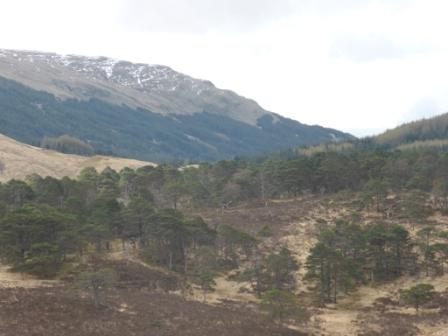
Coille Coire Chuilc is an ancient woodland of Scots pines lying between the river Cononish and Allt Gleann Auchreoch close to the village of Tyndrum in Strath Fillan. Tyndrum grew out of the lead mining industry. The mines were located in Beinn Chuirn. During the 18th C pack horses travelled 50 miles to Alloa with lead ingots then back with fuel for the smelter.

Cononish HillsDuring the 19th C gold was discovered in the hills of the Cononish glen, which led to a miniature gold rush. This ended in the 20th C but has recently restarted with the approval of a second planning application to Scotsgold Resources in 2011. Gold is once more being mined from the hills and may be panned from the river Cononish, although it is more likely one will find lead and pyrite: ‘fool’s gold’. As the area is renowned for its ‘fairy places’ it was interesting to hear the hills were hollowed with mines where one is more likely to find false gold than the real deal…

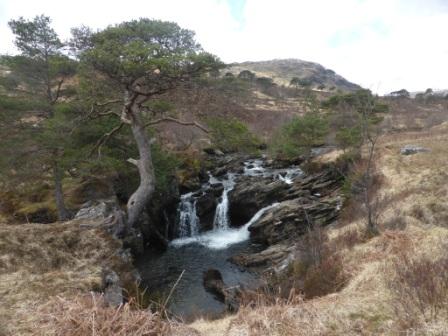
Our expedition to Coille Coire Chuilc did not go to plan. Firstly we took the ‘wrong’ path, ending up north of the river Cononish rather than within the woodland. However this had the advantages of providing a good view of the distant Scots pines and an excuse to walk back down the river, seeing some sensational falls, ravines and trees clinging drastically to rocks.

The next set back was that the bridge across the Allt Gleann Auchreoch pictured in The Ancient Pinewoods of Scotland: A Guide (2013) was plankless and uncrossable!

This led to a precarious injurious fording of the burn into a woodland of bent old round-crowned pines and deep sphagnum mosses that didn’t feel overly friendly to two foolish searching humans.

Blog 6. Coille Coire ChuilcDying trees stood with a stark grey dignity reminiscent of gwyllon; ancestral presences of their land. A land where we were not at home. Where all was strange and fey. And said leave.

On our return, after I slipped over again crossing a boggy patch, one of the more positive points was glimpsing a magnificent bird which I think may have been a golden eagle.

Blog 9. Golden EagleTyndrum itself, however, was hellish. No longer a mining village but conglomeration of shops and a tourist information centre. We arrived at the scene of an accident where a car had hit a motorbike and shortly afterward saw two near car crashes within the space of a minute. We saw the whole place was now based around the tourist industry and as tourists we were part of the problem.

I felt like I was a long way north of the wall far from home in a landscape that did not want me.

I left with the impression that whilst the story of Gwyn, Gwythyr and Creiddylad in Culhwch and Olwen contains universal themes (the battle between winter and summer kings for a maiden goddess on May Day) its variant from Strathclyde locating Annwn in the Caledonian forest very much belonged to its time and people.

The fairies of Coille Coire Chuilc had concerns of their own with mining and tourism and little care for a pair of wanderers from Lancashire seeking the ancient roots of a Brythonic tale that may never have been located in their woodland at all.

Whether Myrddin ever fled quite so far remains uncertain. Perhaps we went too far north. However I think sometimes you must stray too far to come back…

Penwortham By-Pass Protected

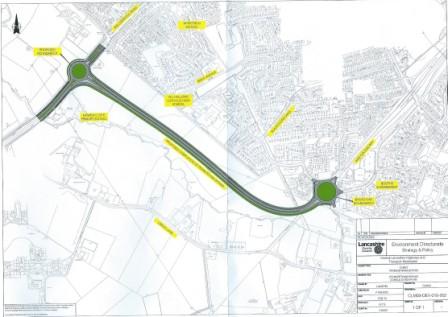
A few days ago I received a letter from Lancashire County Council announcing that the route for the new stretch of by-pass in Penwortham running from the Booths roundabout to the A59 at Howick has been protected.

Plans for Penwortham By-passLast year I attended public consultations and found out the plan to build this piece of by-pass is founded on a longer term plan to build further sections linking to a new bridge over the river Ribble then to the M55 at Swill Brook.

Penwortham Link RoadThe reason there has never been a Junction 2 on the M55 (which opened in 1975) was to leave room for this new piece of by-pass. This plan has been dormant for many years and re-risen as a result of the City Deal Programme:

‘The Preston, South Ribble and Lancashire City Deal is an ambitious programme of work that builds on the strong economic performance of the area over the last ten years and will help ensure the area continues to grow by addressing major transport issues to deliver new jobs and housing. Over a ten-year period the deal will generate more than 20,000 jobs, over 17,000 homes and more importantly grow the local economy. With the funding certainty it brings, we are able to deliver these transport improvements sooner we would otherwise be able to. This means new homes and jobs can come sooner and we can reduce congestion on existing roads and improve areas for communities and road users.’

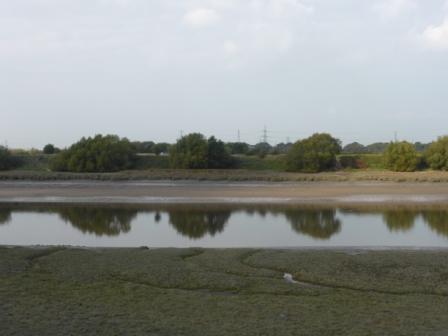
I attended a Penwortham Town Council Meeting on Monday the 7th of October where I raised concerns about the impact of the new section of by-pass on the local environment in Penwortham and the longer term plan for the Ribble bridge. This would destroy part of the Ribble’s natural coast line and Lea Marsh, a Biological Heritage Site which is home to two rare salt marsh grasses; long-stalked orache and meadow barley.

At this meeting the Town Council voted against the new route in favour of the ‘rescinded route’ which would run through Longton and would not link to a new bridge. In light of their vote I was shocked (but not surprised) when I received the letter from LCC saying the new route had been protected. LCC are preparing to submit a planning application in spring 2016 and have promised further public consultations. Should permission be granted the by-pass could be completed and opened by 2018.

The results of the questionnaire to local residents about the by-pass are revealingly vague:

‘the questionnaire you received back in September 2014 was sent to 13,000 residents… Over 1,250 residents and others interested in the road replied and only a small number were against completing Penwortham bypass by whichever choice of route. This suggests a strong degree of consensus among the local community that the bypass should be completed. As part of our consultation, the County Council presented its preferred route…’

By careful rewording relating to the completion of by-pass in general  LCC have covered up the fact that there was a large amount of opposition to the new route and they have over-ridden the vote of Penwortham Town Council and the opinions of local residents.

The letter describes the benefits of the new route including the long term plans to link to the new Ribble bridge and aims to address ‘legitimate concerns’. It also speaks of plans to improve Liverpool Road ‘the local centre of Penwortham’. This seems like a decoy and tantamount to sweeping the dust under the carpet. The destructive impact of the new by-pass can be redeemed by promoting the use of buses, walking and cycling in the town centre (???). This looks like extremely skewed logic to me.

It’s clear the destruction of local fields, the natural coastline of the Ribble and Lea Marsh need to be prevented. Is there a way to oppose the building of the new stretch of by-pass that would persuade LCC to change their minds before planning permission is granted in spring 2016? I’d be very interested to hear your thoughts on what can be done.

Natural Coastline of the river Ribble with Lea Marsh in the background

Natural Coastline of the river Ribble with Lea Marsh in the background

Gwyn, Gwythyr and Creiddylad: A Story from the Old North

Cherry BlossomCulhwch and Olwen is one of the oldest and most fascinating repositories of ancient British mythology. It originates from two texts; a fragmented version in The White Book of Rhydderch (1325) and full version in The Red Book of Hergest (1400). The main narrative centres on Culhwch’s quest to win Olwen for which he enlists the help of Arthur and his retinue; a medley of historical and mythological characters.

Embedded within it we find fragments of other tales which may be of older origin and have stood alone. These include the hunt for the legendary boar Twrch Twryth and release of Mabon from imprisonment in Gloucester. Most significantly for me as someone who venerates Gwyn ap Nudd, we find the story of his rivalry with Gwythyr ap Greidol for the love of Creiddylad and their battle for her every May Day.

This story is central to understanding Gwyn’s mythology. Because I am based in Lancashire it also of great interest that it originates from the Old North. In this article I summarise the story and introduce its themes and background with the aim of bringing Gwyn’s neglected connections with the north to the fore. In conclusion I discuss its contemporary relevance.

The story begins by stating that Creiddylad ‘went off’ with Gwythyr. Creiddylad is the daughter of Lludd Llaw Eraint ‘Lludd of the Silver Hand’ a mythic king of Britain. Earlier in the main narrative we are told she is ‘the most majestic maiden there ever was in the Three Islands of Britain and her Adjacent Three Islands.’ This shows she is deeply connected with the sovereignty of the land. Whilst attempts to trace the etymology of her name have been made such as ‘Craidd’ ‘heart’ and ‘dylan’ ‘water’ no agreement has been reached.

Gwythyr and his father, Greidol, are named in the genealogies of the Men of the North. Greidol is ‘the son of Enfael the son of Deigyr the son of Dyfnwal (Dyfnarth) the son of Ednyfed the son of Maxen (Macsen Guledig)’. Greidol’s name means ‘hot, passionate, fierce’. He was a knight in Arthur’s court and appears in the triads as one of the great architects and enemy-subduers of Britain.

Robert Graves interprets Gwythyr ap Greidol as ‘Victor son of Scorcher’. Gwythyr is the father of Arthur’s wife, Gwenhyfawr. His horse appears alongside Arthur’s in The Songs of the Horses ‘boldly bestowing pain’. In Culhwch and Olwen he wins the friendship of a colony of ants who bring nine hestors of flax seed, one of the items Culhwch must attain. Gwythyr’s resting place is included in The Stanzas of the Graves. These references show the longevity of his connection with Arthur and that he was a significant hero in his own right.

Unfortunately I have not found any references to where Greidol or Gwythyr lived. As other Men of the North in his family such as Nwython ruled in the Strathclyde area, south-west Scotland may be a possibility.

Creiddylad’s status as a maiden and the statement about her going off with Gwythyr suggest he may be her first love. Next we are told ‘before he could sleep with her Gwyn ap Nudd came and took her by force.’ It is likely Gwythyr is waiting to marry Creiddylad before they sleep together. Before they can wed Gwyn takes her away.

In Culhwch and Olwen Gwyn ap Nudd ‘White son of Mist’ is introduced as a ruler of Annwn (the Brythonic underworld) who contains the fury of its spirits and prevents their destruction of this-world. This may relate to earlier beliefs about Gwyn’s status as a god of the dead connected with chthonic spirits. Will Parker cites examples of offerings in ritual shafts and pits to propitiate such deities in the Bronze to Romano-British periods.

In The Dialogue of Gwyn ap Nudd and Gwyddno Garanhir Gwyn appears as a gatherer of the battle dead. After offering Gwyddno protection he states his presence at the deaths of a number of warriors; Gwenddolau, a northern British king who perished at the Battle of Arfderydd (north of Carlisle) and Bran who died alongside him, Gwallog ap Llenog ruler of Elmet (Yorkshire), Llachau Arthur’s son and Meurig ap Careian. This provides further confirmation of Gwyn’s role as a god who facilitates the transition from life to death.

In later literature Annwn becomes Fairyland and Gwyn its King. Although Gwyn’s status is reduced from god to fairy (and likewise his people) he remains feared and respected. Our rich heritage of Brythonic fairy lore demonstrates a continuity of relations between the worlds and interactions with spirits. In most of these tales uncanny themes such as glamoury, enchantment, changeling children and abduction take the fore. Fairies are often connected with wild and liminal places. Divisions between the fay and the dead remain blurred.

Gwyn’s abduction of Creiddylad may have its basis in prevalent superstitions. Professor Ronald Hutton notes that Early Welsh literature testifies ‘to the attribution of an especially arcane quality to May Day (‘Calan Mai’) and its eve.’ This was a liminal time when winter gave way to summer and was connected with love, fertility and woodland trysts. It was also a time dangerous spirits were abroad. Marriage was not advised in case one should mistakenly take a fairy lover.

When Gwyn takes Creiddylad by force I assume he abducts her to Annwn and claims her maidenhood. Frustratingly we gain no insight from the text into what Creiddylad thinks or feels. As a ‘maiden’ I imagine she must be terrified when he takes her and they descend. What he says to her and whether their sex is consensual remains uncertain.

Later Gwyn and Creiddylad become lovers. This is shown in The Dialogue of Gwyn ap Nudd and Gwyddno Garanhir where Gwyn introduces himself as ‘Gwyn ap Nudd / The lover of Creiddylad, daughter of Lludd’. If scholars are correct in identifying Nudd (the Romano-British god Nodens) and Lludd, Gwyn and Creiddylad are brother and sister. Whilst this would make their relationship incestuous in human terms, in many myths gods and goddesses consider it superior to sleep with members of their blood-line.

The 14th century manuscript Speculum Christiani reads ‘Gwyn ap Nudd who are far in the forests for the love of your mate allow us to come home’. Gwyn’s love of Creiddylad is central. Whilst he may not always be moved directly by human pleas he can be compelled to answer for love of his partner. This shows Gwyn holds Creiddylad in reverence and esteem. In later stories where Gwyn appears as the King of Fairy he is often accompanied by his Queen who is a respected equal.

Creiddylad’s transition from maiden to Queen of Annwn may be read as a story of coming to maturity. It might also reflect an ‘initiatory’ process whereby her relationship with Gwyn introduces her not only to sexuality but wild nature and the hidden wisdom of the underworld.

In relation to Gwyn and Creiddylad being ‘far in the forest’ it is interesting to note a tradition amongst the Strathclyde Britons of locating Annwn in the forests of the north. The 6th century Byzantine writer Procopius claims the lands north of Hadrian’s Wall were populated with snakes, serpents and other wild creatures. Those who cross the wall die straight away and this area is the destination of the souls of the dead. This fits with Gwyn’s rulership of Annwn and dwelling with Creiddylad in a forest abode. A feasible location is Celyddon (the Caledonian forest).

Gwythyr gathers a host and goes to fight against Gwyn. I imagine they ride into the wild depths of Celyddon and thereby enter Annwn to seek out the lovers. Their attack on Gwyn relates to a long tradition of stories depicting raids on the underworld by the armies of this-world.

In this case Gwyn triumphs and captures Gwythyr and a number of his noblemen. The majority are Men of the North and close relations of Gwythyr’s. Gwrgwst Ledlwm is the son of Dynfnarth. Cyledyr and his father, Nwython are also descended, through Guipno, from Dyfnarth. Pen son of Nethog is a corruption of Nwython. Hence Pen is Nwython’s son. If the genealogies are correct, Gwyn captures four generations of northern men (!). The only persons not of northern descent are Graid son of Eri and Glinneu son of Taran.

Gwyn’s slaughter of Nwython, cutting out his heart and feeding it to Cyledyr casts him as a cruel and sinister deity. This is hinted at in the lines about him containing the fury of Annwn’s spirits. However, there is no historical record of Nwython meeting his end this way. Tim Clarkson says that Neithon ap Guipno ‘died peacefully in his bed’. How much of this episode is a result of Gwyn’s demonization by adherents of Christianity and how much reflects his true nature is open to debate.

That Cyledyr becomes ‘Wyllt’ may relate to superstitions connecting Gwyn and his spirits with wildness and madness. Following the Battle of Arfderydd (where Gwyn states his presence at the death of Gwenddolau) Lailoken (Myrddin) sees an unendurable brightness and host of warriors in the sky. Afterward he becomes ‘Wyllt’ living amongst ‘gwyllon’ in Celyddon. The gwyllon hold a similar status to the spirits of Annwn as ancestral presences immanent in wild places. It seems significant they are connected with the forests of the north.

Afterward Arthur ‘comes north’ summons Gwyn to him and releases Gwythyr and his other noblemen from captivity. The source of Arthur’s power over Gwyn is not mentioned nor is it obvious he brings an army. Sense suggests he cannot take on Gwyn and the spirits of Annwn alone, particularly considering that in The Spoils of Annwn only seven return of each three hundred who set sail for the underworld.

Arthur makes peace between Gwyn and Gwythyr by consigning them to battle every May Day for Creiddylad’s hand. An additional condition, which seems rather unfair, is that neither can take her until Judgement Day. Until then she must remain in her father’s house. Creiddylad is presented not only as a puppet tossed between two lovers but at the beck and call of Arthur. It is not explained how Arthur puts this command on Gwyn, Gwythyr or Creiddylad.

It is my intuition Arthur’s intercession is a later addition to an earlier myth inserted for the purpose of integrating it into the narrative of Culhwch and Olwen. Like ‘God’ (who is said to have put the fury of the spirits of Annwn in Gwyn!) Arthur is introduced as a deus ex machina. His agency explains and makes palatable to a Christian audience the rivalry between an underworld god and human (or perhaps semi-divine) hero for the favour of a fertility goddess. Arthur shutting Creiddylad in her father’s house could represent a Christian ban on woodland liaisons.

MayflowerThis story may originate from an earlier seasonal myth where Gwyn and Gwythyr are the forces of winter and summer battling over Creiddylad who embodies new life and spring. In this case their struggle is eternal. On May Day, Gwythyr the Summer King and a hero of this-world triumphs over Gwyn the Winter King and ruler of the underworld.

That such a tradition existed is suggested by ritual combats enacted in Wales in the nineteenth century by representatives of summer and winter. After summer won celebratory dancing was held around a May-pole. Pairs or groups would often fight over the May-pole. Whilst May-pole dancing is still a strong tradition across northern Britain, I haven’t found any battles between summer and winter yet.

If Gwythyr wins Creiddylad’s hand on Calan Mai (May Day) it would make sense that Gwyn takes her back to Annwn on Nos Galan Gaeaf or Calan Gaeaf (the eve or first of November) another time associated with dangerous spirits. If this is the case I know of no stories or traditions based around it.

I find it important to remember this story of Gwyn, Gwythyr and Creiddylad is only one medieval variant set in the Old North. Doubtless it underwent countless re-tellings in other times and places before it was written down and stuck. For me it is imperative to gain a personal understanding of it through lived relationships with its deities on the land where I live in the here and now.

So far I have reached the insights that the forgetting of this story in northern Britain is also the story of our forgetting of our relationship with the passing seasons, the deities associated with them and the sovereignty of the land. Another lesson it discloses is that human ownership of the land is transitory. There is a balance the forces of the wild and the underworld maintain.

In modern times the majority of people walk only within the Arthurian courts of this-world, paying respect to celebrities, pop culture and football heroes. In this era Gwythyr rules. He and the people of the north have forgotten about Creiddylad’s marriage to Gwyn in the wild forests of Annwn.

However, after centuries of forgetting Gwyn is appearing again within our folklore and as a god to his devotees. We’re remembering the seasons. We’re remembering Annwn, wild places, spirits and the dead. And first-most in Gwyn’s eyes we’re remembering Creiddylad and to treat her with reverence and respect.

***

SOURCES

 Bromwich, Rachel and Evans, Simon D. Culhwch and Olwen (University of Cardiff Press, 1992)
Clarkson, Tim The Men of the North: The Britons of Southern Scotland (John Donald, 2010)
Davies, Sioned (transl.) The Mabinogion (Oxford University Press, 2007)
Evans, J. Gwengobryn The Black Book of Carmarthen (Lightning Source UK Lmtd, 1907)
Green, Thomas Concepts of Arthur (Tempus Publishing, 2007)
Gwynn Jones, T. Welsh Folklore and Custom (D. S. Brewer, 1979)
Heron (transl) ‘Gwyn ap Nudd and Gwyddno Garanhir’ https://barddos.wordpress.com/2015/02/08/gwyn-ap-nudd-and-gwyddno-garanhir/
Hutton, Ronald The Stations of the Sun (Oxford University Press, 1996)
Parker, Will The Four Branches of the Mabinogi http://www.mabinogi.net/
Pennar, Meirion (transl.) The Black Book of Carmarthen (Llanerch Enterprises, 1989)
Rudiger, Angelika H. ‘Gwyn ap Nudd: Transfigurations of a character on the way from medieval literature to neo-pagan beliefs’ in Gramarye, Issue 2 (University of Chichester, Winter 2012)
Sikes, Wirt British Goblins (Lightning Source UK, 2011)
Skene, William F. The Four Ancient Books of Wales (Forgotten Books 2007)
Squire, Charles Celtic Myths and Legends (Parragon, 2000)

Nith’s Estuary

After visiting the site of the Battle of Arfderydd, we chose to stay in the Nith Hotel at the mouth of the estuary as it was close to Caerlaverock and because I wondered whether, like Neath, there was a connection with Nudd and his son, Gwyn. I went with no strong expectations or feelings.

When we arrived at the car park I was utterly blown away. Clouds dark blue and dappled silver were reflected perfectly in still quiet waters. Splitting the silence hollering overhead flew drove after drove of barnacle geese following the river’s course then disappearing from sight at the estuary.

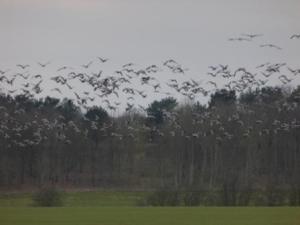
Earlier we had accidentally spooked a field filled with these magnificent birds. With barking cries and clamouring wings they took off flashing black and white, ascending into hurtling v’s.Shortly afterward a covey of swans flew over honking deep and resonant calls.

SwansIn the folklore of Wales, northern England (and beyond) ‘the Wild Hunt’ is associated with flights of swans and geese. Gwyn is one of its leaders. The term is usually limited to instances where the birds cannot be seen and those who hear them fear for their lives and souls.

My experience in this case was more of beauty than terror. The estuary of the Nith where sky met river and Criffel displayed its otherside in the lucid water was clearly a liminal place. There was something deeply magical about the passing birds and their wild song.

This reminded me a translation of Annwn (the Brythonic ‘otherworld’ Gwyn rules) is ‘the deep’. Annwn as hidden depth has intriguing resonances with the sound of ‘Nudd’. Onomatopoeically it links not only to Neath and Nith but the concepts beneath, underneath and the netherworld. This evening showed Annwn’s depth is immanent in this-world and can be experienced here.

Later on the brink of sleep I found myself thinking of Nudd / Nodens’ temple on the estuary of the river Severn. People made votive offerings to him as a god of hunting, healing and dream then slept in a designated space and priests interpreted their dreams in the morning.

Recently I discovered Nudd is not only the name of a family of Brythonic gods but also a human family name. Dreon ap Nudd fought on the dyke of Arfderydd not far from the Nith. His father, Nudd Hael, is included in the genealogies of the Men of the North. In the Yarrow valley lies a memorial stone to ‘the illustrious princes Nudus and Dumnogenus. In this tomb lies the son of Liberalis.’ Tim Clarkson says ‘Nudus is a Latinisation of Nud or Nudd.’

It seems possible this ancient northern family derived their name from Nodens / Nudd and that he was their ancestral deity and they may have served him in a similar way to the priests on the Severn. Preparing to slip into the netherworld, ‘the land of Nod,’ I wondered how many other worshippers of Nudd and his kindred had slept on Nith’s estuary.

In the morning when I awoke the barnacle geese were flying back up river to feed on the fields and salt marsh. Several groups landed on the banks and by making a careful approach we managed to draw close enough to photograph them.

Barnacle GeeseBarnacle geese possess some fascinating folklore. It was once believed they grew on driftwood like barnacles hanging down from their beaks until they grew a coat of feathers and were ready to fly away. Their growth from barnacles in summer explained why they only appeared as birds in the winter months.

Visiting the Caerlaverock Wildfowl and Wetlands Trust we found out the ‘real’ reason they can only be seen in winter. Barnacle geese incubate their eggs and raise their goslings in Svalbard in Norway between May and September when the Gulf Stream melts the ice. As winter approaches they fly 3000 km south to the Solway Firth.

In the 1940’s there were only 300 birds. Due to the work of the trust there are now over 30,000. However, if global warming continues it is possible that ice melting early in Svalbard will leave their eggs vulnerable to being eaten by polar bears.

As well as finding out more about barnacle geese we got to see whooper swans up close at feeding time. Whooper swans are another over-wintering bird who fly in from Iceland and can be told apart from mute swans by their yellow beaks.

Whooper SwansIt is my growing intuition that Gwyn, as a god of winter, may have a connection with birds over-wintering in Britain and that this would vary from place to place.

Forgotten Arfderydd and the Hearsay of Corvids

Last Saturday I set out north to the site of the Battle of Arfderydd. At the forefront of my mind was the matter of forgetting.

If Arfderydd was significant enough to be recognised as one of Three Futile Battles of Britain, if it was where Gwenddolau, the last pagan Brythonic king of the Old North, made his final stand and one hundred and sixty men lost their lives before he died and three hundred after and where Myrddin Wyllt went mad, why no marker of the site? Why no songs? Why has Arfderydd been forgotten?

Considering Gwyn ap Nudd stated his presence at Gwenddolau’s death and at the deaths of other northern warriors and the episode where he abducts Creiddylad, Gwythyr and his (mainly northern) supporters takes place in the Old North why has his memory faded from the minds of the people of northern Britain?

In search of clues, a friend and I travelled north to Longtown and set off on foot up Netherby Road, consciously following in the footsteps of William Skene and Nikolai Tolstoy. The first place we visited was Netherby Hall, the mansion of the Graham family built on the site of the Roman fort Castra Exploratum. An altar dedicated to a god called Vitris and ram-horned head carved from local red sandstone found nearby suggest it was the location of a Romano-British cult.

Netherby HallAs we approached from the south Netherby Hall’s sandstone walls came into view atop a prominent ridge with polygonal towers, parapets and scaffolding. An encircling wire fence said strictly out of bounds. Following the path round the mansion we passed a woodland carpeted with snowdrops and trees stacked with rooks’ nests filled with noisy, vocal, raucous birds

Never before had I seen many rooks or heard such a racket. Their croaking and cawing see-sawed in my mind like something trying to break through. Unfortunately I don’t speak very good rook. Yet the rooks seemed important. More important than the blank face of the mansion and its ‘Private’ sign.

We rejoined the main road and headed north for Carwinley. When Lailoken (Myrddin Wyllt) told St Kentigern of his guilt at the deaths of the combatants and vision of a host of warriors (who I believe to be Gwyn and the spirits of Annwn) he stated the battle took place ‘in the field between Liddel and Carnwanolow.’ Skene identified Liddel with Liddel Water and Carnwanolow as Caer Gwenddolau and connected this with Carwinley.

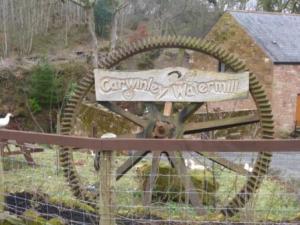
Passing Carwinley cottage, farm and water mill we looked down into the sandstone gulley of the burn, steep banks green with ferns, onto shining reddish water. I recalled Andrew Breeze’s interpretation of Arfderydd as ‘burning weapon’ relating to this bloody stream forming the parish of Arthuret’s boundary. Breeze said ‘Car’ need not mark a fort but a defensive stockade. It certainly seemed possible the burn was named after Gwenddolau’s fall.

Carwinley BurnThe Triads of Ancient Britain also mention ‘the retinue of Dreon the Brave at the Dyke of Arfderydd.’ Dreon ap Nudd is the son of Nudd Hael. If this etymological link to Gwyn ap Nudd (and his father Nudd or Nodens) suggests an ancient connection between a northern family and their ancestral deities it is no surprise Gwyn and his host appeared at the battle where Dreon and his retinue met their end.

As I pondered whether the ‘Dyke’ they fought on was above Carwinley Burn I saw crows over the trees who shouted and cawed then pitched their games across a sky of constant silver-grey cloud. A sky of concealing. A sky of protection. A sky of no openings onto crashing visions of warriors.

Fields of Arfderydd


As we passed the green and well-tilled-over crow-haunted fields the dead did not rise. There were no whispers, no warnings, only the hearsay of corvids.


Upper Moat


At Upper Moat where reputedly the three hundred men who fought after Gwenddolau’s death were buried there was no sign of the orchard Skene mentioned but crows filled the trees in the background.

Our final destination was Liddel Strength, a motte and bailey which might have been the location of Gwenddolau’s fort and where his ‘Faithful War Band’ could have made their last stand, fighting for a month and a fortnight after the death of their leader. Unable to find our way we were directed by a local farmer (coincidentally Skene was directed by a farmer from Upper Moat too!) onto a shooter’s path which climbed steeply beside Liddel Water.

On the way we encountered a line of not-dead reeds hauntingly reminiscent of flags or ribboned spears blowing in the wind on an abandoned battlefield. Or of forlorn warriors.

Reeds of ArfderyddThe site of Liddel Strength was badly eroded by the river and appallingly overgrown. Breaching the defensive ditch we scrambled through hat-snatching hawthorns and ankle-snagging brambles up the motte which didn’t feel overly welcoming in its firm return to nature. There were no crows but a bird of prey screeched somewhere out of sight reminding me of Gwenddolau’s birds who fed on the corpses of the Britons.

Looking down from the summit Liddel Water flowed far below at the foot of a slope impossible to ascend. Fields and woodland stretched out before us. The land seemed as determined in swallowing time as it was in absorbing the abandoned railway track Skene arrived on two hundred years ago. On our return journey only the bridge and fragments of the embankment remained.

The dereliction of Liddel Strength contrasted sharply with Caer Laverock Castle (the ‘Lark’s Nest’ Arfderydd was supposedly fought over) which we visited the next day. This splendid medieval stronghold belonging to the Maxwell family was well preserved by the National Trust. Its siege by the English immortalised in the ‘Song of Caerlaverock’ was reconstructed on a video in the display rooms.

Caer Laverock CastleCrows flocked in the trees and played over its terraces. South was an earlier fort closer to the Solway Firth, an artist’s representation showed the higher sea levels and its importance as a strategic location.

Heading north again we climbed Ward Law, a lookout point where the Maxwell Clan gathered shouting their battle cry: “Wardlaw! I bid ye bide Wardlaw!” Beyond was another Roman camp invisible from the ground.

Ward LawLooking south from Ward Law to Solway Firth for the first time the all-encompassing silver-grey clouds broke. Seeing clear light and waters ablaze with cold fire I was reminded of the unendurable brightness Myrddin saw as Gwyn approached with the hosts of Annwn. The otherworld opening only just beyond the sands and tides of this-world.

Solway FirthI left with intuitions but no answers about Gwyn and his kindred, battles, forgetting, clouds and corvids… another part of this story waits to be told about the estuary of the river Nith and I shall be sharing this in my next post…

SOURCES

Breeze, Andrew “The Name and Battle of Arfderydd, near Carlisle,” Journal of Literary Onomastics: Volume 2: Issue 1, Article 1. (2012)
Clarkson, Tim The Men of the North: The Britons of Southern Scotland (John Donald, 2010)
Heron (transl) ‘Gwyn ap Nudd and Gwyddno Garanhir’ https://barddos.wordpress.com/2015/02/08/gwyn-ap-nudd-and-gwyddno-garanhir/
Pennar, Meirion (transl.) The Black Book of Carmarthen (Llanerch Enterprises, 1989)
Ross, Anne Pagan Celtic Britain (Cardinal, 1974)
Skene, William F. The Four Ancient Books of Wales (Forgotten Books 2007)
Tolstoy, Nikolai The Quest for Merlin (Sceptre, 1985)

The Brightness beyond Endurance: Gwyn ap Nudd and the Battle of Arfderydd

In my waking dream spears pierce the night sky opening onto another night filled with rainbows and blinding stars. Battle cries ascend from black fog. In a stained glass window I glimpse a man with a hunched back in a green and mossy gown departing from a picture into darkness. From these images I derive my research on Gwyn ap Nudd and the Old North should begin with the Battle of Arfderydd. This is an account of my initial findings and thoughts to date.
The Battle of Arfderydd haunts Britain’s consciousness as one of three of the most futile Dark Age battles. It took place in 573 and was fought between Brythonic rulers of the Old North; Gwenddolau ap Ceidio and his cousins Gwrgi and Peredur ap Eliffer. All were descendants of Coel Hen. Thus it epitomises the internecine strife that prevented northern rulers from putting up a successful resistance to the Angles of Northumbria.

The Triads of Ancient Britain tell us it was fought over a lark’s nest. This probably refers to Caerlaverock (‘Lark’s Fort’) on the site of which still stands a stunning medieval castle. It is generally believed the Battle of Arfderydd took place on the plain between Liddel Water and Carwinley Burn. It is possible the motte and bailey named Liddel Strength was the location of Gwenddolau’s fort. After Gwenddolau was killed, his war-band retreated to the fort and held out for ‘a fortnight and a month’ before their defences fell and they too were slain and (according to a local tradition) buried near Upper Moat.

In ‘The Dialogue of Gwyn ap Nudd and Gwyddno Garanhir’ Gwyn states his presence at Gwenddolau’s death:

‘I was there when Gwenddolau was slain,
Ceidio’s son, a pillar of poetry,
When ravens croaked on gore.’

That Gwenddolau adhered to a pre-Christian mythos featuring Gwyn as a god who gathered the souls of the dead to Annwn is hinted at by certain lines in the Triads. Gwenddolau is referred to as one of three ‘Bull Protectors’ of Britain. Gwyn himself is referred to as a ‘Bull of battle’. Contrary to popular belief, Celts and not Vikings wore helmets affixed with bull horns. The bull was viewed as a sacred animal and its qualities were attributed to war leaders and psychopomps. It is also of interest ‘Gwyn’ and ‘Gwen’ both mean ‘white’ or ‘blessed’.

Gwenddolau is also said to own a pair of birds who wear a ‘yoke of gold’ and devour two corpses of the Britons for dinner and two for supper. If the latter is an oblique reference to funerary practices whereby bodies are left on stone slabs for their flesh to be consumed by carrion birds this shows Gwenddolau and his people were not performing Christian burials. The northern Britons may have believed Gwyn’s presence as a gatherer of souls was signalled by the approach of corpse-eating birds (or dogs or wolves). Gwenddolau’s birds may have had a permanent position in this role.

Another striking passage which may read as a portrayal of Gwyn’s presence at the Battle of Arfderydd with the spirits of Annwn can be found in The Life of St Kentigern. Here, Lailoken (Myrddin Wyllt) tells the saint of a vision which drove him to madness in Coed Celyddon (the Caledonian Forest):

‘In that fight the sky began to split above me and I heard a tremendous din, a voice from the sky saying to me ‘Lailocen, Lailocen, because you alone are responsible for the blood of all these dead men, you alone will bear the punishment for the misdeeds of all. For you will be given over to the angels of Satan, and until the day of your death you will have communion with the creatures of the wood. But when I directed my gaze towards the voice I heard, I saw a brightness too great for human senses to endure (my italics).

The Brightness beyond EnduranceI saw, too, numberless martial battalions in the heaven, like flashing lightning, holding in their hands fiery lances and glittering spears which they shook most fiercely at me. So I was torn out of myself and an evil spirit seized me and assigned me to the wild things of the woods, as you see.’

It seems possible the introduction of the voice of God and angels of Satan are a Christian cover for the appearance of Gwyn and the spirits of Annwn. Gwyn’s earlier name Vindonnus ‘clear light, white’ links him to the unendurable brightness. As a god of thresholds; between the worlds and life and death, experiences of his presence take place on the edge of human sense. Hence Lailoken / Myrddin’s transition from ‘sanity’ to ‘madness.’

The battalions in the sky look more like warriors than angels. The notion that the spirits of Annwn include deified ancestors arriving to take their fallen kindred fits with their numinous apparel. These spirits are frequently demonised by Christian writers. That an ‘evil spirit’ (ie. a spirit of Annwn) tears Lailoken / Myrddin ‘out of himself’ and assigns him to the wildwood is a significant factor in his flight and later recovery.

In the saga poetry of The Black Book of Carmarthen and The Red Book of Hergest we witness Myrddin’s transformation from a golden-torqued warrior of Gwenddolau’s court into a poet who prophecies against war. Myrddin shares harrowing depictions of ‘the blood-shed of battle’ and his guilt about the deaths of Gwendydd’s children. Whether he is literally responsible for killing them or feels responsible is uncertain.

‘Now Gwendydd loves me not and does not greet me…
I have killed her son and daughter.
Death has taken everyone, why does it not call me?
For after Gwenddolau no lord honours me.’

He mourns Gwenddolau’s death:

‘I have seen Gwenddolau, a glorious prince,
Gathering booty from every border;
Beneath the brown earth now he is still,
Chief of the kings of the North, greatest in generosity.’

Myrddin also speaks of his flight from ‘Rhydderch Hael, defender of the Faith’. Rhydderch was ruler of Alt Clut and renowned for championing Christianity and his patronage of St Kentigern. Myrddin’s words have led some scholars to believe Arfderydd was fought between Pagan (Gwenddolau) and Christian (Rhydderch) forces. After Gwenddolau’s death Rhydderch rises to greater power, forming an alliance with Urien Rheged, Gwallog ap Llenog and Mercant Bwlc against the Angles at Lindisfarne.

During this period Myrddin retreats to Celyddon, keeping the company of wild creatures such as wolves, a piglet and a favoured apple tree. He states he has wandered ‘ten and twenty years’ with ‘madness and madmen’ ‘gan willeith a gwyllon.’ Myrddin’s epithet ‘gwyllt’ means ‘mad’ or ‘wild.’ ‘Gwyllon’ can refer to ‘madmen’, ‘wildmen’ or to ‘spirits’ or ‘shades.’ They may be equated with the ‘seven score men’ who fought at Arfderydd then lapsed into madness in Celyddon and perished. These gwyllon are ancestral presences; spirits of Annwn.

Myrddin’s capacity to see the spirits of Annwn may result from his vision of the brightness beyond endurance. Whilst initially it tips him over the edge, it confirms the existence of Gwyn and his spirits and an afterlife. This provides him with the strength to live through suffering; ‘Snow up to my hips among the wolves of the forest, / Icicles in my hair’ until his ‘threefold’ death. Myrddin says ‘After enduring sickness and grief in the Forest of Celyddon / May I be a blissful man with the Lord of Hosts.’ (In ‘The Dialogue of Gwyn ap Nudd and Gwyddno Garanhir’ Gwyn is referred to as ‘Lord of Hosts’.)

Associations between Gwyn and healing processes that take place in the wild also appear in a fourteenth century Latin manuscript called Speculum Christiani: ‘Some stupid people also stupidly go to the door holding fire and iron in the hands when someone has inflicted illness, and call to the king of the Benevolent Ones and his queen, who are evil spirits, saying ‘Gwyn ap Nudd who are far in the forests for the love of your mate allow us to come home.’

Myrddin’s vision also grants him the power of prophetic poetry. It is noteworthy that this former warrior uses poetry to give voice to the horror of warfare and to warn against future bloodshed. A critical attitude toward war differentiates the saga poems from earlier heroic poetry. We might recall similarities between Myrddin’s ‘Death has taken everyone, why does it not call me?’ and Gwyn’s ‘I have been where the warriors of Britain were slain / I live on; they are dead’. Both are laments.

Unfortunately, the northern British stories of Gwyn ap Nudd and Myrddin Wyllt and the deep, wild wisdom they contain are little known in contrast to the courtly Christian tales of King Arthur, Merlin and his knights. For a medieval aristocracy later bent on Crusades; ‘One King, One God, One Law’ there was no room for a northern wild man and his words against war or the ruler of an otherworld and ancestral presences immanent in the wild places of this-world. Perhaps this can be changed…

***

SOURCES

Blake, William The Complete Poetry and Prose of William Blake (Anchor Books, 1988)
Breeze, Andrew “The Name and Battle of Arfderydd, near Carlisle,” Journal of Literary Onomastics: Volume 2: Issue 1, Article 1. (2012)
Evans, J. Gwengobryn The Black Book of Carmarthen (Lightning Source UK Lmtd, 1907)
Heron (transl.) ‘Gwyn ap Nudd and Gwyddno Garanhir’ https://barddos.wordpress.com/2015/02/08/gwyn-ap-nudd-and-gwyddno-garanhir/
Hunt, August The Arthur of History: A Reinterpretation of the Evidence (August Hunt, 2012)
Pennar, Meirion (transl.) The Black Book of Carmarthen (Llanerch Enterprises, 1989)
Rudiger, Angelika H. ‘Gwyn ap Nudd: Transfigurations of a character on the way from medieval literature to neo-pagan beliefs’ in Gramarye, Issue 2 (University of Chichester, Winter 2012)
Skene, William F. The Four Ancient Books of Wales (Forgotten Books 2007)
Thomas, Neil ‘The Celtic Wild Man Tradition and Geoffrey of Monmouth’s Vita Merlini: Madness or Contemptus Mundi?’ in Arthuriana Vol. 10, No. 1 (Spring 2000)
Tolstoy, Nikolai The Quest for Merlin (Sceptre, 1985)

The Old North from Peneverdant

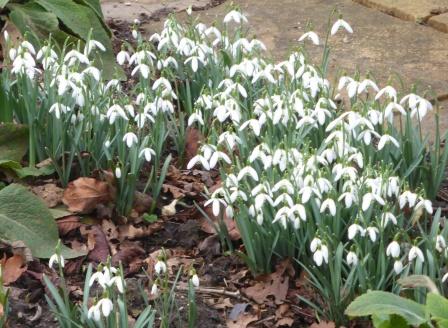
SnowdropsIn the land where I live, spring awakes. Snowdrops in their prime unfold the voluminous skirts of their lanterns. Lords and ladies push their courtship through the soil alongside first signs and scents of ransoms. Swollen mosses take on a bright green living vibrancy.

As I walk the path centuries of ancestors walked to St Mary’s Well, I hear the loudness of a thrush. Could it be the one who calls me from sleep each morning, speckled chest blanched and white as birch amongst ash and sycamore? The trees hold back for now, but I know the sap will start rising soon.

I pass the site of the healing well and cross the road to the War Memorial. Splashes of pink, purple and yellow primroses are planted in beds before the Celtic cross. Etched on blue-grey slabs are the names of seventy-three men who lost their lives in the First World War and forty-six who died in the second. They are honoured and remembered here. I also think of the dead who have no memorial or whose memories have been erased or forgotten.

I follow the footpath uphill onto Church Avenue. Leading to St Mary’s Church, it once went to a Benedictine Priory, dissolved and more recently demolished. A strange road this; trodden by pilgrims in search of miraculous cures and by funeral processions. By soldiers too, maybe armies, defending this crucial position from what we now see as the castle motte.
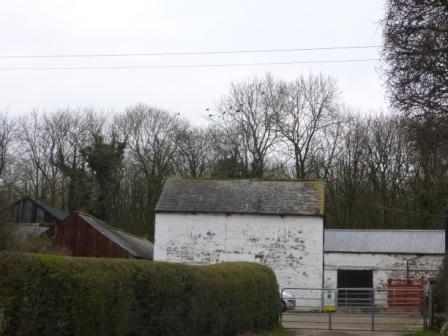
Passing the church on the hill’s summit I stand in the graveyard amongst tilted and fallen headstones, beneath sentinel beech trees whose shells and bronzed and curling leaves still litter the greening earth.

There’s no access to the motte’s vantage point, but through leafless trees I can make out the city of Preston with its clock tower, steeples, tower blocks and huge manufacturies along Strand Road. I recall images of its panoply of smoking chimneys, flaming windows, imagine the pounding Dickensian melancholy-mad elephants.

Preston’s sleeker now. Cleaner. Less red and black. Concrete grey. Not so smoky. But sometimes the industrial pall still holds. Somewhere behind its walls lies a medieval town and behind that…

The Pennines form a sweeping backdrop, rising higher than Priest Town’s spires ever could; Parlick, Wolf Fell, Longridge Fell, Billinge Hill, Great Hill, Winter Hill. An easterly green and purple barricade. To the west, the river Ribble, Belisama, strapped into her new course, stretches long arms to her shining estuary. A sea gull cries over the horizon and disappears.
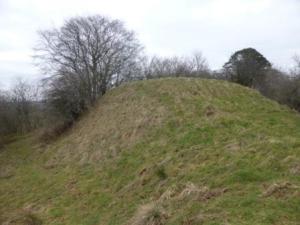
I’ve spent several years researching the history of Penwortham. The Riversway Dockfinds mark the existence of a Bronze Age Lake Village. Ballista balls on Castle Hill and a huge industrial site at Walton-le-dale ascertain a Roman presence. Following the breakdown of Roman rule, history grinds to a halt.

There is a black hole in Penwortham’s past the size of the Dark Ages; during the time of the Old North.

Historians have conjectured about this. David Hunt and Alan Crosby agree that place names (where we find a mixture of Brythonic and Old English, like Penwortham* often conjoined) suggest a gradual settlement of the local area by Anglo-Saxons during the seventh century. They say Penwortham’s remoteness on the edges of Northumbria and Mercia meant it was not a major concern. However, this conflicts with the significance of its location as a defensive position for the early Britons and Romans and later probably for the Saxons of Mercia and the key role it played for the Normans during the harrying of the North.

History starts up again with the Saxon hundreds, invasions from Scandinavia and the Norman Conquest. But what happened in between?

Unfortunately, likewise, there is a black hole in the history of the Old North the size of Penwortham. And it isn’t the only one.

The very concept of ‘Yr Hen Ogledd’ ‘the Old North’ is problematic. It is a term used post datum by scholars to identify an area of land covering the majority of northern England and southern Scotland from the time of the breakdown of Roman rule in the fifth century until the Anglian kingdom of Northumbria came to dominate in the eighth century.

During this period, it was simply known as ‘Y Gogledd’ ‘the North’. Its people spoke a Brythonic language known as Cumbric, which was similar to the Cymric language of the Welsh. Its rulers ‘Gwŷr y Gogledd’ ‘the Men of the North’ claimed common descent from either Coel Hen (Old King Coel) or Dyfnawl Hen. Again, the genealogies are problematic because they were created by kings to certify their reign by tracing their lineage back to legendary ancestral figures.

The main kingdoms of the Old North are usually identified as Alt Clud, in the south-west of Scotland, which centred on Dumbarton and later became Strathclyde; Gododdin, in the south-east of Scotland, which had a base at Edinburgh; Elmet, in western Yorkshire and Rheged in north-west England.

The location of Rheged is a matter of ongoing debate. For Ifor Williams it centres on Carlisle and the Eden Valley and covers Cumbria, the Solway Firth and Dumfries and Galloway. John Morris posits the existence of a northern Rheged in Cumbria and a southern Rheged that extended into Lancashire and Cheshire. On the basis of landscape and resources, Mike McCarthy suggests a smaller kingdom or set of sub-kingdoms existed either north or south of the Solway. If McCarthy is correct, we do not have a name for present day Lancashire at all but a black hole the size of a county or larger!

Another problem is that textual sources about the Old North are extremely limited. We have some historical records such as the Annales Cambriae, the Historia Brittonum and Anglo-Saxon Chronicle. Much of the history of this period is derived from the heroic poetry of the Dark Age bards Taliesin and Aneirin. Later saga poetry construes dramatic dialogues between characters associated with earlier events.

Research leads to where history and myth converge but can take us no further. It becomes necessary to step beyond study across the threshold to otherworlds where the past, our ancestors and deities still live.

So I speak my intentions to the spirits of place; the Lady in the Ivy with her glance of green, wood pigeons gathered in the trees, the people buried here in marked and unmarked graves.

I speak with my god, Gwyn ap Nudd, who abides beyond this land but sometimes seems closer than the land itself. The god who initiated and guides this quest.

His suggestion: what is a black hole but a portal?

Our agreement stirs a ghost wind from behind the graves, rustling bronze beech leaves and tree whispers from above.

The hill seems greener. A single white sea gull barks. Then long-tailed tits come chittering and twirling to the brambles.

Beech trees and castle motte*Penwortham first appears in the Domesday Book in 1086 as ‘Peneverdant.’ Writing in 1857 Rev. W. Thornber claims this name is of British origin and ‘formed of three words- pen, werd or werid and want, as Caer werid, the green city (Lancaster) and Derwent, the water, that is the green hill on the water’. This describes exactly how I imagine Castle Hill would have looked during the eleventh century near the Ribble on the marsh. However, ‘verdant’ has always sounded more like French for ‘green’ to me.

Alan Crosby says ‘Peneverdant’ results from a Norman scribe trying to write an unfamiliar word (which was likely to have been in use for up to 500 years) phonetically. He tells us the ‘Pen’ element in Penwortham is British and means ‘prominent headland’ whilst ‘wortham’ is Old English and means ‘settlement on the bend in the river’.

If Penwortham had an older British name prior to Saxon settlement, it is unknown. I can’t help wondering if it would have been something like ‘y pen gwyrdd ar y dŵr,’ which is modern Welsh for ‘the green hill on the water’. It’s not that far from Peneverdant.

Gwyn ap Nudd and the Old North

Rivington Moor with Winter HillI’ve recently started researching Gwyn ap Nudd’s neglected connections with the Old North. In the final verses of ‘The Dialogue of Gwyn ap Nudd and Gwyddno Garanhir’ Gwyn states his presence at the deaths of northern warriors. In How Culhwch won Olwen Gwyn’s rival for the love of Creiddylad, Gwythyr, and his allies (who Gwyn takes captive) are of northern descent. There is consensus amongst scholars that this episode and ‘The Very Black Witch’ originate from the Old North.

As somebody who venerates Gwyn in Lancashire I find it strange, perplexing and quite sad that, whilst in medieval texts equal precedence is given to Gwyn’s roles in Wales and the north, in later literature his northern links disappear entirely. I’m in the process of developing some ideas about how this happened.

Before I started reading Welsh mythology I thought it was solely about the area of land we now know as Wales. When I discovered William Skene’s translation of The Four Books of Ancient Wales I realised that the earliest heroic poetry attributed to Taliesin and Aneirin originates from and is about the fall of the Old North to the Anglian kingdom of Northumbria. Whilst the focus of The Mabinogion is Wales many adventures lead beyond. Welsh mythology contains the lore of all of ancient Britain.

This body of ancient British lore was absorbed into ‘Welsh’ mythology because when the Anglo-Saxon kingdoms came to rule, many Britons were forced west, taking their stories with them. The tantalising fragments of Gwyn’s earliest myths in the medieval texts result from the mixing of northern and Welsh oral tales, which were later penned by Christian scribes.

Memories of Gwyn were kept alive by the reminiscences of Welsh saints, soothsayers and poets and later revived by nineteenth century scholars and folklorists. During this process his name became synonymous with areas where his stories were still told; Wales and Somerset. This is evidenced by Shakespeare’s ‘Heavens defend me from that Welsh Fairy’ and John Cowper Powys’ reference to Glastonbury Tor as ‘the great haunted hill, the hill of Gwyn-ap-Nud, the Welsh Fairy-Demon’.

His northern connections sank into the background. As far as I know there have been no literary references to Gwyn ap Nudd in the north since the medieval period.

***

Last year, when I was giving a talk on ‘Voicing Place’ in Ipswich, I mentioned my relationship with Gwyn and how some of my journeys under his guidance had led not only to Annwn but to memories in the dreamscape of my locality. Afterward, I got questioned about the legitimacy of my work with a ‘non-local’ god; shouldn’t it be ‘local gods for local people’?

I disagreed, both on the principle that only relationships with local gods are valid and that Gwyn isn’t a local god. Gwyn revealed his presence to me (quite unexpectedly!) at a local fairy site. His imperative of ‘enchanting the shadowlands’ referred to my locality. Throughout my relationship with him he’s demonstrated a concern for the north and its history.

I’ve been pondering this for a while and reached the following conclusion: Gwyn is a king of Annwn and is said to ‘contain’ (literally to hold within and to hold back) the fury of the spirits of Annwn. These are chthonic spirits, referred to today as ‘fairies, who play a role in mediating between this-world and the otherworld, the living and dead. Because of this intermediary role they have a deep concern for the land and the way we maintain our heritage. Their concerns are Gwyn’s.

Gwyn’s concern with history (and some of his fury) also stems from the fact he and the spirits of Annwn have been all but erased by the processes of Anglicisation and Christianisation. Gwyn and his kindred spirits also seem bound up with other voices written out of history by the victors. Thus, he calls me to step outside history to listen to those voices and bring his myths back to life on the land from which they have been erased.

This marks a new direction in my research and writing. Since my dedication to Gwyn, my path as an Awenydd has focused on what Heron refers to as ‘imaginative recall’; working with historical fragments and maps and listening to the land and its deities in order to gather memories in poems and stories.

In Enchanting the Shadowlands my focus was my local area. I am now experiencing the impulse to revisit some of Britain’s most ancient myths at a deeper level and visit the places they are set with the purpose of reweaving Gwyn’s neglected connections with the Old North into the present day.

In this respect, I share aims with Charlotte Hussey who in her collection of medieval glosa Glossing the Spoils set out through active imagining to ‘mend a break in tradition and time.’ Charlotte mentions that P. K. Page ‘defined ‘religion (re-legere)’ as ‘to read again.’’ Re-reading and re-imagining our ancient myths is a religious duty, an act of devotion to land, gods and ancestors.

Hence as an Awenydd to Gwyn and his spirits and all the voices between the lines of known history and myth, I embark on this new project. I am aware at this point it is not only memories I must quest, but an appropriate form to fit them.

The Star-Strewn Pathway

‘Thence rolled down upon him the storm-clouds from the home of the tempest;
thence streamed up the winter sky the flaming banners of the Northern lights;
thence rose through the illimitable darkness on high
the star-strewn pathway of the fairy king.’
-Wirt Sikes

I write this post as a newcomer to the path of the Awenydd, having walked it in earnest little longer than a year and a day. The terms Awen and Awenydd have been familiar since coming to Druidry. In the Awen I found a name for the all-consuming force of inspiration that has burnt forever in my veins with the fire of stars in the iciest reaches of a dark universe. Its furious purpose was revealed by a god after many years of searching.

Restless years. Wilder years. Seeking Blake’s infinite. Throwing my soul into the furthermost abysses of Western European philosophy where reason bites its own tail, curls up and dies and the only way to survive the white hot sun of truth is to burn with and express its creativity.

Trying to find a framework to decipher visions of our native spirit world without knowing if my experiences were ‘real’. Searching Christian mysticism, Graeco-Roman, Saxon and Norse mythologies and finding only analogies. Discovering Britain has its own mythology in The Mabinogion, The Triads of the Island of Britain, The Four Ancient Books of Wales and regional folk and faerie lore.

Finally, Gwyn ap Nudd, my Fairy King finding me and teaching me to walk the Star-Strewn Pathway.

***

The Star-Strewn Pathway begins in one’s local area with the recognition the whole landscape is inspirited. Awen sings from the earth-sun at this world’s core through its molten mantle, sandstone bedrock, layers of clay and harrowed loam. Wonder can be found in backyards of composting earthworms and hatching spiders.

Pathways lead to suburban edgelands. Narrow valleys of trees impossible to build on, brooks shrunken by drainage systems tripping down wooden platforms. Algae-covered stagnant ponds beloved of ducks. Decaying mills pink with Herb Robert housing volleys of pigeons circling above.

These places are inspirited and there are spirits: huge boggarts who once stretched gurgling through mosslands grey and whiskery; undines clasping their last waters; newly planted woodlands arising into forms of consciousness with inherent knowledge of tree, bird and mycelia of mushrooms to the tread of deer.

Inevitably pathways lead abroad. It is necessary to trace local brooks to the river’s crashing heart, find its trickling source and greet rolling tides with the sea at its shining estuary. To meet its Great Goddess who washes her hair by moonlight and stretches watery arms throughout the watershed.

To travel ancient woodlands of oak men, snow-topped mountains of icy blasting and cities of tower blocks, steeples and malls which guard a heritage locked in catacombs and glassy vaults. Every facet of woe and joy, awe and strife, adds to the alchemy of our own sun.

***

In rain or mist, at twilight to the touch of thunder, it is possible to step from known to unknown pathways. Wandering lost in a storm-cloud of emotion I have often found myself on unfamiliar tracks with strange figures, no longer myself. Sometimes it is those dusky shadows who beckon me, footsteps leading into the wildwood’s tangled heart.

In the wildwood all the fay lights are lit by stars. They dance and glimmer, throwing bright shapes and longer shadows across paths which intertwine like roots. These paths have their own lives, untwining and uprooting to walk their own way through the wood. Where the fay strew their lanterns on the ground one might find the Star-Strewn pathway.

There is a long tradition of caves and holes leading to the underworld. Their entryways are utter darkness. Timeless. Illimitable as despair. They lead into a womb of tunnels, the edge of an abyss, to where that age-old creatrix Old Mother Universe gives birth to stars. From thence the Star-Strewn Pathway unfurls through underground heavens.

When the moon is full she lays out her bridge of vibrant stars in the river. The ripples become stepping stones. From the river-moon the Star-Strewn Pathway leads through the catastrophic beauty of falling stars to the star-decked parapets of the Fairy King’s hall.

At his banquet stars burn and freeze. The order of things is undone. In the crux of fairy arts, the Fairy King’s Star Cauldron, the wonder of the universe is reflected and re-made anew.

***

There are other ways to reach Gwyn’s Hall. As many ways as there are souls. Some fly with coveys of hounds or wild geese. Others do not need to fly at all.

This is not the path for everyone. There are many gods, stars and cauldrons.

Any soul flight requires a return to and grounding in the body of this world; dragging backward through hedgerows, screaming and echoing from slanting rock-faces to kiss the earth with bloodied and muddy lips.

Apostasies need voicing in cafes and bars, chain-stores and museums. Launching into the internet’s mirror-void where the dust-mote of a spark of Awen can be multiplied into a million blazing simulacra fading as quickly into black holes.

Following the Star-Strewn Pathway does not lead to catasterism ‘placing amongst the stars,’ but living a full life upon this earth, returning to and from the halls of our deities, knowing only our bones and star-songs will survive for future generations. Until, with our land and gods, we are swallowed by the sun. Perhaps in this manner we will receive our final catasterism.

***

*This article was written for and first published with an introduction by Heron on ‘The Path of the Awenydd‘. This blog aims to explicate and explore this lesser known path. It is also an excellent and growing resource on Bardic, Brythonic and Faerie Lore. Do check it out. Many thanks to Heron for supporting my work.