The Lady of the Marsh

I. Heather Awen and the Lady of the Marsh

Over the past few weeks I have been in conversation with Heather Awen, an animist and devotional polytheist based in Vermont in America, about an unknown Welsh marsh goddess. Tracing her mother’s ancestral line to northern Wales enabled Heather to perform a ritual where she raised a toast of pure clean water to each of her ancestors she knew by name.

Heather told me that the next day during her devotions to the Germanic goddess, Freyja, ‘a woman emerged out of nowhere, dripping with water as if she had leapt out of a lake like a fish. ” She’s my child!” she screeched “leave her alone!” She was very connected to a marsh… small and compact but curvy, darker skin with long wavy almost curly dark hair. And the fact that she knew me as her child felt very right and the closest thing I’ve ever felt to having a mother.’
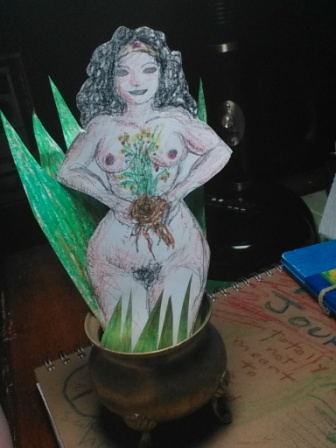
Lady of the Marsh - Copy

Lady of the Marsh by Heather Awen

Since then Heather has worked to gain an understanding of the Lady of the Marsh and her ancestors. She has witnessed torch-lit processions up a winding hill and offerings of weapons of fallen enemies thrown into the marsh with jewellery and gifts of butter. Sometimes these were made from a wooden platform.

On dark nights women went to pray for a ‘baby to fill their womb’ and the dark moon was a special time of communion between ‘a woman and her goddess’. She also saw a woman ‘wrapped in what looked like burlap tied with ropes’ thrown into the marsh whilst people looked on frightened. Heather remains unsure whether this was a ritual burial or sacrifice.

Heather said: ‘The main focus of all of the ceremonies was the understanding that every member of our family lived at the bottom of the marsh. Women would pray there to have one enter their own uterus while the dead, literally at least sometimes, were returned – and this had been happening for a very, very long time, even if language and culture changed.

As things decomposed and layers of soil and water shifted, the lines between those not yet born and those who had lived also decomposed and shifted, bringing a sense of at least partial reincarnation. Once you are a member of the tribe that came from this lady of the marsh, your descendants also would be born from her, no matter how far away in time or space. I was her child even though her worship was an indivisible combination of blood and bioregion.’

II. The Lady of Peneverdant

When I read Heather’s first e-mail introducing some of her visions, I shivered. Although I live in Lancashire what she had seen felt familiar. My hometown of Penwortham was known as Peneverdant ‘the Green Hill on the Water’ in the Domesday Book. Its Bronze Age inhabitants occupied a Lake Village on Penwortham Marsh. This is evidenced by the Riversway Dockfinds: two dug-out canoes, part of a timber platform, animal bones and 30 human skulls dating from 4000BC to 800AD.

It is indubitable these people used Castle Hill as a defensive position and sacred site. On the hill’s summit is a church dedicated to St Mary the Virgin. St Mary’s Well, which was renowned for its healing qualities, lay at its foot. I believe veneration of Mary here is rooted in the worship of an older pre-Christian ‘mother’ goddess.

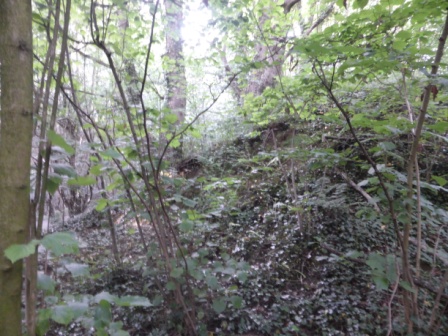
My relationship with this female deity of the hill and marsh, who I am beginning to know as the Lady of Peneverdant, has developed slowly and tentatively. I feel her presence most strongly in the wet mosses and ferns in Penwortham Wood (on the hill’s east bank and side) and sometimes see her face or outline in the dripping ivy.

Lady on the Mound - Copy


During a sequence of lunar meditations I saw members of the Setantii tribe ‘the Dwellers in the Water Country’ leaving the hill in oaken boats paddling down-river on the dark moon and returning on the full moon for a torch-lit procession. As they lit a beacon fire and toasted the moon above and reflected in the waters I felt the building potency of their rite but the rest was cut off.

I often wonder whether the human skulls found near the Lake Village were from marsh burials or even sacrifices. The perfectly preserved head of a woman with long auburn hair wearing a necklace of jet with an amber bead wrapped in coarse woollen cloth (found in Pilling) along with the more famous Lindow Man ‘Pete Marsh’ show ritual burials were not unknown in Lancashire. The current scholarly theory is people who died up-river were carried down and washed up in a tidal pool.

It’s my intuition the Lady of Peneverdant was venerated by local tribespeople as a mother of nurturing and healing waters closely associated with women, childbirth and death, potentially for 4000 years. This changed when the Romans arrived around 70AD and put an end to women playing an equal role in religion to men.

Whereas the Romans venerated The Mothers across Britain, scattered rumours of a Mithraeum near to Castle Hill or within the hill itself suggest a different transformation took place here. The focus shifted from the mother goddess to a divine son: Mithras, who was miraculously birthed from a rock on December the 25th.

This ‘virgin birth’ could go some way to explain the later dedications to St Mary the Virgin. References to an Anglo-Saxon stone cross and inscription of the Magnificat suggest the well was Christianised when the Anglo-Saxons settled in Penwortham (630BC onward?) if not before.

Under Christianity a sacred complex developed centring on Castle Hill and St Mary. Penwortham Priory was built in the 12th C. A pilgrim’s path led to St Mary’s Well where people cleansed their hands and bathed in the healing water. The path led to a stone cross further up the hill where further prayers were said before visits to St Mary’s Church and Priory (which was dissolved in 1535).

The earliest evidence for ancestral burial on the hill is the tombstone of a 12th C ‘crusader’. The oldest gravestones date to 1682 and 1686. The graveyard has been extended several times since 1853 and is now used only for select burials and cremations with the majority of Penwortham’s people being buried at Hill Road Graveyard and Cemetery and in its new woodland burial ground.

The shift of worship and perhaps ancestral burial from the marsh to the hill and from a marshland goddess to St Mary led to the marsh losing its sense of sanctity. Local folklore featuring boggarts, dobbies, fairies, phantoms, and Jen o’ Lanterns show under Christianity marshes became viewed as sinister places associated with old ‘pagan’ beliefs. Even these cautionary superstitions faded.

By the time of the Tithe Map (1837) most of Penwortham Marsh had been drained and reclaimed as farmland. Far worse followed during the industrial revolution. When the dockland was built in 1884 the Ribble was moved south. Penwortham Marsh was cut in two by the river with its larger northern remnant not only becoming Riversway Dockland but part of Preston.

More tragically the Ribble’s movement shattered the sandstone bedrock and breached the aquifer beneath Castle Hill. Afterward St Mary’s Well dried up. Two years ago I had a vision of a water dragon gasping and shrinking then sliding into the underworld. I feel on some level this was the Lady’s womb.

Industrialisation has not ended. In the 1960’s the expansion of the A59 led to the covering over of the site of St Mary’s Well. Penwortham By-pass, built in the 1980’s, now obscures the hill and church, drowning its peace with the roar of traffic. It is my intuition vibrations from the by-pass combined with the shattered aquifer have led to the subsidence of the hill and falling gravestones. This has caused the closure of a large part of the graveyard.

For these reasons my relationship with the Lady of Peneverdant has been slow and difficult. Her marsh has been drained and severed and her holy waters have dried up. Often I feel she and the local spirits don’t want any more contact with humans. At one point I wished to revive their worship and introduce other pagans to the place but I’ve received clear signals this isn’t wanted.

III. Hopeful Coincidences

A couple of days after receiving Heather’s first e-mail I set off down the remainder of the pilgrim’s path toward Castle Hill. In Well Field I asked the Lady of Peneverdant whether she had ever been known as the Lady of the Marsh and if so could she show me a sign. As I walked across the field awash with rain from days of downpour so deep it nearly came over the top of my boots I received the gnosis ‘this is the Lady’s Field’.
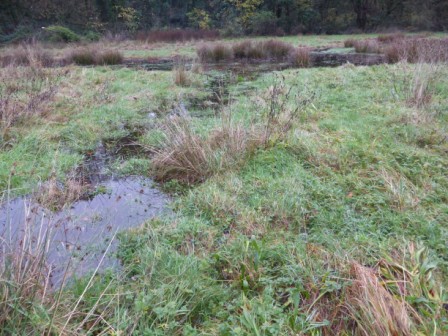
Well Field  - Lady's Field - Copy

Passing the site of St Mary’s Well, ascending the steps, then crossing the A59 to Penwortham War Memorial I caught a glimpse of running water. Looking again I could not believe my eyes. I had found a new ‘spring’ flowing into a stony basin! Drawing closer I saw it was called Centenary Well and dated 1914 to 2014. It must have been built to mark the commemoration of the First World War.
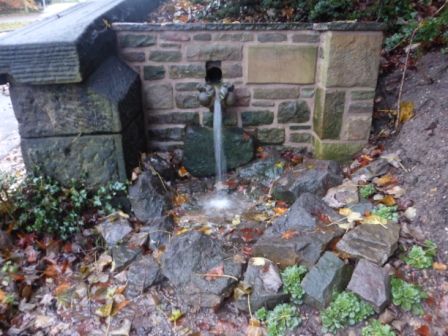
Centenary Well - Copy

How could I not have noticed it before? Could this mean the aquifer wasn’t completely broken? I contacted local historian Heather Crook who told me Centenary Well was built last year by a local joiner called Peter Gildert to commemorate WWI. It was designed to channel run-off water from the hill. I hadn’t noticed it before as I hadn’t been past in a period of such heavy rain. Although I was disappointed to learn the water was run-off, finding the well on the day I posed the question seemed like a sure sign I was on the right track identifying her as the Lady of the Marsh.

The notion people in Lancashire and northern Wales once worshipped similar deities is backed up by Stephen Yeates’ theory that Gwynedd, Powys, Cheshire and Lancashire to Morecambe Bay were included together in Roman Valentia. Evidence from place-names, field patterns and customs based on the Venodotian Laws suggest northern Wales and Lancashire once shared a Brythonic culture. Until the 13th C a Brythonic language called Cumbric, which is similar to Cymric (Welsh), was spoken in Lancashire. My experiences suggest the Lady of the Marsh may be ‘the same’ deity with localised variants rather than the genius loci of a single site, which was my original belief.

One of the questions Heather asked was how to say ‘Lady of the Marsh’ in Welsh. To find out I got in touch with Heron who replied:

“Lady of the Marsh’ is best translated as ‘Arglwyddes y Gors’, although much wet ground in Wales apart perhaps from the marshy areas along the Gwent Levels, is upland boggy moorland, usually known as ‘Migneint’. So ‘Arglwyddes y Figneint’ or ‘Dynes y Figneint’ would also be possible. One other possibility also occurs to me and that is ‘Marian’, not a personal name but a term used to denote marginal (liminal?) land, usually between fields and beach. As a name it probably derives from Mar- or Môr (sea) but it might be fortuitous in this respect?’

In relation to the cluster of Marian sites on or near Penwortham and Preston Marshes: St Mary’s on Castle Hill, Lady Well on Marsh Lane, the site of St Mary’s Church on Friargate and a chapel and hospital dedicated to St Mary in Maudlands, the term ‘Marian’ seemed extremely fortuitous. In relation to its derivation from ‘Mar- or Môr (sea)’ I recalled that in Penwortham St Mary was worshipped as Stella Maris ‘Star of the Sea’ which fits with the long usage of the area by sea-faring people.

Of the Marian sites I mentioned only St Mary’s on Castle Hill remains. Lady Well was connected with a Fransiscan Friary (which gave the names of Friargate and Greyfriar’s Pub). The Friary was dissolved in 1539 but the well remained open until the 19th C. It now lies beneath the carpark of student halls on Lady Well Street. St Mary’s Church on Friargate was founded in 1605 and closed in 1992 and has been replaced by St Mary’s Car Park. It is memorialised by a statue of St Mary with a one-handed Jesus.

Close to the towering spire of present-day St Walburge’s was a leper hospital and chapel run by the Franciscan Friars. This was an important place of pilgrimage in the 14th C. The chapel and hospital began to fall into disrepair in 1520 and were dissolved in 1548. According to local legend, on Christmas Eve bells can be heard ringing in the sunken chapel.

The story of the Lady of the Marsh in Penwortham and Preston is one of loss and sadness. Her very being has sunk down and dried up in a land that is no longer a marsh and been covered over by industrial developments. However Heather’s visions and the fact she is able to access this old, unknown Brythonic goddess through her bloodline from America provide hope.

More positively Heather said: ‘When you told me about that church and other churches like it, I understood that those are the people she still loves and provides for even though the water has been drained and her name has changed again. She’s been there for so long under so many different names being called Mary doesn’t matter as much as the fact that she is still helping; especially women with issues around motherhood and death.’

As the church bells ring out on Christmas Eve from thisworld and the underworld; Catholics prepare for Midnight Mass, Heathens celebrate Mother’s Night and Roman pagans prepare for the birth of Mithras I will honour the Lady of the Marsh.
Riding the White Horse

Carngrwn

In ‘The Conversation of Gwyn ap Nudd and Gwyddno Garanhir’ Gwyn introduces his white stallion, Carngrwn, before introducing himself. He says:

“My horse is Carngrwn from battle throng
So I am called Gwyn ap Nudd”

At first I was surprised to hear Gwyn introducing his horse before himself. Then I realised a medieval audience would have recognised riding Carngrwn ‘Terror of the Field’ was an essential part of his identity as a gatherer souls and a precedent to the revelation of his name.

Later in the poem ‘the white horse’ calls the conversation between Gwyn and Gwyddno to an end. Carngrwn leads Gwyn away to battles not in Neath and Tawe in this land but a Tawe ‘far away in a distant land / where the tide ebbs fiercely on the shore’.

Gwyn’s service as a psychopomp is necessary not only in thisworld but Annwn. It seems Carngrwn, the white horse, has power over his destiny and he has little choice but to trust in and ride this wild kindred spirit to where he is needed most.

Nothing is known about how Gwyn came into partnership with Carngrwn. My intuition is this story may bear similarities with Cu Chulainn’s. Cu Chulainn was born at the same time as two horses: Liath Macha ‘The Grey of Macha’ and Dub Sainglend ‘The Black of Saingliu’. The grey (or white) horse is a companion from birth and protects him until death.

Gwyn is associated with a white horse: Carngrwn and a black horse: Du y Moroedd ‘The Black of the Seas’. Both are supernatural in origin. I feel Gwyn’s relationship with Carngrwn is stronger and the white horse will be with him until the end. In his case this could mean until the end of the world. The white horse is his destiny.

These insights have helped me understand my own relationship with the white horse. Horses have been part of my life since childhood and I worked with them in my twenties. I constantly dream about them and a white fairy-mare is my guide to the otherworld.

Although I haven’t been called to serve as a psychopomp (yet) I know what it’s like to walk between worlds, tell the stories of the dead and feel my destiny is beyond my control. Whenever I’ve sought to find a comfortable role in the system something with big hooves has kicked back and galloped me away.

Yet since meeting Gwyn I’ve got better at riding the white horse: trusting his guidance; staying true to my wild inner nature; letting my fay-mare run and take me where I’m needed; not being restricted by today’s opinions knowing my destiny will keep running until the end of the world.

Crane-Dance and Sunshine

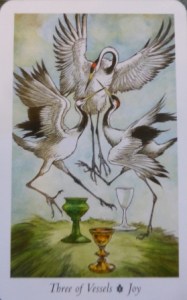
P1130306A card which keeps recurring in my readings (I mainly use The Wildwood Tarot) is ‘The Three of Vessels: Joy’. It features two common cranes dancing and a third spreading its wings, rising into flight with three vessels; white, green and gold. Its meaning is welcoming ‘new life or good fortune’, ‘celebration within a communal group or family’ and ‘successful return after migration’. The reading points state it’s about being able to give ourselves permission to experience ‘authentic joy’ as a ‘gift from the universe’.
At the beginning of the year after completing my first publication: Enchanting the Shadowlands and dedicating it to him, Gwyn ap Nudd advised me to ‘find my sun’. Interpreting this as finding a calling I enjoyed, I balked. Although intuitively I knew continuing to serve Gwyn as an awenydd by recovering his neglected stories and their associations with the British landscape was a source of joy, I couldn’t believe in it.

There were too many awful things happening in the world. Too many other people stuck in meaningless jobs for me to deserve the liberty to follow my joy. So I ignored Gwyn’s advice, took an admin job and tried to force myself into the political sphere: areas antithetical to my natural disposition as an intuitive thinker and poet. Unsurprisingly, I had a thoroughly miserable time.

The event that broke my misery was a holiday to Wales where I experienced the enormity of Cadair Idris and, after reading Heron’s translation of ‘The Dialogue of Gwyn ap Nudd and Gwyddno Garanhir’ on Borth beach, witnessed the otherworld appearing across the sea at sunset: a gift from Gwyddno’s lands and from Gwyn, a King of Annwn. This led me to write a story based on the ancient Welsh poem called ‘The Crossing of Gwyddno Garanhir.’

During my research I found out whilst Garanhir is usually translated as ‘longshanks’, ‘garan’ means ‘crane’ in Welsh and could refer to ‘crane-legs’. That’s how Gwyddno appeared to me: an old man, grey-faced, crane-legged, picking his way along the misted edge of Borth Beach. He had lost his memory. This was because the cranes were gone with their elegant black legs whose dancing alphabet spelled the forgotten names of his kindred.

Cranes became extinct in Britain during the 17th C due to shooting and the draining of wetlands. I’m not sure when the last crane was sighted in the precincts of Maes Gwyddno ‘The Land of Gwyddno’. According to local legend, Cantre’r Gwaelod ‘the Bottom Hundred’ was drowned after the flood gates of Gwyddno’s fort were left open after Seithenin’s seduction of Mererid.

Boddi Maes Gwyddno ‘The Drowning of the Land of Gwyddno’ is set in the 6th century but could have its roots in sightings of an ancient, submerged forest on Borth beach. Whenever it happened, it seems a flood devastated lowland plains, areas of woodland and the homes of a human community. A haunting story tells of church bells ringing beneath the sea. I imagine the flood-waters drowned coastal wetlands and the nesting places of numerous wildfowl too.

Another tale linked with the area is Hanes Taliesin ‘The Story of Taliesin’. After Gwion Bach spilled three drops of Ceridwen’s brew on his finger and imbibed the Awen, the cauldron shattered and its toxic contents spilled across the land and poisoned Gwyddno’s horses. Today this conjures images of large-scale industrial tragedies such as the Gold King Mine Disaster in Colorado in August this year where three millions gallons of waste water flooded into the Animas.

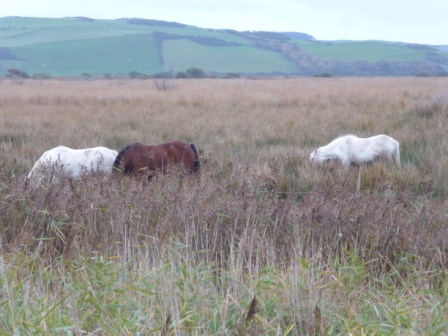
This may not be far from the ‘truth’ as lead mining took place in the hills close to Cors Fochno ‘Borth Bog’ and lead smelting at Taliesin, Llangynfelyn and Ynys Capel during the Roman period. A medieval wooden walkway connecting these sites has recently been discovered. Perhaps an industrial disaster poisoning streams and wildlife gave rise to this tale? (On a happier note, wild ponies can be seen grazing safely near Cors Fochno in the present-day.)

P1120640

Both ‘Dark Age’ tales may be related to the disappearance of cranes from Maes Gwyddno. A story which has not made its way into legend is the draining and enclosure of Cors Fochno. This began in 1813 and reduced its area of 24 square kilometres to 7 square kilometres (now protected as an SSSI). Whilst this took place too late to be cited as a cause of the disappearance of cranes from Cors Fochno it would have decimated other wetland species.

***

Common_crane_grus_grus

Wikipedia Commons

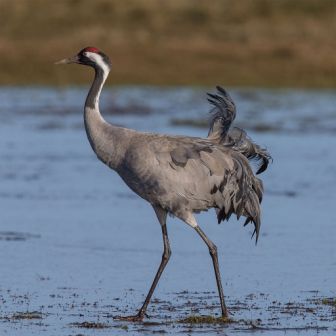
The extinction of common cranes forms an incredibly sad marker in British history. These striking birds with their grey body- feathers, black and white necks and unique red crowns are renowned for the choreography of their elaborate ballet-like courtship-dance which involves a complex sequence of bobs, bows, crouches, coils, spins, leaps, pirouettes and calls.

After mating, both parents care for and fiercely protect their eggs which are laid in May and hatch 30 days later. After 5-6 weeks the parents go through a post-breeding molt which renders them unable to fly. Their offspring are ready to fly at 9 weeks. It seems possible the precarious 3 week period when none of the family can take off played a part in the demise of common cranes.

As well as being an irreplaceable part of the natural world, cranes are deeply embedded in Celtic and Romano-Celtic culture and mythology. The most famous example is Tarvostrigaranus ‘the Bull with Three Cranes’ from a 1st C Parisian monument. In Dorset, a statue of a three-horned bull with three female figures on his back was found in a 4th C shrine. These seem related through lore about women shapeshifting into cranes. In Risingham, Northumberland, a Gaulish slab depicts Victory with a crane beneath her and Mars accompanied by a goose.

Whilst crane stories in Brythonic tradition seem lacking, I found cranes play a central role in Irish mythology. In light of my devotion to Gwyn I was delighted to find several stories connecting his Irish counterpart, Finn, with cranes. In ‘Bairne Mor’ whilst Finn is a young child, his father, Cumhall, is slain in battle. Finn is thrown over a cliff and caught by his grandmother in the form of a crane.

In ‘Cailleach an Teampuill’, Finn encounters the Cailleach as ‘the Hag of the Temple’ with four sons who appear as cranes. They are associated with death and will only ’emerge as warriors’ if they receive a drop of blood from the skull of the Connra Bull (who is owned by the Cailleach).

Finn also comes into custodianship of a crane-bag which belonged to his father. The story of its origin is fascinating. The crane-bag first belonged to Manannan Mac Lir and contained his treasures. It is made from the skin of a crane who was originally a woman called Aoife. Aoife was transformed into a crane by Iuchra; a jealous female rival for the love of a man. In modern Druidry, the crane-bag is associated with the ogham alphabet and used to carry magical tools.

When I wrote my story, the only part of this complex web of correspondences I knew of was the connection of the crane-bag with letters. Considering the relationship between cranes and female shapeshifters, looking back, it’s intriguing I was guided by an impulse to relate Gwyddno’s regaining of his crane-knowledge to memories of his mother.

Gwyddno’s recollections of his identity and ancestry took place under the auspices of Gwyn’s protection as a psychopomp. It is my belief the dialogue is set between worlds after Gwyddno’s death. Because Gwyddno lost his memory before he died he was unable to find his way to Annwn. Thus Gwyn appeared with his dog, Dormach, to help him regain his memory and ancestral connections and aid his crossing.

In my story, after Gwyn helped Gwyddno re-gain his ‘inner crane-knowing’, Gwyddno saw the arrival of his family, including his grandmother and his wife Ystradwen as a flock of cranes. Finally he took crane-form, was united with them and flew to Annwn as it appeared across the sea by the light of the setting sun.

Thus, for me, the three cranes on ‘The Three of Vessels: Joy’ could represent Gwyddno and Ystradwen dancing watched over by Gwyddno’s mother with Gwyn’s presence represented by the misty background. The three vessels seem linked to the three drops of Awen, which had led to the poisoning of the landscape, recovered and contained.

Another interesting coincidence is that Gwyn appears to Gwyddno as a ‘bull of battle’: a sacred title referring to his status as a psychopomp. In the dialogue I picture him as a white warrior wearing a bull-horned helmet. Could there be a link to the magical power of Tarvostrigaranus and / or the Cailleach’s bull? If so my story inverts the transformation of the Cailleach’s sons as Gwyddno shifts from king and warrior into crane-form.

Another piece of Irish lore worth mentioning is that three cranes guard the sidh (mound and otherworld entrance) of Midir. Their calls have the capacity to ‘unman’ warriors and if a crane is seen before battle this is taken as an ill omen. I’ve also read three cranes act as guardians of Annwn. Although I haven’t found a scholarly reference for this yet, it would fit with my suggested crane-trio and Gwyn as a King of Annwn.

***

Whilst writing my story, I was excited to find out common cranes are returning from ‘extinction’ in Britain. In 1979 common cranes arrived at Horsey on the Norfolk Broads. Their survival was made possible by the custodianship and management of ‘Crane Country’ by John Buxton and his team of wardens.

In 2010 ‘The Great Crane Project’ was established and is ongoing. At the WWT Centre in Slimbridge, crane eggs from Germany are incubated and hatched then the chicks are hand-reared and released; mainly on the Somerset levels and also in South Wales, Wiltshire, Gloucestershire, Oxfordshire and East Somerset.

Although over a dozen pairs have established territories and bred, this is the first year chicks have matured to the age of taking flight. In August not only one or two but three young cranes (two in Somerset and one at Slimbridge) took flight for the first time. The trio have all been named Peter after the RSPB’s Peter Newbery who was a driving force behind the project and sadly passed away before he saw the young cranes fly.

A couple of weeks ago, Brian Taylor (who I have been conversing with for a while about soul-birds amongst other topics) mentioned a pair of Eurasian cranes in the ‘wildfowl garden’ of the WWT Centre at Martin Mere. I’d been planning to go to see the Pink-footed Geese and Whooper Swans so visited with my friend, Peter Dillon.

From a distance, I was struck by the Eurasian cranes’ presence and the dramatic change in their appearance from when they crouched and raised themselves to full height. After spending a short while with them, I walked to the other side of their pen. Both turned from a crouched, coiled, position in synchrony, pirouetted then approached. Seeing them perform a simple movement with such grace in captivity I can only imagine their courtship dance in the wild.

Seeing cranes face to face was a source of joy as was re-imagining the dialogue of Gwyn and Gwyddno. During the process I had an overwhelming gnosis of the significance of Gwyn’s role as a psychopomp, the great service he performs for the dead and his promise of blissful re-union with the depths of nature (Annwn) and one’s ancestors in the afterlife.

In Welsh folklore the hounds who help Gwyn gather the souls of the dead are called Cwn Annwn: ‘Hounds of the Otherworld’. Their barking is identified with noisy nocturnal flights of geese. The hounds in Lancashire folklore who perform this role are Gabriel Ratchets and their baying is also connected with droves of geese and wild swans.

In Wales and Lancashire to hear swans or geese flying over at night is a portent of death. During the day at Martin Mere hearing the calls of Whooper and Bewick’s Swans, Pink-footed and Barnacle Geese on the lakes and overhead filled me with great joy: in their presence and a sense of knowing like them one day I would be going ‘home’ to a land far away.

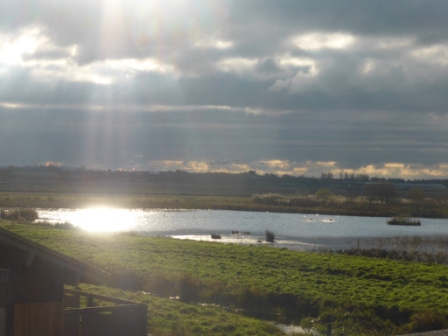
Looking out from the Ron Barker Hide across wetlands lit by magical rays of sunshine as flights of geese and swans arrived and departed I realised in Gwyn, his stories and their revelation within this remarkable landscape I had found my joy, my Awen: my sun.

P1130233 - Copy

I perceive parallels between the return of cranes and the re-emergence of the stories of the old gods and ancestral animals of Britain. Such returns don’t happen on their own or without people dedicated to making them happen. Thus I see my vocation as an awenydd to Gwyn and the spirits of the land not only as a source of joy for myself but hope for future generations. I’ve found my sun and finally accept its gifts.

***

SOURCES

AlainaFae and Cliareach Filleadh, ‘Crane’s Cauldron / Brigid’s Cross
AlainaFae and Cliareach Filleadh ‘Artistic Creation Exploration: Corr Teanga
Anne Ross, Pagan Celtic Britain, (Cardinal, 1974)
Miranda Green, Animals in Celtic Life and Myth, (Routledge, 1992)
The Wildfowl and Wetlands Trust, Waterlife, 194, Oct / Dec 2015
The Great Crane Project
The Norfolk Cranes’ Story

Lund-in-the-mist and Altar to the Mothers

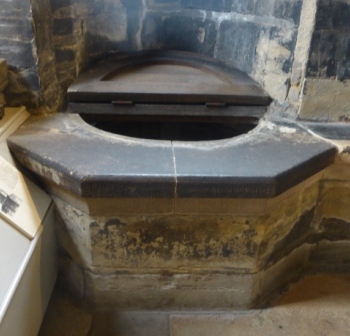
At the beginning of November, I cycled to the church of St John the Evangelist in Lund, which is about six miles outside Preston. Lund means ‘grove’ in Norse and Germanic thus it seems likely the church was built on a pre-Christian sacred site. This is supported by the presence of an altar to the Mothers within the church now used as a baptismal font.

Matronae ‘Matrons’ and Matres ‘Mothers’ were worshipped across Northern Europe from the 1st to 5th C particularly in Germany and Gaul and other places occupied by the Roman army. They are usually depicted in threes, often with fruit, bread, cornucopias and nursing infants.

Worship of the Mothers was widespread in Britain. Whilst some of the Mother Goddesses were clearly brought from over-seas (shown by inscriptions reading ‘To the Mothers from Overseas’ ‘To the German Mother Goddesses’) there is evidence for a Romano-British tradition centring on Matrona ‘the Mother’ and Maponos ‘the Son’ which seems strongest in north-west England and southern Scotland.

Altars and inscriptions to ‘the Mother Goddesses’ and ‘the Mothers the Fates’ have been found at Burgh-by-Sands, Carlise, Old Penrith, Skinburness and Bowness-on-Solway. The worship of Maponos in this area is evidenced by the place-name Lochmaben, the Clochmaben stone and the Locus Maponi.

Matrona and Maponus re-appear in medieval Welsh literature as Modron ‘Mother’ and Mabon ‘Son’. The story of Mabon being stolen from Modron when he is three nights old and rescued from imprisonment in a ‘house of stone’ forms an important part of Culhwch and Olwen.

In The Triads, Modron daughter of Avallach, bears Urien Rheged’s son and daughter, Owain and Morfudd. Urien’s relations with Modron and Owain’s inheritance of Mabon’s divine qualities show his family’s dependence on ancestral deities for the fertility of their land and lineage and success in battle.

Modron’s father, Avallach, is the son of Beli Mawr: one of the oldest ancestral gods of Britain. He is associated with Ynys Avallach ‘The Island of Apples’ or ‘The Island of Avalon’. This is inhabited by nine maidens: Morgan and her sisters. In Welsh and Breton folklore, Morgens are water spirits.

The Mothers are frequently associated with water: in Gaul, Matrona is goddess of the Marne. A reference from 1AD exists to ‘the Island of Sein’ ‘known because of the oracle of a Gaulish God; the priestesses of that divinity are nine in number.’ One wonders whether the god is Dis Pater, from whom the Gauls claim descent.

Avalon is often identified with Glastonbury. Another of Glastonbury’s deities is Gwyn ap Nudd, a King of Annwn who resides over spirits bearing striking similarities to the Gaulish andedion (underworld gods). Both Morgan and Gwyn become known as ‘fairies’ in later literature.

In Peniarth Manuscript 147. the mother of Urien’s children appears as the Washer at the Ford (‘The Ford of Barking’) and introduces herself as ‘daughter to the King of Annwfn’.

A pattern emerges: one, three or nine female figures connected with an underworld god.

Here in Lancashire there are altars to the Matronae and to Maponos (as Apollo-Maponus) in the Roman museum at Ribchester. This is the site of Bremetenacum ‘place by the roaring river’ and is located on a major ford of the Ribble. Ribchester was also likely to have been a centre of worship for the Ribble’s goddess: Belisama ‘Most Shining One’ ‘Most Mighty One’.

During the Romano-British period, the Ribble ran much closer to Lund. This is shown by the nearby place-name Clifton ‘Cliff Town’. St John the Evangelist also stands very close to the Roman road running from Ribchester through Preston to Kirkham and across the Fylde. Because the stone of the altar at Lund is similar to those from Ribchester, it seems possible it was made there and brought on the road. This would mean, like the Ribchester altars, it dates from 2BC.

The altar’s appearance as a font is recorded in a leaflet in the church. In ‘the records of the Parish Vestry’ it says ‘Matt Hall, Churchwarden of Kirkham in 1688 set up a scandalous trough for a font in Lund Chapel…. For this poor Matthew was presented, that is brought before, the bishop of the diocese. History does not record the outcome of the interview, nor for that matter, how he came by the ‘scandalous trough’ in the first place.’ In spite of the ‘scandal’, the ‘trough’ is still used as a font today.

When I set out to St John’s it was originally for a recky so I could get the timing right when I booked an appointment to visit. Therefore it was a pleasant surprise to find the church open (it’s open every day from 10am) and to be greeted by Joan Shepcot, a volunteer gardener and co-ordinator of the Children’s Society, who invited me in to see the altar and let me take as many photographs as I needed.

2. Altar to the Matres, front

As I approached the altar I could see it was beautifully maintained. Three female figures wearing loose dresses or robes stood in the centre. Their hair looked coiffured or perhaps they were wearing headgear. Were they one Mother Goddess in triple-form? Three individual Mothers or the Mothers the Fates?

P1120472 - Copy

On the right and left hand side of the altar female figures were depicted dancing, arms above their heads, feet tapping a beat. They were also clad in loose robes or dresses. Were these the Mother Goddesses dancing? Or perhaps nymphs of the sacred grove? Or devotees? Their swaying stances with arms raised reminded me a little of trees.


Together could they form a sisterhood of nine? Could the ancestral presence of an underworld god be felt in the background?

7. Faith, Hope and Charity

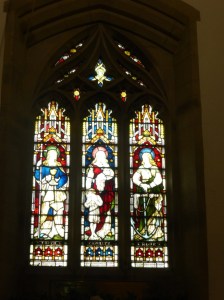
The back of the altar was blank because it once stood against a wall. Behind the altar was a stained glass window depicting Faith, Hope and Charity with the head of an unnamed male figure in blue and gold above. This is interesting because Alex Garman says these ‘three sisters’ show a strong influence of the Matronae. Considering their presence on a font I found myself imagining ‘the Mothers the Fates’ as ‘fairy godmothers’ at baptisms.

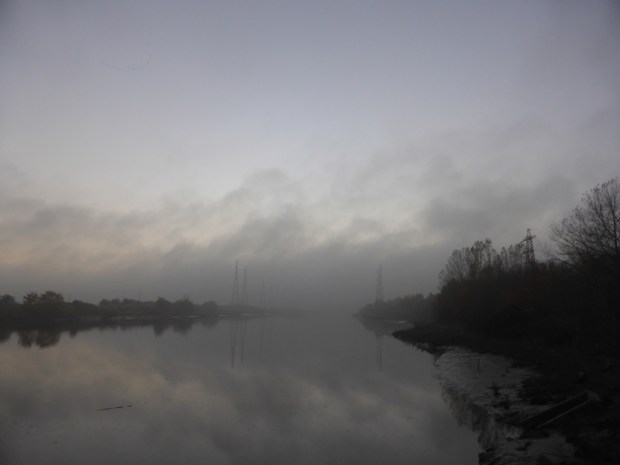
After a chat with Joan about her wildflower patch I cycled to the next point along the Roman road from St John’s: Dowbridge. As I headed back from the bridge over the river Dow, mist descended; cloaking St John’s at Lund, Clifton Cross and Clifton Mill. Rolling over Savick Brook and the Ribble.

In the cold swathes of mist passing over grey waters where time stood still I sensed the passage of underworld spirits. I had, after all, stumbled out on All Soul’s Day.

P1120528

*Many thanks to Joan Shepcot at St John the Evangelist in Lund for permission to use these photographs on my blog.

Glasgow Cathedral and the Stories of Teneu, Kentigern and Lailoken

P1120028

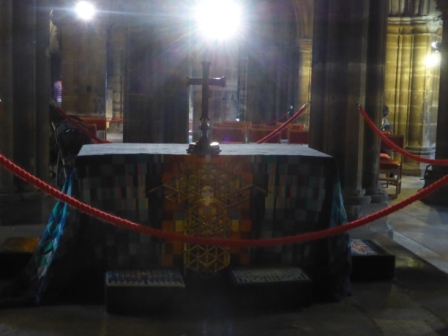
One of the last places I visited during my time in Glasgow was the cathedral, which was founded on the site of St Kentigern’s tomb. The first stone was laid in 1136 and the building was consecrated in 1197. During this period, Bishop Jocelin commissioned Jocelyn of Furness to write The Life of St Kentigern (1185) to encourage devotion to the saint.

The story of Kentigern’s birth is a troubling one. His mother, Teneu, was the daughter of Lleuddun, ruler of Gododdin. Teneu was seduced by Owain, ruler of Rheged, in the guise of a woman. Afterward she became pregnant.

When Lleuddun found out, he threw her off Dumpelder (Traplain Law: a hill in Gododdin, which may have been the seat of power prior to Din Eiddyn; Edinburgh). Luckily she survived and washed up in a coracle on the river Forth at Culross. There Kentigern was born.

Teneu is now revered as a saint. A medieval chapel to her once stood on the site of her grave at present-day St Enoch Square. At the ritual to Epona, I was told the well in the cathedral dedicated to Kentigern as Mungo may originally have been to Teneu. This is backed up the nearby street-name Lady Well Street.

P1120066

This made me wonder whether Teneu may have been a pre-Christian deity. Owain is often equated with Mabon and his mother is Modron. These names are derived from the pre-Christian deities Maponus ‘the Son’ and Matrona ‘Mother’. In a Welsh romance, Owain courts, acts as a guardian for, and eventually marries ‘The Lady of the Well.’

Combined with her river-journey this suggests Teneu may have been a deity connected with sacred waters. If this is the case, her appalling treatment by both Owain and Lleuddun forms a sad reflection on the transition from a worldview where water-deities were revered and women were treated as equals to patriarchal Christianised society.

Teneu and Kentigern were taken in by Saint Serf, who named the boy Mungo ‘my dear’. Kentigern started preaching when he was twenty-five and built a church where the cathedral now stands. He was then expelled by an anti-Christian movement headed by King Morken, ruler of Strathclyde*.

Kentigern fled to Wales until called back by Strathclyde’s new Christian ruler, Rhydderch Hael, after the Battle of Arfderydd in 573. Rhydderch’s defeat of the pagan ruler, Gwenddolau, formed a precedent for St Kentigern’s conversion of the people of Hoddom, who were said to have worshipped Woden**. Kentigern then returned to Glasgow.

Whilst praying in the wilderness, Kentigern met Lailoken (Myrddin Wyllt) who spoke of the source of his ‘madness’: a vision of host of warriors in the sky after the Battle of Arfderydd and being ‘torn out of himself’ by an evil spirit and assigned ‘to the wild things of the woods’.

Afterward, Lailoken followed Kentigern back to Glasgow and took to prophesying from a steep rock above Molendinar Burn (unfortunately covered over in the 1870’s and now beneath Wishart Street) north of the church.

Little heed was paid to his words because they were obscure and unintelligible and he refused to repeat himself. However, some of his ‘apparently idle remarks’ were written down. I wonder whether these lost fragments, passed on orally, could have formed the basis for the prophetic poems attributed to Myrddin in The Black Book of Carmarthen?

Just north of Glasgow Cathedral, Lailoken predicted his ‘three-fold’ death and supposedly begged Kentigern for communion before he met his end.

P1120017


Kentigern’s miracles are depicted outside and within the cathedral and on Glasgow’s Coat of Arms: a robin he brought back to life, a hazel tree from which he started a fire, and a bell he brought back from Rome. Most curious is a fish which swallowed a ring, belonging to Rhydderch’s wife, Languoreth. Rhydderch is said to have thrown her ring into water with the purpose of proving she had given it to a lover. By ordering one of his monks to catch the fish, Kentigern saved her from execution.

Perhaps Kentigern’s compassion resulted from knowledge of his mother’s near execution at the hands of his grandfather?

In his old age Kentigern became increasingly debilitated to the point his chin needed to be tied up with a bandage. He is said to have died in the bath on Sunday 13th of January in 614.

P1120074

*An alternative king list does not name Morken but Tutagual, Rhydderch Hael’s father as his predecessor to the rulership of Stratchclyde.
**This seems to be an anachronism because the Anglo-Saxons had not arrived in south-west Scotland in the 6th century.

Dumbarton Rock

Consolidating Gwyn ap Nudd’s links with the Strathclyde Britons

In October after the ritual to Epona I stayed overnight with Potia and Red Raven in Glasgow. The next morning, Red Raven kindly took me to visit Dumbarton Rock: Dun Breatann ‘Fortress of the Britons’ to continue my research on Gwyn ap Nudd’s lost connections with the Old North.

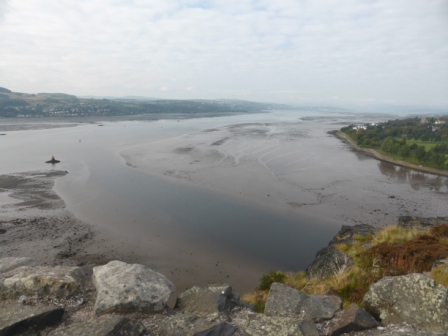
Dumbarton Rock stands on the estuary of the river Clyde beside the river Leven, stern, stony, commanding, cloven into two peaks, White Tower Crag and The Beak. Its proximity to an ancient hill fort on Carman Hill and Roman Forts such as Whitemoss guarding the estuary suggest its use as a defensive position from at least the Iron Age and Romano-British periods. Looking up at its vertical cliff face from beneath and climbing its 557 steps provided a distinct impression of how difficult it would have been to attack.

Dunbreatann emerged as the capital of Strathclyde, controlling south-west Scotland after the Romans withdrew from the Antonine Wall, in the 4th century. Later it was known as Alt Clut ‘Clyde Rock’. The first written reference comes from St Patrick from Ireland between 453 and 493AD, reprimanding Coroticus (Ceretic, ruler of Alt Clut) for taking his new Christian converts and selling them as slaves to the Picts.

The majority of its rulers were descendants of Ceretic: notably Dyfnawl Hen, Cinuit, Clinoch, Tutagual then Rhydderch Hael. After Rhydderch’s death in 612, rulership passed to another line stemming from Ceretic: Neithon son of Guipno and his lineage ruled until Dumbarton Rock was taken by the Vikings in 869.

A fragment in The Black Book of Chirk states that following the death of Maelgwn Gwynedd in 547, Elidyr Mwynfawr (first cousin of Tutagual and husband of Eurgain, Maelgwyn’s oldest legitimate daughter) attempted to seize the throne from Maelgwn’s illegitimate son, Rhun. Elidyr was killed at Arfon. This led to Rhydderch Hael, Clydno Eiddin, Nudd Hael and Mordaf Hael burning Arfon in revenge and being pursued north by Rhun’s forces to the river Gweryd.

Elidyr’s journey is recorded in a triad of ‘Horse-Burdens’ where the eponymous water-horse Du y Moroedd (‘The Black One of the Seas’) is said to have carried Elidyr and his party (seven and a half people including a cook hanging onto the crupper- hence the half!) from an unknown Benllech in the north to Benllech on Anglesey. Du is notably the steed ridden by Gwyn ap Nudd in the hunt for Twrch Trwyth (‘King of Boars’).

Rhydderch Hael (‘the Generous’) is the most famous of Strathclyde’s rulers. He was renowned as one of ‘Three Generous Men of Britain’ and owned a sword called Dyrnwyn ‘White Hilt’ which burst into flames when held by a well-born man and was numbered amongst the Thirteen Treasures of Britain.

The extent of Rhydderch’s generosity is hinted at by the third ‘Unrestrained Ravaging’ where Aeddan Fradog (‘the Wily’) came to his court and left no food, drink nor living beast (if Rhydderch was exceedingly generous and Aeddan took everything he must have been greedy and unrestrained indeed: one can sense the shock and disbelief of a contemporaneous audience).

Rhydderch championed Christianity and was the patron of St Kentigern. He came to power in 573, which coincides with the Battle of Arfderydd. Poems attributed to Myrddin Wyllt in The Black Book of Carmarthen suggest Rhydderch played a leading role in the defeat of the pagan ruler, Gwenddolau at Arfderydd and this was a factor in his rise to power.

In The Black Book of Carmarthen Gwyn ap Nudd states his presence at Gwenddolau’s death. Gwyn’s appearance to gather the soul of Gwenddolau and other dead warriors played a role in Myrddin’s madness and flight to Celyddon. The ex-warrior become wild man and prophet was hounded by Rhydderch Hael and supposedly converted to Christianity by St Kentigern.

Rhydderch also played a prominent part fighting against Theodric of Anglo-Saxon Bernicia with his Brythonic allies Urien Rheged, Gwallog ap Llenog and Morcant Bulc. During the campaign, whilst the Anglo-Saxons were successfully blockaded on Lindisfarne, Morcant assassinated Urien; a move which eventually led to the fall of the Old North.

Rhydderch’s successor, Nwython (Neithon) and his family feature prominently in the episode of Gwyn, Gwythyr and Creiddylad in How Culhwch won Olwen. After Gwyn ‘abducts’ Creiddylad from Gwythyr and takes her to Annwn, Nwython, his sons Cyledyr and Pen, Dyfnarth (Dynfawl?) and his Dyfnarth’s father Gwrgst Ledlwm join Gwythyr in an assault on Gwyn to win her back (four generations of Strathcylde Britons!).

Gwyn defeats Gwythyr and his army and imprisons them. During their imprisonment, Gwyn kills Nwython and feeds his heart to Cyledyr, who becomes wyllt (‘wild’ ‘mad’). Arthur then rescues Gwythyr and his men and places a command on Gwyn and Gwythyr to battle for Creiddylad every May Day until Judgement Day.

It is my intuition this story originates from an earlier seasonal myth where a hero (‘the Summer King’) challenged the god of Annwn (‘the Winter King’) for the love of a goddess of fertility and sovereignty who may originally have been revered as a free agent in a sacred marriage.

This episode is only one variant, fixed in 6th C Strathclyde, known because of its incorporation within the narrative of How Culhwch won Olwen (14th C). It is clear Gwyn has lost his status as a god of Annwn and Creiddylad her independence as a fertility goddess. Its fixity may be read to mark the death of a seasonal rite and its transition into story.

No doubt this coincided with the rise of Christianity, which led to Gwyn’s demonisation as the representative and literal embodiment of the ‘demons’ of Annwn and Creiddylad’s demotion to a helpless maiden flung like a ragdoll between two male lovers and finally locked away, powerless, in her father’s house.

The seasonal myth is thus replaced in the 6th century with a story designed for the political purpose of cementing alliances between the Strathclyde Britons, Gwythyr ap Greidol (deified as ‘the Summer King’) and Arthur against a common enemy: the demonised King of Winter and Annwn, Gwyn ap Nudd.

The disturbing sequence of Gwyn’s murder of Nwython and torture of Cyledyr has led me to question whether it has any historical basis. From my research so far there is nothing to suggest Nwython died a sudden or inexplicable death or disappeared during a campaign (often attributed to otherworldly forces).

However this does not mean such stories did not exist. Another explanation is that it was cited by the bards of Christian rulers to highlight the atrocities Gwyn committed against the lineage of Strathclyde to keep paganism at bay. One can only imagine the fear and repulsion of Strathclyde’s people and in particular Nwython’s descendants when it was voiced.

P1110994

It seems possible early variants of these stories were told in the fortress on The Beak alongside inaugural poems which would form Y Gododdin and The Black Book of Carmarthen. The existing texts suggest belief in Gwyn as a psychopomp lingered on beside the Christian faith for a long while. As a guide and warrior-protector to some and a cruel, demonic figure to others, he haunted the margins of every recital of battle-tales.

After Dumbarton Rock was taken by the Vikings, the kingdom of Strathclyde re-emerged up-river at Govan and stretched from Glasgow into Penrith in Cumbria. During this transition and, later, when Strathclyde was finally integrated into Scotland in 1034 many Britons went into exile and settled in Wales. In medieval Wales the oral tales about Gwyn ap Nudd and the fall of the Old North were finally penned.

Since then Dumbarton Rock has seen various uses; most notably as a medieval royal castle with its famous Wallace Tower. It is now primarily a tourist attraction within the custodianship of Historic Scotland.

Time passes. History fades into story into myth and even myth is forgotten. Yet the deepest myths are fated to return from the most distant edges of the otherworld like a boomerang.

P1110997

Looking out across the Clyde and Leven from the Fortress of the Britons I saw a pair of ravens who have lived forever on that ancient rock flying on the winds from there into poetry to the realm of the gods and back again.

P1120006

On that note I’ll thank Red Raven for taking me to Dumbarton Rock and bring this piece to end.

Gwyn ap Nudd and the Gwyllon: ‘Wyllt-ness’ and the Healing Power of Art

Barrow Mound, Fulwood

The wight whose footsteps I heard
imprinted on my cold soul,
the cold marrow of my bones.
He walked in soul as his bones laid still
and my soul reached out to him:
another one of the gwyllon.

The glimmer of fairy lights.
This place secluded and so still.

Fulwood Barrow MoundSometimes you stumble somewhere and forget yourself. No longer breathing. In the time of the gods. You hear the footsteps of a deity. Not your deity. But one connected with him.

***

In the mythology of ancient Britain, Gwyn ap Nudd (a ruler of Annwn and guide of the dead) is intimately connected with ‘gwyllon’: madmen, wildmen, wraiths, who through some traumatic experience have become ‘outside themselves’, open to the otherworld, ‘wyllt’.

The most famous is Myrddin Wyllt. Myrddin is a golden-torqued warrior of the court of the northern British ruler, Gwenddolau, who becomes wyllt after the Battle of Arfderydd; a conflict between Brythonic kinsmen renowned for its carnage and futility.

Looking across the battlefield, stricken with guilt because his sister Gwendydd’s sons are amongst the dead, Myrddin sees an unendurable brightness and martial battalion in the sky. It seems possible this is Gwyn (‘white’ ‘blessed’ holy’ from Vindos or Vindonnus ‘white’ ‘clear light, white’) and his host: the spirits of Annwn and the war-dead, approaching to gather their kindred to the otherworld.

‘Torn out of himself’ by one of these spirits, Myrddin flees to Celyddon (the Caledonian forest). He wanders there ‘ten and twenty years’ with ‘madness and madmen’ ‘gan willeith a gwyllon’. These gwyllon are ‘seven score men’ who also fought at Arfderydd then lapsed into madness in Celyddon and perished.

Similar cases are found in The Triads of the Island of Britain: ‘Tri Gwyd Ellyll Ynys Brydein’ ‘Three Wild Spectres of the Island of Britian’. The notes state ‘ydellyll’ (for ‘gwyd ellyll?’) ‘occurs in the Gododdin in reference to furious activity in battle’ and could relate to tales of men who become wyllt as a consequence of war.

What makes Myrddin’s story unique is his recovery. Amongst wild creatures of the forest; a piglet, a wolf and a favourite apple tree he undergoes a healing process through which he learns the art of poetry and uses it to prophecy against future bloodshed.

***

Cyledyr Wyllt possesses an entirely different story. In Culhwch and Olwen, after Gwyn abducts Creiddylad, his rival Gwythyr ap Greidol raises an army of northern men to win her back. Amongst them are Cyledyr and his brother, Pen, his father Nwython and his great grand-father’s brother, Gwrgst Ledlwm. If Gwrgst is still living this means Cyledyr must be in his teens.

Gwythyr and his army attack Gwyn. My intuition is this attack represents a raid on Annwn. Gwyn triumphs over Gwythyr and the northern men and takes them prisoner. During their captivity he kills Nwython and feeds his heart to Cyledyr, who goes mad. The etymological links between Cyledyr and Celyddon suggest that, like Myrddin, he flees to the forest.

Gwyn’s motive for torturing Cyledyr is never explained. Did he do it from fury? For vengeance? Did he have some darker purpose in feeding a young man his father’s heart? Could this have originated from some arcane rite of the past whereby the strength of one’s ancestors was conferred by eating their flesh, of which Gwyn makes a mockery?

Another question worth asking is ‘Did it happen at all?’ The historical Nwython is recorded to have died in his bed.

It seems possible Cyledyr’s fevered recollections result from the effects of unbidden entry to Annwn, the battle between Gwyn and Gwythyr’s forces and time spent in prison on an impressionable young mind. Whilst Cyledyr is telling this story Nwython could be anguishing over the unknown fate of his son. Whether Cyledyr recovered from his trauma or died in Celyddon remains uncertain.

***

Another story I believe features Gwyn (as the King of Fairy) and a human ruler who becomes wyllt is Sir Orfeo. This begins when the Fairy King abducts Heurodis, Orfeo’s wife. Driven wyllt by grief, Orfeo abandons his sovereignty and departs ‘like a beggar’ for the wilderness where his only solace is playing his harp, which brings joy to the wild creatures.

After ten long years Orfeo finally finds a way into Fairyland. After travelling sunlit green plains and hunting grounds he comes to the Fairy King’s glass palace. Therein he makes a terrible discovery: ‘Folk long thought dead… as living found’ headless, armless, torn, ‘with dreadful wounds’, ‘full-armed on horses’, strangled, drowned, burned, wives laid in child-bed ‘stolen out of life’: those ‘the fairies seize and keep’. Heurodis lies amongst them.

These images represent a little-known truth, rarely made explicit in Brythonic mythology: the beauty of Fairyland is founded on the horror of death. The knights and damsels of the Fairy King’s hunt who feast in his hall number the war-dead, murder-victims, women who have died in labour.

Heurodis is amongst them because when the Fairy King took her whilst she slept beneath an orchard tree she died or became comatose or catatonic. Such superstitions can be traced through Brythonic fairylore to earlier beliefs about Gwyn and the spirits of Annwn conveying souls to the otherworld.

This knowledge does not prevent Orfeo from entering the Fairy King’s hall and playing his wondrous music. The King is so moved he offers Orfeo anything he wants. Of course, Orfeo asks for Heurodis. He brings her back to this-world where the pair are re-united in sovereignty.

This story shows how Orfeo gains his ability as a musician from his period wandering wyllt and that hard-won art has the power to move the gods, to sing the souls of those held captive in Fairyland back to this earthly home.

***

These myths represent the experience of becoming wyllt at the outermost limits of human experience. The ‘wyllt-ness’ of Myrddin and Cyledyr results from battle trauma. Cyledyr’s battle trauma is exacerbated by his unwarranted entry into Annwn, imprisonment in the ‘not-world’ and real or imagined torture by Gwyn.

Orfeo’s story differs slightly. His wyllt-ness results from loss. His time spent wandering the wilderness provides him with the strength to survives his gnosis of the terrible truth at the heart of Fairyland and Heurodis’ fate to win her back and return to his seat of rule.

Key to the survival of becoming wyllt is the power of art. For Myrddin and Orfeo giving voice to their trauma and to the powers of nature who surround and console them is an essential part of the healing process. It is possibly because he does not discover art that Cyledyr remains wyllt. This may also be the case for the other gwyllon who lapsed into madness and perished.

These stories contain lasting significance for modernity where art and nature therapy are recognised as powerful means of helping victims of war and loss.

***

Later folktales represent a variety of different encounters with and responses to Fairyland. In most we find the recurrent themes of wyllt-ness and art. People who meet fairies, stumble into or are taken to Fairy invariably become ‘dead, mad or poets’. My personal experiences with Gwyn and his realm bear stronger resemblances to these tales.

Glastonbury TorIn the year 2000 at Glastonbury Festival (long before I knew the name of the mysterious god of the Tor) I had a vision of what I recognise now to be Fairyland which left me shocked, stunned and profoundly questioning the nature of reality.

My quest for an explanation led me through a dangerous combination of drink, drugs, all-night dancing and all the texts of the Western European philosophical tradition, deeper into madness, to the brink of an abyss where I was faced with the choice of life or death.

Unable to choose either I was confronted by three beings I now recognise as ellyllon (‘fairies’ akin to gwyllon). What followed was equally beautiful and perturbing and put an end to the pain of having to make that choice. My experiences left me half-wyllt, wandering between life and death, plagued by anxiety and panic attacks and put a temporary end to my vision-quest.

After giving up my philosophy PhD, I spent four years working with horses. During this period of re-connecting with the land, the seasons and the animal world, working hard and thinking little, I underwent a return to nature that bears a little analogy to the flight of the wyllt to Celyddon.

When I met Gwyn and put a face to the god who governed the magical landscape I haphazardly intruded on at Glastonbury Festival twelve years ago, my initial terror was edged by relief. I finally knew the source of the calling to the otherworld that had haunted me for as long as I can remember. Gwyn became my patron and I his awenydd: ‘person inspired’ or ‘poet’.

***

In the contemporary world where poetry, let alone pagan poetry, is rarely acknowledged or valued the path of the awenydd is not an easy vocation. Deep gnosis of nature and Annwn and its deities necessarily places one outside the bounds of ordinary experience; makes one wyllt, other. With Celyddon gone there is no wild and wooded place of retreat outside the norms of society where gwyllon can flee and gather in company.

Yet in the shaded spaces of our localities where trees still stand and that great forest stood before it walked to Scotland centuries ago we can commune with the gwyllon of old and find unison with the gwyllon of today. Sharing can also take place in the green nooks and crannies of books, in the pubs and cafes and wooded stages where we perform and on the internet. In our stories we find camaraderie.

In a world becoming increasingly superficial where we are losing touch with the deep knowledge our ancestors held to help those touched by the wyllt-ness of Fairyland be it through trauma, loss, enchantment or some silly mistake, we have never had a greater need for the stories of Gwyn ap Nudd and the gwyllon. For the healing power of art.

Castle Hill from Fairy LaneSOURCES

Bromwich, Rachel (ed) The Triads of the Island of Britain (University of Wales Press, 2014)
Bromwich, Rachel and Evans, Simon D. (eds) Culhwch and Olwen (University of Wales, 1998)
Davies, Constance ‘Classical Threads in Orfeo’ The Modern Language Review, Vol 56, No 2, (Modern Humanities Research Association, April 1961)
Davies, Sioned (transl.) The Mabinogion (Oxford University Press, 2007)
Evans, J. Gwengobryn The Black Book of Carmarthen (Lightning Source UK Lmtd, 1907)
Friedman, John Block ‘Eurydice, Heurodis and the Noon-Day Demon’ Speculum, Vol 41, Vol 1 (Medieval Academy of America, 1966)
Hunt, Edward Eyre Sir Orfeo (Forgotten Books, 2012)
Pennar, Meirion (transl.) The Black Book of Carmarthen (Llanerch Enterprises, 1989)
Skene, William F. The Four Ancient Books of Wales (Forgotten Books 2007)
Thomas, Neil ‘The Celtic Wild Man Tradition and Geoffrey of Monmouth’s Vita Merlini: Madness or Contemptus Mundi?’ in Arthuriana Vol. 10, No. 1 (Spring 2000)
Tolstoy, Nikolai The Quest for Merlin (Sceptre, 1985)

Gwyn ap Nudd and Gwallog ap Lleenog: One Brother Dies and the Other Lives On

In The Conversation of Gwyn ap Nudd and Gwyddno Garanhir, Gwyn states his presence at the death of Gwallog ap Lleenog ‘From a long line of princes / Grief of the Saxons’. Gwallog is a descendant of Gwyr y Gogledd ‘The Men of the North’. His descent on his father’s side is recorded in the Harleian Genealogies. ‘[G]uallauc map Laenauc map Masguic clop map Ceneu map Coyl hen.’ This places him amongst the lineage of Coel Hen (Old King Cole).

More importantly within the context of my research on Gwyn ap Nudd and the Old North, Gwyn, Gwallog and Caradog are mentioned as half-brothers through their shared descent on the maternal side from Tywanwedd in Descent of the Saints. Tywanwedd is the daughter of Amlawdd Wledig, a Welsh prince who may have ruled on the border of Herefordshire.

These three brothers appear again in an entry in Peniarth MS 132: ‘Gwyn ap Nudd greiddyei (?) ap Lludd. He went to Llew ap Llyminod Angel. He went between sky and air. He was brother to Caradog Freichfras and Gwallog ap Lleenog. He and they had the same mother.’

Between Sky and Air

Between Sky and Air

In Geraint son of Erbin Caradog, Gwallog, Gwalchmai and Owain son of Nudd appear alongside Arthur as ‘guarantors’ of Edern son of Nudd after he is mortally wounded by Geraint. Caradog and Edern appear together as Arthur’s ‘counsellors’ in The Dream of Rhonabwy. This brings to light further familial links.

It is of great interest to note that if Tywanwedd is Gwyn’s mother, this places him in the same lineage as Arthur (Arthur’s mother was Eigr daughter of Amlawdd) and Culhwch (Culhwch’s mother was Goleuddydd, daughter of Amlawdd): the three are first cousins (!).

However, Peter Bartrum argues due to Gwyn, Gwallog and Caradog’s ‘disparate nature’ in ‘character, place and time’ it was more likely their mother was a fairy like Gwyn. Considering Gwyn is a god whose worship as Vindos / Vindoroicos / Vindonnus can be traced back to the Romano-British period it seems clear she must also have been divine: a goddess who, like Gwyn, may later have been perceived as a fairy.

As within Brythonic mythology there is a long tradition of relations between deities and mortals, often bearing offspring (for example Owain Rheged’s parents were Urien Rheged and the goddess Modron, mother of Mabon) it seems possible the story behind Gwallog’s birth was that his father, Lleenog, slept with a fairy woman. Perhaps one of her guises was Tywanwedd, and as Tywanwedd she seduced Lleenog?

The story of Gwallog’s birth from a fairy woman provides some fascinating insights into the continuity of pagan beliefs within a northern British society that was nominally Christian. It also supports my growing intuition that Gwyn, his father (and now his mother) were viewed as ancestral deities by the Britons of the Old North, Wales and beyond.

***

Gwallog’s kingdom is traditionally Elmet. This is derived from Ifor Williams’ translation of lines in The Song of Gwallawg ap Lleenawg where Gwallog is named ‘a judge over Elmet’. Bede speaks of ‘silva elmete’ (‘the forest of Elmet’) saying ‘subsequent kings made a house for themselves in the district, which is called Loidis.’ Loidis is Leeds and place-name evidence suggests Elmet covered West Yorkshire.

Further evidence Gwallog ruled Elmet comes from Nennius’ History of the Britons. He tells of how Edwin of Northumbria ‘occupied Elmet and expelled Certic, king of that country’. Certic is usually identified as Ceredig, Gwallog’s son.

Gwallog’s renown as a war-leader is evidenced by the Triads, where he is named as one of three ‘Pillars of Battle’, ‘Bull Protectors’ and ‘Battle-Leaders’ of Britain. According to Nennius he was amongst four kings; Urien, Rhydderch the Old, Gwallog and Morcant, who played a leading role in defending the north against the Bernician Angles. Whilst some scholars assume Nennius refers to an alliance between the four kings, Tim Clarkson believes he refers to separate campaigns and these northern rulers were as likely to have been enemies as allies.

Whilst the existence of an alliance is impossible to prove or disprove we know Morcant ordered Urien’s assassination at Aber Lleu (opposite Lindisfarne) and Gwallog fought either with or against the sons of Urien Rheged ‘Gwallach, horseman of battle, planned / to make battle in Erechwydd (Rheged) / against the attack of Elphin’ following Urien’s death.

In two poems attributed to Taliesin we find further evidence Gwallog fought just as ferociously against other Brythonic war-lords as against the Angles and Saxons. In The Song of Llenawg, Taliesin lists battles in Agathes, Bretrwyn, Aeron (a river in Ceredigion), Arddunion, the wood of Beit, Gwensteri and the marsh of Terra. He also mentions a cattle raid and conflict ‘At the end of the wood of Oleddyfein, / From which there will be pierced corpses, / And ravens wandering about.’

In The Song of Gwallog ap Lleenawg, Taliesin says Gwallog ‘rejected uniform ranks of the rulers, / Of the hosts of Rhun and Nudd and Nwython’. This shows he battled against other well-known northern rulers. He is finally described as ‘king of the kings of tranquil aspect’ over Caer Clud (Dumbarton, capital of the kingdom of Strathcylde), Caer Caradawg (the location of one of three ‘perpetual harmonies’ of the Isle of Britain) and the land of Penprys (Powys?). It seems he subjugated a number of other kings.

In The Black Book of Carmarthen we find an enigmatic poem called A Song on Gwallawg ab Lleenawg which refers to how Gwallog lost an eye in his youth. He is said to have lost it to an ‘accursed tree’ which appears thrice: as ‘black’, ‘white’ then ‘green’. In another variant he loses it to a ‘white goose’.

That Gwallog and his battles are so well remembered suggests this fearsome one-eyed warrior was known across Britain during his time and centuries later. Whilst his exploits are celebrated by the Bards I can only imagine his opponents and the ordinary people must have lived in dread of being caught up in the conflicts or ordered to fight.

Sadly we have no records of how anybody outside the ruling classes viewed Gwallog. However in the poem about how he lost his eye we may find reminiscences of a folk tradition. One can imagine gatherings around the fire whereby beery speculations led to a plethora of ‘how Gwallog lost his eye’ songs.

***

The only record I have been able to find which may relate how Gwallog met his end is in Geoffrey of Monmouth’s The History of the Kings of Britain. He refers to Guallauc of Salisbury who dies fighting against the Romans in the Battle of Saussy (France). Whether this is ‘true’ and whether Gwallog and Guallauc are the same person remains uncertain.

In The Conversation of Gwyn ap Nudd and Gwyddno Garanhir, Gwyn tells Gwyddno he was present at Gwallog’s death. Within the context of Gwyn’s rulership of Annwn and role as a psychopomp, I assume he appeared to guide him to the land of the dead. The knowledge that Gwyn and Gwallog were half-brothers adds a whole new dimension to this scene and to their relationship. Gwyn was not only acting as a guide of the dead to a celebrated warrior but to his kinsman.

Gwyn also mentions his presence at Llachau’s death. Llachau is Arthur’s son. If Tywanwedd was Gwyn’s mother, this makes them cousins once removed. Again he gathers the soul of a relative.

At the end of The Conversation, Gwyn laments that he is alive whilst the warriors of Prydain (Britain) are slain and in their graves. Knowledge of Gwyn’s ancestral connections with these men provides a deeper understanding of why he chooses to recite their names to Gwyddno and particularly grieves their fall.

Because Gwyn is a god of Annwn whose role is to guide and contain its spirits until the world’s end, he is fated to witness the deaths of his mortal and semi-mortal kindred as he lives on.

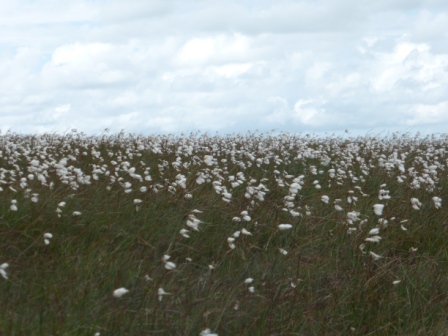
Cotton Grass, Winter HillSOURCES

Bartrum, Peter A Welsh Classical Dictionary: People in History and Legend up to about A.D. 1000 (National Library of Wales, 1993)
Bromwich, Rachel (ed) The Triads of the Island of Britain (University of Wales Press, 2014)
Clarkson, Tim The Men of the North: The Britons of Southern Scotland (John Donald, 2010)
Evans, J. Gwengobryn The Black Book of Carmarthen (Lightning Source UK Lmtd, 1907)
Heron (transl) Gwyn ap Nudd and Gwyddno Garanhir https://barddos.wordpress.com/2015/02/08/gwyn-ap-nudd-and-gwyddno-garanhir/
Monmouth, Geoffrey of The History of the Kings of Britain (Penguin Classic, 1973)
Pennar, Meirion (transl.) The Black Book of Carmarthen (Llanerch Enterprises, 1989)
Skene, William F. The Four Ancient Books of Wales (Forgotten Books 2007)

Gwyn ap Nudd and Du y Moroedd: Travelling the Old North, Wales and Beyond

In Culhwch and Olwen, Du y Moroedd (‘The Black of the Seas’) is introduced as the only horse who can carry Gwyn ap Nudd on the hunt for Twrch Twryth (‘King of Boars’). Du is a water-horse of celebrated fame in the Brythonic tradition. A study of his stories reveals that, like Gwyn, he is intimately connected with the landscapes and peoples of the Old North and Wales. He is also a traveller between worlds and thus a most fitting mount for Annwn’s ruler on his hunt for the greatest of boars.

The most detailed piece of information we possess about Du appears in The Triads of the Islands of Britain. As one of three ‘horse burdens’ he ‘carried on his back seven and a half people from Benllech in the north to Benllech (Elidir) in Mon. These were the seven people: Elidyr Mwynfawr and Eurgain his wife, daughter of Maelgwn Gwynedd, and Gwyn Good Companion and Gwyn Good Distributor, and Mynach Naoman his counsellor, and Prydelaw the Cupbearer, his butler, and Silver Staff his servant, and Gelbeinifen, his cook who swam with two hands and on the horse’s crupper – and he was the half person.’

The historical basis of this triad is Elidyr’s seaward journey from his home in northern Britain to Wales to seize the throne of Gwynedd from Rhun, Maelgwn’s illegitimate son (Elidyr’s claim was based on his marriage to Eurgain). Elidyr was killed at Aber Mewydd near Arfon. Afterward his fellow Men of the North; Clydno Eidyn, Nudd Hael, Mordaf Hael and Rhydderch Hael took vengeance by burning Arfon. Rhun and all the men of Gwynedd pursued them north to the river Gweryd.

This demonstrates the complex ancestral and political relationships between the people of the north and Wales and exemplifies the internecine strife that eventually led to the fall of the northern Brythonic kingdoms. It also shows that armies travelled between the Old North and Wales by land and sea.

It is of interest the Men of the North who came to avenge Elidyr are all of the ‘Macsen Guledig’ lineage. This places them in the same family as Gwyn’s ally and rival, Gwythyr ap Greidol and his kinsmen who Gwyn battles against and takes captive. Gwyn’s relationship with these northern men as a ruler of Annwn is just as fraught and unstable as relations between human rulers.

That Gwyn rides the same horse as Elidyr strengthens the sense of his familial ties with these Men of the North. That he acts as a psychopomp to several northern warriors suggests he may have been seen as an ancestral god. This is backed up by common usage of the name Nudd: Nudd Hael, Dreon ap Nudd and Nudus (the Latinised form from a memorial stone in Yarrow).

***

I assume Du is named as the only horse who can carry Gwyn due to his capacity to move between worlds. This is supported by analogy with The Pursuit of Giolla Dheachair where a ‘monstrous horse’ carries fifteen and a half of Finn’s (Gwyn’s Irish counterpart) companions to the Otherworld.

In this context it seems possible the triad depicts the surprise arrival of Elidyr and his party from the blackness of the sea on the darkest of nights as if from (or perhaps literally from!) the Otherworld. After Elidyr’s death one can imagine Gwyn appearing aboard this great water-horse on the bank of the Arfon to escort him to Annwn.

Du’s possession of uncanny and even monstrous qualities is echoed in later water-horse legends. In Brigantia: A Mysteriography Guy Ragland Phillips identifies the Black Horse of Bush Howe (a horse-shaped landscape feature of stone on the Howgill Fells in Cumbria) with Du. He suggests Elidyr’s northern Benllech was Bush Howe and cites an alignment down Long Rigg Beck valley to Morecambe to Anglesey saying the horse would be within its line of sight.

Ragland Phillips also claims a ‘dobbie cult’ centres on the Black Horse. ‘Dobbie’ is the ‘Brigantian’ name for a water-horse and he defines it as ‘a big, black misshapen thing that ‘slips about’. Like dobbin (a term still commonly used in the north for horses who are ploddy or woodenheaded) it ‘may have for its first element the Celtic Dhu, ‘black’.’

David Raven records a recent visit to the site, during which he photographed the Black Horse and stood on its back. Afterward he found out from a local historian that in the 1930’s and 40’s school children used to be allowed a day off to maintain the horse. A village elder said this was a practice undertaken by farmers in the pre-war period on an ‘annual Boon Day’.

This is strongly suggestive of cult activity and a longstanding service to the Black Horse. Jack (the village elder) also told David of a legend about Roman legions using the horse as a landmark on their travels ‘up the Lune valley, from Lancaster to Penrith and Carlisle.’ The Black Horse of Bush Howe is associated with travelling the northern landscape too.

The continuity of Du’s fame in Wales is attested by Welsh poetry. He appears in The Song of the Horses, a poem attributed to Taliesin: ‘The Black, from the seas famous, / The steed of Brwyn’. He is frequently used as a standard of comparison. Guto’r Glyn compares a foal with the ‘Son of the Black One of Prydyn’ (Du’s grandson) and Tudur Aled compares another horse with Du saying he is of ‘greater vigour… such was his strength and daring.

Like northern Britain, Wales has a water-horse tradition: the ‘ceffyl dwr’. I haven’t found any water-horse stories connected with Anglesey or Arfon on the internet but this doesn’t eliminate the possibility they exist in Welsh literature or folk memory.

***

Finally I’d like to return to Gwyn’s partnership with Du on the hunt for Twrch Trwyth in Culhwch and Olwen. Ysbaddaden’s statement to Culhwch that the hunt cannot begin until Gwyn is found hints at his role as a divine huntsmen and former leader of the boar hunt. Culhwch’s central task of assembling an array of renowned huntsmen, hounds and horses to hunt the Twrch is founded on an older and deeper myth.

About its details we can only conjecture. It is my guess it featured Gwyn, huntsmen, horses and hounds pursuing the King of Boars. It may have contained clues to the ‘mysteries’ of hunting: the hunt, the kill and ensuing feast as sacred activities based on an earlier shamanistic perspective.

Further insights may be gained by analogy with Odin’s hunting of the boar Saehrimnir (‘Sooty Sea-Beast’). Odin rides a great black eight-legged horse who can travel between worlds called Sleipnir (‘Slippy’ or ‘Slipper’). After the hunt Saehrimnir is cooked every evening but the next day is whole. Odin’s feast in Valhalla is mirrored by Gwyn’s feast in his otherworldy hall (in The Life of St Collen on Glastonbury Tor). Perhaps Gwyn’s hunt also rides each day to slay the Twrch then magically he is reborn and this reflects the sacred acts of hunting and eating and the procreation of the boar.

In Culhwch and Olwen it is not mentioned whether Gwyn or Du are found. They do not appear on Arthur’s hunt. Gwyn only comes when summoned by Arthur, who asks him if he knows the whereabouts of Twrch Twryth after he disappears at Glyn Ystun. It is implicit Arthur is seeking Gwyn’s knowledge because he suspects the Twrch has fled to Annwn. Gwyn claims he does not know anything about Twrch Trwyth. It is my intuition he is lying to protect the King of Boars and perhaps to cause mischief.

Following a chase across Wales and finally to Cornwall, whereby many of Arthur’s men are injured or killed by the Twrch and his piglets, they finally catch him and remove the comb and shears from between his ears. Afterward he is driven into the sea, which is suggestive of his return to Annwn. It is of interest that, unlike other otherworldly animals he confronts, Arthur does not slay Twrch Trwyth.

In later Welsh folklore Gwyn is depicted as a demon huntsman aboard a monstrous black horse who preys on the souls of sinners. This image derives from and parodies his partnership with Du as a divine huntsmen and his role as a guide of the dead. Whereas he was revered as much as feared by the pagan Britons, in this Christianised guise he solely brings terror (a misguided and one-sided view).

Gwyn and Du’s names disappear from the stories of northern Britain completely after the medieval period. It seems possible their myths lie behind some of our stories of spectral huntsmen and dobbies but due to the complex intermingling of local legends with Brythonic and Germanic lore the origins of these tales cannot be ascertained.

Yet our landscape remembers the travels of Gwyn and Du across the Old North, Wales and beyond by land and sea. On the paths of the hunt and at river-estuaries where tides beat the shore to gull-cries and winds of distant longing they are still here.

Ribble EstuarySOURCES
Bartrum, Peter A Welsh Classical Dictionary (National Library of Wales, 1993)
Bromwich, Rachel (ed.) The Triads of the Islands of Britain (University of Wales Press, 2014)
Davies, Sioned (transl.) The Mabinogion (Oxford University Press, 2007)
Ragland Phillips, Guy Brigantia: A Mysteriography (Routledge and Keegan Paul Ltd, 1976)
Raven, David http://davidraven-uk.blogspot.co.uk/2010/01/black-horse-of-bush-howe.html
Rhys, John Studies in the Arthurian Legend (Adamant Media Corporation, 2001)
Skene, William F. The Four Ancient Books of Wales (Forgotten Books 2007)
Sturluson, Snorri The Prose Edda (Penguin Books, 2005)

Teyrnllwg: A Bright Kingdom Slips Away Like Dust

A couple of weeks ago something immensely exciting happened: I received a response to queries on my blog regarding the black hole in the post-Roman history of Lancashire. A Penwortham resident called Ozrico told me the area between the Ribble and the Dee was known as Theyrnllwg. It belonged to the Britons until the Battle of Chester in 613 where its king, Brocmail, took on the Saxon king, Aethelfrith (and lost).

Therynllwg! I thought I had finally found the lost name of the kingdom to which south Lancashire belonged. Not only that, I had the name of its king!

Searching the internet, I found two sources for Theyrnllwg. The first was Charles Onam’s England Before the Norman Conquest (1921). Onam said ‘the lands between the Ribble and the Dee’ were ‘originally known as Therynllwg, of which the later Powys was the surviving remnant. It then extended from the Ribble to the Upper Wye, and from the Clwyd to Cannock Chase, and had been for a century a connecting link between the Britons of the North and those of the West.’

Onam’s words extended the territory of Theyrnllwg into Wales and were doubly exciting because for the first time I had found scholarship stating the area we now know as Lancashire formed a link between Wales and the Old North. This would have meant people had a connecting route (or routes) by which to trade and on their travels would have shared myths and stories. In relation to my on-going quest to uncover Gwyn ap Nudd’s forgotten connections with the Old North, if he was known in Wales and by the Strathclyde Britons this would have made it likely he was known in Lancashire too.

Through a reference in the footnotes, I traced Onam’s words back to William Stubbs’ Origines Celticae (1883) where I found within a list of Welsh names of districts ‘Theyrnllwg from Aerfen to Argoed Derwenydd’ (the river Arfon in Gwynedd and the woodland of the river Derwent in Cumbria?). This extended Theyrnllwg further and led to more sources. Stubbs said the list originated from the ‘Iolo MSS’ and this was ‘taken from a MS belonging to Mr Cobb of Cardiff, and is a mere fragment, a page of the MS having been torn out.’

Having obtained as much information as I could on the internet, I contacted Heron (who lives in Wales and is knowledgeable on such matters) and asked if he knew anything about Theyrnllwg. When I received his answer I was greatly disappointed.

Heron replied saying the name Theyrnllwg derives from Teyrnllwg and sent me an extract from Peter Bartrum’s A Welsh Classical Dictionary (1994). Bartrum stated Teyrnllwg was an ‘imaginary territory’ derived from the name of Cadell Ddyrnllug, a prince of Powys mistakenly taken to be its ruler.

I found out Cadell Ddyrnllug first appeared in Nennius’ History of the Britons (830) as Catel Durnluc, a servant of the tyrannical king of Powys, Benlli. When St Germanus arrived to remonstrate Benlli, Castel offered him hospitality. After Benlli, his city and his subjects had been burned by fire from heaven, Germanus rewarded Castel for his hospitality by making him king. This fulfilled ‘the prophecy of the Psalmist: “He raiseth up the poor from dust, and lifteth the needy out of the dunghill”.’

Bartrum said in modern Welsh Durnluc would take ‘the form Ddyrnlluch or Ddyrnllug, meaning ‘gleaming hilt’, from dwrn, ‘hilt’ and lluch, ‘gleaming’ or llug, ‘bright’. The meaning evidently became obscure very early, and was perhaps interpreted as derived from teyrn, ‘prince’ and llwch, ‘dust’. This may have been the basis of the legend which derived Cadell from a humble origin, the author actually quoting Psalm 113 vv.7.8.’

The name Teyrnllwg was later and erroneously identified as Teyrnllwg’s kingdom. When I looked it up on the internet, I found a pamphlet titled The Fictitious Kingdom of Teyrnllwg (1960) by Melville Richards reprinted for Transactions of the Lancashire and Cheshire Antiquarian Society which provided further explanation.

The Fictitious Kingdom of TeyrnllwgIn its two pages Richards criticises an earlier article by Dr. J . D. Bu’Lock which ‘recreates the history of ‘The lost kingdom of Teyrnllwg’’ saying he has been misled by ‘the comparative validity and authenticity of the Welsh material’ (ie. the Iolo MS). ‘Dyrnllug is an epithet which can be readily analysed as dwrn (‘fist’) and llug (‘bright’), referring to some (?) physical characteristic of Cadell… By the fifteenth century Dyrnllug had become Deyrnllug in the genealogical lists.’

Teyrnllwg became accepted as a ‘territorial designation’ firstly because teyrn means ‘king, ruler’ and secondly because -wg was a common territorial suffix (ie. Morgannwg ‘country of Morgan’). Whilst Richards accepted the possible existence of a kingdom in the area of Cheshire and Lancashire he stated adamantly ‘its name was not Teyrnllwg’.

The existence of Teyrnllwg, kingdom of a prince with a bright and gleaming hilt or fist who rose from dust was well and truly refuted. (Although it continues to exist in the gleaming brightness of the name. The glamoury of a bright kingdom slipping away like dust…)

***

However a loose end remained to be tied up. If Teyrnllwg was fictitious what about Brocmail, its king? Oman said Brocmail is the son of Cincen, a descendant of Cadell. I discovered this was backed up by the Harleian MS 3859: The Genealogies, where he appears in the lineage of the rulers of Powys ‘[S]elim map Cinan map Brocmayl map Cincen map Maucanu map Pascent map Cattegirn map Catel dunlurc.’

It was also likely Brocmail was present in the Battle of Chester. In Bede’s Ecclesiastical History of the English People (8th C) Brocmail was the guard of 1200 monks from Bangor who had come to pray for the Welsh army. When the Saxon ruler Aethelfrith commanded his army to slaughter them, Brocmail fled, escaping with fifty.

The Anglo-Saxon Chronicle (9th C) stated Scromail (a mis-spelling of Brocmail?) was the leader of the Welsh. After Aethelfrith slew ‘countless Welsh’ and ‘200 priests’ ‘he escaped as one of fifty.’ In Geoffrey of Monmouth’s The History of the Kings of Britain (1136) Brocmail was Earl of Leicester and the battle took place in Leicester. Brocmail made a stand against Aethelfrith, in spite of having less soldiers, and only fled after he had ‘inflicted exceeding great slaughter upon the enemy.’ This version also mentioned ‘one thousand two hundred monks’ were killed.

As Brocmail is listed as a king of Powys, it seems more likely he was a leader in the battle than a guard. Nick Higham notes Bede is unreliable because he is more concerned about writing ‘providential history’ than military reality and is dubious about the slaughter of the monks. This makes it possible Brocmail’s deposition from a British king who faced the Saxons to a cowardly guard reflects his bias. (However it is equally possible Monmouth’s glorification of him as a British king is biased too…).

Archaeological evidence from Heronbridge, near Chester (a group of skeletons with clear signs of violent injury buried in a pit, believed to be the dead of the Saxon victors) demonstrates the battle took place in Chester and not Leicester. From this we can derive that the Battle of Chester really took place, Brocmail took part in it, and at this pivotal point Cheshire, and perhaps south Lancashire, first became subject to Saxon rule.

Brocmail’s involvement in the Battle of Chester also demonstrates these areas had real political links with Powys. This is supported by the fact when the Mercian Saxons took rule, they formed an alliance with the rulers of Gwynedd and Powys to take on Oswald and the Saxons of Northumbria at Maserfelth (Makerfield in Lancashire). It seems likely they were drawing on a pre-existing alliance.

Whilst the kingdom of Terynllwg may be dismissed as fictitious, the name provides important clues to links between rulers of Powys and the Britons of Cheshire and Lancashire.

***

A more realistic picture of these post-Roman British territories is drawn by Denise Kenyon in The Origins of Lancashire (1991). Kenyon notes attempts to locate Teyrnllwg in north-west England are not widely accepted. She goes on to suggest that concentrations of British place-names may be used to identify areas of lordship.

She posits three main territories. The first centres around Makerfield and Wigan and extends into the Leyland and Newton hundreds down to the Mersey (I assume its northern limit is the Ribble). The second includes the Fylde and centres on ‘Preese and Preesall, Greater and Little Eccleston and Inskip.’ There are two groups in Greater Manchester; around Manchester itself and ‘on the edge of the Rossendale forest’.

A further possibility is that ‘iuxta Rippel was in origin a small British kingdom or lordship encompassing the west Lancashire lowlands on either side of the Ribble, as far south as Makerfield, and extending into the Pennine foothills above Whalley’. These British lordships would have formed the basis for later Anglo-Saxon territorial units.

Kenyon identifies my home town of Penwortham as a ‘central place’ occupying a nodal position in the communication network on a crossing of the Ribble. She says its name is of interest as a hybrid of British and English: ‘Pen’ is British and means ‘hill’ whilst ‘ham’ is English and means ‘safe place’.

‘Ham’ names are indicative of ‘central places’ connected with ‘Roman military and industrial settlements’ (in Penwortham’s case Walton-le-dale) and are often seats of ancient parishes. The construction of the name reflects the acculturation of an important British ‘central place’ by the English.

Thus we have a picture of post-Roman Penwortham lying either on the northern edge of a British lordship centring around Makerfield or in the midst of iuxta Rippel. Differences between the dialects north and south of the Ribble (ie. ‘chester’ to the south and ‘caster’ to the north) make the former seem more probable. This lordship would have been taken over by the Saxons some time after the Battle of Chester. The ‘wahl’ element of Walton-le-dale suggests a strong British presence remained in this town, adjacent to Penwortham.

Kenyon’s identification of Penwortham as a central place on the communication network re-opens the possibility of it linking Wales and the North. Whilst most historians are dubious about connection by road due to boggy ground, the river Ribble was no doubt used for transport and communication with Penwortham as a look-out point and possible port.

Is there any way of making a case that the Britons of the lordship centring on Makerfield once shared a pagan mythology and told similar stories to those further north and in Wales?

The only evidence of native British pagan worship in the vicinity comes from Romano-British altars, statues and inscriptions to deities such as Deae Matronae (the mother goddesses), Apollo-Maponus (Maponos was a Brythonic god of youth) and Mars-Nodontis (Nodens was a Brythonic god of hunting and healing and is cognate with Nudd, Gwyn’s father). These are not in our Makerfield lordship but north of the Ribble in the Fylde.

That Kenyon believes the Anglo-Saxon ecclesiastical divisions are likely to have been founded on earlier British ones (drawing on the etymology of Eccles from eglys ‘church’) and monks from Bangor were praying for the Welsh army suggests the Britons had been Christian before the English arrived in 613.

How and when they were converted (or chose to convert) remains a matter for further investigation. Insights in this direction may throw light on how the ancient British gods and goddesses slipped from the consciousness of the people of my locality like the bright dust of Terynllwg.