Not Getting to Caer Siddi: Sea Fortresses, Warships and Prisoners of War

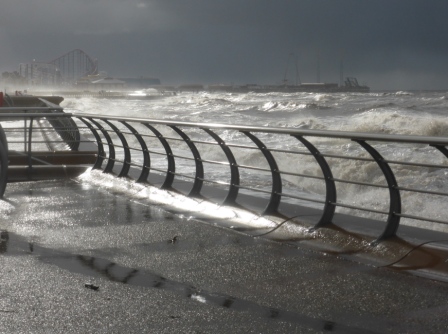
Last year I attempted some journeywork with the otherworldly sea fortress Caer Siddi which did not go to plan. Setting out from the beach and swimming out to sea aboard my white mare, I noticed the waves becoming increasingly turbulent.

A horn blew and I saw a white sleek-prowed warship cutting through the water ahead. I recognised this as Prydwen (‘Fair Form’) the vessel of Arthur and his warriors. The horizon turned red and flashed with explosions. I saw the dark forms of other warships.

The waters rocked. At this point I knew I wasn’t getting to Caer Siddi. I turned my mare back to the beach and slipped from the otherworld dumbfounded. Reading medieval Welsh stories about Caer Siddi hadn’t prepared me for modern warships and warfare.

***

What did this mean? I started looking for clues in the world around me. In an entirely unrelated e-mail, a friend mentioned the sinking of the Lancastria off the French Port of St Nazaire on the 17th of July, 1940, whilst evacuating British nationals and troops from France.

At least 6,000 people (9,000 has been estimated) were aboard the Lancastria when she was bombed by a German aircraft. Three hits to the hold caused the spillage of 300 tons of oil. Twenty minutes later the ship capsized and sank. As the passengers struggled for their lives in the oily water they were strafed by machine gun fire from German planes and tracer bullets fired to set light to the oil.

The_Sinking_of_the_Cunard_Liner_Ss_Lancastria_Off_St_Nazaire_HU3325

Sinking of the Lancastria, Wikipedia Commons

2447 survivors were rescued, many of whom were shipped to Plymouth. Twice that number perished, making the sinking of the Lancastria Britain’s worst maritime disaster and the largest loss of British forces in a single engagement in World War II.

Great controversy surrounds Winston Churchill’s cover-up of this tragedy. A D-Notice prevented newspapers and broadcasters reporting it because two weeks after the Dunkirk Evacuation, British people ‘had had enough bad news’.

Since then the British government have refused to acknowledge the site of the wreck as a war grave. As the result of an extended campaign, the sinking of the Lancastria was finally marked by the government in July last year: 75 years on.

There seems to be some meaning in my vision of warships in the year the Lancastria’s sinking was acknowledged. Lines from ‘The Spoils of Annwn’ stating that of ‘three full loads of Prydwen’ that went into Caer Siddi only seven came back recall the terrible death toll of seaborne warfare.

***

At the same time I was led to re-reading Eternity by the Stars by Louis Auguste Blanqui. This was written in 1871 whilst he was imprisoned in the Fort Du Taureau ‘Castle of the Bull’ (a sea-fortress off the north of Morlaix in France) for his radical political beliefs during the reign of the transitional government of Adolphe Thiers.

1280px-Chateau_du_Taureau

Chateaux du Taureau, Wikipedia Commons

Kept in solitary confinement as the only prisoner of the island and banned from approaching his window on pain of death, Blanqui penned a philosophical treatise that would inspire Nietzsche’s eternal return and Walter Benjamin’s critique of progress.

Some of Blanqui’s insights are hauntingly Taliesin-like. The consensus amongst scholars is that Taliesin’s time in the prison of Arianrhod and acquisition of his chair in Caer Siddi are metaphors for Bardic initiation. Taliesin’s omnipresence is connected with his imprisonment.

Blanqui’s claims are equally profound. However the voice of a lonely 19thC radical in his sea-dungeon possesses none of the bravado of the Taliesin persona:

‘The universe is eternal, the stars are perishable, and since they form all matter, every one of them has passed through billions of existences. Gravity, thanks to its resurrecting shocks, divides, blends and kneeds them incessantly to the point that every one is a compound of the dust of others. Every inch of the ground that we walk has been part of the whole universe.’

‘Every human being is eternal at every second of its existence. That which I am writing in this moment, in a dungeon of the Fort de Taureau, I have written and shall write forever, on a table, with a quill, under clothes and in entirely similar circumstances. And so it is for all of us.’

‘At heart, man’s eternity by the stars is melancholic, and even sadder this estrangement of brother-worlds caused by the inexorable barrier of space. So many identical populations come to pass without having suspected each other’s existence! Well, not really: this shared existence is discovered at last in the 19th century but who shall believe it?’

Is it mere coincidence that I’m led to Eternity by the Stars as I’m trying to work out why I didn’t get to Caer Siddi: The Fortress of the Zodiac?

***

My insights have led me to believe that the medieval Welsh material about Caer Siddi is not only a metaphor for the initiatory journey of bards but may have a basis in the realities of seaborne warfare and prisoners of war.

If it does not refer to historical events it perhaps originated from the efforts of people to make sense of disastrous military expeditions from which only a handful of friends and kinsmen returned and what they endured whilst imprisoned by their enemies.

The stories of Brân’s battle in Ireland, Cunedda driving the Irish out of Wales and Arthur’s theft of the cauldron of Diwrnarch Wyddel (‘the Irishman’) refer to hostilities between the Welsh and Irish that no doubt had maritime dimensions.

Initiatory experiences during periods of imprisonment are rare but the number of existing testimonies (others include Aneirin, Jean Genet and Nicholas R. Mann) demonstrate their reality and provide hope and inspiration for prisoners of today.

I didn’t get to Caer Siddi yet, blown off course, I discovered valuable stories from the modern era which sadly continue to echo the ancient themes of sea-fortresses, warships and prisoners of war.

The Changing Faces of Caer Siddi

Caer Siddi is a legendary fortress in the enigmatic medieval Welsh poem ‘The Spoils of Annwn’, which is written from the perspective of Taliesin and describes his journey with Arthur and his men aboard the warship, Prydwen (‘Fair Form’) to seven fortresses in Annwn (‘the deep’).

Their aim is to accomplish a series of tasks including the rescue of the divine prisoner, Gwair, the theft of the cauldron of the Head of Annwn and capture of the Brindled Ox. Parallels with the anoethau (‘impossible tasks’) in Culhwch and Olwen suggest a shared source in Brythonic tradition.

Caer Siddi is the first fortress Arthur’s party raid. The name Caer Siddi has been translated as ‘Fortress of the Mound’ or ‘Fortress of the Fairies’ from the Welsh caer ‘fortress’ and Irish síd which refers both to the aos sí ‘fairies’ and the sídhe ‘mounds’ they inhabit. Another translation is ‘Fortress of the Zodiac’ from the Welsh siddi ‘zodiac’.

In ‘The Spoils of Annwn’ Taliesin says:
‘Maintained was Gwair’s prison in Caer Siddi,
throughout Pwyll and Pryderi’s story.
No-one went there before he did –
into the heavy grey chain guarding the loyal lad.
And before the spoils/herds of Annwfn he was singing sadly.’

Caer Siddi is presented as a prison and Gwair is its first prisoner. Gwair’s imprisonment takes place throughout the story of Pwyll and Pryderi, which is set in the ‘British foretime’ preceding the Roman invasion. Gwair’s prison is magically maintained until Arthur’s day.

The line referring to ‘the spoils/herd of Annwfn’ links the first verse to ensuing verses where the cauldron is stolen, no doubt filled with Annuvian treasure, and the Brindled Ox is towed away from his custodianship of Annwn’s herds.

Gwair’s sad song may be likened to the lamentation of Mabon son of Modron in ‘a house of stone’ in Culhwch and Olwen. Mabon and Gweir son of Gweirioed (Gwair) are listed alongside Llŷr Half-Speech as ‘Three Exalted Prisoners of the Island of Britain’ in The Triads.

Mabon provides an alternative triad of prisoners: ‘he who is here has reason to lament… no-one has been so painfully incarcerated in a prison as I, neither the prison of Lludd Llaw Eraint nor the prison of Graid son of Eri.’

There are clear parallels between the trios Mabon, Llŷr, Gweir / Mabon, Lludd, Graid. Some scholars claim Llŷr / Lludd and Gweir / Graid are the same people.

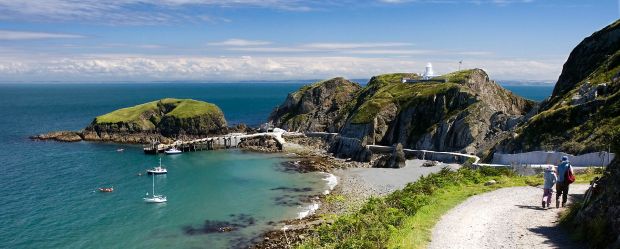
Lundy's Jetty and Harbour by Michael Maggs, Wikipedia Commons

Lundy’s Jetty and Harbour by Michael Maggs, Wikipedia Commons

The name Gweir ap Gweirioed has been translated as ‘Hay son of Grassiness.’ Gwair means ‘hay’, gweirglodd ‘meadow’ and gweiryn ‘blade of grass.’ The green island of Lundy is known as Ynys Weir. Whether this was Gwair’s place of origin or imprisonment remains uncertain. Perhaps Gwair is a deity of grasslands and meadows and his imprisonment is representative of a barren or winter landscape.

In Culhwch and Olwen, Graid son of Eri is part of an army imprisoned by Gwyn ap Nudd, a ruler of Annwn and god of winter. Arthur rescues Graid and the other prisoners along with Graid’s dog, Drudwyn, the leash of Cors Cant Ewin to hold him with, and a steed called Myngddwn for Mabon to use on the hunt for Twrch Trwyth.

Whether these are two different tellings of the same narrative is unclear. However we can assert that imprisonment in Annwn is a longstanding theme in medieval Welsh literature.

***

Caer Siddi is also mentioned by Taliesin in ‘The Chair of Taliesin’:

‘Harmonious is my song in Caer Siddi;
sickness and old age do not afflict those who are there,
as Manawyd and a Phryderi know.
Three instruments/organs around a fire play in front of it
and around its turrets are the wellsprings of the sea;
and (as for) the fruitful fountain which is above it-
its drink is sweeter than white wine.’

Contrastingly, for Taliesin, Caer Siddi is a paradisal place where he has attained a Bardic chair. This has been linked to his claim to have spent ‘three times in the prison of Arianrhod’ in The Story of Taliesin. He also says ‘My darling is below / ‘Neath the fetters of Arianrhod’.

Arianrhod (‘Silver Wheel’) and her home, Caer Arianrhod, an island off the coast of Gwynedd seven miles south west of Caernarvon, are described by Taliesin in ‘The Chair of Ceridwen’:

‘Arianrhod, famed for her appearance surpassing the radiance of fair weather,
her terrifying was the greatest shame (to come) from the region of the Britons;
a raging river rushes around her court,
a river with its savage wrath beating against the land:
destructive its snare as it goes round the world.’

Here she appears as a beautiful yet imposing deity. This description fits with her representation in the Fourth Branch of The Mabinogion where she refuses to give her son, Lleu, a name, arms or a wife.

Unfortunately nothing is written about what happened to Taliesin during his imprisonment in Caer Arianrhod, whether he rescued his ‘darling’ and how this links to his chair in Caer Siddi. Analogies between the ‘heavy grey chain’ and ‘snare’ of a river may suggest Caer Arianrhod is Caer Siddi.

Many scholars and modern Druids interpret Taliesin’s period of imprisonment as a form of Bardic initiation giving rise to his shapeshifting capacities and omnipresence:

‘I was in a multitude of forms
before I was unfettered:
I was a slender mottled sword
made from the hand.
I was a droplet in the air,
I was the stellar radiance of the stars.’

‘I was revealed
in the land of the Trinity;
And I was moved
through the entire universe;
And I shall remain till doomsday
upon the face of the earth.’

***

It is of interest that Taliesin says Manawydan and Pryderi know Caer Siddi. In the Third Branch, Manawydan, his wife Rhiannon, Pryderi and his wife Cigfa follow a white boar to a fortress that belongs to Llwyd Cil Coed, a powerful enchanter who has put a spell on Dyfed.

In spite of Manawydan’s warnings, Pryderi enters. Captivated by a golden bowl hanging over a well he touches it and gets stuck. Rhiannon follows and meets the same fate. A blanket of mist descends and with a tumultuous noise the fortress disappears.

When Llwyd sends his people as mice to devour Manawydan’s wheat fields, Manawydan captures his pregnant wife in mouse form. By threatening to hang her on a miniature gallows, he persuades Llywd to remove the enchantment and release Rhiannon and Pryderi.

Afterward, Llwyd reveals he enchanted Dyfed as revenge for the violence inflicted by Pwyll, Rhiannon’s first husband and Pryderi’s father, on his friend Gwawl ap Clud. As Rhiannon is a divinity associated with Annwn, it may be suggested Gwawl and Llywd are Annuvian figures too.

This is backed up by Llwyd’s reappearance in Culhwch and Olwen. After Arthur and his men return from Ireland with the cauldron of Diwrnarch Wyddel, they land ‘at the house of Llwydeu son of Cilcoed at Porth Cerddin in Dyfed. And Mesur y Pair (‘the measure of the cauldron’) is there.’

The cauldron of Dyrnwch the Giant is listed amongst ‘The Thirteen Treasures of the Island of Britain’ and its property of not brewing meat for a coward identifies it with the cauldron of the Head of Annwn. The symbolic links between ‘the measure of the cauldron’ at Llwyd’s house and the well and golden bowl in his enchanted fortress are intriguing.

***

Caer Siddi is mentioned again in Ellis Gruffydd’s Chronicle of the Ages (16th C). Gruffydd claims that ‘Merlin was a spirit in human form’ who appeared in ‘the time of Maelgwn Gwynedd’ as Taliesin ‘who is said to be alive yet in a place called Caer Sidia.’

He appeared a third time as the son of Merfyn Frych son of Esyllt and ‘was called Merlin the mad. From that day to this, he is said to be resting in Caer Sidia, whence certain people believe firmly he will rise up once again before doomsday.’

An alternative story about Merlin’s resting place is found in Pen. 147. Myrddin (an earlier name for Merlin) sets out to acquire the Thirteen Treasures of the Island of Britain. The owners of the treasures agree to hand them over if Myrddin can obtain the Horn of Brân the Niggard.

Surprisingly, Brân agrees. Myrddin obtains all Thirteen Treasures and takes them to ‘the Glass House’, which is frequently identified with Bardsea Island.

Bardsey Island by Mynydd Mawr, Wikipedia Commons

Bardsea Island by Mynydd Mawr, Wikipedia Commons

***

Caer Siddi has many faces. It is the place where Gwair sings sadly fettered by a heavy grey chain. It disappeared with Rhiannon and Pryderi whilst they stared entranced into a golden bowl. Taliesin holds a Bardic chair there beneath a fountain of mead ever remembering when its rivers were a savage snare. Myrddin rests with an old, battered cauldron filled with rescued treasure beside the well where the golden bowl once hung.

These faces of Caer Siddi were known in medieval Wales. What are its faces now? I can’t tell you because I haven’t got there yet. Not getting there led to some surprising discoveries and I’ll share them in the next post.

SOURCES

Heron, ‘Merlin, Taliesin and Maponus’
John and Caitlin Matthews, King Arthur’s Raid on the Underworld, (Gothic Images, 2008)
Marged Haycock, Legendary Poems from the Book of Taliesin, (CMCS, 2007)
Patrick Ford, Mabinogi and Other Welsh Tales, (University of California Press, 2008)
Rachel Bromwich (ed), The Triads of the Island of Britain, (University of Wales Press, 2014)

Sunshine Old as Memory: Hôrai and Preserving Visions of Fairyland

I. Blue Vision of Depth

P1120613 - Copy

‘Blue vision of depth lost in height – sea and sky interblending through luminous haze. The day of spring and the hour morning.
Only sky and sea – one azure enormity… in the fore ripples are catching a silvery light, and threads of foam are swirling. But a little farther off no motion is visible, nor anything save colour: dim warm blue of water widening away to meet into blue of air. Horizon there is none: only distance soaring into space – infinite concavity hovering before you, and hugely arching above you – the colour deepening with the height. But far in the mid-way blue there hangs a faint, faint vision of palace towers, with high roofs horned and curved like moons – some shadowing of splendour strange and old, illumined by sunshine old as memory…
…Those are the glimmering portals of Hôrai the blest; and those are the moony roofs of the Palace of the Dragon King.’
Kwaidan, Lafcadio Hearn

Kwaidan (1904) is a collection of Japanese ghost stories and studies of superstitions about the insect world by Lafcadio Hearn. Hôrai is a legendary place in Japanese mythology known as Mount Penglai by the Chinese. Lafcadio’s ethereal yet beautiful descriptions share surprising parallels with Celtic representations of Fairyland.

Lafcadio says in the books of the Chinese Shin dynasty Hôrai is a place where there is no death, pain or winter. The flowers never fade and the fruits never fail. Enchanted plants heal sickness. A fountain of perpetual youth nourishes grass that quickens the dead. The people eat rice and drink wine out of very small cups that are never empty.

However Lafcadio claims these books were not written by people who have visited Hôrai. Really there are no fruits that forever satisfy the eater, magical grasses that revive the dead, fountains of perpetual youth or cups never empty. It is not true sorrow and death never enter Hôrai or that there is no winter: ‘The winter in Hôrai is cold; and winds then bite to the bone; and the heaping of snow is monstrous on the roofs of the Dragon King.’

The textual descriptions of Hôrai are deceptive as the place itself. Another name for Hôrai is Shinkirō: ‘Mirage.’ Similarly on the surface Fairyland appears a paradisal place. Take for example this description of St Collen’s arrival at the castle of the Brythonic Fairy King, Gwyn ap Nudd:

‘he saw the fairest castle he had ever beheld, and around it the best appointed troops, and numbers of minstrels, and every kind of music of voice and string, and steeds with youths upon them the comeliest in the world, and maidens of elegant aspect, sprightly, light of foot, of graceful apparel, and in the bloom of youth and every magnificence becoming the court of a puissant sovereign…
And Collen went into the castle, and when he came there, the king was sitting in a golden chair. And he welcomed Collen honourably and desired him to eat, assuring him that, besides what he saw, he should have the most luxurious of every dainty and delicacy that the mind could desire, and should be supplied with every drink and liquor that his heart could wish.’

Collen refused to partake in the meal saying “I will not eat the leaves of trees” and disparaged the costumes of Gwyn’s host because their red signified burning and blue coldness. When he threw holy water the castle and its inhabitants disappeared.

Collen saw through the fairies’ glamoury but gained no perception of the deeper reality beneath. In my earliest travels to Gwyn’s castle I found I had to go through a curious combination of sky and sea – an ocean filled with stars. Sometimes I arrived on the shore and sometimes above. The palace’s most distinguishing feature was a lunar crescent on its roof mirroring the bull horns Gwyn wore in an earlier vision of him as a ‘bull of battle.’

Sometimes the palace was alive and thronging with people and there was feasting, singing and mead. Sometimes it was derelict, cold, draped in hoar frost and Gwyn sat with only his hound, Dormach, for company. I voiced this in my poem ‘Gwyn’s Hall’ at midsummer in 2013:

‘Summer here and winter there
My longest day your darkest night
Hoar frost drapes your haunted fortress
Whilst swallows ride my glowing sunlight.

Summer here and winter there
My brightest day your longest night
Whilst blackbirds sing my endless fanfare
Crazy owl streaks across your vaunted midnight.

Winter there and summer here
And I between them like the song
That lies unsung between the years
Between your hall and my brief home.’

My jaw dropped when I read Lafcadio’s words about Hôrai and its blue vision of depth which corresponded so well with my experiences of Fairyland, or as it was earlier known, Annwn ‘the deep.’ Particularly considering on the day of my dedication to Gwyn at Glastonbury Tor he appeared to me as a dragon, something completely unrecorded in known literature, although there are plenty of references to divine shapeshifters taking serpentine form.

Since then I have learnt that although Fairyland can be mind blowingly beautiful it is far from perfect. Its winters and sorrows mirror our own. Its treasures are not indestructible. Its resources are finite. There are no panaceas or such thing as eternal youth.

Fairyland is not free from death, war or political strife. When we die we carry the concerns of thisworld with us and indeed our world passes over into the next. The blue vision of depth is ours in the making and we bear as much responsibility as the gods.

II. Made of Ghost

Lost in the Mist 082 - Copy

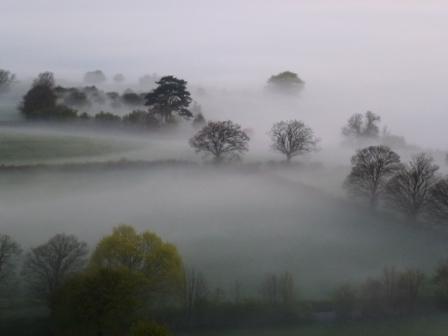
‘It is an atmosphere peculiar to the place; and, because of it, the sunshine in Hôrai is whiter than any other sunshine – a milky light that never dazzles – astonishingly clear, but very soft. This atmosphere is not of our human period: it is enormously old, so old that I feel afraid when I try to think how old it is; and it is not a mixture of nitrogen and oxygen. It is not made of air at all, but of ghost – the substance of quintillions of quintillions of generations of souls blended into one immense translucency – souls of people who thought in ways never resembling our ways. Whatever mortal man inhales that atmosphere, he takes into his blood the thrilling of these spirits; and they change the senses within him – reshaping his notions of Space and Time – so that he can see only as they used to see, and feel only as they used to feel, and think only as they used to think. Soft as sleep are these changes of sense…’
Kwaidan, Lafcadio Hearn

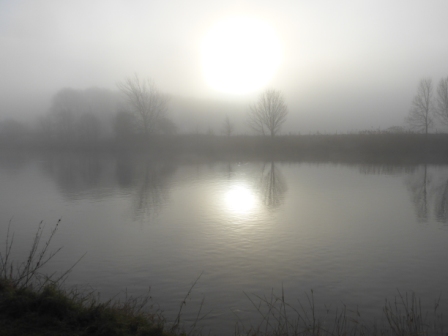
Gwyn ap Nudd translates as ‘White son of Mist’. His presence can be felt on misty mornings when the cold winter sun is an icy disk moving through a limboland of grey clouds reflected in the river. He and the dead in the smooth white air silently whispering the blurring of borderlines reshaping benches, trees, rivers, hills, the thoughts in our minds.

In Culhwch and Olwen it is said ‘God has put the spirits of the demons of Annwn in him, lest the world be destroyed.’ These words suggest Gwyn physically contains the spirits of Annwn although this may be a gloss on his rulership of them. Taken literally he is made of ghost.

It’s rare in Celtic literature to find links between Fairyland and the dead. It seems possible these connections were repressed by Christian rulers in favour of eternal reward in heaven or punishment in hell to ensure moral conduct. Such acts of repression are represented in St Collen’s supposed banishment of Gwyn and his host.

Gwyn’s role as a gatherer of the dead and King of Fairy provides a clue. Further evidence may be gleaned from Sir Orfeo. This Breton lay displays roots in Brythonic tradition:

‘In Britain in the days of yore
The harpers writ that men should praise
The gallant deeds that were before-
Of such the Britons made their lays.’

The setting is Winchester. Although it is modelled on the story of Orpheus the protagonist, Orfeo, does not descend to the gloomy depths of the Classical underworld to win back his beloved, Heurodis, but enters Fairyland by striding into a rock.

Fairyland is described as a country ‘bright as the summer sun… green vast.’ The knights are ‘bright… with large display / Of gorgeous banners gaily blent’ and the ladies ‘dancing free / In quaint attire… To sound of pipes and minstrelsy.’ Heurodis is amongst them.

Orfeo goes to the castle of the Fairy King who abducted her on May Day many years ago. This is described as a castle tall with a hundred towers of crystal ‘The jewelled stones shed forth a light / Like sunbeams on a summer’s day.’

The Fairy King and Queen are seated on a ‘tabernacle fair and light’ wearing glistening crowns and garments ‘so hot they shone’ ‘He could not gaze.’ The court are got up in ‘rich array.’

This contrasts with a horrifying discovery Orfeo made previously in the castle:

‘Some headless stood upon the ground,
Some had no arms, and some were torn
With dreadful wounds, and some lay bound
Fast to the earth in hap forlorn.

And some full-armed on horses sat,
And some were strangled as at meat,
And some were drowned as in a vat,
And some were burned with fiery heat,
Wives lay in child-bed, maidens sweet…

…Each thus was stolen out of life,
For such the fairies sieze and keep.
And there he saw his darling wife,
Sweet Heurodis as one asleep.’

These lines provide clear evidence of connections between the fairies and the dead. The host of knights, ladies including Heurodis herself is composed of people who have died suddenly or violently. Gwyn is intimately associated with the battle dead and people who have perished of unknown causes were often seen as taken by the fairies.

Orfeo’s task is not only to bring Heurodis back from Fairyland but from the dead. He succeeds through his wit and the power of his music. In Sir Orfeo there is no cruel condition vetoing looking back. He returns from Fairyland, from the Fairy King and Queen and their host bright and shining and made of ghost, to fleshly existence with his wife.

III. The Vision is Fading

View from Glastonbury Tor Beltane 2013 109 - Copy

‘Evil winds from the West are blowing over Hôrai; and the magical atmosphere, alas! is shrinking away before them. It lingers now in patches only, and bands like those long bright bands of cloud that trail across the landscapes of Japanese painters. Under these threads of the elfish vapour you still can find Hôrai – but not elsewhere… Remember that Hôrai is also called Shinkirō, which signifies Mirage – the Vision of the Intangible. And the Vision is fading – never again to appear save in pictures and poems and dreams…’
Kwaidan, Lafcadio Hearn

It is impossible to imagine a time the Vision has not been under threat. The ancient tribal people who inhabited Britain and those who still exist in small wild pockets across the world living off the land, maintaining old stories, communing with their deities and ancestors, have never been immune to natural disasters or invasions by other people.

Kwaidan was published in 1904. Lafcadio translated most of the stories from old Japanese manuscripts. Yuki-onna was told to him by a farmer and Riki-baka and Hi-Mawara are based on his own experiences. ‘Evil winds from the West are blowing over Hôrai’ suggests Lafcadio thought the introduction of Western institutions posed a threat to Japanese folk beliefs and this motivated him to translate and share them.

Similarly in Britain as the industrial revolution forced country dwellers to move into towns to find factory work the loss of their beliefs prompted a resurgence of interest in folklore. Here in Lancashire folktales collected in the 19th and 20th centuries contain a fascinating admixture of ‘pagan’ Celtic, Anglo-Saxon, Norse and Christian folk beliefs featuring fairies, boggarts, demons, spectral huntsmen, phantoms and ghosts.

Whilst these stories have not died out, belief in our ability to interact with Fairyland has. Its name, once held in superstitious regard, evokes parodic Barbie Fashion Party Fairytale Palaces with glitzy innocuous fairy god mothers with glitter wands and nothing of its deeper truths: a trend initiated by Shakespeare’s reduction of Queen Mab to diminutive size with butterfly wings and enforced by an era of Victorian twee.

The connection between Fairyland and the dead has been lost. The majority of people in our secularised society do not give much serious thought to where they will go when they die, what it will look like, who will guide them, who will be waiting when they arrive.

Disappointingly the majority of books on shamanism offer little but hypostasised lower, middle and upper worlds, instructions for entering green and leafy glades for pleasant get-togethers with spirit guides and power animals and tips for self development.

The myths and stories of our lands and ancestors make better field guides but are dated. We’ve seen industrial change on a global scale since then, two devastating world wars decimating towns and cities and tearing apart blood lines, and are still embroiled in brutal conflicts.

Before setting off on otherworld journeys we think little of what effect this has had on Fairyland. What great effort it takes to cover over nuclear waste and fracking wells. How much mead is needed to calm the dead forced to go to war for the sake of empire; for a political system founded on the ceaseless exploitation of finite resources to fuel machines of war.

Sunshine old as memory still shines in Fairyland. Go there and you will taste its magic, breath its atmosphere of quintillions of souls. Its Vision may be fading, fragile, fractured, rent by bloody wounds but it is still with us. It is our responsibility to preserve it for generations to come in pictures and poems and dreams; in our creation of thisworld as it passes into the otherworld.

The Wizard of the Waves

P1140193 - Copy

I.
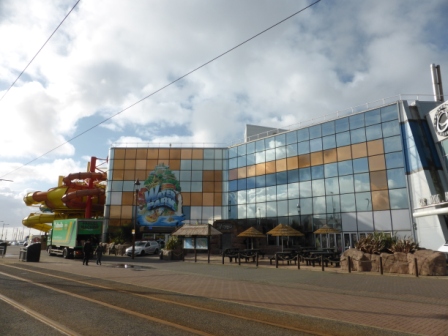
Several years ago, I made the mistake of offending Manawydan. I was new to journeying. My guide took me to the otherside of Blackpool and we alighted outside a swimming pool. On the wall was a stereotypical plasticy image of a wizard in starry indigo-blue robes with a wand and bent wizard’s hat. Cartoon letters beside him read: ‘THE WIZARD OF THE WAVES’.

I couldn’t believe my eyes. I was incredulous. This wasn’t how the otherside appeared in books about shamanism. Turning to my guide I asked affrontedly “why have you brought me to see this tacky wizard?”

The wizard stepped from the wall and raised his wand. The scene dissipated with the dismal crashing of all the waves of the sea. I found myself back in my room immensely disorientated. Later it dawned on me that I’d offended Manawydan. I felt like kicking myself.

II.
Manawydan’s stories contain deep magic. However I struggle to connect with him because he’s humble, practical, wise: all the things I’m not.

After the catastrophic battle against Matholwch, King of Ireland, where Brân was slain, Manawydan and seven survivors returned with his head. They feasted with it for seven years at Harlech then for a potentially interminable period on the island of Gwales.

In the feasting hall in Gwales there were three doors: two open, one closed. Previously Brân told them “so long as you do not open the door… you can remain there and the head will not decay. But as soon as you open that door you can stay no longer.”

Manawydan echoed his brother’s wisdom. ‘”See over there… the door we must not open.”‘

Darned doors. Particularly the closed ones. They’re such a temptation. As soon as someone says “don’t open that door”…

This time the culprit was Heilyn. When he opened the door and looked out all their past sufferings and losses returned. Brân’s head began to decay.

III.
Manawydan should have inherited Brân’s Kingdom but it was usurped during their sojourn in Ireland by Caswallon. To make up for his loss, Pryderi offered him Dyfed and marriage to Rhiannon.

Manawydan and Rhiannon were happily married and became firm friends with Pryderi and his wife, Cigfa. Their life of hunting, feasting and enjoyment was brought to an end when a blanket of mist descended leaving Dyfed devoid of men, domestic beasts and dwellings.

They survived in the wilderness for a year by hunting and fishing and eating honey from wild bees. Tiring of their frugal lifestyle, Manawydan suggested leaving for England to earn a living through craftsmanship.

In Hereford Manawydan took up saddlemaking. There were was more than a hint of magic about his work: he enamelled the pommels with the skill of Llasar Llaesgyngwyd; the gigantic blue smith who forged the Cauldron of Rebirth and delivered it to Brân.

Manawydan was a victim of his own success. The jealous townspeople decided to kill him and his company. Pryderi’s response was to “kill these churls.”

More sensibly Manawydan said “if we were to fight them, we would get a bad reputation and would be imprisoned. It would be better for us to go on to another town and earn our living there.”

Pryderi listened and they moved on. However when Manawydan took up shieldmaking he coloured the shields the same way they coloured the saddles. Again the townspeople were jealous and they were forced to move on.

In the next town Manawydan took up shoemaking. Instead of using enamel he made friends with the goldsmiths who taught him to make golden buckles. He became known as one of Three Golden Shoemakers and again was far too successful for his own good.

IV.
Manawydan and his company decided to return to Dyfed. Out hunting they were led by a white boar to a fortress. Manawydan recognised the work of whoever put the spell on the land and advised them not to enter.

“Don’t enter that enchanted fortress!” A bit like “don’t open that door…”

Pryderi rushed straight in. Enraptured by a golden bowl, upon touching it, he became speechless and well and truly stuck. Rhiannon followed and suffered the same fate. The blanket of mist descended and in a blink of an eye the fortress was gone.

Manawydan saved the day by capturing the pregnant wife of Llywd Cil Coed, the enchanter, in the form of a mouse. Ransoming her at a miniature gallows he persuaded Llywd to remove the magic from Dyfed and release Pryderi and Rhiannon.

V.
Manawydan’s stories are filled with magic. He’s got deep knowledge of the magical arts, those who wield magic, the unfathomable nature of magic itself. He’s a true wizard.

However if I was in his stories I’d indubitably be the one who failed to listen to his advice. Who could not resist the temptation to open the door or storm the fortress. Who’d still be wandering through mist subsisting on wild fruits and honey or staring entranced into a golden bowl.

But I’m not in his stories. He’s started coming into mine. In a memory that’s not my own in which I’m drunk aboard The Manxman: a boat moored at Preston Dock and used as a floating nightclub pulled away in 1991 long before I was old enough to drink.

In dreams of tides and shoes and rollercoasters dropping into the sea. In the call of gulls. In the tidal pull of the sea drawing me further and further up the Ribble estuary to the coast.

VI.
The medieval stories of the Brythonic deities are immensely valuable. However because they were penned by Christian monks nearly a thousand years ago they can impose a filter on direct experience of ‘pagan’ deities in the twenty-first century.

I’ve learnt a lot from Manawydan’s devotee, Angharad Lois, who keeps a blog called From the Edges which features stories from the shorelines and also Muddy Boots and Mistletoe where she’s part way through the Thirty Days of Devotion project for Manawydan. Angharad carefully weaves Manawydan’s lore together with her own experiences and contemporary art and literature presenting a fuller picture of who he is in the modern world.

I found a quotation Angharad picked out by Alison Leigh Lilly, about Manawydan’s Irish cognate, Manannan Mac Lir, resonated with me ”One day I am sweet, another day I am sour,’ says the Irish trickster god Manannan mac Lir in his guise as the traveling buffoon whose hat is full of holes and whose shoes squish with puddle water when he walks.’

I recognised this deity in The Wizard of the Waves and this wooden carving of a wizard at Martin Mere titled ‘The Great Mere Vanishing Act’ where he says ‘Can you find the missing mere?’

Quiz on walkway, Martin Mere

Well I worked out what happened to Martin Mere: fifteen miles of lake drawn out to sea by the pumps at Banks. But I still haven’t fathomed Manawydan. Maybe that’s it. Maybe the Wizard of the Waves is unfathomable as magic and his deep blue starry robes of the sea.

P1140208 - Copy

The Bull of Battle and the Great Horned Bull

Auroch Skull, the Harris Museum

Auroch Skull, Harris Museum, Preston

I. Bull of Battle: Tracing an Epithet

In the opening line of The Conversation of Gwyn ap Nudd and Gwyddno Garanhir, Gwyddno addresses Gwyn as tarv trin* ‘bull of battle.’ This has always struck me as a sacred title suitable for Gwyn (‘White’ ‘Blessed’) as a divine warrior-huntsman and psychopomp on an intuitive level. Tracing its origin has led to fascinating discoveries.

Gwyn is not the only one awarded this title. In The Gododdin, a poem from The Book of Aneirin which praises the exploits of the warriors who died in the catastrophic battle of Catraeth, Eithinyn is called tarw trin twice. Caradog and ‘a man of Gwynedd’ are referred to as tarw byddin ‘bull of an army’.

In The Triads we find Tri Tharw Unben ‘Three Bull-Chieftains’ and Tri Tharw Caduc ‘Three Bull-Protectors’. Amongst them are several famous warriors of the Old North: Cynfawr ap Cynwyd Cynwydion, Gwenddolau ap Ceidio, Urien ap Cynfarch, Gwallog ap Lleenog and Afaon, son of Urien’s bard, Taliesin.

More strangely we find Tri Tharw Ellyll ‘Three Bull-Spectres’. Ellyll means ‘spirit, phantom, ghost,’ ‘goblin, elf’ or ‘wraith’ whilst gwyd ellyll refers to ‘furious activity in battle’ and is related to gwyllt ‘wild’ ‘mad’. ‘Bull-Spectres’ may be bull-epitheted warriors who went mad through battle-trauma or their ghosts.

These bull-epithets are more than poetic metaphors. Anne Ross says their underlying significance is ‘an especially apposite title for eminent warriors in a society which at one stage likened its tribal god, leader in war and protector of his people, to a great horned bull, possessing all the most impressive and desirable qualities of the animal.’

Gwyddno addresses Gwyn as ‘awesome / Leader of many’ and enters his protection. Gwyn’s rulership of Annwn and recitation of the names of prominent warriors whose deaths he attended demonstrate his role as a psychopomp and tribal or ancestral deity.

If Gwyn is the ‘tribal god’ of the men whose souls he gathers and other bull-epitheted warriors, who is the ‘great horned bull’ to whom he is likened?

II. The Great Horned Bull

Cattle played a central role in Celtic society and bulls were highly valued for their virility and strength. Therefore it is surprising we do not have an equivalent of Deiotarus ‘Divine Bull’ or Donnotaurus ‘Lordly Bull’ in Britain.

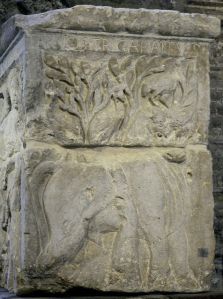
However in Paris we find a sculpture named Tarvos Trigaranus (‘The Bull with Three Cranes’). He is depicted on ‘The Pillar of the Boatmen’ (1AD) thick-set, heavy-chested, with two cranes back-to-back on his back and a third crane on his head. He stands in front of a willow. On an adjacent panel Esus (‘Lord’) is pictured cutting a willow-branch.

Tarvos Trigaranus, Wikipedia Commons

Tarvos Trigaranus, Wikipedia Commons

On a similar monument from Triers on a single stone a man cuts down a tree with a bull’s head and three cranes or egrets in it. At Maiden Castle in Dorset a bronze bull with three horns carrying three female figures was found at a 4AD shrine and may have a basis in legends of shapeshifters who took the form of cranes.

This intrigues me because with Gwyn as a bull of battle we find Gwyddno Garanhir (‘Crane-Legs’). In a personal vision, after their conversation, Gwyddno took the form of a crane and flew to Annwn with his wife and mother who were also cranes. I saw a bull and three cranes before knowing anything about Tarvos Trigaranus.

Miranda Green suggests a naturalistic explanation for the Bull with Three Cranes: ‘egrets and cattle are symbiotically linked in that the birds feed on tics and other pests which infest the hides of the cattle.’ The cattle egret is variously named ‘cow crane’, ‘cow bird’, ‘cow heron’, ‘father of ticks’ and performs this role. Could an egret picking tics from a bull’s back be the source?

Cattle egrets are native to Africa, Spain and Portugal and only spread to northern France in 1981 and Britain in 2007 so it appears this is not the case. Cranes migrate from Sweden through Germany and France to Spain and Mexico but their stops are only temporary and wouldn’t explain a long-term link with local cattle.

Although cattle egrets have only just arrived in Britain, lasting relationships exist between longhorned cattle and wetland birds. English Longhorns originate from Craven and were popular before Holstein Friesians were imported in the 19th C. They are currently being revived as ‘wetland lawnmowers’ at nature reserves because their grazing of long grasses leaves tufts for wildfowl to feed on and hollows left by their hooves are used by nesting lapwings and redshanks.

P1130794 - Copy

Longhorned Cow, Brockholes Nature Reserve

It seems possible such relations date back two thousand years to when aurochs existed alongside wetland birds. Paris’s ancient name was Lutetia (‘marsh’). The image of the ‘great horned bull’ Tarvos Trigaranus was no doubt born from Lutetia’s landscape and inhabitants.

III. The Sacrificial Bull

Auroch bulls could stand two metres high at the shoulder and weigh 1000kg. In his Gallic Wars (48-49BC), Julius Caesar describes an aurochs as ‘a little below the elephant in size, and of the appearance, colour, and shape of a bull.’ These mighty beasts were prized prey for hunters and sadly hunted to extinction in Britain in the Iron Age.

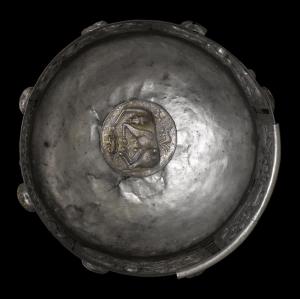
The hunting and killing of an aurochs-like bull is depicted in the bottom of the Gundestrup Cauldron. A hunter or huntress aided by three hounds prepares its slaughter with a blade. Cleverly this death-scene is also one of regeneration. The dead bull lies in a near foetal position surrounded by foliage. On a separate panel three bulls are killed by three hunters accompanied by hounds above and beneath.

'The Bull Fight' National Museum of Denmark

‘The Bull Fight’ National Museum of Denmaek

A sculpture of a sacrificial bull in the same position is found in Paris. On two altars from Alpraham near Chester we find the same bull sculpture and a hound with a close resemblance to one of the three in the bottom of the Gundestrup Cauldron.

We possess several written records of bull sacrifices. Pliny’s Natural History (1AD) refers to a complex Druidic healing ceremony in Gaul where a white-robed Druid climbs a tree and cuts mistletoe with a golden sickle on the sixth day of the moon. Afterward two white bulls ‘whose horns are bound for the first time’ are sacrificed with prayers to an unnamed god. This is followed by ritual feasting.

In Tara the way of selecting a new king was through a tarbhfhess (‘bull feast’). A bull was slaughtered then a medium ate its meat and drank its broth. Four Druids chanted a truth-spell whilst he slept and received a vision of the king. A trace of similar rites in Britain is found in Rhonabwy’s Dream where Rhonabwy experiences a prophetic vision sleeping on an ox-hide.

Stories of bull sacrifices are supported by archaeological evidence. At the war sanctuary of Gournay-sur-Aronde, cattle (including bulls) were led to a pit, killed by a single blow to the nape of the neck then left to decompose; their blood and rotting flesh feeding the earth and underworld deities. Broken weapons were piled in pits surrounding the dead animal.

Afterward the cattle bones were separated. The heads were removed and stored whilst the neck, shoulder and spine were deposited in ditches either side of the entrance with the weapons. About 3,000 bones and 2,000 bent and broken weapons were found. This provides clear evidence of associations between bulls, battle and the underworld gods.

In Britain a complete bull was found interred in a subterranean Cambridge shrine which may have been a sacrifice to the chthonic deities. A West Yorkshire chariot burial surrounded by bones from 300 cattle is suggestive of ritual feasting taking place over hundreds of years. At Maiden Castle human burials were discovered with joints of beef.

This accumulation of evidence shows the importance of the bull as a sacrificial animal whose flesh was deemed incredibly sacred as food for humans and the gods. The sacrifice of a bull would have been a considerable cost for a community. From it powerful magic stemmed for healing, prophecy and war.

IV. Magical Bulls and the Underworld

A pair of magical bulls: Finnbennach (‘White-horned of Connacht’) and Donn Cúailnge (‘Brown Bull of Cooley’) appear in the Táin Bó Cúailnge (‘The Cattle Raid of Cooley’) and fight to their deaths at the end. These bulls were originally divine herdsmen and also took the forms of ‘ravens, stags, champions, water-beasts, demons and water-worms.’

Their capacity to shift shape suggests they were theriomorphic bull deities and progenitors and protectors of their herd (which may be extended metaphorically to people). Donn Cúailnge bears resemblances to Donnotaurus ‘Lordly Bull’ whereas Finnbennach may be connected to the special white cattle sacrificed by the Gaulish Druids.

In Culhwch and Olwen, the impossible tasks fulfilled by Arthur and his men for Culhwch include the capture and yoking together of three pairs of legendary oxen: ‘two oxen of Gwylwlydd Winau’, ‘the Melyn Gwanwyn (‘The one of the yellow of spring’) and the Ych Brych (‘Brindled Ox’)’ and ‘Two horned oxen… Nyniaw and Peibiaw.’

Nyniaw and Peibiaw are the sons of Erb, King of Archenfield, ‘whom God transformed into oxen for their sins.’ I suspect this is a Christian overlay for divine herdsmen who defied the boundaries of man and ox like Finnbennach and Donn Cúailnge.

In Culhwch and Olwen it is not explained how the Brindled Ox is captured or where from. This may be derived from his appearance in The Spoils of Annwn at Caer Fanddwy (‘Fortress of God’s Peak’). Along with seven other Caers, Caer Fanddwy is located in Annwn. The Brindled Ox is described: ‘thick his headband / Seven score links / on his collar’.

The headband gives him a human-like apparel and puts me in mind of Anne Ross’s description of bronze heads on Bronze and Iron Age bucket mounts. One has a ‘hair-line defined by means of a narrow, notched band.’ Human heads with bull’s horns and birds emerging from bull’s heads appear together and are suggestive of shapeshifting bull deities. Such ancient iconography may lie behind the Brindled Ox.

In The Conversation of Gwyn ap Nudd and Gwyddno Garanhir, Gwyn speaks of his sorrow at witnessing battle at Caer Fanddwy: ‘a host / Shields shattered, spears broken, / Violence inflicted by the honoured and fair.’ It seems likely Gwyn refers to the struggle between Arthur and the people of Annwn for the Brindled Ox and this is how he was captured. Of Arthur’s side ‘except seven / none rose up.’

I believe it is no coincidence Gwyn, a bull of battle and ruler of Annwn, is present at the capture of the Brindled Ox. The Chief of Annwn is a central figure in The Spoils of Annwn and Gwyn is a potential candidate for this title. The Chief of Annwn possesses a magical cauldron. This could well be connected with a bull sacrifice and feast.

V. Fairy Kine

The notion cattle come from the underworld is deeply ingrained in the lore of Ireland and Wales. In Cruachan, King Conn steals cattle from the Sidhe then covers his land with magical snow. To melt the snow, the Sidhe kill three hundred white cows with red ears and spread their livers across the plains. For this reason, Magh Ai is called ‘The Plain of Livers’.

Here we find white cows with red ears belonging to the Sidhe (‘fairies’) which presumably come from the Sidhe (‘mounds’). A shining white coat and red ears are traditional significators of otherworldly origins.

Several Welsh stories refer to Gwartheg y Llyn (‘Kine of the Lake’) watched over by divine herdswomen called Gwragedd Annwn (‘Wives of the Underworld’). Wirt Sikes says their favourite haunts are ‘lakes and rivers… especially the wild and lonely lakes upon the mountain heights’ which ‘serve as avenues of communication between this world and the lower one of Annwn, the shadowy domain presided over by Gwyn ap Nudd.’

Cairn adjacent to Llyn Barfog, geograph.org.uk, by andy, Wikimedia Commons

‘Cairn adjacent to Llyn Barfog’, geograph.co.uk, by Andy, Wikipedia Commons

Gwragedd Annwn were rumoured to appear at dusk close to Llyn Barfog, in the hills behind Aberdovey, clad in green with hounds and ‘beautiful milk white kine’. When one of these cows strayed, falling in love with cattle from a thisworldly herd, a farmer managed to catch her. She produced calves, milk, butter and cheese like none seen in Wales.

Unfortunately the farmer decided to fatten her up to eat. Once she was fatter than the fattest cow he’d ever seen he called for the butcher. As the butcher raised his ‘red right arm’ and ‘struck fair and hard between the eyes’ with his bludgeon the blow went straight through the cow’s ‘goblin head’ raising a deafening shriek and knocking over nine men. A green Graig appeared on a crag above the lake crying:

‘Dere di felen Emion,
Cyrn Cyfeiliorn-braith y Llyn,
A’r foci Dodin,
Codwch, dewch adre.

Come yellow Anvil, stray horns,
Speckled one of the lake,
And of the hornless Dodlin,
Arise, come home.’

The milk white cow returned with all her progeny, leaving only one cow who turned from white to black. This legend explains the origin of Welsh black cattle.

VI. White Park Cattle

Historical records exist of payments of ‘real’ white cows with red ears. An Irish law tract states the penalty for satirising King Cernodon of Ulster included ‘seven white cows with red ears’.

In Wales The Laws of Hywel Dda (10th C) determined fines by numbers of colour-pointed cattle. The honour price for an insult to the King of Aberffraw was ‘100 cows for each cantref (‘hundred town’) in his dominion; a white bull with red ears for every hundred cows.’

The Lord of Dinefwr’s honour price was ‘as many white cattle with red ears that will extend, the head of the one to the tail of the other from Argoel to the palace of Dinefwr, with a bull of the same colour for every score.’ The Welsh sent 400 white colour-pointed cows and a bull to King John (who reigned 1199 – 1216AD) in a failed attempt at appeasement.

A fascinating fact that emerged from my research is that white cattle with red ears really existed and are still with us in Britain today. On Dinefwr Park in Carmarthenshire, Cadzow in Lanarkshire and Chartley in Staffordshire herds of White Park cattle are thriving. They are white and ‘have a pigmented skin with red or black ears, eyelids, muzzle, feat and teats. Sometimes there are freckles on the face, neck or shoulders. Sometimes the tail switch is white.’

White Park cow with calf on Hambledon Hill 1 Marilyn Peddle,  flickr.com. Wikipedia Commons

White Park cow with calf on Hambledon Hill 1, Marilyn Peddle, flickr.com, Wikipedia Commons

White Parks could be the source of the laws and earlier stories about white bulls and fairy kine. They even carry a recessive gene resulting in black calves which could explain the remaining black cow in the story from Llyn Barfog. Although scholars have speculated they were brought by the Romans, genetic research has proved this is not true. These Ancient British cattle could come from the underworld.

VII. The Bull and the Portal

In September 2012, Gwyn appeared to me as a bull of battle: a white warrior in a bull-horned helmet stepping with spear and shield straight out of 6th C Wales into 21st C Preston to gift me the imperative of ‘enchanting the shadowlands.’ Now my book is complete I’m being led through the portal opened on that day to explore the connections between the modern world and ‘Heroic Age’.

The image of Gwyn in the numinous prophetic aegis of tarv trin emerged from a Brythonic society not only at war with the Anglo-Saxons but plagued by bloody internecine warfare between its rulers. Gwyn served as a psychopomp to the Men of the North and the death of an era.

1500 years on thankfully wars between rival kingdoms in Britain are at an end. However we still face battle and conflict in relation to environmental and political issues.

Gwyn appears again in the Old North calling me to enter Annwn, learn to shift shape like his herdsmen and women. To seek the friendship of a great horned bull with horns of willow filled with singing birds, an island of dancing cranes, stampedes of wild white red-eared cattle careering from lakes stopping traffic on country lanes. To return with horns and hair full of birds and twigs to speak visions of hope for a new world alongside the marsh and the gods of the deep.

P1130785 - Copy

*The change in spelling from tarv to tarw results from the transition between Old and Middle Welsh. Tarv would have been pronounced ‘tarb’ whilst tarw is ‘tar-oo’. The shift from tarw to tharw is caused by the spirant mutation. Many thanks to Heron for this information and help with understanding Jarman’s translations in The Gododdin.

SOURCES

A.O.H. Jarman (transl), Aneirin – Gododdin, (Gomer Press, 1998)
Anne Ross, Pagan Celtic Britain, (Cardinal, 1974)
Anne Ross & Don Robins, The Life and Death of a Druid Prince, (Touchstone, 1991)
Heron (transl), Gwyn ap Nudd and Gwyddno Garanhir (2015)
Janet Vorwald Dohner, The Encyclopedia of Endangered and Historic Lifestock and Poultry Breeds, (Yale University Press, 2002)
Jean Sprackland, Strands: A Year of Discoveries on the Beach, (Vintage, 2013)
Lady Augusta Gregory (transl), Cuchulain of Muirthemne, (Sacred Texts, 1902)
Miranda Green, Animals in Celtic Life and Myth, (Routledge, 1998)
Miranda Green, Dying for the Gods, (The History Press, 2002)
Peter Thomas Ellis, Welsh Law and Custom in the Middle Ages, (University of Bristol)
Rachel Bromwich (ed), The Triads of the Island of Britain, (University of Wales Press, 2014)
Rachel Bromwich and Simon D. Evans (eds), Culhwch and Olwen, (University of Wales, 1998)
Sarah Higley (transl), Preiddu Annwn: The Spoils of Annwn, (The Camelot Project, 2007)
Sioned Davies (transl), The Mabinogion, (Oxford University Press, 2007)
Thomas Kinsella (transl), The Tain, (Oxford University Press, 1969)
W.A.McDevitte & W.S.Bohn (transl.), Julius Caesar, Gallic Wars, (Sacred Texts, 1859)
Wirt Sikes, British Goblins, (Lightning Source, 1880)

Thirteen calves born at WWT Martin Mere‘, Wetland and Wildfowl Trust
Ancient chariot burial excites experts‘, BBC News
The famous white cattle of Carmarthenshire’s Dinefwr’ Park‘, Wales Online

Dôn and Returning to the Source

Creatures by Greg Hill

On the cover of Greg Hill’s poetry collection, Creatures, is an image of a sculpture by Fidelma Massey called ‘Water Mother’. The first ekphrastic poem bears the same name. Rivers flow through the book with rain and turning tides.

When I reviewed Creatures in November 2014 I didn’t think I’d ever meet a mother goddess; I decided not to have children at an early age and don’t have a nurturing bone in my body.

However I’ve long been drawn to local rivers, streams and wells, above ground and those unseen, been haunted by the songs of their spirits whether rippling in sunshine, hurtling through darkness, rattling against culverts or running free.

I’ve seen a water dragon shrink and die because we shattered her aquifer, heard the screams of her daughters, stood before the empty greyness of her ghost.

In retrospect it’s not that surprising I should meet a water mother: the primal source from whom every river flows and returns. The fountainhead of all water. She who gives and draws back into the abyss.

***

Her name is Dôn. I met her last October in a vision where I was surrounded by hills filled with people. Somehow the hills became the folds of my coat and I was privileged with custodianship of these people whilst together we witnessed a primordial creation scene.

A dark orb appeared, then pupil-like, placenta-like, emerged the diaphanous form of a goddess. After her appearance the orb came to life: amoeba, green moving swards of vegetation, trees, people, marching through a labyrinthine kingdom back into the void carrying houses and entire civilisations.

Sometimes people get stuck, I heard them knocking, felt they wanted to shout out through me. From a huge crow watching above I received the gnosis my patron, Gwyn, carries the lost ones under his wings, that I too bear some responsibility for them; albeit by carrying their stories.

At the end the goddess’s name rang through the hills, from the spiralling abyss of the deep, echoing in the minds of her people, in the vow I’d made to Gwyn who flies between them: Dôn Dôn Dôn. I had the feeling of being part of her family.

***

Little is known about Dôn from Brythonic tradition. The rivers Don in south Yorkshire and Aberdeenshire bear her name suggesting she is a water goddess. In The Mabinogion we find her children: Gwydion, Gilfaethwy, Arianrhod, Gofannon, Amaethon, Eufydd and Elestron.

To learn more it is necessary to turn to Irish parallels and Danu, mother goddess of the Tuatha Dé Danaan (‘Tribe of the Goddess Danu’). Danu derives from proto-Celtic *Dānu ‘fluvial water’ and is associated with the ‘Indo-European heartland’ of the river Danube. Liz Greene says her ‘dark face was Domnu, which means “abyss” or “deep sea”.

The Tuatha Dé Danaan arrived in dark clouds from islands in the north and took the kingship of Ireland from the Fir Bolg. In turn they were defeated by the sons of Míl Espáne who took the surface whereas the Tuatha were forced underground into the sídhe (‘mounds’) becoming the aos sí (‘people of the mounds’).

Will Parker suggests the Tuatha’s arrival from the north is based on a migratory route from Greece via Scandinavia and says Neolithic Grooved Ware and Bronze Age Bell Beaker cultures show Indo-European influence.

There are no records of how the Children of Don arrived. In the Fourth Branch, Dôn has fallen into the background and her son, Gwydion, is lord of Gwynedd. Similarly we find out little about Beli, grandfather of Brân and father of Caswallon and Lludd, who become rulers of Britain.

In contrast with the Irish myths, the sons of Beli do not defeat the children of Dôn. Instead, Dôn and Beli marry and their children are seen as one family belonging to the House of Dôn.

After the death of Nudd / Lludd Llaw Eraint (‘Lludd of the Silver Arm’), like the Tuatha Dé Danaan, the Children of Dôn retreat into the Brythonic ‘underworld’ Annwn (‘not-world’ ‘the deep’). Gwyn ap Nudd appears as Annwn’s ruler and later as a Fairy King.

***

I’ve been devoted to Gwyn for three years and have gradually been getting to know him and Annwn. My explorations have led me through the deep memories of the landscape to his realm where history and myth blur and are never wholly separate

My initial work (which remains important) involved recovering the memories of my locality. Now I am being led deeper into the underworld where Nudd / Nodens, keeps the matter of dream and Dôn presides over the waters of creation and destruction.

Although earlier worlds and their children have sunk into Annwn they remain in our sacred landscape: in the hollow hills, in deep lakes and the sea, in our flowing rivers and their names.

Although barrow mounds have been ploughed over, rivers culverted, lakes drained, they are still with us in Annwn’s memory which will not let us forget their presence and what we’ve done.

Old bonds split and severed by centuries of Christianity, industrialisation, commodification, hyper-rationalism can be reknit and renewed by swimming back down the labyrinthine ways to where we’re unified with our ancestors, the old gods, their primal source: the water mother Dôn.

SOURCES

Liz Greene, The Astrological Neptune and the Quest for Redemption, (Weiser, 1996)
Robert Alexander Stewart Macalister, Lebor Gabála Érenn, (Dublin University Press, 1937)
Sioned Davies (transl.), The Mabinogion, (Oxford University Press, 2007)
Will Parker, The Four Branches of the Mabinogi, (Bardic Press, 2005)

What Ails You, Father? The Rain of Nodens

P1130621 - Copy

My article ‘What Ails You, Father? The Rain of Nodens’ has been published on Gods & Radicals HERE.

After heavy rain and floods across northern England, Scotland and Wales my article focuses on addressing Nodens (‘the Catcher’) as a Romano-British rain god. Exploring Nodens’ identification with Neptune as a god of rain it moves onto his role as a dream-god at Lydney and transformation into Lludd of the Silver Hand (a Catcher who cannot catch) and parallels with the Fisher King. It ends by discussing the importance of ‘asking the question’ and being open to answers in a time of uncertainty and climate change.

Cwn Annwn and the Passage of Souls

Cwn Annwn Tattoo Design by Nixie

Gwyn ap Nudd… he went between sky and air.’
Peniarth MS. 132

Have you heard them howling through the skies?
Have you heard them howl of distant worlds?
Have you felt the howling fear you’ll die?
Have you feared they’re howling for your soul?
If you have, your soul is no longer yours, my friend,
It has never been and will never be until the end.
And never is never as the howling winds
That carry us between sky and air.

Dormach and Death’s Door

Gwyddno Garanhir (‘Crane-Legs’) stands in a misty hinterland before the divine warrior-huntsman and psychopomp Gwyn ap Nudd (‘White son of Mist’) and his white stallion, Carngrwn.

Beside Gwyn is Dormach, his hunting dog, ‘fair and sleek’ and ruddy-nosed. Dormach’s gaze is commanding. His nose shines like a torch-fire; a beacon; a setting sun. Although he appears as a dog his shape somehow exceeds dog-like proportions. Gwyddno says:

‘Dormach red-nose – why stare you so?
Because I cannot comprehend
Your wanderings in the firmament.’

Gwyddno’s sensory perception is distorted. Dormach is close enough for his nose to be seen yet distantly wandering across the heavens.

This is due to the misty shape-shifting nature he shares with Gwyn. J. Gwengobryn Evans tells us Dormach ‘moved ar wybir, i.e. rode on the clouds which haunt the mountain-tops.’ ‘Wybir‘ is ‘condensed floating white cloud’ referred to as Nuden and ‘serves as a garment for Gwyn.’

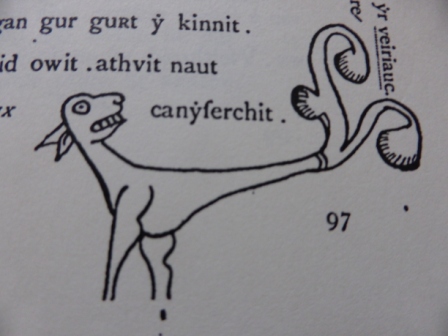
In a remarkable image beside the poem, Dormach appears as a strangely grinning dog with forelegs but instead of back legs he possesses two long and tapering serpent’s tails! This illustrates Dormach’s capacity to be near and distant and shows he is clearly not of this world.

Dormach Sketch - Copy

From J. Gwenogbryn Evans, The Black Book of Carmarthen, (1907)

Dormach is a member of the Cwn Annwn (‘Hounds of the Otherworld’) who are sometimes known as Cwn Wybyr (‘Hounds of the Sky’). They occupy a liminal position between the worlds and play an important role in the passage of souls.

This is represented beautifully by John Rhys’ translation of Dormach (re-construed as Dormarth) as ‘Death’s Door’. He links this to the Welsh paraphrase for death Bwlch Safan y Ci ‘the Gap or Pass of the Dog’s Mouth’, the English ‘the jaws of death’ and the German Rachen des Todes and suggests Dormach’s jaws are the Door of Annwn. Although this translation is disputed by scholars it possesses poetic truth. Death is not an end but a passage to the next life.

Gwyddno’s passing is not depicted in ‘The Conversation of Gwyn ap Nudd and Gwyddno Garanhir’. I’ve been meditating on this poem for several years and had a break-through when I realised Gwyddno’s epithet, Garanhir, was an indicator of his inner crane-nature.

In a personal vision following from the poem Gwyddno donned his red crane’s mask, grew wings and followed the red sun of Dormach’s nose to be re-united with his kindred on an island of dancing cranes in Annwn.

Transformation

Physical death is not always a prerequisite of passage to Annwn. This is shown in the story of Pwyll and Arawn in the First Branch of The Mabinogion. Pwyll’s life-changing encounter with a King of Annwn called Arawn is heralded by the ‘cry of another pack’.

Although Pwyll notices Arawn’s hounds are ‘gleaming shining white’ and red-eared he fails to recognise their otherworld nature. He commands his pack to drive them off their kill: a grand stag, and feasts his own pack on it.

As recompense Arawn asks Pwyll to take his form and role in Annwn and fight his ritual battle against his eternal foe: Hafgan. By defeating Hafgan and resisting the temptation to sleep with Arawn’s wife, Pwyll wins the title of Pwyll Pen Annwn (‘Pwyll Head of Annwn’).

In the liminal space opened by the cries of Arawn’s hounds, Pwyll does not die but is transformed. Where passage to Annwn does not demand physical death it demands the death of one’s former identity and birth of a new one in service to the powers of Annwn.

Cwn Annwn

In later Welsh folklore Cwn Annwn are known by a number of names: Cwn Wybyr, Cwn Cyrff ‘Corpse Dogs’, Cwn Toili ‘Phantom Funeral Dogs’, Cwn Mamau ‘Mother’s Dogs’, ‘Hell-Hounds’ and ‘Infernal Dogs’. Here we find an admixture of pagan and Christian folk beliefs.

Annwn is identified with hell, its gods with demons, and its hounds with hell-hounds. Christianity’s dualistic logic limits the transformative potency of encounters with Annuvian deities by reducing them to objects of fear and superstition.

Yet the lore of Cwn Annwn endures with startling vivacity. They are famed for barking through the skies pursuing the souls of the dead. Therefore to hear them is a death-portent. They often fly the ways corpses will follow: hence their associations with teulu (‘phantom funerals’).

Their magical and disorientating qualities prevail. The 14th C poet Dafydd ap Gwilym speaks of encountering ‘the dogs of night’ whilst lost in ‘unsightly fog’ after hearing Gwyn’s ‘Crazy Owl’. In a report from Carmarthenshire the closer Cwn Annwn get the quieter their voices until they sound like small beagles. The further away the louder their call. In their midst the ‘deep hollow voice’ of a ‘monstrous blood hound’ is often heard.

Like Dormach they delight in a Cheshire-cat-like ability to shift their shape. Some appear as white dogs with red ears or noses. One is a ‘strong fighting mastiff’ with a ‘white tail’ and ‘white snip and ‘grinning teeth’ able to conjure a fire around it. Others are ‘the size of guinea pigs and covered with red and white spots’, ‘small’, ‘grey-red or speckled’. Some are ‘mice or pigs’.

At Cefn Creini in Merioneth they are accompanied by a ‘shepherd’ with a black face and ‘horns on his head’ who sounds remarkably like Gwyn: a horned hunter-god who blacks his face. He is supposedly fended off with a crucifix. In certain areas of Wales the ‘quarry’ of Gwyn and the Cwn Annwn is restricted to the souls of ‘sinners’ and ‘evil-livers’.

Gabriel Ratchets

In northern England we find the parallel of Gabriel Ratchets. Although they are nominally Germanic and rooted in the Wild Hunt there are striking resemblances with Cwn Annwn.

According to Edward A. Armstrong ‘Ratchet’ derives from the ‘Anglo-Saxon raecc and Middle English… rache, a dog which hunts by scent and gives tongue’. Rachen also means jaws: we recall ‘Rachen des Todes’ ‘Jaws of Death’.

In Yorkshire they are known as ‘gabble-ratchets’. Armstrong says ‘Gabble’ is a corruption of ‘Gabriel’ and ‘is connected with gabbara and gabares, meaning a corpse’. We find similarities with Cwn Cyrff ‘Corpse-Dogs’.

Gabriel Ratchets are also defined as packs of dogs barking through the skies portending death. Intriguingly they are identified with noisy flights of nocturnal birds who sound like beagles. In Lancashire James Bowker equates them with ‘whistling’ Bean Geese* flying over lonely moors.

In Burnley, Gabriel Ratchets are connected with the Spectre Huntsman of Cliviger Gorge. A maiden called Sibyl hears ‘wild swans winging their way above her’ before she is swept through the air by a ‘demon’. Poet Philip Hamerton shares the evocative lines ‘Wild huntsmen? Twas a flight of swans, / But so invisibly they flew.’

Thousands of Bewick’s swans and Pink-footed Geese arrive to over-winter on Martin Mere between September and November: the time ‘the Wild Hunt’ flies and may form the root of these Lancashire legends.

In Nidderdale the Gabble Ratchet is equated with the ‘night-jar, goat-sucker, screech-owl, churn-owl, puckbird, puckeridge, wheelbird, spinner, razor-grinder, scissor-grinder, night-hawk, night-crow, night-swallow, door-hawk, moth-hawk, goat-hawk, goat-chaffer… and lich-fowl’

We also find the ‘Ratchet Owl’: the ‘death-hound of the Danes’ and ‘night crow’: ‘This kind of owl is dog-footed and covered with hair; his eyes are like the glistering ice; against death he uses a strange whoop.’

Gabble Ratchets also take the form of birds with burning eyes and appear to warn of death. In some cases they are identified with the souls of un-baptised children.

Cwn Annwn and the Passage of Souls

In stories of Cwn Annwn and Gabriel Ratchets we find an astonishing menagerie of imaginal ‘hounds’. These rich folk beliefs, rooted in wild moorlands and piping wetlands, were not extinguished by Christianity.

Industrialisation forced country dwellers into towns to work in factories. 12 hour shifts in ‘dark Satanic mills’ crushed imagination. Wild places disappeared with the wild mind beneath red bricks of housing developments and asylum walls of schools and universities and secular careers.

Yet through the concrete of office-blocks and head-phones of call-centres over the white-noise of television we still hear the Cwn Annwn howling. The harder we try to shut them out the louder they howl.

The stoppers in Death’s Door tremble as they bark back the liminal spaces where the gods of Annwn are encountered and souls are transformed.

An increasing number of people are encountering hounds and gods of Annwn and having their lives turned around. I met Gwyn at a local phantom funeral site when I was lost. Passing through Death’s Door with him confirmed the reality of the afterlife and has given me a deeper appreciation of life in thisworld.

As I have striven to uncover Gwyn’s forgotten mythos from the British landscape I have been unfailingly drawn to flight paths of migratory birds and recovering wetlands. Locally, the Ribble Estuary and Martin Mere; further afield, Nith’s Estuary and Caerlaverock, Glastonbury Tor and the Somerset Levels, Cors Fochno (‘Borth Bog’) in Maes Wyddno (‘Gwyddno’s Land’).

This has led me to believe that as Brythonic King of Winter Gwyn presides over wintering birds and the passage of souls. This seems significant at a time migratory birds are threatened by melting glaciers and drained wetlands and floods have wrecked havoc across the UK. Our fates are intrinsically linked.

One of the most powerful lessons trusting my soul to Gwyn taught me was it has never been my own. I have always been one of his pack, one of his flock passing between worlds between sky and air.

Arfderydd, River Nith and Caerlaverock 220 - Copy

Swans over Nith Estuary

SOURCES

Charles Hardwick, Traditions, Superstitions and Folklore, (Chiefly Lancashire and the North of England) (1872)
Dafydd ap Gwilym, Rachel Bromwich (ed.), A Selection of Poems, (1982)
Edward A. Armstrong, The Folklore of Birds (1958)
Heron (transl.) ‘The Conversation of Gwyn ap Nudd and Gwyddno Garanhir’ (2015)
Jacqueline Simpson and Steve Roud, A Dictionary of English Folklore, (2003)
James Bowker, Goblin Tales of Lancashire, (1878)
J. Gwenogbryn Evans, The Black Book of Carmarthen (1907)
John Billingsley, West Yorkshire Folk Tales, (2010)
John Rhys, Studies in the Arthurian Legend, (1841)
John Roby, Traditions of Lancashire: Volume 2 (1829)
John Webster, The Displaying of Supposed Witchcraft, (1677)
Miranda Green, Animals in Celtic Life and Myth, (1998)
Philip Gilbert Hamerton, The Isles of Loch Awe and Other Poems of My Youth, (1855)
Sioned Davies, The Mabinogion, (2007)
T. Gwynn Jones, Welsh Folklore and Folk-Custom, (1930)
Wirt Sikes, British Goblins, (1880)
Nottingham Evening Post, Monday 23rd August, 1937

*This seems odd as Bean Geese over-winter in south-west Scotland and Norfolk.
**With thanks to John Billingsley and Brian Taylor for providing some helpful pointers on Gabriel Ratchets, particularly sections from Edward A. Armstrong’s The Folklore of Birds.

Memories of Gwyn’s Hunt in Culhwch and Olwen

P1130437 - Copy

Boar Hunt (from Moniack Sloe Liqueur)

I.
Recovering the Memories

Introduction: The Hunt for Twrch Trwyth and the Impossible Tasks

Within the main narrative of Culhwch and Olwen (1325) lies the story of the hunt for Twrch Trwyth ‘King of Boars’. To win Olwen, Culhwch must fulfil forty impossible tasks. These are set by Olwen’s father Ysbaddaden Bencawr ‘Hawthorn Giant’. The purpose of hunting the Twrch is to take the comb, shears and razor from between his ears so Ysbaddaden’s thorn-bush beard can be untangled, cut and shaved on the day of the wedding feast.

Twrch Trwyth is not just a huge silver, bristly, hoary, old boar but the son of a human chieftain: Taredd Wledig. He was reputedly turned into a boar by God as punishment for his sins. Beneath this Christian veneer lie deeper animistic roots disclosing Twrch Trwyth’s personhood and significance as one of Britain’s ancestral animals.

Irish and Norse myths feature magical boars who are hunted, killed, eaten, then the next day made whole. These could be rooted in tribal perceptions of father and mother animals who generate so long as they are treated respectfully. It is likely similar beliefs were found in Britain. It is of interest to note the Twrch is the father of seven piglets.

The list of impossible tasks contains the names of huntsmen, hounds and horses who are needed to hunt Twrch Trwyth. These include other mythic and numinous figures such as the pre-Christian hunter-deities Gwyn ap Nudd and Mabon mab Modron and a number of legendary hounds and huntsmen. Culhwch does not recruit these personages himself. He enlists the help of Arthur, who gathers and leads the hunt for Twrch Trwyth.

Gwyn’s Leadership of the Hunt

It is my intuition Arthur’s hunt for Twrch Trwyth is based on an older and more primal hunt led by Gwyn ap Nudd ‘White’ or ‘Blessed’ ‘son of Mist’. Gwyn appears as a divine warrior-huntsman with his white stallion, Carngrwn, and white red-nosed hound, Dormach in The Black Book of Carmarthen (1250). Here his role as a gatherer of souls is disclosed.

In later Welsh folklore Gwyn is associated with the Cwn Annwn ‘Hounds of the Otherworld’ and depicted hunting the souls of sinners. Many modern pagans view Gwyn as the Brythonic leader of the pan-European Wild Hunt. The longevity of Gwyn’s lore demonstrates his ongoing significance as a hunter-god and psychopomp within Britain’s consciousness.

Culhwch and Olwen is the only place Gwyn’s associations with the hunt for Twrch Trwyth can be found. However parallels exist within Irish and Norse mythology. Gwyn’s Irish counterpart, Finn ‘Fair’ ‘White’, leads the hunt for the giant destructive boar of Formael. The Norse hunter-warrior god and psychopomp, Odin, feasts on a mythic self-generating boar called Saehrimnir with his host of dead fighters in Valhalla.

Whereas Finn and Odin are central figures in Irish and Norse mythology, Gwyn plays a more marginal role in the British myths. I believe Gwyn may have once possessed a much greater mythos akin to the Fenian Cycle and the body of lore surrounding Odin.

Due to Gwyn’s rulership of Annwn, the Brythonic otherworld or underworld, he and his hunt have been demonised and marginalised through centuries of Christianity. Annwn has been identified with hell, Gwyn and his huntsmen with demons and the Cwn Annwn with hell-hounds.

This process can be traced within Culhwch and Olwen. Reading the narrative ‘otherwise’ to expose its sub-text shows how Gwyn’s mythos has been suppressed and replaced by Arthur’s. From its deeper levels memories of Gwyn’s hunt and the identities of its members can be recovered.

The Spirits of Annwn

Ysbaddaden tells Culhwch ‘Twrch Trwyth will not be hunted until Gwyn ap Nudd is found’. This may refer obtusely to Gwyn’s earlier leadership of the hunt which cannot begin without its divine leader.

Gwyn is impossible to get because ‘God has put the spirit of the demons of Annwn in him, lest the world be destroyed. He will not be spared from there.’ Ysbaddaden’s words hint at Gwyn’s rulership of Annwn and containment of its spirits.

Gwyn’s paradoxical nature as a white and blessed protector on the one hand and the ‘dark’ embodiment of the fury of the spirits of Annwn on the other is too much for the dualistic logic of Christianity to handle. Hence it calls for an explanation via the agency of God. This intolerable ambiguity is the source of Gwyn’s marginalisation and suppression of his myths.

The only clue I have found to the identity of the spirits of Annwn is an inscription from Chamalieres invoking the Andedion ‘Underworld Gods’ including ‘Maponos Arvenatis’. Maponos ‘The Son’ was the Gallo-Brythonic name of Mabon; a pre-Christian deity of youth and hunting who also appears in the impossible tasks. Mabon’s mother, Modron, is the daughter of Avallach, a King of Annwn. Mabon’s Annuvian nature is clear.

Thus it seems possible Mabon and other figures found imprisoned or underground in the narrative of Culhwch and Olwen are spirits of Annwn and members of Gwyn’s hunt. It seems significant some are viewed as prisoners of Gwyn and it is Arthur’s task to liberate them. By freeing huntsmen, hounds and horses from imprisonment in the underworld, Arthur removes them from Gwyn’s containment and finally usurps his role as the leader of the hunt.

II.
The Members of Gwyn’s Hunt

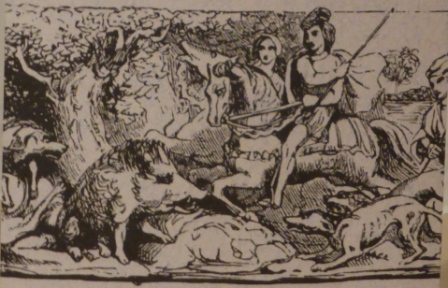
Who are the members of Gwyn’s hunt?

It is possible to locate them in the Impossible Tasks in Culhwch and Olwen.

Drudwyn and Graid son of Eri

One of Culhwch’s impossible tasks is to get Drudwyn ‘Fierce White’ who is so fierce and strong no leash can hold him except the leash of Cors Cant Ewin. No collar can hold the leash but the collar of Canhastyr Can Llaw plus… the chain of Cilydd Canhastyr is required to hold the collar along with the leash!

Drudwyn has clear Annuvian qualities. I’m reminded of a later folkloric reference to an ‘Infernal Dog’ which takes the form of a mastiff with a white tail and white snip down its nose and grinning teeth which conjures a fire around it.

Drudwyn is the ‘whelp’ of Graid son of Eri. In the episode of Gwyn, Gwythyr and Creiddylad, Graid attacks Gwyn with Gwythyr’s army and is resultingly defeated and imprisoned by Gwyn then rescued by Arthur. It seems likely this takes place in Annwn.

This episode is flanked by the opening sentence ‘It is best to seek Drudwyn the whelp of Graid son of Eri’ and the closing words ‘Arthur obtained… the leash of Cors Cant Ewin.’ By rescuing Graid, Arthur also got Drudwyn and his leash. Thus Graid, Drudwyn and his leash may all be seen as brought from Annwn.

Mabon mab Modron

However it is not Graid who is destined to hold Drudwyn on the hunt but Mabon mab Modron. Mabon is an important god of youth and hunting in his own right. I have previously noted his associations with the spirits of Annwn and descent from Modron, daughter of Avallach: A King of Annwn.

In Culhwch and Olwen Mabon is impossible to get because he was stolen from Modron when he was three nights old. Nobody knows where he is or whether he is alive or dead. Arthur’s men find it necessary to consult the oldest animals: the blackbird of Cilgwri, the Stag of Rhedynfre, the Owl of Cwm Calwyd, the Eagle of Gwernabwy and the Salmon of Llyn Lliw.

This tale is of considerable antiquity and may date back to a pre-Arthurian variant where Modron herself was seen as wandering the earth conversing with the animals to find her lost son.

Arthur’s men are guided by the salmon to Caerlowy (Gloucester) where Mabon is found lamenting in a ‘house of stone’. He complains ‘no-one has been so painfully incarcerated in prison as I, neither the prison of Lludd Llaw Eraint nor the prison of Graid son of Eri.’

Arthur and his warriors arrive to defeat Caerlowy’s defenders whilst Cai tears down the wall and takes Mabon on his back. Mabon is borne ‘home’ and made a ‘free man’.

Links between Mabon, Graid and Drudwyn become clearer. They are all prisoners of Annwn released from its unhomeliness and redeemed of their Annuvian natures to join Arthur’s hunt.

Gwyn Myngddwn

Mabon’s designated steed, Gwyn Myngddwn ‘White Dark Mane’, was also got at the same time as Drudwyn’s leash. Gwyn Myngddwn does not belong to Mabon: he is the horse of Gweddw. Gweddw’s horse is listed as one of ‘Three Bestowed Horses of the Islands of Britain’ in The Triads as Myngrwn ‘Arched Mane’.

Gwyn Myngddwn’s white colouring and epithet ‘swift as a wave’ suggest he possesses Annuvian qualities and may be a water-horse. ‘Myngrwn’ is also suggestive of arching waves. Gwyn Myngddwn’s watery nature makes it possible for Mabon to ride him into the Hafren (the river Severn) and snatch the razor from between the Twrch’s ears.

Rhymi and Her Two Whelps

Another impossible task Arthur fulfils is capturing the ‘the two whelps of the bitch Rhymi’. Rhymi is fascinating because she is a shapeshifter who adopts the form of a ‘she-wolf’. It is enlivening to find a powerful female figure in this male-dominated narrative.

And more so when parallels with Irish mythology are considered. Finn owns two beloved hounds called Bran and Sceolang. They are the son and daughter of his aunt who was transformed into a dog whilst she was pregnant. Hence they are his nephews!

Gwyn’s descent from Nudd ‘the superior wolf lord’ suggests like his father he was theriomorphic and able to take canine form. Perhaps Rhymi and her whelps have familial connections with Gwyn.

Rhymi and her offspring dwell at Aber Cleddyf in a cave. The fact that they can live beneath a river underground is another sure indicator of their Annuvian nature.

When Arthur nears Aber Cleddyf he speaks with a farmer called Tringad who says Rhymi and her whelps have been destroying his landscape. Arthur boards Prydwen and leaves some men on the ground. Together they round up and capture the wolfish-hounds and God turns them back into their ‘own shape’.

I assume ‘own shape’ means human form. This contrasts with God fixing Twrch Trwyth in swine-form. Becoming animal is punishment whereas humanisation represents redemption. Rhymi’s whelps appear as hounds again on the hunt so this magic doesn’t last long.

Cynedyr and Cyledyr Wyllt

Rhymi’s whelps can only be held by a leash from the beard of Dillus Farfog. The only huntsman who can hold the leash is Cynedyr Wyllt who ‘is nine times wilder than the wildest beast on the mountain.’ Cynedyr is one of the gwyllon: madmen, wildmen or spectres who have intimate connections with the forest of Celyddon.

Celyddon is the Welsh name for the Caledonian Forest, which has long-standing associations with wildness and death. The 6th century Classical writer Procopius said north of the wall ‘it is actually impossible for a man to survive there even half an hour, but countless snakes and serpents and every other kind of wild creature occupy their area as their own. And, strangest of all, the inhabitants say that if a man crosses this wall and goes to the other side, he dies straight away… the souls of men who die are always conveyed to this place.’

In The Black Book of Carmarthen Myrddin Wyllt speaks of his flight to Celyddon after the Battle of Arfderydd to recover from trauma wandering amongst wild creatures and gwyllon. In The Life of St Kentigern (12th C) (as Lailoken) Myrddin shares his guilt and a vision of an unendurable brightness in the sky and host of warriors. One is described as a ‘demon’ who tore Myrddin out of himself and assigned him to the wild things of the woods.

It seems possible this company was Gwyn and the spirits of Annwn. Hence they played a role in Myrddin’s retreat to the forest and transition into wyllt-ness but also his recovery and acquisition of the powers of poetry and prophecy.

We know nothing more about Cynedyr Wyllt than his reputation for extreme wildness. Yet we find the story of Cyledyr Wyllt within the episode of Gwyn, Gwythyr and Creiddylad. Along with Graid son of Eri, his brother, Pen, his father, Nwython, Nwython’s uncle Gwrgwst Ledlwm and Gwrgwst’s father Dyfnarth, Cyledyr accompanied Gwythyr in his attack upon Gwyn.

During their imprisonment, Gwyn killed Nwython and fed his heart to Cyledyr, who went mad. I have no idea whether this gory scene is founded in ancient ancestral rites or superstitions about Gwyn or whether it was invented to demonise him.

It seems significant four generations of Strathclyde Britons are captured and Cyledyr is fed his father’s heart. Could Nwython’s heart be viewed as containing the life-force of his family? Could transgressing the moral bounds of Dark Age society be a form of initiation into Gwyn’s hunt? Consuming his father’s heart clearly makes Cyledyr ‘wyllt’.

Neither human or animal (Myrddin takes the form of a bird and Cynedyr is compared to a mountain beast), living or dead, the gwyllon occupy a liminal position similar to the spirits of Annwn.

Later, Arthur goes north and captures Cyledyr. Alongside Mabon, Cyledyr rides the Twrch into the Hafren and snatches the shears from between his ears.

III.
Gwyn’s Hunt and Impossibility

The Escape of Twrch Trwyth

Arthur’s hunt for Twrch Trwyth begins in Ireland. After the hounds are loosed, the Twrch lays waste to a fifth of the land. Arthur fights the boars for nine days and nights and only kills one piglet.

Twrch Trwyth and his piglets then swim across the sea to Wales. The Twrch kills men and beasts in Daugleddyf then cattle in Cynwas Cwryfagyl. At the river Nyder, he stands at bay. In the first round he kills four of Arthur’s champions. In the second he slaughters Arthur’s son, Gwydre, and several other men. The next day he kills numerous ‘men of the country’ including Arthur’s chief craftsman, three servants of his gatekeeper and the King of France.

Arthur’s men lose the Twrch at Glyn Ystun. At this point Arthur summons Gwyn to him and asks if he knows anything about Twrch Trwyth. Gwyn says he does not. It seems likely the Twrch has fled deep into the wild or taken shelter in Annwn and Gwyn is covering his flight from his adversary.

This makes it painstakingly obvious in spite of Ysbaddaden’s demand all the listed hunters are gathered before the hunt begins, Gwyn has not been got and is not riding with Arthur. There is no evidence of Gwyn’s recruitment in the text nor of the capture of his steed: the famous water-horse Du y Moroedd ‘The Black of the Seas’.

Following Gwyn’s evasion of revealing the location of Twrch Trwyth, Arthur’s men are forced to hunt his piglets instead. Of the group who take them on none survive except one. When Arthur arrives with men and hounds the Twrch returns to defend his little pigs. Four piglets are killed. Another piglet is slaughtered at Garth Grugyn. After the King of Brittany and Arthur’s uncles meet their end the last piglet is defeated at Ystrad Yw.

Arthur summons Devon and Cornwall and they agree to drive Twrch Trwyth into the Hafren. Arthur and his warriors fall upon the Twrch and souse him in the river. At this point Mabon and Cyledyr flank him and snatch the razor and shears. Two of Arthur’s servants drown.

Afterward Twrch Trwyth escapes to Cornwall. Following a confrontation which makes the preceding trouble look like ‘mere play’ the comb is taken. He is chased from Cornwall into the Cornish sea. It is noteworthy Arthur and his men do not (cannot, dare not?) kill Twrch Trwyth.

Perhaps the rite of killing the Twrch is preserved for Gwyn, his legendary water-horse, Du, and his Annuvian huntsmen alone. Only they possess the knowledge of Nudd / Nodens ‘the catcher’ which is required to hunt and kill this great magical silver-bristled ancestral boar and bear him away to the feast in the deep from which he runs wild again.

Impossibility and the End of the World

Although Arthur does not complete all the impossible tasks, the comb, shears and razor are wrested from between the Twrch’s ears. Ysbaddaden’s beard is untangled, cut and shaved (down to the bone and even his ears are cut off!) and after his decapitation Culhwch marries Olwen.

The Twrch is hunted and the shaving equipment won but at a terrible cost. A fifth of Ireland is decimated along with a good part of Wales. Countless huntsmen lie dead including members of Arthur’s court, his close companions and family, most notably a son.

One recalls Ysbaddaden’s caution: ‘Twrch Trwyth will not be hunted until Gwyn ap Nudd is found’. The reference to Gwyn’s containment of the spirits of Annwn, a task he cannot be spared from in case the world is destroyed, highlights the danger inherit in Arthur’s decision to usurp his role as leader of the hunt and contain it with the help of God. This raises the question of whether the consequences would have been so dire if they worked together.

I don’t believe this is possible. Gwyn’s paradoxical mythos which transgresses the bounds of civilised Christian society is not compatible with Arthur’s worldview. There is not room for two leaders of the hunt. Arthur’s usurpation of Gwyn’s role as a protector of Britain could be the key to his marginalisation.

The central fact about Gwyn’s hunt is it belongs to him and the spirits of Annwn: the not-world, the deep, the realm of impossibility where all boundaries between civilisation and wildness, human and animal, life and death break down.

Attempting to make the impossible possible Arthur contains Gwyn’s hunt in a form palatable to Christian civilisation for a limited amount of time before, like Twrch Trwyth, it slips back into the watery realm of impossibility.

It is my further intuition Gwyn’s hunt is not only bound up with the literal destruction of the world but the end of the worlds we create as people. It is associated with the dissolution of what is possible and the manifestation of the impossible and thereby with radical change at the deepest level.

Nicolas R. Mann writes: ‘Gwyn is not only a guide into Annwn but also mysteriously connected with the end of a world… Gwyn may be seen as a guide into the next human world.’

EPILOGUE

As centuries of disbelief dissolve
they can be seen again
on the misted edges of Celyddon.

Drudwyn’s fierce white face pushing forward.
Graid son of Eri with a tentative hand on his collar.

Bright radiant Mabon holding Drudwyn’s leash,
leading Gwyn Myngddwn arching
his white neck and tossing his dark mane.

Deep in the forest Rhymi shakes
velvety flaps of red ears
as she suckles a litter of soft white pups
who will one day run with young hunters.

Cynedyr and Cyledyr fly
on the wings of birds
traverse mountains
goat-footed.

Standing apart in ruffled white furs
with a steadying hand on Du’s neck
Gwyn listens with Dormach
to the song of the forest
for a sign it is time.

They call to us to take their hands
ride swift mounts steer bellowing hounds
through the gap in the skies
where nothing is impossible.

Should we choose to join them
it is wise to heed
Culhwch and Olwen:
know for better or worse
the fate of the world is at stake.

Ribble Rising

After a month’s heavy rain across northern England, rivers have risen to record levels. Following 100mm of downpour in one night in Lancashire, the river Ribble (from Gallo-Brythonic Riga Belisama ‘Most Shining’ or ‘Most Mighty Queen’) burst her banks at Ribchester and Whalley, forcing people from their homes.

Yesterday the Ribble ran high between Penwortham and Preston swelling under Penwortham Bridge carrying trees, branches, tyres and other debris out to the sea with an urgent roar.

A playground in Middleforth with an overflowing storm drain was underwater.

Several riverside footpaths were submerged.

The Ribble had flooded the bottom of Miller Park completely, almost covering the fountain and pagoda.

The Pavillion Cafe was cut off like a stranded lake dwelling.

P1130527

As dusk approached, Victorian lamps illuminated the submerged pathway.

P1130534


Luckily at the most dangerous point: high tide at around 11pm, the Ribble did not break over the flood walls. Avenham and Miller Parks and the flood plains of Central Park managed the rest and no-one was evacuated.

It would have been a very different story if the Riverworks project, which intended to create a barrage on the Ribble and build on its floodplains had gone ahead. We have Jane Brunning and other ‘Save the Ribble‘ campaigners to thank that we have Central Park instead.

This morning, I walked along the old railway track to see Central Park’s flooded fields.

The floods had receded from Avenham and Miller Park and the Ribble sunk back to her normal course.

P1130579

Last night Belisama heard our apologies, songs and prayers. Today she received gratitude and thanks. This was the highest I have ever seen the Ribble rise. It was really quite terrifying and gave me a fuller understanding of why, before flood-walls, our ancestors revered and feared her as a Mighty Queen.

With temperatures increasing ten times faster than in known history and water levels rising globally I fear this will not be the last time the Ribble bursts her banks. It is a clear message everything possible must be done to slow climate change and adjustments must be made to accomodate rising rivers and returning wetlands.

Having Central Park saved us here. My thoughts are with those not so lucky in Ribchester, Whalley and in York from where 2,200 people have been evacuated.