Vindolanda: The Land of White Springs

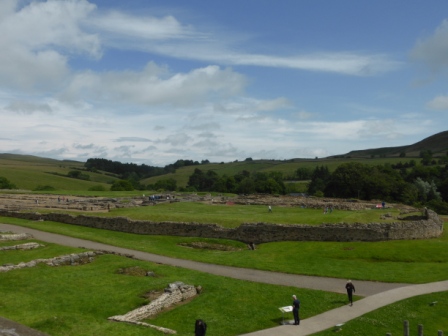
29 miles east along Hadrian’s Wall from Carlisle lies the ruins of the Roman village of Vindolanda. I was drawn there because the name Vindolanda, usually translated ‘White Fields’ or ‘White Lands’, derives from *Windo ‘fair, white, blessed’ and this is the root of Gwyn ap Nudd’s name. Gwyn may have been known as Vindos in Iron Age Britian. There are no known dedications to Vindos but it seems possible he was venerated at Vindolanda and Vindogladia.

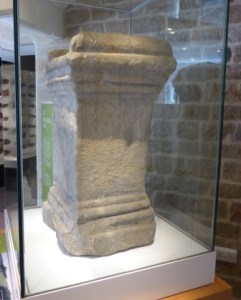
Evidence for the place-name Vindolanda comes from the Vindolanda Altar, which was found at the edge of the settlement. It reads, ‘Pro domu divina et Numinibus Augustorum Volcano sacrum vicani Vindolandesses curam agente…V S L…’ ‘For the Divine House and the Deities of the Emperors, the villagers of Vindolanda (set up) this sacred offering to Volcanus, willingly and deservedly fulfilling their vow, under the charge of…’

P1170197 - Copy

Here we find the name Vindolandesses ‘villagers of Vindolanda’. The altar was set up for Volcanus, Roman god of volcanoes and blacksmithing. As there isn’t any evidence of volcanic activity in the area, I assume the villagers chose Volcanus because iron smelting and forging took place at Vindolanda.

Surprisingly there is no information on display about what was there before the Roman invasion. When I asked a member of staff, she said it was farmland and told me the name Vindolanda derives from the land being coloured white by natural springs running from above the village and Barcombe Hill.

Near the wells and water tanks above the ruins is a notice which mentions ‘many springs and good steams’ and states ‘the most powerful source lay near here’. The stone aqueduct which carried the water into the village is still visible, but its source appears to have run dry.

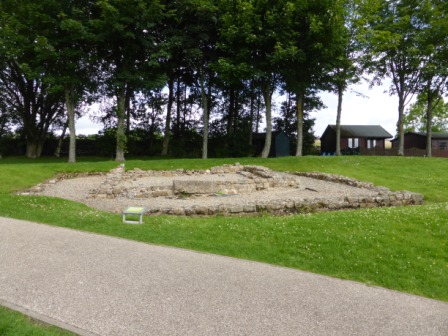
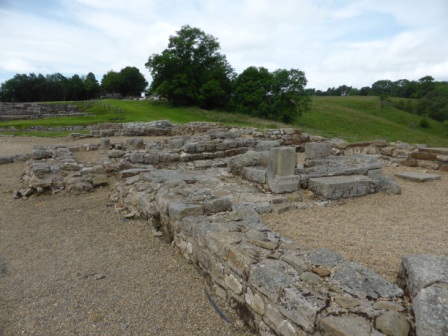
Adjacent to the wells and tanks stands the remains of a Romano-Celtic temple ‘used by soldiers to celebrate both local and Roman gods’. No individual deities are named. Gwyn is associated with the White Spring beneath Glastonbury Tor and I’ve experienced his presence at Whitewell here in Lancashire.

P1170043

It’s my intuition he could have been worshipped as Vindos in this temple beside the source of the white springs. My excitement at potentially discovering one of Vindos/Gwyn’s most ancient sacred sites was tempered with sadness that the springs had run dry.

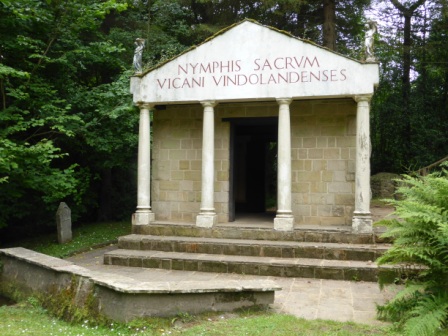
Below the village near to Chainley Burn is a reconstructed shrine with the painted inscription, ‘NYMPHIS SACRUM VICANI VINDOLANDENSES’ ‘The villagers of Vindolanda (dedicated this temple) sacred to the Nymphs’. This is based on an ornate temple still standing in the 18th century. There is plenty of evidence Vindolanda was a place of water worship.

P1170179

*

 Nine forts have existed at Vindolanda, built between 85AD and 370AD. Archaeological evidence suggests it was occupied long into the Dark Ages. It has been the home of soldiers from many different cultures; the 9th cohort of Batavians (Netherlands), the 1st cohort of Tungrians (Belgium), the 4th cohort of Gauls (France), the 2nd cohort of Nervians (Belgium) and Vardullian Cavalry (Spain). These men were removed from their homelands and stationed across the Empire. Defeated Britons were sent to fight for Rome in other countries.

P1170110

Rows of houses, storehouses, a tavern and mausoleums lie outside the walls of the fort which, when they were built in 211AD, were two storeys high with impressive guard towers (much of the stone has since been stolen). Inside are more houses and stores, bathhouses, workshops, horrea ‘granaries’, the principia ‘headquarters’ (where regimental officers and clerks maintained records) and the praetorium ‘house of the commanding officer’.

One of the buildings was a temple to Jupiter Dolichenus, an ancient weather god from the south-east of modern Turkey, who is depicted holding bolts of lightning whilst standing on a goat. His temple was destroyed then set on fire in 370AD when paganism was replaced with Christianity and a Christian church built within the fort. This is significant as it provides an exact date for the conversion of the people of Vindolanda to Christianity. It seems likely other Roman-ruled populaces on Hadrian’s Wall were converted around the same time.

P1170143

Within the museum are a large variety of finds perfectly preserved by the peaty soil. 6,000 shoes (but only one pair!) of all shapes and sizes were found in the ditches surrounding the fort, along with armour, weaponry, tents, a drawstring bag, cavalry standard and equipment for horses.

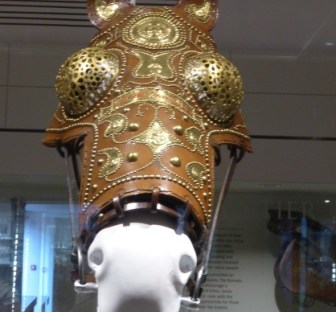
I was particularly impressed by the chamfron; a horse’s ceremonial face-mask made from leather with bronze fittings and protection for the eyes. Gwyn speaks of Carngrwn as a ‘white horse gold-adorned’. I could imagine Carngrwn wearing similar headgear. Could his depiction in The Black Book of Carmarthen have originated from the Land of White Springs and its tradition of elaborately decorated saddlery?

*

Most famous of all are the Vindolanda tablets. These inscriptions on wood date back to 121AD and provide some fascinating insights into the lives and viewpoints of the soldiers of Vindolanda.

‘…the Britons are unprotected by armour. There are very many cavalry. The cavalry do not use swords, nor do the wretched Britons (Brittonculi) mount in order to throw their javelins.’

‘…order (accommodation) to be given to…, but also a lodging where horses are well (looked after). Farewell, brother dearest to me’

‘Tomorrow nice and early in the morning come to Vindolanda, so that (you can join the counting of the census)’

Pieces of writing not on display are summarised on the surrounding walls:

Tranquilius ‘Who supplied some undergarments to the Cerialis household’

Claudius Super ‘A centurion, apologising to Cerialis for failing to attend Sulpicia Lepidina’s birthday celebrations’

Flavius Genialis ‘A predecessor prefect to Cerialis, who appears to have had a nervous breakdown at some point’

Lucius ‘A cavalry troop commander (decurion), receives a letter from a friend reporting on a gift of 50 oysters from a place called Cordonovi

Virrilus ‘A veterinary surgeon (veterinarius), who is reminded by Chrauttius that he hasn’t yet sent the castrating shears that he promised’

There is a small collection of statues and altars of gods and goddesses. These include statues of Priapus, Maponus and statuettes of Venus and Dea Nutrices and altars to the Veteres and an unknown god which frustratingly simply reads ‘Deo’.

They represent only a small portion of the dedications found at Vindolanda. I hoped to find an altar to Mogons ‘great one’ inscribed ‘Mogonti et Genio Loci’, as Vindos may have been viewed as the genius of the place. However, it was not on display.

That’s only a small complaint. The people who work at Vindolanda have done a superb job in their excavations of the Roman forts and preservation of the objects and remains of the people who lived there. No inscriptions to Vindos have been found, but their work is ongoing and no-one knows what might be recovered next…

*

Vindos god of the Land of White Springs
where the springs flow no longer
yet memories flow from
Annwn’s wells

soldiers from a thousand distant lands
have whispered your name

water holds their peaty memories

I do not wield a stylus on birch
nor chisel on altar

to engrave your greatness here forever

I let my words fall on the wind
spiralling downward
to join
the well-springs

Caer Ochren: The Birth of Pen Annwn and the Silver-Headed Beast

The final fort which Arthur, Taliesin and their party raid in ‘The Spoils of Annwn’ is Caer Ochren. Marged Haycock translates Caer Ochren as ‘Angular Fort’ (from ochr ‘edge’, side’). This name could relate to the fortresses having four corners/quarters/turrets/peaks. Ochr also translates as ‘aspect’ or ‘facet’. My working thesis is we’re looking at seven names for the same fort. Caer Ochren thus encompasses all its facets rolled into one.

Once again Taliesin berates ‘pathetic men’ (monks) for their lack of knowledge of certain mysteries:

‘I don’t deserve to be stuck with pathetic men, with no go in them,
(those) who don’t know on what day the Lord is created,
(nor) when, at noon, the Ruler was born,
(nor) what animal it is they guard, with his silver head.’

Haycock draws parallels with Christian tradition. ‘What hour was he (Christ) born? As the prophet says, he came at midnight from his regal thrones’. ‘At what time of the day or night was the world made, and (at what time) will it be destroyed, and (at what time) did the Lord arise from the dead?’

However, this relies on the translation of ‘Lord’ from Pen which literally means ‘Head’. Considering the poem centres on the theft of the cauldron of Pen Annwn (‘Head of Annwn’), it seems more likely he is the subject of the riddles and they refer to the day of his creation and the hour of his birth.

This is the interpretation of Caitlin and John Matthews, who refer to ‘the conception and birth of the Chief (of Annwn)’. In an evocative painting of Caer Ochren*, Meg Falconer depicts the Chief’s face as he awaits birth beneath a snowy mound accompanied by running deer, a triskele, and slither of new moon. The text around the painting reads: ‘Caer Ochran – the cold castle under the stone – the magic beast of the silverhead – day of the kings birth.’ It seems significant the birth of Pen Annwn is linked with the last fort in the poem.

Next we come to the silver-headed animal. ‘Animal’ is translated from vil (mil) by Haycock whereas the Matthews favour ‘beast’. We find the repetition of pen (aryant y pen ‘silver head). Sarah Higley and the Matthews translate Perchen as ‘owner’, which suggests it belongs to Pen Annwn and is guarded by his people. The question of the identity of this beastie has produced a proliferation of divergent conjectures.

Robin Melrose suggests the silver-headed animal/beast is the Brindled Ox from the previous verse. The lines about the Brindled Ox are also preceded by a similar riddle about the birth at mid-day of Dwy, ‘God’ (Pen Annwn?) and it’s possible this verse echoes the one before it. An old ox could certainly be pictured with silver hairs.

An alternative theory is put forward by Marged Haycock. She says ‘Mil is understood as an ‘animal’ guarded by the monks, perhaps a riddling question referring to ‘a silver-headed crozier with a zoomorphic crook bearing a reliquary box.’

The Matthews point out ‘The animal that most commonly has silver hair on its head is an elderly human.’ They suggest this may be a kenning for Henben ‘Old Head’, an epithet of Maelgwn Gwynedd’s chief poet Henin Fardd. Further ‘the real Henben or Old Head is Brân himself.’

The mention of a silver-headed beast puts me in mind of Twrch Trwyth, ‘King of Boars’. One of his piglets is Grugyn Gwrych Eraint, ‘Grugyn Silver-bristle’; ‘all his bristles were like wings of silver, and one could see the path he took through the woods and over fields by the way his bristles glittered.’ It seems likely Grugyn inherited his silvery bristles from his father.

In Culhwch and Olwen, Arthur leads the hunt for Twrch Trwyth, yet lines stating the hunt cannot begin until Gwyn ap Nudd is found suggest Gwyn was the original leader. Gwyn is a candidate for the title Pen Annwn and it seems possible his people guard the silver-headed beast. An objection is the Twrch is a wild animal unlikely to be owned or guarded.

Another suggestion is the animal owned by Pen Annwn is a dog. Both Gwyn and Arawn are connected with hounds of Annwn. Gwyn owns a dog named Dormach who is ‘fair’, ‘red-nosed’ and pictured with two serpent’s tails. He could possess a few silver hairs. However it’s more likely he’d be doing the guarding than being guarded!

The silver-headed beast slips from grasp like quick-silver and perhaps that’s the key. Many animals in Celtic mythology were shapeshifters and didn’t stay the same for long. Interestingly there is no record of Arthur getting his hands on this evasive beast.

The verse ends with the refrain:

‘And when we went with Arthur, sad journey,
save seven none came back from Caer Ochren.’

The journey of Arthur, Taliesin and the other survivors is complete. It is drawn into connection with the birth of Pen Annwn. In Caer Ochren end and beginning meet. Yet the poem has not finished. Taliesin has plenty of insults left for those monks…

~

Caer Ochren

I am the end and the beginning.
Count my angles. You will never count them all
because I am spinning beyond the terminal velocity
of sight. You will never know what is behind,
beyond the walls unless you come in,
scratch the head of a silver-headed beast,
a hound beside the chair of the one who rules the fort
and has been absent half a year. How he stretches
his great jaws, unrolls himself into a serpent.
Where teeth touch tail the story ends
and begins again.

P1170370

*In King Arthur’s Raid on the Underworld. Some of Meg’s paintings can be viewed HERE.

Caer Vandwy and the Theft of the Brindled Ox

A plain of blood where men once stood.
The lights have gone out in Caer Vandwy.
The clashing sea rolls over shield and spear.
The living dead. The dead dead again.

***

The sixth fortress in ‘The Spoils of Annwn’ is Caer Vandwy. This has been translated as ‘Fortress of God’s Peak’ and ‘Fort of the High God’. Marged Haycock uses ‘Mand(d)wy Fort’ but does not explain her re-rendering. It could relate to Manawydan (‘Manawyd’ in ‘Arthur and the Porter’). The connection of a sea-god with an island location seems credible.

In the verse relating to Caer Vandwy, Taliesin again berates ‘pathetic men’ (monks) for their lack of insight into certain mysteries he is knowledgeable about:

‘I don’t deserve to be stuck with pathetic men trailing their shields,
who don’t know who’s created on what day,
when at mid-day God was born,
(nor) who made the one who didn’t go to the Meadows of Defwy.’

The second line suggests the existence of a Bardic riddle enumerating mythic and/or historic figures born on certain days. In line three, Haycock reconstitutes Dwy ‘God’ from Cwy. Caitlin and John Matthews prefer Cyw ‘chick’ whereas Sarah Higley sticks with Cwy as a personal name.

Haycock’s choice fits with the translations of Caer Vandwy as a fortress belonging to (a) God. This may not be the Christian God. In the next verse Taliesin refers to the ‘pathetic men’ as ‘(those) who don’t know on what day the Lord is created’. Lord is translated from Pen ‘Head’. Perhaps this god is Pen Annwn ‘The Head of Annwn’.

Next we come across an unnamed person ‘who didn’t go to the Meadows of Defwy’. Haycock suggests Defwy is a river-name meaning ‘black’ (from def-/dyf) and poses the question ‘Was this imagined as a river between this world and the next?’

The Matthews link the Meadows of Defwy to Gweir ap Gweirioed ‘Hay son of Grassiness’ (the divine prisoner in verse one) and say ‘we may be looking at Doleu Defwy as an otherworldly meadow’.

This brings to mind the Gwerddonau Llion (translated as ‘green meadows of the sea’ and ‘green islands of the floods’). In a triad* referring to ‘three losses by disappearance of the Isle of Britain’ Gavran is said to have gone to sea in search of the Gwerddonau Llion.

Philip Runngaldier connects the Gwerddonau Llion with the sunken land of Cantre’r Gwaelod ‘The Bottom Hundred’ and says they are inhabited by ‘Gwyllion’: ‘the shades of (Llyn) Llion’ ‘the dead’. Perhaps the one who didn’t go to these mysterious meadows escaped death.

***

Taliesin continues to deride the monks:

‘those who know nothing of the Brindled Ox, with his stout collar,
(and) seven score links in its chain.’

Grazing on the Meadows of Defwy we come across an animal of great fame: Ych Brych ‘The Brindled Ox’. He appears in The Triads as one of ‘Three Principal Oxen of the Island of Britain’:

‘Yellow Spring (‘The One of the yellow of spring’)
and Chestnut, of Gwylwylyd (or ‘a meek and gentle ox),
and the Brindled Ox.’

His capture is amongst the ‘impossible tasks’ Arthur and his men must fulfil on Culhwch’s behalf in Culhwch and Olwen. For food to be grown for Culhwch and Olwen’s wedding feast, a field must be ploughed by the divine ploughman, Amaethon.

The plough must be pulled by a team of six oxen: ‘the two oxen of Gwylwlydd Winau, yoked together’, ‘Melyn Gwanwyn and the Ych Brych yoked together’ and ‘two horned oxen… Nyniaw and Peibiaw.’

Two oxen from the triad: Yellow Spring and the Brindled Ox are placed together and Gwylwylyd appears as the owner of two oxen, presumably Chestnut and an unnamed ox. Intriguingly Nyniaw and Peibiaw are the sons of the king of Archenfield ‘whom God transformed into oxen for their sins.’

John Rhŷs records a folkloric story where Nyniaw and Peibiaw are brother kings. One moonlit night, Nyniaw boasts his field is ‘the whole firmament’. Peibiaw says his sheep and cattle are grazing in his fields: ‘the great host of stars, each of golden brightness, with the moon to shepherd them.’ Nyniaw is furious and a terrible battle ensues which leads to their transformation into oxen by God.

This may be a Christianised explanation of their shapeshifting capacities. In The Tain, the two bulls Finnbennach and Donn Cuailnge are ‘pig-keepers’ ‘practiced in the pagan arts’ who can ‘form themselves into any shape’. Tricked into falling out, they battle against each other as birds of prey, whale and seabeast, stags, warriors, phantoms, and as dragons before becoming maggots, being swallowed by cows and reborn as bulls. It seems likely the Brindled Ox was originally a shapeshifter with the capacity to take human and other forms.

***

In the last lines of the verse Taliesin says:

‘And when we went with Arthur, sad journey,
save seven none came back from Caer Vandwy*’.

The final line is repeated as a refrain at the end of each verse. Of three full loads of Prydwen who went to Annwn, only seven survivors return. Some catastrophe has taken place. Lines spoken by Gwyn ap Nudd in The Conversation of Gwyn ap Nudd and Gwyddno Garanhir suggest this was a battle at Caer Vandwy:

‘to my sorrow
I saw battle at Caer Vandwy**.

At Caer Vandwy I saw a host
Shields shattered, spears broken,
Violence inflicted by the honoured and fair.’

It is my growing intuition the names of individual fortresses are in fact different names for the same fort. In the previous verse Taliesin said six thousand men and an incommunicative watchman were standing on Caer Wydyr’s glass walls. Gwyn is referring to the catastrophic battle against the people of Annwn by which Arthur and his men broke into the fort. After breaking in, they took Gweir, stole the Head of Annwn’s cauldron, and captured the Brindled Ox before slamming ‘Hell’s gate’ shut.

A couple of months ago Brian Taylor drew my attention to a passage in James Hillman’s The Dream and the Underworld which illustrates the parallels between Arthur’s raid on the Head of Annwn’s fortress and Hercules’ assault on the House of Hades: ‘drawing his sword, wounding Hades in the shoulder, slaughtering cattle, wrestling the herdsman, choking and chaining Cerberos… the Herculean ego does not know how to behave in the underworld’.

As I continue my own journey through ‘The Spoils of Annwn’ where others see a quest for inspiration, I see violence, desecration, the utmost disrespect for the people of Annwn: a trail of atrocities committed by a power-hungry warlord and ambitious bard.

Far from being a model for seekers of Annwn’s mysteries it advocates the selfish pursuit of objects of desire through deceit and brute force. Our stories of journeys to the underworld are reflected in the upperworld and we have still not outgrown this Arthurian/Herculean mindset.

New ways of approaching Annwn based on respectful relationships with its people are required. Perhaps in time these will yield the stories needed to replace Arthur’s hegemony. But first repairs must be made…

*This is referred to in The Cambro Briton but I can’t find a source. It isn’t in The Triads of the Islands of Britain.
**Rather than using Haycock’s unexplained re-rendering of Gaer Vandwy I have stuck with the name in the Welsh text.
***Heron translates kaer wantvy as Caer Fanddwy. I’ve stuck to Caer Vandwy for consistency.

SOURCES

Caitlin and John Matthews, King Arthur’s Raid on the Underworld, (Gothic Image, 2008)
Heron (transl), ‘Gwyn ap Nudd and Gwyddno Garanhir’
James Hillman, The Dream and the Underworld, (CN, 1979)
Marged Haycock (transl.), Legendary Poems from the Book of Taliesin, (CMCS, 2007)
Philip Runggaldier, Llyn Llion Theory, (Matador, 2016)
Rachel Bromwich (ed), The Triads of the Island of Britain, (University of Wales Press, 2014)
Sarah Higley (transl.), ‘Preiddu Annwn’, (Camelot, 2007)
Sioned Davies (transl.), The Mabinogion, (Oxford University Press, 2007)
Thomas Kinsella (transl), The Tain, (OUP, 1979)
Wirt Sikes, British Goblins, (Lightning Source, 1880)

Caer Golud: The Guts of Annwn

In verse four of ‘The Spoils of Annwn’ the lines about Caer Wydyr (‘Glass Fort’) are followed by a single reference to Caer Golud (‘Fortress of Impediment’).

‘Three loads of Prydwen went with Arthur:
save seven, none came back from the Fort of Impediment.’

Nothing more is said about Caer Golud. To the best of my knowledge it does not appear in any other literature. Marged Haycock translates golud as ‘impediment’ from goludd. This suggests Caer Golud is another name for the impenetrable Caer Wydyr, which is guarded by six thousand men and an incommunicative watchman.

An alternative translation is from coludd (which mutates from ‘g’): ‘guts’, ‘bowels’ or ‘entrails’ This is a fascinating possibility and fits with links between the Glass Fort and Glastonbury (‘the Glass Island’) as a place the 6thC prophet, Melkin, claims is ‘greedy for the death of pagans, above others in the world.’

Melkin’s words suggest pagan beliefs and practices survived in Glastonbury into the 6thC. The word ‘greedy’ evokes devouring and the digestive processes of the guts. This would certainly tie in with other descriptions of the Brythonic otherworld.

In ‘The First Address of Taliesin’ the bard inquires into the width of ‘the mouth’ of Uffern (‘inferno’). ‘Kat Godeu’ refers to ‘a great-scaled beast’ with ‘a fierce battalion / beneath the roof of his tongue’ and ‘A speckled crested snake’ with ‘a hundred souls, on account of (their) sin… tortured in its flesh.’

snake-water-river-sketch-cartoon-big-wild-animal

Public Domain

Both poems are heavily Christianised yet if we remove the punitive connotations resulting from Annwn’s identification with Uffern/Hell and thus sin, it is possible to find traces of a shamanistic standpoint far more visceral than courtly medieval portrayals of the otherworld.

We recall Gwion Bach (as a grain of wheat) was swallowed by Ceridwen (as a black hen). A sow feeds on Lleu Llaw Gyfes’ rotten flesh when, mortally wounded, he takes the form of an eagle. The Hounds of Annwn hunt down and devour souls.

Gwion’s swallowing by Ceridwen leads to his rebirth as Taliesin. In a similar Irish story, Dechtire swallows a small animal whilst drinking a glass of water and is then told she is pregnant by Lugh with the son who will grow up to become Cu Chullain.

It is possible these stories date back to a time people didn’t causally connect sex and pregnancy due to the time lapse. The belly is not only the place of digestion but gestation: eating the ‘dead’ and birthing life were connected with this mysterious place.

***

In From The Cauldron Born, Kristoffer Hughes notes that in Welsh the word for cauldron is pair or crochan, which resembles croth ‘womb’. Ceridwen’s cauldron, her belly, is where Gwion is devoured and reborn as Taliesin.

Taliesin describes his fate in language evocative of malting and brewing in ‘The Hostile Confederacy’:

‘I was a grain…
A hen got hold of me –
a red-clawed one, a crested enemy;
I spent nine nights
residing in her womb.
I was matured,
I was a drink set before a ruler,
I was dead, I was alive,
a stick went into me;
I was on the lees,
separated from it, I was whole;
and the drinking-vessel stiffened resolve,
(for) the red-clawed one imbued me with passion.’

In ‘Lake of the Cauldron’ Charlotte Hussey glosses lines from The Second Branch where the giant, Llasar, emerges from a lake in Ireland with the Cauldron of Rebirth on his back to depict a similar process.

The cauldron is described as decorated with animals and divinities including a woman with ‘long-breasts’ and a ‘sweaty belly’ stirring it ‘as if it were a pan’. The woman pushes the narrator ‘into the boil’. Llasar watches as

‘…She hacks
shoulder blades, buttocks apart,
scrapes off chunks of flesh,
bones sinking then surging to the rim,
tossed by the churning waters.’

This bears similarities with scenes of initiation from shamanic cultures. Mircea Eliade records that a Samoyed shaman was decapitated and chopped into bits by a blacksmith who boiled him in a cauldron ‘big as half the earth’ then reforged him with magical capacities. In some traditions the initiate is eaten.

In relation to the devouring snake in ‘The Spoils of Annwn’ it’s of interest amongst the Negritos there is great snake named Mat Chinoi. Thirty female Chinoi ‘of the utmost beauty’ live in its belly with their ornaments and combs. By passing two ordeals it is possible to enter the snake to find a wife.

It’s noticeable none of the Brythonic texts mention bowels or excrement. This may be because they were penned by Christian scribes in the medieval period. This contrasts with the bawdy toilet humour of the Norse myths and the mythologies of other cultures.

In Dream and the Underworld, James Hillman notes that in a late Orphic hymn the name of ‘the Goddess of the realm of death’ is ‘borborophoba, which was can render in the double-sense of shit-fearing: she who keeps it at bay, and she who makes it flow in panic.’ In the Egyptian Otherworld, where everything is reversed, people defecate through their mouths.

Hillman refers to dreams of diarrhea as ‘radical compelling movements into the underworld or as an underworld that has come to sudden irrepressible life within us, independent of who we are and what we are. Like death, diarrhea strikes when it will and all alike. Shit is the great leveller… Toilet dreams… can be read as underworld initiations.’

***

Our lack of knowledge of Caer Golud parallels the lack of attention our cerebrally obsessed culture has paid to the gut over the last few centuries. Thankfully over the past few decades scientists have begun to pay attention to this long neglected area.

In the 1960’s Michael Gershon published a ground-breaking book called The Second Brain. He draws attention to the fact that if the major nerve between the brain and gut is cut, the gut continues to work, and can function independently of the central nervous system.

The Enteric Nervous System ‘the brain below’ regulates peristalsis. One of the most important neurostransmitters in this process is serotonin. Serotonin plays an important role in the regulation of mood and 95% lies in the gut.

More recently scientists have been studying the microbiota of the gut as a ‘collective unconscious’, their symbiotic relationship with their host, and their influence on behaviour. Gut microbiota affect memory, sociability, and levels of stress and anxiety.

I’ve suffered from anxiety most of my life and a few months ago got diagnosed with IBS (Irritable Bowel Syndrome). Finding out these links was a eureka moment. When I get stressed I have bowel problems which upset my gut making me more stressed: it’s a vicious cycle.

Frighteningly 10% of people in the UK suffer from IBS and it’s the second biggest cause of absence from work yet nobody talks about it. As I’ve also done in the past, they just make excuses or take Immodium and pretend it isn’t an issue. I can’t help thinking such a high percentage of people suffering from IBS results from living in such a stressful world.

I can’t see an easy or immediate way out of this cycle. However, I do believe the root cause can be addressed. We need to stop participating in the stressful worlds our guts cannot tolerate and which are indigestible to the deities of Annwn and work toward creating alternatives.

The time has returned to learn to listen again to the forgotten worlds of our guts which are paralleled by Caer Golud and its great-scaled beasts and speckled crested snakes in the realm of our Annuvian borborophoba, Ceridwen.

P1160376 - Copy

SOURCES

Charlotte Hussey, Glossing the Spoils, (Awen Publications, 2012)
Cryan, Dinan, Stilling, Stanton, ‘Collective Unconscious: How Gut Microbes Shape Human Behaviour’, Journal of Psychiatric Research 63, (2015)
James Hillman, The Dream and the Underworld, (CN, 1979)
Kristoffer Hughes, From the Cauldron Born, (Llewellyn, 2013)
Marged Haycock, Legendary Poems from the Book of Taliesin, (CMCS, 2007)
Michael D. Gershon, The Second Brain, (Harper Collins, 1999)
Mircea Eliade, Shamanism, (Princeton, 2004)
Nicolas R. Mann, The Isle of Avalon, (Green Magic, 2001)
Thomas Kinsella (transl), The Tain, (OUP, 1979)

Caer Wydyr: Seeing Beyond the Glass Fort

As I progress through ‘The Spoils of Annwn’ it is my growing intuition that imagistic links* suggest Taliesin is not referring to a series of different forts raided by Arthur and his men but to one otherworldly fortress by different names.

Under this tentative interpretation, verse four takes us from the theft of the cauldron and escape from Annwn back to the beginning of the action. Taliesin says:

‘I don’t rate the pathetic men involved with religious writings,
those who hadn’t seen Arthur’s feat beyond the Glass Fort:
six thousand men were standing on its wall;
it was hard to communicate with their watchman.’

Taliesin is mocking ‘pathetic men’ (monks) for being unable to see beyond Caer Wydyr: the Glass Fort. This is the fourth fortress named in the poem but, I intuit, the first to be approached.

In modern Welsh, gwydyr means glass. The image of the fort as glass: clear, see-through, near-invisible, is deeply evocative of its otherworld nature. Its walls, with room for six thousand men, are extensive.

It is possible to think of these glass walls as representative of the boundary between thisworld and Annwn. To penetrate beyond requires an invitation from Annwn’s deities, cunning, or a good deal of brute force.

Much speculation surrounds the incommunicative nature of the watchman. In other poems and stories such as ‘Arthur and the Porter’ and Culhwch and Olwen, the watchmen/gatekeepers are communicative. Questions must be answered and conditions met to enter the fortresses of otherworldly persons.

The watchman’s incommunicability has led some scholars to suggest he and perhaps the six thousand men on the walls are risen dead. In The Second Branch of The Mabinogion, dead Irishmen thrown into the Cauldron of Rebirth rise able to fight but unable to speak.

Another possibility is the guards are the spirits of Annwn who are ruled by Gwyn ap Nudd. They are perfectly able to speak: in The Life of St Collen, Gwyn’s watchman courteously invites St Collen into ‘the fairest castle he had ever beheld’.

The ominous silence of the watchman and six thousand men could stem from the fact three loads of warriors from Arthur’s warship have just landed outside their home, fully-armed, with their eyes glinting with lust for Annwn’s treasures.

***

Glass fortresses are a recurrent feature in Celtic literature and are often the abode of otherworldly rulers. This leads me to suspect there was once a deep, underlying mythos surrounding the Head of Annwn and his otherworldly fort which has gradually been lost.

A very close parallel with Caer Wydyr can be found in Nennius’ History of the Britons. Thirty ships of Spaniards sailing to Ireland find in the midst of the sea ‘a tower of glass, the summit of which was covered with men, to whom they often spoke, but received no answer.’ When they attack the tower, all but one of their ships are swallowed by the waves.

In The Life of St Gildas, Glastonbury is described as the Island of Glass. Caradog of Llancarfan says ‘Glastonia was of old called Ynisgutrin, and is still called so by the British inhabitants. Ynis in the British language is insula in Latin, and gutrin (made of glass).’

This is echoed by Gerald of Wales in Speculum Ecclesiae. Glastonbury ‘used to be called “Ynys Gutrin” in the Welsh language, that is the Island of Glass, no doubt from the glassy colour of the river which flows around it in the marshland.’

Glastonbury is the abode of Gwyn ap Nudd and Melwas who are both abductors of important female figures and riders of the famous water-horse ‘The Black of the Seas’**. Melwas keeps Gwenhwyfar imprisoned on the Island of Glass.

In Sir Orfeo, the Fairy King abducts Orfeo’s wife, Heurodis, and takes her to his crystal castle. Its vivid description provides clues to the appearance of Caer Wydyr:

‘Amid the land a castle tall
And rich and proud and wondrous high
Uprose, and all the outmost wall
Shone as crystal to the eye.
A hundred towers lit up the sky,
Of diamond all battled stout;
And buttresses rose up near by
Arched with red gold and broad about.

All the bonsour was carved in stone
With every beast and every wight,
And all within the castle shone
And sparkled with unearthly light.’

***

In The Four Branches of the Mabinogi, Will Parker suggests the imagery of ‘the Indigenous Underworld of Annwfn’ stems from the ‘memory of the riches of the Romano-British civilian zone’.

The Romans brought glass-making to Britain and it seems likely memories of their cosmopolitan ways of life, fine clothes, and wine fed into conceptions of Annwn, which later became known as Faery.

A fascinating blend of Brythonic and Roman influence can be found in the list of ‘The Thirteen Treasures of the Island of Britain’ ‘that were in the North’:
‘Drynwyn… the Sword of Rhydderch the Generous’, ‘The Hamper of Gwyddno Long-Shank’, ‘The Horn of Brân the Niggard’, ‘The Chariot of Morgan the Wealthy’, ‘The Halter of Clydno Eiddyn’, ‘The Knife of Llawfroedd the Horseman’, ‘The Cauldron of Dyrnwch the Giant’, ‘The Whetstone of Tudwal Tudglyd’, ‘The Coat of Padarn Red-Coat’, ‘The Vat and Dish of Rhygenydd the Cleric’, ‘The Chessboard of Gwenddolau son of Ceidio’ and ‘The Mantle of Arthur’.

All these treasures possess magical qualities which are suggestive of their otherworld origin. They are also of interest because in the marginalia of the list in Pen. 147 (1566) we find the story of how Myrddin managed to acquire them and retreat ‘to the Glass House’ (ty gwydyr).

The traditional location of Myrddin’s glass house is Bardsey Island. Patrick Ford says ‘In a version of… “Treasures of the Kings of Britain”… Mad Merlin took all these from the city called Caerlleon-on-Usk to the House of Glass in Bardsey Island’.

In Celtic Remains, Lewis Morris says ‘In Caerlleon on Usk there was a museum of rarities in King Arthur’s time, which Myrddin ap Morfran, the Caledonian, upon the destruction of that place, carried with him to a house of glass on the Isle of Enlli or Bardsey…

This house of glass, it seems, was the museum where they kept their curiosities to be seen by everybody, but not handled; and it is possible Myrddin, who is said to live in it, was the keeper of their museum at the time’.

The shift from treasures used by their owners (some stolen by Arthur: Gwyddno’s Hamper and Dyrnwch’s cauldron) to their placing in a glass museum as relics is an interesting one, which reflects that they have fallen out of use and become part of our cultural heritage.

It also shows we have become cut off from their magic. As Christianity replaced Romano-British paganism, the doors to Annwn were sealed. Mad Myrddin became the uncommunicative watchman of the glass walls.

Caer Wydyr and its people have been forgotten and we have since then built our own Glass Fortresses: Crystal Palaces, Arcades, department stores, shopping malls, and stocked them full of the treasures of thisworld.

Crystal_Palace

The Crystal Palace, London,  Great Exhibition 1851, Wikipedia Commons

P1150490 - Copy

Yet the call returns to journey to Annwn, to see beyond the Glass Fort to the feats of Arthur, to their consequences reflected like mirror images in the years between then and now.

*Caer Vedwit and Caer Rigor are described as having four quarters/corners/turrets/pinnacles/ peaks and Caer Vandwy is referred to as the Fortress of God’s Peak. The sea beats around the turrets/pinnacles of Caer Siddi.
**In Culhwch and Olwen the only horse Gwyn can hunt Twrch Trwyth ‘King of Boars’ with is Du y Moroedd ‘The Black of the Seas’. In the opening lines of The Dialogue of Melwas and Gwenhyfer, Melwas introduces his horse before himself

‘Black is my steed and brave beneath me
No water will make him fear
And no man will make him swerve.’

It is notable that in The Conversation of Gwyn ap Nudd and Gwyddno Garanhir, Gwyn also introduces his horse (although here it is Carngrwn) first.

Caer Rigor and the Closed Door

In the second verse of ‘The Spoils of Annwn’ Taliesin, Arthur and his men stole the cauldron of the Head of Annwn, escaped from Caer Vedwit, slammed ‘Hell’s gate’ shut and lit lamps outside. By their flickering light they saw only seven survivors remained.

At the opening of the third verse Taliesin says:

‘I’m splendid of fame: songs are heard
in the four quarters of the fort, stout defence of the island.’

Taliesin’s reference to songs heard ‘in the four quarters of the fort’ echoes the opening of the second verse. Here the fortress is not revolving. Instead, its defensive function is emphasised.

Marged Haycock translates ynys pybyrdor as ‘stout defence of the island’. However, it is more commonly translated as ‘island of the strong door’ (from ynys ‘island’, pybyr ‘strong’ and dor ‘door’).

This suggests it bears relation to the feasting hall on the island of Gwales in ‘The Second Branch’. Taliesin was one of seven survivors from the battle between the armies of Brân (King of Prydain) and Matholwch (King of Ireland). He and his companions feasted with Brân’s head. Beforehand Brân told them:

‘And you will stay for eighty years in Gwales in Penfro. And so long as you do not open the door towards Aber Henfelen, facing Cornwall, you can remain there and the head will not decay. But as soon as you enter that door you can stay no longer.’

After eighty years, Heilyn’s curiosity got the better of him and he opened ‘that door’. When he looked out at Cornwall and Aber Henfelen ‘every loss they had ever suffered, and every kinsman and companion they had lost, and every ill that had befallen them was as clear as if they had encountered it in that very place; and most of all concerning their lord.’

Robin Melrose says ‘The ‘strong door’… seems to be the door between the otherworld and the world of the living – strong because in this case it prevents the dead from regretting all that they have left behind in the world of the living.’

When Taliesin and his companions feasted with Brân’s head, they entered the timeless state of the otherworld host; of the dead. Contrastingly in ‘The Spoils of Annwn’ they raid the otherworld, assault its people, steal their treasure then slam ‘the strong door’ shut behind them.

The shift in narrative from participation to raiding, assault and theft is symbolic of how views of Annwn differed between the British Foretime and Arthurian period. In the former, Pwyll and Arawn, a King of Annwn, struck up an honourable alliance. The gargantuan Brân was considered a hero. In the latter, giants and the rulers of Annwn appear as adversaries.

Haycock notes there is scribal confusion between pybyr and pefr. Pefrdor has been translated as ‘radiant door’, ‘shining door’ and ‘flaming door’. Perhaps because of its fiery connotations the door was labelled as ‘porth Vffern’ (Vffern is from Latin inferno) ‘Hell’s gate’.

flaming_door_by_dull_stock

Flaming Door by Dull Stock on Deviant Art

The closing of the door seems symbolic of the way relationships with Annwn and its deities were shut off during the Arthurian period. Annwn was equated with hell and its people with demons. They later became known as fairies.

In the next lines, Taliesin refers to what is going on in the fortress whilst they stand outside the door listening to the songs:

‘Fresh water and jet are mixed together;
sparkling wine is their drink, set in front of their battalion.’

The lines about the otherworldly battalion drinking wine are self-explanatory but what about the mixing of jet and water? Jet is a lignite, like coal formed from trees decaying under extreme pressure, which was used in jewellery during the Bronze Age and late Roman period.

Jet’s chthonic nature links it with the otherworld. It is frequently found in ancient burials. As the dead were buried with jet to wear in the next life, it seems possible some of the otherworld host are wearing jet.

However, this doesn’t explain its mixing with water. A possible source is the Archbishop of Seville’s Etymologiae (600-625): ‘(Jet) is black, flat, smooth, and burns when brought near fire. Dishes cut out of it are not destructible. If burned it puts serpents to flight, betrays those who are possessed by demons, and reveals virginity. It is wonderful that it is set on fire by water and extinguished with oil.’

The main focus is on jet’s combustible nature. Caitlin and John Matthews describe the effect of jet being set on fire by water as ‘like a flambeau’. The term ‘flambeau’ may refer to a burning torch or to a cocktail to which a splash of Grand Mariner is added before it is ignited. This certainly fits with the imagery of the lamps outside ‘Hell’s Gate’ and the drinking party within illuminated by the hallucinatory effect of water and jet mixing.

Haycocks translates muchyd as ‘jet’ and echwyd as ‘fresh water’. She says echwyd could also mean ‘mid-day’, thus contrasting the darkness of jet with the light of the mid-day sun. This fits with the later question of ‘when, at noon, the Ruler (of Annwn?) was born’.

At the end of the verse we find out this fortress is called Caer Rigor. This is from the Latin rigor ‘stiffness, rigidity’ hence Haycock translates Caer Rigor as ‘The Petrifaction Fort’. For me this represents the hardening of the fluidity of the otherworld, the closing of doors and the end of relationship.

Additionally, frigor means ‘cold’ which contrasts with porth Vffern. Annwn is both fiery and icy. This is paralleled in The Life of St Collen where Collen says the garments of the host of the Annuvian King, Gwyn ap Nudd, are ‘red’ to signify ‘burning’ and ‘blue’ to signify ‘coldness’.

In Norse mythology, Muspel: ‘bright and hot’ and Niflheim: source of all things cold and grim, were the first two worlds to come into existence from Ginnungagap ‘the great void before creation’. The fierceness and intensity of fire and ice originated from other worlds. Only under Christianity did these qualities become punitive.

Later in ‘The Spoils of Annwn’ Taliesin poses questions about the nature of the elements:

‘… whether the sea is all one water,
whether fire – an unstoppable force is all one spark.’

The mixing of jet and water may well be connected with the mysteries of creation. In an earlier post, I noted that Caer Vedwit ‘is bound up with the passage of day and night and the seasons and the cycles of birth, life, death and rebirth, time itself.’

The door to Annwn is now closed yet Taliesin, Arthur and their party possess the cauldron: the vessel of its mysteries. To what use will they put it now they have shut themselves off from the advice of the deities of the otherworld?

~

Caer Rigor

This is Caer Rigor
(from the Latin rigor:
rigid, stiff, petrified,
frigid, cold).

Rigor mortis has
set in to this dead fort.
This is the body
post mortem.

The revolving fort
does not move.
When it turns
it turns backwards.

The song in its quarters
is sung backward
like a record
on loop.

Caer Rigor is dying
into itself:
a sword blow
to the sacred place,

the desecrated cauldron
borne away.
In the vortex
jet and water mix.

The song of the dead
is deafening.
Taliesin,
how will you explain?

How will you craft
your verses
so you are the hero
and no-one hears

Caer Rigor?

Crane-Dance in the Labyrinth?

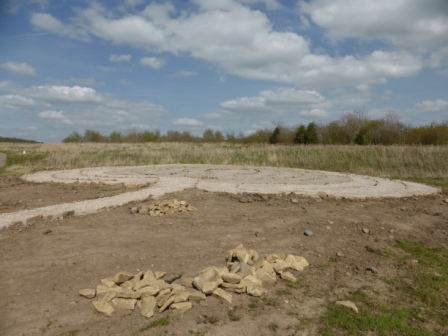
Over the past few months I’ve been involved with several of the work parties building a labyrinth for ‘fun, exploration and meditation’ at Brockholes Nature Reserve. It was designed by John Lamb (an archaeologist and Lancashire Wildlife Trust’s Senior Conservation Officer) and opened on April the 23rd 2016.

During the period the labyrinth was being built, I was researching links between Gwyn ap Nudd as a ‘bull of battle’ and Gwyddno Garanhir (‘the Knowing One with Long/Crane Legs’) and Tarvos Trigaranus (‘The Bull with Three Cranes’).

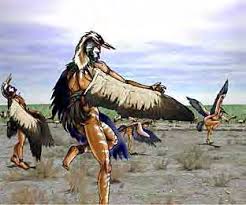
Coincidentally I came across a ritual crane-dance in Greece called geranos initiated by Theseus after defeating the minotaur in the  labyrinth in Crete. Its blows and crane-like turns imitated the battle and the labyrinth’s winding course and the leader of the dance was known as geranoulkos. This got me wondering whether the name Gwyddno Garanhir may have been a title deriving from a similar role.

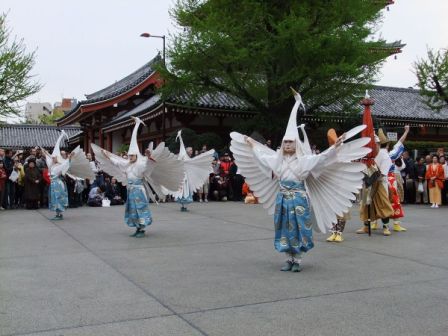
Crane-dances are found in many parts of the world. One of the most famous is the Japanese Shirasagi-no-mai ‘White Heron (‘Crane’) Dance’ which is one thousand years old and ‘was originally performed to drive out the plague and to purify the spirits on their passage to the next world.’ Cranes are also associated with the otherworld in Celtic mythology.

Shirasagi no mai (White heron dance) of Sensō-ji, Wikipedia Commons

Shirasagi-no-mai, Wikipedia Commons

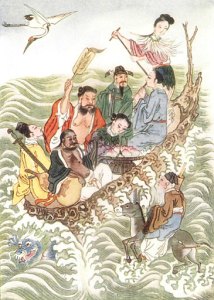
Cranes are depicted accompanying the Eight Immortals in Chinese mythology. They inhabit five islands in the Bohai Sea which include Mount Penglai. This is known as Horai by the Japanese. In both cultures it is a paradisal place with endless amounts of food and drink where nobody grows old. This is intriguing because Gwyddno is a sage-like figure.

Eight_Immortals_Crossing_the_Sea_-_Project_Gutenberg_eText_15250

Eight Immortals Crossing the Sea, Wikipedia Commons

One of the earliest finds relating to a crane-dance is an 8,500 year old crane wing found on top of a cattle horn core in Çatalhöyük in ancient Anatolia. The crane bones were pierced by holes of a suitable size for string which suggests they were tied to the arms of a crane-dancer. Two black cranes are depicted on a painting on one of the walls facing a bull  on the opposite wall. A dance scene depicting a sacred marriage and mother and child may prove the dance focused on fertility and birth.

Dance of the Cranes John-Gordon Swogger

Dance of the Cranes by John-Gordon Swogger http://www.savingcranes.org

Crane-dances have many meanings across cultures. One theme that stands out is passage: from the trials of the labyrinth, from one world to the next on birth or death. Gwyn and Gwyddno’s conversation takes place upon Gwyddno’s passing from thisworld to Annwn, possibly in crane-form.

At Brockholes the closest likenesses to a bull (or minotaur!) with cranes are the long-horned cattle and numerous herons who can be seen on the river Ribble and lakes.

When I walked the labyrinth for the first time my intention was getting a feel for its path within the nature reserve between the car park and stone circle as skylarks loudened the summer sky and oystercatchers pipped overhead.

P1150689

I found myself pondering whether a geranoulkos would have used such a setting for a crane-dance and what the steps would have looked like at various rites. But I didn’t dance. I’ll leave that to those more agile with longer legs…

SOURCES

Edward A. Armstrong, The Folklore of Birds, (Dover, 1970)
Nerissa Russell & Kevin J. McGowan, ‘Dance of the Cranes: Crane Symbolism at Çatalhöyük and beyond’, (2003) HERE
‘Hypocherma’ (Geranos), Wikipedia HERE
‘White heron (“crane”) dance: Shirasagi-no-mai and heron symbolism’, Japanese Mythology and Folklore HERE

Maelawr Gawr and Gwerthmwl Wledig: Pen Dinas in Retrospect

P1120829

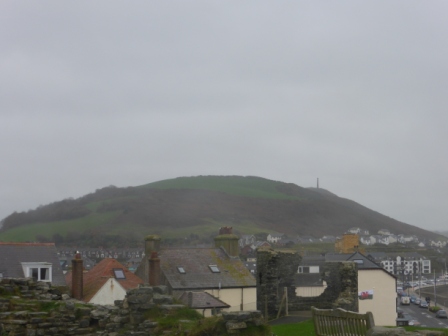
When I went to visit Heron in Borth last year I stayed in Aberystwyth. On my last day I had the chance to climb Pen Dinas (‘Head of the Citadel’). This is the name of the northern summit of the hill overlooking Aberstwyth which lies between the rivers Ystwyth and Rheidol.

When I made my visit, I went with limited knowledge. I’d read on Wikipedia that there was a Bronze Age burial mound on the southern summit. It was the site of two consecutive Iron Age hill-forts, one of which had been raided. The Romans did not occupy the hill, but a 4thC hoard of coins suggested they used it as a shrine.

I also read that Pen Dinas was associated with Maelawr Gawr (‘the giant’) who had three sons called Cornippyn, Crygyn and Babwa. Like in so many British stories he was presented as an adversary. In this case it isn’t clear what he’d done wrong. The crux of the story is that he was captured in Cyfeiliog and sentenced to death.

Maelawr asked his enemies a final request: to blow on his horn three times. The horn was so loud and forceful that on the first blow his hair and beard fell out, on the second his finger and toenails fell off and on the third the horn blasted apart and crumbled into pieces.

Cornippyn heard the horn whilst he was out hunting with horse and hound. He set off to rescue his father so fast he tore the head off his hound. He spurred his horse on in one leap over the Ystwyth and was slain in his attack on Maelor’s captors. Crygyn and Bwba were murdered in their fortresses in Llanilar and Llanbadarn Fawr the same night.

P1120748

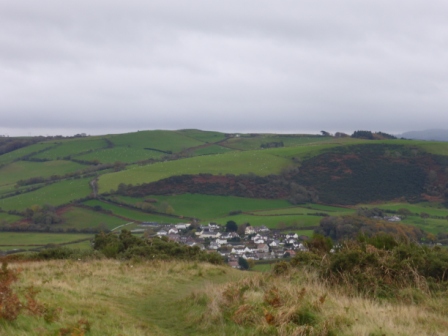
I was drawn up the hill by the magnetism of the Wellington Monument on the northern summit. It felt like a strong place: like the aura of giant wasn’t quite gone nor the feeling of relative safety offered by occupying a high hill.

P1120741

Looking toward Penparcau I didn’t spot or hear a headless hound but I did see a pair of ravens.

Clouds marched in on a growing wind. I found myself feeling distant from the harbour beneath, Aberystwyth and the cliff railway, not so much in place but time.

P1120743

I felt Gwyn’s presence and that of others cloaked in cloud and knew he had been there to gather the dead.

That was unexpected and it wasn’t until several months later I found a possible explanation. In The Triads of the Island of Britain I found the fragments of a story set during the Dark Ages.

One of ‘Three Horses who carried the Three Horse Burdens’ is ‘Dappled the horse of the sons of Gwerthmwl Wledig, who carried Gweir and Gleis and Archenad up the hill of Maelawr in Ceredigion to avenge their father.’

‘The hill of Maelawr’ has been identified as Pen Dinas by Owen Jones. In Cymru, he says ‘in the land of Aber Teifi there was in former times before Brutus came to this island, the giant Maylor, and the place where he lives is still called Castell Maylor, built upon a high hill or ridge which is called Y Dinas, beside the river Ystwyth, within the freehold of the town of Aberystwyth.’

It appears that Gwerthmwl led an attack on Maelawr and was defeated hence his three sons rode up Pen Dinas to avenge him. Pen Dinas was the site of two Dark Age battles as well as a raid in the Iron Age. There is no record of whether Gwerthmwl’s sons succeeded.

Further research turned up that Gwerthmwl was an important (albeit now forgotten) figure in British mythology who originated from northern Britain. In Rhonabwy’s Dream he appears as one of forty-two of Arthur’s counsellors.

In the ‘Three Tribal Thrones’ he is listed as ‘Chief Elder’ in ‘Pen Rhionydd in the North’ alongside ‘Arthur as Chief of Princes’ and ‘Cyndeyrn Garthwys’ (St Kentigern) as ‘Chief of Bishops’.

Pen Rhionydd has been identified with Ptolemy’s Rerigonium ‘very royal place’ and may have been located on the Rhinns. One possible location is Port Patrick, which used to be called Portree (from port righ ‘King’s Port’). Another is Penrith. Wherever Pen Rhionydd was, Gwerthmwl’s three sons travelled a long way to avenge their father’s death.

Gwerthmwl also appears in The Triads as one of ‘Three Bull-Spectres’. Epithets such as Bull Chieftain, Bull Protector and Bull of Battle were commonly assigned to Dark Age warriors to illustrate their strength and battle-prowess.

Gwerthmwl’s status as a Bull-Spectre suggests he was as a bull-epitheted warrior who remained as a ghost. Another interpretation is he became wyllt ‘wild’ or ‘mad’ as a result of his battle with Maelawr (the welsh for Bull Spectre is tharw ellyll).

It is notable that Gwyn, who is addressed as a Bull of Battle by Gwyddno Garanhir, has strong associations with warriors with bull-epithets and gwyllon.

The resting place of Gwerthmwl is listed in ‘The Stanzas of the Graves’:

‘The grave of a chieftain from the North
is in the open land of Gwynasedd,
where the Lliw flows into the Llychwr;
at Celli Friafael is the grave of Gyrthmwl.’

Gwerthmwl’s grave is where the Lliw runs into the Llwchwr near Casllwchwr in Gower. He was buried a long way south of Pen Dinas and a long, long way from Pen Rhionydd in the North.

In the story of Maelawr and Gwerthmwl I come across another example of the destructive conflicts between the people of Wales and the North which Gwyn attended as a psychopomp.

What makes this particular story interesting is that Maelawr is most famously remembered as a giant. This raises the question of whether he was always known as a giant or was a human chieftain who literally grew in status after defending his hill from Gwerthmwl.

Could the story of Maelawr’s capture and death be founded on the vengeance of the sons of Gwerthmwl?

The answer lies buried as the giant’s bones, his fallen beard, fingernails, toenails, the broken pieces of his horn which still blasts clouds over the pillar that marks the location of his citadel.

P1120742

P1120866

SOURCES

Mike McCarthy, ‘Rheged: An Early Historic Kingdom near the Solway’ in Proc Soc Antiq Scot, 132 (2002),
Peter Bartrum, A Welsh Classical Dictionary: People in History and Legend up to about A.D. 1000, (National Library of Wales, 1993)
Rachel Bromwich (ed), The Triads of the Island of Britain, (University of Wales Press, 2014)
Sioned Davies (transl.), The Mabinogion, (Oxford University Press, 2007)
Wikipedia ‘Pen Dinas’ https://en.wikipedia.org/wiki/Pen_Dinas

The Theft of the Cauldron

In the second verse of ‘The Spoils of Annwn’ the cauldron of the Head of Annwn is stolen in one swift move:

‘Lleog’s flashing sword was thrust into it,
and it was left behind in Lleminog’s hand.

These lines have been interpreted in many different ways. Cledyf means ‘sword’ and lluch ‘flashing’. Lleawc (‘Lleog’) has been taken to mean ‘destroyer’ or ‘death-dealer’.

Lluch Lleawc has been identified with Llen(n)l(l)eawc Wyddel ‘Llenlleog the Irishman’ from Culhwch and Olwen. There is a strong case for this because parallels exist between Lleog’s role in the theft of the Head of Annwn’s cauldron and Llenlleog’s in stealing the cauldron of Diwrnarch Wyddel.

In Culhwch and Olwen, Arthur and his men must attain Diwrnarch’s cauldron to boil food for the guests at Culhwch’s wedding feast. (In an earlier post I mentioned that the cauldrons of Diwrnarch and the Head of Annwn share the quality of only boiling meat for the brave).

Arthur sends a message to Odgar, King of Ireland, to tell Diwrnarch, his steward, to hand the cauldron over. Diwrnarch refuses. Arthur and his men set sail for Ireland and make for Diwrnarch’s house where they eat and drink. After feasting, Arthur asks for the cauldron.

Diwrnach says no again. Bedwyr seizes the cauldron and puts it on the back of Hygwydd, Arthur’s servant. Llenlleog Wyddel grabs Caledfwlch (‘hard breach / cleft’ Arthur’s sword) and by swinging it round kills Diwrnarch Wyddel and all his retinue. They escape with the cauldron filled with Irish treasure.

It seems possible the flash of Lleog’s sword as he thrusts it into the cauldron parallels its death-dealing swing, killing or blinding and incapacitating the Head of Annwn and his company as they feast and drink in Caer Vedwit.

Some scholars equate Lleog with the Irish god Lugh whose name may derive from the Proto-Indo-European *leuk ‘flashing light’. Lugh’s epithets include Lámhfhada ‘long arm’ or ‘long hand’, Lonnbeimnech ‘fierce striker’ and Ildánach ‘skilled in many arts’.

To complicate matters further, Lleog has been identified with Lleminog, in whose hand the cauldron of the Head of Annwn is left. Lleminawc may be translated as ‘leaping (one)’ or ‘leaper’.

In ‘Teithi etmygant’* (‘They admire qualities’) Llyminawc bears the meaning ‘keen, eager, ready.’ It refers to ‘an eager leader of an army’ who is a prophetic figure. Some scholars identify Lleminog with Arthur.

So… the Head of Annwn and his people are defeated by Lleog’s flashing sword and the cauldron is left in the hand of Lleminog (who may be Lleog or Arthur). We don’t find out whether there is further conflict or how Arthur and his men escape with the cauldron.

The next line of ‘The Spoils of Annwn’ reads: ‘And in front of the door of Hell’s gate lamps were burned’.

One assumes the escape has been made, ‘hell’s’ door slammed shut and lamps lit outside it. The word translated as Hell here is Vffern. ‘Uffern’ is borrowed from the Latin inferno and appears frequently in medieval Welsh poetry as a negative appellation for the otherworld.

‘What is the measure of Hell? (translated from Uffern)
how thick its veil,
how wide its mouth,
how big are its baths?’**

‘Madawg…
Was taken by fierce Erof…
Among the hideous fiends
Even to the bottom of Uffern.’***

Doors between the worlds are also a regular feature in Welsh mythology. In ‘The Spoils of Annwn’, Ynys pybyrdor has been translated as ‘isle of the strong door’ (ynys ‘island’, pybyr ‘strong’ + dor ‘door’). In ‘The Second Branch’ the Assembly of the Noble Head takes place in an otherworldly stasis on the island of Gwales until a forbidden door is opened.

The name of Dormach, the dog of Gwyn ap Nudd, has been translated as ‘death’s door’ by John Rhys (dor ‘door’ and marth ‘death’). Dogs are frequently guardians of the otherworld. There are no dogs in ‘The Spoils of Annwn’ but Taliesin speaks of monks congregating and howling like wolves and dogs in the final two verses.

Emphasis is placed on closing the door between the worlds and keeping it shut. The people of Annwn and its spatio-temporal laws must be kept separate. We recall that if Gwyn did not contain the fury of the spirits of Annwn, they would destroy thisworld.

The second verse of ‘The Spoils of Annwn’ ends with the refrain ‘save seven, none returned from the Mead-Feast Fort’. This is repeated after the visit to each fort and conveys the terrible cost of raiding the otherworld. Its repetition suggests the names of seemingly individual fortresses are perhaps names for one fort and the verses refer to different parts of the same journey.

The forces of Annwn are shut out yet the presence of the cauldron represents the destabilising power of Annuvian magic in thisworld. The cauldron of the Head of Annwn has been stolen from the mead feast in Caer Vedwit: the revolving fortress, centre of the mysteries of day and night, the seasons, birth, life, death and rebirth, time itself.

Diwrnarch’s cauldron is taken from Ireland to the house of Llwydeu son of Cilcoed in Dyfed where it is remembered by Mesur y Pair (‘the measure of the cauldron’). It is then presumably used to brew food for Culhwch and Olwen’s guests at their wedding feast. Later it is taken by Myrddin to ‘the glass house’ with the other Treasures of the Island of Britain.

What happens to the cauldron of the Head of Annwn after it is stolen next nobody knows. It is never seen again. It may be worth contemplating the question “where is it now?”

P1140789 - Copy

*In Skene’s translation this is the second part of ‘Canu y Cwrwf’ (A Song to Ale’)
**‘The First Address of Taliesin’ (transl. Marged Haycock)
***‘The Death-song of Madawg’ (transl. William Skene)

SOURCES

Caitlin and John Matthews, King Arthur’s Raid on the Underworld, (Gothic Image, 2008)
Marged Haycock (transl.), Legendary Poems from the Book of Taliesin, (CMCS, 2007)
Rachel Bromwich (ed), The Triads of the Island of Britain, (University of Wales Press, 2014)
Sarah Higley (transl.), ‘Preiddu Annwn’, (Camelot, 2007)
Sioned Davies (transl.), The Mabinogion, (Oxford University Press, 2007)
William F. Skene (transl), The Four Ancient Books of Wales, (Forgotten Books 2007)

Caer Vedwit: The Fortress of the Mead-Feast and its Revolutions

The second sea fortress raided by Arthur, Taliesin and ‘three full loads’ of Prydwen in ‘The Spoils of Annwn’ is Caer Vedwit ‘The Mead-Feast Fort’.

Opening the second verse Taliesin says:

‘I’m splendid of fame – song was heard
in the four quarters of the fort, revolving (to face) the four directions.’

Kaer pedryuan, ‘four quarters of the fort’ has also been translated as ‘Four-Cornered Fort’, ‘Four-Pinnacled Fort’, ‘Four-Peaked Fort and ‘Four-Turreted Fort’. The latter suggests it bears relationship with Caer Siddi: ‘around its turrets are the wellsprings of the sea’.

The image of a four-quartered, revolving fortress filled with song is fascinating and compelling. So far I have not come across the name Caer Vedwit or revolving fortresses in any other medieval Welsh literature. However fortresses that disappear, recede, or can only be entered under special conditions feature in numerous stories.

A close parallel with Caer Vedwit is found in the Ulster Cycle. In ‘The Feast of Bricriu’, Cú Roí has a fortress which revolves to his chant throughout the night so that nobody can enter:

‘In what airt soever of the globe Curoi should happen to be, every night o’er the fort he chaunted a spell, til the fort revolved as swiftly as a mill-stone. The entrance was never to be found after sunset.’

Caer Vedwit is associated with the Head of Annwn. It seems possible its revolutions are brought about by his spell-song.

The mead-feast is a central feature of medieval stories set in thisworld and Annwn. The status of a lord was judged by his capacity to maintain large groups of warriors feasting and drinking in his hall. The consumption of copious amounts of mead could provide a more prosaic explanation for the songs in Caer Vedwit and its revolutions.

The Cauldron of the Head of Annwn

The purpose of raiding Caer Vedwit is the theft of the cauldron of the Head of Annwn, which no doubt formed the centre of the mead-feast. Taliesin says:

‘My first utterance was spoken concerning the cauldron
kindled by the breath of nine maidens.
The cauldron of the Head of Annwn, what is its disposition
(with its) a dark trim, and pearls?
It does not boil a coward’s food, it has not been destined to do so;’

A cauldron with similar qualities appears in ‘The Thirteen Treasures of the Island of Britain’. It is owned by Dyrnwch the Giant ‘if meat for a coward were put in it to boil, it would never boil; but if meat for a brave man were put in it, it would boil quickly (and thus the brave could be distinguished from the cowardly.’

The cauldron’s special ‘disposition’ of only brewing food for the brave shares similarities with the Irish tradition of the champion’s portion. In ‘The Feast of Bricriu’, Bricriu invites a group of champions to his house to fight for ‘a cauldron full of generous wine with room enough for the three valiant braves of Ulster’ along with a seven-year-old boar and other delicacies.

Cú Chulainn wins but his right to the champion’s portion is not settled until he has defended Cú Roí’s fortress and proved his courage to Cú Roí in the beheading game*.

The Blue Smith and the Cauldron of Rebirth

Haycock says gwrym am y oror a mererit (‘a dark trim and pearls’) refers to a dark substance decorating the rim of the cauldron such as ‘an iron band, or enamel, jet or niello (black sulphide of silver)’. Mererit is borrowed from Latin margarita and means ‘pearl’.

John and Caitlin Matthews translate gwrym am y oror a mererit as ‘Ridged with enamel, rimmed with pearl’ and suggest the cauldron was crafted by Llasar Llaes Gyfnewid (‘Blue Smith who Reforges the Weak’).

In ‘The Second Branch’ of The Mabinogion, Llasar emerged from the Lake of the Cauldron in Ireland with the cauldron of rebirth on his back. After he and his wife were driven out of Ireland, he took it to Britain and gifted it to Brân then taught Manawydan the art of enamelling.

Brân gave the cauldron to Matholwch, King of Ireland, as recompense for an insult. Matholwch later used it to bring life to dead Irish warriors who were killed by Brân’s army. The cauldron was shattered when a living man was thrown into it.

We hear nothing else about Llasar except that his son, Llashar, was one of seven men left by Brân to guard Britain. Bryn Saith Marchog ‘The Hill of the Seven Horsemen’ is named after them.

Whether the cauldron of rebirth and the cauldron of the Head of Annwn are the same remains a matter of speculation. Their magical properties and elaborate craftmanship suggest they were forged by an otherworldly being, perhaps a gargantuan blue smith, in Annwn’s depths.

The Head of Annwn

Who is the Head of Annwn? In ‘The First Branch’, Pwyll wins the title Pen Annwn by taking the form and role of Arawn, a King of Annwn, winning his yearly battle and resisting the temptation of sleeping with his wife. It’s my intuition Pwyll’s acquisition of the title is based on his assumption of Arawn’s identity and Arawn was formerly Pen Annwn.

Another candidate for the title is Gwyn ap Nudd. In Culhwch and Olwen, Gwyn is introduced as the deity who contains the fury of the spirits of Annwn to prevent the destruction of the world and adversary of Arthur.

Arthur sides with Gwyn’s rival, Gwythyr, during their struggle for Creiddylad and binds them in battle for her every May Day. Gwyn and Gwythyr also act as tricksters when Arthur goes to kill Orddu ‘The Very Black Witch’.

In ‘The Conversation of Gwyn ap Nudd and Gwyddno Garanhir’ Gwyn refers to witnessing a battle at Caer Vandwy:

‘… I saw a host
shield shattered, spears broken,
violence inflicted by the honoured and fair.’

Caer Vandwy is the sixth fortress in ‘The Spoils of Annwn’. It seems likely Gwyn refers to the battle between Arthur and the people of Annwn for the Brindled Ox.

Seasonal Revolutions

In the sixth verse we find a second reference to the Head of Annwn:

‘(those) who don’t know on what day the Head** is created,
(nor) when, at noon, the Ruler was born,
(nor) what animal is it they guard, with his silver head.’

It’s likely the silver-headed animal is the Brindled Ox guarded by the people of Annwn and the ‘Ruler’ is the Head of Annwn. This riddle pertains to his conception and birth. In his Gallic Wars (58-49BC) Julius Caesar said:

‘All the Gauls assert that they are descended from the god Dis, and say that this tradition has been handed down by the Druids. For that reason they compute the divisions of every season, not by the number of days, but of nights; they keep birthdays and the beginnings of months and years in such an order that the day follows the night.’

Dis was a Roman god of the underworld who presided over its wealth. Whilst it seems unlikely the Gaulish deity was called Dis this identification suggests he performed a similar role and had deep connections with how people perceived the passage of time and the seasons.

Caesar says the ‘institution’ of the Druids ‘is supposed to have been devised in Britain, and to have been brought over from it into Gaul; and now those who desire to gain a more accurate knowledge of that system generally proceed thither for the purpose of studying it.’

It seems possible Gaulish beliefs about ‘Dis’ derive from the mythos of the Head of Annwn. Arawn and Gwyn both fight yearly battles against opponents associated with summer: Hafgan (haf means ‘summer’) and Gwythyr ap Greidol (‘Victor son of Scorcher’) placing them in the role of the Winter King who must be defeated for summer to come.

In The Death of Cú Roí, Cú Roí carries off a maiden called Blathnat (‘Blossom’) along with a cauldron that is the child of three cows who carry three men/birds on their ears. Cú Chulainn’s army behead Cú Roí and win Blathnat, cattle and treasure.

Parallels with Gwyn’s abduction of Creiddylad, Arthur rescuing her and taking the cauldron and Brindled Ox are obvious. Of course these wintry deities don’t stay ‘dead’ long.

It may be suggested the revolutions of Caer Vedwit, home of the Head of Annwn, are bound up with the passage of day and night and the seasons and the cycles of birth, life, death and rebirth, time itself.

The Nine Maidens

Taliesin says the cauldron of the Head of Annwn is kindled by the breath of nine maidens. There are numerous references to groups of nine women connected with underworld gods in Gallo-Brythonic tradition.

In 1AD, Pomponius Mela wrote of nine priestesses serving a Gaulish god on the island of Sein. Known as Senes, they could create storms, shift shape, cure illnesses and foretell the future.

A Gaulish tablet from Larzac dated 90AD provides evidence of a coven of nine sorceresses working underworld magic:

‘Herein-:
– a magical incantation of women,
– their special infernal names,
– the magical incantation of a seeress who fashions this prophecy…

…Below, there they shall be impressed, the prophetic curse of these names of theirs is a magical incantation of a group of practitioners of underworld magic: Banona daughter of Flatucia, Paulla wife of Potitos, Aiia daughter of Adiega, Potitos father of Paulla, Severa daughter of Valens (and) wife of Paullos(?), Adiega mother of Aiia, Pottita wife of Primos daughter of Abesa.’

Here anderna is used to refer to the underworld and andernados to a group of practitioners working underworld magic. A similar tablet from Chamalières invokes andedion ‘underworld gods’ and anderon ‘infernal beings’. These Gaulish terms bear similarities with the Irish Andeé ‘non-gods’ and Brythonic Annwn ‘the deep’ ‘the not-world’.

Superstitions surrounding witchcraft and the underworld no doubt lie behind Arthur’s slaughter of Orddu and the nine witches of Caer Loyw and Cai’s killing of nine witches in Arthur and the Porter.

In Geoffrey of Monmouth’s The Life of Merlin, Morgan and her sisters: Moronoe, Mazoe, Gliten, Glitonea, Gliton, Tyronoe, Thitis and Thitis with her lyre, are presented in a more positive light. They inhabit the paradisal island of Avalon. Morgan is a shapeshifter adept in herbalism and the healing arts who tends Arthur’s fatal wound after Camlan.

Bringing Life to the Dead

A man named Morgan Tud appears as Arthur’s physician in Geraint son of Erbin. It’s my suspicion this is Morgan in male guise. Morgan acts as healer to Gwyn’s brother, Edern ap Nudd. Edern is defeated by Geraint in another seasonal battle at Whitsuntide.

Geraint strikes Edern what sounds like a killing blow: ‘he summoned up his strength and struck the knight on the top of his head so that all the armour on his head shatters and all the flesh splits, and the skin, and it pierces the bone and the knight falls on his knees.’

However Edern gets up and ride to Arthur’s court. Upon his arrival the gatekeeper says: ‘no one has ever seen such a terrible sight to gaze upon as he. He is wearing broken armour, in poor condition, with the colour of his blood more conspicuous on it than its own colour.’

Edern’s invincibility indubitably stems from his identity as an Annuvian deity like Gwyn. Morgan is assigned the task of healing Edern, which is analogous to bringing him back to life.

The capacity of women not only to heal but bring life to the dead is shown in Peredur. At the court of the King of Suffering, Peredur sees ‘only women’ then:

‘a horse approaching with a saddle on it, and a corpse in the saddle. One of the women got up and took the corpse from the saddle, and bathed it in a tub of warm water that was by the door, and applied precious ointment to it. The man got up, alive, and went up to Peredur, and greeted him, and made him welcome. Two other corpses entered on their saddles, and the maiden gave those two the same treatment as the previous one.’
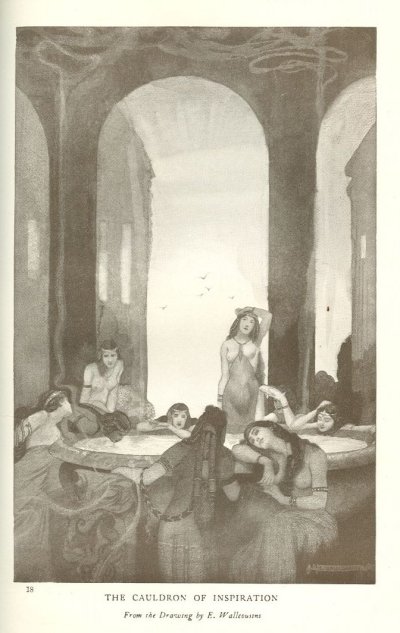
E. Wallcousins 'In Caer Pedryvan' (1912) Wikipedia Commons

Wikipedia Commons

Morgan is also associated with the mysteries of death and rebirth represented by the cauldron. It may be suggested the scene where she heals Arthur is based on an older myth wherein she and her sisters tended the Head of Annwn after his seasonal death.

Glastonbury Tor and the Mead-Feast

The sacred complex associated with Caer Vedwit: the cauldron, the Head of Annwn, and the nine maidens came together for me several years ago at Glastonbury Tor.

The isle of Avalon (‘apples’) is frequently identified with Glastonbury in the apple-growing summerlands of the Somerset Levels. Prior to the fall in sea levels, Glastonbury was an island; the area is still prone to flooding. It is easy to see how the story of Arthur being taken to Morgan and her sisters on Avalon by boat emerged from the landscape.

In The Life of St Collen whilst Collen was abbot of Glastonbury he supposedly banished Gwyn and his fairy host whilst they were feasting in the hall of his magical castle on the Tor. It seems likely the cauldron formed the centre of their mead-feast.

My first vision of the otherworld took place at Glastonbury Festival. After thirteen years of searching for an explanation, Gwyn finally appeared in my life and I realised he was my patron. Identifying the nine maidens as Morgan and her sisters and the Head of Annwn as Gwyn led me back to Glastonbury to devote myself him.

When I entered the Well House of the White Spring I could barely believe my eyes. The scene depicted in Caer Vedwit was there before me. In the centre of a subterranean cavern was the cauldron overflowing with thundering water. A dark haired woman in long skirts kindled candles around its rim. In the centre was a shrine to the Lady of Avalon and to the right and left altars for Gwyn and Brigid***.

For one day of my life everything went beautifully to plan. I made my vow to Gwyn beside the candle-lit cauldron as shadows of otherworlds and othertimes circled around me. The world spun around my resolution and my life has never been the same.

However Caer Vedwit has revolved since. Last time I went to Glastonbury the White Spring was barred. Shortly afterward I witnessed a vision where the cauldron lay shattered, its poison streaming throughout the land. I’d tasted the Awen. The time had arrived to look at the consequences of bringing forth Annuvian magic into thisworld.

The theft of the cauldron will be covered in upcoming posts.

* Cú Roí arrives at the Royal Court in Emain and challenges the Ultonians to behead him if he can return the blow. Presuming Cú Roí will die, Fat Neck agrees. Afterward Cú Roí picks up his head and returns the next night for his recompense. Fat Neck refuses. Loigaire and Conall Cernach also play the game but refuse to accept the blow. The only person brave enough to proffer his neck to Cú Roí is Cú Chullain who through his bravery wins the champion’s portion. The beheading game also forms the central plot of Gawain and the Green Knight.
**ny wdant py dyd peridyd Pen is translated by Marged Haycock as ‘(those) who don’t known on what day the Lord is created’ but I’ve chosen the more literal translation of ‘Pen’ as ‘Head’. An alternative used by Sarah Higley and John and Caitlin Matthews is ‘Chief’.
***Some scholars have connected the role of the nine maidens kindling the flames beneath the cauldron with their breath with the work of St Brigid’s flamekeepers at Kildare. In his 12th C The History and Topography of Ireland, Giraldus Cambrensis ‘it is only lawful for women to blow the fire, fanning it or using bellows only, and not with their breath.’ It seems possible this was a ban on older pagan practices.

SOURCES

Caitlin and John Matthews, King Arthur’s Raid on the Underworld, (Gothic Image, 2008)
Geoffrey of Monmouth, The Life of Merlin, (Forgotten Books, 2008)
Geraldus Cambrensis, The History and Topography of Ireland, (Penguin Classics, 1982)
George Henderson (transl.), Fled Bricend (The Feast of Bricriu), (Parentheses Publications, 1999)
John Koch (transl.), ‘The Tablet of Larzac,’ The Celtic Heroic Age (CSP, 2003)
Lady Charlotte Guest, ‘St Collen and Gwyn ap Nudd
Heron (transl), ‘Gwyn ap Nudd and Gwyddno Garanhir
Marged Haycock (transl.), Legendary Poems from the Book of Taliesin, (CMCS, 2007)
Maria Tymoczko, Two Death Tales from the Ulster Cycle: The Death of Cu Roi and the Death of Cu Chulainn, (Dolmen Press, 1981)
Rachel Bromwich (ed), The Triads of the Island of Britain, (University of Wales Press, 2014)
Sarah Higley (transl.), Preiddu Annwn, (Camelot, 2007)
Sioned Davies (transl.), The Mabinogion, (Oxford University Press, 2007)
William F. Skene (transl), The Four Ancient Books of Wales, (Forgotten Books 2007)
Will Parker, The Four Branches of the Mabinogi, (Bardic Press, 2005)
W. A. W.A. McDevitte and W.S. Bohn (transl.), The Works of Julius Caesar, (Sacred  Texts, 1869)