You are in the Dark Tower

A while back I dreamt of watching a film in a cinema. The centrepiece was a dark tower on a looming hill. Turning on its foundations, raising and dropping its drawbridge, it possessed the power to command the shifting landscape, influence the weather, and draw people into its swallowing darkness.

At the end of the film the lights went off and a voiceover resonated through the cinema and every molecule of my being: “You are in the Dark Tower”. I believed the statement to be wholly true and was struck by a combination of fear and anticipation and the fulfilling of my destiny.

But the other people seemed completely unfazed. They continued munching popcorn, crackling crisp packets, slurping on straws, and laughing amongst themselves at the ‘special effects’. I felt incredibly angry they did not heed the otherworldly voice. The magic broke. I awoke.

***

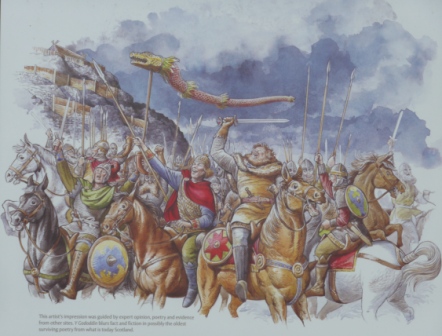
I researched ‘the Dark Tower’ and learnt it appears in the folktale of ‘Childe Roland’. Reading this dismal story of a knight (‘childe’ means untested knight) assaulting the Dark Tower, which is identified with the castle of the King of Elfland/Fairyland, left me soul-weary. I’d heard its like so many times before….

The first record of ‘Childe Rowland’ is in Shakespeare’s King Lear (1606). Edgar, an exiled son in the guise of Tom O’Bedlam, recites its jumbled lines to a maddened Lear on the heath:

Childe Rowland to the Dark Tower came,
His word was still ‘Fie, foh, and fum,
I smell the blood of a British man.

The first whole version is recorded in Jamieson’s Illustrations of Northern Antiquities (1814). The sons of King Arthur; Rowland and his two elder brothers, are playing ball around a kirk. Their sister, Burd Ellen, runs after the ball, and disappears. Merlin tells them Ellen has been ‘carried away by fairies’ to ‘the castle of the King of Elfland.’

Rowland’s brothers fail to rescue Ellen because they do not follow Merlin’s instructions. Merlin tells Rowland to kill everyone he meets in the land of Fairy and not to eat or drink anything offered. Rowland asks directions to the king’s castle from a fairy horse-herd, cow-herd, sheep-herd, goat-herd, swine-herd, and hen-wife. After they aid him, he remorselessly beheads them.

He arrives at ‘a round green hill surrounded with rings (terraces) from the bottom to the top’ and walks around it widdershins saying, “Open, door! open, door! and let me come in!” Through a twilight passage he enters a brilliant hall adorned with gold, silver, and clusters of diamonds, illumined by ‘an immense lamp of one hollowed pearl’ with a magically turning carbuncle.

Ellen sits on a sofa of ‘velvet, silk, and gold’. She warns Rowland that the King of Elfland poses a threat to his life yet, enspelled, offers him a golden bowl of bread and milk. When Rowland refuses to consume the fairy food the King of Elfland bursts through the doors yelling:

“With ‘fi, fi, fo, and fum!
I smell the blood of a Christian man!
Be he dead, be he living, wi’ my brand
I’ll clash his harns frae his harn-pan!”

“Strike, then, Bogle of Hell, if thou darest!” Rowland exclaims. He defeats the King of Elfland and offers to spare his life if he restores his brothers, who lie in trance in the corner of the hall, and Ellen. The King agrees. Producing a ‘small crystal phial’ he anoints the ‘lips, nostrils, eye-lids, ears, and finger-ends’ of the brothers with a ‘bright red liquor’. They awake ‘as from a profound sleep, during which their souls had quitted their bodies’ to speak visions.

In Joseph Jacob’s retelling in English Fairy Tales (1890) the brothers are not entranced but dead. Rowland demands the King ‘raise my brothers to life’ and ‘they sprang at once into life, and declared that their souls had been away, but had now returned.’ Fairyland is the land of the dead. Rolande’s quest, like Arthur’s before him, is to defeat the ruler of the dead and death itself.

***

This tale is repeated in Robert Browning’s poem ‘Childe Rowland to the Dark Tower Came’ (1895), which is based on a dream and written in the first person from Rowland’s perspective.

The guiding figure of Merlin is replaced by a ‘hoary cripple with malicious eye’ and ‘skull-like laugh’. The landscape is a ‘grey plain’ devoid of life aside from bruised dock and grass ‘scant as hair / In leprosy.’ Instead of herds, Rowland finds a single ‘stiff blind horse, his every bone a-stare.’

He is tormented by visions of other knights who set out to the Dark Tower and did not return: ‘Cuthbert’s reddening face / Beneath its garniture of curly gold’ and ‘Giles then, the soul of honour… faugh! what hangman hands / Pin to his breast a parchment?’

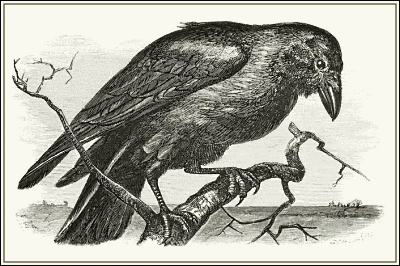
Fording a river lined with a ‘suicidal throng’ of ‘drench’d willows’ he is terrified of standing on a ‘dead man’s cheek’ or tangling his spear in ‘his hair or beard’. On the otherside he journeys across a trampled battlefield, through a furlong with an engine ‘fit to reel / Men’s bodies out like silk’, then over marsh, bog, clay, and rubble, to be led by a ‘great black bird’ with unbeating wings to his destination in the ‘mere ugly heights and heaps’ of the mountains.

‘The Tower itself’ is ‘the round squat turret, blind as the fool’s heart, / Built of brown stone, without a counterpart / In the whole world’. The ‘tempest’s mocking elf’ he aims to ‘stab and end’.

The poem ends with a vision of the dead:

There they stood, ranged along the hill-sides, met
To view the last of me, a living frame
For one more picture! in a sheet of flame
I saw them and I knew them all. And yet
Dauntless the slug-horn to my lips I set,
And blew “Childe Rowland to the Dark Tower came.”

It is is repeated again in Stephen King’s eight part dark fantasy series The Dark Tower (1982 – 2012) where Roland Deschain, a member of a knightly order of ‘gunslingers’ of ‘Arthur’s eld’ battles against ‘the Crimson King’.

***

This old tale of the sword-wielding, gun-toting ‘hero’ overcoming the fay and the dead and ultimately the King of the Otherworld has been repeating since Arthur defeated the Head of Annwn.

It’s so deeply ingrained in our consciousness we can’t imagine any other telling.

We sit munching popcorn confident the ‘hero’ will win and the ‘bad guy’ with his ‘fi, fi, fo and fum’ is all special effects.

What if that’s not the case? What if the knights in shining armour are rusting on the scrap heap of a false history, their journey is at an end, we are in the Dark Tower, and the King of Elfland is not just a one-dimensional comic book villain?

What new stories will unfold from the unknighted, the armourless, the weaponless?

Will we wait for the ‘hero’ to save us or is this where our story finally begins?

You are in the Dark Tower
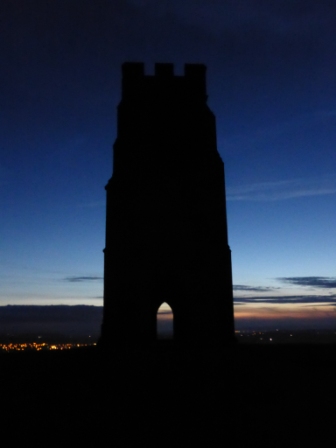
St Michael's Tower, Glastonbury Tor

The Dark Tower on the green terraces of Glastonbury Tor
Nodens and the Serpents of the Deep

Nodens is in an ancient British god of hunting/fishing, water, the weather, healing, and dreams. ‘Nodens’ has been translated as ‘the Catcher’ and ‘Cloud-Maker’, and ‘Deus Nodens’ as ‘God of the Abyss’ and ‘God of the Deep’. The latter links him with Annwfn, ‘the Deep’, the underworld. The nursery rhyme name for the dreamworld, ‘the Land of Nod’, derives from ‘Nodens’.

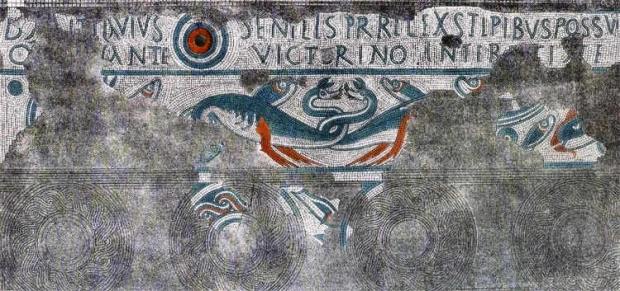
Nodens is a god of the subliminal realms beneath the everyday world and their hidden processes. This is suggested by the imagery of his Romano-British dream-temple at Lydney. In the centre was a mosaic depicting two blue and white sea-serpents with intertwined necks and striking red flippers. William Bathurst likens them to the icthyosaurus, ‘fish lizard’, of the late Triassic and early Jurassic whose remains have been found across Europe and Asia.

Mosaic from Nodens' temple

The mosaic also depicts numerous fish, possibly salmon, which would fit with salmon fishing on the river Severn, which the temple overlooks, and the legend of the salmon of Llyn Lliw carrying Arthur’s men up the Severn to Gloucester to rescue Mabon.

An inscription on the mosaic reads: ‘D(eo) N(oenti) T(itus) Flavious Senilis, pr(aepositus) rel(oqiatopmo), ex stipibus possuit o [pus cur]ante Victorio inter[pret]e.’ ‘The god Nodens, Titus Flavious Senilis, officer in charge of the supply-depot of the fleet, laid this pavement out of money offerings; the work being in charge of Victorious, interpreter of the Governor’s staff.’ It has been argued Victorio inter[pret]e, ‘Victorious, interpreter’ was an interpreter of dreams.

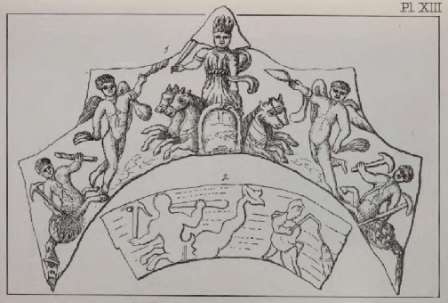
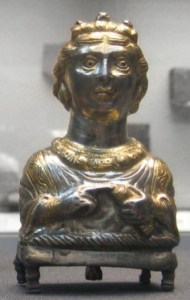
Another artefact found in Nodens’ temple was a bronze plaque from a priest’s ceremonial headdress. Nodens rides from the deep on a chariot pulled by four water-horses. He wears a crown, carries a sceptre in his right hand, and a sea-serpent is looped around his left arm. Flanking him are two winged wind-spirits and two icthyocentaurs, ‘fish-centaurs’ or ‘centaur tritons’, with heads and chests of men, front hooves of horses, and tails of fish. They carry hammers and anchors. Beneath is another icthyocentaur with a hammer and chisel and a fisherman with a short tail and gills hooking a fish, which could be a salmon.

Plate XIII Bathurst

All of this imagery is suggestive of the deep: rivers, the sea, and the depths of the dreamworld/underworld where prehistory gives birth to myth and the boundaries between species break down.

Pilgrims came to Lydney for dream-healing. They would arrive at the guesthouse, bathe in the baths, then make offerings to Nodens through a funnel in his temple (which suggests he dwelled below in the deep). They would then retire to a long row of cells to enter a sacred (likely drug-induced) sleep during which they would receive a vision from Nodens. The dream-interpreter would listen to the dream then suggest a method of healing based on Nodens’ message.

Offerings included coins and several beautifully crafted bronze hounds. It is likely dogs were present to lick the wounds of the injured to aid in the healing process. They may also have acted as psychopomps guiding the sleepers through the dreamworld. The son of Nodens/Nudd, Gwyn ap Nudd, had a red-nosed dog called Dormach with two serpents’ tails.

***

Nodens’ temple was built on an iron ore mine and he was known as ‘Lord of the Mines’. This may explain the hammers and chisels carried by the icthyocentaurs. Mines are associated with the chthonic depths of the underworld and its riches, which are often guarded by serpents.

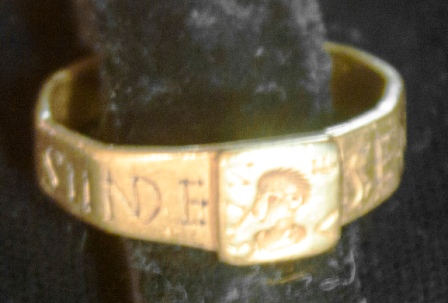
Intriguingly a man called Silvianus vowed half the worth of a 12g golden ring to Nodens in exchange for withholding health from its thief, Senicianus, until it was ‘returned to the Temple of Nodens’. The ring was dug up in a field in Silchester in 1785 with a new inscription: Seniciane vivas in deo, ‘Senicianus, may you live in God’. What was originally inscribed on it remains unknown. It seems possible it served a ritual function in Nodens’ temple.

Ring of Silvianus - Wikipedia Commons

In ‘The Conversation of Gwyn ap Nudd and Gwyddno Garanhir’, Gwyn states ‘I have a carved ring, a white horse gold-adorned’. His ring is an important part of his symbology and  might have been a gift from his father. Angelika Rüdiger links its circularity with the ouroboros.

The ouroboros first appears in ‘The Enigmatic Book of the Netherworld’ in the ancient Egyptian Funerary text KV62, which focuses on the union of the sun-god Ra with Osiris, god of the underworld. In an illustration two serpents with their tails in their mouths coil around the unified Ra-Osiris. The image represents the beginning and the end of time.

The ouroboros was passed on to the Phoenicians and ancient Greeks who gave it its name. In Greek oura means ‘tail’ and boros ‘eating’, thus ‘tail eater’. The ouroboros appears in most cultures across the world and throughout history.

A pair of sea-serpents are central to Nodens’ temple. He holds a sea-serpent. It seems possible two ouroboros serpents may have been carved on a ring worn by Nodens and passed on to his son, representing their knowledge of the depths of time where beginning and end meet as they bite their tails. Silvianus’ ring may have been a replica of this powerful mythic artefact.

It’s rumoured that Tolkien based his One Ring on the ring from the temple of Nodens and that Nodens, ‘Lord of the Mines’ was a precursor to Sauron, ‘Lord of the Rings’.*

***

In medieval Welsh literature Nodens appears as Nudd/Lludd Llaw Eraint, ‘Lludd of the Silver Hand’. Their linguistic connection is certified by a bronze arm found in the temple of Nodens.

Nobody knows how Lludd lost his arm or how his silver one was made. Parallels might be found with his Irish cognate, Nuada Airgeadlámh, ‘Nuada Silver Arm’, king of the Tuatha Dé Danann, who lost his arm battling against the Fir Bolg. Because of his physical imperfection Nuada was replaced as king by the tyrant, Bres. After Bres was removed Nuada was restored to sovereignty with a new silver arm made by the healer Dian Cecht.

In the story of Lludd and Llefelys, Lludd’s sovereignty is also under threat. Although he is described as ‘a good warrior, and benevolent and bountiful in giving food and drink to all who sought it’ he is unable to defend Britain from three plagues; perhaps this is due to his missing arm.

The first plague is a people called the Coraniaid who cannot be harmed because they can hear all  conversations on the wind. The second is a scream every May eve that causes such terror that men lose their strength, women miscarry, youths go mad, and the land becomes barren. The third is the disappearance of the year’s supply of food and drink from the king’s courts.

This story is set during Caesar’s invasion of Britain in 55BC. The Coraniaid are the Caesariad, ‘Romans’ and the other plagues seem linked to the ill effects of their attacks. Lludd, of course, was not a ‘real’ king at that time but a divine ruler of the underworld who may have been called upon by the Britons for aid against the Romans.

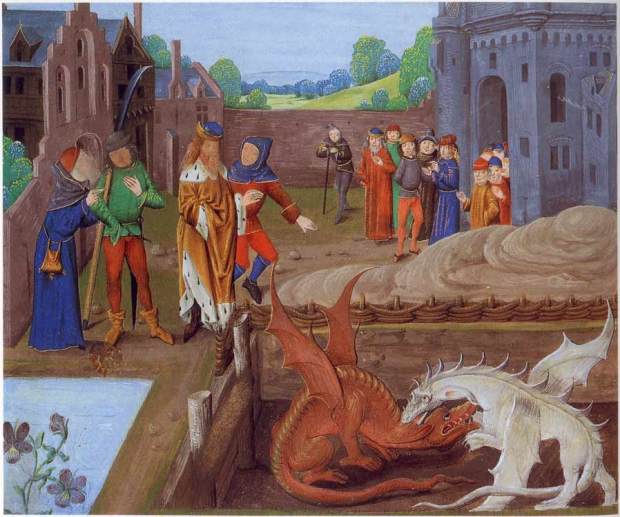
Unable to defeat the plagues himself, Lludd is forced to seek the aid of his brother, Llefelys, ‘king of France’. Llefelys instructs Lludd to poison the Coraniaid with insects crushed into water. He then explains the scream: ‘that is a dragon, and a dragon of another foreign people is fighting it and trying to overthrow it, and because of that your dragon gives out a horrible scream.’

Red and white dragons - from 15th C History of the Kings of Britain - Wikipedia Commons

Lludd’s dragon represents the Britons and the other dragon the Romans. Lludd, again, is connected with two dragons/serpents. Will Parker has likened Lludd’s dragon’s scream to ‘the scream over Annwfn’, a ‘mysterious ritual frenzy’ uttered by a person threatened with losing their claim to inherited land. It may have originated as an invocation of the spirits of Annwfn to bring about madness and barrenness. Likewise Lludd’s dragon screams as its land is lost to the Romans, blighting all who live there. Lludd has lost control of these chthonic forces.

Llefelys teaches Lludd to put an end to the second plague by a complex ritual process. He must measure Britain, length and breadth, and locate its centre. This omphalos, ‘navel’, turns out to be Oxford. It is of interest that the Greek omphalos, Delphi, was formerly known as Pytho and its oracle, the Pythian priestess, spoke with the aid of the whispering python coiled beneath.

Could Oxford have been the location of a dragon (or dragons) who whispered prophecies from the navel of Britain? Dragon Hill lies 50 miles outside Oxford. Its connections with Uther Pendragon and a dragon-slaying by Saint George are suggestive of an older and deeper mythos.

Lludd is instructed to dig a hole at the centre of Britain then place in it a vat of mead with a sheet of brocaded silk over the top. Llefelys says, ‘You will see the dragons fighting in the shape of monstrous animals. But eventually they will rise into the air in the shape of dragons; and finally when they are exhausted after the fierce and frightful fighting, they will fall onto the sheet in the shape of two little pigs, and make the sheet sink down with them, and drag it to the bottom of the vat, and they will drink all the mead, and after that they will fall asleep.’

This scene depicts the return of the escapee dragons to the omphalos of Britain and the deep. It is intriguing that they are not just dragons but are capable of taking many different forms. It is possible to perceive a mythic and perhaps evolutionary development in their shapeshifting from ‘monstrous animals’ beyond description to ‘dragons’ to two seemingly innocent ‘little pigs’.

Finally Llefelys tells Lludd to ‘wrap the sheet around them, and in the strongest place you can find in your kingdom, bury them in a stone chest and hide it in the ground, and as long as they are in that secure place, no plague shall come to the island of Britain from anywhere else.’

Lludd buries the dragons at Dinas Emrys in Snowdonia. The next time they cause trouble is during the reign of Vortigern. Every time he attempts to build a fortress on the hill it falls down. Merlin Emrys reveals to him that the cause is two dragons battling. The red one represents the Welsh and the white one the Anglo-Saxons.

Llefelys informs Lludd that the food and drink are stolen from his court by a magician who uses a sleep spell. He suggests Lludd step in a tub of cold water to keep himself roused. Lludd defeats the magician in combat, all that is lost is restored, and the magician becomes his vassal.

All three plagues are defeated. The chthonic forces of Annwfn are brought back under Lludd’s control. Caesar’s invasion of Britain fails. Lludd and Llefelys depicts the mythic processes beneath this historical period, which the Druids and seers who interacted with the deities of the underworld might have been aware of and perhaps instigated with prayers and invocations.

Lludd reigns ‘until the end of his life’ ‘in peace and prosperity’. One wonders whether Llefelys had a role in creating Lludd’s silver arm…

It seems Lludd’s ‘kingdom’, Annwfn, the deep, is passed on to his son, Gwyn ap Nudd, whose role is to contain the spirits of Annwfn to prevent them from bringing about the end of the world.

Does Gwyn’s inheritance include the serpents of the deep: beings who are older than gods, whose ‘battles’ may be less about conflicts between groups of humans than the regenerative processes that shape the earth through the aeons, through the beginnings and endings of each world?

***

*Tolkien advised Sir Mortimer Wheeler on his excavation of Lydney in 1938

SOURCES

Angelika Heike Rüdiger, ‘Gwyn ap Nudd: A First and Frame Deity, Temple 13, (Temple Publications)
Caitlin Matthews and Jane Dagger, ‘Temple of Nodens Incubation’ http://www.hallowquest.org.uk/temple-of-nodens-incubation
Elizabeth A. Grey (transl), The Second Battle of Mag Tuired, (Forgotten Books, 2007)
Greg Hill (transl), ‘Gwyn ap Nudd and Gwyddno Garanhir’ https://barddos.wordpress.com/2015/02/08/gwyn-ap-nudd-and-gwyddno-garanhir/
Sioned Davies, The Mabinogion, (Oxford University Press, 2008)
Sylvia Victor Linsteadt, ‘The Return of the Snake’ http://theindigovat.blogspot.co.uk/2017/05/the-return-of-snake.html
William Hiley Bathurst, Roman Antiquities at Lydney Park, https://archive.org/details/romanantiquitie00bathgoog
‘The Forest of Dean and Wye Valley’s Celts and Romans’ http://www.deanweb.info/history4.html

The Two Birds of Gwenddolau

In The Triads of the Island of Britain we find two triads referring to ‘the two birds of Gwenddolau’.

The first is Triad 10. W ‘Three Chieftains of Deira and Bernicia, and they were three bards, and three sons of Dissynyndawd, who performed the Three Fortunate Slayings’; ‘Gall son of Dissynyndawd who slew the two birds of Gwenddolau, who were guarding his gold and his silver: two men they used to eat for their dinner, and as much again for their supper.’

The second is Triad 32. ‘Three Men who performed the Three Fortunate Slaughters’. ‘Gall son of Dysgyfawd who slew the two birds of Gwenddolau. And they had a yoke of gold on them. Two corpses of the Cymry they ate for dinner, and two for their supper.’

These birds must have been significant and held a sinister reputation if their deaths are recorded twice amongst the three fortunate slaughters/slayings of the island of Britain.

Who or what were they and why were they so feared so much?

Birds who feast on the corpses of the dead are common in Brythonic tradition. To ‘feed the ravens’ or ‘feed the eagles’ is a common metaphor for death. Gwyn ap Nudd, a death-god, appears with ravens who ‘croak’ on ‘flesh’ and ‘gore’. In the Heledd Cycle the eagle of Eli drinks ‘has swallowed fresh drink, / heart blood of Cyndylan the fair’ and wallows in the blood of ‘fair men’. Similarly the eagle of Pengwern ‘is eager for the flesh of Cyndylan’.

Interestingly August Hunt suggests a possible etymology for Arderydd, where Gwenddolau lived and was killed in battle. ‘Ardd = Hill’, ‘Erydd (= eryr) = Eagle) ‘Eagle-Hill or Eagle-Height’. He backs this up with lines in ‘The Dialogue of Myrddin and His Sister, Gwenddydd’, gueith arderyd ac erydon’ ‘The Battle of Arderyd and the Eagles’.

It thus seems likely the two birds of Gwenddolau were eagles. We might enquire further ‘what kind of eagles?’ In the Heledd Cycle the eagle of Eli is clearly a white-tailed eagle (often referred to as a sea-eagle): ‘The eagle of Eli keeps the seas; / He will not course the fish in the Aber. / Let him call, let him look out for the blood of men!’

Haliaeetus_albicilla,_Mull_2 Wikipedia Commons

Ian L. Baxter argues that the white-tailed eagle is the ‘carrion-gulper’ of Anglo-Saxon and Norse poetry in which ‘men… gave the eagle food’; ‘Olaf feeds the eagles… the erne* drinks his supper’. He notes the white-tailed eagle is a ‘predator, scavenger and kelptoparasite’ and has a ‘marked preference for carrion… compared with the golden eagle’. Thus I believe Gwenddolau’s birds were white-tailed eagles.

Parallels with Irish stories where pairs of birds bound by gold or silver chains are transformed humans suggest Gwenddolau’s two eagles may be of human origin. Owain Rheged’s army are depicted as ravens who attack Arthur’s army, first carrying off their heads, eyes, ears, and arms, then seizing men into the sky and tearing them apart between each other.

On the Papil Stone we find a fascinating portrayal of two axe-wielding human warriors with bird’s heads and long beaks with a human head between their beaks. It seems possible Gwenddolau’s birds were warriors transformed into white-tailed eagles.

Papilstone

Their ritualised eating of two corpses of the Cymry for dinner and two for supper may symbolise Gwenddolau’s brutality as a warlord who slays four of his Cymric neighbours every day. Or it might refer obliquely to him practicing excarnation – leaving the bodies of his own Cymric people to be eaten by the birds before they were buried. Whatever the case, their corpse-eating certainly inspired a significant amount of fear across the island of Britain.

It is of interest the birds were also seen as guardians of Gwenddolau’s gold and silver. Gwenddolau was renowned for ‘gathering booty from every border’. One of his most treasured possessions was a golden chessboard with silver men who, once set, played by themselves.

How Gall son of Dysgyfawd slew the two birds of Gwenddolau remains unknown. It might be conjectured that they were slain after Gwenddolau was killed at the Battle of Arfderydd in 573 and his ‘Faithful War Band’ who ‘continued the battle for a fortnight and month’ were killed.

The death of Gwenddolau and his two birds, like Diffydell Dysgyfawd’s slaying of Gwrgi Garwlwyd, ‘Rough Grey’, who ‘used to make a corpse  of one of the Cymry every day, and two on each Saturday so as not to (slay) one on the Sunday’ might be seen to form part of a process of eradicating shapeshifters associated with the pagan world. Gwrgi’s appearance alongside ‘dog-heads’ in ‘Pa Gur’ suggests he was a dog-headed man who feasted on human flesh.

These beings may once have been considered psychopomps by the pre-Christian peoples of Britain, devouring the flesh of the dead and conveying their souls to the Otherworld, who appeared increasingly uncanny and threatening as pagan beliefs were eliminated and replaced by Christian ones.

In the Neolithic Tomb of the Eagles on Orkney the bones of eight white-tailed eagles were found alongside human remains. It is likely they were buried with the humans as guides into the next life. Perhaps the birds’ associations with treasure might be linked to their custodianship of the wealth of the grave and guardianship of grave goods?

No white-tailed eagles soar over Arderydd anymore. White-tailed eagles became extinct in the UK in 1918 as a consequence of their poisoning and shooting by gamekeepers because they were viewed as threat to livestock and gamebirds. The slaughter of the two birds of Gwenddolau forms an unhappy precedent to the white-tailed eagle’s extinction.

However, white-tailed eagles have been reintroduced to the west coast of Scotland. Since their reintroduction in 1975, 140 have returned to the wild. Still they are threatened by those who seek to poison them and to steal their eggs. We have a long way to go to restoring the sense of sanctity surrounding these birds which was clearly in decline around the time of Gwenddolau.

~

In this poem I attempt to evoke the presence of the two birds of Gwenddolau:

Two warriors fight over the corpse;
two sea-eagles juggling,

sun-yellow metatarsals
a band around the head crushing,
beaks yellow, sharp-tipped,
spliced tongues

darting the eyes
tugging out the optic nerve
sucking up the olfactory
clawing into the pit of the heart.
The sticky lungs are stretched between two beaks,
the duodenum unravelled to the stars like a birth cord.
Well-oiled beaks slide between joints
snipping ligaments.

They glean the bones.
The skull shines on the hilltop of the eagles.

As the extracted part flees like a glowing grain
toward the light of the Otherworld
they rattle their chain,

stomp their feathered legs
and laced up talons.

How long until they are free
to circle Arderydd white-tailed on strong brown wings
coursing for fish and skudding clawing feet
across the shining skin of the sea?

~

*Earn is Anglo-Saxon for white-tailed eagle and erne is Gaelic.

SOURCES

August Hunt, The Mysteries of Avalon, (August Hunt, 2011)
Ian L. Baxter, ‘Eagles in Anglo-Saxon and Norse Poems’, https://www.academia.edu/29025802/Eagles_in_Anglo-Saxon_and_Norse_Poems
Kelly A. Kilpatrick, ‘The iconography of the Papil Stone’ http://archaeologydataservice.ac.uk/archiveDS/archiveDownload?t=arch-352-1/dissemination/pdf/vol_141/141_159_205.pdf
Mark Prigg, ‘The return of the sea eagle’ http://www.dailymail.co.uk/sciencetech/article-2216152/The-return-Sea-Eagle-Researchers-say-extinct-bird-thriving-Scottish-coast.html
Peter Bartrum, A Welsh Classical Dictionary: People in History and Legend up to about A.D. 1000, (National Library of Wales, 1993)
Rachel Bromwich (ed), The Triads of the Island of Britain, (University of Wales Press, 2014)
Sioned Davies (transl.), The Mabinogion, (Oxford University Press, 2007)
William F. Skene (transl), ‘The Heledd Cycle’ http://www.maryjones.us/ctexts/h16.html

Gwyddbwyll – Why the War Games?

Gwyddbwyll is a Brythonic war game. The name derives from gwydd, ‘wood’, and pwyll, ‘sense’, hence ‘wood sense’. It is played with gwerin, which means both ‘pieces’ and ‘men’.

We find references to gwyddbwyll in a number of medieval Welsh texts. Together these suggest it was played by sovereigns and that the board represented their realm and the gwerin their army and the army of a rival. The board and gwerin are usually carved from gold or silver. The gwerin are anthropomorphic and magically endowed with a life of their own.

In The Dream of Macsen Wledig, the Roman Emperor, Macsen, dreams of a hall in which two lads are playing gwyddbwyll with silver and red gold pieces whilst a grey-haired man sits at a second board carving pieces with steel files from a bar of gold watched over by a beautiful, lavishly dressed maiden who he falls in love with.

Macsen finds out the maiden is Elen Luyddog, ‘Elen of the Hosts’ and her castle is at Aber Saint. He travels from Rome to Elen’s hall where he finds her overlooking the gwyddbwyll boards just as in his dream and marries her. It seems likely the first gwyddbwyll board represents Elen’s old realm and the new one the realm she will rule alongside Macsen.

In Peredur, the protagonist sees a gwyddbwyll board in the Fortress of Wonders. The two sides are playing each other. When the side Peredur supports loses, the other side shouts ‘just as if they were men’. Angry because his side has lost, Peredur takes the pieces in his lap and throws the board into a lake.

A black-haired maiden enters saying, ‘May you not receive God’s welcome. You do evil more than good… You have made the empress lose her board, and she would not wish that for her empire.’ Again we find evidence that the gwyddbwyll board of a sovereign represents her realm.

The Gwyddbwyll Gwenddolau is amongst ‘The Thirteen Treasures of the Island of Britain’ ‘which were in the North’. Gwenddolau ruled Arfderydd and may have been a ‘High King’ of northern Britain during the 6th century. The text states, ‘if the pieces were set, they would play by themselves. The board was of gold, and the men of silver’. It clearly had magical qualities.

Rhonabwy’s Dream features a gwyddbwyll match between Arthur and Owain Rheged. As they play, messengers arrive reporting that Arthur’s men are harassing then wounding and killing Owain’s ‘ravens’. Arthur refuses to call them off saying, “your move” and they play on.

The tides turn. As Owain’s ravens lift Arthur’s men into the skies and drop them in pieces, Owain refuses to call them off saying, “your move” and they play on. When Arthur finally loses his temper and crushes the golden pieces to dust everything becomes peaceful.

This shows gwyddbwyll was related to real wars via the logic of microcosm – macrocosm and suggests that matches had a divinatory function. Perhaps when the gwerin played by themselves they predicted the outcome of future battles.

***

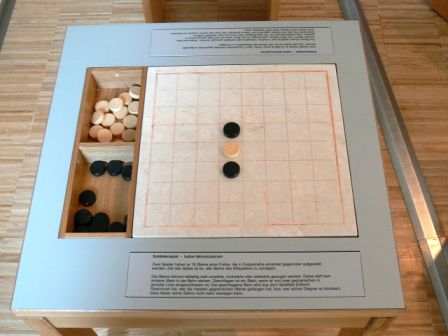
Unfortunately we have no archaeological evidence for the existence of gwyddbwyll. This is odd because boards and counters for the Roman Ludus Latrunculorum, ‘The Game of Little Soldiers’, have been found at Housesteads, Vindolanda, and in the grave of a man from Stanway in AD 50 alongside diving rods suggesting it was buried with its owner and served a divinatory purpose.

Ludus Latrunculorum, modern reconstruction, Museum Quintana, Germany, Wikipedia Commons

Ludus Latrunculorum, modern reconstruction, Museum Quintana, Germany, Wikipedia Commons

These boards were wooden (as ‘wood sense’ might suggest) and have not rotted away. If gold and silver gwyddbwyll sets existed, which indeed might have been possible based on examples of Romano-British silversmithing such as the ‘Empress Pepper Pot’, surely they would have been found?

Empress Pepper Pot, British Museum, Wikipedia Commons

Empress Pepper Pot, British Museum, Wikipedia Commons

In Ireland we find a parallel game called fidchell, from fid, ‘wood’, and ciall, ‘intelligence’, also ‘wood sense’. Again it belongs to sovereigns, the board and pieces are made of gold and silver, and are anthropomorphic and endowed with their own life (in one instance ‘the queen is asleep’). Games are played for high stakes bound up with the livelihood of the realm. Likewise there is no archaeological evidence for its existence.

According to the Lebor Gabala Erenn, the god Lug brought fidchell to Ireland along with ball-play, horse racing and assembling. It seems possible that gwyddbwyll was also perceived to be of divine origin and introduced by the pan-Celtic god Lugus who is euhemerised in the medieval Welsh texts as Lleu Llaw Gyfes, ‘Lleu of the Skillful Hand’ and Lleog, ‘death-dealer’ or ‘flashing light’.

Although gwyddbwyll is the modern Welsh name for chess they should not be equated. Chess originated in India in the 6th century and spread to Spain via Persia, arriving in Britain with the Normans in the 12th century.

***

As I’ve conducted this research I’ve been nagged by a constant question, ‘Why the war games?’

The very concept of gwyddbwyll as a game played by sovereigns predicated on perpetual war between players and realms has felt increasingly problematic.

The gwyddbwyll board symbolises the fact that Britain’s sovereigns have always maintained their power through warfare and by positing a mentality of ‘us’ against ‘the enemy’.

It is no coincidence that Arthur, the first warlord to unite Britain, plays gwyddbwyll. Or that when he raids the Otherworld, subdues its deities, and steals its treasures he is aided by Lleog, the bringer of war games, with his deadly flashing sword.

Arthur’s reign is founded on his defending Britain from enemies within (such as giants, monsters, and the deities of the Otherworld) and from enemies without (such as the Anglo-Saxons).

This gwyddbwyll mentality has led to the Crusades, imperialism, colonialism, and to the War on Terror.

Whereas movements for electoral reform and the rights of minority groups have succeeded, anti-war protests and campaigns have consistently been ignored because war lies at the heart of Britain’s political and economic structure and maintains its hierarchies and elites.

We’re trapped on a gwyddbwyll board growing more terrified of attacks whilst the rulers muster their gwerin.

Where does our hope lie?

In breaking their rules, revealing their war games as ‘wood sense’, refusing to ‘play on’?

Gwyn ap Nudd and Gwenddolau ap Ceidio, Bull Protector of Arfderydd

In ‘The Conversation of Gwyn ap Nudd and Gwyddno Garanhir’ Gwyn speaks of attending the death of Gwenddolau ap Ceidio:

‘I was there when Gwenddolau was slain,
Ceidio’s son, a pillar of poetry,
When ravens croaked on gore.’

Gwenddolau was one of four northern British warlords whose souls Gwyn gathered from the battlefield. The root of his name, ‘Gwen’, like ‘Gwyn’, means ‘White, Blessed, Holy’. His descent from Ceidio places him in the lineage of Coel Hen amongst the ‘Men of the North’.

Gwenddolau’s brother was Nudd Hael/Llawhael, ‘The Generous/Generous Hand’. It seems possible he was named after Gwyn’s father, Nudd/Lludd Llaw Eraint ‘Silver Hand’. Connections have been made between Nudd Hael and a stone in Yarrow Kirk commemorating ‘the illustrious Nudus and Dumongenus… sons of Liberalis’. Nudus is a Latinisation of Nudd.

It may be suggested that Nudd and Gwyn were ancestral deities to the Coeling. The other northern men whose souls Gwyn gathered: Bran ap Ywerydd, Meurig ap Careian, and Gwallog ap Lleenog were also descendants of Coel Hen.

View from Liddel Strength

Gwenddolau’s fortress, Caer Gwenddolau, stood on present-day Liddel Strength beside Liddel Water. It is likely his rule extended from there throughout the modern parish of Arthuret, which was then known as Arfderydd, and perhaps more widely.

The nearby Roman settlement Castra Exploratum ‘Fortress of the Scouts’ supplies generous evidence of pagan worship including altars to Roman and British deities and a striking ram-horned head.

In ‘Greetings’ Myrddin speaks of Gwenddolau as ‘a glorious prince, / Gathering booty from every border… Chief of the kings of the North, greatest in generosity.’ This shows that, like his kinsmen, he was fond of raiding his enemies and endowing wealth on his subjects and bards (hence the epithet ‘pillar of poetry’). He may even have held the position of ‘High King’.

In Triad 6 Gwenddolau is named as one of three ‘Bull Protectors’ of the Island of Britain. Anne Ross notes Tarw, ‘Bull’, is a ‘title’ for ‘eminent warriors in a society which at one stage likened its tribal god… to a great horned bull.’ Gwyn is addressed by Gwyddno as a ‘Bull of Battle’. Gwenddolau’s title of Bull Protector might derive from his likening to Gwyn. Bulls were held especially sacred by the cattle-raiding kingdoms of the North.

The word used for ‘Protector’ is Caduc. Rachel Bromwich notes it has several meanings: ‘fog, gloom, darkness, covering, armour’ which she links to ‘the battle-fog of the host of Gwenddolau’ (Triad 44) describing it as ‘the rising vapour or cloud of dust or steam which rose from an army under stress of battle’.

This battle-fog may have been caused by combat. Another explanation is that Gwenddolau, like certain Druids, had the ability to summon a protective fog around his host. This could be rooted in his relationship with Gwyn, whose father is Nudd, ‘Mist’. The term nuden refers to a ‘condensed floating white cloud’ said ‘to claw ones vitals’ which serves as a garment for Gwyn.

Gwenddolau was the owner of two birds who ‘had a yoke of gold on them. Two corpses of the Cymry they ate for their dinner, and two for their supper’ (Triad 33). There is a longstanding tradition of corpse-eating birds in Welsh literature. Dead warriors are said to feed the ravens or eagles and Gwyn gathers the souls of the dead accompanied by ravens who ‘croak over gore’.

Gwenddolau’s ownership of these birds could suggest their excarnation of corpses was part of his funerary practice. By ‘the Cymry’ it is unclear whether they eat the corpses of his tribe, his Cymric enemies, (or both!). Birds yoked together in pairs by gold or silver chains appear in Irish literature and are often transformed humans. On the Papil Stone, from West Burra, Shetland, we find the image of two bird-headed figures with a small human head between their beaks. Could Gwenddolau’s birds have been shapeshifting corpse-eaters?

Gwenddolau also possessed a magical chessboard that appears as one of ‘The Thirteen Treasures of the Island of Britain’ ‘which were in the North’. ‘The Chessboard of Gwenddolau son of Ceidio: if the pieces were set, they would play themselves. The board was of gold and the men were of silver’.

In Peredur the protagonist finds a gwyllbwyll board similar to the Gwyddbwyll Gwenddolau in the Castle of Wonders. The two sides play each other by themselves. When one side loses the other shout ‘as if they were men’. These chessboards, like the other treasures, are alive, animate, endowed with a life and spirit of their own.

Gwenddolau was killed at the Battle of Arfderydd in 573. This is recorded in The Annales Cambriae: ‘The Battle of Arderydd between the sons of Elifer and Gwenddolau the son of Ceidio; in which battle Gwenddolau fell; Merlin became mad’.

Triad 84 ‘Three Futile Battles’ refers to ‘the Contest of Arfderyd, which was brought about because of the lark’s nest’*. Robert Vaughan speaks of a tradition wherein the shepherds of Rhydderch of Alt Clut (Strathclyde) and Aeddan of Dal Riada fell out over a lark’s nest and Aeddan sided with Gwenddolau against Rhydderch. The poems attributed to Myrddin/Merlin also suggest Rhydderch fought against Gwenddolau.

It seems possible Gwrgi and Peredur allied with Rhydderch against Gwenddolau and perhaps Aeddan. Gwrgi and Peredur were Gwenddolau’s cousins and ruled Eboracum (York). To add to the confusion they were supported by Dunawd the Stout of Dununtinga (Dent?), Cynfelyn the Leprous (location unknown) and Cynan Garwyn of Powys.

Many warlords had it in for Gwenddolau! This is unsurprising considering his raiding and overlording as ‘Chief of the kings of the North’. It has been suggested that Gwenddolau was targeted because, unlike his Christian kinsmen he maintained his pagan beliefs and practices. Perhaps he was attacked for a mixture of these reasons and more.

Gwenddolau was supported by his nephew Dreon ap Nudd. In Triad 31 he is referred to as Dreon the Brave whose ‘Noble Retinue’ fought at the Dyke of Arfderydd. After Gwenddolau fell, his ‘Faithful Warband’ ‘continued the battle for a fortnight and a month’ (Triad 29).

After the Battle of Arfderydd, Myrddin, a warrior who fought for Gwenddolau, became wyllt, ‘mad’. The Life of St Kentigern records his** vision of a ‘brightness too great for human senses to endure’ with martial battalions in the skies. It seems likely this was Gwyn and his host arriving to gather Gwenddolau’s soul and the souls of the other warriors from the battlefield.

Was Gwenddolau taken by Gwyn to Annwn to be re-united with his ancestors? Or, like other bullish warlords such as Gwidawl, Llyr Marini, and Gyrthmwl Wledig, did he become a ‘Bull Spectre’ (Tarw Ellyll) haunting Arfderydd with his corpse-eating birds and chessmen who go on playing by themselves?…

Chillingham_Bull_by_Thomas_Bewick_1789

*This may have been Caer Laverock, ‘The Lark’s Fort’.
**Here he is named Lailoken, deriving from Llallogan, ‘other’.

SOURCES

Anne Ross, Pagan Celtic Britain, (Cardinal, 1974)
J. Gwengobyrn Evans, The Black Book of Carmarthen, (Pwllhelli, 1907)
Greg Hill (transl) ‘Gwyn ap Nudd and Gwyddno Garanhir’
Meirion Pennar (transl.), The Black Book of Carmarthen, (Llanerch Enterprises, 1989)
Nikolai Tolstoy, The Quest for Merlin, (Sceptre, 1985)
Rachel Bromwich (ed), The Triads of the Island of Britain, (University of Wales Press, 2014)
Sioned Davies (transl.), The Mabinogion, (Oxford University Press, 2007)
Tim Clarke, The Men of the North: The Britons of Southern Scotland, (John Donald, 2010)
Tim Clarkson, Scotland’s Merlin, (Berlinn, 2016)

Gwenddydd: The Dreamer at the End of the World

I have come hither to tell
Of the jurisdiction I have in the North;
Every region’s beauty is known to me.’
The Dialogue of Myrddin and his Sister Gwenddydd

Many people have heard of Merlin and a few of the northern British wildman, Myrddin Wyllt. But what of Gwenddydd, Myrddin’s twin sister, who was also an important prophetic figure from the Old North, whose legacy has been overshadowed by her brother’s?

Gwenddydd and Myrddin lived during the 6th century and their father’s name was Morfryn. From the poems attributed to Myrddin in The Black Book of Carmarthen (1350), we can derive that he was a warrior of Gwenddolau. His deep fondness of his lord suggests the twins grew up at Caer Gwenddolau (Liddel Strength) in Arfderydd (Arthuret).

View from Liddel Strength

Liddel Strength

What kind of upbringing did Gwenddydd have? Gwenddolau was renowned as a ‘Bull-Protector’ and cattle-raiding warlord. Many legends surround him: he owned two birds who ate two corpses of the Cymry for dinner and supper; his gwyddbwyll set played itself; he conjured a mysterious battle-fog; his soul was gathered from the battlefield by Gwyn ap Nudd.

These stories have led scholars such as Nikolai Tolstoy to argue that Gwenddolau was the last of the northern British pagan warlords. Unfortunately this cannot be proven as many of the Christian warlords had magical abilities and, like Gwenddolau, were named as the owners of ‘The Thirteen Treasures of the Island of Britain, which were in the North’.

Whatever the case, Gwenddolau was a formidable figure. Gwenddydd grew up alongside Myrddin and their four brothers, Morgenau, Cyvrennin, Moryal and Moryen in a male-dominated culture where internecine warfare and cattle-raiding between the kingdoms of the Old North was the norm.

The ethos of the society was ‘heroic’. The warriors who committed the most blood-thirsty deeds in battle and stole the most cattle won immortality in the songs of the Bards. Both pagans and Christians believed that inspiration and prophecy originated from the Awen*; those able to give voice to it (particularly for military purposes) were held in high esteem.

The medieval texts suggest that women played a subordinate role to men as wives and home-keepers. How much this accurately reflects 6th century society and how much the gloss of medieval scribes is open to question. There are suggestions in several texts that Gwenddydd was seen as important, not only due to her upbringing at Caer Gwenddolau, but because of her intelligence and her prophetic abilities.

Gwenddydd eventually married Rhydderch Hael** who ruled Alt Clut from present-day Dumbarton. It is my belief this was a political marriage to cement an alliance between the kingdoms of Arfderydd and Alt Clut. Whether this was arranged by Gwenddolau or initiated by Gwenddydd in accord with her own political aims remains a matter of conjecture.

Dumbarton Rock

Dumbarton Rock

It’s my opinion that Gwenddydd was not just a pawn in the games of the male warlords. In ‘The Dialogue of Myrddin and his Sister Gwenddydd’ from The Red Book of Hergest (1380 – 1410) she speaks of ‘the jurisdiction’ she has ‘in the North. / Every region’s beauty is known to me.’

Gwenddydd was an important co-ruler. Not only did she have ‘jurisdiction’ over Alt Clut and, perhaps, Arfderydd, but the whole of the North. This may have been founded on her prophetic abilities: her capacity to see the unfolding of the fates of all the regions.

The alliance between Arfderydd and Alt Clut lasted for at least as long as it took Gwenddydd and Rhydderch’s son and daughter to grow to fighting age (from around 550 to 573 – a long time in those war-torn days!); it is notable that both Gwenddydd’s son and her daughter became warriors. It then broke down with tragic consequences, leading to the Battle of Arfderydd in 573 (whether Gwenddydd foresaw this battle remains uncertain).

Many reasons have been cited for the Battle of Arfderydd. In The Triads of the Island of Britain (13th C), it is listed as one of three ‘futile battles’ because it was fought over a Lark’s Nest: possibly an allusion to the nearby fortress of Caer Laverock. Another theory is that Rhydderch allied against Gwenddolau with other Christian warlords to bring an end to northern British paganism. Alternatively it may simply have been about land and power.

Rhydderch and his allies, Gwrgi and Peredur, fought against Gwenddolau and his nephew, Dreon ap Nudd. Gwenddolau was killed. Gwenddydd’s son and daughter fought on Rhydderch’s side and were slaughtered by Myrddin. The latter tragedy is referenced in a poem attributed to Myrddin called ‘The Apple Trees’ from The Black Book of Carmarthen (1350):

‘Now Gwenddydd loves me not and does not greet me
– I am hated by Gwasawg, the supporter of Rhydderch –
I have killed her son and her daughter.
Death has taken everyone, why does it not call me?…

Oh Jesus! would that my end had come
Before I was guilty of the death of the son of Gwenddydd.’

These lines show that Gwenddydd was devastated by Myrddin’s slaughter of her children. Understandably, her love of her twin had turned to hatred, and she refused to speak to him. Other poems show that Rhydderch was actively pursuing the killer of his children.

In ‘The Apple Trees’, Myrddin mentions his ‘sweet-apple tree’ has ‘a peculiar power’ which ‘hides it from the lords of Rhydderch’. In ‘The O’s’, which are addressed to a ‘little pig, a happy pig’, he tells it to ‘Burrow in a hidden place in the woodlands / For fear of the hunting-dogs of Rhydderch Hael, defender of the Faith.’

These poems are attributed to Myrddin during the time he was wyllt (‘wild’ or ‘mad’). Tormented by battle-trauma, guilt, and grief, and haunted by a blinding vision of a martial battalion in the skies***, he wandered the forest of Celyddon ‘for ten and twenty years’ amongst other gwyllon (‘wildmen’ or ‘madman’) speaking poems to the wild creatures. When he emerged, he used the art of prophecy to warn against future bloodshed.

Eventually, Gwenddydd forgave Myrddin. Her reasons for this decision remain mysterious. Did she realise Myrddin’s slaughter of her children resulted from the fatal circumstances of the breakdown of Gwenddolau and Rhydderch’s allegiance and the power-hunger of the northern warlords? Did she sympathise with Myrddin’s suffering? Did she acknowledge his use of prophecy to warn against future wars?

Their reconciliation is evidenced by several texts. In The Life of Merlin (1150) Gwenddydd persuades Rhydderch to send out a messenger with a cither to charm Myrddin back to Rhydderch’s court. When he arrives she kisses him and twines her arms around his neck. However, unable to bear civilised life, Myrddin flees back to the forest, where Gwenddydd builds him a home. After Rhydderch dies, Gwenddydd joins her brother in Celyddon.

We learn ‘She too was at times elevated by the spirit so that she often prophesied to her friends concerning the future of the kingdom.’ Gwenddydd speaks of future conflicts through a blend of cosmic, animal and martial imagery:

‘I see two moons in the air near Winchester and two lions acting with too great ferocity, and one man looking at two and another at the same number, and preparing for battle and standing opposed.  The others rise up and attack the fourth fiercely and savagely but not one of them prevails, for he stands firm and moves his shield and fights back with his weapons and as victor straightway defeats his triple enemy.  Two of them he drives across the frozen regions of the north while he gives to the third the mercy that he asks, so that the stars flee through all portions of the fields…

I see two stars engaging in combat with wild beasts beneath the hill of Urien where the people of Gwent and those of Deira met in the reign of the great Coel.  O with what sweat the men drip and with what blood the ground while wounds are being given to the foreigners!  One star collides with the other and falls into the shadow, hiding its light from the renewed light…’

Finally, Myrddin says, ‘Sister, does the spirit wish you to foretell future things, since he has closed up my mouth and my book? Therefore this task is given to you; rejoice in it, and under my favour devoted to him speak everything’.

In The Story of Myrddin Wyllt (16th C), during the period of his madness, Gwenddydd delivers food and water to her brother’s forest abode. She shares her dreams with Myrddin and he interprets them. Three dreams relate to the unfair distribution of wealth, the fourth concerns an attack by foreigners and in the fifth, in a graveyard, Gwenddydd eerily hears children speaking from their mother’s wombs.

‘The Dialogue of Myrddin and his Sister Gwenddydd’ takes place when the twins are aged: Myrddin has ‘white hair’. After telling Myrddin of her ‘jurisdiction… in the North’ Gwenddydd asks him a series of questions about who will rule Prydain. The positions of prophet and interpreter are reversed and we can conjecture that the twins habitually swapped roles. With the aid of wyllon mynydd (‘mountain ghosts’) Myrddin  predicts all the rulers of Prydain until:

‘…the time of Cymry suffering
Without help, and failing in their hope–
It is impossible to say who will rule.’

The tone then becomes apocalyptic:

‘When killing becomes the first duty
From sea to sea across all the land–
Say, lady, that the world is at an end…

There will be no portion for priest nor minstrel,
Nor repairing to the altar,
Until the heaven falls to the earth…

Extermination, lady, will be the end…

There will be no more kings!’
Gwenddydd consoles Myrddin:
‘Arise from your rest,
Open the books of Awen without fear.
Hear the discourse of a maid,
Give repose to your dreams.’

It is clear that the twins’ deaths are drawing near. Gwenddydd suggests Myrddin seek communion. Brother and sister finally commend one another to God and ‘the supreme Caer’.

This echoes a story from The Life of St Kentigern (12th C)****. Myrddin predicts his ‘threefold’ death by stoning, being pierced by a stake and drowning and asks for the sacrament from Kentigern. After receiving it he flees to meet his predicted end by being stoned by shepherds and falling onto a stake in the river Tweed.

Nothing is recorded about Gwenddydd’s response to her brother’s death or how she perished. However, from ‘A Fugitive Poem of Myrddin in his Grave’ in The Red Book of Hergest we can infer that Myrddin continues to speak from the afterlife with ‘mountains ghosts’, who ‘come to me / Here in Aber Carav.’ It is thus likely Gwenddydd also possesses the ability to speak her dreams and prophesies with the aid of spirits from her grave: her ‘supreme Caer’.

As our world is threatened by many ends: climate change, mass extinctions, global warfare, what does she dream? Could her story – one of loss, forgiveness and a determination to prophesy against future bloodshed, form a source of inspiration for people seeking alternative narratives to the militant worldviews responsible for her son and daughter’s death, the deaths of millions of others, and our living landscape?

Blog 6. Coille Coire Chuilc

Coile Coire Chulic – one of the last remnants of Celyddon

*Divine inspiration.
**This is depicted in The Life of Merlin (1150), a fictionalised account of Myrddin’s life by Geoffrey of Monmouth based on earlier sources. Myrddin appears as Merlin and Gwenddydd as Ganieda.
***This is recorded in The Life of Merlin and The Life of St Kentigern. I believe Myrddin saw Gwyn ap Nudd and the spirits of Annwn as in The Black Book of Carmarthen, Gwyn states his presence at Gwenddolau’s death as a gatherer of souls. The spirits who interact with Myrddin and Gwenddydd may be spirits of Annwn.
****Here Myrddin is named Lailoken, which is derived from Llallogan ‘other’.

Gwyn ap Nudd, Meurig ap Careian and Elaeth the Poet

Another warrior whose death Gwyn ap Nudd states his presence at in ‘The Conversation of Gwyn ap Nudd and Gwyddno Garanhir’ is Meurig ap Careian:

‘I was there when Meurig was slain,
Careian’s son, honoured in praise,
When ravens croaked on flesh.’

To the best of my knowledge, Meurig ap Careian does not appear in any other literature by that name. The patronymic ‘Careian’ may be the result of a scribal error. In Early Welsh Saga Poetry, Jenny Rowlands puts forward a theory about his identity.

Rowlands mentions that in the margin of ‘A Song on Gwallawg ap Lleenawg’ (which precedes ‘The Conversation of Gwyn ap Nudd and Gwyddno Garanhir’ in The Black Book of Carmarthen) there are two verses which associate Gwallawg with ‘a certain Meurig who is probably to be identified as Meurig m. Idno, his son-in-law.’ Both men are ‘clearly vilified’.

‘No one who would have been famous
went in the plight that Gwallawg did
to the accursed one, to the thorn bushes.

No one who would have been admired
Went in the plight that Meurig did
On the back of his wife bent-in-three.’

Rowland says ‘These stanzas perhaps allude to a scurrilous story in which both men fled ignominiously from battle, and the englyn about Gwallawg could reflect a variant, more shameful, tale about how he lost one eye.’* Gwallawg and Meurig are ‘held up as patterns to avoid.’

Rowland also mentions that Meurig ap Idno may be referred to by Llywarch Hen in ‘Gwahodd Llywarch i Lanfawr’ as Meurgawg marchgawg ‘horseman like Meurig’. This places Meurig alongside Gwallawg and Brân ap Ymellryn as Llywarch Hen’s enemies. Considering that Gwyn states his presence at the deaths of Gwallawg and Brân, these associations could well be correct.

In Early Welsh Genealogical Tracts, Meurig ap Idno’s mother is Gwallawg’s sister, Onnengreg, strengthening the case for a connection. It seems possible Careian was an obscure epithet for Meurig’s father, Idno, which got confused with a patronymic.

Many of the Men of the North have epithets such as ‘Mwynfawr’ ‘the wealthy’ and ‘Freichras’ ‘strong arm’. Might Careian derive from cariad, which is Welsh for ‘lover’? There is a tradition of triads celebrating lovers and lover’s horses. The marginal lines about Meurig ‘On the back of his wife bent-in-three’ might parody his epithet.

It is notable that Idno is the son of Meirchion Gul son of Gwrwrst Ledlwm son of Ceneu son of Coel Hen. Gwrwrst Ledlwm was one of the northern men who allied with Gwythyr ap Greidol, Gwyn’s rival for the love of Creiddylad, in Culhwch and Olwen. Gwythyr, Gwrwst and a collection of mythic and historical warriors assaulted Gwyn and were consequently imprisoned by him then rescued by Arthur. Gwyn has a long history of interactions with this family.

Meurig ap Idno also had a brother called Mabon (‘Divine Son’). His naming after the Brythonic god of youth also demonstrates a continuation of pagan influence on Idno’s family. However, this ended with Meurig and Onnengreg’s son, Elaeth, who became St Elaeth Frenin of Anglesey. Frenin derives from brenin King and suggests he succeeded his father, Meurig, as king of a region in the Old North. Where he reigned is debatable.

If we look at the traditional locations of other Coelings: Gwallog was associated with Leeds, Urien Rheged with Carlisle and/or the Solway Firth, Dunod with Dent, it seems possible he was located somewhere in modern-day Cumbria, Yorkshire, or Lancashire. August Hunt’s theory is the town of Moresby in Cumbria derives from ‘Gwas Meurig’ ‘Abode of Meurig’. Guasmoric is mentioned in Historia Brittonum and may be identified with the Gabrosentum fort near Moresby.

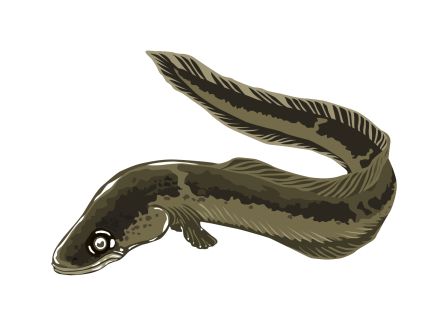
Elaeth was driven from his northern lands (whether by Anglo-Saxons or other Britons remains open to question), went to live in a monastery run by St Seiriol at Penmon on Anglesey, and founded St Eleth’s church at Amlwch. He was also associated with a healing well: Fynnon Elaeth. Intriguingly this was used for divination by means of the ‘motions and actions’ of an eel who was kept in it. Inquirers often waited for days for the eel to appear. Elaeth’s feast day is November the 10th.

free-eel-clipart-clipart-kid

Elaeth was also a poet and is believed to have composed two of the poems in The Black Book of Carmarthen: ‘The Cynhogion of Elaeth’ and ‘Not To Call Upon God’. This seems significant because The Black Book of Carmarthen was once a much longer prose saga, which may once have contained the details of Meurig’s death and the reasons for Elaeth’s flight.

Most of the men whose souls Gwyn gathers appear in other works in The Black Book of Carmarthen. Some poems document the battles and eulogise the deaths of warriors associated with the Old North. Others, such as those attributed to Myrddin and Llywarch, provide accounts of the devastating effects of war and reflections on the joys and hardships of eking out an existence in the natural world after losing one’s place within civilisation.

Unlike The Book of Taliesin, which provides all-out praise of the ‘heroic’ ethos, The Black Book of Carmarthen documents the after-effects of war, provides a critique of the age in which the Old North was lost and offers solace in nature and religion as a way to recovery.

***

*‘A Song on Gwallawg ap Lleenawg’ refers to the loss of his eye:

‘Accursed be the tree
Which pulled out his eye in his presence,
Gwallawg ab Lleenawg, the ruler.’

With thanks to Greg at The Way of the Awenydd for information on the pages from Jenny Rowland’s Early Welsh Saga Poetry from The National Library of Wales.

SOURCES

Anna, ‘St Elaeth the Poet
August Hunt, The Arthur of History, (August Hunt, 2012)
Heron (transl) ‘Gwyn ap Nudd and Gwyddno Garanhir
Jenny Rowland, Early Welsh Saga Poetry, (Cambridge, 1990)
Peter Bartrum, A Welsh Classical Dictionary, (National Library of Wales, 1993)
Sioned Davies (transl.), The Mabinogion, (Oxford University Press, 2007)
William F. Skene (transl), The Four Ancient Books of Wales, (Forgotten Books 2007)

Gwyn ap Nudd and Brân ap Ywerydd: Five Brâns?

In ‘The Conversation of Gwyn ap Nudd and Gwyddno Garanhir’, Gwyn states his presence at the death of Brân ap Ywerydd:

‘I was there when Brân was slain,
Ywerydd’s son of wide fame,
When battle-ravens croaked.’

Gwyn recites Brân’s name amongst the names of three famous northern warlords: Gwenddolau ap Ceidio, Gwallog ap Llenog and Meurig ap Careian* and also Llachau, Arthur’s son. It is clear Brân was slain in battle and that Gwyn was present as a psychopomp to gather his soul back to Annwn. Brân’s name must have held meaning for Gwyddno Garanhir** and the audience. Who is Brân ap Ywerydd? Scholars have attempted to solve this puzzle by identifying him with a number of mythological and historical figures.

Brân the Blessed

raven-clipart-we-heart-it-public-domain

There exists a tradition which identifies Brân ap Ywerydd with Bendigeidfran ‘Blessed Raven’ or ‘Brân the Blessed’ son of Llŷr. Brân is a well known and much loved figure in British mythology who was fatally wounded in a battle against King Matholwch of Ireland. His severed head, buried beneath the Tower of London, served an apotropaic function protecting the Island of Britain until Arthur dug it up.

Scholars such as John Rhŷs and John Koch identify Iwerydd as the mother of Brân the Blessed. Koch says ‘Iwerydd (Atlantic) was a goddess from the Atlantic ocean, from the Western land of Hades, which could have been Ireland (Iwerddon). Iwerydd married Llyr and bore him two children named Brân (Raven) and Branwen (White Raven).’

The birth of Brân, his sister, Branwen, and perhaps their brother Manawydan by Iwerydd and Llŷr Llediaith (Irish Ler ‘the sea’, Welsh Llediaith ‘half-speech) makes sense within the context of Brân’s gargantuan stature and his affairs across the sea in Ireland.

If Brân ap Ywerydd and Brân the Blessed were identified, this would place Gwyn at the near-apocalyptic battle between the armies of Brân and Matholwch where the Irish dead are reborn from the Cauldron of Rebirth before it is broken by Efnysien. Of the Irish only five pregnant women are left alive. Just seven British survivors return with Brân’s head. If Gwyn attended the death of Brân the Blessed it might be suggested he also served as psychopomp to the victims of this terrible clash.

However, there are arguments against the identification of these two Brâns. Elsewhere, Brân the Blessed’s mother is named as Penarddun (‘Chief Beauty’). In ‘The Second Branch’ of The Mabinogion, Bendigeidfran is named as a son of Llŷr with Manawydan as his brother and Branwen as his sister. Nysien and Efnysien are sons of Euroswydd by ‘his own mother Penarddun, daughter of Beli.’

In The Triads of Ancient Britain, Llŷr Half-Speech is named as one of ‘Three Exalted (Supreme) Prisoners of the Island of Britain’. He was ‘imprisoned by Euroswydd’. It seems likely Euroswydd conceived Nysien and Efnysien with Penarddun whilst Llŷr was his prisoner.

Although textual evidence provides a stronger case for Penarddun being Brân’s mother than Iwerydd, within mythology we often find multiple genealogies which are equally valid. Iwerydd and Penarddun could also be titles for the same divinity. Therefore the identification of these two Brâns cannot be ruled out.

Brân ap Ymellryn

Grufudd Hiraethog identifies Brân ap Ywerydd with Brân ap Ymellyrn: a historical figure who appears in the poems attributed to Llywarch Hen. These are set after the assassination of Llywarch’s cousin, Urien Rheged, on the order of his jealous rival, Morgan, during a campaign against the Anglo-Saxons on Lindisfarne in 585.

Llywarch bore Urien’s head home. Afterward, Urien’s sons and Llywarch were driven from their lands in the Old North*** by Urien’s enemies who included Dunawd, Morgant, Gwallawg and Brân ap Ymellyrn. In The Death of Urien, Llywarch speaks of his plight (Pasgen and Elphin are Urien’s sons):

‘Dunawd, the chief of the age, would drive onward,
Intent upon making battle,
Against the conflict of Pasgen.

Gwallawg, the horseman of tumult, would drive onward,
Intent upon trying the sharpest edge,
Against the conflict of Elphin.

Brân, the son of Mellyrn, would drive onward,
Collecting men to burn my ovens:
A wolf that looked grimly by the banks of Abers.

Morgant and his men would drive onward,
Collecting a host to burn my lands:
He was a mouse that scratched against a rock.’

Llywarch flees to the court of Cynddylan in Powys. After Cynddylan is killed, he is again left homeless and destitute. A friend advises him to trust neither Brân nor Dunawd and to take refuge in Llanfawr:

‘Trust not Brân, trust not Dunawd;
Consort not with them in hardship.
Herdsman of calves, go to Llanfawr.’

Glyn E. Jones suggests Brân ap Ymellyrn may be identified with Brân ap Dyfnwal (Ymellyrn was his mother and Dyfnwal his father). This places him with Urien, Llywarch and their enemies Gwallawg and Dunawd amongst the descendants of Coel Hen within the lineages of the Old North.

Brân Galed

Hiraethog identifies Brân ab Ywerydd with Brân Galed (‘the Niggard’). He is the keeper of a magical horn that appears amongst ‘The Thirteen Treasures of the Island of Britain’ ‘which were in the North’: ‘The Horn of Brân the Niggard from the North: whatever drink might be wished for was found in it.’ Most of the owners of the treasures (who include Gwyddno and Gwenddolau) are ‘Men of the North’ and lived during the 6thC.

In the marginalia of an early list is a story about how Myrddin asked for the treasures from the thirteen owners. They all agreed if Myrddin obtained Brân’s horn, they would hand their treasures over, assuming Brân was so niggardly he would never give his up. Somehow, Myrddin persuaded Brân to give him the horn and he took all the treasures to a glass house where they remain forever.

It has been suggested Taliesin played a role in Brân’s decision. In a poem by Guto’r Glyn ‘Miserly, niggardly Brân they used to call him, who of old was descended from the Men of the North; Taliesin, no mean magician, transformed him into one better than the three generous men.’ In some variants Taliesin is the collector of the treasures. In another, Hercules slays a centaur and obtains Brân’s horn from its head.

Brân at Cynwyd

In The Gododdin we find the line ‘Brân was at Cynwyd’. Jenny Rowlands notes ‘Cynwyd is attested as both a personal and place name’. It may relate to a battle where Pelis, son of Urien fought, or to his leadership of the Cynwydion (named after Cynwyd Cynwydion, another descendent of Coel Hen).

Considering the antipathy between Urien’s sons and Brân ap Ymellyrn, it seems possible Pelis and the Cynwydion fought against Brân ap Ymellyrn and his allies and are commemorated at Cynwyd. Brân may have perished there too. The location remains unconfirmed, although there is a Cynwyd near to Corwen beside the river Dee in Wales.

Five Brâns?

Can we ascertain Brân ap Ywerydd’s identification with any or all of these Brâns? Are we looking at one, two, three, four or five different figures?  I think it’s safe to say that Brân the Blessed and the Brâns of the sixth century are entirely different due to the differences in timescale and mythological and historical context.

Within the context of Brân ap Ywerydd’s appearance in ‘The Conversation of Gwyn ap Nudd and Gwyddno Garanhir’, I think it most likely, like Gwenddolau, Gwallog and Meurig, he is a northern British figure from the 6thC. Brân ap Ywerydd, Brân ap Ymellyrn, the Brân who was at Cynwyd, and Brân Galed could be the same person.

We can tentatively piece together his story as follows: Brân was the son of Ywerydd and Dyfnawl and lived during the period of intense internecine conflict between the Brythonic kingdoms of the Old North as they fought against the Anglo-Saxons. Brân, Gwallawg, Dunawd and Morgant allied against Urien and Llywarch, arranging Urien’s assassination and driving Llywarch from the North. Brân later fought against Urien’s son, Pelis, at Cynwyd and perished and Gwyn attended his death. Brân was renowned for his niggardly nature and keeping his horn and his drink to himself. Sometime after his death, this fell into the realm of myth and became one of the Thirteen Treasures.

Gwyn’s association with Brân the Blessed cannot, however, be ruled out. As Gwyn is a ruler of Annwn and guide of the dead he could well have attended Bendigeidfran’s death too. The croaking ravens in each of the elegaic verses spoken by Gwyn invoke Brân’s presence as a reminder of the futile, destructive and seemingly unending nature of war.

Associations between ravens and the battlefield continue to endure in contemporary poetry. Speaking of the Iraq war in her modern rewriting of the traditional ballad ‘The Two Ravens’, Clare Pollard writes:

‘I watched the ravens feed on war,
and knew I’d watch for evermore.’

***

*Meurig ap Careian is a famous northern warlord if Careian is a scribal error and he is identified with Meurig ap Idno. I’ll cover this in a later post.
**Another ‘Man of the North’ associated with Porth Wyddno in the North and Borth in Wales.
***Some scholars associate Llywarch with Caerlaverock (Caer Llywarch) on the Solway Firth. Others have conjectured he may have ruled ‘South Rheged’ (Lancashire?) from modern-day Ribchester.

SOURCES

Clare Pollard, ‘There Wasn’t Even a Song in that Desolation: Poetry After a Decade in Iraq
Heron (transl), ‘Gwyn ap Nudd and Gwyddno Garanhir’, (2015)
John Koch, Celtic Culture: A Historical Encyclopedia, (ABC-CLIO, 2006)
John Rhŷs, Studies in the Arthurian Legend, (Adamant Media Corporation, 2001)
Peter Bartrum, A Welsh Classical Dictionary, (National Library of Wales, 1993)
Rachel Bromwich (ed), The Triads of the Island of Britain, (University of Wales Press, 2014)
Sioned Davies (transl.), The Mabinogion, (Oxford University Press, 2007)
William F. Skene (transl), The Four Ancient Books of Wales, (Forgotten Books 2007)

Din Eidyn and Drunken Catraeth

A few weeks ago I visited Edinburgh. This was partly due to my interest in its history as part of the Old North. During this period it was known as Din Eidyn ‘fort of Eidyn’ (Eidyn’s identity and whether this name refers to a person and/or place remain a mystery).

There is evidence of settlements on Castle Rock and Arthur’s Seat from the Bronze and Iron Ages. The earliest fort was known as ‘The Castle of the Maidens’. It may have been established on a pre-Christian site sacred to ‘the nine maidens’ amongst whom was Morgen: a divinity connected with water, shapeshifting, healing and the weather.

During the Iron Age the local tribe were known as the Votadini. It has been argued this name originates from the early Celtic *wo-tādo, which means ‘foundation’ or ‘support’ and that this was the name of an ancestral figure. During the Romano-British period, the Votadini became known as the Gododdin and their kingdom was Manaw Gododdin.

Like many of the northern British peoples, the Gododdin had complex relationships with Wales. Sometime between 380 and 440, Cunedda, a man from Manaw Gododdin, helped defend north Wales from the Irish and played a prominent role in founding the kingdom of Gwynedd, which his offspring ruled.

After the death of Cunedda’s descendant, Maelgwn Gwynedd in 547, Elidyr Mwynfawr, who was married to Maelgwn’s daughter, Eurgain, travelled from Benllech in the North via the sea* to Benllech on Anglesey to contest the claim of Maelgwn’s illegitimate son, Rhun, to the throne of Gwynedd. Elidyr was killed at Arfon.

Afterward, Clydno Eiddyn, who may have ruled Din Eidyn, formed part of a warband alongside other northern rulers; Nudd Hael, Mordaf Hael and Rhydderch Hael. Seeking vengeance for Elidyr’s death, they travelled to Wales, set fire to Arfon and were driven back all the way to the river Gwerydd (the Forth).

Clydno was also the keeper of one of ‘The Thirteen Treasures of the Island of Britain’ ‘which were in the North’: ‘The Halter of Clydno Eiddyn, which was fixed to a staple at the foot of his bed: whatever horse he might wish for, he would find in the halter.’

p1170878

The Gododdin are immortalised in the poem The Gododdin, which has been dated to the 7th century. This takes the form of a series of verses eulogising and elegising the northern Britons who perished in the battle of Catraeth** in 600AD fighting against the Bernician Angles. Prior to the battle, the warriors feasted and drank for a year in the hall of Mynyddog Mwynfawr, ruler of Din Eidyn. The joy of the mead-feast is repeatedly contrasted with the bloodshed of the battle from which ‘of three hundred, save one man, none returned.’

‘Warriors went to Catraeth with the dawn,
Their ardours shortened their lives,
They drank mead, yellow, sweet, ensnaring,
For a year many a minstrel was joyful.
Blood-stained were their swords, may their spears not be cleansed;
White were the shields and square-pointed the spearheads
Before the retinue of Mynyddog Mwynfawr.’

Cynon, a son of Clydno Eidyn was amongst the casualties and is the subject of several verses.

‘…generous-hearted Cynon, lord of graces…
Whomever he struck would not be struck again.
Sharp-pointed were his spears,
With shattered shields he tore through armies,
His horses swift racing forward.’

‘He slew the enemy with the sharpest blade,
Like rushes they fell before his hand.
Son of Clydno of enduring fame’

The imagery of The Gododdin is strikingly similar to that of The Conversation of Gwyn ap Nudd and Gwyddno Garanhir. In The Conversation, Gwyddno addresses Gwyn as a ‘bull of battle’ and says ‘armies fall before the hooves of your horse / As swiftly as cut reeds to the ground’. Gwyn speaks of ‘shields shattered, spears broken’ and states his presence at the deaths of a number of northern warriors ‘where ravens croaked on gore’.

In The Gododdin, two warriors are referred to as ‘bull(s) of battle’, one as ‘bull of an army’ and another as ‘heroic bull’. Men are hewn down ‘like rushes’, there are countless references to ‘shattered’ and ‘splintered’ spears and shields and the dead become ‘food’ for ‘ravens’. This suggests both poems originated from the same milieu. It seems possible Gwyn gathered the souls of the dead after the battle of Catraeth as he did after the battle of Arfderydd in 573.

p1170962

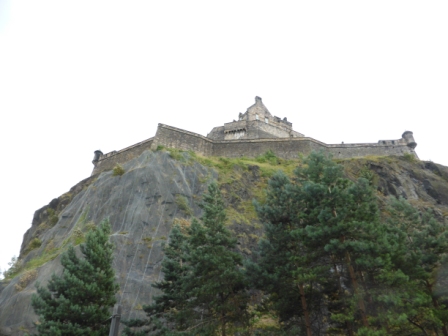
When I visited Edinburgh Castle, I was struck by the height and impenetrability of the cliff face (Castle Rock was originally a volcano which was later flattened by a glacier) and could see why it has been a defensive location for so long.

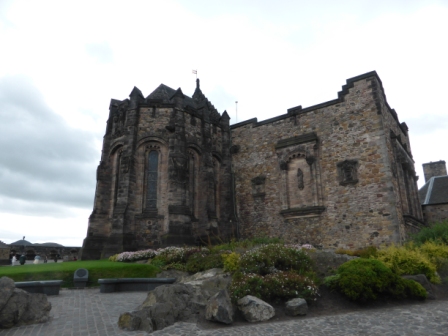
Unsurprisingly, after so many centuries, there were few traces of the Gododdin. The castle was built in stone in the 12th century and the current banqueting hall during the 15th. The hall has a prominent hearth fire and is decorated with spears, swords and armoury. It’s possible to imagine Mynyddog Mwynfawr’s hall would have been equipped in a similar manner.

Since Catraeth, Edinburgh’s people have seen countless bloody battles, including the Wars of Independence from 1296 and 1341, the ‘Lang’ siege which lasted from 1571-1573 and the Jacobite Risings from 1688-1746. The castle was later used as a military prison. It is still a barracks and is now home to the Scottish National War Memorial: an extensive ‘shrine to the fallen of two world wars and campaigns since 1945’.

p1170885

As a metaphor for tragic and ill-conceived warfare, ‘drunken Catraeth’ may be seen to repeat itself throughout history. A. O. H. Jarman notes ‘a veteran of the action of Mametz Wood during the battle of the Somme in 1916 ‘recalled an observer saying what a magnificent sight it was seeing the Welsh battalions moving along in a line without wavering until they fell’… His observation could have translated a couplet of Y Gododdin.

In ‘Elegy for the Welsh Dead in the Falkland Islands, 1982’, Tony Conran draws analogies between Catraeth and the Falklands War:

‘Men went to Catraeth. The luxury liner
For three weeks feasted them…
With the dawn men went. Those forty-three,
Gentlemen all, from the streets and byways of Wales,
Dragons of Aberdare, Denbigh and Neath –
Fragment of Empire, whore’s honour, held them.
Forty-three at Catraeth died for our dregs.’

Beneath Din Eidyn I read my poem, ‘Lamentation for Catraeth’, which is also based on lines from The Gododdin: ‘By fighting they made women widows, / Many a mother with her tear on her eyelid’. Written in the voices of mourning women, it laments ‘drunken Catraeth / the battle that knows no end’.

***

*This is recorded in the triad of the Horse Burdens where Elidyr and seven-and-a-half men (one holding onto the crupper!) are carried by the legendary water-horse, Du y Moroedd.
**The location of Catraeth is hotly contested. Traditionally it has been identified as Catterick, yet so far no evidence for a full-scale battle has been found. Tim Clarkson notes the identification of Catraeth with Catterick is based on a ‘sounds like’ etymology’ and suggests the conflict was more likely to have taken place on the fringes of Lothian.

SOURCES

John Matthews (ed), The Book of Celtic Verse, (Watkins Publishing, 2007)
Heron (transl), Gwyn ap Nudd and Gwyddno Garanhir, HERE
Kenneth Hurlstone Jackson (transl), The Gododdin, (Edinburgh University Press, 1969)
Peter Bartrum, A Welsh Classical Dictionary: People in History and Legend up to about A.D. 1000, (National Library of Wales, 1993)
Rachel Bromwich (ed), The Triads of the Island of Britain, (University of Wales Press, 2014)
Stuart McHardy, The Quest for the Nine Maidens, (Luath Press, 2002)
Tim Clarkson, The Men of the North: The Britons of Southern Scotland, (John Donald, 2010)
Votadini, ‘The History Files’, HERE

Riddles and Howling Monks

In ‘The Spoils of Annwn, after Taliesin has finished narrating Arthur’s raid, he continues to mock the monks (earlier referred to as ‘pathetic men’) because they do not know the answers to certain riddles.

The opening ‘Myneich dychnut val cunin cor / o gyfranc udyd ae gwidanhor’ has been translated ‘Monks congregate like a pack of dogs / because of the clash between masters who know’ and ‘Monks howl like a choir of dogs / from an encounter with lords who know’.

Dychnut may derive from cnut ‘pack of hounds, wolves’ or *dychnudo, an archaism meaning ‘howl’. Cun means ‘pack of dogs’ or ‘lord’. The primary meaning of cor is ‘choir’, but it is also used to refer to groups such as ‘a host of angels’ or ‘a company of bards’. Côr bytheiaid and côr hela  both mean ‘kennel or pack of hounds’. Udyd may be the plural of ud ‘lord’ or relate to udaw ‘howl’.

In these ambiguous, carefully chosen words, dogs/wolves, choirs, lords and howling are cleverly and intricately linked. These intricate connections are unfortunately not conveyed by the English language.

Within Welsh tradition numerous divine ‘lords’ are associated with hounds: Cunomaglus ‘Hound Lord’; Cunobelinus ‘Hound of Belinus’; Nudd who Taliesin refers to as ‘the superior wolf lord’ and his son, Gwyn ap Nudd, who owns a hound called Dormach ‘Death’s Door’ and hunts with the Cwn Annwn. Another is Arawn who, like Gwyn, is a ruler of Annwn and associated with white, red-eared Annuvian hounds. It seems possible Taliesin is comparing the howling monks with their howling hounds.

Cyfranc means ‘clash, contention’ or ‘tale, story’. This brings to mind Taliesin’s clash with the bards of Maelgwn in The Story of Taliesin. Taliesin enters this contest to rescue his master, Elphin, son of Gwyddno Garanhir, from Maelgwn’s imprisonment.

Gwidanhor ‘one who knows’ (from gwybod ‘know’) shares a likeness with Gwyddno Garanhir ‘knowing one’. In The Conversation of Gwyn ap Nudd and Gwyddno Garanhir, Gwyddno converses with Gwyn and meets his hound, Dormach. Gwyn reminds Gwyddno that Dormach ‘was with Maelgwn’. These complex mythic intersections would have been in a medieval Welsh audience’s mind.

Taliesin claims the lords/masters  know, ‘Whether the wind (follows) a single path, whether the sea is all one water, / whether fire – an unstoppable force is all one spark’. In The Story of Taliesin, Taliesin wins the contest with a series of poems including an extended riddle about the wind. He is claiming knowledge of the elements Maelgwn’s bards do not possess.

Taliesin counts himself amongst the ‘knowing ones’ initiated into the mysteries of the universe alongside lords/masters such as Gwyddno and Gwyn. The howling of the monks parodies their otherworldly company.

The next verse continues in a similar vein:

‘Monks congregate like wolves
because of the clash between masters who know.
They (the monks) don’t know how the darkness and light divide,
(nor) the wind’s course, its onrush,
what place it devastates, what land it strikes,
how many saints are in the void, and how many altars.’

The reference to the monks’ lack of knowledge of where darkness and light divide echoes preceding verses where Taliesin mocks them for not knowing the divisions of time nor when Pen Annwn ‘Head of Annwn’ was conceived or born. These questions are intrinsically linked as Pen Annwn is associated with the transitions between night and day, the seasons and the mysteries of death and rebirth.

The line referring to saints and altars being ‘in the void’ is intriguing. This may relate back to the transitional period between paganism and Christianity when the links between Annwn and the dead were severed and Annwn was re-construed as a hellish (hot, cold or empty) place.

In the final lines Taliesin says, ‘I praise the Lord, the great Ruler: / may I not endure sadness: Christ will reward me.’ The ending is undeniably Christian yet in Pendefic mawr, ‘great Ruler’ we find traces of a most un-Christian lord: Pen Annwn.

 So the end of the poem has been reached. Arthur and his men have raided Annwn and slammed its gate shut. As Taliesin returns to his chair in Caer Siddi we’re left contemplating a trail of destruction amongst the howling monks whose choir echoes the howling of the hounds of the Lord(s) of Annwn.

 ***

The monks howl.
We howl with them.
There is no turning back
to when Annwn was unspoilt
before the flashing sword
the stolen cauldron
and trail of death.

No turning back
only howling onwards
into the next chapter
the next myth…

P1170785 - Copy

*The translations of Preiddu Annwn ‘The Spoils of Annwn’ I have used are Marged Haycock’s from Legendary Poems of Taliesin and Sarah Higley’s HERE. With thanks to Heron for notes on cor from The University of Wales Dictionary.