Autism and Coping with Overload

Introduction

Over the past few years, since my late diagnosis of autism in 2021, I have been researching its affects on the brain, body and nervous system in order to gain a deeper understanding of the ways being autistic has impacted my life. 

Looking back it has brought many benefits such as being incredibly focused on my special interests, creativity, intuition and the ability to think outside the box. However it has also has its costs. My struggles with sensory and information overload have made it impossible to hold a regular job and being unable to handle publicity played a role in my failing to make a living from my writing.

This led me to seeing myself as a failure and not understanding why. My autism diagnosis coupled with more recent learnings has revealed the reasons I find everyday life overwhelming and helped me develop better coping strategies. I’m sharing my insights here in the hope they will help others.

What is autism?

The term ‘autism’ was coined by psychiatrist Eugen Bleuler in 1911. It is composed of the Greek autós ‘self’ and ism ‘a doctrine or theory’ and was used ‘to describe a schizophrenic patient who had withdrawn into his own world.’ (1)

It was first used as a diagnostic category in 1943 in a paper by a physician called Leo Kanner in a paper titled ‘Autistic Disturbances of Affective Contact.’ Here he speaks of eleven children with shared symptoms –  ‘the need for solitude; the need for sameness. To be alone in a world that never varied.’ (2)

The Diagnostic and Statistic Manual of Mental Disorders 5 uses two criteria  to diagnose autism – ‘Persistent deficits in social communication and social interaction’ and ‘restricted, repetitive patterns of behavior, interests, or activities.’ (3)

Part One: The Causes of Overload

Autism and Neurodevelopmental Differences in the Brain

Autism is a neurodevelopmental disability that has its basis in differences in the brain that began developing in utero. In The Autistic Brain autistic authorTemple Grandin speaks of some of the ‘anomalous growth patterns’ that she has discovered in her brain through neuro-imaging and how these relate to her life experiences. She tells us that her ‘cerebellum is 20 percent smaller than the norm’ explaining her lack of balace and motor coordination. (4) Her left ventricle is 57 per cent longer than her right extending into her parietal cortex – a disturbance which she associates with her poor working memory and lack of maths skills. Having more connections between her inferior fronto-occipital fasciculus (IFOF) and inferior longitudinal fasciculus (ILF) explains her excellent visual memory.

Most interestingly for me she notes: ‘My amygdalae are larger than normal. The mean size of the three control subjects’ amygdalae was 1,498 cubic millimeters. My left amygdala is 1,719 cubic millimeters, and my right is larger still — 1,829 cubic millimeters, or 22 percent greater than the norm. And since the amygdala is important for processing fear and other emotions, this large size might explain my lifelong anxiety… Enlarged amygdalae are also often seen in people with autism. Because the amygdala houses so many emotional functions, an autistic can feel as if he or she is one big exposed nerve.’ (5) 

I found this incredibly relatable as my sensory sensitivities and emotional responses to them have often made me feel like ‘one big exposed nerve’ too. Likewise my fear of being overwhelmed by sensations and emotions and having shutdowns and meltdowns has resulted in struggles with anxiety. These insights inspired me to learn more about the amygdala and its function.

The Amygdala and Emotional Responses

An excellent description of how sensory experience is processed and delivered to the amygdala and how this brings about an emotional response is provided by Bessel van der Kolk in The Body Keeps the Score. 

‘Sensory informationabout the outside world arrives through our eyes, nose, ears, and skin. These sensations converge in the thalamus, an area inside the limbic system that acts as the “cook” within the brain. The thalamus stirs all the input from our perceptions into a fully blended autobiographical soup, an integrated, coherent experience… The sensations are then passed on in two directions—down to the amygdala, two small almond-shaped structures that lie deeper in the limbic, unconscious brain, and up to the frontal lobes, where they reach our conscious awareness… The central function of the amygdala, which I call the brain’s smoke detector, is to identify whether incoming input is relevant for our survival… If the amygdala senses a threat… it sends an instant message down to the hypothalamus and the brain stem, recruiting the stress-hormone system and the autonomic nervous system (ANS) to orchestrate a whole-body response. Because the amygdala processes the information it receives from the thalamus faster than the frontal lobes do, it decides whether incoming information is a threat to our survival even before we are consciously aware of the danger. By the time we realize what is happening, our body may already be on the move.’ (6)

Van der Kolk not only describes brilliantly how the amygdala brings about our emotional responses but explains why we respond to situations which are threatening or overwhelming with extreme reactions such as outbursts of anger, panic attacks and in the case of autistic people meltdowns and shutdowns before the conscious mind comes on board. 

Intense World Syndrome

Van der Kolk links his insights into the amygdala to responses to trauma and in particular to PTSD. These connections also seem valid for autistic people for whom living in a world of sensory and information overload can be traumatic.

This is described in the ‘Intense World’ paper, published in 2007, as ‘intense world syndrome’. The authors say ‘excessive neuronal processing may render the world painfully intense’ resulting in autistics retreating ‘into a small repertoire of secure behavioral routines that are obsessively repeated.’ ‘Impaired social interactions and withdrawal may not be the result of a lack of compassion, incapability to put oneself into someone else’s position or lack of emotionality, but quite to the contrary a result of an intensely if not painfully aversively perceived environment.’ (7) For an autistic person sensory overload is traumatic and leads to them withdrawing from the world.

Sensory Gating Deficits

Another factor relating to overload in autistic people is differences in sensory gating. In Plant Intelligence and the Imaginal Realm Stephen Buhner describes ‘sensory gating channels… as tiny apertures or gates or doors in specific sections of the nervous system’s neural network… like a series of locks on the river of incoming sensory flows.’ (8) He speaks of how, as we grow up, these channels, for most people, narrow and close. Those with ‘gating deficits’ (such as autistics) remain open and they are more likely to suffer from sensory overload which can lead to ‘a breakdown in cognitive integrity.’ (9) 

Part Two: Coping with Overload

Self-Awareness and Befriending Inner Experience

In The Body Keeps the Score van der Kolk describes methods of coping with trauma that can also be harnessed by autistics to help cope with extreme emotional responses to sensory overload. Fundamental is restoring the balance between the rational and emotional brains, the pre-frontal cortex ‘the watch tower’ and the amygdala ‘the smoke detector’ or ‘alarm system.’

He says: ‘the only way we can consciously access the emotional brain is through self-awareness, i.e. by activating the medial prefrontal cortex, the part of the brain that notices what is going on inside us and thus allows us to feel what we’re feeling… and learning to befriend what is going inside ourselves.’ (10)

He tells us that ‘those who cannot comfortably notice what is going on inside become vulnerable to respond to any sensory shift either by shutting down or by going into a panic—they develop a fear of fear itself… The price for ignoring or distorting the body’s messages is being unable to detect what is truly dangerous or harmful for you and, just as bad, what is safe or nourishing. Self-regulation depends on having a friendly relationship with your body. Without it you have to rely on external regulation—from medication, drugs like alcohol, constant reassurance…’ (11)

Van der Kolk here describes my personal experiences perfectly. For most of my life I’ve been alienated from my body and the confusion of sensations and emotions that it throws at me and I’ve always felt out of control. Due to not being self-aware I have struggled in social situations with family, friends and work colleagues due to not being able to read people or control my reactions. I’ve been subject to outbursts of anger and panic attacks and depended on alcohol to tolerate socialising and to down-regulate afterwards. 

Becoming more self-aware and befriending my inner experiences has led to a more conscious and caring attitude towards my body and to feeling more in control.

Movement and Meditation as Medicine

Van der Kolk tell us: ‘If you want to manage your emotions better, your brain gives you two options: You can learn to regulate them from the top down or from the bottom up… Top-down regulation involves strengthening the capacity of the watchtower to monitor your body’s sensations. Mindfulness meditation and yoga can help with this. Bottom-up regulation involves recalibrating the autonomic nervous system. We can access the ANS through breath, movement, or touch.’ (12)

He says: ‘In contrast to the Western reliance on drugs and verbal therapies, other traditions from around the world rely on mindfulness, movement, rhythms, and action. Yoga in India, tai chi and qigong in China, and rhythmical drumming throughout Africa are just a few examples. The cultures of Japan and the Korean peninsula have spawned martial arts, which focus on the cultivation of purposeful movement and being centered in the present… These techniques all involve physical movement, breathing, and meditation.’ (13)

Van Der Kolk’s words really resonated with me because I have have been led my a combination of guidance and intuition to these practices. When I was diagnosed with anxiety in 2004 I was put on Venlafaxine and advised to take up exercise. I started going to the gym and learning a martial art – Taekwondo. Both forms of movement have helped me to regulate my stress levels. 

Since then physical exercise has been a massive help in self-regulating. I’ve been through periods of long-distance walking and running, practicing martial arts, cycling and my current passion is strength training.

Meditation is something I’ve found much harder. As someone who is incredibly imaginative and has a busy mind I’ve always been good at visualisation meditations but meditation in the more traditional sense of focusing on one thing or simply witnessing thoughts has been more difficult. 

I dismissed these practices as ‘Eastern’ and ‘not for the Western mind’ until I started practicing yoga in 2023 as a result of a sports injury and advice from my PT. One of my teachers, Bre, of Breathe and Flow, said if we find something difficult it’s often the thing we need most. So it was with yogic meditation.

As I have persevered I have found that focused meditation helps slow down my thoughts and calm my mind and training my witness helps prevent me from become so caught up in overwhelming sensations and emotions.

Disovering that by changing our breathing patterns through breathwork I can also change my emotions and my thoughts has been a life-changer.

Rhythmic drumming has also been helpful. As someone who has been practicing shamanism for many years being able to use various drumbeats such as the journeybeat to shift into trance and a slow heartbeat to calm my nervous system have helped me to cope with being overwhelmed.

Moving Up and Down the Polyvagal Ladder

Another discovery that has changed my life is learning about polyvagal theory. I first came across this on a Radical Embodiment course with my supervisor Jayne Johnson and Alex Walker. Introduced by Stephen Porges in 2004 it posits three states of the nervous system – social engagement (ventral vagal), flight or fight (sympathetic) and freeze (dorsal vagal). 

Coming to understand and be aware of these states has aided me to become able to move through them. When I feel anxiety and a shift towards flight or fight checking in with my nervous system to see what it needs to feel safe. When I feel myself getting burnt out and moving towards shutdown / freeze cutting down on social activities and taking time alone to rejuvenate.

Mastering the Gates

Buhnen mentions that having open sensory gating is not always a bad thing. In face ‘gating remains very open, especially among young children, artists, schizophrenics and specialists of the sacred such as shamans and Buddhist masters, and those ingesting psychotropics.’ (14) ‘In cultures that recognize the importance of this capacity, this group of people are trained to use their enhanced perceptual capacities for the benefit of the group.’ (15)

He speaks of how we can intentionally shift gating by ‘1) having a task that demands a greater focus on incoming sensory data flows, or 2) regenerating a state similar to that which occurred during the first few years of life, or 3) by altering the nature of the gating channels themselves by shifting consciousness.’ (16)

Focusing on a single task, whether it’s writing a poem or article, gardening, or lifting weights, has always been a great way of staying present and not getting overwhelmed by troubling sensations and emotions. Over the years training in both shamanism and meditation has enabled me to get better at recognising and shifting between states of consciousness. 

A yogic practice that I began learning in August last year on a course in meditation with the Mandala Yoga Ashram has been particularly helpful. This is Antar Mouna ‘Inner Silence’. In the first stage you focus on sensations – sound, touch, inner sight, taste and smell. You practice focusing on, for example, louder sounds, softer sounds, all the sounds, then shifting to touch, then all the sensations at once so you’re in a sea of sensations. Fundamental is not attaching any place or meaning to the sensations but simply experiencing them as they arise in themselves. I believe this to be a form of mastering sensory gating. It has been very useful in helping me to shift my attention away from and be less bothered by noise from my neighbours.

Slowing the World Down

So far I’ve mentioned things autistic people can do to cope with overload. It would also be of benefit if the world was a less overwhelming place. Grandin cites autistic author Donna Williams: ‘the constant change of most things never seemed to give me any chance to prepare myself for them… Stop the world, I want to get off…  stop the world, at least slow it down… The stress of trying to catch up and keep up… often became too much and I found myself trying to slow everything down and take some time out.’ (17)

Like Williams I’ve also found it difficult to keep up, in the workplace, in the blogosphere, on social media with quicker and quicker platforms appearing. As the world is not slowing down I’ve been left with no choice but to get off. I’ve abandoned hope of regular work, left social media, and cut down from reading around 50 different blogs and websites to a small select few.

Monasticism – Embracing Withdrawal

When Bleuler defined autism he depicted withdrawal into oneself as a disorder. Withdrawal is often associated with mental health issues and withdrawn persons are invariably encouraged to ‘come out of themselves’.

In contrast to this, within monastic traditions, withdrawal from the world is advocated as a positive movement and a necessary condition of attaining greater self-knowledge and knowledge of the Gods and of the universe.

For me being able to withdraw, having a safe home, a room I have made into a sanctuary, being able to spend time in prayer and meditation with my Gods and guides is essential for enabling me to go out into the world and do the shamanic work in person and online I eventually hope to make a living from.

I believe the world would be a better place if there were more quiet spaces, more sanctuaries, more monasteries to provide the opportunity for withdrawal. If withdrawal was embraced and not pathologised.

Shamanic and meditative techniques are time-tested methods of dealing with overload and trauma and it is in helping others to practice them and providing safe spaces to do so that is where my current passion lies as a nun of Annwn.

Footnotes

(1) https://www.news-medical.net/health/Autism-History
(2) Grandin, Temple; Panek, Richard, The Autistic Brain, (Ebury Publishing, 2014), p12
(3) Ibid., p121
(4) Ibid., p36
(5) Ibid., p41 – 42
(6) Kolk, Bessel van der. The Body Keeps the Score, (Penguin Books, 2014), p60 – 61
(7) Grandin, Temple; Panek, Richard, The Autistic Brain, (Ebury Publishing, 2014), p97 – 100
(8) Buhner, Stephen Harrod. Plant Intelligence and the Imaginal Realm, (Inner Traditions, 2014) p31-33
(9) Ibid. p 33
(10) Kolk, Bessel van der. The Body Keeps the Score, (Penguin Books, 2014), p206
(11) Ibid, p97
(12) Ibid., p63-64
(13) Ibid., p207-208
(14) Buhner, Stephen Harrod. Plant Intelligence and the Imaginal Realm, (Inner Traditions, 2014), p48
(15) Ibid. p43
(16) Ibid. p59
(17) Grandin, Temple; Panek, Richard, The Autistic Brain, (Ebury Publishing, 2014), p98

Annwn and the Dead – Those Who Live On

Introduction – Who Lives On?

In ‘The Conversation of Gwyn ap Nudd and Gwyddno Garanhir’, Gwyn, a ruler of Annwn and gatherer of souls, speaks the following lines:

‘I was there when the warriors of Britain were slain
From the east to the south;
I live on; they are dead.’ (1)

Here Gwyn draws a distinction between Himself living on and the mortal warriors who have died. He and His people, the spirits of Annwn or fairies, are immortal or at least very long-lived. Annuvian figures are often capable of returning from death (for example the Green Knight) and although there have been sightings of fairy funerals they are rare occasions of exceptional sadness.

In my last two articles I argued that Annwn is primarily a world of the living to which Gwyn and His people guide the souls of the dead to be reborn from His magical vessel of rebirth – the Cauldron of the Head of Annwn.

I then cited evidence for certain souls, such as the souls of inspired bards and brave warriors, living on for longer and perhaps attaining immortality. In this article I will be examining other examples and exploring the reasons why some souls pass into new lives and others choose, or are chosen, to live on.

1. Inspired Bards

      Previously I showed how Taliesin stole the awen from the cauldron and became ‘unfettered’ from the cycle of reincarnation as an inspired bard.

      Taliesin claims his ‘native abode / is the land of the Cherubim’ and boasts of visiting the Court of Don and the fortresses of Gwydion and Arianrhod. (2) The abodes of the Children of Don are located in the landscape of Wales and in the stars. According to Charles Squire, the Court of Don is Cassiopea, Caer Arianrhod the Northern Crown, and Caer Gwydion the Milky Way. (3) Taliesin thus might be seen to join the immortal Gods feasting in the Heavens.

      This might explain where he gained his ‘two keen spears: / from Heaven did they come’ (4) which he used to pierce the monsters of Annwn in ‘The Battle of the Trees’.

      Taliesin brags about singing a ‘harmonious’ song in Caer Siddi ‘The Fairy Fort’. Considering he raided this Annuvian fortress one wonders whether this was a victory song he is claiming is superior to the songs of the fair folk.

      The long-lived, or immortal, spirit of Taliesin has been invoked and channelled by bards for many centuries and modern bards, such as Kevan Manwaring and Gwilym Morus-Baird continue this practice in the present day.

      Yet Taliesin is not the only bard whose spirit continues to live on. Another well-known example is Myrddin (Merlin). After dying a three-fold death (5) at the hands of shepherds at the confluence of Pausalyl Burn and the river Tweed in Drumelzier he continues to prophecy from his grave at Aber Caraf.

      ‘He who speaks from the grave
      Knows that before seven years
      |March of Eurdein will die.

      I have drunk from a bright cup
      With fierce and warlike lords;
      My name is Myrddin, son of Morvyn’. (6)

      Myrddin spoke through me resulting in a poem called ‘Myrddin’s Scribe’. This happened at a time when I was researching his lesser-known story as the northern British wildman Myrddin Wyllt and he continues to speak to others. His northern origins have been investigated by a series of scholars from William Skene to Nikolai Tolstoy, Tim Clarkson and William A. Young. Only recently have they grown in public recognition enough to warrant the initial plans for the building of a ‘Merlin Centre’ at Moffat in Annandale. (7)

      Other bards included with Taliesin amongst the Cynfeirdd ‘early poets’ who might live on include Talhaearn Tad Awen, Aneirin, Bluchbardd and Cian.

      2. The Brave not the Cowardly

      The Cauldron of the Head of Annwn ‘does not boil a coward’s food’ (8). This statement might be read on a number of levels. It could refer to the tradition of the champion’s portion, or the ‘food’ or ‘meat’ might be a metaphor for awen. Awen carries connotation of inspiration and destiny which are breathed into a person by the Gods (9) at auspicious moments including rebirth.

      An ambiguous image on the Gundestrup Cauldron might represent rebirth in either world. Are the warriors plunged headfirst into the cauldron by a deity with a hound, likely Gwyn, riding away to a mortal life in Thisworld or to join Him and His people, living on, perhaps forever, as magical huntsmen? 

      In the Norse myths the spirits of courageous warriors join Odin feasting in Valhalla. Might brave souls be similarly rewarded by joining Gwyn’s feast?

      This is suggested in the writing of Pomponius Mela who records a druidic doctrine ‘commonly known to the populace so that warriors might fight more bravely, that the spirit is eternal and another life awaits the spirits of the dead’. (10)

      Our evidence comes from warrior cultures but there is no reason to restrict the concept of bravery to warriors. In my personal experience any person might be rewarded for their courage by joining Gwyn on His hunt and at His feast.

      3. Speaking Heads

      In the Second Branch of The Mabinogion after Bendigeidfran is slain in battle he asks seven survivors, including Pryderi and Taliesin, to cut off his head and to feast with it for seven years in Harlech and for eighty years in Gwales. He tells them, ‘And you will find the head to be as good company as it ever was when it was on me’. (11) True to his word, ‘Having the head there was no more unpleasant than when Bendigeidfran had been alive with them’. (12) 

      This is suggestive of Brythonic beliefs about the soul residing in the head and being able to live on there after death. It suggests Bendigeidfran’s spirit was so strong it played a role in delaying the process of decomposition (although there are other factors at play in the pausing of time such as the singing of the birds of Rhiannon and the door that should not be opened). His spirit lived on in his head after death for at least eighty-seven years, continuing to speak with and counsel the seven companions.

      We find evidence of this belief amongst the neighbouring Gauls from Roman writers. Diodorus Siculus says in war: ‘They capitate their slain enemies and and attach the heads to their horses’ necks… The choicest spoils they nail to the walls of their houses just like the hunting trophies from wild beasts. They preserve the heads of their most distinguished enemies in cedar oil and store them carefully in chests. These they display proudly to visitors, saying that for this head one of his ancestors, or his father, or he himself refused a large offer of money. It is said some proud owners have not accepted for a head an equal weight in gold, a barbarous sort of magnimity. For selling the proof of one’s valour is ignoble, but to continue hostility against the dead is bestial’. (13)

      This passage, evidencing the tradition of head-hunting, is also suggestive of the belief the soul lives on in the head. More darkly it shows the dangers of one’s head being taken and one’s spirit living on in servitude to one’s enemies through the practice of embalming. This may be why Bendigeidfran was so keen for his people to take his head away before his enemies stole it.

      Bran finally asked for his head to be buried under the Brynfryn ‘White Hill’ in London facing towards France. From thereon it served an atropaic function: ‘for no oppression would ever come from across the sea to this island while the head was in that hiding place’. (14)

      4. Bog Heads and Bog People

      The tradition of the living head is evidenced by the bog heads recovered from the mosslands of present-day Lancashire and Cheshire, which were inhabited by the Setantii, ‘the Reaping People’, at the time of their burial.

      On Pilling Moss district was found ‘the head of a female… wrapped in coarse yellow cloth, with strings of beads. She is described as having a great abundance of hair, of a most beautiful auburn, which was plaited and of great length’ with a necklace of jet beads with ‘one large round amber bead’. (15)

      Other bog heads include another female with plaited hair from Red Moss and male heads from Lindow Moss, Ashton Moss, Worsley, Briarfield and Birkdale. (16)

      Peat bogs, known as mosslands in the north, are formed from Sphagnum mosses, which hold large amounts of water and break down to form peat. They provide anaerobic environments which prevent decay and are heavy in tannins, which preserve organic materials, including skin and organs.

      The Setantii were likely well aware of these magical properties and placed the heads of their ancestors in the bogs so they continued to live on, like the head of Bendigeidfran, offering counsel and / or defending their territories.

      We sometimes also find whole bog bodies such as Lindow Man and Seascale Man. Lindow Man died a ritualised three-fold death (like Myrddin). (17). This ritual killing has been read as a sacrifice to the Gods for aid in battle and as punishment for a criminal but might alternatively be read as a rite which bound his spirit in his body so he would live on. 

      His treatment prior to his death, such as the trimming of his moustache, the manicuring of his fingernails and his consumption of a griddle cake baked from wheat, barley and weed seeds and food, drink or medicine containing mistletoe pollen (18) are suggestive of preparation for a special fate, perhaps living on as a guide, for which he was chosen by his tribe and / or by the Gods.

      5. The Venerable Dead

      Prehistoric burial mounds look very much like houses for the dead. Indubitably they were created to appear this way for this reason. Thus it might be suggested that the spirits of the dead were believed to abide there or to return there at specific times in order to counsel the living. 

      Burials with grave goods, which include all the accoutrements needed in life, such as clothing, armour, weapons, games, jewellery, make-up sets, eating equipment and food, show the soul is believed to live on after death.

      A number of suggestions about what it did in the afterlife might be made. Perhaps the soul was seen to reside in the burial mound or to move on to the Otherworld or perhaps it was able to move between the worlds at will. 

      That the soul remained in the mound or sometimes returned is suggested by the evidence of ritual feasts that might have taken place at liminal times such as Nos Galan Gaeaf when the veils between the worlds were thin. This way venerable ancestors might have lived on as counsellors and guides.

      6. The Angry and Vengeful Dead

      Whereas there were some persons who were chosen to live on there were others who certainly were not – enemies, criminals, the angry and vengeful.

      Whilst some severed heads were placed in a bog to preserve the facial features of an ancestor some heads were mutilated perhaps with the intent of preventing the spirit from residing in the skull. Examples include the head from Briarfield which was ‘deposited in a defleshed state without the mandible’ and four defleshed skulls from the Thames. (19) The disarticulation of corpses and their binding (20) might have served a similar function. These practices suggest some spirits who lived on might have been powerful enough to raise their bodies and return physically from the dead.

      Will Parker associates such dismemberments with the ‘devils’ of Annwn who are contained by Gwyn ap Nudd to prevent the destruction of the world. (21)

      7. Witches of Annwn

      Another group of individuals who were relentlessly persecuted and the likes of Arthur and his warriors seriously did not want to live on were the witches of Annwn. 

      This term appears in the poetry of Dafydd ap Gwilym: 

      ‘Unsightly fog wherein the dogs are barking,
      Ointment of the witches of Annwfn.’ (22)

      It refers to a Gallo-Brythonic tradition of magic-workers whose powers and inspiration came from Annwn. Their practices are recorded on ritual tablets from ancient Gaul. On the Tablet of Chamalieres (50 AD) a group of male magic-workers invoke the Andedion ‘Underworld God(s) / Spirits’, Maponos and Lugus for aid in battle and the Tablet of Larzac (90 AD) records the ‘prophetic curse’ of a group of female ‘practitioners of underworld magic’.  (23) 

      Others existed in ancient Britain for example the black-robed women who defended Anglesey from the invasion of the Romans with the Druids in the account of Tacitus. ‘Women in black clothing like that of the Furies ran between the ranks. Wild-haired they brandished torches. Around them, the Druids, lifting their hands to the sky to make frightening curses frightened (the Roman) soldiers with this extraordinary sight. And so (the Romans) stood motionless and vulnerable as if their limbs were paralysed’. (24)

      The Christian persecution of these uncanny figures is recorded in our myths. At the end of Peredur son of Efrog the eponymous ‘hero’ slays the nine witches of Caer Loyw. A witch is killed in a specific way. ‘Peredur drew his sword and struck the witch on the top of the helmet, so that the helmet and all the armour and the head were split in two’. (25) The splitting of the head may be a ritual maneuver to prevent a witch’s soul from living on.

      Arthur kills Orddu, ‘Very Black’, a hag who lives in a cave ‘in Pennant Gofid in the uplands of Hell’ in a similar manner. ‘Arthur… aimed at the hag with Carwennan, his knife, and struck her in the middle so she was like two vats.’ (26) Her severing in twain was likely intended to serve the same function.

      From personal experience I know Arthur’s ploy was unsuccessful. On her death Orddu joined the spirits of Annwn and lives on with her mother, Orddu, and other witches of Annwn as guides to the magical tradition of the Old North.

      Conclusion – To Live On or Not to Live On?

      In this essay I have shown that certain persons choose, or are chosen by their people and / or the Gods to live on after death. It is likely they were chosen for personal qualities such as inspiration, bravery and wisdom to become ancestral guides with whom their people could commune. 

      On the other hand people went to great lengths to prevent the vengeful dead from returning. One example, from the not so distant past, is the burial of the ‘witch’ Meg Shelton face down with a boulder on top in St Anne’s graveyard in Woodplumpton, not far outside Preston, near my home, in 1705.

      In ancient Britain, in a polytheistic society, in which the people lived in constant communion with the Gods and spirits there would have been a much deeper awareness of the processes surrounding whether a spirit lived on along with a knowledge of the rites for maintaining and dismissing their presence.

      As the old ways return the question arises who amongst us might choose or be chosen to live on and, if given the choice, what answer we might give.

      1. Hill, G. (transl), ‘The Conversation between Gwyn ap Nudd and Gwyddno Garanhir’, Awen ac Awenydd 
      2. Parker, W. (transl), The Mabinogion, (University of California Press, 2008), p173
      3. Squire, C. Celtic Myth and Legend, (1905), p252-3 https://sacred-texts.com/neu/celt/cml/index.htm
      4. Haycock, M. (transl), Legendary Poems from the Book of Taliesin, (CMCS, 2007), p183, l187-188
      5. He is beaten with stones, tumbles into the water and drowns, and is impaled on a stake. E. Lawrence, ‘Threefold Death and the World Tree’, Western Folklore, Vol. 69, No.1, p92
      6. Jones, M. ‘A Fugitive Poem of Myrddin in his Grave’, Mary Jones Celtic Literature Collective, l1-6, https://www.maryjones.us/ctexts/h02.html
      7. Breen, Christie, ‘September date for Merlin study release’, DnG, https://www.dng24.co.uk/september-date-for-merlin-study-release/
      8. Haycock, M. (transl), Legendary Poems from the Book of Taliesin, (CMCS, 2007), l17
      9. Awen shares a similar root to awel ‘breath’ and the cauldron is kindled by the breath of nine maidens – likely Morgana and Her sisters.
      10. Koch, J. The Celtic Heroic Age, (Celtic Studies Publications, 2003), p32
      11. Davies, S. (transl.), The Mabinogion, (Oxford University Press, 2007), p32
      12. Ibid. p34
      13. Koch, J. The Celtic Heroic Age, (Celtic Studies Publications, 2003), p13
      14. It remained there until it was dug up by Arthur – one of ‘Three Unfortunate Disclosures’. Davies, S. (transl.), The Mabinogion, (Oxford University Press, 2007), p34, p237
      15. Lamb, J. ‘Lancashire’s Prehistoric Past’ inSever, L. (ed.), Lancashire’s Sacred Landscape, (The History Press, 2010), p27
      16. Barrowclough, D. Prehistoric Lancashire, (The History Press, 2011), p206
      17. He was hit on the head, garroted, then he drowned in the bog.Joy, J. Lindow Man, (The British Museum Press, 2009), p38 – 44.
      18. Ibid. p29
      19. Barrowclough, D. Prehistoric Lancashire, (The History Press, 2011), p209
      20. Ibid. p205
      21. Parker, W., The Four Branches of the Mabinogi, (Bardic Press, 2005), p645
      22. Gwilym ap, D. Poems, (Gomer Press, 1982), p134
      23. Koch, J. The Celtic Heroic Age, (Celtic Studies Publications, 2003), p1-3
      24. Ibid. p34
      25. Davies, S. (transl.), The Mabinogion, (Oxford University Press, 2007), p102
      26. Ibid. p213

      BIBLIOGRAPHY

      Aldhouse Green, M., Dying for the Gods: Human Sacrifice in Iron Age and Roman Europe (The History Press, 2002)
      Barrowclough, D. Prehistoric Lancashire, (The History Press, 2011)
      Breen, Christie, ‘September date for Merlin study release’, DnG, https://www.dng24.co.uk/september-date-for-merlin-study-release/
      Cooper, A., Garrow, D., Gibson, C., Giles, M., Wilkin, N. Grave Goods: Objects and Death in Later Prehistoric Britain, (Oxbow Books, 2022)
      Davies, S. (transl.), The Mabinogion, (Oxford University Press, 2007
      E. Lawrence, ‘Threefold Death and the World Tree’, Western Folklore, Vol. 69, No.1, p92
      Fahey, R. ‘Mystery of 80 bound skeletons found in mass grave explained by items found with their remains’, The Mirror, (2021)
      Guest, C. (transl), The Mabinogion, (1838)
      Gwilym ap, D. Poems, (Gomer Press, 1982)
      Haycock, M. (transl), Legendary Poems from the Book of Taliesin, (CMCS, 2007)
      Hill, G. (transl), ‘The Conversation between Gwyn ap Nudd and Gwyddno Garanhir’, Awen ac Awenydd
      Hughes, K. 13th Mt Haemus Lecture: Magical Transformation in the Book of Talieisn and The Spoils of Annwn, (OBOD, 2019)
      Jones, M. ‘A Fugitive Poem of Myrddin in his Grave’, Mary Jones Celtic Literature Collective
      Joy, J. Lindow Man, (The British Museum Press, 2009)
      Koch, J. The Celtic Heroic Age, (Celtic Studies Publications, 2003)
      Morus-Baird, G. Taliesin Origins, (Celtic Source, 2023)
      Sever, L. (ed.), Lancashire’s Sacred Landscape, (The History Press, 2010)
      Squire, C. Celtic Myth and Legend, (1905), p252-3 https://sacred-texts.com/neu/celt/cml/index.htm

      Annwn and the Dead – The Mysteries of Rebirth

      Introduction – How is a soul reborn?

      In my last article I put forward an argument that Annwn is primarily a land of the living through which the souls of the dead pass to be reborn.

      The notion that the soul does not stay in the spirit world for good but takes a new form bears similarities to the Dharmic religions (Hinduism, Buddhism and Jainism). Scholars and modern druid orders have noted the similarities between the doctrine of reincarnation and ancient British beliefs about the soul being immortal and passing into a new body after death along with other parallels such as the likeness between the Brahmins and Druids. (1)

      References to reincarnation are found in the Rig Veda and Upanishads and the Bardo Thodol (The Tibetan Book of the Dead) lays out a detailed picture of the processes the soul undergoes upon death and by which it is reborn. 

      In the Brythonic tradition we find hints about the mysteries of rebirth in medieval Welsh literature and in this article to these I will turn.

      1. The Transformations of Taliesin

      The most famous and most cited source for evidence of ancient British and druidic beliefs about reincarnation is the poetry of Taliesin. This historical and legendary bard is central to the bardic tradition and to modern druidry.

      Taliesin speaks of his transformations in several poems. In the opening lines of ‘The Battle of the Trees’ he tells us ‘I was in a multitude of forms / before I was unfettered’. This might be a reference to being trapped in the cycle of reincarnation before his liberation as an inspired bard.

      Taliesin lists his forms which include elemental qualities, a bird, a tree, and a number of man-made artefacts:

      ‘I was a slender mottled sword
      made from the hand.
      I was a droplet in the air,
      I was the stellar radiance of the stars.
      I was a word in writing,
      I was a book in my prime.
      I was the light of a lantern
      for a year and a half.
      I was a bridge standing
      over sixty estuaries.
      I was a path, I was an eagle,
      I was a coracle on the seas.
      I was effervescence in drink,
      I was a raindrop in a shower,
      I was a sword in the hand,
      I was a shield in battle.
      I was a string in a harp
      under enchantment for nine years,
      (and) foam in water.
      I was a tinder-spark in a fire,
      I was a tree in a conflagration.’ (2)

      In ‘The Hostile Confederacy’ Taliesin lists animal transformations:

      ‘I was a blue salmon, 
      I was a dog, I was a stag,
      I was a roebuck on the mountain’. (3)

      Followed by tools:

      ‘I was a block, I was a spade,
      I was an axe in the hand,
      I was an auger (held) in tongs,
      for a year and a half.’ (4)

      Then lusty male animals:

      ‘I was a speckled white cockerel
      covering the hens in Eidyn;
      I was a stallion at stud,
      I was a fiery bull.’ (5)

      He then tells his story as a grain:

      ‘I was a stook in the mills,
      the ground meal of farmers;
      I was a grain…
      it grew on a hill;
      I’m reaped, I’m planted,
      I’m dispatched to the kiln,
      I’m loosed from the hand
      in order to be roasted.
      A hen got hold of me – 
      a red clawed one, a crested enemy;
      I spent nine nights residing in her womb.
      I was matured, 
      I was drink set before a ruler,
      I was dead, I was alive,
      a stick went into me;
      I was on the lees,
      separated from it I was whole…
      I’m Taliesin.’ (6)

      One might read this simply as an account of the bard’s protoplasmic ability to shift through multiple forms in Thisworld if we didn’t find the lines, ‘I was dead, I was alive’. Implicit is the idea each form is a separate incarnation.

      Taliesin’s account of his rebirth from the womb of a crested red-clawed hen into his bardic incarnation provides a link to The Story of Taliesin.

      2. The Cauldron of Ceridwen

      In The Story of Taliesin we meet Ceridwen, who is ‘learned in the three crafts, which are known as magic, witchcraft and divination’. Ceridwen has a son called Afagddu who is ‘terribly ugly’ and because of his ‘wretchedness’ she sets out to brew a potion in her cauldron ‘to make him in possession of the Prophetic Spirit and a great storyteller of the world to come’. (7)

      To stir her cauldron for a year and a day she recruits a young man called Gwion Bach. When the time arrives for Afagddu to receive the three magical drops Gwion pushes him out of the way, receives them, and is ‘filled with knowledge’. Ceridwen is furious. Thereon follows a shapeshifting chase. Gwion takes the form of a hare and Ceridwen a black greyhound bitch, Gwion a salmon and Ceridwen an otter, Gwion a bird and Ceridwen a hawk. Finally, he takes the form of a grain of wheat and she a crested black hen and she swallows him. He gestates in her womb for nine months. When he’s born she casts him out to sea in ‘a coracle, or skin belly’. (8) He is found in the salmon weir of Gwyddno Garanhir by Gwyddno’s son, Elffin, who, on opening the skin, declares, “Behold the radiant brow!” Thus he is named Taliesin. (9)

      The parallels between the poem and story are clear. Each portrays the soul shifting through a series of forms before it is reborn from the womb of Ceridwen, as a crested black hen, ‘whole’ in its bardic incarnation.

      In medieval Welsh literature Ceridwen is associated with the pair awen ‘cauldron of inspiration’ and invoked by the bards as a muse (10). Her presence at the Court of Don as a ‘knowledgeable one’ (11) suggests, like Don and Her children, She is an important Brythonic Goddess.

      Kristoffer Hughes notes ‘in the Welsh language the word “crochen” meaning cauldron shares the same prefix “cro” as the word “croth” meaning womb’ (12) suggesting Ceridwen’s cauldron and womb are one. Her magical vessel is the source of initiation, inspiration, transformation and rebirth. (13) 

      Gwilym Morus-Baird hypothesises this story might be rooted in interactions between the bardic tradition and the visionary tradition of the witches. (14) Taliesin steals his awen from a ‘witch’ who knows its secrets and can be seen continuing his thieving ways in his raid with Arthur on Annwn.

      3. The Cauldron of the Head of Annwn

      In the midst of Annwn, in the midst of Caer Vedwit ‘The Mead Feast Fort’, lies ‘the Cauldron of the Head of Annwn’. The most likely candidate for this title is Gwyn ap Nudd as He speaks of witnessing a battle at one of the forts raided, Caer Vandwy ‘The Fort of God’s Peak’, in His conversation with Gwyddno. 

      This cauldron is kindled by ‘the breath of nine maidens’ (15) who might be named as Morgana and Her sisters. (16) It has ‘a dark trim and pearls’ and its ‘disposition’ is such that ‘it does not boil a coward’s food’. (17) 

      It appears again in association with the Head of Annwn’s cauldron keeper, Dyrnwch the Giant, in ‘The Thirteen Treasures of the Island of Britain’. ‘The Cauldron of Dyrnwch the Giant: if meat for a coward were put in it to boil, it would never boil; but if meat for a brave man were put in it, it would boil quickly (and thus the brave could be distinguished from the cowardly’. (18)

      It is clear this cauldron serves an initiatory function distinguishing the brave and the cowardly and this might be linked to the tradition of the hero’s portion wherein the bravest hero gets the choicest cut of meat.

      On a deeper level this ‘food’ or ‘meat’ is awen and this might be understood both in the sense of one’s inspiration and one’s destiny. Only the bravest win the best awen, the best fates, from the Cauldron of the Head of Annwn.

      An image on the Gundestrup Cauldron may represent Gwyn, a hound at His side, plunging a line of warriors headfirst into a cauldron to be reborn. They emerge on otherworldly steeds with horns and animals on their helms. Perhaps this shows the transformation of the bravest of the battle-dead riding on to new lives, new destinies, symbolised by the features on their headgear, or that they have been gifted with immortality as riders on Gwyn’s Hunt.

      Rather than facing their testing by Annwn’s ruler and the nine maidens, Arthur and his men steal the cauldron and bear it back to the Thisworld.

      4. The Cauldron of Rebirth

      Taliesin’s theft of the awen from Ceridwen’s cauldron results in the poisoning Gwyddno’s land and an episode from the Second Branch of The Mabinogion suggests the consequences of stealing the cauldron from Annwn will be just as disastrous.

      ‘The Cauldron of Rebirth’ is brought to Bendigeidfran by a ‘huge monstrous man’ ‘with yellow-red hair’ from the Lake of the Cauldron. (19) It has ‘the property’ ‘that if you throw into it one of your men who is killed today, then by tomorrow he will be good as ever except that he will not be able to speak’. (20)

      Bendigeidfran gives the cauldron to the King of Ireland who uses it against him in war. ‘The Irish began to kindle a fire under the Cauldron of Rebirth. Then they threw the corpses into the cauldron until it was full, and they would get up the next morning fighting as well as before except that they could not talk’. (21)

      This cauldron, brought from the depths of a lake, may be the Cauldron of the Head of Annwn. In Thisworld the magic by which it brings the dead to life does not function fully, bringing them back in their old forms, deprived of speech.

      What Arthur and Taliesin do with the cauldron, if they can use it all, outside the presence of its custodians – Ceridwen, Gwyn, the nine maidens, is unknown.

      5. The Unfettering of Taliesin

      In ‘The Battle of the Trees’ Taliesin claims he has been ‘unfettered’ suggesting that, by his theft of the awen, he has freed himself from the cycle of reincarnation and attained a state akin to moksha ‘liberation’.

      This is evidenced by his claim that his ‘native abode / is the land of the Cherubim’ and his boasts of visiting the Court of Don and the fortresses of Gwydion and Arianrhod (22) as well as singing in Caer Siddi ‘The Fairy Fort’. (23)

      He might be seen to share a kinship with the ‘ascended masters’ of the Dharmic religions explaining why he remains such a presence as a ‘legendary master’ (24) of the bardic tradition who is still channelled today by bards.

      Yet, his state is not well won, but a stolen one. One wonders whether Gwyn and his huntsman will one day catch him and throw him back in the cauldron.

      This, along with the image on the Gundestrup Cauldron of warriors potentially becoming riders on Gwyn’s hunt suggests that whereas some of the dead passed quickly through Annwn and into the cauldron to reborn others joined the living for far longer or even achieved immortality.

      6. Those Who Return to Utter Darkness

      In the reading presented so far it seems only the prestigious – warriors and bards – attain liberation from the cycle of reincarnation and join the immortals. 

      This raises a number of questions. Firstly, what happens to those who do not taste the awen, who do not die bravely, who like Afagddu remain in ‘utter darkness’? (25)

      Parallels with the Dharmic religions suggest they might shift back into animal, plant, mineral, object and elemental forms or descend to lower levels of Annwn where monsters reside and furious spirits are held in check. (26)

      This raises further questions about the hierarchical and anthropocentric viewpoints inherent in the Dharmic religions which are less evident in our texts. Is reading Taliesin’s transformations as an ‘ascent’ from a being of ‘seven consistencies’: fire, earth, water, air, mist, flowers and ‘the fruitful wind (27) through a ‘multitude of forms’ to an ‘unfettered’ bard the only way?

      Might unfettering not also be seen, contarily, as a joyful return to plant and animal forms, to the elements, to the utter darkness of the womb of Ceridwen, to the vastness of cauldron, that precedes creation?

      Conclusion – The Custodians of the Mysteries

      In this article I have pieced together a picture of how souls are reborn based on the likenesses between the transformations of Taliesin and the cycle of reincarnation in the Dharmic religions and the material surrounding the cauldron.

      It appears that souls takes a number of forms, passing to Annwn, being reborn from the Cauldron of Rebirth, until by some brave deed or inspired work (or act of theft) they win a longer time amongst the living or are granted immortality.

      Those of us who wish to engage with these mysteries have the choice of whether to approach the cauldron and its custodians with respect or to continue the thieving and plundering traditions of Arthur and Taliesin.

      REFERENCES

      1. The One Tree Gathering organised by OBOD ‘explores and celebrates the idea that Indian and European cultures share a common origin’ https://druidry.org/get-involved/the-one-tree-project
      2. Haycock, M. (transl), Legendary Poems from the Book of Taliesin, (CMCS, 2007), p174, l1 – 24
      3. Ibid. p121, l229 – 233
      4. Ibid. p121 – 122, l234 – 236
      5. Ibid. p122, l237 – 240
      6. Ibid. p122 – 123, l241 – 263
      7. Hughes, K. From the Cauldron Born, (Llewellyn Publications, 2013), p32
      8. Ibid. p34
      9. Ibid. p37
      10. Haycock, M. (transl), Legendary Poems from the Book of Taliesin, (CMCS, 2007), p313
      11. Ibid. p317, l26
      12. Hughes, K. 13th Mt Haemus Lecture: Magical Transformation in the Book of Talieisn and The Spoils of Annwn, (OBOD, 2019), p24
      13. Hughes notes that the cauldron has ‘three symbolic functions’ – ‘a vessel of inspiration’, ‘a transformative device’ and ‘a vessel of testing’. Ibid. p24
      14. Morus-Baird, G. Taliesin Origins, (Celtic Source, 2023), p147 – 154
      15. Haycock, M. (transl), Legendary Poems from the Book of Taliesin, (CMCS, 2007), p 435, l13
      16. Geoffrey of Monmouth speaks of ‘nine sisters’ who rule ‘the island of apples’, or the Island of Avalon, an Annuvian location Gwyn is associated with. Morgen possesses the skills of healing, shapeshifting and flying. Monmouth, G. The Life of Merlin, (Forgotten Books, 2008), p27
      17. Haycock, M. (transl), Legendary Poems from the Book of Taliesin, (CMCS, 2007), p 435 – 6, l16 – 17
      18. Bromwich, R. The Triads of the Island of Britain, (University of Wales Press, 2014),p259
      19. Davies, S. (transl.), The Mabinogion, (Oxford University Press, 2007), p26
      20. Ibid. p25
      21. Ibid. p33
      22. Parker, W. (transl), The Mabinogion, (University of California Press, 2008), p173
      23. Haycock, M. (transl), Legendary Poems from the Book of Taliesin, (CMCS, 2007), p277, l45
      24. A term used to describe Taliesin by Gwilym Morus-Baird. Morus-Baird, G. Taliesin Origins, (Celtic Source, 2023), p269
      25. Afagddu means ‘Utter Darkness’. Hughes, K. From the Cauldron Born, (Llewellyn Publications), p32
      26. Evidence for monsters of Annwn can be found in ‘The Battle of Trees’ where Taliesin speaks of ‘piercing’ ‘a great-scaled beast’, ‘a black forked toad’ and ‘a speckled crested snake’. Haycock, M. (transl), Legendary Poems from the Book of Taliesin, (CMCS, 2007), p175, l30 – 37. Gwyn is said to hold back the fury of the ‘devils of Annwn’ to prevent them from destroying the world. Davies, S. (transl.), The Mabinogion, (Oxford University Press, 2007), p199
      27. Haycock, M. (transl), Legendary Poems from the Book of Taliesin, (CMCS, 2007), p517

      BIBLIOGRAPHY

      Davies, S. (transl.), The Mabinogion, (Oxford University Press, 2007
      Haycock, M. (transl), Legendary Poems from the Book of Taliesin, (CMCS, 2007)
      Hughes, K. From the Cauldron Born, (Llewellyn Publications, 2013)
      Hughes, K. 13th Mt Haemus Lecture: Magical Transformation in the Book of Talieisn and The Spoils of Annwn, (OBOD, 2019)
      Monmouth, G. The Life of Merlin, (Forgotten Books, 2008),
      Morus-Baird, G. Taliesin Origins, (Celtic Source, 2023)
      Parker, W. (transl), The Mabinogion, (University of California Press, 2008)

      Annwn – A Land of the Living or the Dead?

      Introduction – Annwn ‘Very Deep’

      Over the last couple of centuries there has been a good deal of scholarly debate about whether Annwn is a land of the dead or whether, instead, it is a land of the living. Annw(f)n, from the suffix an ‘Very’ and dwfn ‘Deep’ (1), features in medieval Welsh literature and is generally understood to be the Brythonic Otherworld and later became known as Faery.

      In this article I will introduce the evidence for and against the presence of the dead in Annwn in the source texts and the arguments of scholars past and present. Then, on the basis of this inquiry, I will present my conclusion.

      1. The Fairest Men

      In the First Branch of The Mabinogion, in which Pwyll prince of Dyfed takes the place of Arawn, a King of Annwn, for a year, there is no evidence that Annwn is a land of the dead. The people of Annwn are very much alive. They, their land, dwellings and accoutrements are far brighter and more beautiful than anything seen in Thisworld and they appear to live a life of endless pleasure.

      ‘He could see… the fairest and best-equipped men that anyone had seen, and the queen with them, the most beautiful woman that anyone had ever seen, wearing a golden garment of brocaded silk… They spent the time eating and drinking, singing and carousing. Of all the courts he had seen on earth, that was the court with the most food and drink and golden vessels and royal jewels.’ (2)

      We find a very similar depiction of the fortress of Gwyn ap Nudd, another King of Annwn (3), in The Life of St Collen.

      And when he (Collen) came there, he saw the fairest castle he had ever beheld, and around it the best appointed troops, and numbers of minstrels, and every kind of music of voice and string, and steeds with youths upon them the comeliest in the world, and maidens of elegant aspect, sprightly, light of foot, of graceful apparel, and in the bloom of youth and every magnificence becoming the court of a puissant sovereign. And he beheld a courteous man on the top of the castle, who bade him enter, saying that the king was waiting for him to come to meat. And Collen went into the castle, and when he came there, the king was sitting in a golden chair. And he welcomed Collen honourably and desired him to eat, assuring him that, besides what he saw, he should have the most luxurious of every dainty and delicacy that the mind could desire, and should be supplied with every drink and liquor that his heart could wish; and that there should be in readiness for him every luxury of courtesy and service, of banquet and of honourable entertainment, of rank and of presents: and every respect and welcome due to a man of his wisdom.’ (4)

      However, it is hinted at that the fairness of these men and their ruler and the banquet they offer is illusory and behind them lies a more sinister reality. Collen refuses to eat the food calling it ‘the leaves of trees’. He disdains the ‘equipment’ of the men saying ‘red… signifies burning’ and ‘blue… signifies cold.’ (5) The implication is that the beauty of the banquet is an illusion cast by fairy magic and that these people are hellish and might even number the dead.

      The paradisal view of Annwn is echoed in the poetry of Taliesin. In ‘The Spoils of Annwn’ he speaks of seven fortresses raided by Arthur. One is called Caer Vedwit ‘The Mead Feast Fort’ and in its centre lies the cauldron of the Head of Annwn. In Caer Rigor ‘The Petrification Fort’ ‘sparkling wine’ is set in front of a batallion. A youth named Gweir sings in chains in front of the glittering spoils in Caer Siddi ‘The Fairy Fort’. (6)

      In ‘The Chair of Taliesin’ Caer Siddi is described more fully:

      ‘Harmonious is my song in Caer Siddi;
      Sickness and age do not afflict those who are there…
      Three instruments/organs around a fire play in front of it
      and around its turrets are the well springs of the sea;
      and (as for) the fruitful fountain which is above it – 
      Its drink is sweeter than the white wine.’ (7)

      However ‘The Spoils of Annwn’ is shot through with images of restriction and violence. Gweir in his ‘heavy grey chain’ (8) and the Brindled Ox ‘with his stout collar, / and seven-score links in his chain’. (9) The six thousand unspeaking men and the uncommunicative watchman guarding the glass walls. The lightning thrust of Lleog’s ‘flashing sword’ into the cauldron and its theft by Lleminog’s hand. The refrain, ‘save seven none returned from the … fort.’ (10)

      In ‘The Conversation of Gwyn ap Nudd and Gwyddno Garanhir’, Gwyn speaks of His ‘sorrow’ at seeing battle at one of the seven fortresses, Caer Vanddwy. ‘I saw a host / Shields shattered, spears broken, / violence inflicted by the honoured and fair.’ (11) Here Gwyn, who I believe to be the Head of Annwn, laments that his fair people were forced to inflict violence on Arthur and his men, because of their raiding behaviour killing three shiploads. ‘Three full loads of Prydwen we went into it: save seven none came back.’ (12) This shows death can take place in Annwn. 

      No mention is made of whether there are casualties on the side of the Head of Annwn and His people. A parallel tale in Culhwch ac Olwen suggests the cauldron-keeper and retinue are killed (13) and, possibly, the king himself. Yet, like another Annuvian figure, the Green Knight, He doesn’t stay dead long. His fair men, unaging, unsickening, may likewise be immortals.

      2. Such the Fairies Seize and Keep

      A source showing more explicitly that the dead can be found in Annwn / Faery is the medieval Breton lay Sir Orfeo. This retelling of the Greek story of the descent of Orpheus (Orfeo) to Hades (Annwn / Faery) to recover Eurydice (Heurodis) is set in Winchester (which may be named after Vindos / Gwyn). 

      Here the dead are found by Orfeo in the castle of the Fairy King:

      Some headless stood upon the ground,
      Some had no arms, and some were torn
      With dreadful wounds, and some lay bound
      Fast to the earth in hap forlorn.

      And some full-armed on horses sat,
      And some were strangled as at meat,
      And some were drowned as in a vat,
      And some were burned with fiery heat, 
      Wives lay in child-bed, maidens sweet…

      … such the fairies seize and keep.’ (14)

      It is notable these people died untimely deaths. Implicitly, when Heurodis was bitten by the snake, she died and the Fairy King and Queen restore her to life.

      Additionally, in Breton culture, the dead are said to go to Annwn. (15) In later folklore there are numerous tales of fairies taking the living and dead to their realm.

      3. Gwyn ap Nudd – Gatherer of Souls

      In ‘The Conversation of Gwyn ap Nudd and Gwyddno Garanhir’ Gwyn is represented as a ‘bull of battle’, a divine warrior and huntsman, who appears to gather the soul of Gwyddno, who implicitly is dead, back to Annwn. In this poem Gwyn speaks of attending the deaths of a number of famous warriors. This is followed by a lament which shows His immortal nature:

      ‘I was there when the warriors of Britain were slain
      From the east to the north; 
      I live on; they are in the grave.

      I was there when the warriors of Britain were slain
      From the east to the south;
      I live on; they are dead.’ (16)

      In Culhwch ac Olwen we learn ‘God’ has put the aryal ‘fury’ of ‘the demons of Annwfn’ in Gwyn and ‘he will not be spared from there’ ‘lest the world be destroyed’. (17) Reading beneath the Christian overlay we find the suggestion that part of Gwyn’s role as a King of Annwn is to contain a host of dangerous spirits, who may number the dead, to prevent Thisworld’s destruction.

      We are told ‘Twrch Trwyth will not be hunted until Gwyn ap Nudd is found.’ (18). ‘Twrch Trwyth’ ‘Chief of Boars’ is presented as a human king changed into a boar ‘for his sins’ ‘by God’. (19) Again, reading beneath, we see the twrch is a human soul in animal form. He cannot be hunted until Gwyn is found as Gwyn is the leader of the hunt for souls – the Wild Hunt.

      In later folklore Gwyn is depicted riding out with the Hounds of Annwn on Nos Galan Gaeaf, again leading the Wild Hunt, (20) and as a demonic figure with a black face and horns hunting the soul of a sinner on Cefn Creini. (21)

      Put together with the evidence in Sir Orfeo this suggests Gwyn hunts and gathers the souls of dead (in particular the battle-dead and those who died traumatically) and takes them to his fortress in Annwn. His people, the spirits of Annwn / fairies also play a role in the passage of the souls of the dead.

      Thus, so far, we have a picture of Annwn as primarily a land of the living to which the dead (and occasionally the living) are taken by Gwyn and His fair men.

      4. A Final Destination?

      I shall pause here to consider some scholarly opinions. John Rhys clearly views Annwn as a land of the dead for he equates it with Hades, the Greek underworld, where souls stayed forever in a shadowy afterlife. Rhys speaks of another otherworldly fortress, Caer Arianrhod, as a ‘Court of Death’ (22) and of Gwyn and His ‘hell-hounds’ hunting ‘disembodied souls’. (23)

      Contrastingly, Roger Sherman Loomis (here cited in a lecture by Kristoffer Hughes) claims Annwn ‘is the realm of the ever-living ones, the immortals, or the abode of the Celtic Gods.’ It lacks mortal inhabitants and those who venture there do not undergo death and usually return unharmed. (24) 

      Recent scholars take a more nuanced view. Angelika Rudiger argues for the Welsh belief: ‘the realm of the fairies was not generally a realm of the dead but reserved for a special kind of deceased… a kind of liminal space where those souls can linger whose moral life has prematurely ended, but who are not yet “ripe” to be accepted into heaven or hell’ resembling the ‘Catholic limbo’. (25) She cautions against ‘reducing Annwn… to a land of the dead’ or ‘fairies to the spirits of the dead’ and concludes ‘Annwn is a liminal world, though not an abode set aside exclusively for the departed’ (26).

      Considering whether Annwn is ‘a type of land of the dead’ Gwilym Morus-Baird cites Dafydd Epynt who describes ‘how in death the poet “casts aside his spear and the four elements”’. Morus-Baird compares this to Taliesin’s creation from ‘seven substances’ (the traditional four elements air, fire, earth and water along with mist, flowers and wind) and says ‘the common idea in all these poems is that the four elements are the foundations of physical existence, and therefore don’t belong in Annwn’. (27)

      Annwn is, instead, a place where spirits reside. These include the spirits of dead bards such as Taliesin and Merlin. Both of these famous bards have been through the process of death and rebirth many times. Thus Morus-Baird concludes that Annwn ‘is not a final destination for one’s death, but a place the soul passes through on the way to further incarnations’. (28)

      Morus-Baird’s view fits with the evidence from Roman writers on the beliefs of the ancient Celts. For example Julius Caesar says they believe ‘the soul does not die but crosses over after death from one place to another’ (29) and Diodorus Siculus that they ‘subscribe to the doctrine of Pythagoras that the human spirit is immortal and will enter a new body after a fixed number of years’. (30)

      Conclusion – A Joyful Union

      Following on from these arguments I am led to conclude that Annwn is primarily a land of the living in which the spirits of the dead reside for a period of time before being reborn. Rather than being a final destination, like Hades, or a limbo-land like Purgatory, it is a living realm where spirits are joyfully united with other immortals (such as Gwyn and His people) and reminded of their immortality before moving on into another form. These spirits, dead to us in Thisworld, in the Otherworld are very much alive. Only in rebirth, when they put back on the four elements, do they become mortal again.

      *

      This is the first in a series of articles exploring the existing lore about Annwn, Gwyn ap Nudd and the spirits of Annwn, and the dead. I’m planning to write more about my personal experiences of journeying to Annwn and how they relate to the source material and more widely on spiritwork in the Brythonic tradition.

      I stopped writing such articles for a while because I got down-hearted by the fact that others, such as Gwilym Morus-Baird, Greg Hill, Kristoffer Hughes and Kris Hughes, do it a lot better (some more engagingly on video) and also because I was exploring Annwn more experientially and creatively. I’ve recently been given a kick by my Gods to bring the academic and the experiential together. And been told I have a unique perspective to share as a devotee of Gwyn guided by Orddu and her ancestors in the traditions of the Old North.

      You can support my work by joining my Patreon HERE.

      REFERENCES

      1. There are a number of translations of Annwn and this one is from Kristoffer Hughes. Hughes, K. 13th Mt Haemus Lecture: Magical Transformation in the Book of Talieisn and The Spoils of Annwn, (OBOD, 2019), p10. Gwilym Morus-Baird notes: an ‘is often read as the preposition “in”, or in this context “inside or inner”, dwfn is a noun that has a few meanings in Middle Welsh: “world” or “sea”; but also as in Middle Welsh “deep” and “profound.” Altogether, Annwfn can be read as meaning “inner world” or “inner depth with connotations of profundity’. Morus-Baird, G. Taliesin Origins, (Celtic Source, 2023), p220-21
      2. Davies, S. (transl.), The Mabinogion, (Oxford University Press, 2007), p5
      3. Some argue that Gwyn ap Nudd, ‘White son of Mist’, and Arawn (meaning unknown) are titles of the same deity who is the ruler of Annwn.
      4. Guest, C. (transl), The Mabinogion, (1838)
      5. Ibid.
      6. Haycock, M. (transl), Legendary Poems from the Book of Taliesin, (CMCS, 2007), p435 – 437
      7. Ibid. p277, l45 – 52
      8. Ibid. p435, l6
      9. Ibid. p437, l39 – 40
      10. (10) Ibid. p436, l18 -19
      11. (11) Hill, G. (transl), ‘The Conversation between Gwyn ap Nudd and Gwyddno Garanhir’, Awen ac Awenydd, l30 – 33
      12. The lines cited here refer to Caer Siddi but the number of men on the ship and the refrain hold for all the fortresses. Haycock, M. (transl), Legendary Poems from the Book of Taliesin, (CMCS, 2007), p435, l9 – 10
      13. ‘Bedwyr got up and took hold of the cauldron… Llenlleog grabbed Caledfwlch and swung it round and killed Diwrnarch Wyddel and all his retinue.’ Davies, S. (transl.), The Mabinogion, (Oxford University Press, 2007), p208
      14. Hunt, E. E. (transl), Sir Orfeo, (Forgotten Books, 2012), p21
      15. Morus-Baird, G. Taliesin Origins, (Celtic Source, 2023), p261
      16. Hill, G. (transl), ‘The Conversation between Gwyn ap Nudd and Gwyddno Garanhir’, Awen ac Awenydd
      17. Davies, S. (transl.), The Mabinogion, (Oxford University Press, 2007), p199
      18. Ibid. 199
      19. Ibid. 209
      20. Rhys, J. Celtic Folklore, Welsh and Manx, (Oxford: Clarendon Press, 1901), p203
      21. Ibid. p216
      22. Rhys, J. Studies in the Arthurian Legend, (Oxford: Clarendon Press, 1891), p157
      23. Ibid. p 342
      24. Hughes, K. 13th Mt Haemus Lecture: Magical Transformation in the Book of Talieisn and The Spoils of Annwn, (OBOD, 2019), p11
      25. Rudiger, A. ‘Y Tylwyth Teg. An Analysis of a Literary Motif,’ (Bangor University, 2021), p75
      26. Ibid. p78 – 79
      27. Morus-Baird, G. Taliesin Origins, (Celtic Source, 2023), p258
      28. Ibid. p261
      29. Koch, J. The Celtic Heroic Age, (Celtic Studies Publications, 2003), p22
      30. Ibid. p12

      BIBLIOGRAPHY

      Davies, S. (transl.), The Mabinogion, (Oxford University Press, 2007
      Guest, C. (transl), The Mabinogion, (1838)
      Haycock, M. (transl), Legendary Poems from the Book of Taliesin, (CMCS, 2007)
      Hill, G. (transl), ‘The Conversation between Gwyn ap Nudd and Gwyddno Garanhir’, Awen ac Awenydd
      Hughes, K. 13th Mt Haemus Lecture: Magical Transformation in the Book of Talieisn and The Spoils of Annwn, (OBOD, 2019)
      Koch, J. The Celtic Heroic Age, (Celtic Studies Publications, 2003)
      Morus-Baird, G. Taliesin Origins, (Celtic Source, 2023)
      Rhys, J. Studies in the Arthurian Legend, (Oxford: Clarendon Press, 1891)
      Rhys, J. Celtic Folklore, Welsh and Manx, (Oxford: Clarendon Press, 1901)
      Rudiger, A. ‘Y Tylwyth Teg. An Analysis of a Literary Motif,’ (Bangor University, 2021)

      13. The Mantle of Arthur

      The mantle of Arthur in Cornwall: whoever was under it could not be seen, and he could see everyone.’
      Thirteen Treasures of the Island of Britain

      We know of the atrocities
      he committed when he was visible:
      the headless giants, witches with cloven heads,
      slaughtered dog-heads and wolves stripped of their furs.

      We have seen the desolate battlefields in thisworld and Annwn.

      What then of the invisible deeds behind his rise to power?

      Some say Arthur walks invisibly amongst us still,
      seeing everyone without being seen,
      his hand guiding Empire.

      Sweeping from his mantle the blade of Caledfwlch falls.

      ~

      The Mantle of Arthur

      ~

      Arthur was the son of Uther Pendragon and Eigr and was a legendary warlord who fought against the giants and witches of ancient Britain and carried out an infamous raid on Annwn. He also led twelve battles against the Anglo-Saxons and died at Camlan in 537. It’s odd to find Arthur’s mantle, here associated with Arthur’s court in Cornwall, in this list of northern treasures.

      We find a detailed description of Arthur’s mantle, Gwen ‘White’ or ‘Blessed’, in Rhonabwy’s Dream. It is made of ‘damasced, brocaded silk’ and has ‘a reddish gold apple at each of its corners’. We are told of its attributes: ‘the person wrapped in it could see everyone yet no one could see him. And no colour would ever last on it except its own colour.’

      In Culhwch and Olwen, Arthur’s mantle, along with his ship, sword, spear, shield, and dagger are listed as the only gifts that he refuses to give to Culhwch.

      In ‘The Second Branch’ Caswallon, son of Beli Mawr, puts on a magic mantle in order to murder Caradog, son of Brân the Blessed, and six of his men, thus usurping the rulership of Britain. We are told ‘no one could see him killing the men – they could only see his sword.’ It may be suggested this is the same mantle and was associated with sovereignty.

      As far as I am aware there are no stories about Arthur using his mantle to make himself invisible and carrying out any kind of deeds or misdeeds whilst under its protection.

      Rich mantles, cloaks, and coats make frequent appearances in medieval Welsh mythology.  There is story about Arthur attempting to take Padarn’s Coat and I can’t help wondering whether these treasures are connected or the same. Culhwch wears a ‘purple, four-cornered cloak about him, with a ruby-gold ball at each corner. Each ball was worth a hundred cows.’

      It seems possible that, like Padarn’s Coat, Arthur’s mantle and Culhwch’s cloak were dyed with Tyrian Purple and thus symbolic of the wealth and prestige of the Romano-British elites. Although the name of Arthur’s cloak, Gwen, suggests it may be white, I think this alludes to its blessed/magical nature. Without laundrettes and whiteners it would have been impractical to keep a garment white particularly for a warlord regularly up to his elbows in blood. One of the qualities of Tyrian Purple was its ‘resistance to weather and light’. For Arthur it would have been a blessing that his mantle kept its own colour and the countless blood stains didn’t show.

      ~

      SOURCES

      Rachel Bromwich (ed), The Triads of the Island of Britain, (University of Wales Press, 2014)
      Sioned Davies (transl.), The Mabinogion, (Oxford University Press, 2007)
      Tyrian Purple, Wikipedia

      12. The Chessboard of Gwenddolau

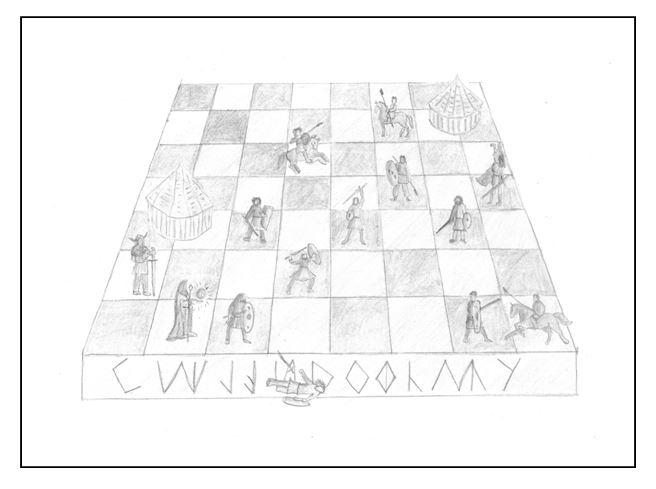
      The Chessboard of Gwenddolau son of Ceidio: if the pieces were set, they would play by themselves. The board was of gold, and the men of silver’.
      The Thirteen Treasures of the Island of Britain

      I leave my world behind at Carwinley Burn
      to follow the feral steps of a girl,
      red-haired, torqued, coloured-trousered,
      a wild thing with fox’s teeth at her neck
      down a fox-hole to the grave
      of Gwenddolau.
      Beside his bull-horned corpse
      stands a table and upon it a golden board.
      Round its edges silver dead men lie.
      The Chessboard of Gwenddolau.

      has lain here as long as my father,”
      she says. “It predicts the outcome of battles.
      It played before Arfderydd, Catraeth,
      when Britain’s air force clashed
      with the Luftwaffe,
      on the eve of the invasion of Iraq. As yet
      it has never mispredicted an event.
      At times of peace it sleeps.
      At times of threat
      if the pieces are set

      they play out every move in the coming conflict.”
      As she speaks the eyes of a warrior
      jerk open and his spasmodic
      hand grips his spear.
      A warhorse rises from a tangle of stirrups and mane.
      A bishop shakes off his robes and delves
      for fireballs and mist in his pockets.
      Caers rebuild their ramparts.
      Returning to health
      they play by themselves

      speechless as automata resuming their positions.
      Warriors move forward two squares
      spearing on the diagonal.
      Warhorses leap
      over the mounting carnage,
      on a fiery blast fall into splinters.
      A king drags his queen into a caer.
      As the bishops prepare the final spell
      I am shaken by a premonitory shiver.
      The board is gold and the men silver.

      ~

      The Chessboard of Gwenddolaur

      ~

      Gwenddolau was born around 400. He was the son of Ceidio and a descendant of Coel Hen. His fortress, Caer Gwenddolau, stood on present-day Liddel Strength beside Liddel Water north of Carwinley Burn. It is likely Gwenddolau’s rule extended throughout the present-day parish of Arthuret, which was then known as Arfderydd.

      Gwenddolau was renowned as one of three ‘Bull Protectors’ of the Island of Britain and referred to as ‘Chief of the kings of the North’ suggesting he ruled some of the other kingdoms. His ownership of two birds who ate two corpses of the Cymry for dinner and two for supper suggests he practiced excarnation.

      In 573 Gwenddolau’s kinsmen: Gwrgi, Peredur, and Dunawd, allied against him with Rhydderch Hael of Alt Clut. In spite of support from his nephew, Dreon ap Nudd, who fought bravely at the Dyke of Arfderydd, and his ability to conjure a mysterious battle-fog, Gwenddolau was killed during the Battle of Arfderydd. Afterward Gwyn ap Nudd gathered his soul.

      The Welsh term for ‘chessboard’ is gwyddbwyll. Gwydd means ‘wood’ and pwyll ‘sense’ hence ‘wood sense’. It is translated here as ‘chess’. However it’s important to note that chess originated in the Arab world and was imported into Britain by the Normans in the 11th century. The game played by Gwenddolau would have been quite different to modern chessGwyddbwyll is associated with sovereigns in several medieval Welsh stories. In The Dream of the Emperor Maxen, in the hall of Elen of the Hosts, two lads play with silver and red gold pieces whilst a grey-haired man sits at a second board carving pieces with steel files from a bar of gold.

      In Peredur the protagonist finds a board, like Gwenddolau’s, on which the two sides play each other and the losers shout ‘as if they were men’. Peredur is told the side of the Empress has lost and connects this with losing her Empire. This suggests the board represents a ruler’s kingdom.

      Arthur and Owain Rheged play gwyddbwyll in Rhonabwy’s dream. The outcome of each game is connected with an ongoing battle between Arthur’s men and Owain’s ravens, suggesting it serves a divinatory function working from the level of microcosm to macrocosm.

      One wonders whether Gwenddolau’s silver pieces fell before his death at the Battle of Arfderydd.

      ~

      SOURCES

      J. R. Murray, A History of Chess, (Clarendon Press, 1913)
      John Koch, Celtic Culture: A Historical Encyclopedia, (ABC-CLIO Ltd, 2006)
      Peter Bartrum, A Welsh Classical Dictionary: People in History and Legend up to about A.D. 1000, (National Library of Wales, 1993)
      Rachel Bromwich (ed), The Triads of the Island of Britain, (University of Wales Press, 2014)
      Sioned Davies (transl.), The Mabinogion, (Oxford University Press, 2007)

      The Crazy Owl of Gwyn ap Nudd

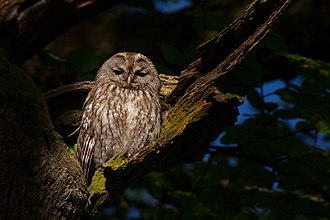
      330px-Waldkauz-Strix_aluco

      In ‘Y Dylluan’ (‘The Owl’) (1350), the medieval Welsh poet Dafydd ap Gwilym refers to the ‘Crazy Owl’ ‘of Gwyn ap Nudd’:

      Piercingly she shrieked: I recognise her form,
      she is the bird of Gwyn ap Nudd.
      Crazy Owl that sings to robbers,
      misfortune on her tongue and on her tune.

      She will not be silent whilst he chants his prayer by starlight. He cannot sleep because of ‘the voice and screeching of the Owl, / her frequent outcry and her laugh, / and poetry’s travesty from her tongue.’ His description of her is far from flattering and becomes increasingly sinister:

      Dirty she is, with two raucous cries,
      big-headed, with a hateful shout,
      broad-browed, and berry-bellied,
      old wide-eyed catcher of mice,
      busy, vile, and colourless,
      shrivelled her voice, her colour that of tin…
      and her face, like that of a gentle human being,
      and her form, she-fiend of birds.

      Speaking of her ‘wretched song’ he says ‘“Hw-ddy-hw” – a lively gasp – / with energy, by Anna’s grandson, / she incites the hounds of night.’ By the “hw-ddy-hw” we know Dafydd is referring to the tawny owl who is also known as the screech owl.

      ‘Anna’s grandson’ refers to Gwyn. In The Mabinogion, Gwyn’s father, Nudd/Lludd is the son of Beli Mawr who, in the Harleian Genealogies, is partnered with Anna. This may be mapped onto an older cosmography where Bel and Don are the ‘parents’ of Gwyn’s father, Nudd.

      The ‘hounds of night’ are the Cwn Annwn, ‘Hounds of the Otherworld’, with whom Gwyn hunts the souls of the dead. This poem suggests the screech of Crazy Owl precedes Gwyn’s Hunt and that she flies at its head, terrifying, fiend-like with her human-like face.

      In the final verse, Dafydd determines not only to scare the owl away with his song, but to ‘put… a bonfire in each ivied tree’, presumably with the intention of eliminating owls!

      ***

      Gwyn is not the only god of hunting and the dead who appears with an owl. Charles Hardwick notes that the Hunter Hackelberg, who he identifies with Woden, the Germanic leader of ‘the Wild Hunt’, is accompanied by an owl named Tutursel:

      ‘Mounted on his white or dappled grey steed, the wild huntsman may always be recognised by his broad-brimmed hat, and his wide mantle, from which he is named Hakelbarend or Hakelberg, an old name signifying mantle-wearer. The hooting owl, Tutursel, flies before him.’

      In the story of ‘The Hunter Hackelberg and the Tut-Osel’, the owl was a nun called Ursula who tormented her sisterhood and interrupted services with her ‘discordant voice’. Therefore they called her Tutursel. After her death, ‘from eleven o’clock at night she thrust her head through a hole in the tower and tooted miserably; and every morning at about four o’clock she joined unasked in the matin song.’

      When the nuns realised the voice was Tutursel’s they refused to enter the nunnery until she was banished. Tutursel eventually met Hackelberg and found she delighted in his wood-cry “Hu Hu!” as much he delighted in her “U! Hu!” and she has flown with him since.

      We do not know the story behind how Crazy Owl came to fly with Gwyn. Yet the reference to her ‘face, like that of a gentle human being’ may suggest she is of human origin or is a shapeshifter capable of taking human form.

      ***

      In ‘The Fourth Branch’ of The Mabinogion, Blodeuwedd, a flower maiden, is transformed into an owl by Gwydion as a punishment for helping her lover, Gronw, to kill her husband, Lleu. This story may be based on an older seasonal myth where Blodeuwedd chose freely to be flowers whilst with Lleu in summer and an owl whilst with Gronw (a hunter god) in winter.

      This story is paralleled by Creiddylad spending the summer with Gwythyr and winter with Gwyn. This led me to wonder whether Creiddylad takes owl-form on Gwyn’s Hunt. My meditations spoke otherwise – Crazy Owl is a separate person to Creiddylad with her own story*.

      I’d like to end with this poem by Thomas Vantor, written in 1619, which describes the owl as a bright lady singing the dirge of the dying and puts me in mind of the Crazy Owl of Gwyn ap Nudd:

      Sweet Suffolk owl, so trimly dight,
      With feathers like a lady bright,
      Thou sittest alone, singing at night
      Te whit, te whoo, te whit, te whoo,
      Thy note that forth so freely rolls
      With shrill command the mouse controls,
      And sings a dirge for dying souls,
      Te whit, te whoo, te whit, te whoo.

      *Crazy Owl’s story will appear in my next book Gatherer of Souls.

      SOURCES

      Dafydd ap Gwilym, Poems, (Gomer Press, 1982)
      Charles Hardwick, Traditions, Superstitions, Folklore, (Forgotten Books, 2012)
      Kristine Weinstein, The Owl in Art, Myth, and Legend, (Book Sales, 1991)
      Marianne Taylor, Owls, (Bloomsbury, 2012)
      Sioned Davies (transl.), The Mabinogion, (Oxford University Press, 2007)
      The Hunter Hackelnberg and the Tut-Osel

      Lancashire’s Last Wolf

      European_grey_wolf_in_Prague_zoo

      And here is our old grey enemy, the last wolf in England, stone dead.’
      Jerome Mercier

      Many counties claim England’s wolf. Lancashire is no exception. It’s a story to raise the hackles, stir a deep and ominous growl from the pit of the belly of anyone who loves the wild.

      This mean old tale is set during the fourteenth century but written records are comparatively recent. The earliest appears in The Remains of John Briggs (1825). Here we are told ‘a bold and intrepid knight, named Harrington, fixed his abode at Wraysholme’ and ‘erected the Tower’.

      In Harrington’s day all the wolves in the south had been killed, but a few remained in the forest of Cartmel. ‘These it was his amusement to hunt, in order to exterminate the breed.’

      Whilst hunting on Humphrey Head, Harrington was ‘stopped by the shrieks of a female in extreme peril’. She was trapped in the cleft of a rock by ‘an enormous wolf… his barking was tremendous and death lightened his eyes’. John ‘transfixed the animal with his lance’.

      Humphrey Head

      Humphrey Head

      The hapless maiden immediately fell in love with her rescuer and they married. Harrington made the wolf – the last in England – his crest. The ‘happy pair… were buried in a niche in Cartmel church. Their effigies were cut in stone with a figure of the wolf at their feet.’

      In an elaborated retelling in a ballad printed in the Annals of Cartmel (1872) King Edward had offered a prize for the head of the last wolf in England. To win it Sir Edgar Harrington organised a hunt and promised the hand in marriage of Adela, his ward, to the killer of the wolf.

      Two knights competed for her favour: Leyburn and the mysterious Delisle. Delisle was a stranger who appeared on a white Arab horse. Adela wanted neither as her heart belonged to John Harrington, Edgar’s son, who she believed had died fighting in foreign lands.

      The hunt reached its end on ‘Humphrey’s Height’ with the wolf ‘racked with sore distress’ approaching a ‘black hole’. Adela sat aboard a palfrey on the other side. Delisle’s horse leapt the chasm where Leyburn’s failed. To Adela’s horror the ‘wild wolf’ burst into sight baring its ‘glistening teeth’.

      When Adela next looked the wolf and Delisle’s horse lay dead and the knight unscathed. Delisle revealed his identity as John Harrington, Adela’s lost love, and the pair were married immediately by a priest in a cave ‘called Sir Edgar’s Chapel still’.

      P1180821

      Fairy Cave (Sir Edgar’s Chapel?), Humphrey Head

      The head of the last wolf in England became John Harrington’s crest. The ballad ends:

      In Cartmel’s Church his grave is shown,
      And o’er it side by side,
      All graved in stone lie brave sir John,
      And Adela his bride.

      Cartmel Priory

      Cartmel Priory

      Harington Tomb, Cartmel Priory

      Harington Tomb, Cartmel Priory

      The tale was further romanticised in Jerome Mercier’s novel The Last Wolf (1906) where it is retold from the perspective of a friend of Adela’s called Margaret of Arnside. John Harrington was sent away to fight in the Crusades and Adela feared he had been killed by Turks. He again re-appeared as Delisle on a ‘milk-white Arab’.

      Only Delisle’s horse made the leap as rushing toward Margaret and Adela came a ‘gristly beast… with grinning jaws and cruel, bloodless eyes… no hound but the wolf itself, in the rage of imminent death.’ Delisle’s horse was torn down yet he transfixed the wolf with his spear.

      As Adela fainted from her horse John caught her and she recognised her former love. Again they were married on the spot in Sir Edgar’s Chapel.

      The story ends: ‘And so, by the will of God, and in His own good time, the old, rough, cruel days passed away, even like the race of wolves – the last one being slain by a gentle Christian knight. Thus were the ignorance and cruelty of former ages slain by gentlehood and Christianity, and ere long the dawn of a new day came…’

      harrington coat of arms Wikipedia Commons

      ***

      The story of Lancashire’s last wolf has a basis in the local landscape and its history but doesn’t all ring true. John Harington (de Haverington) was a real person. His father was Sir Robert de Haverington. As far as I am aware no records of a Sir Edgar Harrington exist. John was born in Farleton in 1281 and owned lands in Furness. He did not build Wraysholme Tower, which was erected during the 15th century.

      John was knighted in 1306 and in 1309 accompanied Edward II on a military expedition to Scotland and stayed within the military until 1335. It seems likely he was involved in the First War of Scottish Independence (1296 – 1314) which ended in Scottish victory when Edward was defeated by Robert de Bruce at the Battle of Bannockburn. It is impossible that John fought in the Crusades because the ninth and final Crusade took place between 1271 and 1272.

      Sir John was married to Joan of the Dacre family (not to Adela), died in Aldingham, and was buried at Cartmel Priory in 1347. At the foot of John’s tomb there is a grotesque with a face that looks part-human, part-wolf, with what looks like a serpent’s tail. The creature at Joan’s tomb-foot, more strangely, looks part-mermaid, part-lion! Unfortunately I have been unable to find out anything more about these enigmatic sculptures.

      P1220515

      A wolf appears on the Harington family crest and a golden wolf’s head is the weathervane on Cartmel Priory.

      P1220448

      It seems possible John Harington was associated with the hunting of Lancashire’s last wolf and killed it in the cave on Humphrey Head in the early 14th century. If this is the case, the story was clearly embellished, perhaps by John’s descendants when they built Wraysholme Tower during the 15th century as a way of romanticising and justifying their rulership. I remain sceptical about the wolf attacking a screaming maiden and the ‘love story’ being true.

      It’s significant to note that an entirely different variant exists wherein the wolf was hunted down by local people from the Bowland Fells and slaughtered with pikes on Humphrey Head. Additionally, other accounts claim that wolves roamed Bowland well into the 15th century.

      ***

      Wolves have been present on the land-mass we know as Britain for at least 120,000 years. This is evidenced by wolf bones found with the remains of hyenas, hippos, elephants, tigers, deer, weasels, and rabbits, in Kirkdale Cave in North Yorkshire.

      ‘A rude instrument produced from a wolf’s metacarpal bone’ found with the Red Lady of Paviland, the oldest ceremonial burial in Western Europe dating to 33,000 years ago, in Goat’s Hole Cave on the Gower Peninsula in South Wales is suggestive of a long-standing tradition of humans interacting with wolves and associating them with death and passage to the Otherworld.

      Dogs began evolving from wolves 32,000 years ago and were domesticated by European hunter-gatherers. When the first humans returned to Britain after the last Ice Age 10,000 years ago, following the reindeer north, they and their dogs would have competed with wolves and feared and revered them as fellow predators.

      Various examples of human bones gnawed by canids before their burial from the prehistoric period show the ancient Britons practiced excarnation. They left the corpses of their dead outside so the flesh could be consumed by wolves or dogs then buried the bones afterward.

      Wolves and dogs were sacred to the ancient British hunter god Nodens/Nudd ‘the superior wolf-lord’ and his son Vindos/Gwyn. Gwyn owns a wolfish dog called Dormach, ‘Death’s Door’ and hunts with dogs who devour the corpses of the dead before he gathers their souls to Annwn.

      Wolves/dogs appear as guardians of the underworld in many world myths. Intriguingly both Dormach and Cerberus, guardian of Hades in Greek mythology, have serpent’s tails, just like the wolf pictured at the foot of John Harington’s tomb who uncannily shares Dormach’s grin…

      Dormach Sketch - Copy

      Dormach, Black Book of Carmarthen

      ***

      The relationship between humans and wolves (but not dogs) broke down in the Neolithic as people transitioned from hunting and gathering to farming. The woodland habitat of wolves was destroyed and, as humans laid claim to the herds, the displaced wolves became seen as a nuisance who preyed on ‘their’ animals.

      Wolves gained a reputation for being numerous and noisome. According to Hector Boece a king called Dorvadilla who ruled Scotland in 2BCE decreed: ‘he slayer of ane wolf to have ane ox to his reward… Oure elders persewit this beist with gret hatreut, for the gret murdir of beistis.’ Boece’s translator notes the Caledonian forest had ‘gret plente of… wolffis’ and describes the ‘wolffis’ as being ‘rycht noysum to the tame bestiall in all parts of Scotland.’

      References from Y Gododdin equating warriors with wolves: Gwefrfawr is ‘a wolf in fury’ and Tudfwlch the ‘wolf of the host’ and bleiddiad, ‘wolfish warrior’, suggest wolves were still held in a certain amount of esteem for their ferocity amongst the Britons in the 6th century.

      However, in Arthurian mythology, Rhymi, who goes ‘in the form of a she-wolf’, and her whelps, Gwyddrud and Gwydden ‘two old men from the land of enchantment’, are hunted down by Arthur and changed ‘back into their own shape’. Arthur contends with Gwrgi Garwlwyd, ‘Rough Grey’, another wolfish shapeshifter, and slaughters cynvyd, ‘dog-heads’ ‘by the hundred’.

      Britishwolfhunt Wikipedia Commons

      Wolves continued to be heavily persecuted into the Middle Ages because they preyed on flocks, devoured the corpses of the dead after battles, and dug them up after burial. The Welsh King Hywel Da paid a tribute of 300 wolf-skins to King Athelstan in 950. Norman kings employed wolf hunters who operated wolf-pits and allowed criminals to pay for their crimes in wolf-tongues rather than being put to death.

      Edward I ordered the extermination of all wolves from England and Edward II followed in his footsteps. This led to their extinction from England and Wales in the 15th century and Scotland in the 19th century.

      ***

      Of all extinct animals wolves seem to speak to humans the loudest. This is demonstrated by our plethora of last wolf stories and the comparative lack of tales about the last elk, aurochs, lynx, beaver…

      I’m always surprised by how many people in the Pagan community have wolf guides. This seems to go deeper than them simply being ‘cool’ and may have a basis in their presence within the landscape as animals we shared a sacred relationship with for many thousands of years.

      Wolves haunt us. Their absence from our physical and spiritual ecosystems leaves a yawning howling gap that, like Bwlch Safan y Ci, ‘the Pass of the Dog’s Mouth’, will never be closed.

      wolf-clipart-19 Public Domain

      ***

      SOURCES

      A.O.H. Jarman (transl.), Aneirin, Y Gododdin, (Gomer Press, 1998)
      Ed Yong, ‘Origin of Domestic Dogs‘, The Scientist,
      Janice Short, ‘Wolf’s Tale’, The Wolves and Humans Foundation,
      James Stockdale, Annals of Cartmel, (Kessinger, 2010)
      Jason Smalley, ‘England’s Last Wolf‘, Way of the Buzzard
      Jerome Mercier, The Last Wolf, (Grange Over Sands, 1906)
      John Briggs, The Remains of John Briggs (Kessinger, 2010)
      Marianne Sommer, Bones and Ochre: The Curious Afterlife of the Red Lady of Paviland, (Harvard University Press, 2008)
      Natural Historian, ‘Kirkdale Cave Hyena Den‘, Naturalis Historia,
      Sioned Davies (transl.), The Mabinogion, (Oxford University Press, 2007)
      Arthur and the Porter’, Mary Jones Celtic Literature Collective,
      Ice Age Wolf Bones found in Thornton Cleveleys Garden‘, BBC News,
      Wolves in Great Britain‘, Wikipedia,

      Grey Geese and Oracles

      Between September and November grey geese arrive in my locality. I’ve seen a local flock of greylag geese on the stretch of the river Ribble near Howick Cross at this time two years running. Greylags are the ancestors of domestic geese and residents in the UK all year round; migratory birds are only found in Scotland. This flock also contains Canada and domestic geese.

      Greylag Geese, Ribble

      Greylag geese, river Ribble

      More dramatically pink-footed geese begin arriving from Iceland and Greenland. They can be heard flying overhead to WWT Martin Mere. This year the first group touched down on September the 9th and there are currently 15000 roosting on the reserve.

      Pink-footed Geese, Martin Mere

      Pink-footed geese, Martin Mere

      Watching their return to the last fragment of Martin Mere at sunset is awe-inspiring. One can only imagine the noise and patterns of the skeins before the Lancashire’s Lost Lake, once 15 miles long, was drained.

      Pink-footed Geese, Martin Mere

      Pink-footed geese return at sunset, Martin Mere

       ***

      In the folklore of northern England, the cries of migrating geese are linked to Gabriel Ratchets. ‘Gabriel’ may derive from the name of the Angel of Death, the ‘gabble’ of geese, or the medieval word gabbe, ‘corpse’. ‘Ratchet’ originates from the Old English ‘ræcc’ meaning a ‘a dog that hunts by scent’.

      The earliest record of Gabriel Ratchets is from 1664. Whilst living at Coley Hall in the Calder Valley, Reverend Oliver Heywood wrote in his Memoranda:

      ‘There is also a strange noise in the air heard of many in these parts this winter, called Gabriel-Ratches by this country-people, the noise is as if a great number of whelps were barking and howling, and ‘tis observed that if any see them the persons that see them die shortly after, they are never heard but before a great death or dearth… Though I never heard them.’

      In his Notes on the Folklore of the Northern Counties of England and the Borders (1879), William Henderson suggests the ‘belief in a pack of spectral hounds’ originates from ‘the strange un-earthly cries, so like the yelping of dogs, uttered by wild fowl on their passage southwards.’

      Lancashire folklorist James Bowker notes, in his Goblin Tales of Lancashire (1879), ‘Mr Yarrell, the distinguished naturalist, reduces the cries of the Gabriel Hounds, into the whistling of the Bean Goose… as the flocks are flying southward in the night, migrating from Scandinavia.’

      Bean Goose, WWT Slimbridge, Wikipedia Commons

      Bean Goose, WWT Slimbridge, Wikipedia Commons

      This appears to be a mistake: bean geese migrate from Scandinavia to Norfolk and southern Scotland. Here in Lancashire it seems more likely that pink-footed geese, with their ‘high-pitched honking calls, being particularly vocal in flight, with large skeins being almost deafening’ would have been associated with Gabriel Ratchets. The pink-footed goose is closely related to the Bean Goose and was once considered a subspecies. Perhaps Mr Yarrell conflated the two.

      Gabriel Ratchets are often associated with a spectral huntsmen. This may originate from pagan beliefs about ‘the Wild Hunt’ which takes place at the time of year geese migrate. In Norse and Germanic tradition it is usually led by Odin or Woden, to whom a goose was sacrificed on the Autumn Equinox. The Germanic goddess, Berchta, has a goose-foot and also leads a hunt with a goose flying in front of her. Dancers in her processions, the Berchten, wear bird-masks.

      In Brythonic tradition a leader of ‘the Wild Hunt’ is Gwyn ap Nudd. His hounds are known as Cwn Annwn ‘Hounds of the Otherworld’, Cwn Wybyr ‘Hounds of the Sky’, or Cwn Cyrff, ‘Corpse Hounds’. Like the Gabriel Ratchets they are seen as death portents because they hunt the souls of the dead. Gwyn is a ruler of Annwn who oversees the passage of souls between the worlds, which is mirrored by the migrations of geese.

      ***

      Goose is traditionally eaten on Martinmas, November the 11th, which is dedicated to St Martin of Tours. This festival ‘originated in France, then spread to the Low Countries, the British Isles, Germany, Scandinavia, and Eastern Europe’. Martin attempted to hide in a goose pen to avoid being ordained as a bishop, but was given away by the cackling of geese. (I can’t help noticing connections between Martin, Martin Mere and geese…)

      Roast goose, all things clipart

      After the feast, divination was performed by the breast-bone. In 1455, Dr Hartlieb wrote, ‘When the goose has been eaten on St Martin’s Day or Night, the oldest and most sagacious keeps the breast-bone and allowing it to dry until the morning examines it all around, in front, behind and in the middle. Thereby they divine whether the winter will be severe or mild, dry or wet.’ In Hampshire ‘the nature of the coming winter’ was divined from a breast-bone and, in Yorkshire, weather was predicted from the colour of goose-flesh.

      The British Apollo (1708) poses the question why the ‘breast of a fowl’ is ‘called the Merry Thought’ and provides the answer, ‘The original of that name was doubtless from the pleasant fancies that commonly arise from the breaking of that bone, and ‘twas then first certainly so called, when these merry notions were first started.’ Every Commercialmas someone in my family breaks the ‘wish-bone’ of our turkey and makes a wish.

      These traditions are rooted in a wide-spread belief that the goose was an oracular bird. It has been argued this derives from the Etruscans who ‘believed geese had supernatural visionary powers as oracle birds with these prophetic powers residing within its bones’ and was brought to Britain by the Romans.

      ***

      Our understanding of the oracles of geese has diminished; drained away with their wetland homes. We can no longer tell, from the cacophany of voices barking overhead, who carries news and who carries a death portent. Goose is rarely eaten in Britain, with the tradition of rearing flocks of domestic geese for food, particularly for during the festive season, being replaced by turkey farming. Divination has been reduced to a facile act of wish-fulfilment in a world increasingly disconnected from the language of the divine.

      Yet, whilst there are geese, there is hope that their language can be re-learnt by re-attuning to their flight paths, their life ways, listening to their gabble, divining how this relates to teachings from our gods. Perhaps, as pumps are shut down and wetlands are re-flooded, our abilities to divine will return with the geese.

      Martin Mere at Sunset

      Martin Mere at sunset

      ***

      SOURCES

       Edward A. Armstrong, The Folklore of Birds, (Dover, 1958)
      James Bowker, Goblin Tales of Lancashire, (Classic Reprint, 2015)
      William Henderson, Notes on the Folklore of the Northern Counties of England and the Borders (Create Space, 2014)
      ‘Origin of the Wishbone Tradition’, Republic of You Blog
      ‘The Gabble Ratchets’, Ghosts and Legends of the Lower Calder Valley
      Pink-Footed Goose, RSPB
      WWT Martin Mere

      Du y Moroedd

      Black horse of wonder
      Black horse of terror
      Black of the seas
      Take me under

      Du y Moroedd Devotional Art Benllech Beach

      Devotional Art for Du y Moroedd on Benllech beach, Anglesey

      Du y Moroedd, ‘Black of the Seas’, is a legendary water-horse in Brythonic tradition. His fame is attested by Taliesin in ‘The Song of the Horses’, ‘The Black, from the seas famous, / The steed of Brwyn’.

      He is referred to in The Triads of the Islands of Britain in ‘44. Three Horses who carried the Horse Burdens’:

      ‘Du y Moroedd… horse of Elidyr Mwynfawr, who carried on his back seven and a half people from Benllech in the north to Benllech (Elidir) in Mon. These were the seven people: Elidyr Mwynfawr and Eurgain his wife, daughter of Maelgwn Gwynedd, and Gwyn Good Companion and Gwyn Good Distributor, and Mynach Naoman his counsellor, and Prydelaw the Cupbearer, his butler, and Silver Staff his servant, and Gelbeinifen, his cook who swam with two hands and on the horse’s crupper – and he was the half person.’

      This passage shows that Du is not only a sea-going water-horse, as his name suggests, but of supernatural size and strength to be able to carry seven-and-a-half people and swim vast distances. He is intimately associated with the sea-lanes between northern Britain and Wales; perhaps sightings of him off the west coast were once common.

      Triad 44 is set in the mid-6th century and has a historical basis. According to The Black Book of Chirk, Elidyr made a voyage from his home in the Old North to Wales to press the claim of his wife, Eurgain, to the throne of Gwynedd following the death of Maelgwn in 547, because Maelgwn’s son, Rhun, was illegitimate. Elidyr was slain at Aber Mewdus in Arfon. An army of northern men, including Clyddno Eiddin, Nudd Hael, Mordaf Hael, and Rhydderch Hael avenged Elidyr by burning Arfon, then were driven back north by Rhun to the river Gweryd.

      Morecambe Bay, Lancashire

      Morecambe Bay, Lancashire

      In Brigantia, Guy Ragland Phillips conjectures that Du might be identified with the Black Horse of Bush Howe in the Howgill Fells in Cumbria. He suggests Elidyr’s northern Benllech was Bush Howe and cites an alignment down Long Rigg Beck valley to Morecambe to Anglesey, saying the horse would be within its line of sight. This might have been the route taken by Du and his riders. ‘Benllech in Mon’ is likely to be present-day Benllech on Anglesey.

      Benllech beach, Anglesey

      Benllech Beach, Anglesey

      Elidyr’s voyage aboard Du with seven-and-a-half or eight people was well known by Welsh poets until the early 16th century. Tudur Aled says ‘Of greater vigour than Du’r Moroedd, such was his strength and daring… for a spree with the cold wind, eight men formerly went upon his back’. Guto’r Glyn speaks of a foal whose ‘mother was a daughter to that horse of Mon who went to carry eight men: Du y Moroedd has grandsons – this one, I know was one of them.’

      Another renowned rider of Du is Gwyn ap Nudd, a Brythonic hunter-god and ruler of Annwn. In Culhwch and Olwen it is stated ‘No steed with be of any use to Gwyn in hunting Twrch Trwyth, except Du, the steed of Moro Oerfeddog’ (the latter is a jumbling of Du’s name).

      Because he fails to recruit Gwyn, Arthur does not manage to kill Twrch Trwyth, ‘King of Boars’, who finally escapes into the sea. Only the otherworldly Gwyn can ride Du to hunt the Twrch into the ocean, which might also be identified with Annwn, ‘the Deep’, ‘the Otherworld’.

      Gwyn’s father, Nudd/Nodens, is pictured in a chariot pulled by four water-horses. At Vindolanda Nodens is equated with Neptune. Both Neptune (as Neptune Equester) and his Greek counterpart, Poseidon (as Poseidon Hippios) were associated with sea-horses (hippocampi).

      Intriguingly we find a story in Irish mythology called ‘The Pursuit of Giolla Deacair’ featuring Gwyn’s cognate, Fionn, wherein fifteen-and-half of Fionn’s men are abducted into the sea by a water-horse.

      Giolla Deacair, ‘the Troublesome Slave’ and his horse are taken in by Fionn. Both are described as monstrous. Giolla has a ‘twisted mouth with long pointed teeth projected from it at all angles’ and ‘eyes like black holes in the skull of a corpse’. He drags a large iron club leaving ‘a deep trench in the ground’.

      His horse is described as ‘dirty, shaggy hair covered its long, spiny back and the ribs were sticking out through its sides. Its legs and feet were crooked and splayed and a leg that seemed too large for his body dangled awkwardly from a scrawny neck.’

      The horse causes trouble amongst the other horses. Feargus tells Conan to jump on its back and ride it across country to break its spirit. However, it will not move until it carries the weight of its rider, Giolla Deacair, which is equal to fifteen men. This shows Giolla and his horse are gigantic. The men pummel and kick the horse yet still it won’t move.

      Infuriated by his horse’s mistreatment, Giolla leaves. His horse follows with the men ‘welded’ to him ‘like a sword to its hilt’. Fionn and his remaining warriors follow, but no matter how fast they pursue the horse goes even faster, like the wind, over mountains, rivers, and valleys until reaching the sea. As it shoots into the waves one of Fionn’s warriors grabs onto its tail.

      We are told that, as it journeys through the sea, ‘The waves did not touch it nor the fifteen Fianna on its back, nor the unfortunate man clinging to its tail. Instead, the water parted before the animal, so that it travelled on a path of dry land.’ We might imagine Du travelling similarly.

      Fionn and his men sail after Giolla and his horse to where the riders are imprisoned in Tír fo Thuinn, ‘The Land Under the Wave’. Giolla reveals he is a magician called Abartach. Fionn’s marriage to Taise persuades Abartach to release his men. As retribution Goll claims fourteen of Abartach’s women to return on the horse’s back and his wife to cling onto the horse’s tail.

      This tale suggests Du also originates from the watery regions of the Otherworld. I wonder whether, like Giolla’s horse, Du had an earlier otherworldly owner whose name and stories have been forgotten. Perhaps there was once a story about how Gwyn came to ride Du between worlds.

      Du also shares resemblances with the Welsh ceffyl dwr, the northern British dobbie, and the Scottish kelpie. The latter are notorious for luring humans onto their backs then drowning them. Once a rider has mounted, their hand sticks to the kelpie’s neck and they cannot let go.

      Du’s stories have fascinated me since I heard his splashing hoofbeats approaching whilst meditating on the Ribble estuary. When I travel to the west coast his presence is always on the edges of my mind: his great arched neck, his oar-like legs, the multitude of riders he has carried. My fingers are caught in his mane and he is forever drawing me toward the Otherworld…

      Irish Sea from Morecambe

      The Irish Sea from Morecambe Bay