Being Present for Gwyn

I. How the Furthest God became Present

My practice of being present for Gwyn arose from two different sources. The first is my marriage to Him. Before we were married, as the King of Annwn, I saw Him as distant, as Other, as the furthest away and Othermost God.

‘Gwyn ap Nudd who are far in the forests for the love of your mate allow us to come home,’ reads a 14th century invocation from the Speculum Christiani.

These words contain a paradox typical of the mythos of the King of Annwn. The God who is furthest away in the forest has the greatest ability to bring us home, to the places where we we live, to the here and now, to our ourselves.

I only realised this after our wedding when Gwyn came to reside within me as the Heart of my Heart and I realised He had been there all along. As I became accustomed to His indwelling I began to feel (paradoxically again) that the more present I am the closer He is. He confirmed this insight.

Secondly, in yoga, I became aware of the sankalpa – a heartfelt intention which might be stated at the beginning of an asana, pranayama or yoga Nidra practice. Immediately I intuited it – ‘being present for Gwyn.’ 

This resolution has more recently come to inform my whole life and I have associated it with mindfulness in the yogic and Buddhist traditions and with ‘the Practice of the Presence of God’ in the Christian tradition. Below I will share how I have related these learnings to being present for Gwyn.

II. Mindfulness – ‘the life-and-death matter of awareness’

Mindfulness derives from the Hindu and Buddhist concept sati which means ‘to remember or observe’. (1) It was introduced to the West by Thich Nhat Hanh and others in the second half of the twentieth century. Hanh defines it as ‘being aware of what is happening inside and around you in the present moment.’ (2)

In The Miracle of Mindfulness he refers to ‘the life-and-death matter of awareness’. (3) In a well-known passage: ‘If while washing dishes, we think only of the cup of tea that awaits us, thus hurrying to get the dishes out of the way as if they were a nuisance, then we are not “washing the dishes to wash the dishes.” What’s more, we are not alive during the time we are washing the dishes. In fact we are completely incapable of realizing the miracle of life while standing at the sink. If we can’t wash the dishes, the chances are we won’t be able to drink our tea either. While drinking the cup of tea, we will only be thinking of other things, barely aware of the cup in our hands. Thus we are sucked away into the future – and we are incapable of actually living one minute of life.’ (4)

It is this feeling of aliveness in the present moment that I believe Gwyn, a God of the Dead, is paradoxically attempting to cultivate in me and share, in the practice of being present for Him.

In Full Catastrophe Living Jon Kabat-Zinn says: ‘I define mindfulness operationally as the awareness that arises by paying attention on purpose, in the present moment, and non-judgmentally.’ (5) He describes in depth how our constant busyness, which stems from constantly wanting more, clinging onto what we like and trying to avoid what we don’t like, drives our inability to be present in the moment and thus truly alive. 

He writes of how mindfulness creates an island of non-doing in the ocean of doing and provides us with the insight we are not our thoughts. This liberates us from ‘the tyranny of the thinking mind’ and allows us to live more fully. (6)

Over the past few years my yogic practices and Gwyn Himself have been helping me to access my inner witness and be less enslaved by my thoughts. 

When Gwyn and I are in the present together we are free.

III. The Practice of the Presence of God

I discovered this delightful little book by a 17th century monk called Brother Lawrence whilst looking for inspiration for my monasticism in the Carmelite tradition. It was not written by Lawrence himself but pieced together after his death by his vicar from their letters and conversations in 1693.

Lawrence’s method is simple yet demanding.‘There is no art or formula to communing with God. All that’s needed is an unwavering heart determined to apply itself to nothing but Him, for His sake, and loving Him only.’ (7) The heart must be emptied of all but God – in particular the distractions that tear our attention away from Him and that might offend Him. ‘Wholehearted renunciation of everything that doesn’t lead us to God’ is required so we can attune ourselves to Him, carrying on a simple, continual conversation.’ (8) It is through constantly conversing with God we know and don’t stray from His will.

For Lawrence there is no separation between work and prayer. He says: ‘in the noise and clatter of my kitchen, as people all around are calling for different things, I possess God with all the peace in the world, as if I were upon my knees before the blessed sacrament.’ (9)

Through his practice of the presence of God Lawrence claims to have reached a state in which all he wants is God’s will in everything.

I will have to admit I’m not there yet. I’m still being swayed by my fears and desires, led astray by distractions, unable to quiet my thoughts. Yet I’m becoming more aware and able to bring my mind back to being present for Gwyn.

This feels all the more important in the summer, when as our Winter King He sleeps in Annwn, yet through me is able to participate in living in Thisworld.

REFERENCES

  1. https://en.wikipedia.org/wiki/Sati_(Buddhism)
  2. https://thichnhathanhfoundation.org/
  3. Hanh, Thich Nhat. The Miracle Of Mindfulness: The Classic Guide to Meditation by the World’s Most Revered Master. Kindle Edition. p26)
  4. Ibid. p5
  5. Kabat-Zinn, Jon. Full Catastrophe Living, Revised Edition: How to cope with stress, pain and illness using mindfulness meditation. Kindle Edition. p33
  6. Ibid. p149
  7. Lawrence, Brother. The Practice of the Presence of God: A Modern Translation. Kindle Edition. p12
  8. Ibid. p13
  9. Ibid. p18

The Brow Chakra

I know this chakra far too well –
it’s a monkey wrestling with an owl.
Only when the chatter ends
can I access deeper wisdom.

~

When I’ve been exploring the issues I’m experiencing in all the other chakras they have led me up, through the nervous system, to my brain where I believe many of my problems with disregulation stem from. 

The brow chakra is associated with the mind, both its thinking and intuitive capacities and is viewed in the yogic tradition as the command centre. 

I’ve done a lot of research into the brain and thought, at first, my troubles stem from my hypothalamus, which is the control station for so many of our bodily functions such as sleep, hormone regulation, autonomic nervous system.

Yet, when I did some journeywork around this I got told by my hyopthalamus that it’s only doing it’s job based on signals from other brain parts. Through a combination of journeys and research I discovered that I’ve got an enlarged overactive amygdala, our inner alarm bell, whose constant ringing keeps telling my hypothalamus to put me into a sympathetic ‘fight or flight’ state. My anterior cingulate cortex, which is responsible for attention, emotional awareness, self control and behavioural adaptability, is underdeveloped. 

I’m also subject to getting to stuck in the ‘worry loop’ (a tract of neurons running in a circle from the pre-frontal cortex to the striatus to the thalamus and back linking to the limbic system (which includes the amygdala). For me this manifests as worrying constantly about financial security and being unable to cope if I cannot make a living from my vocation. These thoughts keep my amygdala sounding the alarm bell and result in adrenaline and cortisol constantly coursing through my body, which has led to my overactive inflammation response causing conditions such as rosacea, eczema, tendinopathy and IBS along with Raynaud’s and secondary amenorrhea.

It’s only over the past few years I have discovered meditation, breathwork and polyvagal practices as ways of activating my parasympathetic nervous system, strengthening my anterior cingulate cortex and shrinking my amygdala.

At the brow chakra we find the monkey mind and its constant chatter which keeps ever distracted and ever over-stimulated. Yet we also find the pineal gland and the third eye which are associated with intuition and second sight. There’s less science to explain the latter. I’ve found that when the monkey is quiet, when I meditate, when I journey, I can access depths of wisdom that are not available to the thinking mind and bring it back for others.

~

Location: Brow / Colour: Indigo / System: Brain / Endocrine: Pituitary and pineal / Sense: Sight / Faculty: Mind / Realm: Thought / Faculties: Thinking and intuition / Animals: Monkey and Owl

The Throat Chakra

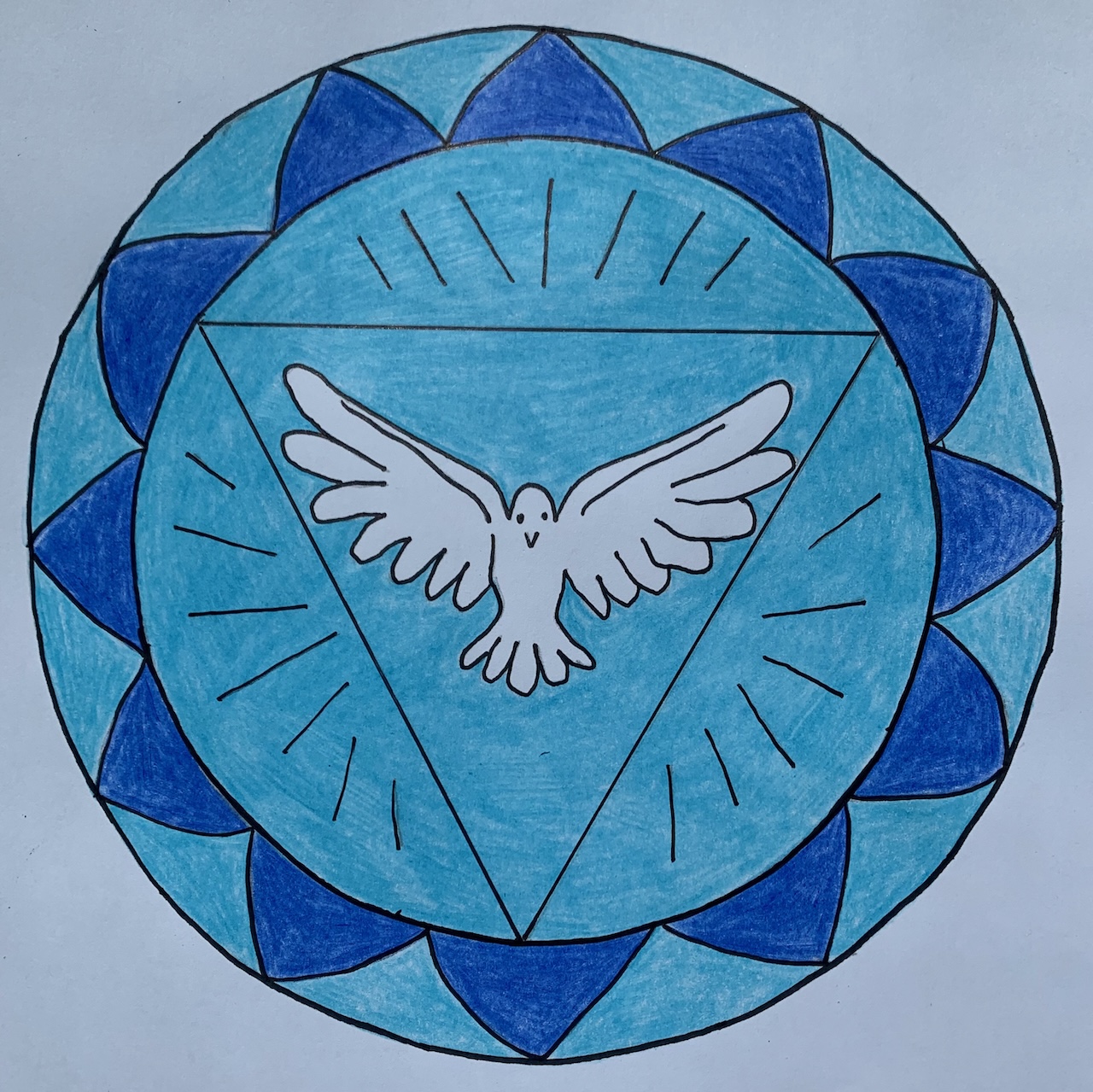
A dove flies free
across a clear blue sky.
I have the right to stay silent
and from Annwn sound my cry.

~

The throat chakra is associated with the voice and communication. It’s been an interesting one for me to work with as somebody who was once a performing poet with a really big gob but who has recently begun to appreciate far more spending time in solitude and silence. 

I had my first Reiki session a few months ago and the practitioner aptly spotted my overactive solar plexus chakra and told me that I had a blockage between it and my throat chakra. Intriguingly during the treatment I found a lot of saliva in my mouth which related to her work to clear the blockage. When we chatted about it afterwards she intuited that the block might be to do with me being unable to say positive things about myself. I realised this was true – I’m able to speak about my fears and limitations but not my assets. 

She suggested trying positive affirmations. I had a go at these. I could just about manage, “I am strong,” as I’ve worked so much on my physical and mental strength. However, “I am kind,” “I am patient,” did not ring true as I was still being snappy with my dad. “I am becoming kinder,” “I am becoming more patient,” felt more realistic. Unfortunately this work has recently gone out of the window due to recent stresses but I intend to return to it. 

It also connected with purification and with the breath. I’ve found that breathwork is one of the best things for helping me to regulate nervous system.

In The Miracle of Mindfulness Thich Nhat Hanh says: ‘Our breath is the bridge from our body to our mind, the element which reconciles our body and mind and which makes possible one-ness of body and mind. Breath is aligned to both body and mind and it alone is the tool which can bring them both together, illuminating both and bringing both peace and calm.’

It’s interesting that, as I’ve been working with this chakra, a number of negative thought and behaviour patterns have arisen to be purified. These have been based around financial insecurity causing me to go against my commitment to my spiritual vocation and inner nature as a monastic who needs solitude and routine by signing up for a secular counselling course and by forcing myself into running and attending groups on evenings and weekends. Neither of these things worked out and I needed to withdraw.

In relation to purification I found out the origin of the word ascesis. It comes from theGreek askēsis ‘training’, from askein ‘to exercise’ and was associated with athletics. I had associated it only with self-denial in its extreme and punitive forms and had not thought of myself as an ascetic. Yet for me as someone for whom exercising regularly (strength training and yoga), eating healthy foods and not engaging with social media is important the term has begun to resonate with me and I now associate it with this chakra.

Metabolism, digestion, heart rate, hormones and sleep are regulated by the thyroid gland so I see why the throat chakra is related to ascetic processes.

At first when the white dove appeared as the symbol I was surprised. I thought, ‘I’ve never even seen a white dove.’ Then I Googled white doves and found out they are specially bred birds of the species Columba livia domestica – rock doves or rock pigeons. The very same as the feral pigeons who visit my back garden to feed on the seed and live under the railway bridge. 

Intriguingly, a few months back, in a dream a bird appeared that looked like a pigeon but which I intuited was a dove (both are in the Columbidae family). I was told it had come from my supervisor, Jayne, ‘to end the conflict between A and B.’ A number of conflicts within and without have come to an end (and Jayne has helped with this) in the period I have been working with this chakra.

~

Location: throat / Colour: Blue / System: Pulmonary / Nerve Plexus: Cervical / Faculty: Speech / Realm: Social / Element: Ether / Qualities: Communication and purification / Animal: Dove

Sister Patience of the Heart of Annwn

Whilst watching the Carmelcast Podcast on Youtube for its discussions on prayer I noticed the hosts introducing themselves as Brother John Mary of Jesus Crucified and Brother Pier Georgio of Christ the King. This alerted me to the fact many monastics not only take a monastic name but add a dedication to an aspect of their Deity or religion. Other examples include Saint Elizabeth of the Trinity and Sister Mary of the Divine Heart.

Thus I meditated on what aspect of Gwyn or my tradition I’d dedicate myself to. I considered firstly our Monastery of Annwn Nine Faces of Gwyn – Gwyn the Warrior, Gwyn the Hunter, Gwyn the Lover, Gwyn the Dreamer, Gwyn the Inspirer, Gwyn the Reaper, Gwyn the Gatherer, Gwyn the Unknown.

Ten years back I might have chosen Gwyn the Inspirer. As a trainee shamanic practitioner practicing soul retrieval I wondered if Gwyn the Gatherer (of souls) might be apt but it didn’t feel right. I felt drawn to Gwyn the Unknown but that didn’t feel quite right either.

I then contemplated aspects of our tradition such as the Awen. Not as important in my life as it was once was. I gave up and went upstairs to the bathroom and on my way saw what should have been obvious considering that central to our monastery is the Rule of the Heart – the Heart of Annwn. I saw and felt it beating in the depths of the Otherworld and within my own heart. 

“Will you dedicate yourself to the mysteries of my Sacred Heart?” Gwyn asked.

Returning to meditation I agreed and for the first time Gwyn took me into His heart. 

Artwork by Morgannah

The Return of the Hooded Man

Oh Hooded Man, my old friend,
what have you come to say?
In solitude and silence cloaked
dark and familiar on a spring day?

~

After two years of solitude focusing on my writing my shamanic work has led me out into the community again. I’ve really enjoyed guiding individuals and groups into the Otherworlds in one-to-one sessions and shamanic circles. Offering shamanic healings is magical work that fits perfectly with my calling as a nun of Annwn dedicated to Gwyn and makes my soul sing.

However, I’ve discovered that, as an autistic person and introvert who needs a set routine (my natural circadian rhythyms work best on 4.30am get-ups and 8.30am bed times) I can only cope with such intense interpersonal interaction in the daytime. I tried shifting my timings half an hour to 5am and 9pm to make it easier to attend and run groups in the evenings. Yet when I did, I found I was getting overstimulated, unable to sleep, then when I slept, waking up early with my mind whirring desperately trying to process the events. As a knock-on effect I was coming to dread late groups and that was causing additional sleep loss. Running a shamanic circle each month locked me into a monthly cycle of anxiety and sleep deprivation. Thus, although it was sad, it was also a relief when due to not having enough numbers to pay for the room, I was forced to close Penwortham Shamanic Circle. 

As an alternative to evenings I thought about running weekend groups as I wanted to provide opportunities to practice shamanism to working people. As an experiment I tried attending a seasonal creative workshop on a Sunday but in spite of it being really thoughtfully put together and well run struggled with the shift in routine. It made me realise how much I need weekends after working with clients during the week. Once-upon-a-time my Saturday wind-down was drinking a bottle of wine and writing drunken poetry but more recently I’ve replaced that with playing the heartbeat of Annwn for Gwyn for an hour then entering deep relaxation through an hour of body scan meditation or Yoga Nidra. This provides me with a much-needed nervous system resest before I spend Sunday continuing to recharge by praying, meditating, cleaning and going for a local walk or a swim. Attending an event on a Sunday made me stressed all Saturday and unable to benefit from my wind-down then resentful on Sunday as I couldn’t have my alone time. This made me realise that weekends aren’t going to work for me either.

I’ve been trying to force myself to do things against need for solitude and routine for several reasons. One is that I have been trying to follow as role models shamanic practitioners who have succeeded in making a living from their work by running evening shamanic circles and weekend workshops. Another is, although I’m not naturally a community builder, I have mistakenly stepped into the role of attempting to build community in the hope this will establish a foundation for my one-to-one work. The last is financial insecurity – feeling that if I can provide more opportunities for more people I will be more likely to make a living from my shamanic services.

By trying to copy others I’ve not only gone against my own nature but forgotten there are other models available. In the Brythonic tradition the awenyddion ‘people inspired’ (our native soothsayers / spiritworkers / shamans) appear to be hermits, edge dwellers, who were occasionally consulted by the community for prophecies spoken through possession by spirits. One of my spirit guides, who I consider to be an ancestor of spirit, Orddu, lived alone in a cave in Pennant Gofid ‘the Valley of Grief’ in ‘the uplands of Hell’ and was referred to as a gwrach ‘witch’ likely on account of her practicing spiritwork / shamanism inspired by Gwyn and the spirits of Annwn. Myrddin Wyllt is another prophetic figure who lived a hermitic life as a wildman in the forest of Celyddion and only occasionally appeared to prophecy.

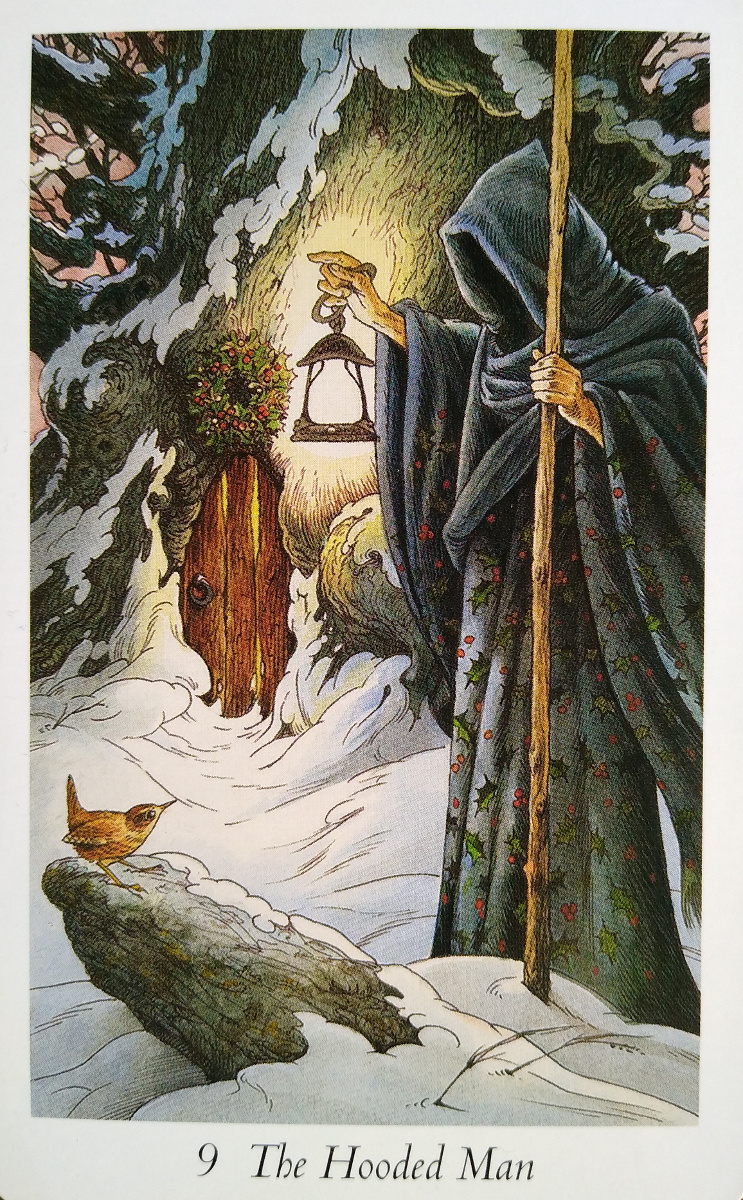
I have a print-out of the Hooded Man from the Wildwood Tarot on my wall to remind me to honour my need for solitude. He’s been absent from my tarot readings of late and it’s unsurprising he has reappeared at this point in time. I have taken this as a sign that I need to better balance my monastic need for solitude and routine with my outward-facing vocation of doing shamanic work.

A Black Butterfly in Your Heart

There is a black butterfly in Your heart.
I cannot decipher the meaning
on a bright spring morning
when the May flowers blossom
and all the hawthorns are in bloom.

There is a black butterfly in Your heart.
I cannot decipher the meaning
at midday when the sun burns bright
and Maponos strums a song on His harp
with chords of sunlight brighter than the fires of Bel.

There is a black butterfly in Your heart.
I cannot decipher the meaning
at sunset as the blackbirds sing
the sun down and burning happy dancers dance
and talk and do the things that people do.

There is a black butterfly in Your heart.
I cannot decipher the meaning
until midnight comes and I follow
the funeral procession of the sun into darkness.
Until I walk with the dead sun into the depths of the Otherworld.

~

“Dead sun, dead sun, what are we doing here,
what are we doing here in this darkness,
darker than the dark side of the moon,
darker than the dark side of the sun?

“Dead sun, dead sun, what are we doing here,
what are we doing here in this silence,
more silent than the silence
when the King of Annwn died
and Maponos ceased to play His harp?

“Dead sun, dead sun, what are we doing here,
what are we doing here in this stillness
stiller than the places between
the dance-steps of His faery dancers,
the hoofbeats of the horses of His hunt,
the spaces between the beats of His heart?”

“Come deeper, come deeper,” says the dead sun,
“beneath the world’s chatter and words and images
that paint butterfly colours, come deeper, come deeper.”

~

The dead sun takes me to Your tomb in the Castle of Cold Stone.
Reminds me of how Your castle fell from the skies of Annwn,
circling four-cornered, from the songs of the mead-feast,
from the revelry, from the boiling of the cauldron,
from the passing of the mead-cup,

down, down, down,

into the Abyss,

into the place between
the end and the beginning of life and death,
the end and beginning of words and of worlds…

~

You’re dead – there are no words to express my sorrow.
You’re alive, only sleeping, there are no words to express my hope.

You’re dressed in black as if ready to attend Your own funeral.
Your hair is white and silver as the light of the moon
and the hairs in the manes and tails of the horses of Your hunt.

And Your heart, Your heart is red as the reddest
of the roses of Your queen who forever betrays You on May the first.

For You I plant five red roses in Annwn and a single rose above.

~

For you I sit here in the darkness, the silence, the stillness.
I listen to Your breath and the beating of Your heart.

At first it is felt, not heard, not seen.

Then I hear it, then I see it –
the dark flutter of the butterfly in Your heart.

“What is this? What is this?” My heart flutters in concern.
“Why has a black butterfly come to abide
in the heart of the King of Annwn,
the heart of the Otherworld?”

“Worry not.” Even death does not faze You.
You do not speak like a corpse
but like the most living of the living
and the brightest light in Annwn’s darkness.
“You are the black butterfly who flaps her wings in my heart.”

~

“Did You hear that?” I ask the dead sun. 

The dead sun has already fled – it is morning. 

“Did You hear that?” I ask Maponos.

He has already gone to play His harp.

We’re alone now, my King and I, butterfly and heart,
in the darkness, in the silence, in the solitude,
for a moment before the world’s call forces us to part.

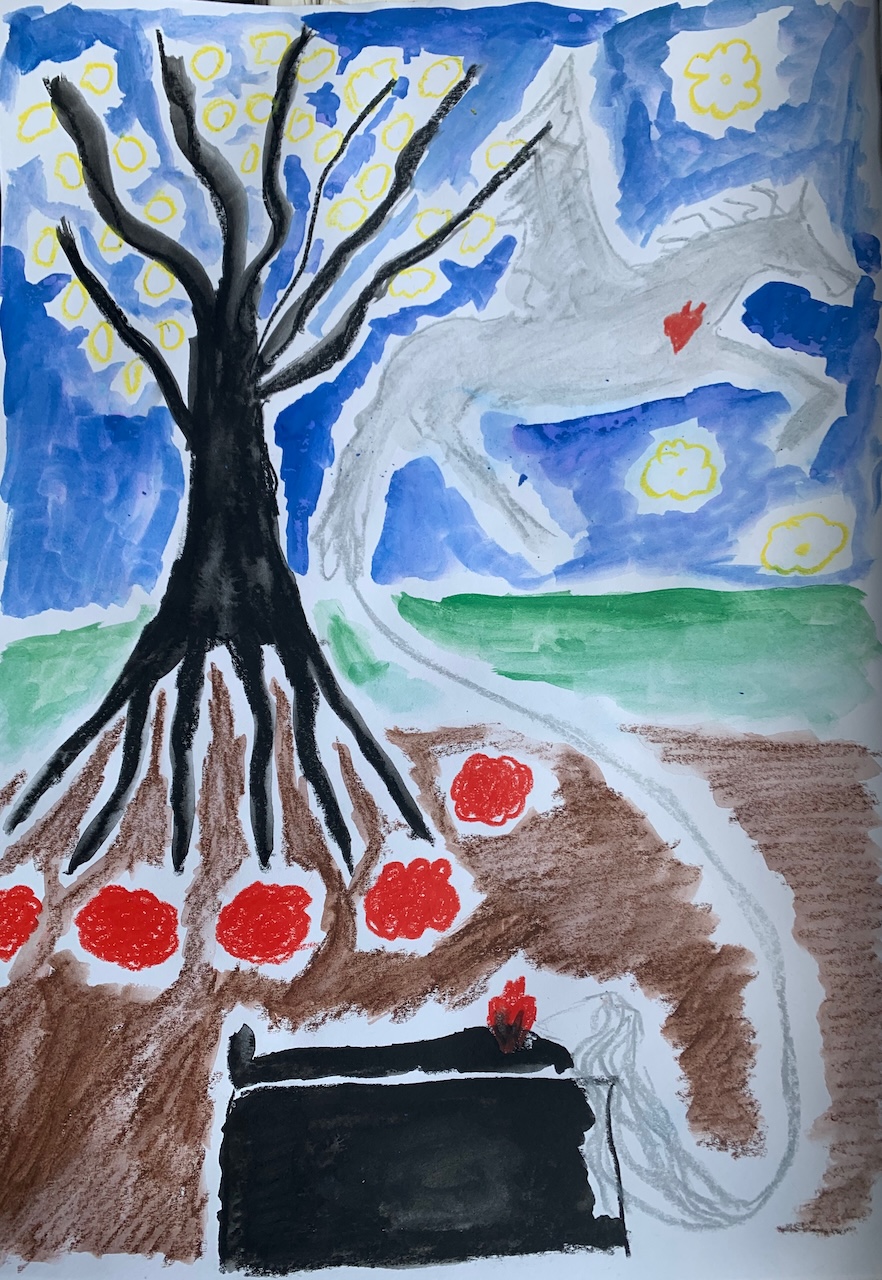
I created this painting at a Beltane focused seasonal creative workshop with Two Birds Therapy and wrote the poem afterwards. It’s based on the dichotomy I always feel at this time of year between the beauty and energy of nature and the sadness of Gwyn’s death and my need to be alone with Him whilst others are celebrating. The black butterfly was the result of a mistake wherein I tried to make Gwyn’s heart redder but instead smudged black into it. For me this gave the piece its meaning.

Prayer – Some Scaffolding

I’ve recently been re-reading St Teresa of Avila for inspiration on forming a framework for my own practices and experiences of prayer. Teresa’s techniques are complicated and vary as her ideas change over time as evidenced in The Way of the Perfection and The Interior Castle.

During this time I had a dream in which the Mother Superior of an abbey was giving a talk on prayer and told the audience not to mistake the scaffolding for the thing itself. I thought her words were wise but at present feel like I need a little scaffolding as I attempt to build a palace for prayer fit for Gwyn – Annwn’s King. Below, inspired by Teresa, is my scaffolding for prayer.

Formal Prayer

Formal prayers are those that are addressed to the Gods and are often written down and spoken regularly – daily, monthly or at seasonal celebrations. For example prayers of praise (“Gwyn ap Nudd, Lord of Annwn, I adore Your starlit crown”), prayers of thanksgiving (“I thank You, White Son of Mist, for guiding me on the misty ways”) and prayers of celebration (“Hunter in the Skies tonight we honour You as You ride out with Your hunt.” Prayers of petition and intercession might also be included here. “Bull of Battle, with Your horned helmet, strong shield and piercing spear, lend me Your strength”. “Gatherer of Souls please gather the soul of… to Your realm.”

Conversational Prayer

Conversational prayer is less formal and gives the Gods more space to respond. As St Teresa says it is like conversing with a friend. Checking in, asking what They need from us and for Their advice and guidance, listening to Their opinions on how we have served Them throughout the day. “Good morning.” “I’m feeling… how are you?” “How might I serve you best?” “I’ve got this problem.” “Good evening.” “My day’s been… how was yours?” “I messed up, I’m sorry, what do you think and how can I make repairs?”

Conversations with the Gods might take place like those between human persons, like between two friends, with a Deity appearing in human-like form and speaking directly through the inner senses. The Gods might also respond in more nuanced ways, providing us with a feeling or a knowing, they might show us a vision or a sign in nature or gift us with a dream.

The Prayer of Vision

The prayer of vision involves the active visualisation of a Deity. We can visualise our Gods before us, at our altars, or we can use visualisation meditation to visit Them at Their sacred places in Thisworld or the Otherworld. In this type of prayer we often find at the beginning we feel like we’re ‘making it up’ and we are to some degree yet the very act of imagining is sacred and the beginning of the co-creation of a vision that often shifts and takes on a life of its own as we enter deeper communion with our Gods. Spontaneous visions can also occur both in and outside of prayer time.

The Prayer of Silence

Whilst the prayer of vision involves the active use of the imagination and the inner senses the prayer of silence occurs when the faculties are stilled. Here, it is common to experience a deep sense of calm, of quiet, of abiding with a God. As it lacks sensory content it is notoriously difficult to put into words. I experience it as the otherside of Gwyn’s paradoxical nature – the calm within the storm, the hunter waiting patiently before He rides out hunting for souls, His sleep as the Sleeper in Deep Annwn throughout the summer months.

The Prayer of Union

In the prayer of union we not only abide with a God but are united. This is the sacred marriage or hieros gamos wherein we become one with our Gods. This is not only difficult to put into words but on account of its intimate nature is a mystery that is shared between devotee and God alone.

The Prayer of Presence

I’ve come to this type of prayer last but it might as easily have been first or come anywhere in between because it’s the type of prayer that takes place inside and outside set prayer times and can be practiced any time day and night. That is being present, in the moment, for the Gods and those who we are in relationship with in our every daily lives in both the seen and unseen worlds. 

In most religions we find the aspiration towards ‘unceasing prayer’. Every act, if we have but the will and focus, can become an act of prayer – waking, eating, drinking, working, gardening, cleaning, sleeping. It might be argued that the purpose of the types of prayer above is to provide us with the connection and communion with the Gods that enables to lead deeper and richer lives in Thisworld and to be of better service to the land and to others.

To the Spirit of the Sanctuary

A place of quiet beyond the row,
the heartbeat of Annwn
is Your only sound,
the occasional song rising
like heartbreak from the Deep.

To keep me safe Your invisible roses twine around.

Your forget-me-nots remind me
of the King of Annwn in the summer.

Into You I am gathered by the Gatherer of Souls.
In You, with my Beloved, I am at home.

In You I can heal and I can heal others too.
Into You I gather the lost pieces of our souls.

In You I am complete in every single moment.
In You I can breathe every single breath.
In You my heartbeat is at one
with the heartbeat of Annwn – the heart of my Lord.

So hold me here, until I die, my sacred home.

Blue and not Red

We are blue and not red. 
We sing of times a’ringing.
Of the living and the dead.
Of the death of the Fairy King.

We are blue and not red.
We ring of times a’singing.
Of the Fairy King’s death.
Behold the coming of May!

We sing from blood so red
the song of Summer’s kingdom.
The Fairy Queen in bloom.
The King of Annwn in His tomb.

We sing from skies so blue
the song of Annwn’s sorrows.
Our king is dead so summer comes
yet He’ll be back tomorrow.