By Your Anger and Your Arrow – On Invoking Rudra and Gwyn

In a recent article I mentioned my discovery that yoga and tantra originate from Shaivism, ‘the Path of evoking Shiva’, ‘a system of mysticism rooted in indigenous shamanism’ which existed before the beginning of the Vedic period (1).

This got me really excited as it provided evidence that yoga has shamanic origins and that Shiva, ‘Lord of Yoga,’ was the God of this pre-vedic system. As a Brythonic polytheist and shamanic guide I associate my patron God, Gwyn ap Nudd, a King of Annwn (the Otherworld) with shamanic practices and have come to know Him as a ‘Master of Meditation’.

These similarities led me to looking for the earliest textual references to Shiva. I found out that He was earlier known by the name Rudra – ‘Roarer’ or ‘Howler’. By this name He shares many similarities with Gwyn as a God of hunting, wind and storms, and healing. Rudra is the leader of the Maruts or Rudras – storm Deities who are His sons. Gwyn and His ‘family’ are associated with ‘the province of the wind’ (2). Gwyn is a leader of the Wild Hunt, which is a similar phenomenon.

The oldest hymns to Rudra appear in the Rig Veda (1500BCE). In her introduction Wendy Doniger describes Him as follows: ‘Rudra is a liminal figure… invoked with Vedic hymns but not invited to partake in the regular Vedic sacrifice; as the embodiment of wildness and unpredictable danger, he is addressed more with the hope of keeping him at bay than with the wish to bring him near… Though only three entire hymns in the Rig Veda are addressed to Rudra, the rich ambivalence of his character is the basis of an important line of Indian theology that culminates in the Hindu god Śiva. Rudra is fierce and destructive like a terrible beast, like a wild storm; the sage begs him to turn his malevolence elsewhere. Yet Rudra is not merely demonic, for he is the healer and cooler as well as the bringer of disease and destructive fever’ (3).

I found this description striking and it reminded me very much of Gwyn, who shares an outsider status as a wild God who is revered and feared. Gwyn and the spirits of Annwn, like the Irish andedion ‘ungods’, also exist outside the ‘pantheons’ of culture Gods – the Children of Don  and the Tuatha De Dannan (4). This is suggestive of their origins in an earlier wilder shamanic culture.

Gwyn shares with Rudra a ‘rich ambivalence’. As the leader of the spirits of Annwn He contains their aryal ‘fury’ and demonic nature yet, at the same time, He is the Deity who holds it back to prevent the destruction of the world (5). These spirits share many similarities with the Maruts, or Rudras, the sons of Rudra. Rudra is also said to have power over the Asuras, ‘demons’.

Like Rudra, Gwyn is viewed as being able to bring disease and destruction and, contrastingly, is seen as a healer. In the fourteenth century He was invoked to heal the effects of the Evil Eye as recorded in The Speculum Christiani: ‘Some stupid people also stupidly go to the door holding fire and iron in the hands when someone has inflicted illness, and call to the King of the Benevolent Ones and his Queen, who are evil spirits, saying, “Gwyn ap Nudd who are in the forests for the love of your mate allow us to return home” (6).

It is very interesting to see Gwyn referred to as the King of the Benevolent Ones. This, like the term Tylwyth Teg, ‘Fair Family,’ is a euphemism for His spirits similar to how the Greek furies are referred to as the Eumenides, ‘Kindly Ones’. Likewise, Rudra is implored for His ‘kindness’. Gwyn’s name, which means ‘white, blessed, holy,’ might be seen as a similar appellation.

In ‘Rudra, Father of the Maruts’, Rudra is called upon to send ‘kindess’ and ‘healing medicine’, to drive away ‘hatred’, ‘anguish’ and ‘disease’ and to ward off ‘attacks and injury’. He is petitioned as ‘the best healer’ and as a protector who takes the form of a ‘tawny and amazing bull’ carrying ‘arrows and bow’ (7). In this apparel He bears striking similarities with Gwyn, who appears as a warrior-huntsman and ‘bull of battle’ in The Black Book of Carmarthen (8).

In ‘Have Mercy on us Rudra’ He is again petitioned to show ‘kindness’, to offer ‘protection, shelter, refuge’ and to hold back His destructive power. ‘Do not kill our father or our mother, nor harm the bodies dear to us.’ ‘Keep far away from us your cow-killing and man-killing power, O ruler of heroes’ (9). Here, like Gwyn, whose horse tramples armies like felled reeds to the ground (10) He brings death. ‘Ruler of heroes’ resembles Gwyn’s epithet ‘Lord of Hosts.’

Intriguingly we find the lines: ‘We call down for help the dreaded Rudra… the sage who flies.’ (11) This might refer to Rudra’s mastery of shamanic soul-flight. 

In the Yajur Veda we find a hymn to Rudra called ‘Shri Rudram’ which is divided into two parts. In the Namakam, Rudra is invoked by a number of names to stay His bow and arrow and destructive tendencies and to bring happiness and peace. ‘Oh! Rudra Deva! My salutations to your anger and your arrows. My salutations to your bow and to your pair of hands. Oh! Destroyer! By that arrow of yours, that bow of yours and that quiver of yours which have become the most peaceful make us happy’ (12).

Here Rudra and the Rudras are intimately associated with forests and trees. We find lines where They share similarities with the spirits of Annwn or fairies who, in The Life of St Collen, wear garments of red and blue and offer a delicious banquet (13). ‘Those Rudras who exist in trees as their overlords, yellow-hued, like tender grass, crimson and blue-necked… lords of ghosts and spirits… those Rudras who are protectors of the pathways, the givers of food’ (14).

The Chamakan is a series of petitions to Rudra for health and good fortune. ‘Let the life forces and vital airs of Prana, Apana and Vyana function properly in me.’ ‘Let me have well functioning sense organs with clear eye sight and clear hearing.’ ‘May I be granted happiness in this world and the other world’ (15).

These early hymns show how Rudra was invoked in the vedic times and hint at His function in an earlier wilder shamanic culture. At their heart lies Rudra’s ambivalent nature – His fierceness and His kindness – qualities He shares with Gwyn. Thus, they offer clues to how Gwyn (by His earlier name Vindos) might have been praised and called upon by the Brythonic people around 1500BCE and might serve as inspiration for new hymns from modern devotees.

REFERENCES

  1. Swami Nischalananda, Insight into Reality, (Kindle Edition, 2019), p387
  2. Dafydd ap Gwilym, Poems, (Gomer Press, 1982), p131
  3. Wendy Doniger (transl), The Rig Veda (Penguin Classics, Kindle Edition), p219 – p222
  4. Similar wild outsider Gods are found in other Indo-European cultures such as Dionysus to the Olympian Gods in the Greek tradition and the Vanir to the Aesir in the Norse tradition.
  5. ‘Gwyn ap Nudd… God has put the spirit of the demons of Annwfn in Him, lest the world be destroyed.’Sioned Davies, The Mabinogion, (Oxford University Press, 2007),p199
  6. Angelika H. Rudiger, ‘Gwyn ap Nudd: Transfigurations of a character on the way from medieval literature to Neo-pagan beliefs’, Gramayre: The Journal of the Sussex Centre for Folklore, Winter 2012, Issue 2 
  7. Wendy Doniger (transl), The Rig Veda (Penguin Classics, Kindle Edition), p222 – 223
  8. https://awenydd.weebly.com/the-conversation-between-gwyn-ap-nudd-and-gwyddno-garanhir.html
  9. Wendy Doniger (transl), The Rig Veda (Penguin Classics, Kindle Edition), p224 – 225
  10. https://awenydd.weebly.com/the-conversation-between-gwyn-ap-nudd-and-gwyddno-garanhir.html
  11. Wendy Doniger (transl), The Rig Veda (Penguin Classics, Kindle Edition), p224 – 225
  12. https://www.sathyasai.org/sites/default/files/pages/eternal-companion/vol-4/issue-3/rudram-namakam-chamakam.pdf p1-2
  13. https://www.maryjones.us/ctexts/collen.html
  14. Ibid. p23

Power Animals and Power Animal Retrieval

The term ‘power animal’ was introduced to the West by Michael Harner as one of the central concepts within core shamanism. It is borrowed from the native North American peoples and is interchangeable with ‘guardian spirit’.

A power animal helps us to connect with the natural world and the spirit world. According to Harner its presence provides us with energy and good health, whereas when we lack a guardian spirit, we are no longer power-filled and this leaves us open to the intrusive energies that cause illness.

Harner notes ‘the individual characters represent entire species or larger classes of animals… the entire genus or species… a person usually possesses not just the power of a bear, or of an eagle, but the power of Bear or of Eagle.’

Power animals or guardians spirits can be found across cultures. It’s a concept I relate to deeply because I connect so strongly with Horse. When I was little I used to run round the playground playing horses (until I got it bullied out of me). I managed to persuade my parents to let me go horseriding and spent all my time outside school helping out at a local riding school in exchange for free rides and later in life worked with horses.

When I was eighteen I got a tattoo of a white winged unicorn on my back and, later, when I discovered shamanism, she appeared as my guardian spirit. It didn’t take me long to work out that my power animal was Horse.

Since our ‘meeting’ (I believe she’s always been there) she has brought an abundance of joy and energy into my life whether out walking or at the gym or when she carries me between the world in my shamanic journeywork.

I’ve had relationships with other power animals and have a regular ‘team’. It’s common to have one or more power animals who stay for life and others who appear to guide us through certain life lessons then depart once they are done. For example, a one-legged raven guided me on my explorations of the Old North then disappeared and I haven’t seen him since.

Different power animals bring different powers and qualities into our lives. We can call on their power and shapeshift into them – a practice seen in the Brythonic culture wherein warriors invoked their energy as bulls of battle, wolves of war and ravening ravens when they fought on the battlefield and in the Anglo-Saxon and Norse cultures where we find the Berserkers ‘Bear Shirts.’

Such relationships are reciprocal with the human benefiting from the animal’s power and the animal benefiting from being able to express its power in the world.

The absence of a power animal results in power loss, which can cause ill health. The shamanic healing for this is a power animal retrieval. This is a practice that Harner borrowed from the native North American peoples. Herein a shamanic practitioner journeys to the Lower World to bring back a power animal for the client. Harner tells us, ‘the secret to recognizing the power animal is a simple one: it will appear to you at least four times in different aspects or at different angles.’ For example, one might see Stag at a distance, shapeshift into Stag, see Stag on a cave wall, then ride on Stag. Once the identity of the power animal is established, the practitioner gathers the power animal into their arms and returns to blow them into the body of the client (Harner notes the Jívaro blow the animal into the chest and then into the fontanelle but I have been guided to blow them into one of the chakras) and then rattles around the client to seal them in.

I first learnt power animal retrieval at The Shaman’s Pathway workshop with the Sacred Trust and have progressed towards using it to heal clients in my one-to-one shamanic training. Including the person I worked with in the introductory workshop I have so far completed six power animal retrievals. I have found these healings to be a source of power and wonder for both the client and myself as I have helped (re)unite them with their guardian spirits.

I have used the traditional way of journeying for a client then reporting back and other methods taught to me by my mentor which provide more scope for agency and participation for the client. These are speaking out loud as I journey so the client is more immersed, taking them with me on the journey so they can look around and interact, and holding space for them to journey.

Each journey was unique and ranged from one client being courted by every animal in the forest to another to whom only one animal appeared. In some instances the client’s power animal turned out to be the one who had consistently shown itself as the most powerful presence in their lives, whereas others were less frequent guides or a complete surprise.

I was astounded by the immense power and intelligence of other people’s guardians. Each was unique and it was a privilege to meet and interact in such a close way and to play a role in helping clients to establish and deepen their relationships with them. When I was sealing agreements between the client and their animal I felt a sense of being a bridge between the worlds and, somewhat laughably, like a celebrant, as they made their ‘vows’.

This work was a step up from the guidance journeys as there was more responsibility in finding a power animal who would bring energy and health to the client and might be a friend and source of guidance and wisdom for life. I feel I met the demands, ensuring that I was fully present for each person, listening to their needs, and paying full attention during the journeys.

One of the things I was slightly uncertain about was Harner’s method of recognising the power animal from four angles. In an introductory workshop to core shamanism I got an animal who showed themselves in four different ways (Panther) but who didn’t turn out to be my power animal (Horse). 

I was also unsure about this method of recognition because there is no evidence that it was ever used in British or other Western European traditions. However, I went with it for the journeys and found when doing  power animal retrievals for clients it was integral for identifying the power animal from all the other animals and could think of no better method.

The greatest challenges I faced were self-doubt and the desire of my ego to get things ‘right’ by providing a journey that matched those of shamanic authors. Being aware of these tendencies I made sure I trusted and stayed with what was shown by my guides, the spirit world, and the spirits we met.

The effects of the healings for the clients have varied from experiencing more power and joy in their lives and new or deeper connections with their power animals, to ailments easing and being able to come of some medications. It has been a beautiful and edifying experience for clients, their guardians and myself.

I’m very happy to announce that I have now completed my power animal retrieval training and am offering this healing at a student rate of £30 HERE.

The Universe Unrolls from His Heart – Thoughts on Kashmir Shaivism and Annuvian Monasticism

‘He becomes intent to roll out the entire splendour of the Universe that is contained in His heart…’
~ Swami Maheshwarananda

When I first started practicing yoga in 2022 in the hope it would help with my hip and knee problems I had no idea that I would fall in love not only with the asana ‘postures’ but with pranayama ‘breathwork’ and dhayana ‘meditation’. I never guessed that I would find such astonishing parallels between the Hindu God Shiva, ‘Lord of Yoga’, and my patron God, Gwyn ap Nudd, who presented Himself to me as our Brythonic ‘Master of Meditation’. Both, I realised, come from a shared Indo-European origin.

I found similarities exist between Shiva and Gwyn on a symbolic level. Both are associated with bulls and serpents and with intuitive insight and visionary experience. Shiva’s often seen as a destroyer and Gwyn has destructive potency as a leader of the Wild Hunt and the God who holds back the fury of the ‘devils’ of Annwn in order to prevent their destruction of the world.

There’s a story about Shiva riding down the mountain to His wedding feast on a huge bull ‘covered in snakes and ash’ ‘with ghosts and demons’ ‘some had their mouths in their stomachs, some had only one foot and some had three’. Yet when He and His company ‘crossed the wedding portals’ and entered the presence of His bride, Shakti, they were transfigured into ‘a handsome young man’ and ‘divine beings’ (1). This spoke immediately to me of the paradoxical nature of Gwyn and the spirits of Annwn who are referred to both as furious ‘devils’ and as beautiful and beneficent fair folk.

Whilst studying yogic meditation in more depth with the Mandala Yoga Ashram I discovered an incredible text called the Vigyana Bhairava Tantra from the Kasmir Shaivite tradition.The ashram founder, Swami Nischalanda, refers to it as his Bible and many of the practices within the ashram derive from it. Over recent months I have taken a short course (2) and read Swamiji’s exposition of it in Insight Into Reality from which I gleaned many insights.

Bhairava ‘Fearsome’ or ‘Awe-Inspiring’ is another name for Shiva which evokes qualities of Gwyn, whilst vigyana means ‘insight’ and tantra ‘techniques’. The text is also known as Shiva Vigyana Upanishad ‘The Secret Teachings of Shiva’. Within, Bhairava addresses His consort, Bhairavi as His Beloved and student, teaching Her in 112 dharanas ‘concentrations / lessons’ how to gain insights into the fundamental nature of reality. As I’ve been listening to and practicing the dharanas I have felt that Gwyn is speaking through it to me as His student and beloved as a nun of Annwn.

In The Edge of Infinity Swami Nischalananda provides an account of the history of Kashmir Shaivism. He says: ‘In the past, tantra was widely known as Shaivism, ‘the Path of Evoking Shiva’, a system of mysticism rooted in indigenous shamanism. It existed  throughout India well before 1500 CE, the start of the vedic period’ (3). Tantra, as an oral tradition, predates the Vedic texts, with its first scriptures emerging in the first millenium CE. Kashmir Shaivism originated in 850 CE with one of the main texts being the Shiva Sutras which were gifted to Vasugupta by Shiva in a dream. The Vigyana Bhairava Tantra is central and was written down around 7 – 800CE.

I was incredibly excited to find out that a number of texts, such as Pratyabhijna Hridayam ‘The Heart of Recognition’ and The Triadic Heart of Shiva, refer to the universe unfolding from Shiva’s heart and to His residence in the heart. 

‘When He becomes intent to roll out the entire splendour of the Universe that is contained in His heart… he is designated as Sakti.’ (4)

‘The Heart, says Abhinavagupta, is the very Self of Siva, of Bhairava, and of the Devi, the Goddess who is inseparable from Siva. Indeed, the Heart is the site of their union (yamala), of their embrace (samghata). This abode is pure consciousness (caitanya) as well as unlimited bliss (ananda)… The Heart, says Abhinavagupta, is the sacred fire-pit of Bhairava. The Heart is the Ultimate (anuttara) which is both utterly transcendent to (visvottirna) and yet totally immanent in (visvamaya) all created things. It is the ultimate essence (sãra). Thus, the Heart embodies the paradoxical nature of Siva and is therefore a place of astonishment (camatkara), sheer wonder (vismaya), and ineffable mystery. The Heart is the fullness and unboundedness of Siva (purnata), the plenum of being that overflows continuously into manifestation. At the same time, it is also an inconceivable emptiness (sunyatisunya). The Heart is the unbounded and universal Self (purnahantä).’ (5)

‘He, truly, indeed, is the Self (atman) within the heart, very subtle, kindled like fire, assuming all forms. This whole world is his food. On Him creatures here are woven. He is the Self, which is free from evil, ageless, deathless, sorrowless, free from uncertainty, free from fetters, whose conception is real, whose desire is real. He is the Supreme Lord. He is the ruler of beings. He is the protector of beings. This Soul, assuredly, indeed, is Isana, Sambhu, Bhava, Rudra.’ (6) (The names at the end are all epithets of Shiva).

Reading these words was meaningful for me because Gwyn revealed to me that His heart is the Heart of Annwn ‘Very Deep’ (the Brythonic Otherworld). During my practice of playing the heartbeat of Annwn on my drum for an hour every week I have experienced visions of the universe and its people being born from Annwn like red blood pouring from His heart and returning at death like blue blood. When we entered a sacred marriage He came to dwell within my heart as ‘the Heart of my Heart’. I was told that my heart is also the Heart of Annwn and the universe unrolls from my heart (which fits with the practices emphasising the importance of the heart-space in yoga).

As I read more about Kashmir Shaivism I found further similarities with the cosmology I have been gifted in visions from Gwyn. In Kashmir Shaivism the fundamental ground of reality is Brahman or Parama ‘Ultimate’ Shiva. In mythology it is represented as the serpent-king Nagaraja ‘the infinite… who spreads out the universe with thousands of hooded heads, set with blazing, effulgent jewels’ (7). Before I had read these lines I was shown that the ground of reality is Anrhuna, the Mother of Annwn, the Dragon Mother, who has nine dragon heads with jewels in their foreheads and an infinite number of coils. 

In a vision I was shown how Anrhuna was slaughtered and Gwyn and His sister, Creiddylad, were torn from Her womb. Through eating His mother’s heart Gwyn inherited the Heart of Annwn and became King of Annwn (8). Creiddylad brought life to the world as the energy behind creation – the ‘green fuse’ of vegetative life and by breathing life into living creatures. 

This bears a resemblance with Kashmir Shaivism wherein Brahman divides into Shiva (Consciousness) and Shakti (energy and matter). There are parallels between the Heart of Annwn being the source of the universe from which all living beings are born and to which they return and the Heart of Shiva being the source of all energy and matter manifesting as Shakti.

Intriguingly, the first three dharanas in the Vigyana Bhairava Tantra focus on the origin and end points of the breath. When I practice these exercises I find myself contemplating how Creiddylad gave breath to life and Gwyn takes it away.

Finding these similarities between Kashmir Shaivism and the Annuvian monasticism I am developing for Gwyn has been revealing and exciting. I’m sure there is much more to be discovered as I continue with my research and practices.

REFERENCES

(1) Swami Nischalananda, Insight into Reality, (Kindle Edition, 2019), p393
(2) https://www.mandalayogaashram.com/self-study-course-vigyana-bhairava-tantra
(3) Swami Nischalananda, Insight into Reality, (Kindle Edition, 2019), p387
(4) Jaideva Singh, Pratyabhijna Hridayam, (Sundar Lal Jain, 1963), p30
(5) Paul Eduardo Muller-Ortega, The Triadic Heart of Siva, (State University of New York Press), p71
(6) Ibid. p82
(7) Richard Freeman, The Mirror of Yoga: Awakening the Intelligence of Body and Mind, (Kindle Edition, 2019) p19
(8) This story has a basis in medieval Welsh mythology. In Culhwch and Olwen, Gwyn kills a king called Nwython then feeds his heart to his son. I believe this might evidence an earlier ‘Cult of the Heart’ that preceded the ‘Cult of the Head’ wherein the soul was seen to dwell in the heart and the wisdom of one’s ancestors could be passed on by eating their hearts.

Awareness – Three Guidelines from Gwyn

Over the past year I have been practicing meditations in the yogic tradition that develop awareness such as antar mouna ‘inner silence’ and ‘spaciousness.’ This has led from the development of my personal practice of being present for my patron, God, Gwyn, to be being aware that I am present. 

Whilst reflecting on this He gave me three guidelines for awareness – 

  1. Be present and aware in both Thisworld and Annwn.
  2. Be aware of Me without and within (I am everywhere).
  3. Spend time in solitude and silence so we can meet in awareness.

Having an awareness practice is very helpful for me as an autistic person who struggles with sensory and emotional overload and tends to disassociate and get lost in thoughts. It helps me stay present and grounded in Thisworld and focused when journeying in the Otherworld.

Being aware of Gwyn in each moment makes awareness a devotional act. Any moment, no matter what’s happening, can be transfigured by the knowledge that He is with me, inspiring me and guiding me. 

The hardest guideline to follow is withdrawing from the busyness of everyday life and quieting my mind enough to find inner silence and meet with Gwyn awareness to awareness but when this happens it works deep magic.

“Meet Me in the place between thoughts,” is a guiding thread running through these guidelines that has helped me, as a nun of Annwn and Bride of Gwyn, to rendezvous with my Beloved in any place and time.

The Frozen Men of Caer Rigor

‘I’m splendid of fame: songs are heard
in the four quarters of the fort, island of the strong door.
Fresh water and jet are mixed together;
sparkling wine is their drink, set in front of their battalion.
Three full loads of Prydwen we went by sea:
save seven, none came back from Caer Rigor.’
~ The Spoils of Annwn

It’s the middle of summer. We set sail for Caer Rigor beyond the ninth wave and further on to where all waves freeze beneath the turning of the frosty gulls. 

There is no fortress in Thisworld or the Otherworld colder than Caer Rigor. It wears its icicles like the Winter King’s crown upside down when he was cast down. There are frozen birds upon the turrets with songs frozen on their tongues.

The gate of the fortress is frosted shut like the cold lips of the gatekeeper.

Down from a tower swoops a messenger on wide white wings like an albatross. He pours water over jet mixing them together. Whoosh! A rush of flames, like from a flamethrower, burning in a multitude of colours, like a flambeau.

Ice drips from the gate and hinges open like the gatekeeper’s jaw. The giant stares and unclenches his fist but halts not our passage as we enter the frozen corridors of Caer Rigor and are taken to stand before the Strong Door.

“The door to this hall has not been opened for 1500 years,” the messenger speaks solemnly, “the men inside have known not death, nor decay, nor old age.”

He holds the jet-flame to the door and the icy seal around it melts. Inside is a battalion of frozen men, not the seven survivors, no, these are dead men. Young, pitifully young hopefuls who accompanied Arthur on his fateful voyage.

There is wine, sparkling wine, in their cups, they wear the faces of happy drunks. Yet, as the door opens, as the ice begins to thaw, they set down their glasses and the pain of memory appears in their eyes with the onset of sobriety as fire and ice, jet and water mix, fiercely coloured and hallucinatory.

“Where are we?” “Thisworld or the Otherworld?” “Are we alive or are we dead?” “Are we burning or are we freezing?” “Is this reward or punishment?”

“All I remember is the flash of Llenlleog’s sword as it was thrust into the cauldron.”

“Blinding!” “The explosion.” “It blinded us.” “Yet we can see.” 

“I remember the cauldron, tiny, in Lleog’s hand.” 

“Nonsense – that was just an illusion – the cauldron cannot be stolen.”

“Arthur cut off His head! The head of the Head of Annwn.” 

“And it sung to us for nights in this feasting hall.” 

“The Head of Annwn sung of cutting off Arthur’s head and how it was deaf and dumb.”

“What will become of us now?” “How can we return to the cauldron if it is gone?”

“I told you it was all an illusion,” speaks the youngest of the men. 

“You’re no longer trapped in that old myth,” the messenger tells them. 

“That old myth is done,” I am inspired to speak up, “we come as new monastic devotees of the Head of Annwn to set you free from Arthur’s rule. When this castle has thawed to the cauldron you will return to be reborn.”

They raise their cups and embrace – fire and ice, jet and water mix fierce and hallucinatory as from the turrets the birds fly free and burst into song.

~

This piece is based on my experiences during our Monastery of Annwn Brythonic texts meditation group last night. Caer Rigor has been translated as ‘the Petrification Fort’ from the Latin rigor from ‘stiffness’ and also contains connotations of ‘cold’ from frigor. The citation above is from Marged Haycock but replaces her translation of ynys pybrydor as ‘stout defence of the island’ with the more popular translation ‘island of the strong door’. This allows it to be related to the Second Branch of The Mabinogion wherein the seven survivors of the battle between the Britons and the Irish feast and drink blissfully on the Island of Gwales with the head of Bran the Blessed until one of the men, Heilyn, opens the door, and all their losses and ills return.

The Breath of Nine Maidens and the Kindling of the Cauldrons

‘My first utterance was spoken concerning the cauldron
kindled by the breath of nine maidens.
The cauldron of the Head of Annwn, what is its disposition
(with its) a dark trim, and pearls?
It does not boil the food of a coward, it has not been destined to do so.’
~ ‘The Spoils of Annwn’

In ‘The Spoils of Annwn’, a medieval Welsh poem from The Book of Taliesin, we find mysterious lines about the breath of nine maidens kindling the cauldron of the Head of Annwn. The cauldron, the source of awen, ‘poetic inspiration’, is a central symbol within Celtic mythology. 

In ‘The Story of Taliesin’ the cauldron belongs to Ceridwen. In this tale Ceridwen is referred to as a witch but it’s my intuition She is a Goddess whose crochan – cauldron / womb is a sacred vessel of rebirth (1). In Her cauldron she brews a potion from 365 herbs (one picked on each day of the year) to provide her ugly son, Afagddu ‘Utter Darkness’ with the ‘Prophetic Spirit’. She assigns a blind man called Morda to bring kindling for the cauldron and to stir the cauldron she summons a boy called Gwion. After a year and a day Gwion shoves Afagddu out of the way and steals the awen. After a shapeshifting chase he is swallowed by Ceridwen (he as a grain and She as a black hen) then reborn from her womb as Taliesin.

In ‘The Spoils of Annwn’ the model is slightly different. The cauldron of Ceridwen, the magical vessel associated with inspiration and rebirth, is in the custodianship of the Head of Annwn – the ruler of the Brythonic Otherworld. Here there is no need for kindling or a person to stir the cauldron as the breath of the nine maidens is enough to set the processes within it into motion. The ‘food’ ‘not for a coward’ that it brews no doubt refers to the awen. Taliesin accompanies Arthur and his men not only to steal the awen, but the cauldron itself, bringing it back through ‘Hell’s Gate’ to the world.

This shows that when a potential awenydd, ‘person inspired’, proves their courage to the Head of Annwn, the breath of the nine maidens or awenau, ‘muses’ (2), kindles the cauldron, then the awen is received as a gift from the Gods.

This feels like an older and deeper model for the origins of awen. The significance of the breath of the nine maidens can be further elucidated by looking at the etymology. The medieval Welsh term used for breath is anadyl and this derives from the proto-Celtic anatla which shares a resemblance with anaman the proto-Celtic word for ‘soul’. The Indo-European *uel is closely related giving us the root form of awel ‘breeze’ and awen ‘inspiration’. There seems to be something fundamental this myth is telling us about how, in Annwn, on the soul-level, the breath of the nine maidens kindles the cauldron and sets in motion the processes within the cauldron that create the awen.

It’s my personal intuition that the cauldron / womb of Ceridwen, who I know as Old Mother Universe, is a macrocosm of the universe. That it lies in Annwn ‘Very Deep’ shows the Otherworld is a deeper reality underlying the universe. 

On a microcosmic level each awenydd might too be seen as a cauldron which is kindled by the breath of the nine maidens producing awen for poetic works. The breath itself might be seen as a gift from the awenau. 

Microcosm within microcosm a number of Celtic Pagans have come to relate the three cauldrons in the seventh century Irish text ‘The Cauldron of Poesy’ to the three main energy centres or chakras in our belly, heart and head (3). Interestingly the Irish term coire ‘cauldron’ or ‘whirlpool’ might be seen to relate to the spiralling manifestation of the universe and the turning of the chakras.

In yogic meditation the breath is used to awaken the chakras. I was once dubious about the existence of ‘Celtic Chakras’ but I am now coming to perceive the resonsances between these shared Indo-European traditions. I wonder whether anatla ‘breath’ is the Celtic equivalent of the yogic prana ‘breath’ or ‘life force’ which Celtic Pagans have long been searching for (4). 

(1)These insights derive from Kristoffer Hughes’ From the Cauldron Born.
(2)This term is borrowed from Greg Hill who uses it in his poem ‘The Muses’ in his poetry collection The Birds of Rhiannon – ‘O Muses / O Awenau / You whose breath kindled the cauldron of awen in Ceridwen’s keeping.’
(3) For example see Erynn Rowan Laurie’s ‘The Cauldron of Poesy’ – https://www.obsidianmagazine.com/Pages/cauldronpoesy.html
(4) Some druids have in the past mistakenly identified prana with nwyfre ‘sky, firmament’ which Mhara Starling explains is erroneous on her Youtube channel – https://www.youtube.com/channel/UCkc4iRymvz4t619FEk5dFfA/videos Interestingly the proto-Celtic anatla ‘breath’and anaman ‘soul’ share similarities with the Sanksrit atman which is sometimes translated as ‘soul’ but refers to the Self or witness-consciousness beyond phenomena and ananda which refers to bliss at escaping the cycle of mortality or uniting with a God.

Greencroft Valley Shamanic Circle

First Monday of the month 1 – 2.30pm

Entry £5

~Learn about shamanism in a safe inclusive space.
~Connect with nature on a lovely suburban park.
~Find out about local history, mythology, folk and fairylore.
~Explore the spirit worlds and build relationships with spirit guides.
~Journey for yourself and others for guidance and healing.
~Work with the fae and British Gods and Goddesses.
~Become part of a like-minded community.
~Experience spiritual growth and personal transformation.

Woodland Nursery, off Alderfield, Penwortham, PR1 9LB

For further details contact: sisterpatience22@gmail.com

Animal Power

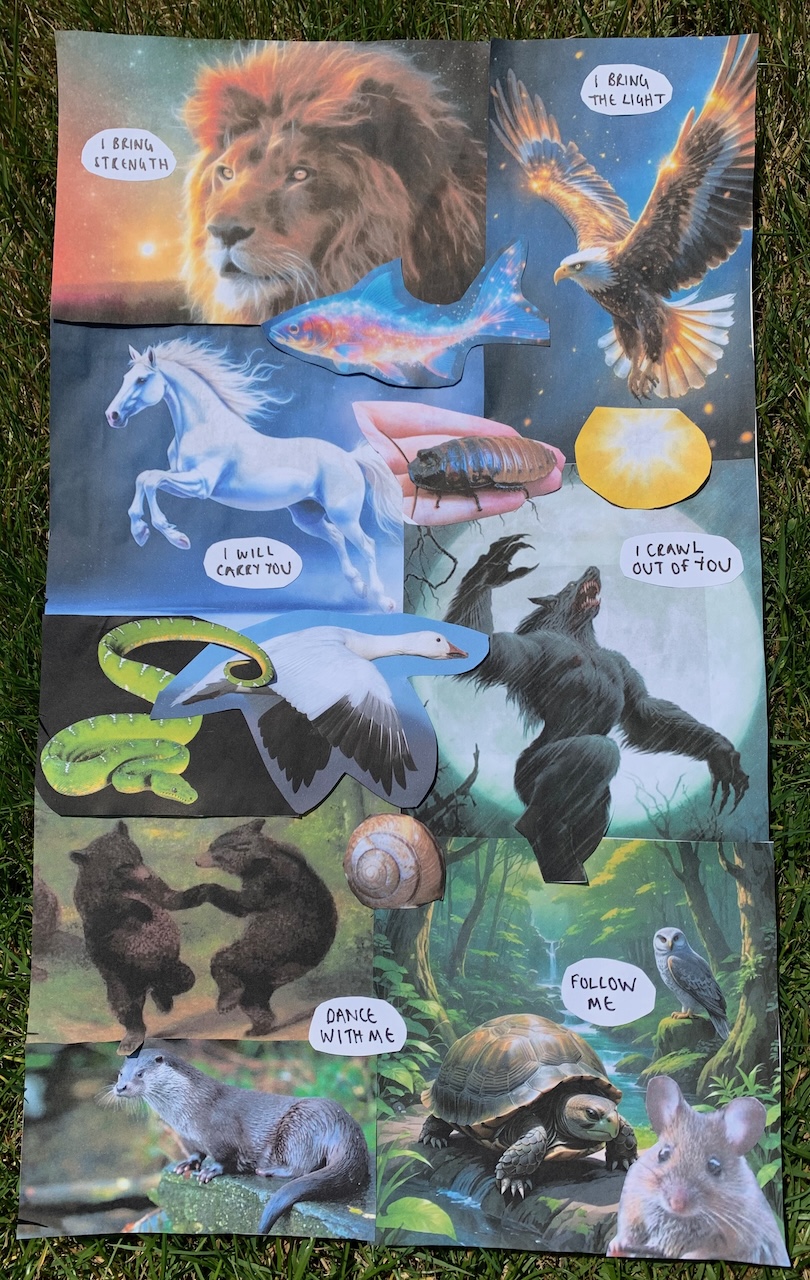
This collage was pieced together from some of the encounters and messages from animal spirits experienced by clients during shamanic journeys on my introduction to shamanism course and during power animal retrievals. It forms a celebration of the work we have done together to date. I would like to thank those who I have worked with for permission to share. I’m continuing to offer student rate shamanic guidance HERE and free shamanic healing (including power animal retrievals HERE).

The Animals Beside Us

It’s said there’s an animal beside us
from the moment we’re born
’til the moment we die.

Why, then, was I so alone
when I walked through the school doors,
and got knocked down by the animals 
in the playground again and again?

Why was I mocked when I showed a bit of spirit – 
running as a horse round the edges of the tarmac
whilst the others played British Bulldogs or Red Rover 
or skidded on the crips the seagulls fought over?

Why was I so alone when I sat in the classroom
writing secret stories about horses in the back of my books
and sketching them running, jumping showjumps, galloping free?

One of the lucky ones I had the chance to loan a pony
and muck out for free rides yet even at the stables
we were saddled by the same rules – boxed in.

I was like the horse on the end of the lungeline,
the box walker going round and round and round…

My white winged mare revealed herself in the form of a tattoo
when I came of age yet it wasn’t until ten years later
she revealed her magic breaking all taboos.

Now I help others to find the animals beside them –
to bring back their bears, eagles, otters, wolves,
to befriend their snakes and cockroaches.

Together we are slowly escaping our boxes,
learning to see through the illusion of separation,
with the animals beside us to understand why we are here.

*A poem based on my relationship with my white winged mare and on helping others to discover their animal spirit guides and power animals on my introduction to shamanism courses and in power animal retrievals.

I am currently offering free power animal retrievals as I progress in my shamanic training HERE.

Sanctuary Shamanic Circle

ONLINE

Second Tuesday of the month 1 – 2pm
Third Wednesday of the month 10 – 11am

Entry FREE (donations optional)

~Learn about shamanism in a safe inclusive space.
~Explore the spirit worlds and build relationships with spirit guides.
~Journey for yourself and others for guidance and healing.
~Work with the fae and British Gods and Goddesses.
~Become part of a like-minded community.
~Experience spiritual growth and personal transformation.

For further details contact: sisterpatience22@gmail.com