Dawn arrives yet You are gone. The birds are singing yet You are gone. The flowers are turning their petalled heads towards the sun yet You are gone.
Your absence is like the spinning of the Void.
You are gone to its bottommost depths with Your castle of cold stone.
You are gone but Your haunting is everywhere with Your promise of return.
You died but You are not dead but only sleeping.
We share a heartbeat and a breath and every one brings us a little closer together. I remember this when You are gone.
This is a gifted song that I have been singing for Gwyn at His altar in my morning and evening devotions since His death in His seasonal battle against Gwythyr on Calan Mai after which He sleeps over the summer months in His castle of cold stone. (At night I replace ‘dawn’ with ‘dusk’ and ‘towards’ with ‘from’).
This is the first time I have sung on video and I’ve only sung in public once before in a performance group. I was put off when a friend jestingly told me I ‘sing like a nun’ in the sense I am not rock ‘n’ roll enough. Well I am a nun now so I can sing like a nun!
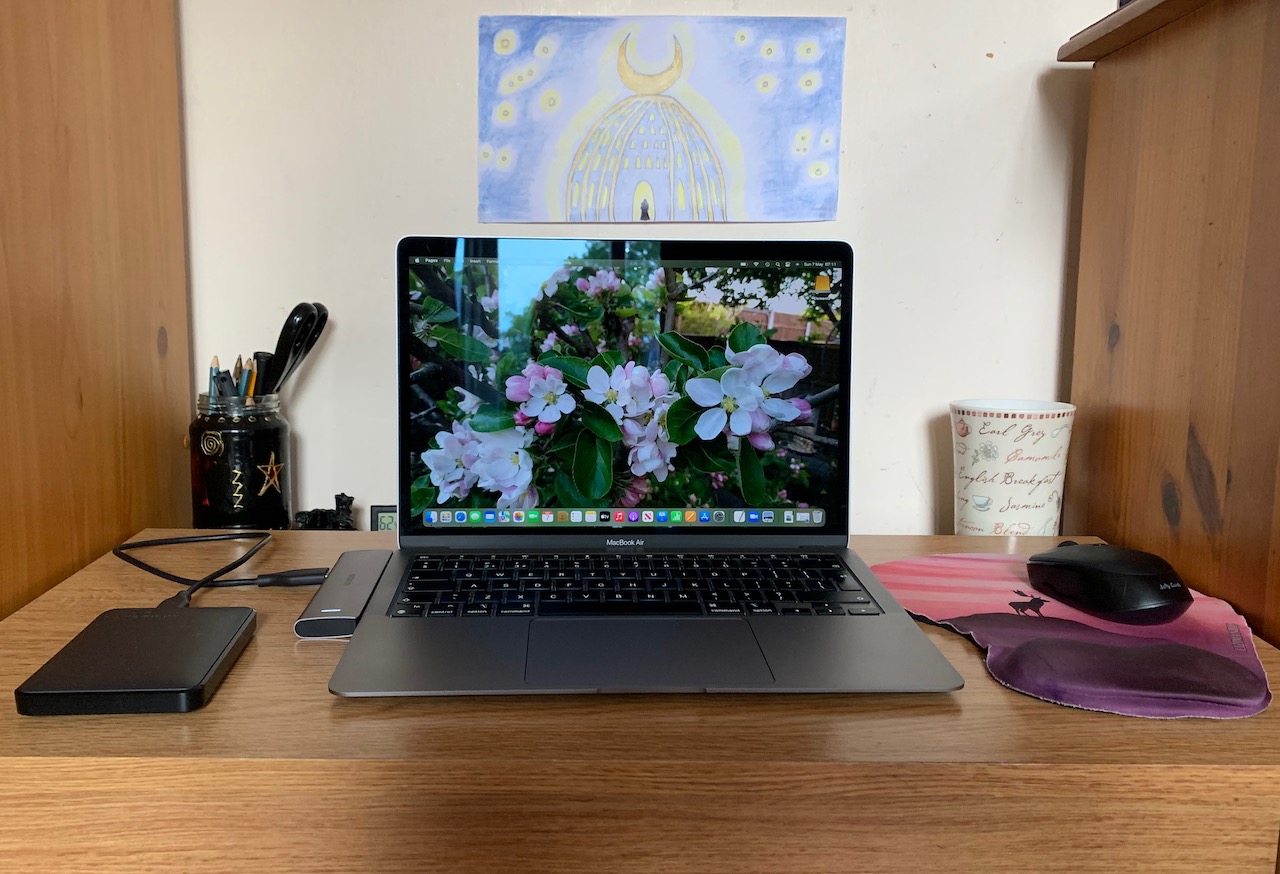
The image on my altar is a visionary painting by Meg Falconer of Caer Ochren ‘the cold castle under the stone’ from King Arthur’s Raid on the Underworld.
Over the past couple of weeks I’ve been blogging about my problematic relationship with technology as a source of distractions and my unhealthy habits surrounding compulsions to check emails and keep up with what is happening online.
After writing last Sunday about considering the possibility I might be able to check my emails once a day or even take a day off I realised what a huge hold this habit has over me and something within me said, “Enough. I’m not going to be ruled by this any more.” I made the decision to cut my email checking down to just twice a week, Wednesdays and Saturdays, and have managed it.
As part of the process I have spent some time reflecting on where it is coming from. As mentioned in a previous post I believe it to be caused by a combination of pernicious influences without and anxieties within.
I haven’t always had this habit. I didn’t have it when I was at university when I only had email traffic from tutors. I certainly didn’t have it at all when I was working with horses (when I worked in Hertfordshire and lived in a mobile home on the yard I could only check once a week on my employer’s computer!).
I believe it began around around 2011 when I started getting involved in local community groups such as South Ribble Transition Towns and a number of local poetry groups and in the latter took up a co-ordinating role. It got worse when I was also acting as editor for Gods & Radicals, so dealing with a lot of email submissions, then on top of that took a part time admin job at UCLan which involved a lot of emails and multi-tasking and left me very burnt out.
I had some time out after that and recovered a bit but didn’t address the problem of my anxiety as I was using alcohol several times a week to blank it out.
When I was volunteering in conservation and during this period gave up alcohol I began feeling better, but when I got paid work it involved more admin. When I was a trainee with the Lancashire Wildlife Trust I was doing my admin, including dealing with emails, 7 – 9am before my drive to the Manchester Mosslands to be onsite for 10am then driving back at 3pm to deal with the last of my admin 4 – 5pm. Having two hours of unpaid driving made for long days and I got very anxious about missing emails or not answering them correctly particularly in relation to plans for contract work.
Then, when I worked in ecology, I had to multitask a lot when I was in the office. Organising surveys often took as much work as doing them. Surveys for great crested newts and bats needed at least two and up to eight to ten people, with maps to be printed, meeting times and places arranged, all the equipment got together (there is a lot of equipment for bats!) and we were constantly having to rearrange with the weather and it was very stressful.
When I was writing an ecological report I had to keep my emails open to co-ordinate surveys and in case my employer sent me quotes to send out to clients and then to reply to clients about quotes as well and it was overwhelming.
After I resigned from that job, which left me very burnt out, instead of taking time to process what had happened I poured all my energy into my writing and escaped my feelings of failure by exercising and weekend drinking.
Since I came to Paganism and through it Polytheism I have been good at serving the land and my Gods through outdoor work and creativity but no good at looking after my mental health or working on my spiritual development.
That has begun to change as I have been drawn to Polytheist Monasticism, taken vows as a nun of Annwn, committed to becoming Sister Patience and been spending more time in meditation and contemplation.
I have come to believe that, if the mind is a whole, and is more than a thinking thing (the origin of the concept of ‘mind’ comes from the Greek psyche and means a lot more – ‘animating spirit’, ‘soul’,’ and comes from the root psykhein ‘to blow, breathe’*) then forcing it to do more than one thing at once is in opposition to its nature.
It’s common to see the mind referred to as a muscle. I believe it’s more than that, but let’s take that analogy. Trying to work a muscle in more than one direction at once is going to result in weakness and tears and an ineffective muscle.
I think that’s what’s happened to my mind. The last few years of doing a lot of both paid and voluntary admin work along with being part of the blogosphere and engaging with social media for short periods have weakened my mind, left me scatty, scattered, and far more prone to being dominated by my anxieties and prey to compulsions from within and without.
Identifying what ails me has helped me to see my solution lies with monasticism. The origin of this term is in the Greek monos, ‘one’, ‘single’, ‘alone’**. It might be seen as the practice of spending time alone, apart from secular society, off the Internet in order to recover the lost wholeness of our scattered pysches.
When I speak of alone I mean away from other humans – at least noisy ones – to better hear the voices of the land and the Gods and one’s own soul. Shifting our focus from the barrage of human noise on and offline to one thing – this might be praying to a God, meditating on a myth, spending time in nature, working on a novel, perfecting a poem, crafting a necklace or a shawl.
These practices feel very important to me at the moment as an antidote to the effect our increasingly technologised jobs have on our minds. I am currently in the privileged position of being to live as a nun until my savings run out with minimal online commitments such as running the monastery, sending material to my patrons, and maintaining this blog.
I feel like I’m well on my way to conquering my email and blog checking habits, having got them down to twice a week and having countered my fears of critcisms for not responding sooner with the knowledge that the people who matter to me respect I am a monastic and need to spend time offline.
Already I have seen improvements in my ability to focus in meditation, maintain the flow of my writing and be my more mindful when working in the garden. Small changes, I know, but steps towards healing my scattered psyche.
In the first two of his essays, ‘Four Questions Concerning the Internet’ (1) Paul Kingsnorth identifies the force behind the Machine (technology/the internet) as Ahriman, an evil and destructive spirit in the Zoroastrian religion (2).
He argues that ‘the sacred and the digital not only don’t mix, but are fatal to each other. That they are in metaphysical opposition.’ ‘The digital revolution represents a spiritual crisis’ and ‘a spiritual response is needed.’ As an aid to living through ‘the age of Ahriman’ he suggests the practice of ‘technological askesis.’ He notes that the Greek word ‘askesis’ has been translated as ‘self-discipline’ and ‘self denial’ and that asceticism forms the ‘foundation stone of all spiritual practices’. Its literal translation is ‘exercise’. ‘Asceticism, then, is a series of spiritual exercises designed to train the body, the mind and the soul.’
As a nun of Annwn in the making I can relate to much of what Kingsnorth is saying. As an animist and polytheist I perceive technology and the internet to be a living being with a will of its own although I’m not sure it can be reduced to one supposedly evil spirit. I tend to see it as the co-creation of many humans and many Gods, some more benevolent, some more malevolent. Unfortunately as the hunting ground of many malicious humans and non-human entities including the one I identified as the King of Distractions last week.
I personally do not agree with the statement that ‘the sacred and the digital don’t mix’ are ‘fatal to each other’ ‘in metaphysical opposition.’ I think their relationship is more complex and ambiguous. The internet can certainly steer us away from the sacred if we’re mindlessly scrolling or using it merely for entertainment. Yet it can help us deepen our relationship with the sacred if used mindfully to view content and engage in dialogue that is thoughtful and meaningful.
Without the internet I would not have managed to reach the small but much appreciated audience I have today through my blogging and my books. The Monastery of Annwn would not exist as a virtual space of sanctuary where members feel safe to converse on the deeper aspects of spiritual practice and we wouldn’t be able to hold on-line meditations and events.
Although I didn’t have a name for it ‘technological askesis’ is something I have been practicing for a while. Firstly by leaving social media. More recently by blocking off my time on week days from when I get up at 4am until around 3pm to focus on my spiritual practice and writing and only when I have done my deeper work answering emails and using the internet.
This has helped me to be more focused and less scattered. It hasn’t been easy – not being able to check my emails has been like an itch I can’t scratch and I’ll admit I’ve given in to checking them again at around 6pm ‘just in case there’s anything I need to deal with so I can relax for the evening.’ It’s possible next week I will set them back to 6pm so I only need to check them once and I might even try a day without checking them at all (!).
As I write this I see that going to such lengths and the amount of restraint I am having to use shows that I am under the sway of forces difficult to control within and without. I have an addiction to checking my emails and my blog and much of it comes from anxiety so might be labelled ‘email/blog anxiety’. I get anxious about ‘missing something’ or having one or more email or blog comment that is long or difficult to answer and getting overwhelmed. My checking is for reassurance – making sure ‘there are none there.’
Of course this is a bit silly as I have placed strict limitations on what I subscribe to and my communications and correspondences are usually from friends and thus friendly and encouraging and usually quite positive.
I think when tackling the internet the best way forward is being mindful of how we are relating to it in terms both of our inner impulses and the forces without. Of how we are using it and how it is using us. Of the complex net of relationships it has brought us into, friendly and unfriendly, human and non-human.
Ahriman’s nature is described by John R. Hinnel: ‘He is the demon of demons, and dwells in an abyss of endless darkness in the north, the traditional home of the demons. Ignorance, harmfulness, and disorder are the characteristics of Ahriman. He can change his outward form and appear as a lizard, a snake, or a youth. His aim is always to destroy the creation of [Ahura Mazda] and to this end he follows behind the creator’s work, seeking to spoil it. As Ahura Mazda creates life, Ahriman creates death; for health, he produces disease; for beauty, ugliness. All man’s ills are due entirely to Ahriman.’ HERE
‘The first time I saw an Athonite monk pull a smartphone out from the pocket of his long black robes, I nearly fell over backwards… the pit that appeared in my stomach when I first saw a monk on the Holy Mountain with one of those black mirrors in his hand came from an instinct I’ve long had: that the sacred and the digital not only don’t mix, but are fatal to each other. That they are in metaphysical opposition.’ ~ Paul Kingsnorth, ‘The Neon God‘
He sees a monk on mount Athos take a smart phone from his black robes and nearly faints in horror
whereas I run on – a nun of Annwn with an Apple watch on my wrist telling me when I have completed split one, split two, split three, the exact mileage I have done, my pace, how many calories burned, congratulating me when I close my move ring and exercise ring, teaching me to breathe by mimicking my breath with a cool blue cloud.
When I look into the black mirror I wonder whether it is a parasite or a companion,
a trustworthy advisor or a replacement for my body’s knowing.
I pose the question – IS TECHNOLOGY HOLY?
The black plastic reminds me of the primordial material, the dark matter of the womb from which the universe was birthed,
the cauldron from which spilled the elements that would make ion-x glass, liquid crystalline, an aluminium case, a polyester with titanium strap,
the lithium ion rechargeable battery
(from cobalt mined by children in the Congo).
By age, height, weight, gender, heart beat movement, workout type it measures whether my day has been a success.
Like counting the fall of apple, cherry or orange blossoms I wonder if it is beyond good and evil?
It keeps my horarium for now and warns me when the sun will be too hot and when my heartrate is too high
He came into my life around 2012 when I started this blog and joined the strange world of the blogosphere. His presence was invisible at first and it took me a few years to perceive his influence. I started this blog to share inspiration and find and connect with like-minded people and I succeeded in those aims. Only I found that during that process ‘something’ had gained power over me. I was not only reading what inspired me and felt important but trying to keep up with every last thing on the blogosphere, on social media, not wanting to miss out or get left behind.
In 2015 when I was doing my best to fit the mould of being a politically-engaged Pagan there were days when I did nothing but scroll the internet for information to make the right replies on blogs and Facebook and Twitter feeds.
Around that time there were some really nasty arguments between right and left-wing polytheists that led to the breakdown of the polytheist movement. It was a horrible thing to see and this, on top of being burnt out from having forced myself into activism, led me to stop blogging and abandon social media.
I went to Wales. I had some experiences with Gods and giants. I came back.
Since then I have been more mindful of my internet use and how it uses me. After a couple of brief flirtations I have abandoned Facebook and Twitter. I follow only blogs that inspire me. I steer clear of arguments. I limit my engagements to old-fashioned forums at the Monastery of Annwn and The Cloister.
Yet still I’m distracted which I find to be a terrible irony for a nun of Annwn, one who is devoted to the Gods of the Deep, is writing a book called ‘in the Deep.’ When I need a break or when I get stuck I’m tempted to check my emails or look at a blog, then one thing leads to another and I’ve lost half an hour.
The problem of attention theft, of stolen focus, and the resulting atrophy of our deep work muscles is something we have been working with at the Way of the Buzzard Mystery School* and has been picked up on by fellow Polytheist Monastic Danica Swanson.**
Since then reclaiming my attention and retraining my deep work muscles has been a large part of my personal spiritual development as a nun of Annwn. But it hasn’t been easy. I’ve had a lot of resistance to keeping my focus on one thing at a time, whether it is meditation, writing, gardening, running or a gym work out. I’ve had a lot of minor things go wrong recently from personal and family health issues to a stolen bike and a troublesome member at the monastery. I’ve used them as excuses for letting distractions have their way.
In spite of my best efforts I have been struggling to focus on one thing at a time to the point I have felt that ‘something’ is actively stealing my attention.
Returning to look at the Way of the Buzzard journey circle in January 2022 ‘Reclaim your Attention’ last night I noticed the intention was to journey on ‘what is getting in the way of your attention?’ I intended to do so this morning but instead woke up with the answer – ‘the King of Distractions.’
Having dreamt a couple of days ago about our house being burgled and linking this to the man of enormous stature with a huge hamper who stole food and drink from Lludd in Lludd ac Llefelys I realised I had found the culprit.
I then had the gnosis that the King of Distractions has been here, not only in my house, but in my very room since I started blogging. He has been sitting beside me, stealing my attention and focus away from the things that really matter, putting them into his huge hamper, filling it full, as my mind grows weak.
(‘And nothing amazed Lludd more than that so much could fit into that hamper!’)
He’s been following me about taking my mind from nature on a walk, bike ride, or run, from what I’m doing with my body at the gym. He’s been next to me when I sleep, waking me up with distractions, robbing me of my dreams.
It thus seems meaningful that Lludd/Nudd/Nodens, God of Dreams, defeats this man and that his identity has been revealed to me by sleeping and dreaming.
In Lludd ac Llefelys the man achieves his theft by sending everyone to sleep. As the King of Distractions he makes himself invisible by putting us into a sleep-like trance in which we are barely aware of what we’re doing as we flick onto our emails or onto the internet and begin scrolling from this to that.
On Nos Galan Mai Lludd manages to defeat the man by immersing himself in a tub of cold water every time sleep comes upon him. He then confronts him in a violent battle in which sparks fly from their weapons, throws him to the ground, and demands that all his losses are restored and the man becomes his vassal.
Whilst immersing myself in a tub of cold water every time I’m distracted isn’t very practical it could serve as a good visualisation aid against the King of Distractions. As could visualising beating him off, sparks flying, forcing him to give back what is in his hamper and putting him in his place.
An additional tactic is to put up some defences. Thus I’ve drawn up a schedule in which I’ve restricted my internet usage to checking emails once a day in the late afternoon when my other work is complete and limiting catching up on blogs and reading articles online to Saturdays.
I’m hoping this will help me reclaim my focus and strengthen my deep work muscles so I can make better progress with ‘In the Deep’ and my spiritual practices.
*Nicola at the Way of the Buzzard blogs about stolen focus in her post ‘Attention’ HERE. ****Danica Swanson proposes ‘Creative Incubation’ as a remedy for stolen focus and the atrophy of deep work muscles HERE.
The Path of the Sacred Hermit: Exploring Monasticism in Modern Pagan Spirituality is the first book by Avallach Emrys. Avallach is a novice monk with the Gnostic Celtic Church of the Ancient Order of Druids of America and the Order of the Sacred Nemeton. He is also a monk with the Monastery of Annwn and has played a much appreciated role in setting up our forum.
This is the third book I know of that has been published over the past few years on the topic of Pagan and Polytheistic Monasticism (1) as the movement, originating in the early 2000s (2), continues to grow and define itself.
In his introduction Avallach makes it clear this is not a scholarly book but one created ‘as a novice… for other novices’. It is a ‘book for beginners’.
He defines Pagan Monasticism as: ‘A way of life that returns us to a focus on the simple things: our connection to the natural world, our connection with the Divine, and our connection to each other. It is a life of service, devotion, and contemplation.’
Speaking of what Pagan Monastics do in terms of monastic spiritual practices he lists prayer, meditation, ritual, ceremony (including celebrating Holy Days), making offerings, shrine tending, divination, and keeping daily offices/a monastic horarium. He notes that ‘Pagans also engage in study and learning’, service to the community and environment, and self-care and self-improvement such as regular exercise and healthy eating.
It is of interest, that in contrast to monastic traditions in other religions and the definition of Polytheistic Monasticism put forward by Janet Munin (3), that Afallach does not mention renunciation or any strict rules controlling behaviour.
Avallach goes on to say that Pagan monastic practice is based on four components – ‘discernment, discipline, devotion and contemplation’. I thought this explicated a strong and firm foundation and has led me to contemplate how these four components manifest in my own spiritual path.
A brief history of monasticism is provided. Also coverered are key elements of monasticism one would expect to find in a beginner’s book such as monastic vocation (and suitable vocations for paid work), commitments and vows, life as a monastic and the challenges of creating physical Pagan monasteries.
In the Appendix are writing exercises and prayers by the author written for commitments and Holy Days and for honouring individual deities such as Brighid and Cernunnos. Some of these include Latin translations. As I can’t read Latin I can’t vouch for their accuracy but I found this impressive as a devotional act in itself.
I felt this book covered the basics of Pagan Monasticism very well and provided some sound components to help a beginner to start practicing. Much of it resonated with me as Brythonic Polytheist, such as the section of devotion. ‘Devotion means giving your heart and mind to the deity or deities you worship and committing yourself to their service. It means making them the focus of your life and seeking to live in accordance with their will.’
Another thing I liked was the repeated emphasis on doing ‘what works for you.’ The following passage, I felt, was of utmost importance for a beginner – ‘don’t feel like you must do everything that traditional Monastics do in order to be considered a “real” monastic. Instead focus on small commitments that work for you.’ Not feeling monastic enough is an obstacle that has hampered my own spiritual progress and taken joy from my path.
This book is not without its flaws. The language is quite repetitive and the author explains that in the introduction, stating that he chose that style to convey a ‘concise and easily-readable message’.
Whilst in some places the approach to deity resonates in others I found it a little problematic. Avallach says, ‘One way that pagans connect with the divine through devotional prayer is by honouring deities associated with different aspects of life such as love, fertility, or protection. For example, a pagan seeking to improve their love life might choose to honour Aphrodite, the Greek goddess of love’ or when ‘trying to conceive’ honour Freya ‘for fertility’. Whilst understanding the need to keep things simple I thought it might be worth adding a cautionary note that one needs to build a relationship with deities before asking for ‘blessings and guidance’ and it’s not always the obvious deities who choose to relate to us and answer our prayers.
I was also a little unsure about the author’s claims about the existence of historical ‘monastic magick’. He notes it has been found in ancient Egypt in the ceremonies of ‘temple priests and priestesses’ and in ancient Greece in the context of the mystery cults but I’m not sure how many of these practitioners identified as monks or nuns. However, this isn’t my area of expertise, and as there are no footnotes, I couldn’t check the sources.
Overall I feel this book makes a valuable contribution to the Pagan and Polytheistic Monastic movement and succeeds in fulfilling the aim outlined in the introduction of providing a guide for novices written by a novice monk.
The Path of the Sacred Hermit is available through Barnes & Noble HERE.
The first is A New Monastic Way: Modern Polytheistic Celtic Monasticism by Oisin Dolye (2017) and the second is Polytheistic Monasticism: Voices from the Pagan Cloisters edited by Janet Munin (2022).
‘Monastics are those who take solemn vows to live centred on their relationship with one or more Holy Power. Anything which impedes or compromises that relationship is left behind or minimized as much as possible. They are renunciates, offering up wealth, social status, a conventional career, and family life on the altar of devotion.’ Polytheistic Monasticism: Voices from the Pagan Cloisters edited by Janet Munin (2022), p.2
‘This is a point in our lives where we decide (or are forced) to throw the anchor down, to live in one place, have a teacher, dig in.’ – Martin Shaw
The word ‘anchorite’ or ‘anchoress’ comes from the Greek, anachoreo, meaning ‘to withdraw’. – Mary Wellesney
I am not quite an anchorite. I have not yet been buried alive. Not with Christ. Not even with Gwyn. I do not live in a cell twelve metres by twelve metres with servants to bring my food, remove my waste and feed me books in exchange for insights from a tiny window called a squint.
I have not yet given up all my worldly possessions or ambitions.
I like to run and might have been one of the nuns who ran away like Isolde de Heton from Whalley Abbey in the 1470s but not for forbidden children or men
but simply for the desire to roam however far my walking, running or cycling legs will carry me through the labyrinth of this land following the streets that lie on older streets, on pilgrim’s paths and padways and Roman roads and horse paths and deer paths.
The horses in me bolt from their stables when kept in too long.
They run with the hounds before the wolves and ravens, the owls with their crazy eyes mad on psychedelics, the portents from the stars and our gardens.
Honesty is here and all the pavement plants.
I am told I must be ‘a guide to the soul.’
I fear my revelations will be mundane and suburban.
They will include words like ‘cloths’ and ‘washing’ and ‘washing up’ but also honesty, Lunaria annua, enchanter’s nightshade, Circaea lutetiana, ivy, hedera, yew, Taxus buccata.
In a vision I am a hell-hound prowling around my anchor. I am the anchoress who howls and where my head is I do not know.
I dream of a wren’s nest on a wooden beam overhanging tidal waters. Then I’m holding it. It’s warm and soft and feathery and filled with baby wrens. I’m afraid for them. I fear they will fall into the water.
The scene shifts and I’m watching from beyond as the wren chicks fall as I feared, but before they drown each of them is saved by a kingfisher with a blue-grey beak, who plucks them out and places them on the nearby sands.
I’ve been struggling of late. Minor health problems. Exercise niggles. Burning myself out by working 7 day weeks even though I’m not in paid work. Problems with my spiritual practice and lamenting having no human teacher, no existing structure or tradition to turn to.
I’ve been losing wrens.
Wrens. They’re secretive birds. A lot of people can’t or don’t see them. I’m not brilliant with birds or bird calls but I often spot the ‘little pointy tails’ in the undergrowth before hearing their loud song and I also see wren chicks around this time of year. In the Wildwood Tarot they’re associated with voice and prophecy and folklorically they are a sacrifical bird killed around mid-winter.
Kingfishers. Contrastingly I don’t see kingfishers often and when they do show up I know something deep and numinous is happening. The last time I saw a kingfisher it was connected with the death of a friend and spiritual guide.
The message of this dream seems to be not to be too harsh on myself or on our fledgling spiritual traditions. To stop getting frustrated and jettisoning my wrens.
This time the kingfisher has shown up to save them. I’m not sure who the kingfisher is. Glas y dorlan ‘blue of the riverbank’. Maybe Nodens, the Fisher King. Maybe a messenger of His or of His son, Vindos/Gwyn, my patron. Or maybe something or someone else turning up to remind me I have been guided less formally by a number of different mentors in different ways along my path*.
Perhaps here is represented the Monastery of Annwn and the polytheistic movement as a fledgling endeavour. Although we have no structure or tradition we have each other for support and the saving grace of our Gods.
*To name them Phil and Lynda Ryder in Druidry, Brian Taylor in animism, Greg Hill in the Brythonic tradition, Jason and Nicola Smalley in shamanistic practices.




 The Sanctuary of Vindos