Review – The Way of the Gods by Edward Butler

In The Way of the Gods philosopher and polytheist Edward P. Butler provides an introduction to polytheisms around the world. This book originated as a course he delivered for the Center for Global Polytheist and Indigenous Traditions at INDICA*.

It contains fifteen chapters covering India, the Mideast, Hellenic and Roman Polytheism, Northern Europe, Ancient Egypt, African Traditional Religions, South America, Mesoamerica, the African Diaspora, North America, Oceania and New Zealand, Australia, Southeast Asia, Japan and Korea and China. 

It is unique within academia as, from the start, Butler states his standpoint as a polytheist who believes the Gods of all the world’s traditions are real**. Thus for him these religions are not ‘solely a matter for historical study’ but embody ‘eternal relationships to the Gods whom they address.’ 

Throughout the book Butler makes clear that the terms ‘polytheism’ and ‘Gods’ are not used to ‘determine the self-understanding’ of non-Western cultures. Consistently he provides the indigenous terms for the religions and deities of each culture. He notes his use of ‘Gods’ is to ensure their divinities are not seen as lesser than the Christian God or reduced to pantheistic concepts. He also notes the Western mistake in the labelling of cultures as animistic in a way that sets up a false opposition between animism and polytheism, leading to the supposition that cultures that have spirits have no Gods.

In each chapter Butler provides a history of the polytheistic traditions of the cultures of his chosen geographical areas. It is noted that whilst some have continuity (such as ‘India, ‘home of the largest polytheistic tradition in the world… Hinduism’ and Australia ‘the longest continuous tradition on Earth) many others (such as Greek and Roman and Egyptian) are sundered. Butler does not flinch from speaking of the oppression most polytheistic traditions have suffered, and some still suffer, under the hegemony of Christianity. 

The chapters begin with core readings and many are on creation myths such as Enuma Elish, Theogony, Gylfaginning, Kumalipo and the Popol Vuh. Butler provides studies of these cosmogonies showing how several originate with ‘water’ as ‘a much broader cosmic phenomenon’ and ‘result in the emergence of a hierarchical or layered reality’. ‘Every cosmogonic myth is a doctrine concerning Being’. He notes the similarities and differences between the African cosmogonies where the Creator withdraws into the sky opening up a space for further action and the threat of the falling sky in South America due to the decline of spiritwork which maintains the supports. 

Throughout Butler emphasises that myth does not relate to some distant past but is ‘always now’. Western scholarship has tended to favour diachronic interpretations and linear narratives to those that are synchronic. Rituals, such as the recitation of Enuma Elish ‘on the fourth day of the Babylonian New Year’, allow for participation in this eternal now with the Gods.

Different approaches to ritual and spiritwork are presented. One of these is the Yoruba tradition of Vodou from the African Diaspora. Herein there is a single pantheon of Orishas (from ori ‘head’ and sa ‘selection or choice’). Divination reveals the patron deity as ‘the owner of the head’. One of the practices is the mounting or possession of the devotee by one’s God.

This book provides a fascinating introduction to polytheisms around the world. It is meticulately researched and respectful to each of the cultures and their Gods. As a philosophy post-graduate I particularly enjoyed Butler’s analyses of the cosmogonies in the creation myths and discussions about the rich philosophical traditions these polytheisms have given birth to.

I would recommend The Way of the Gods to all polytheists who want to learn more about our world-wide polytheisms and to anyone interested in the subject. I found having prior knowledge of basic philosophical concepts helpful but it is accessible to all with a dictionary to hand.

It also a beautiful act of devotion in itself from a practicing polytheist who states his ‘life work is the study of polytheism and polytheistic traditions’.

*https://indica.in/
** This contrasts with the majority of academics who keep their personal spiritual and religious beliefs separate from their academic work.
Why I failed to write a Brythonic creation myth

In my attempted novel, In the Deep, I tried to imagine a story for the origins of Vindos / Gwyn, His kingdom in Annwn, and for the creation of the world. This was based on a combination of my readings of Brythonic and other Celtic and Indo-European and world myths and my personal gnosis. 

I worked for a year and a half on a story that had meaning for me and I felt Gwyn wanted me to write as the awen kept on flowing. Yet it didn’t speak to many humans and, in retrospect, although coherent, contained a lot of flaws.

Looking back, I feel it was a process I needed to go through. I genuinely believe I saw faces of Gwyn, such as the Boy in the Serpent Skins, that were meaningful for me and needed to journey with Him and write those tales.

Yet there were elements of the story I could never quite make work. My personal gnosis led me to perceive parallels between Tiamat in the Enuma Elish and a ‘found’ Goddess I know as Anrhuna who takes the form of a nine-headed dragon and is Gwyn’s mother and the Mother of Annwn.

In the Deep was written as an inversion of Enuma Elish ‘When on High’ reimagining what might have been a wider Indo-European origin myth centring on the slaying of a dragon from the side of the Deep rather than the victors.

It opens with a battle between the Dragons of the Deep (Annwn) and the Children of Don wherein Lugus / Lleu slays Anrhuna, the Dragon Mother. By cutting off Her nine heads He releases the dragon children of the nine elements*. He then cuts open Her womb and tears out Kraideti / Creiddylad (the Girl who will Bring Life) and Vindos / Gwyn (the Boy who will Bring Death). Lugus takes Kraideti to the stars and flings Vindos into the Abyss. Uidianos / Gwydion steals the magical jewels from Anrhuna’s foreheads and with them commands the dragon children to create the world. 

Although I’ve been able to picture the dragon slaying scene quite vividly I’ve never quite managed to see or write the creation of the world. I’ve ‘seen’ Uidianos and a circle of enchanters with their wands conjuring with the elements to form a world but can’t seem to connect it with the dragons.

The role of Gwydion as demiurge I derived from His creation of Taliesin in ‘The Battle of the Trees’ from ‘nine forms of consistency’ – ‘fruit’, ‘fruits’, ‘God’s fruit in the beginning’, ‘primroses’, ‘flowers’, ‘the blossoms of trees and shrubs’, ‘earth’ / ‘sod’, ‘nettle blossoms’, and ‘the ninth wave’s water’. 

In ‘The Song of the Great World’ Taliesin is created by God from ‘seven consistencies’ – ‘fire and earth, / and water and air, / and mist and flowers, / and the fruitful wind’. Like the the microcosmic Adam** his creation may be seen to mirror the creation of the world by God in this poem. It seems possible Gwydion was earlier seen as creating Taliesin and the world.

In ‘A British Myth of Origins’ John Carey suggests the Fourth Branch of The Mabinogion might contain an origin myth with Math’s kingdom whilst He has His feet in the lap of a virgin, Goewin, representing a timeless paradisal state. Gwydion’s scheming with Gilfaethwy to bring about her rape represent a fall. Gwydion and Gilfaethwy’s transformation by Math into a deer and a pig and a wolf, and their bearing of offspring, may explain the origin of animals.

Carey also suggests the story of Taliesin shapeshifting into various animals after stealing the awen from the cauldron of Ceridwen and the animal transformations of figures such as Mongan in the Irish myths function ‘as a device to connect the present with its origins, whether the beginnings of history or the transtemporal eternity of the Otherworld.’

It’s my personal intuition that Ceridwen may be a creator Goddess. That Her crochan ‘cauldron’ or ‘womb’ could be the vessel from which the universe was born. This is another strand that I attempted to weave into my book. 

If we look back beyond medieval Welsh mythology to the Roman sources we find no evidence whatsoever of a creation myth. Instead Strabo reports that the Gallic peoples (who according to Caesar derived their beliefs from the Britons) believe ‘men’s souls and the universe are imperishable’. Several authors speak of the belief that the soul is immortal. According to Caesar it ‘does not die but crosses over after death from one place to another’ showing existence in an ‘otherworld’ (potentially Annwn). Diodorus Siclus claims the Gauls ‘subscribe to the doctrine of Pythagoras that the human spirit is immortal and will enter a new body after a fixed number of years’. The key doctrine of Pythagoras is metempychosis and we find this throughout the Taliesin material wherein he speaks of his transformations. 

It seems possible we don’t have a Brythonic creation myth as the universe was viewed as ‘imperishable’ and the eternal soul as shifting through different shapes, potentially crossing from this world to Annwn and back again.

One of the things that has stood out to me whilst returning to the Taliesin material is that rather than telling of creation as given he instead poses riddles.  ‘How is the sun put into position? / Where does the roofing of the Earth come from?’ ‘Where do the day and the night come from?’ He mocks Christian scribes for not knowing ‘how the darkness and light divide, / (nor) the wind’s course’.

Taliesin seems to be claiming to know yet he leaves the answers a mystery. Could it be that our Brythonic ancestors treated these issues as mysteries rather than having clear cut myths and stories and explanations? 

If so could my failure to create a myth that works be based on the fact there have never been any direct answers and these things should be left mysterious?

If so it seems this book idea has played itself out for what it is but can go no further. I fulfilled my promise to Gwyn to write Him an origin story (something He didn’t ask for but that I did as an act of devotion to Him). It just didn’t turn out to be a novel sellable to humans. Which is ok. 

Where to go from here I’m not sure. I still want to write, I still need to write, in service to my Gods and to give voice to the awen from Annwn and within. To provide content for my patrons who continue to support me. But it might be that now I’ve become a nun of Annwn, Sister Patience, what I write will change.

It seems possible I will be taking a more meditative approach with a focus on mystery, which feels fitting for a nun dedicated to a God of the Deep.

*Stone, earth, water, ice, mist, wind, air, fire, magma.
**In her notes to ‘The Battle of the Trees’ Marged Haycock adds some references to medieval Christian texts where Adam is said to be created from ‘eight consistencies’ – ‘land, sea, earth, clouds of the firmament, wind, stones, the Holy Spirit and the light of the world’ or ‘earth (flesh), fire (red, hot blood), wind (breath), cloud (instability of mind), grace (understanding and thought) blossoms (variety of his eyes), dew (sweat), salt (tears).’

Review – Taliesin Origins by Dr. Gwilym Morris-Baird

Dr. Gwilym Morus-Baird is a native Welsh speaker and scholar. He runs the excellent Celtic Source website where he shares scholarly research and personal insights into the Celtic myths through videos and free and paid online courses. Taliesin Origins originated from an online course. 

As would be expected this book provides a superb introduction to the myth of Taliesin well grounded in the social and political history of Wales. It not only introduces material that might already be known to students of the bardic tradition such as Ystoria Taliesin (‘The Tale of Taliesin’) and the poetry from Llyfr Taliesin (The Book of Taliesin) but sets it in a context with and expounds on its themes through other bardic works that are less familiar. The author’s translations of these, as well as the Taliesin content, are valuable resources in themselves. 

Morus-Baird, who is not only a scholar, but a musician, presents the material in a way that is not only academically accurate but lively and vivid and enthused with experiential insights based on his practices as a living bard.

One of my favourite parts was where he traces the travels of the historical Taliesin north from Cynan’s court at Pengwern (Shrewsbury) to Urien’s court in Rheged*. Here we find an evocation of the revelry in the hall and the lord with ‘long, flowing white hair and beard’ ‘his body’ ‘covered with many battle scars’.

There is a good deal of speculation founded on research and personal insights. Morus-Baird presents a strong argument for the story of Gwion stealing awen from Ceridwen’s cauldron then being eaten by her and reborn as Taliesin originating from interactions between the visionary tradition of the witches and the Welsh bards. This tale is shown to play out in the prehistoric ritual landscapes around the Dyfi and Conwy estuaries where it is set. It is argued that the alternative telling of the creation of Taliesin by Gwydion from vegetation as ‘a weapon of bardic destruction’ along with the trees in Kat Godeu (‘The Battle of the Trees’) originates from a different bardic lineage.

This book also contains much philosophical depth. The concept of awen is explored from its Proto-Celtic origin in *awek ‘inspiration or insight’ through its complex of meanings in Irish and in Welsh which include awel ‘breath.

The imagination is beautifully likened to the Mare Goddess Rhiannon as ‘an insubstantial beast, a grey mare of little but breath. We may ride her to ends of the Earth, but she vanishes the minute we look at her too closely.’ Awen as is seen to ‘live’ in Annwfn and is drawn upon by the bards.

Morus-Baird states that the popular understanding of Annwfn as the otherworld isn’t the ‘most accurate’ and translates it as ‘inner world’ or ‘inner depth’, describing it as ‘a world-within-the-world, a depth that is everywhere’. Drawing on the First Branch of The Mabinogion along with the poetry of Cynddelw and Taliesin (who speaks of his seat in Caer Siddi ‘the fairy-mound Fortress’) he categorieses Annwfn as a timeless, pristine place of high ideals and dismisses the Christianised hellish view in Culhwch ac Olwen.

At the end of the section on Annfwn he summarises his argument: 

‘The main difference between Annwfn and our realm appears to be a temporal one. Whereas our plane of existence is characterised by ageing and death, ‘sickness and old age’ do not affect those in Caer Siddi. It appears to be the place of eternal renewal, where pristine life continues without the effects of time and its changes. By contrast, to partake of the mortal realm is to be swept up in the turbulent currents of transformation, to be spun in the cycles of birth and death and to know the suffering of experience.’**

Annwfn is described not as a land of dead, in the sense of a final destination for souls, but it is one where spirits such as those of Taliesin and Myrddin can reside. These ‘bardic masters’ can be channelled in live performances.

Taliesin Origins is an engaging read on an intellectual and spiritual level. I have been studying the bardic tradition for over ten years and it gave me additional food for thought and led me to question a number of assumptions. I would recommend it as the go-to source for anyone interested in the Taliesin myth whether from an academic or religious perspective or both. 

*There’s a mention of Taliesin crossing the Ribble at Preston near to my home. It hadn’t crossed my mind he would have passed so close on his travels.
**This isn’t an argument I wholly agree with. Although there are lots of examples of Annwfn being a timeless, pristine place we also have descriptions of terrible battles there which include violence and death. The prime example being in Preiddeu Annwfn from which only seven men return. Gwyn ap Nudd speaks of this conflict – ‘At Caer Fanddwy I saw a host / Shields shattered, spears broken, / Violence inflicted by the honoured and fair’. If this is to be conflated with the raid set in Ireland the Head of Annwfn himself is killed. One might claim these are so terrible because they are interruptions to the pristine state and I believe this is partly the case. Yet the presence of Annwfian monsters in Kad Godeu along with the gormes ‘oppression’caused by a dragon in Lludd a Llefelys that blights Britain and its people are suggestive of a darker side to Annwfn. It’s my personal belief that like the ‘otherworlds’ of most Indo-European cultures it has both pristine and beautiful and monstrous and terrifiying aspects (for example the Hindu and Buddhist ‘heavens’ and ‘hells’, the Norse Valhalla and Hel, the Greek Elysian Fields and Tartarus). In my personal experience of travelling Annwfn in spirit the transformative processes, including life and death, mirror our own.

A Journey Book

Over the past few years my Gods have been encouraging me to draw more (even though I am not very good at it) and I have been inspired by the work of Ceri Davies at Below the Wood* who has been recording spiritual experiences in words and images.

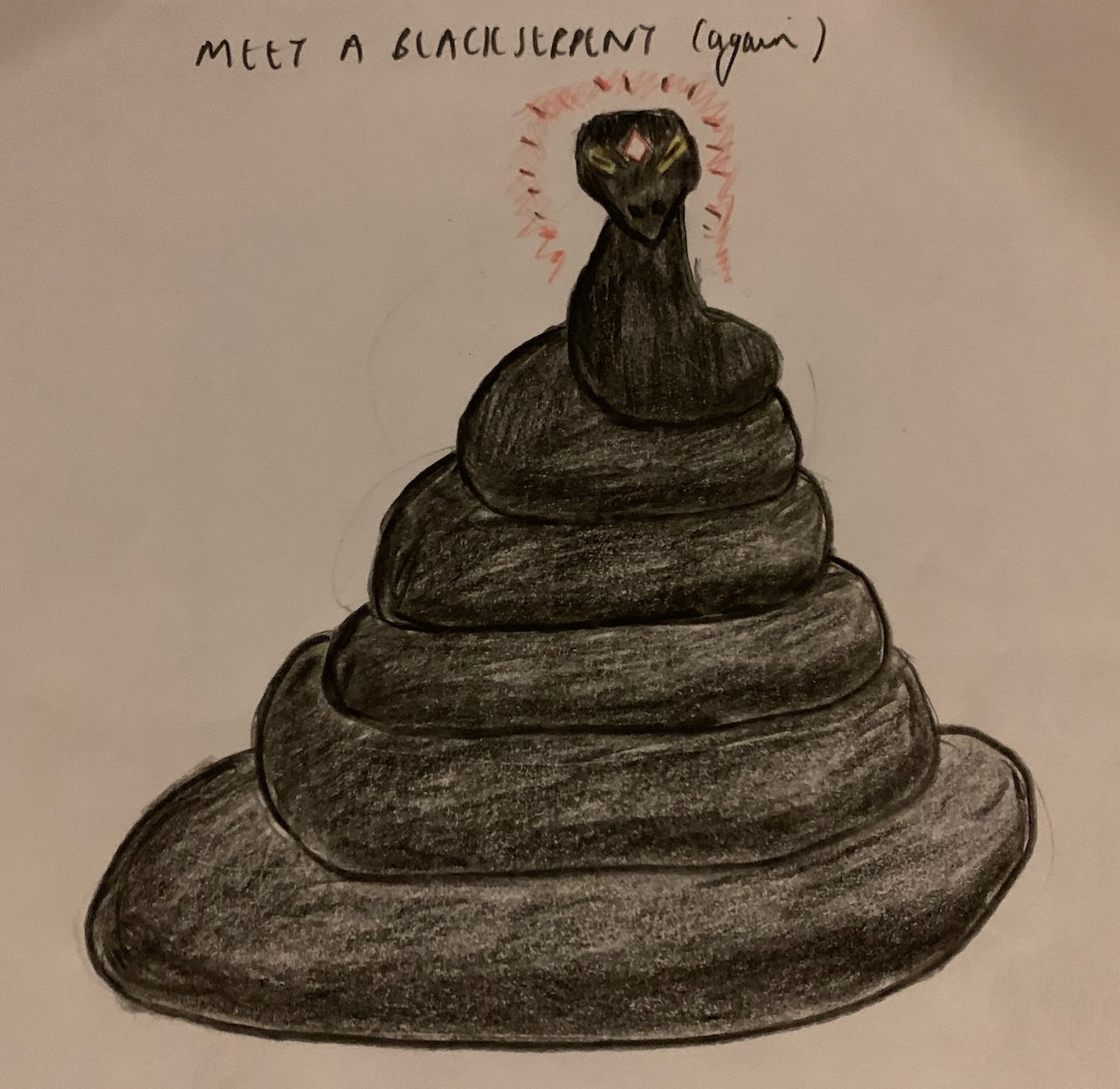
Recently when I journeyed to ask my guides how to improve my journeywork a black serpent showed me ‘I must begin a journey book’.

Up until now I have been recording my journeys in word documents on my computer and they tend to get filed away and not looked again. I guessed there is something in the old fashioned way of working with hand and pencils on paper and the time and effort this requires that honours the journey, fixes it in memory and brings its transformative potential into the world.

The first step in the process was buying the right book. This wasn’t hard. Knowing Jason Smalley has a shop** selling products based on his animistic photography of our local landscape I looked there first and immediately found the ‘Storm Raven’ journal. This fit perfectly as my patron God, Gwyn, is associated with ravens and the stormy nights of the Wild Hunt as well as the calm in the midst of the storm.

Since then I have been recording my journeys and have felt their effect more greatly in my life.

In one of my journeys behind a waterfall I discovered ‘three joys’ who appeared as three cranes to gift me ‘the dances of creation and destruction’ and ‘the standing crane’.

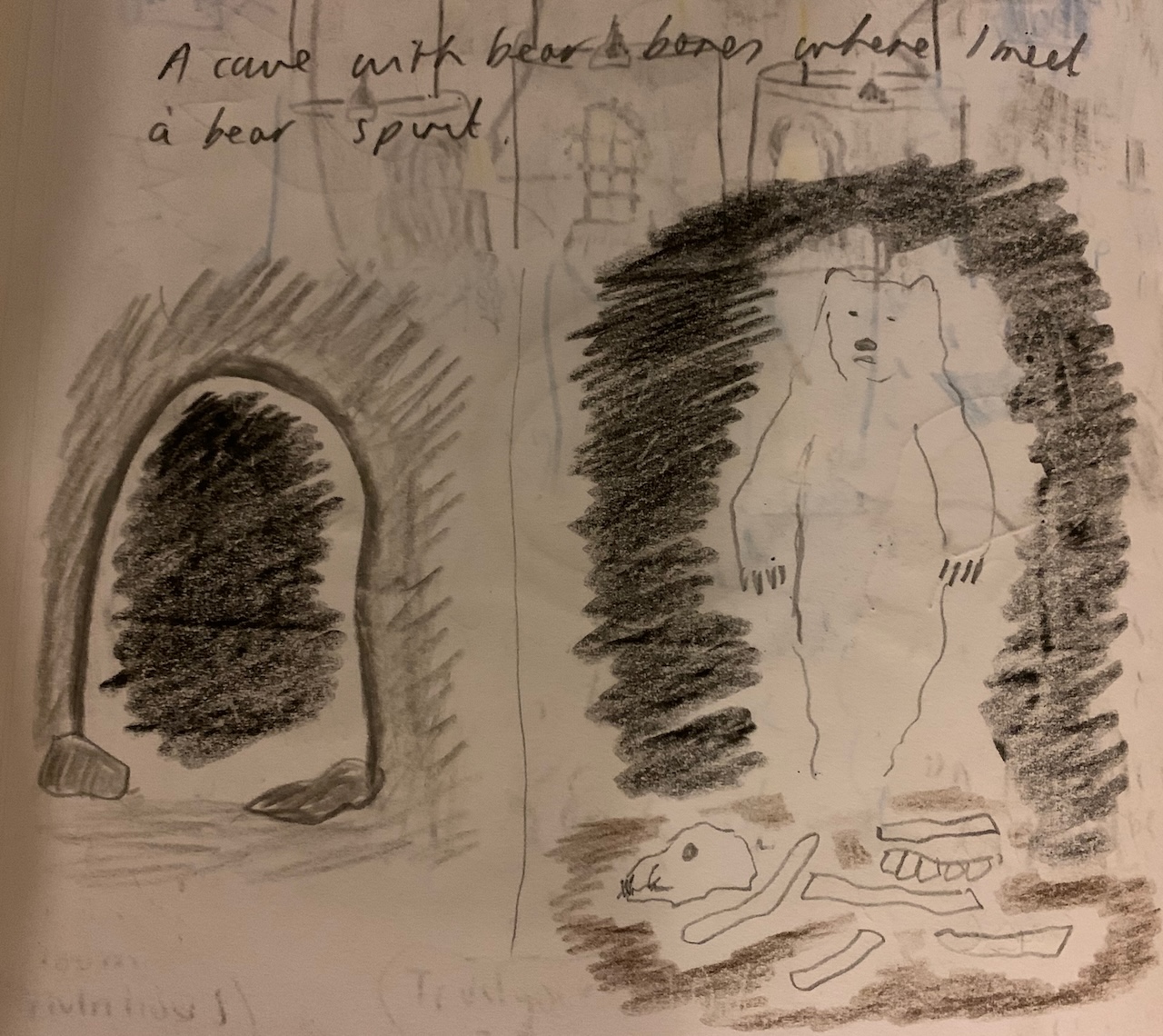
In a journey I narrated to my spiritual mentor I met a bear spirit who took me to witness the unfolding of a numinous vision of a dark castle in a pool with shadowy entities entering and leaving with gifts. I was told I was ‘not allowed to go in’. ‘I must stay still’ and ‘be the witness’. This was very hard as I like to do and understand things rather than simply witnessing. This has stuck with me as a lesson in the appreciation of mystery. 

At the Way of the Buzzard*** Bear Necessities retreat a bear full of stars appeared to me and in a shapeshifting experience showed me how to be more grounded in my body by being aware of all my muscles and slowing down.

Drawing my journeys has not only helped imprint them in my mind but in my body and it is noticeable that I am being encouraged towards embodying insights physically and through movement practices to bring them into my life.

*https://belowthewood.ca
**https://earthlight-images.myshopify.com/
***https://thewayofthebuzzard.co.uk

Review – Polytheistic Monasticism edited by Janet Munin

This is the third time I have read this book. The first was when I was asked to write an endorsement for it prior to publication around 2019. The second was on publication in 2021. This third time round I am re-reading it to refamiliarise myself with the foundations of the movement and for inspiration.

In her introduction editor Janet Munin defines polytheism as ‘the worship of more than one Deity or Holy Power’ and polytheistic monastics as ‘those who take solemn vows to live centred on their relationship with one or more Holy Power.’ For me this definition describing centring one’s life on one or more Deity under vows captures perfectly the core of polytheistic monasticism.

Common features of monastic life are listed as living by a Rule, taking vows and structuring time. Living a devotional life necessitates the renunciation of distractions such as ‘wealth acquisition, social life, media consumption’.

Nine essays from polytheistic monastics* follow. The first two cover the topic of callings. Aine Llewellyn’s short piece was very relatable as they speak about being called to throughly orientate their life around their Gods but finding no existing structures and not feeling monastic enough before returning ‘eyes clearer,’ ‘mind tempered,’ ‘heart opened’. Kimberley Kirner tells of being called by the spirits but not to the priesthood and notes the differences between these vocations – being inward and outward looking, one serving the spirits first and community second and the other vice versa. 

Julie Bond, an early pioneer, describes how she began developing a druidic monastic practice in the 1990s before taking formal vows with the Order of the Sacred Nemeton in 2012. She speaks of developing a system of daily observance based around set times of day and their correspondences, keeping seasonal festivals, a breviary, and adopting a habit.

John Michael Greer shares the story of the conception of the Gnostic Celtic Church Monastery centring on the Rule of Awen and the Hermitage of the Heart. Patricia Christmas is interviewed about being the resident votary at Harvest Home Hermitage and her spiritual and physical work on its 0.8 acre plot.

Danica Swanson speaks of her development of the Blackstone Sanctuary as a place of worship for a number of Norse Goddesses and for a variety of monastic practices including incubation retreats. The rule is ‘Follow the Ways of Non-Contrivance’. Swanson’s principle of ‘sacred endarkment’ – ‘holding respectful space for beings and places of holy darkness’ resonated deeply with me as a nun of Annwn. Her words about an initiation involving a mystical encounter with ‘the Void, the Abyss’ and the need for spaces where we can engage with such states deliberately felt very important and wise.

Rebecca Korvo focuses on reclaiming ‘the custody of the eye’ as a method for ‘pushing out the unholy and toxic’ and turning our attention to the Gods.

Syren Nagakyrie describes polytheistic monasticism as a ‘revolutionary vision’. She speaks of it as a form of resistance to ‘the exploitation of time and labour’, ‘disenchantment’, ‘oppression and devaluation of all beings’ and ‘extraction from the earth’ by ‘making every day sacred’.

Within these pages polytheistic monasticism is covered from a number of angles. As I said in my endorsement it is ‘a defining and much-needed book’. Three reads through I would still highly recommend it as the go-to publication for all people interested in the topic and to practicing pagan and polytheistic monastics who are seeking inspiration from like minds.

As the movement develops with more monastics being called and with online communities such as the Cloister** this book will continue to guide the way.

*With the exception of John Michael Greer.
**https://cloister.bone.blue

Composting with Ceridwen

A couple of years ago our local council stopped taking our food waste for recycling so we decided to get a compost bin. Over this period I have come to associate it with Ceridwen. She has revealed Herself to be not only a Goddess of the Cauldron, a vessel used for cooking, but of a number of other vessels of transformation including our compost bin which takes the bits of food that don’t go in the cauldron (apple cores, onion skins, potato peelings, carrot tops etc.) and turns it into compost for our garden.

I’ve felt Her presence as I’ve learnt how it works, what it likes and dislikes, how to get a healthy balance of the food waste with greens (vegetative material) and browns (paper and cardboard) to make good compost.

One of the startling things that happened was that the comfrey plant I have kept in a pot nearby for many years seeded a number of new plants in the cracks around the compost bin. I thought about pulling them up before I realised comfrey leaves make really good compost and the plants had come to help. They felt like a gift and I believe they are likely to be included in the 365 herbs from which Ceridwen brewed awen.

As the weather grows colder composting time has to an end. The last thing I put into the bin were the pages from my novel-in-progress, In the Deep, which isn’t to be, at least in that format. It feels right to be returning them to Ceridwen, Goddess of the Awen. I pray they will make good compost.

A Timely Dissolution

Hoof falls. The hunt rides. Trampling the falling leaves.

It’s a time of letting go. Of dissolution. Of the banishing of illusions. Of the seeing of the hidden truths that have been haunting the shadow edges of vision.

It hits me like a blow to the chest. Like I’ve been knocked down by a charging horse although I should have seen it coming long ago. Read it from what people have been telling me and moreover from their silence.

My devotional book for Gwyn isn’t meant to be a fantasy style novel. I’ve been reading too much fantasy. I got out of touch. Carried away by the old ambition to be a fantasy writer I long ago promised to give up. 

Understandable perhaps. When I failed to succeed in a career in the environmental sector and realised by autisism places me in a position in which I’m too neurodivergent to cope in above base level jobs but not disabled enough to claim benefits it left me in a very dark and desolate place.

I turned to dark fantasy as the stories of dark and broken characters battling alone in dystopian worlds resonated with me and made me feel less alone. 

I think a lot of this, along with my own feelings of despair, got reflected back into the story I was inspired to write for Gwyn. Getting torn from the womb at birth when His Dragon Mother was slaughtered during the Battle of the Dragons. Being flung into the Abyss. Crawling out. With the guidance of the ghost of His Dragon Mother building His kingdom from the bones of dead dragons and the light of dead stars. Mastering the art of turning sorrow into joy.

Writing this story was deeply meaningful for me and a gift from Gwyn. Quite a lot of the other material I wrote in an effort to combine it with a creation myth featuring the Children of Don and to wed the story of Gwyn, Gwythyr and Creiddylad with some of the material in the Four Branches of The Mabinogion never really worked.

Also, the process of writing a novel, long hours at my laptop, hasn’t been good for me. It makes my eyes go squiffy. I grind my teeth. I twitch. 

I still intend to create a devotional book for Gwyn. I promised Him. I owe it to my patrons. But it isn’t going to be a fantasy style novel. I’m not sure what it is going to be yet but what He and my spirits and my body and soul are guiding me towards are creating it not on the laptop but to allowing it to come through in journeys, meditations, hand writing and drawing. To going back to more traditional forms of creativity that were practiced by awenyddion and monastics and moving away from the screen.

This has come at a time when I’ve also realised I’m living too much of my life online. I deeply value and appreciate the support of my patrons and my online community at the Monastery of Annwn and membership of the Way of the Buzzard Mystery School which are real lifelines. But I’ve come to realise they’re not a substitute for physical community and a physical role in the world. 

What this might look like for me in terms of something that fits with my vocation and with the limits of my autism and social anxiety I don’t know yet.

But this dissolution feels timely as Gwyn’s hunt tramples the fallen leaves, rides down the old, the decayed, the dying, makes way for something new.

Falling Leaves and Wanting to Live

A late autumn. Nos Galan Gaeaf passing. The leaves at last coming down in the fullness of their vivid vibrancy – the yellows of lime and maple and the bronzes of beech whilst the acers on the park shine their reds and oranges.

The trees are letting go. Surrendering. Preparing for sleep. Dying a kind of death.

I’m feeling well. As a result of my practices my physical and mental health is improving. Following an injury I’m running half marathons at my best pace yet.*

Yet, still, after being triggered by a reader’s comments on my book I’m turning the old cogs and being chewed up by an old destructive thought pattern. ‘If my readers don’t like my writing I will lose my audience, I won’t make any money, I will have to return to proper paid work and forfeit my time for spirituality and creativity, meaning my mental health will deteriorate, leaving me with the choice between a living death and death.’ 

For a few days I considered totally rewriting my book to fit better with what I thought those in my audience who are Celtic Polytheists and Druids might want or expect by removing some of the darker and more gory scenes that are based on my personal gnosis about the story of Gwyn/Vindos and His interactions with the serpents of Annwn but this led to total paralysis. I realised it wasn’t what He wanted and ultimately the book is for Him.

I then perceived I’d slipped back into the false belief I could make a living as a professional author, which I promised Gwyn I would give up over ten years ago, had thought I’d given it up, but was unconsciously still clinging onto it.

In a journey with the Way of the Buzzard Mystery School** I performed a rite of letting it go with puffin – viscerally vomiting it up as a huge and toxic fish.***

This done I’m still turning those darned cogs. ‘I can’t make a living from my writing so when my savings run out I will be faced with the choice between living death and death.’

Then, entirely expectedly,  a voice from within, a voice from my healthy body, from my life force, from my spirit, ‘I WANT TO LIVE.’

This was utterly astonishing because, in my existing memory, I cannot remember once thinking ‘I want to live.’ Since I started primary school most of my life has been a battle against ‘wanting to die’ so this signals a vast change.

I believe this comes from having arrived at a monastic lifestyle that suits me centred around devotional creativity in service to my Gods. This incorporates practices that nourish my well being and relationship with Them such as meditation, journeywork, yoga, running, strength training and good nutrition (giving up alcohol has been a big factor) along with cleaning, gardening and litter picking as service to my home and local greenspace. It has also been a great help having the support of my spiritual mentor, Jayne Johnson.

I think my letting go ritual at this time of leaf fall also played a big role.

Much of my fear lies around having to give much of this up to earn a living when my savings run out. I haven’t found a solution yet but it seems a huge step forward to have my inner impulses on board, not to want to die but to live. To be recognising my negative thought patterns and stopping fighting myself.

Those cogs fixed in my mind by the capitalist system I smash, I trample, I cast down amongst the fallen leaves to rust, to rot, to die, so I can live. 

*Last year’s PB was 1:54:55 and since recovering from my sciatic nerve injury I have bested it by nearly six minutes with 1:49:02 – well above average for a 42-year-old female.
**The Way of the Buzzard Mystery School website can be found HERE.
***The images from my journey book recording my journey with puffin.

Evidence of Monks of Annwn in The Book of Taliesin?

Inbetween my decision to rewrite In the Deep and beginning I decided to return to some of the source material. I had been avoiding The Book of Taliesin for a long long time because, as a devotee of Gwyn ap Nudd, a King of Annwn, I find his support of Arthur in the raiding of Annwn (1) and of Lleu and Gwydion in battling against Annuvian monsters (2) incredibly emotive.

Still, I took another look, and didn’t find anything I hadn’t remembered. And Taliesin’s warmongering and bragging had got no less annoying.

Then, when, I was out running this morning I found my mind wandering to Taliesin mocking ‘pathetic men’ (monks) who do not know when God / the Lord, potentially Pen Annwn ‘Head of the Otherworld (3), was born / created then referring to monks who ‘congregate’ or ‘howl’ (4) like a pack of dogs’ and ‘like wolves’ ‘because of the masters who know’ the answers to certain riddles such as ‘the wind’s course’, ‘how the light and darkness divide’.

I had always assumed those monks were Christians but as I was running the question came into my mind, ‘What if they were monks of Annwn?’ 

*

My first intimation of the possibility of the existence of previous monks and nuns of Annwn occurred during my night long vigil for my lifelong dedication to Gwyn.

I spent the first six hours alone in my friend’s living room drawing a card from the Wildwood Tarot for each hour. My first card was the Four of Vessels – Boredom. Disappointing. But not unexpected. So I sat and surrendered to the likelihood the first hour was likely to be very boring. But instead of getting bored I got very lonely and found myself lamenting that I had no tradition to follow, no-one else for support in making such deep vows to Gwyn.

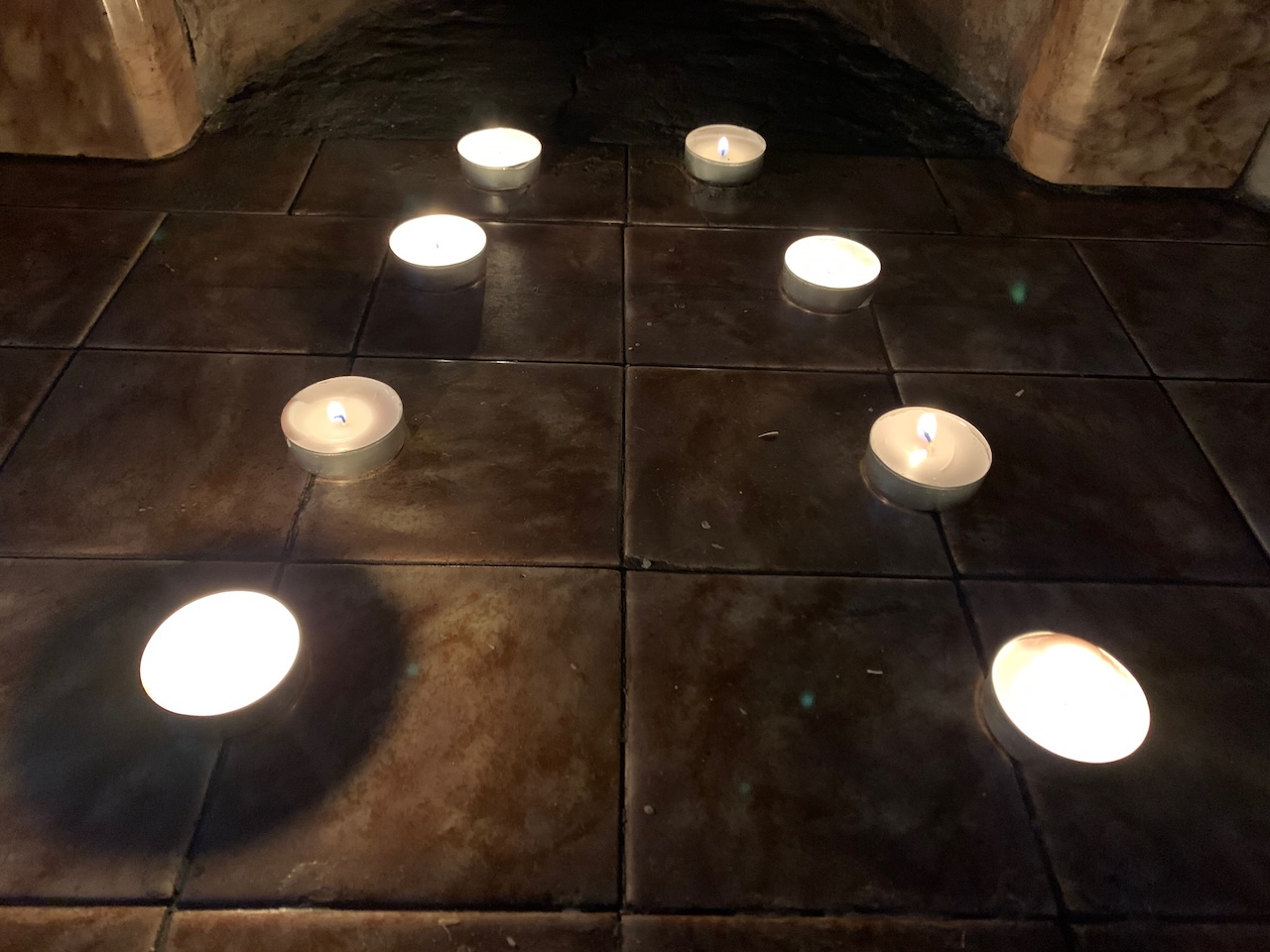
Then I had a vision. I was no longer alone. I was in some kind of underground shrine, chapel, or tomb, with long lines of monks and nuns wearing dark robes carrying candles before and behind me. 

I had always thought they were monastics from other traditions who walked similar paths and had come to provide me with company but now I’m wondering if they might have been past and future monastic devotees of Annwn.

*

This reasoning might seem a bit wild particularly considering there is no evidence for monks or nuns of Annwn in Brythonic literature or lore. 

However, if we look at those lines from Talieisn, first off we find them in Preiddeu Annwn ‘The Spoils of Annwn’ wherein the bard accompanies Arthur on his devastating raid on Gwyn’s realm from which only seven return. 

Secondly, the monks are exhibiting extremely strange behaviour for Christians – congregating or howling like dogs or wolves. This would make far more sense if they were devotees of Gwyn who is associated with a red-nosed hound called Dormach (5) and the Cwn Annwn ‘Hounds of the Otherworld’ (6) and whose father, Nudd, is referred to as ‘the superior wolf lord’ (7).

Thus, it might be argued, Taliesin is taunting monks of Annwn with accusations of not knowing the mysteries of their God – Pen Annwn – when He was born / created, of the source of the wind, the division of light and darkness. These seem bound up with Annw(f)n (from an ‘very’ and dwyfn ‘Deep) as the primordial reality that ‘underlies or underpins our known universe’ (8).

*

Even further, another of Taliesin’s taunts, is that they do not know ‘how many saints are in the void, and how many altars’. Again it would seem odd if saints and altars were consigned to ‘the void’ rather than raised to the Christian Heaven. If they were Christians… yet the consignment to the void of Annuvian saints and altars would make a lot more sense. 

Read into this more deeply and we find the disturbing possibility there existed monastic devotees of Annwn with saint-like qualities who with the altars of their Gods were committed by the likes of Taliesin and Arthur to the void. 

It is notable here ‘void’ is translated from diuant ‘space, void, annihliation, death’. These monastics have not returned to Annwn, ‘the Deep’, the regenerative deep home of their God but have instead been annihilated. Their names and memories chillingly wiped by Christianity from existence. 

Could it be their voices I hear from the void at this time the veil is thin?

(1) In ‘The Spoils of Annwn’, 
(2) In ‘The Battle of the Trees’.
(3) Potentially the Christian God but another possibility is Pen Annwn, the Head of the Otherworld, as in the second instance ‘Lord’ is translated from Pen.
(4) Margeret Haycock’s translation reads ‘congregate’ and Sarah Higley’s ‘howl.’
(5) In ‘The Conversation of Gwyn ap Nudd and Gwyddno Garanhir’.
(6) In the story of Iolo ap Huw in John Rhys Celtic Folklore. 
(7) In ‘The Pleasant Things of Taliesin’. 
(8) Kristoffer Hughes, ‘The Thirteenth Mount Haemus Lecture: Magical Transformation in the Book of Taliesin and The Spoils of Annwn’.

Lyke Wake Dirge – Pagan Version for Gwyn ap Nudd

This is a ‘paganised’ version of Lyke Wake Dirge – a North Yorkshire folk song that tells of the passage of the soul. Traditionally the last line of the refrain reads ‘And Christ receive thy saule’ and the journey leads to ‘Purgatory’s fires’. Here it is rewritten and sung for my patron God, Gwyn ap Nudd, a ruler of Annwn and guide of souls on Nos Galan Gaeaf when he rides with His hunt to gather the dead.

Lyke Wake Dirge

This ae nighte, this ae nighte,
(Refrain:) —Every nighte and alle,
Fire and fleet and candle-lighte,
(Refrain:) — And He’ll receive thy saule.

When thou from hence away art past,
(Refrain:) —Every nighte and alle,
To Whinny-muir thou com’st at last;
(Refrain:) — And He’ll receive thy saule.

If ever thou gavest hosen and shoon,
(Refrain:) —Every nighte and alle,
Sit thee down and put them on;
(Refrain:) —And He’ll receive thy saule.

If hosen and shoon thou ne’er gav’st nane
(Refrain:) —Every nighte and alle,
The whinnes sall prick thee to the bare bane;
(Refrain:) —And He’ll receive thy saule.

From Whinny-muir when thou may’st pass,
(Refrain:) —Every nighte and alle,
To Brig o’ Dread thou com’st at last;
(Refrain:) —And He’ll receive thy saule.

From Brig o’ Dread when thou may’st pass,
(Refrain:) —Every nighte and alle,
To Annwn’s fire thou com’st at last;
(Refrain:) —And He’ll receive thy saule.

If ever thou gavest meat or drink,
(Refrain:) —Every nighte and alle,
The fire sall never make thee shrink;
(Refrain:) —And He’ll receive thy saule.

If meat or drink thou ne’er gav’st nane,
(Refrain:) —Every nighte and alle,
The fire will burn thee to the bare bane;
(Refrain:) —And He’ll receive thy saule.

This ae nighte, this ae nighte,
(Refrain:) —Every nighte and alle,
Fire and fleet and candle-lighte,
(Refrain:) —And He’ll receive thy saule (x2).

*This version was first sung by Nina George and my performance group Guests of the Earth at the launch of my third book, Gatherer of Souls, in 2018. I have been singing it this time every year since to aid the passage of souls.