Building Brythonic Polytheistic Monastic Practices Part Two – Meditation

Meditation is most developed in the Hindu and Buddhist religions. The earliest references to meditation are in the Vedas from around 1500 BC. In Hinduism the aim of yoga – a combination of meditation (dhayana), breathwork (pranayama) and body postures (asana) – is to still the mind, liberating it from sensory distractions and ultimately from the cycle of death and rebirth, unifying the self (atman) with the Gods (the Brahman or Shiva). In Buddhism the aim of meditation is to reach enlightenment, which resulted in liberation from the cycle of reincarnation as a buddha ‘awakened one’.

These forms of meditation begin with training the mind to focus on one thing – usually the breath. Other subjects of meditation include nature and virtues. Both employ the chanting of sacred syllables to still the mind. Tantric practices involve meditating on and attaining union with a multitude of Deities.

In Christianity meditation is a form of contemplative prayer. Discursive meditation is rooted in the scriptures and involves imagining oneself in the stories, in the shoes of the protagonists, to develop a deeper understanding. Lectio Divina focuses on passages of scripture and has four phases – Lectio (read), meditatio (reflect), oratio (respond) and contemplatio (rest).

Unfortunately I haven’t been able to find any references to meditation in ancient polytheist cultures. The only evidence I have found is the image of the antlered Deity on the Gundestrup Cauldron (150 BC) who is sitting in a meditative position and bears a striking resemblance to Shiva the ‘Lord of Yoga’.

The cauldron is of Celtic La Tène period design and the antlered figure has tentatively been identified as Cernunnos, ‘Horned’, which might be a Gaulish title for Vindos / Gwyn ap Nudd, who I believe is pictured on another plate plunging dead warriors into a vessel headfirst to emerge as riders on His hunt. 

*

When I came to Paganism and Polytheism the first type of meditation I came across was guided meditation, which involves being guided by written words or voice into imaginal landscapes to meditate in safe places or meet with Deities. 

Examples include meditations leading to an inner grove, a spring, or a tree, or another form of sanctuary, meeting Brigit at a well or Cernunnos in a woodland. To the best of my knowledge this type of meditation originated in the Western esoteric tradition with groups like the Hermetic Order of the Golden Dawn and Thelema and was later taken up by Wiccans, Druids and polytheists.

The way I see guided meditation to work is that one must first consciously imagine the scenery (our imagination is one of the tools by which we connect with the Divine) and this act of imagining creates an interface through which the spirit realm speaks. In my experience it is an act of co-creation. Some comes from one’s own imagination and some from the spirit realm in varying degrees and intensity. On some occasions I’ve remained within my imagination and felt like the scenery and Gods are nothing more than cardboard cut-outs and on others I have found myself in lands that are not of my imagining, entirely other, having genuine conversations with the Gods.

Through Druidry I learnt ways of working meditatively with the Brythonic myths by entering into them and standing in the shoes of some of the Deities. Most notably Afagddu, when Taliesin stole His awen and the Cauldron of Ceridwen shattered leaving Him with its poisoning of Gwyddno’s lands.

I also developed a practice akin to Lectio Divina drawn from creative writing workshops in which I meditated on a line or a scene from a medieval Welsh story or poem, then did free writing around it, then crafted it into a finished piece.

*

It’s only over the last couple of years I’ve looked into more traditonal forms of mediation. As a Brythonic polytheist I steered clear of the ‘Eastern’ traditions until I learnt that India and Europe shared an Indo-European culture and there are lots of resonances between Hindu and Brythonic beliefs.

Last year I started practicing yoga and integrating meditation, breathwork and body postures into my practice on the basis of a revelation of the Gundestrup Deity as ‘Meditating Gwyn’ as a way of unifying myself with Him.

At the core of my practice is uniting my breath with Gwyn’s breath, my heart with His heart, being as present in my body as possible so He and my other spirits can experience presence in Thisworld through their union with me.

When I first tried focused meditation I found it incredibly difficult (and still do). I avoided it for a while sharing the beliefs of many others that Eastern meditation isn’t for Westerners and isn’t suitable for our busy Western minds.  This changed when I discovered the Breathe and Flow yoga channel and Bre mentioned that if something is difficult it’s often the thing we need most. 

I started practicing focused meditation with their Expand programme and particularly benefited from their meditation, ‘Refocus’, which describes the benefits of stilling our busy ‘monkey minds’, shifting from sympathetic to parasympathetic states of the nervous system and rewiring our neural pathways. This meditation is very useful as every couple of minutes there are reminders, if thoughts have begun to trickle in, to return the attention to the breath. When I meditate alone it often takes longer to catch myself thinking.

Learning from Breathe and Flow that by focusing on and changing my breath I can control my mind and my emotions has been life changing in helping me manage my anxiety and panic which were beforehand often out of control.

I’ve been inspired to adapt some of the pranayama practices to fit with my spiritual path. Sama vritti, ‘box breathing’ (inhale, hold, exhale, hold), I do to a count of seven heartbeats to unite myself with ‘the Breath of the Gods’. Nadi shodhana, ‘alternating nostril breathing’ I use as a way of balancing the red and white dragons, fire and mist, strength and calm. Dirga ‘deep breathing’ and ‘sleep breath’ (4-7-8) I associate with the healing states of Nodens.

As I have learnt the body postures I have come to link some with my Deities and with various animals in the Brythonic myths. Suptka Baddha Konasana ‘reclining bound angle pose’ is Anrhuna as Mother of Annwn and Parsva Savasana ‘side corpse pose or foetal position’ is foetal Gwyn. Tadasana ‘Mountain Pose’ and Utkata Konasana ‘Goddess pose’ invoke the strength of Anrhuna. Adho Mukha Svanasa ‘downward dog’ and ‘Uttana shishosana ‘puppy pose’ are Gwyn’s hounds or the healing dogs in the temple of Nodens.

The medley of animals, Marjaryasana ‘Cat Pose’, Bitilasana ‘Cow Pose’, Mrigasana ‘Deer Pose’, Catur Svanasana ‘Dolphin’ puts me in mind of the animals surrounding the antlered God on the Gundestrup Cauldron and I wonder if the flows between the poses might have been based around stories featuring sacred animals such as the search for Mabon.

The power of these practices and the changes they have brought about in my life have led me to believe that what we know about the Bardic Schools and their twenty-year programmes for memorising poetic forms and traditional tales is but the remnant of a deeper spiritual tradition in which the stories were meditated on and embodied and lived as mythic realities.

Building Brythonic Polytheistic Monastic Practices Part One – Prayer

In building Brythonic polytheistic monastic practices I feel at once like a pioneer because few people are doing this specific work today but at the same time like I’m standing on the shoulders of thousands of ancestors because since homanids arose the majority have been animists and polytheists.

Since I came to Brythonic polytheism through Paganism and Druidry over ten years ago I have been developing my practices and deepening them further as a monastic since I took vows as a nun of Annwn in 2022.

My main practices are prayer, meditation and trance. These lead into and complement one another and their boundaries can be permeable. Here I will provide my personal understandings and how I have come to them through studying their development in ancient and contemporary polytheisms and current mainstream religions then share how I put them into practice.

Prayer

The first and foremost of my practices is prayer. Prayer, in its most basic form, is conversation with the other-than-human worlds and persons. Indigenous people have always lived in dialogue with the land and its spirits, the Gods and the ancestors, with prayer permeating their lives from rising to sleeping. 

People have likely been praying for as long as they can speak. Some of the earliest recorded examples of polytheist prayers are the Litany of Re from the Egyptian New Kingdom (16th – 11th BC) and the Homeric Hymns (7th BC).

The hegemony of Christianity brought about a shift in focus in prayer from the land and its Deities to one transcendent God and the saints. The rise of rationalism, materialism, industrialisation and capitalism have all played a role in putting into doubt and in erasing beliefs in Gods and spirits. One of the main problems with Western society is that we’ve forgotten how to pray.

Within the current mainstream religions Christianity has the most developed system of prayer and meditation is seen to be a form of contemplative prayer. 

Prayers can be formal (written prayers that are often memorised) or informal (personal prayers in one’s own words often taking the form of a dialogue). Some of the most common forms of prayer are praise / adoration, thanksgiving, petition / supplication, confession, and intercession. Other prayers are written for the marking and celebration of Holy Days.

*

Unfortunately we don’t have any evidence of prayers to the Brythonic Gods because the ancient Britons did not write anything down. However, archaeological evidence shows they made offerings of bones, pottery, jewellery, weapons and other objects in sacred places such as hill-tops, springs, rivers, lakes, bogs, in pits and shafts, and in or near burial mounds. Such offerings were undoubtably accompanied by prayers and ceremonies. 

Much of our knowledge of the Brythonic Gods comes from Romano-British altars and temples wherein they were often equated with the Roman Gods (for example Apollo-Maponos, Mars-Nodens, Sulis-Minerva). The vast numbers of Romano-British curse tablets recovered from sacred sites show people were petitioning the Gods for aid against those who had wronged them.

We also find references in Roman texts to ancient Gaulish and British rituals. Most of them describe sacrifices of animals and humans. These ceremonies  (and others less bloody) likely opened and closed and were punctuated with prayers to the Gods who were the recipients. Tacitus describes black-clad women with fiery brands and Druids raising their hands to the skies in prayer to call upon the Gods for aid against the Roman invastion of Anglesey.

These more extreme examples presuppose an underlying relationship with the Gods founded on prayer and reciprocity common amongst the general populace.

By the time the stories of the Brythonic Gods were written down in the medieval period Britain had been Christianised and all but Wales Anglicised. The Gods appear in the texts in euhemerised form (eg. Maponos as Mabon, Matrona as Modron) but the only prayers to be found are to the Christian God.

*

This has meant Brythonic polytheists have had to begin writing prayers from scratch, building on the forms found in ancient polytheisms and other religions.

Thankfully we’re not alone. The rise of the polytheist movement has given birth to numerous devotionals featuring prayers from publishers such as 

Bibliotheca Alexandrina and Moon Books and from independent authors and editors.

I worked with Dun Brython building devotional material for several years. On the website and in the devotional anthology The Grey Mare on the Hill can be found a variety of prayers to Brythonic Deities with a focus on Rigantona / Rhiannon.

Pauline Kennedy’s ‘Prayer for Epona Rigantona’ is an excellent example of praise.

‘Epona of Horses, I praise you!
Rigantona of the Land, I praise you!
Epona of Sovereignty, I praise you!
Rigantona of Journeys, I praise you!
Epona of Stables, I praise you!…’

‘Rigantona: Calan Gaeaf’ by Greg Hill is a seasonal prayer marking the first day of winter.

‘By Orion’s light
At the dark of the moon
Now the hawthorn tree is bare

A shadow passes through the veil
Of the Otherworld on a Grey Mare

Rigantona; roses wither on your altar
But we keep your vigil here.’ 

Albion and Beyond is an active Brythonic polytheist group committed to sharing information and resources and to building community. Here there is a section on the Bardic Arts with poetry for Andraste, Cocidius, Maponos and Nodens.

‘Cloud-Maker’ by Nico Solheim-Davidson praises Nodens and petitions Him for rain.

‘Nodens, Iron-handed ruler
Cloud-maker, dream-catcher
Hound-master, net-thrower, rain lord. 
Waters of deep Dumons you ride,
Turning to rain, the provider…
Guide us Iron-Hand to good times,
As we turn our praise to you, lord.
Come fast cloud-chasers, mist-racers,
Bounding and bustling in the sky,
Bring unto us your rapid rains, 
Fill the heavens with your dark cloaks.’

*

My personal practice began mainly with informal prayers to Gwyn, my patron God, and His family and my local spirits along with formal prayers for Holy Days. Since I became a nun I have been using more formal prayer – some prayers I have written myself and shared prayers of the Monastery of Annwn.

I get up at 4am and begin my morning prayers with a statement of intent to honour Gwyn. Speaking His name as the first word after I have got up and the last word before I go to bed has become increasingly important to me.

This is followed by prayers of praise to the Spirit of the Monastery, the spirits of place, the ancestors, and Gwyn and His family then formal prayers for Gwyn. These include both written prayers and songs. In the summer, when Gwyn is absent, every morning I sing a seasonal song called ‘You Are Gone.’ 

‘Dawn arrives but You are gone,
the birds are singing yet You are gone,
the flowers are turning their petalled heads
Towards the sun but you are gone…

You are gone but Your haunting 
is everywhere with Your promise of return…’

I also read a shared prayer of the monastery, ‘In Summer We Miss You.’

‘In summer we miss You 
We miss You like we miss the rain
but we know You will return again
like the raindrops on our window panes…’

This is followed by informal prayer which usually includes adoration and petition. ‘Gwyn ap Nudd, my lord, my teacher, my inspiration, my beloved, I appreciate the sacrifice You made through your death and sleep so summer can come. I am grateful for Your tireless work through the winter gathering souls. You are the Heart of my Heart, the heartbeat of my heartbeat, keeping me alive and strong. I pray to You today I might be more present, compassionate, loving, as You love me and all the souls You gather…’ Time is also spent simply being with Gwyn and listening to what He has to say.

My evening prayers take a similar form but with thanksgiving in the place of praise and ‘confession’ in the place of petition. Here I don’t mean confessing sins as such but sharing what I’ve done during the day and getting any mistakes and failures off my chest. ‘I’ve worked hard today on Your book but I got side-tracked by wondering if anyone has checked in on my blog…’ I spend time in communion with Gwyn and playing a heartbeat on my drum to bring my heart into alignment with His.

Finally, I pray to Nodens for as my God of dreams, then I say farewell to Gwyn.

An example of my daily prayers from last October can be viewed HERE. 

I am also striving to become more prayerful in my daily activies. To see writing, exercising, cleaning, cooking, gardening as forms of prayer. This doesn’t come easily to me as someone who has been very task / goal rather than relationship orientated for most of my life and is one of my biggest challenges.

Married to Gwyn in Life and in Death

I have an announcement to make. A happy announcement. One that may come to you partly as a surprise and partly not at all (as it did to me). 

Gwyn and I got married! – A sacred marriage between a God and a nun of Annwn.

The moment Gwyn and I met and He revealed His name and His face I fell in love with Him and knew that I’d known Him from time’s beginning. 

It’s taken a long time for me understand the nature of that love, which has taken many forms – of the love between patron and devotee, of teacher and apprentice, of inspirer and inspired one, of truth and one who receives truths.

For many years that we might be beloveds – married as bride and groom, husband and wife – was completely unthinkable to me as someone who is asexual and aromantic and found the language of love soppy and sentimental. 

Another reason is that although Gwyn saved my life and my sanity and has been there for me through the toughest of times it’s taken me a while to become open to the possibility that He cares about me let alone loves me.

This changed when I had my first soul retrieval with my spiritual mentor, shamanic practitioner and wild therapist Jayne Johnson, in March. Jayne knew Gwyn is my patron God but didn’t know the meaning of Gwyn ap Nudd, ‘White son of Mist’ or His earlier name Vindos / Vindonnus ‘White / Clear Light’ or about His associations with Gwynfyd, ‘Paradise’. 

Before we began Gwyn told me He would oversee the soul retrieval and I told Jayne. The landscapes she journeyed were covered with mist and she came across an area of thick mist and an incredibly bright light and felt confused – like she was in the upperworld although she was in the lowerworld. The mist revealed an ancestor who led her to my lost soul part –  the young girl who had fled the trauma of school to the stables. Gwyn appeared to carry her back and Jayne blew her into my heart. The experience was incredibly moving and I was astonished to learn Gwyn cared.

This tied in with my experiences of the Heart of Annwn as Gwyn’s Sacred Heart. Of my playing a heartbeat on my drum every night to unite my heart with His and with my offering my heart to Gwyn several years ago and its travails in fire and ice before Him returning it to me on His feast day last year. 

More recently attending a shamanic workshop in London led me to discovering the Tyburn Convent and the Christian mystics whose experiences of the Sacred Heart of Jesus related to mine with the Sacred Heart of Gwyn. In the writings of these Brides of Christ I found descriptions of sacred marriage as a spiritual union that was neither sexual or romantic.

At the workshop, for the first time, I practiced being possessed by my spirits – my winged horse, my hounds, my crows, Orddu and all her ancestors. My teacher, Simon Buxton, described this as a form of sacred marriage / hieros gamos.

When I returned home, Gwyn asked, “Why have you denied me?” 

I could provide no answer beyond my fears of that kind of intimacy with a God so intense, so terrifying, so beautiful and of what other people might think.

On Nos Galan Mai He asked the question: “Will you marry me in life and in death?”

Knowing I couldn’t deny my love for Him, His for me any longer, I said “Yes.” 

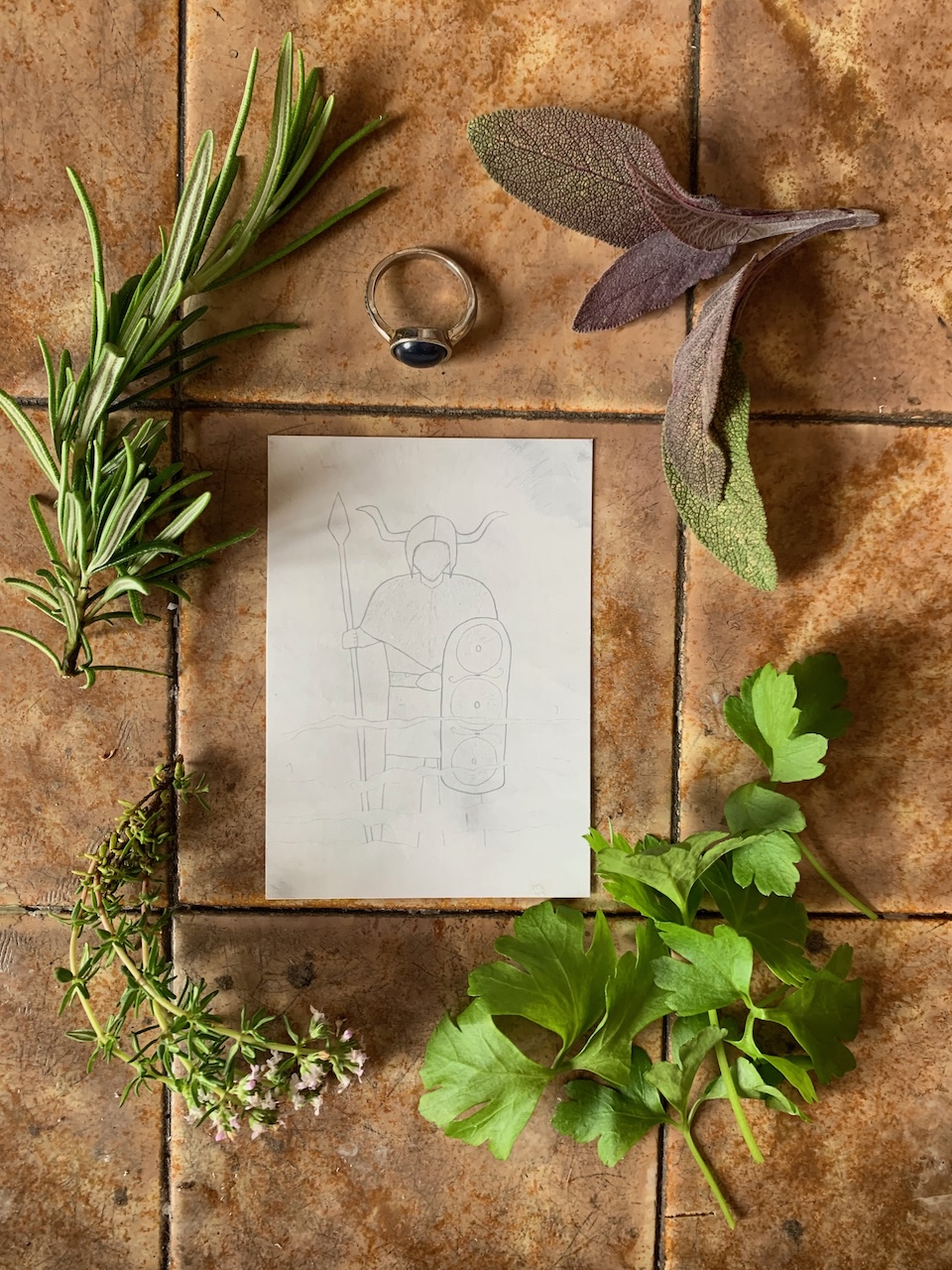
On Nos Galan Mai we got married in life. An amusing side story – how I got the ring. Many years ago I was told to get a ring as an offering for the river Defwy, a river in Wales that is also a Brythonic river of the dead, and found a fitting ring with a black stone in a charity shop. It turned out I never visited. Gwyn admitted it was a trick as I would never have got the ring otherwise. It turns out it fits perfectly on my wedding finger – He knew I’d marry Him then!

After Gwyn fought his yearly battle with Gwythyr on Calan Mai and died and returned to sleep in His tomb in His Castle of Cold Stone I married Him in death. This took place as the finale of a shamanic burial ritual. I have rewritten the Yorkshire folk ballad, Scarborough Fair (in which a woman completes impossible tasks to win a fairy lover), loosely based on my experiences.

The Land of the Fair

Chorus: 

Are you going to the Land of the Fair
Parsley, sage, rosemary and thyme
Remember me to one who lived there
For she once was a true love of mine

Verses:

Tell her to build us a coffin of wood
Parsley, sage, rosemary and thyme
From no tree that ever has stood
And she will be a true love of mine

Tell her to dig the deepest of graves
Parsley, sage, rosemary and thyme
Without a pick axe or a spade
And she will be a true love of mine

Tell her to seal our burial tomb
Parsley, sage, rosemary and thyme
Without hammer or nails return to the womb
And she will be a true love of mine

I can’t say anything else about our sacred marriage in life and death only that  as the final result of it Gwyn has become ‘the Heart of the my Heart’. He is within me, me within Him, like in the mystical unions of the Brides of Christ. 

My heart has been opened to Gwyn, through this opening to others, to the nuptial spirituality of the Mystics of the Sacred Heart and fellow godspouses.

I am now happily married as a nun of Annwn and Bride of Gwyn.

Interior Castles – The Journeys of Saint Teresa and Arthur

Two castles – crystal, shining, illumined from within by the light of a glorious King. Each has seven appearances. Outside are venomous monsters. 

Two journeyers – a nun and a warlord. One goes to marry the King, one to kill Him.

The Vision

Theresa

She is gifted a vision of a ‘beautiful crystal globe’ ‘in the shape of a castle’ ‘containing seven mansions, in the seventh and innermost’ ‘the King of Glory, in the greatest splendour, illuminating and beautifying them all.’ (1)

‘A castle made of a single diamond or of very clear crystal, in which there are many rooms, just as in Heaven there are many mansions… some above, others below, others at each side; and in the centre and midst of them all is the chiefest mansion where the most secret things pass between God and the soul.’ (2)

Outside ‘foul, dark, infested with toads, vipers and other venomous creatures’. (3)

Arthur

He hears rumours of ‘the Glass Fort’ (4) ‘a tower of glass’ ‘in the middle of the sea’ (5). ‘Amid the land a castle tall’, shining as ‘crystal’, a hundred towers lighting the sky, ‘of diamond… battled stout’, lit from within, sparkling with ‘unearthly light’. Jewelled stones shining forth a light ‘like sunbeams.’ (6) The King glistening so bright, shining so hot none can gaze upon him. (7)

‘The fairest castle’ with ‘the best appointed troops,’ ‘minstrels,’ ‘music,’ comely youths, elegant maidens, in the midst ‘the king sitting in a golden chair’ offering ‘every dainty and delicacy’, ‘every drink and liquor,’ ‘every luxury of courtesy and service, of banquet and of honourable entertainment.’ (8)

Outside ‘a great scaled beast’ with ‘a hundred heads’, a battalion ‘beneath the root of his tongue’ and ‘in each of his napes’. ‘A black forked toad’ with ‘a hundred claws’. ‘A speckled crested snake’ torturing a hundred souls in her flesh. (9)

The Fortress of Impediment

Teresa

She goes with her sisters and tells them not to fight against the ‘snakes and vipers and poisonous creatures’ who ‘prevent the soul from seeing the light.’ She tells them they are nothing but dust in their eyes obscuring their vision. (10)

Here the soul is deaf and dumb. The ears must be opened, the tongue loosened. ‘The door of this castle is prayer’. (11) Not just vocal prayer, but mental prayer, ‘for if it is prayer at all, it must be accompanied by meditation. If a person does not think Whom he is addressing, and what he is asking for, and who it is that is asking and of Whom he is asking it, I do not consider that he is praying at all even though he be constantly moving his lips.’ (12)

Teresa and her sisters open the door with their prayers and are guided in.

Arthur

He takes ‘three loads of Prydwen’ and storms ‘Hell’s gate’ without a prayer. (13) Taliesin, with ‘two keen spears’ ‘from Heaven’ from ‘the streams of Annwn’ (14) pierces the monsters (15) but they do not die. They grow more heads and form a dark fog swelling like motes in the corners of every eye.

Battle-weary at last they find, or are found by, the glass fort, ‘six thousand men’ ‘standing on its wall’, its uncommunicative watchman. ‘Covered with men, to whom they often spoke, but received no answer.’ (16) Who is deaf and dumb?

Arthur and his warriors fight and break their way through the fortress door. 

The Four-Cornered Fortress

Teresa

Teresa and her sisters still find it hard to speak yet can hear. ‘These souls’ ‘understand the Lord when He calls them; for, as they gradually get nearer to the place where His Majesty dwells, He becomes a very good Neighbour.’ ‘He calls them ceaselessly, time after time, to approach Him; and this voice of His is so sweet that the poor soul is consumed with grief at being unable to do His bidding immediately’ so ‘suffers more than if it could not hear Him.’ (17)

It seems to come from all four corners of the fortress and Teresa’s sisters rush from one to the next in longing and she is forced to still them, tell them to listen. She reminds them their King is in the centre, the midst, infinitely patient. ‘His Majesty is quite prepared to wait for many days, and even years, especially when He sees we are persevering and have good desires.’ (18)

Arthur

A song is heard ‘in the four quarters of the fort revolving to face the four directions’. (19) Arthur tells his men to put their hands over their ears, to ignore its sweetness, the seductive music of the minstrels, the pipes and harp.

‘A song is heard in the four quarters of the fort, stout defence of the island.’ (20) The calling of the King is ceaseless and Arthur’s men rush from corner to corner, until Arthur takes the middle, tells them ‘I am King’, ‘hear no more.’

The Petrification Fort

Teresa

They spend ‘long periods of aridity in prayer’ (21) learning to be ‘humble’ not ‘restless’ (22). They face the testing of when His Majesty ‘withdraws His help’ (23)

It’s cold, so cold, in the Petrification Fort, they are tempted to close their hearts. To make them hard and solid as ice when their prayers are not fulfilled. 

They progress at a slow pace by penance and renunication of themselves.

When all their desires have run dry they hear the flow of fresh water mixing with jet and know their petrified hearts are melting and opening to the source.

Arthur

Cold and hard the fortress. Cold and hard the walls. But not cold and hard as the hearts of Arthur and his warriors who have slain a hundred witches and giants.

They listen not. They pray not. When ‘fresh water and jet are mixed together’ (25) they hear it not. When servants dressed in blue and red arrive to set ‘sparkling wine their drink’ ‘in front of their battalion’ (24) they slaughter them.

Blood and wine run crimson through the frozen corridors of the fort. 

The Fortress of the Silver-Headed Beast

Teresa

Teresa and her sisters ‘are now getting near to the place where the King dwells, they are of great beauty and there are such exquisite things to be seen and appreciated in them that the understanding is incapable of describing them’ ‘without being completely obscure to those devoid of experience.’ (26)

‘The water comes direct from its source, which is God, and, when it is His Majesty’s will and He is pleased to grant us some supernatural favour, its coming is accompanied by the greatest peace and quietness and sweetness’. (27) It enlarges the heart and dilates the soul. No effort is needed ‘for the Lord gives when He wills and as He wills and to whom He wills.’ (28)

The thaw is complete and the water rushes through the veins of the nuns. Teresa perceives a vision of the Lord as a silver-haired child riding a beast with a silver head and He laughs and He whispers to her the answers to the riddles about which day He was created and the mysteries of His birth at noon.

Arthur

Arthur’s frustrated, Taliesin too, at being ‘stuck with pathetic men, with no go in them.’ (29) The fortress is still cold, his warriors bent, buckled, as old men. Their joints creak, there is snow in their hair, hoar frost coats their beards.

A voice mocks ‘those who don’t know on what day the Lord was created, when, at noon, the ruler was born, what animal they guard with his silver head’. (30)

When finally they reach the centre of the fortress and kill the guards they find nothing but a bishop’s crozier, a silver-headed crook, the head of a cold old man.

The Fortress of God’s Peak

Teresa

A lovely land of water-meadows, aurochs grazing, horses on the green hills. A surprise the arrows shooting from the fortress as if from the bow of a Hunter.

Each nun is wounded by an ‘arrow of fire’ not ‘where physical pain can be felt, but in the soul’s most intimate depths. It passes as quickly as a flash of lightning and leaves everything in’ their ‘nature that is earthly reduced to powder.’ (31)

‘The soul has been wounded with love for the Spouse and seeks to be alone.’ (32) ‘It has completely died to the world so that it may live more fully in God.’ (33)

The nuns are prepared for their deaths for, like silkworms, they have fed well on the ‘mulberry leaves’ of prayer and meditation. Now they find their twigs, ‘upon which, with their tiny mouths, they start spinning silk, making themselves very tight cocoons, in which they bury themselves. Then, finally the worm, which was large and ugly, comes out… as a beautiful white butterfly.’ (34)

Teresa and her nuns take flight as white butterflies to the Fortress of God’s Peak.

Arthur

Taliesin’s still cursing the ‘pathetic men with their trailing shields, who don’t know who’s created on what day, when at mid-day God was born, who made the one who didn’t go to the meadows of Defwy.’ (35)

‘Those who know nothing of the Brindled Ox, with his stout collar and seven score links in its chain,’ (36) he berates them as they approach the majestic beast.

Arthur claims the Brindled Ox and sends his men to round up all the cattle – Yellow Spring, Speckled Ox, Chestnut, the Brothers from the Horned Mountain. (37)

From on high a rain of arrows from the bow of the Hunter and His huntsmen. Arthur and his men throw up their shields refusing the blows to pierce their souls.

“Attack!” They scale God’s Peak. ‘Shields shattered, spears broken, violence inflicted by the honoured and the fair’ to the ‘sorrow’ of the fair King. (38)

The Fair Fort

Teresa

They enter the fortress, filled with treasures of the soul, glittering more brightly than gold. Bright, so bright, but none so bright as the throne of the Lord.

‘God suspends the soul in prayer by means of rapture, or ecstasy, or trance.’ (39) It’s as if they’re in chains, blue-grey chains, yet in chains they are more free. ‘When the soul is in this state of suspension the Lord sees fit to reveal to it certain mysteries, such as heavenly things and imaginary visions.’ (40)

The doors of the fortress slam shut and He enters without need of a door with a brilliance ‘like that of infused light or of a sun covered with some material of the transparency of a diamond, if such a thing could be woven. This raiment looks like the finest cambric.’ A ‘terrible sight’  ‘because, though the sight is the loveliest and most delightful imaginable, even by a person who lived and strove to imagine it for a thousand years, because it so far exceeds all that our imagination and understanding can compass, its presence is of such exceeding majesty that it fills the soul with a great terror. It is unnecessary to ask here how, without being told, the soul knows Who it is, for He reveals Himself clearly as the Lord of Heaven and earth.’ (41)

Arthur

They storm into the fair fortress where they see the glistening spoils. Before them, in ‘the heavy grey chain’ is the ‘loyal lad’, ‘Gwair’, ‘singing sadly’. (42)

He’s in an ecstasy, a trance, a rapture, his soul suspended, rapt by a vision.

What could inspire his song, so sad, so beautiful it could melt the heart of the hardest warlord and bring a tear to the eye of one never broken by war?

“Listen not.” Arthur tells his men. “It is a spell. We must free the prisoner.”

None can break the chains, none can break the trance, but another Lord.

“Leave him be,” the voices of nuns, ‘until Doom our poetic prayer will continue.’ (43)

The Fortress of the Feast

Teresa

“These fortresses lie deep within our souls,” Teresa explains to her sisters. “In this seventh fortress we will enter our Spiritual Marriage one and all.”

‘Our Lord is pleased to have pity upon this soul, which suffers and has suffered so much out of desire for Him, and which He has now taken spiritually to be His bride, He brings her into this Mansion of His, which is the seventh, before consummating the Spiritual Marriage. For He must needs have an abiding-place in the soul, just as He has one in Heaven, where His Majesty alone dwells: so let us call this a second Heaven. (44)

‘This secret union takes place in the deepest centre of the soul, which must be where God Himself dwells… the soul remains… in that centre with its God.’ ‘This little butterfly has died’, ‘found rest,’ within her lives the Lord. (45)

They are married. He is their feast, their wine, their bread. They enter Heaven.

Arthur

Arthur and his warriors rush into the hall and bring an end to the feast. In the centre is ‘the cauldron of the Head of Annwn’ ‘kindled by the breath of nine maidens’ ‘with its dark trim and pearls’. ‘It does not boil a coward’s food.’ (46)

“Will you join me for meat?” asks the sovereign. “Bread?” “Wine?” “Mead?”

“I will not eat the flesh of the dead or drink the blood of devils!” 

“That’s no way to speak at the most sacred of weddings.”

“Kill him,” orders Arthur, “kill them all.” Arthur cuts off the King’s head. Lleog thrusts his ‘flashing sword’ into the cauldron and it is left ‘in Lleminog’s hand’. ‘Save seven, none’ return through ‘Hell’s gate’ where ‘lamps burn’. (47)

When he returns with the spoils of Annwn Arthur realises he is in Hell.

~

This prose piece is reconstructed from St Teresa of Avila’s Interior Castle and ‘The Spoils of Annwn’, which documents Arthur’s raid on the Otherworld, and supporting medieval Welsh texts. It attempts to draw out the contrasts between prayerful reverential and exploitative disrespectful approaches to the treasures and rulers of the ‘interior’ realms. Annwn has been translated as ‘inner depth’ and might be seen as a world within and without.

REFERENCES

  1. Saint Teresa of Avila, Interior Castle, (Dover Publications, 2012), p2
  2. Ibid. p15 – 16
  3. Ibid. p2
  4. Haycock, M. (transl), ‘The Spoils of Annwn’, Legendary Poems from the Book of Taliesin, (CMCS, 2007), p436
  5. Nennius, History of the Britons, (Book Jungle, 2008), p14
  6. Hunt, Edward Eyre, Sir Orfeo, (Forgotten Books, 2012), p19 – 20
  7. Ibid. p22
  8. Guest, Charlotte, ‘St Collen and Gwyn ap Nudd’, The Mabinogion, https://www.maryjones.us/ctexts/collen.html
  9. Haycock, M. (transl), ‘The Battle of the Trees’, Legendary Poems from the Book of Taliesin, (CMCS, 2007), p175 – 176
  10. Saint Teresa of Avila, Interior Castle, (Dover Publications, 2012), p25
  11. Ibid. p14
  12. Ibid. p18
  13. Haycock, M. (transl), ‘The Spoils of Annwn’, Legendary Poems from the Book of Taliesin, (CMCS, 2007), p435 – 6
  14. Haycock, M. (transl), ‘The Battle of the Trees’, Legendary Poems from the Book of Taliesin, (CMCS, 2007), p183
  15. Ibid. p175
  16. Nennius, History of the Britons, (Book Jungle, 2008), p14
  17. Saint Teresa of Avila, Interior Castle, (Dover Publications, 2012), p29
  18. Ibid. p29
  19. Haycock, M. (transl), ‘The Spoils of Annwn’, Legendary Poems from the Book of Taliesin, (CMCS, 2007), p435
  20. Ibid. p436
  21. Saint Teresa of Avila, Interior Castle, (Dover Publications, 2012), p38
  22. Ibid. p39
  23. Ibid. p40
  24. Haycock, M. (transl), ‘The Spoils of Annwn’, Legendary Poems from the Book of Taliesin, (CMCS, 2007), p436
  25. Ibid. p436
  26. Saint Teresa of Avila, Interior Castle, (Dover Publications, 2012), p53
  27. Ibid. 49
  28. Ibid. p47
  29. Haycock, M. (transl), ‘The Spoils of Annwn’, Legendary Poems from the Book of Taliesin, (CMCS, 2007), p437
  30. Ibid. p437
  31. Saint Teresa of Avila, Interior Castle, (Dover Publications, 2012), p141 – p142
  32. Ibid. p86
  33. Ibid. p65
  34. Ibid. p44
  35. Haycock, M. (transl), ‘The Spoils of Annwn’, Legendary Poems from the Book of Taliesin, (CMCS, 2007), p437
  36. Ibid. p437
  37. Davies, S. (transl.), The Mabinogion, (Oxford University Press, 2007), p195
  38. Hill, G. (transl.), ‘The Conversation between Gwyn ap Nudd and Gwyddno Garanhir’ https://awenydd.weebly.com/the-conversation-between-gwyn-ap-nudd-and-gwyddno-garanhir.html
  39. Saint Teresa of Avila, Interior Castle, (Dover Publications, 2012), p104
  40. Ibid. p105
  41. Ibid. 132 – 133
  42. Haycock, M. (transl), ‘The Spoils of Annwn’, Legendary Poems from the Book of Taliesin, (CMCS, 2007), p435
  43. Ibid. p43
  44. Saint Teresa of Avila, Interior Castle, (Dover Publications, 2012), p146 – 147
  45. Ibid. p151 – 152
  46. Haycock, M. (transl), ‘The Spoils of Annwn’, Legendary Poems from the Book of Taliesin, (CMCS, 2007), p436
  47. Ibid. p436

BIBLIOGRAPHY

Davies, S. (transl.), The Mabinogion, (Oxford University Press, 2007)
Haycock, M. (transl), ‘The Spoils of Annwn’, Legendary Poems from the Book of Taliesin, (CMCS, 2007)
Hill, G. (transl.), ‘The Conversation between Gwyn ap Nudd and Gwyddno Garanhir’ https://awenydd.weebly.com/the-conversation-between-gwyn-ap-nudd-and-gwyddno-garanhir.html
Nennius, History of the Britons, (Book Jungle, 2008)
Saint Teresa of Avila, Interior Castle, (Dover Publications, 2012)
Heart of the Void

Oh Heart of the Void
distant from Your Queen of Roses

Oh Heart of the Void
distant from Your Queen of Thorns

Oh Heart of the Void
distant from where the roses grow

Oh Heart of the Void
distant from where the thorn trees grow

~

A devotional song for Gwyn ap Nudd for the period when He lies dead / sleeping in His Castle of Cold Stone in the deepest reaches of Annwn in the depths of the Abyss.

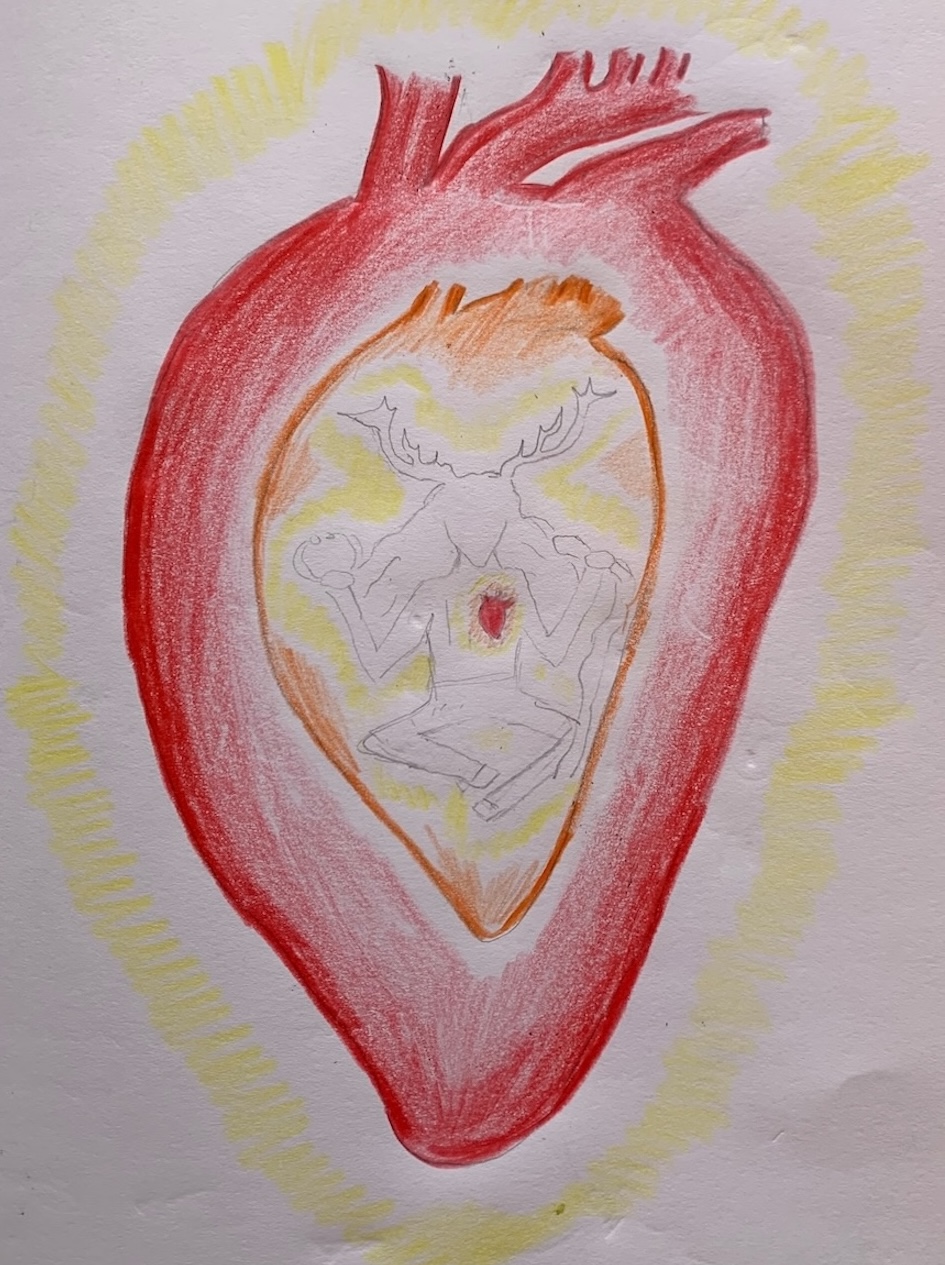
Artwork by Morgannah based on my recent writings about the Heart of Annwn as the Sacred Heart of Gwyn.

Devotional Art – Gwyn by Morgannah

A couple of weeks ago I was delighted and honoured to receive this stunning piece of devotional art inspired by my representation of Gwyn in my King of Annwn Cycle books from one of my patrons, Morgannah. The dragon-scale shading around His eyes and the jewel in His forehead are based on my story about Him being born from the Dragon Mother, Anrhuna, His brief transformation into a black dragon when He eats His mother’s heart and His early days as ‘the Boy in the Serpent Skins’.

The Fractal Mythos of the Sleeping King

In The Way of the Gods Edward Butler speaks of the ‘fractal quality’ of Egyptian cosmogony. He says: ‘There is one way in particular in which I believe that Egypt can still guide us, namely in the coexistence there of a numerous incommensurable cosmogonies, in a system which lacked any overarching structure integrating them, and which was yet highly stable over vast spans of time… If we can grasp how the Egyptians sustained the belief in many different cosmogonies without reducing them to mere images of some single, superior truth, we can scale up that model to apply to the vast number of incommensurable cosmogonies at the heart of the world’s many sacred traditions traditions, and arrive at a genuine solution to the problem of religious pluralism…. Egyptian cosmogony… has a fractal quality, because everything which comes to be does so in the manner in which the cosmos itself came to be, and continues every day to come to be.’ (1)

A fractal is: ‘an irregular geometric structure that cannot be described by classical geometry because magnification of the structure reveals repeated patterns of similarly irregular, but progressively smaller, dimensions.’ (2) The term was coined by the mathematician Benoit Mandelbrot and comes from the Latin fractus ‘broken or fractured’. (3) Fractals occur in mathematics, physics, architecture, decorative art, and natural phenmomena. Examples include tree branches, lungs, lightning, clouds, crystals, and snowflakes. (4)

*

Butler’s identification of cosmogonies as fractal can be applied more broadly to myth and can help us gain a better understanding of British mythology.

Unfortunately, here in Britain, we don’t have knowledge of any of our ancient creation myths. They are merely hinted at in medieval Welsh literature in which Taliesin, who claims to be have been born or created in various ways, is often represented as a microcosm of the macrocosmic world. In some sources he is (re)born from the womb of Ceridwen, the Goddess of the Cauldron, who takes the form of a crested black hen. (5) In others he is created by five enchanters, Math, Gwydion, Eurwys, Euron and Modron ‘from nine forms of consistency’ (fruit, God’s fruit, primroses, flowers, blossom of trees and shrubs, earth, sod, nettle blossom and ‘the ninth wave’s water’) (6) and by God from ‘seven consistencies’ (fire, earth, water, air, mist, flowers, and ‘the fruitful wind’). (7) This suggests the world was seen as originating from the womb of Ceridwen and as being created by the Gods. These stories, like the Egyptain cosmogonies, are incommensurable. This speak of the fracturing of the crochan, womb or cauldron, of Ceridwen, who I see as Old Mother Universe, with the Big Bang, at the beginning of time. Such a beginning perhaps explains the fractal nature of our myths.

Another myth that might be read as fractal is that of Merlin. Many versions of the stories of Merlin Emrys / Merlin Wyllt are located across Britain and in Brittany. Similarly with the story of King Arthur which has been told and retold since the medieval period with his court at Camelot having numerous locations including Caerleon, Celliwig, and Cadbury Castle. He and his knights are also said to be sleeping in various underground caverns.

*

It is little known that Arthur’s fractal mythos as the Sleeping King is a purloined one. This can be read from the fragments portraying Arthur’s raid on Annwn, his defeat of the Head of Annwn and his theft of His cauldron through which he claims leadership of His hunt and His role as the Sleeping King.

In Culhwch ac Olwen Arthur and his men ‘go North’ (then presumably into Annwn) to rescue Gwythyr ap Greidol and a group of northerners from the fortress of Gwyn ap Nudd, the Head of Annwn. In this fragment Arthur wins by negotiating. (8) In other fragments there is carnage, ‘Shields shattered, spears broken, / violence inflicted by the honoured and fair’. (9) Of the ‘three full loads of Prydwen’ (Arthur’s ship) to go into Annwn ‘save seven’ none return. (10) (Lllen)Lleog thrusts his sword into the cauldron and makes off with it (11) and in another fragment grabs Arthur’s sword, killing the Head of Annwn’s cauldron keeper and his retinue and likely the Head himself. (12)

Interestingly, in ‘The Spoils of Annwn’, Arthur raids seven fortresses which might be fragments of a fractal – the Head of Annwn’s fort. There is no original. All are incommensurable. Intriguingly we find Caer Wydyr ‘the Glass Fort’. Our texts are redolent with the imagery of shattering. Shattered shields, shattered forts. The Head of Annwn Himself is conspicious by His absence whereas Arthur’s presence is lauded and sung through all.

Following his victory over the Head of Annwn and theft of His cauldron Arthur usurps the hunt for Twrch Trwyth ‘the King of Boars’. The twrch was originally a human chief turned into a boar because of his sins by God. This is a Christian overlay obscuring that it was a hunt for human souls – the Wild Hunt. Thus Arthur became known as the Leader of the Hunt. 

Finally, Arthur lays claim to the Head of Annwn’s role as the Sleeping King. The battle between Gwyn and Gwythyr likely has its origins in an ancient British seasonal myth wherein Gwyn, Winter’s King, is killed by Gwythyr, Summer’s King, on Calan Mai. When Gwyn dies he returns to His fortress in Annwn to sleep until His return to the world on Nos Galan Gaeaf later in the year. Arthur’s retreat to beneath the Isle of Avalon is a mirror image of Gwyn’s.

As Christianity rose to popularity the fractal mythos of Arthur replaced the fractal mythos of Gwyn. Their fractals might be seen to be like two crystals, their reflections reflecting one another, composed of fragmentary tales.

*

For the past couple of years Gwyn has been appearing to me with a jewel in His forehead. In a meditation with the Monastery of Annwn on His birth at the end of last year He said: ‘There are as many stories of my birth as facets to my jewel’.

When I first came to polytheism it was with the preconception that the Gods had one true story that could be found by piecing together the fragments into one whole or peeling them away to reveal some singular truth. Now I know better. Myths are, in their essence, fractal. There is no one truth or original.

This has been pushed home as, over the past two years, in our meditation and group at the monastery Gwyn has revealed Himself and His stories to us as monastic devotees in many diverse and sometimes contradictory ways. Yet there have also been many reflectings suggestive of their fractal nature. 

I don’t think it’s a coincidence that Gwyn has revealed Himself to be associated with so many fractal things – trees, clouds, jewels, snowflakes. There is a similar beauty in the incommensurability of His myths and mysteries. Every year I look forward to different stories of our Sleeping King.

*Image of quartz crystal from La Gardette mine, Bourg d’Oisans, Isère, France, courtesy of Wikipedia commons.

(1) Butler, E., The Way of the Gods, (Indica 2022), p100 – 104
(2) https://www.dictionary.com/browse/fractal
(3) https://iternal.us/what-is-a-fractal/
(4) Ibid.
(5) ‘The Story of Taliesin’ in Hughes, K. From the Cauldron Born, (Llewellyn Publications, 2013), p32 and ‘The Hostile Confederacy’ in Haycock, M. (transl), Legendary Poems from the Book of Taliesin, (CMCS, 2007), p313
(6) ‘The Battle of the Trees’, Ibid. p180
(7) ‘The Song of the Great World’, Ibid. p516
(8) Davies, S. (transl.), The Mabinogion, (Oxford University Press, 2007), p207
(9) Hill, G. (transl), ‘The Conversation between Gwyn ap Nudd and Gwyddno Garanhir’, Awen ac Awenydd
(10) ‘The Spoils of Annwn’ Haycock, M. (transl), Legendary Poems from the Book of Taliesin, (CMCS, 2007), p435
(11) Ibid. p146
(12) Davies, S. (transl.), The Mabinogion, (Oxford University Press, 2007), p208

Strength Training Achievements

I took up strength training two and a half years ago on advice from a physio who told me strengthening my muscles would help me with the problems that were holding me back with my running (‘runner’s knee’ and glute tendinopathy that affected my sciatic nerve in a similar way to piriformis syndrome). It has really helped and last year I exceeded my goal of running a sub 2 hour half marathon with a PB of 1:49:02. An additional bonus is that building muscle has fixed my over pronation.

At first strength training was just as an aid to running but as I have learnt and progressed I’ve come to value it in its own right and to prefer it to running. I’ve become fascinated by the different muscle groups, exercises and their variations and the ways they feel in my body and their effects. This is due to the expertise of my personal trainer, Marie Meagher, who I wouldn’t have managed to do a single squat without.

When I first started training I knew absolutely nothing. I could barely tell a dumbbell from a kettlebell. I couldn’t do basic squats or lunges or push a leg press because my technique was so bad everything hurt my knees.

Fast forward to now and I’m doing quad and hamstring dominant leg days and push and pull upper body days featuring a variety of exercises with different grips and stances.

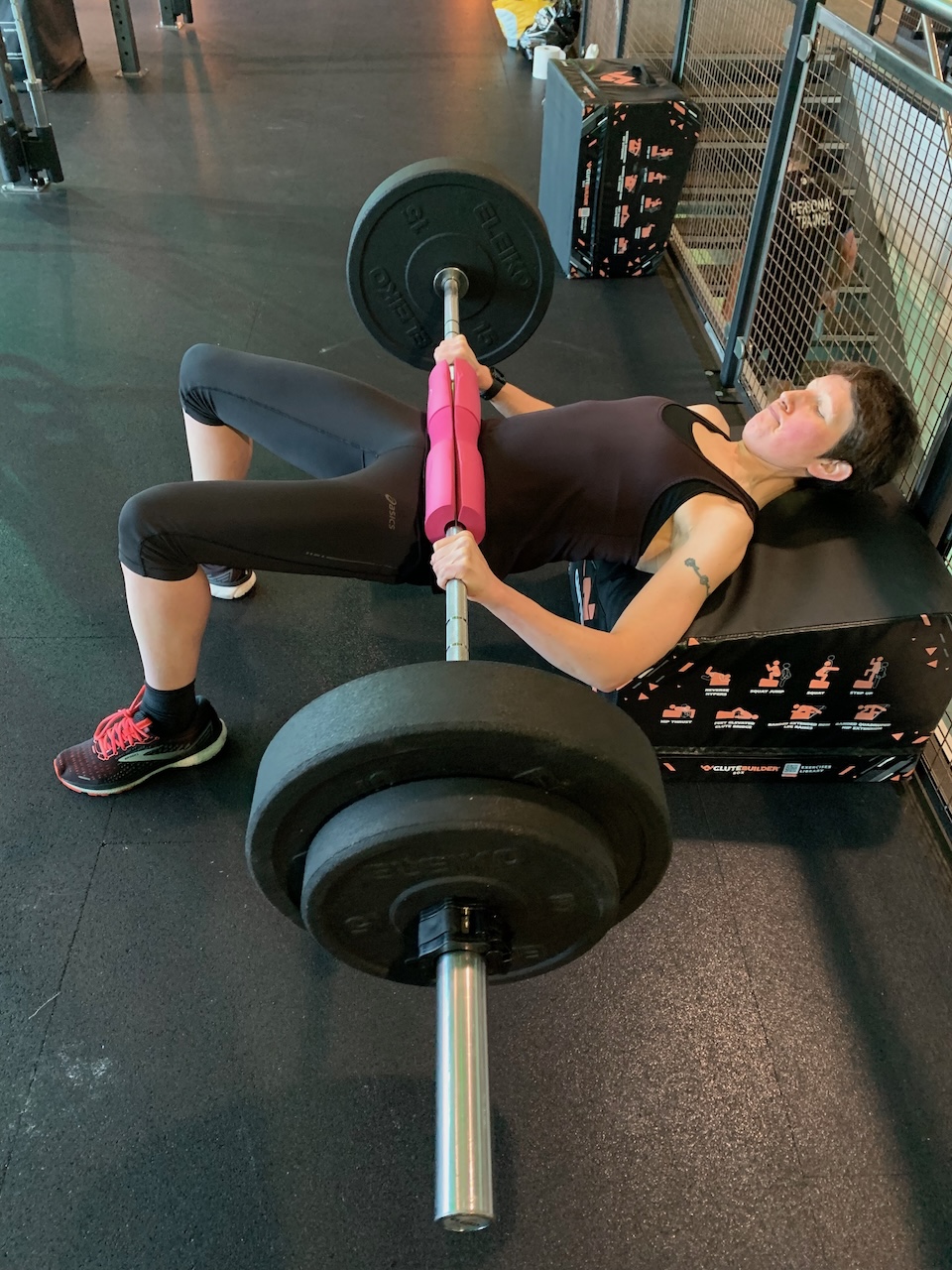
I’ve recently hit two of my goals for my lower body – my body weight on the leg press and barbell hip thrusts (60kg). To those of you who don’t go to the gym this might sound like a lot whilst seasoned gym goers will know it puts me at almost novice level (with 35kg being beginner and 67kg being novice). (1) It’s not much but it’s a huge achievement for me as a 42-year-old autistic woman with creaky knees.

Other goals I have to yet meet. I would really like to be able to do a full chin-up and am currently progressing towards that on a machine with a knee support that decreases your body weight.

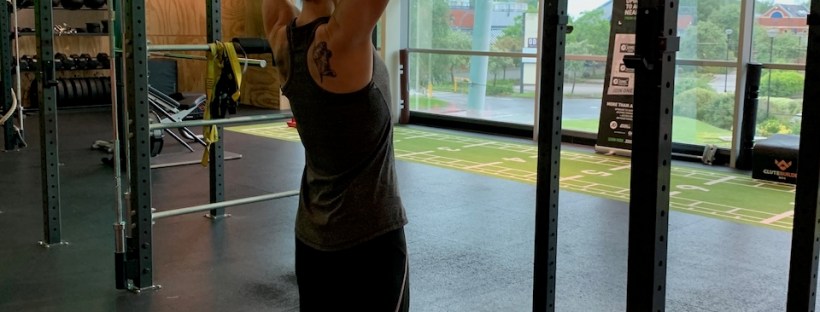
I’m continuing to learn new exercises with my most recent achievement being a barbell push press. For this one you have to rest the bar on your collar bone, bend at the knees and hips, then push (explosively!) with your legs and shoulders at the same time to press the bar up over your head. I would never have been able to get my head around this without Marie there to explain and to correct my mistakes.

I’ve put on muscle mass and feel stronger around the house and garden and am less injury prone.

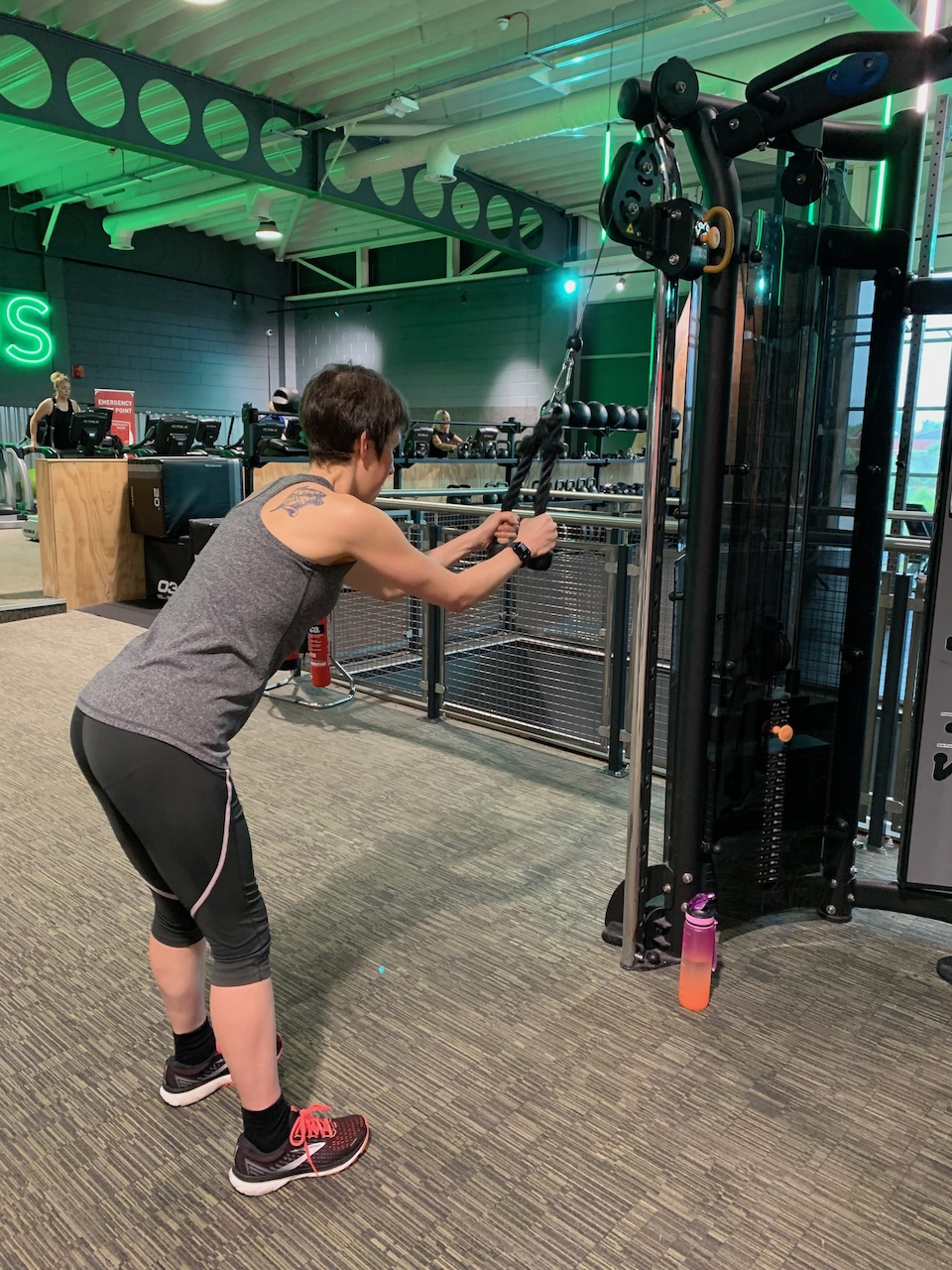
I have also begun to master the Matrix which, at a first look, with all its complicated pulleys, cables, bars and ropes is enough to melt the brain of a neurotypical person let alone somebody with autism. Yet Marie has slowly shown me some of the exercises one step at a time and I now use it regularly for exercises such as tricep extensions, mid-cable flys, face-pulls and straight arm pull downs.

Those of you who follow this blog likely know I’m a polytheist nun and might be surprised to see me in a gym. In response to this I’d like to point out there are varied attitudes towards exercise across monasticism from Buddhist monks who are not allowed to exercise because it is ‘not proper’ resulting in obesity (2), Christian nuns with gyms (3), and the Marathon Monks of Hiei who run 1000 marathons in 1000 days (4).

Druid author Rhyd Wildermuth talks about strength training as ‘ritual body work’ (5) and I’m very much in line with him for it demands just as much discipline and dedication as spiritual work and really is inseparable.

Having a fit and healthy body makes me a far better vessel for the inspiration of my Gods and better able to serve Them. Being physically strong has helped me to become mentally stronger and has played a large role in my giving up alcohol and with managing my anxiety. It recently got me through the initiation ritual for my shamanic practitioner training, which was physically, psychologically and spiritually demanding.

If I ever succeed in founding a monastery one of the first things to be built will be the gym.

*With many thanks to my personal trainer, Marie Meagher, (who took the photos and would be my first choice of trainer for the monastics) and to all the staff at JD Gym Preston for making it a clean and welcoming place. If you’re local to Preston I’d highly recommend JD and training with Marie whose Facebook page, PT with Marie, is here – https://www.facebook.com/Ptwithmarie/

(1) https://strengthlevel.com/strength-standards/horizontal-leg-press/kg
(2) “Monks should exercise but it is difficult for us… You cannot do weight lifting and you cannot jog, that is not proper, only fast walking or maybe a walking meditation. Yoga can also be fine, but not in public.” https://www.theguardian.com/world/2018/dec/26/battle-of-the-bulge-thailand-strives-to-bring-monk-obesity-crisis-under-control
(3) https://www.midsouthpresbytery.org/can-nuns-go-to-the-gym/
(4) https://www.theguardian.com/lifeandstyle/2015/mar/31/japanese-monks-mount-hiei-1000-marathons-1000-days
(5) https://rhyd.substack.com/p/shaping

The Castle of Cold Stone – Altar Art

‘Your absence is like the spinning of the void.
You are gone to its bottommost depths
with Your Castle of Cold Stone.’
~ You are Gone

In the myth I live by after my patron God, Gwyn ap Nudd (Winter’s King) is defeated by His rival, Gwythyr ap Greidol (Summer’s King) He ‘dies’ and retreats to sleep for the summer in Caer Ochren, the Castle of Cold Stone.

For a long while I had been using Meg Falconer’s image of Caer Ochren from King Arthur’s Raid as my altar art for this period but this year I received the calling to create my own. This image depicts Gwyn’s fortress sinking into the Abyss with grief at His passing with snow and frost on the towers and winds showing that, contrarily, it is winter in Annwn. I was planning to show Gwyn’s tomb in the interior of the fort but, instead, it came through to me that He wanted me to show intimations of His faces on the walls. These appeared to me like projections of light but in ice showing that whilst He dreams His representations in myths and stories are still manifesting to us in the world.